






 informatics
Similar presentations:









SOF108 - Computer Architecture Week 13: Parallel Processing
1. SOF108 - Computer Architecture Week 13: Parallel Processing
MALAYSIASOF108 - Computer Architecture
Week 13: Parallel Processing
1
2. Agenda
• Parallel Processing• Flynn’s taxonomy
• Multiprogramming vs Multiprocessing
• Cache coherence problem
• The MESI protocol
2
3. Parallel Processing
• Traditionally, the computer has been viewed as a sequentialmachine
• This view of the computer has never been entirely true
• At the micro-operation level
• multiple control signals are generated at the same time.
• Instruction pipelining, at least to the extent of overlapping fetch
and execute operations, has been around for a long time.
3
4. Parallel Processing
• Usually to enhance performance and,• In some cases, to increase availability
• Some of the most prominent approaches to parallel organization
• Symmetric multiprocessors (SMPs)
• Multithreaded processors and chip multiprocessors
4
5. Multiple Processor Organizations
• Multiprocessing = Multicores• The use of two or more CPUs within a single computer system
• Core - a unit that reads and executes instructions.
• A taxonomy first introduced by Flynn is still the most common way of
categorizing systems with parallel processing capability.
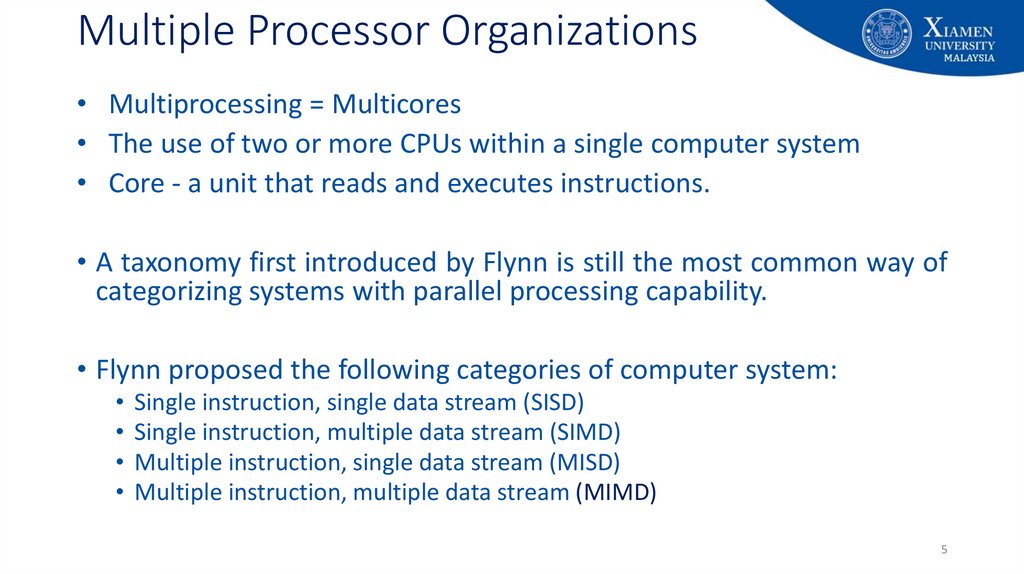
• Flynn proposed the following categories of computer system:
• Single instruction, single data stream (SISD)
• Single instruction, multiple data stream (SIMD)
• Multiple instruction, single data stream (MISD)
• Multiple instruction, multiple data stream (MIMD)
5
6. SISD: Single Instruction, Single Data
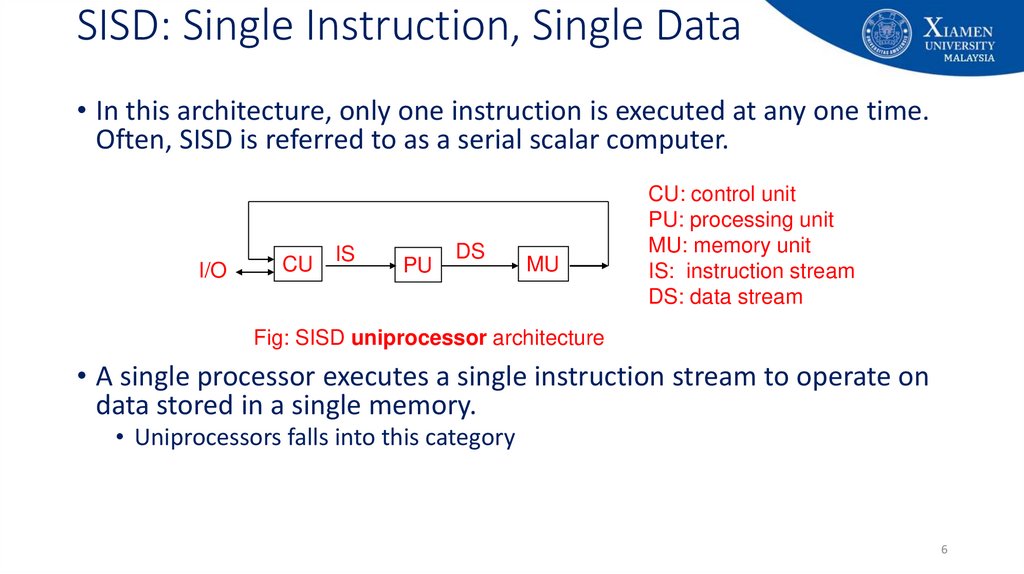
• In this architecture, only one instruction is executed at any one time.Often, SISD is referred to as a serial scalar computer.
I/O
CU
IS
PU
DS
MU
CU: control unit
PU: processing unit
MU: memory unit
IS: instruction stream
DS: data stream
Fig: SISD uniprocessor architecture
• A single processor executes a single instruction stream to operate on
data stored in a single memory.
• Uniprocessors falls into this category
6
7. SIMD: Single Instruction, Multiple Data
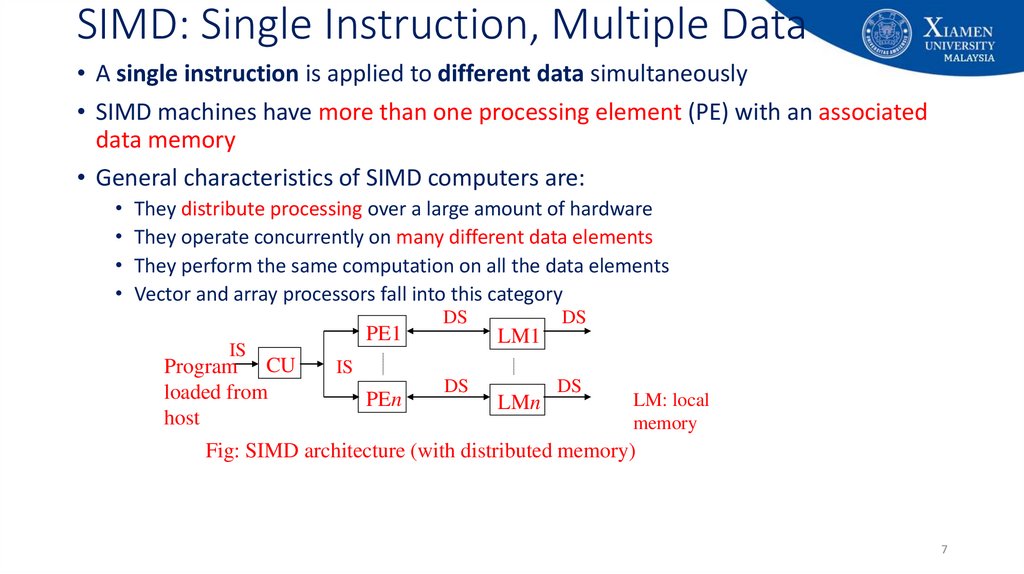
• A single instruction is applied to different data simultaneously• SIMD machines have more than one processing element (PE) with an associated
data memory
• General characteristics of SIMD computers are:
• They distribute processing over a large amount of hardware
• They operate concurrently on many different data elements
• They perform the same computation on all the data elements
• Vector and array processors fall into this category
IS
Program CU
loaded from
host
PE1
DS
DS
LM1
IS
PEn
DS
LMn
DS
LM: local
memory
Fig: SIMD architecture (with distributed memory)
7
8. Data Level Parallelism
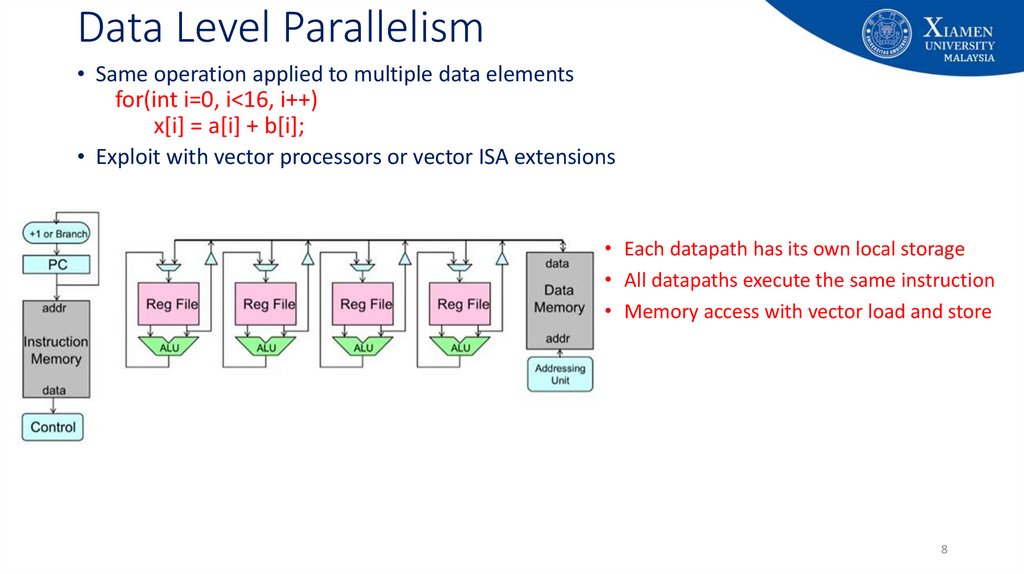
• Same operation applied to multiple data elementsfor(int i=0, i<16, i++)
x[i] = a[i] + b[i];
• Exploit with vector processors or vector ISA extensions
• Each datapath has its own local storage
• All datapaths execute the same instruction
• Memory access with vector load and store
8
9. Data Level Parallelism
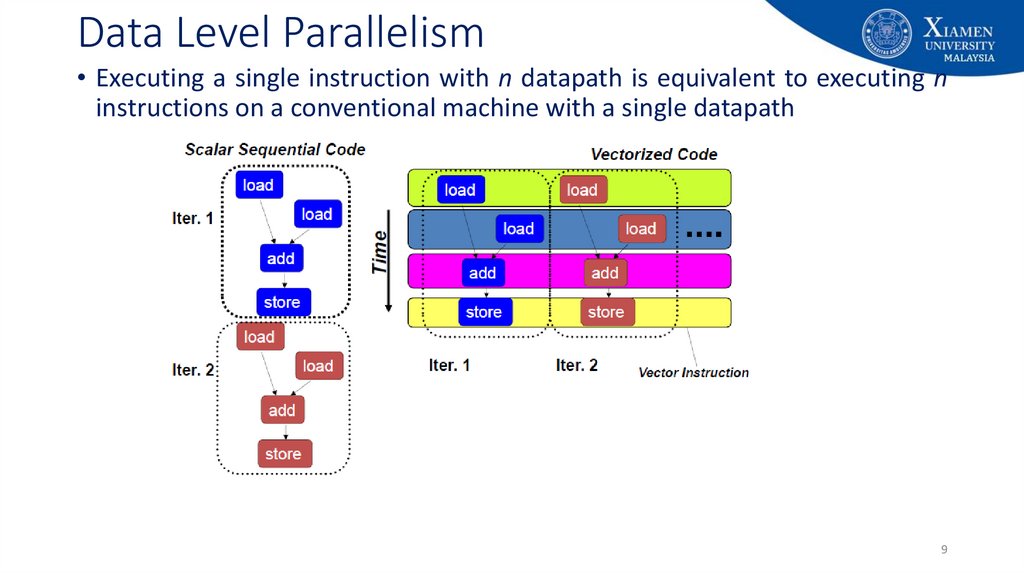
• Executing a single instruction with n datapath is equivalent to executing ninstructions on a conventional machine with a single datapath
9
10. MISD: Multiple Instruction, Single Data
• This implies that several instructions are operating on a single piece of data.• The same data flows through a linear array of processors executing different
instruction streams.
• This architecture is also known as systolic array for pipelined execution of specific
algorithms.
• Not much used in practice.
10
11. MIMD: Multiple Instruction, Multiple Data
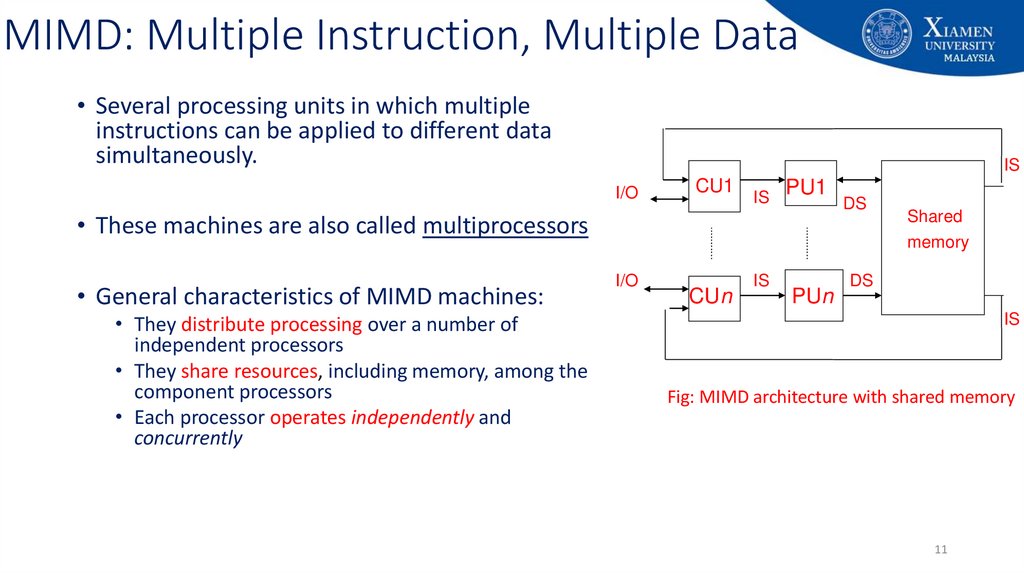
• Several processing units in which multipleinstructions can be applied to different data
simultaneously.
IS
I/O
CU1
IS
PU1
• These machines are also called multiprocessors
• General characteristics of MIMD machines:
• They distribute processing over a number of
independent processors
• They share resources, including memory, among the
component processors
• Each processor operates independently and
concurrently
DS
Shared
memory
I/O
CUn
IS
PUn
DS
IS
Fig: MIMD architecture with shared memory
11
12. MIMD: Multiple Instruction, Multiple Data
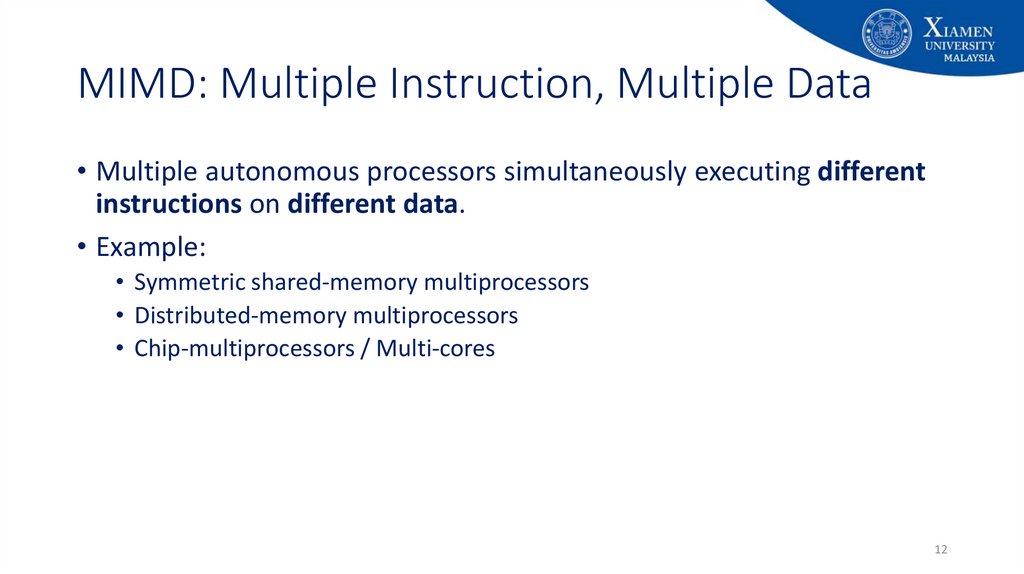
• Multiple autonomous processors simultaneously executing differentinstructions on different data.
• Example:
• Symmetric shared-memory multiprocessors
• Distributed-memory multiprocessors
• Chip-multiprocessors / Multi-cores
12
13. Symmetric Multiprocessors
• Until fairly recently, virtually all single-user personal computers andmost workstations contained a single general purpose microprocessor
• Demands for performance increase
• Cost of microprocessors continues to drop
• Vendors have introduced systems with SMP organization
13
14. Symmetric Multiprocessor (SMP)
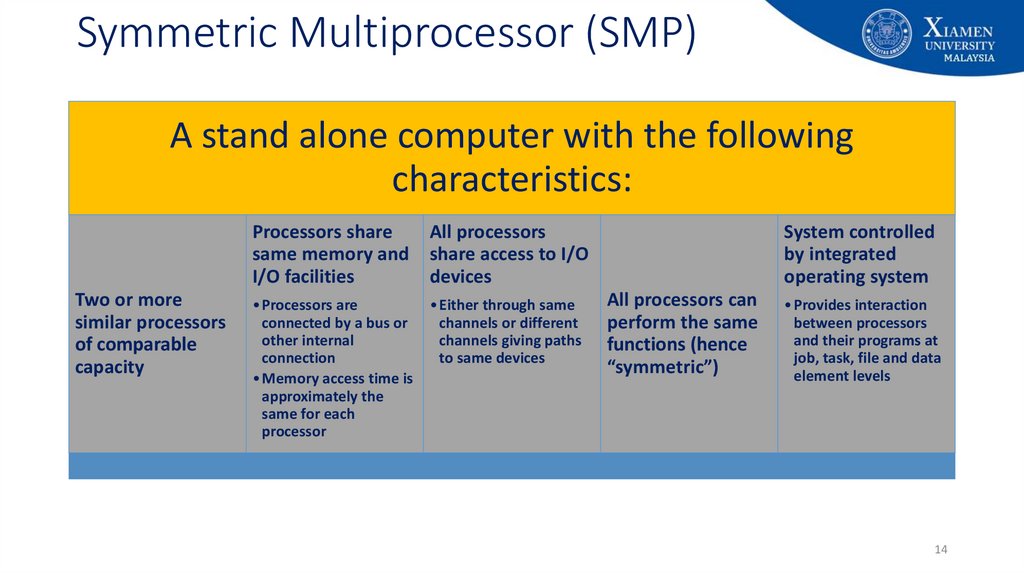
A stand alone computer with the followingcharacteristics:
Processors share
All processors
same memory and share access to I/O
I/O facilities
devices
Two or more
similar processors
of comparable
capacity
• Processors are
connected by a bus or
other internal
connection
• Memory access time is
approximately the
same for each
processor
• Either through same
channels or different
channels giving paths
to same devices
System controlled
by integrated
operating system
All processors can
perform the same
functions (hence
“symmetric”)
• Provides interaction
between processors
and their programs at
job, task, file and data
element levels
14
15. Multiprocessor System Organization
• Two or more processors• Self-contained, including a control
unit, ALU, registers, and one or more
levels of cache
• Processors can communicate with
each other through memory
15
16. Advantages of SMP System
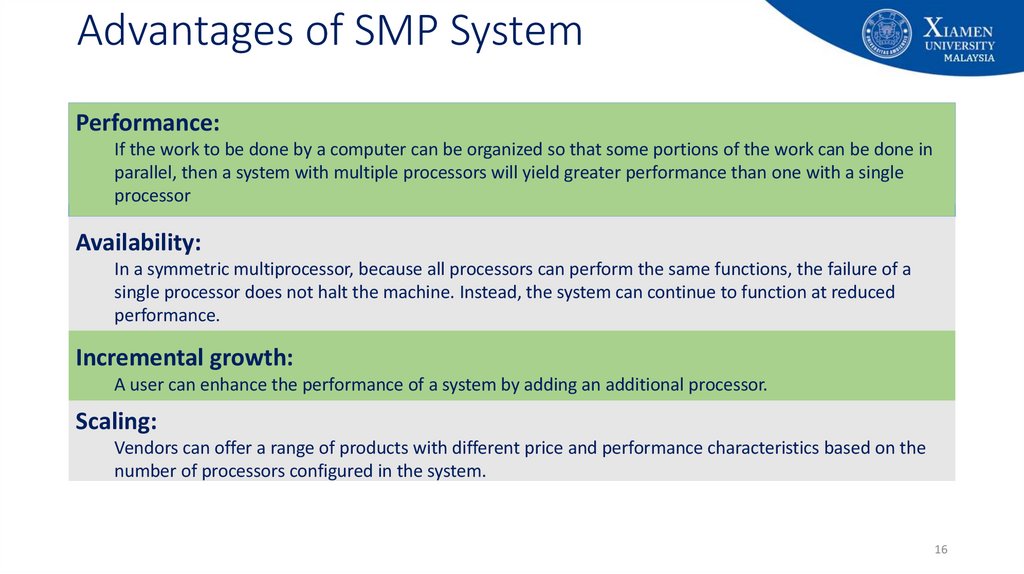
Performance:If the work to be done by a computer can be organized so that some portions of the work can be done in
parallel, then a system with multiple processors will yield greater performance than one with a single
processor
Availability:
In a symmetric multiprocessor, because all processors can perform the same functions, the failure of a
single processor does not halt the machine. Instead, the system can continue to function at reduced
performance.
Incremental growth:
A user can enhance the performance of a system by adding an additional processor.
Scaling:
Vendors can offer a range of products with different price and performance characteristics based on the
number of processors configured in the system.
16
17. Symmetric Multiprocessor Organization
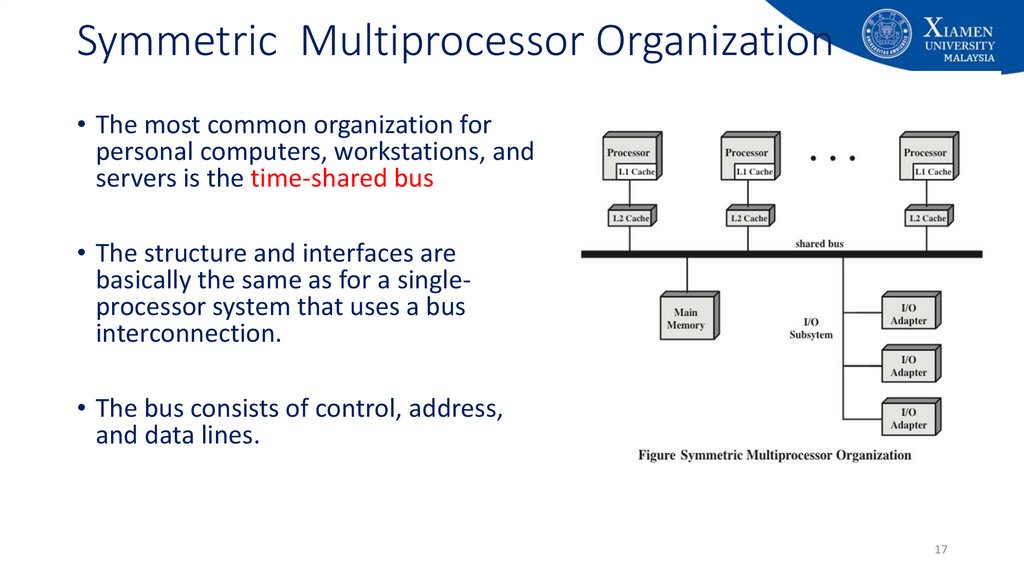
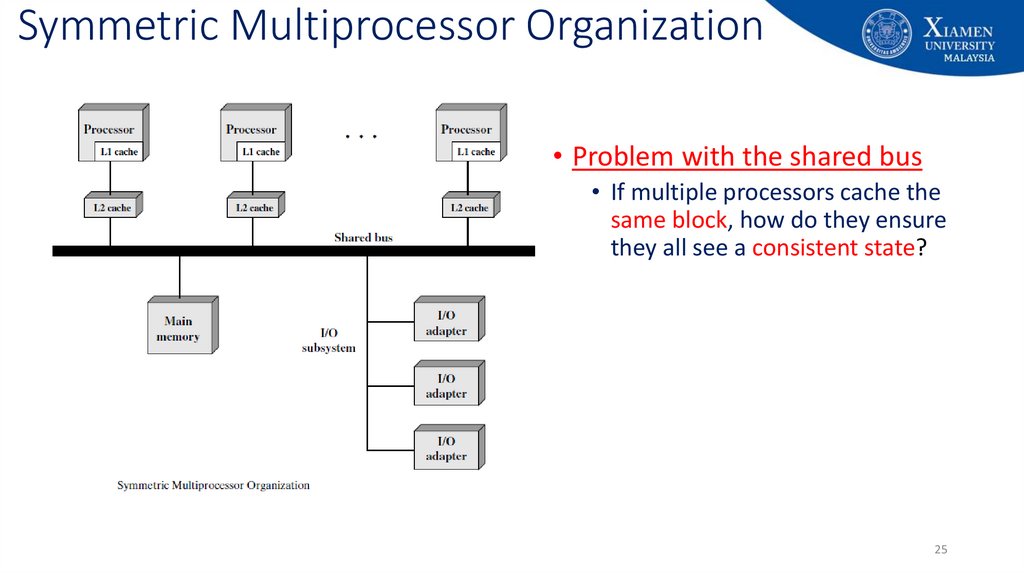
• The most common organization forpersonal computers, workstations, and
servers is the time-shared bus
• The structure and interfaces are
basically the same as for a singleprocessor system that uses a bus
interconnection.
• The bus consists of control, address,
and data lines.
17
18. Shared Bus Organization in SMP
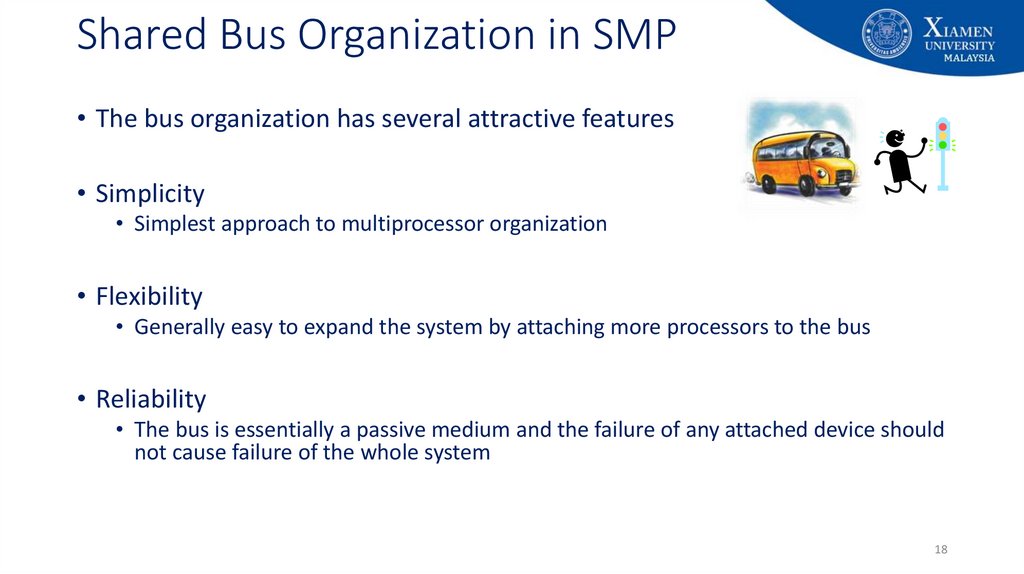
• The bus organization has several attractive features• Simplicity
• Simplest approach to multiprocessor organization
• Flexibility
• Generally easy to expand the system by attaching more processors to the bus
• Reliability
• The bus is essentially a passive medium and the failure of any attached device should
not cause failure of the whole system
18
19. Shared Bus Organization in SMP
• Main drawback is performance• All memory references pass through the common bus
• Performance is limited by bus cycle time
• Each processor should have cache memory
• Reduces the number of bus accesses
• To improve performance, it is desirable to equip each processor with a cache memory
• Typically, workstation and PC SMPs have two levels of cache, with the L1 cache internal (same chip
as the processor) and the L2 cache either internal or external.
• Some processors now employ a L3 cache as well.
• Leads to problems with cache coherence
19
20. Multithreading and Chip Multiprocessors
• An alternative approach, which allows for a high degree of instructionlevel parallelism without increasing circuit complexity or power
consumption
• The instruction stream is divided into smaller streams, known as
threads
20
21. Multithreading
• Multithreading subdivides specific operations within a single application intoindividual streams / threads
• Different parts of an application, called threads, executed in parallel
• The OS divides processing time not only among different applications, but also
among different threads within an application
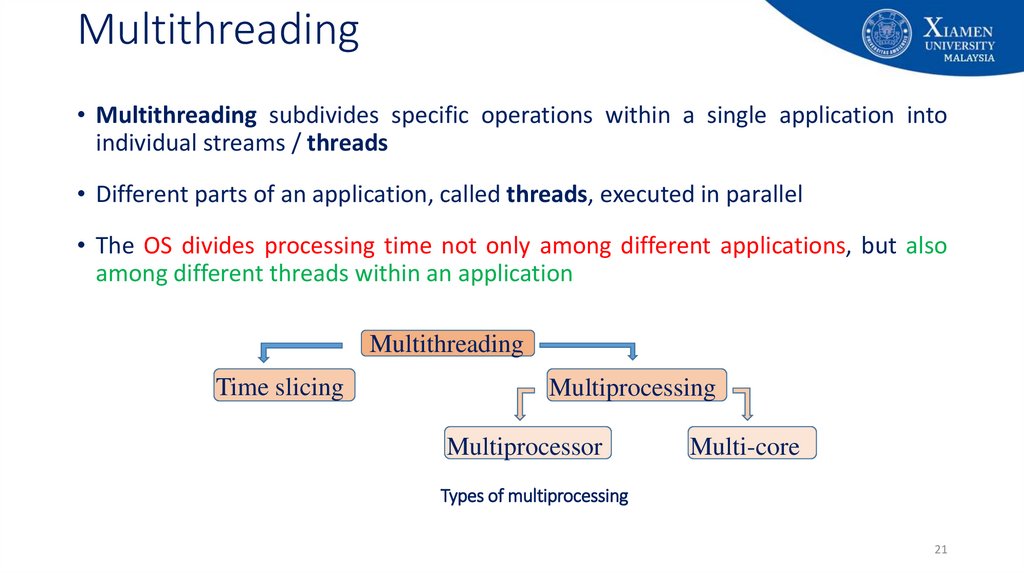
Multithreading
Time slicing
Multiprocessing
Multiprocessor
Multi-core
Types of multiprocessing
21
22. Multithreading
Multiprogramming (Time slicing )• A single processor switches between different threads in a very fast manner
to give the illusion of simultaneity to an end user.
• Early day PCs with only one processor core, but can run multiple programs at
once, by switching back and forth between these separate processes.
Multiprocessing or multi-core:
• Different processes can run simultaneously on different processors or cores
• Multiprocessors: Multiple processors in a system
• Multi-core: Single processor with multiple cores in a system
22
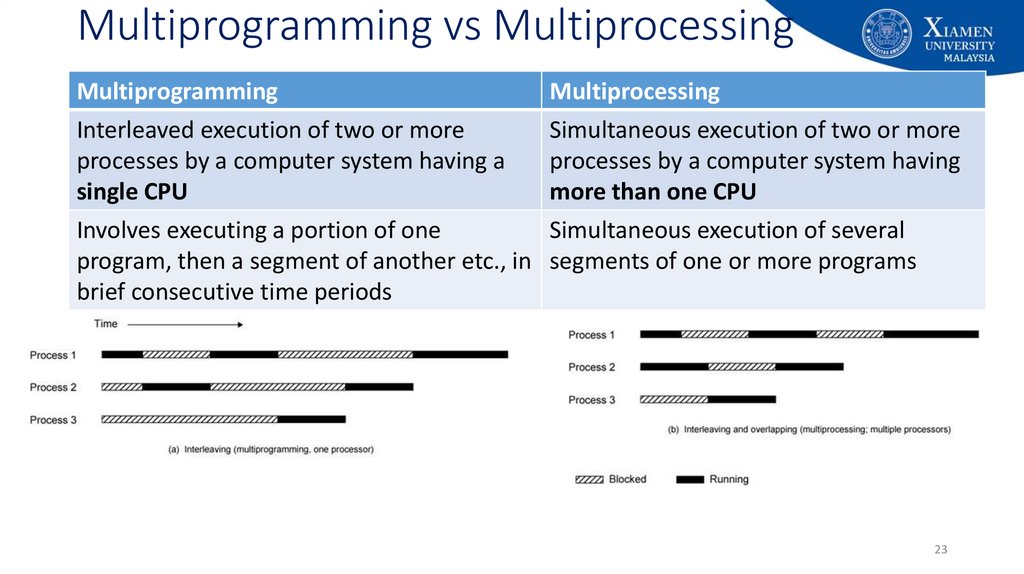
23. Multiprogramming vs Multiprocessing
MultiprogrammingMultiprocessing
Interleaved execution of two or more
Simultaneous execution of two or more
processes by a computer system having a
processes by a computer system having
single CPU
more than one CPU
Involves executing a portion of one
Simultaneous execution of several
program, then a segment of another etc., in segments of one or more programs
brief consecutive time periods
23
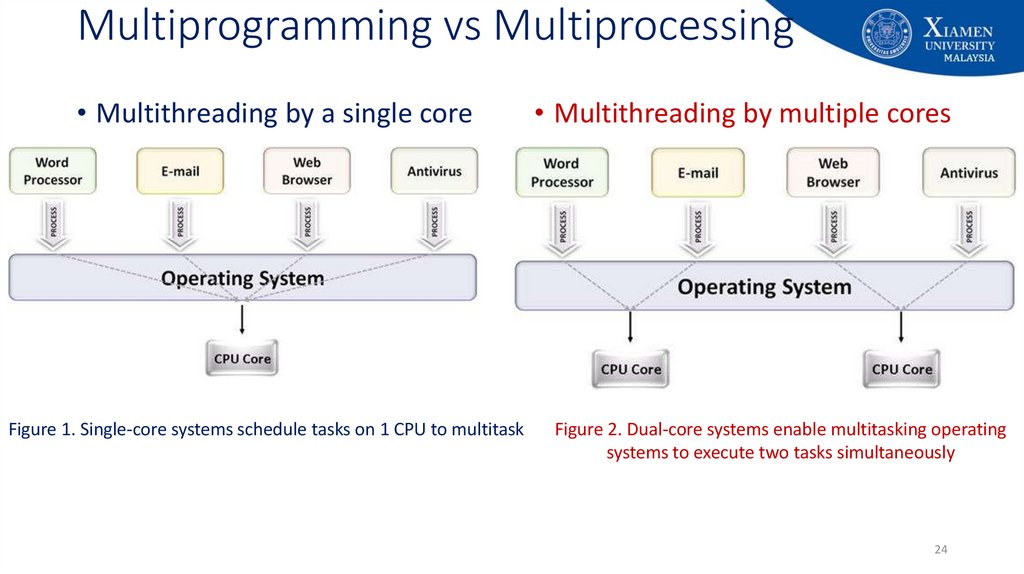
24. Multiprogramming vs Multiprocessing
• Multithreading by a single coreFigure 1. Single-core systems schedule tasks on 1 CPU to multitask
• Multithreading by multiple cores
Figure 2. Dual-core systems enable multitasking operating
systems to execute two tasks simultaneously
24
25. Symmetric Multiprocessor Organization
• Problem with the shared bus• If multiple processors cache the
same block, how do they ensure
they all see a consistent state?
25
26. Cache Coherence
• Because each local cache contains an image of a portion of memory, ifa word is altered in one cache, it could conceivably invalidate a word
in another cache.
• To prevent this, the other processors must be alerted that an update
has taken place.
• This problem is known as the cache coherence problem and is
typically addressed in hardware rather than by the operating system.
26
27. Cache Coherence
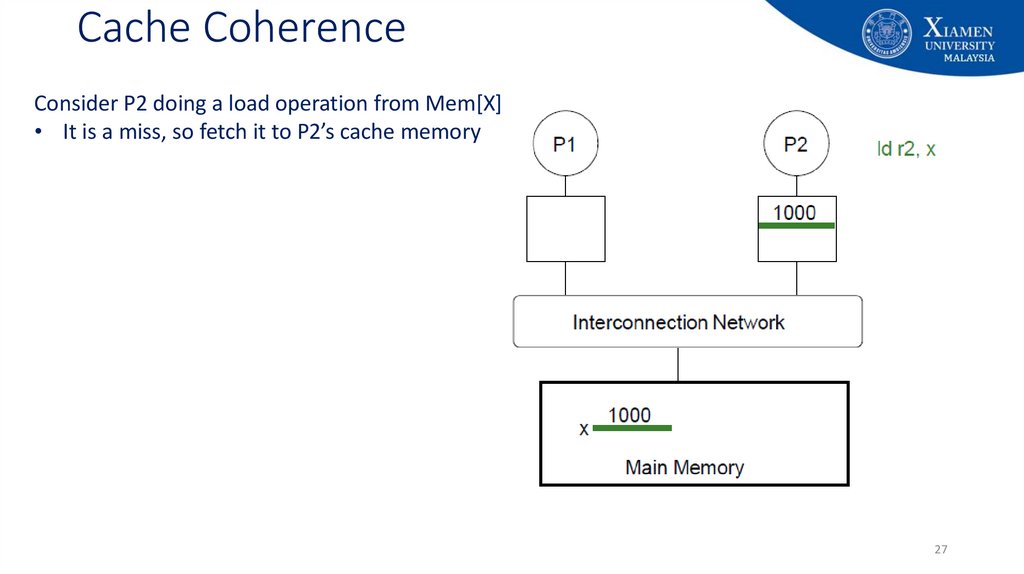
Consider P2 doing a load operation from Mem[X]• It is a miss, so fetch it to P2’s cache memory
27
28. Cache Coherence
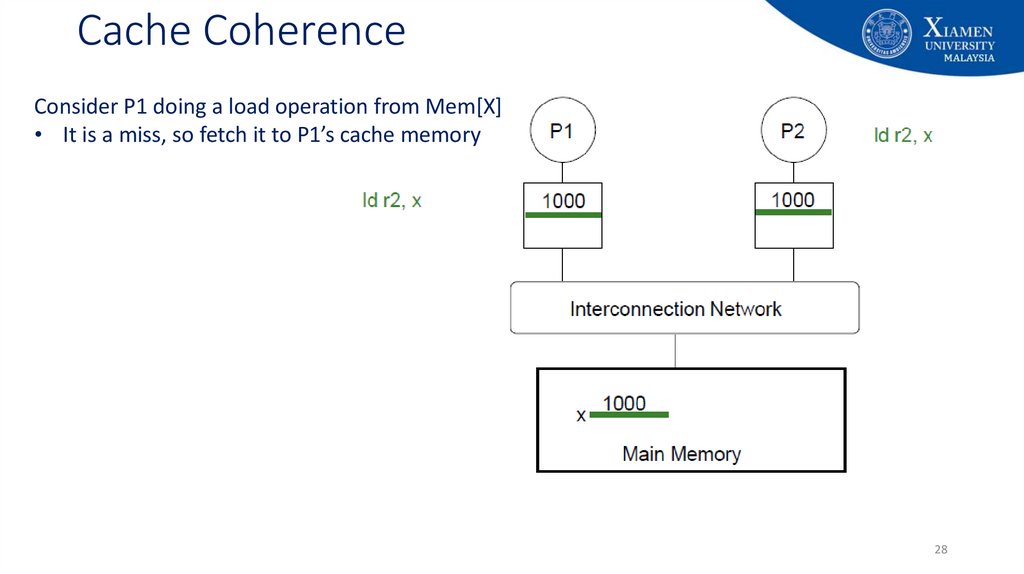
Consider P1 doing a load operation from Mem[X]• It is a miss, so fetch it to P1’s cache memory
28
29. Cache Coherence
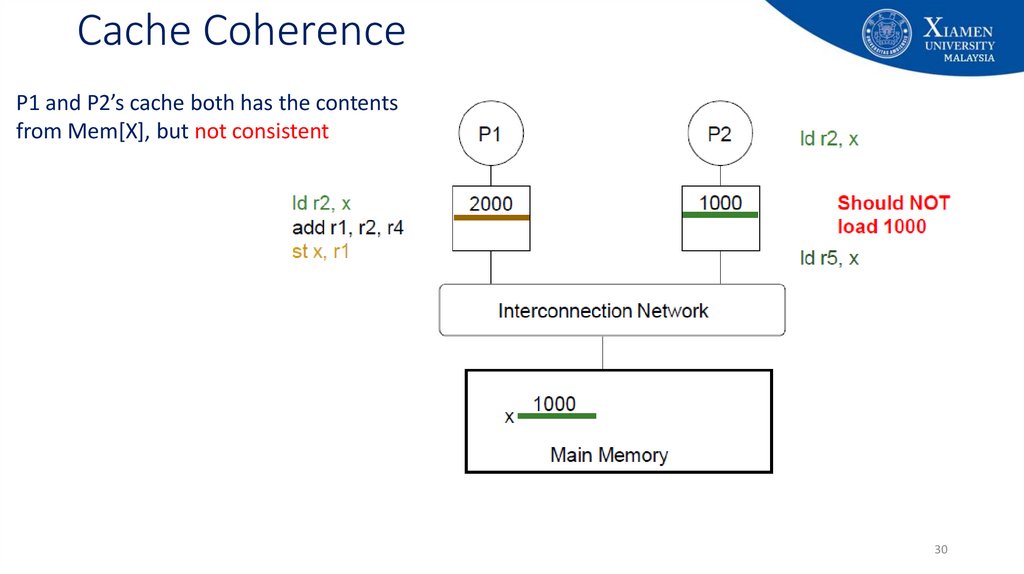
Both P1 and P2’s cache has the contents from Mem[X]P1 add r1, r2, r4
• Assume, the result in r1 is 2000
P1 stores the result in Mem[X]
• Stores in cache (it is a hit), if it is
a write back cache memory
P1 and P2’s cache bot has the contents from Mem[X],
but not consistent
29
30. Cache Coherence
P1 and P2’s cache both has the contentsfrom Mem[X], but not consistent
30
31. Example: Cache coherence problem
PAPB
PA
PB
PA
PB
cache A
cache B
cache A
cache B
cache A
cache B
x
x
x*
x
x*
x
Bus
Bus
Bus
Shared
memory
Shared
memory
Shared
memory
x
x*
x
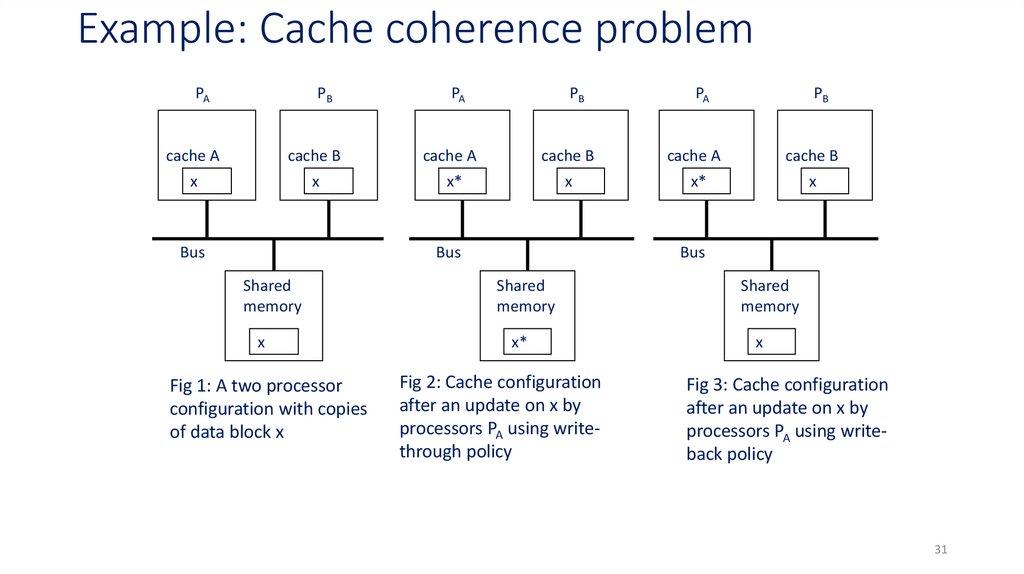
Fig 1: A two processor
configuration with copies
of data block x
Fig 2: Cache configuration
after an update on x by
processors PA using writethrough policy
Fig 3: Cache configuration
after an update on x by
processors PA using writeback policy
31
32. Effect of Cache Write on Cache Coherence
• It is clear that a write-back policy can result in inconsistency.• If two caches contain the same line, and the line is updated in one cache, the
other cache will unknowingly have an invalid value. Subsequent reads to that
invalid line produce invalid results.
• Even with the write-through policy, inconsistency can occur unless
other caches monitor the memory traffic or receive some direct
notification of the update.
32
33. Cache Coherence Protocol
• The objective is• to let recently used local variables get into the appropriate cache
• and stay there through numerous reads and write
• while using the protocol to maintain consistency of shared variables that might be in
multiple caches at the same time.
• Cache coherence approaches have generally been divided into software
and hardware approaches.
• Some implementations adopt a strategy that involves both software and
hardware elements.
33
34. Cache Coherence: Software Solutions
• Compiler-based coherence mechanisms perform an analysis on thecode to determine which data items may become unsafe for caching,
and they mark those items accordingly.
• The operating system or hardware then prevents non-cacheable
items from being cached
• The simplest approach is to prevent any shared data variables from
being cached.
34
35. Cache Coherence: Software Solutions
• Software cache coherence schemes attempt to avoid the need foradditional hardware circuitry and logic by relying on the compiler and
operating system to deal with the problem.
• Software approaches are attractive because the overhead of detecting
potential problems is transferred from run time to compile time, and the
design complexity is transferred from hardware to software.
• On the other hand, compile-time software approaches generally must
make conservative decisions, leading to inefficient cache utilization.
35
36. Cache Coherence: Hardware Solutions
• Hardware solutions are generally referred as cache coherence protocols.• These solutions provide dynamic recognition at run time by identifying
potential inconsistency conditions.
• Because the problem is only dealt with when it actually arises, there is
more effective use of caches, leading to improved performance over a
software approach.
• In addition, these approaches are transparent to the programmer and the
compiler, reducing the software development burden.
36
37. Cache Coherence: Hardware Solutions
• Directory Protocols• Snoopy Protocols
37
38. Snoopy Protocols
• Snoopy protocols distribute the responsibility for maintaining cache coherenceamong all of the cache controllers in a multiprocessor.
• A cache must recognize when a line that it holds is shared with other caches.
• When an update action is performed on a shared cache line, it must be
announced to all other caches by a broadcast mechanism.
• Each cache controller is able to “snoop” on the network to observe these
broadcasted notifications, and react accordingly.
38
39. Snoopy Protocols
• Snoopy protocols are ideally suited to a bus-based multiprocessor, because theshared bus provides a simple means for broadcasting and snooping.
• However, because one of the objectives of the use of local caches is to avoid bus
accesses,
• care must be taken that the increased bus traffic required for broadcasting and snooping
does not cancel out the gains from the use of local caches
• Two basic approaches have been explored:
• Write invalidate
• Write update (or write broadcast)
39
40. Snoopy Protocols: Write Invalidate
• Write-invalidate protocol:• there can be multiple readers but only one writer at a time.
• Initially, a line may be shared among several caches for reading purposes.
• When one of the caches wants to perform a write to the line, it first issues a
notice that invalidates that line in the other caches, making the line exclusive
to the writing cache.
• Once the line is exclusive, the owning processor can make cheap local writes
until some other processor requires the same line.
40
41. Snoopy Protocols: Write Update
• With a write-update protocol, there can be multiple writers as well asmultiple readers.
• When a processor wishes to update a shared line, the word to be updated
is distributed to all others, and caches containing that line can update it.
• Some systems use an adaptive mixture of both write-invalidate and writeupdate mechanisms
41
42. Write Invalid vs Write Update
• Neither of these two approaches is superior to the other under allcircumstances.
• Performance depends on the number of local caches and the pattern of
memory reads and writes.
• Some systems implement adaptive protocols that employ both writeinvalidate and write-update mechanisms.
42
43. The MESI Protocol
• To provide cache consistency on an SMP, the data cache oftensupports a protocol known as MESI.
• For MESI, the data cache includes two status bits per tag, so that each
line can be in one of four states:
• Modified
• Exclusive
• Shared
• Invalid
43
44. The MESI Protocol
• Modified: The line in the cache has been modified (different from main memory)and is available only in this cache.
• Exclusive: The line in the cache is the same as that in main memory and is not
present in any other cache.
• Shared: The line in the cache is the same as that in main memory and may be
present in another cache.
• Invalid: The line in the cache does not contain valid data.
44
45. The MESI Protocol: Read MISS
• When a read miss occurs in the local cache• the processor initiates a memory read to read the line of main memory
containing the missing address.
• The processor inserts a signal on the bus that alerts all other processor/cache
units to snoop the transaction. There are a number of possible outcomes
45
46. The MESI Protocol: Read MISS – Outcome 1
• If one other cache has a clean copy of the line in the exclusive state, itreturns a signal indicating that it shares this line.
• Does the responding processor needs to change it’s state?
• The responding processor then transitions the state of its copy from
exclusive to shared
• The initiating processor reads the line from main memory and transitions
the line in its cache from invalid to shared.
46
47. The MESI Protocol: Read MISS – Outcome 2
• If one or more caches have a clean copy of the line in the sharedstate, each of them signals that it shares the line.
• Does the responding processor need to change it’s state?
• The initiating processor reads the line and transitions the line in its
cache from invalid to shared.
47
48. The MESI Protocol: Read MISS – Outcome 3
• If one other cache has a modified copy of the line, then that cache blocksthe memory read and provides the line to the requesting cache over the
shared bus.
• Need to change the state?
• The responding cache then changes its line from modified to shared.
• The line sent to the requesting cache is also received and processed by the
memory controller, which stores the block in memory.
48
49. The MESI Protocol: Read MISS – Outcome 4
• If no other cache has a copy of the line (clean or modified), then nosignals are returned.
• The initiating processor reads the line.
• What state?
• Transitions the line in its cache from invalid to exclusive
49
50. The MESI Protocol: Read HIT
• When a read hit occurs on a line currently in the local cache, theprocessor simply reads the required item.
• Need to change the state?
• There is no state change: The state remains modified, shared, or exclusive.
50
51. The MESI Protocol: Write MISS
• When a write miss occurs in the local cache,• the processor initiates a memory read to read the line of main memory containing the missing
address
• For this purpose, the processor issues a signal on the bus that means read-with-intentto-modify (RWITM)
• When the line is loaded, it is immediately marked modified
• With respect to other caches, two possible scenarios precede the loading of the line of
data.
51
52. The MESI Protocol: Write MISS – Scenario 1
• First, some other cache may have a modified copy of this line (state = modify)• In this case, the alerted processor signals the initiating processor that another processor has a
modified copy of the line.
• The initiating processor surrenders the bus and waits.
• The other processor gains access to the bus,
• writes the modified cache line back to main memory,
• and transitions the state of the cache line to invalid (because the initiating processor is going to modify this
line).
• Subsequently, the initiating processor will again issue a signal to the bus of RWITM
• and then read the line from main memory,
• modify the line in the cache,
• and mark the line in the modified state
52
53. The MESI Protocol: Write MISS – Scenario 2
• The second scenario is that no other cache has a modified copy of therequested line.
• In this case, no signal is returned, and the initiating processor proceeds to
read in the line and modify it.
• Initiating processor state?
• Anything else need to do? What about if another cache has a clean copy of
the line?
• Meanwhile, if one or more caches have a clean copy of the line in the shared state,
each cache invalidates its copy of the line,
• and if one cache has a clean copy of the line in the exclusive state, it invalidates its
copy of the line.
53
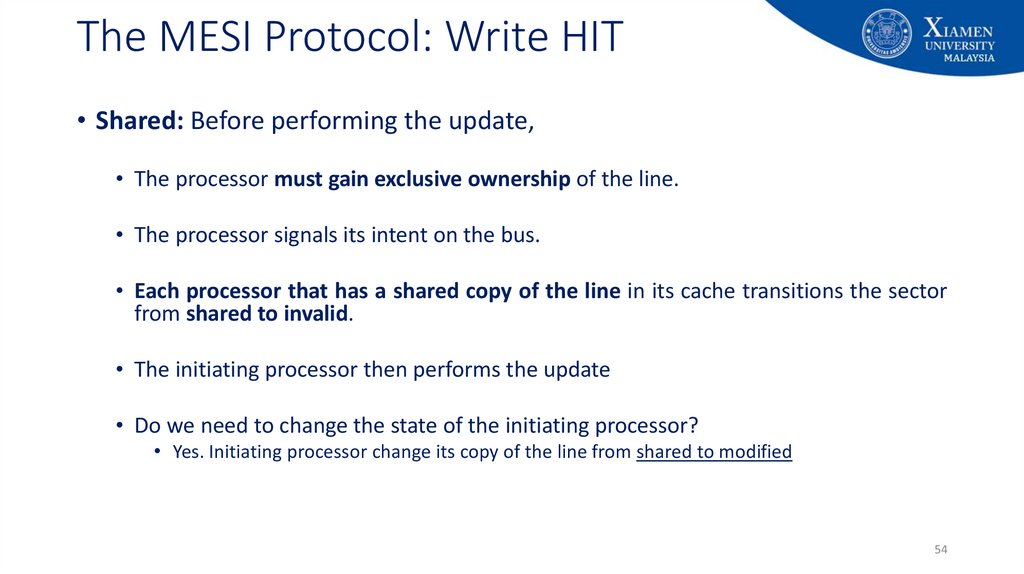
54. The MESI Protocol: Write HIT
• Shared: Before performing the update,• The processor must gain exclusive ownership of the line.
• The processor signals its intent on the bus.
• Each processor that has a shared copy of the line in its cache transitions the sector
from shared to invalid.
• The initiating processor then performs the update
• Do we need to change the state of the initiating processor?
• Yes. Initiating processor change its copy of the line from shared to modified
54
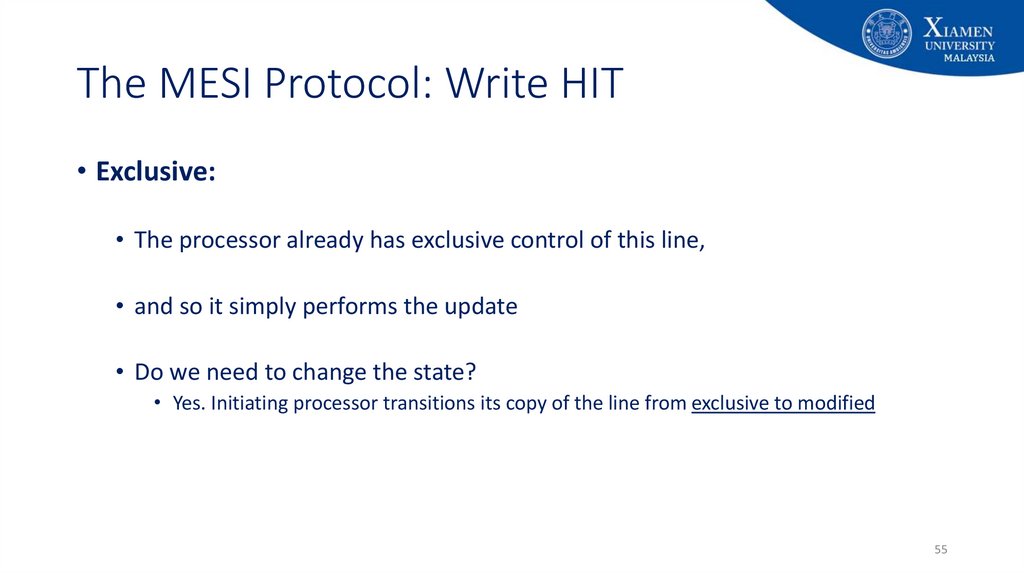
55. The MESI Protocol: Write HIT
• Exclusive:• The processor already has exclusive control of this line,
• and so it simply performs the update
• Do we need to change the state?
• Yes. Initiating processor transitions its copy of the line from exclusive to modified
55
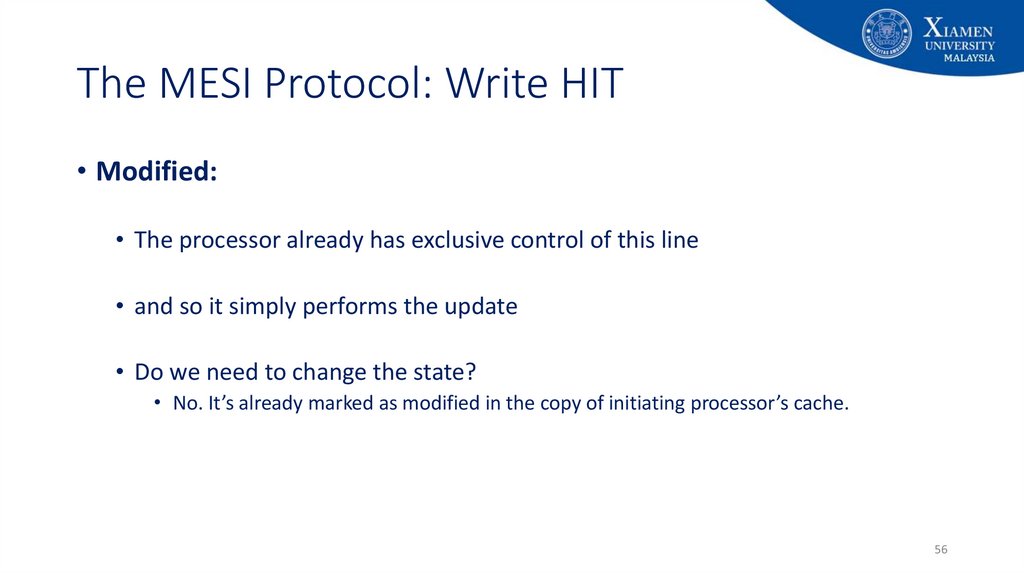
56. The MESI Protocol: Write HIT
• Modified:• The processor already has exclusive control of this line
• and so it simply performs the update
• Do we need to change the state?
• No. It’s already marked as modified in the copy of initiating processor’s cache.
56
57. Summary
• Parallelism• Multithreading
• Multiprocessing
• Multiprogramming
• Multi-core
• Cache coherence problem
• Cache coherence protocols
• Snoopy bus: The MESI Protocol
57
58. End of Lecture 10!
End of Lecture 10!• Additional readings:
• Chapter 17 (Parallel Processing): Stallings, W. Computer organization and
architecture: Designing for performance, Tenth Edition Upper Saddle River, N.J:
Prentice Hall.
• Next week lecture: Pipelining
• Questions?
58
59.
Appendix59
60.
Appendix: University's vision and missionVision
Xiamen University Malaysia aspires to become a university with a
distinct global outlook, featuring first-class teaching and research, and
embracing cultural diversity.
Mission
To nurture young talents with dignity and wisdom, turning them into
fine citizens of the region who will contribute to the prosperity of the
people and social progress of Malaysia, China and Southeast Asia.
60
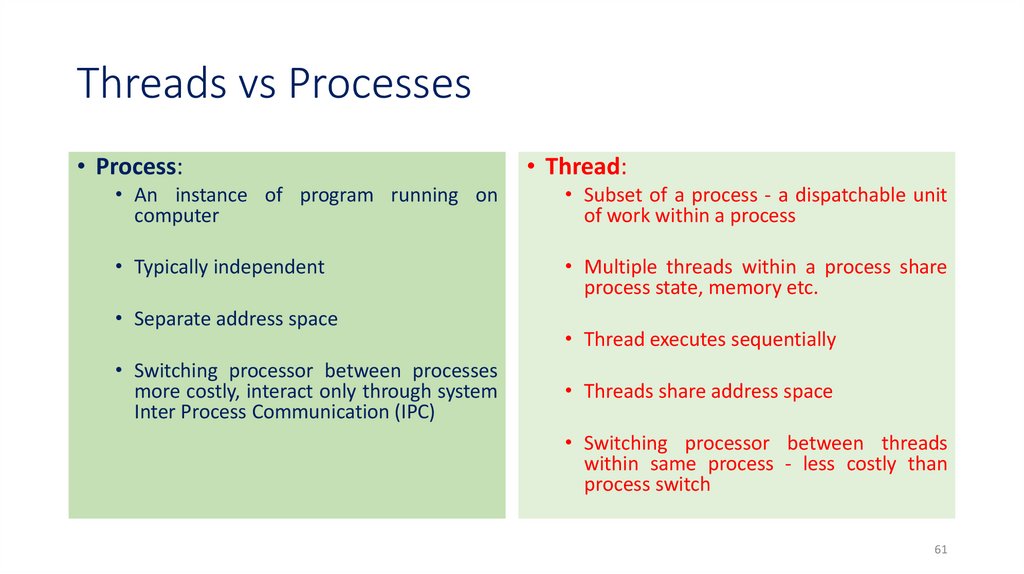
61. Threads vs Processes
• Process:• Thread:
• An instance of program running on
computer
• Subset of a process - a dispatchable unit
of work within a process
• Typically independent
• Multiple threads within a process share
process state, memory etc.
• Separate address space
• Switching processor between processes
more costly, interact only through system
Inter Process Communication (IPC)
• Thread executes sequentially
• Threads share address space
• Switching processor between threads
within same process - less costly than
process switch
61
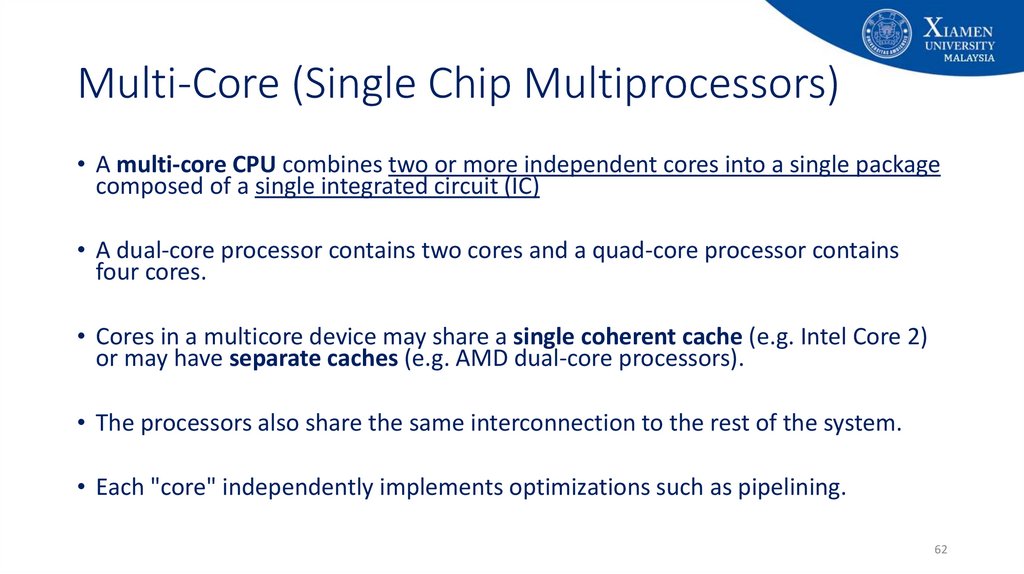
62. Multi-Core (Single Chip Multiprocessors)
• A multi-core CPU combines two or more independent cores into a single packagecomposed of a single integrated circuit (IC)
• A dual-core processor contains two cores and a quad-core processor contains
four cores.
• Cores in a multicore device may share a single coherent cache (e.g. Intel Core 2)
or may have separate caches (e.g. AMD dual-core processors).
• The processors also share the same interconnection to the rest of the system.
• Each "core" independently implements optimizations such as pipelining.
62
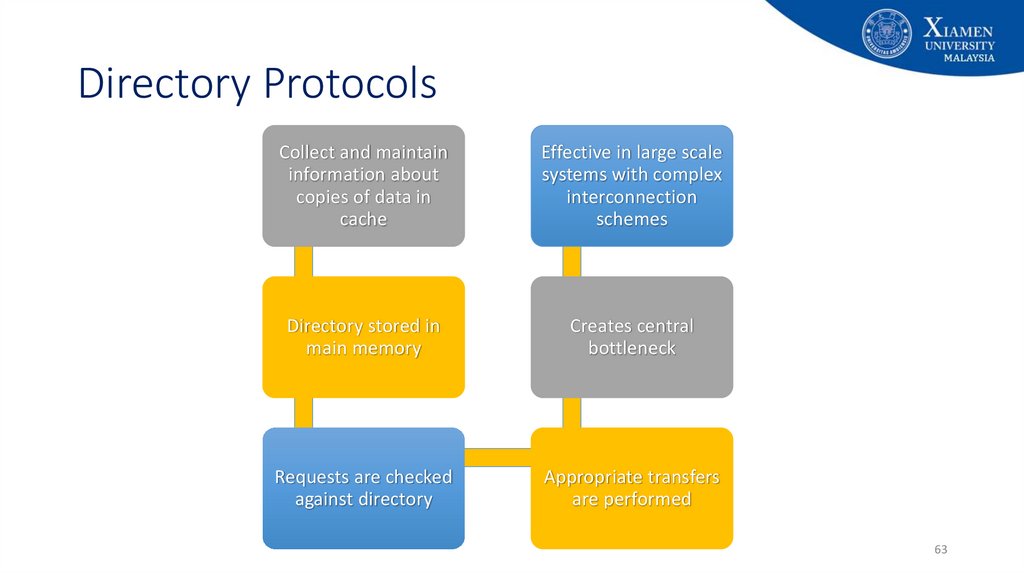
63. Directory Protocols
Collect and maintaininformation about
copies of data in
cache
Effective in large scale
systems with complex
interconnection
schemes
Directory stored in
main memory
Creates central
bottleneck
Requests are checked
against directory
Appropriate transfers
are performed
63