





 informatics
Similar presentations:









Computer Architecture of Embedded Systems ELE 475 / COS 475 Slide Deck 3: Cache Review
1.
Computer Architectureof Embedded Systems
ELE 475 / COS 475
Slide Deck 3: Cache Review
Lecturer: Assistant-professor –
Mukhanov Samat
Bakytzhanovich
1
2. Agenda
• Memory Technology• Motivation for Caches
• Classifying Caches
• Cache Performance
2
3. Agenda
• Memory Technology• Motivation for Caches
• Classifying Caches
• Cache Performance
3
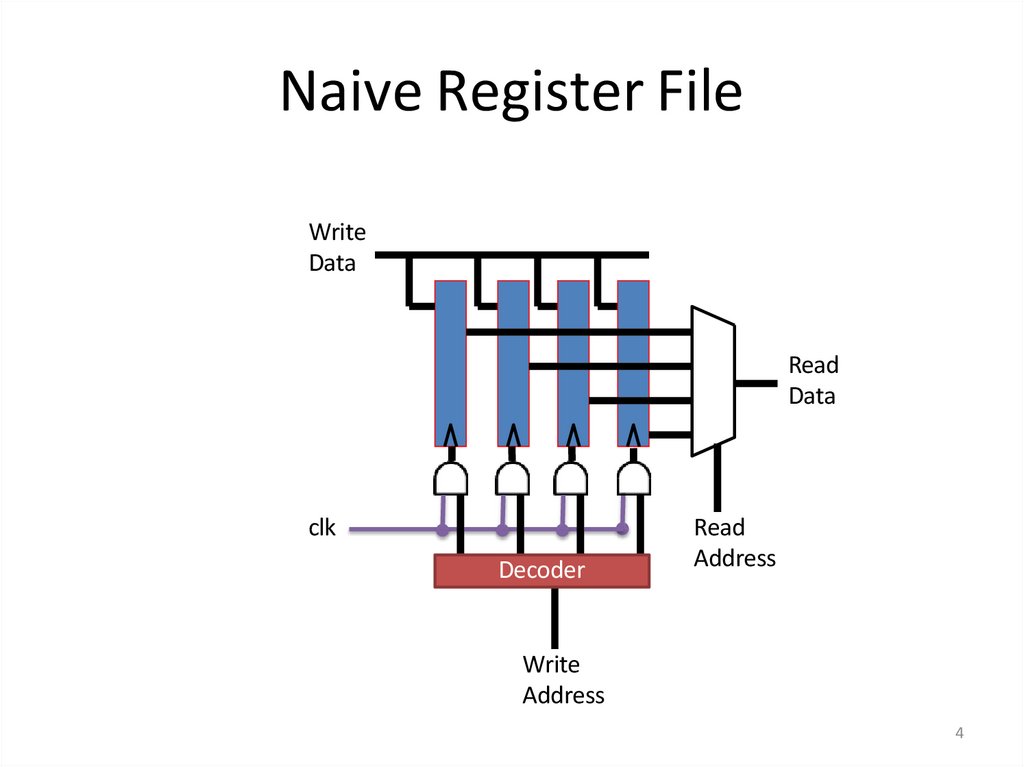
4. Naive Register File
WriteData
Read
Data
clk
Decoder
Read
Address
Write
Address
4
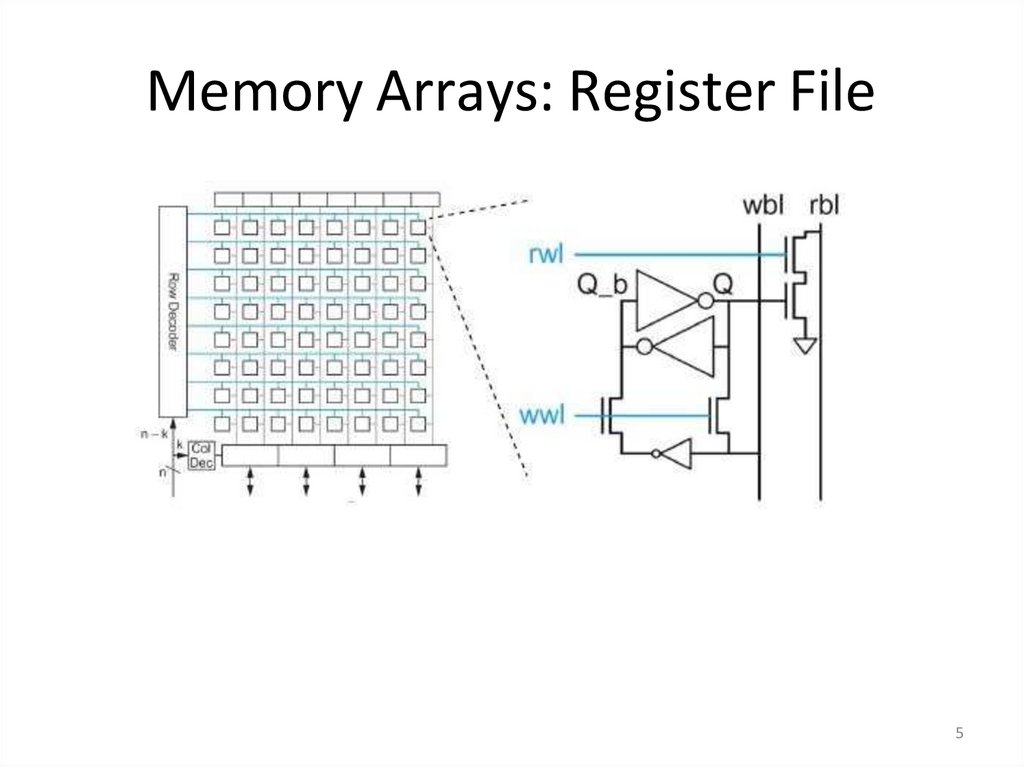
5. Memory Arrays: Register File
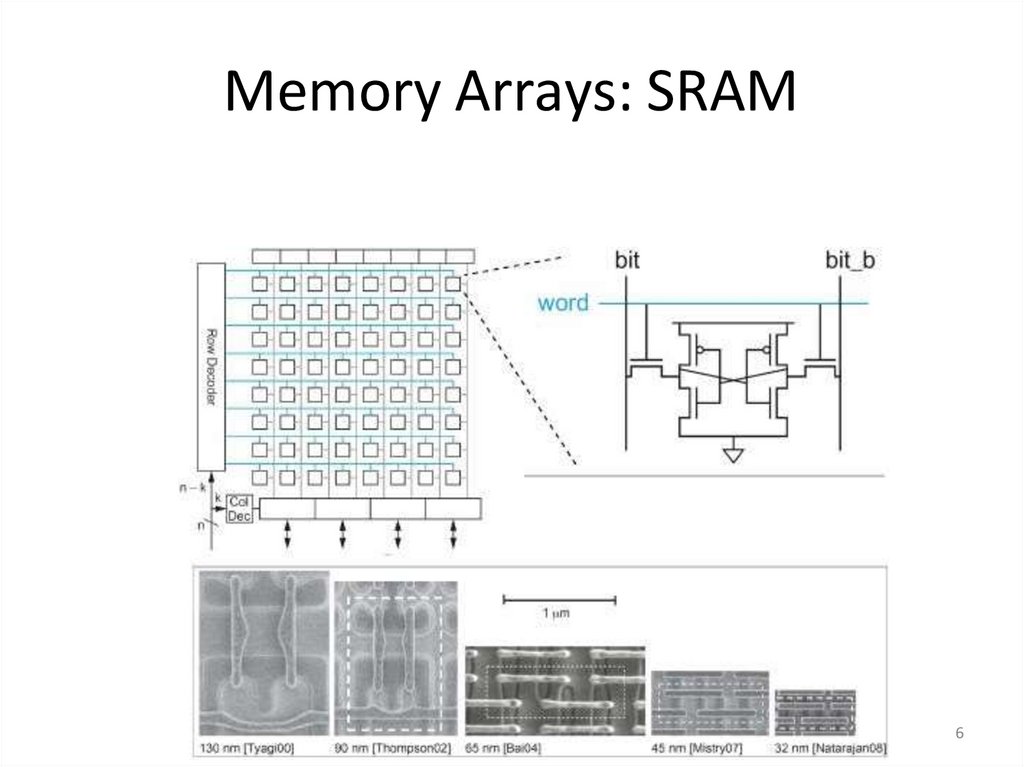
56. Memory Arrays: SRAM
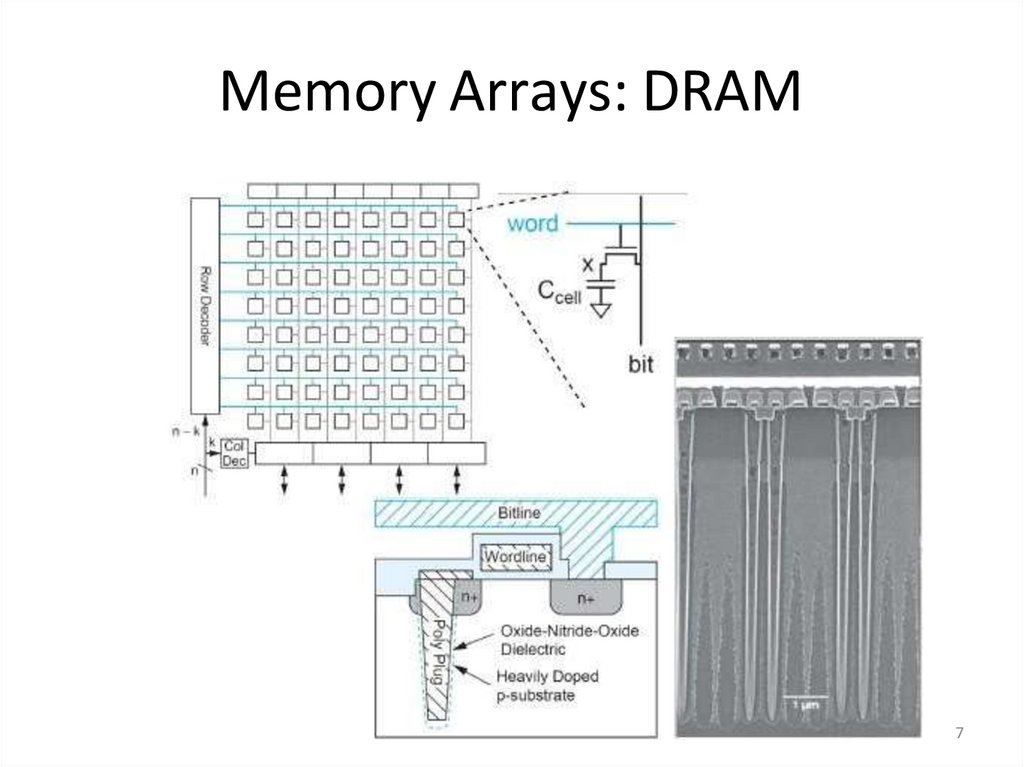
67. Memory Arrays: DRAM
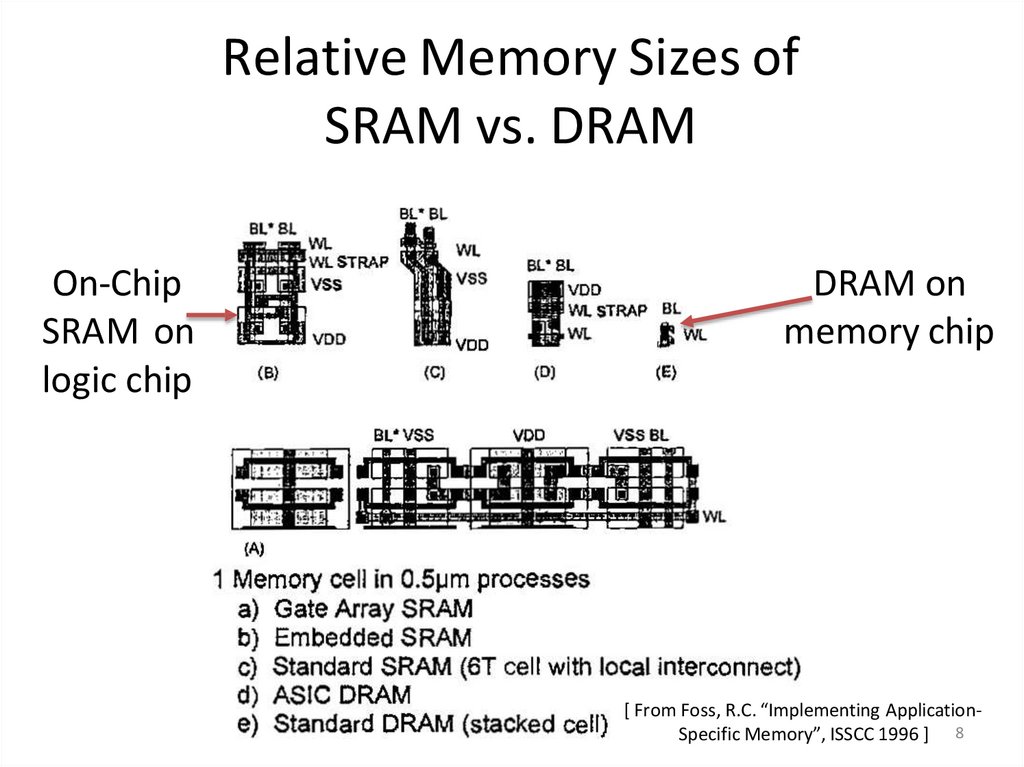
78. Relative Memory Sizes of SRAM vs. DRAM
On-ChipSRAM on
logic chip
DRAM on
memory chip
[ From Foss, R.C. “Implementing ApplicationSpecific Memory”, ISSCC 1996 ] 8
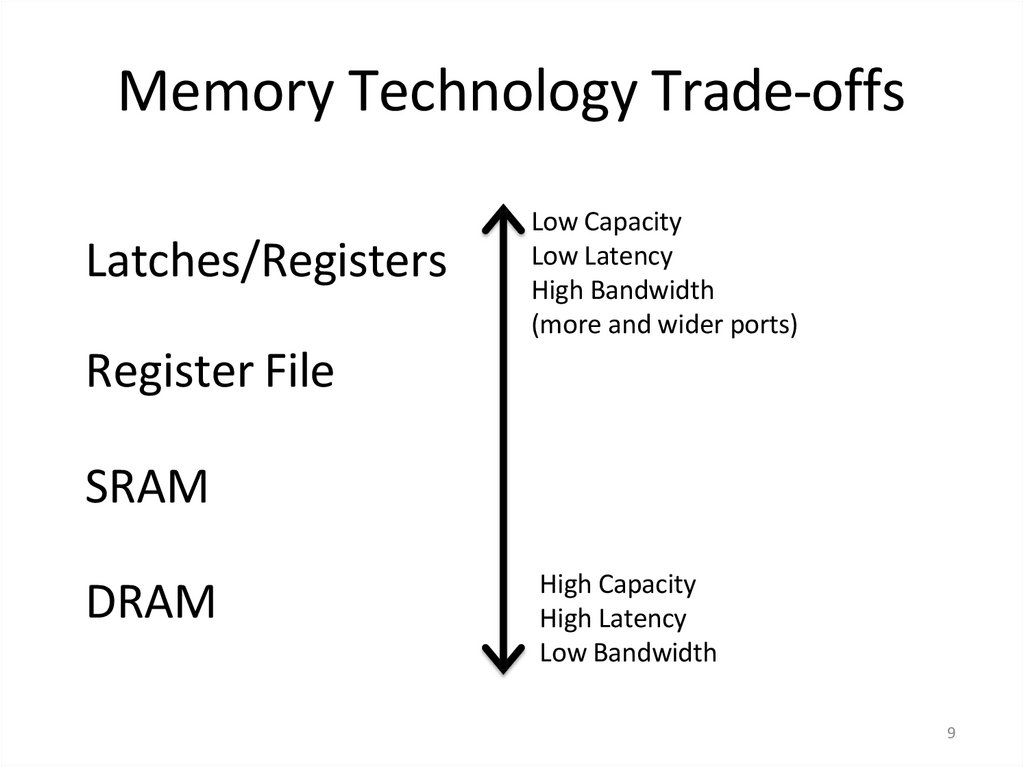
9. Memory Technology Trade-offs
Latches/RegistersLow Capacity
Low Latency
High Bandwidth
(more and wider ports)
Register File
SRAM
DRAM
High Capacity
High Latency
Low Bandwidth
9
10. Agenda
• Memory Technology• Motivation for Caches
• Classifying Caches
• Cache Performance
10
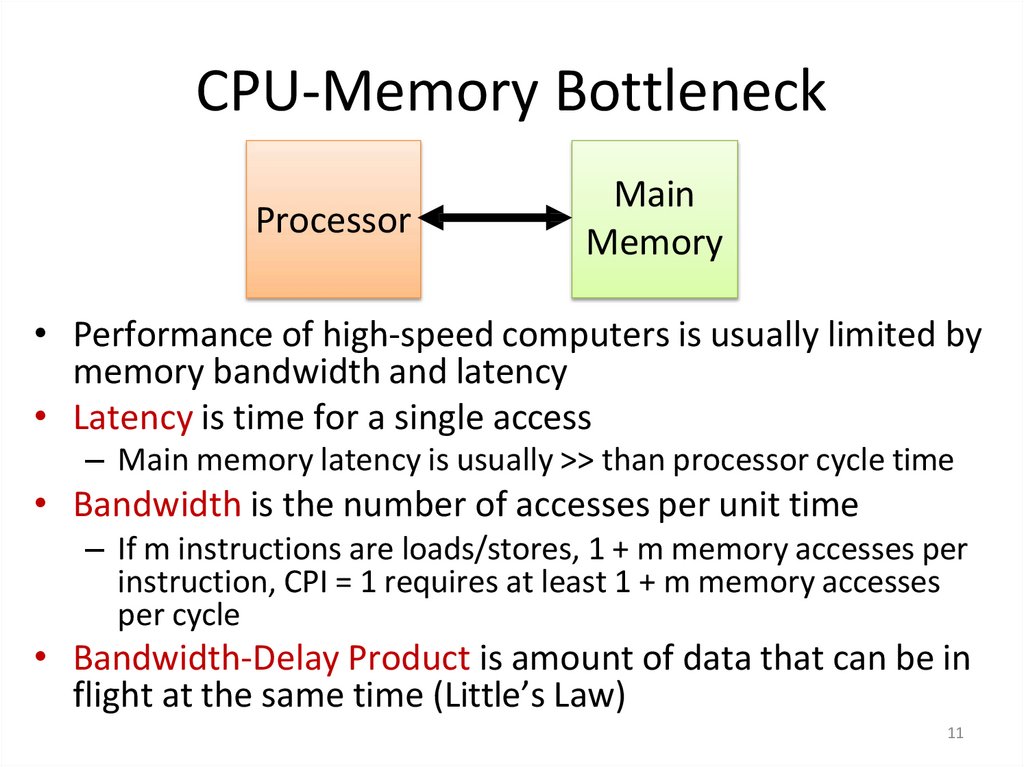
11. CPU-Memory Bottleneck
ProcessorMain
Memory
• Performance of high-speed computers is usually limited by
memory bandwidth and latency
• Latency is time for a single access
– Main memory latency is usually >> than processor cycle time
• Bandwidth is the number of accesses per unit time
– If m instructions are loads/stores, 1 + m memory accesses per
instruction, CPI = 1 requires at least 1 + m memory accesses
per cycle
• Bandwidth-Delay Product is amount of data that can be in
flight at the same time (Little’s Law)
11
12. Processor-DRAM Latency Gap
[Hennessy &Patterson 2011]
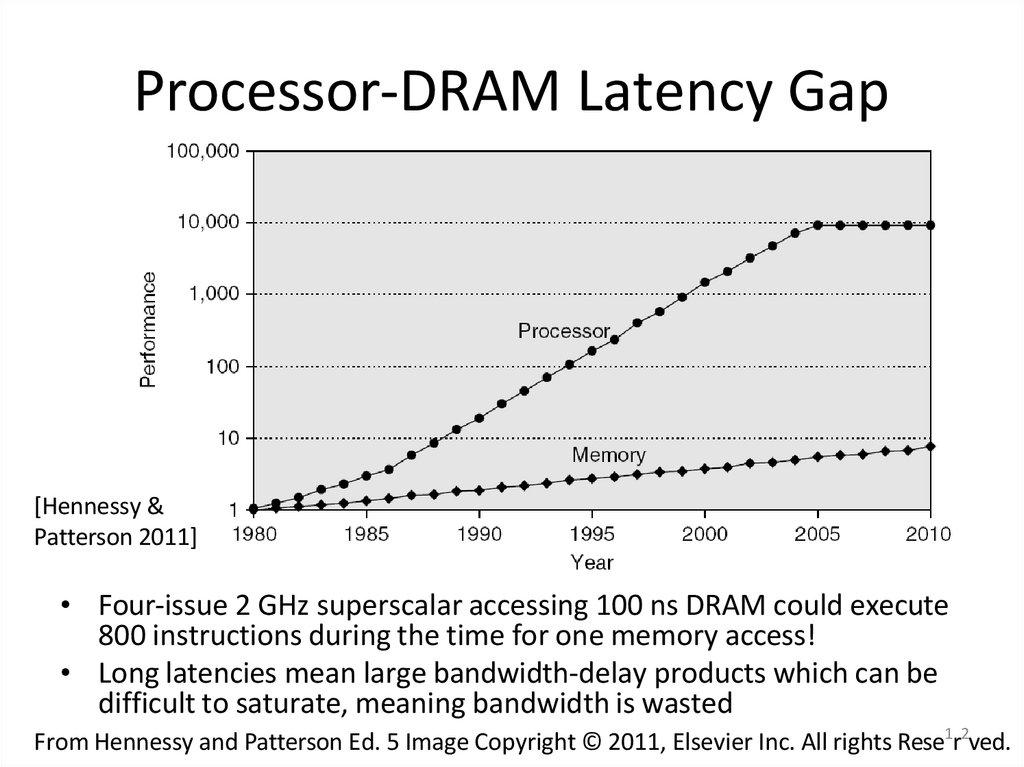
• Four-issue 2 GHz superscalar accessing 100 ns DRAM could execute
800 instructions during the time for one memory access!
• Long latencies mean large bandwidth-delay products which can be
difficult to saturate, meaning bandwidth is wasted
From Hennessy and Patterson Ed. 5 Image Copyright © 2011, Elsevier Inc. All rights Rese1r2ved.
13. Physical Size Affects Latency
ProcessorProcessor
Small
Memory
Big Memory
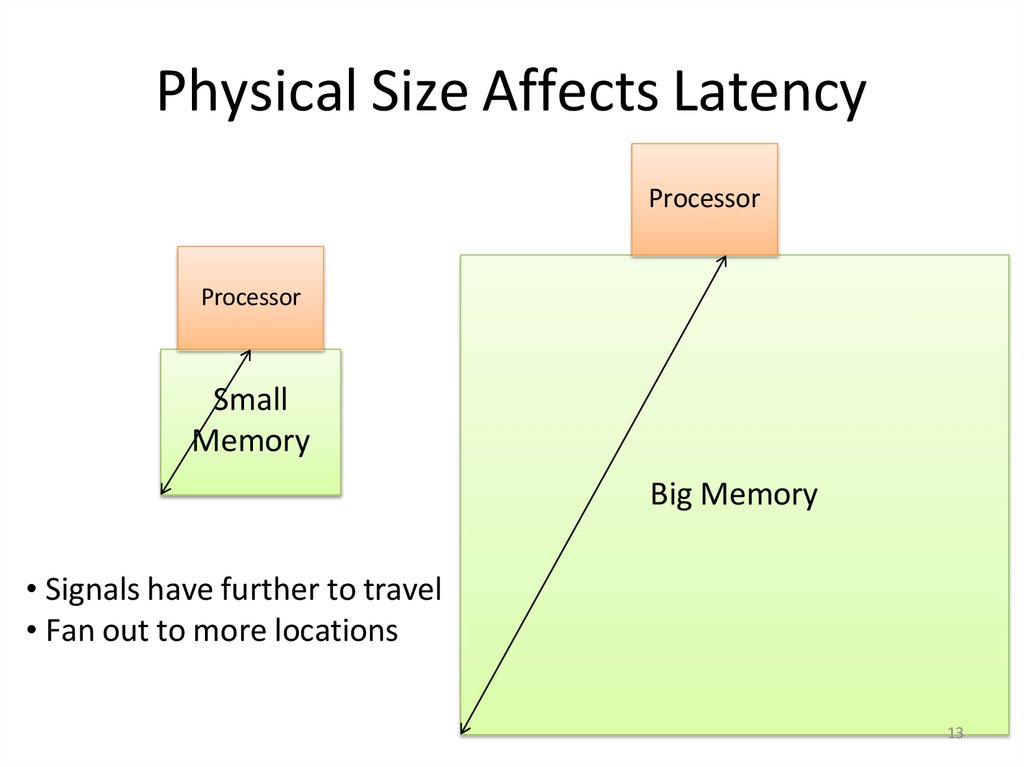
• Signals have further to travel
• Fan out to more locations
13
14. Memory Hierarchy
ProcessorSmall Fast
Memory
(RF, SRAM)
Big Slow
Memory
(DRAM)
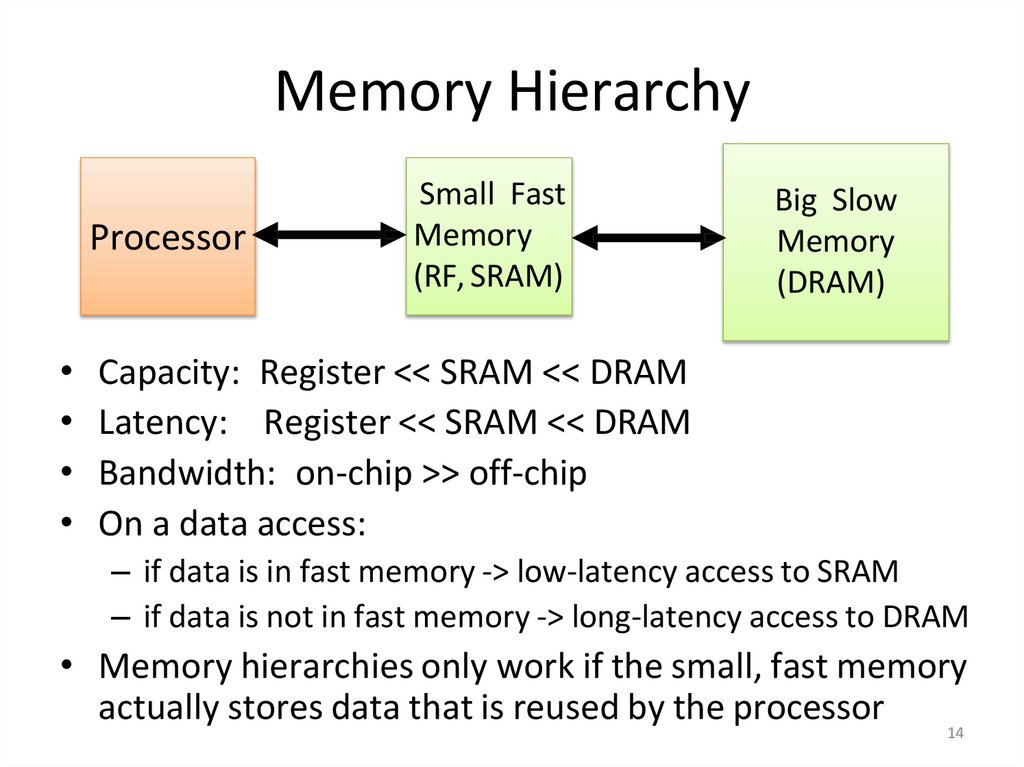
• Capacity: Register << SRAM << DRAM
• Latency: Register << SRAM << DRAM
• Bandwidth: on-chip >> off-chip
• On a data access:
– if data is in fast memory -> low-latency access to SRAM
– if data is not in fast memory -> long-latency access to DRAM
• Memory hierarchies only work if the small, fast memory
actually stores data that is reused by the processor
14
15. Common And Predictable Memory Reference Patterns
Addressn loop iterations
Instruction
fetches
Stack
accesses
subroutine
call
subroutine
return
argument access
Data
accesses
scalar accesses
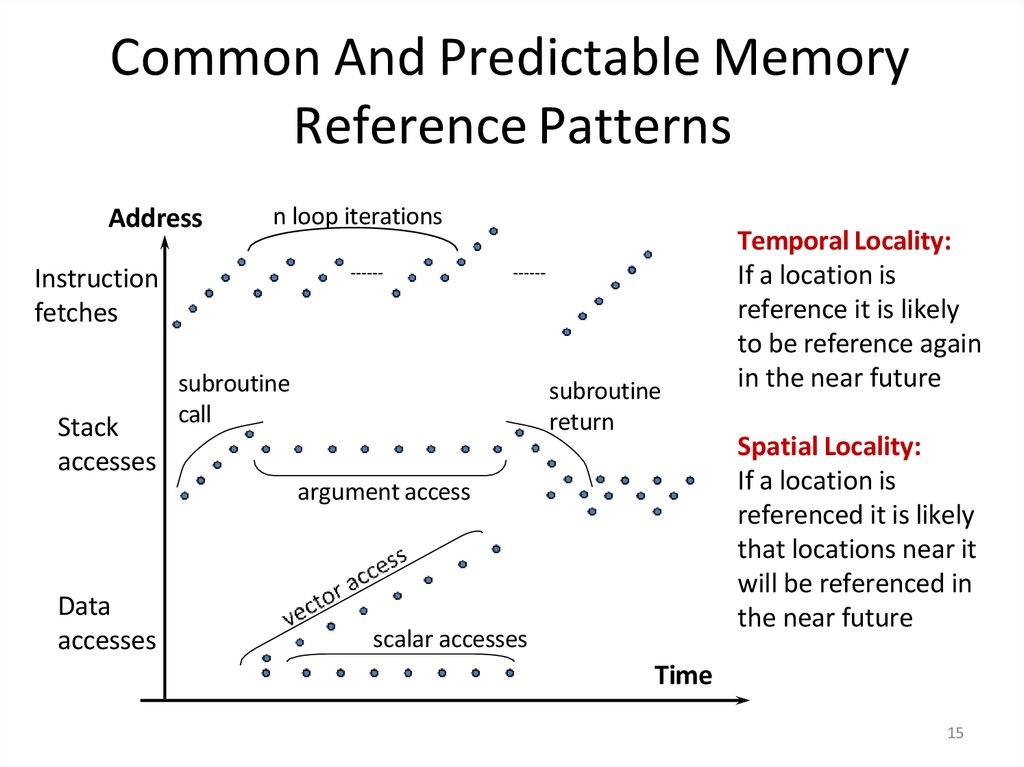
Temporal Locality:
If a location is
reference it is likely
to be reference again
in the near future
Spatial Locality:
If a location is
referenced it is likely
that locations near it
will be referenced in
the near future
Time
15
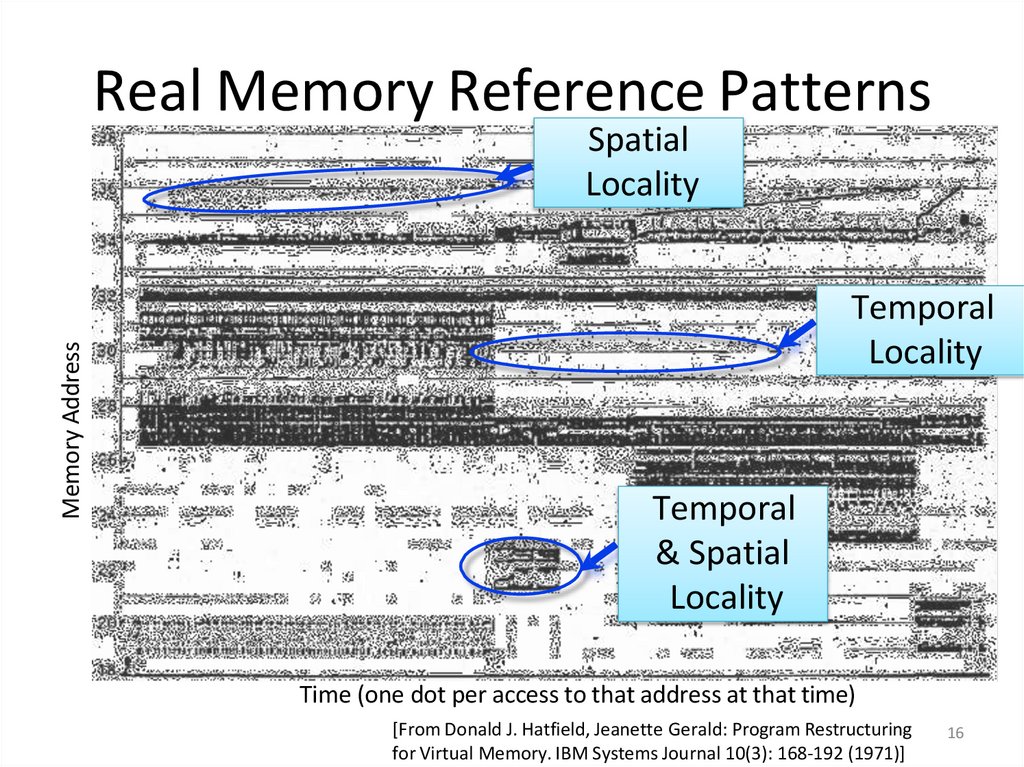
16. Real Memory Reference Patterns
Memory AddressSpatial
Locality
Temporal
Locality
Temporal
& Spatial
Locality
Time (one dot per access to that address at that time)
[From Donald J. Hatfield, Jeanette Gerald: Program Restructuring
for Virtual Memory. IBM Systems Journal 10(3): 168-192 (1971)]
16
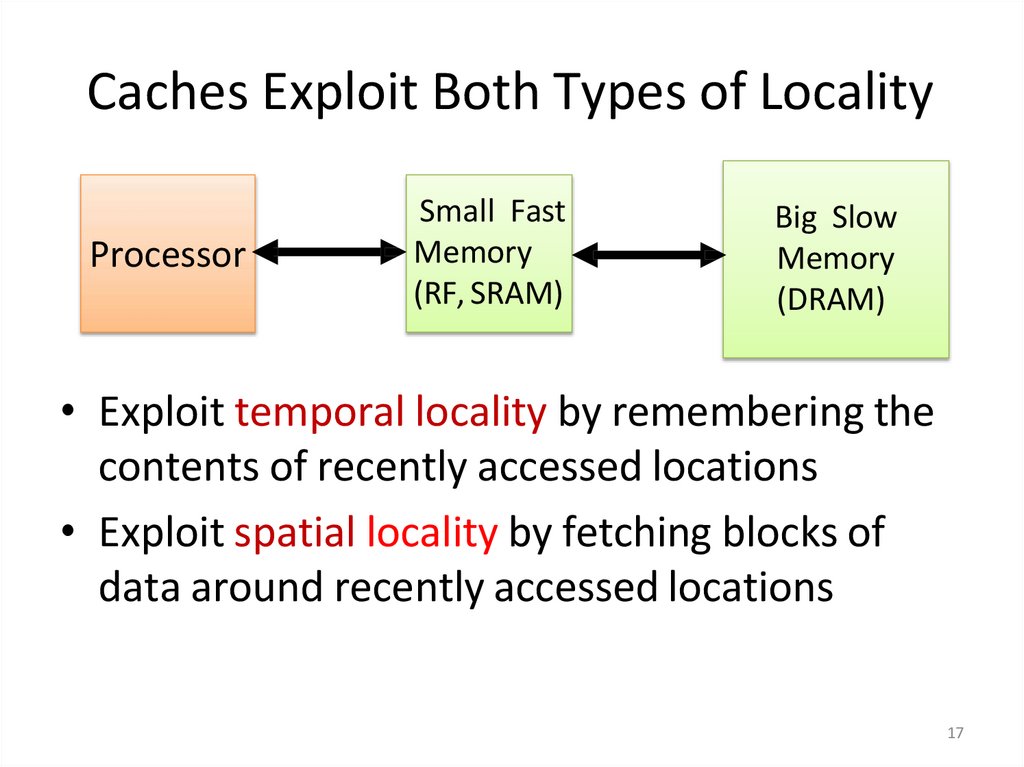
17. Caches Exploit Both Types of Locality
ProcessorSmall Fast
Memory
(RF, SRAM)
Big Slow
Memory
(DRAM)
• Exploit temporal locality by remembering the
contents of recently accessed locations
• Exploit spatial locality by fetching blocks of
data around recently accessed locations
17
18. Agenda
• Memory Technology• Motivation for Caches
• Classifying Caches
• Cache Performance
18
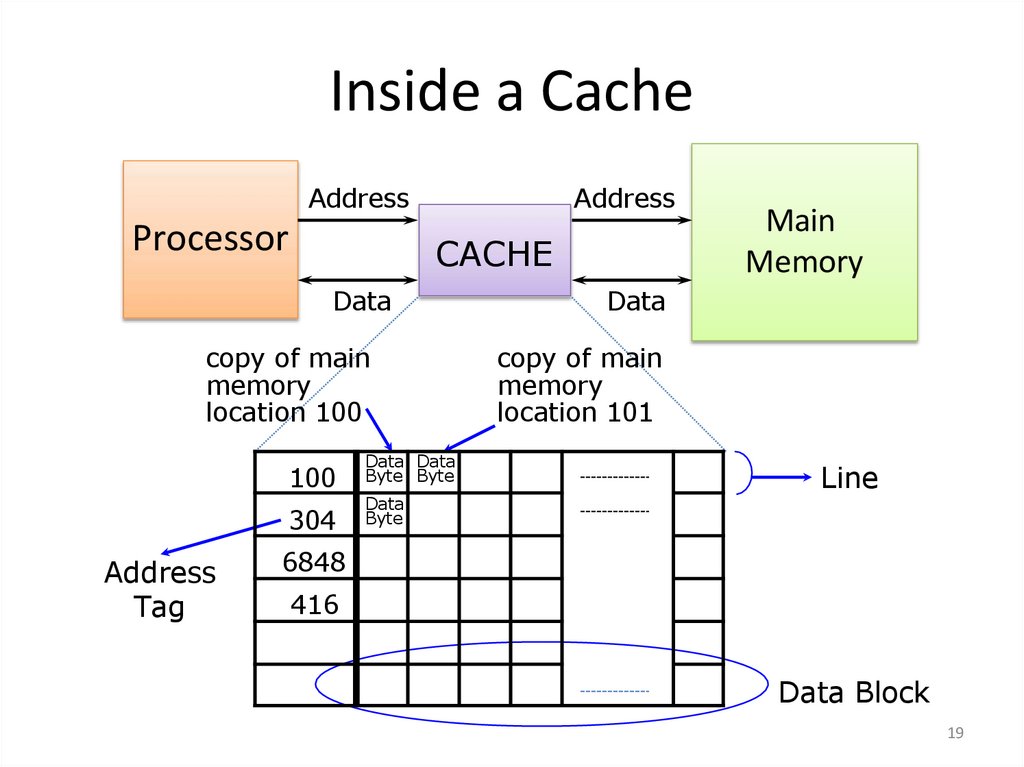
19. Inside a Cache
AddressProcessor
Address
CACHE
Data
copy of main
memory
location 100
Address
Tag
100
Data Data
Byte Byte
304
Data
Byte
Main
Memory
Data
copy of main
memory
location 101
Line
6848
416
Data Block
19
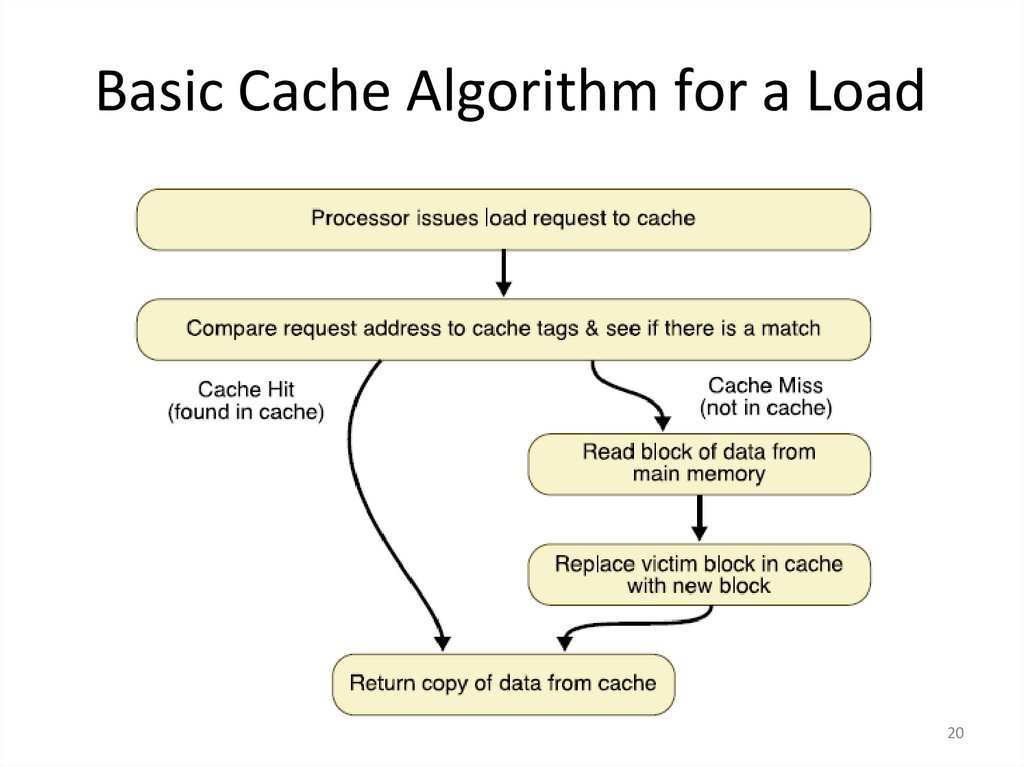
20. Basic Cache Algorithm for a Load
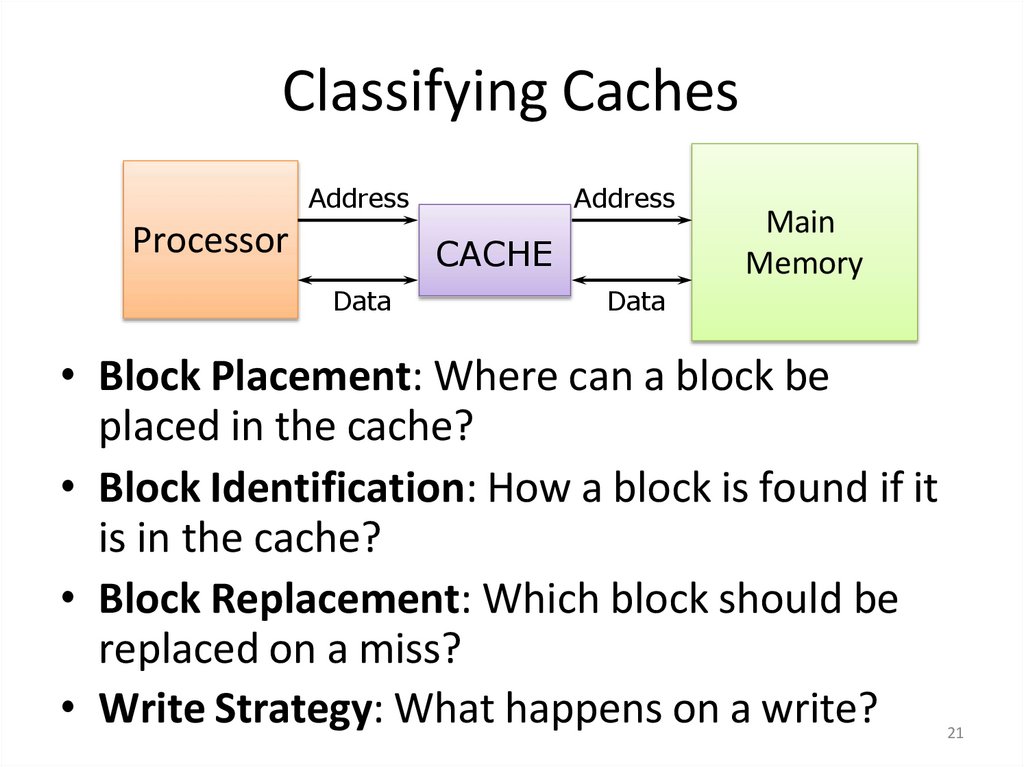
2021. Classifying Caches
AddressProcessor
Address
CACHE
Data
Main
Memory
Data
• Block Placement: Where can a block be
placed in the cache?
• Block Identification: How a block is found if it
is in the cache?
• Block Replacement: Which block should be
replaced on a miss?
• Write Strategy: What happens on a write?
21
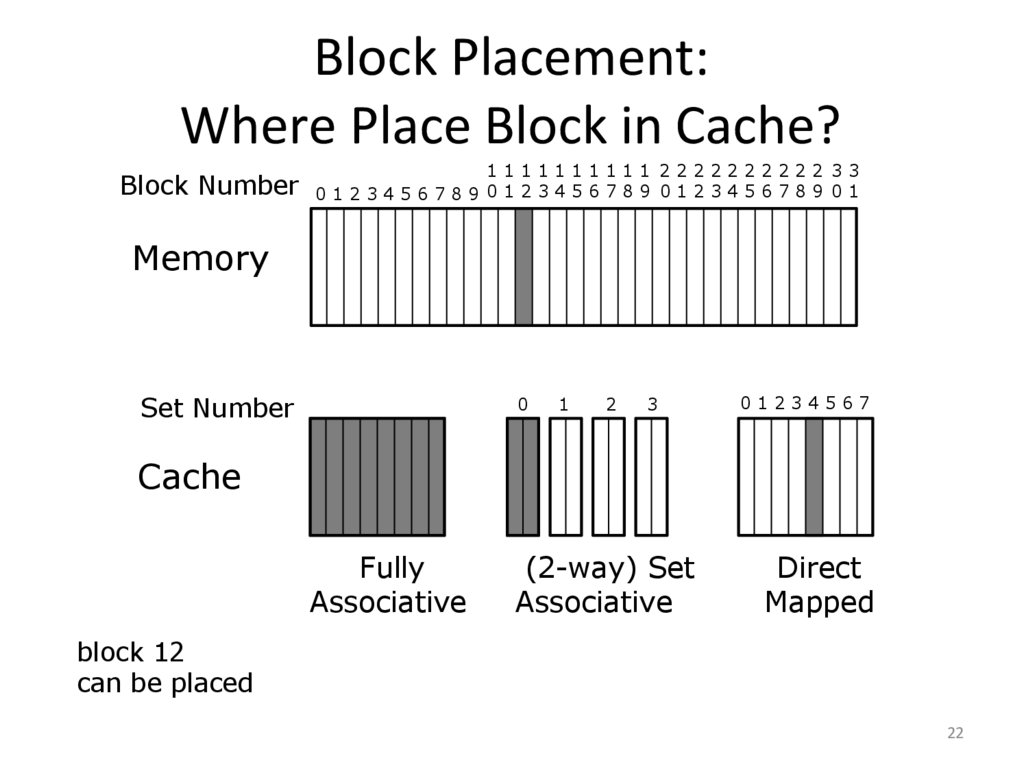
22. Block Placement: Where Place Block in Cache?
1111111111 2222222222 33Block Number 0 1 2 3 4 5 6 7 8 9 0 1 2 3 4 5 6 7 8 9 0 1 2 3 4 5 6 7 8 9 0 1
Memory
Set Number
0
1
2
3
01234567
Cache
Fully
Associative
(2-way) Set
Associative
Direct
Mapped
block 12
can be placed
22
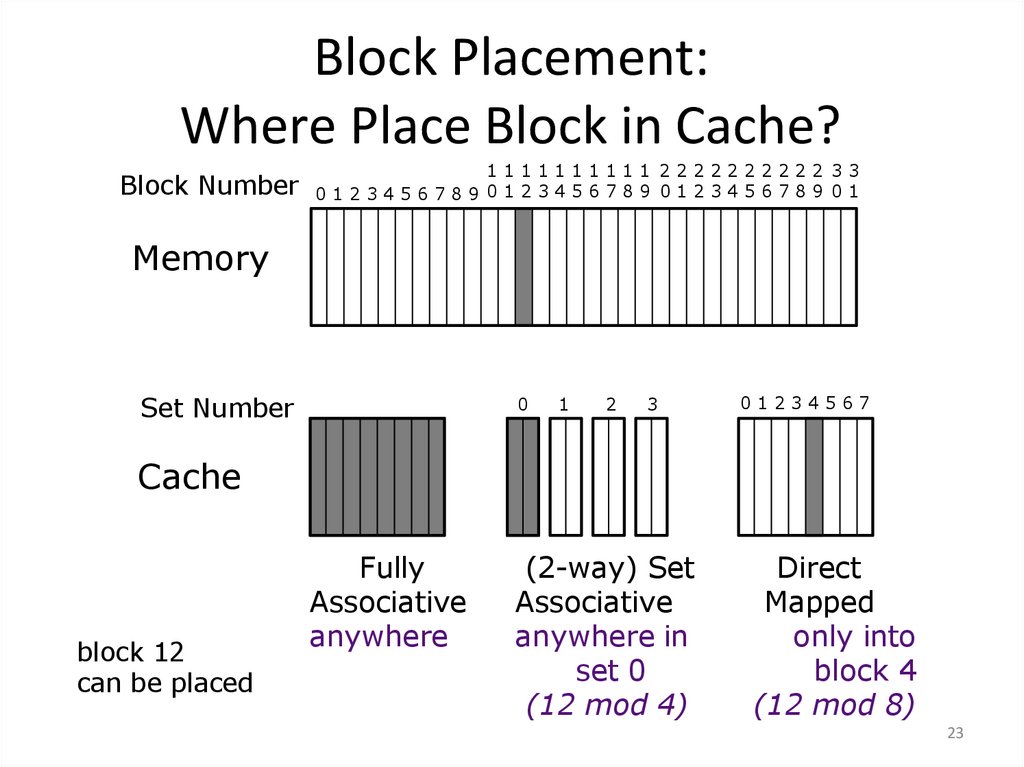
23. Block Placement: Where Place Block in Cache?
1111111111 2222222222 33Block Number 0 1 2 3 4 5 6 7 8 9 0 1 2 3 4 5 6 7 8 9 0 1 2 3 4 5 6 7 8 9 0 1
Memory
Set Number
0
1
2
3
01234567
Cache
block 12
can be placed
Fully
Associative
anywhere
(2-way) Set
Associative
anywhere in
set 0
(12 mod 4)
Direct
Mapped
only into
block 4
(12 mod 8)
23
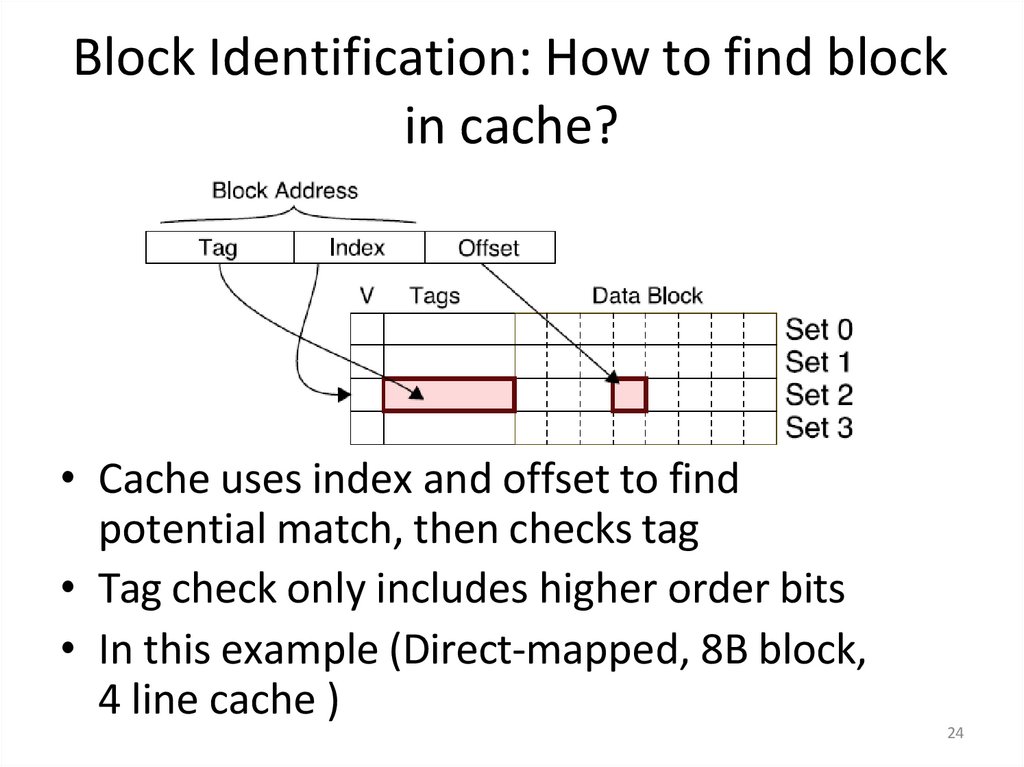
24. Block Identification: How to find block in cache?
• Cache uses index and offset to findpotential match, then checks tag
• Tag check only includes higher order bits
• In this example (Direct-mapped, 8B block,
4 line cache )
24
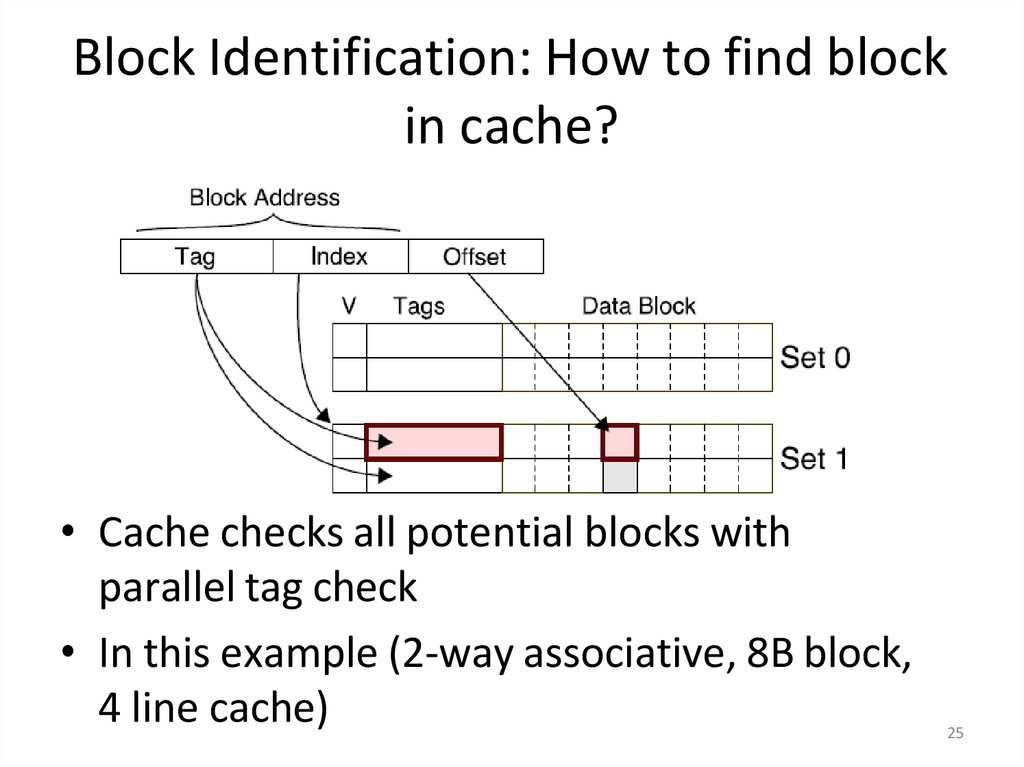
25. Block Identification: How to find block in cache?
• Cache checks all potential blocks withparallel tag check
• In this example (2-way associative, 8B block,
4 line cache)
25
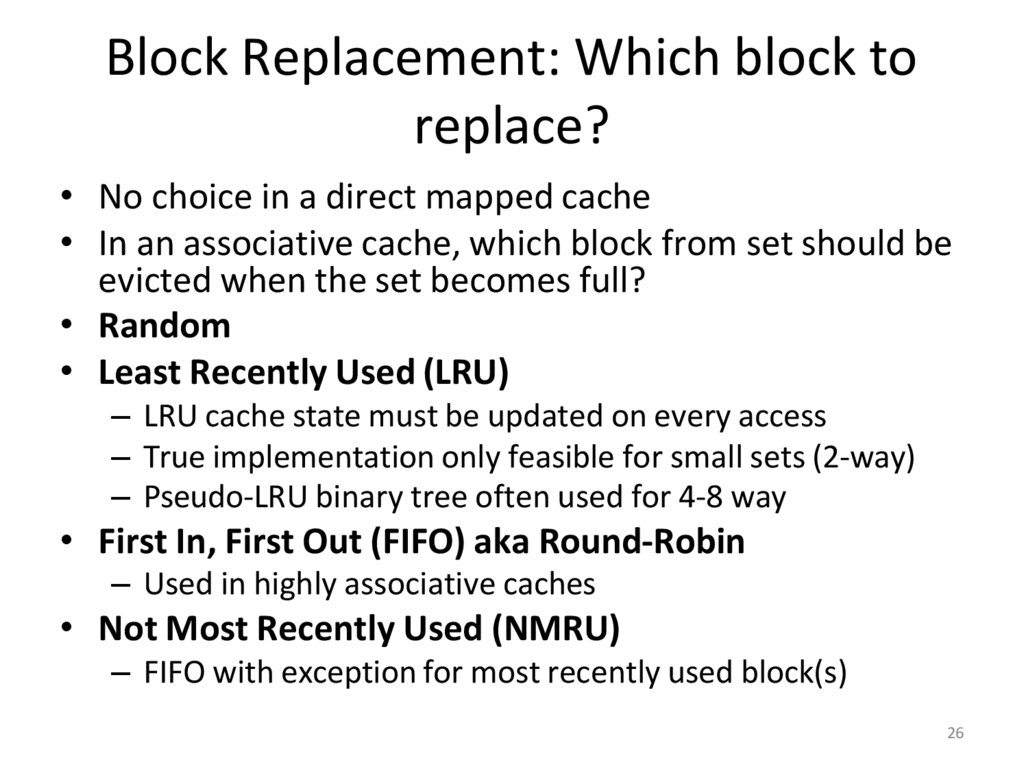
26. Block Replacement: Which block to replace?
• No choice in a direct mapped cache• In an associative cache, which block from set should be
evicted when the set becomes full?
• Random
• Least Recently Used (LRU)
– LRU cache state must be updated on every access
– True implementation only feasible for small sets (2-way)
– Pseudo-LRU binary tree often used for 4-8 way
• First In, First Out (FIFO) aka Round-Robin
– Used in highly associative caches
• Not Most Recently Used (NMRU)
– FIFO with exception for most recently used block(s)
26
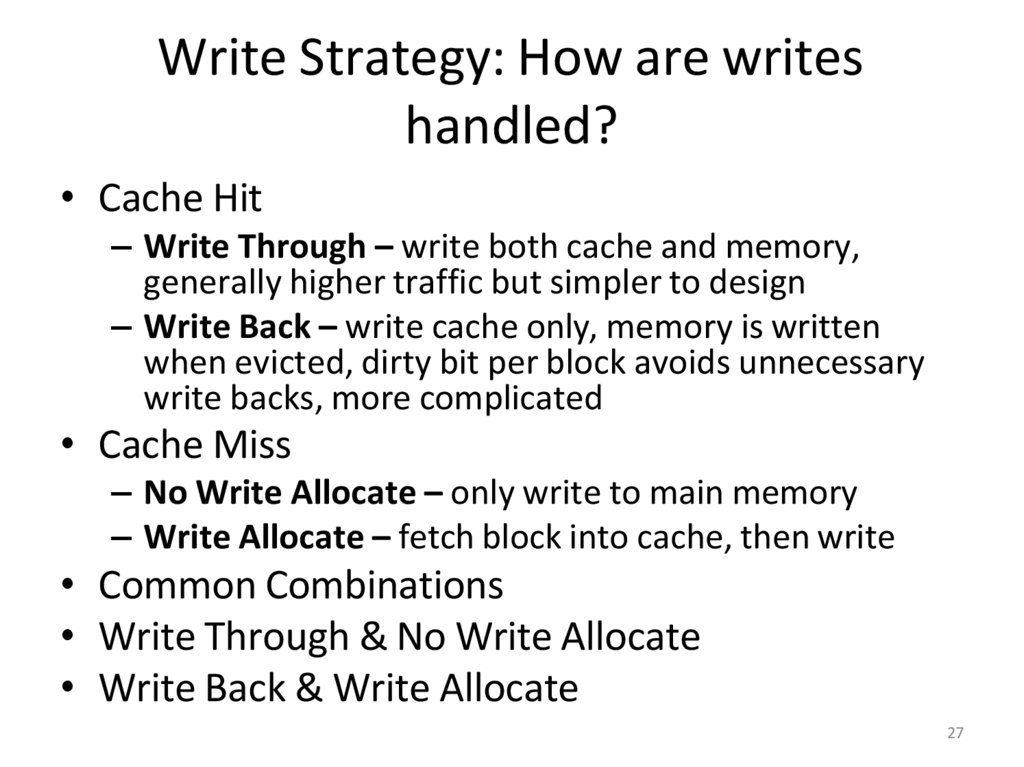
27. Write Strategy: How are writes handled?
• Cache Hit– Write Through – write both cache and memory,
generally higher traffic but simpler to design
– Write Back – write cache only, memory is written
when evicted, dirty bit per block avoids unnecessary
write backs, more complicated
• Cache Miss
– No Write Allocate – only write to main memory
– Write Allocate – fetch block into cache, then write
• Common Combinations
• Write Through & No Write Allocate
• Write Back & Write Allocate
27
28. Agenda
• Memory Technology• Motivation for Caches
• Classifying Caches
• Cache Performance
28
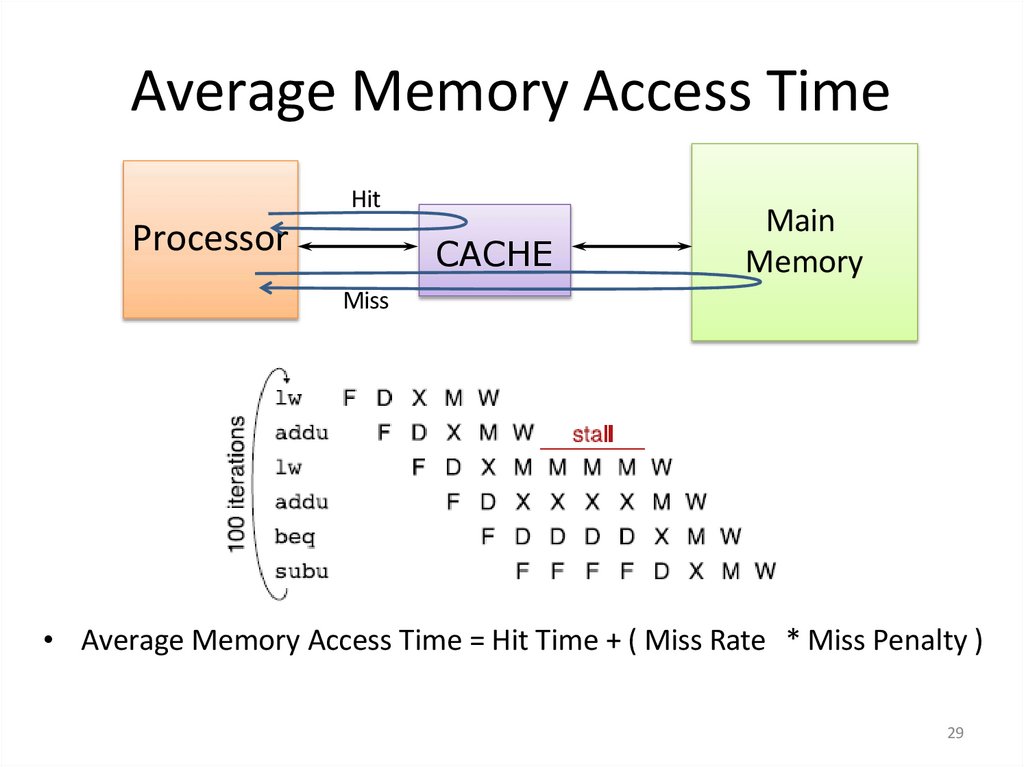
29. Average Memory Access Time
HitProcessor
CACHE
Main
Memory
Miss
• Average Memory Access Time = Hit Time + ( Miss Rate * Miss Penalty )
29
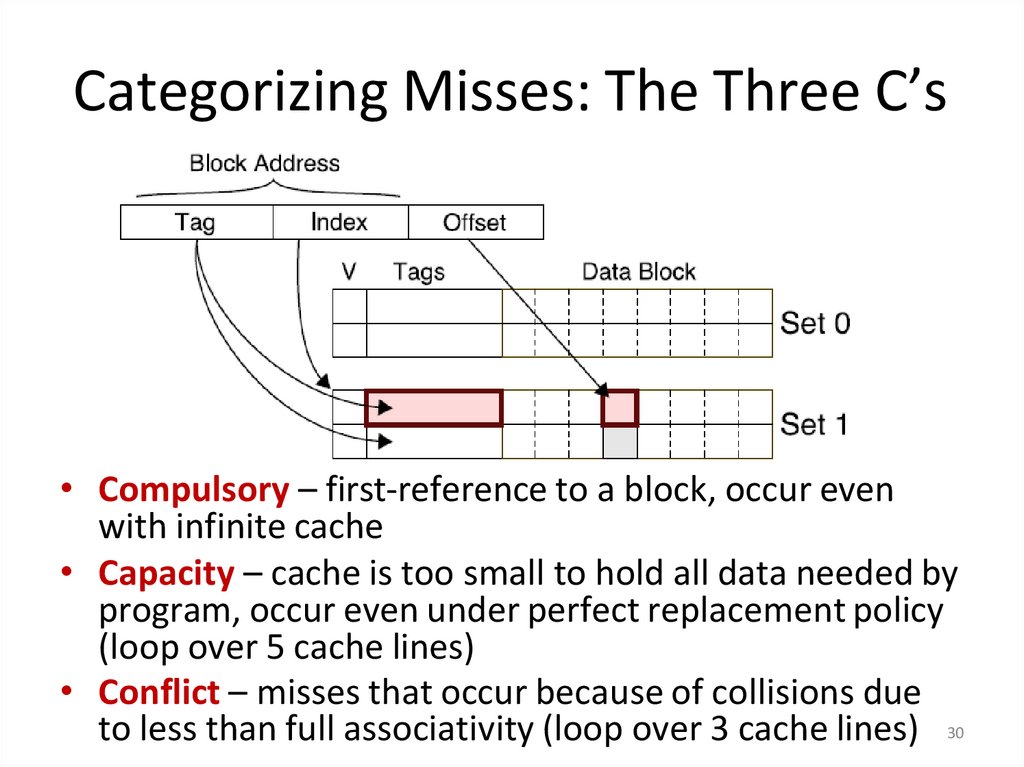
30. Categorizing Misses: The Three C’s
• Compulsory – first-reference to a block, occur evenwith infinite cache
• Capacity – cache is too small to hold all data needed by
program, occur even under perfect replacement policy
(loop over 5 cache lines)
• Conflict – misses that occur because of collisions due
to less than full associativity (loop over 3 cache lines) 30
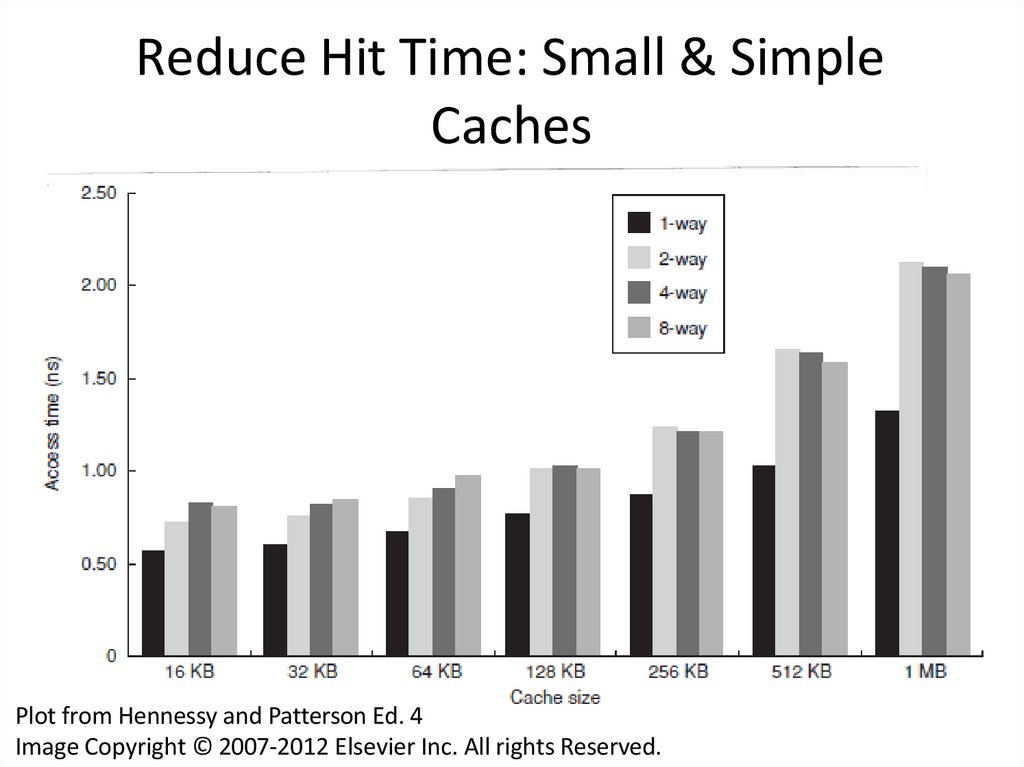
31. Reduce Hit Time: Small & Simple Caches
Reduce Hit Time: Small & SimpleCaches
Plot from Hennessy and Patterson Ed. 4
Image Copyright © 2007-2012 Elsevier Inc. All rights Reserved.
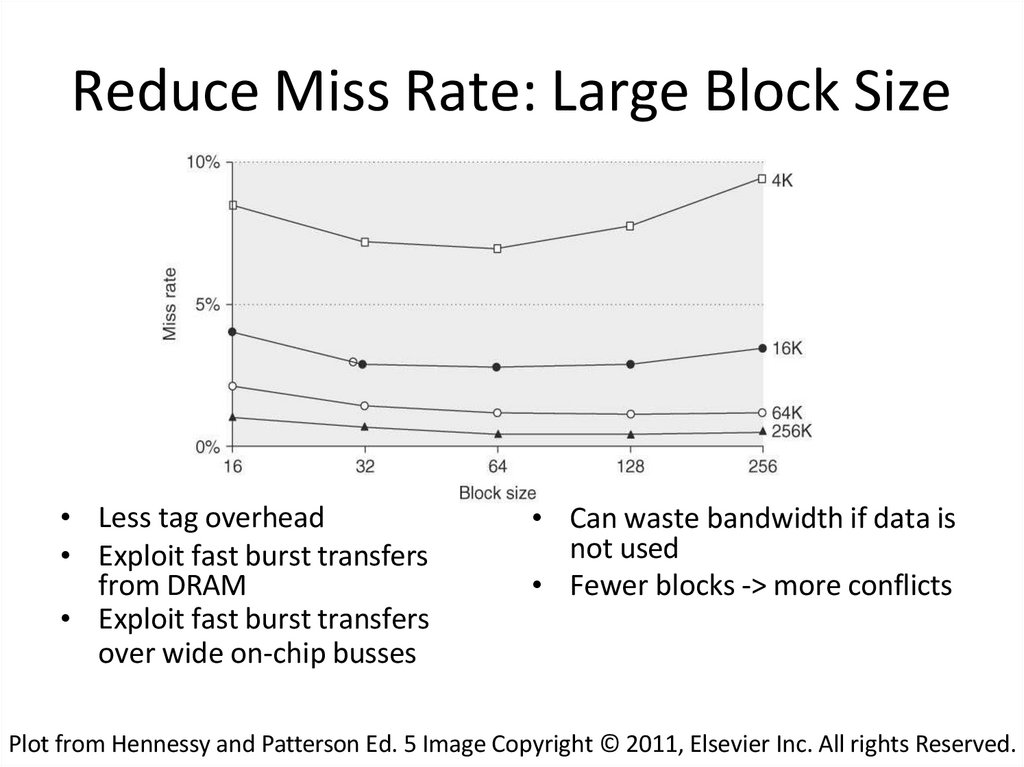
32. Reduce Miss Rate: Large Block Size
• Less tag overhead• Exploit fast burst transfers
from DRAM
• Exploit fast burst transfers
over wide on-chip busses
• Can waste bandwidth if data is
not used
• Fewer blocks -> more conflicts
Plot from Hennessy and Patterson Ed. 5 Image Copyright © 2011, Elsevier Inc. All rights Reserved.
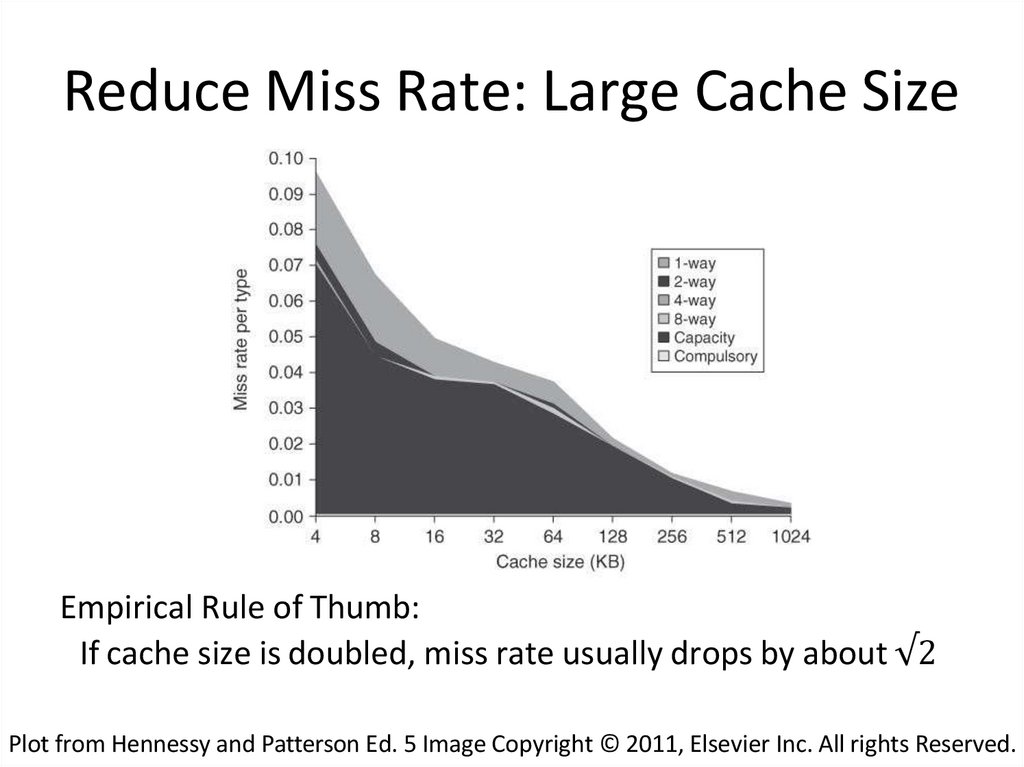
33. Reduce Miss Rate: Large Cache Size
Empirical Rule of Thumb:If cache size is doubled, miss rate usually drops by about √2
Plot from Hennessy and Patterson Ed. 5 Image Copyright © 2011, Elsevier Inc. All rights Reserved.
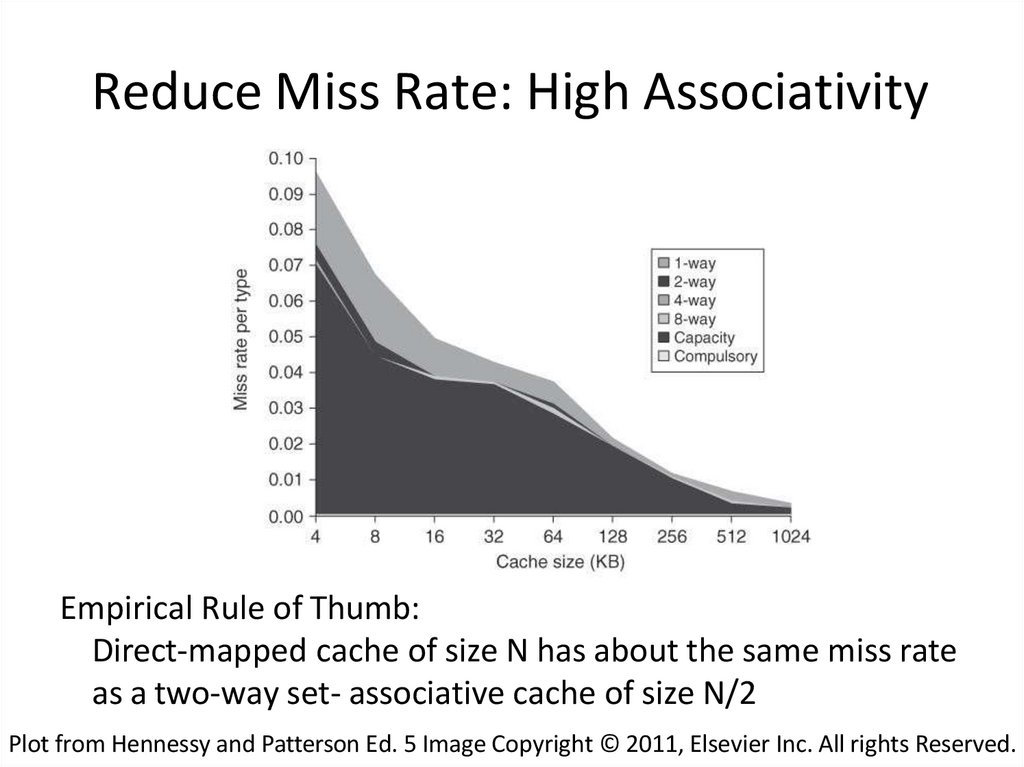
34. Reduce Miss Rate: High Associativity
Empirical Rule of Thumb:Direct-mapped cache of size N has about the same miss rate
as a two-way set- associative cache of size N/2
Plot from Hennessy and Patterson Ed. 5 Image Copyright © 2011, Elsevier Inc. All rights Reserved.
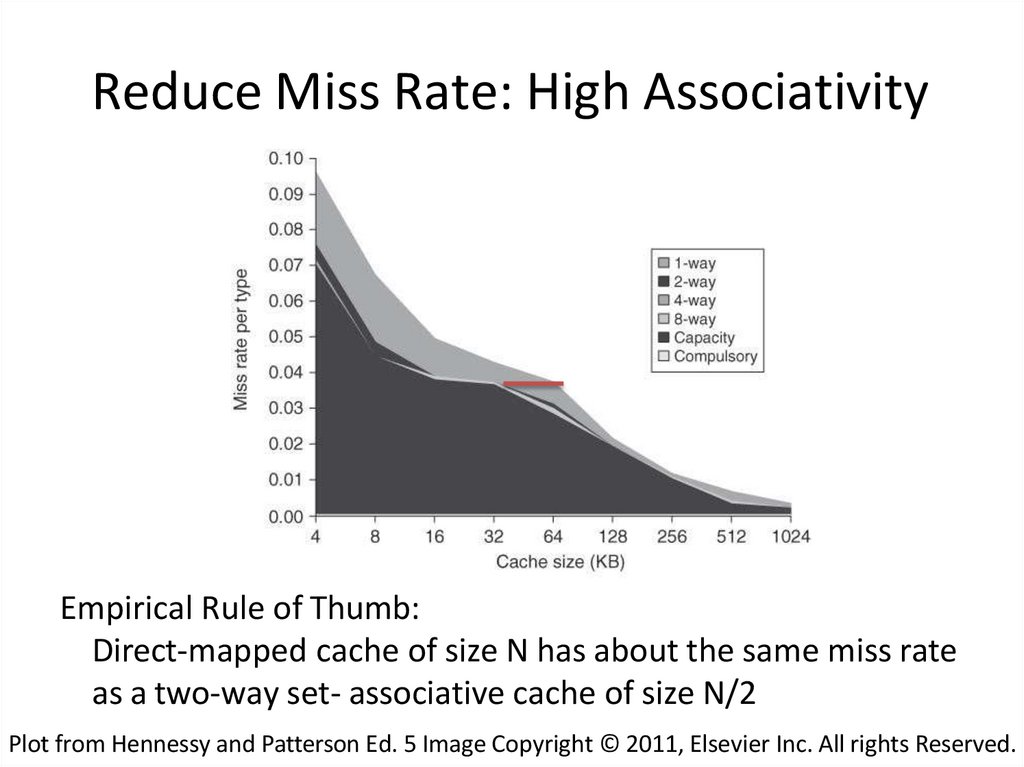
35. Reduce Miss Rate: High Associativity
Empirical Rule of Thumb:Direct-mapped cache of size N has about the same miss rate
as a two-way set- associative cache of size N/2
Plot from Hennessy and Patterson Ed. 5 Image Copyright © 2011, Elsevier Inc. All rights Reserved.
36. Agenda
• Memory Technology• Motivation for Caches
• Classifying Caches
• Cache Performance
36
37. Acknowledgements
• These slides contain material developed and copyright by:– Arvind (MIT)
– Krste Asanovic (MIT/UCB)
– Joel Emer (Intel/MIT)
– James Hoe (CMU)
– John Kubiatowicz (UCB)
– David Patterson (UCB)
– Christopher Batten (Cornell)
• MIT material derived from course 6.823
• UCB material derived from course CS252 & CS152
• Cornell material derived from course ECE 4750
37