

 medicine
Similar presentations:






Temporomandibular joint
1.
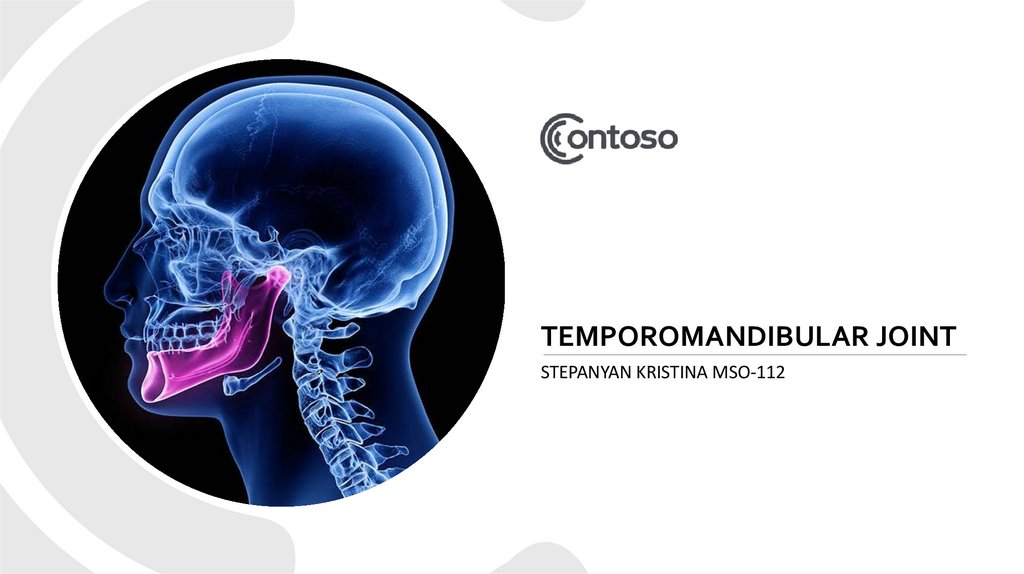
TEMPOROMANDIBULAR JOINTSTEPANYAN KRISTINA MSO-112
2.
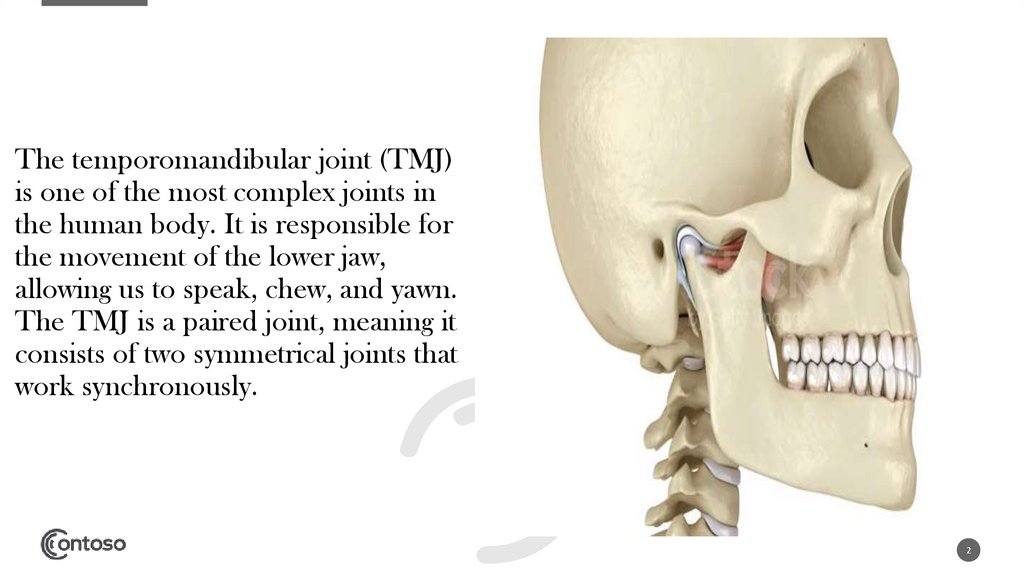
The temporomandibular joint (TMJ)is one of the most complex joints in
the human body. It is responsible for
the movement of the lower jaw,
allowing us to speak, chew, and yawn.
The TMJ is a paired joint, meaning it
consists of two symmetrical joints that
work synchronously.
2
3.
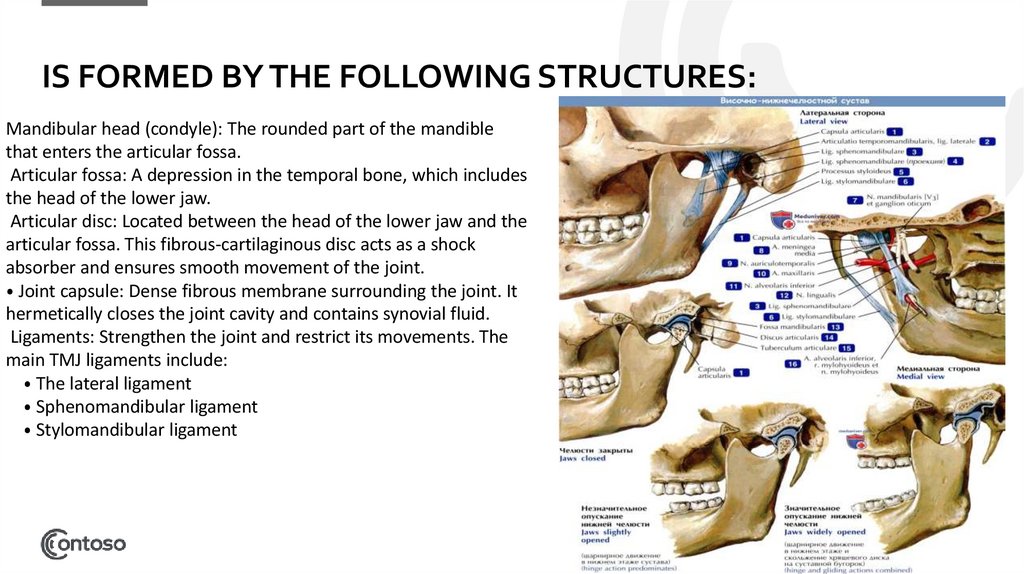
IS FORMED BY THE FOLLOWING STRUCTURES:Mandibular head (condyle): The rounded part of the mandible
that enters the articular fossa.
Articular fossa: A depression in the temporal bone, which includes
the head of the lower jaw.
Articular disc: Located between the head of the lower jaw and the
articular fossa. This fibrous-cartilaginous disc acts as a shock
absorber and ensures smooth movement of the joint.
⦁ Joint capsule: Dense fibrous membrane surrounding the joint. It
hermetically closes the joint cavity and contains synovial fluid.
Ligaments: Strengthen the joint and restrict its movements. The
main TMJ ligaments include:
⦁ The lateral ligament
⦁ Sphenomandibular ligament
⦁ Stylomandibular ligament
3
4.
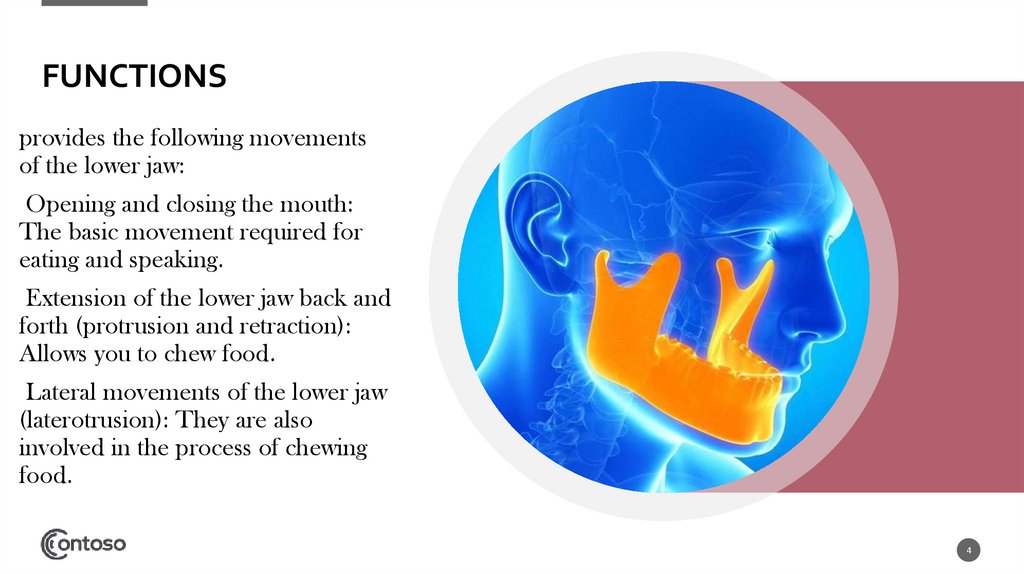
FUNCTIONSprovides the following movements
of the lower jaw:
Opening and closing the mouth:
The basic movement required for
eating and speaking.
Extension of the lower jaw back and
forth (protrusion and retraction):
Allows you to chew food.
Lateral movements of the lower jaw
(laterotrusion): They are also
involved in the process of chewing
food.
4
5.
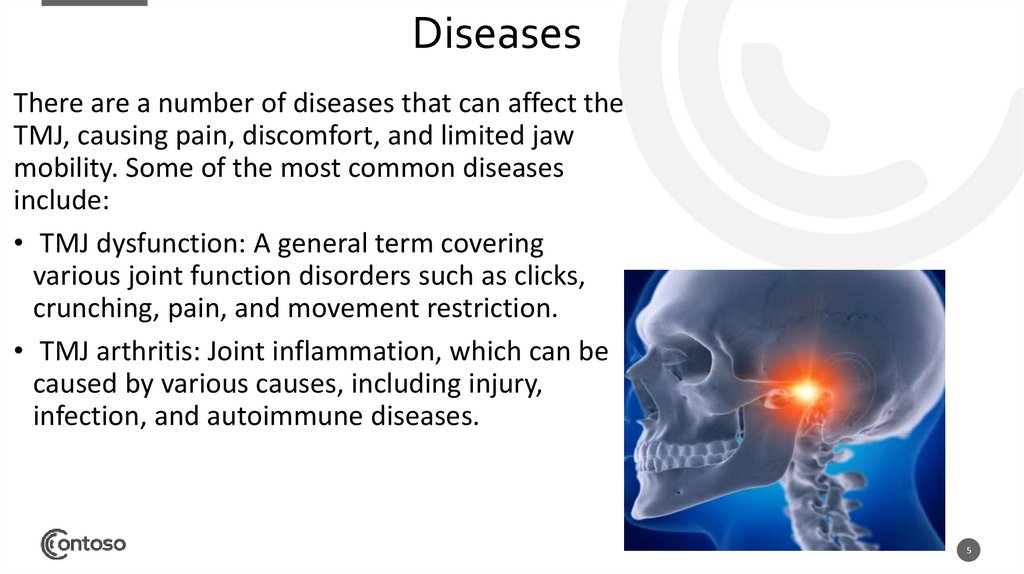
DiseasesThere are a number of diseases that can affect the
TMJ, causing pain, discomfort, and limited jaw
mobility. Some of the most common diseases
include:
• TMJ dysfunction: A general term covering
various joint function disorders such as clicks,
crunching, pain, and movement restriction.
• TMJ arthritis: Joint inflammation, which can be
caused by various causes, including injury,
infection, and autoimmune diseases.
5
6.
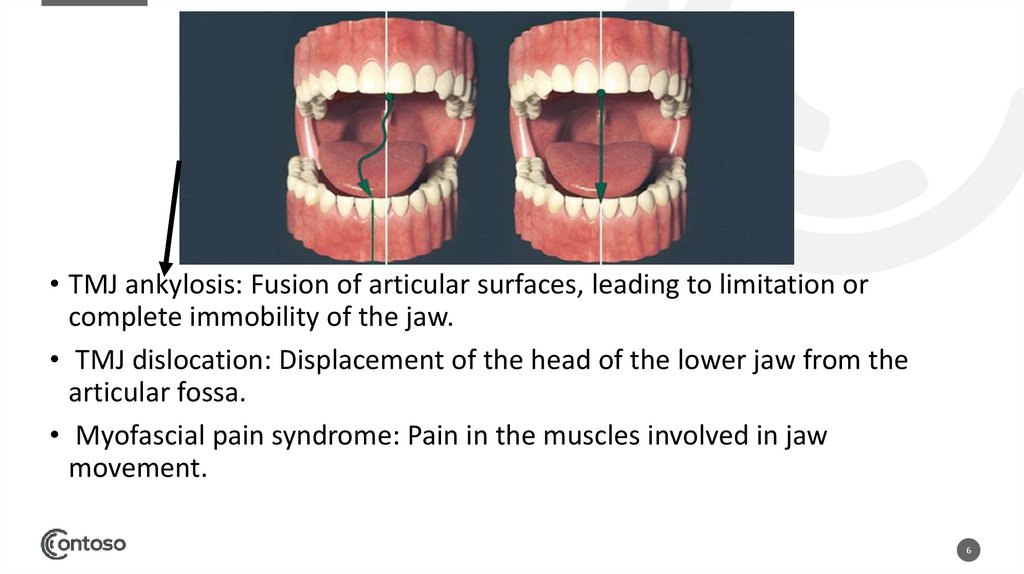
• TMJ ankylosis: Fusion of articular surfaces, leading to limitation orcomplete immobility of the jaw.
• TMJ dislocation: Displacement of the head of the lower jaw from the
articular fossa.
• Myofascial pain syndrome: Pain in the muscles involved in jaw
movement.
6
7.
Diagnosis of TMJ diseases:• Physical examination: The doctor will examine the joint and assess its
mobility.
• Radiography: Allows you to visualize the bone structures of the joint.
• Computed tomography (CT) or magnetic resonance imaging (MRI): They
may be necessary for a more detailed examination of the joint.
7
8.
89.
TREATMENT OF TMJ DISEASES:Conservative treatment: Medication, physical therapy, wearing
mouth guards.
Surgical treatment: In some cases, surgical intervention may be
required.
9
10.
THANK YOU FOR YOURATTENTION