


 mathematics
Similar presentations:




Теорія ймовірностей та математична статистика
1. PROBABILITY THEORY AND MATHEMATICAL STATISTICS
PhD Misiura Ie.Iu. (доцентМісюра Є.Ю.)
1
2. ТЕОРІЯ ЙМОВІРНОСТЕЙ ТА МАТЕМАТИЧНА СТАТИСТИКА
PhD Misiura Ie.Iu. (доцентМісюра Є.Ю.)
2
3. Theme 1 (part 1). Empirical and logical bases of probability theory / Емпіричні та логічні основи теорії ймовірностей
PhD Misiura Ie.Iu. (доцент Місюра Є.Ю.)Theme 1 (part 1).
Empirical and logical bases of
probability theory /
Емпіричні та логічні основи
теорії ймовірностей
3
4. BASIC NOTIONS OF PROBABILITY THEORY
PhD Misiura Ie.Iu. (доцентМісюра Є.Ю.)
4
5. A subject of probability theory
• Probability theory is the branch of mathematics whichstudies properties, laws and the analysis of mass random
phenomena. The basic objects of probability theory are
random variables, stochastic process and random events.
In practice we often deal with random events, i.e. with
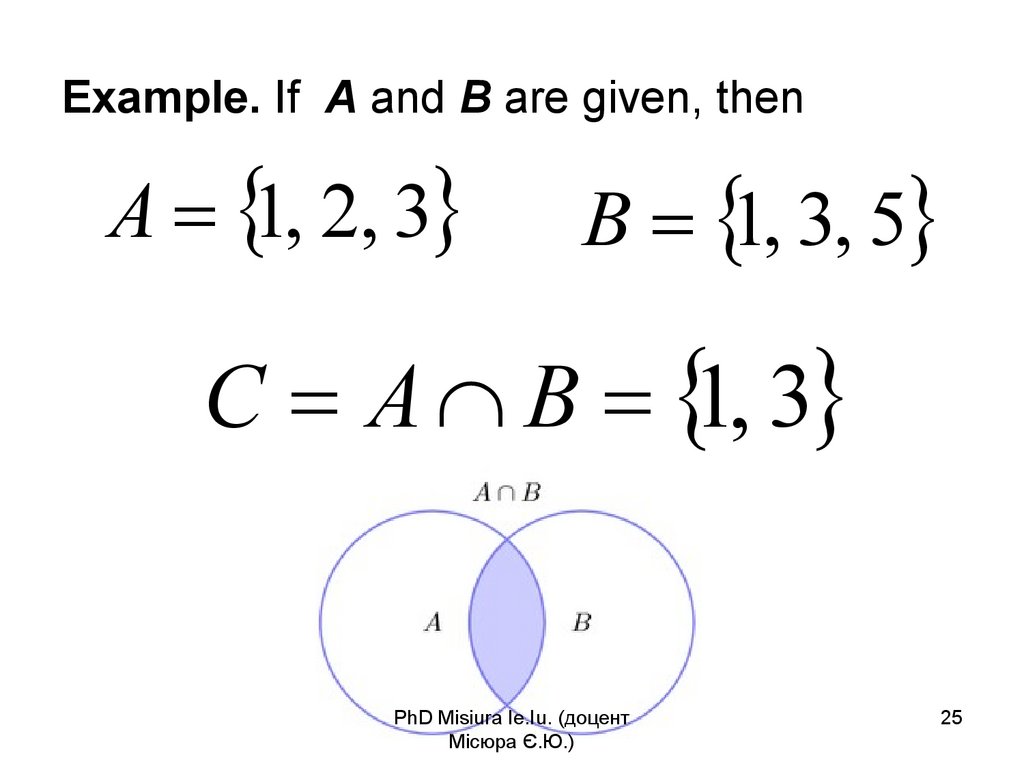
events which can occur or can’t occur under definite
conditions which can’t be analyzed by direct computations.
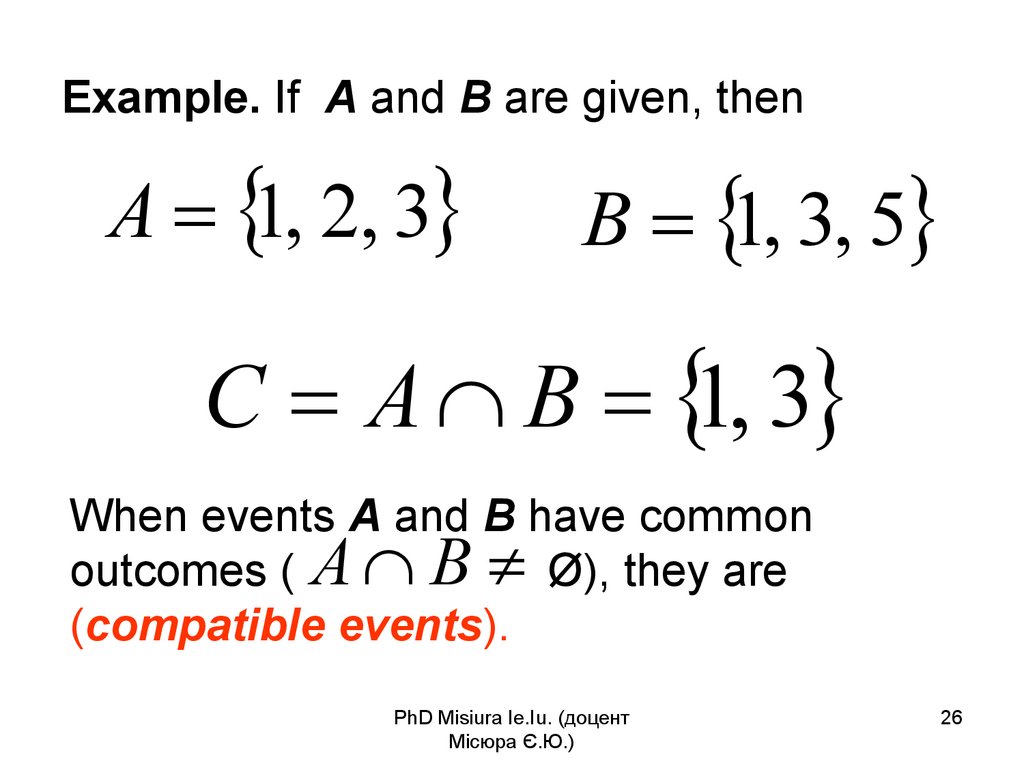
Analysis of quantitative laws which can be described by
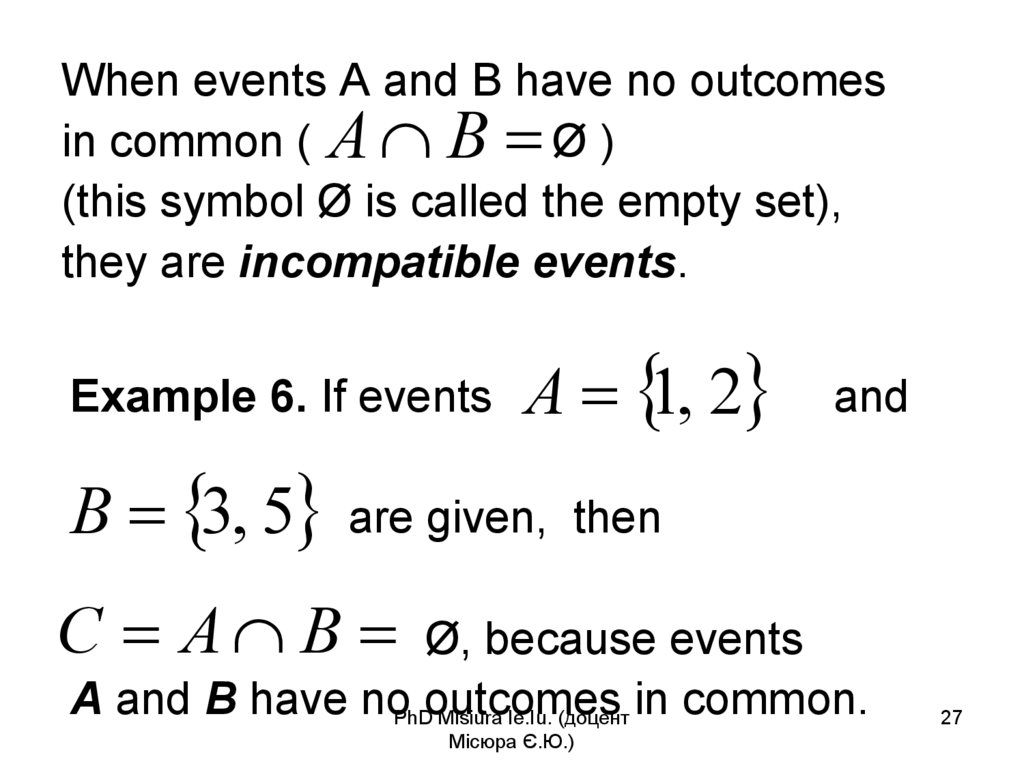
mass random phenomena is the subject of probability
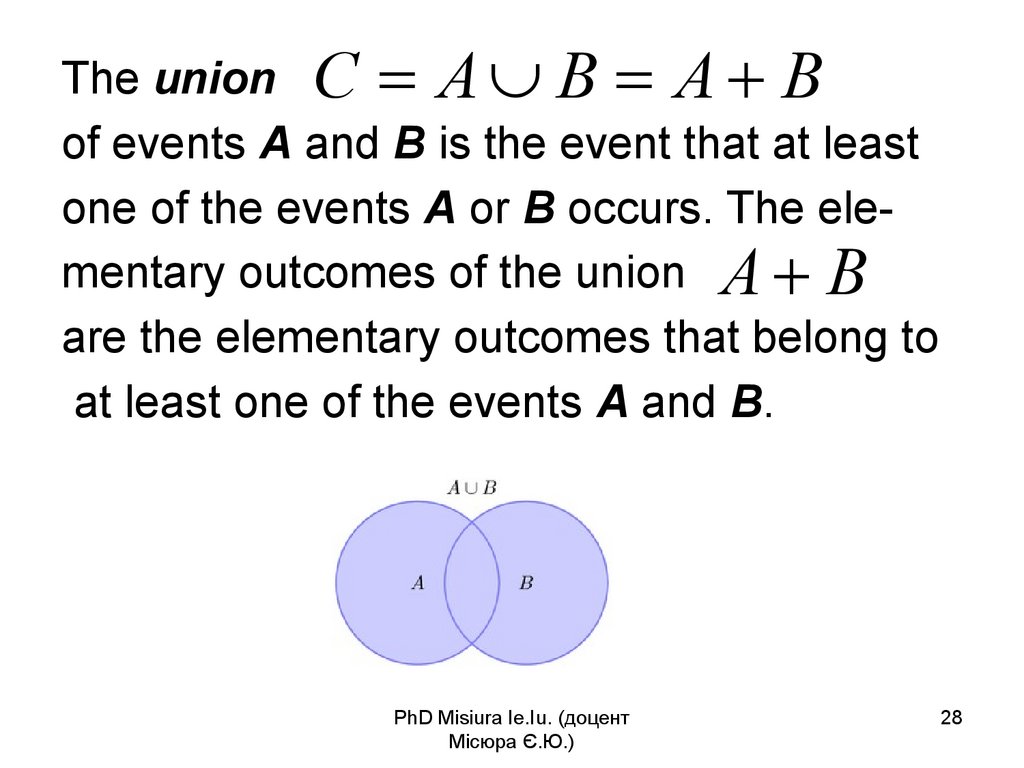
theory.
• Probability theory plays an important role in everyday life
in economics, in business, in trade on financial markets, in
risk assessment and many other areas where statistics is
applied to the real world.
PhD Misiura Ie.Iu. (доцент
Місюра Є.Ю.)
5
6. Let’s consider the fundamental concepts of probability theory.
• An experiment is a repeatable processthat gives rise to a number of outcomes.
• An outcome is something that follows as
a result or consequence.
• An event is a collection (or set) of one or
more outcomes.
PhD Misiura Ie.Iu. (доцент
Місюра Є.Ю.)
6
7.
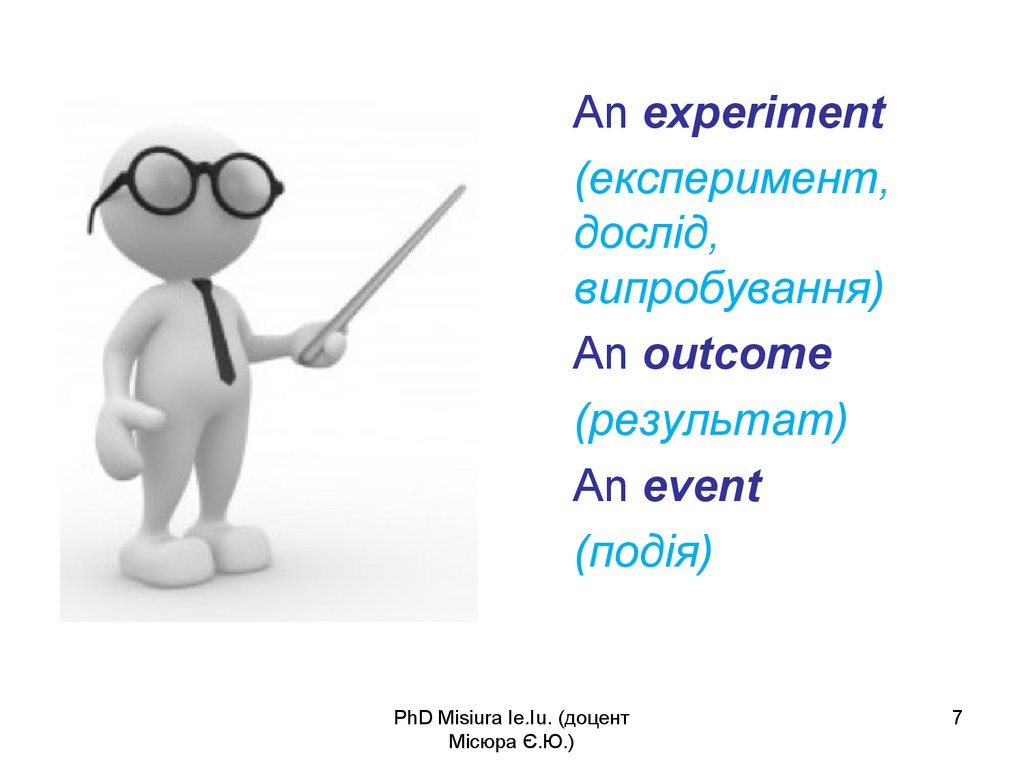
An experiment(експеримент,
дослід,
випробування)
An outcome
(результат)
An event
(подія)
PhD Misiura Ie.Iu. (доцент
Місюра Є.Ю.)
7
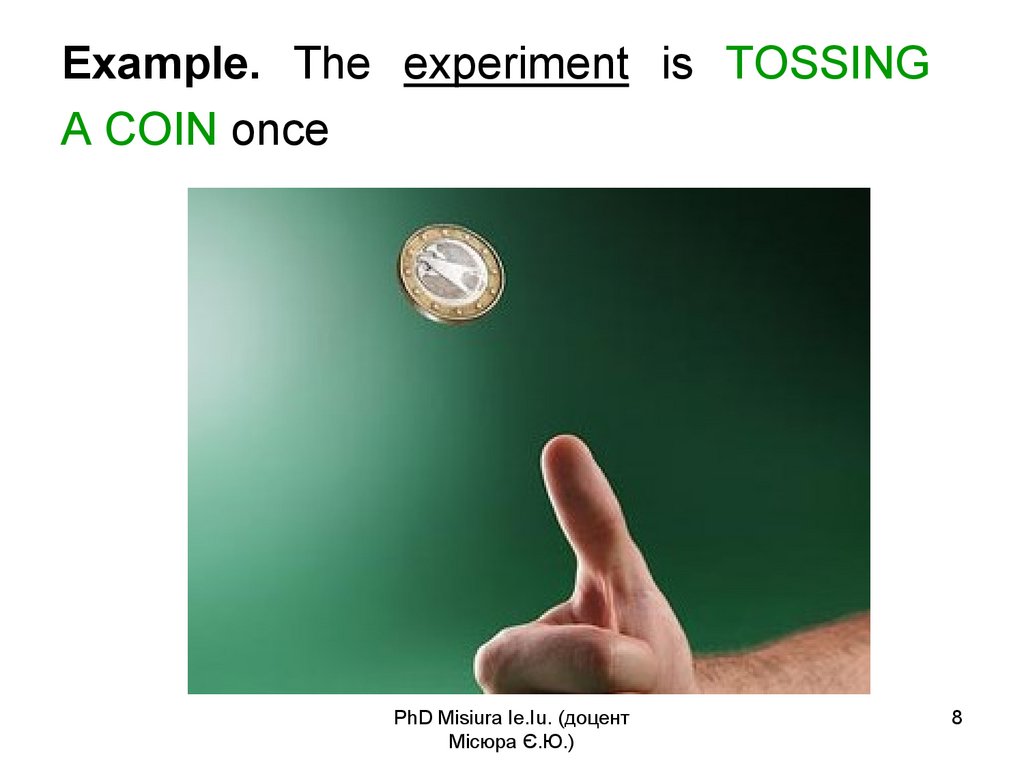
8. Example. The experiment is TOSSING A COIN once
PhD Misiura Ie.Iu. (доцентМісюра Є.Ю.)
8
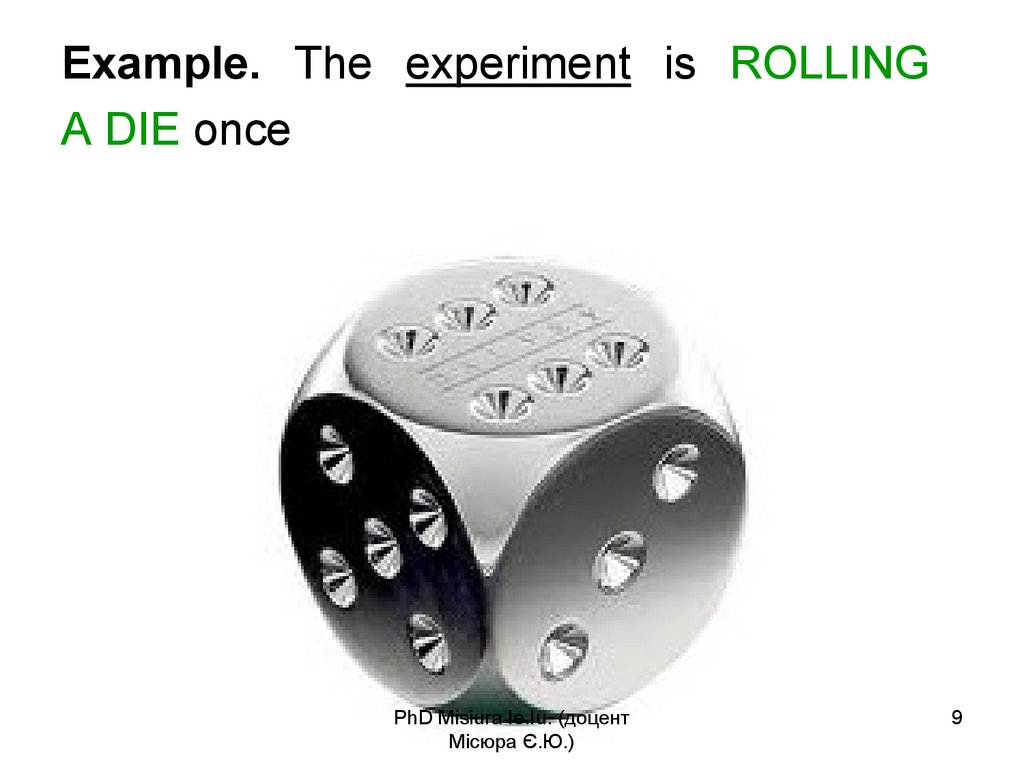
9. Example. The experiment is ROLLING A DIE once
PhD Misiura Ie.Iu. (доцентМісюра Є.Ю.)
9
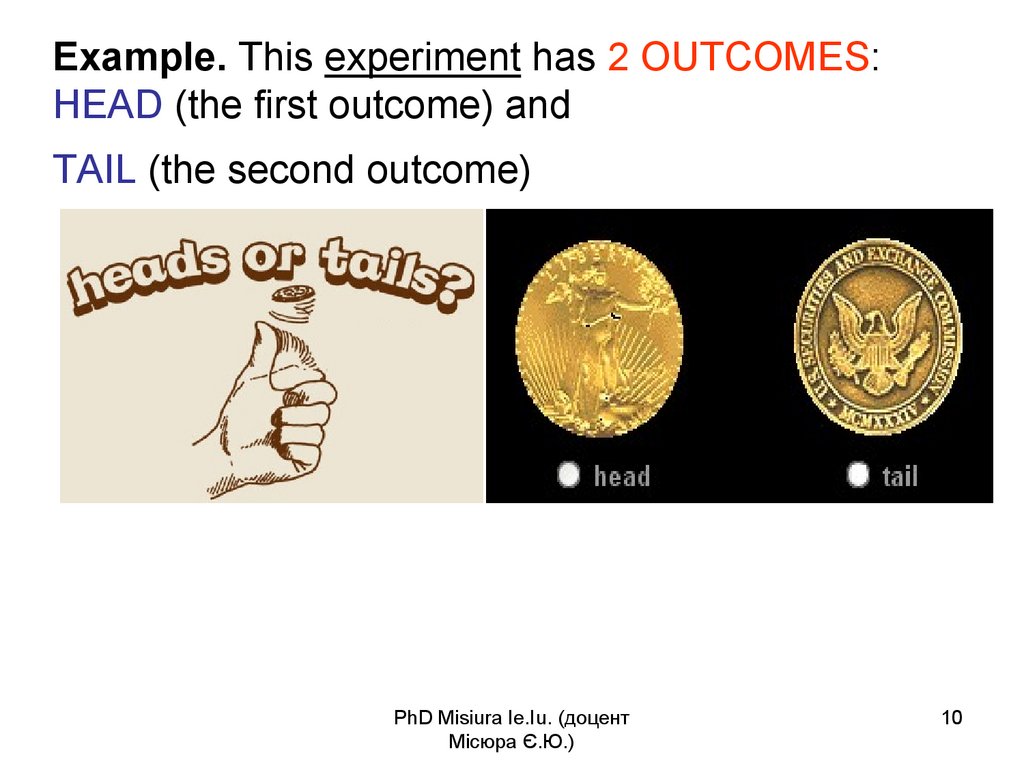
10. Example. This experiment has 2 OUTCOMES: HEAD (the first outcome) and TAIL (the second outcome)
PhD Misiura Ie.Iu. (доцентМісюра Є.Ю.)
10
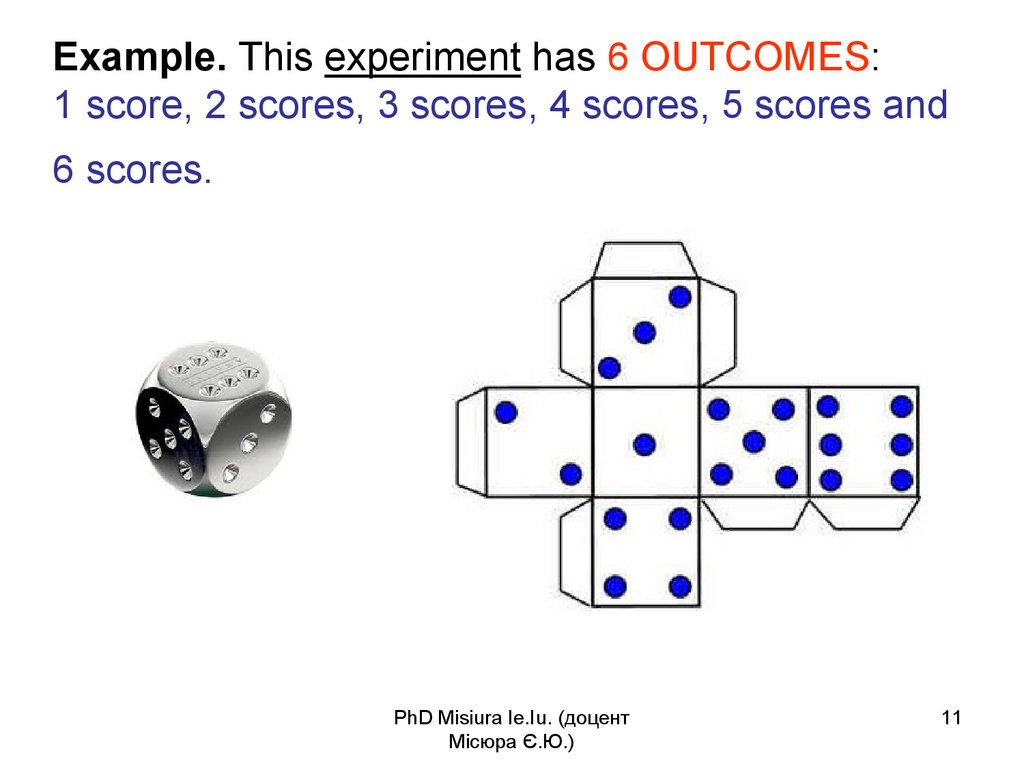
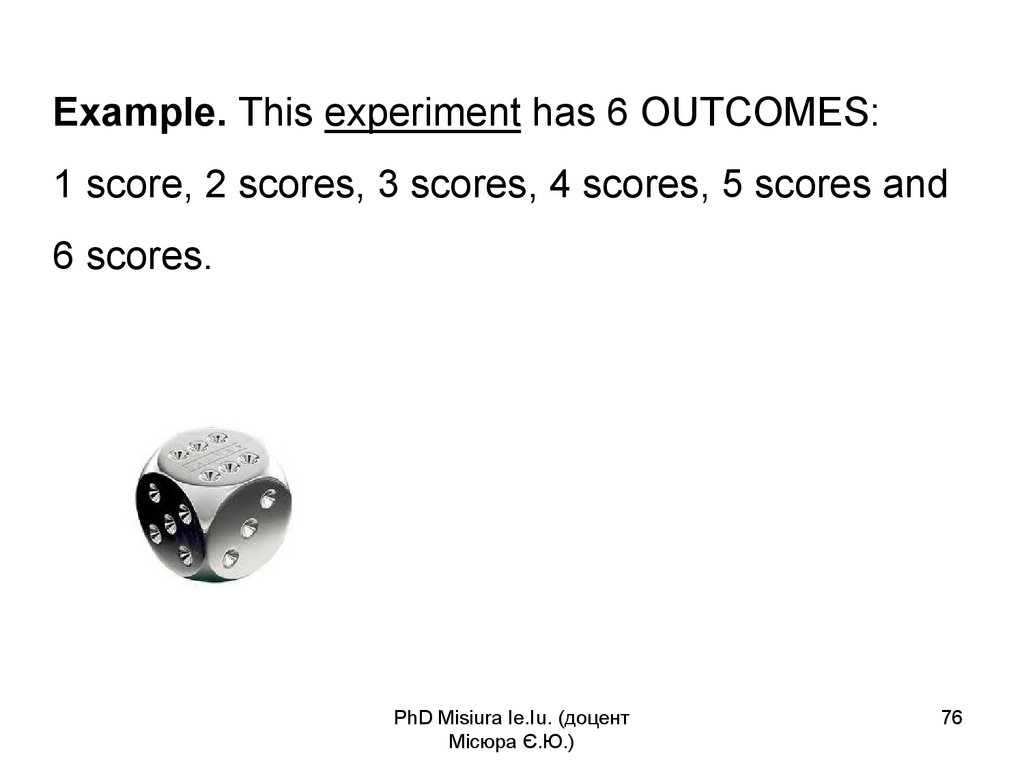
11. Example. This experiment has 6 OUTCOMES: 1 score, 2 scores, 3 scores, 4 scores, 5 scores and 6 scores.
PhD Misiura Ie.Iu. (доцентМісюра Є.Ю.)
11
12. Example. The event is getting “HEAD”.
PhD Misiura Ie.Iu. (доцентМісюра Є.Ю.)
12
13. Question 1
Which of the following is an outcome?1)Rolling a pair of dice.
2)Landing on red.
3) Choosing 2 marbles from a jar.
4) None of the above.
PhD Misiura Ie.Iu. (доцент
Місюра Є.Ю.)
13
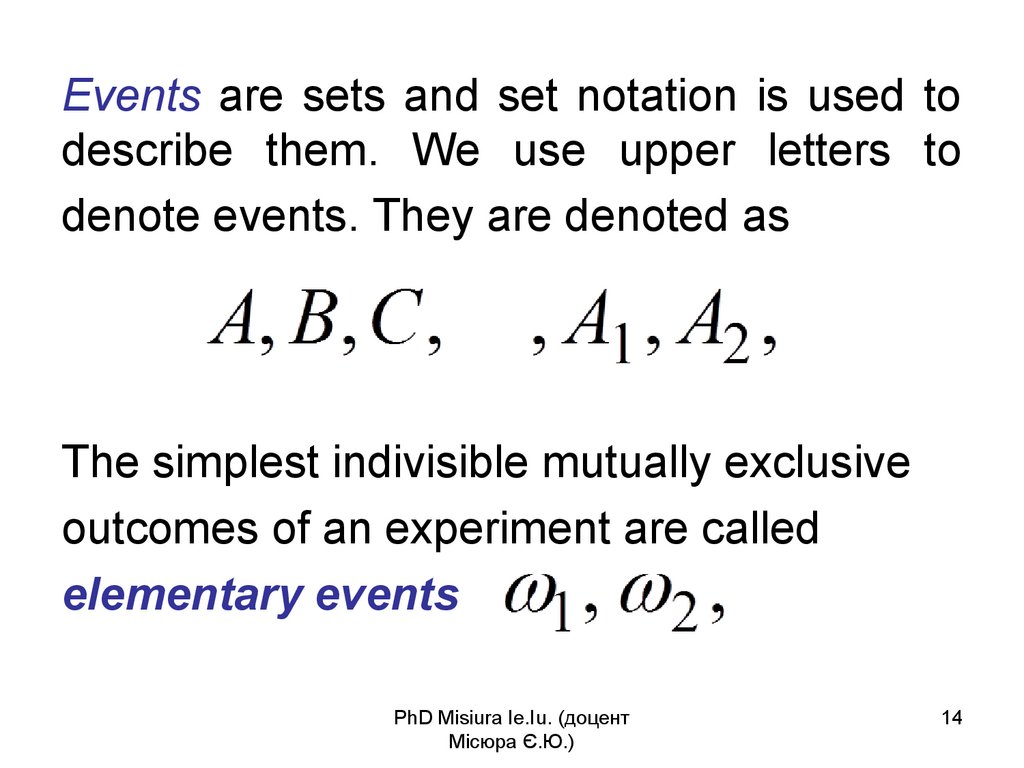
14. Events are sets and set notation is used to describe them. We use upper letters to denote events. They are denoted as
The simplest indivisible mutually exclusiveoutcomes of an experiment are called
elementary events
PhD Misiura Ie.Iu. (доцент
Місюра Є.Ю.)
14
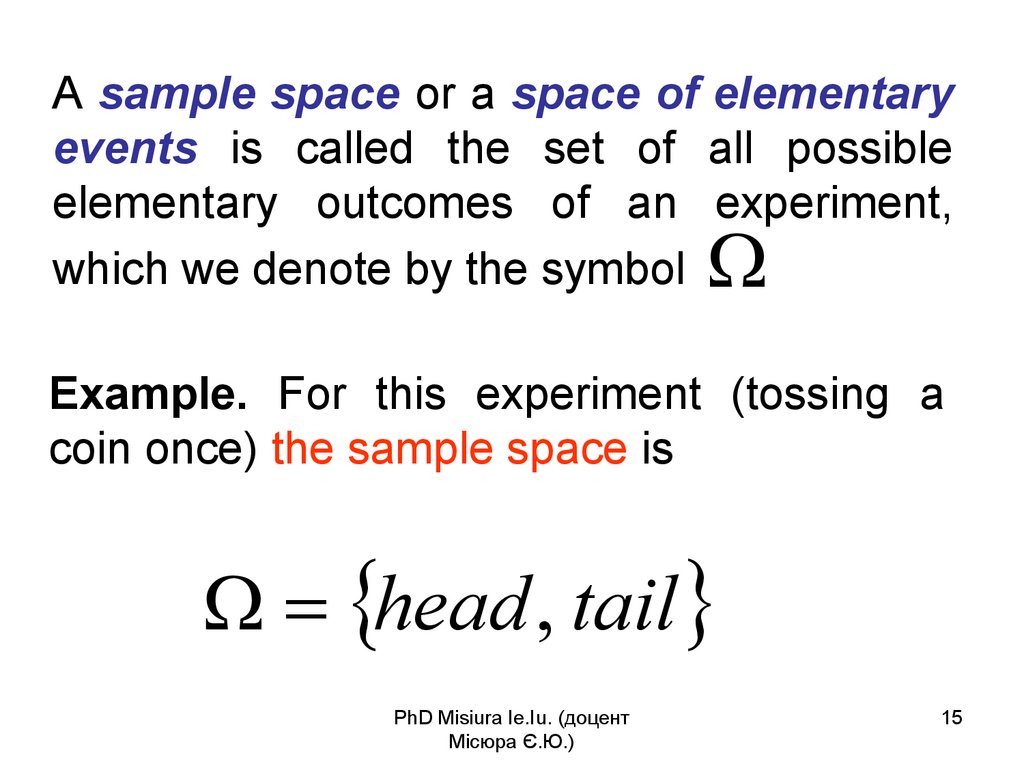
15. A sample space or a space of elementary events is called the set of all possible elementary outcomes of an experiment, which we
denote by the symbolExample. For this experiment (tossing a
coin once) the sample space is
head, tail
PhD Misiura Ie.Iu. (доцент
Місюра Є.Ю.)
15
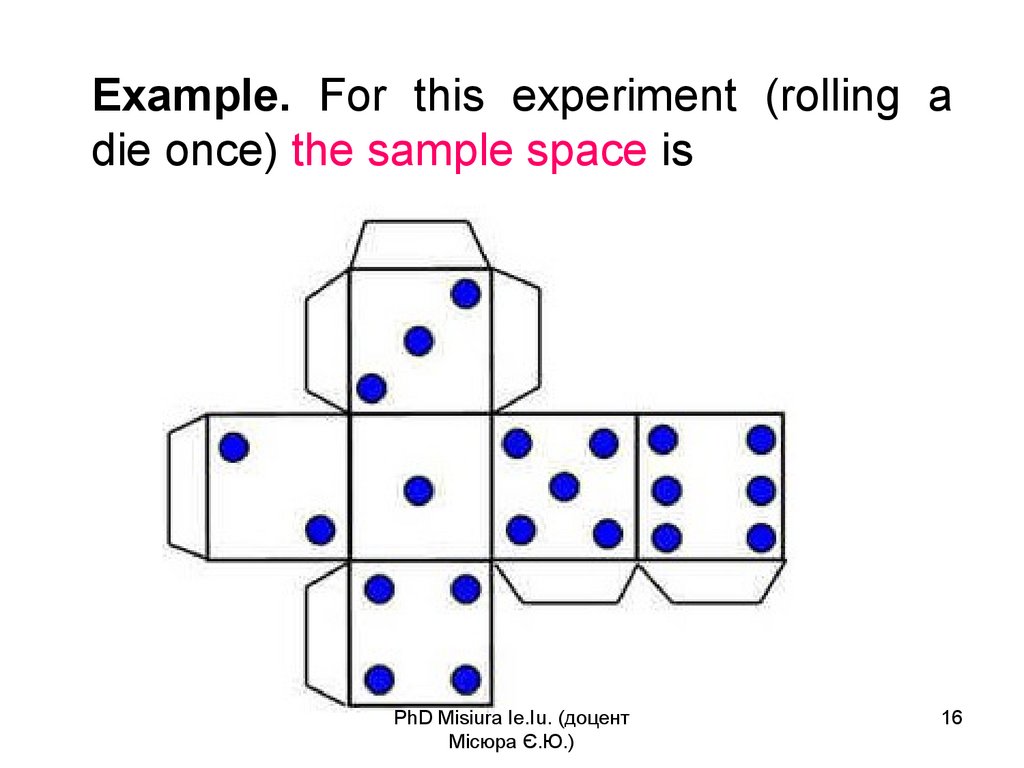
16.
Example. For this experiment (rolling adie once) the sample space is
PhD Misiura Ie.Iu. (доцент
Місюра Є.Ю.)
16
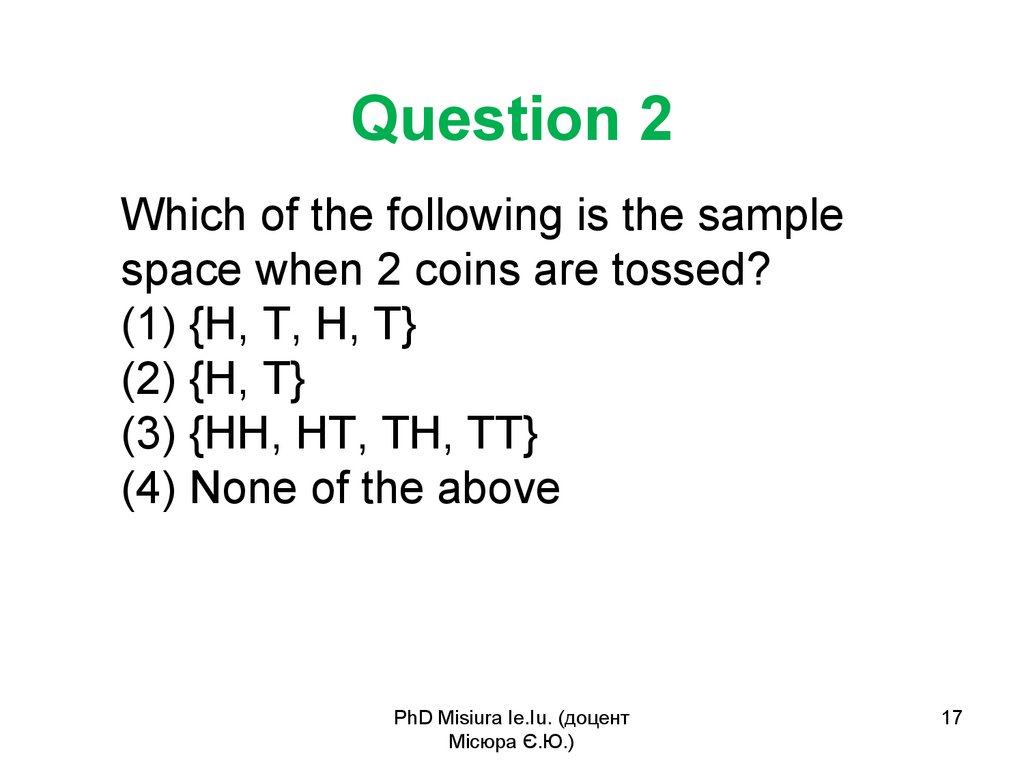
17. Question 2
Which of the following is the samplespace when 2 coins are tossed?
(1) {H, T, H, T}
(2) {H, T}
(3) {HH, HT, TH, TT}
(4) None of the above
PhD Misiura Ie.Iu. (доцент
Місюра Є.Ю.)
17
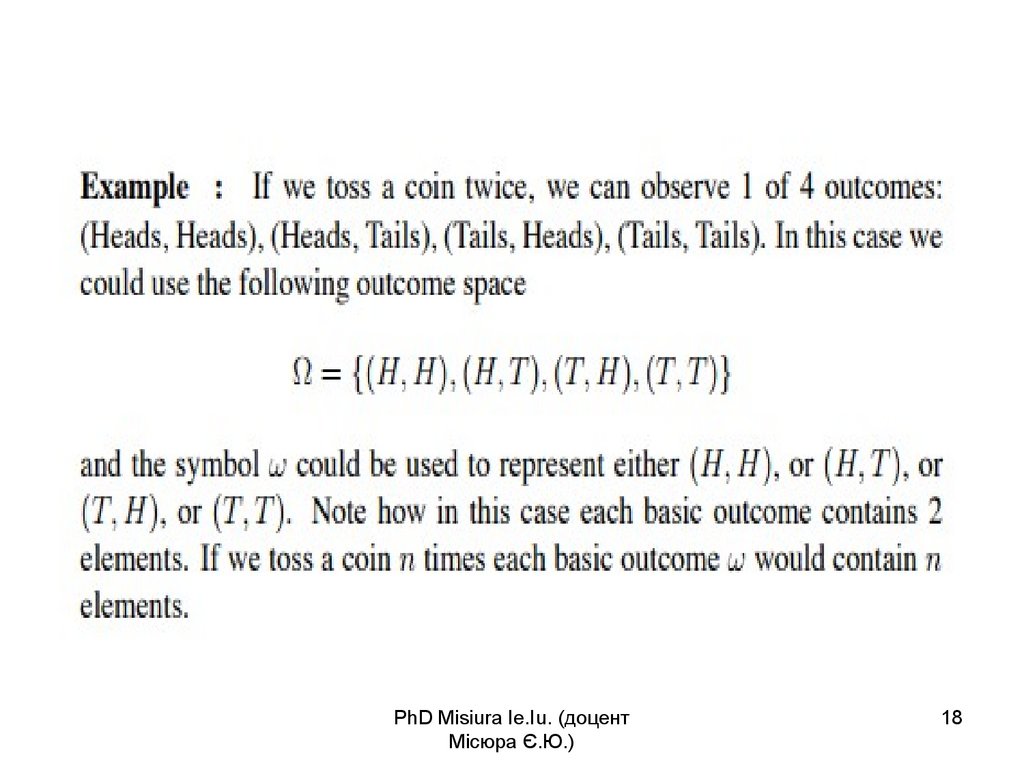
18.
PhD Misiura Ie.Iu. (доцентМісюра Є.Ю.)
18
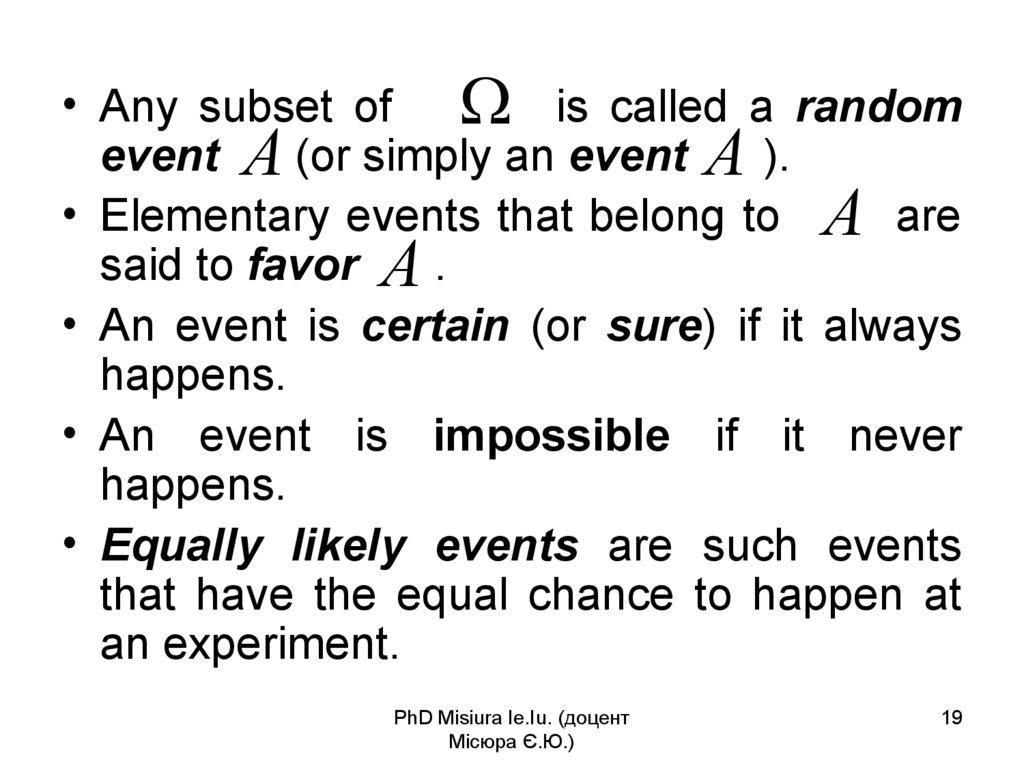
19.
• Any subset of is called a randomevent A (or simply an event A ).
• Elementary events that belong to A are
said to favor A .
• An event is certain (or sure) if it always
happens.
• An event is impossible if it never
happens.
• Equally likely events are such events
that have the equal chance to happen at
an experiment.
PhD Misiura Ie.Iu. (доцент
Місюра Є.Ю.)
19
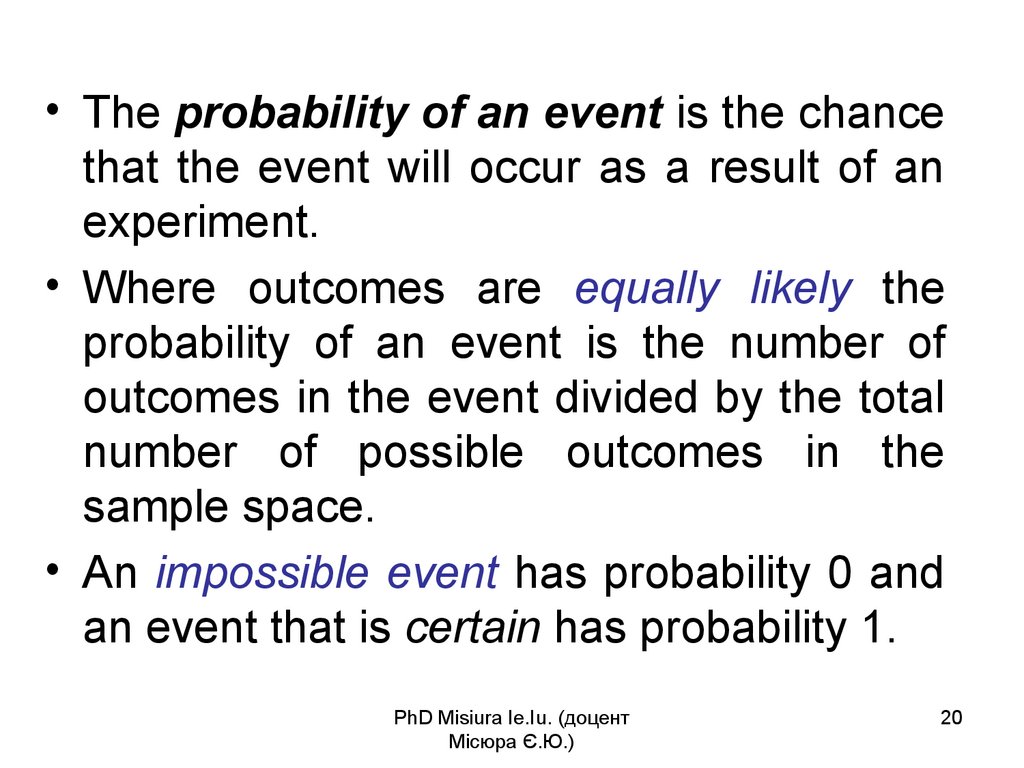
20.
• The probability of an event is the chancethat the event will occur as a result of an
experiment.
• Where outcomes are equally likely the
probability of an event is the number of
outcomes in the event divided by the total
number of possible outcomes in the
sample space.
• An impossible event has probability 0 and
an event that is certain has probability 1.
PhD Misiura Ie.Iu. (доцент
Місюра Є.Ю.)
20
21.
A space of elementary events(простір елементарних подій)
А random
подія)
event
(випадкова
A
certain
(or
sure)
(достовірна подія)
event
An impossible event (неможлива
подія)
Equally likely
можливі події)
PhD Misiura Ie.Iu. (доцент
Місюра Є.Ю.)
events
(рівно
21
22. An algebra of random events
The mathematics of probability isexpressed most naturally in terms
of sets, therefore, let’s consider
basic operations with events.
PhD Misiura Ie.Iu. (доцент
Місюра Є.Ю.)
22
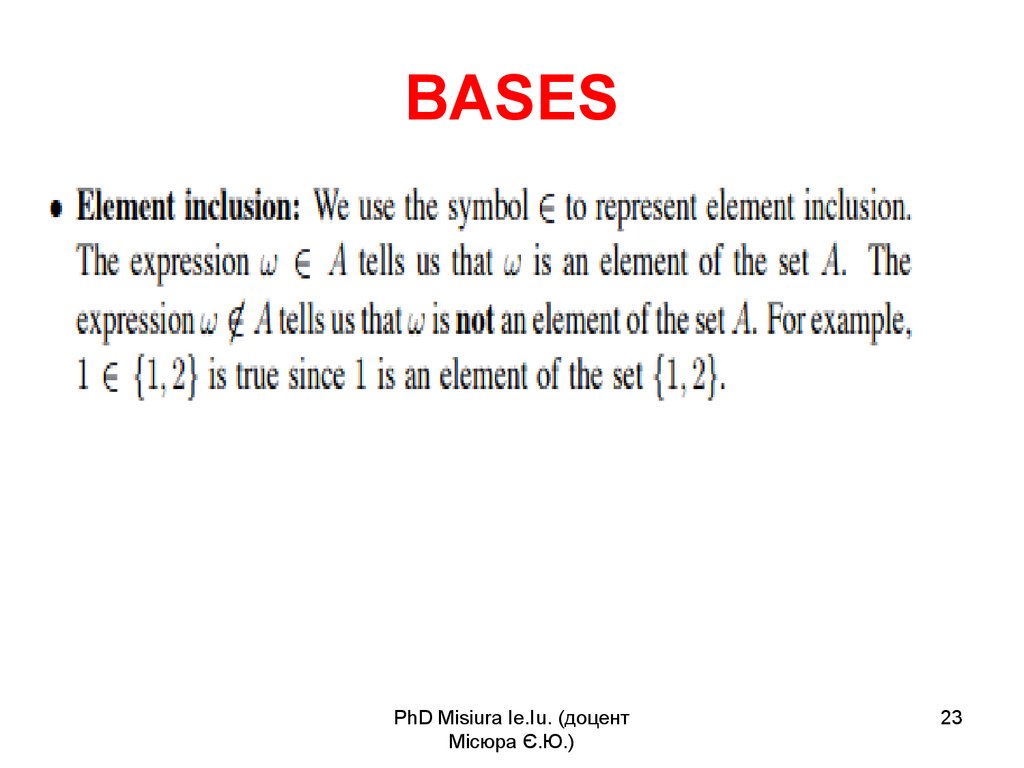
23. BASES
PhD Misiura Ie.Iu. (доцентМісюра Є.Ю.)
23
24.
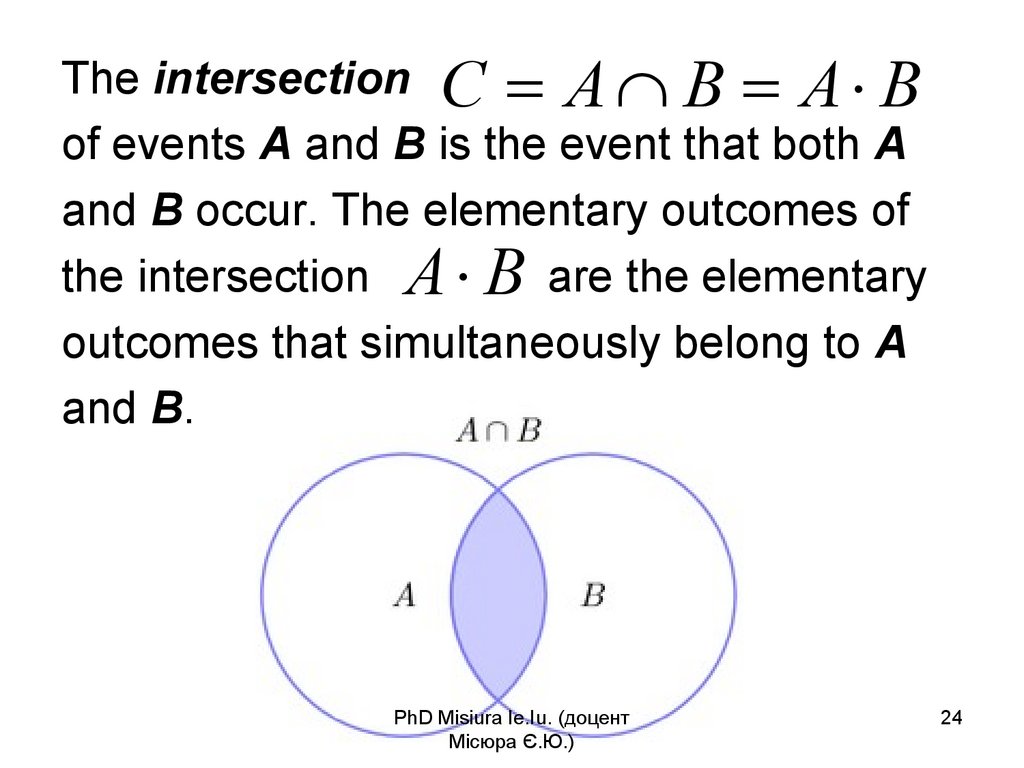
The intersection С A B A Bof events A and B is the event that both A
and B occur. The elementary outcomes of
the intersection A B are the elementary
outcomes that simultaneously belong to A
and B.
PhD Misiura Ie.Iu. (доцент
Місюра Є.Ю.)
24
25. Example. If A and B are given, then
A 1, 2, 3B 1, 3, 5
С A B 1, 3
PhD Misiura Ie.Iu. (доцент
Місюра Є.Ю.)
25
26. Example. If A and B are given, then
A 1, 2, 3B 1, 3, 5
С A B 1, 3
When events A and B have common
outcomes ( A B Ø), they are
(compatible events).
PhD Misiura Ie.Iu. (доцент
Місюра Є.Ю.)
26
27.
When events A and B have no outcomesin common ( A B Ø )
(this symbol Ø is called the empty set),
they are incompatible events.
Example 6. If events
A 1, 2
and
B 3, 5 are given, then
С A B Ø, because events
A and B have noPhDoutcomes
in common.
Misiura Ie.Iu. (доцент
Місюра Є.Ю.)
27
28.
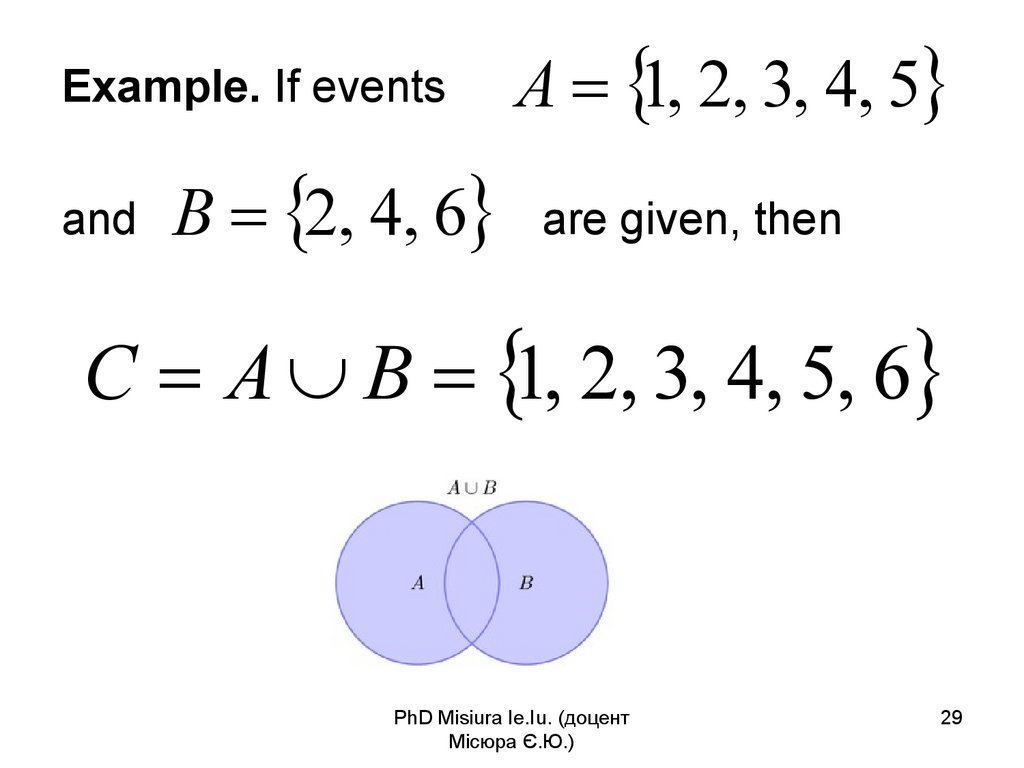
The union С A B A Bof events A and B is the event that at least
one of the events A or B occurs. The elementary outcomes of the union A B
are the elementary outcomes that belong to
at least one of the events A and B.
PhD Misiura Ie.Iu. (доцент
Місюра Є.Ю.)
28
29.
Example. If eventsand
A 1, 2, 3, 4, 5
B 2, 4, 6 are given, then
С A B 1, 2, 3, 4, 5, 6
PhD Misiura Ie.Iu. (доцент
Місюра Є.Ю.)
29
30.
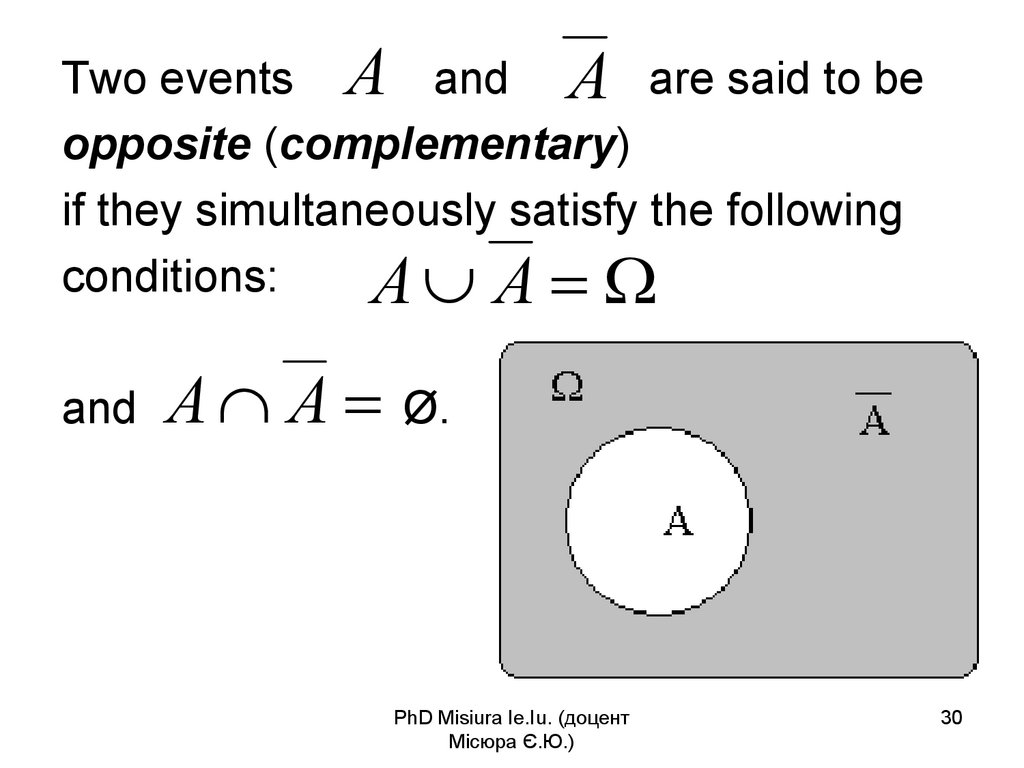
Two events A and A are said to beopposite (complementary)
if they simultaneously satisfy the following
conditions:
A A
and A A Ø.
PhD Misiura Ie.Iu. (доцент
Місюра Є.Ю.)
30
31.
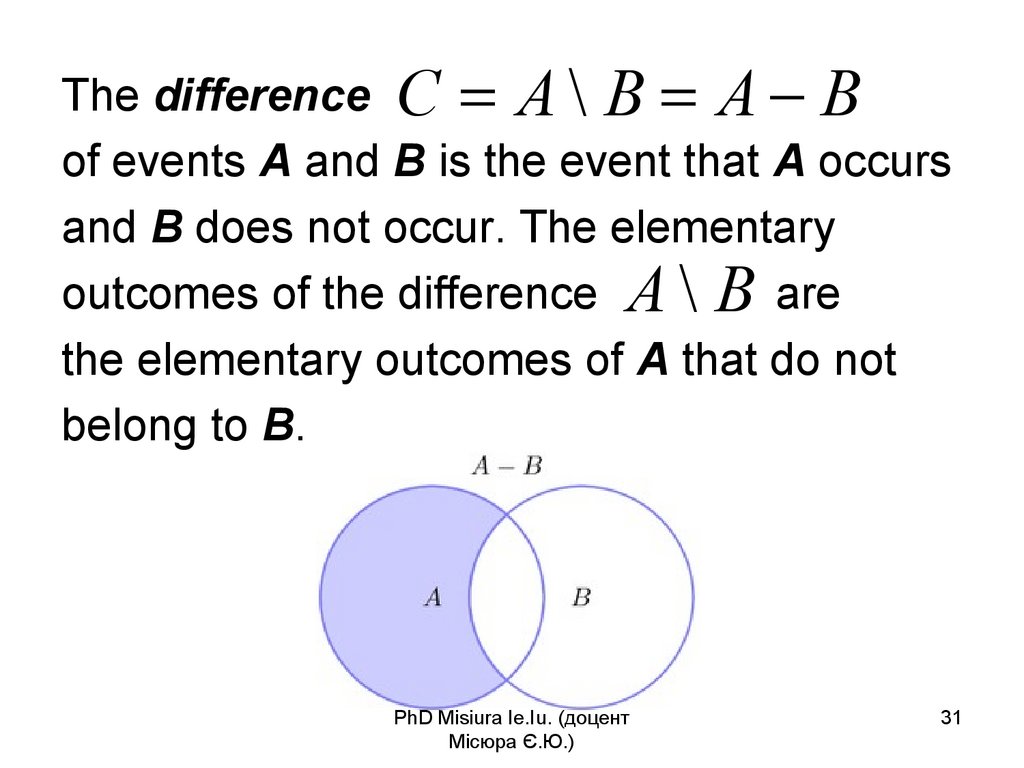
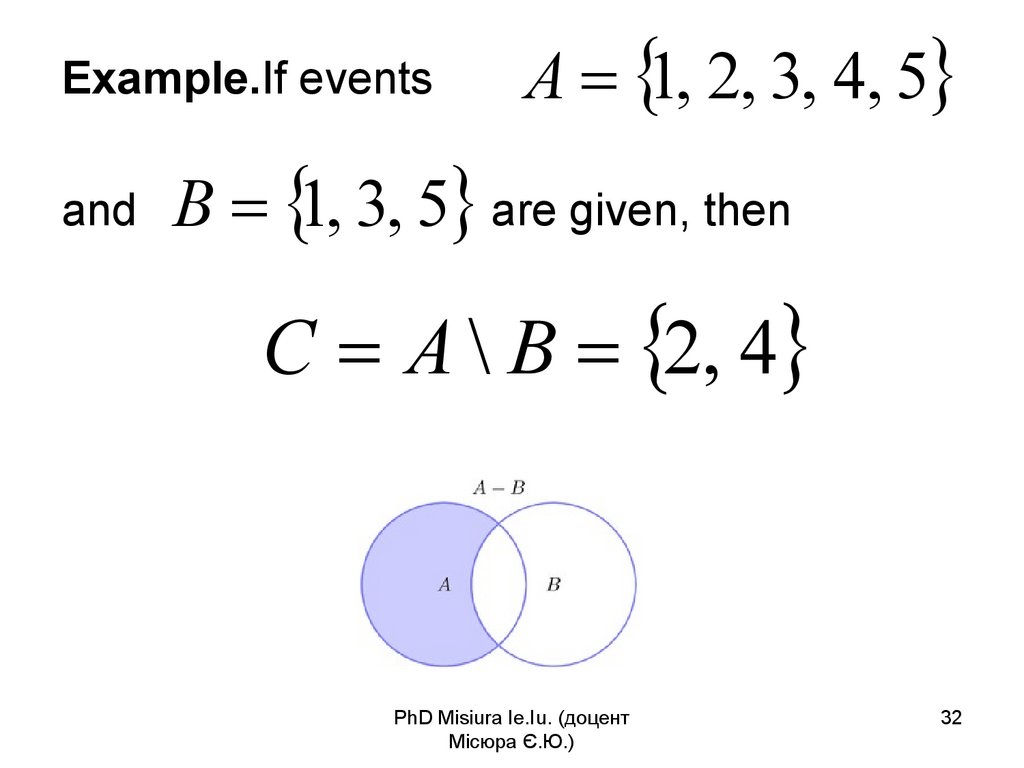
The difference С A \ B A Bof events A and B is the event that A occurs
and B does not occur. The elementary
outcomes of the difference A \ B are
the elementary outcomes of A that do not
belong to B.
PhD Misiura Ie.Iu. (доцент
Місюра Є.Ю.)
31
32.
Example.If eventsand
A 1, 2, 3, 4, 5
B 1, 3, 5 are given, then
С A \ B 2, 4
PhD Misiura Ie.Iu. (доцент
Місюра Є.Ю.)
32
33.
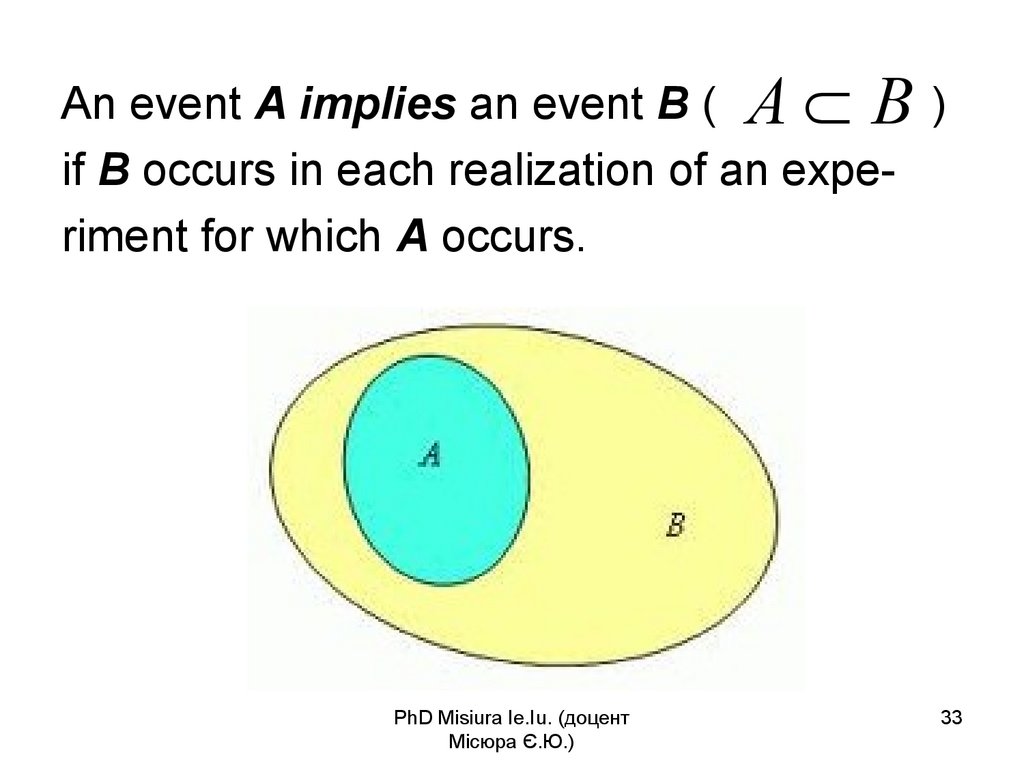
An event A implies an event B ( A B )if B occurs in each realization of an experiment for which A occurs.
PhD Misiura Ie.Iu. (доцент
Місюра Є.Ю.)
33
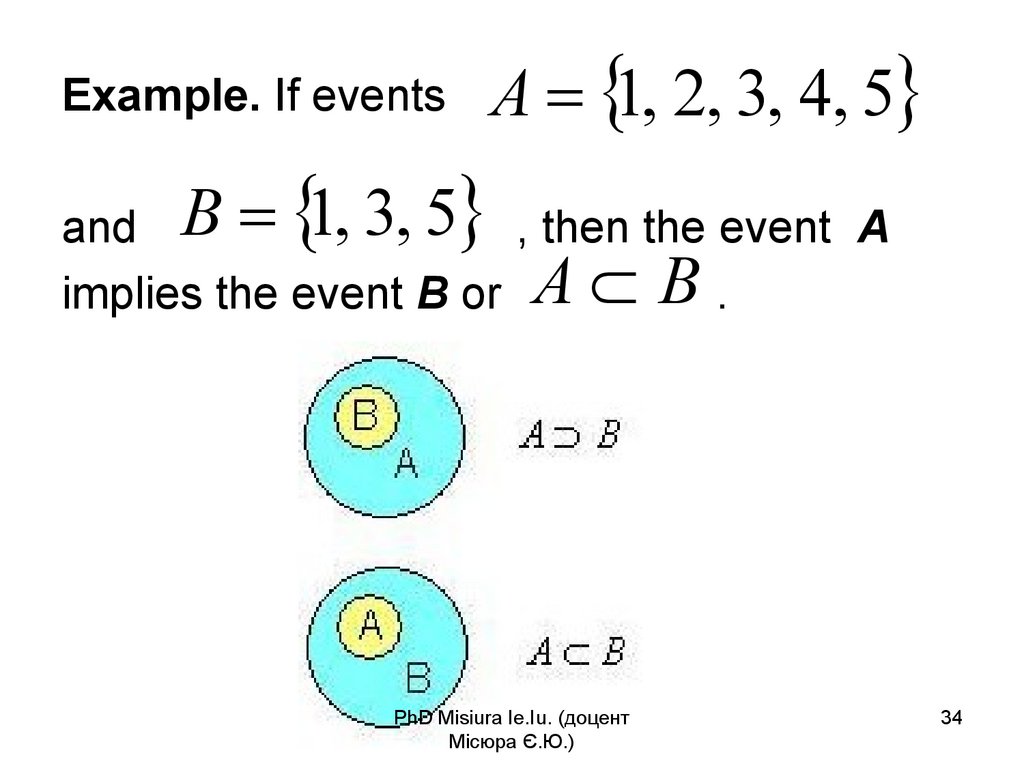
34.
A 1, 2, 3, 4, 5Example. If events
and B 1, 3, 5 , then the event A
implies the event B or A B .
PhD Misiura Ie.Iu. (доцент
Місюра Є.Ю.)
34
35.
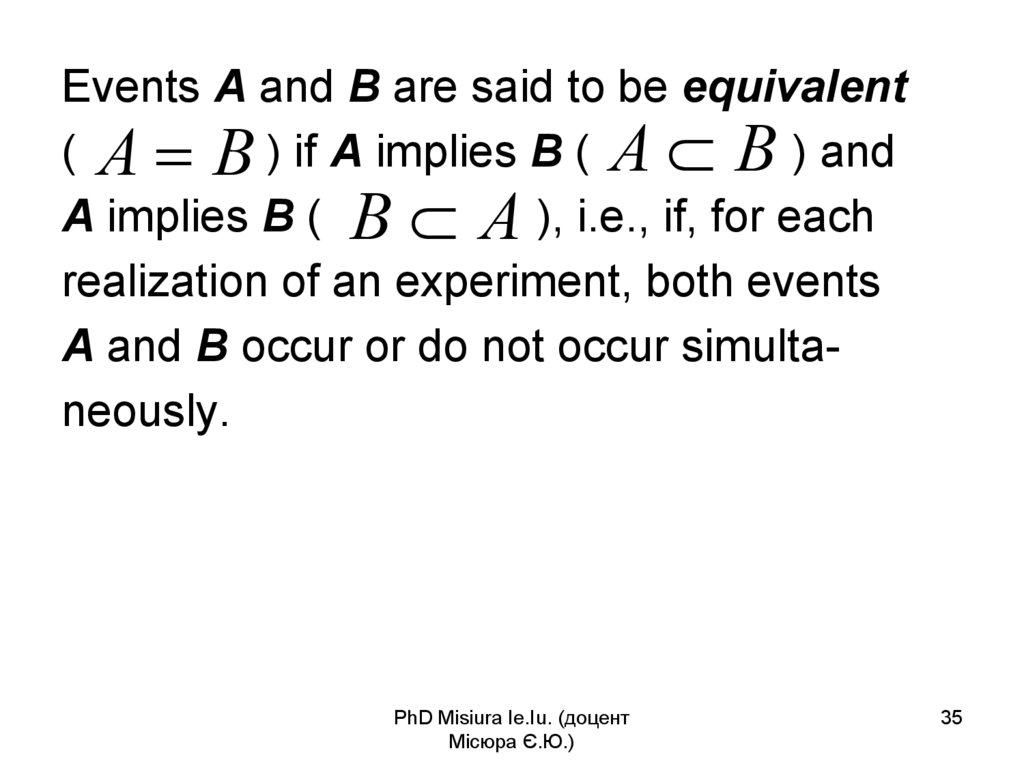
Events A and B are said to be equivalent( A B ) if A implies B ( A B ) and
A implies B ( B A ), i.e., if, for each
realization of an experiment, both events
A and B occur or do not occur simultaneously.
PhD Misiura Ie.Iu. (доцент
Місюра Є.Ю.)
35
36.
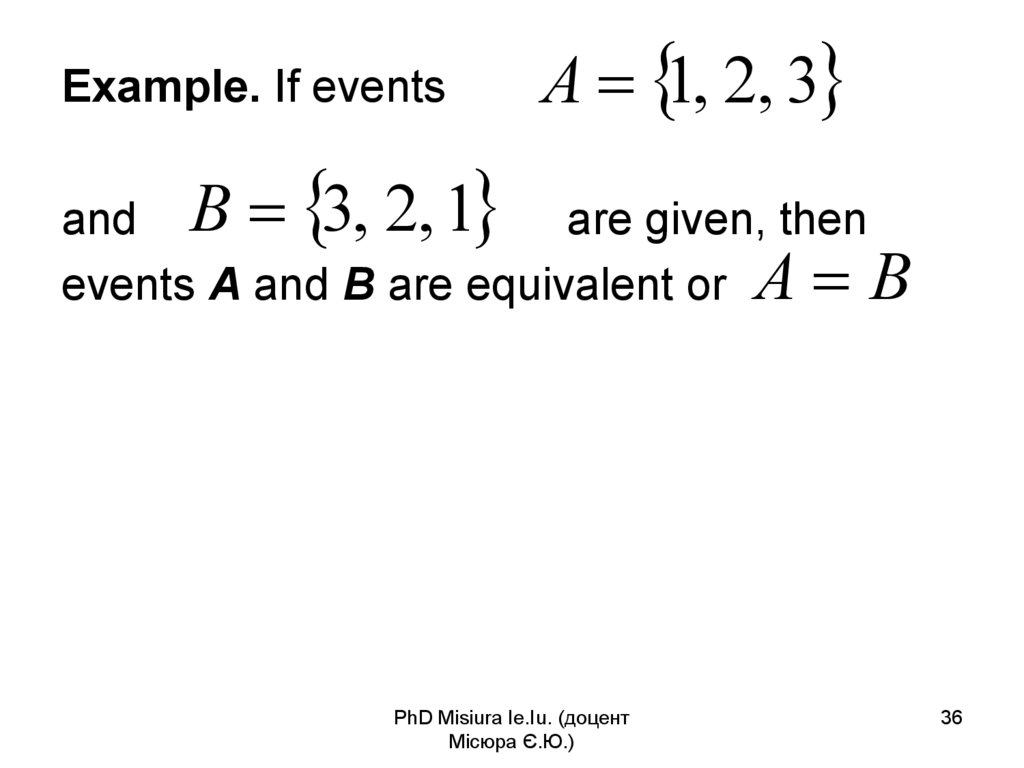
A 1, 2, 3Example. If events
and B 3, 2, 1
are given, then
events A and B are equivalent or A B
PhD Misiura Ie.Iu. (доцент
Місюра Є.Ю.)
36
37.
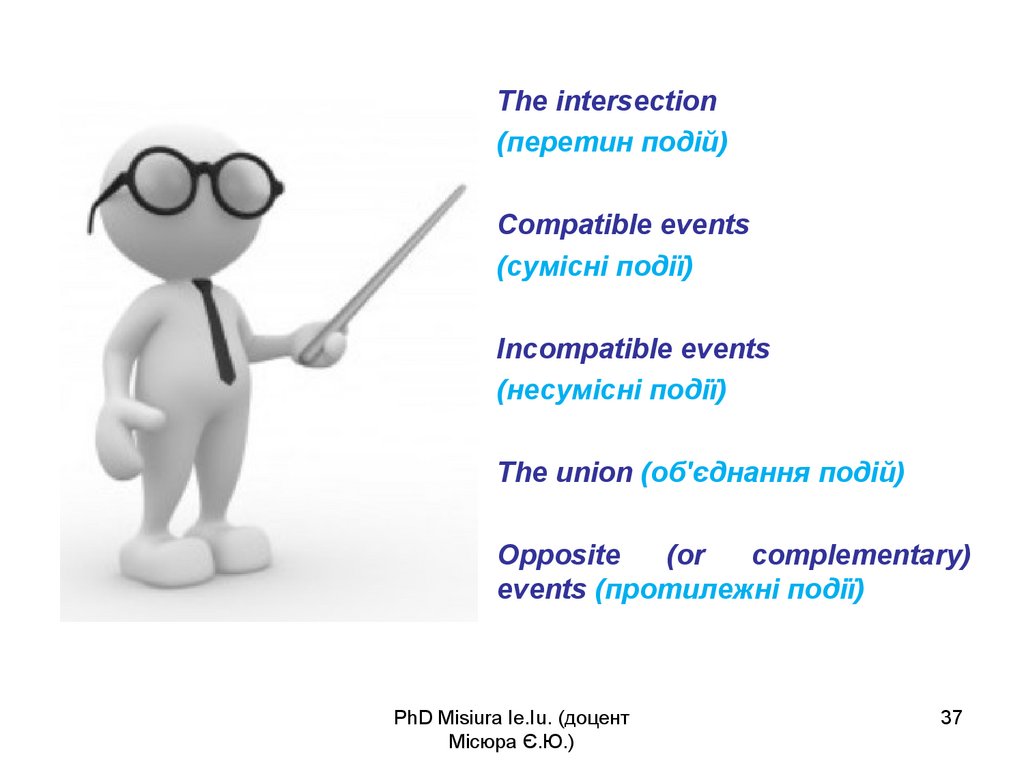
The intersection(перетин подій)
Compatible events
(сумісні події)
Incompatible events
(несумісні події)
The union (об'єднання подій)
Opposite
(or
complementary)
events (протилежні події)
PhD Misiura Ie.Iu. (доцент
Місюра Є.Ю.)
37
38. A BASIC NOTION OF A COMBINATORIAL ANALYSIS
PhD Misiura Ie.Iu. (доцентМісюра Є.Ю.)
38
39. COLLECTION OF FORMULAS OF COMBINATORICS WITHOUT REPETITIONS
PhD Misiura Ie.Iu. (доцентМісюра Є.Ю.)
39
40.
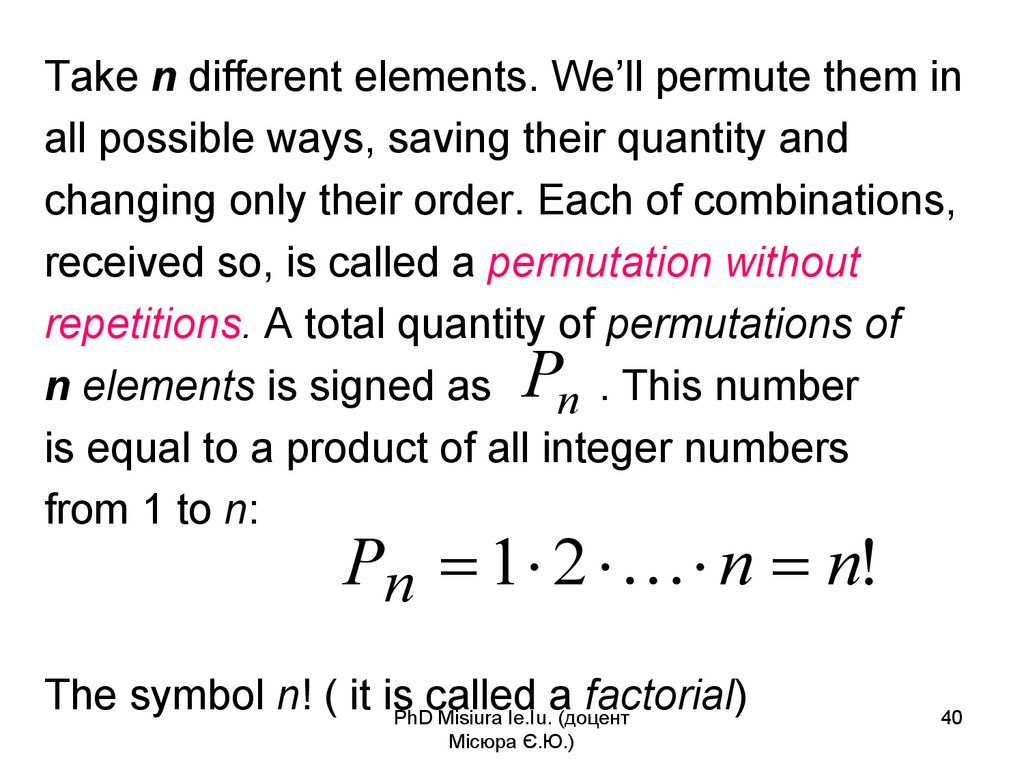
Take n different elements. We’ll permute them inall possible ways, saving their quantity and
changing only their order. Each of combinations,
received so, is called a permutation without
repetitions. A total quantity of permutations of
n elements is signed as
n . This number
is equal to a product of all integer numbers
from 1 to n:
P
Рn 1 2 n n!
The symbol n! ( it isPhDcalled
a factorial)
Misiura Ie.Iu. (доцент
Місюра Є.Ю.)
40
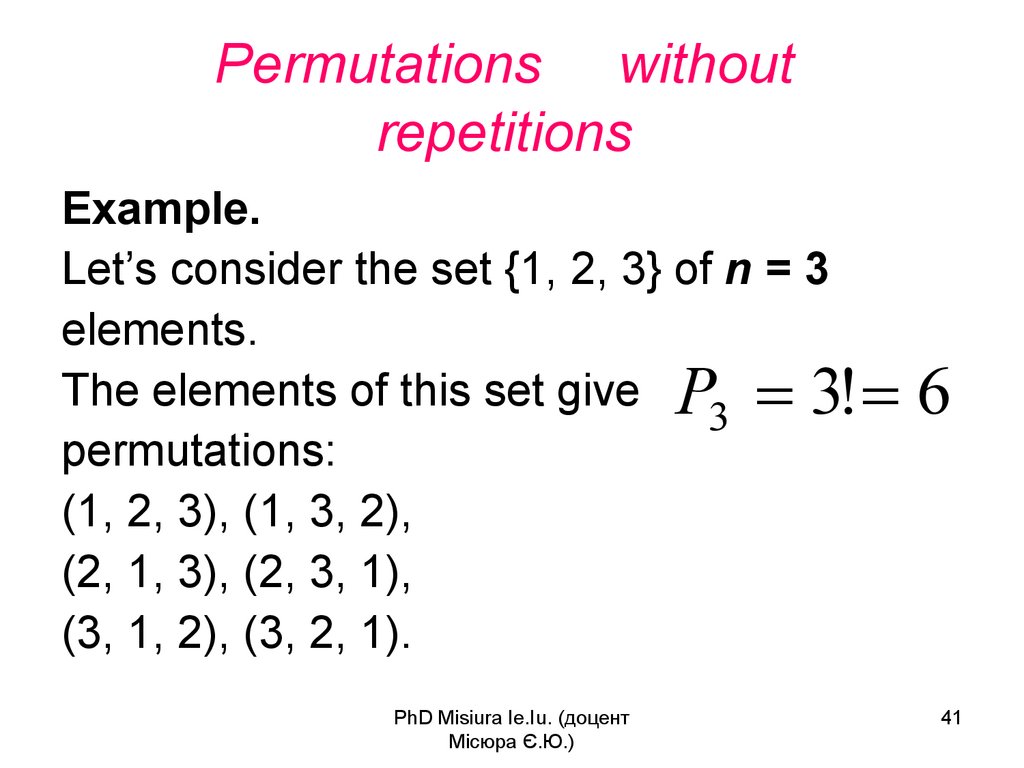
41. Permutations without repetitions
Example.Let’s consider the set {1, 2, 3} of n = 3
elements.
The elements of this set give P 3! 6
3
permutations:
(1, 2, 3), (1, 3, 2),
(2, 1, 3), (2, 3, 1),
(3, 1, 2), (3, 2, 1).
PhD Misiura Ie.Iu. (доцент
Місюра Є.Ю.)
41
42.
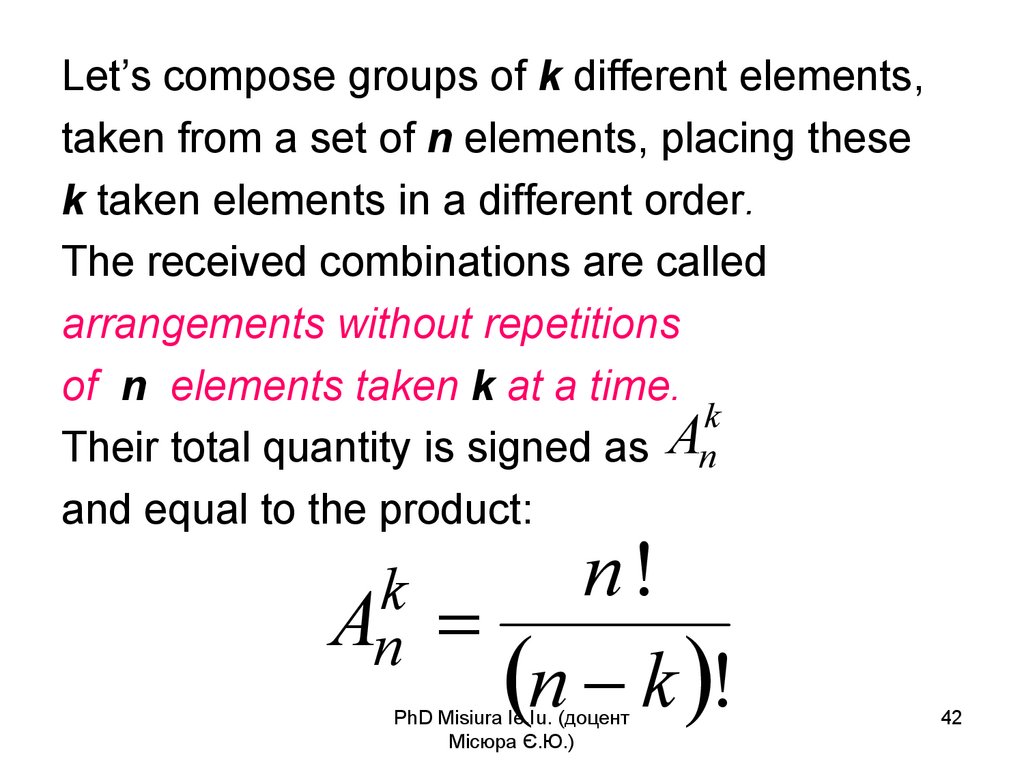
Let’s compose groups of k different elements,taken from a set of n elements, placing these
k taken elements in a different order.
The received combinations are called
arrangements without repetitions
of n elements taken k at a time.
k
Their total quantity is signed as An
and equal to the product:
k
Аn
n!
n k !
PhD Misiura Ie.Iu. (доцент
Місюра Є.Ю.)
42
43. Arrangements without repetitions of n elements taken k at a time
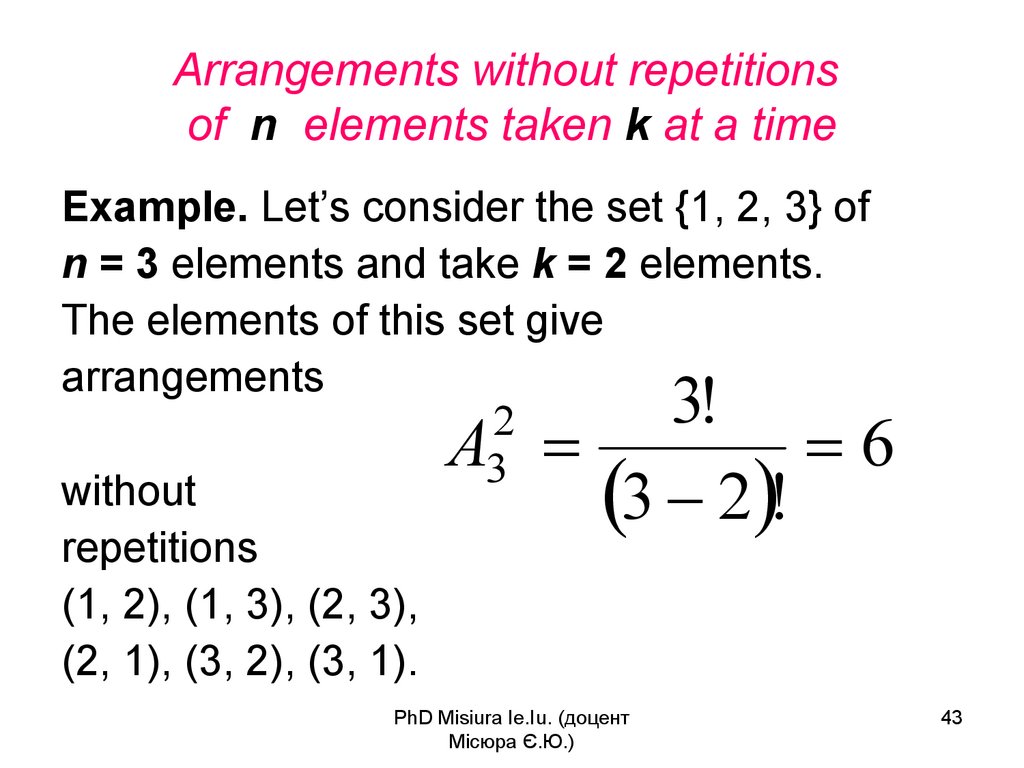
Arrangements without repetitionsof n elements taken k at a time
Example. Let’s consider the set {1, 2, 3} of
n = 3 elements and take k = 2 elements.
The elements of this set give
arrangements
2
3
without
repetitions
(1, 2), (1, 3), (2, 3),
(2, 1), (3, 2), (3, 1).
3!
A
6
3 2 !
PhD Misiura Ie.Iu. (доцент
Місюра Є.Ю.)
43
44.
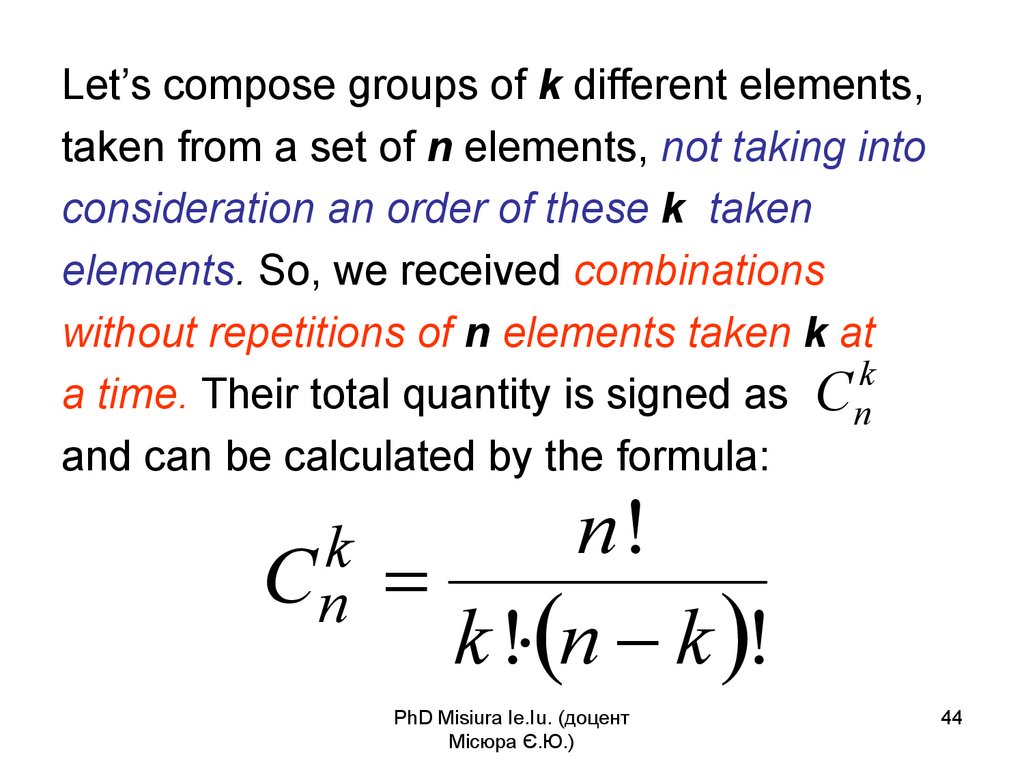
Let’s compose groups of k different elements,taken from a set of n elements, not taking into
consideration an order of these k taken
elements. So, we received combinations
without repetitions of n elements taken k at
k
a time. Their total quantity is signed as Сn
and can be calculated by the formula:
k
Сn
n!
k ! n k !
PhD Misiura Ie.Iu. (доцент
Місюра Є.Ю.)
44
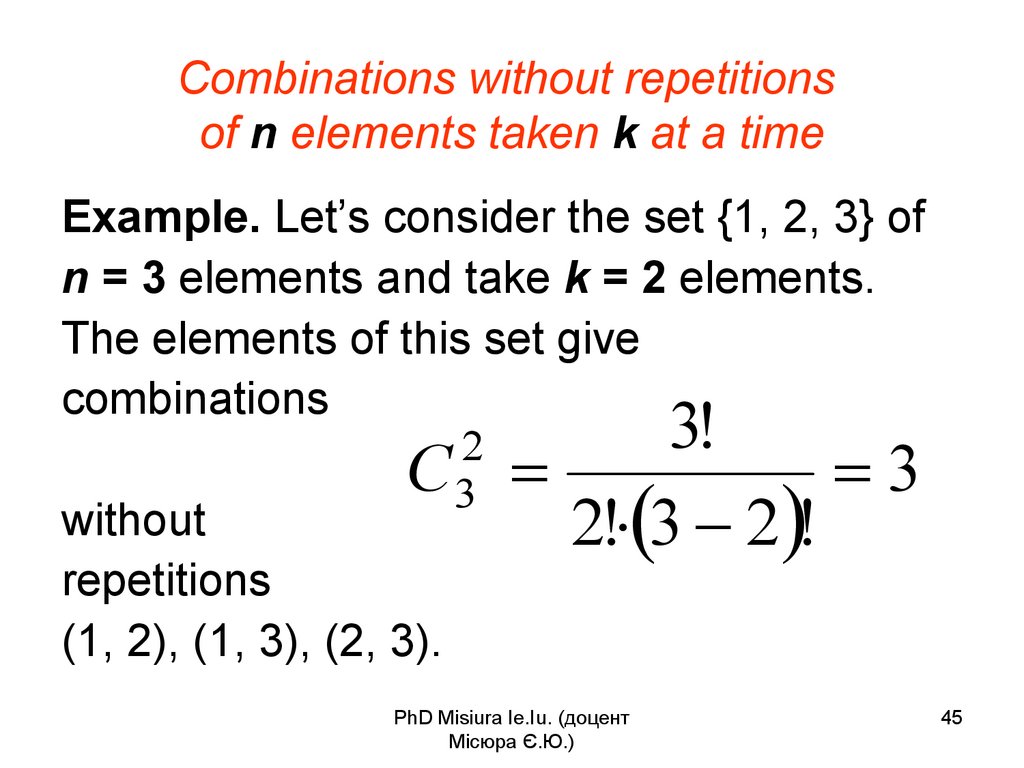
45. Combinations without repetitions of n elements taken k at a time
Example. Let’s consider the set {1, 2, 3} ofn = 3 elements and take k = 2 elements.
The elements of this set give
combinations
3!
C
3
2! 3 2 !
without
repetitions
(1, 2), (1, 3), (2, 3).
2
3
PhD Misiura Ie.Iu. (доцент
Місюра Є.Ю.)
45
46. COLLECTION OF FORMULAS OF COMBINATORICS WITH REPETITIONS
PhD Misiura Ie.Iu. (доцентМісюра Є.Ю.)
46
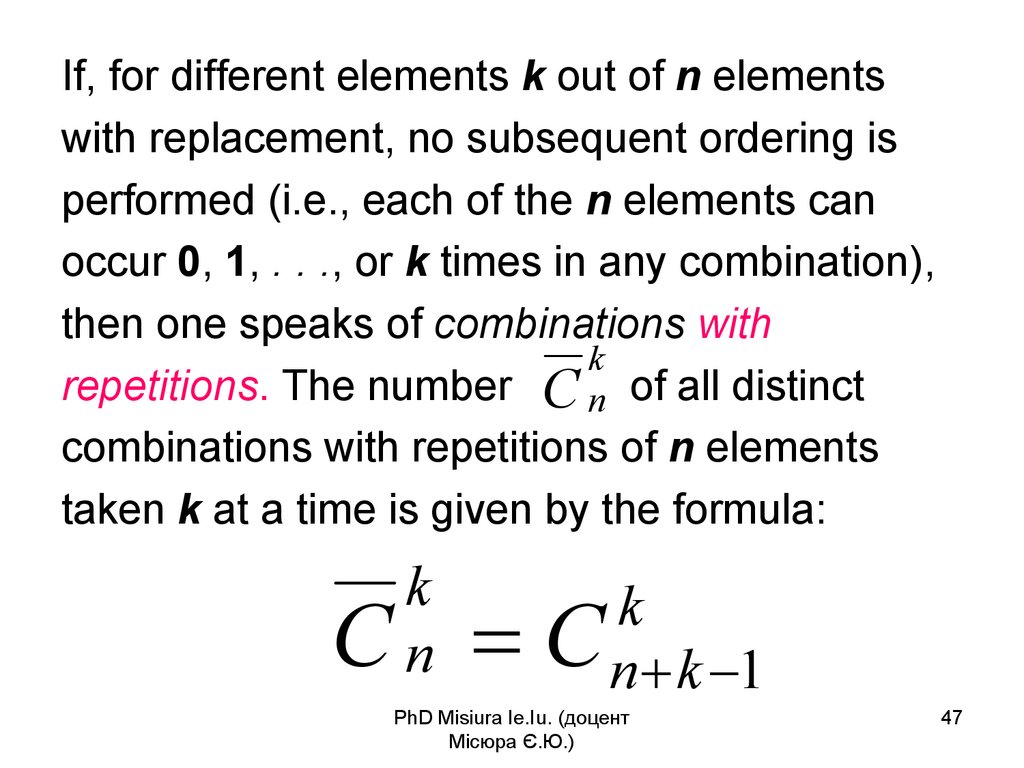
47.
If, for different elements k out of n elementswith replacement, no subsequent ordering is
performed (i.e., each of the n elements can
occur 0, 1, . . ., or k times in any combination),
then one speaks of combinations with
k
repetitions. The number C n of all distinct
combinations with repetitions of n elements
taken k at a time is given by the formula:
k
k
C n С n k 1
PhD Misiura Ie.Iu. (доцент
Місюра Є.Ю.)
47
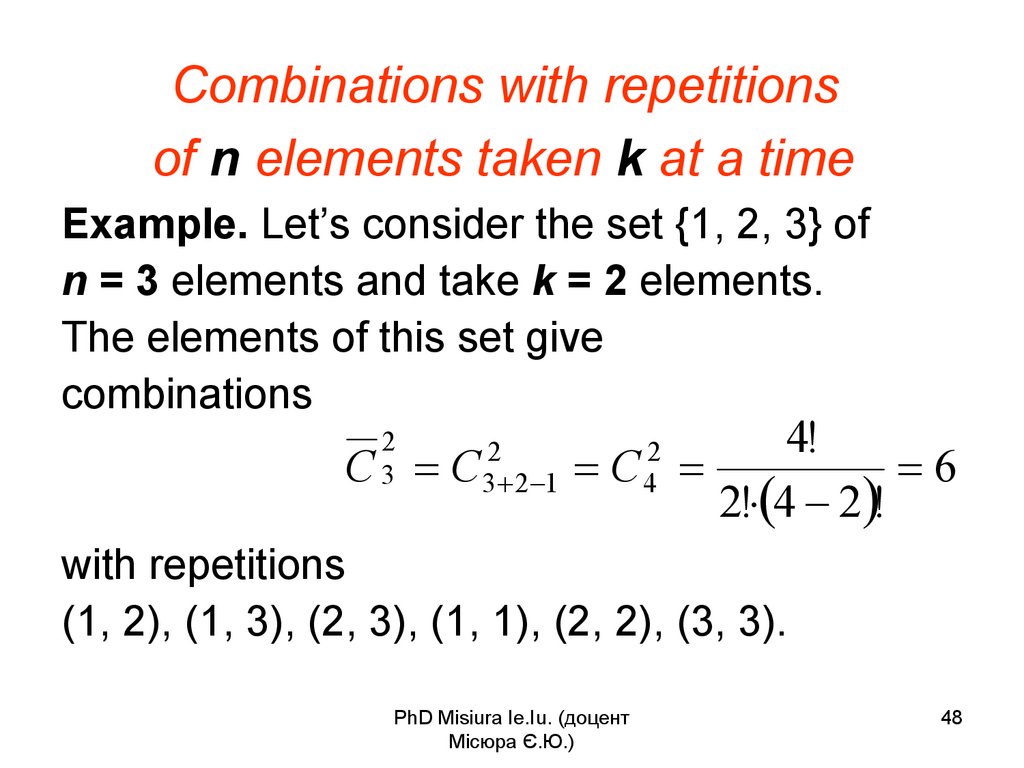
48. Combinations with repetitions of n elements taken k at a time
Example. Let’s consider the set {1, 2, 3} ofn = 3 elements and take k = 2 elements.
The elements of this set give
combinations
2
2
2
C 3 C 3 2 1 C 4
4!
6
2! 4 2 !
with repetitions
(1, 2), (1, 3), (2, 3), (1, 1), (2, 2), (3, 3).
PhD Misiura Ie.Iu. (доцент
Місюра Є.Ю.)
48
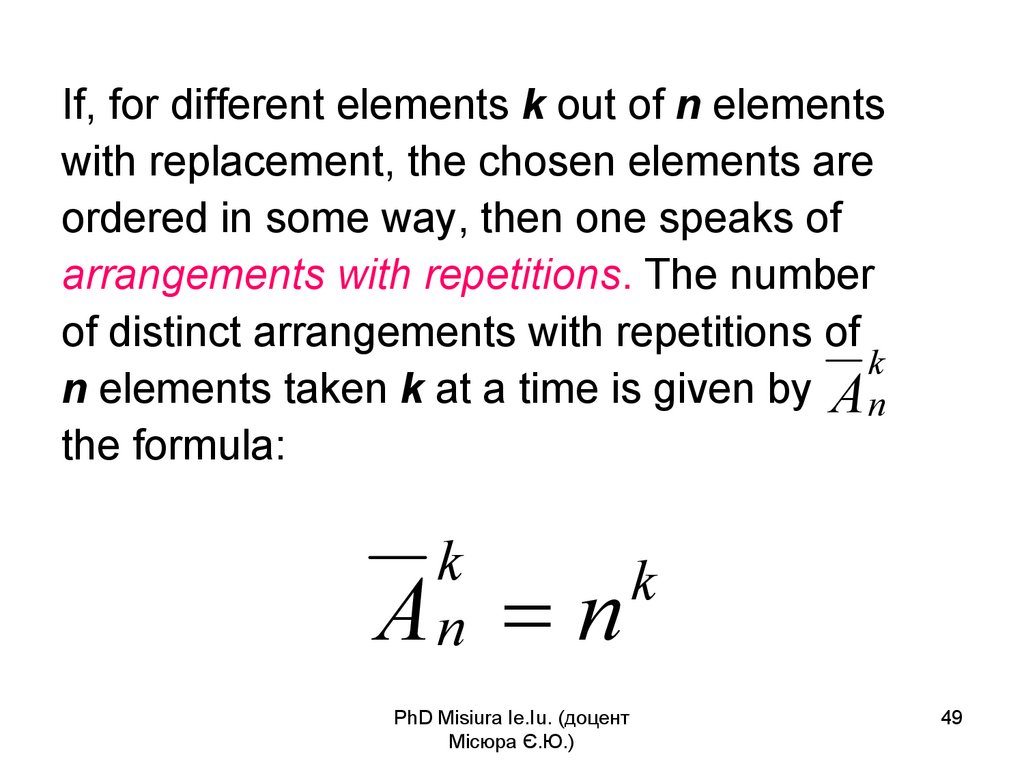
49.
If, for different elements k out of n elementswith replacement, the chosen elements are
ordered in some way, then one speaks of
arrangements with repetitions. The number
of distinct arrangements with repetitions of
k
n elements taken k at a time is given by A n
the formula:
k
k
An n
PhD Misiura Ie.Iu. (доцент
Місюра Є.Ю.)
49
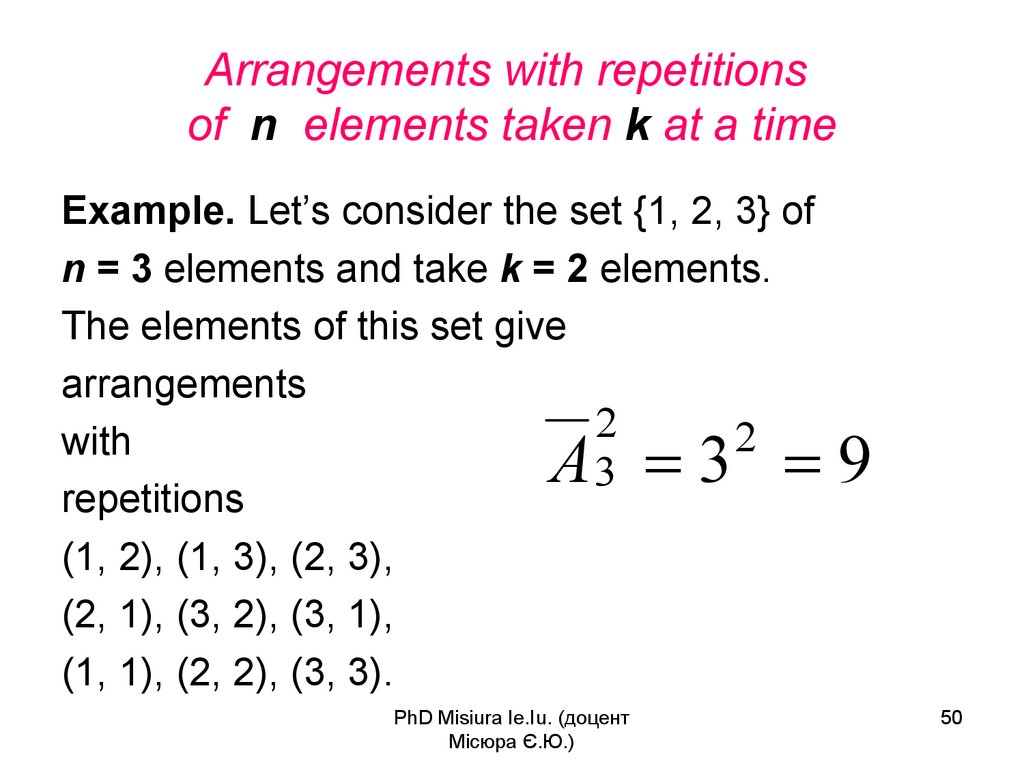
50. Arrangements with repetitions of n elements taken k at a time
Arrangements with repetitionsof n elements taken k at a time
Example. Let’s consider the set {1, 2, 3} of
n = 3 elements and take k = 2 elements.
The elements of this set give
arrangements
2
2
with
3
repetitions
(1, 2), (1, 3), (2, 3),
(2, 1), (3, 2), (3, 1),
(1, 1), (2, 2), (3, 3).
A 3 9
PhD Misiura Ie.Iu. (доцент
Місюра Є.Ю.)
50
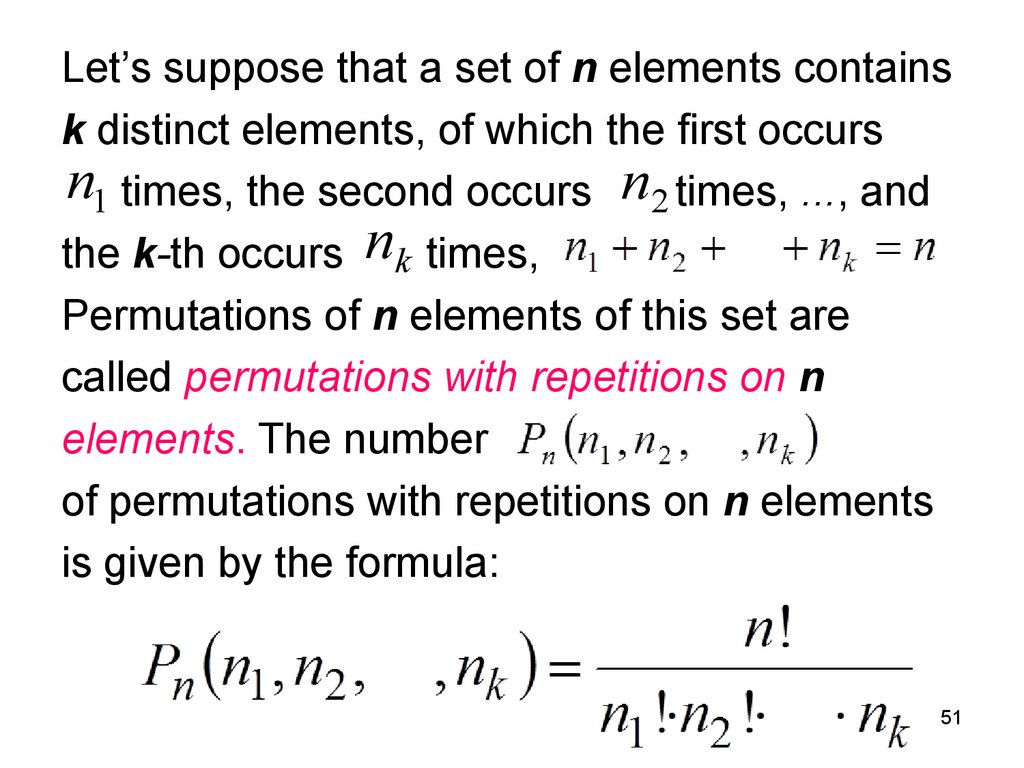
51.
Let’s suppose that a set of n elements containsk distinct elements, of which the first occurs
n1 times, the second occurs n2 times, ..., and
the k-th occurs n k times,
Permutations of n elements of this set are
called permutations with repetitions on n
elements. The number
of permutations with repetitions on n elements
is given by the formula:
PhD Misiura Ie.Iu. (доцент
Місюра Є.Ю.)
51
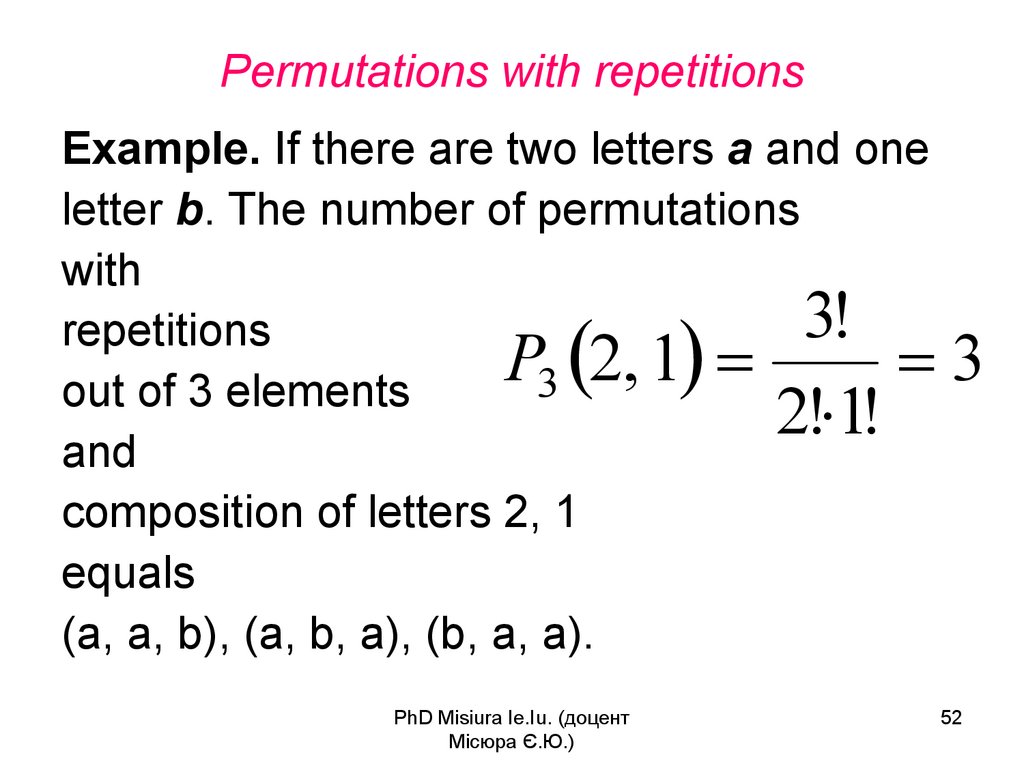
52. Permutations with repetitions
Example. If there are two letters a and oneletter b. The number of permutations
with
3!
repetitions
P
2
,
1
3
3
out of 3 elements
2
!
1
!
and
composition of letters 2, 1
equals
(a, a, b), (a, b, a), (b, a, a).
PhD Misiura Ie.Iu. (доцент
Місюра Є.Ю.)
52
53.
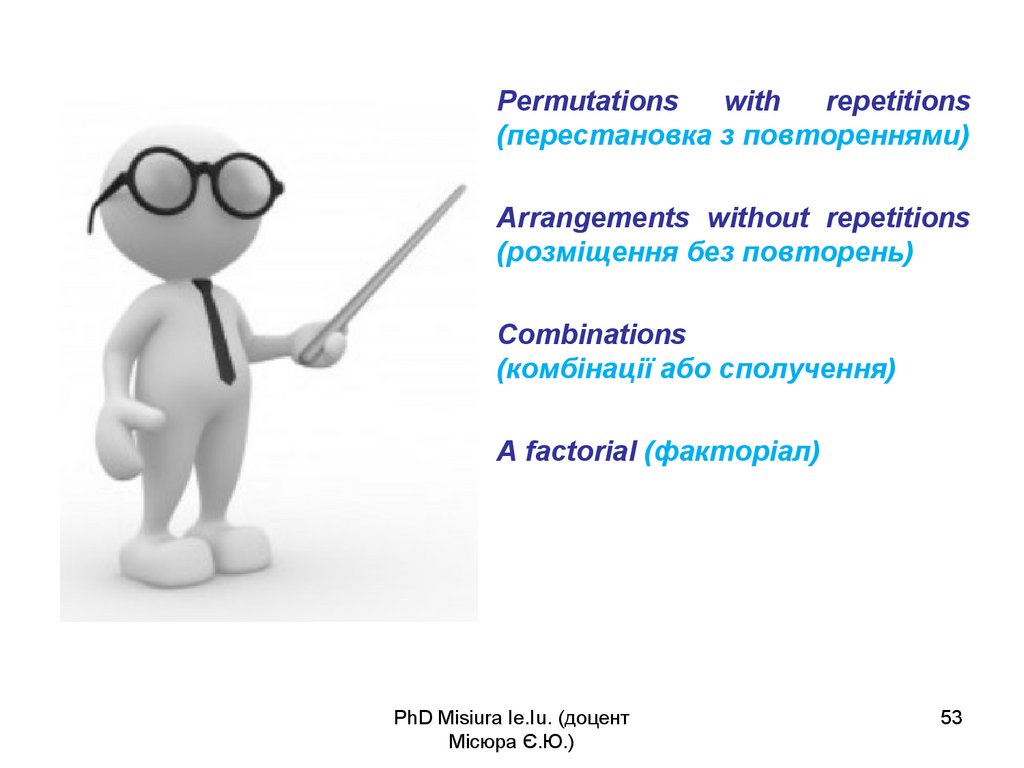
Permutationswith
repetitions
(перестановка з повтореннями)
Arrangements without repetitions
(розміщення без повторень)
Combinations
(комбінації або сполучення)
A factorial (факторіал)
PhD Misiura Ie.Iu. (доцент
Місюра Є.Ю.)
53
54. Question 3
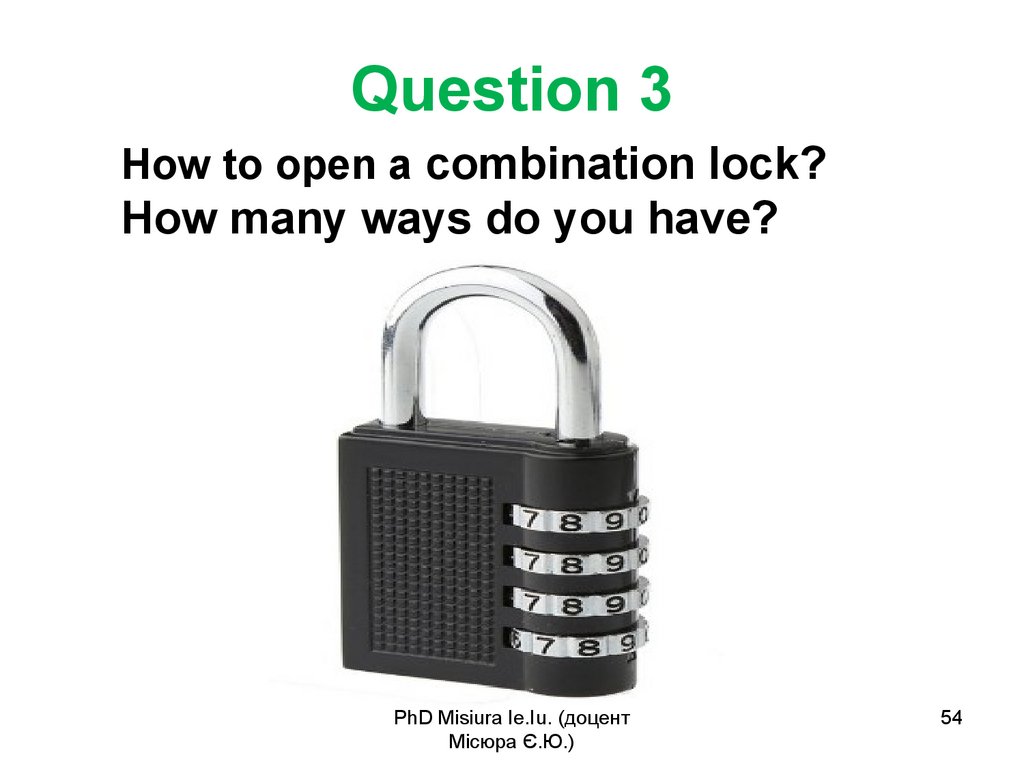
How to open a combination lock?How many ways do you have?
PhD Misiura Ie.Iu. (доцент
Місюра Є.Ю.)
54
55. Question 3
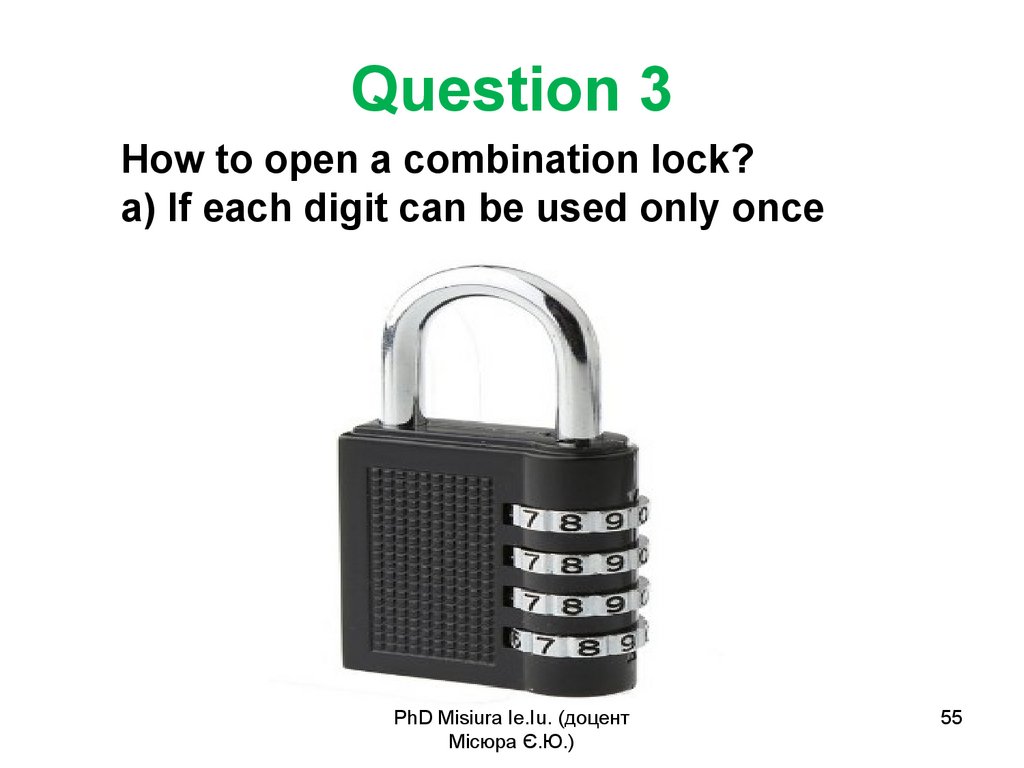
How to open a combination lock?a) If each digit can be used only once
PhD Misiura Ie.Iu. (доцент
Місюра Є.Ю.)
55
56. Question 3
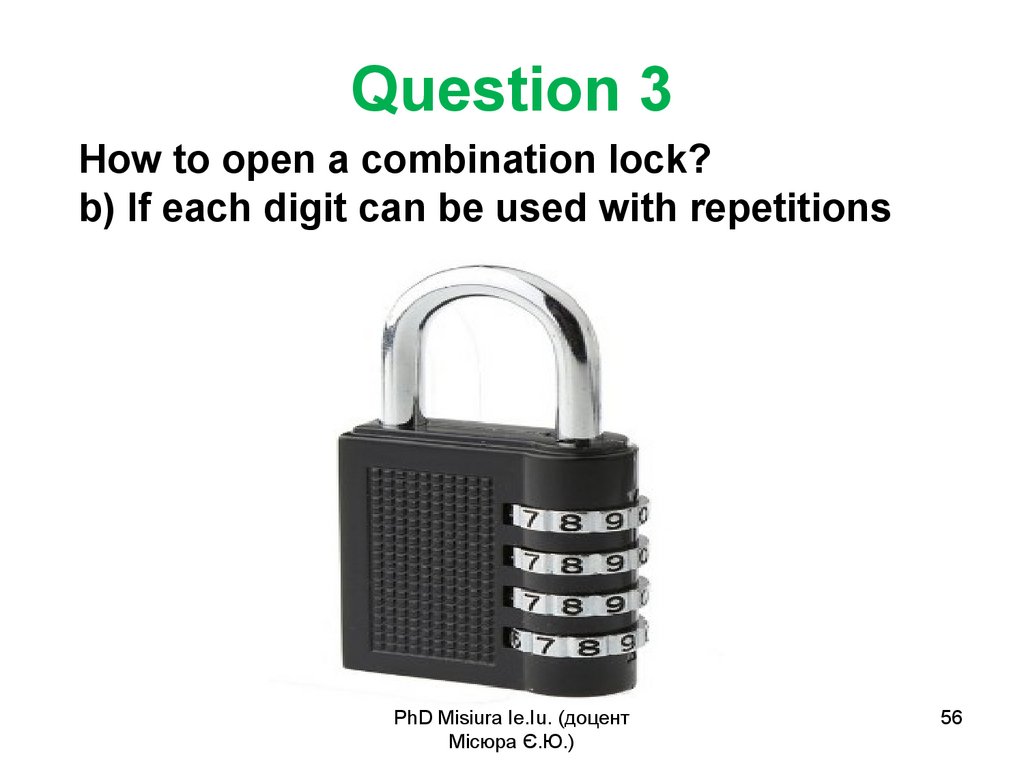
How to open a combination lock?b) If each digit can be used with repetitions
PhD Misiura Ie.Iu. (доцент
Місюра Є.Ю.)
56
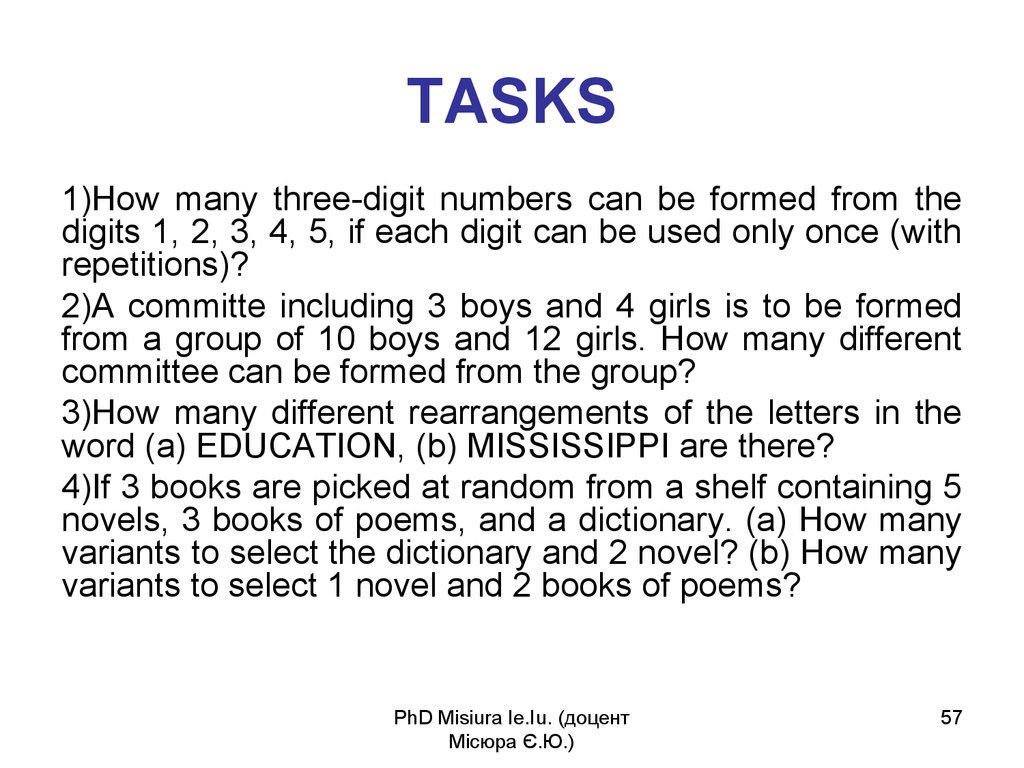
57. TASKS
1)How many three-digit numbers can be formed from thedigits 1, 2, 3, 4, 5, if each digit can be used only once (with
repetitions)?
2)A committe including 3 boys and 4 girls is to be formed
from a group of 10 boys and 12 girls. How many different
committee can be formed from the group?
3)How many different rearrangements of the letters in the
word (a) EDUCATION, (b) MISSISSIPPI are there?
4)If 3 books are picked at random from a shelf containing 5
novels, 3 books of poems, and a dictionary. (a) How many
variants to select the dictionary and 2 novel? (b) How many
variants to select 1 novel and 2 books of poems?
PhD Misiura Ie.Iu. (доцент
Місюра Є.Ю.)
57
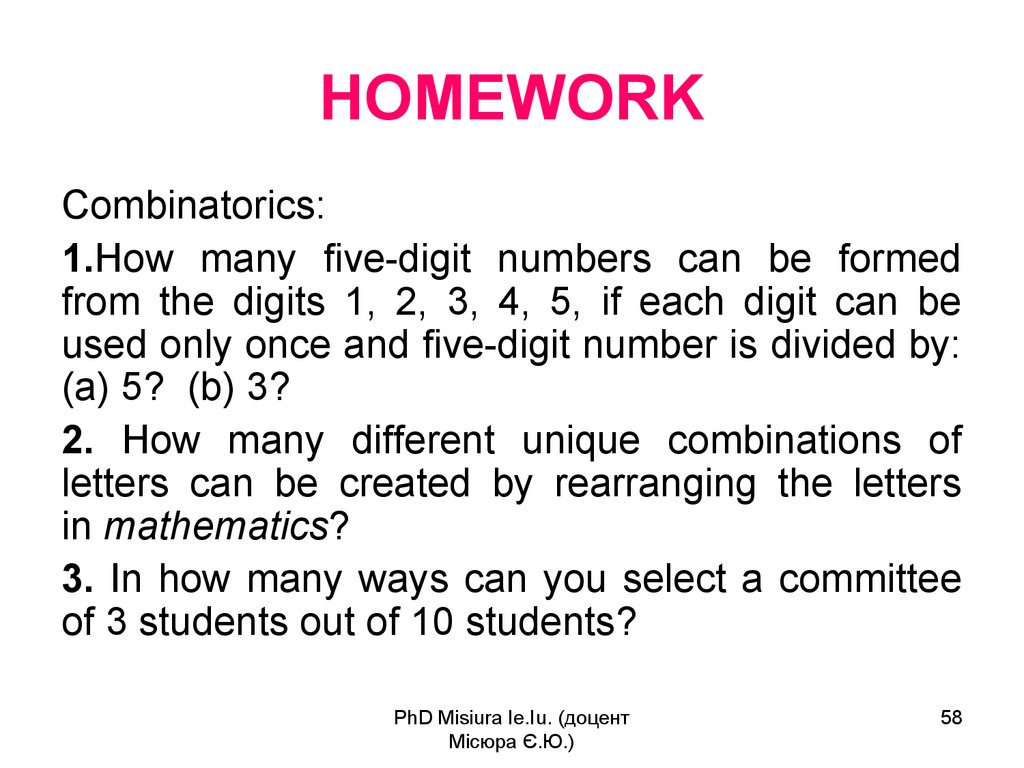
58. HOMEWORK
Combinatorics:1.How many five-digit numbers can be formed
from the digits 1, 2, 3, 4, 5, if each digit can be
used only once and five-digit number is divided by:
(a) 5? (b) 3?
2. How many different unique combinations of
letters can be created by rearranging the letters
in mathematics?
3. In how many ways can you select a committee
of 3 students out of 10 students?
PhD Misiura Ie.Iu. (доцент
Місюра Є.Ю.)
58
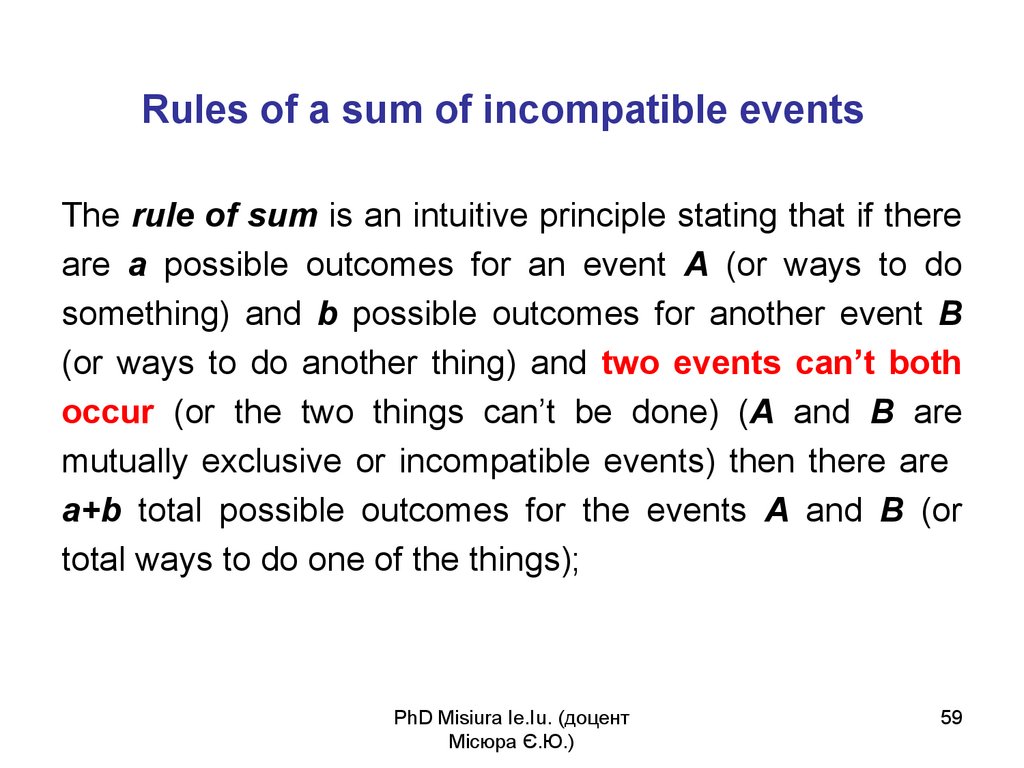
59. Rules of a sum of incompatible events
The rule of sum is an intuitive principle stating that if thereare a possible outcomes for an event A (or ways to do
something) and b possible outcomes for another event B
(or ways to do another thing) and two events can’t both
occur (or the two things can’t be done) (A and B are
mutually exclusive or incompatible events) then there are
a+b total possible outcomes for the events A and B (or
total ways to do one of the things);
PhD Misiura Ie.Iu. (доцент
Місюра Є.Ю.)
59
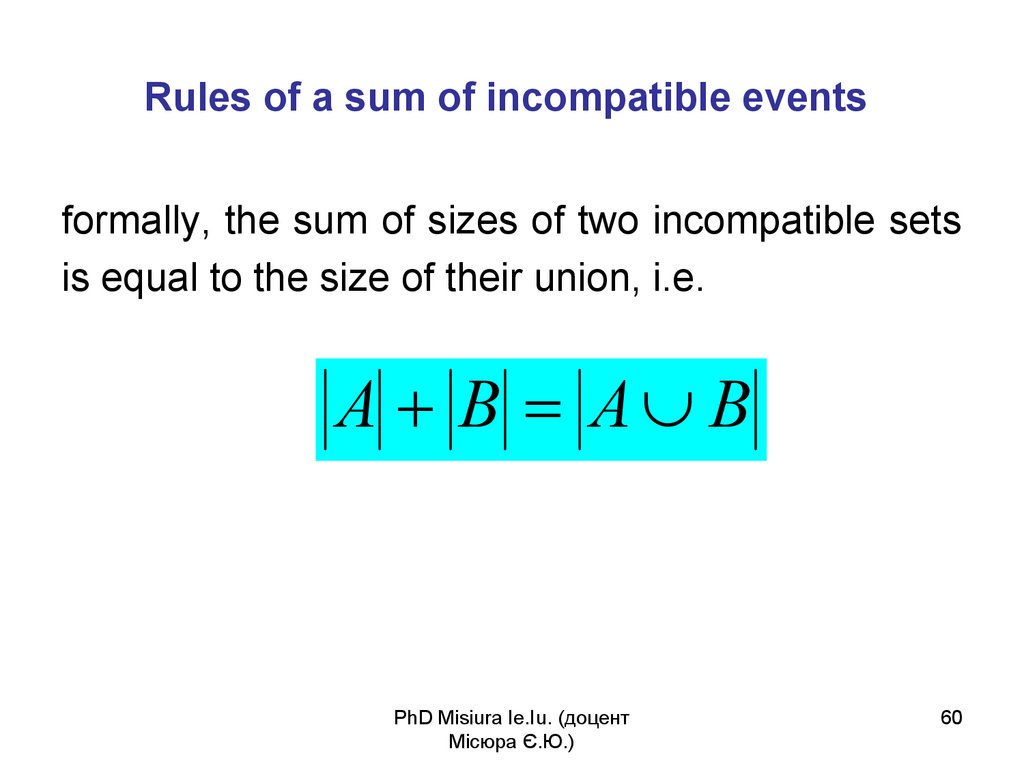
60. Rules of a sum of incompatible events
formally, the sum of sizes of two incompatible setsis equal to the size of their union, i.e.
A B A B
PhD Misiura Ie.Iu. (доцент
Місюра Є.Ю.)
60
61. Rules of a sum of incompatible events
Example. A woman has decided to shop at one storetoday, either in the north part of town or the south part of
town. If she visits the north part of town, she will either shop
at a mall, a furniture store, or a jewelry store (3 ways). If
she visits the south part of town then she will either shop at
a clothing store or a shoe store (2 ways).
PhD Misiura Ie.Iu. (доцент
Місюра Є.Ю.)
61
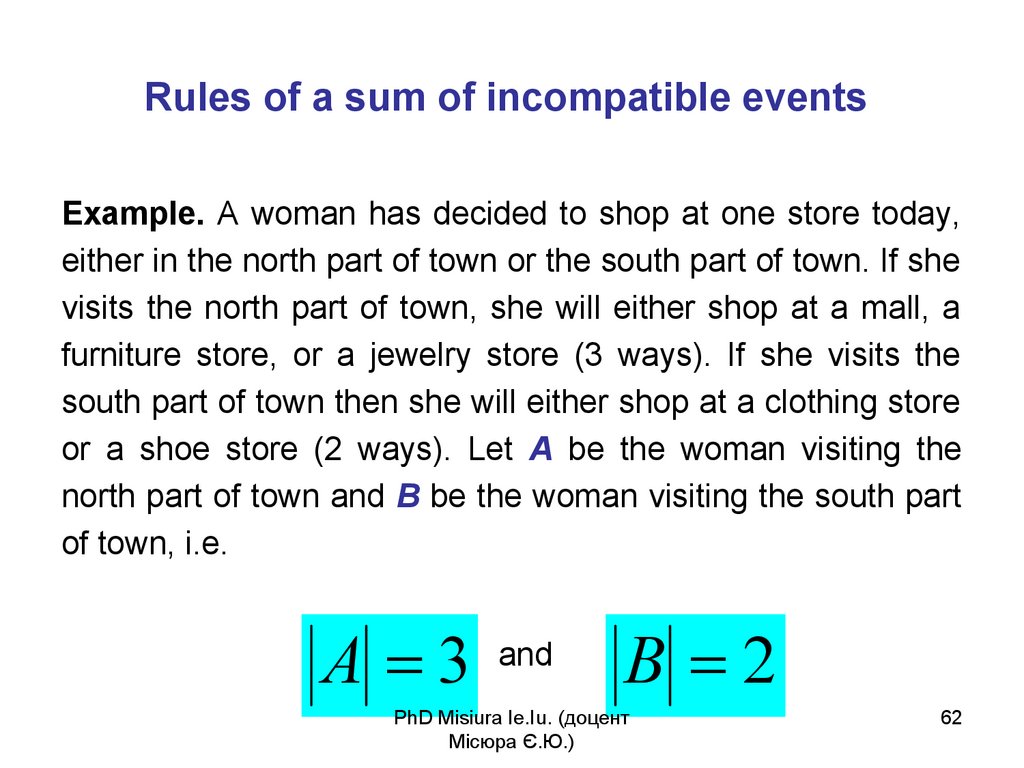
62. Rules of a sum of incompatible events
Example. A woman has decided to shop at one store today,either in the north part of town or the south part of town. If she
visits the north part of town, she will either shop at a mall, a
furniture store, or a jewelry store (3 ways). If she visits the
south part of town then she will either shop at a clothing store
or a shoe store (2 ways). Let A be the woman visiting the
north part of town and B be the woman visiting the south part
of town, i.e.
A 3 and
B 2
PhD Misiura Ie.Iu. (доцент
Місюра Є.Ю.)
62
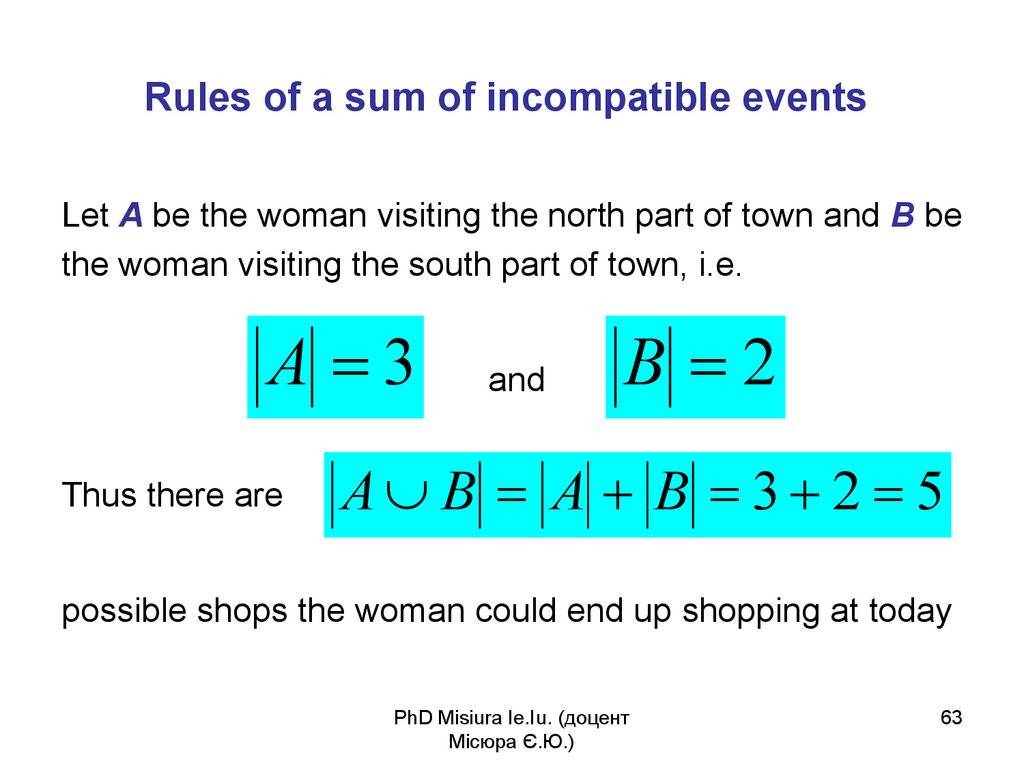
63. Rules of a sum of incompatible events
Let A be the woman visiting the north part of town and B bethe woman visiting the south part of town, i.e.
A 3
Thus there are
and
B 2
A B A B 3 2 5
possible shops the woman could end up shopping at today
PhD Misiura Ie.Iu. (доцент
Місюра Є.Ю.)
63
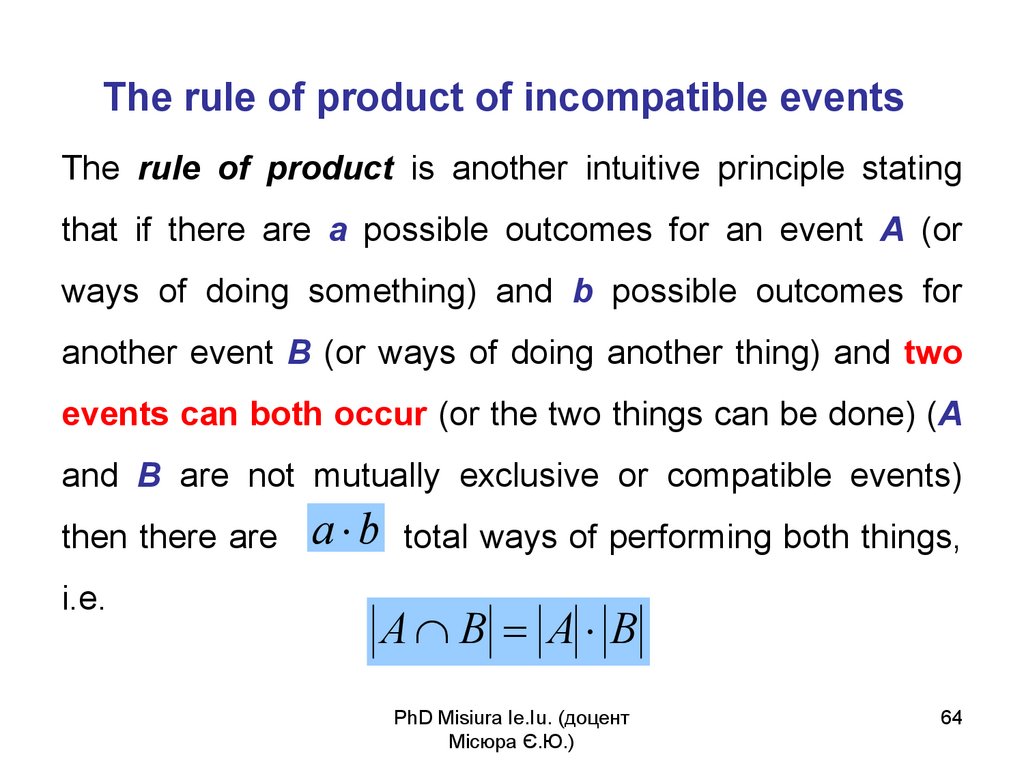
64. The rule of product of incompatible events
The rule of product is another intuitive principle statingthat if there are a possible outcomes for an event A (or
ways of doing something) and b possible outcomes for
another event B (or ways of doing another thing) and two
events can both occur (or the two things can be done) (A
and B are not mutually exclusive or compatible events)
then there are
i.e.
a b total ways of performing both things,
A B A B
PhD Misiura Ie.Iu. (доцент
Місюра Є.Ю.)
64
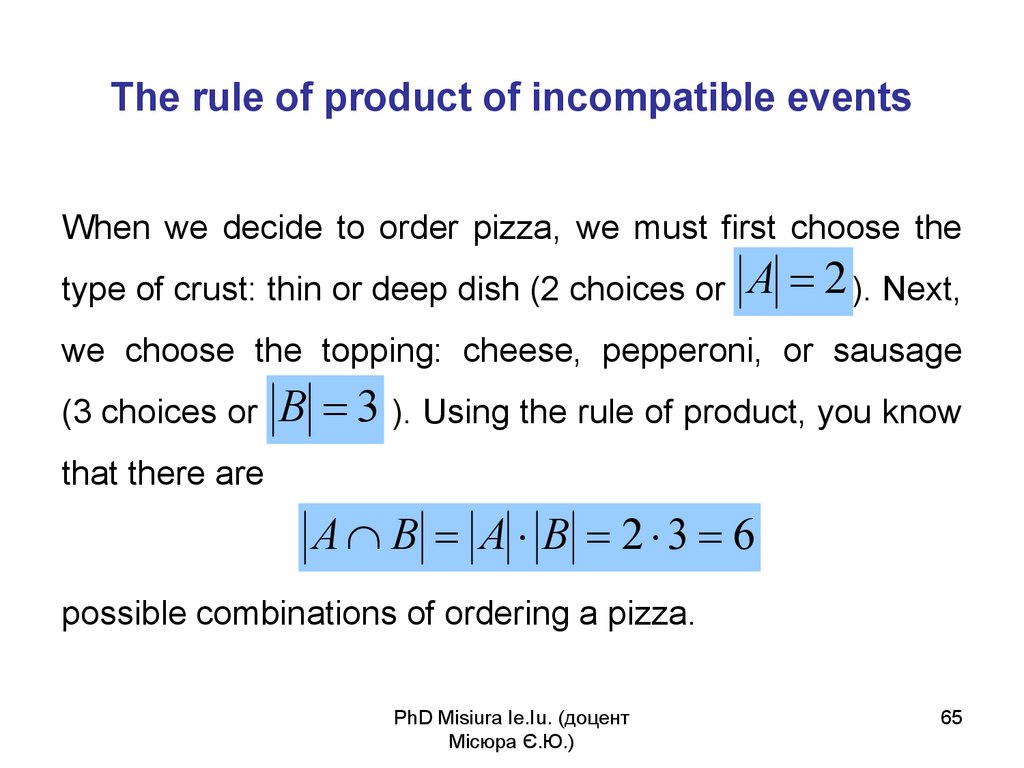
65. The rule of product of incompatible events
When we decide to order pizza, we must first choose thetype of crust: thin or deep dish (2 choices or A 2 ). Next,
we choose the topping: cheese, pepperoni, or sausage
(3 choices or B 3 ). Using the rule of product, you know
that there are
A B A B 2 3 6
possible combinations of ordering a pizza.
PhD Misiura Ie.Iu. (доцент
Місюра Є.Ю.)
65
66. Question 4
A large basket of fruit contains 3 orangesand 2 apples. How many ways of getting an
orange or an apple?
PhD Misiura Ie.Iu. (доцент
Місюра Є.Ю.)
66
67. Question 5
A team including 3 boys and 4 girls is to beformed from a group of 10 boys and 12 girls.
How many different teams can be formed
from the group?
PhD Misiura Ie.Iu. (доцент
Місюра Є.Ю.)
67
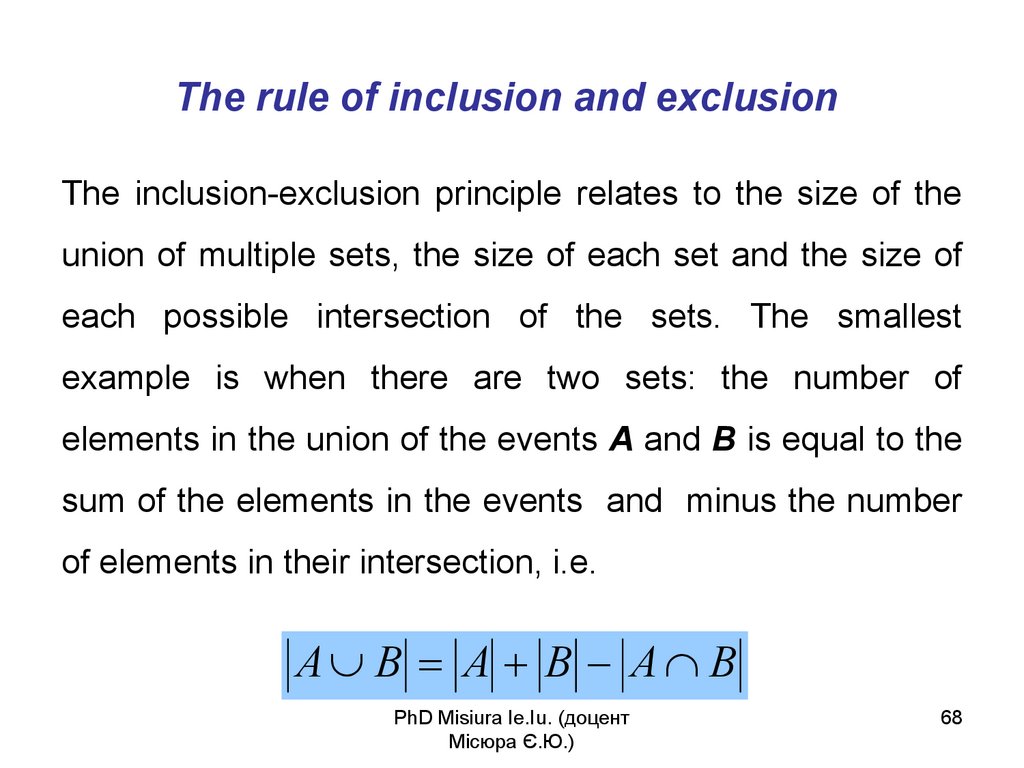
68. The rule of inclusion and exclusion
The inclusion-exclusion principle relates to the size of theunion of multiple sets, the size of each set and the size of
each possible intersection of the sets. The smallest
example is when there are two sets: the number of
elements in the union of the events A and B is equal to the
sum of the elements in the events and minus the number
of elements in their intersection, i.e.
A B A B A B
PhD Misiura Ie.Iu. (доцент
Місюра Є.Ю.)
68
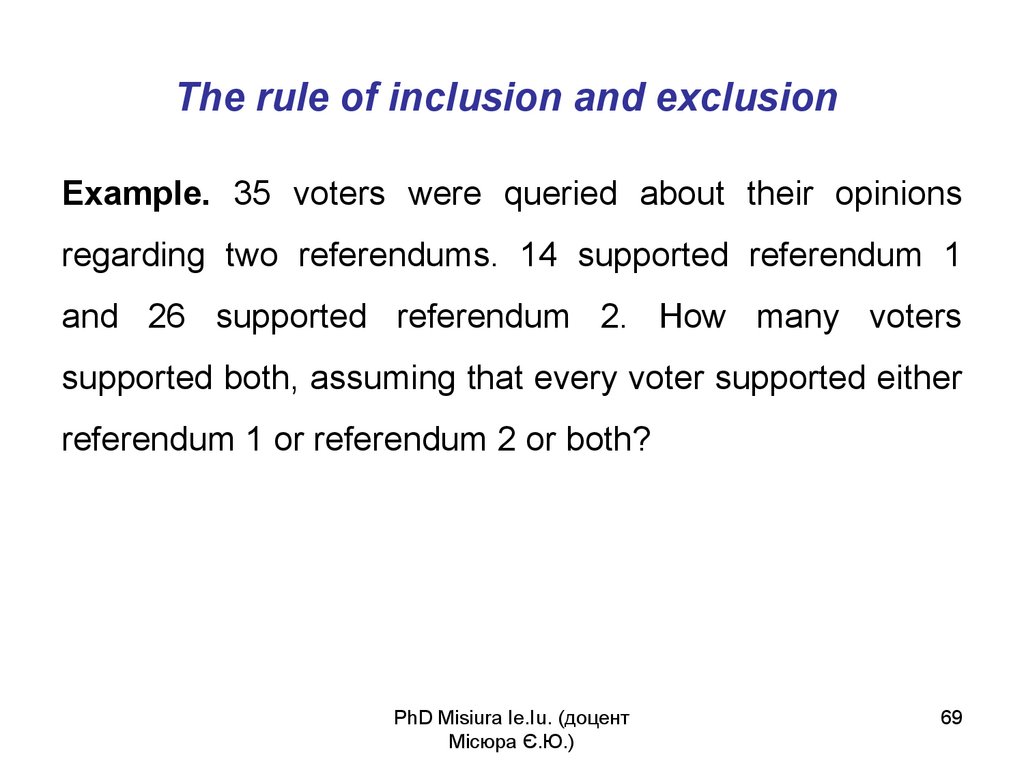
69. The rule of inclusion and exclusion
Example. 35 voters were queried about their opinionsregarding two referendums. 14 supported referendum 1
and 26 supported referendum 2. How many voters
supported both, assuming that every voter supported either
referendum 1 or referendum 2 or both?
PhD Misiura Ie.Iu. (доцент
Місюра Є.Ю.)
69
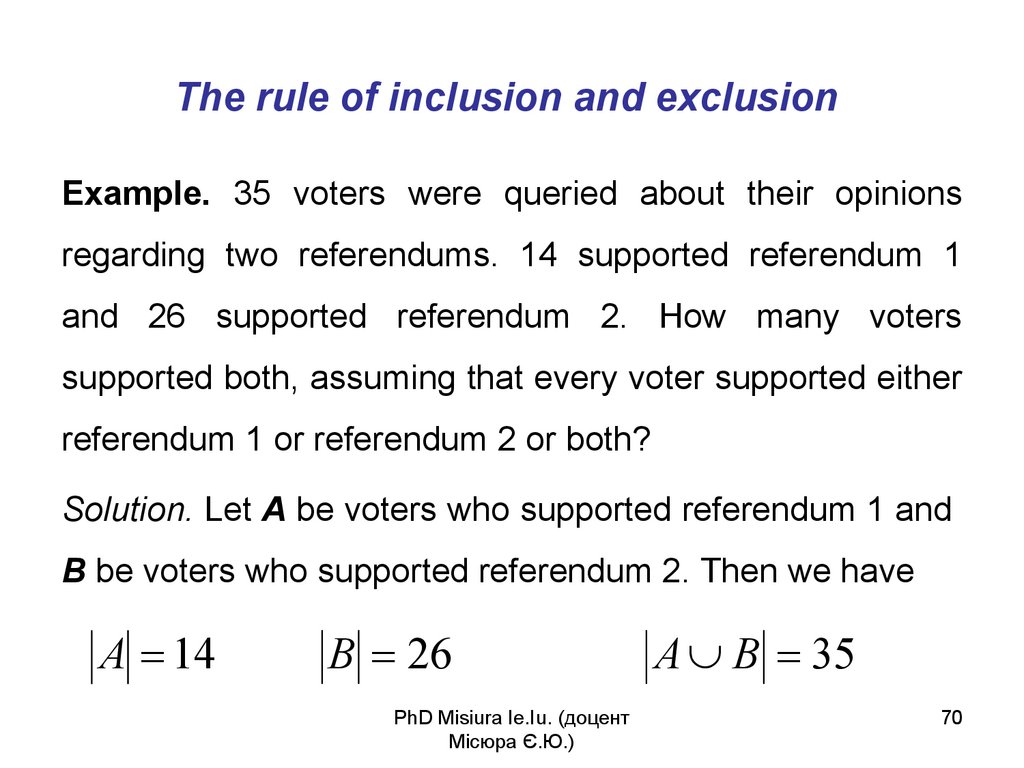
70. The rule of inclusion and exclusion
Example. 35 voters were queried about their opinionsregarding two referendums. 14 supported referendum 1
and 26 supported referendum 2. How many voters
supported both, assuming that every voter supported either
referendum 1 or referendum 2 or both?
Solution. Let A be voters who supported referendum 1 and
B be voters who supported referendum 2. Then we have
A 14
B 26
PhD Misiura Ie.Iu. (доцент
Місюра Є.Ю.)
A B 35
70
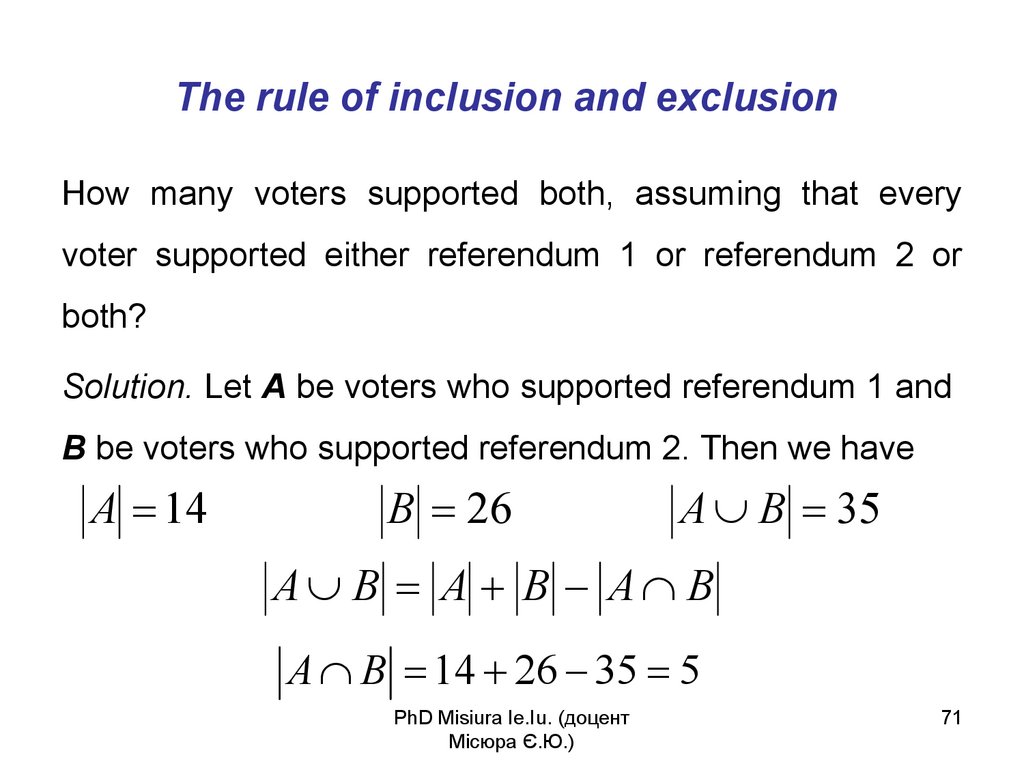
71. The rule of inclusion and exclusion
How many voters supported both, assuming that everyvoter supported either referendum 1 or referendum 2 or
both?
Solution. Let A be voters who supported referendum 1 and
B be voters who supported referendum 2. Then we have
A 14
B 26
A B 35
A B A B A B
A B 14 26 35 5
PhD Misiura Ie.Iu. (доцент
Місюра Є.Ю.)
71
72. A CLASSICAL DEFINITION OF A PROBABILITY
PhD Misiura Ie.Iu. (доцентМісюра Є.Ю.)
72
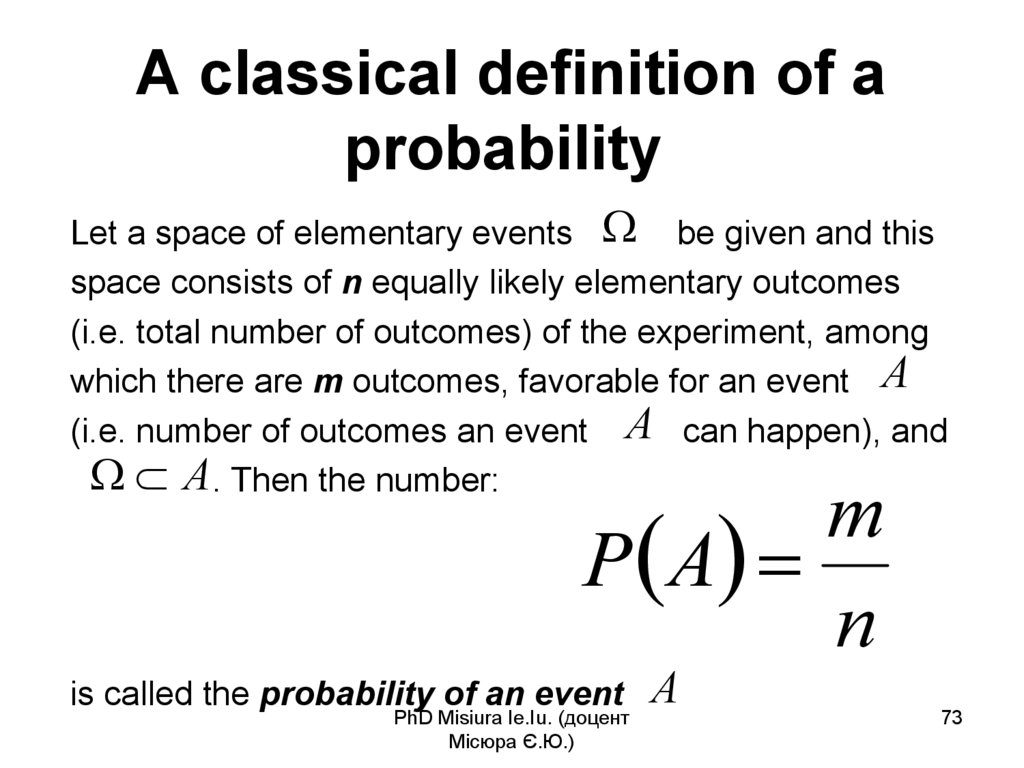
73. A classical definition of a probability
Let a space of elementary events be given and thisspace consists of n equally likely elementary outcomes
(i.e. total number of outcomes) of the experiment, among
which there are m outcomes, favorable for an event A
(i.e. number of outcomes an event A can happen), and
A . Then the number:
m
P A
n
A
PhD Misiura Ie.Iu. (доцент
is called the probability of an event
Місюра Є.Ю.)
73
74.
• As all events have probabilities betweenimpossible (0) and certain (1), then
probabilities are usually written as a
fraction, a decimal or sometimes as a
percentage. We will write probabilities
fractions or decimals.
• The probability is the non-dimensional
quantity. It can be measured in percent
from 0 to 100. For example,
4
Р( А) 0.4 40 %
10
PhD Misiura Ie.Iu. (доцент
Місюра Є.Ю.)
74
75.
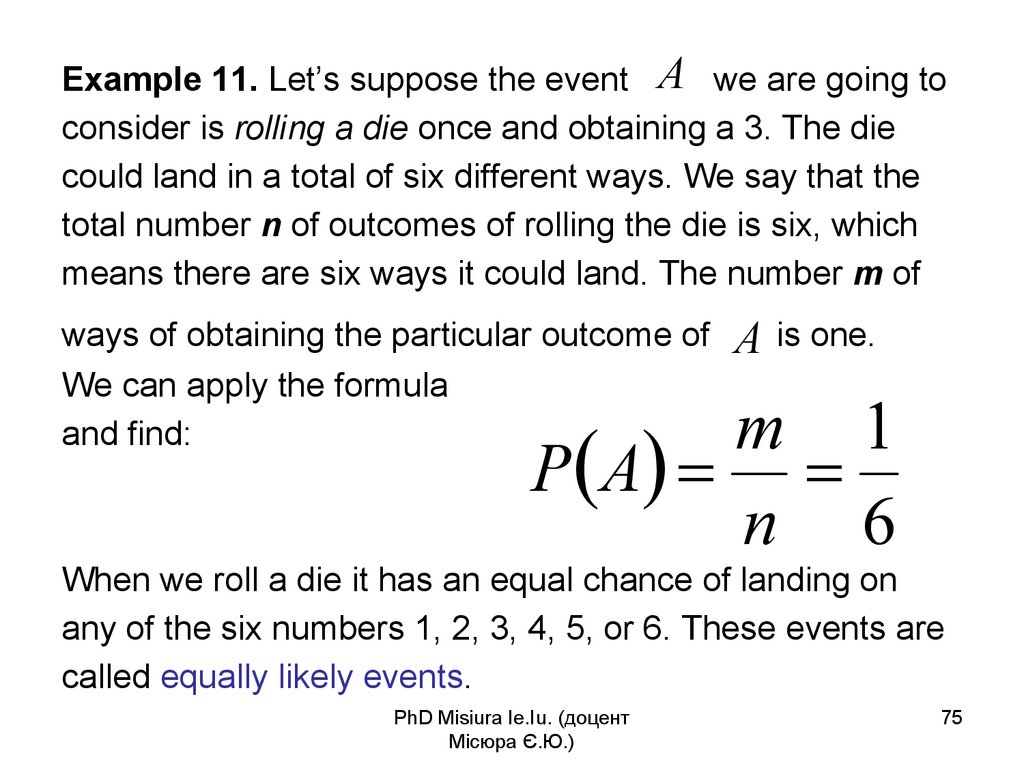
Example 11. Let’s suppose the event A we are going toconsider is rolling a die once and obtaining a 3. The die
could land in a total of six different ways. We say that the
total number n of outcomes of rolling the die is six, which
means there are six ways it could land. The number m of
ways of obtaining the particular outcome of
We can apply the formula
and find:
A is one.
m 1
P A
n 6
When we roll a die it has an equal chance of landing on
any of the six numbers 1, 2, 3, 4, 5, or 6. These events are
called equally likely events.
PhD Misiura Ie.Iu. (доцент
Місюра Є.Ю.)
75
76. Example. This experiment has 6 OUTCOMES: 1 score, 2 scores, 3 scores, 4 scores, 5 scores and 6 scores.
PhD Misiura Ie.Iu. (доцентМісюра Є.Ю.)
76
77. A geometric definition of a probability
A geometric definition of a probability ofan event A . Let be a set of a positive
finite measure and consist of all
measurable (i.e. having a measure) subsets
A . The geometric probability of
an event A is defined to be ratio of the
measure of A to that of , i.e.
PhD Misiura Ie.Iu. (доцент
Місюра Є.Ю.)
A
P A
77
78.
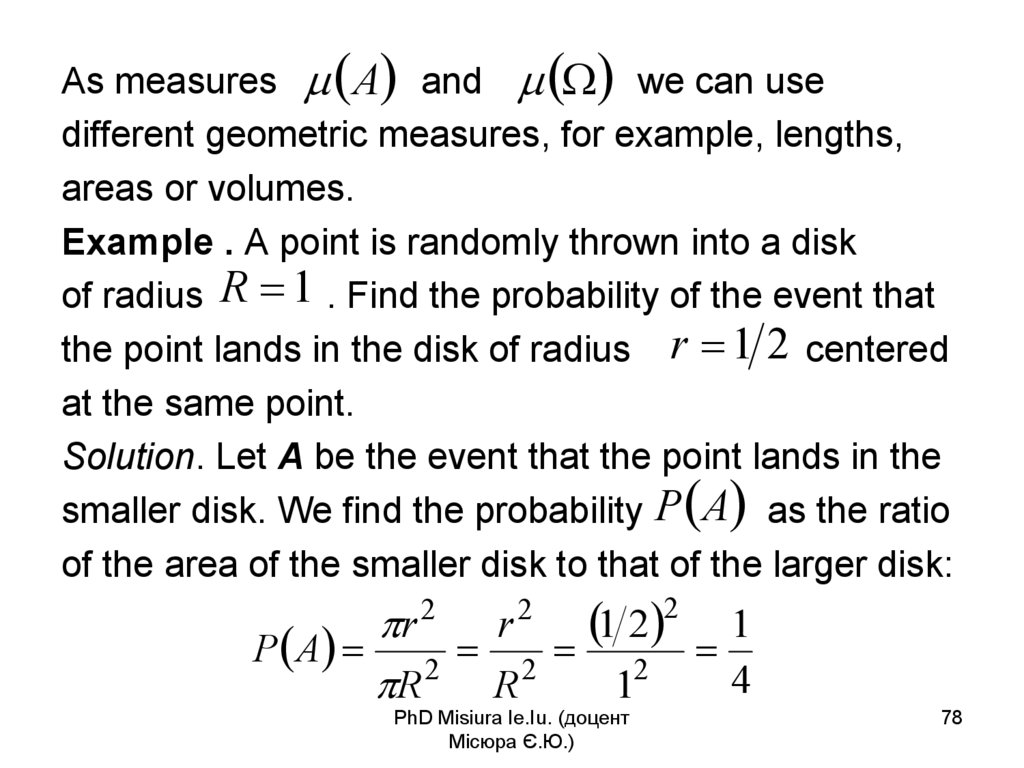
As measures A and we can usedifferent geometric measures, for example, lengths,
areas or volumes.
Example . A point is randomly thrown into a disk
of radius R 1 . Find the probability of the event that
the point lands in the disk of radius r 1 2 centered
at the same point.
Solution. Let A be the event that the point lands in the
smaller disk. We find the probability P A as the ratio
of the area of the smaller disk to that of the larger disk:
r 2 r 2 1 2 2 1
P A 2 2 2
4
R
R
1
PhD Misiura Ie.Iu. (доцент
Місюра Є.Ю.)
78
79. DIFFERENT TYPES OF EVENTS AND PROPERTIES OF PROBABILITY
PhD Misiura Ie.Iu. (доцентМісюра Є.Ю.)
79
80.
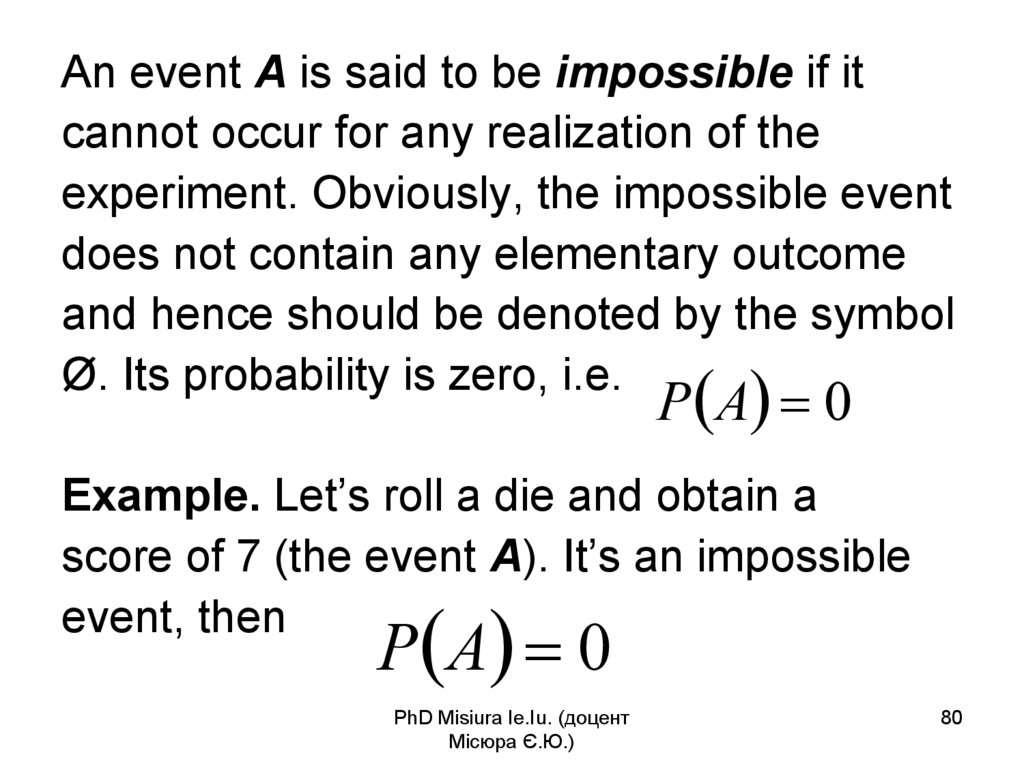
An event A is said to be impossible if itcannot occur for any realization of the
experiment. Obviously, the impossible event
does not contain any elementary outcome
and hence should be denoted by the symbol
Ø. Its probability is zero, i.e.
P A 0
Example. Let’s roll a die and obtain a
score of 7 (the event A). It’s an impossible
event, then
P A 0
PhD Misiura Ie.Iu. (доцент
Місюра Є.Ю.)
80
81.
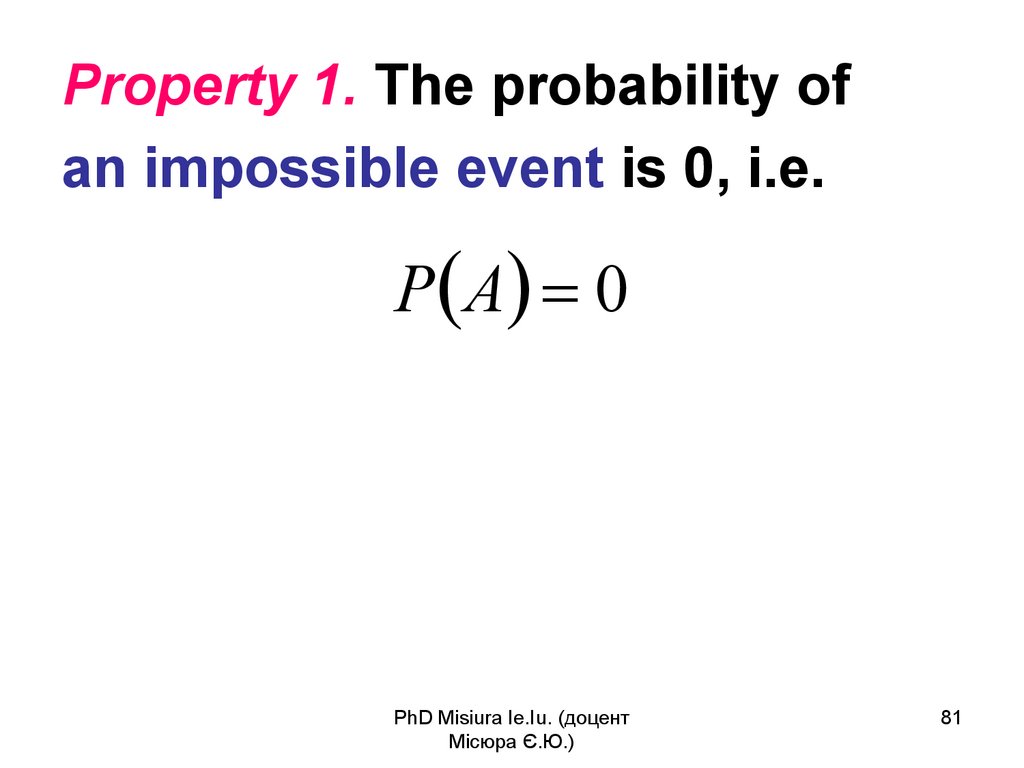
Property 1. The probability ofan impossible event is 0, i.e.
P A 0
PhD Misiura Ie.Iu. (доцент
Місюра Є.Ю.)
81
82.
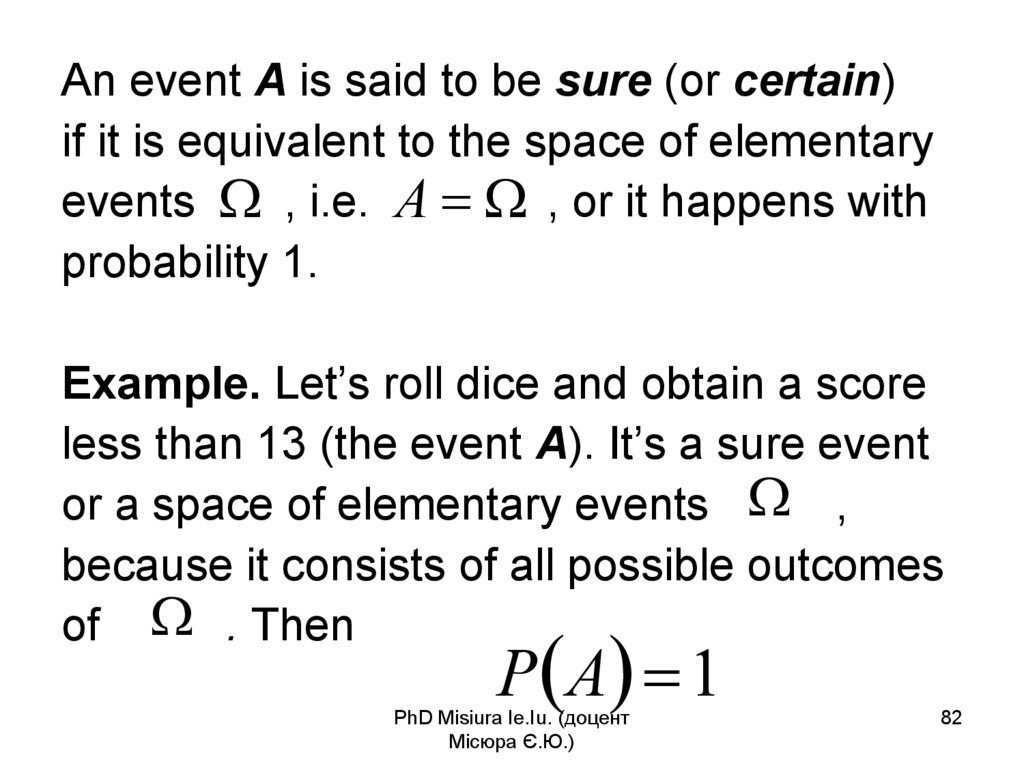
An event A is said to be sure (or certain)if it is equivalent to the space of elementary
events , i.e. A , or it happens with
probability 1.
Example. Let’s roll dice and obtain a score
less than 13 (the event A). It’s a sure event
or a space of elementary events ,
because it consists of all possible outcomes
of . Then
P A 1
PhD Misiura Ie.Iu. (доцент
Місюра Є.Ю.)
82
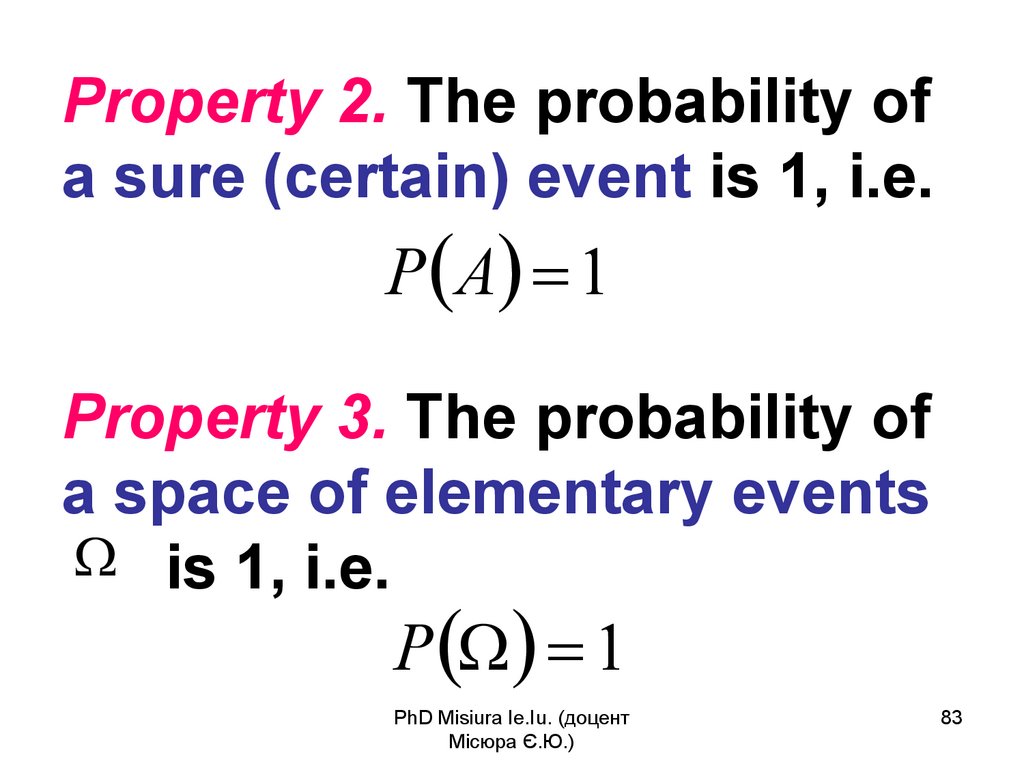
83. Property 2. The probability of a sure (certain) event is 1, i.e.
P A 1Property 3. The probability of
a space of elementary events
is 1, i.e.
P 1
PhD Misiura Ie.Iu. (доцент
Місюра Є.Ю.)
83
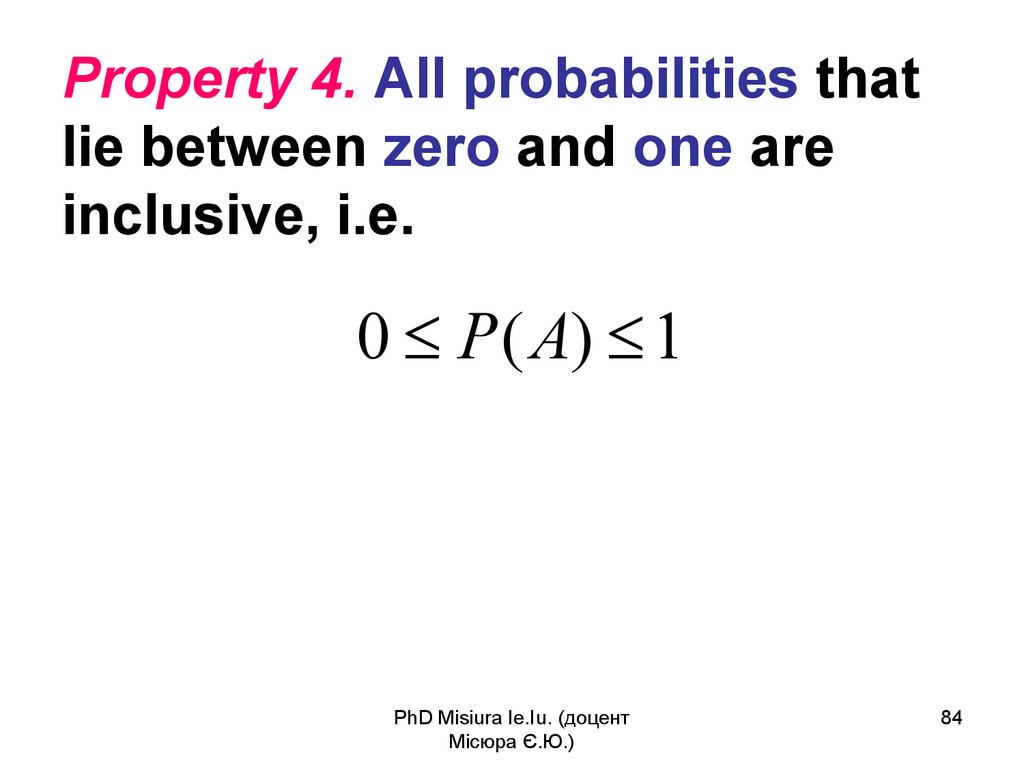
84. Property 4. All probabilities that lie between zero and one are inclusive, i.e.
0 Р ( А) 1PhD Misiura Ie.Iu. (доцент
Місюра Є.Ю.)
84
85.
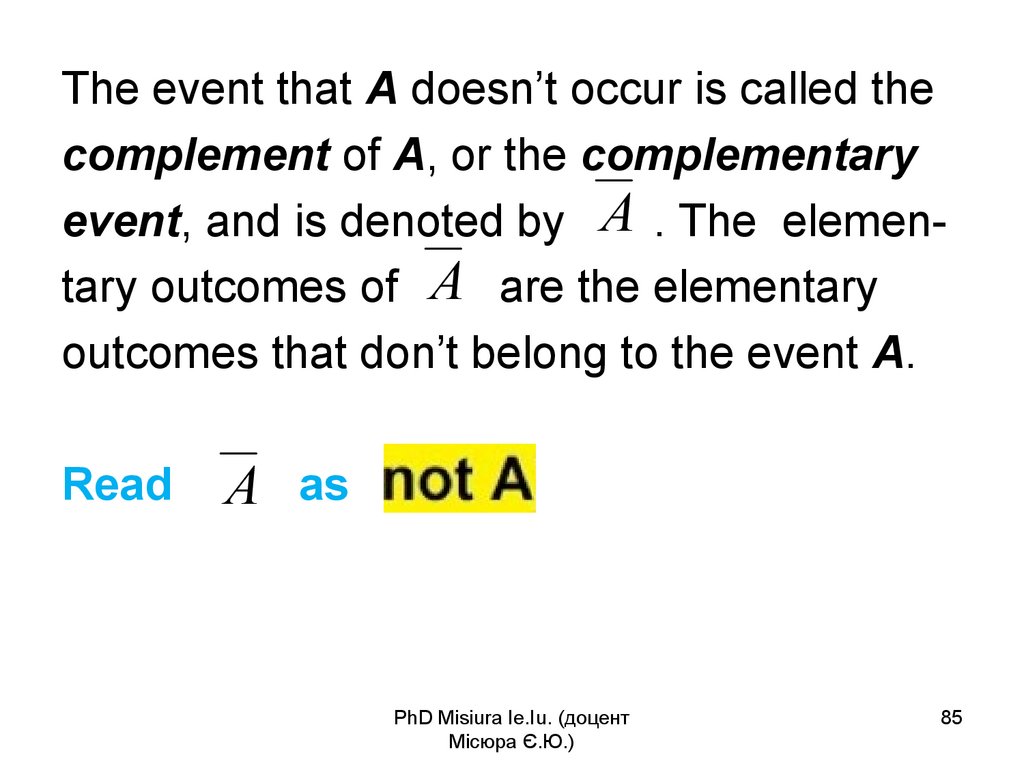
The event that A doesn’t occur is called thecomplement of A, or the complementary
event, and is denoted by A . The elementary outcomes of A are the elementary
outcomes that don’t belong to the event A.
Read
A as
PhD Misiura Ie.Iu. (доцент
Місюра Є.Ю.)
85
86.
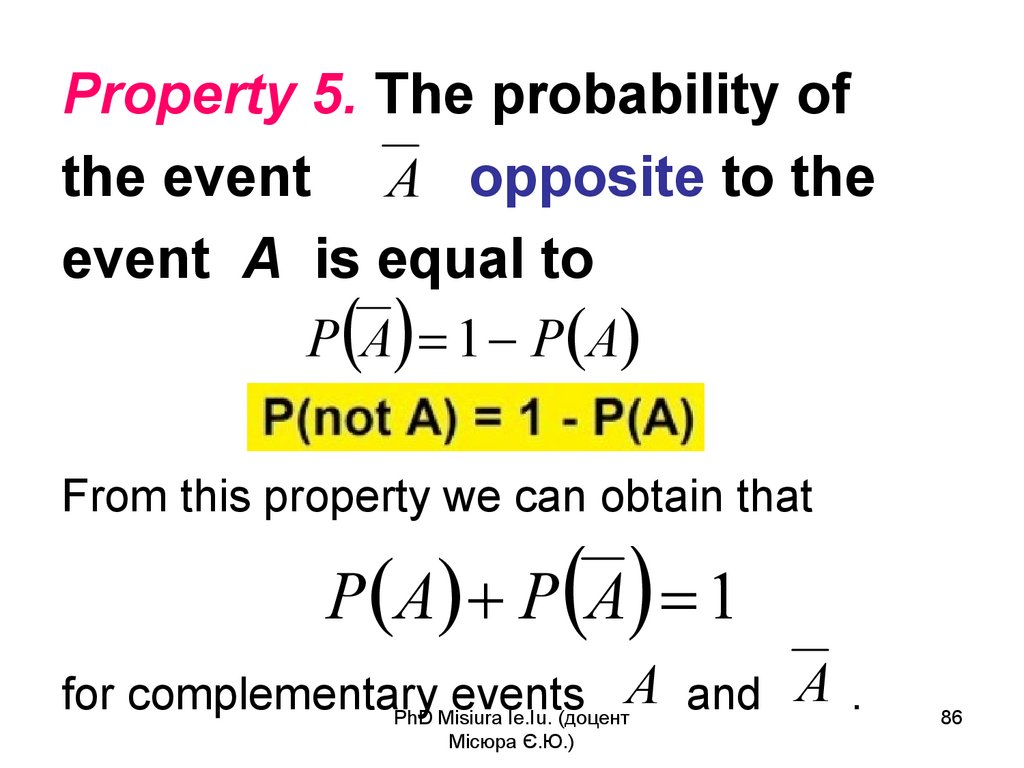
Property 5. The probability ofthe event A opposite to the
event A is equal to
Р A 1 P A
From this property we can obtain that
P A P A 1
A
for complementary
events
and
PhD Misiura Ie.Iu. (доцент
Місюра Є.Ю.)
A.
86
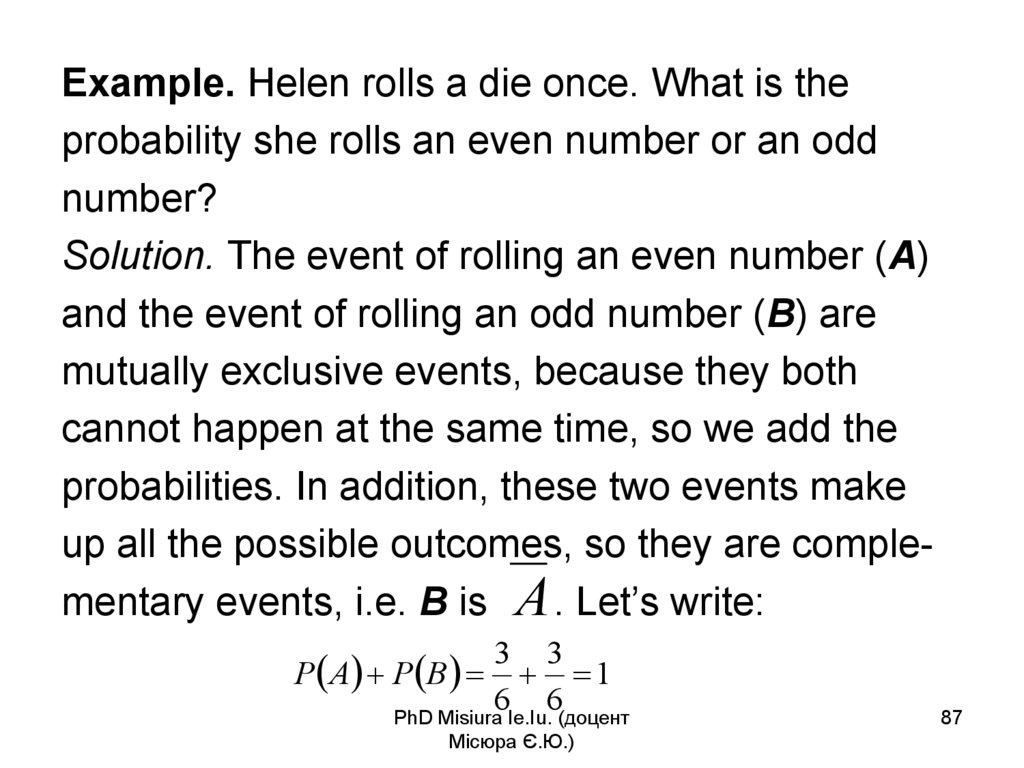
87.
Example. Helen rolls a die once. What is theprobability she rolls an even number or an odd
number?
Solution. The event of rolling an even number (A)
and the event of rolling an odd number (B) are
mutually exclusive events, because they both
cannot happen at the same time, so we add the
probabilities. In addition, these two events make
up all the possible outcomes, so they are complementary events, i.e. B is A . Let’s write:
3 3
Р A Р B 1
6 6
PhD Misiura Ie.Iu. (доцент
Місюра Є.Ю.)
87
88.
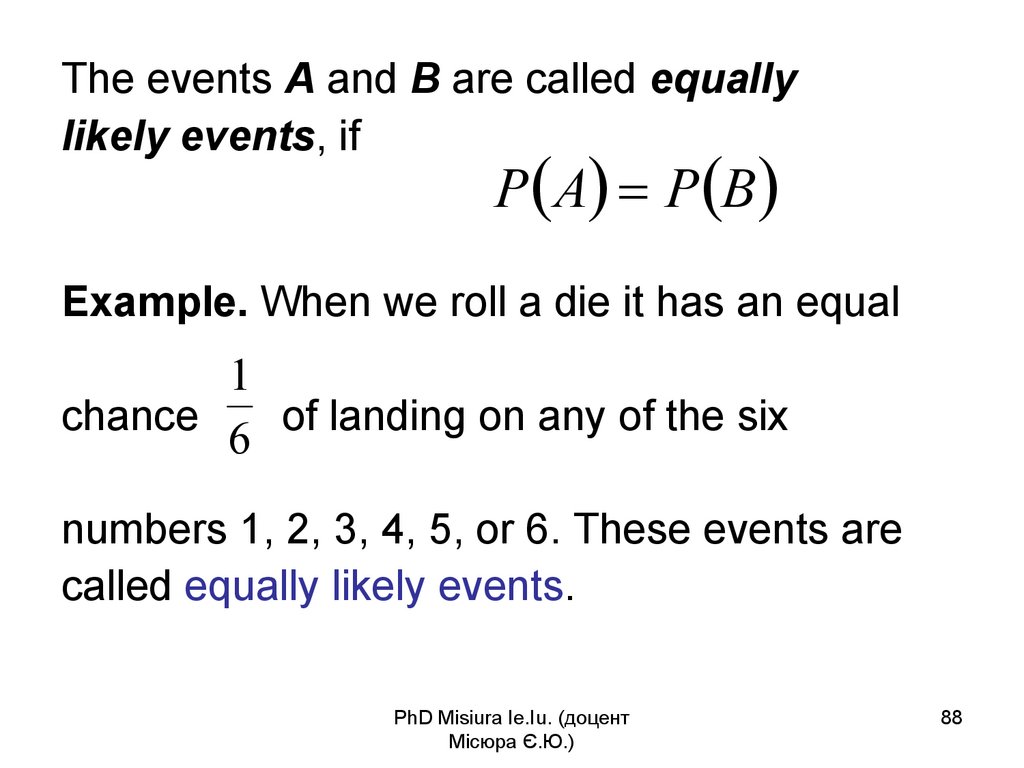
The events A and B are called equallylikely events, if
P A P B
Example. When we roll a die it has an equal
1
chance
of landing on any of the six
6
numbers 1, 2, 3, 4, 5, or 6. These events are
called equally likely events.
PhD Misiura Ie.Iu. (доцент
Місюра Є.Ю.)
88
89.
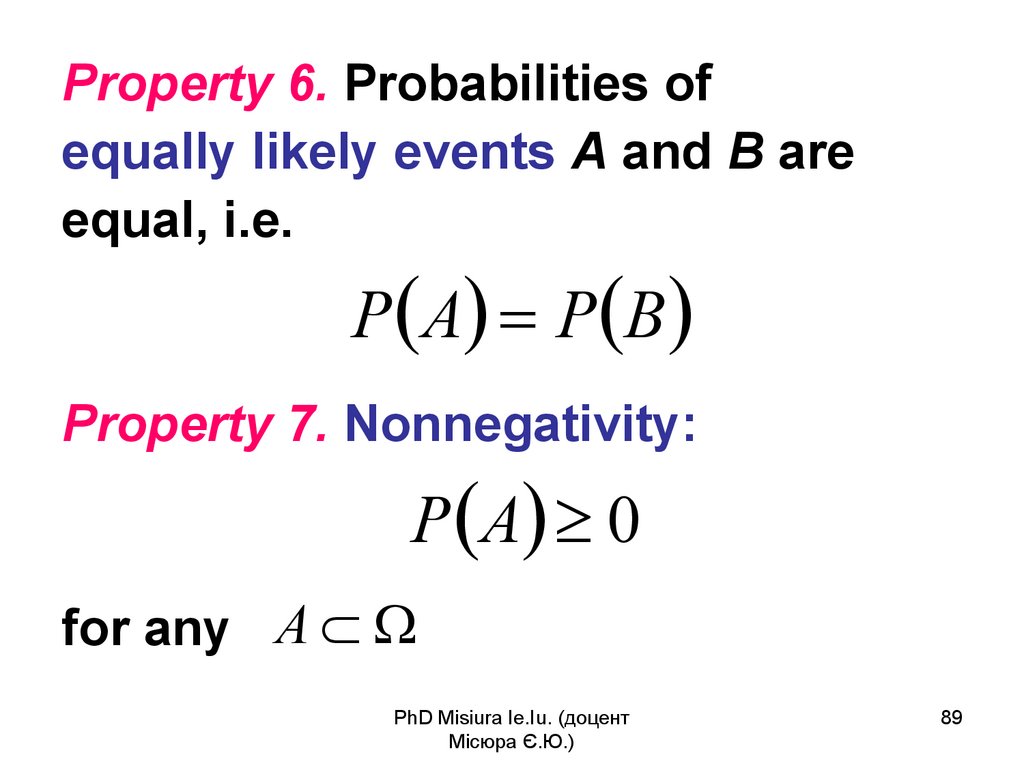
Property 6. Probabilities ofequally likely events A and B are
equal, i.e.
P A P B
Property 7. Nonnegativity:
P A 0
for any A
PhD Misiura Ie.Iu. (доцент
Місюра Є.Ю.)
89
90.
A classical definition of aprobability (класичне визначення
ймовірності)
A geometric definition of a
probability
(геометричне
визначення ймовірності)
n is total number of outcomes (всі
можливі результати даного
випробування)
m are outcomes, favorable for
an event A (кількість результатів
(фіналів) випробування, в яких
настає подія A)
PhD Misiura Ie.Iu. (доцент
Місюра Є.Ю.)
90
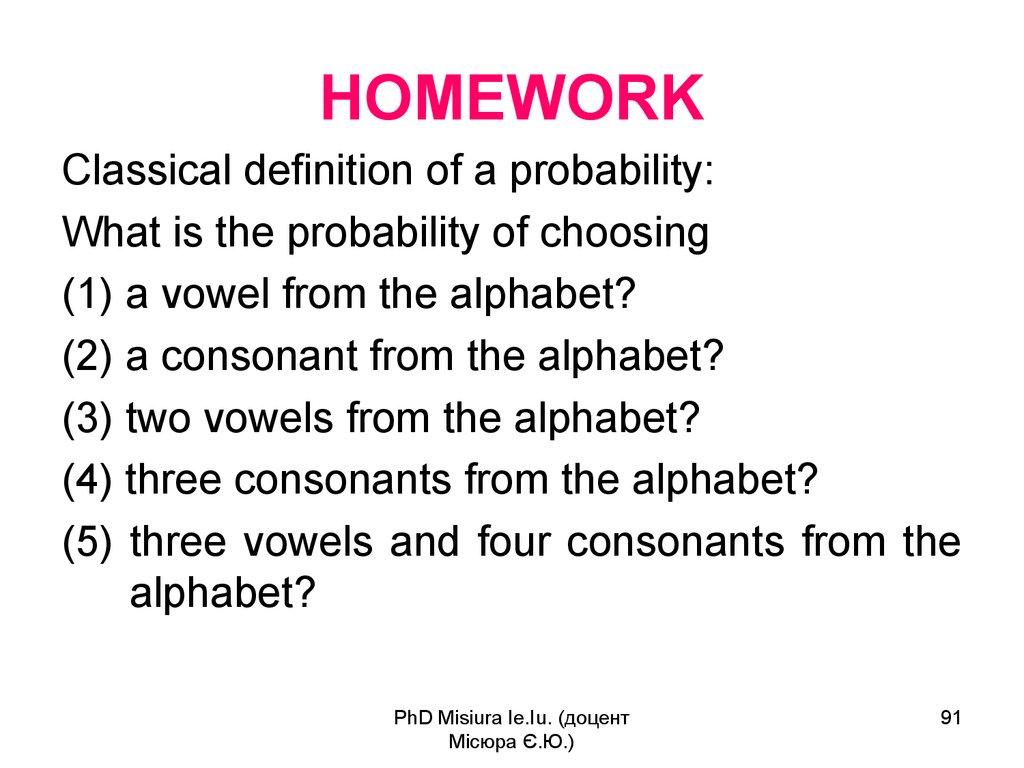
91. HOMEWORK
Classical definition of a probability:What is the probability of choosing
(1) a vowel from the alphabet?
(2) a consonant from the alphabet?
(3) two vowels from the alphabet?
(4) three consonants from the alphabet?
(5) three vowels and four consonants from the
alphabet?
PhD Misiura Ie.Iu. (доцент
Місюра Є.Ю.)
91
92.
PhD Misiura Ie.Iu. (доцентМісюра Є.Ю.)
92