
 mathematics
Similar presentations:





Linear Algebra Review
1. Linear Algebra Review
Yeldos ZhandauletLinear Algebra Review
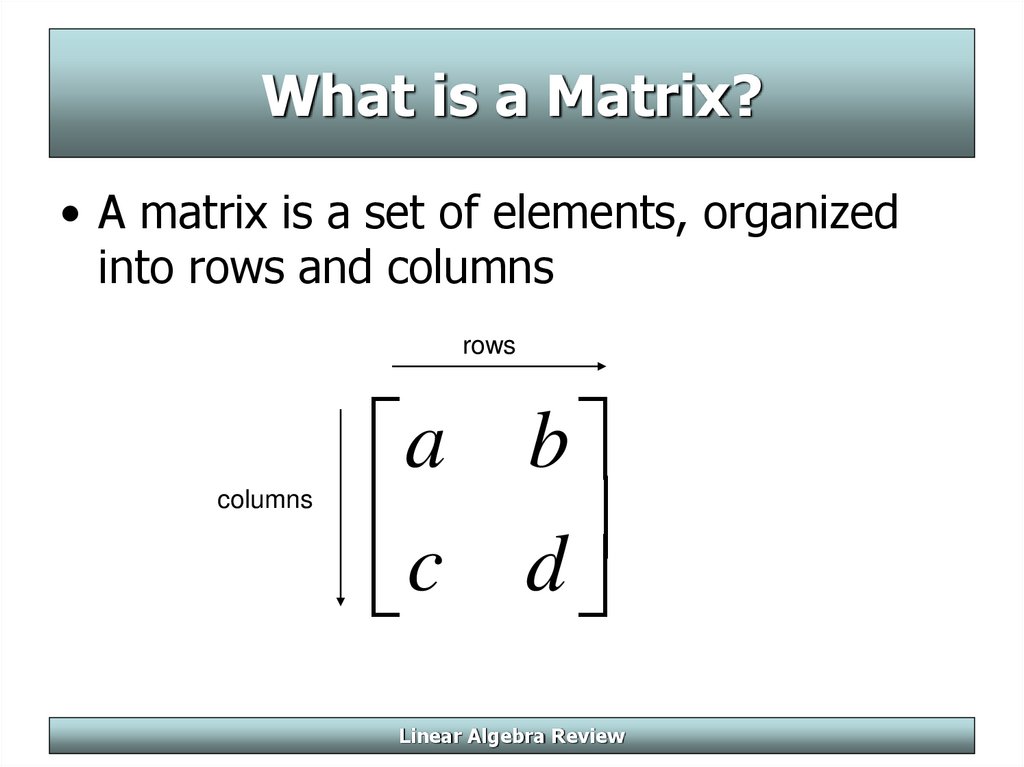
2. What is a Matrix?
• A matrix is a set of elements, organizedinto rows and columns
rows
columns
a b
c d
Linear Algebra Review
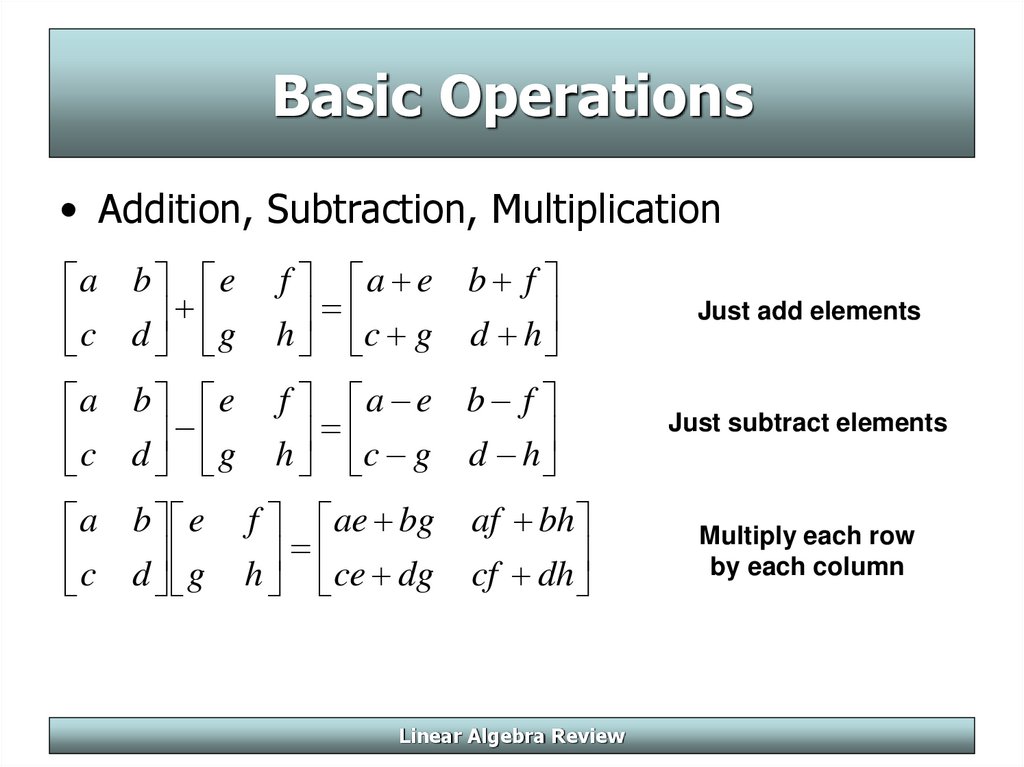
3. Basic Operations
• Addition, Subtraction, Multiplicationa b e
c d g
f a e b f
h c g d h
Just add elements
a b e
c d g
f a e b f
h c g d h
Just subtract elements
a b e
c d g
f ae bg
h ce dg
af bh
cf dh
Linear Algebra Review
Multiply each row
by each column
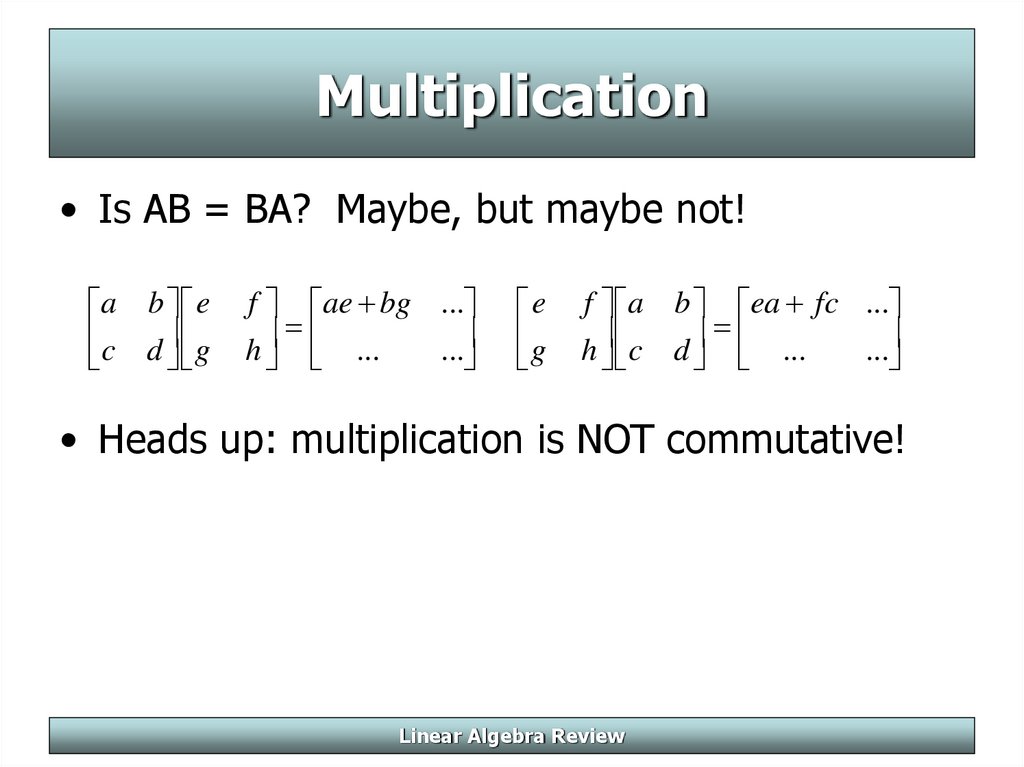
4. Multiplication
• Is AB = BA? Maybe, but maybe not!a b e
c d g
f ae bg ...
h ...
...
e
g
f a b ea fc ...
h c d ...
...
• Heads up: multiplication is NOT commutative!
Linear Algebra Review
5. Vector Operations
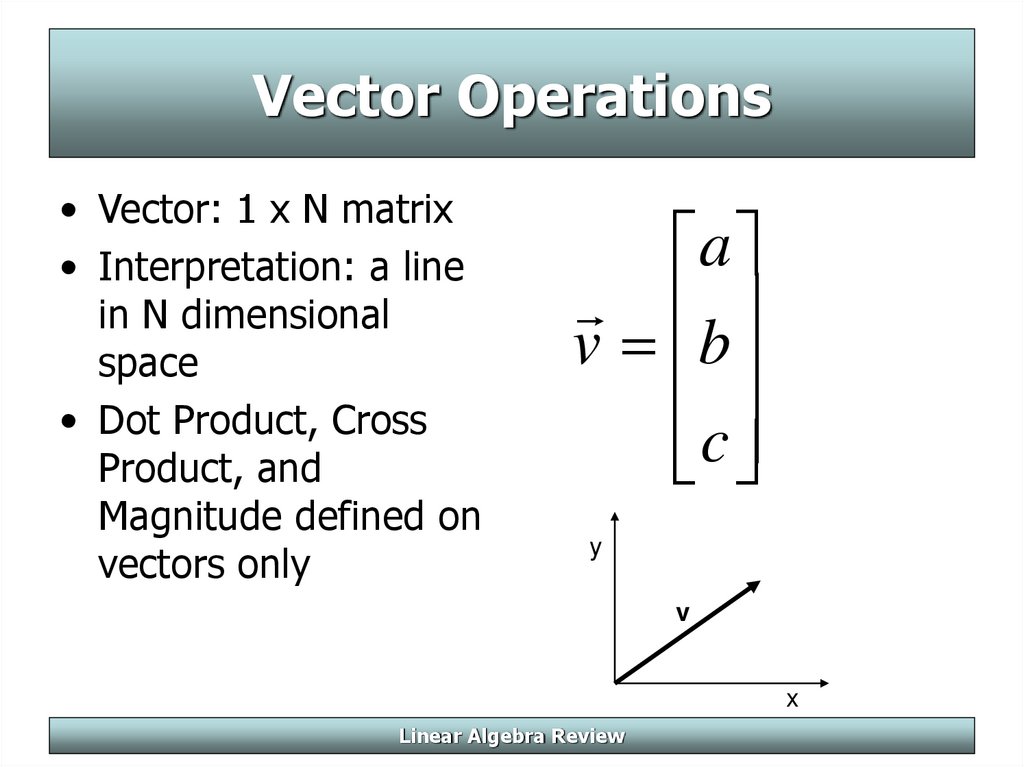
• Vector: 1 x N matrix• Interpretation: a line
in N dimensional
space
• Dot Product, Cross
Product, and
Magnitude defined on
vectors only
a
v b
c
y
v
x
Linear Algebra Review
6. Vector Interpretation
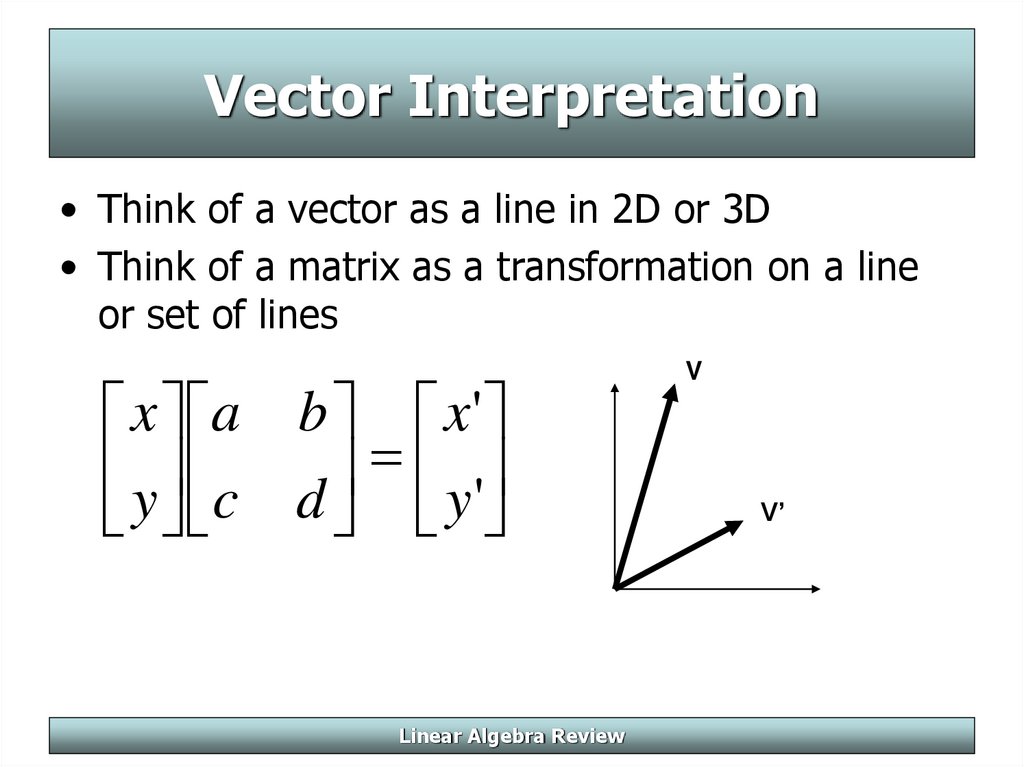
• Think of a vector as a line in 2D or 3D• Think of a matrix as a transformation on a line
or set of lines
x a b x'
y c d y '
Linear Algebra Review
V
V’
7. Vectors: Dot Product
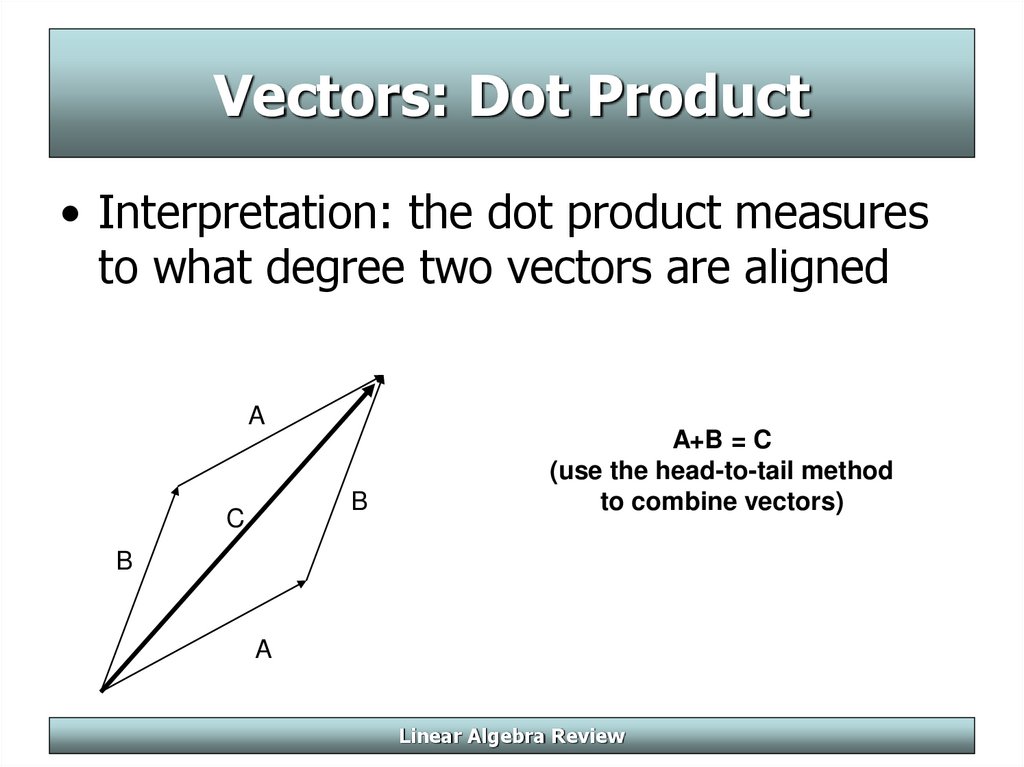
• Interpretation: the dot product measuresto what degree two vectors are aligned
A
B
C
A+B = C
(use the head-to-tail method
to combine vectors)
B
A
Linear Algebra Review
8. Vectors: Dot Product
da b abT a b c e ad be cf
f
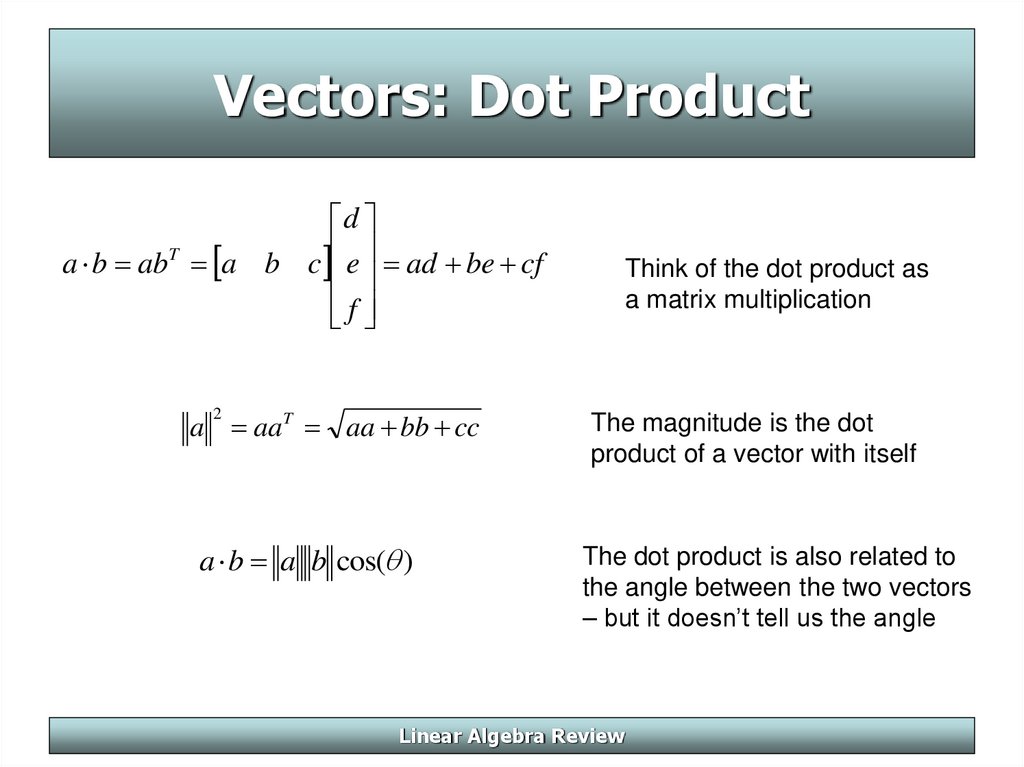
Think of the dot product as
a matrix multiplication
a aaT aa bb cc
The magnitude is the dot
product of a vector with itself
a b a b cos( )
The dot product is also related to
the angle between the two vectors
– but it doesn’t tell us the angle
2
Linear Algebra Review
9. Vectors: Cross Product
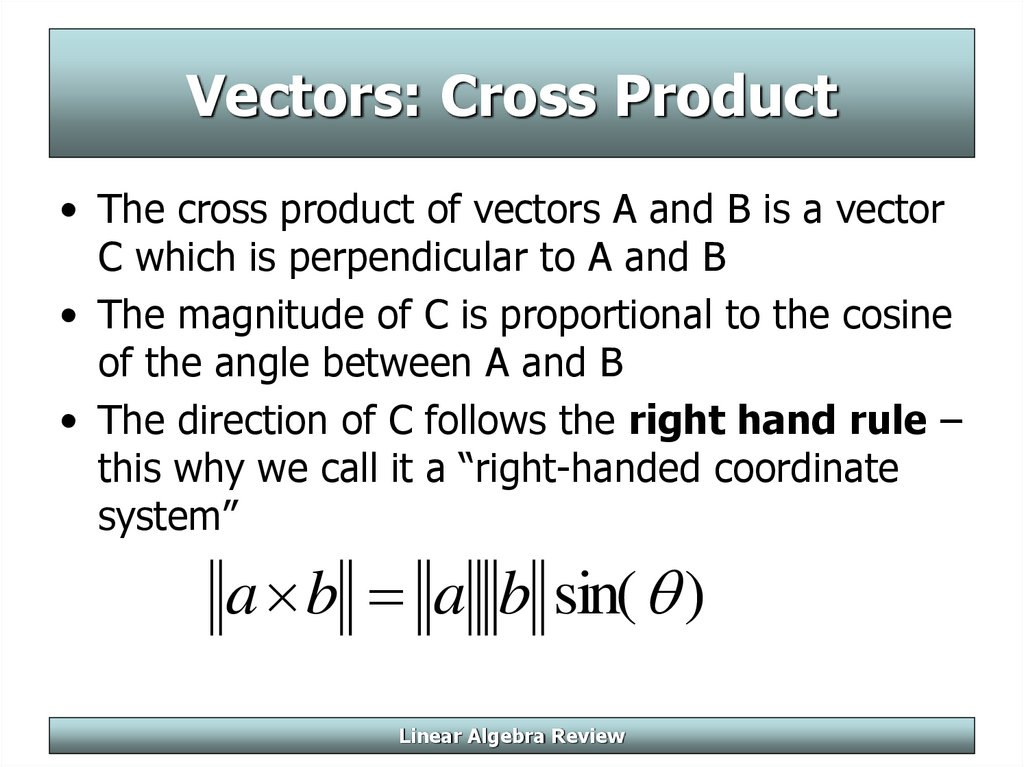
• The cross product of vectors A and B is a vectorC which is perpendicular to A and B
• The magnitude of C is proportional to the cosine
of the angle between A and B
• The direction of C follows the right hand rule –
this why we call it a “right-handed coordinate
system”
a b a b sin( )
Linear Algebra Review
10. Inverse of a Matrix
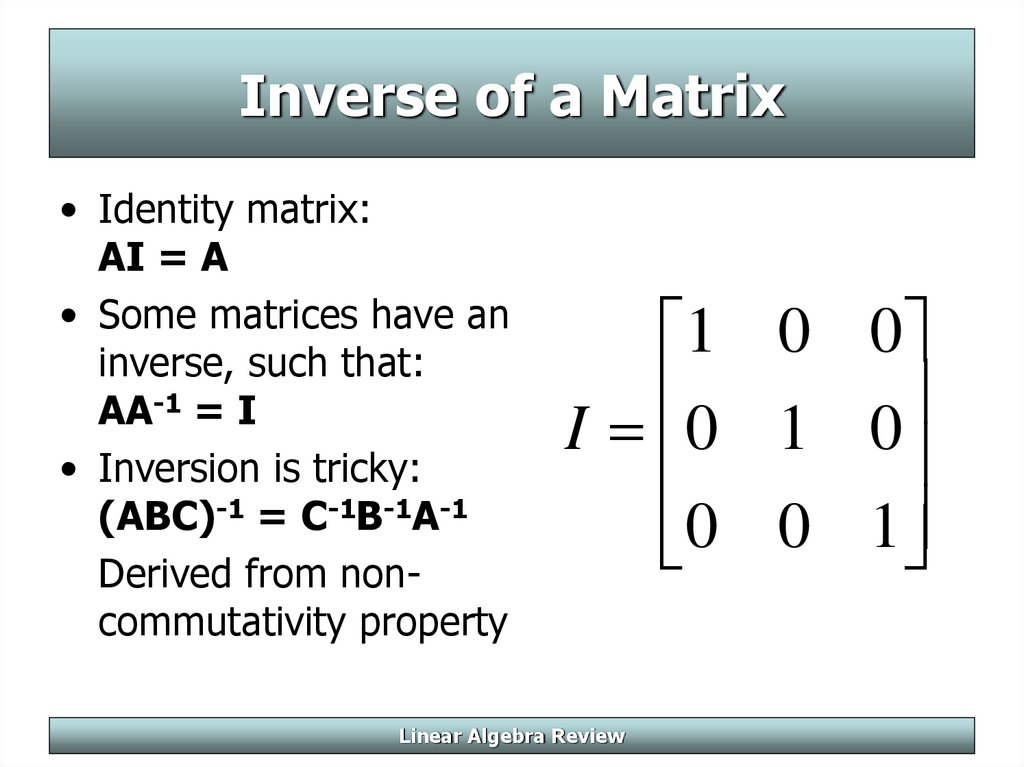
• Identity matrix:AI = A
• Some matrices have an
inverse, such that:
AA-1 = I
• Inversion is tricky:
(ABC)-1 = C-1B-1A-1
Derived from noncommutativity property
1 0 0
I 0 1 0
0 0 1
Linear Algebra Review
11. Determinant of a Matrix
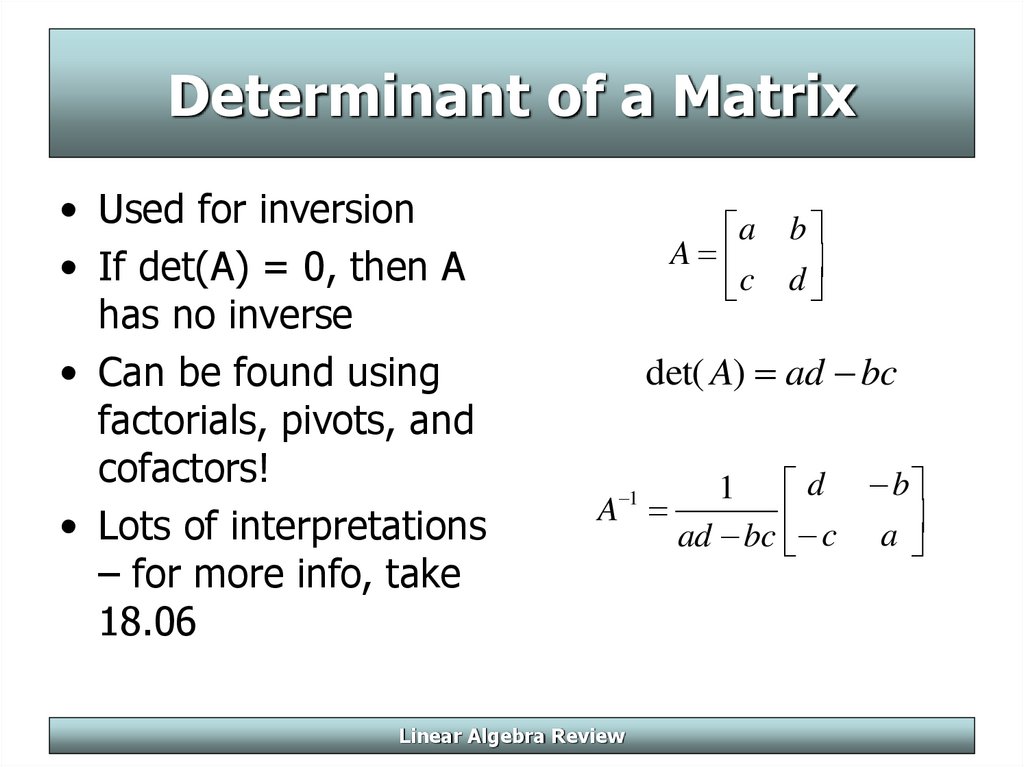
• Used for inversion• If det(A) = 0, then A
has no inverse
• Can be found using
factorials, pivots, and
cofactors!
• Lots of interpretations
– for more info, take
18.06
a b
A
c
d
det( A) ad bc
1 d b
A
ad bc c a
1
Linear Algebra Review
12. Determinant of a Matrix
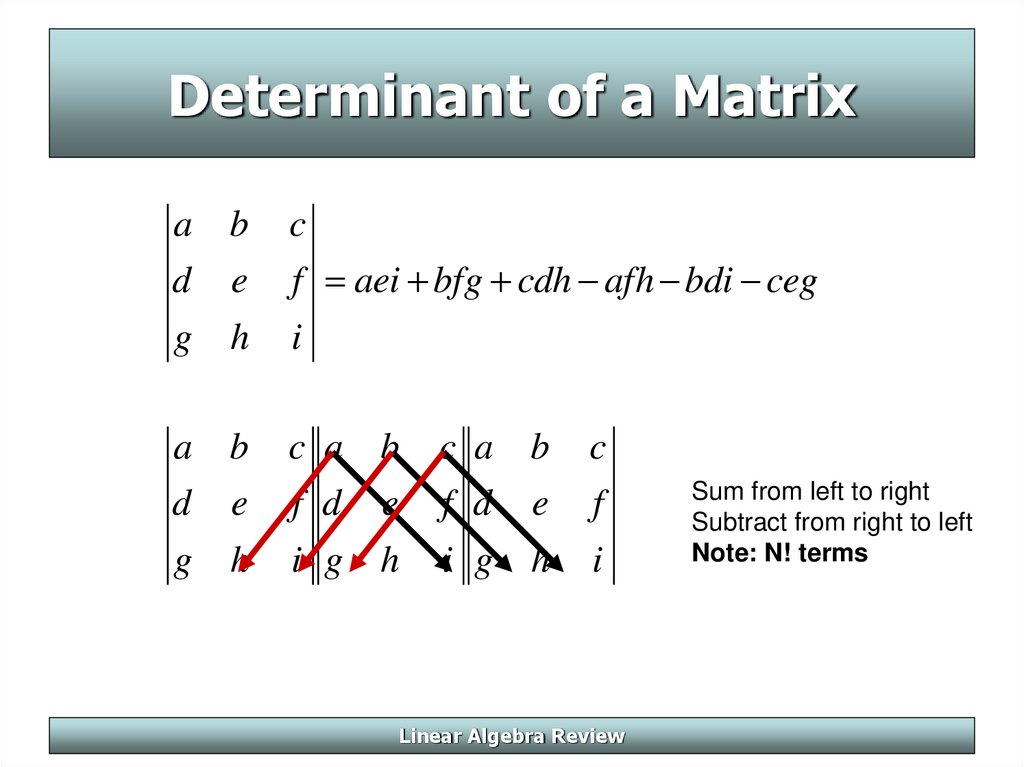
a bd e
g h
c
f aei bfg cdh afh bdi ceg
i
a b
d e
g h
c a b
f d e
i g h
c a b
f d e
i g h
c
f
i
Linear Algebra Review
Sum from left to right
Subtract from right to left
Note: N! terms
13. Inverse of a Matrix
a bd e
g h
c 1 0 0
f 0 1 0
i 0 0 1
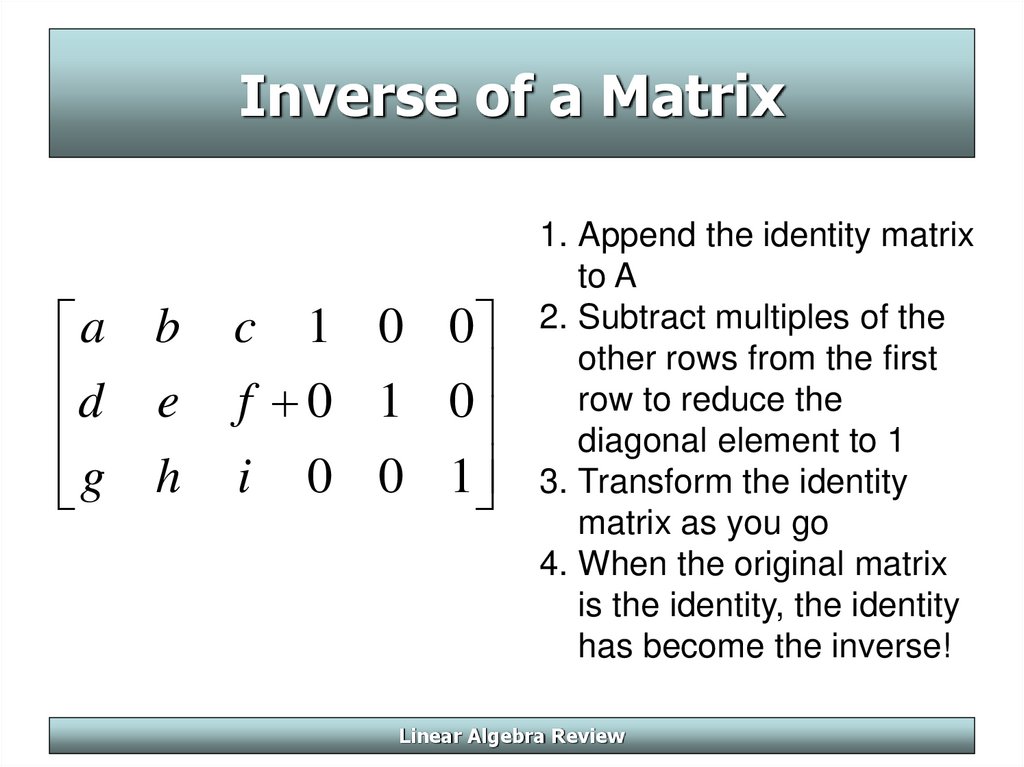
1. Append the identity matrix
to A
2. Subtract multiples of the
other rows from the first
row to reduce the
diagonal element to 1
3. Transform the identity
matrix as you go
4. When the original matrix
is the identity, the identity
has become the inverse!
Linear Algebra Review
14. Orthonormal Basis
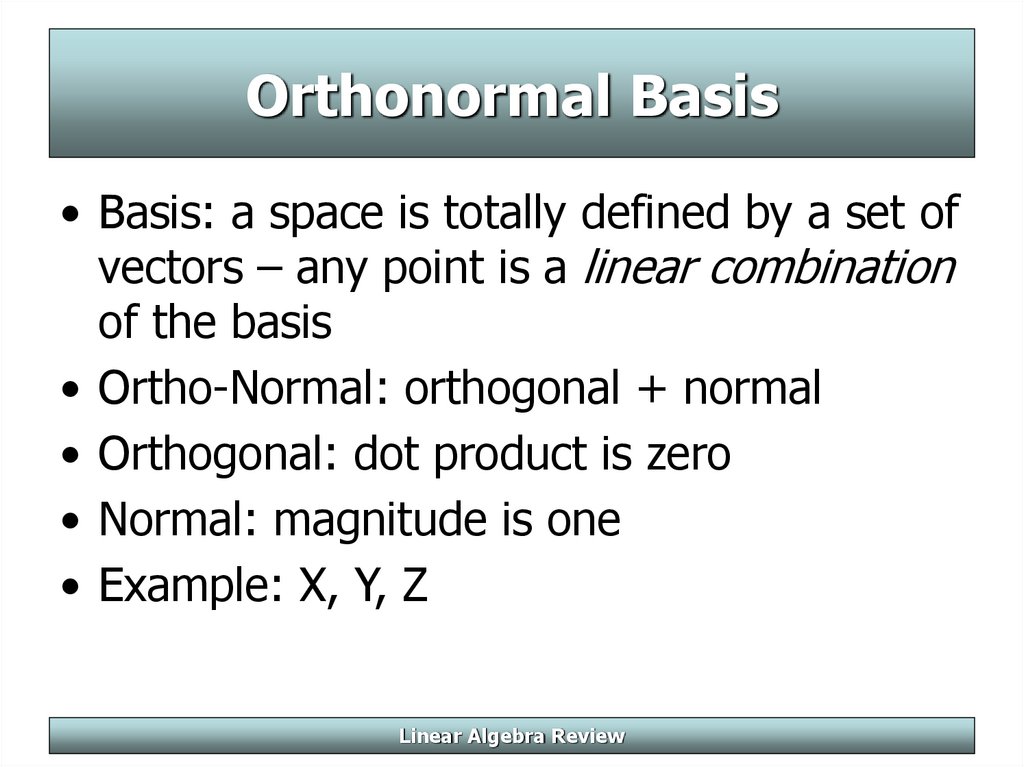
• Basis: a space is totally defined by a set ofvectors – any point is a linear combination
of the basis
• Ortho-Normal: orthogonal + normal
• Orthogonal: dot product is zero
• Normal: magnitude is one
• Example: X, Y, Z
Linear Algebra Review
15. Orthonormal Basis
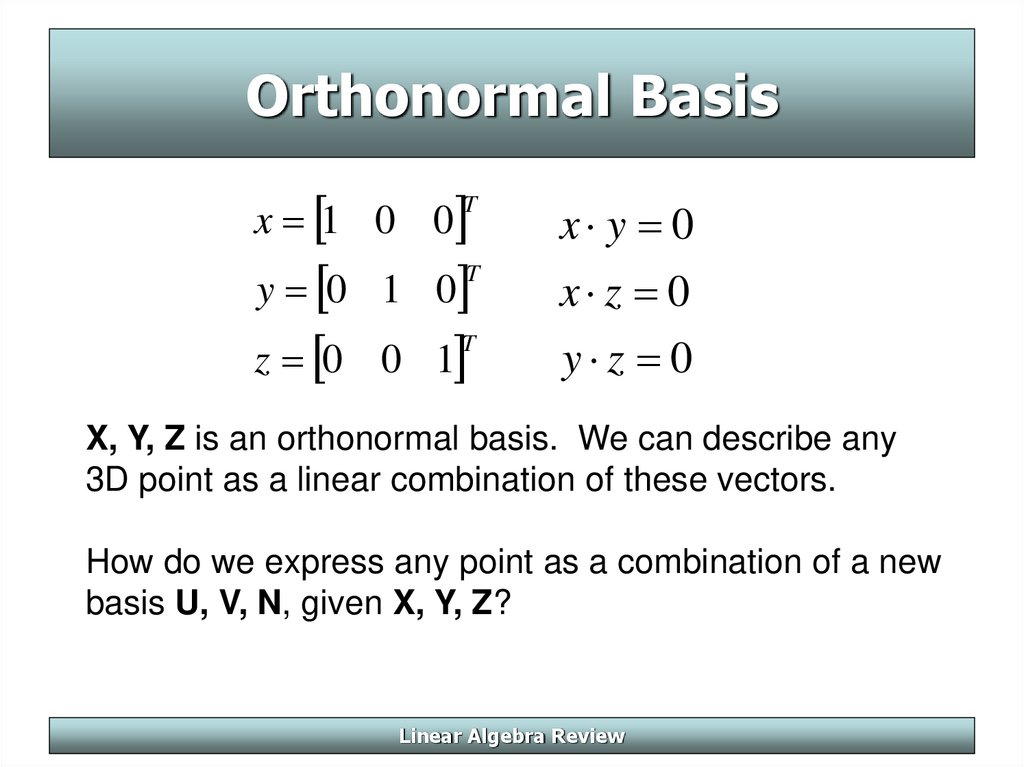
x 1 0 0T
y 0 1 0
T
z 0 0 1
T
x y 0
x z 0
y z 0
X, Y, Z is an orthonormal basis. We can describe any
3D point as a linear combination of these vectors.
How do we express any point as a combination of a new
basis U, V, N, given X, Y, Z?
Linear Algebra Review
16. Orthonormal Basis
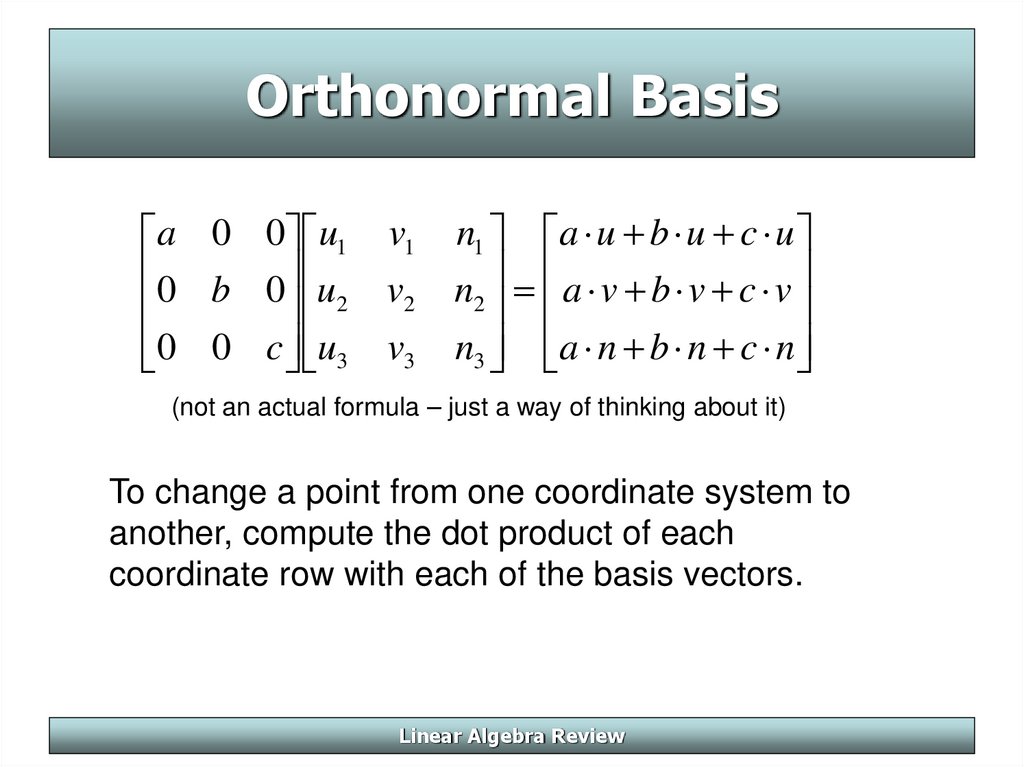
a 0 0 u10 b 0 u
2
0 0 c u3
v1
v2
v3
n1 a u b u c u
n2 a v b v c v
n3 a n b n c n
(not an actual formula – just a way of thinking about it)
To change a point from one coordinate system to
another, compute the dot product of each
coordinate row with each of the basis vectors.
Linear Algebra Review
17. Questions?
?Linear Algebra Review