
 mathematics
Similar presentations:









Digital Design and Computer Architecture
1.
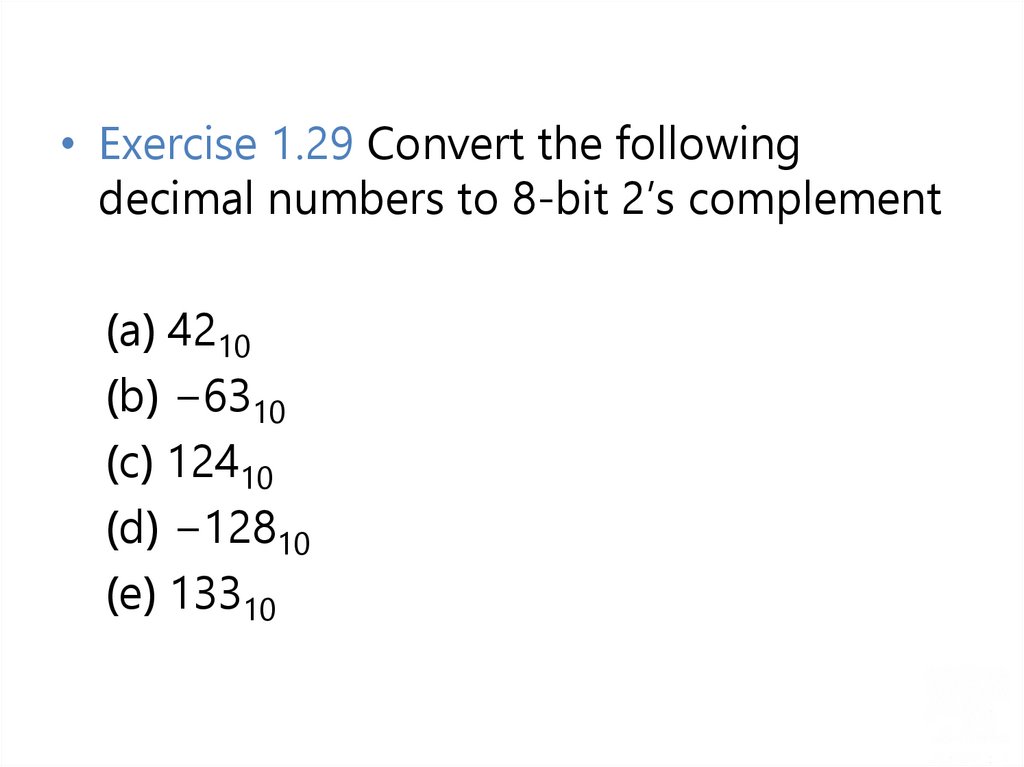
• Exercise 1.29 Convert the followingdecimal numbers to 8-bit 2’s complement
(a) 4210
(b) −6310
(c) 12410
(d) −12810
(e) 13310
Digital Design and Computer Architecture: ARM® Edition © 2015
Chapter 1 <1>
2.
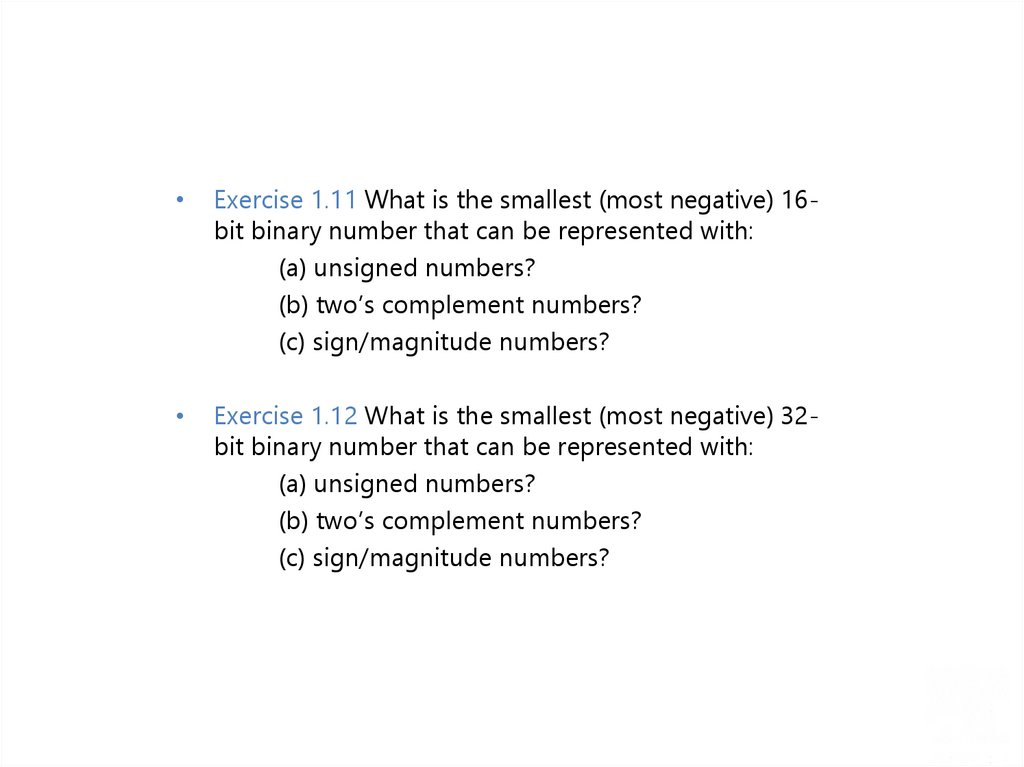
Exercise 1.11 What is the smallest (most negative) 16bit binary number that can be represented with:
(a) unsigned numbers?
(b) two’s complement numbers?
(c) sign/magnitude numbers?
Exercise 1.12 What is the smallest (most negative) 32bit binary number that can be represented with:
(a) unsigned numbers?
(b) two’s complement numbers?
(c) sign/magnitude numbers?
Digital Design and Computer Architecture: ARM® Edition © 2015
Chapter 1 <2>
3.
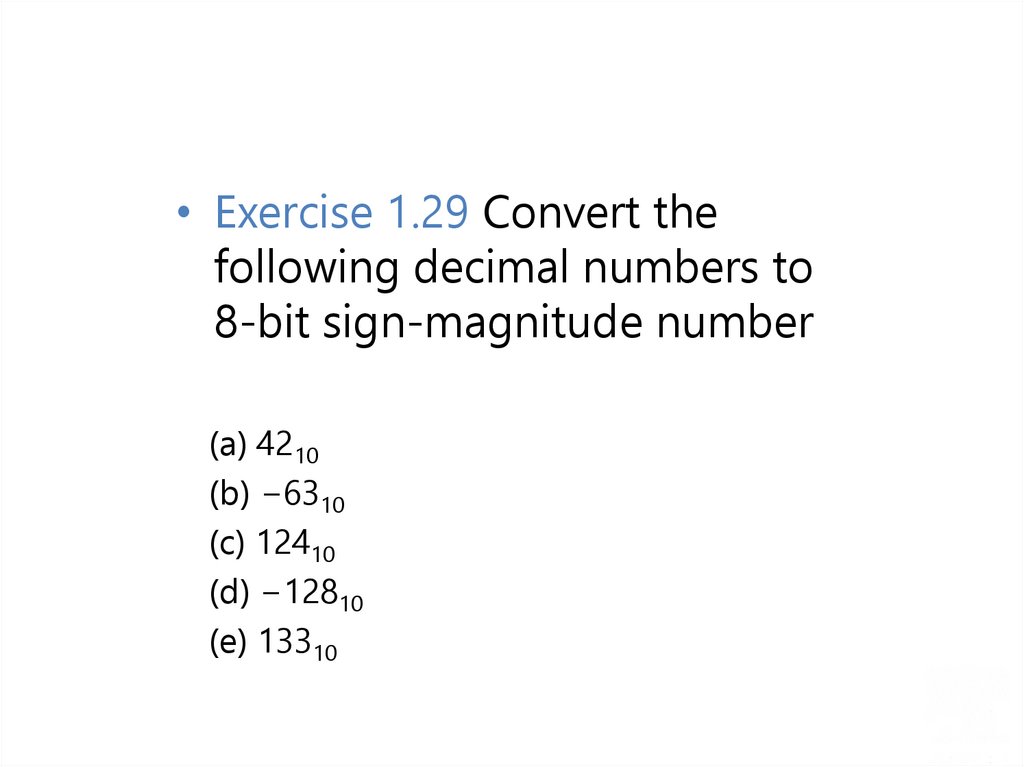
• Exercise 1.29 Convert thefollowing decimal numbers to
8-bit sign-magnitude number
(a) 4210
(b) −6310
(c) 12410
(d) −12810
(e) 13310
Digital Design and Computer Architecture: ARM® Edition © 2015
Chapter 1 <3>
4.
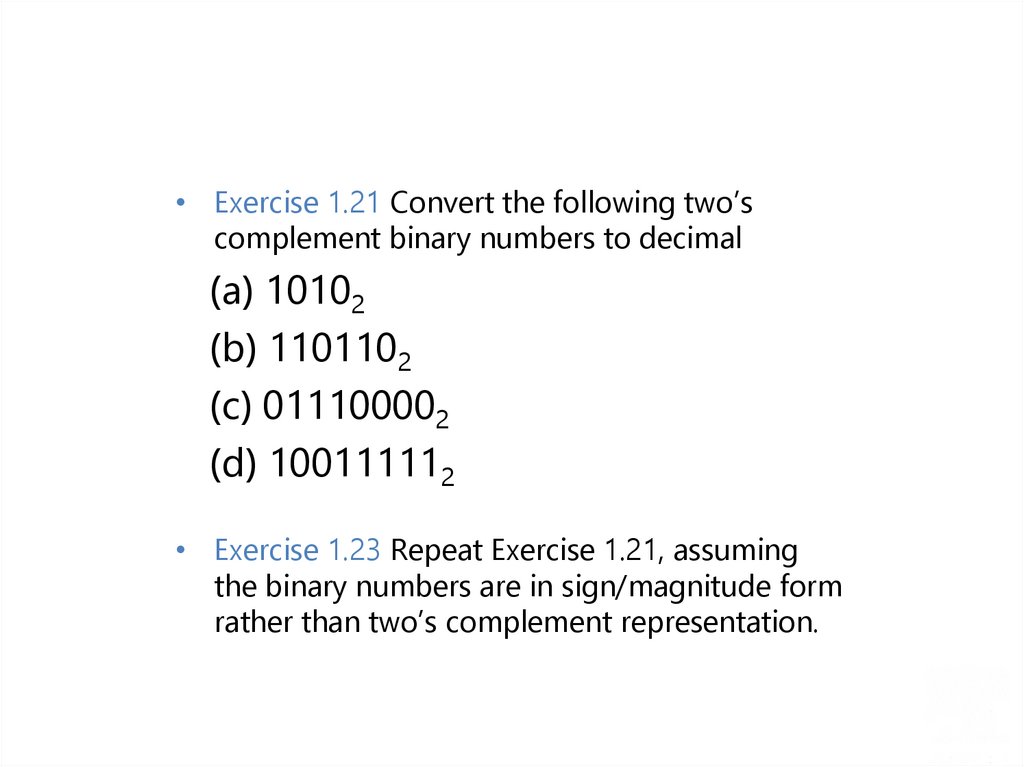
• Exercise 1.21 Convert the following two’scomplement binary numbers to decimal
(a) 10102
(b) 1101102
(c) 011100002
(d) 100111112
• Exercise 1.23 Repeat Exercise 1.21, assuming
the binary numbers are in sign/magnitude form
rather than two’s complement representation.
Digital Design and Computer Architecture: ARM® Edition © 2015
Chapter 1 <4>
5.
Exercise 1.52/1.53 Perform the followingadditions of unsigned binary numbers.
Indicate whether or not the sum overflows a
4-bit result.
(a) 10012 + 01002
(b) 11012 + 10112
(c) 100110012 + 010001002
(d) 110100102 + 101101102
Digital Design and Computer Architecture: ARM® Edition © 2015
Chapter 1 <5>
6.
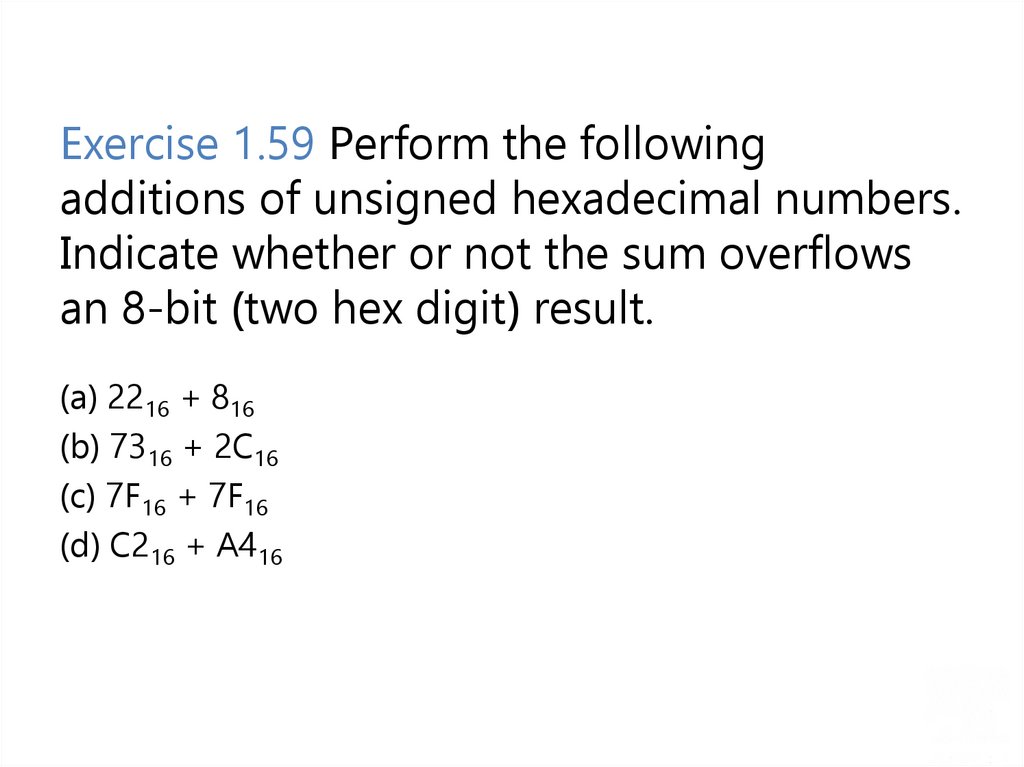
Exercise 1.59 Perform the followingadditions of unsigned hexadecimal numbers.
Indicate whether or not the sum overflows
an 8-bit (two hex digit) result.
(a) 2216 + 816
(b) 7316 + 2C16
(c) 7F16 + 7F16
(d) C216 + A416
Digital Design and Computer Architecture: ARM® Edition © 2015
Chapter 1 <6>
7.
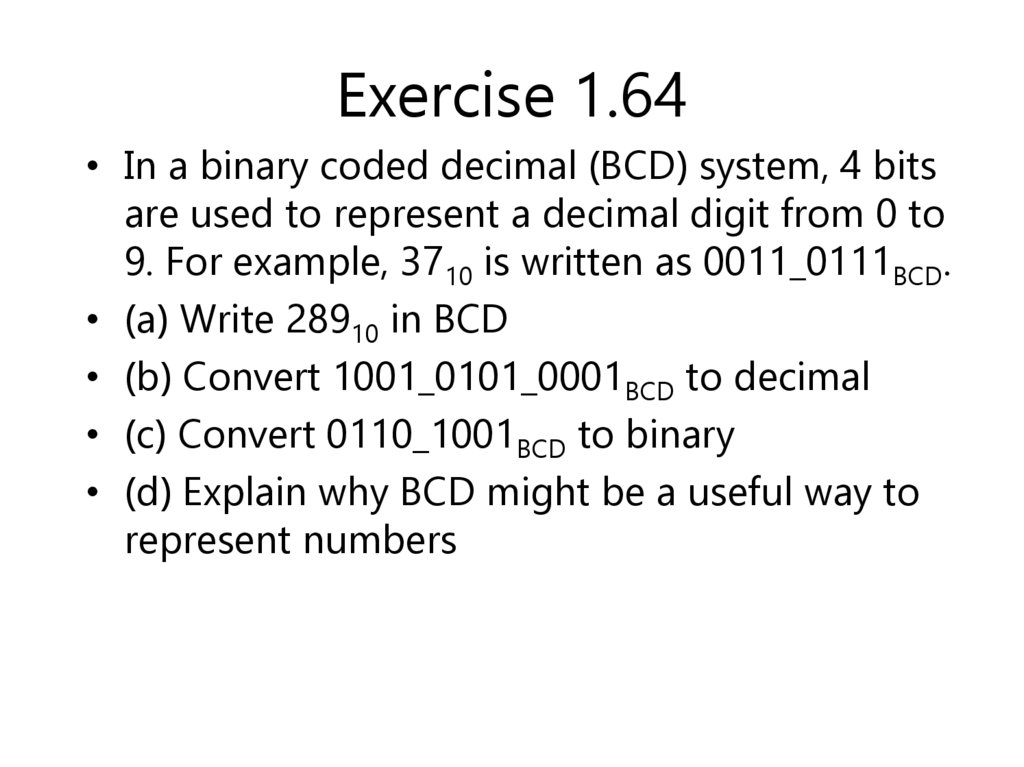
Exercise 1.64• In a binary coded decimal (BCD) system, 4 bits
are used to represent a decimal digit from 0 to
9. For example, 3710 is written as 0011_0111BCD.
• (a) Write 28910 in BCD
• (b) Convert 1001_0101_0001BCD to decimal
• (c) Convert 0110_1001BCD to binary
• (d) Explain why BCD might be a useful way to
represent numbers
8.
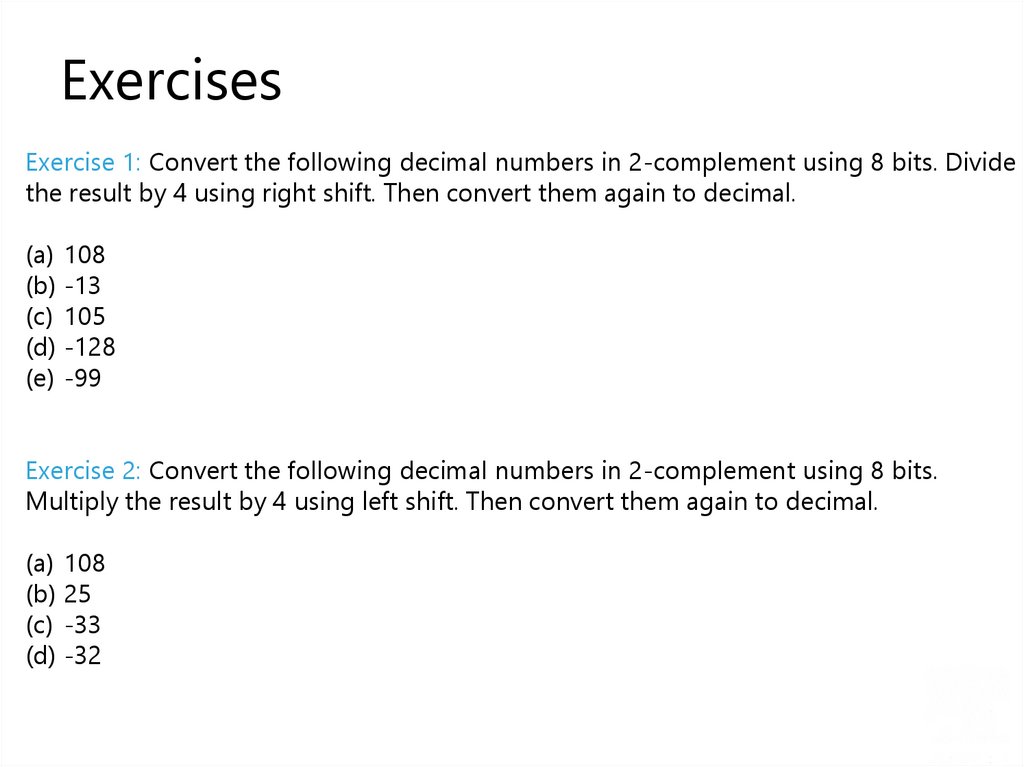
ExercisesExercise 1: Convert the following decimal numbers in 2-complement using 8 bits. Divide
the result by 4 using right shift. Then convert them again to decimal.
(a) 108
(b) -13
(c) 105
(d) -128
(e) -99
Exercise 2: Convert the following decimal numbers in 2-complement using 8 bits.
Multiply the result by 4 using left shift. Then convert them again to decimal.
(a) 108
(b) 25
(c) -33
(d) -32
Digital Design and Computer Architecture: ARM® Edition © 2015
Chapter 1 <8>
9.
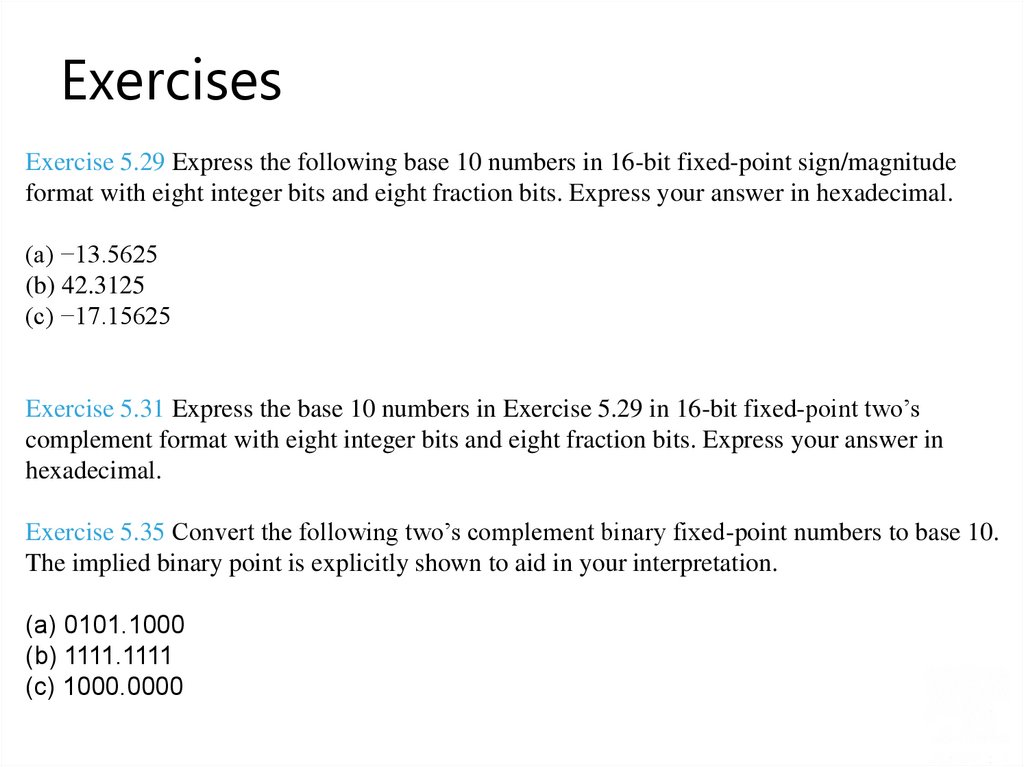
ExercisesExercise 5.29 Express the following base 10 numbers in 16-bit fixed-point sign/magnitude
format with eight integer bits and eight fraction bits. Express your answer in hexadecimal.
(a) −13.5625
(b) 42.3125
(c) −17.15625
Exercise 5.31 Express the base 10 numbers in Exercise 5.29 in 16-bit fixed-point two’s
complement format with eight integer bits and eight fraction bits. Express your answer in
hexadecimal.
Exercise 5.35 Convert the following two’s complement binary fixed-point numbers to base 10.
The implied binary point is explicitly shown to aid in your interpretation.
(a) 0101.1000
(b) 1111.1111
(c) 1000.0000
Digital Design and Computer Architecture: ARM® Edition © 2015
Chapter 1 <9>