 economics
Similar presentations:






Introduction structure of the course
1.
0. Introduction to EconomicsStructure of the course and
information about the exam
Factulty of Humanities
Charles University in Prague
2.
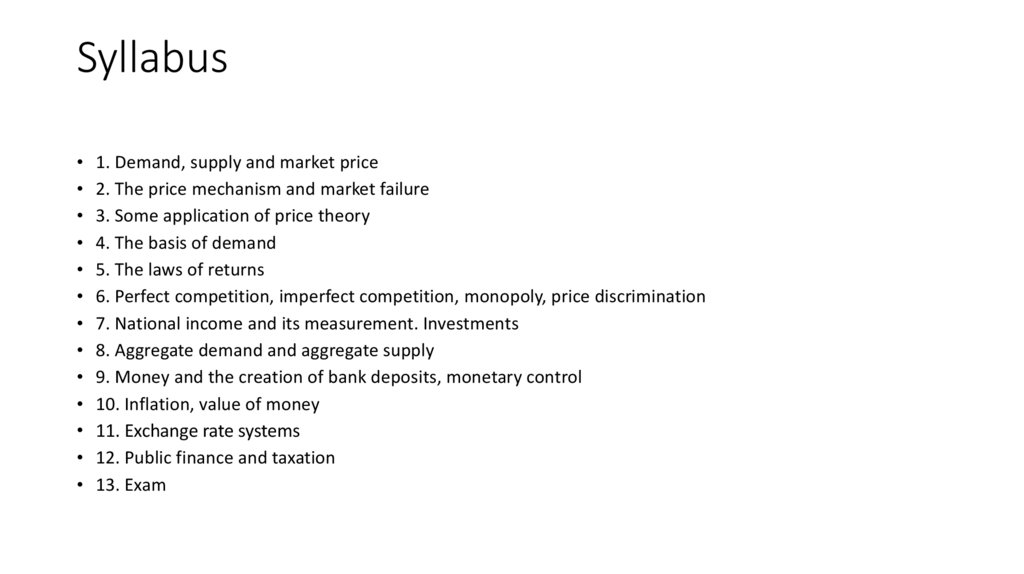
Syllabus1. Demand, supply and market price
2. The price mechanism and market failure
3. Some application of price theory
4. The basis of demand
5. The laws of returns
6. Perfect competition, imperfect competition, monopoly, price discrimination
7. National income and its measurement. Investments
8. Aggregate demand and aggregate supply
9. Money and the creation of bank deposits, monetary control
10. Inflation, value of money
11. Exchange rate systems
12. Public finance and taxation
13. Exam
3.
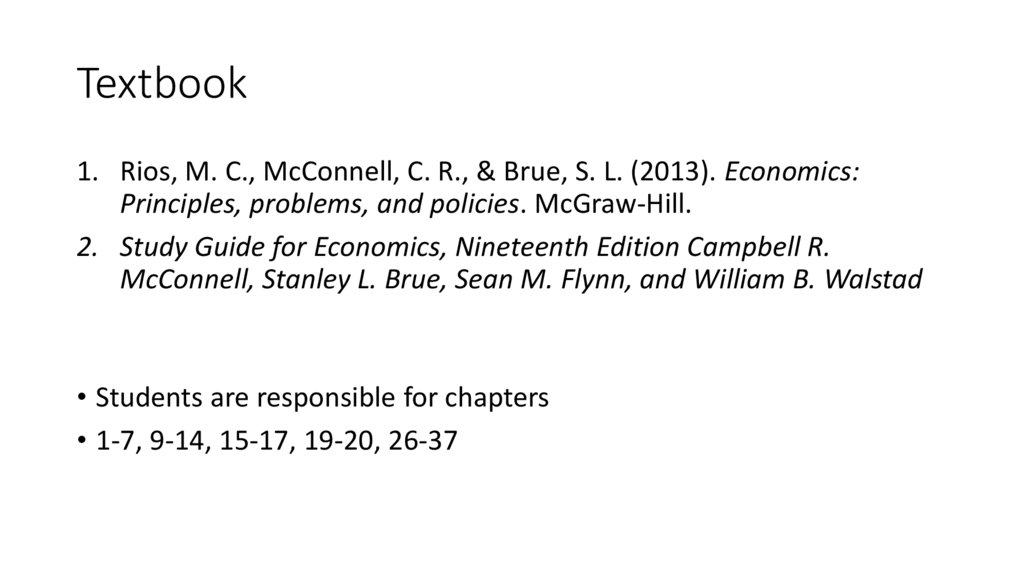
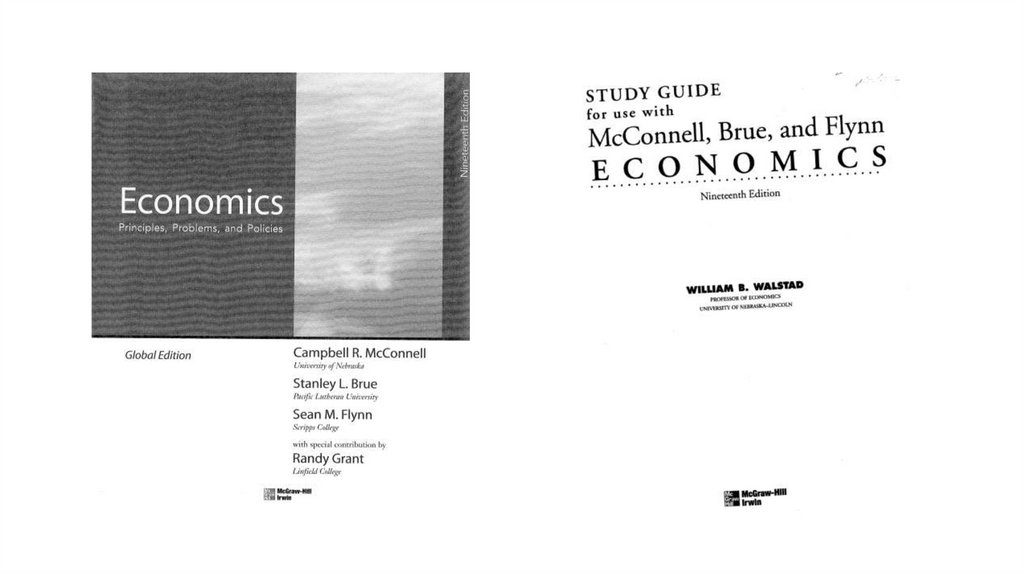
Textbook1. Rios, M. C., McConnell, C. R., & Brue, S. L. (2013). Economics:
Principles, problems, and policies. McGraw-Hill.
2. Study Guide for Economics, Nineteenth Edition Campbell R.
McConnell, Stanley L. Brue, Sean M. Flynn, and William B. Walstad
• Students are responsible for chapters
• 1-7, 9-14, 15-17, 19-20, 26-37
4.
5.
Required reading• Besides the lectures and the homework, you will be supposed to read
at least one of the chapters of the book each week (preferably more
than one) so that at the end of the semester you finish reading all the
required chapters and watching all the videos and have done all the
homework.
6.
Requirements to get the credits for the course• Attendance – 20% of the grade.
• Final test (exam) - 80% of the grade
7.
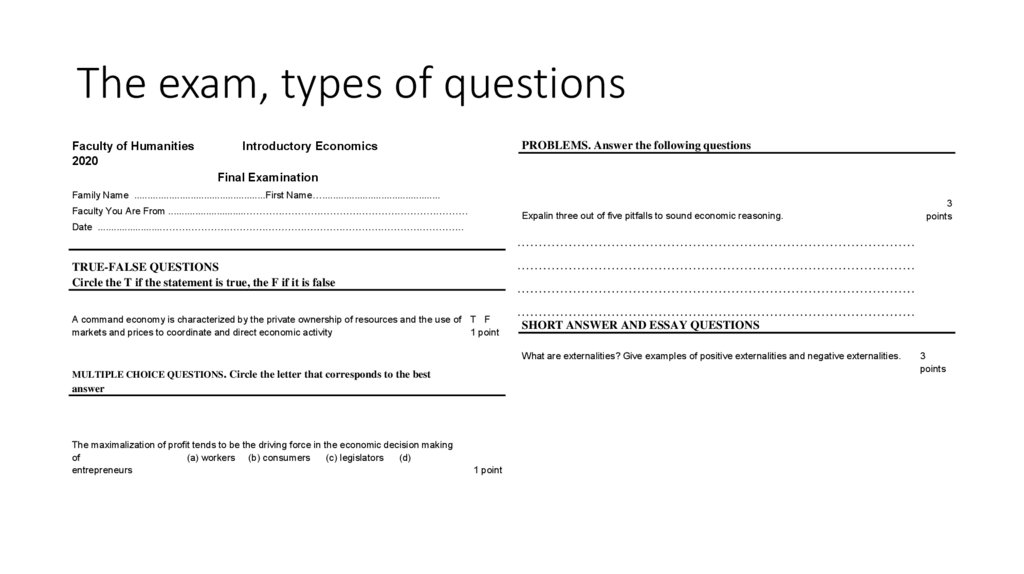
The exam, types of questionsFaculty of Humanities
2020
PROBLEMS. Answer the following questions
Introductory Economics
Final Examination
Family Name .................................................First Name…............................................
Faculty You Are From ............................…………………………………………………………….
Expalin three out of five pitfalls to sound economic reasoning.
3
points
Date .......................…………………………………………………………………………………..
TRUE-FALSE QUESTIONS
Circle the T if the statement is true, the F if it is false
A command economy is characterized by the private ownership of resources and the use of T F
markets and prices to coordinate and direct economic activity
1 point
SHORT ANSWER AND ESSAY QUESTIONS
What are externalities? Give examples of positive externalities and negative externalities.
MULTIPLE CHOICE QUESTIONS. Circle the letter that corresponds to the best
answer
The maximalization of profit tends to be the driving force in the economic decision making
of
(a) workers (b) consumers
(c) legislators
(d)
entrepreneurs
1 point
3
points