
 informatics
Similar presentations:







Sklearn.impute. Transformers for missing value imputation
1.
sklearn.imputeTransformers for missing value imputation
Lyahnovich Kirill, 2021
2.
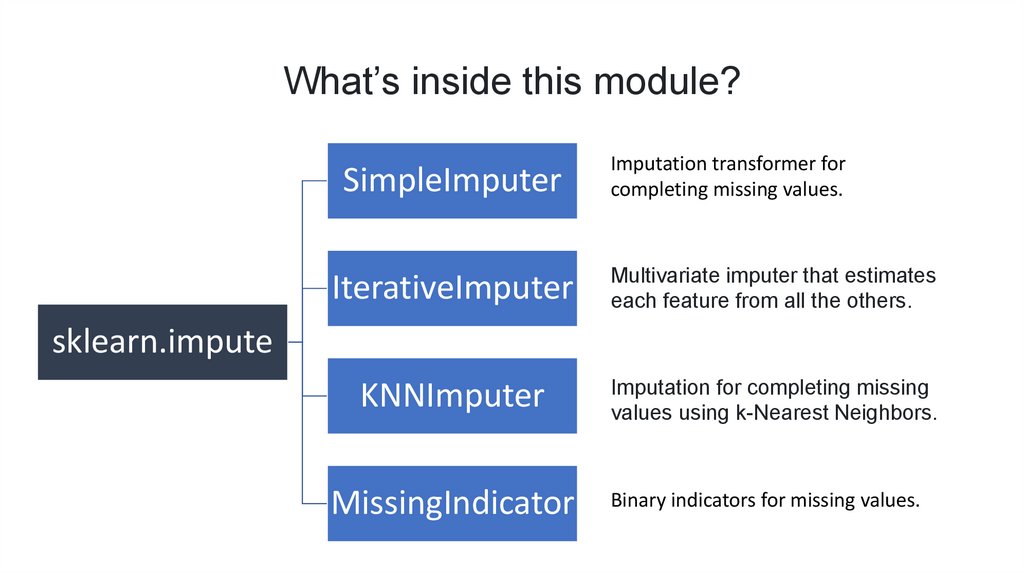
What’s inside this module?SimpleImputer
Imputation transformer for
completing missing values.
IterativeImputer
Multivariate imputer that estimates
each feature from all the others.
KNNImputer
Imputation for completing missing
values using k-Nearest Neighbors.
sklearn.impute
MissingIndicator
Binary indicators for missing values.
3.
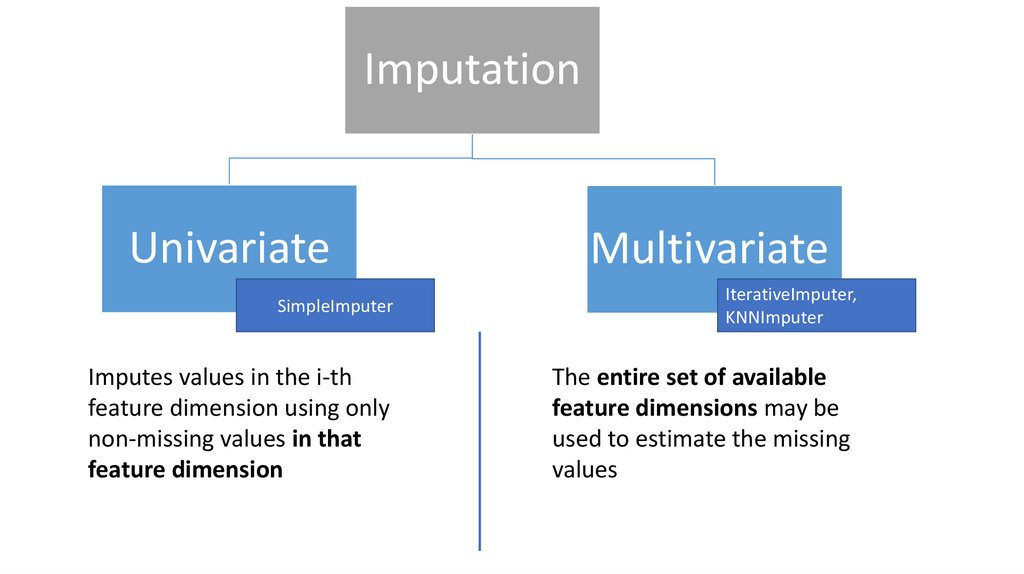
ImputationUnivariate
SimpleImputer
Imputes values in the i-th
feature dimension using only
non-missing values in that
feature dimension
Multivariate
IterativeImputer,
KNNImputer
The entire set of available
feature dimensions may be
used to estimate the missing
values
4.
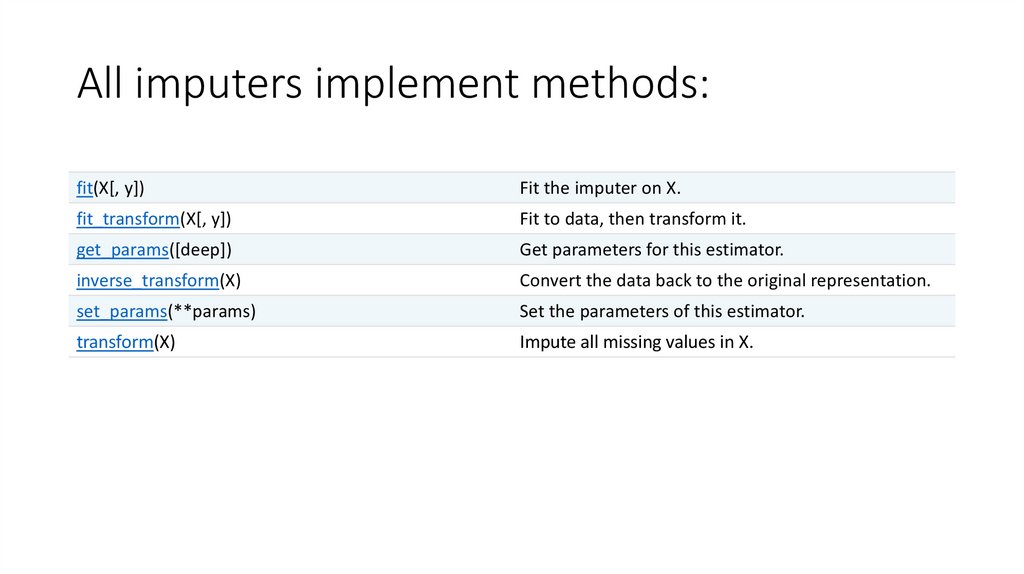
All imputers implement methods:fit(X[, y])
Fit the imputer on X.
fit_transform(X[, y])
Fit to data, then transform it.
get_params([deep])
Get parameters for this estimator.
inverse_transform(X)
Convert the data back to the original representation.
set_params(**params)
Set the parameters of this estimator.
transform(X)
Impute all missing values in X.
5.
Simple Imputerclass sklearn.impute.SimpleImputer
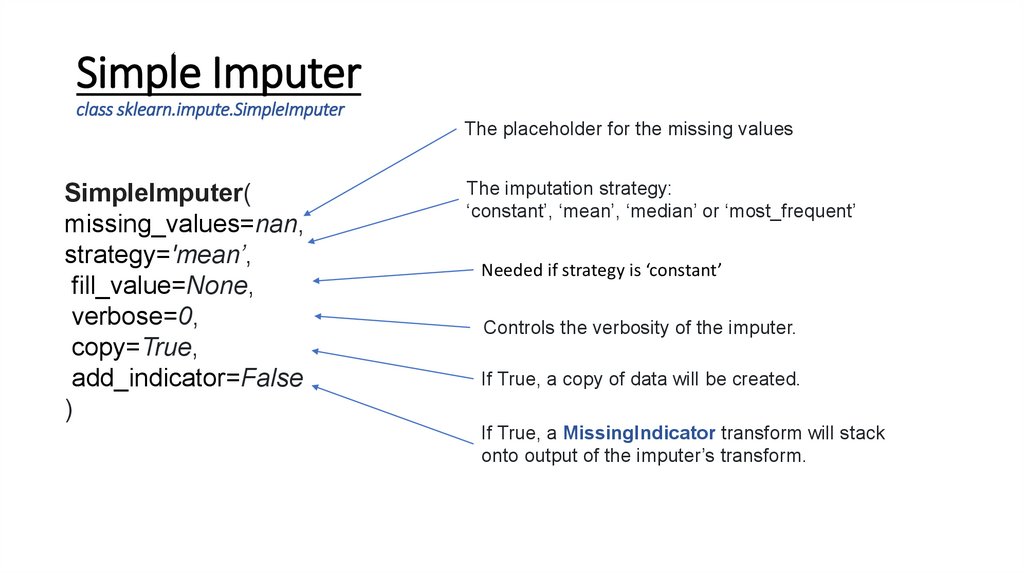
The placeholder for the missing values
SimpleImputer(
missing_values=nan,
strategy='mean’,
fill_value=None,
verbose=0,
copy=True,
add_indicator=False
)
The imputation strategy:
‘constant’, ‘mean’, ‘median’ or ‘most_frequent’
Needed if strategy is ‘constant’
Controls the verbosity of the imputer.
If True, a copy of data will be created.
If True, a MissingIndicator transform will stack
onto output of the imputer’s transform.
6.
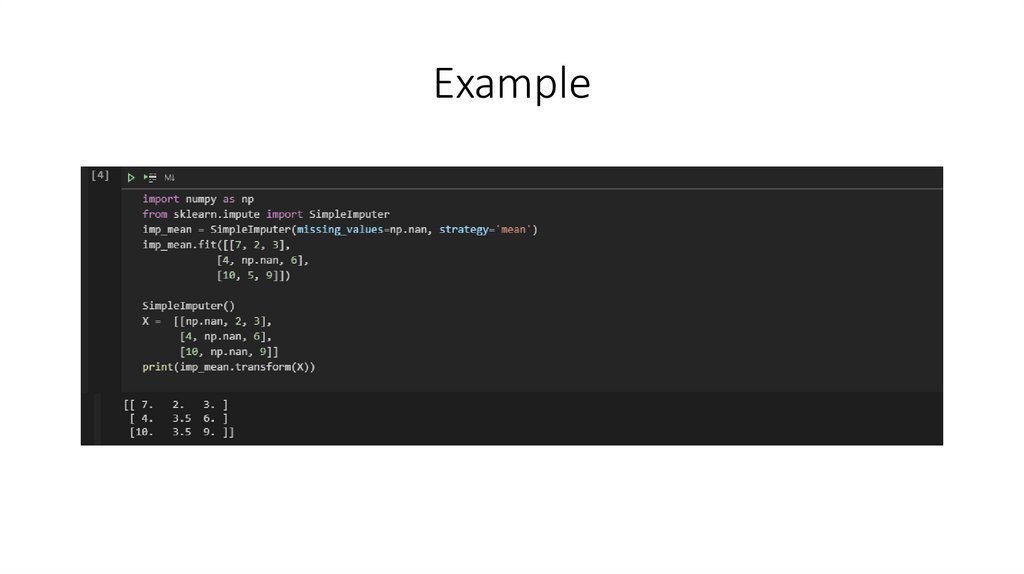
Example7.
Iterative Imputerclass sklearn.impute.IterativeImputer
A strategy for imputing missing values by modeling each feature with missing values as a
function of other features in a round-robin fashion.
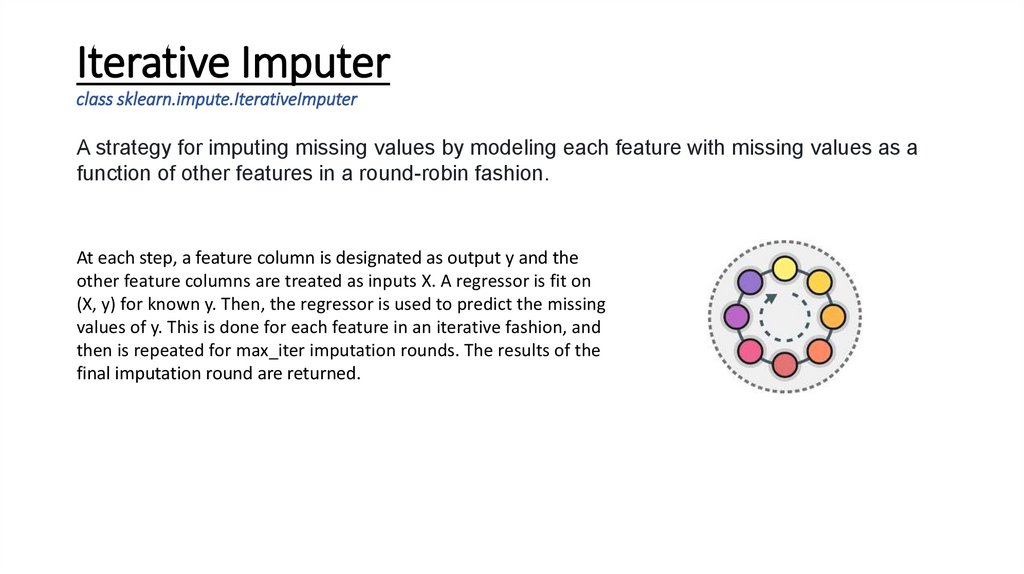
At each step, a feature column is designated as output y and the
other feature columns are treated as inputs X. A regressor is fit on
(X, y) for known y. Then, the regressor is used to predict the missing
values of y. This is done for each feature in an iterative fashion, and
then is repeated for max_iter imputation rounds. The results of the
final imputation round are returned.
8.
Iterative Imputerclass sklearn.impute.IterativeImputer
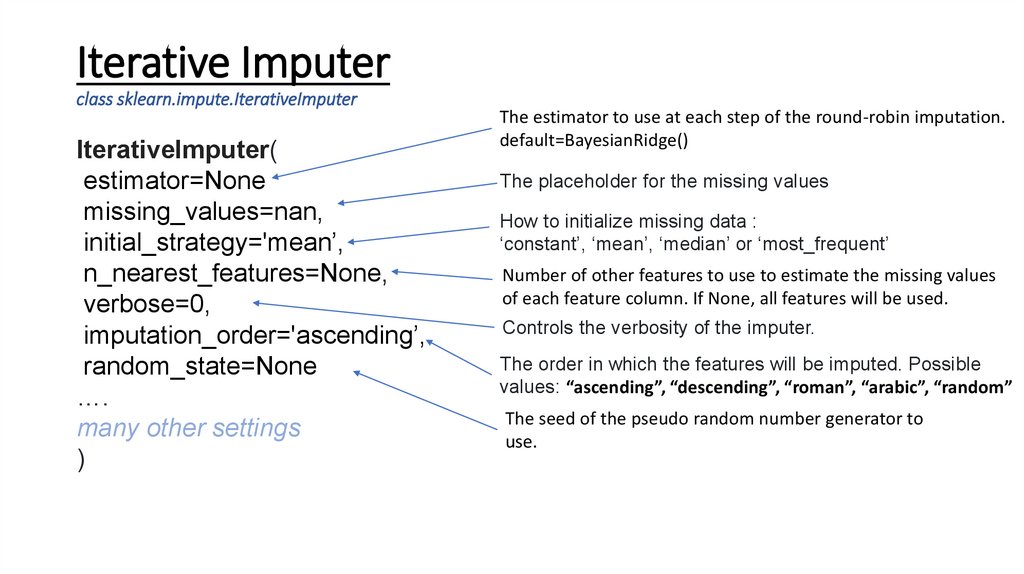
IterativeImputer(
estimator=None
missing_values=nan,
initial_strategy='mean’,
n_nearest_features=None,
verbose=0,
imputation_order='ascending’,
random_state=None
….
many other settings
)
The estimator to use at each step of the round-robin imputation.
default=BayesianRidge()
The placeholder for the missing values
How to initialize missing data :
‘constant’, ‘mean’, ‘median’ or ‘most_frequent’
Number of other features to use to estimate the missing values
of each feature column. If None, all features will be used.
Controls the verbosity of the imputer.
The order in which the features will be imputed. Possible
values: “ascending”, “descending”, “roman”, “arabic”, “random”
The seed of the pseudo random number generator to
use.
9.
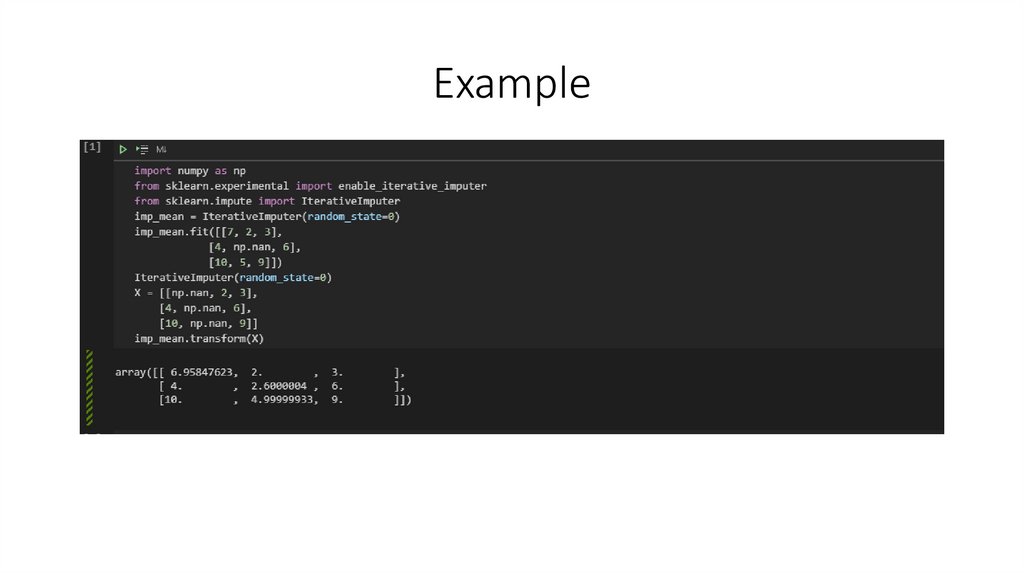
Example10.
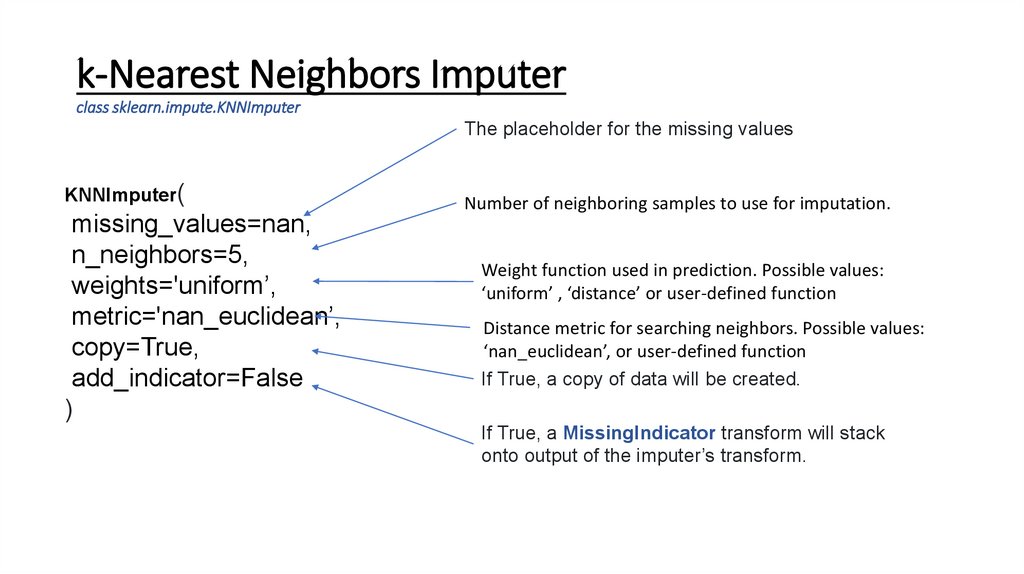
k-Nearest Neighbors Imputerclass sklearn.impute.KNNImputer
The placeholder for the missing values
KNNImputer(
missing_values=nan,
n_neighbors=5,
weights='uniform’,
metric='nan_euclidean’,
copy=True,
add_indicator=False
)
Number of neighboring samples to use for imputation.
Weight function used in prediction. Possible values:
‘uniform’ , ‘distance’ or user-defined function
Distance metric for searching neighbors. Possible values:
‘nan_euclidean’, or user-defined function
If True, a copy of data will be created.
If True, a MissingIndicator transform will stack
onto output of the imputer’s transform.
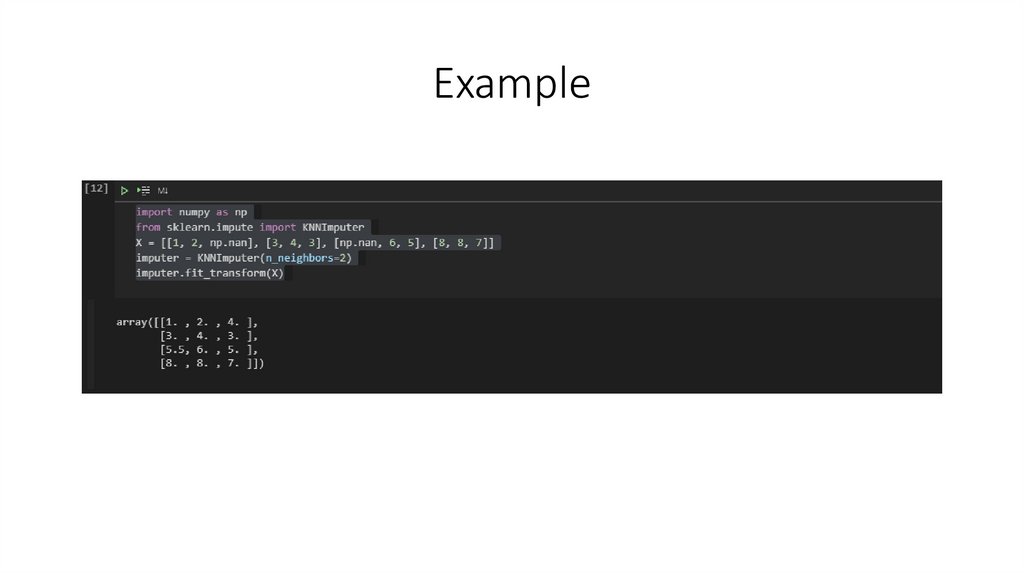
11.
Example12.
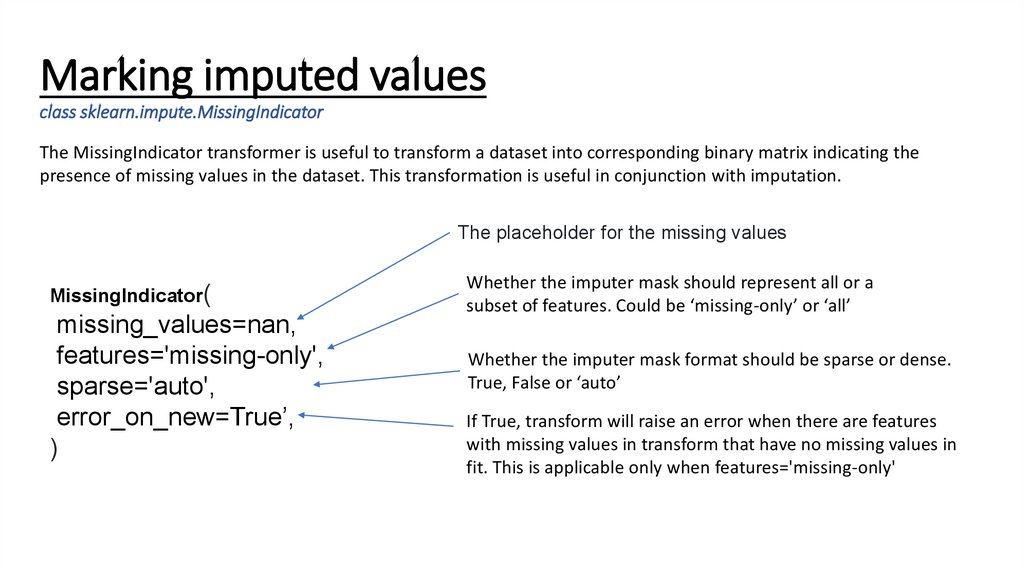
Marking imputed valuesclass sklearn.impute.MissingIndicator
The MissingIndicator transformer is useful to transform a dataset into corresponding binary matrix indicating the
presence of missing values in the dataset. This transformation is useful in conjunction with imputation.
The placeholder for the missing values
MissingIndicator(
missing_values=nan,
features='missing-only',
sparse='auto',
error_on_new=True’,
)
Whether the imputer mask should represent all or a
subset of features. Could be ‘missing-only’ or ‘all’
Whether the imputer mask format should be sparse or dense.
True, False or ‘auto’
If True, transform will raise an error when there are features
with missing values in transform that have no missing values in
fit. This is applicable only when features='missing-only'