

 lingvistics
Similar presentations:







Theory of Prototypes
1. LECTURE 7
THEORY OF PROTOTYPES2. Plan
• Introduction• Theory of prototypes
• Conclusion
3. INTRODUCTION
The question of human categorization of the world, i.e., how a continuum ofexperience is interpreted in terms of discrete categories by means of language,
is not new in linguistics.
The theory of the semantic field, the hypothesis of linguistic relativity by
Sapir–Whorf and the research of the so-called the linguistic picture of the
world has attracted the attention of linguists to, that reality is divided in
different ways in different languages , and these differences affect both lexical
and grammatical meanings.
To what extent do they affect the perception and understanding of the world by
native speakers of different languages? Do they speak different languages in
different worlds, or is it still the same world with different labels attached to it
[Sapir 1993: 261]?
These questions, which have become the subject of research in the
interdisciplinary field of ethnolinguistics, never cease to excite the minds of
linguists, philosophers, anthropologists, and psychologists.
4.
The ethnographic aspect of the problem of categorization isundoubtedly of interest to cognitive science, but it is nevertheless
secondary and derivative in relation to the question of the nature
and internal organization of categories. For some cognitivists, the
latter is especially significant, since it is associated with the basic
principles that organize human thinking, cognition, and memory.
Categorization is the basis of all human activity. Each of us, without
realizing it, performs operations every second to recognize the one
or the other a new fragment of experience (an object, a word, an
action, a state, etc.) as a kind of a certain one, usually already, a
class of entities or phenomena. If you a man does not have this
ability, he will not be able to function either physically neither
socially nor intellectually [Lakoff 1987: 5-6].
5.
How does this happen? Where do categories come from and how do theywork?
At first, it may seem that they are set in reality itself, and our mind only
reflects them. However, this is not the case, and the simplest refutation is the
presence of abstract categories in a person's conceptual system that exist only
in his mind .
Another possible objection is related to the lack of clear boundaries even
between concrete entities (cf.: tree and bush, mountain and hill, forest and
park, river and stream, street and avenue), not to mention abstract ones (for
example, joy and happiness, economic recession and economic crisis , etc.).
Therefore, the categories are not set in the external world, but are the result of
a person's understanding of this world — hence the importance of the problem
for cognitive psychology and cognitive science in general is evident. And
since categorization is implemented through language, then it is directly
related to cognitive linguistics.
6.
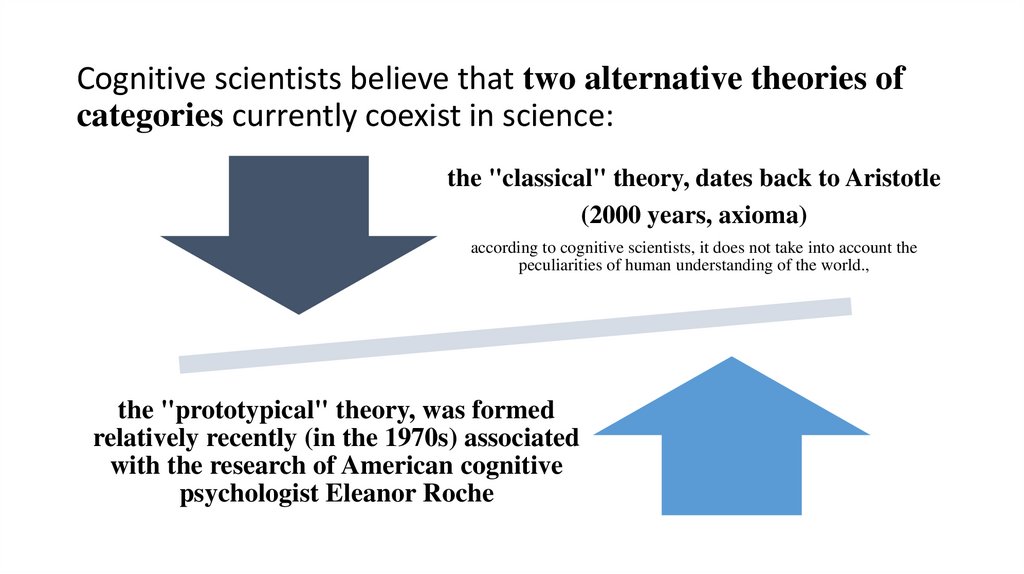
Cognitive scientists believe that two alternative theories ofcategories currently coexist in science:
the "classical" theory, dates back to Aristotle
(2000 years, axioma)
according to cognitive scientists, it does not take into account the
peculiarities of human understanding of the world.,
the "prototypical" theory, was formed
relatively recently (in the 1970s) associated
with the research of American cognitive
psychologist Eleanor Roche
7.
Prototype Theory is a cognitive psychological theory that wasdeveloped as an alternative to the classical view of concepts, where
meaning categories are seen as being based on logical rules.
According to the classical theory, traditionally associated with the
name of Aristotle, a category is a kind of abstract broom container
which includes a number of entities that are equal members of this
category, have a number of common essential properties:
categories are abstract containers with clear boundaries;
category members have a set of essential common properties
that can be considered as necessary and sufficient conditions for
membership in this category;
category members have the same status within the category.
8. “Family resemblance" by Wittgenstein
“Family resemblance" by WittgensteinIn his arguments about the concept of a game Wittgenstein showed that
there are no properties that would be common to all members of this
category.
He concluded that its unity is supported by a complex network of large
and small similarities that can be likened to similarities between family
members, cf.: "I can't think of any better expression to characterize this
similarity, than "family resemblance"; for this is how different lines of
similarity that exist between members of the same family intertwine and
intersect.: height, facial features, eye color, temper, etc. — And I will say:
"games form a family" (cit. according to [Wezhbitska 1996: 213]).
The idea of "family resemblance" does not contradict the presence of
common properties among all members of the category, but it does not
9. Labov
Scientists questioned the ability of classical theory to explain how aperson divides continuous reality into discrete categories.
As an example , let’s study the experiments of a famous American
linguist William Labov [Labov 1983].
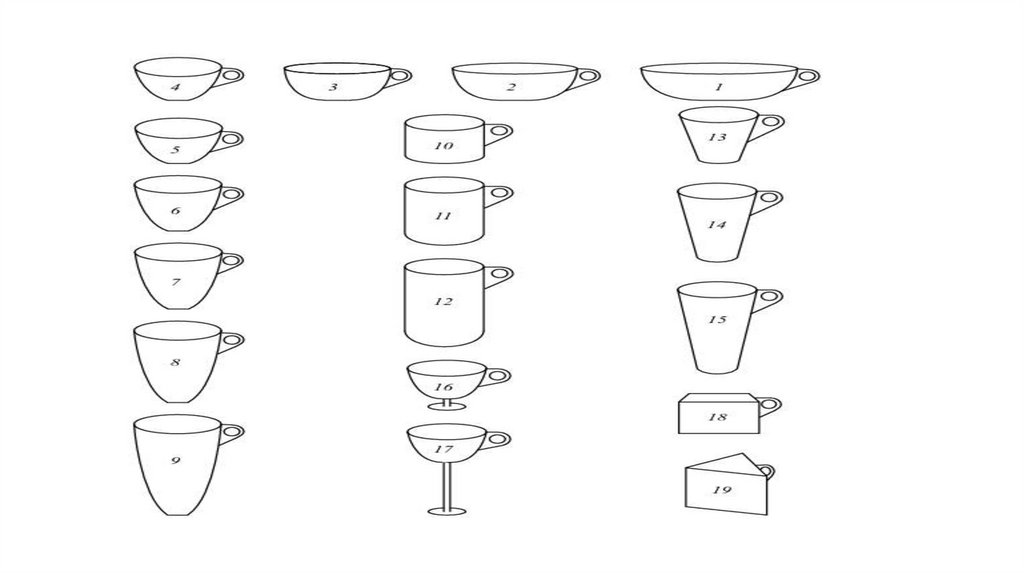
Labov offered the subjects drawings with images of different-shaped
vessels and asked them to classify each of them as a cup, mug, bowl,
or vase.
Labov focused on these borderline cases and set out to find out what
factors influence the reference of an item to a particular category.
10.
11.
It turned out that the shape of the vessel played a role first of all: as thebase area of the vessel increased (while maintaining the same height),
more and more subjects called it a bowl.
On the contrary, as the height of the vessel increases (with the same
diameter of the base) it was more often called a vase. Cylindrical objects
with a handle were usually classified as mugs.
12.
Labov concludes that within the framework of the classicaltheory of categorization, it is extremely difficult to answer the
question of what the "essence" of a cup is, that is, to list those
essential properties that distinguish it from, say, a mug. It is
much more natural to do otherwise — to describe a typical
representative of the cup category (made of porcelain, has a
certain shape and size, a handle, is usually served with a
saucer, is used for hot coffee or tea, can be part of a tea set of
six cups with saucers and a teapot).
13. Theory of prototypes
• Like many American psychologists and linguists of that time , at thebeginning of her scientific career, Roche was engaged in color
designations in various languages, but soon her attention was drawn to
the internal structure of subject categories such as furniture, fruit,
vegetable, weapon, bird, toy, clothing, etc.
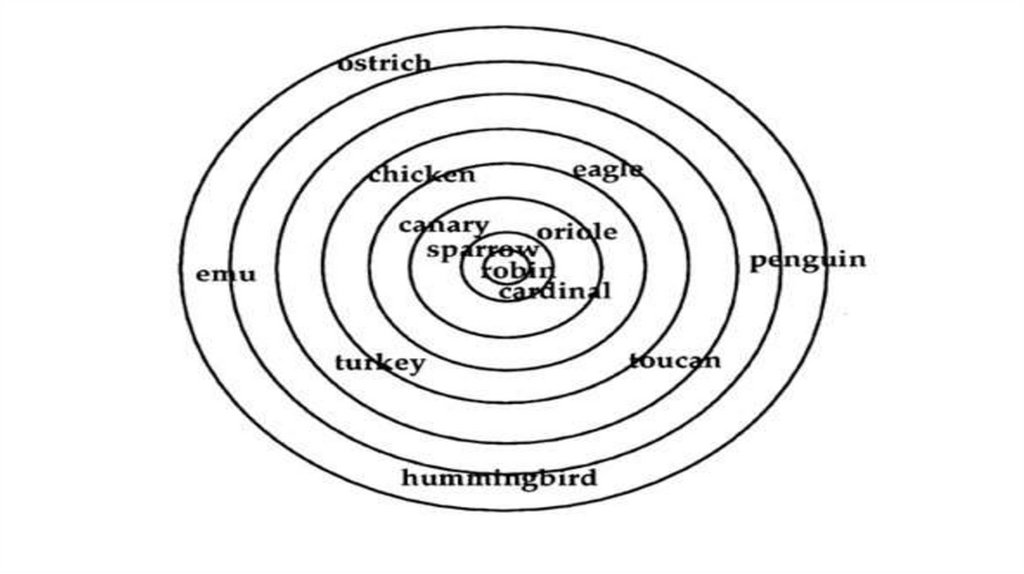
• Experiments with subjects showed that members of the same category
have a different status in human consciousness: more and less typical
representatives stand out among them (see Fig. 4, where perhaps the
plant rank corresponds to the decreasing parameter of typicality).
• To describe this inequality, Roche introduced the concepts of the center
and the periphery of the category, its "best" and "worst" examples, as
well as the prototype of the category. The most typical representative of
the ria category is its best example, it is located in the center and forms
the prototype of this category. The least typical members categories
occupy its periphery.
14.
15. Watch the video
• https://youtu.be/1YPRdIY-YVQ?si=y3FUMa_8PBLm3IJJ16. Rosch Prototype Theory
Eleanor Rosch's research led to the development of the PrototypeTheory, which suggests that categories in our mind are structured
around prototypes. The main characteristics of this theory are:
Categories are represented in the mind by prototypes - typical or
representative examples of the category.
Category membership is determined by the degree to which items
resemble the prototype.
There are no clear boundaries to categories; some items may have
fuzzy or indeterminate membership.
Items of a category can have different degrees of typicality.
17. The starting-point of the prototypical conception of categorial structure is summarized in the statement that
• when describing categories analytically, most traditions ofthought have treated category membership as a digital, all-ornone phenomenon. That is, much work in philosophy,
psychology, linguistics, and anthropology assumes that
categories are logical bounded entities, membership in which is
defined by an item’s possession of a simple set of criterial
features, in which all instances possessing the criterial attributes
have a full and equal degree of membership. In contrast, it has
recently been argued ... that some natural categories are analog
and must be represented logically in a manner which reflects
their analog structure (Rosch and Mervis 1975: 573–574).
18. Prototype
A prototype can be thought of as the best, most typicalexample of a category, and other items are considered part of
the category based on their resemblance to the prototype. This
is referred to as 'grading of category membership', where items
within a category can be ranked in terms of their typically.
19.
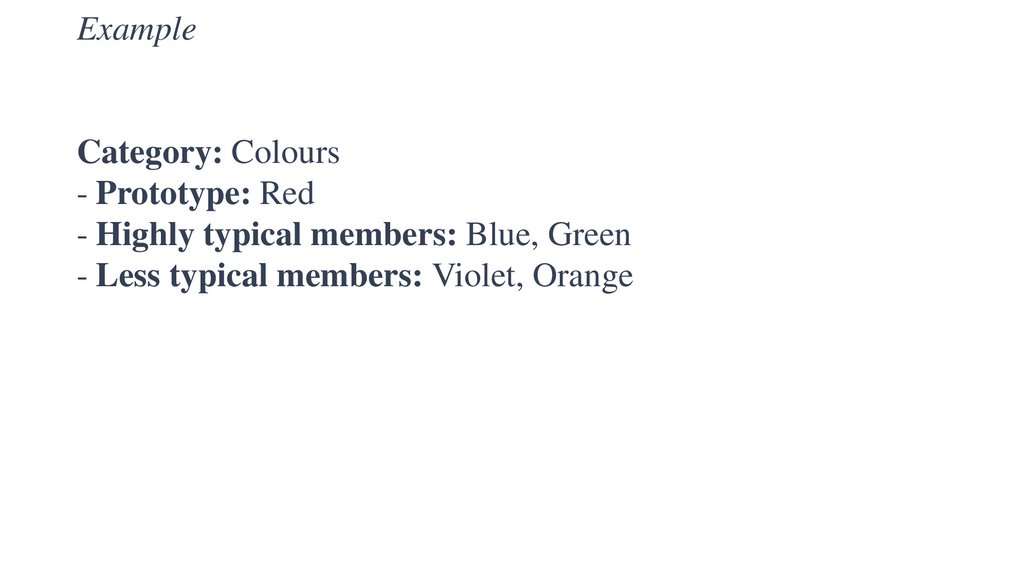
ExampleCategory: Colours
- Prototype: Red
- Highly typical members: Blue, Green
- Less typical members: Violet, Orange
20. Basic level category theory
• Let us now turn to the second component of E. Roche's concept, thetheory of categories at the basic level, which presupposes the
comparison of categories located at different levels of the hierarchy
(taxonomy).
• Note that the classical theory of categorization does not make any
distinctions for categories of varying degrees of generalization: from
the point of view of logic, it does not matter whether we are talking
about, say, animals, mammals, dogs., Sheepdogs or Caucasian
shepherds. However, it turned out that these categories are unequal
for humans: they are to varying degrees They are in demand and
significant in his daily life and, as a result , differ in cognitive
prominence.
21. Levels of categorization
A distinctive feature of the prototypical approach is also the recognition oftwo aspects of categorization: vertical and horizontal .
The horizontal aspect of categorization assumes that an object must
necessarily be assigned to a certain category of the same level of
generalization, for example, to the category of "book", "newspaper" or
"magazine".
This object can be correlated with categories that vary in degree of
generalization , for example: an art book, a book, an edition, an artefact, an
object. The existence of categories of varying degrees. This indicates that the
categorization of objects and phenomena of the surrounding world can occur
at different levels, i.e. it makes us talk about the presence of different levels
of categorization in its vertical aspect, about a certain hierarchical
coherence of these levels.
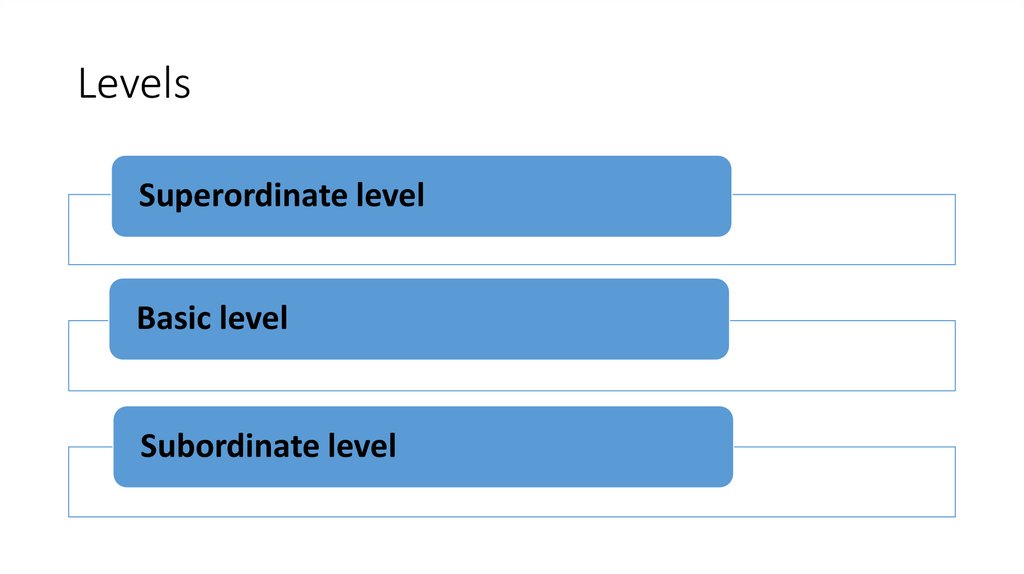
22. Levels
Superordinate levelBasic level
Subordinate level
23.
The basic level includes concepts denoted by words such as: table,chair, book, pen, dog, etc. They require the least cognitive expenditure
in their perception and processing, and therefore are easier and faster to
learn and remember.
At this level, a person, when faced with the ambiguity of the natural
environment, acts most effectively.
It is at this level, based on the experience of material interaction with the
outside world, that we clearly distinguish between a cat and a dog, a
chair and a table, books and notebooks.
Is you go down a level or go up a level, and things get much more
complicated.
It is much more difficult to distinguish one type of dog or cat from
another one than just a cat from a dog, or to identify the common
24. From its psycholinguistic origins, prototype theory has moved mainly in two directions.
• On the one hand, Rosch’s findings and proposals were taken up byformal psycholexicology (and more generally, information-processing
psychology), which tries to devise formal models for human
conceptual memory and its operation.
• On the other hand, prototype theory has had a steadily growing
success in linguistics since the early 1980s, as witnessed by a number
of recent monographs and collective volumes in which prototype
theory and its cognitive extensions play a major role (Wierzbicka
1985; Lakoff 1987; Langacker 1987; Craig 1986; Holland and Quinn
1987; Rudzka-Ostyn 1988; Lehmann 1988a; Hüllen and Schulze
1988; Tsohatzidis 1989; Taylor 1989).
25.
Dominant in the perception of objects and events are , as arule, their permanent characteristics: function - for a camera or
other artifacts, shape - for a watermelon, color and smell - for
grass, spatial characteristics - for events of change , the
presence of an object - for events of creation or destruction ,
etc.
26. Watch the video
• https://youtu.be/G_tPdCBQSVc?si=1Ma_ZwTbXRdveKbq27. Conclusion
It is important to emphasize that the allocation of three main levels ofcategorization is rather conditional. Our thinking is multidimensional,
and the systems of conceptualization and categorization are
multidimensional. Within each level, it is possible to identify different
sublevels and transition zones due to a certain degree of generalization.
At the same time, each sublevel in the language can be represented as a
separate taxonomic system associated with a certain conceptual area
(objects - artefacts - furniture - home furniture - office furniture - desks,
computer desks, etc.).
28.
Naturally, each area of conceptualization sets its dominantcharacteristics , and only a part of them reflects the gestalt perception
and, consequently, the belonging of the category and the language unit
denoting it to the basic level, which is also non-linear and includes units
with varying degrees of manifestation of basic characteristics.
29.
The list of recommended literatureБолдырев Н.Н. Когнитивная семантика. Изд.4-е испр. и доп. – Тамбов: Издательский дом ТГУ им. Г.Р. Державина, 2014. – 236 с.
Болдырев Н.Н. Язык и система знаний: Когнитивная теория языка. – М.: Издательский Дом ЯСК, 2019. – 480 с.
Корнилов О.А. Языковые картины мира как производные национальных менталитетов.- М.: ЧеРо, 2003, 349 с.
Маслова В.А. Введение в когнитивную лингвистику. –М.: Флинта: Наука, 2004. – 294 с.
Скребцова Т. Г. Когнитивная лингвистика: Курс лекций. — СПб.:Филологический факультет СПбГУ, 2011. — 256 с.
Croft William, Cruse Alan D. Cognitive Linguistics/ New York : Cambridge University Press, 2004. Cognitive Linguistics: Basic Readings Edited by Dirk
Geeraerts Mouton de Gruyter Berlin, New York – 2006 . – 496 с
Additional literature:
Croft William, Cruse Alan D. Cognitive Linguistics/ New York : Cambridge University Press, 2004. Cognitive Linguistics: Basic Readings Edited by Dirk
Geeraerts Mouton de Gruyter Berlin, New York – 2006 . – 496 с
Cognitive Linguistics: Current Applications and Future Perspectives. Edited by Dirk Geeraerts.- Mouton de Gruyter Berlin · New York – 2006 . – 513 p.
Коннова М. Н. Введение в когнитивную лингвистику : учебное пособие. Изд. 2-е, перераб. — Калининград : Изд-во БФУим. И. Канта, 2012. —
313 с.
Дзюба Е. В. Когнитивная лингвистика. – Екатеринбург, 2018. – 280 с.
https://articlekz.com/article/12236
https://ulagat.com/2020/11/27/%D0%BA%D0%BB%D1%8E%D1%87%D0%B5%D0%B2%D1%8B%D0%B5%D0%BF%D0%BE%D0%BD%D1%8F%D1%82%D0%B8%D1%8F%D0%BB%D0%B8%D0%BD%D0%B3%D0%B2%D0%BE%D0%BA%D0%BE%D0%BD%D1%86%D0%B5%D0%BF%D1%82%D0%BE%D0%BB%D0%BE%D0%B
3%D0%B8/
https://dereksiz.org/alimjanova-g-m-sopostavitelenaya-lingvokuleturologiya.html?page=7