






 english
Similar presentations:





Categorization Problem questions
1.
Lecture 3. CategorizationProblem questions
1) The theory of categorization
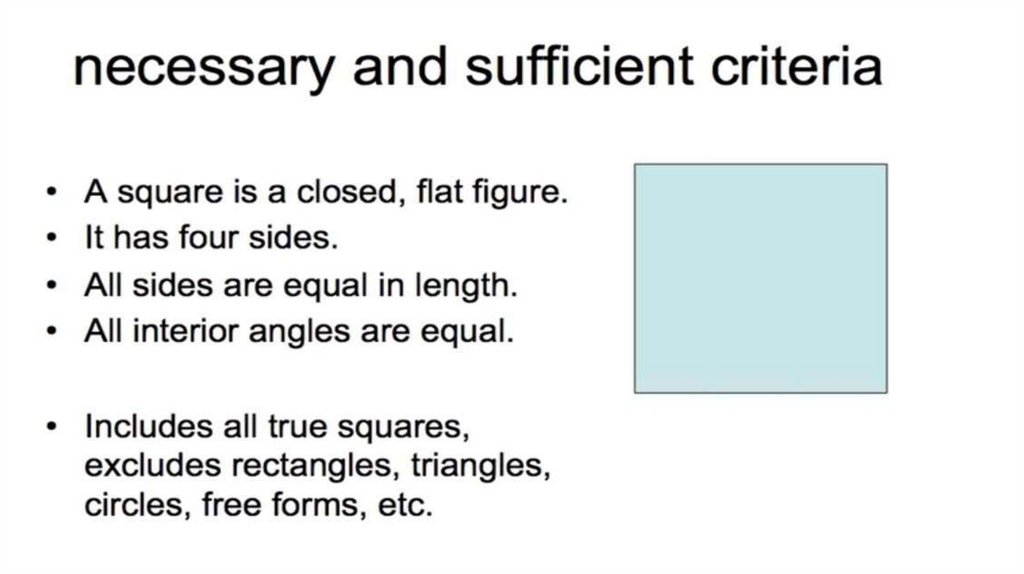
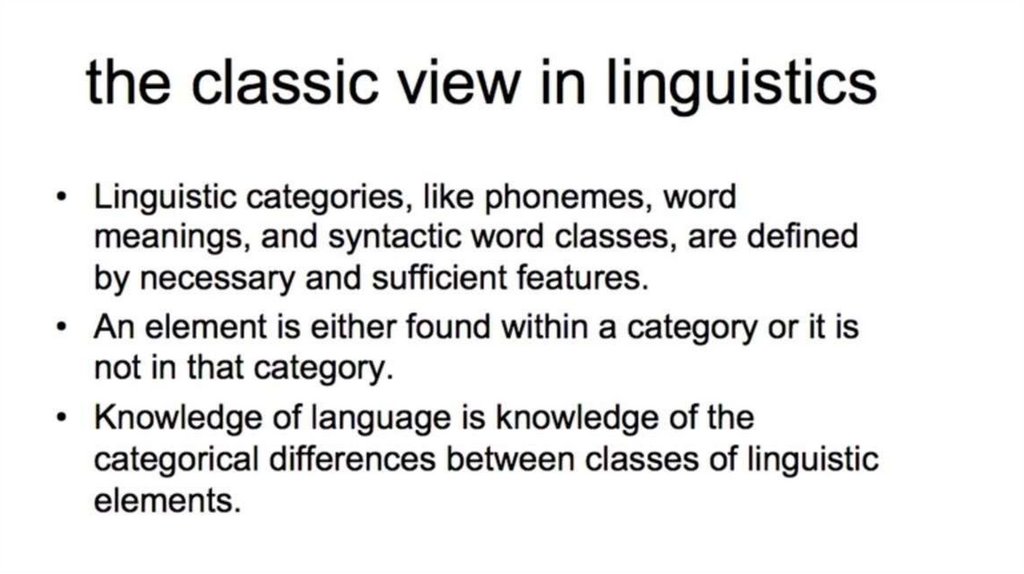
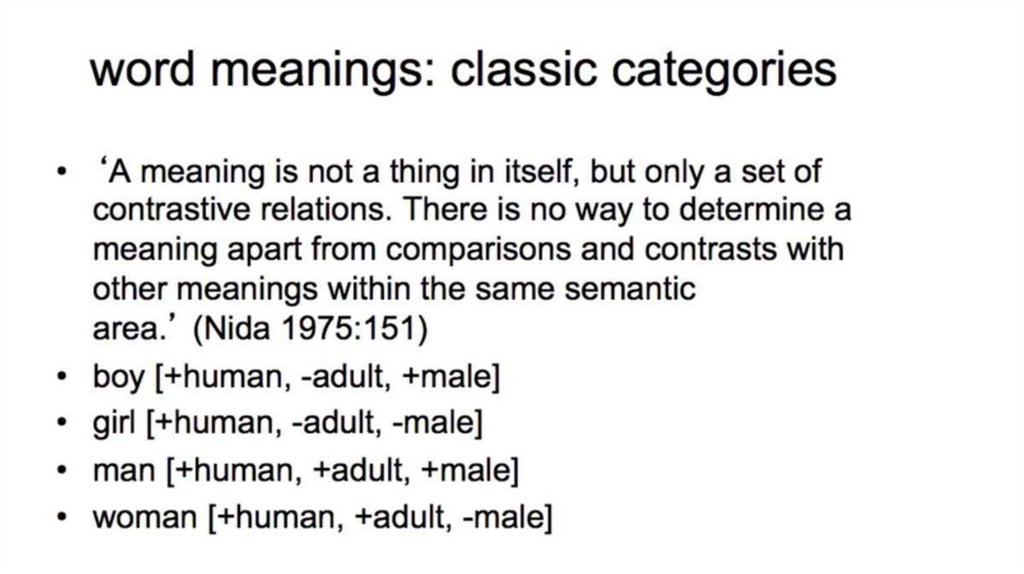
2) Classic Theory
3) Limitations of the classic theory
4) The importance of Categorization
2.
What is categorization?• CATEGORIZATION is the fundamental cognitive process of
arranging objects into categories [Cohen, Lefebvre 2005].
• It is crucial for people’s everyday activity. Every one of us constantly
and unconsciously recognizes new fragments of experience as
members of an already familiar and defined class of entities or
phenomena.
3.
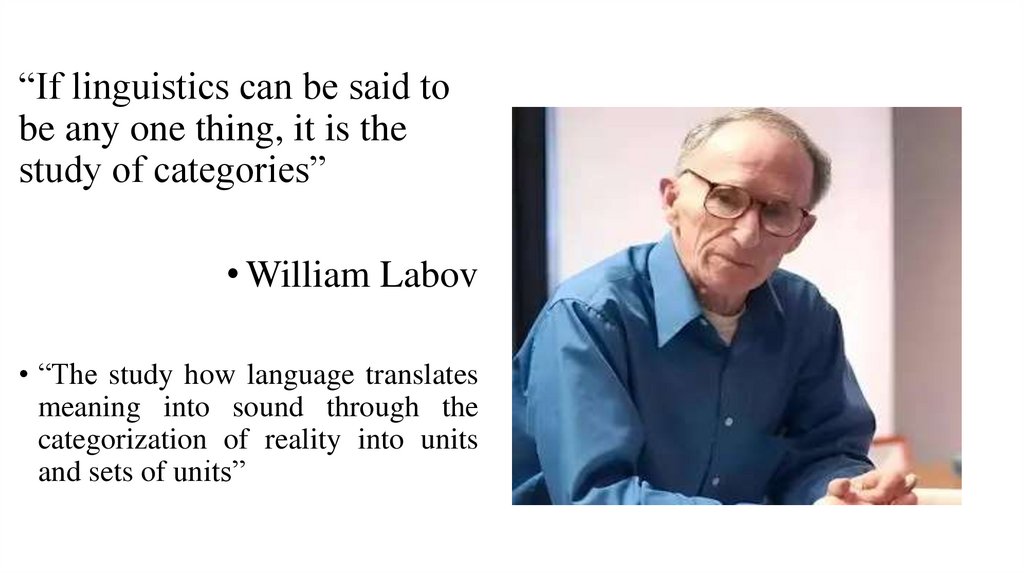
“If linguistics can be said tobe any one thing, it is the
study of categories”
• William Labov
• “The study how language translates
meaning into sound through the
categorization of reality into units
and sets of units”
4.
5.
6.
7.
8.
9.
10.
11.
12.
13.
14.
15.
16.
17.
18.
19.
20.
21.
22.
23.
24.
25.
26.
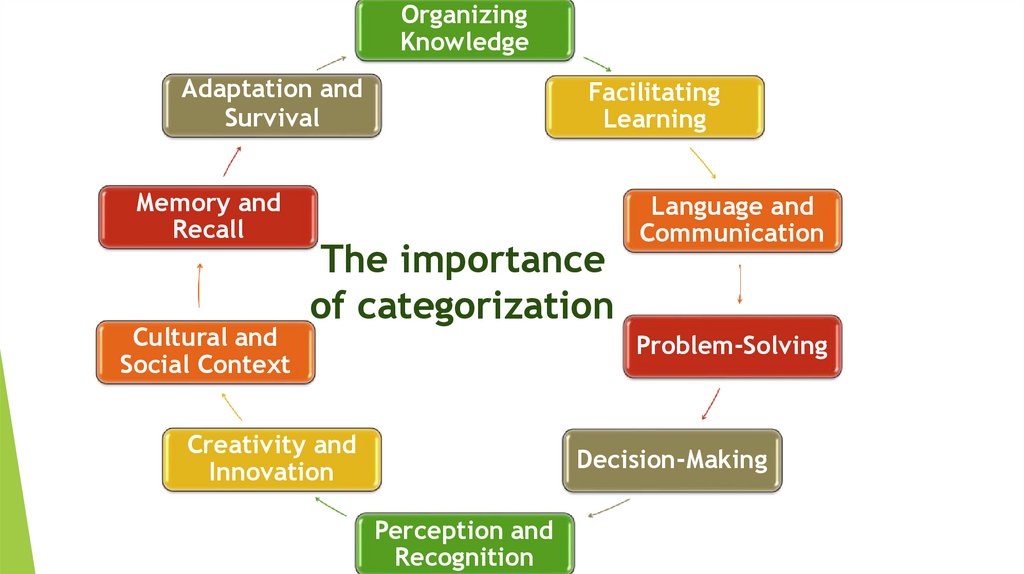
OrganizingKnowledge
Adaptation and
Survival
Memory and
Recall
Cultural and
Social Context
Facilitating
Learning
The importance
of categorization
Language and
Communication
Problem-Solving
Creativity and
Innovation
Decision-Making
Perception and
Recognition
27.
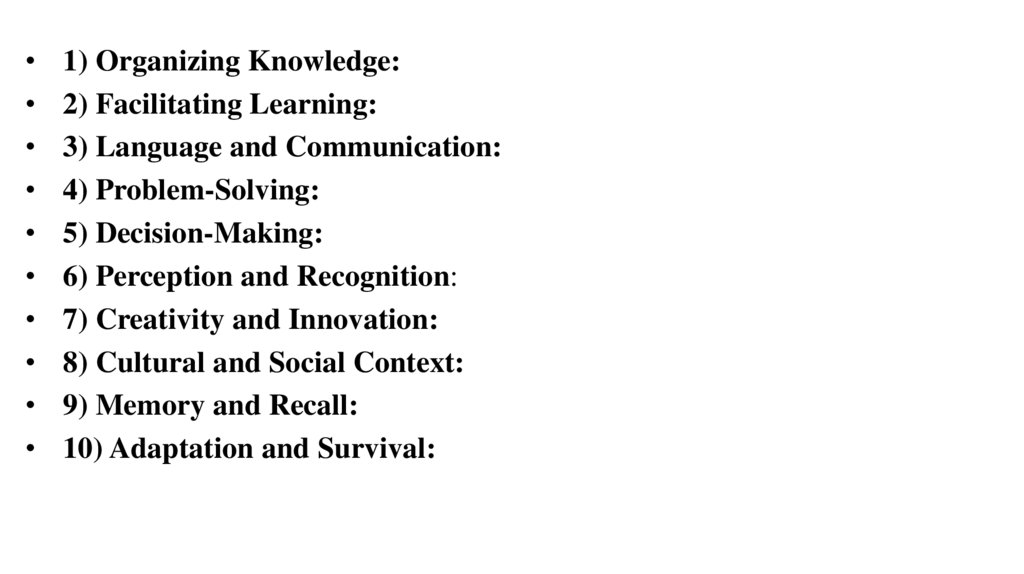
1) Organizing Knowledge:
2) Facilitating Learning:
3) Language and Communication:
4) Problem-Solving:
5) Decision-Making:
6) Perception and Recognition:
7) Creativity and Innovation:
8) Cultural and Social Context:
9) Memory and Recall:
10) Adaptation and Survival:
28.
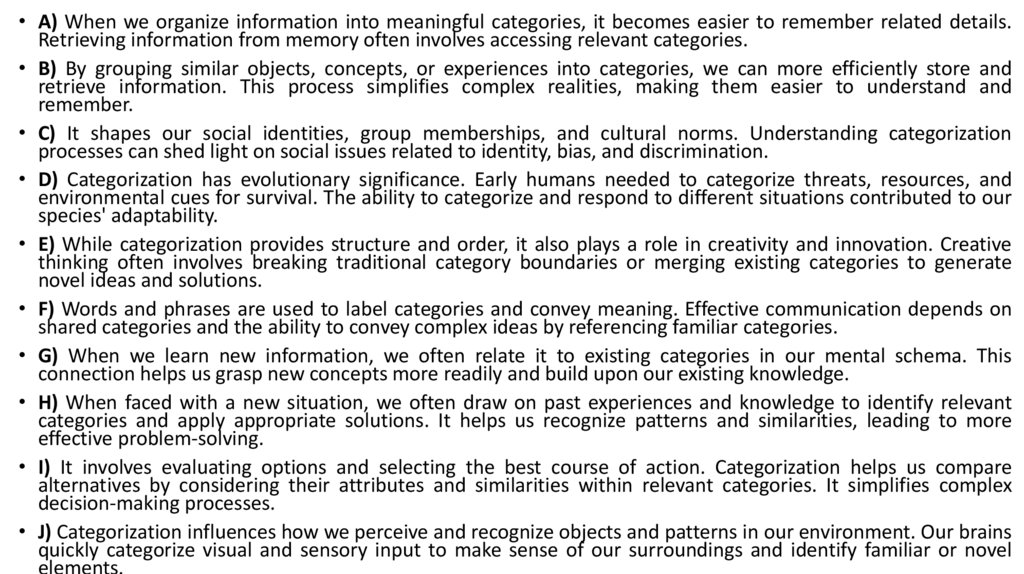
• A) When we organize information into meaningful categories, it becomes easier to remember related details.Retrieving information from memory often involves accessing relevant categories.
• B) By grouping similar objects, concepts, or experiences into categories, we can more efficiently store and
retrieve information. This process simplifies complex realities, making them easier to understand and
remember.
• C) It shapes our social identities, group memberships, and cultural norms. Understanding categorization
processes can shed light on social issues related to identity, bias, and discrimination.
• D) Categorization has evolutionary significance. Early humans needed to categorize threats, resources, and
environmental cues for survival. The ability to categorize and respond to different situations contributed to our
species' adaptability.
• E) While categorization provides structure and order, it also plays a role in creativity and innovation. Creative
thinking often involves breaking traditional category boundaries or merging existing categories to generate
novel ideas and solutions.
• F) Words and phrases are used to label categories and convey meaning. Effective communication depends on
shared categories and the ability to convey complex ideas by referencing familiar categories.
• G) When we learn new information, we often relate it to existing categories in our mental schema. This
connection helps us grasp new concepts more readily and build upon our existing knowledge.
• H) When faced with a new situation, we often draw on past experiences and knowledge to identify relevant
categories and apply appropriate solutions. It helps us recognize patterns and similarities, leading to more
effective problem-solving.
• I) It involves evaluating options and selecting the best course of action. Categorization helps us compare
alternatives by considering their attributes and similarities within relevant categories. It simplifies complex
decision-making processes.
• J) Categorization influences how we perceive and recognize objects and patterns in our environment. Our brains
quickly categorize visual and sensory input to make sense of our surroundings and identify familiar or novel
elements.
29.
References• Cohen H., Lefebvre C. Handbook of Categorization in Cognitive Science.
Elsevier, 2005.
• Croft, William & Cruse, D Alan. (2004). Cognitive linguistics. Cambridge:
Cambridge University Press.
• Hampe, Beate & Grady, Joseh E. (2005). From perception to meaning:
image schemas in cognitive linguistics. Berlin: Mouton de Gruyter.
• Lakoff, George. (1987). Women, fire, and dangerous things. Chicago: The
University Chicago Press.
• Doise, W., and Sinclair, A. (1973). The categorization process in intergroup
relations. Eur. J. Soc. Psychol. 3, 145–157. doi: 10.1002/ejsp.2420030204