
 english
Similar presentations:






Communicative discursive model and cognitive linguistics
1.
Communicative discursivemodel and cognitive linguistics
Iskakova Nazira Serikovna
PhD, associate prof.
2.
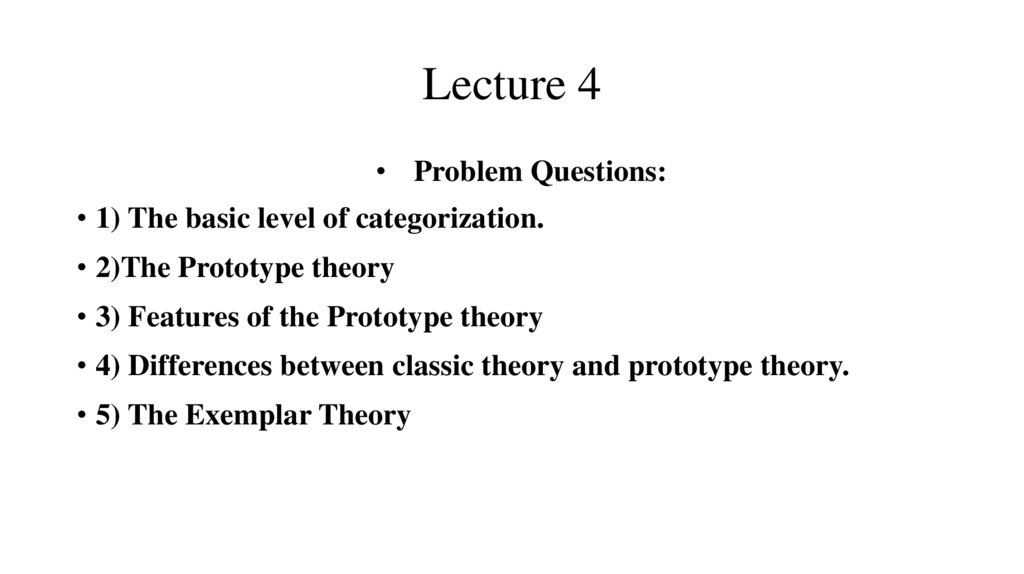
Lecture 4• Problem Questions:
• 1) The basic level of categorization.
• 2)The Prototype theory
• 3) Features of the Prototype theory
• 4) Differences between classic theory and prototype theory.
• 5) The Exemplar Theory
3.
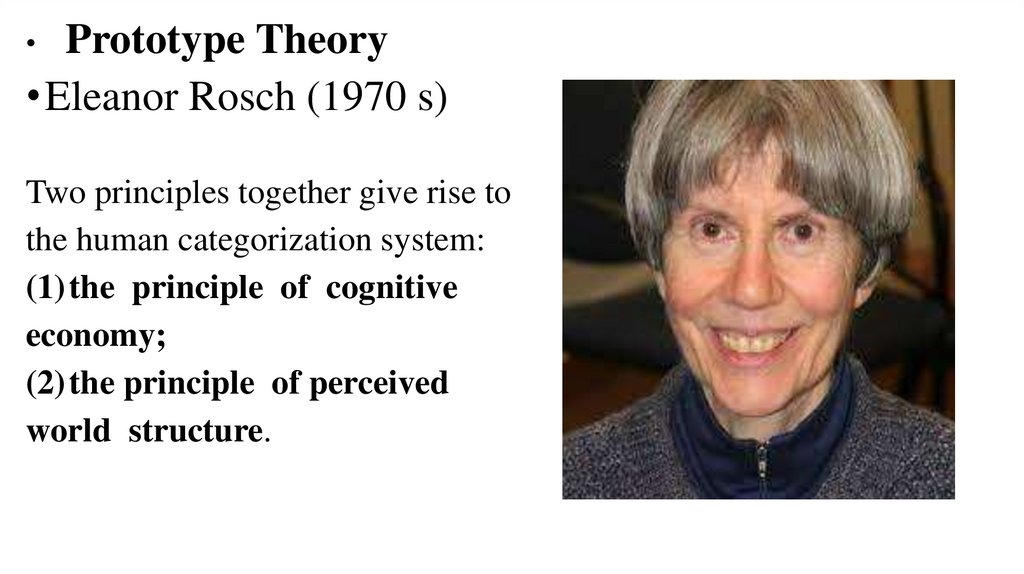
Prototype Theory• Eleanor Rosch (1970 s)
Two principles together give rise to
the human categorization system:
(1)the principle of cognitive
economy;
(2) the principle of perceived
world structure.
4.
The principle of cognitive economy• The first principle, the principle of cognitive
economy, states that an organism like a human being
attempts to gain as much information as possible
about its environment, while minimizing cognitive
effort and resources. This cost-benefit balance drives
category formation.
• This level of categorization is known as the basic
level of categorization.
5.
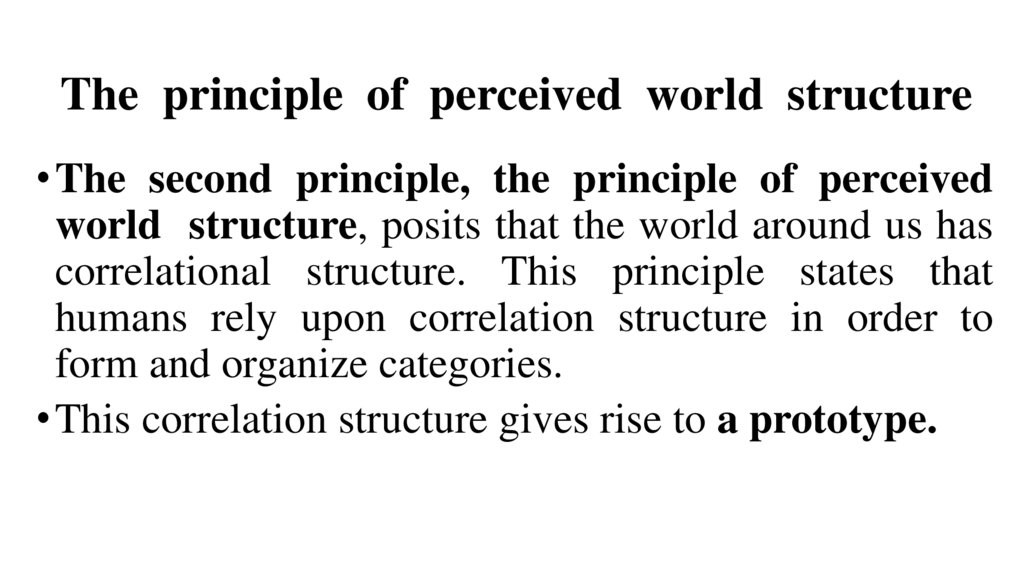
The principle of perceived world structure• The second principle, the principle of perceived
world structure, posits that the world around us has
correlational structure. This principle states that
humans rely upon correlation structure in order to
form and organize categories.
• This correlation structure gives rise to a prototype.
6.
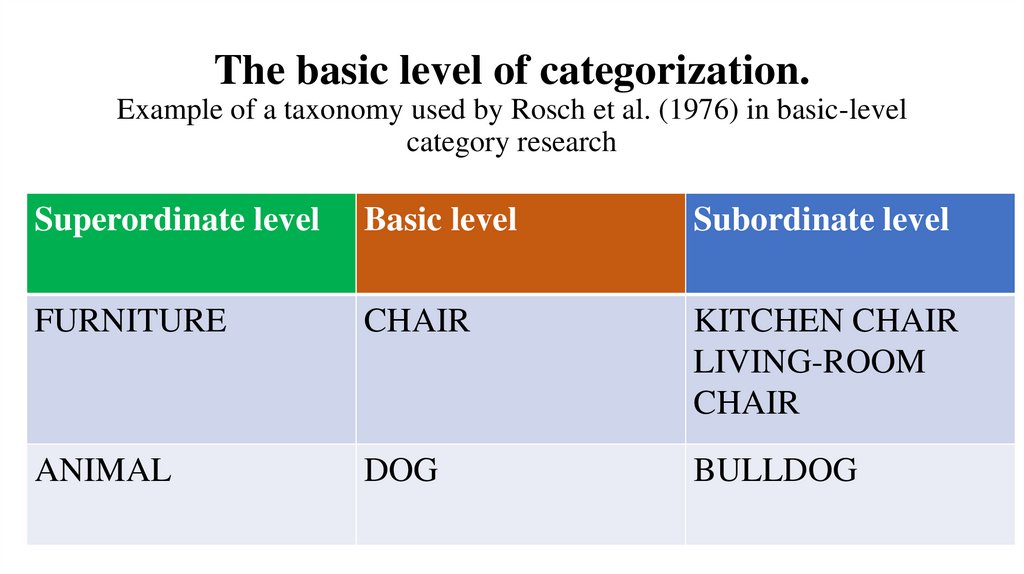
The basic level of categorization.Example of a taxonomy used by Rosch et al. (1976) in basic-level
category research
Superordinate level
Basic level
Subordinate level
FURNITURE
CHAIR
KITCHEN CHAIR
LIVING-ROOM
CHAIR
ANIMAL
DOG
BULLDOG
7.
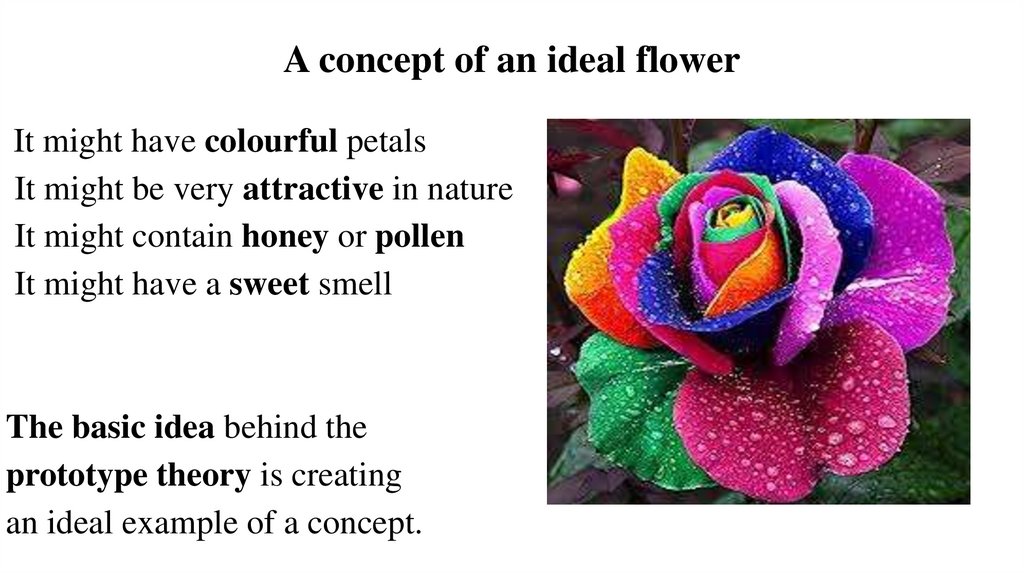
A concept of an ideal flowerIt might have colourful petals
It might be very attractive in nature
It might contain honey or pollen
It might have a sweet smell
The basic idea behind the
prototype theory is creating
an ideal example of a concept.
8.
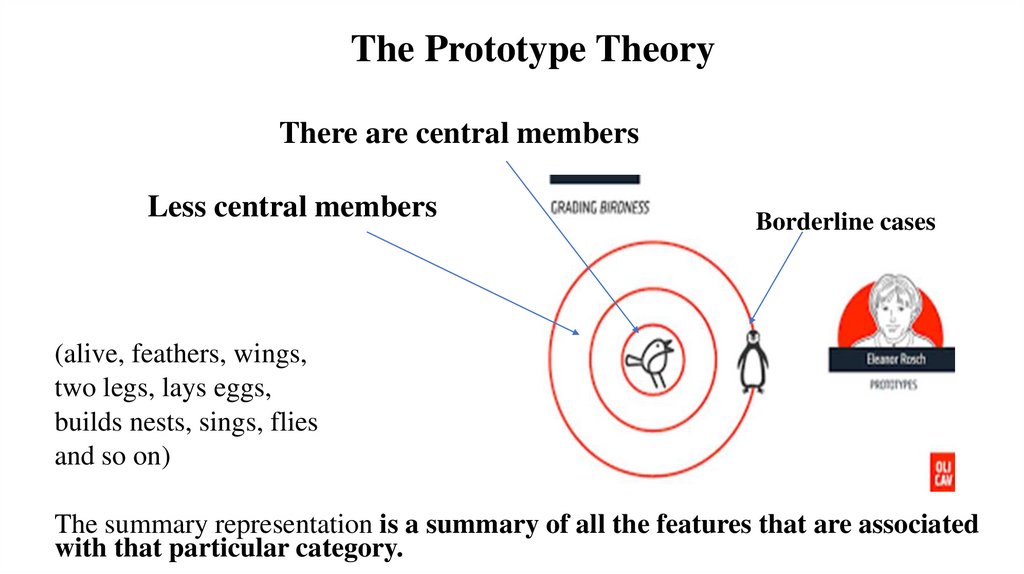
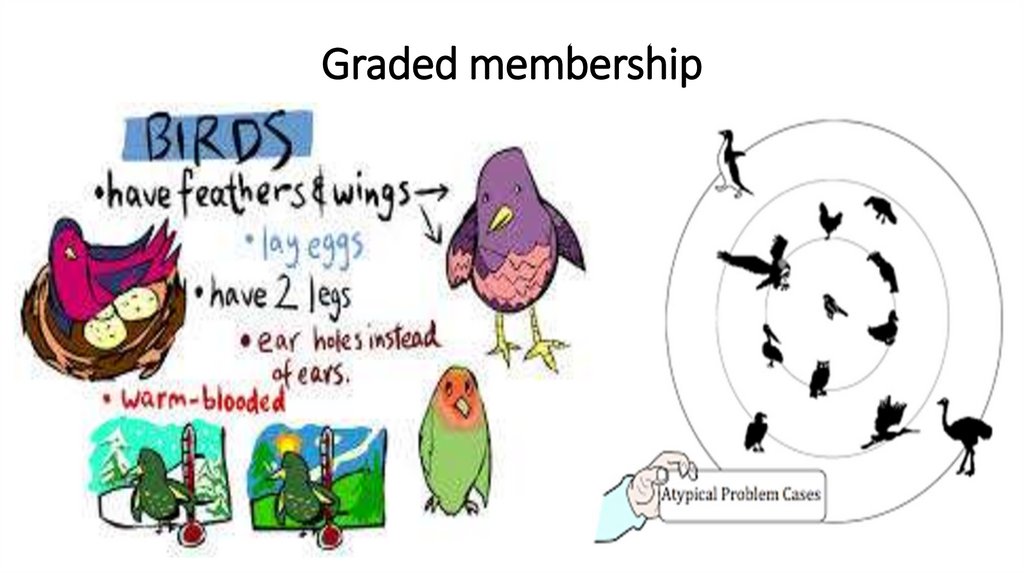
The Prototype TheoryThere are central members
Less central members
Borderline cases
(alive, feathers, wings,
two legs, lays eggs,
builds nests, sings, flies
and so on)
The summary representation is a summary of all the features that are associated
with that particular category.
9.
Graded membership10.
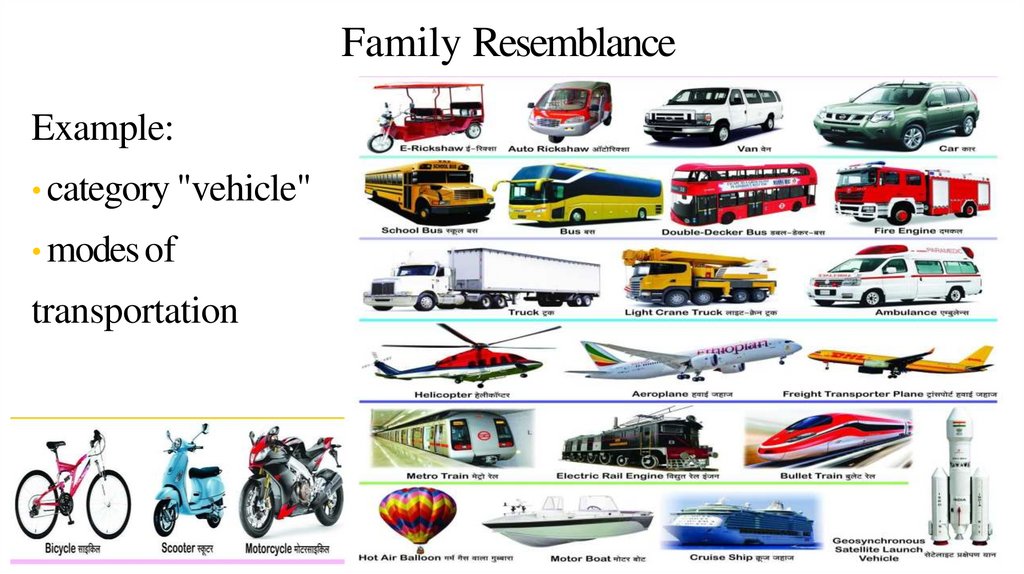
Family ResemblanceExample:
• category "vehicle"
• modes of
transportation
11.
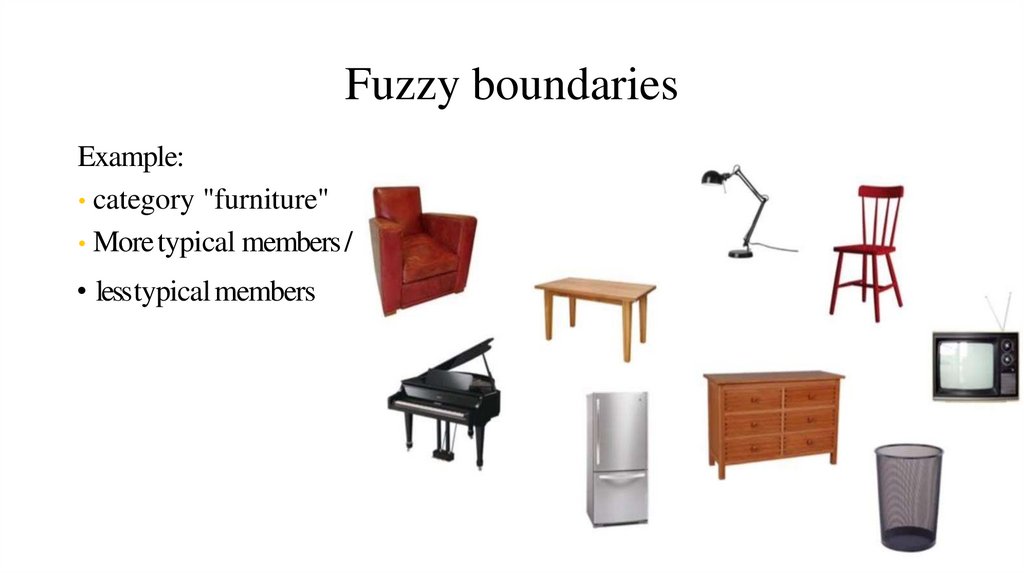
Fuzzy boundariesExample:
• category "furniture"
• More typical members /
• lesstypical members
12.
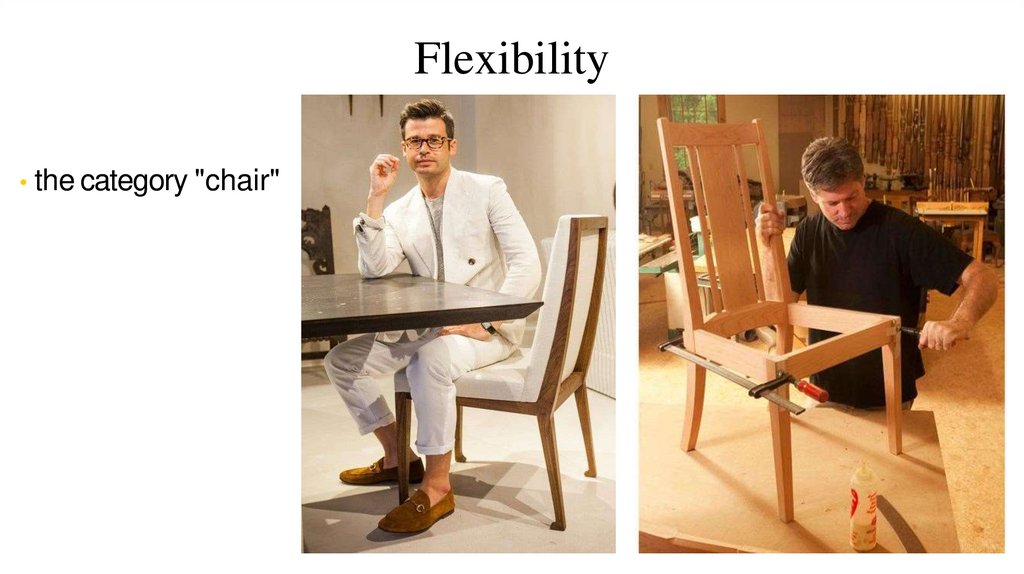
Flexibility• the category "chair"
13.
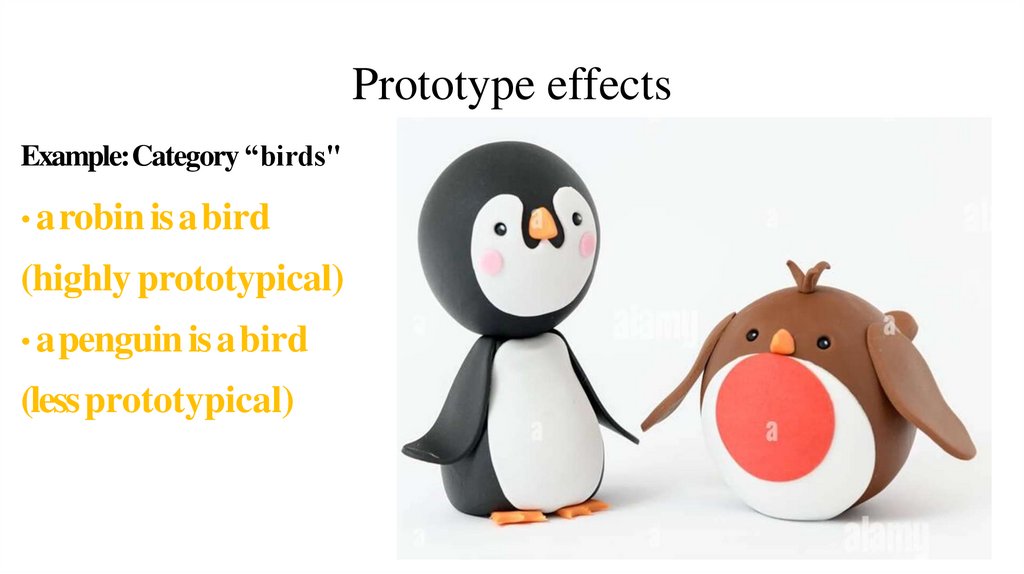
Prototype effectsExample:Category “birds"
• arobin is abird
(highly prototypical)
• apenguin is abird
(less prototypical)
14.
The classic theoryThe prototype theory
Categories are defined in terms of necessary The summary representation is simply a list of
and sufficient criteria. (Definitions)
features and features are not individually
necessary.
All-or Nothing Membership. An element is Even if the given element doesn't satisfy some
either a complete member of a category or not features in the, it can be still in the category.
a member at all.
(summary representation)
Implies clear - cut (fixed) boundaries which Fuzzy boundaries mean no division between
mean that an object either belongs to a category members and non-members.
or does not, based on the presence or absence of
specific defining features.
Every instance of a category represents that Members of the category differ in status
category equally.
(central, peripheral).
15.
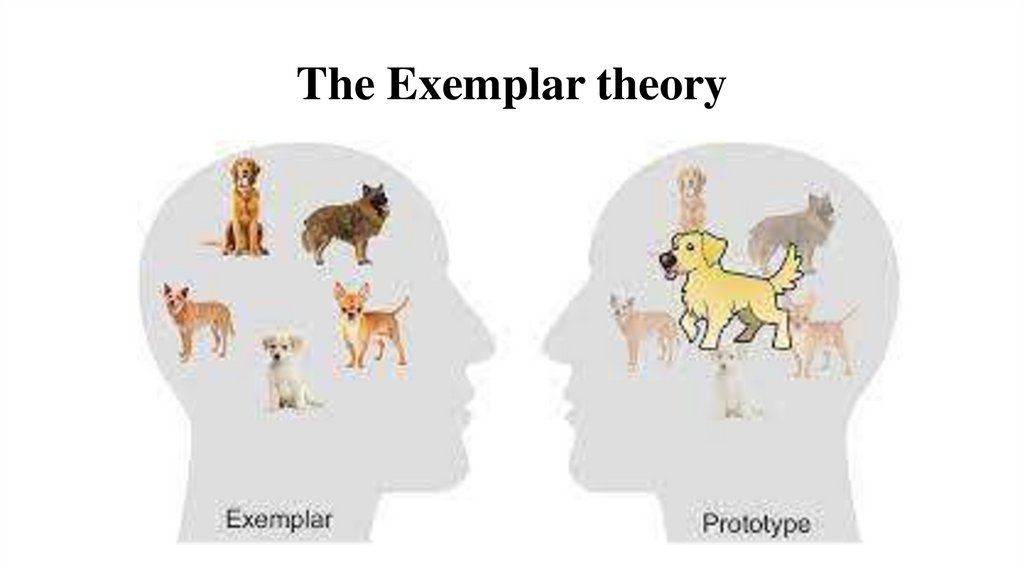
The Exemplar theory16.
Exemplar theoryKey Concepts and Features:
• 1.Categorization by Example
• 2. No Single Prototype
• 3.Category Membership Determination
• 4. Fuzzy Boundaries
• 5. Flexible andContext-Dependent
17.
• 1. Categorization by Example: According to the ExemplarTheory, when people encounter a new object or concept, they
compare it to specific examples or instances of categories
stored in their memory. These examples represent actual
experiences with category members.
• 2. No Single Prototype: Unlike the Prototype Theory, which
posits a central prototype for each category, the Exemplar
Theory does not require a single prototype. Instead, it relies
on multiple exemplars, reflecting the diversity within a
category.
18.
• 3. Category Membership Determination: Categorization occursby assessing the similarity between the new object or concept and
various exemplars stored in memory. The more similar the new item
is to these exemplars, the more likely it is to be categorized as a
member of the category.
• 4. Fuzzy Boundaries: Similar to Prototype Theory, the Exemplar
Theory acknowledges that category boundaries can be fuzzy.
Objects or concepts that do not precisely match any exemplar can
still be categorized based on overall similarity.
• 5. Flexible and Context-Dependent: Categorization under the
Exemplar Theory is flexible and context-dependent. The specific
exemplars used for comparison can vary depending on the situation
or context in which categorization is taking place.
19.
Both prototype theory and exemplar theory have been subject tocriticisms and limitations
• Prototype Theory Limitations:
• Lack of Flexibility: Prototype theory assumes that categories are represented by a
single central prototype, which may oversimplify the variability within categories.
In reality, categories often contain diverse exemplars, and relying solely on
prototypes may lead to rigid categorization.
• Context Sensitivity: Prototype theory does not adequately account for the
influence of context on categorization. It assumes that categorization is based
solely on the similarity to the prototype, overlooking situational factors that may
affect category membership.
• Limited Explanation for Variability: Prototype theory struggles to explain how
individuals deal with variability within categories. For example, it may be
challenging to determine a single prototype for categories with high variability,
such as "bird" or "fruit."
20.
Exemplar Theory Limitations:• Memory Demands: Exemplar theory relies on storing multiple specific instances
or exemplars in memory, which can be cognitively demanding and may lead to
issues with memory retrieval. As the number of exemplars increases, the
cognitive load also increases, potentially limiting the practicality of the theory.
• Difficulty in Generalization: Exemplar theory may struggle to account for
generalization beyond the specific exemplars encountered by an individual.
While it offers a rich representation of category variability, it may not provide a
clear mechanism for how individuals generalize to novel instances that are not
directly represented in memory.
• Failure to Explain Prototype Effects: Exemplar theory does not explicitly
address the phenomenon of prototype effects, where categorization is influenced
by the similarity to a central prototype. Critics argue that exemplar theory
struggles to explain why prototypes often emerge as salient representations
despite the emphasis on specific instances.
21.
There are several scenarios where one theory might be moreapplicable than the other:
• High Variability in Categories:
• Exemplar Theory Applicability: In categories with high variability and diverse
exemplars, exemplar theory may be more applicable. For example, when
categorizing "bird species" or "vegetables, " individuals may rely on their
accumulated experiences with specific instances rather than a single prototype.
• Limited Experience with Categories:
• Prototype Theory Applicability: In situations where individuals have limited
experience with a category or encounter novel instances, prototype theory may be
more applicable. Since prototype theory emphasizes the central representation of a
category, it allows for quick categorization based on perceived similarity to the
prototype, even in the absence of extensive exemplar knowledge.
22.
Key Differences:• Representation: Prototype Theory posits the existence of central prototypes that
represent categories, while Exemplar Theory emphasizes the use of specific exemplars
stored in memory.
• Abstraction vs. Specificity: Prototype Theory involves abstraction and generalization
based on a central representation, whereas Exemplar Theory relies on specific instances
and memory.
• Storage and Utilization: Prototype Theory stores and utilizes abstract representations of
categories, while Exemplar Theory stores and utilizes specific instances of category
members.
• Cognitive Load: Prototype Theory may be more efficient in situations with limited
cognitive resources, while Exemplar Theory may require more memory capacity.
• Generalization: Prototype Theory facilitates generalization to novel instances based on
perceived similarity to prototypes, whereas Exemplar Theory allows for flexible
adaptation to contextual variations based on accumulated exemplar experiences.
23.
Conclusion• In summary, prototype theory and exemplar theory offer distinct
perspectives on how humans categorize the world around them.
Understanding the differences and similarities between these theories
can provide valuable insights into the cognitive processes underlying
categorization. Moreover, reflecting on the practical implications of
each theory can help inform decision-making in real-life
categorization tasks, where one theory may be more applicable than
the other depending on the context and nature of the categorization
task.
24.
References• Geeraerts, D. (2006). Prototype theory. Cognitive linguistics:
Basic readings, 34, 141-165.
• Hampton, J. A. (1995). Testing the prototype theory of concepts.
Journal of Memory and Language, 34(5), 686-708.
• Lakoff, G. (1999). Cognitive models and prototype theory.
Concepts: Core Readings, 391-421.
• Osherson, D. N., & Smith, E. E. (1981). On the adequacy of
prototype theory as a theory of concepts. Cognition, 9(1), 35-58.