 english
Similar presentations:






Cognitive Approach to Grammar. Lectures 11-12
1. Lectures 11-12
Cognitive Approach to Grammar2. What is a cognitive approach to grammar?
Problem Questions:1) Guiding assumptions
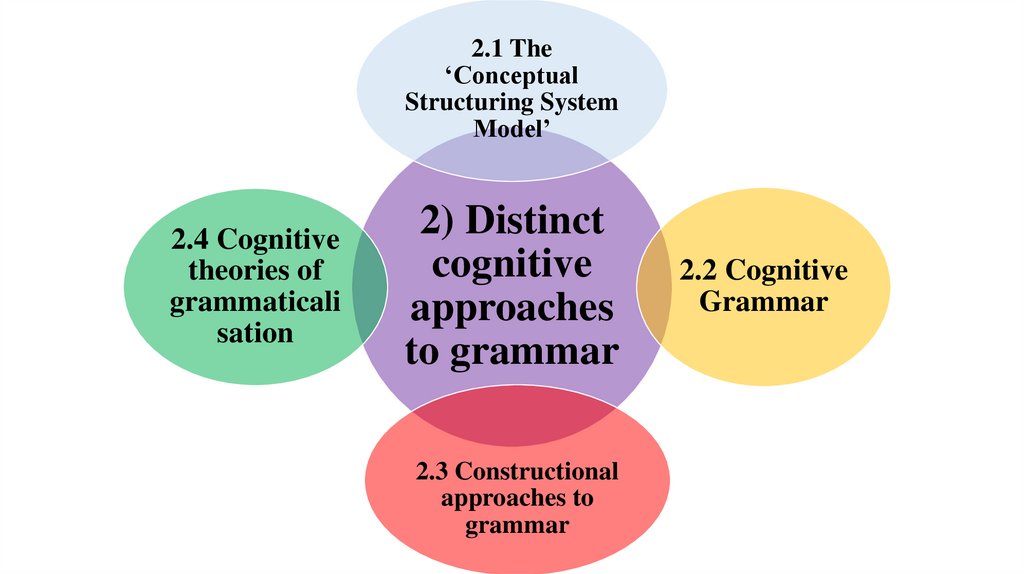
2) Distinct cognitive approaches to grammar
3) Grammatical terminology
4) Characteristics of the cognitive approach to grammar
3.
1. Guiding assumptions1.1 The symbolic thesis
1.2 The usage-based thesis
1.3 The architecture of the model
4.
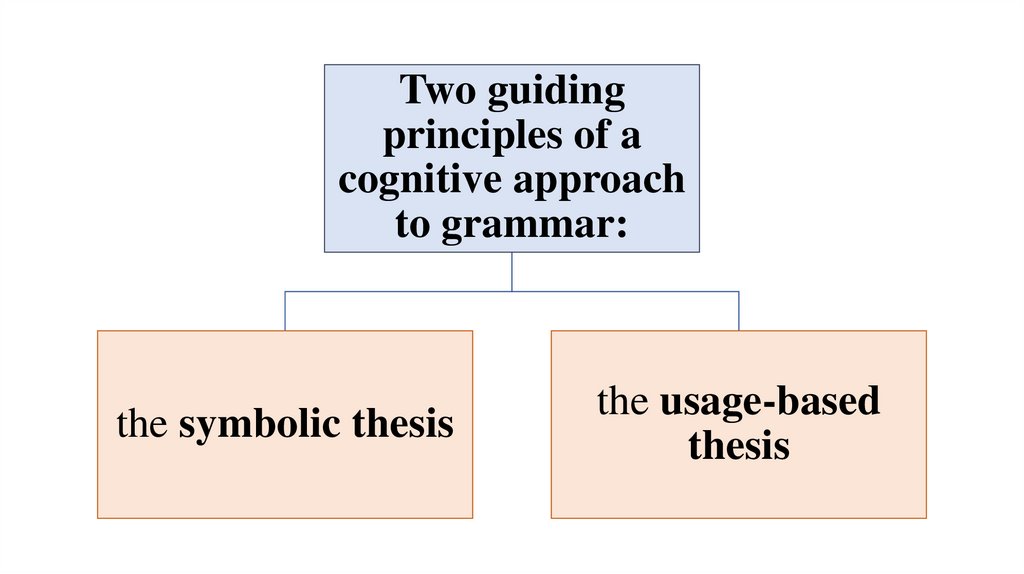
Two guidingprinciples of a
cognitive approach
to grammar:
the symbolic thesis
the usage-based
thesis
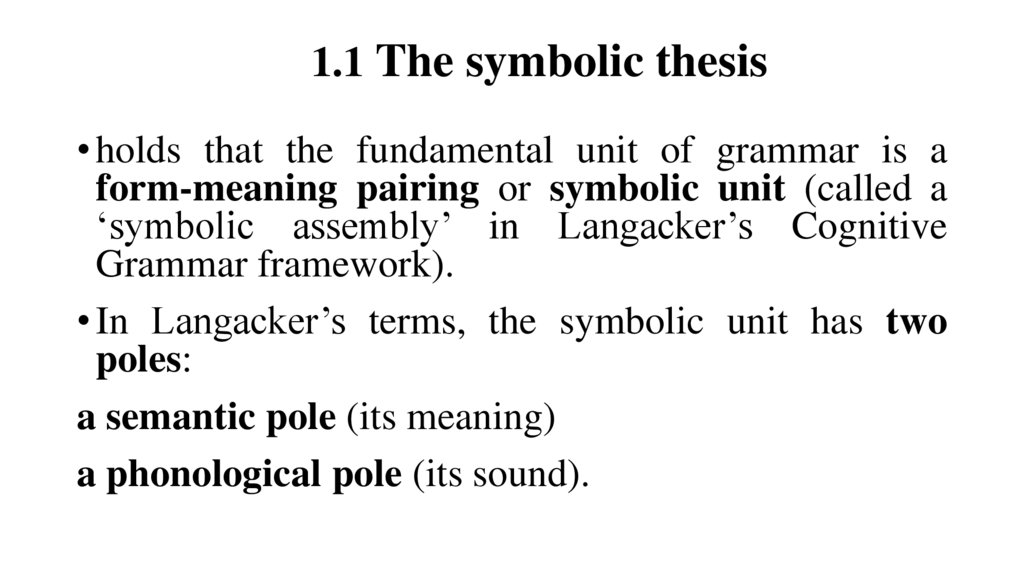
5. 1.1 The symbolic thesis
• holds that the fundamental unit of grammar is aform-meaning pairing or symbolic unit (called a
‘symbolic assembly’ in Langacker’s Cognitive
Grammar framework).
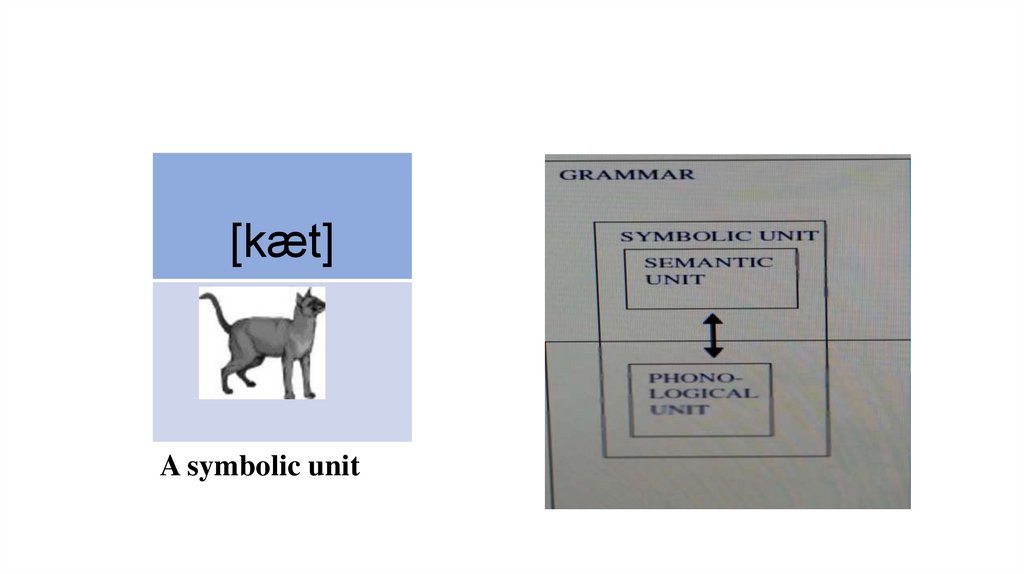
• In Langacker’s terms, the symbolic unit has two
poles:
a semantic pole (its meaning)
a phonological pole (its sound).
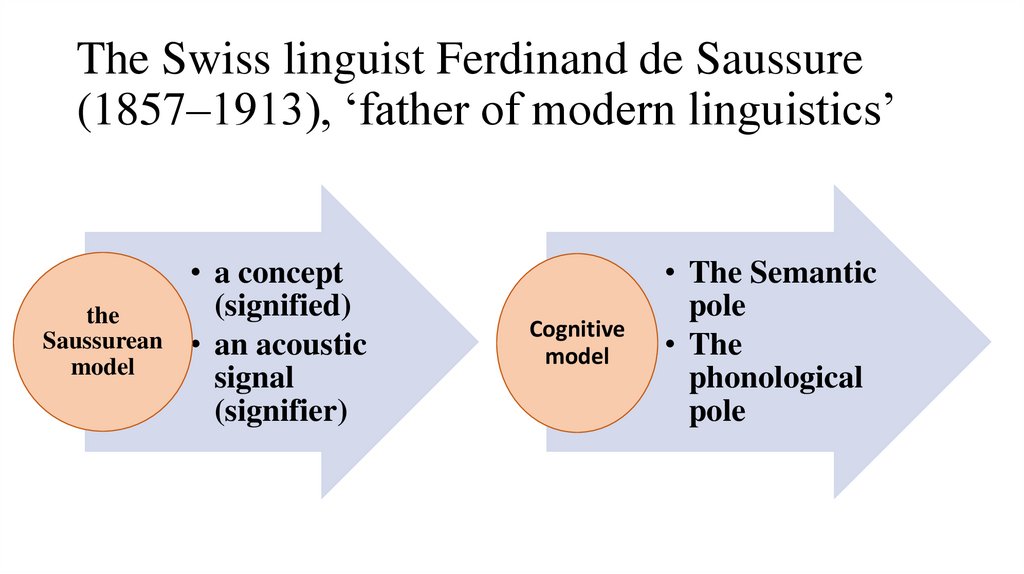
6. The Swiss linguist Ferdinand de Saussure (1857–1913), ‘father of modern linguistics’
theSaussurean
model
• a concept
(signified)
• an acoustic
signal
(signifier)
Cognitive
model
• The Semantic
pole
• The
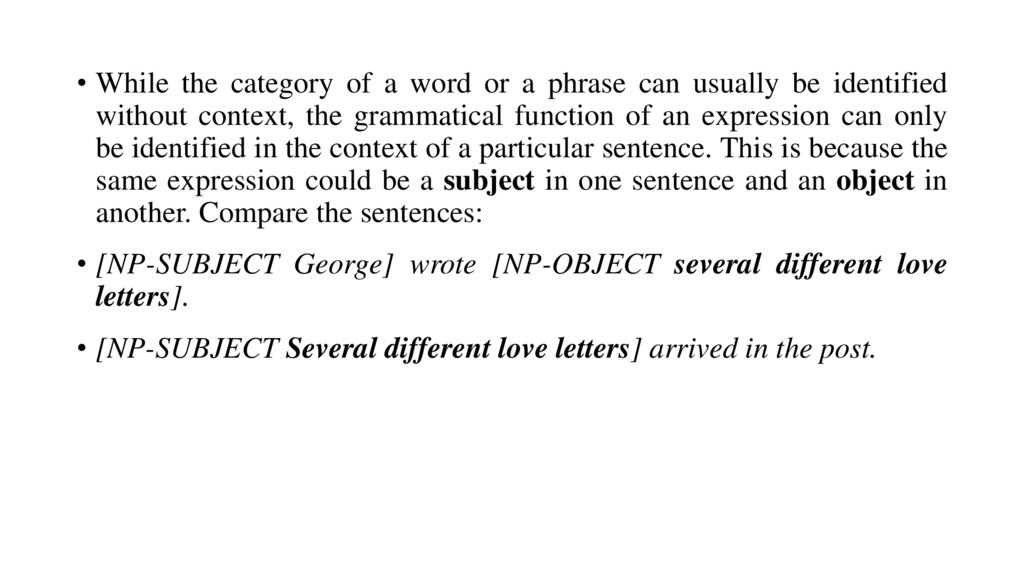
phonological
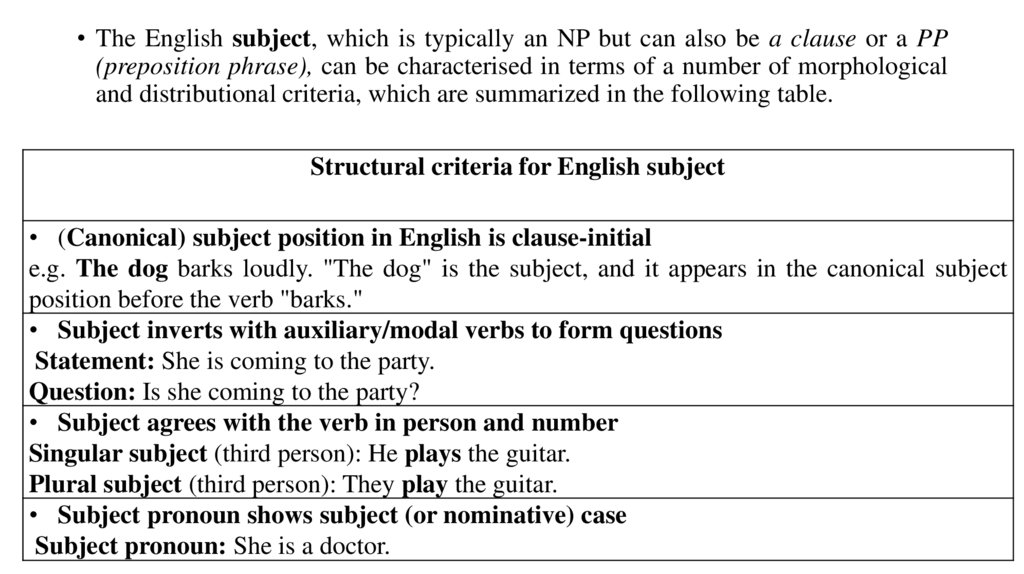
pole
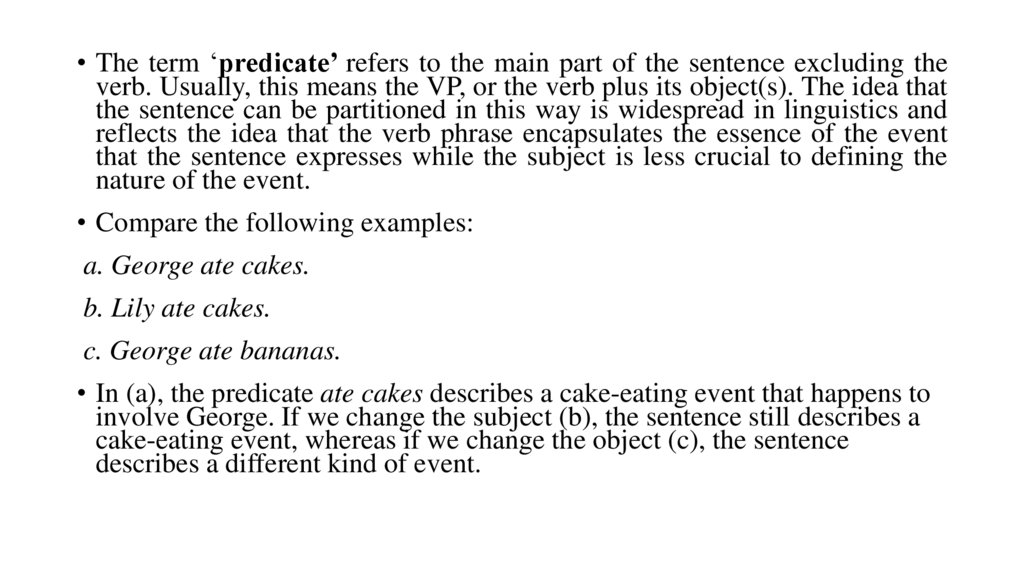
7.
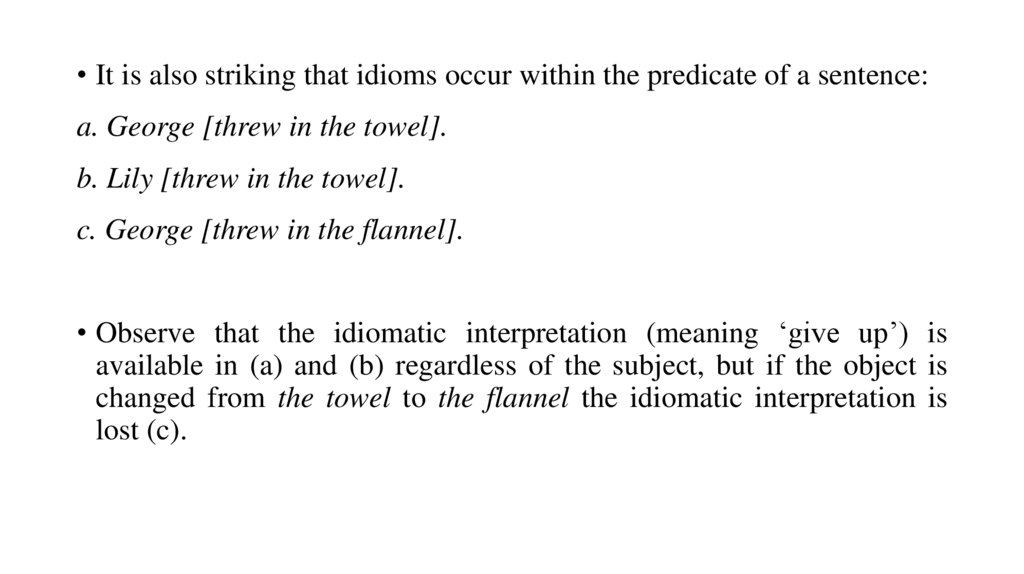
[kæt]A symbolic unit
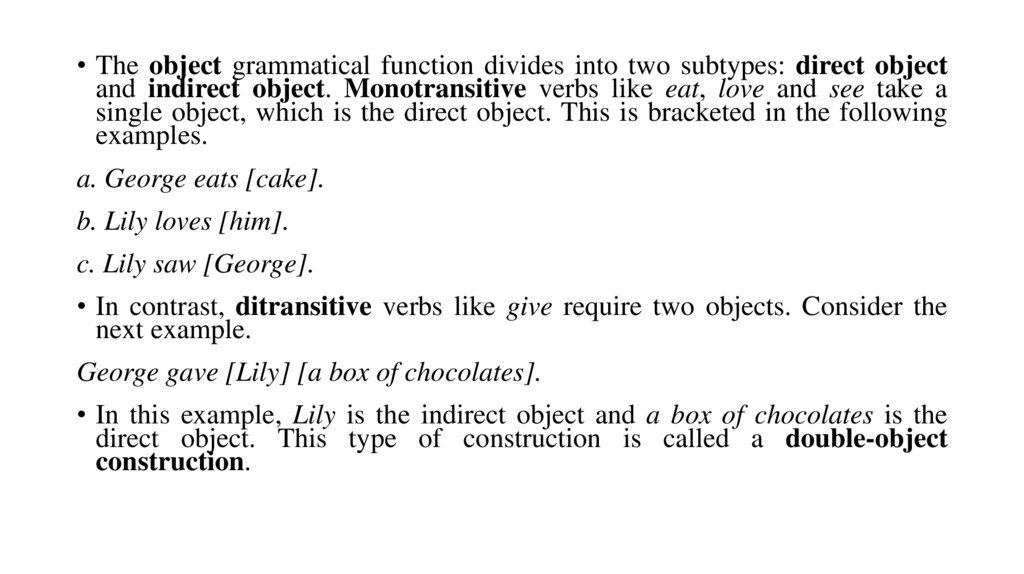
8.
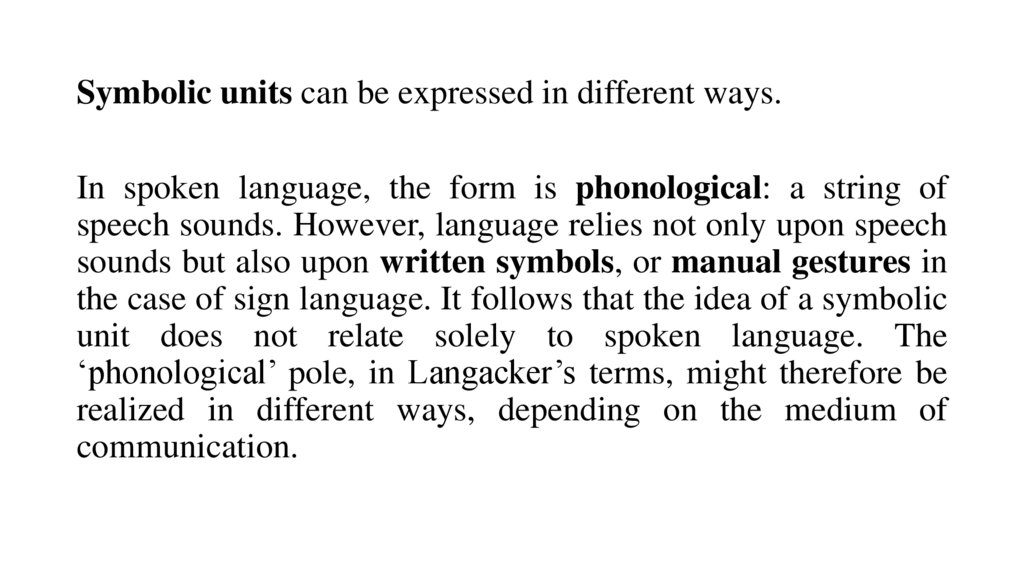
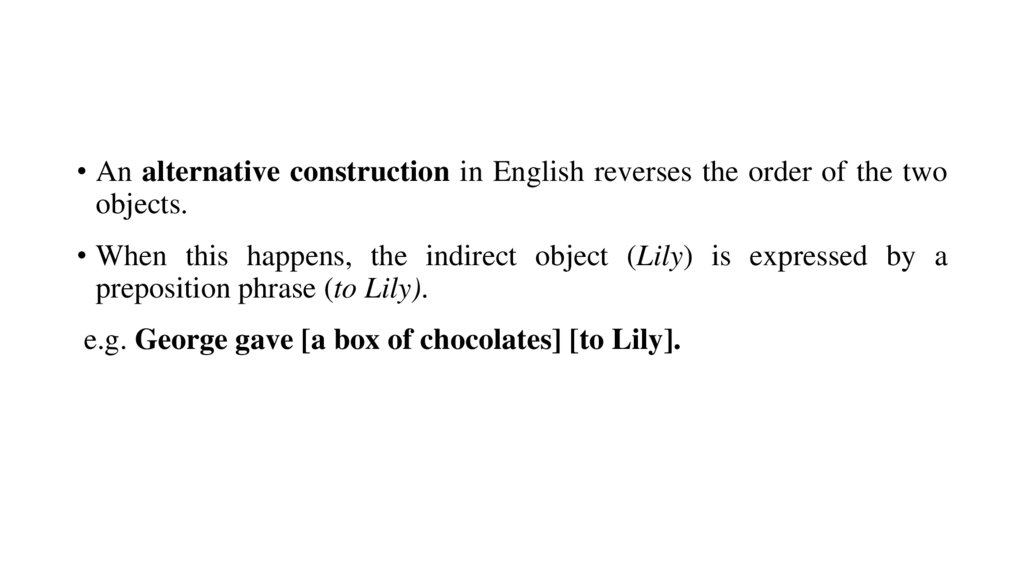
Symbolic units can be expressed in different ways.In spoken language, the form is phonological: a string of
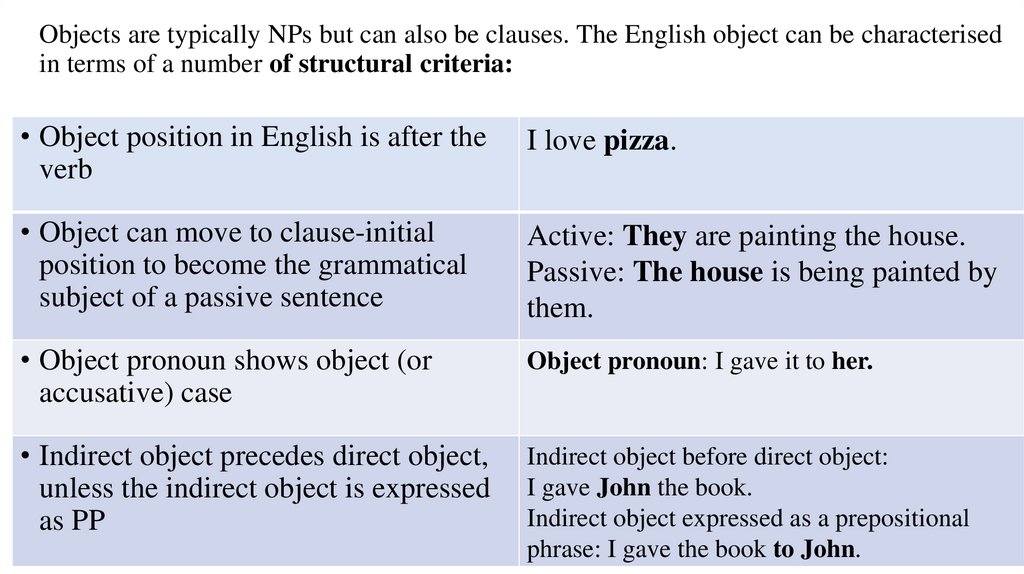
speech sounds. However, language relies not only upon speech
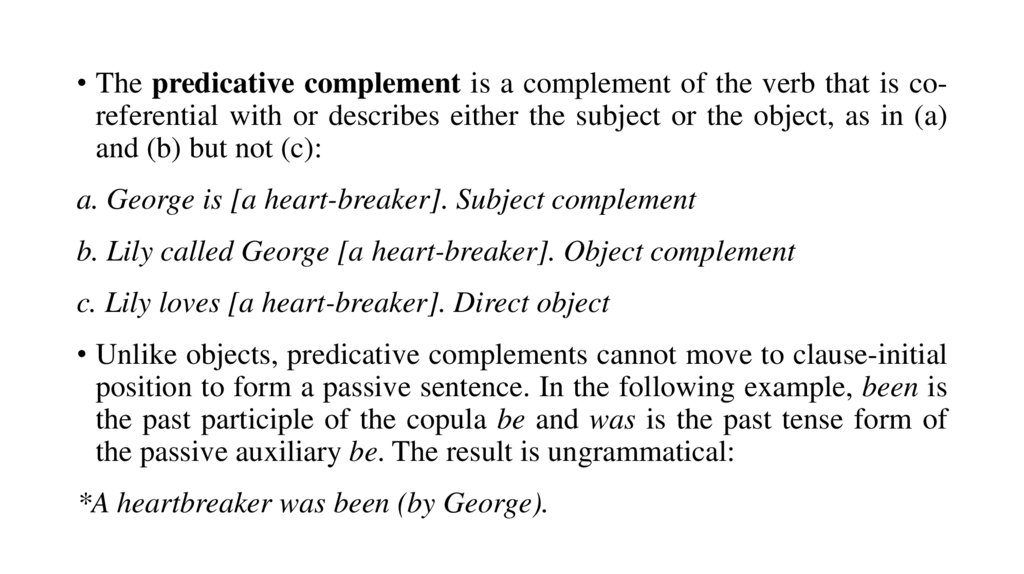
sounds but also upon written symbols, or manual gestures in
the case of sign language. It follows that the idea of a symbolic
unit does not relate solely to spoken language. The
‘phonological’ pole, in Langacker’s terms, might therefore be
realized in different ways, depending on the medium of
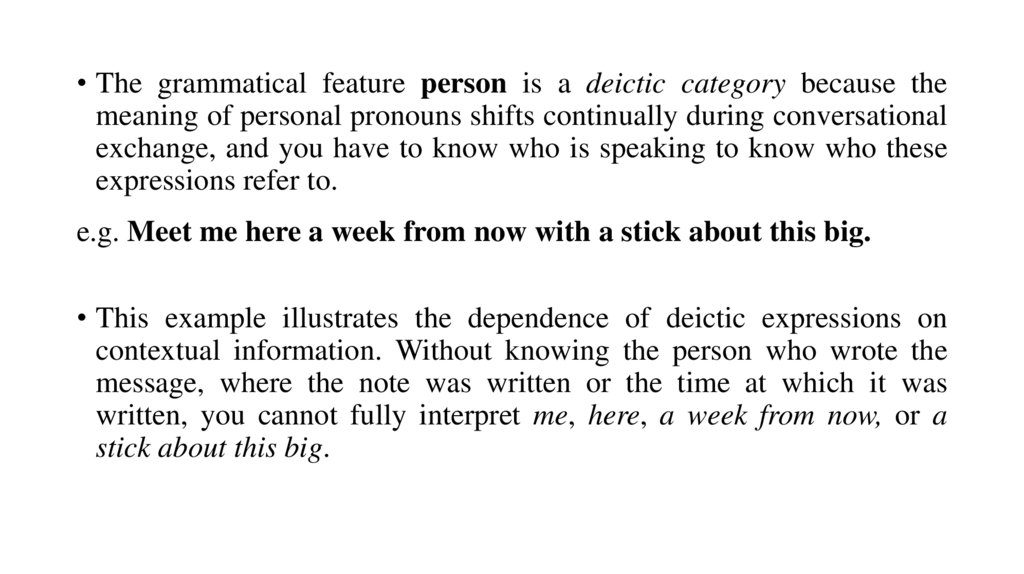
communication.
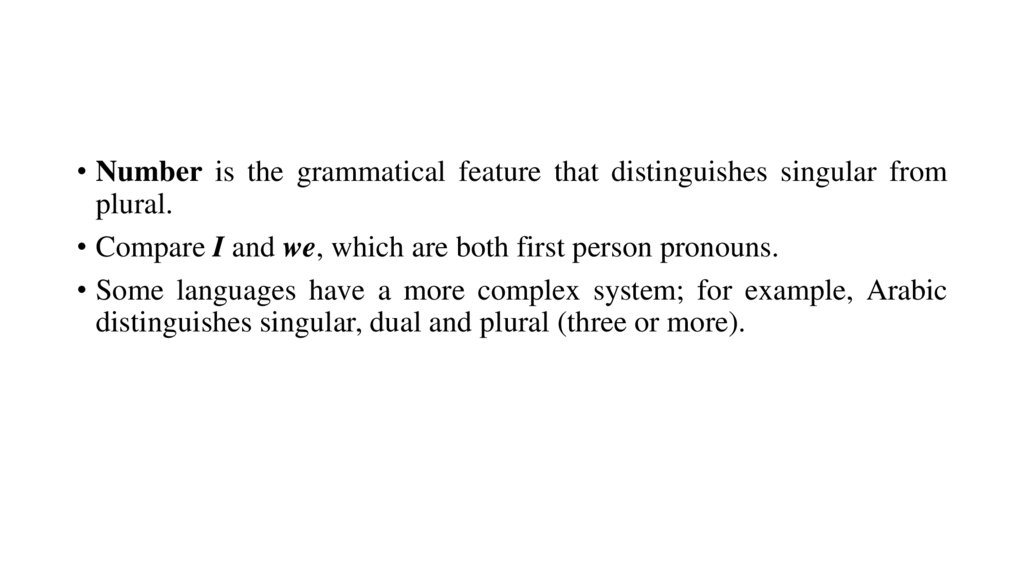
9.
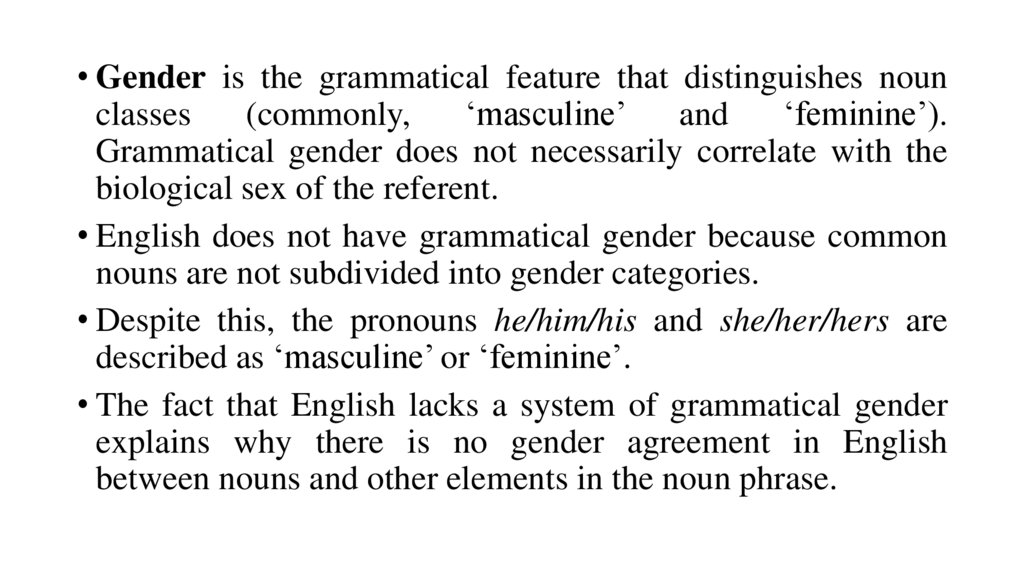
The adoption of the symbolic thesis has an important consequence for a modelof grammar. Because the basic unit is the symbolic unit, meaning achieves
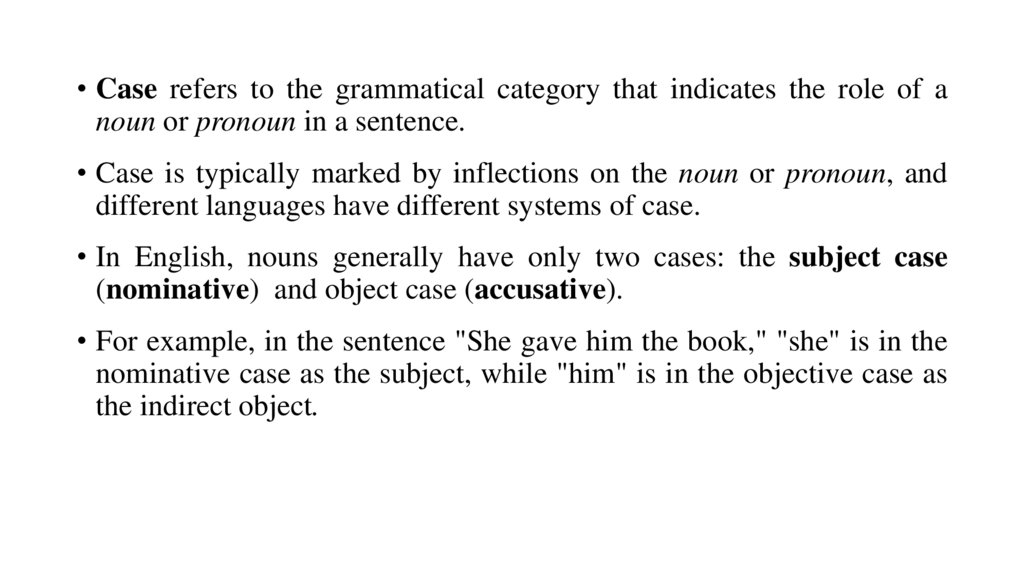
central status in the cognitive model. In other words, if the basic grammatical
unit is a symbolic unit, then form cannot be studied independently of meaning.
This means that the study of grammar, from a cognitive perspective, is the study
of the full range of units that make up a language, from the lexical to the
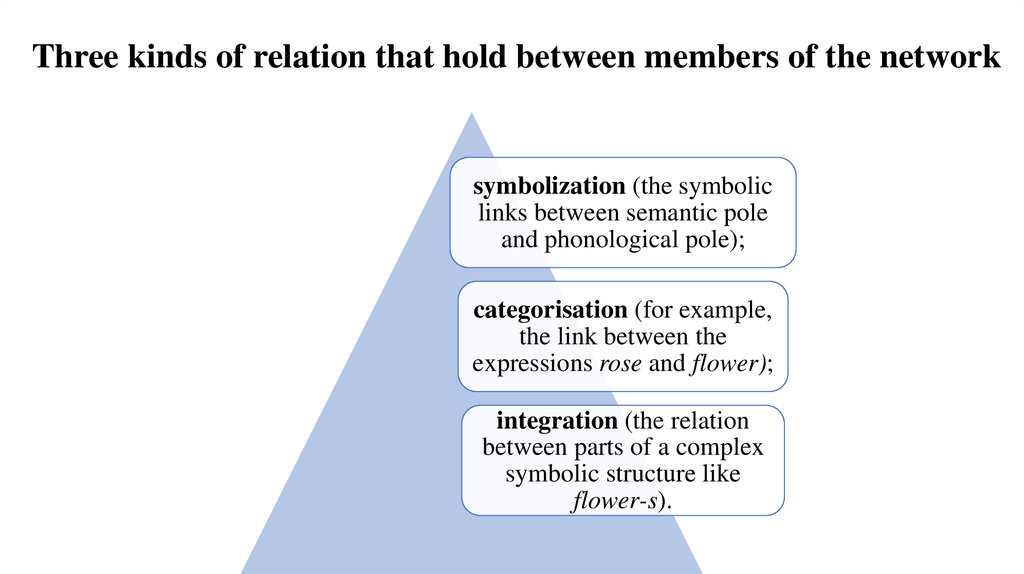
grammatical. For example, cognitive linguists argue that the grammatical form
of a sentence is paired with its own (schematic) meaning in the same way that
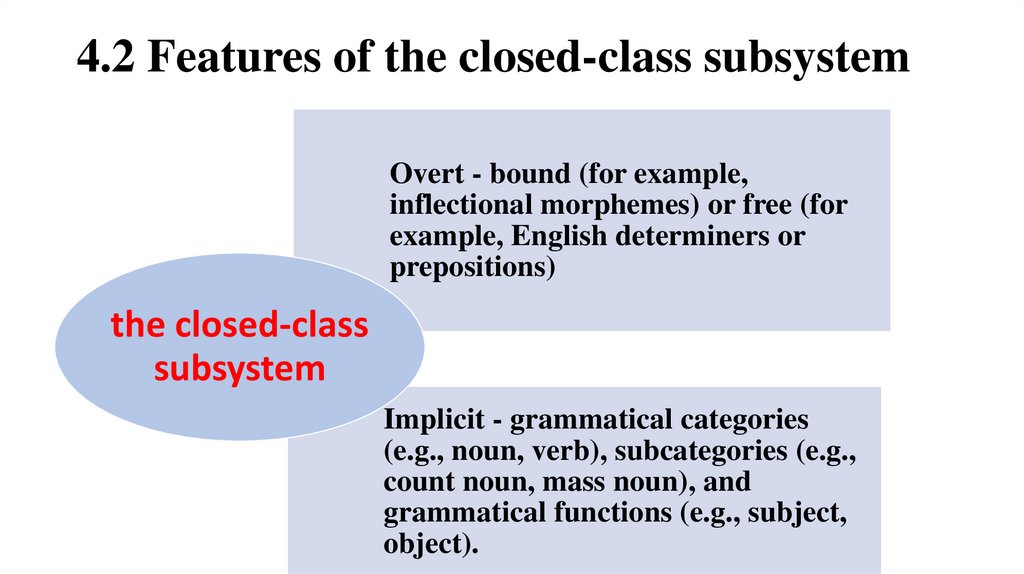
words like cat represent pairings of form and (content) meaning.
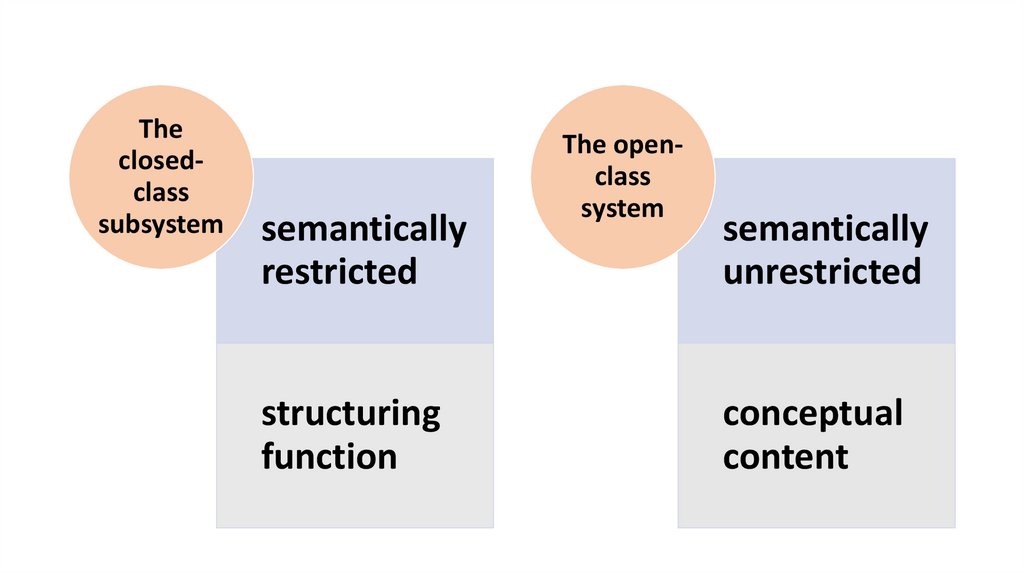
10.
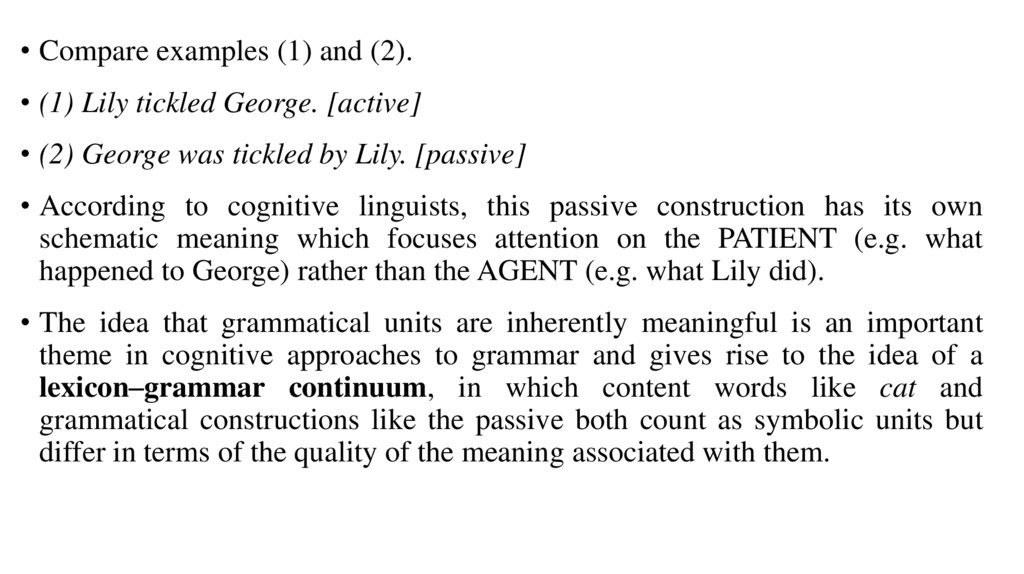
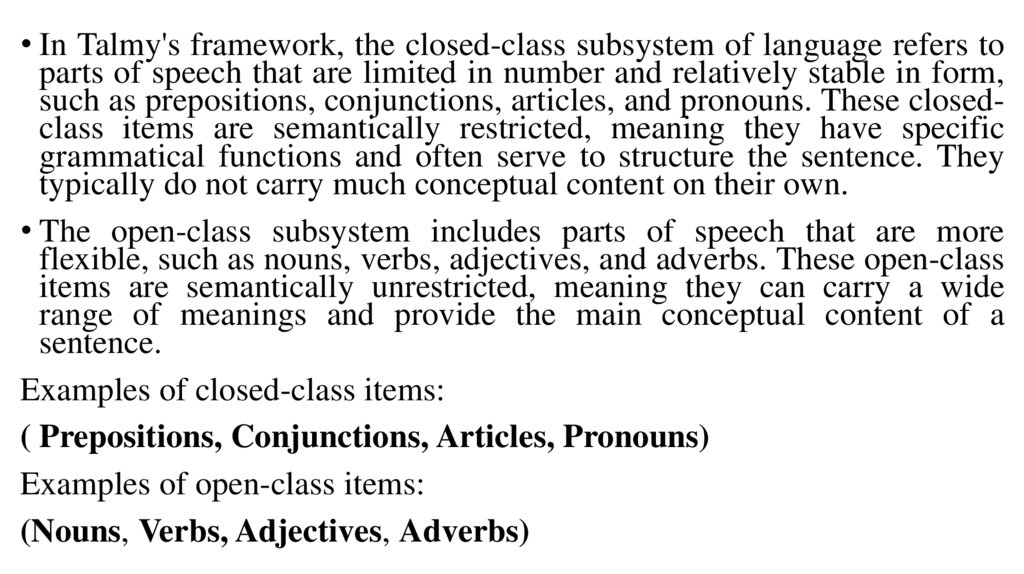
• Compare examples (1) and (2).• (1) Lily tickled George. [active]
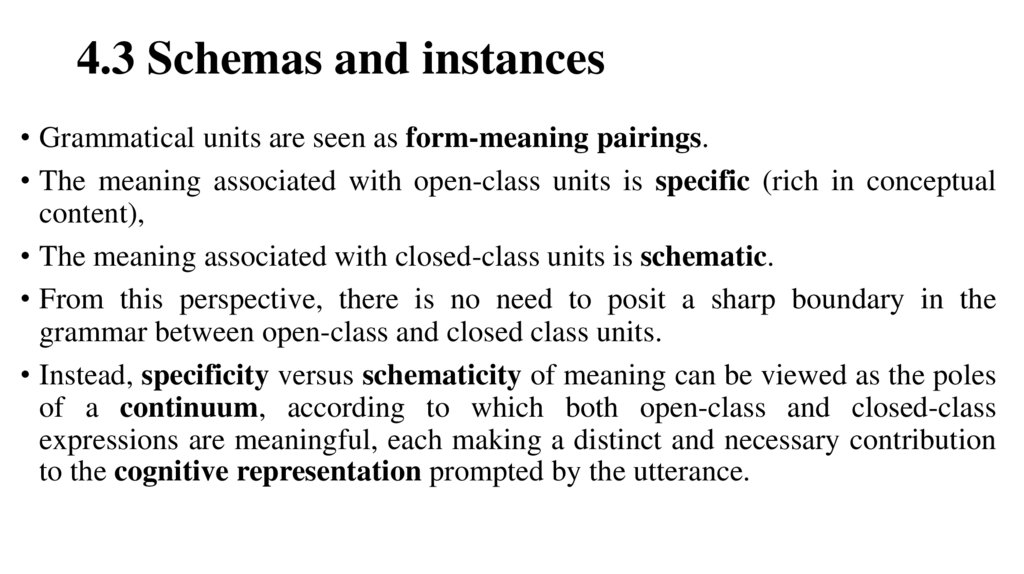
• (2) George was tickled by Lily. [passive]
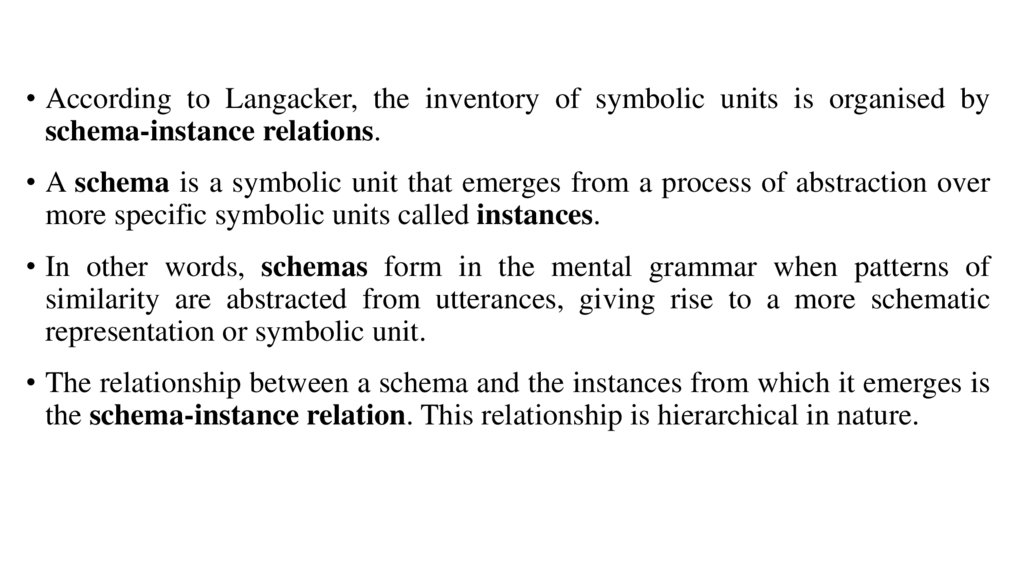
• According to cognitive linguists, this passive construction has its own
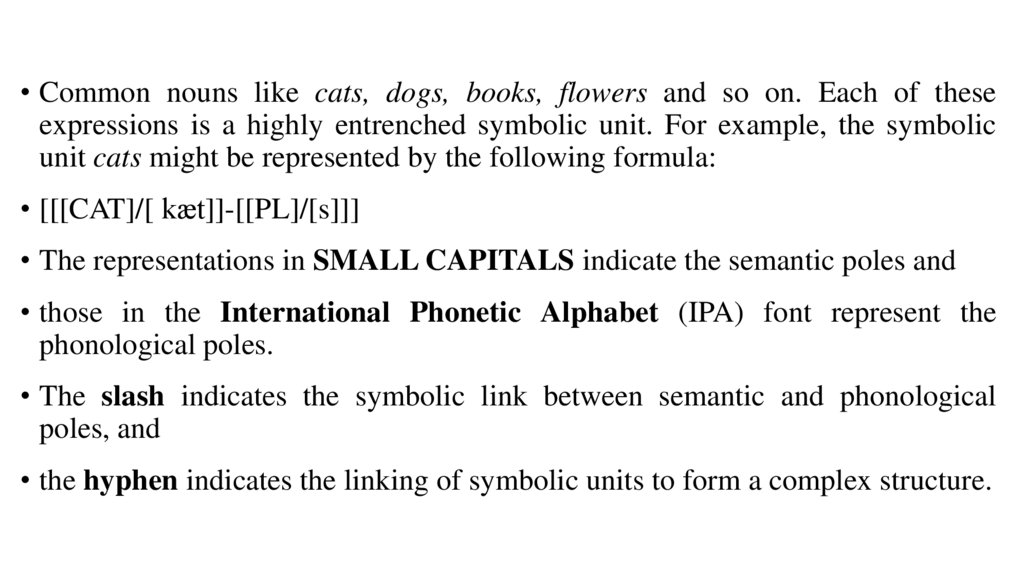
schematic meaning which focuses attention on the PATIENT (e.g. what
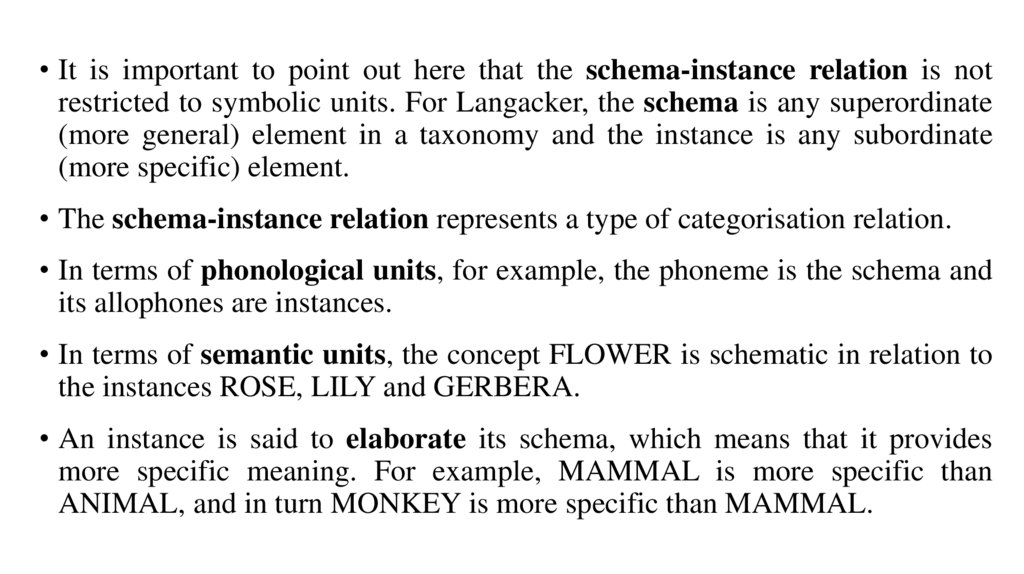
happened to George) rather than the AGENT (e.g. what Lily did).
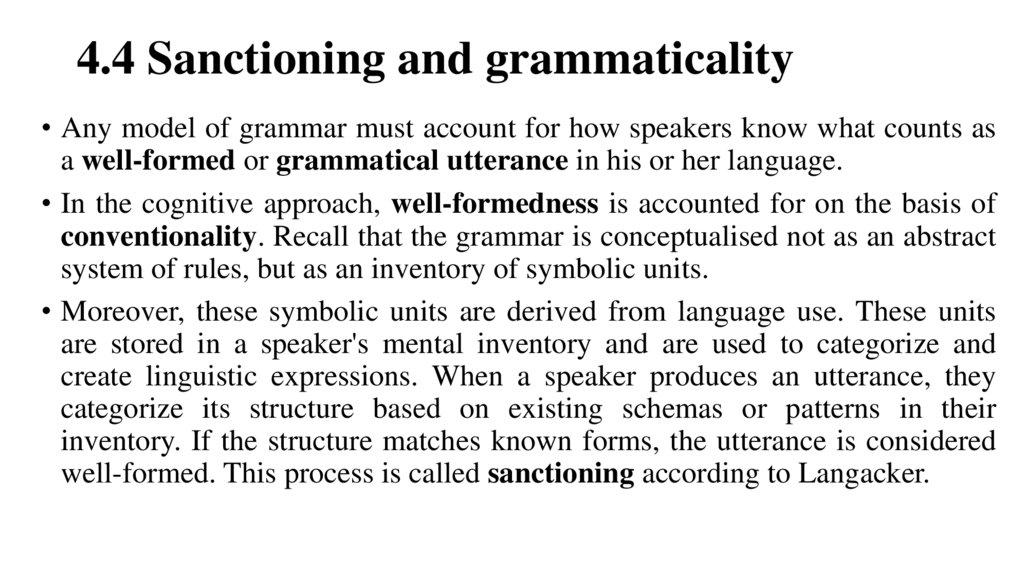
• The idea that grammatical units are inherently meaningful is an important
theme in cognitive approaches to grammar and gives rise to the idea of a
lexicon–grammar continuum, in which content words like cat and
grammatical constructions like the passive both count as symbolic units but
differ in terms of the quality of the meaning associated with them.
11. 1.2 The usage-based thesis
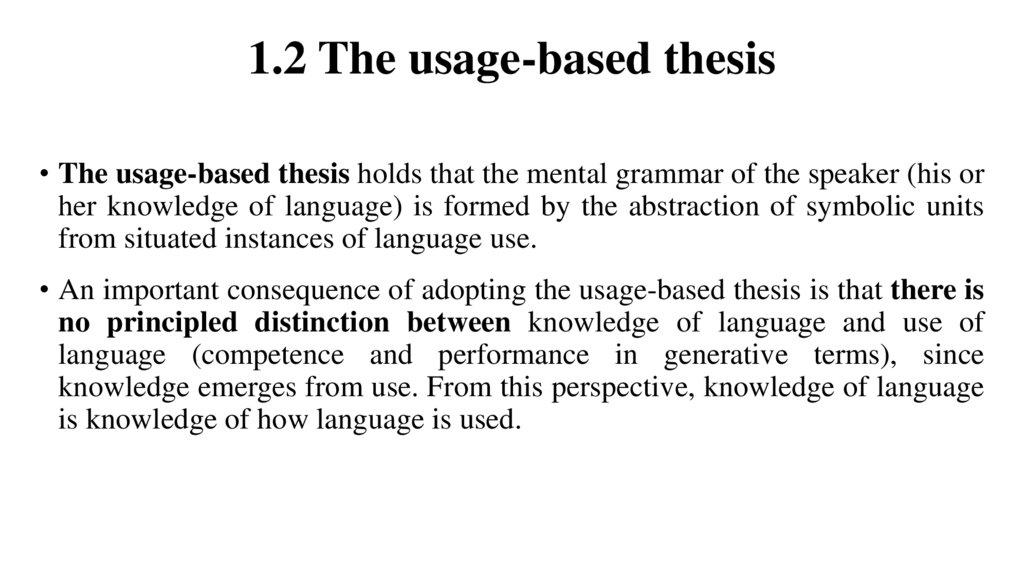
• The usage-based thesis holds that the mental grammar of the speaker (his orher knowledge of language) is formed by the abstraction of symbolic units
from situated instances of language use.
• An important consequence of adopting the usage-based thesis is that there is
no principled distinction between knowledge of language and use of
language (competence and performance in generative terms), since
knowledge emerges from use. From this perspective, knowledge of language
is knowledge of how language is used.
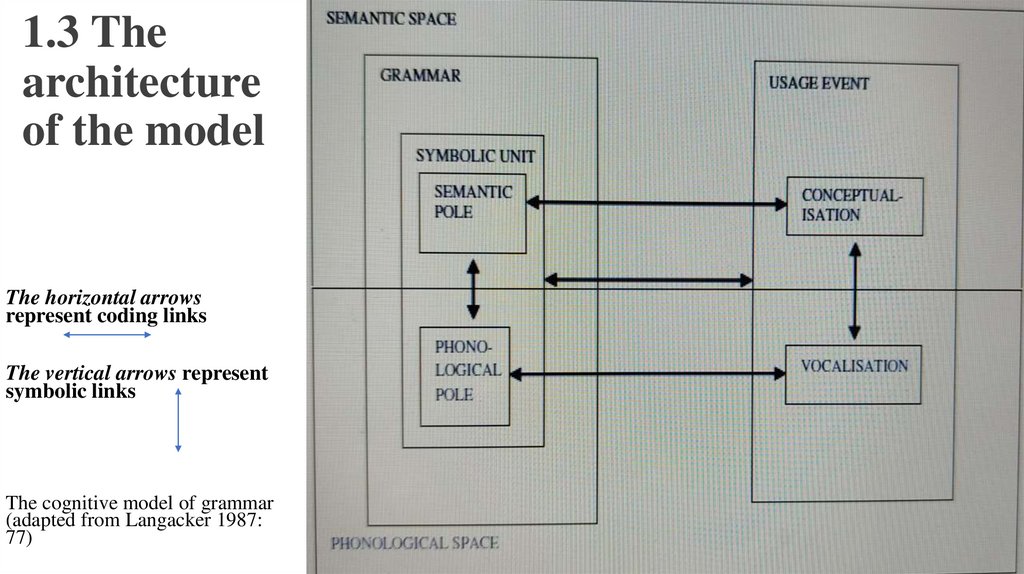
12. 1.3 The architecture of the model
The horizontal arrowsrepresent coding links
The vertical arrows represent
symbolic links
The cognitive model of grammar
(adapted from Langacker 1987:
77)
13.
2.1 The‘Conceptual
Structuring System
Model’
2.4 Cognitive
theories of
grammaticali
sation
2) Distinct
cognitive
approaches
to grammar
2.3 Constructional
approaches to
grammar
2.2 Cognitive
Grammar
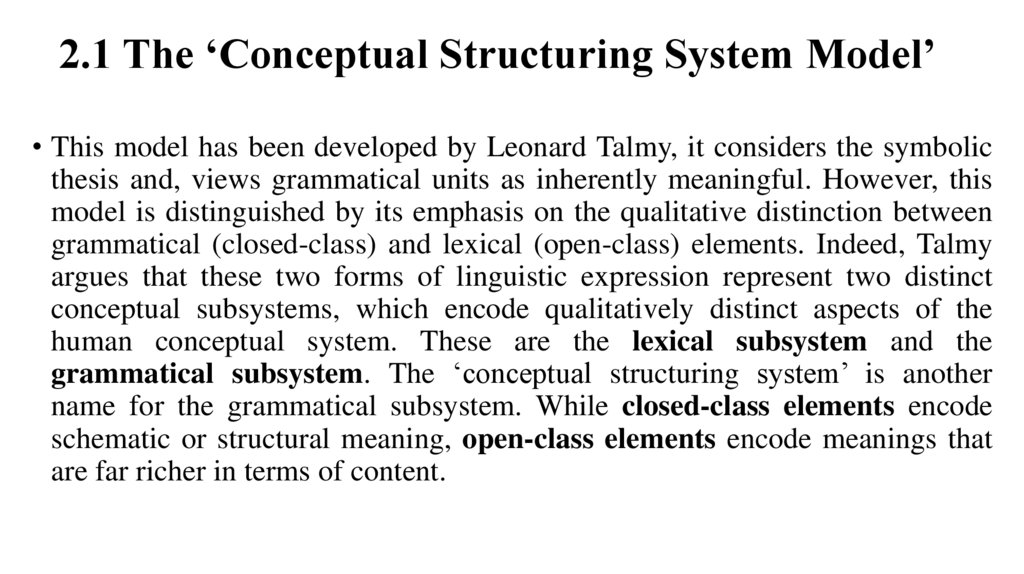
14. 2.1 The ‘Conceptual Structuring System Model’
• This model has been developed by Leonard Talmy, it considers the symbolicthesis and, views grammatical units as inherently meaningful. However, this
model is distinguished by its emphasis on the qualitative distinction between
grammatical (closed-class) and lexical (open-class) elements. Indeed, Talmy
argues that these two forms of linguistic expression represent two distinct
conceptual subsystems, which encode qualitatively distinct aspects of the
human conceptual system. These are the lexical subsystem and the
grammatical subsystem. The ‘conceptual structuring system’ is another
name for the grammatical subsystem. While closed-class elements encode
schematic or structural meaning, open-class elements encode meanings that
are far richer in terms of content.
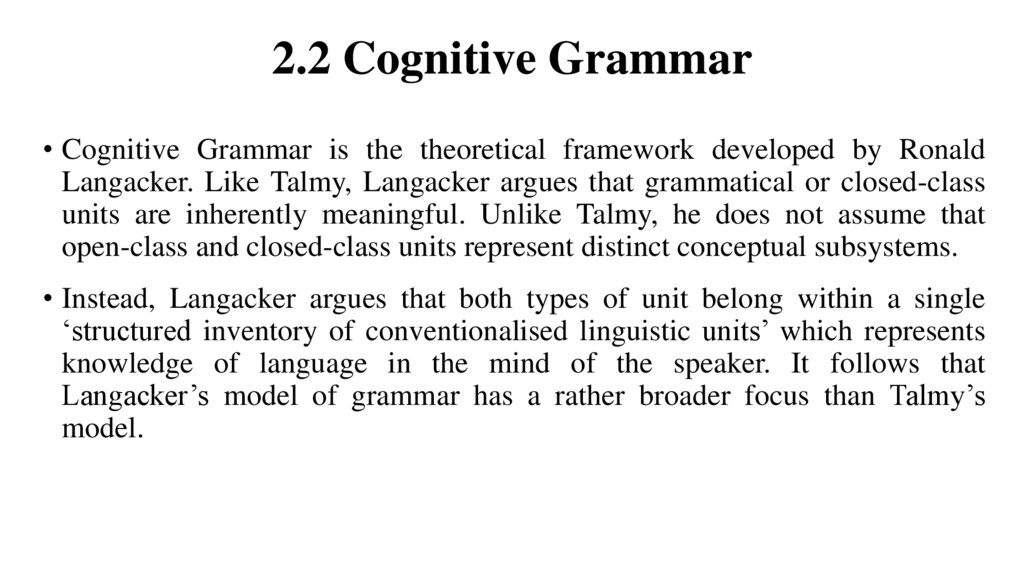
15. 2.2 Cognitive Grammar
• Cognitive Grammar is the theoretical framework developed by RonaldLangacker. Like Talmy, Langacker argues that grammatical or closed-class
units are inherently meaningful. Unlike Talmy, he does not assume that
open-class and closed-class units represent distinct conceptual subsystems.
• Instead, Langacker argues that both types of unit belong within a single
‘structured inventory of conventionalised linguistic units’ which represents
knowledge of language in the mind of the speaker. It follows that
Langacker’s model of grammar has a rather broader focus than Talmy’s
model.
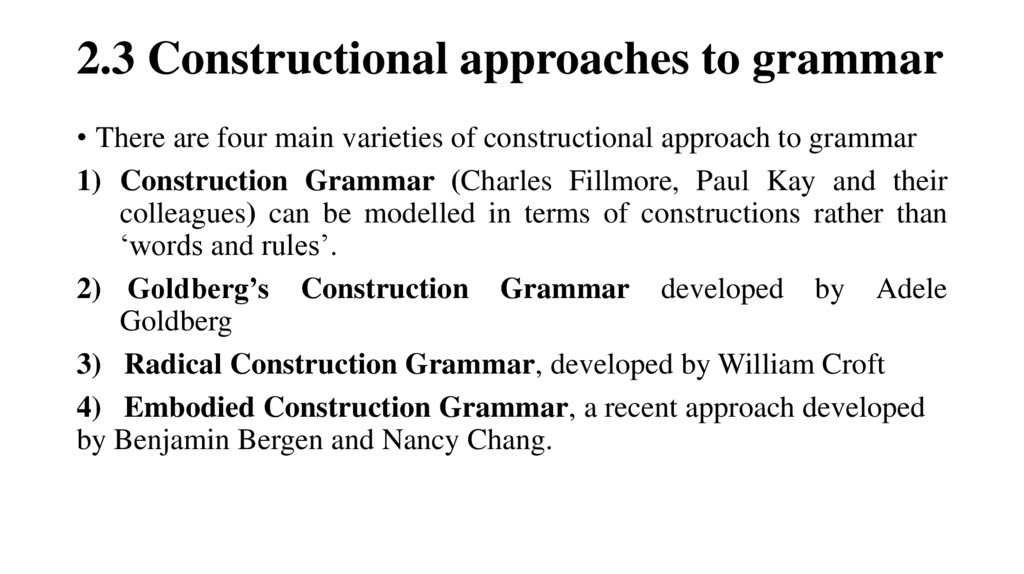
16. 2.3 Constructional approaches to grammar
• There are four main varieties of constructional approach to grammar1) Construction Grammar (Charles Fillmore, Paul Kay and their
colleagues) can be modelled in terms of constructions rather than
‘words and rules’.
2) Goldberg’s Construction Grammar developed by Adele
Goldberg
3) Radical Construction Grammar, developed by William Croft
4) Embodied Construction Grammar, a recent approach developed
by Benjamin Bergen and Nancy Chang.
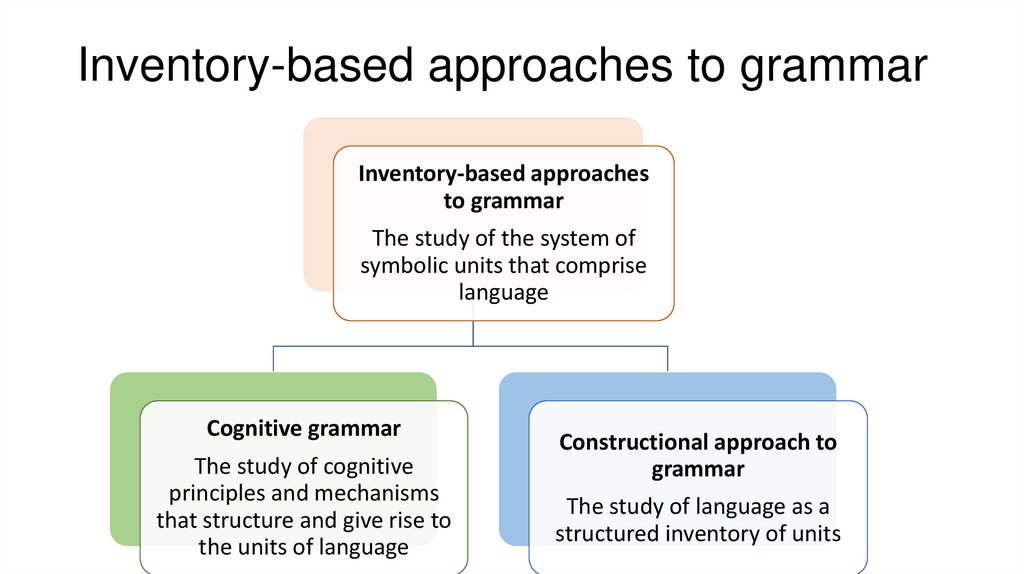
17. Inventory-based approaches to grammar
Inventory-based approachesto grammar
The study of the system of
symbolic units that comprise
language
Cognitive grammar
The study of cognitive
principles and mechanisms
that structure and give rise to
the units of language
Constructional approach to
grammar
The study of language as a
structured inventory of units
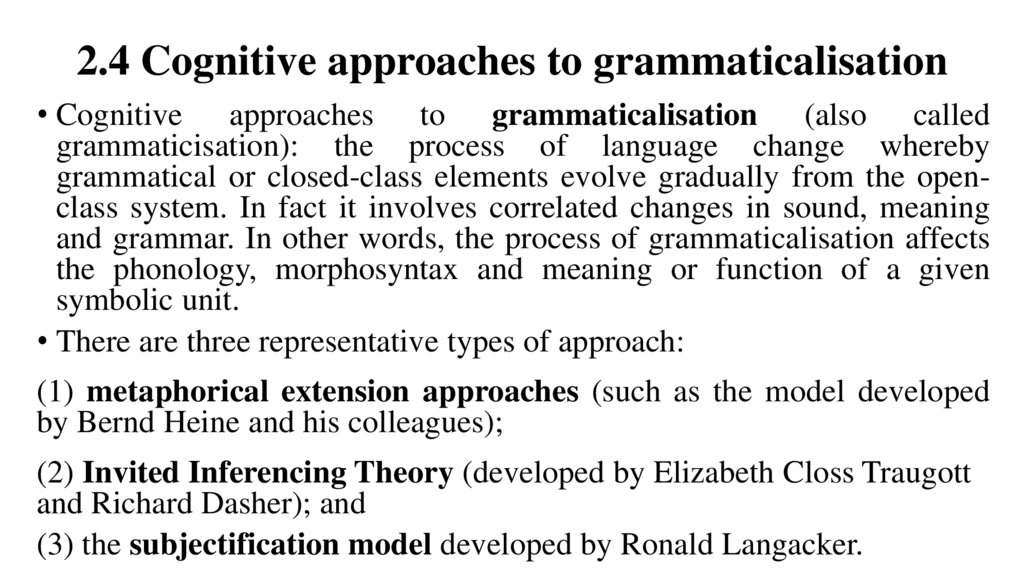
18. 2.4 Cognitive approaches to grammaticalisation
• Cognitive approaches to grammaticalisation (also calledgrammaticisation): the process of language change whereby
grammatical or closed-class elements evolve gradually from the openclass system. In fact it involves correlated changes in sound, meaning
and grammar. In other words, the process of grammaticalisation affects
the phonology, morphosyntax and meaning or function of a given
symbolic unit.
• There are three representative types of approach:
(1) metaphorical extension approaches (such as the model developed
by Bernd Heine and his colleagues);
(2) Invited Inferencing Theory (developed by Elizabeth Closs Traugott
and Richard Dasher); and
(3) the subjectification model developed by Ronald Langacker.
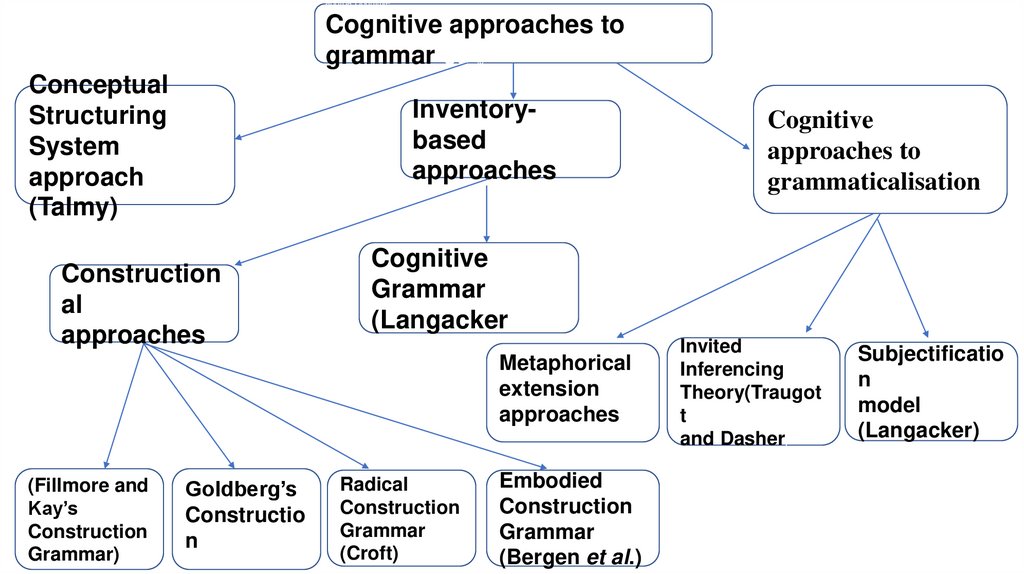
19.
approa CognitiveCognitive approaches to
grammar es
to
grammar
Conceptual
Structuring
System
approach
(Talmy)
Inventorybased
approaches
Construction
al
approaches
Cognitive
Grammar
(Langacker
)
Metaphorical
extension
approaches
(e.g. Heine)
(Fillmore and
Kay’s
Construction
Grammar)
Goldberg’s
Constructio
n
Grammar
Radical
Construction
Grammar
(Croft)
Cognitive
approaches to
grammaticalisation
Embodied
Construction
Grammar
(Bergen et al.)
Invited
Inferencing
Theory(Traugot
t
and Dasher)
Subjectificatio
n
model
(Langacker)
20. 3) Grammatical terminology
3.1 Grammar3.2 Units of grammar
3.3 Word classes
3.4 Syntax
3.5 Grammatical functions
3.6 Agreement and case
21. 3.1 Grammar
The term ‘grammar’, which has a number of different meanings.• A grammar can be a written volume, (a descriptive reference grammar prepared by a linguist
for consultation by other linguists, or a teaching grammar prepared for language students).
• ‘Grammar’ also refers to the discipline that focuses on morphology (word structure) and syntax
(sentence structure), whether from the perspective of language learning (for example, French
grammar, Latin grammar), from the perspective of language description, or from the perspective of
general linguistics, where ‘grammar’ has the status of a subdiscipline alongside phonetics,
phonology, semantics and so on. Indeed, an introductory ‘grammar’ course in a linguistics
programme will usually focus solely upon word structure and sentence structure. If the approach
taken is purely descriptive, this is known as ‘descriptive grammar’.
• The term ‘grammar’ is also used to refer to a theory of language such as Langacker’s Cognitive
Grammar or Chomsky’s Generative Grammar.
• Finally, the term can also be used to refer to the psychological system that represents a speaker’s
knowledge of language. In these last two senses, the term is not (necessarily) restricted to word
structure and sentence structure, but is applied to human language in general, and thus
encompasses phonology and linguistic meaning as well as morphology and syntax.
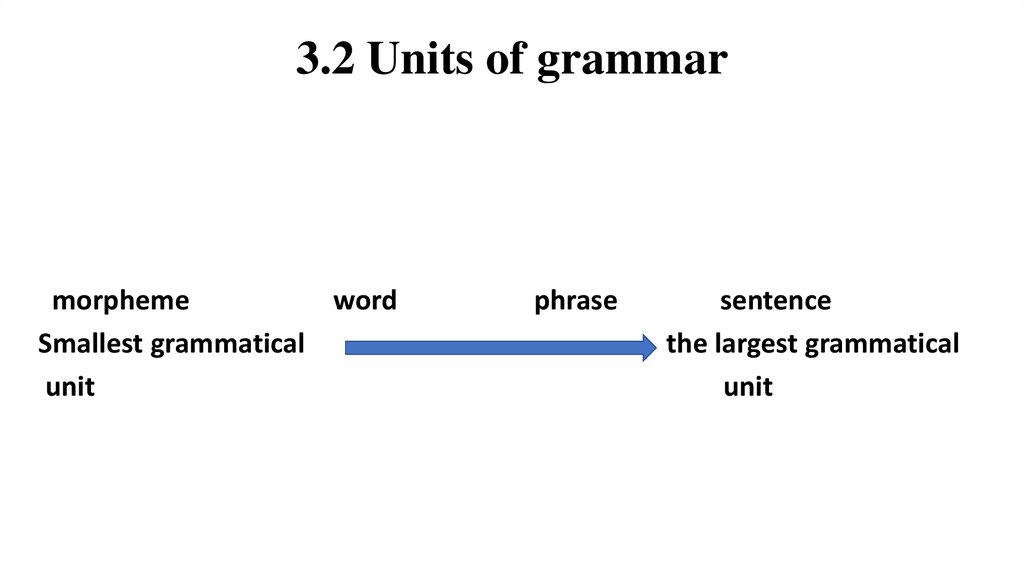
22. 3.2 Units of grammar
morphemeword
Smallest grammatical
unit
phrase
sentence
the largest grammatical
unit
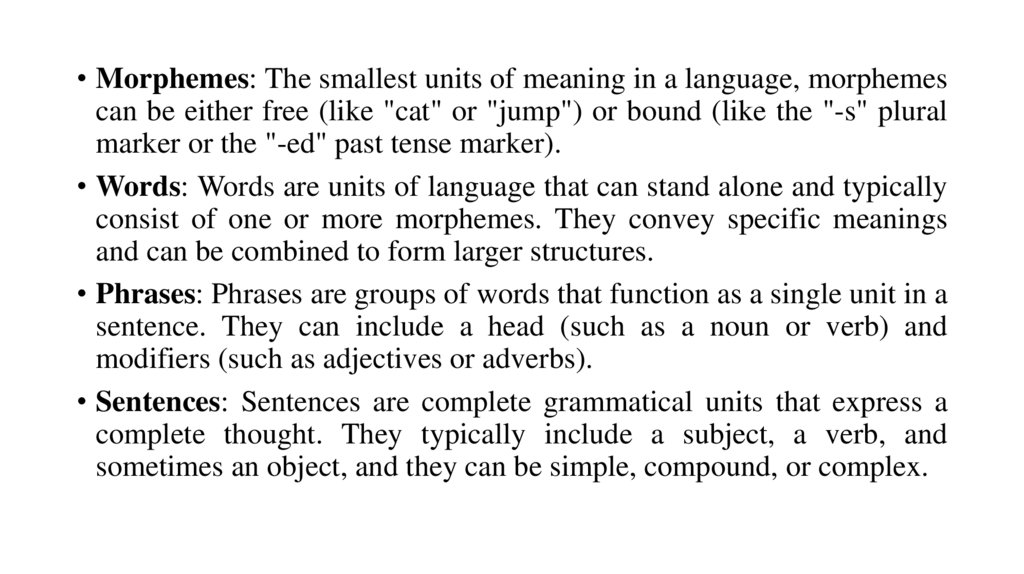
23.
• Morphemes: The smallest units of meaning in a language, morphemescan be either free (like "cat" or "jump") or bound (like the "-s" plural
marker or the "-ed" past tense marker).
• Words: Words are units of language that can stand alone and typically
consist of one or more morphemes. They convey specific meanings
and can be combined to form larger structures.
• Phrases: Phrases are groups of words that function as a single unit in a
sentence. They can include a head (such as a noun or verb) and
modifiers (such as adjectives or adverbs).
• Sentences: Sentences are complete grammatical units that express a
complete thought. They typically include a subject, a verb, and
sometimes an object, and they can be simple, compound, or complex.
24. 3.3 Word classes
• In traditional descriptive grammar, English is usually described ashaving eight word classes: noun, pronoun, adjective, verb, adverb,
preposition, conjunction and interjection.
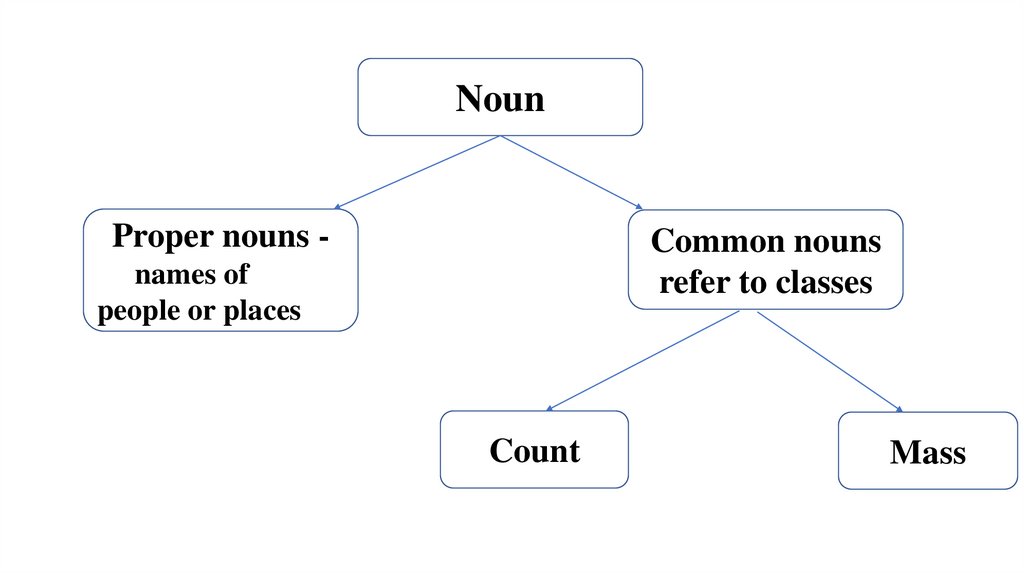
• Nouns
• Nouns often refer to entities, including people, and abstractions (like
war and peace). Nouns typically take the inflectional plural affix -s
(cats, dogs, houses) but there are exceptions (*mans, *peaces).
• Nouns also typically take the possessive affix -’s (man’s best friend),
and in terms of distribution, follow determiners like your and
adjectives like funny (your funny face).
25.
NounProper nouns -
Common nouns
refer to classes
names of
people or places
Count
Mass
26.
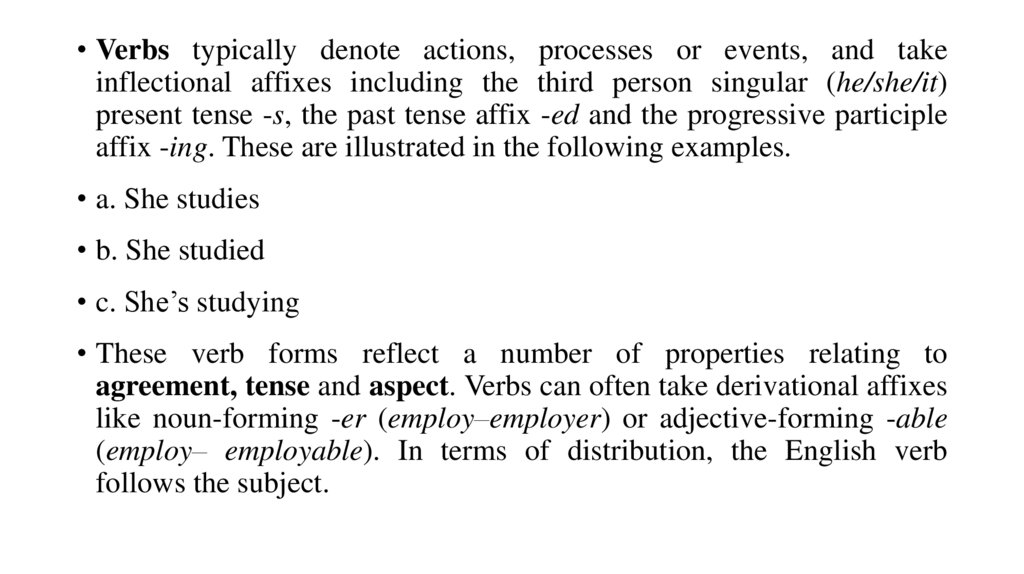
• Verbs typically denote actions, processes or events, and takeinflectional affixes including the third person singular (he/she/it)
present tense -s, the past tense affix -ed and the progressive participle
affix -ing. These are illustrated in the following examples.
• a. She studies
• b. She studied
• c. She’s studying
• These verb forms reflect a number of properties relating to
agreement, tense and aspect. Verbs can often take derivational affixes
like noun-forming -er (employ–employer) or adjective-forming -able
(employ– employable). In terms of distribution, the English verb
follows the subject.
27.
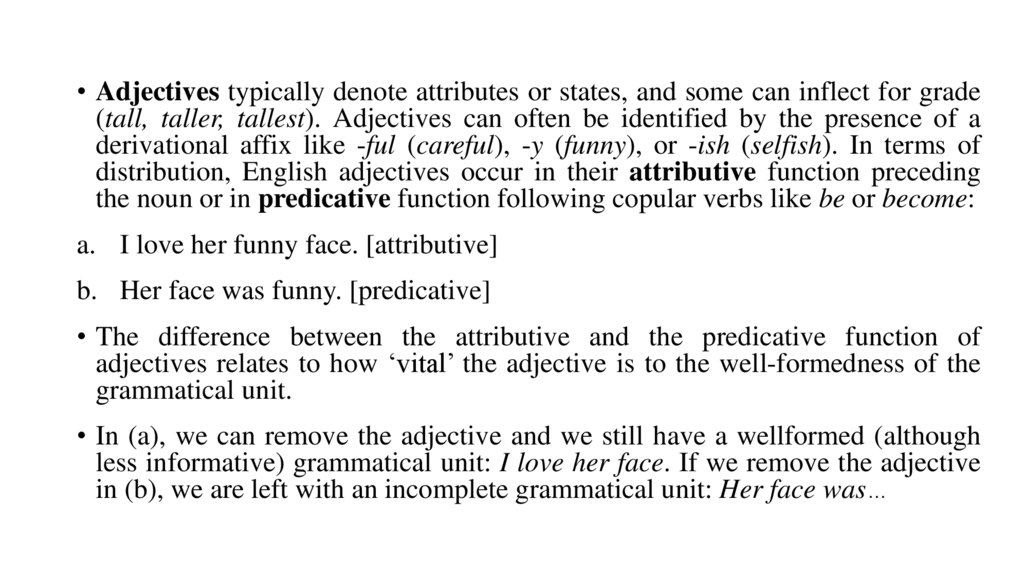
• Adjectives typically denote attributes or states, and some can inflect for grade(tall, taller, tallest). Adjectives can often be identified by the presence of a
derivational affix like -ful (careful), -y (funny), or -ish (selfish). In terms of
distribution, English adjectives occur in their attributive function preceding
the noun or in predicative function following copular verbs like be or become:
a. I love her funny face. [attributive]
b. Her face was funny. [predicative]
• The difference between the attributive and the predicative function of
adjectives relates to how ‘vital’ the adjective is to the well-formedness of the
grammatical unit.
• In (a), we can remove the adjective and we still have a wellformed (although
less informative) grammatical unit: I love her face. If we remove the adjective
in (b), we are left with an incomplete grammatical unit: Her face was…
28.
• Adverbs typically express information relating to time, manner, place andfrequency, and have a modifying function within the sentence (providing
information, for example, about how, where or when something happened
e.g suddenly, repeatedly, hopefully and soon.).
• Some are recognisable by the adverb-forming derivational affix -ly, and a
few inflect for grade (soon, sooner, soonest), but on the whole these are
difficult to identify by morphology or distribution because they have the
widest distribution of all the English word classes.
• A further complication with this category is that members of other word
classes can also perform the same function as adverbs. This is called an
adverbial function, which means that something behaves in the same way
as an adverb, providing modifying information about place, manner, time
and so on, regardless of word class. For example, the expression after
supper performs an adverbial function in the sentence George arrived after
supper, but is not an adverb; it is a preposition phrase, consisting of a
preposition and a noun phrase.
29.
• Prepositions are words like on, with, under and beyond, whichcombine with a noun phrase to form a preposition phrase (on the table,
with my best friend). These are called prepositions because they
precede the noun phrase.
• In some languages, they follow the noun phrase and are called
postpositions. The general term for both prepositions and
postpositions is ‘adposition’.
30.
• Determiners are words like the, my and some, which combine with anoun to form a noun phrase (the garden, my cats, some flowers).
Apart from the determiners this and that which inflect for number
(these, those), determiners have no other inflectional or derivational
properties in English.
• It is important to remember that determiners are followed by nouns
because some words can be both determiners (I love these flowers)
and pronouns (I love these).
31.
• Pronouns are sometimes described as a subclass of nouns because theyshow the same pattern of distribution. However, pronouns can be viewed as
a separate category from nouns because they belong to a closed class and
because they provide schematic meaning rather than content meaning.
• For example, You could probably draw a picture of my favourite teacup
without having seen it, but you would be unable to draw a picture of it
without having seen it. In isolation from context, it means ‘a single
inanimate object’. In reality we are never called upon to interpret it out of
context, but this illustrates the difference between content meaning and
schematic meaning.
• Personal pronouns: ("you," "me," and "her”)
• Possessive pronouns: ("mine" and "hers.“)
• Demonstrative pronouns: ("this/these" and "that/those.“)
32.
• Auxiliary verbs• They are the closed-class category. In English, this category includes
the modal auxiliaries (for example, can, must and will) which
introduce mood into the sentence, and the primary auxiliaries (have
and be) which introduce aspect and passive voice.
• The modal auxiliaries share few characteristics with ‘ordinary’
(lexical) verbs in English. They do not inflect for progressive aspect,
for example (*musting) nor do they have a third person singular -s
form (*she musts). They are called auxiliary verbs because they
belong inside the verb string (Lily [will sing] the blues.), because they
must be followed by a verb phrase (VP), and because they can
function as operators.
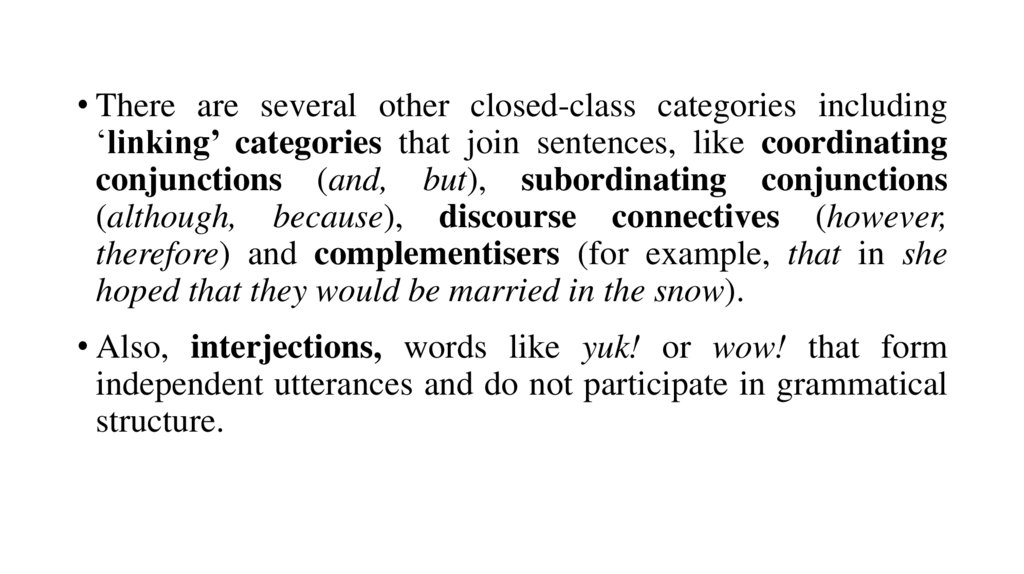
33.
• There are several other closed-class categories including‘linking’ categories that join sentences, like coordinating
conjunctions (and, but), subordinating conjunctions
(although, because), discourse connectives (however,
therefore) and complementisers (for example, that in she
hoped that they would be married in the snow).
• Also, interjections, words like yuk! or wow! that form
independent utterances and do not participate in grammatical
structure.
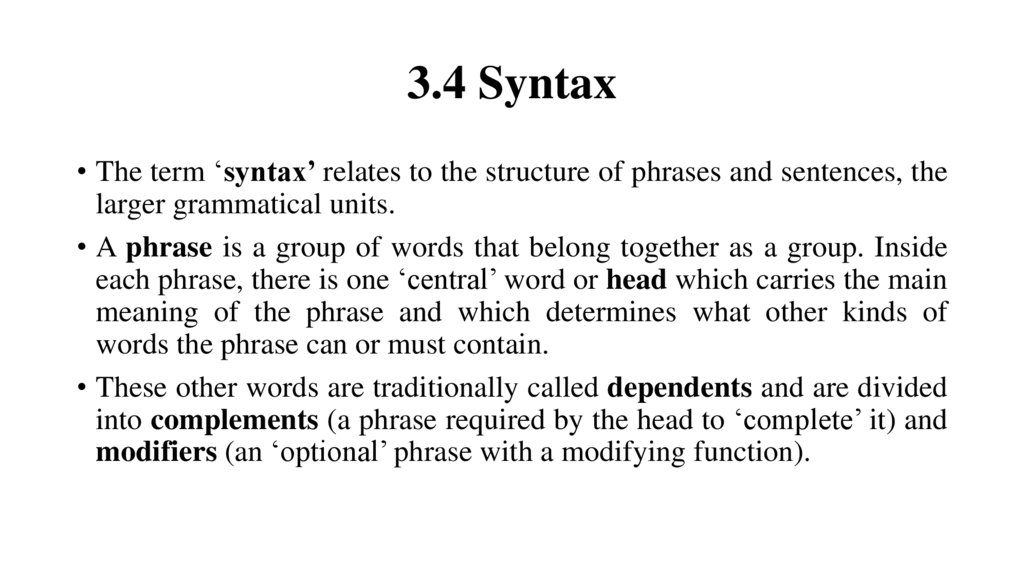
34. 3.4 Syntax
• The term ‘syntax’ relates to the structure of phrases and sentences, thelarger grammatical units.
• A phrase is a group of words that belong together as a group. Inside
each phrase, there is one ‘central’ word or head which carries the main
meaning of the phrase and which determines what other kinds of
words the phrase can or must contain.
• These other words are traditionally called dependents and are divided
into complements (a phrase required by the head to ‘complete’ it) and
modifiers (an ‘optional’ phrase with a modifying function).
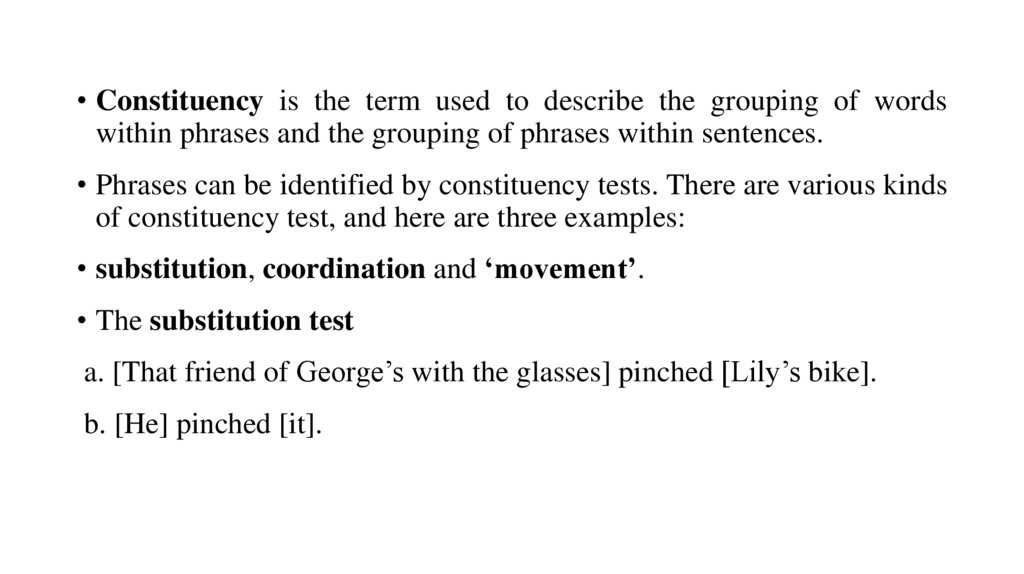
35.
• Constituency is the term used to describe the grouping of wordswithin phrases and the grouping of phrases within sentences.
• Phrases can be identified by constituency tests. There are various kinds
of constituency test, and here are three examples:
• substitution, coordination and ‘movement’.
• The substitution test
a. [That friend of George’s with the glasses] pinched [Lily’s bike].
b. [He] pinched [it].
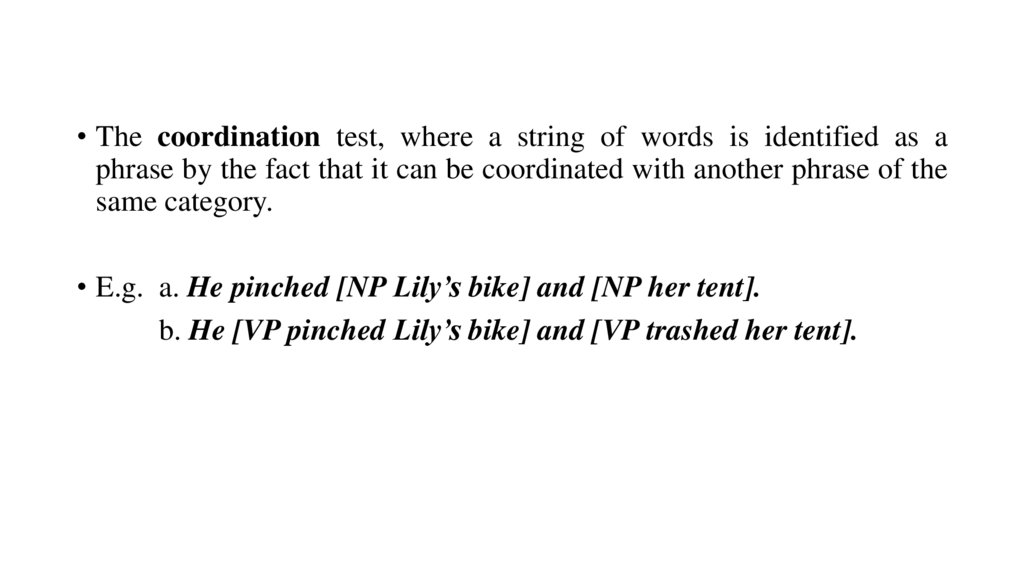
36.
• The coordination test, where a string of words is identified as aphrase by the fact that it can be coordinated with another phrase of the
same category.
• E.g. a. He pinched [NP Lily’s bike] and [NP her tent].
b. He [VP pinched Lily’s bike] and [VP trashed her tent].
37.
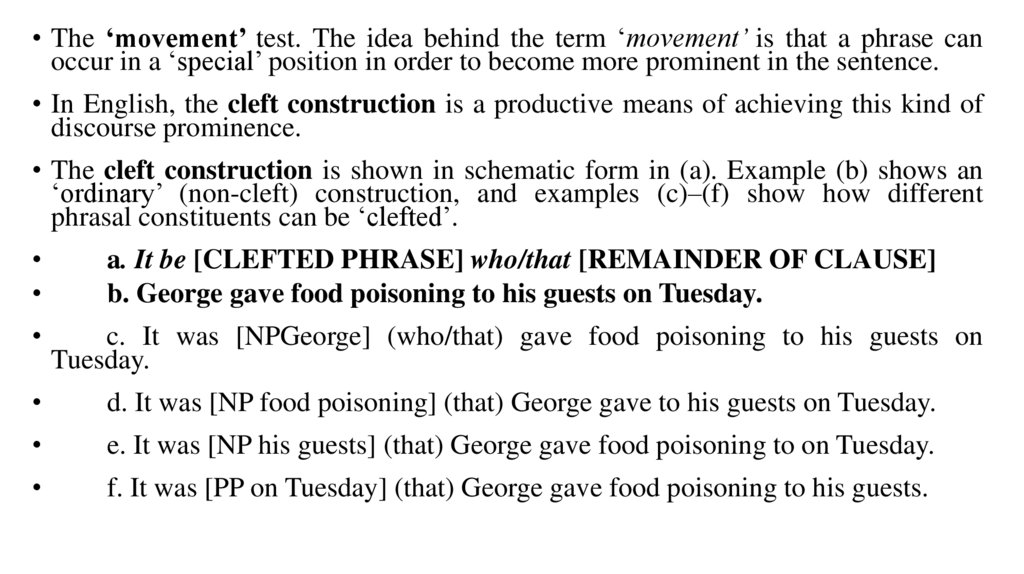
• The ‘movement’ test. The idea behind the term ‘movement’ is that a phrase canoccur in a ‘special’ position in order to become more prominent in the sentence.
• In English, the cleft construction is a productive means of achieving this kind of
discourse prominence.
• The cleft construction is shown in schematic form in (a). Example (b) shows an
‘ordinary’ (non-cleft) construction, and examples (c)–(f) show how different
phrasal constituents can be ‘clefted’.
a. It be [CLEFTED PHRASE] who/that [REMAINDER OF CLAUSE]
b. George gave food poisoning to his guests on Tuesday.
c. It was [NPGeorge] (who/that) gave food poisoning to his guests on
Tuesday.
d. It was [NP food poisoning] (that) George gave to his guests on Tuesday.
e. It was [NP his guests] (that) George gave food poisoning to on Tuesday.
f. It was [PP on Tuesday] (that) George gave food poisoning to his guests.
38.
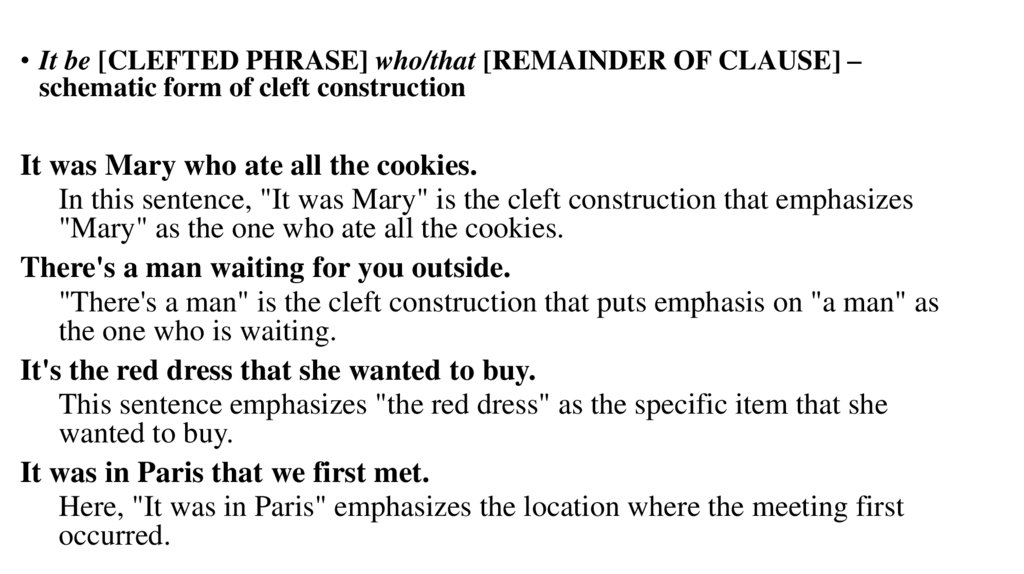
• It be [CLEFTED PHRASE] who/that [REMAINDER OF CLAUSE] –schematic form of cleft construction
It was Mary who ate all the cookies.
In this sentence, "It was Mary" is the cleft construction that emphasizes
"Mary" as the one who ate all the cookies.
There's a man waiting for you outside.
"There's a man" is the cleft construction that puts emphasis on "a man" as
the one who is waiting.
It's the red dress that she wanted to buy.
This sentence emphasizes "the red dress" as the specific item that she
wanted to buy.
It was in Paris that we first met.
Here, "It was in Paris" emphasizes the location where the meeting first
occurred.
39.
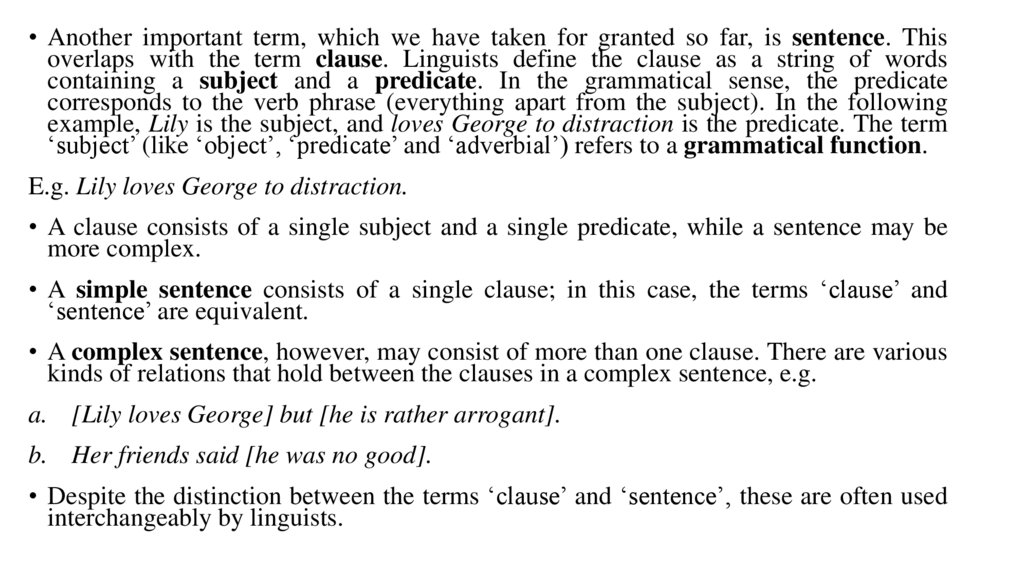
• Another important term, which we have taken for granted so far, is sentence. Thisoverlaps with the term clause. Linguists define the clause as a string of words
containing a subject and a predicate. In the grammatical sense, the predicate
corresponds to the verb phrase (everything apart from the subject). In the following
example, Lily is the subject, and loves George to distraction is the predicate. The term
‘subject’ (like ‘object’, ‘predicate’ and ‘adverbial’) refers to a grammatical function.
E.g. Lily loves George to distraction.
• A clause consists of a single subject and a single predicate, while a sentence may be
more complex.
• A simple sentence consists of a single clause; in this case, the terms ‘clause’ and
‘sentence’ are equivalent.
• A complex sentence, however, may consist of more than one clause. There are various
kinds of relations that hold between the clauses in a complex sentence, e.g.
a. [Lily loves George] but [he is rather arrogant].
b. Her friends said [he was no good].
• Despite the distinction between the terms ‘clause’ and ‘sentence’, these are often used
interchangeably by linguists.
40. 3.5 Grammatical functions
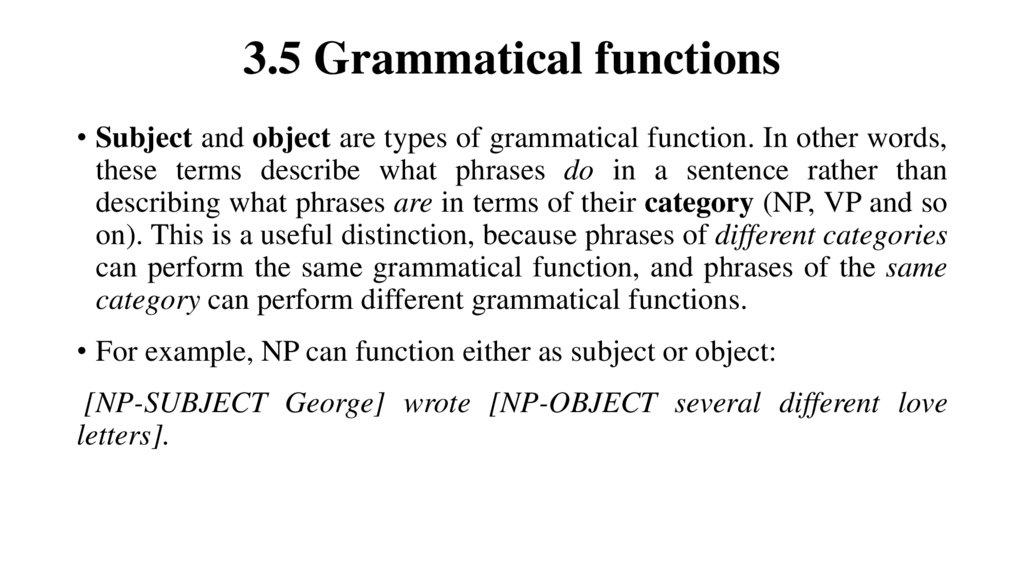
• Subject and object are types of grammatical function. In other words,these terms describe what phrases do in a sentence rather than
describing what phrases are in terms of their category (NP, VP and so
on). This is a useful distinction, because phrases of different categories
can perform the same grammatical function, and phrases of the same
category can perform different grammatical functions.
• For example, NP can function either as subject or object:
[NP-SUBJECT George] wrote [NP-OBJECT several different love
letters].
41.
• While the category of a word or a phrase can usually be identifiedwithout context, the grammatical function of an expression can only
be identified in the context of a particular sentence. This is because the
same expression could be a subject in one sentence and an object in
another. Compare the sentences:
• [NP-SUBJECT George] wrote [NP-OBJECT several different love
letters].
• [NP-SUBJECT Several different love letters] arrived in the post.
42.
• The English subject, which is typically an NP but can also be a clause or a PP(preposition phrase), can be characterised in terms of a number of morphological
and distributional criteria, which are summarized in the following table.
Structural criteria for English subject
• (Canonical) subject position in English is clause-initial
e.g. The dog barks loudly. "The dog" is the subject, and it appears in the canonical subject
position before the verb "barks."
• Subject inverts with auxiliary/modal verbs to form questions
Statement: She is coming to the party.
Question: Is she coming to the party?
• Subject agrees with the verb in person and number
Singular subject (third person): He plays the guitar.
Plural subject (third person): They play the guitar.
• Subject pronoun shows subject (or nominative) case
Subject pronoun: She is a doctor.
43.
• The term ‘predicate’ refers to the main part of the sentence excluding theverb. Usually, this means the VP, or the verb plus its object(s). The idea that
the sentence can be partitioned in this way is widespread in linguistics and
reflects the idea that the verb phrase encapsulates the essence of the event
that the sentence expresses while the subject is less crucial to defining the
nature of the event.
• Compare the following examples:
a. George ate cakes.
b. Lily ate cakes.
c. George ate bananas.
• In (a), the predicate ate cakes describes a cake-eating event that happens to
involve George. If we change the subject (b), the sentence still describes a
cake-eating event, whereas if we change the object (c), the sentence
describes a different kind of event.
44.
• It is also striking that idioms occur within the predicate of a sentence:a. George [threw in the towel].
b. Lily [threw in the towel].
c. George [threw in the flannel].
• Observe that the idiomatic interpretation (meaning ‘give up’) is
available in (a) and (b) regardless of the subject, but if the object is
changed from the towel to the flannel the idiomatic interpretation is
lost (c).
45.
• The object grammatical function divides into two subtypes: direct objectand indirect object. Monotransitive verbs like eat, love and see take a
single object, which is the direct object. This is bracketed in the following
examples.
a. George eats [cake].
b. Lily loves [him].
c. Lily saw [George].
• In contrast, ditransitive verbs like give require two objects. Consider the
next example.
George gave [Lily] [a box of chocolates].
• In this example, Lily is the indirect object and a box of chocolates is the
direct object. This type of construction is called a double-object
construction.
46.
• An alternative construction in English reverses the order of the twoobjects.
• When this happens, the indirect object (Lily) is expressed by a
preposition phrase (to Lily).
e.g. George gave [a box of chocolates] [to Lily].
47. Objects are typically NPs but can also be clauses. The English object can be characterised in terms of a number of structural
criteria:• Object position in English is after the
verb
I love pizza.
• Object can move to clause-initial
position to become the grammatical
subject of a passive sentence
Active: They are painting the house.
Passive: The house is being painted by
them.
• Object pronoun shows object (or
accusative) case
Object pronoun: I gave it to her.
• Indirect object precedes direct object,
unless the indirect object is expressed
as PP
Indirect object before direct object:
I gave John the book.
Indirect object expressed as a prepositional
phrase: I gave the book to John.
48.
• The predicative complement is a complement of the verb that is coreferential with or describes either the subject or the object, as in (a)and (b) but not (c):
a. George is [a heart-breaker]. Subject complement
b. Lily called George [a heart-breaker]. Object complement
c. Lily loves [a heart-breaker]. Direct object
• Unlike objects, predicative complements cannot move to clause-initial
position to form a passive sentence. In the following example, been is
the past participle of the copula be and was is the past tense form of
the passive auxiliary be. The result is ungrammatical:
*A heartbreaker was been (by George).
49.
• Adverbials. It is important to distinguish the term ‘adverb’ from theterm ‘adverbial’. While ‘adverb’ refers to a word class (for example,
suddenly, soon, fortunately), ‘adverbial’ refers to a grammatical
function that can be performed by various categories in addition to the
adverb, as illustrated by the following examples:
a. George [ADVERB distractedly] wrote the letters.
b. George wrote the letters [PP in the back garden].
c. [CLAUSE Humming a happy tune], George wrote the letters.
• The expression humming a happy tune in (c) is described as an
embedded adverbial clause, even though it lacks a subject.
50.
• As these examples illustrate, adverbials are the ‘optional’ parts ofsentence that modify the clause at some level and can be added or
deleted without making the sentence ungrammatical.
• Adverbials typically express information about when, where or how
something happened. It is difficult to pin down a set of structural
criteria that characterise adverbials because they display considerable
flexibility in terms of position. However, unlike the other grammatical
functions, adverbials can be stacked (that is, can occur recursively):
[CLAUSE Humming a happy tune], George [ADVERB distractedly]
wrote the letters [PP in the back garden].
51. 3.6 Agreement and case
• The term ‘agreement’ (known as concord in traditional grammar)describes the morphological marking of a grammatical unit to signal a
particular grammatical relationship with another unit. Agreement
involves grammatical features like person, number and gender and
may interact with case.
52.
• Person is the grammatical feature that distinguishes speaker (firstperson), hearer (second person) and third party (third person).
Compare I, you and she. This feature participates in subject–verb
agreement in English, but only in the present tense and only in the
singular third person form. Consider the following examples.
• a. I love George.
• b. You love George.
• c. She loves George.
• d. We love George.
• e. They love George.
53.
• The grammatical feature person is a deictic category because themeaning of personal pronouns shifts continually during conversational
exchange, and you have to know who is speaking to know who these
expressions refer to.
e.g. Meet me here a week from now with a stick about this big.
• This example illustrates the dependence of deictic expressions on
contextual information. Without knowing the person who wrote the
message, where the note was written or the time at which it was
written, you cannot fully interpret me, here, a week from now, or a
stick about this big.
54.
• Number is the grammatical feature that distinguishes singular fromplural.
• Compare I and we, which are both first person pronouns.
• Some languages have a more complex system; for example, Arabic
distinguishes singular, dual and plural (three or more).
55.
• Gender is the grammatical feature that distinguishes nounclasses
(commonly,
‘masculine’
and
‘feminine’).
Grammatical gender does not necessarily correlate with the
biological sex of the referent.
• English does not have grammatical gender because common
nouns are not subdivided into gender categories.
• Despite this, the pronouns he/him/his and she/her/hers are
described as ‘masculine’ or ‘feminine’.
• The fact that English lacks a system of grammatical gender
explains why there is no gender agreement in English
between nouns and other elements in the noun phrase.
56.
• Case refers to the grammatical category that indicates the role of anoun or pronoun in a sentence.
• Case is typically marked by inflections on the noun or pronoun, and
different languages have different systems of case.
• In English, nouns generally have only two cases: the subject case
(nominative) and object case (accusative).
• For example, in the sentence "She gave him the book," "she" is in the
nominative case as the subject, while "him" is in the objective case as
the indirect object.
57. 4) Characteristics of the cognitive approach to grammar
4.1 Grammatical knowledge: a structured inventory of symbolic units4.2 Features of the closed-class subsystem
4.3 Schemas and instances
4.4 Sanctioning and grammaticality
58. 4.1 Grammatical knowledge: a structured inventory of symbolic units
In cognitive approaches to grammar, language knowledge is seen asan inventory of symbolic units stored in the mind. These units
become established through frequent use and are stored and accessed
as whole entities, not built up from smaller parts.
The units are conventional, meaning they become part of the
language's grammar by being shared among speakers.
Conventionality varies, with common words like "cat" being more
widely shared than specialized terms like "infarct." Entrenchment
and conventionality are key concepts in this usage-based model of
grammar, emphasizing the role of usage patterns in shaping language
knowledge.
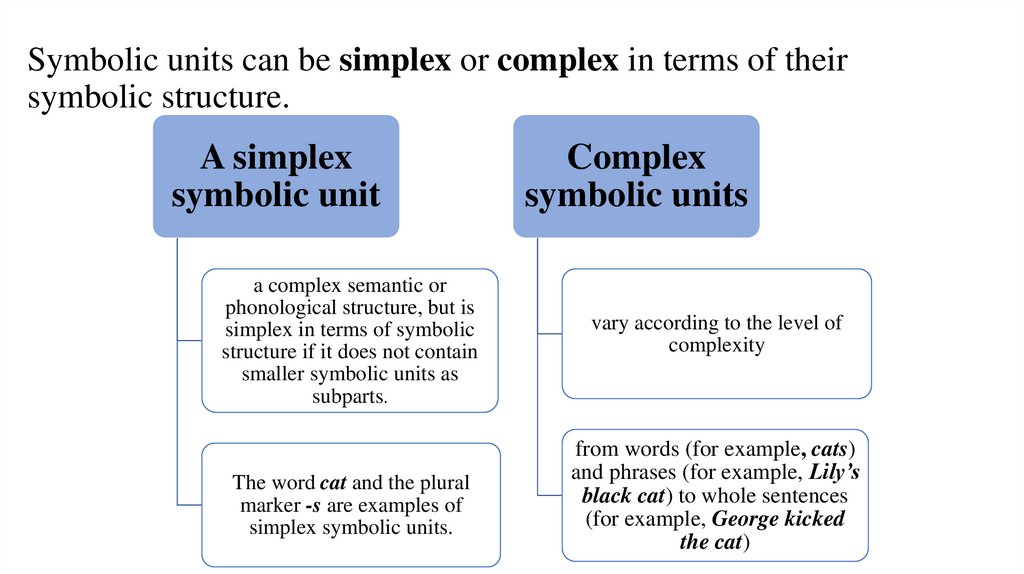
59. Symbolic units can be simplex or complex in terms of their symbolic structure.
A simplexsymbolic unit
Complex
symbolic units
a complex semantic or
phonological structure, but is
simplex in terms of symbolic
structure if it does not contain
smaller symbolic units as
subparts.
vary according to the level of
complexity
The word cat and the plural
marker -s are examples of
simplex symbolic units.
from words (for example, cats)
and phrases (for example, Lily’s
black cat) to whole sentences
(for example, George kicked
the cat)
60.
• The contents of this inventory are not stored in a random way.• The inventory is structured, and this structure lies in the relationships
that hold between the units.
• For example, some units form subparts of other units which in turn
form subparts of other units (for example, morphemes make up words
and words make up phrases which in turn make up sentences).
• This set of interlinking and overlapping relationships is conceived as a
network.
61. Three kinds of relation that hold between members of the network
symbolization (the symboliclinks between semantic pole
and phonological pole);
categorisation (for example,
the link between the
expressions rose and flower);
integration (the relation
between parts of a complex
symbolic structure like
flower-s).
62. 4.2 Features of the closed-class subsystem
Overt - bound (for example,inflectional morphemes) or free (for
example, English determiners or
prepositions)
the closed-class
subsystem
Implicit - grammatical categories
(e.g., noun, verb), subcategories (e.g.,
count noun, mass noun), and
grammatical functions (e.g., subject,
object).
63.
Theclosedclass
subsystem
semantically
restricted
structuring
function
The openclass
system
semantically
unrestricted
conceptual
content
64.
• In Talmy's framework, the closed-class subsystem of language refers toparts of speech that are limited in number and relatively stable in form,
such as prepositions, conjunctions, articles, and pronouns. These closedclass items are semantically restricted, meaning they have specific
grammatical functions and often serve to structure the sentence. They
typically do not carry much conceptual content on their own.
• The open-class subsystem includes parts of speech that are more
flexible, such as nouns, verbs, adjectives, and adverbs. These open-class
items are semantically unrestricted, meaning they can carry a wide
range of meanings and provide the main conceptual content of a
sentence.
Examples of closed-class items:
( Prepositions, Conjunctions, Articles, Pronouns)
Examples of open-class items:
(Nouns, Verbs, Adjectives, Adverbs)
65. 4.3 Schemas and instances
• Grammatical units are seen as form-meaning pairings.• The meaning associated with open-class units is specific (rich in conceptual
content),
• The meaning associated with closed-class units is schematic.
• From this perspective, there is no need to posit a sharp boundary in the
grammar between open-class and closed class units.
• Instead, specificity versus schematicity of meaning can be viewed as the poles
of a continuum, according to which both open-class and closed-class
expressions are meaningful, each making a distinct and necessary contribution
to the cognitive representation prompted by the utterance.
66.
• According to Langacker, the inventory of symbolic units is organised byschema-instance relations.
• A schema is a symbolic unit that emerges from a process of abstraction over
more specific symbolic units called instances.
• In other words, schemas form in the mental grammar when patterns of
similarity are abstracted from utterances, giving rise to a more schematic
representation or symbolic unit.
• The relationship between a schema and the instances from which it emerges is
the schema-instance relation. This relationship is hierarchical in nature.
67.
• Common nouns like cats, dogs, books, flowers and so on. Each of theseexpressions is a highly entrenched symbolic unit. For example, the symbolic
unit cats might be represented by the following formula:
• [[[CAT]/[ kæt]]-[[PL]/[s]]]
• The representations in SMALL CAPITALS indicate the semantic poles and
• those in the International Phonetic Alphabet (IPA) font represent the
phonological poles.
• The slash indicates the symbolic link between semantic and phonological
poles, and
• the hyphen indicates the linking of symbolic units to form a complex structure.
68.
• It is important to point out here that the schema-instance relation is notrestricted to symbolic units. For Langacker, the schema is any superordinate
(more general) element in a taxonomy and the instance is any subordinate
(more specific) element.
• The schema-instance relation represents a type of categorisation relation.
• In terms of phonological units, for example, the phoneme is the schema and
its allophones are instances.
• In terms of semantic units, the concept FLOWER is schematic in relation to
the instances ROSE, LILY and GERBERA.
• An instance is said to elaborate its schema, which means that it provides
more specific meaning. For example, MAMMAL is more specific than
ANIMAL, and in turn MONKEY is more specific than MAMMAL.
69. 4.4 Sanctioning and grammaticality
• Any model of grammar must account for how speakers know what counts asa well-formed or grammatical utterance in his or her language.
• In the cognitive approach, well-formedness is accounted for on the basis of
conventionality. Recall that the grammar is conceptualised not as an abstract
system of rules, but as an inventory of symbolic units.
• Moreover, these symbolic units are derived from language use. These units
are stored in a speaker's mental inventory and are used to categorize and
create linguistic expressions. When a speaker produces an utterance, they
categorize its structure based on existing schemas or patterns in their
inventory. If the structure matches known forms, the utterance is considered
well-formed. This process is called sanctioning according to Langacker.
70. References
• Fillmore, Charles (1988) ‘The mechanisms of construction grammar’,Proceedings of the Berkeley Linguistics Society, 14, 35–55.
• Johnson, Mark (1987) The Body in the Mind: The Bodiliy Basis of
Meaning, Imagination and Reason. Chicago: Chicago University
Press.
• Langacker, Ronald (1987) Foundations of Cognitive Grammar,
Volume I. Stanford, CA: Stanford University Press.
• Langacker, Ronald (1991) Foundations of Cognitive Grammar,
Volume II. Stanford, CA: Stanford University Press.
• Evans V. Cognitive linguistics: An Introduction / М. Evans, M. Green.
– Edinburgh : Edinburgh University Press, 2006. – ХХVI, 830 p.