![Tree diagram for [They cooked the cabbage yesterday.] (the X bar)](https://cf5.ppt-online.org/files5/slide/q/qCKxJcMY8UOwlW2PIAS9pBTz5HDiu6Z17gheFd/slide-18.jpg "Tree diagram for [They cooked the cabbage yesterday.] (the X bar)")
 english
Similar presentations:


Cognitive approaches to grammar in context (lectures 13)
1. COGNITIVE APPROACHES TO GRAMMAR IN CONTEXT
LECTURES 13COGNITIVE A P P R O A C H E S
TO G R A M M A R
IN CONTEXT
2. Theories of grammar: assumptions, objectives, methodology
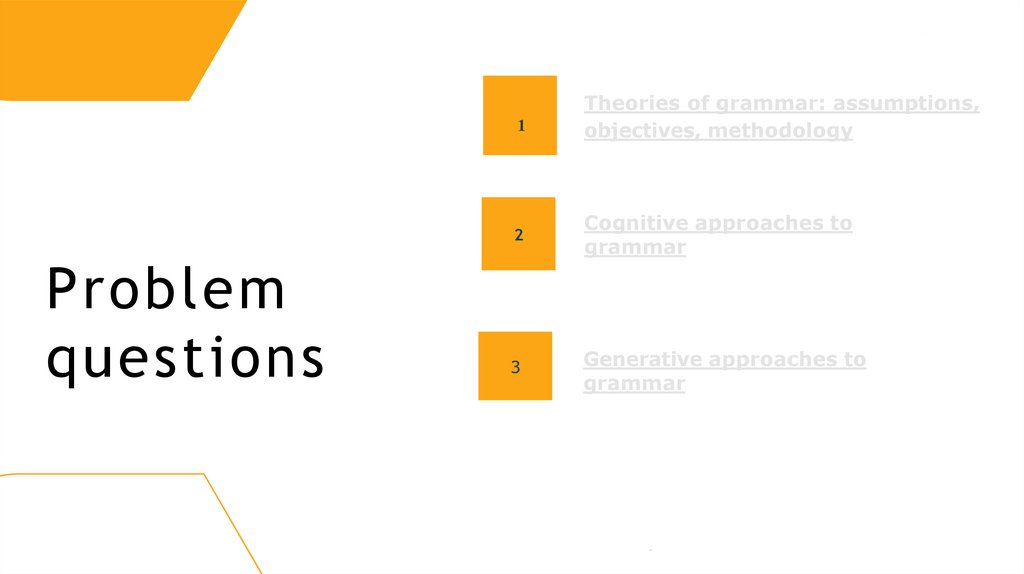
1Problem
questions
Theories of grammar: assumptions,
objectives, methodology
2
Cognitive approaches to
grammar
3
Generative approaches to
grammar
3.
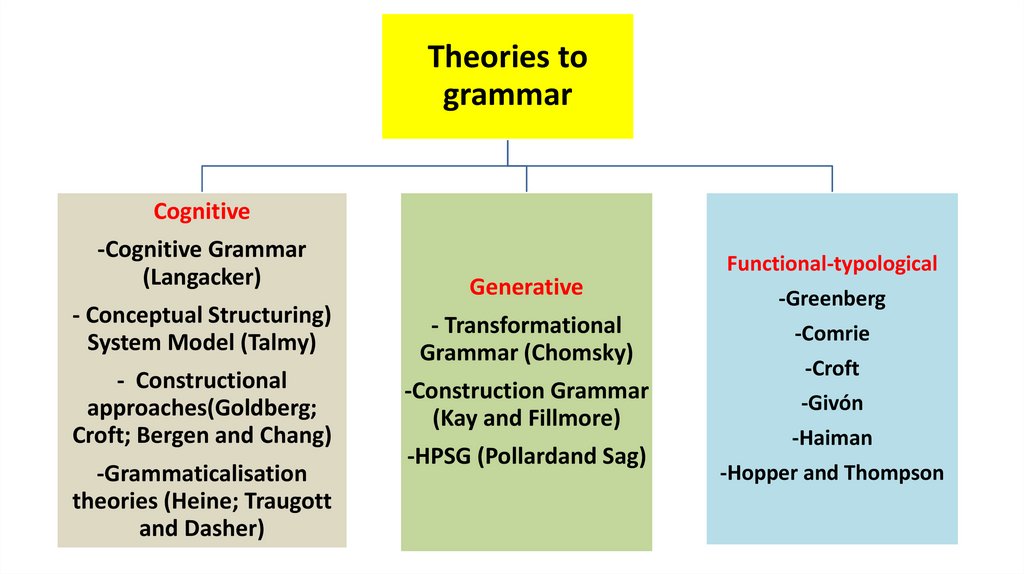
Theories togrammar
Cognitive
-Cognitive Grammar
(Langacker)
Generative
- Conceptual Structuring)
System Model (Talmy)
- Transformational
Grammar (Chomsky)
-Comrie
-Construction Grammar
(Kay and Fillmore)
-Givón
- Constructional
approaches(Goldberg;
Croft; Bergen and Chang)
-Grammaticalisation
theories (Heine; Traugott
and Dasher)
-HPSG (Pollardand Sag)
Functional-typological
-Greenberg
-Croft
-Haiman
-Hopper and Thompson
4. 1. THEORIES OF GRAMMAR: ASSUMPTIONS, OBJECTIVES, METHODOLOGY
1.THEORIES OF GRAMMAR: ASSUMPTIONS, OBJECTIVES,METHODOLOGY
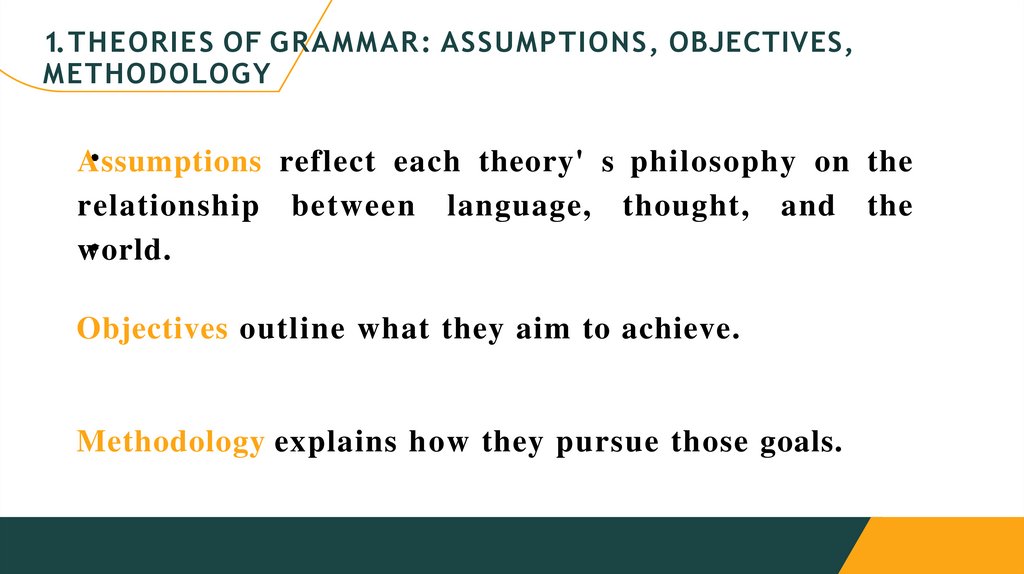
Assumptions reflect each theory' s philosophy on the
relationship between language, thought, and the
world.
Objectives outline what they aim to achieve.
Methodology explains how they pursue those goals.
5. 2. COGNITIVE APPROACHES TO GRAMMAR
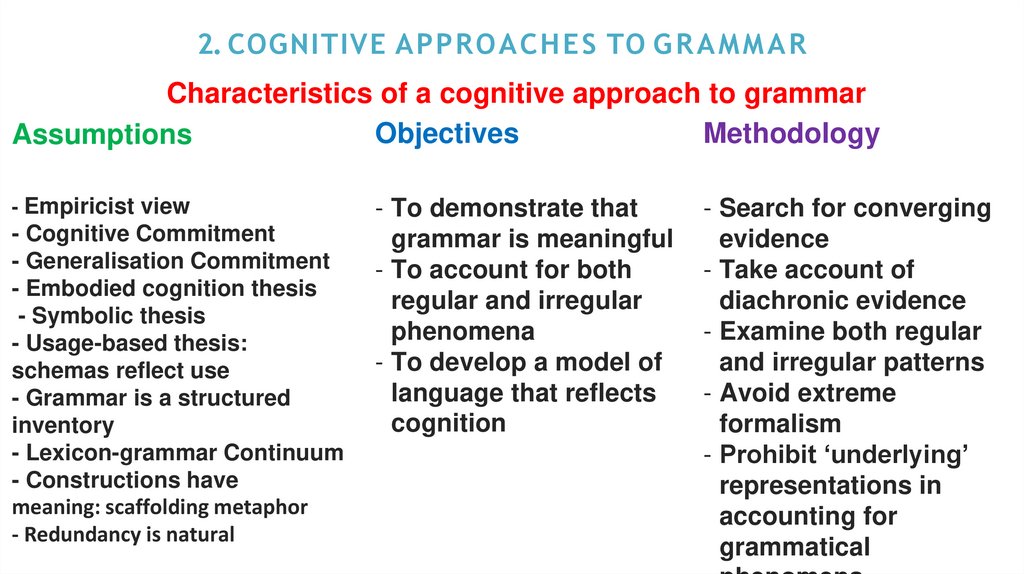
2. COGNITIVE A P P R O A C H E S TO G R A M M A RCharacteristics of a cognitive approach to grammar
Objectives
Methodology
Assumptions
- Empiricist view
- Cognitive Commitment
- Generalisation Commitment
- Embodied cognition thesis
- Symbolic thesis
- Usage-based thesis:
schemas reflect use
- Grammar is a structured
inventory
- Lexicon-grammar Continuum
- Constructions have
meaning: scaffolding metaphor
- Redundancy is natural
- To demonstrate that
grammar is meaningful
- To account for both
regular and irregular
phenomena
- To develop a model of
language that reflects
cognition
- Search for converging
evidence
- Take account of
diachronic evidence
- Examine both regular
and irregular patterns
- Avoid extreme
formalism
- Prohibit ‘underlying’
representations in
accounting for
grammatical
6. 3. GENERATIVE APPROACHES TO GRAMMAR
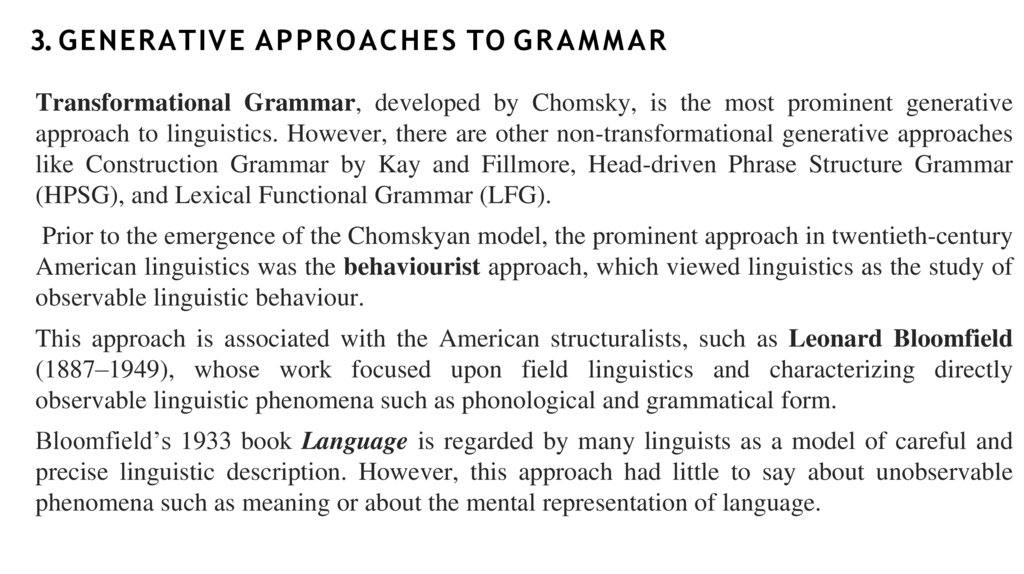
3. GENERATIVE A P P R O A C H E S TO G R A M M A RTransformational Grammar, developed by Chomsky, is the most prominent generative
approach to linguistics. However, there are other non-transformational generative approaches
like Construction Grammar by Kay and Fillmore, Head-driven Phrase Structure Grammar
(HPSG), and Lexical Functional Grammar (LFG).
Prior to the emergence of the Chomskyan model, the prominent approach in twentieth-century
American linguistics was the behaviourist approach, which viewed linguistics as the study of
observable linguistic behaviour.
This approach is associated with the American structuralists, such as Leonard Bloomfield
(1887–1949), whose work focused upon field linguistics and characterizing directly
observable linguistic phenomena such as phonological and grammatical form.
Bloomfield’s 1933 book Language is regarded by many linguists as a model of careful and
precise linguistic description. However, this approach had little to say about unobservable
phenomena such as meaning or about the mental representation of language.
7. 3. GENERATIVE APPROACHES TO GRAMMAR
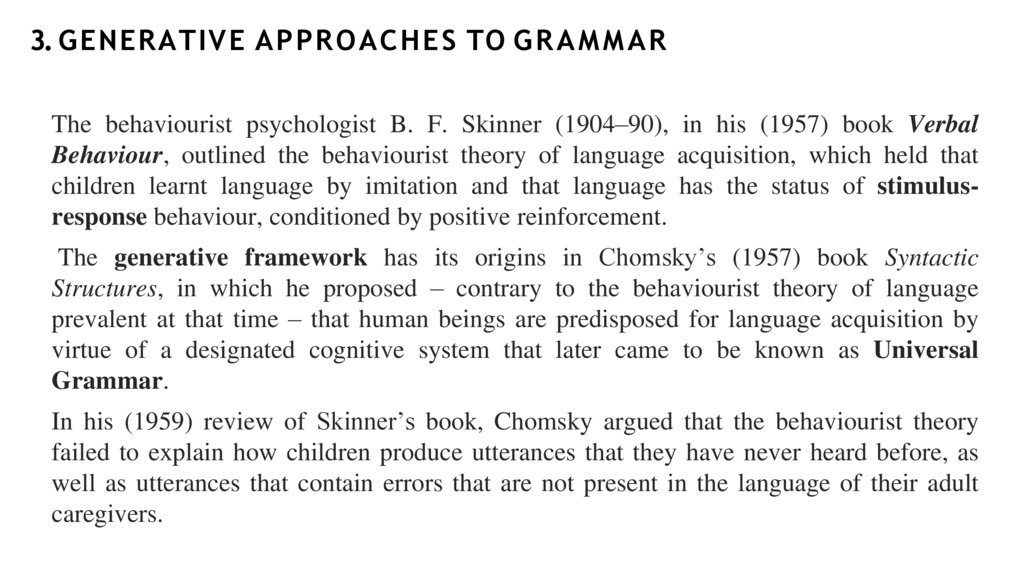
3. GENERATIVE A P P R O A C H E S TO G R A M M A RThe behaviourist psychologist B. F. Skinner (1904–90), in his (1957) book Verbal
Behaviour, outlined the behaviourist theory of language acquisition, which held that
children learnt language by imitation and that language has the status of stimulusresponse behaviour, conditioned by positive reinforcement.
The generative framework has its origins in Chomsky’s (1957) book Syntactic
Structures, in which he proposed – contrary to the behaviourist theory of language
prevalent at that time – that human beings are predisposed for language acquisition by
virtue of a designated cognitive system that later came to be known as Universal
Grammar.
In his (1959) review of Skinner’s book, Chomsky argued that the behaviourist theory
failed to explain how children produce utterances that they have never heard before, as
well as utterances that contain errors that are not present in the language of their adult
caregivers.
8. 3. GENERATIVE APPROACHES TO GRAMMAR
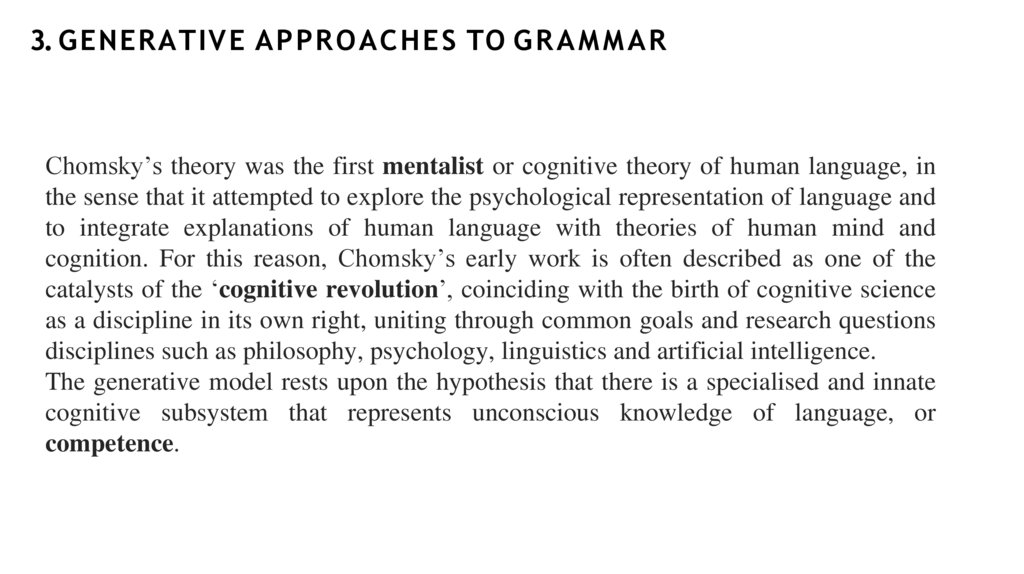
3. GENERATIVE A P P R O A C H E S TO G R A M M A RChomsky’s theory was the first mentalist or cognitive theory of human language, in
the sense that it attempted to explore the psychological representation of language and
to integrate explanations of human language with theories of human mind and
cognition. For this reason, Chomsky’s early work is often described as one of the
catalysts of the ‘cognitive revolution’, coinciding with the birth of cognitive science
as a discipline in its own right, uniting through common goals and research questions
disciplines such as philosophy, psychology, linguistics and artificial intelligence.
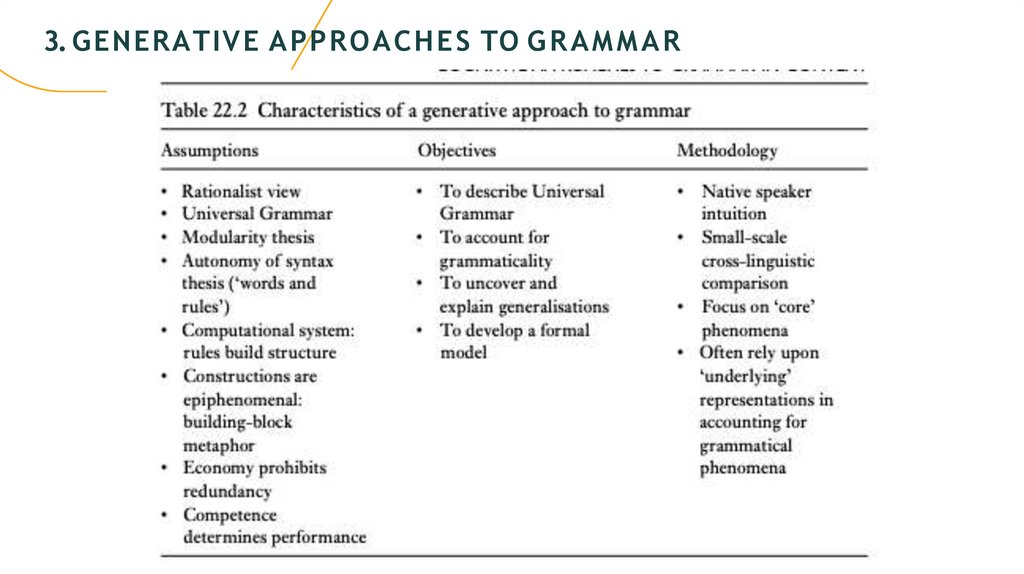
The generative model rests upon the hypothesis that there is a specialised and innate
cognitive subsystem that represents unconscious knowledge of language, or
competence.
9. 3. GENERATIVE APPROACHES TO GRAMMAR
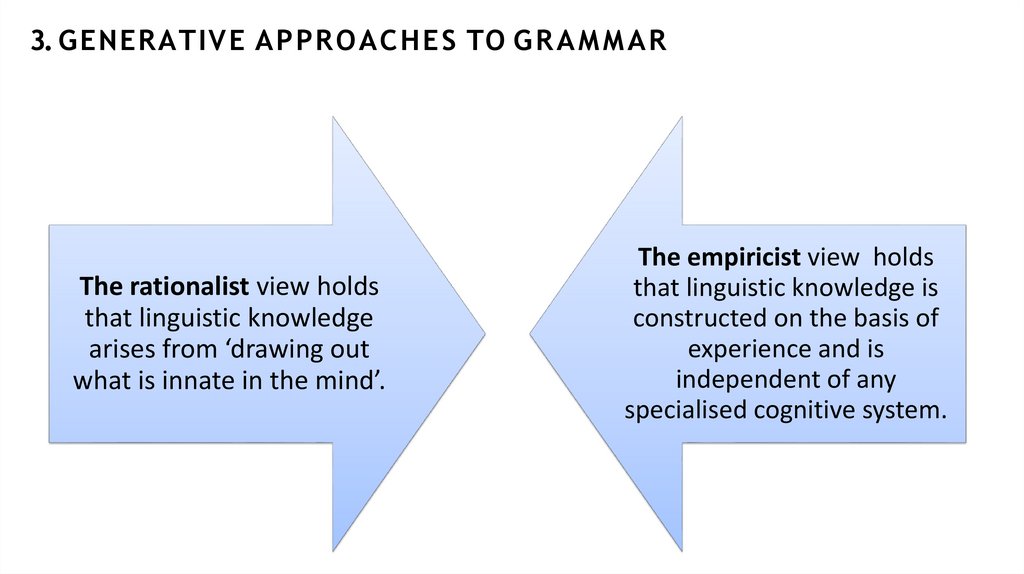
3. GENERATIVE A P P R O A C H E S TO G R A M M A RThe rationalist view holds
that linguistic knowledge
arises from ‘drawing out
what is innate in the mind’.
The empiricist view holds
that linguistic knowledge is
constructed on the basis of
experience and is
independent of any
specialised cognitive system.
10. 3. GENERATIVE APPROACHES TO GRAMMAR
3. GENERATIVE A P P R O A C H E S TO G R A M M A RUniversal Grammar is the model of the initial state of the innate language
faculty: that is, the system of linguistic knowledge that all humans bring to the
process of acquiring their first language.
In developing this mentalist theory of language, Chomsky asserts that the
only revealing object of linguistic study, given the objective of characterising
competence, is the system of linguistic knowledge in the mind of the idealised
individual speaker. This system of internalised linguistic knowledge is known
as I-language (Chomsky 1986: 19–56).
From this perspective, the externalised language of the speech community (Elanguage) is merely epiphenomenal (secondary), in the sense that it arises as
the output of individual I-languages.
11. 3. GENERATIVE APPROACHES TO GRAMMAR
3. GENERATIVE A P P R O A C H E S TO G R A M M A RIn the generative model, this innate language system is viewed as
‘encapsulated’ or modular and patterns of selective impairment,
particularly when these illustrate double dissociation, are often seen as
evidence for the encapsulation of such cognitive subsystems.
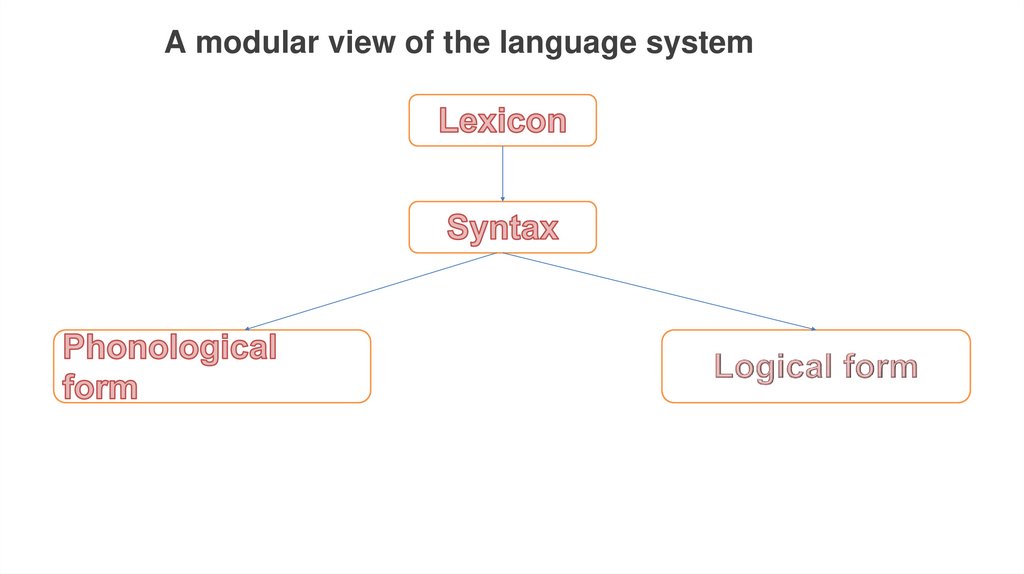
The language module itself is viewed as a modular system, that is the
linguistic subsystems such as syntax, semantics and phonology are seen as
independent submodules within the language system.
This view rests upon the premise that the principles and processes, and the
primitives over which they operate, are different in kind from one area of
language (for example, phonology) to another (for example, syntax).
12. A modular view of the language system
13. 3. GENERATIVE APPROACHES TO GRAMMAR
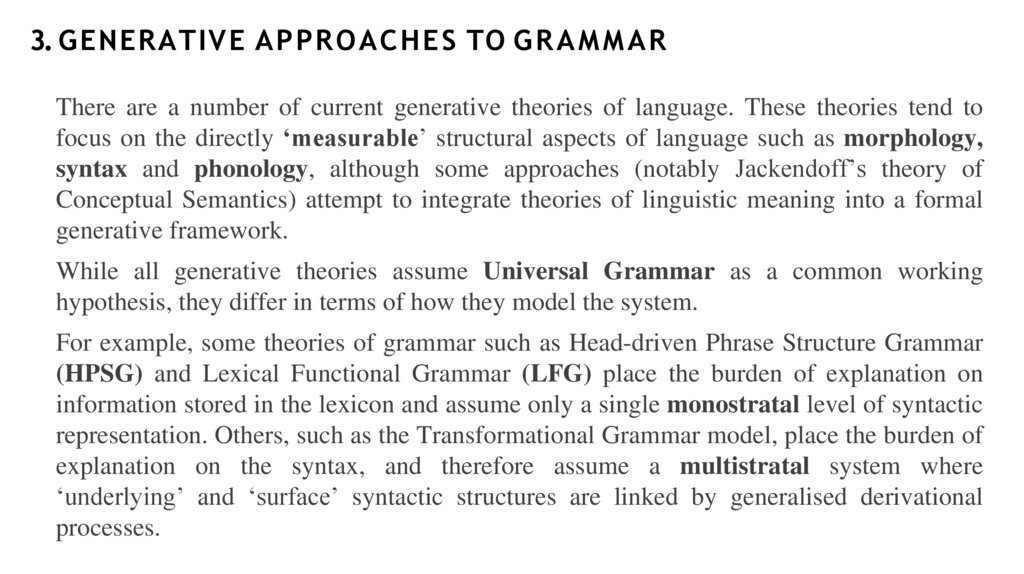
3. GENERATIVE A P P R O A C H E S TO G R A M M A RThere are a number of current generative theories of language. These theories tend to
focus on the directly ‘measurable’ structural aspects of language such as morphology,
syntax and phonology, although some approaches (notably Jackendoff’s theory of
Conceptual Semantics) attempt to integrate theories of linguistic meaning into a formal
generative framework.
While all generative theories assume Universal Grammar as a common working
hypothesis, they differ in terms of how they model the system.
For example, some theories of grammar such as Head-driven Phrase Structure Grammar
(HPSG) and Lexical Functional Grammar (LFG) place the burden of explanation on
information stored in the lexicon and assume only a single monostratal level of syntactic
representation. Others, such as the Transformational Grammar model, place the burden of
explanation on the syntax, and therefore assume a multistratal system where
‘underlying’ and ‘surface’ syntactic structures are linked by generalised derivational
processes.
14. 3. GENERATIVE APPROACHES TO GRAMMAR
3. GENERATIVE A P P R O A C H E S TO G R A M M A R15. TRANSFORMATIONAL GRAMMAR
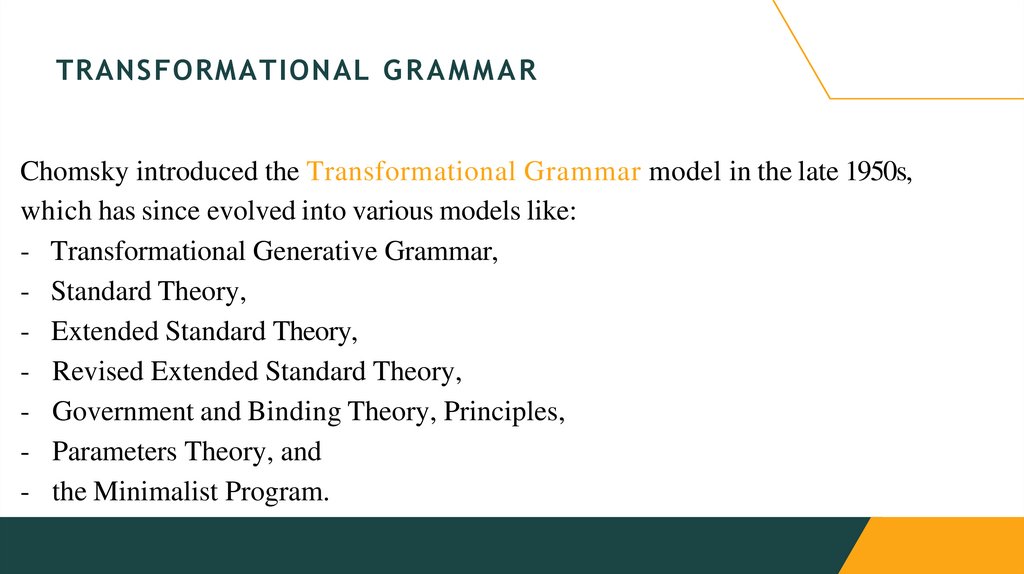
TRANSFORMATIONAL G R A M M A RChomsky introduced the Transformational Grammar model in the late 1950s,
which has since evolved into various models like:
- Transformational Generative Grammar,
- Standard Theory,
- Extended Standard Theory,
- Revised Extended Standard Theory,
- Government and Binding Theory, Principles,
- Parameters Theory, and
- the Minimalist Program.
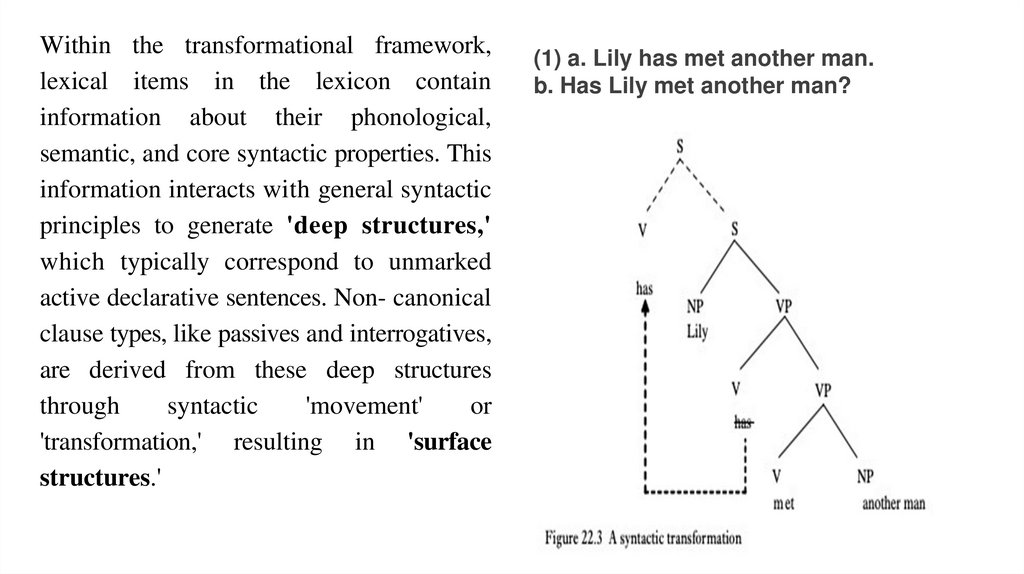
16. (1) a. Lily has met another man. b. Has Lily met another man?
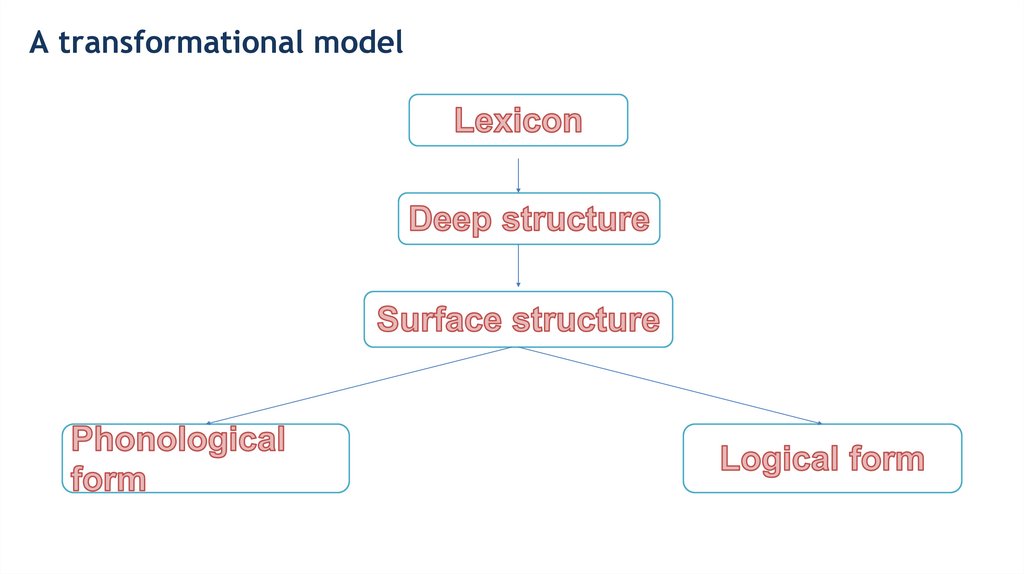
Within the transformational framework,lexical items in the lexicon contain
information about their phonological,
semantic, and core syntactic properties. This
information interacts with general syntactic
principles to generate 'deep structures,'
which typically correspond to unmarked
active declarative sentences. Non- canonical
clause types, like passives and interrogatives,
are derived from these deep structures
through
syntactic
'movement'
or
'transformation,' resulting in 'surface
structures.'
(1) a. Lily has met another man.
b. Has Lily met another man?
17. A transformational model
18. TRANSFORMATIONAL GRAMMAR
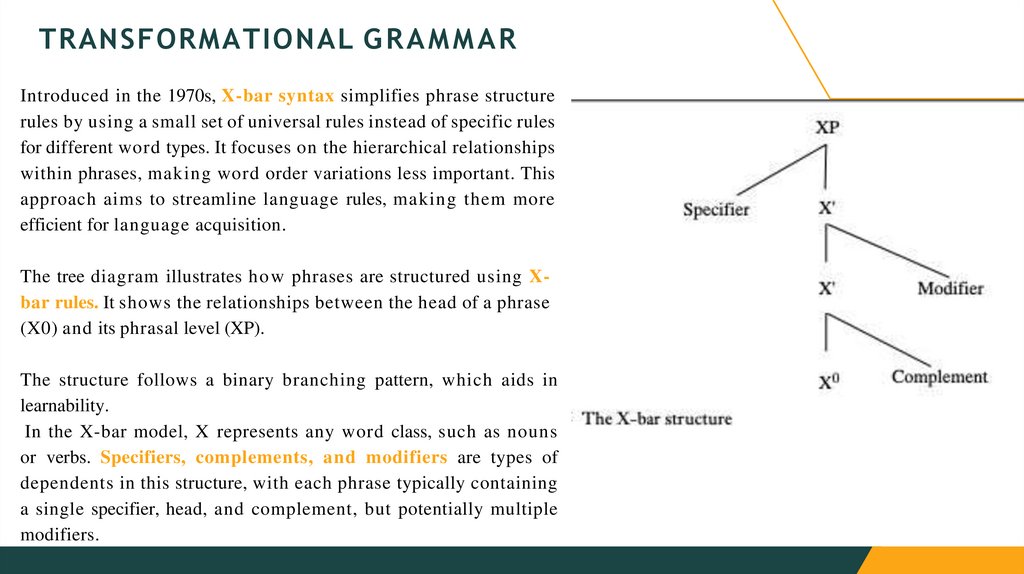
TRANSFORMATIONAL G R A M M A RIntroduced in the 1970s, X-bar syntax simplifies phrase structure
rules by using a small set of universal rules instead of specific rules
for different word types. It focuses on the hierarchical relationships
within phrases, making word order variations less important. This
approach aims to streamline language rules, making them more
efficient for language acquisition.
The tree diagram illustrates how phrases are structured using Xbar rules. It shows the relationships between the head of a phrase
(X0) and its phrasal level (XP).
The structure follows a binary branching pattern, which aids in
learnability.
In the X-bar model, X represents any word class, such as nouns
or verbs. Specifiers, complements, and modifiers are types of
dependents in this structure, with each phrase typically containing
a single specifier, head, and complement, but potentially multiple
modifiers.
19. Tree diagram for [They cooked the cabbage yesterday.] (the X bar)
20. TRANSFORMATIONAL GRAMMAR
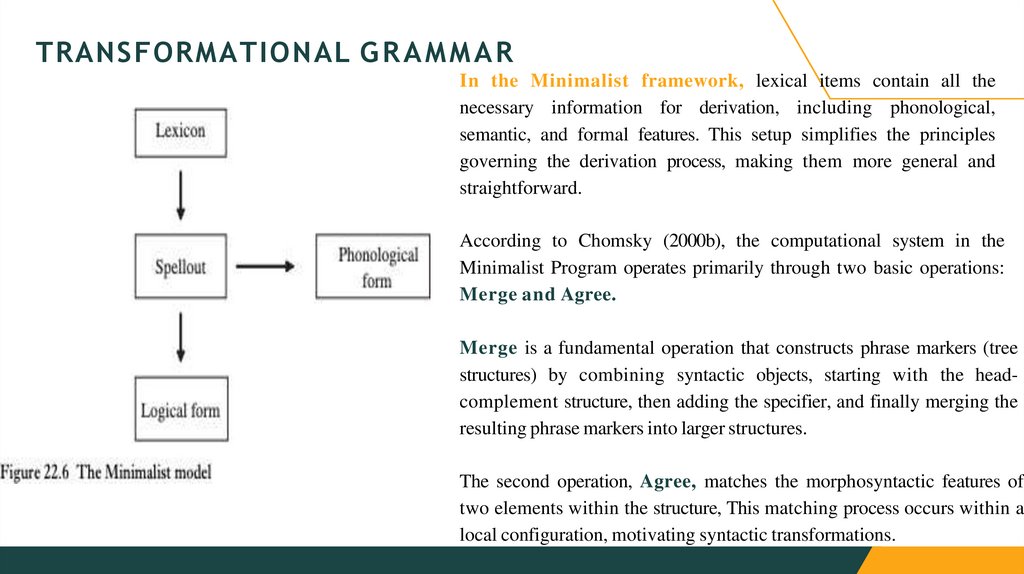
TRANSFORMATIONAL G R A M M A RIn the Minimalist framework, lexical items contain all the
necessary information for derivation, including phonological,
semantic, and formal features. This setup simplifies the principles
governing the derivation process, making them more general and
straightforward.
According to Chomsky (2000b), the computational system in the
Minimalist Program operates primarily through two basic operations:
Merge and Agree.
Merge is a fundamental operation that constructs phrase markers (tree
structures) by combining syntactic objects, starting with the headcomplement structure, then adding the specifier, and finally merging the
resulting phrase markers into larger structures.
The second operation, Agree, matches the morphosyntactic features of
two elements within the structure, This matching process occurs within a
local configuration, motivating syntactic transformations.
21. TRANSFORMATIONAL GRAMMAR
TRANSFORMATIONAL G R A M M A RThe ‘matching’ of these features has to take place within a local
configuration, and it is this requirement that motivates syntactic
transformations.
E.G. In the sentence "He reads books," the operation Agree
ensures that the verb "reads" agrees with the subject "he" in
terms of number (singular).
Without Agree, the sentence might be ungrammatical, such as "He
read books," where the verb does not agree with the subject.
22. SUMMARY
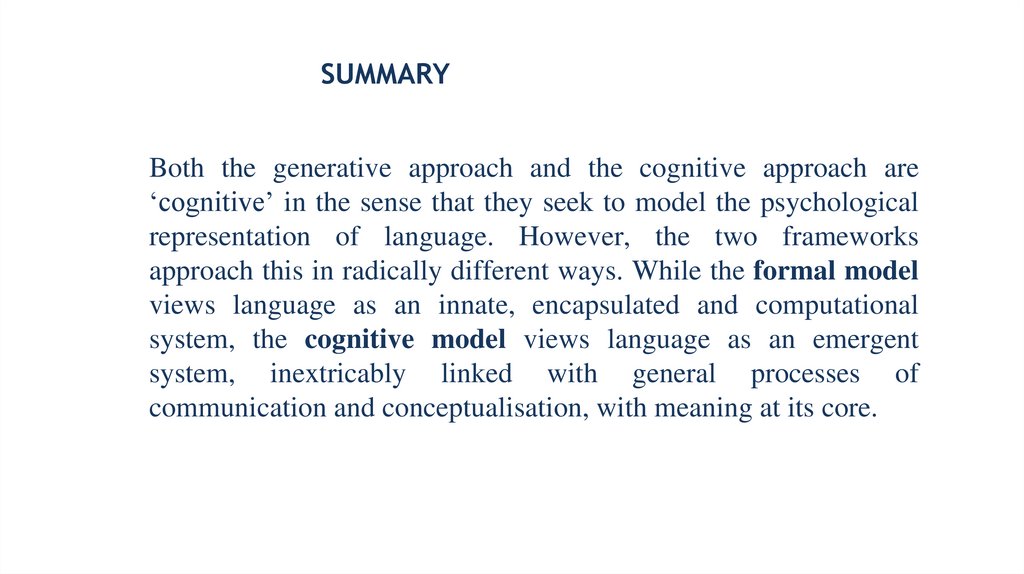
Both the generative approach and the cognitive approach are‘cognitive’ in the sense that they seek to model the psychological
representation of language. However, the two frameworks
approach this in radically different ways. While the formal model
views language as an innate, encapsulated and computational
system, the cognitive model views language as an emergent
system, inextricably linked with general processes of
communication and conceptualisation, with meaning at its core.
23. REFERENCES
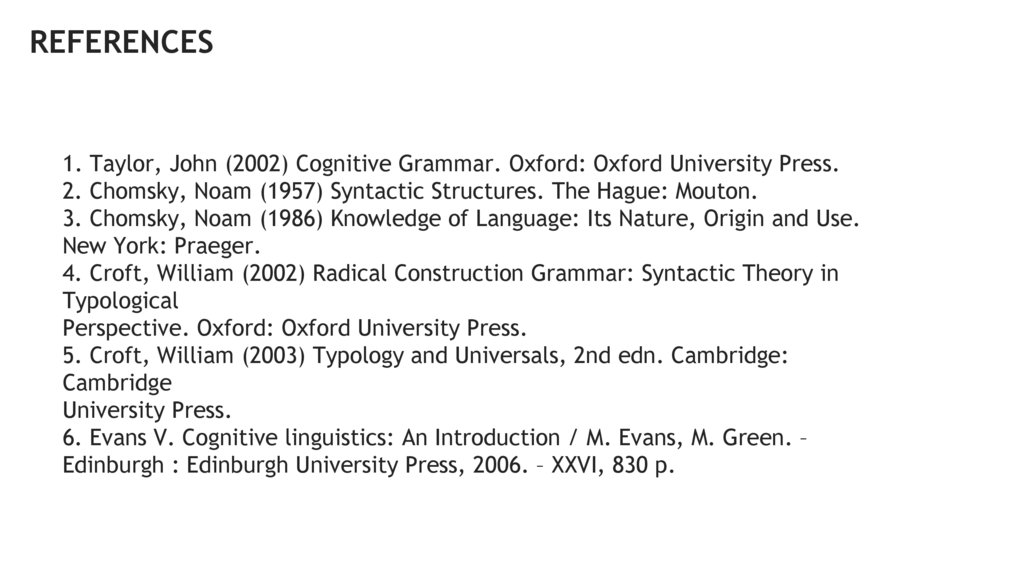
1. Taylor, John (2002) Cognitive Grammar. Oxford: Oxford University Press.2. Chomsky, Noam (1957) Syntactic Structures. The Hague: Mouton.
3. Chomsky, Noam (1986) Knowledge of Language: Its Nature, Origin and Use.
New York: Praeger.
4. Croft, William (2002) Radical Construction Grammar: Syntactic Theory in
Typological
Perspective. Oxford: Oxford University Press.
5. Croft, William (2003) Typology and Universals, 2nd edn. Cambridge:
Cambridge
University Press.
6. Evans V. Cognitive linguistics: An Introduction / М. Evans, M. Green. –
Edinburgh : Edinburgh University Press, 2006. – ХХVI, 830 p.