
 pedagogy
Similar presentations:






Basics of Teaching Profession: Foreign Language Pedagogy
1. Lecture 1.
LECTURE 1.Basics of teaching profession.
2. Outline
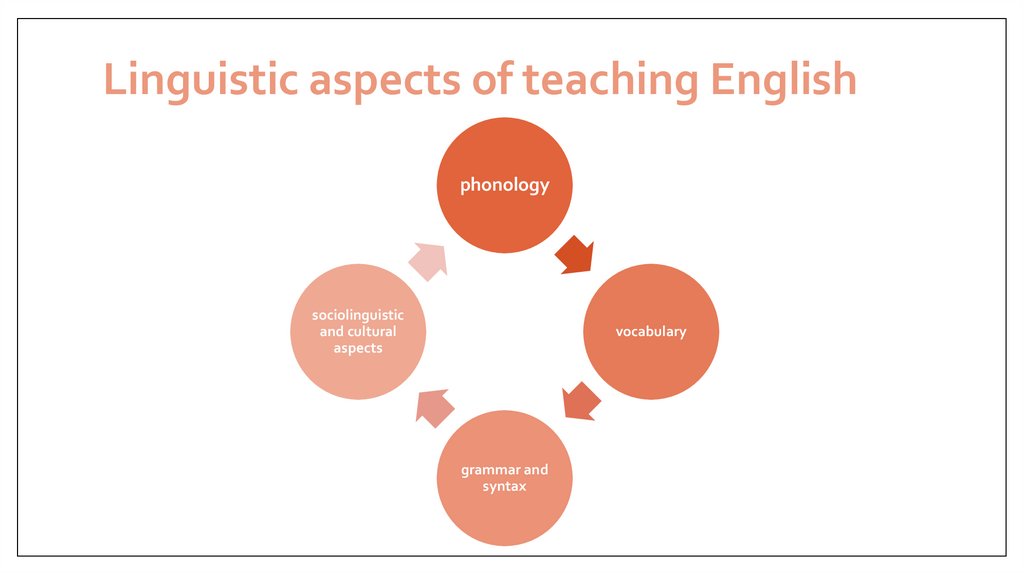
• English teaching methodology.• Linguistic aspects of teaching English.
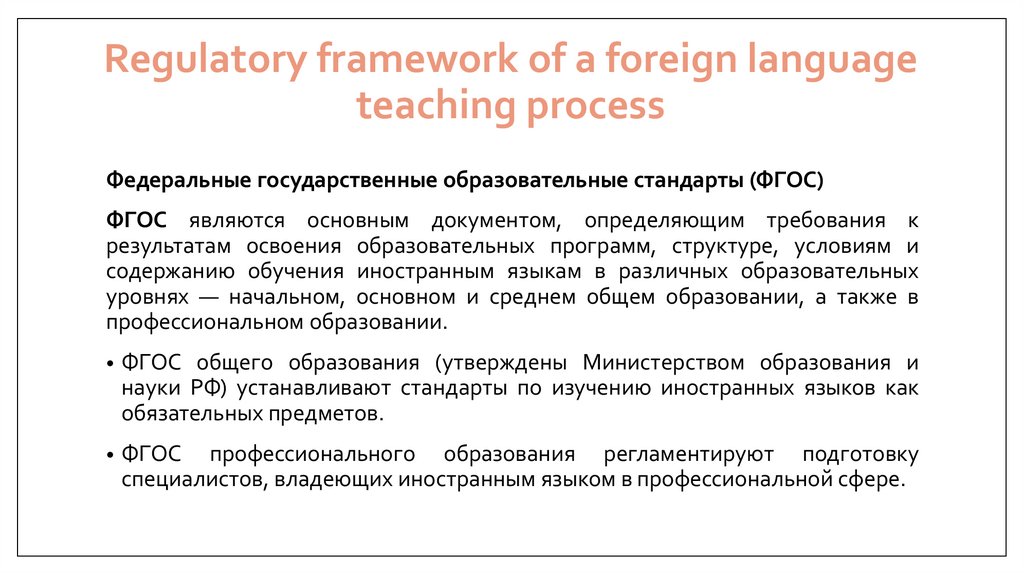
• Regulatory framework of a foreign language teaching process.
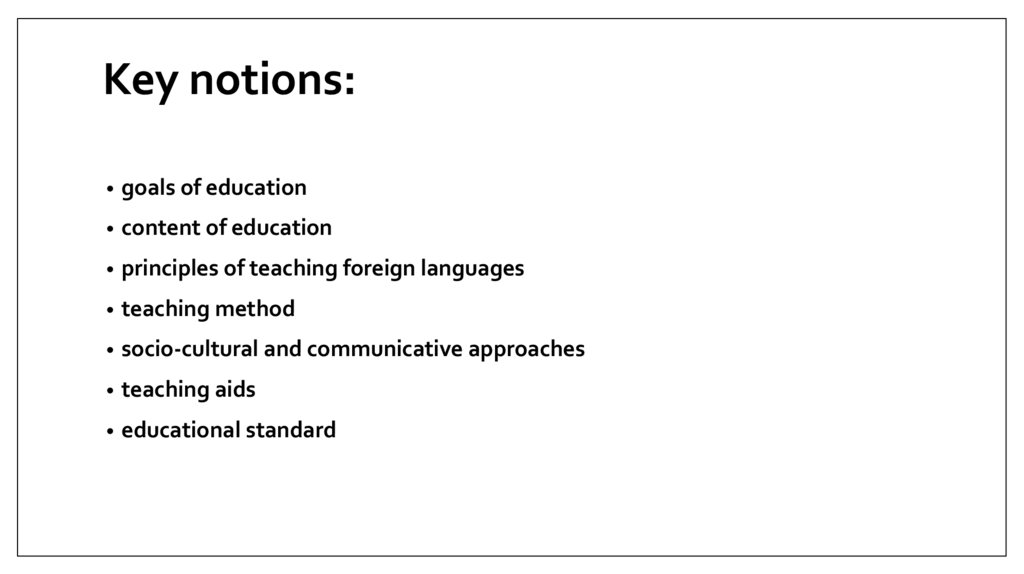
3. Key notions:
• goals of education• content of education
• principles of teaching foreign languages
• teaching method
• socio-cultural and communicative approaches
• teaching aids
• educational standard
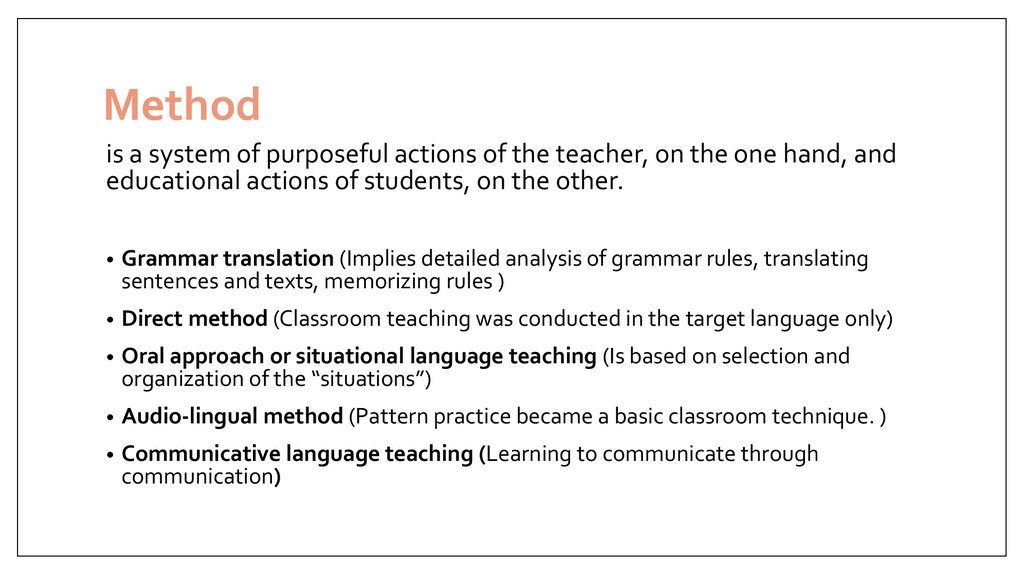
4. Method
is a system of purposeful actions of the teacher, on the one hand, andeducational actions of students, on the other.
• Grammar translation (Implies detailed analysis of grammar rules, translating
sentences and texts, memorizing rules )
• Direct method (Classroom teaching was conducted in the target language only)
• Oral approach or situational language teaching (Is based on selection and
organization of the “situations”)
• Audio-lingual method (Pattern practice became a basic classroom technique. )
• Communicative language teaching (Learning to communicate through
communication)
5.
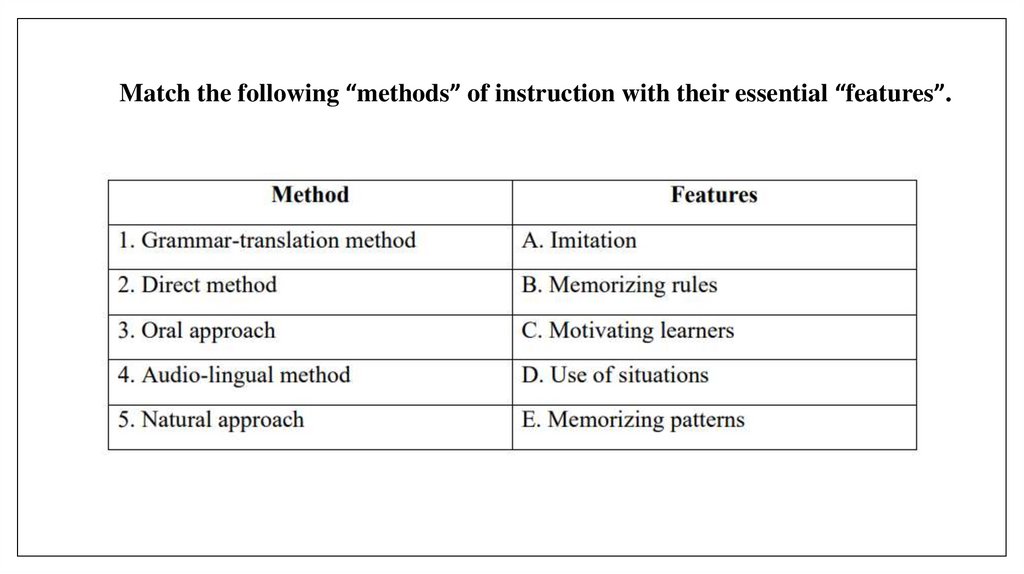
Match the following “methods” of instruction with their essential “features”.6. Technique
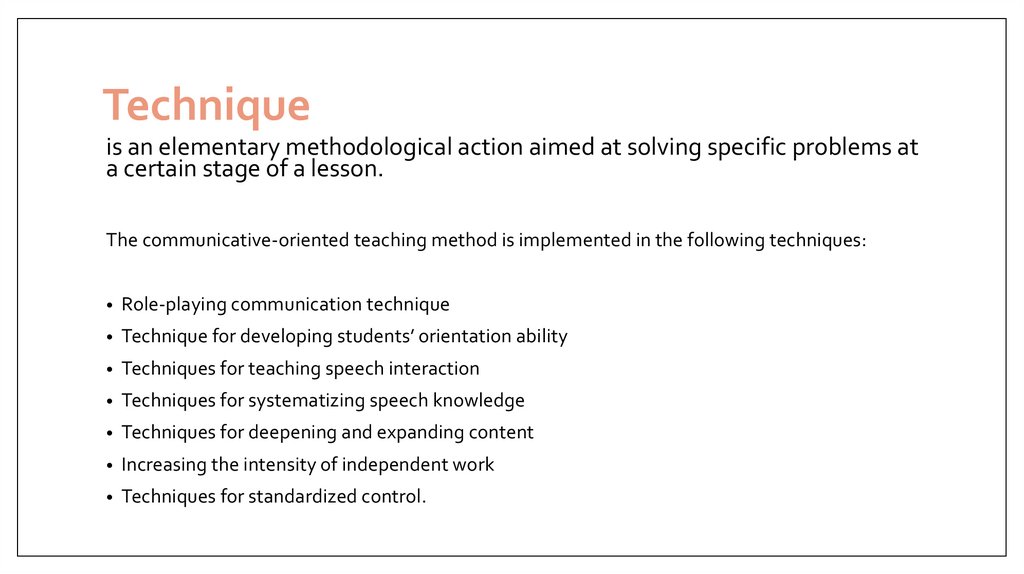
is an elementary methodological action aimed at solving specific problems ata certain stage of a lesson.
The communicative-oriented teaching method is implemented in the following techniques:
• Role-playing communication technique
• Technique for developing students’ orientation ability
• Techniques for teaching speech interaction
• Techniques for systematizing speech knowledge
• Techniques for deepening and expanding content
• Increasing the intensity of independent work
• Techniques for standardized control.
7. Approach
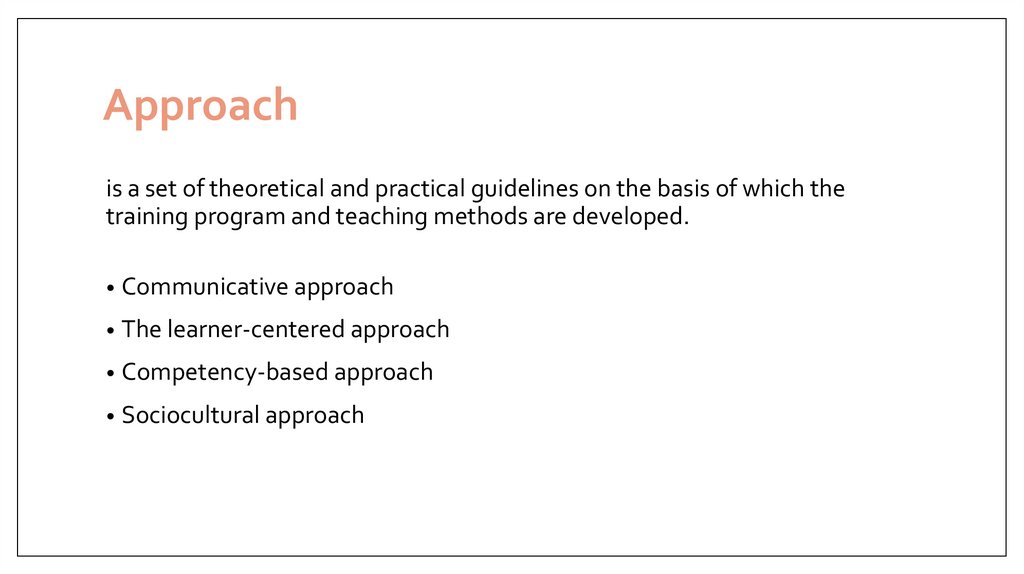
is a set of theoretical and practical guidelines on the basis of which thetraining program and teaching methods are developed.
• Communicative approach
• The learner-centered approach
• Competency-based approach
• Sociocultural approach
8. Communicative approach
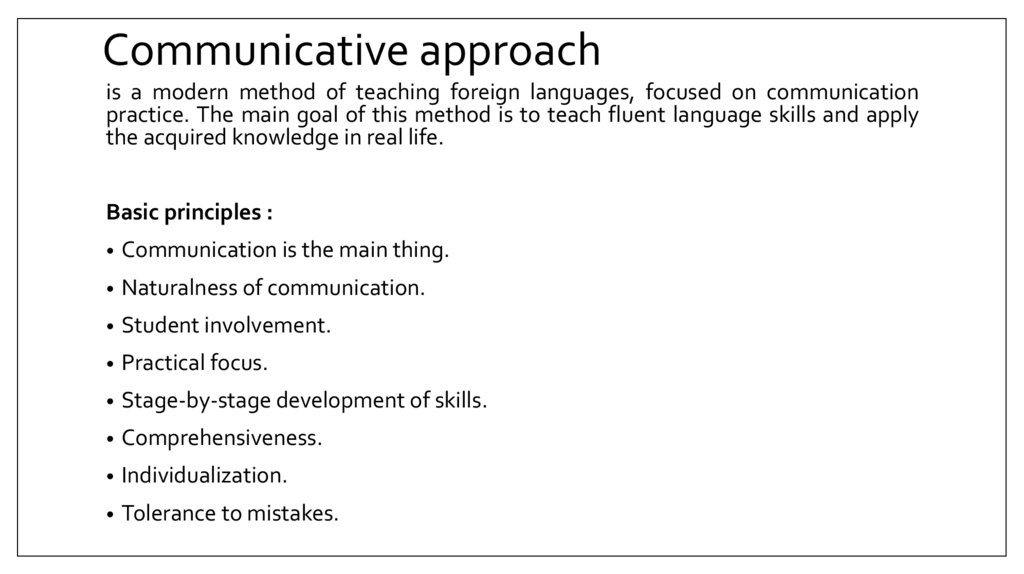
is a modern method of teaching foreign languages, focused on communicationpractice. The main goal of this method is to teach fluent language skills and apply
the acquired knowledge in real life.
Basic principles :
• Communication is the main thing.
• Naturalness of communication.
• Student involvement.
• Practical focus.
• Stage-by-stage development of skills.
• Comprehensiveness.
• Individualization.
• Tolerance to mistakes.
9. Learner-centered approach
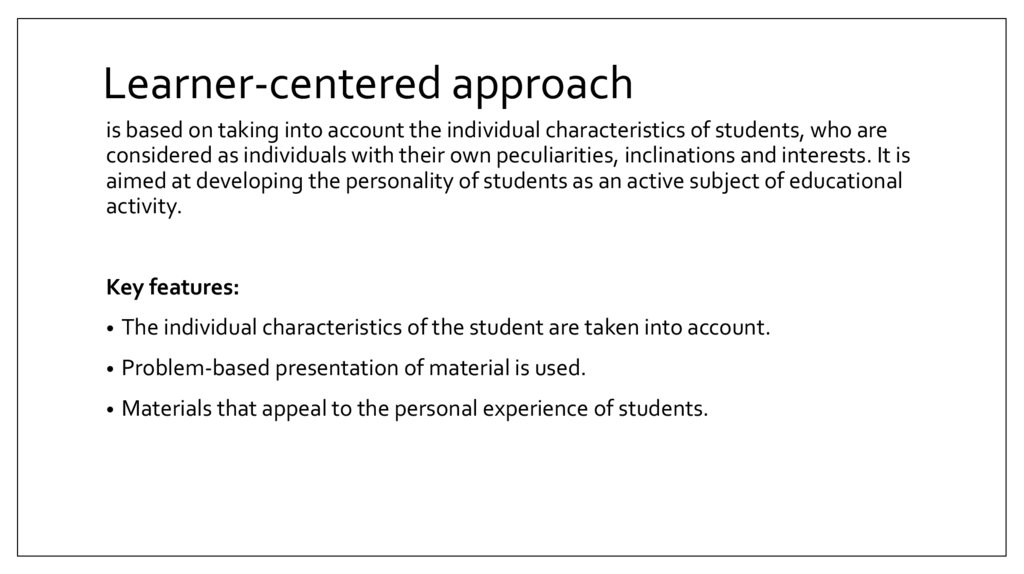
is based on taking into account the individual characteristics of students, who areconsidered as individuals with their own peculiarities, inclinations and interests. It is
aimed at developing the personality of students as an active subject of educational
activity.
Key features:
• The individual characteristics of the student are taken into account.
• Problem-based presentation of material is used.
• Materials that appeal to the personal experience of students.
10. Competency-based approach
aims at developing students' abilities to solve professional problems in accordancewith the requirements for personal professional qualities.
Characteristic features:
• Training takes on an activity-based nature: knowledge and skills are developed in
the practical activities of students, and their joint activities in groups are
organized.
• Active forms and methods of teaching, innovative technologies of a productive
nature are used.
11. Sociocultural approach
Promotes the introduction of students to the culture, traditions, and customs of thecountry of the language being studied.
Key aspects:
• The culture of the country of the language being studied is given through texts
and situations, which structures the image of the foreign language culture in the
mind of the learner.
• Intercultural training is used: analysis of various communication situations,
identification of the general and specific.
• Project-based learning is used, related to the study of cultural aspects of different
countries - students present their findings in the form of multimedia projects,
writing tasks or presentations.
12. Principle
is a starting point that determines the goals, content, methods andorganization of teaching, and is manifested in interconnection and
interdependence.
General didactic principles aim at achieving effective and educational training,
mastering basic knowledge and developing skills and abilities.
• The principle of scientific content
• The principle of educational training
• The principle of consciousness
• The principle of visualization
13.
General methodological principles. They take into account the specifics of a foreignlanguage.
• The principle of communicative (speech) focus
• The principle of taking into account the peculiarities of the native language
• The principle of the dominant role of exercises
14.
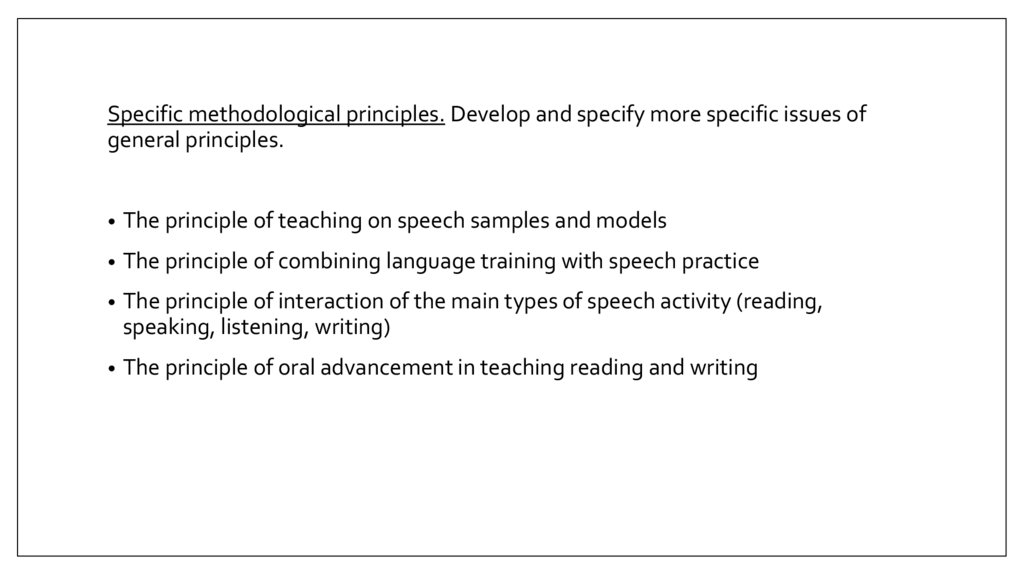
Specific methodological principles. Develop and specify more specific issues ofgeneral principles.
• The principle of teaching on speech samples and models
• The principle of combining language training with speech practice
• The principle of interaction of the main types of speech activity (reading,
speaking, listening, writing)
• The principle of oral advancement in teaching reading and writing
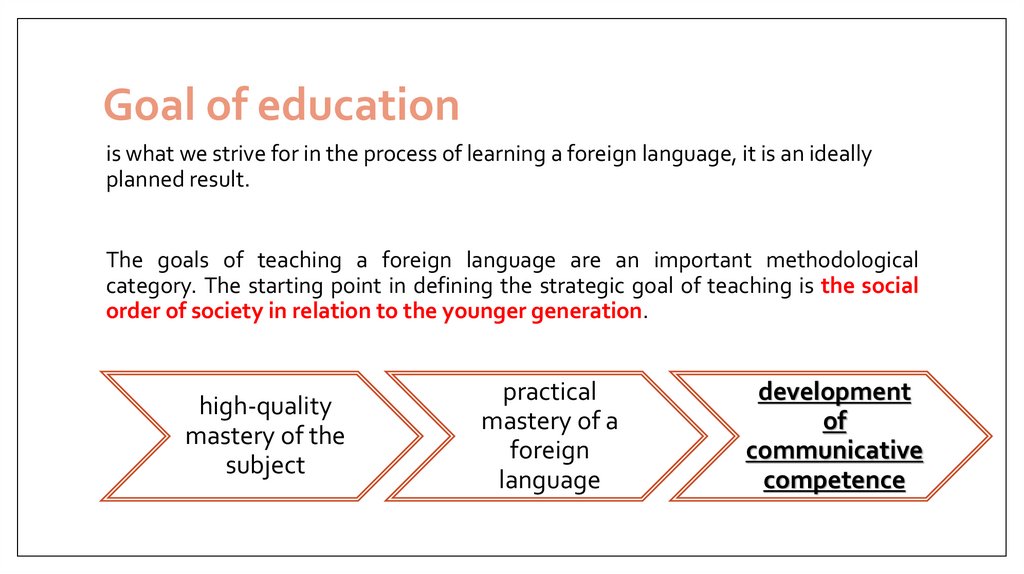
15. Goal of education
is what we strive for in the process of learning a foreign language, it is an ideallyplanned result.
The goals of teaching a foreign language are an important methodological
category. The starting point in defining the strategic goal of teaching is the social
order of society in relation to the younger generation.
high-quality
mastery of the
subject
practical
mastery of a
foreign
language
development
of
communicative
competence
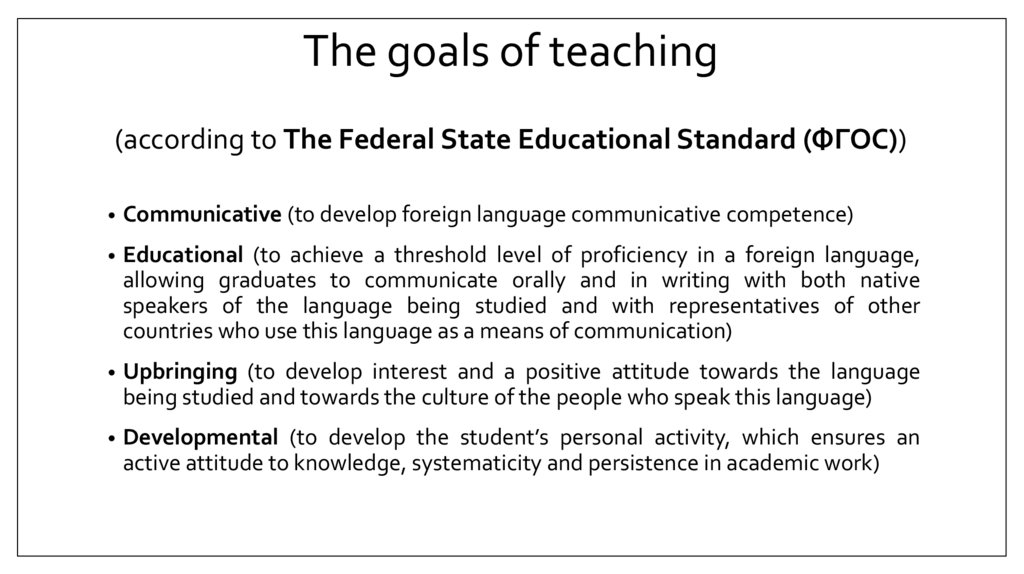
16. The goals of teaching (according to The Federal State Educational Standard (ФГОС))
• Communicative (to develop foreign language communicative competence)• Educational (to achieve a threshold level of proficiency in a foreign language,
allowing graduates to communicate orally and in writing with both native
speakers of the language being studied and with representatives of other
countries who use this language as a means of communication)
• Upbringing (to develop interest and a positive attitude towards the language
being studied and towards the culture of the people who speak this language)
• Developmental (to develop the student’s personal activity, which ensures an
active attitude to knowledge, systematicity and persistence in academic work)
17.
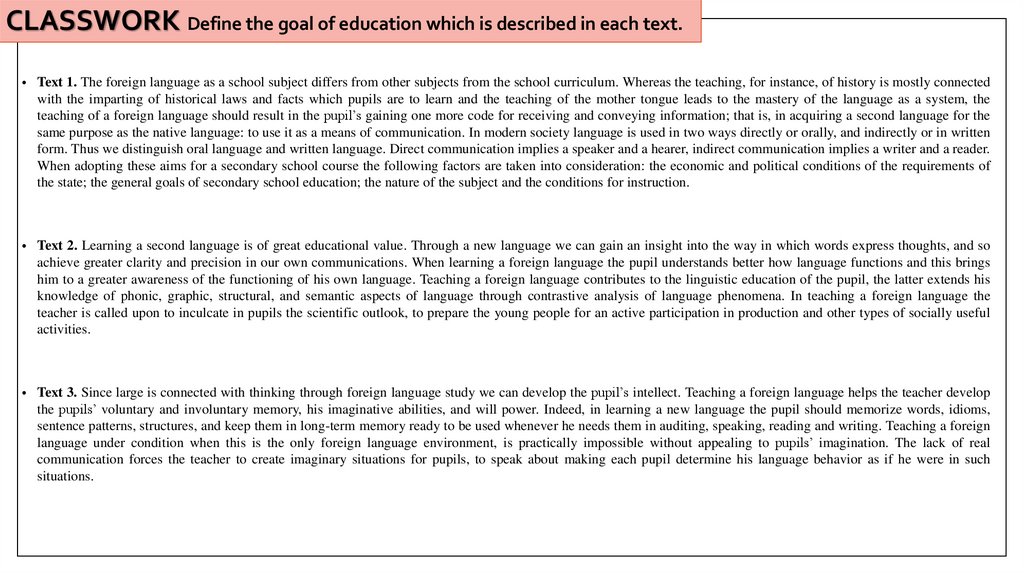
CLASSWORK Define the goal of education which is described in each text.Text 1. The foreign language as a school subject differs from other subjects from the school curriculum. Whereas the teaching, for instance, of history is mostly connected
with the imparting of historical laws and facts which pupils are to learn and the teaching of the mother tongue leads to the mastery of the language as a system, the
teaching of a foreign language should result in the pupil’s gaining one more code for receiving and conveying information; that is, in acquiring a second language for the
same purpose as the native language: to use it as a means of communication. In modern society language is used in two ways directly or orally, and indirectly or in written
form. Thus we distinguish oral language and written language. Direct communication implies a speaker and a hearer, indirect communication implies a writer and a reader.
When adopting these aims for a secondary school course the following factors are taken into consideration: the economic and political conditions of the requirements of
the state; the general goals of secondary school education; the nature of the subject and the conditions for instruction.
Text 2. Learning a second language is of great educational value. Through a new language we can gain an insight into the way in which words express thoughts, and so
achieve greater clarity and precision in our own communications. When learning a foreign language the pupil understands better how language functions and this brings
him to a greater awareness of the functioning of his own language. Teaching a foreign language contributes to the linguistic education of the pupil, the latter extends his
knowledge of phonic, graphic, structural, and semantic aspects of language through contrastive analysis of language phenomena. In teaching a foreign language the
teacher is called upon to inculcate in pupils the scientific outlook, to prepare the young people for an active participation in production and other types of socially useful
activities.
Text 3. Since large is connected with thinking through foreign language study we can develop the pupil’s intellect. Teaching a foreign language helps the teacher develop
the pupils’ voluntary and involuntary memory, his imaginative abilities, and will power. Indeed, in learning a new language the pupil should memorize words, idioms,
sentence patterns, structures, and keep them in long-term memory ready to be used whenever he needs them in auditing, speaking, reading and writing. Teaching a foreign
language under condition when this is the only foreign language environment, is practically impossible without appealing to pupils’ imagination. The lack of real
communication forces the teacher to create imaginary situations for pupils, to speak about making each pupil determine his language behavior as if he were in such
situations.
18. Linguistic aspects of teaching English
phonologysociolinguistic
and cultural
aspects
vocabulary
grammar and
syntax
19.
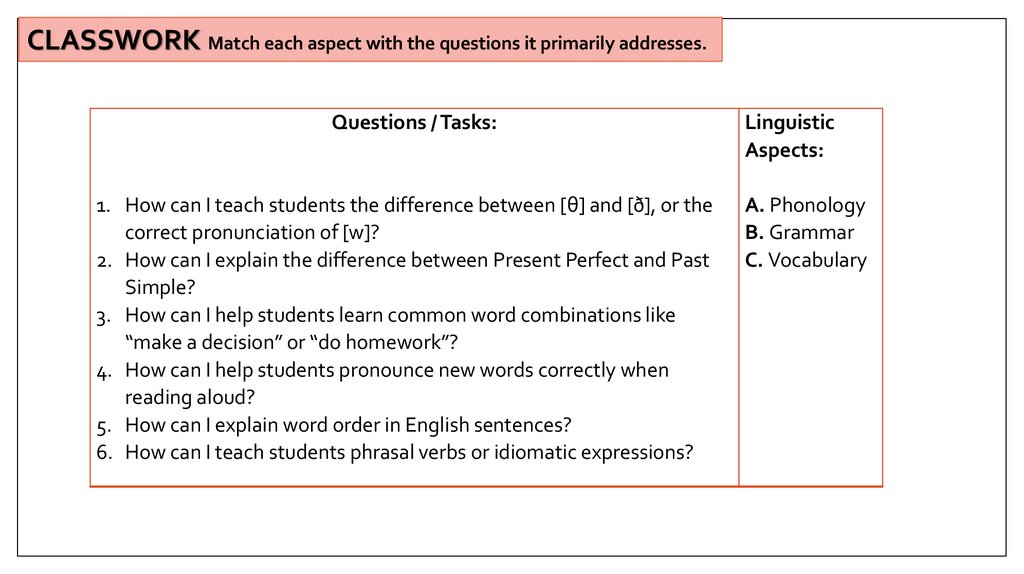
CLASSWORK Match each aspect with the questions it primarily addresses.
Questions / Tasks:
1. How can I teach students the difference between [θ] and [ð], or the
correct pronunciation of [w]?
2. How can I explain the difference between Present Perfect and Past
Simple?
3. How can I help students learn common word combinations like
“make a decision” or “do homework”?
4. How can I help students pronounce new words correctly when
reading aloud?
5. How can I explain word order in English sentences?
6. How can I teach students phrasal verbs or idiomatic expressions?
Linguistic
Aspects:
A. Phonology
B. Grammar
C. Vocabulary
20. Regulatory framework of a foreign language teaching process
Федеральные государственные образовательные стандарты (ФГОС)ФГОС являются основным документом, определяющим требования к
результатам освоения образовательных программ, структуре, условиям и
содержанию обучения иностранным языкам в различных образовательных
уровнях — начальном, основном и среднем общем образовании, а также в
профессиональном образовании.
• ФГОС
общего образования (утверждены Министерством образования и
науки РФ) устанавливают стандарты по изучению иностранных языков как
обязательных предметов.
• ФГОС
профессионального образования регламентируют подготовку
специалистов, владеющих иностранным языком в профессиональной сфере.
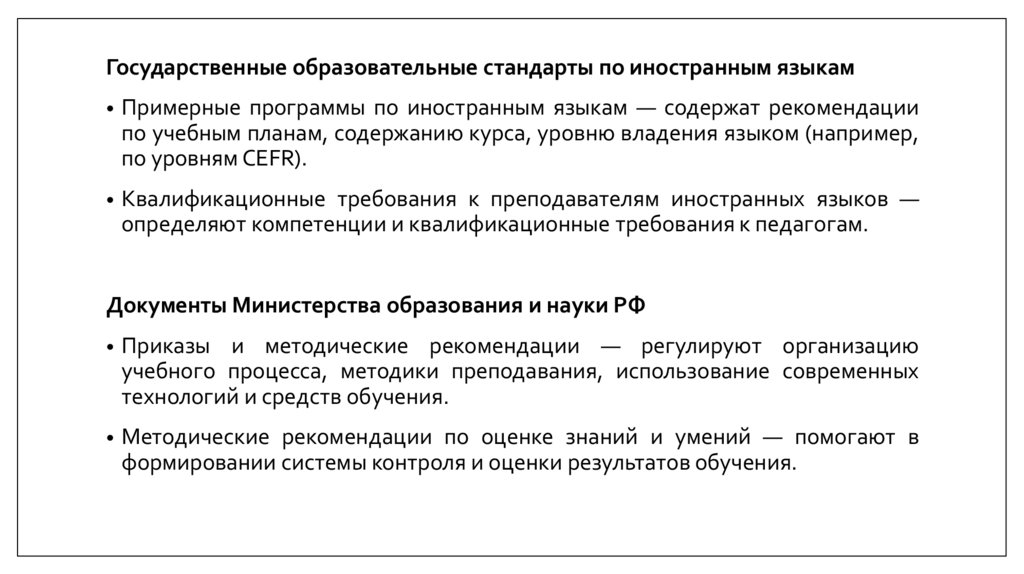
21.
Государственные образовательные стандарты по иностранным языкам• Примерные программы по иностранным языкам — содержат рекомендации
по учебным планам, содержанию курса, уровню владения языком (например,
по уровням CEFR).
• Квалификационные требования к преподавателям иностранных языков —
определяют компетенции и квалификационные требования к педагогам.
Документы Министерства образования и науки РФ
• Приказы
и методические рекомендации — регулируют организацию
учебного процесса, методики преподавания, использование современных
технологий и средств обучения.
• Методические рекомендации по оценке знаний и умений — помогают в
формировании системы контроля и оценки результатов обучения.
22.
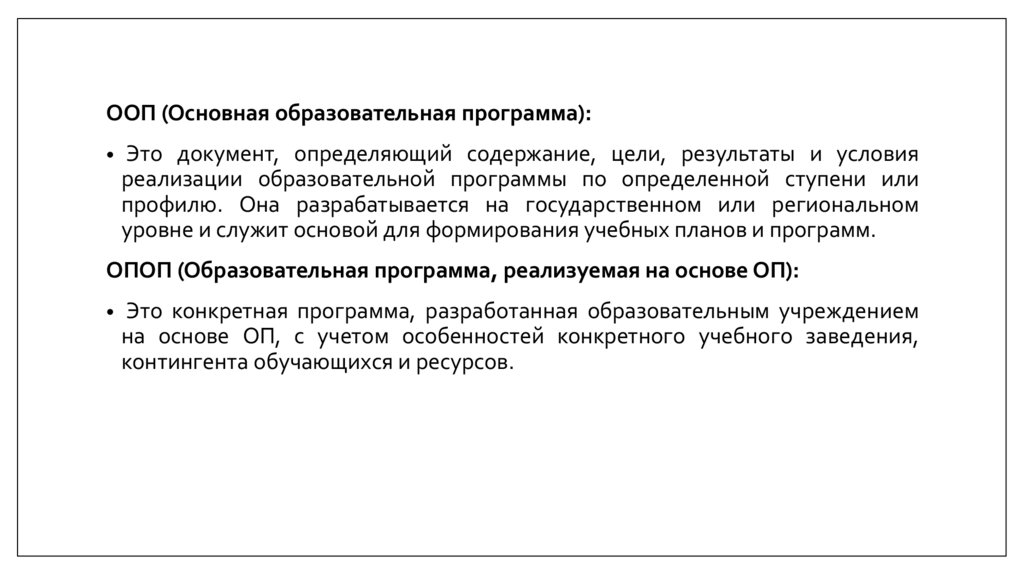
ООП (Основная образовательная программа):• Это
документ, определяющий содержание, цели, результаты и условия
реализации образовательной программы по определенной ступени или
профилю. Она разрабатывается на государственном или региональном
уровне и служит основой для формирования учебных планов и программ.
ОПОП (Образовательная программа, реализуемая на основе ОП):
• Это конкретная программа, разработанная образовательным учреждением
на основе ОП, с учетом особенностей конкретного учебного заведения,
контингента обучающихся и ресурсов.
23. Homework
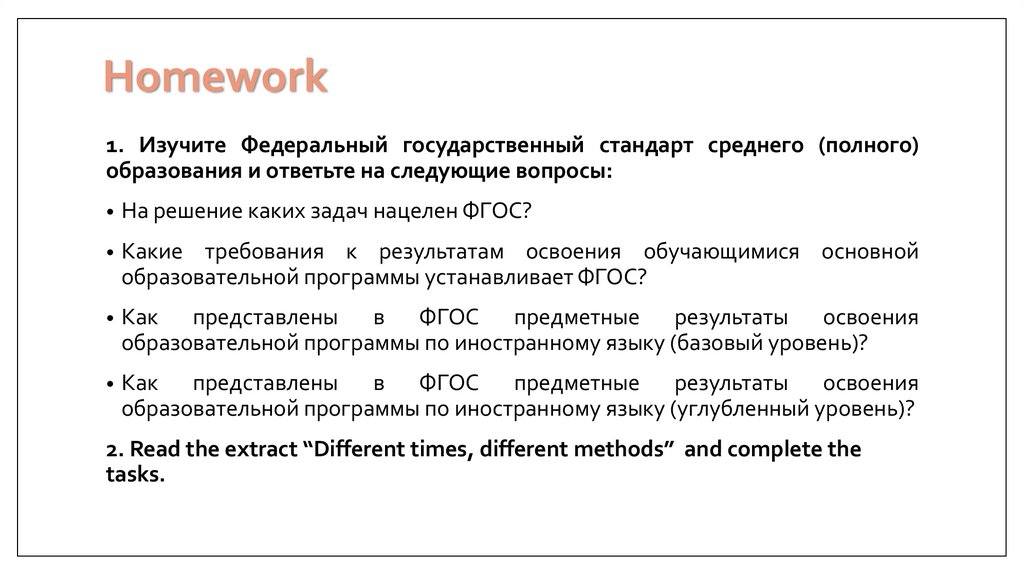
1. Изучите Федеральный государственный стандарт среднего (полного)образования и ответьте на следующие вопросы:
• На решение каких задач нацелен ФГОС?
• Какие
требования к результатам освоения обучающимися основной
образовательной программы устанавливает ФГОС?
• Как
представлены в ФГОС предметные результаты освоения
образовательной программы по иностранному языку (базовый уровень)?
• Как
представлены в ФГОС предметные результаты освоения
образовательной программы по иностранному языку (углубленный уровень)?
2. Read the extract “Different times, different methods” and complete the
tasks.