
 ecology
Similar presentations:






Local and Global Sustainable Development Issues
1. Local and Global Sustainable Development Issues
Presentation made by Mark DolinskyiCertificate in Environmental Education and Interpretation
2. Agenda
• Introduction• What is aquatic life?
• What is the importance of life below water?
• What affects the life below water?
• Key aspects of the problem
• How do issues related to life below water impact other SDGs?
• What is the main problem associated with life in the water in Malta and globally?
• Map of currents and map of plastic pollution in Mediterranean sea (visual comparison)
• Education and Inner Development Goals
• What can we do?
• References
• Discussion
3. Introduction
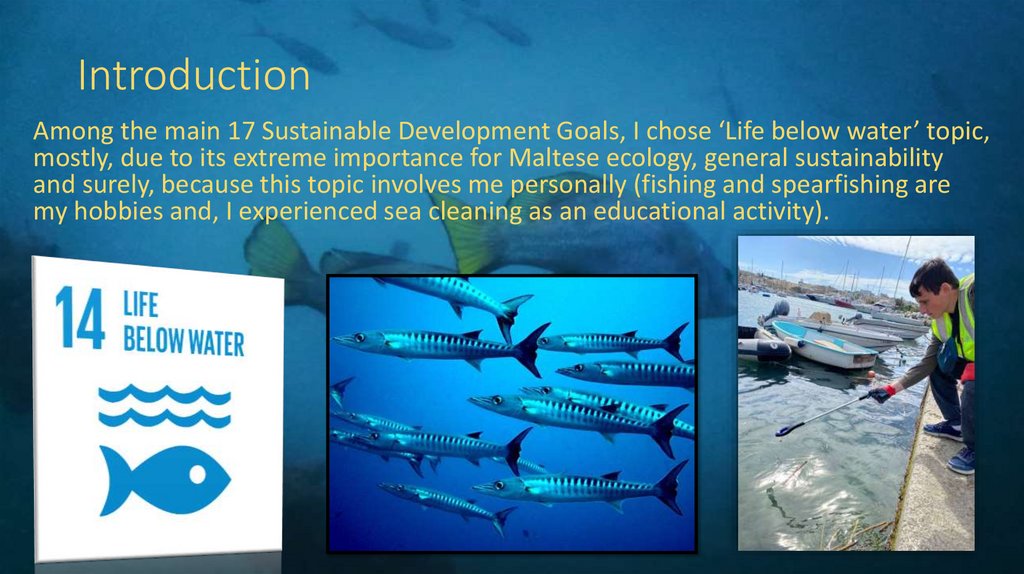
Among the main 17 Sustainable Development Goals, I chose ‘Life below water’ topic,mostly, due to its extreme importance for Maltese ecology, general sustainability
and surely, because this topic involves me personally (fishing and spearfishing are
my hobbies and, I experienced sea cleaning as an educational activity).
4. What is aquatic life?
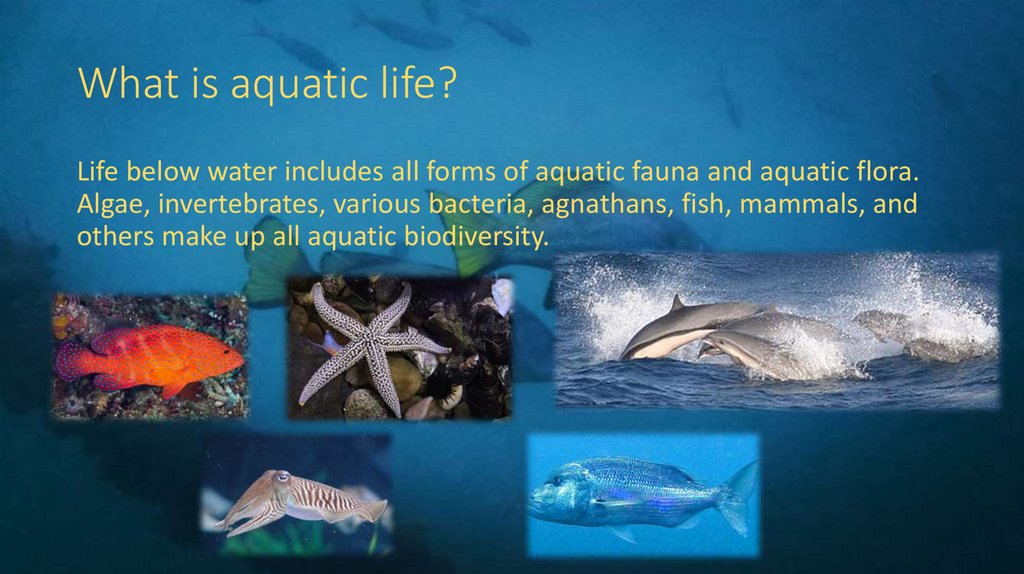
Life below water includes all forms of aquatic fauna and aquatic flora.Algae, invertebrates, various bacteria, agnathans, fish, mammals, and
others make up all aquatic biodiversity.
5. What is the importance of life below water?
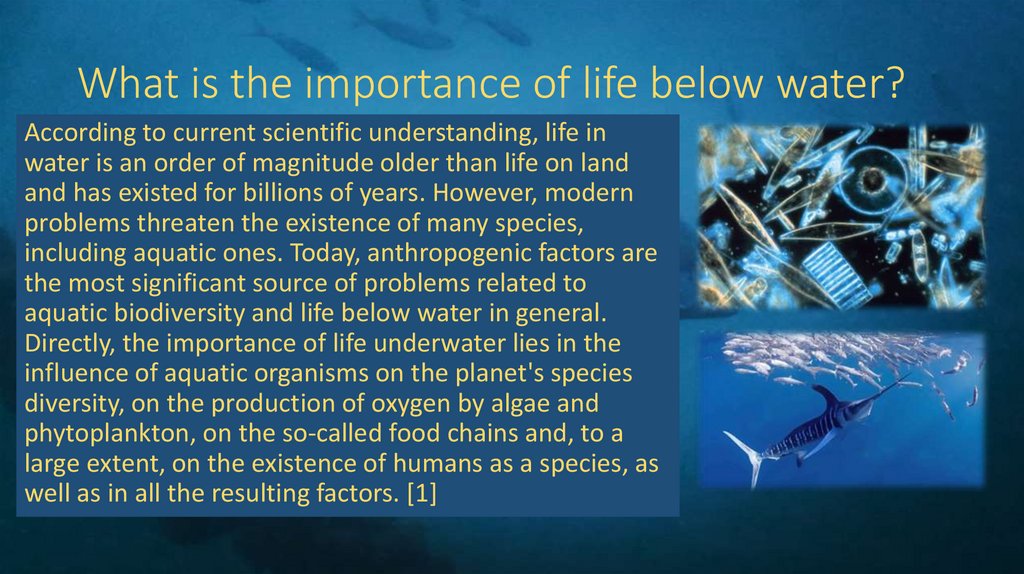
According to current scientific understanding, life inwater is an order of magnitude older than life on land
and has existed for billions of years. However, modern
problems threaten the existence of many species,
including aquatic ones. Today, anthropogenic factors are
the most significant source of problems related to
aquatic biodiversity and life below water in general.
Directly, the importance of life underwater lies in the
influence of aquatic organisms on the planet's species
diversity, on the production of oxygen by algae and
phytoplankton, on the so-called food chains and, to a
large extent, on the existence of humans as a species, as
well as in all the resulting factors. [1]
6. What affects the life below water?
According to the UN (in the article: Conservationand Sustainable Use of Marine Biodiversity in
Areas Beyond National Jurisdiction, Technical
Abstract of the First Global Integrated Marine
Assessment), common changes/factors affecting
the ocean include: changing water temperatures,
sea level rise, changing salinity, sea stratification,
changes in ocean circulation, loss of sea ice near
the poles, changes in ocean productivity, as well
as factors directly related to human activity:
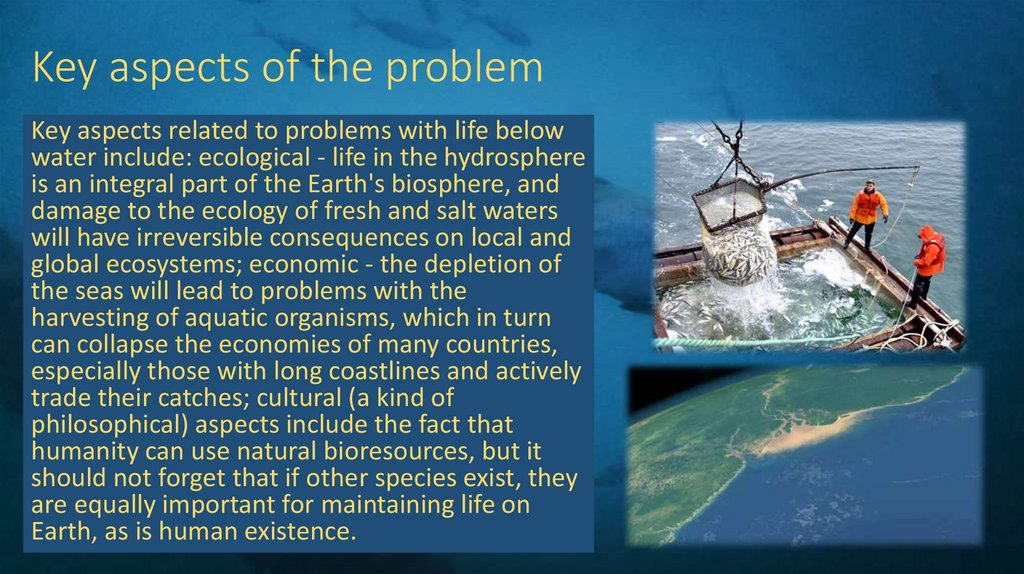
unregulated fishing, discharges and emissions of
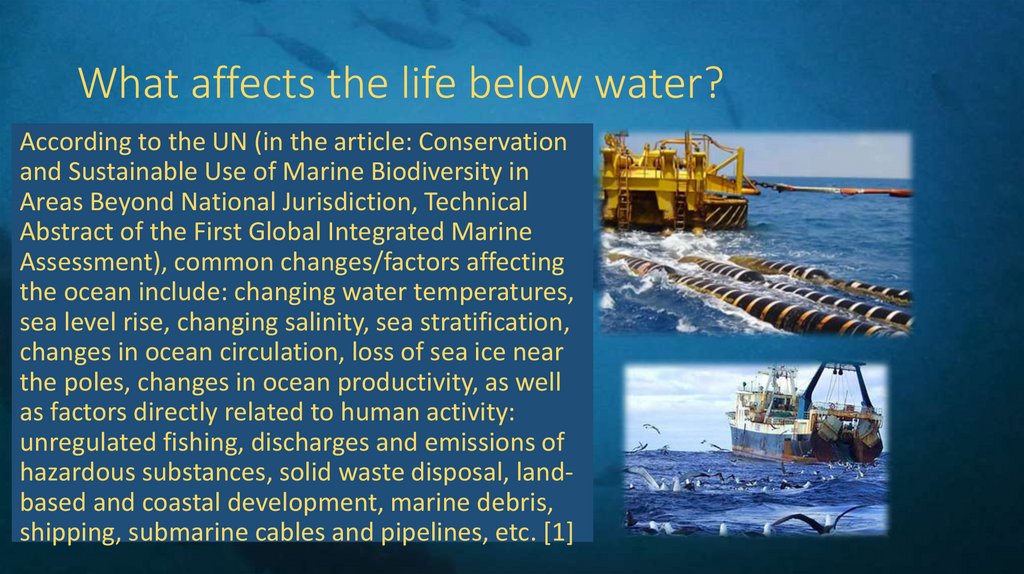
hazardous substances, solid waste disposal, landbased and coastal development, marine debris,
shipping, submarine cables and pipelines, etc. [1]
7. Key aspects of the problem
Key aspects related to problems with life belowwater include: ecological - life in the hydrosphere
is an integral part of the Earth's biosphere, and
damage to the ecology of fresh and salt waters
will have irreversible consequences on local and
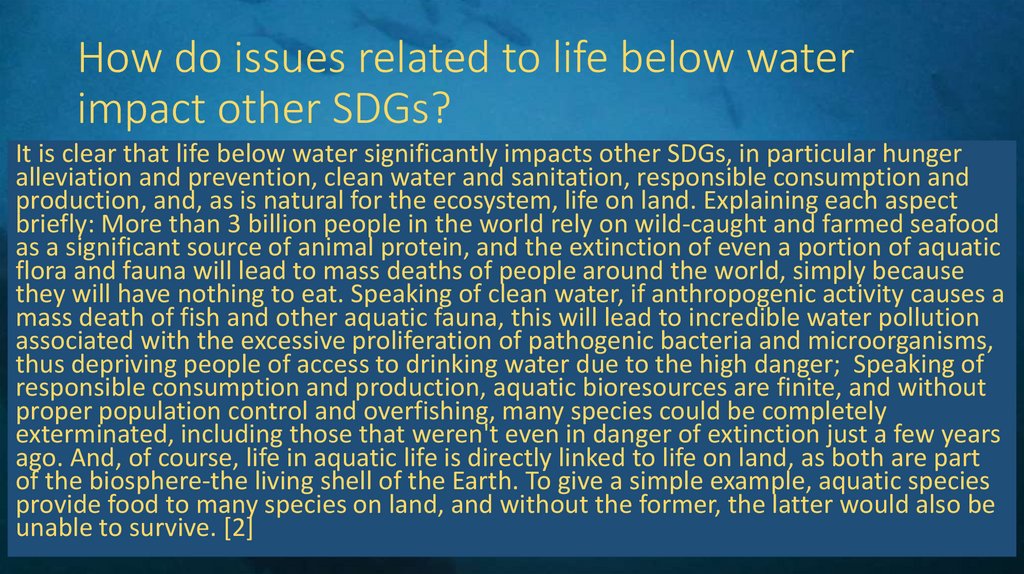
global ecosystems; economic - the depletion of
the seas will lead to problems with the
harvesting of aquatic organisms, which in turn
can collapse the economies of many countries,
especially those with long coastlines and actively
trade their catches; cultural (a kind of
philosophical) aspects include the fact that
humanity can use natural bioresources, but it
should not forget that if other species exist, they
are equally important for maintaining life on
Earth, as is human existence.
8. How do issues related to life below water impact other SDGs?
It is clear that life below water significantly impacts other SDGs, in particular hungeralleviation and prevention, clean water and sanitation, responsible consumption and
production, and, as is natural for the ecosystem, life on land. Explaining each aspect
briefly: More than 3 billion people in the world rely on wild-caught and farmed seafood
as a significant source of animal protein, and the extinction of even a portion of aquatic
flora and fauna will lead to mass deaths of people around the world, simply because
they will have nothing to eat. Speaking of clean water, if anthropogenic activity causes a
mass death of fish and other aquatic fauna, this will lead to incredible water pollution
associated with the excessive proliferation of pathogenic bacteria and microorganisms,
thus depriving people of access to drinking water due to the high danger; Speaking of
responsible consumption and production, aquatic bioresources are finite, and without
proper population control and overfishing, many species could be completely
exterminated, including those that weren't even in danger of extinction just a few years
ago. And, of course, life in aquatic life is directly linked to life on land, as both are part
of the biosphere-the living shell of the Earth. To give a simple example, aquatic species
provide food to many species on land, and without the former, the latter would also be
unable to survive. [2]
9. What is the main problem associated with life in the water in Malta and globally?
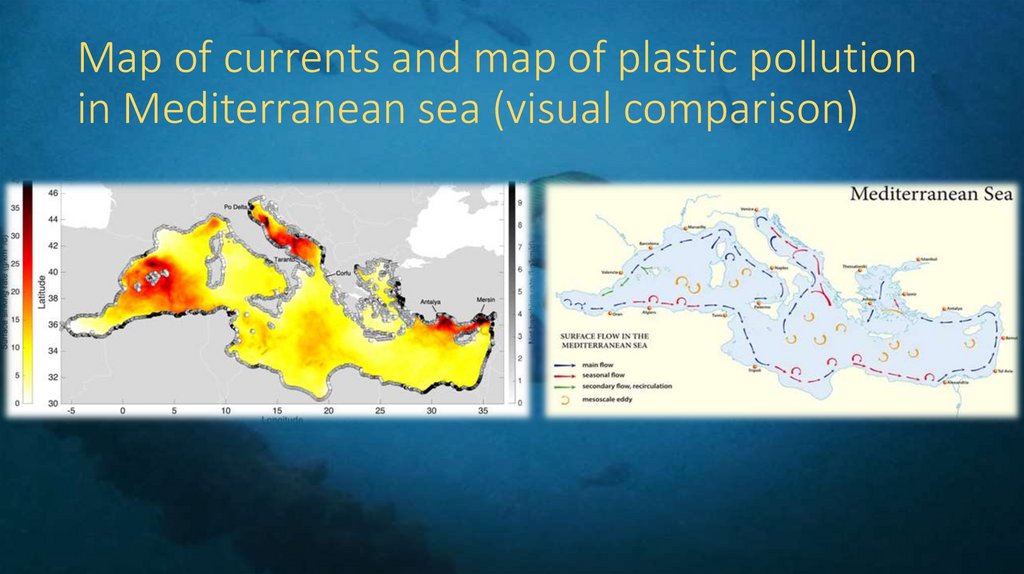
You probably know what I'm talking about. The main problem for lifebelow water, both in the Mediterranean and globally, is plastic pollution.
However, seas and oceans are not polluted uniformly; it's all due to
natural movements of water masses—sea currents. If you look at a map
of Mediterranean currents and a map of plastic pollution, you can see
how plastic waste "migrates" across the sea. The situation is absolutely
identical in the world's oceans, especially in the Pacific Ocean in the
Great Pacific Garbage Patch, where currents accumulate garbage in a
specific area, roughly bounded by the Kuroshio, North Pacific, California,
and North Equatorial Currents. [3],[4],[5]
10. Map of currents and map of plastic pollution in Mediterranean sea (visual comparison)
11. Education and Inner Development Goals
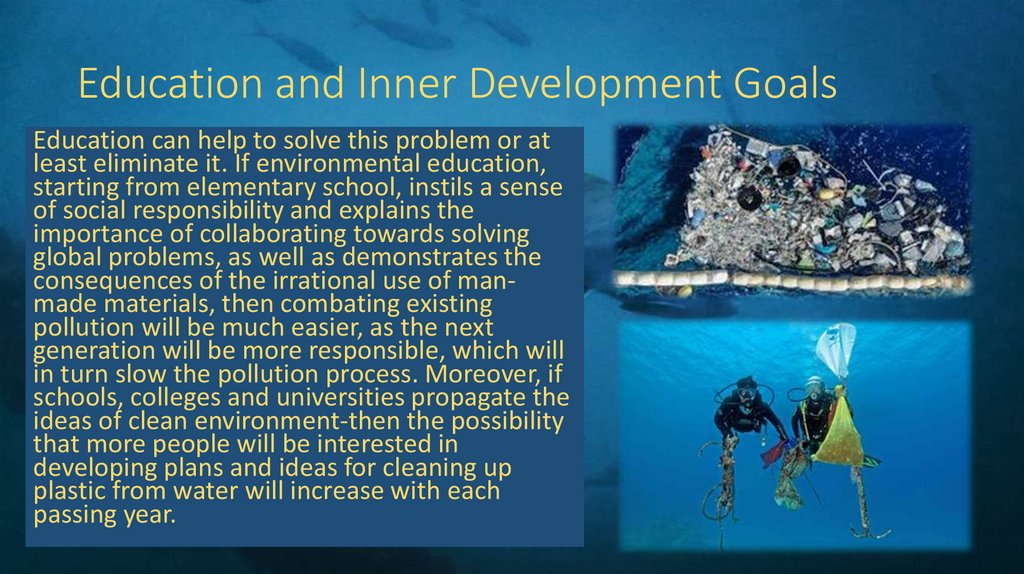
Education can help to solve this problem or atleast eliminate it. If environmental education,
starting from elementary school, instils a sense
of social responsibility and explains the
importance of collaborating towards solving
global problems, as well as demonstrates the
consequences of the irrational use of manmade materials, then combating existing
pollution will be much easier, as the next
generation will be more responsible, which will
in turn slow the pollution process. Moreover, if
schools, colleges and universities propagate the
ideas of clean environment-then the possibility
that more people will be interested in
developing plans and ideas for cleaning up
plastic from water will increase with each
passing year.
12. What can we do?
I believe that a significant portion of the problems associated with lifebelow water can be solved at the individual level. It's simple: given the
rapid growth of the Earth's population, the amount of trash in the
oceans is growing accordingly. The simplest solution for each of us is
simply not to litter and, if possible, for example, while walking by the
sea, to pick up at least a little trash floating on the surface. It might only
take a minute for you, but the ocean will save hundreds of years. But at
the local level, the authorities could introduce some kind of monetary
reward for cleaning up marine debris, which would lead to a significant
improvement in the environmental situation.
13. References
• [1]“THE CONSERVATION AND SUSTAINABLE USE OF MARINE BIOLOGICAL DIVERSITY OFAREAS BEYOND NATIONAL JURISDICTION A TECHNICAL ABSTRACT OF THE FIRST GLOBAL
INTEGRATED MARINE ASSESSMENT.” Accessed: Nov. 09, 2025. [Online]. Available:
https://www.un.org/depts/los/global_reporting/8th_adhoc_2017/Technical_Abstract_o
n_the_Conservation_and_Sustainable_Use_of_marine_Biological_Diversity_of_Areas_B
eyond_National_Jurisdiction.pdf
• [2]“Protecting oceans through seafood,” World Wildlife Fund, Nov. 21, 2019.
https://www.worldwildlife.org/our-work/oceans/sustainable-seafood/
• [3]“Malta Sustainability Forum,” Malta Sustainability Forum - Malta Sustainability
Forum, Mar. 12, 2021. https://maltasustainabilityforum.com/news/marine-species/
• [4]UNEP, “Pollution in the Mediterranean | UNEPMAP,” www.unep.org, Mar. 2021.
https://www.unep.org/unepmap/resources/factsheets/pollution
• [5]“Ocean Motion : Background : Wind-Driven Surface CurrentsGyres,” oceanmotion.org. https://oceanmotion.org/html/background/wind-drivensurface.html
14. Discussion
• In your opinion, what are the most effective ways to save thelife below water? Why?
• How do you think, what is the most serious ecological problem
in Mediterranean sea?
• What is the most serious ecological problem in Malta?