



 english
Similar presentations:




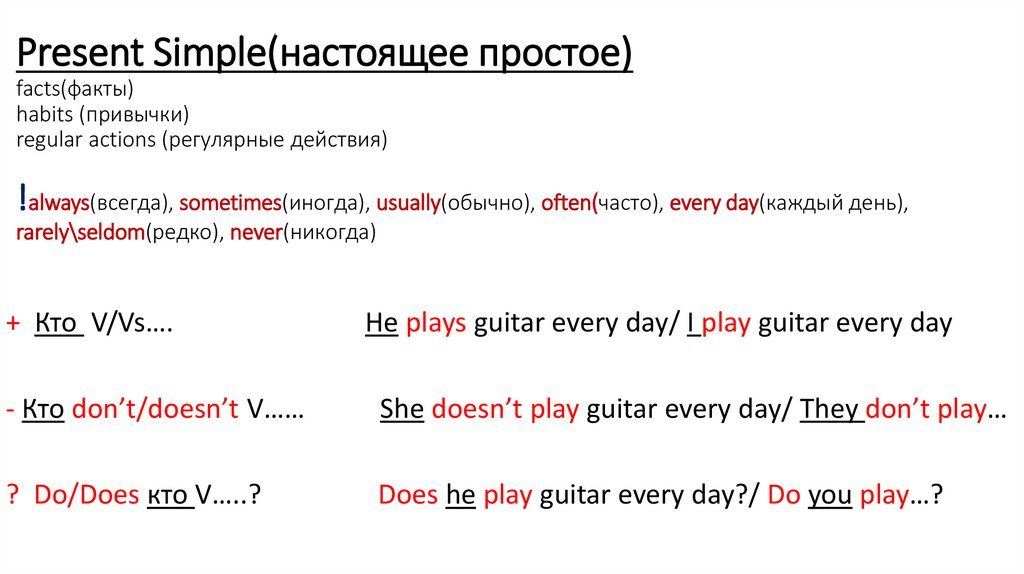
Present Simple(настоящее простое) facts(факты) habits (привычки) regular actions (регулярные действия) !always(всегда
1. Present Simple(настоящее простое) facts(факты) habits (привычки) regular actions (регулярные действия) !always(всегда),
sometimes(иногда), usually(обычно), often(часто), every day(каждый день),rarely\seldom(редко), never(никогда)
+ Кто V/Vs….
He plays guitar every day/ I play guitar every day
- Кто don’t/doesn’t V……
She doesn’t play guitar every day/ They don’t play…
? Do/Does кто V…..?
Does he play guitar every day?/ Do you play…?
2. Do you like this book? I was here last year
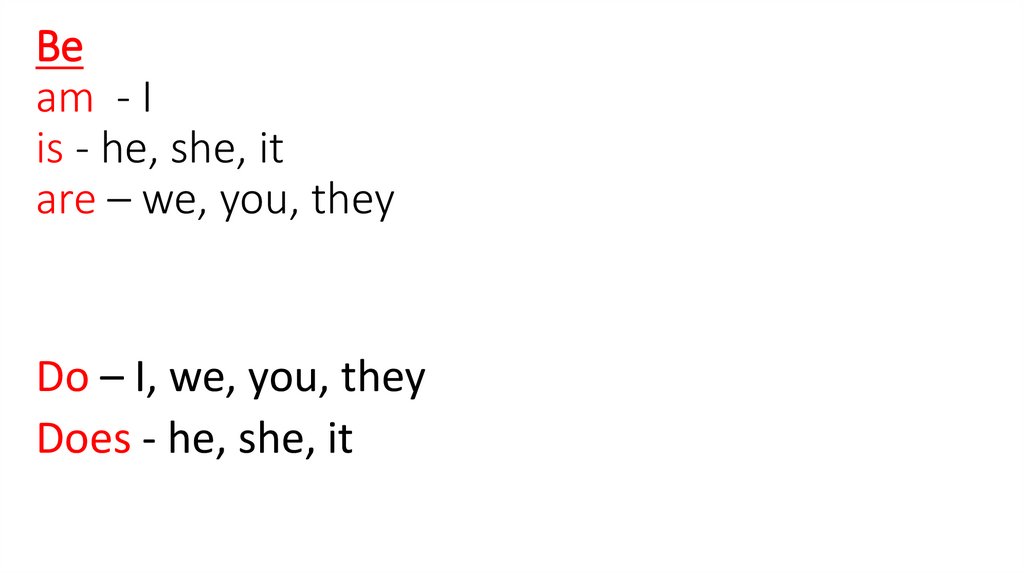
3. Be am - I is - he, she, it are – we, you, they
Do – I, we, you, theyDoes - he, she, it
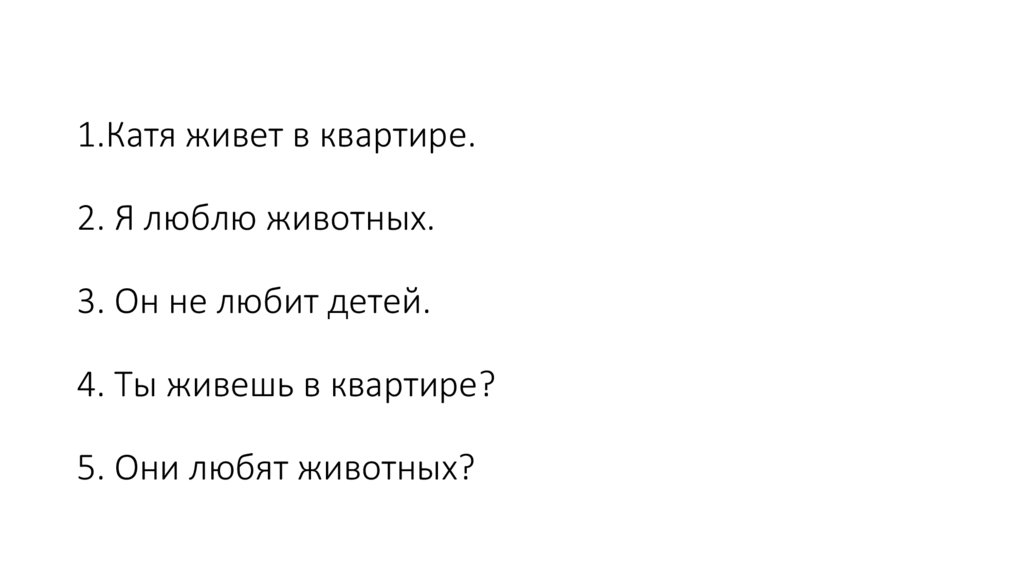
4. 1.Катя живет в квартире. 2. Я люблю животных. 3. Он не любит детей. 4. Ты живешь в квартире? 5. Они любят животных?
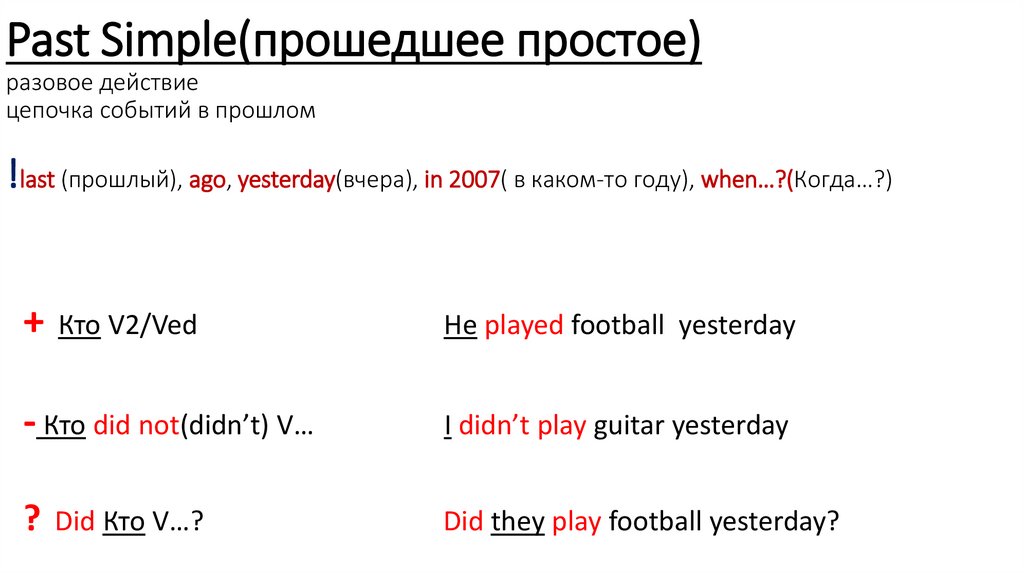
5. Past Simple(прошедшее простое) разовое действие цепочка событий в прошлом !last (прошлый), ago, yesterday(вчера), in 2007( в
каком-то году), when…?(Когда…?)+ Кто V2/Ved
He played football yesterday
- Кто did not(didn’t) V…
I didn’t play guitar yesterday
? Did Кто V…?
Did they play football yesterday?
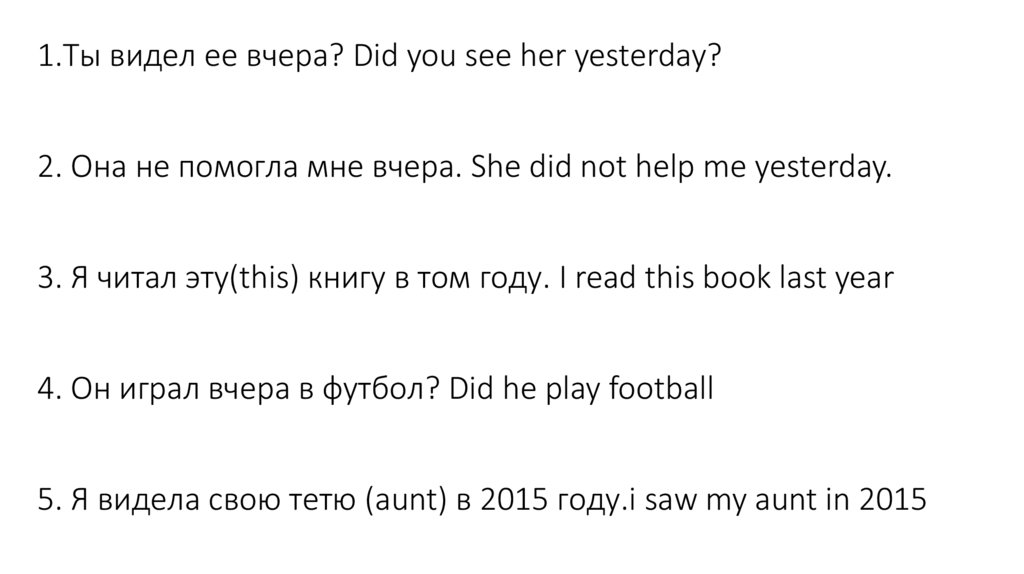
6. 1.Ты видел ее вчера? Did you see her yesterday? 2. Она не помогла мне вчера. She did not help me yesterday. 3. Я читал
эту(this) книгу в том году. I read this book last year4. Он играл вчера в футбол? Did he play football
5. Я видела свою тетю (aunt) в 2015 году.i saw my aunt in 2015
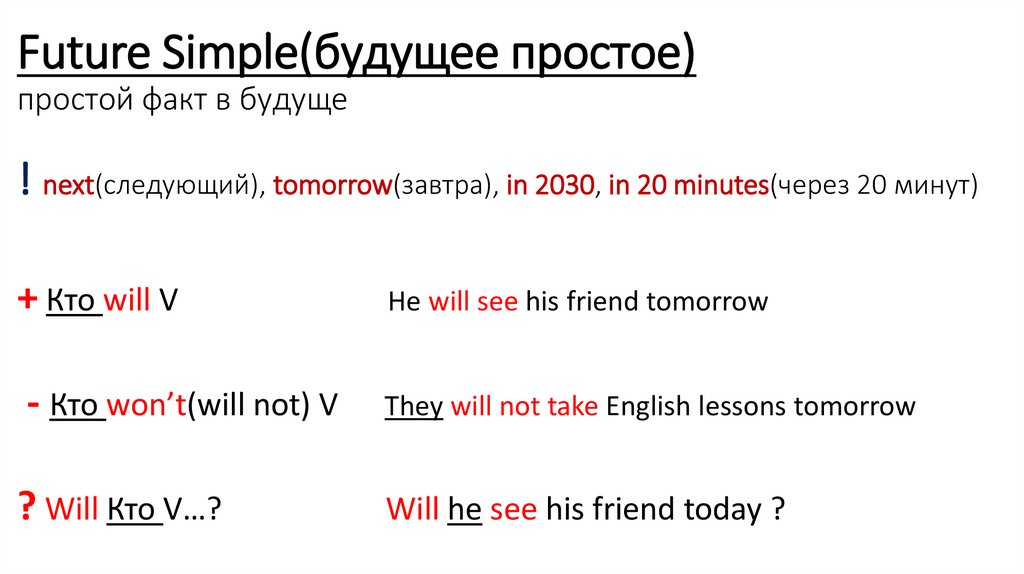
7. Future Simple(будущее простое) простой факт в будущe ! next(следующий), tomorrow(завтра), in 2030, in 20 minutes(через 20
минут)+ Кто will V
He will see his friend tomorrow
- Кто won’t(will not) V
They will not take English lessons tomorrow
? Will Кто V…?
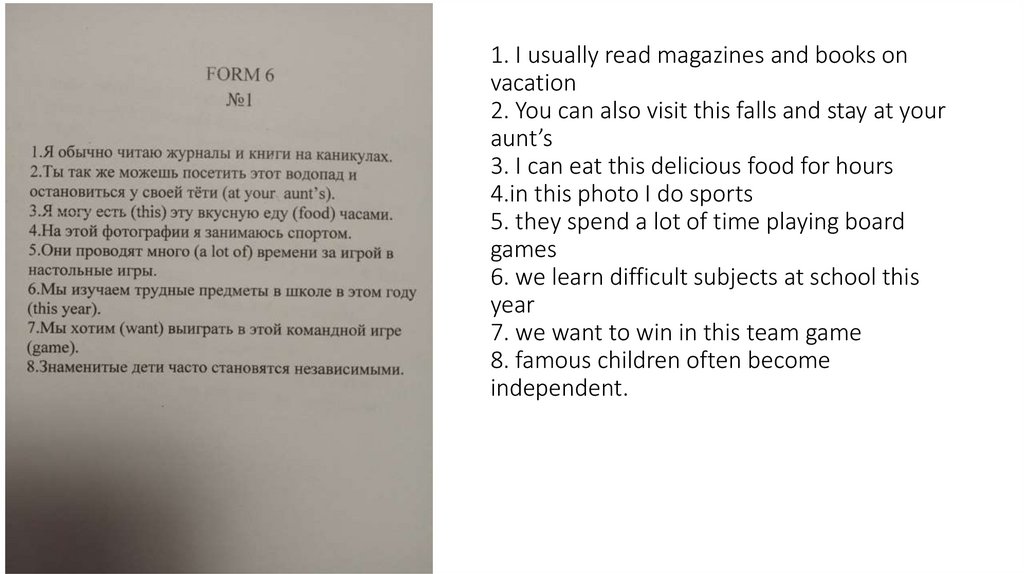
Will he see his friend today ?
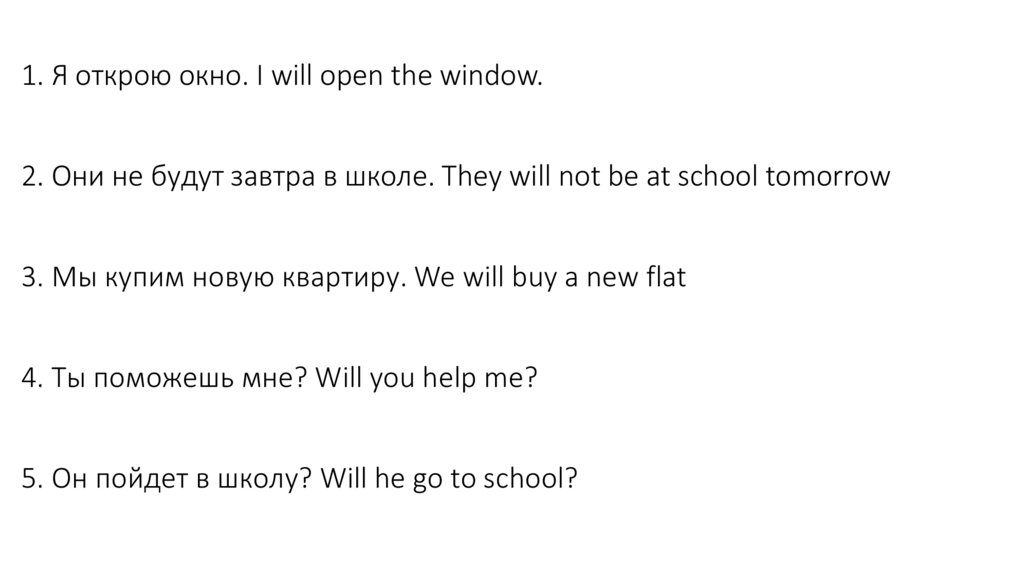
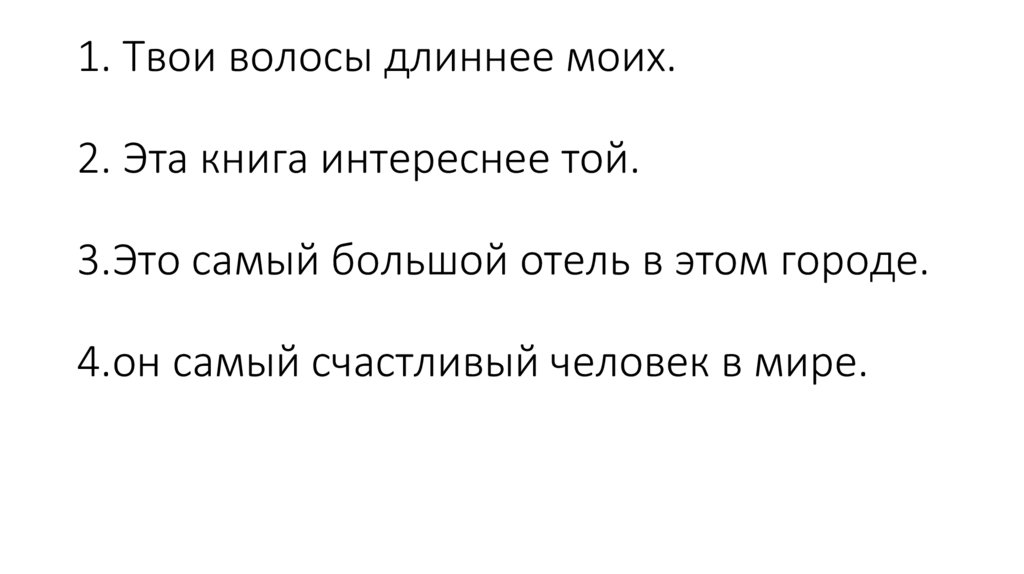
8. 1. Я открою окно. I will open the window. 2. Они не будут завтра в школе. They will not be at school tomorrow 3. Мы купим новую
квартиру. We will buy a new flat4. Ты поможешь мне? Will you help me?
5. Он пойдет в школу? Will he go to school?
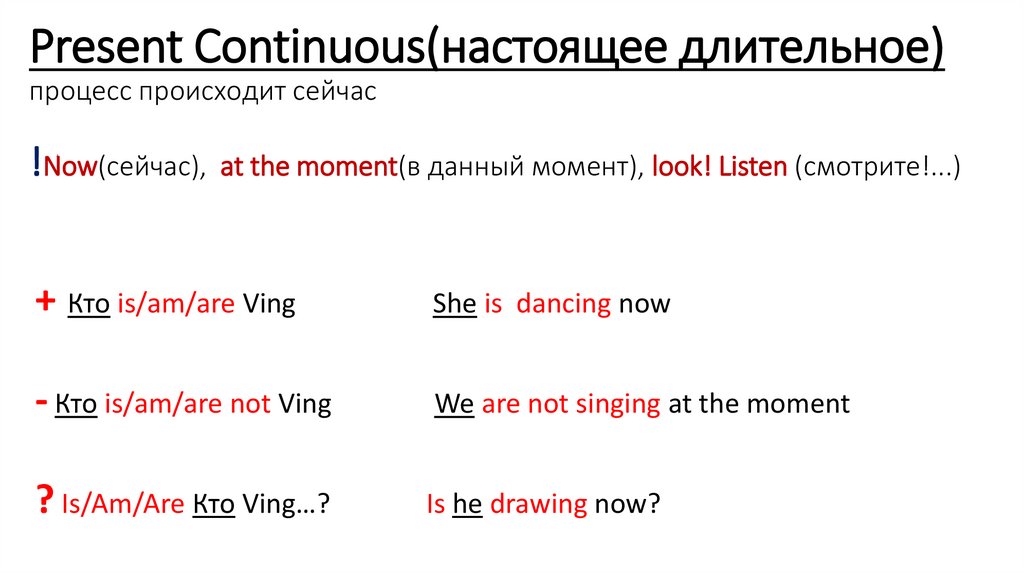
9. Present Continuous(настоящее длительное) процесс происходит сейчас !Now(сейчас), at the moment(в данный момент), look! Listen
(смотрите!...)+ Кто is/am/are Ving
She is dancing now
- Кто is/am/are not Ving
We are not singing at the moment
? Is/Am/Are Кто Ving…?
Is he drawing now?
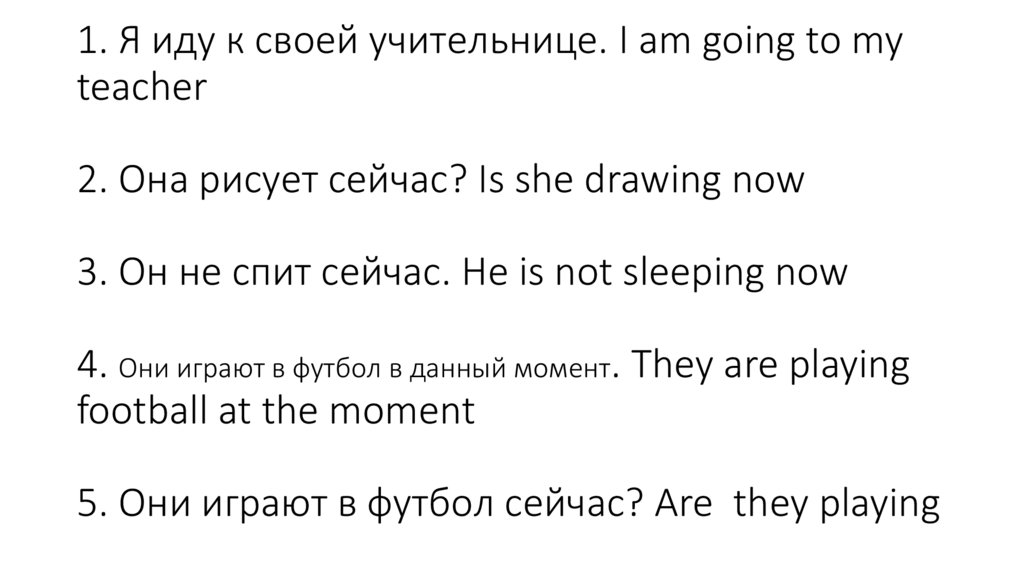
10. 1. Я иду к своей учительнице. I am going to my teacher 2. Она рисует сейчас? Is she drawing now 3. Он не спит сейчас. He is not
sleeping now4. Они играют в футбол в данный момент. They are playing
football at the moment
5. Они играют в футбол сейчас? Are they playing
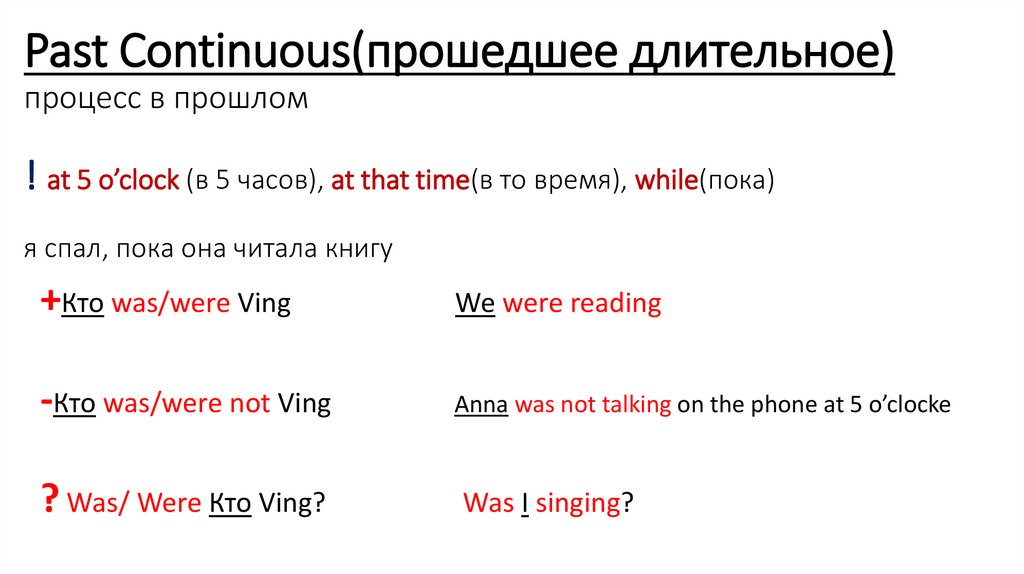
11. Past Continuous(прошедшее длительное) процесс в прошлом ! at 5 o’clock (в 5 часов), at that time(в то время), while(пока) я
спал, пока она читала книгу+Кто was/were Ving
We were reading
-Кто was/were not Ving
Anna was not talking on the phone at 5 o’clocke
? Was/ Were Кто Ving?
Was I singing?
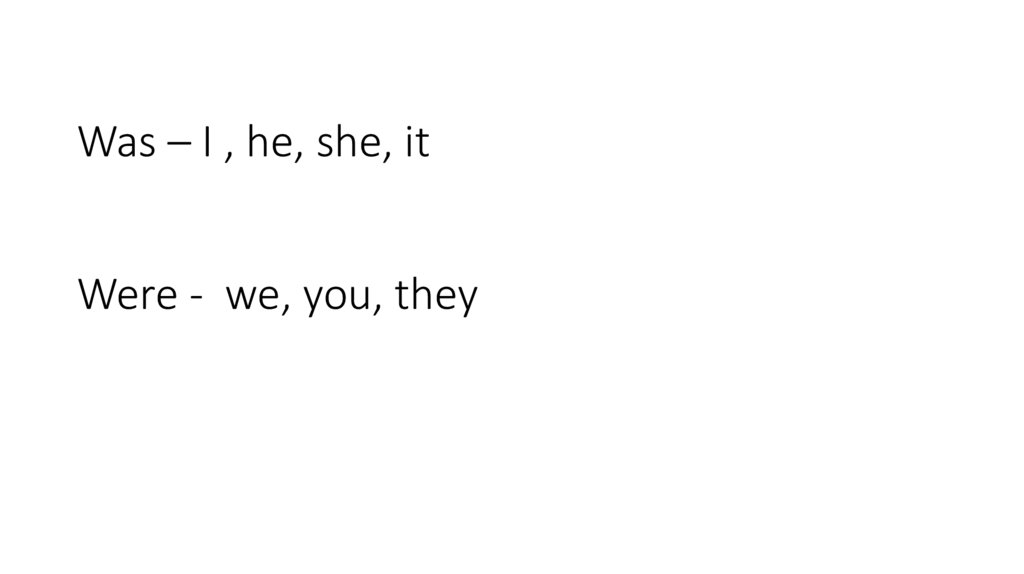
12. Was – I , he, she, it Were - we, you, they
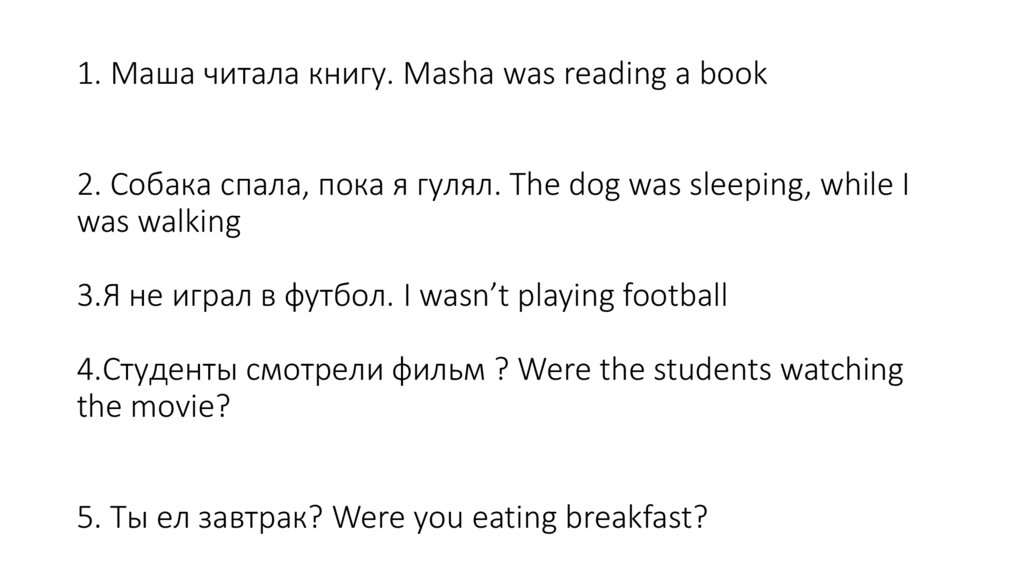
13. 1. Маша читала книгу. Masha was reading a book 2. Собака спала, пока я гулял. The dog was sleeping, while I was walking 3.Я не
играл в футбол. I wasn’t playing football4.Студенты смотрели фильм ? Were the students watching
the movie?
5. Ты ел завтрак? Were you eating breakfast?
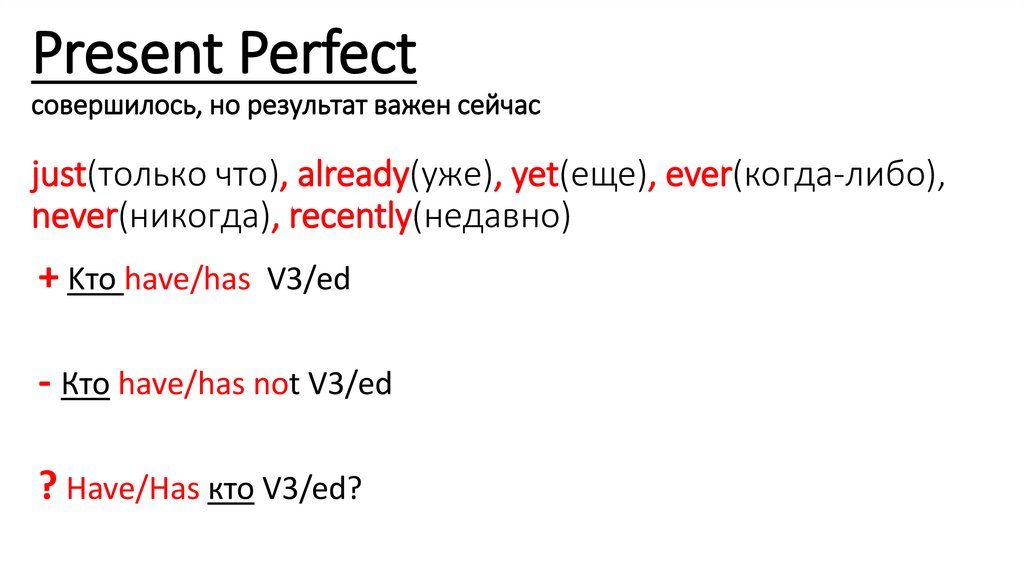
14. Present Perfect cовершилось, но результат важен сейчас just(только что), already(уже), yet(еще), ever(когда-либо),
never(никогда), recently(недавно)+ Kто have/has V3/ed
- Кто have/has not V3/ed
? Have/Has кто V3/ed?
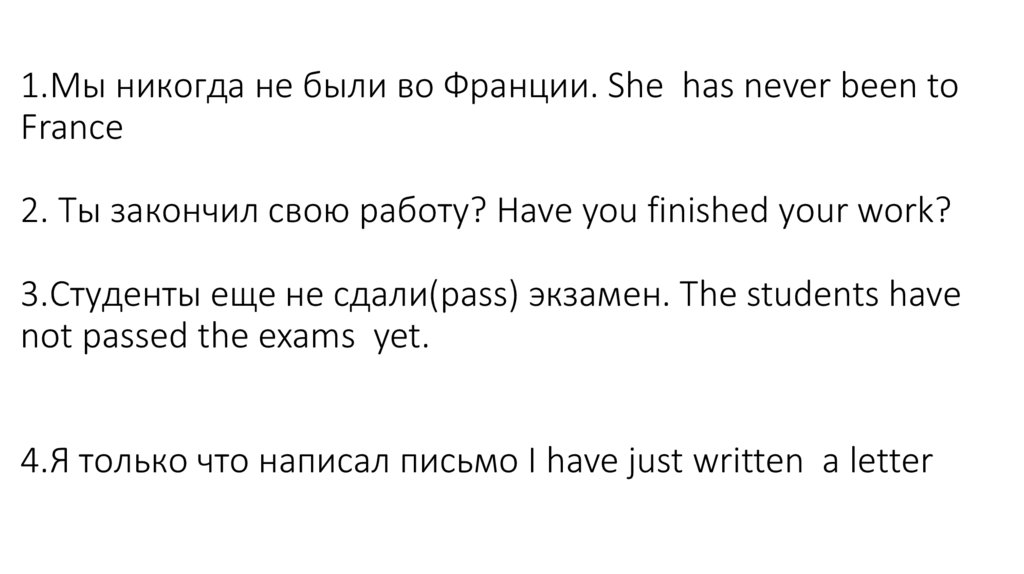
15. 1.Мы никогда не были во Франции. She has never been to France 2. Ты закончил свою работу? Have you finished your work?
3.Студенты еще не сдали(pass) экзамен. The students havenot passed the exams yet.
4.Я только что написал письмо I have just written a letter
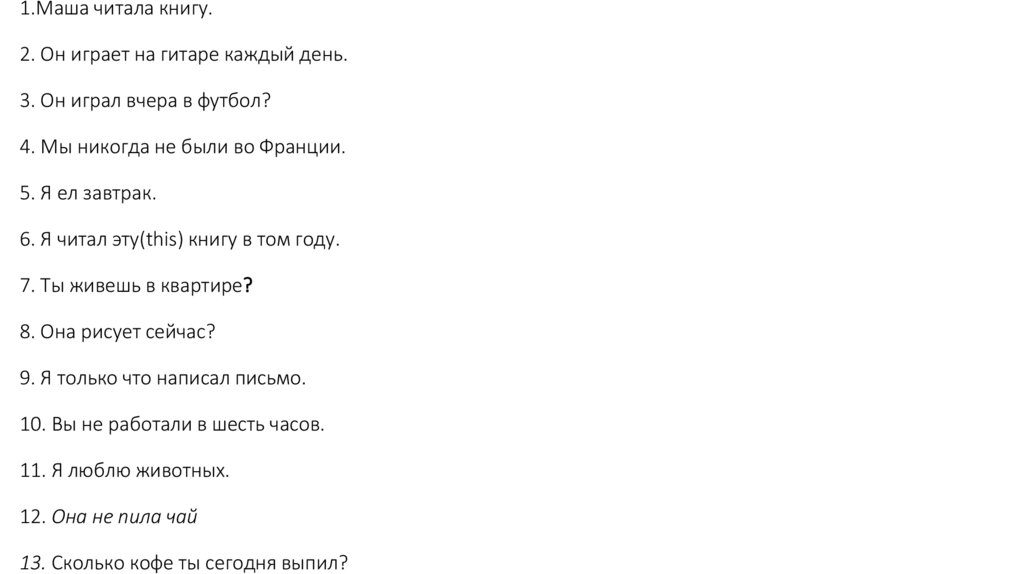
16. 1.Маша читала книгу. 2. Он играет на гитаре каждый день. 3. Он играл вчера в футбол? 4. Мы никогда не были во Франции. 5. Я ел
завтрак.6. Я читал эту(this) книгу в том году.
7. Ты живешь в квартире?
8. Она рисует сейчас?
9. Я только что написал письмо.
10. Вы не работали в шесть часов.
11. Я люблю животных.
12. Она не пила чай
13. Сколько кофе ты сегодня выпил?
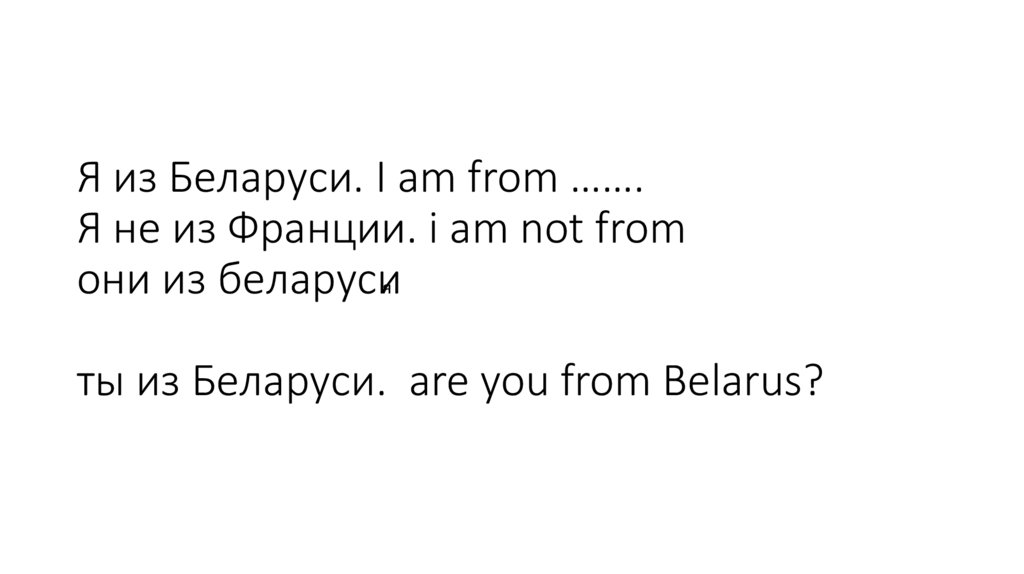
17. Я из Беларуси. I am from ……. Я не из Франции. i am not from они из беларуси ты из Беларуси. are you from Belarus?
Я из Беларуси. I am from …….Я не из Франции. i am not from
они из беларусия
ты из Беларуси. are you from Belarus?
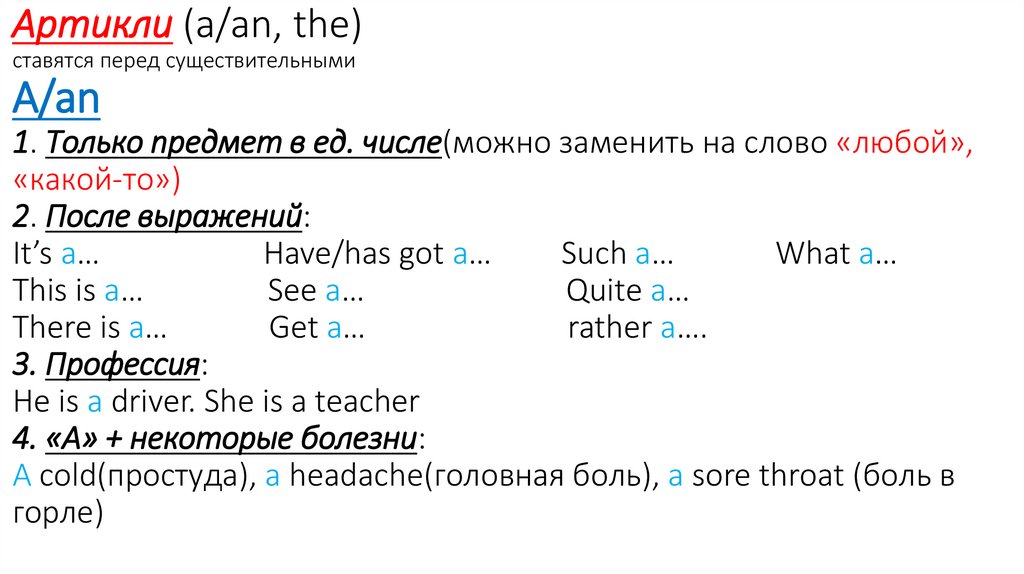
18. Артикли (a/an, the) ставятся перед существительными A/an 1. Только предмет в ед. числе(можно заменить на слово «любой»,
«какой-то»)2. После выражений:
It’s a…
Have/has got a…
Such a…
What a…
This is a…
See a…
Quite a…
There is a…
Get a…
rather a….
3. Профессия:
He is a driver. She is a teacher
4. «А» + некоторые болезни:
A cold(простуда), a headache(головная боль), a sore throat (боль в
горле)
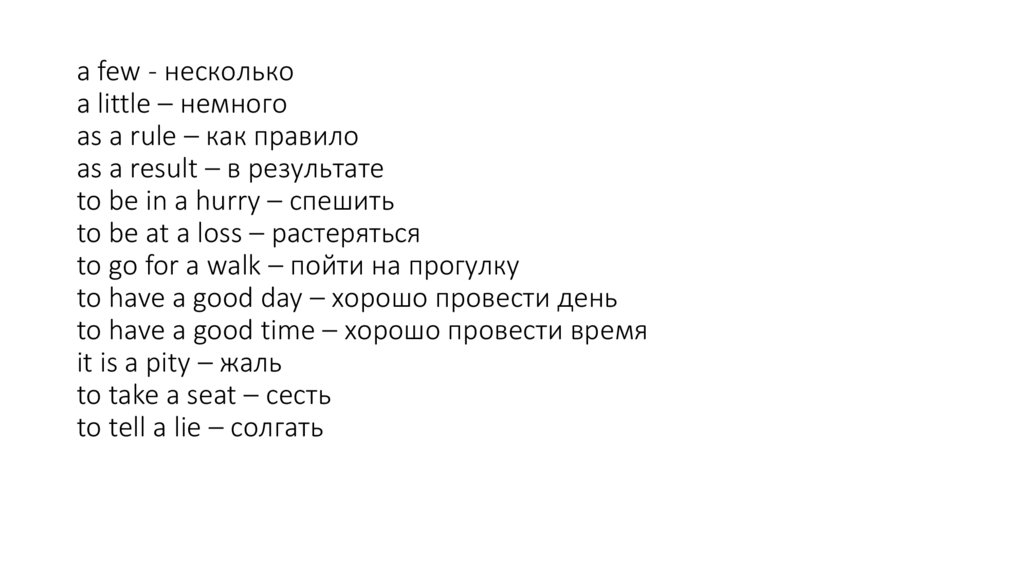
19. a few - несколько a little – немного as a rule – как правило as a result – в результате to be in a hurry – спешить to be at a
loss – растерятьсяto go for a walk – пойти на прогулку
to have a good day – хорошо провести день
to have a good time – хорошо провести время
it is a pity – жаль
to take a seat – сесть
to tell a lie – солгать
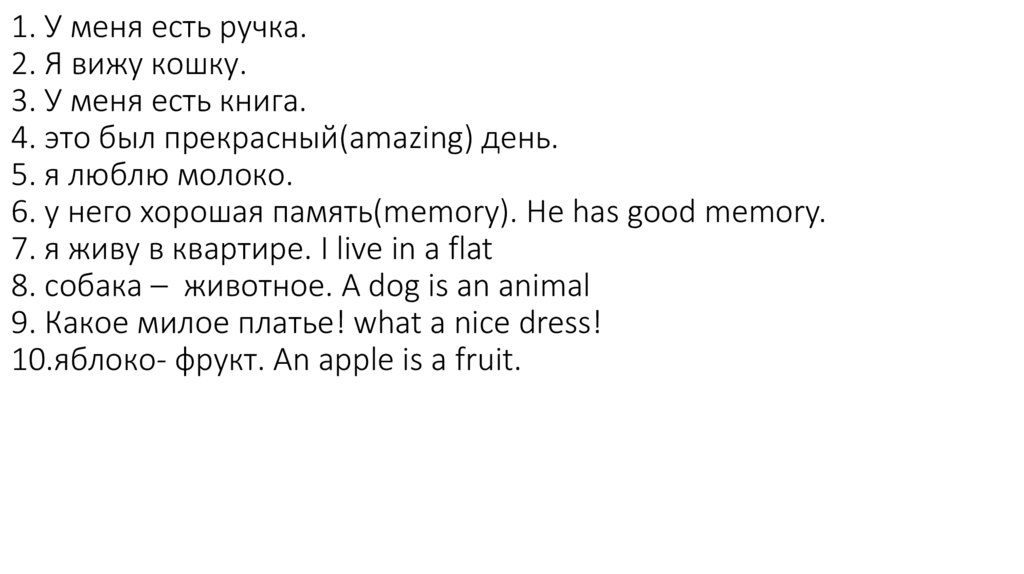
20. 1. У меня есть ручка. 2. Я вижу кошку. 3. У меня есть книга. 4. это был прекрасный(amazing) день. 5. я люблю молоко. 6. у него
хорошая память(memory). He has good memory.7. я живу в квартире. I live in a flat
8. собака – животное. A dog is an animal
9. Какое милое платье! what a nice dress!
10.яблоко- фрукт. An apple is a fruit.
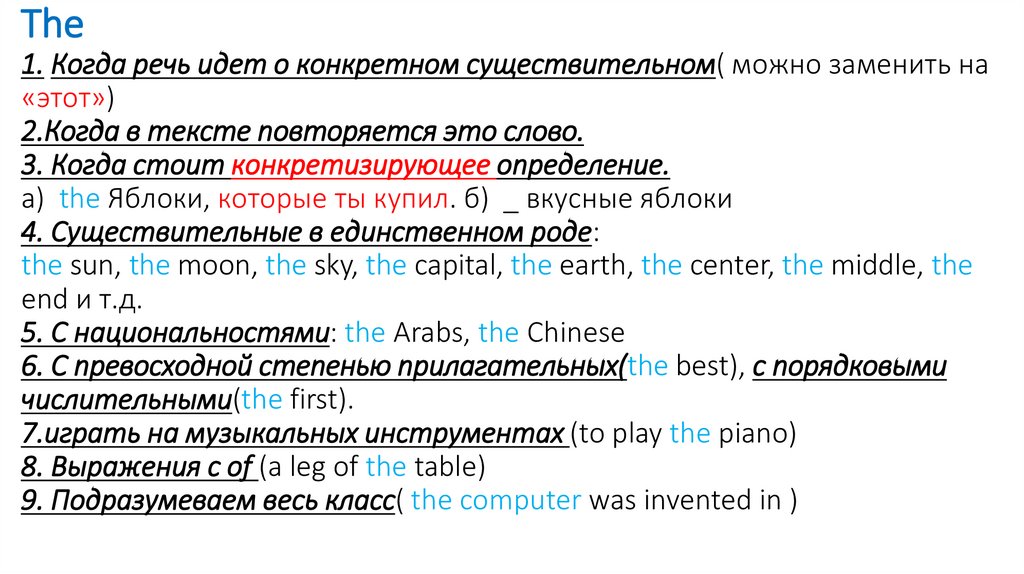
21. The 1. Когда речь идет о конкретном существительном( можно заменить на «этот») 2.Когда в тексте повторяется это слово. 3. Когда
стоит конкретизирующее определение.а) the Яблоки, которые ты купил. б) _ вкусные яблоки
4. Существительные в единственном роде:
the sun, the moon, the sky, the capital, the earth, the center, the middle, the
end и т.д.
5. С национальностями: the Arabs, the Chinese
6. С превосходной степенью прилагательных(the best), с порядковыми
числительными(the first).
7.играть на музыкальных инструментах (to play the piano)
8. Выражения с of (a leg of the table)
9. Подразумеваем весь класс( the computer was invented in )
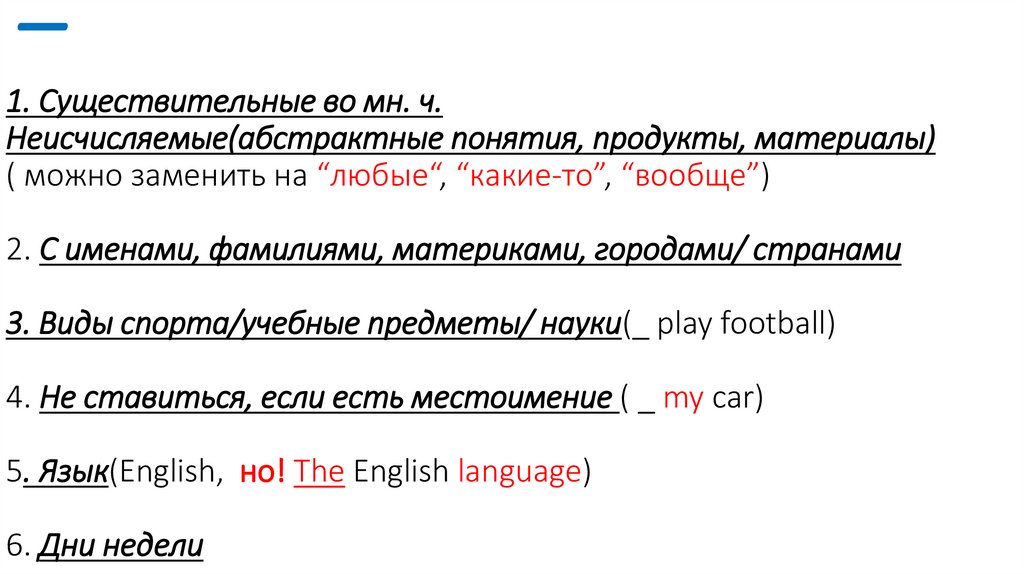
22. _ 1. Существительные во мн. ч. Неисчисляемые(абстрактные понятия, продукты, материалы) ( можно заменить на “любые“, “какие-то”,
“вообще”)2. С именами, фамилиями, материками, городами/ странами
3. Виды спорта/учебные предметы/ науки(_ play football)
4. Не ставиться, если есть местоимение ( _ my car)
5. Язык(English, но! The English language)
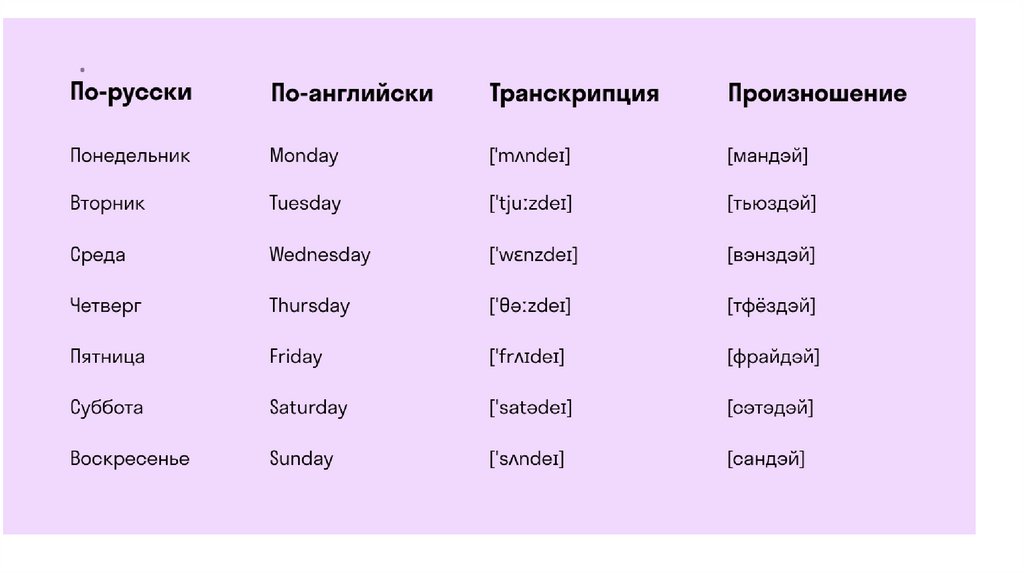
6. Дни недели
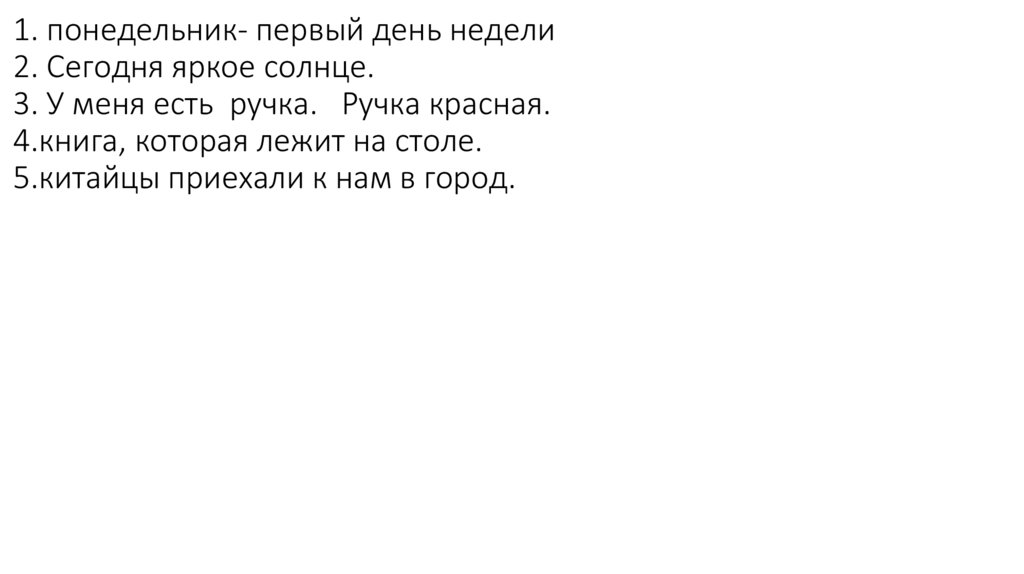
23. 1. понедельник- первый день недели 2. Сегодня яркое солнце. 3. У меня есть ручка. Ручка красная. 4.книга, которая лежит на
столе.5.китайцы приехали к нам в город.
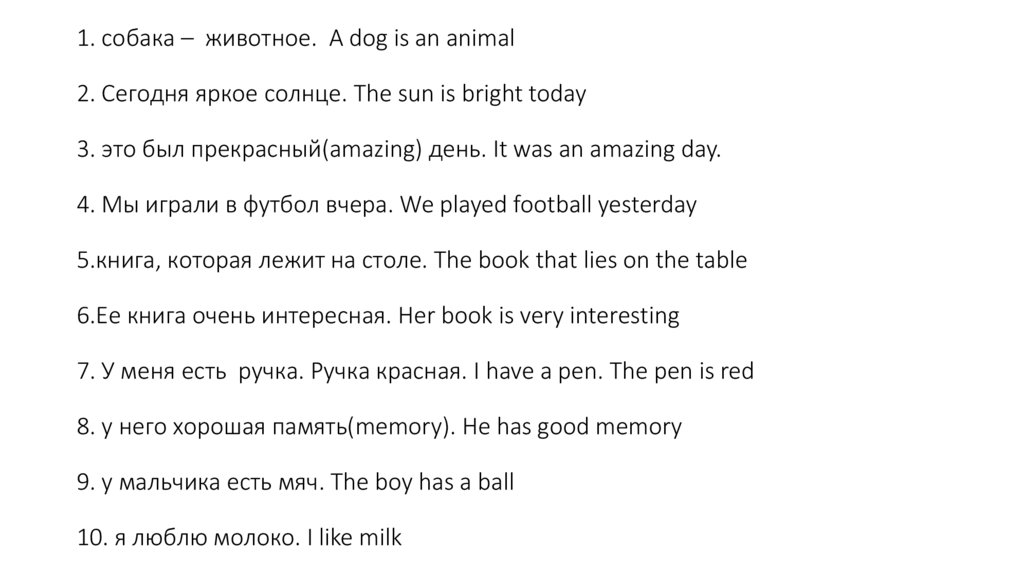
24. 1. собака – животное. A dog is an animal 2. Сегодня яркое солнце. The sun is bright today 3. это был прекрасный(amazing) день.
It was an amazing day.4. Мы играли в футбол вчера. We played football yesterday
5.книга, которая лежит на столе. The book that lies on the table
6.Ее книга очень интересная. Her book is very interesting
7. У меня есть ручка. Ручка красная. I have a pen. The pen is red
8. у него хорошая память(memory). He has good memory
9. у мальчика есть мяч. The boy has a ball
10. я люблю молоко. I like milk
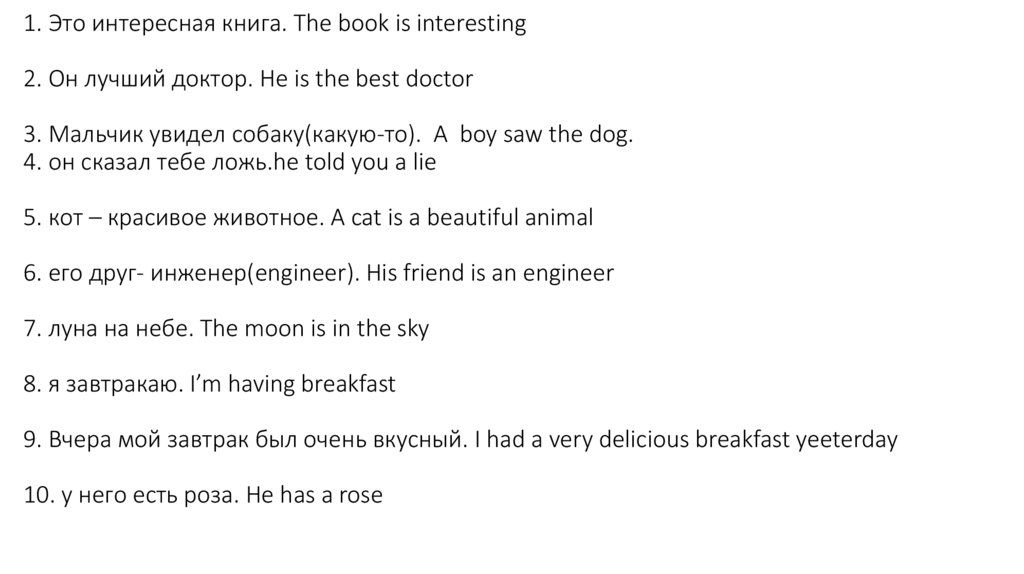
25. 1. Это интересная книга. The book is interesting 2. Он лучший доктор. He is the best doctor 3. Мальчик увидел собаку(какую-то).
A boy saw the dog.4. он сказал тебе ложь.he told you a lie
5. кот – красивое животное. A cat is a beautiful animal
6. его друг- инженер(engineer). His friend is an engineer
7. луна на небе. The moon is in the sky
8. я завтракаю. I’m having breakfast
9. Вчера мой завтрак был очень вкусный. I had a very delicious breakfast yeeterday
10. у него есть роза. He has a rose
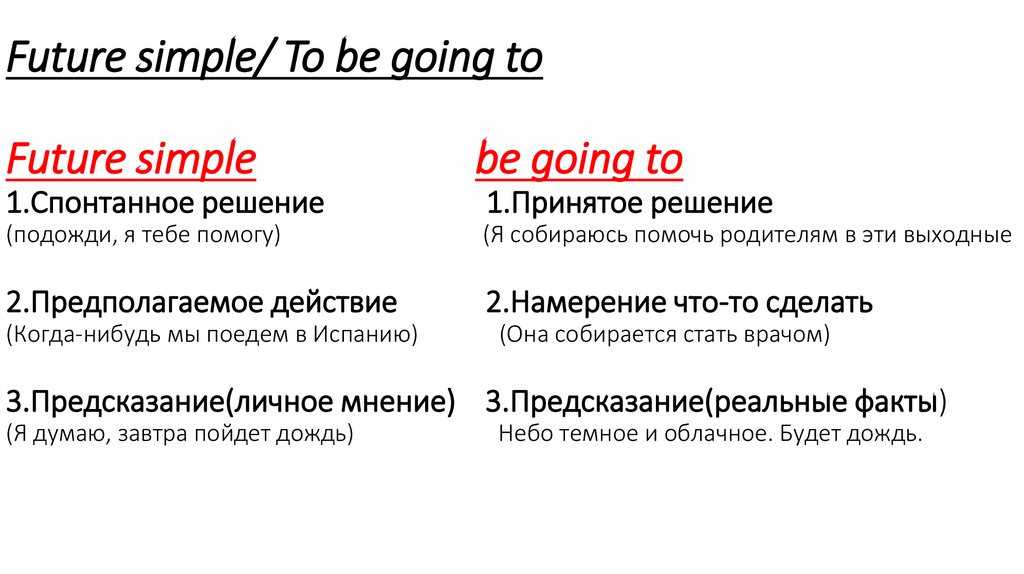
26. Future simple/ To be going to Future simple be going to 1.Спонтанное решение 1.Принятое решение (подожди, я тебе помогу) (Я
собираюсь помочь родителям в эти выходные2.Предполагаемое действие
2.Намерение что-то сделать
(Когда-нибудь мы поедем в Испанию)
(Она собирается стать врачом)
3.Предсказание(личное мнение) 3.Предсказание(реальные факты)
(Я думаю, завтра пойдет дождь)
Небо темное и облачное. Будет дождь.
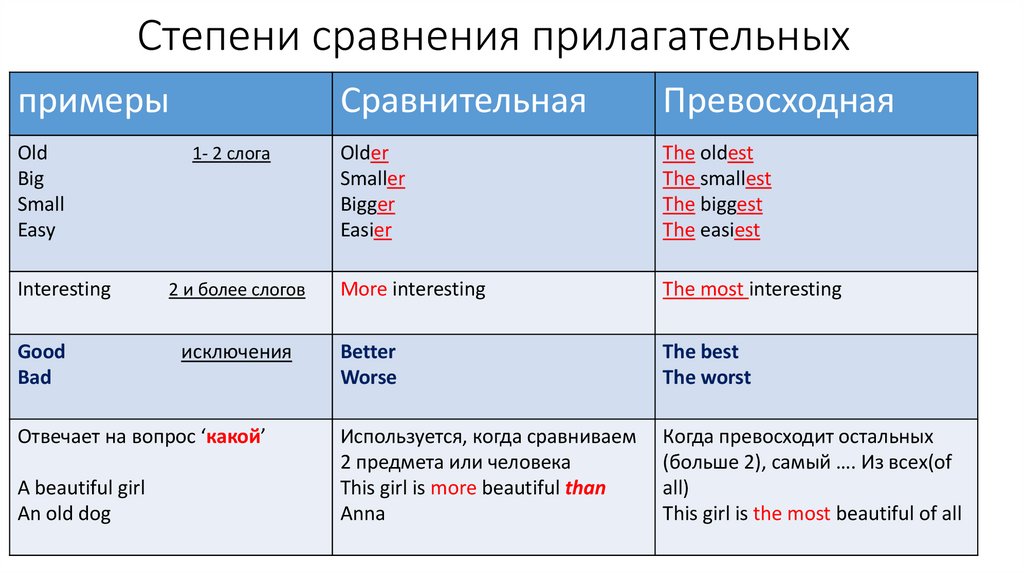
27. Степени сравнения прилагательных
примерыOld
Big
Small
Easy
1- 2 слога
Сравнительная
Превосходная
Older
Smaller
Bigger
Easier
The oldest
The smallest
The biggest
The easiest
Interesting
2 и более слогов
More interesting
The most interesting
Good
Bad
исключения
Better
Worse
The best
The worst
Используется, когда сравниваем
2 предмета или человека
This girl is more beautiful than
Anna
Когда превосходит остальных
(больше 2), самый …. Из всех(of
all)
This girl is the most beautiful of all
Отвечает на вопрос ‘какой’
A beautiful girl
An old dog
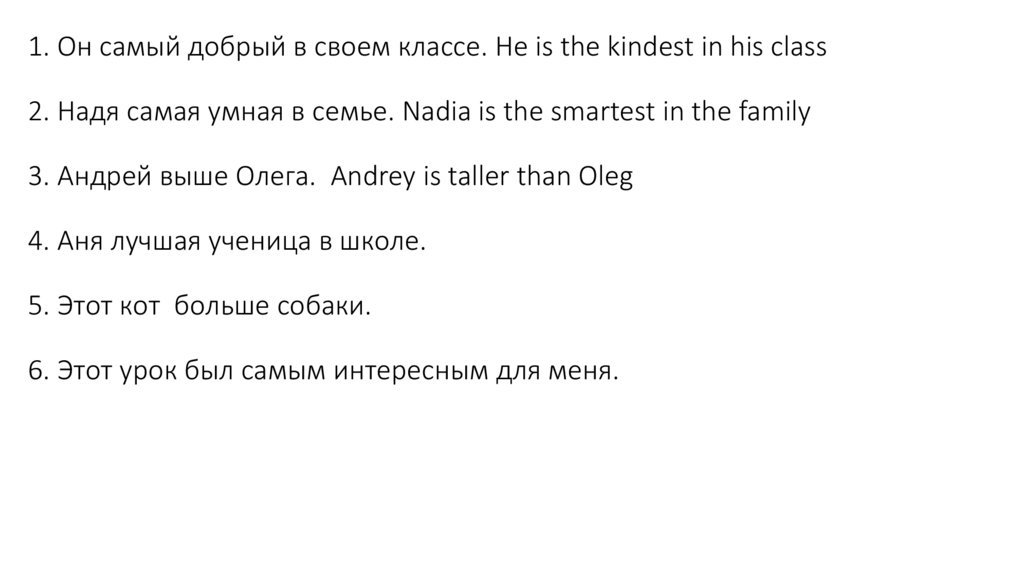
28. 1. Он самый добрый в своем классе. He is the kindest in his class 2. Надя самая умная в семье. Nadia is the smartest in the
family3. Андрей выше Олега. Andrey is taller than Oleg
4. Аня лучшая ученица в школе. Anna is the best student at school
5. Этот кот больше собаки. The cat is bigger than the dog
6. Этот урок был самым интересным для меня. This lesson was the
most interesting for me
29.
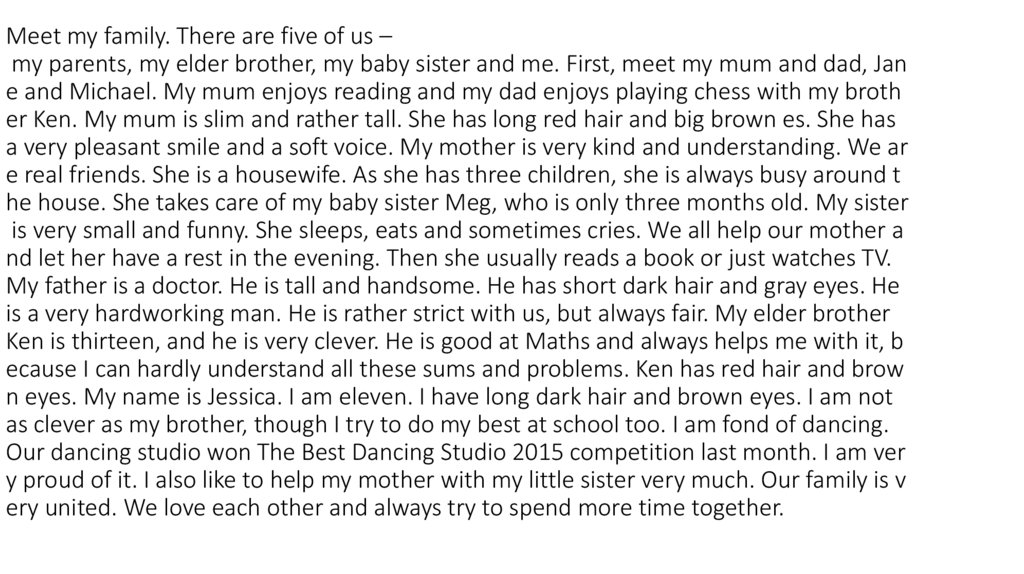
Meet my family. There are five of us –my parents, my elder brother, my baby sister and me. First, meet my mum and dad, Jan
e and Michael. My mum enjoys reading and my dad enjoys playing chess with my broth
er Ken. My mum is slim and rather tall. She has long red hair and big brown es. She has
a very pleasant smile and a soft voice. My mother is very kind and understanding. We ar
e real friends. She is a housewife. As she has three children, she is always busy around t
he house. She takes care of my baby sister Meg, who is only three months old. My sister
is very small and funny. She sleeps, eats and sometimes cries. We all help our mother a
nd let her have a rest in the evening. Then she usually reads a book or just watches TV.
My father is a doctor. He is tall and handsome. He has short dark hair and gray eyes. He
is a very hardworking man. He is rather strict with us, but always fair. My elder brother
Ken is thirteen, and he is very clever. He is good at Maths and always helps me with it, b
ecause I can hardly understand all these sums and problems. Ken has red hair and brow
n eyes. My name is Jessica. I am eleven. I have long dark hair and brown eyes. I am not
as clever as my brother, though I try to do my best at school too. I am fond of dancing.
Our dancing studio won The Best Dancing Studio 2015 competition last month. I am ver
y proud of it. I also like to help my mother with my little sister very much. Our family is v
ery united. We love each other and always try to spend more time together.
30.
31. 1. I usually read magazines and books on vacation 2. You can also visit this falls and stay at your aunt’s 3. I can eat this
delicious food for hours4.in this photo I do sports
5. they spend a lot of time playing board
games
6. we learn difficult subjects at school this
year
7. we want to win in this team game
8. famous children often become
independent.
32. 1. Твои волосы длиннее моих. 2. Эта книга интереснее той. 3.Это самый большой отель в этом городе. 4.он самый счастливый
человек в мире.33. The British Museum has one of the largest libraries in the world. It has a copy of every book that is printed in the English
language, so that there are more thansix million books there. They receive nearly two thousand books and papers daily.
The British Museum Library has a very big collection of printed books and
manuscripts, both old and new. You can see beautifully illustrated old
manuscripts which they keep in glass cases.
You can also find there some of the first English books printed by Caxton. Caxton
was a printer who lived in the fifteenth century. He made the first printing-press
in England.
In the reading-room of the British Museum many famous men have read and
studied.
Charles Dickens, a very popular English writer and the author of 'David
Copperfield', 'Oliver Twist', 'Dombey and Son' and other books, spent a lot of
time in the British Museum Library.
34. London is the capital of Great Britain. More than six million people live in London. London lies on both banks of the river
Thames. It is the largest city in Europe andone of the largest cities in the world.
London is not only the capital of the country, it is also a very big port, one of the
greatest commercial centres in the world, a university city, and the seat of the
government of Great Britain.
The most important parts of London are: the City, the West End, the East End and
Westminster.
The City is the busiest part of London. People do business there. Only about ten
thousand people live there.
The West End is the richest part of London. You can find the best shops, theatres,
cinemas, museums, fine parks and squares there. Its houses and streets are the
finest in the capital. The rich people live in the West End.
The East End is the part of London where working people live. It is not so rich as
other parts of London and there are fewer parks there.
Westminster Abbey is one of the most beautiful buildings in London. There are many
monuments of great men there. Many great English scientists lie buried there;among them Newton, Darwin and Watt. In the Poets' Corner some of the English
poets and writers are buried.
35. .
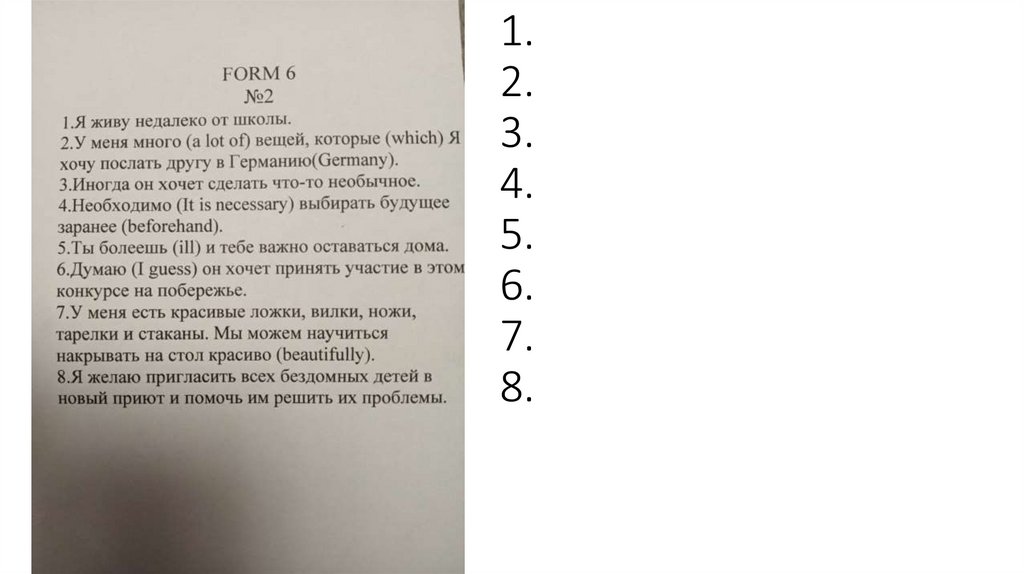
36. 1. 2. 3. 4. 5. 6. 7. 8.
37. .
38.
39. 1.
40. People in Great Britain like animals. There are even special hospitals, which help wild animals. There are a lot of television
films about wildlife. They are very popular withchildren and grown ups. A lot of British families have 'bird tables' in their gardens.
Birds can eat from them during the winter months. The 'bird table' should be high
because cats can eat birds.
The British often think their animals are like people. For example in Britain animals
can have jobs like people. British Rail has cats and pays them for their work. Their
job is to catch mice. There is usually one cat per station. They get food and free
medical help. The cats don't catch a lot of mice but they are very popular with the
British Rail staff and travellers.
41. Skiing is not very popular in Britain, as there is not much snow there. Basketball and volleyball are not very popular in
Britain, but many people play rugby.The British play cricket and netball. Cricket is a typically British sport. There are two teams
of eleven players. Matches last from one to five days.
Netball is similar to basketball. They are seven players (usually girls) in each team. They
throw the ball through the net at the top of three-meter post.
In winter boys play football or rugby, while girls play netball or hockey. In some schools boys
and girls play tennis.
42. Времена - https://langformula.ru/exercises/tenses-exercises/ Степени сравнения -
https://senglish.ru/uprazhneniya/stepeni-sravneniya-prilagatelnykh43.
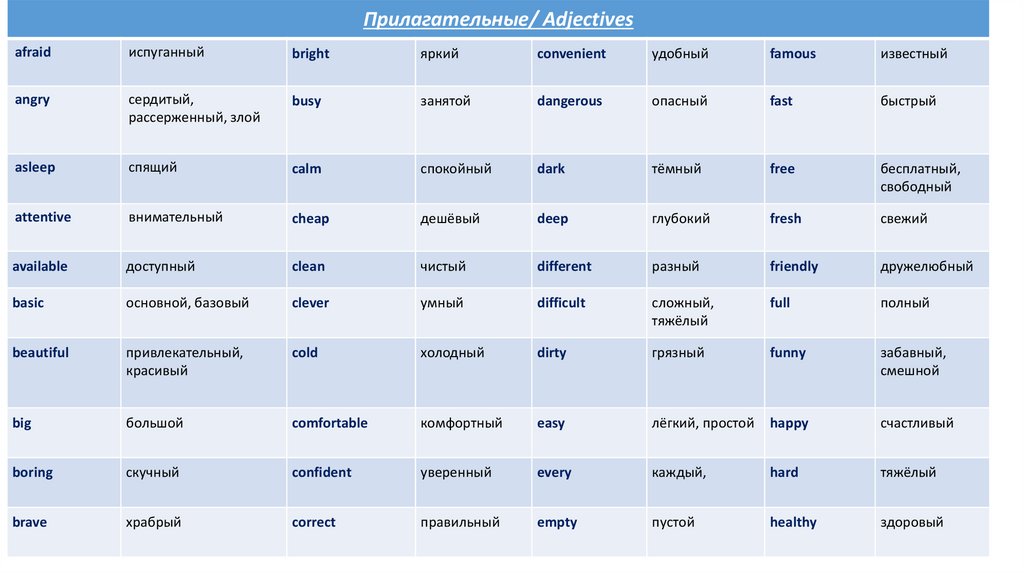
Прилагательные/ Adjectivesafraid
испуганный
bright
яркий
convenient
удобный
famous
известный
angry
сердитый,
рассерженный, злой
busy
занятой
dangerous
опасный
fast
быстрый
asleep
спящий
calm
спокойный
dark
тёмный
free
бесплатный,
свободный
attentive
внимательный
cheap
дешёвый
deep
глубокий
fresh
свежий
available
доступный
clean
чистый
different
разный
friendly
дружелюбный
basic
основной, базовый
clever
умный
difficult
сложный,
тяжёлый
full
полный
beautiful
привлекательный,
красивый
cold
холодный
dirty
грязный
funny
забавный,
смешной
big
большой
comfortable
комфортный
easy
лёгкий, простой
happy
счастливый
boring
скучный
confident
уверенный
every
каждый,
hard
тяжёлый
brave
храбрый
correct
правильный
empty
пустой
healthy
здоровый
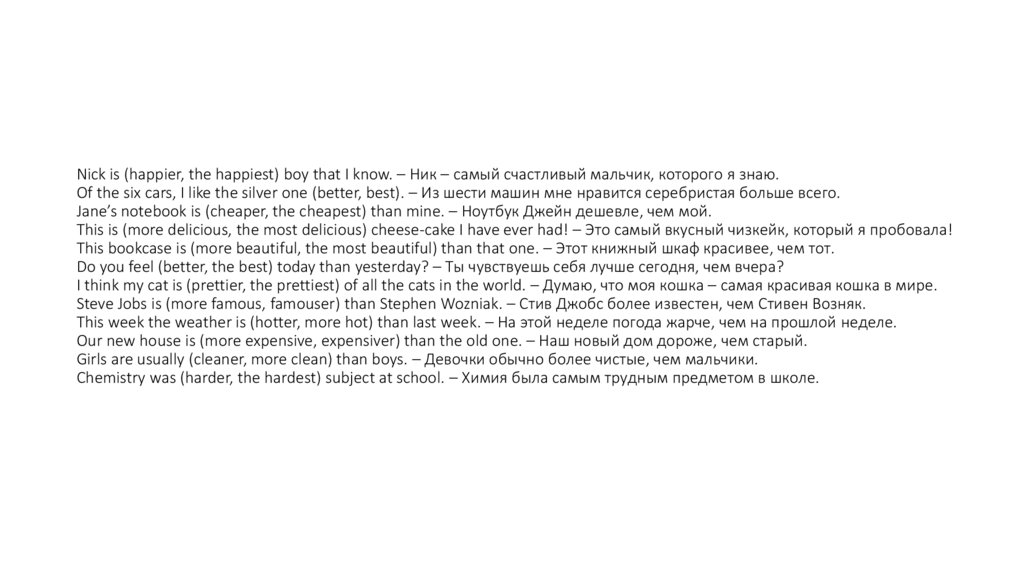
44. Nick is (happier, the happiest) boy that I know. – Ник – самый счастливый мальчик, которого я знаю. Of the six cars, I like the
silver one (better, best). – Из шести машин мне нравится серебристая больше всего.Jane’s notebook is (cheaper, the cheapest) than mine. – Ноутбук Джейн дешевле, чем мой.
This is (more delicious, the most delicious) cheese-cake I have ever had! – Это самый вкусный чизкейк, который я пробовала!
This bookcase is (more beautiful, the most beautiful) than that one. – Этот книжный шкаф красивее, чем тот.
Do you feel (better, the best) today than yesterday? – Ты чувствуешь себя лучше сегодня, чем вчера?
I think my cat is (prettier, the prettiest) of all the cats in the world. – Думаю, что моя кошка – самая красивая кошка в мире.
Steve Jobs is (more famous, famouser) than Stephen Wozniak. – Стив Джобс более известен, чем Стивен Возняк.
This week the weather is (hotter, more hot) than last week. – На этой неделе погода жарче, чем на прошлой неделе.
Our new house is (more expensive, expensiver) than the old one. – Наш новый дом дороже, чем старый.
Girls are usually (cleaner, more clean) than boys. – Девочки обычно более чистые, чем мальчики.
Chemistry was (harder, the hardest) subject at school. – Химия была самым трудным предметом в школе.
45.
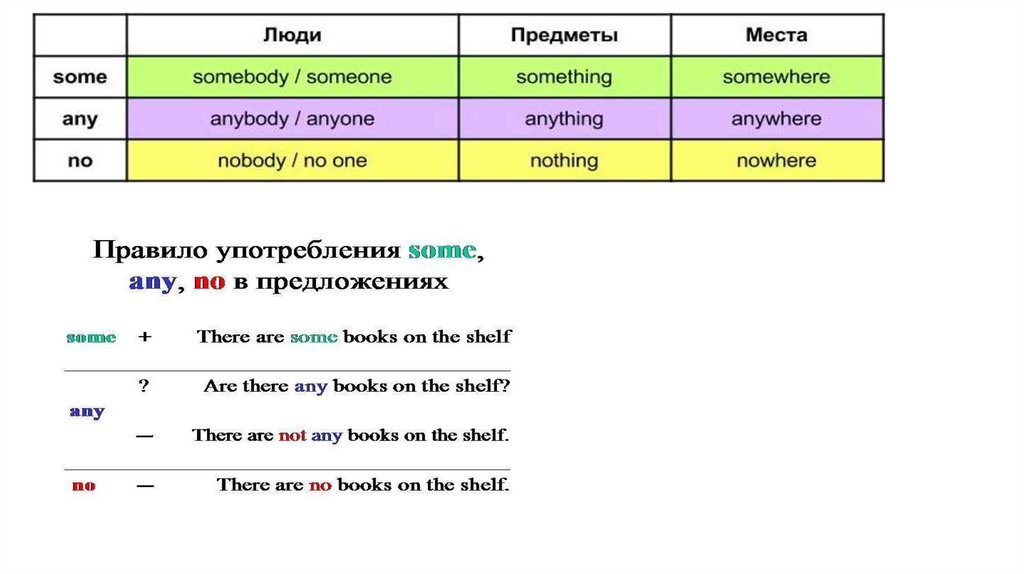
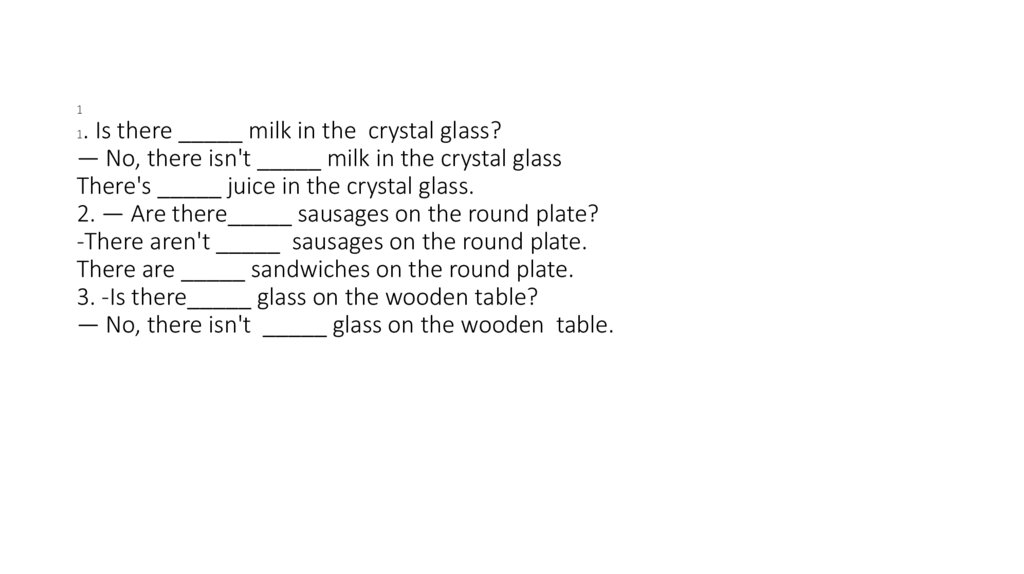
46. 1 1. Is there _____ milk in the crystal glass? — No, there isn't _____ milk in the crystal glass There's _____ juice in the
1. Is there _____ milk in the crystal glass?
— No, there isn't _____ milk in the crystal glass
There's _____ juice in the crystal glass.
2. — Are there_____ sausages on the round plate?
-There aren't _____ sausages on the round plate.
There are _____ sandwiches on the round plate.
3. -Is there_____ glass on the wooden table?
— No, there isn't _____ glass on the wooden table.
1
47. Exercise (2). Write in a, an, some, any. 1.There's __an____angel on the top. 2.There are ______ornaments on the tree. 3.Are
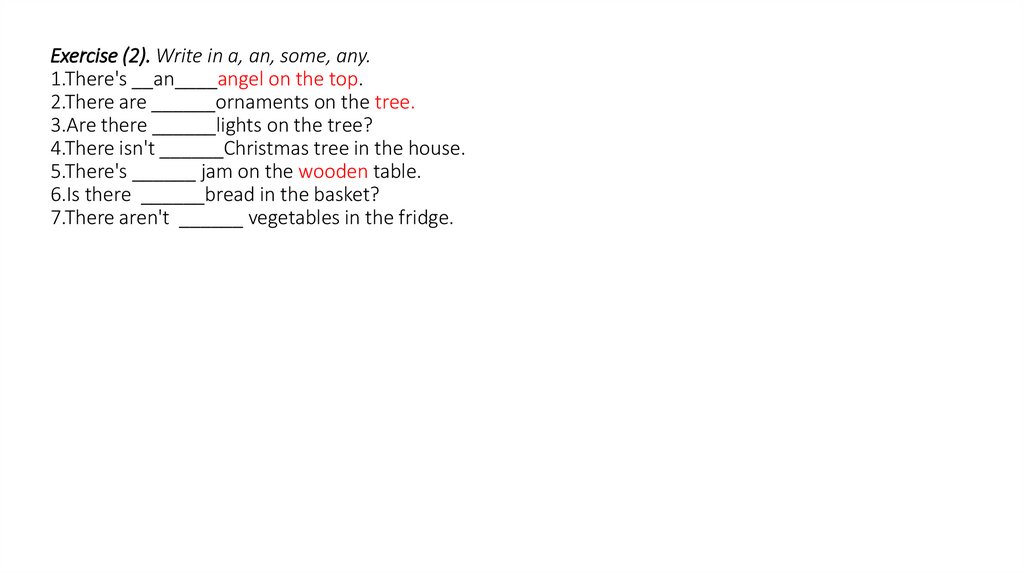
Exercise (2). Write in a, an, some, any.1.There's __an____angel on the top.
2.There are ______ornaments on the tree.
3.Are there ______lights on the tree?
4.There isn't ______Christmas tree in the house.
5.There's ______ jam on the wooden table.
6.Is there ______bread in the basket?
7.There aren't ______ vegetables in the fridge.
48. Exercise 3. Complete the sentences with some/any/no. 1.There is _______ tea in the crystal glass, but it is very hot. 2.There
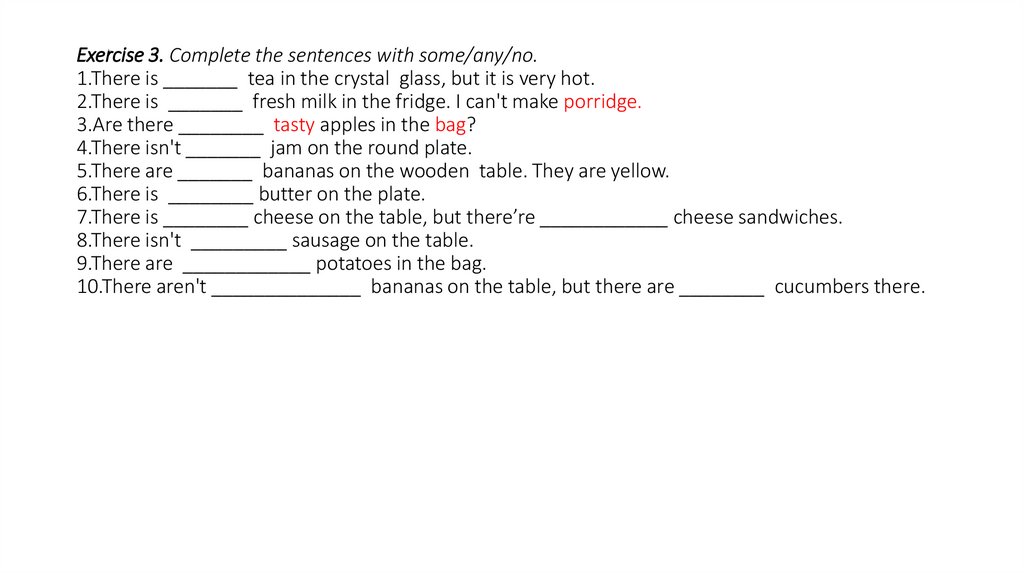
Exercise 3. Complete the sentences with some/any/no.1.There is _______ tea in the crystal glass, but it is very hot.
2.There is _______ fresh milk in the fridge. I can't make porridge.
3.Are there ________ tasty apples in the bag?
4.There isn't _______ jam on the round plate.
5.There are _______ bananas on the wooden table. They are yellow.
6.There is ________ butter on the plate.
7.There is ________ cheese on the table, but there’re ____________ cheese sandwiches.
8.There isn't _________ sausage on the table.
9.There are ____________ potatoes in the bag.
10.There aren't ______________ bananas on the table, but there are ________ cucumbers there.
49. Exercise 6. Choose the correct item. Is there some/any butter in the fridge? There isn't any/no bread in the bag. There are
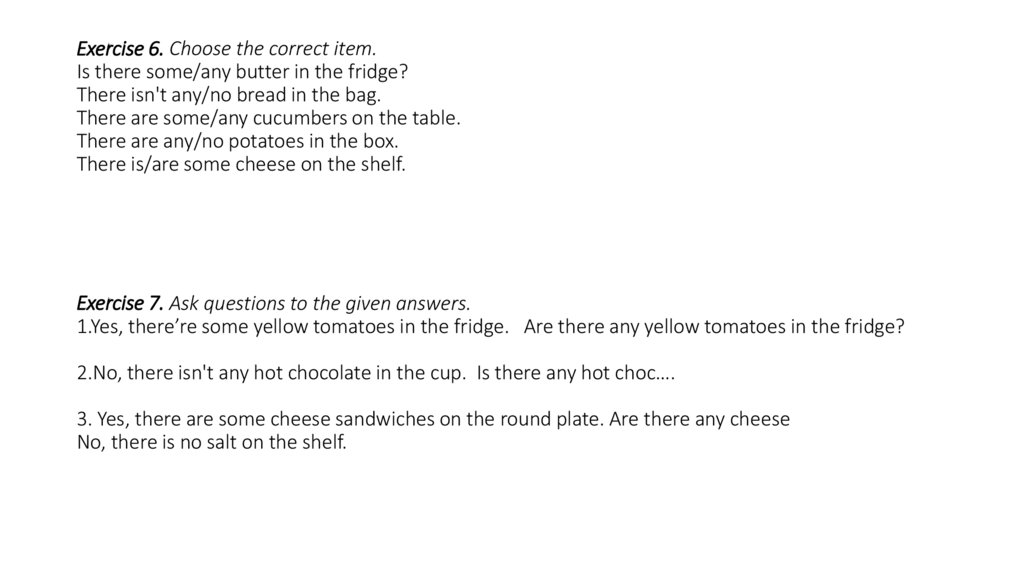
Exercise 6. Choose the correct item.Is there some/any butter in the fridge?
There isn't any/no bread in the bag.
There are some/any cucumbers on the table.
There are any/no potatoes in the box.
There is/are some cheese on the shelf.
Exercise 7. Ask questions to the given answers.
1.Yes, there’re some yellow tomatoes in the fridge. Are there any yellow tomatoes in the fridge?
2.No, there isn't any hot chocolate in the cup. Is there any hot choc….
3. Yes, there are some cheese sandwiches on the round plate. Are there any cheese
No, there is no salt on the shelf.
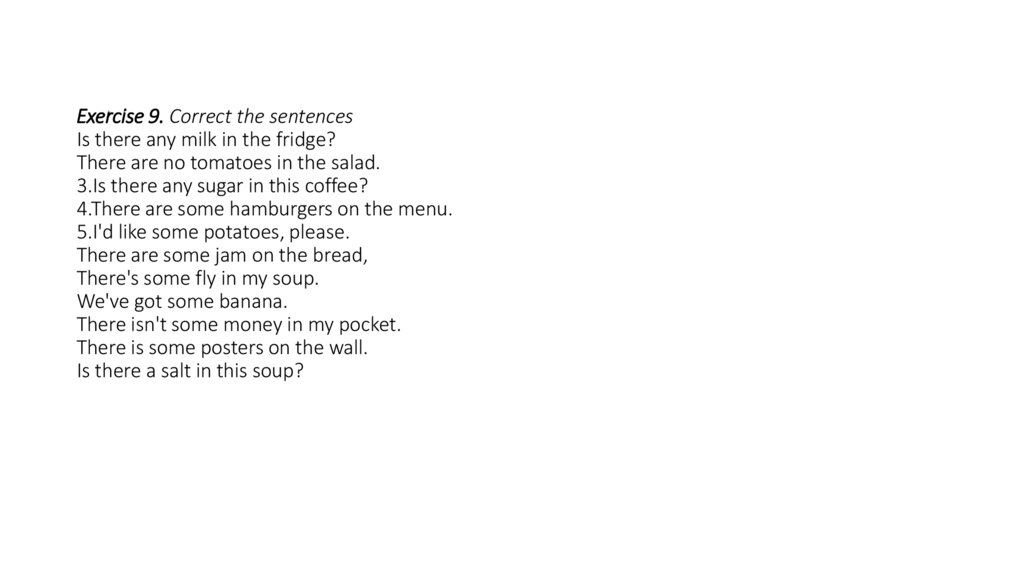
50. Exercise 9. Correct the sentences Is there any milk in the fridge? There are no tomatoes in the salad. 3.Is there any sugar in
Exercise 9. Correct the sentencesIs there any milk in the fridge?
There are no tomatoes in the salad.
3.Is there any sugar in this coffee?
4.There are some hamburgers on the menu.
5.I'd like some potatoes, please.
There are some jam on the bread,
There's some fly in my soup.
We've got some banana.
There isn't some money in my pocket.
There is some posters on the wall.
Is there a salt in this soup?
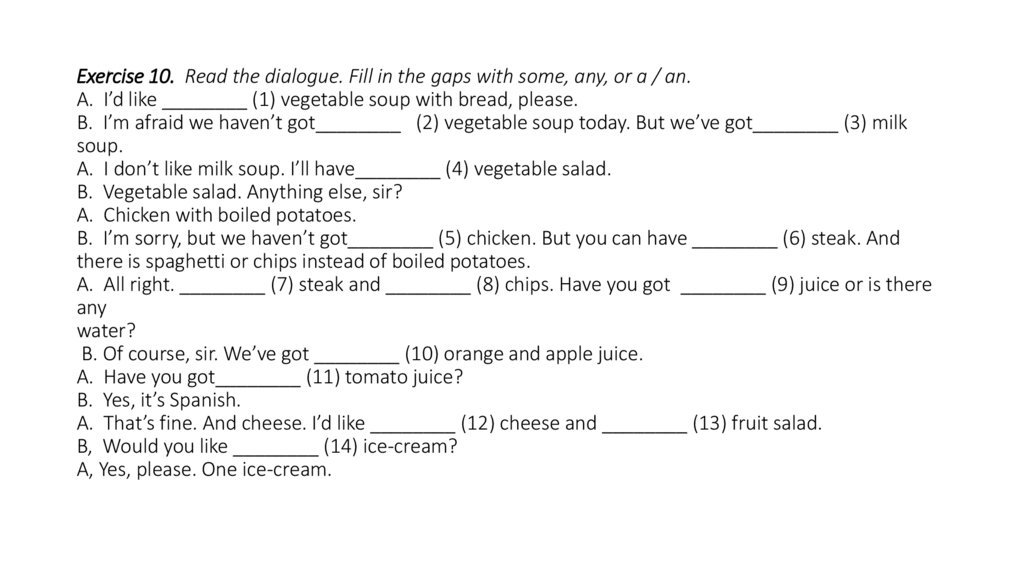
51. Exercise 10. Read the dialogue. Fill in the gaps with some, any, or a / an. A. I’d like ________ (1) vegetable soup with
Exercise 10. Read the dialogue. Fill in the gaps with some, any, or a / an.A. I’d like ________ (1) vegetable soup with bread, please.
B. I’m afraid we haven’t got________ (2) vegetable soup today. But we’ve got________ (3) milk
soup.
A. I don’t like milk soup. I’ll have________ (4) vegetable salad.
B. Vegetable salad. Anything else, sir?
A. Chicken with boiled potatoes.
B. I’m sorry, but we haven’t got________ (5) chicken. But you can have ________ (6) steak. And
there is spaghetti or chips instead of boiled potatoes.
A. All right. ________ (7) steak and ________ (8) chips. Have you got ________ (9) juice or is there
any
water?
B. Of course, sir. We’ve got ________ (10) orange and apple juice.
A. Have you got________ (11) tomato juice?
B. Yes, it’s Spanish.
A. That’s fine. And cheese. I’d like ________ (12) cheese and ________ (13) fruit salad.
B, Would you like ________ (14) ice-cream?
A, Yes, please. One ice-cream.
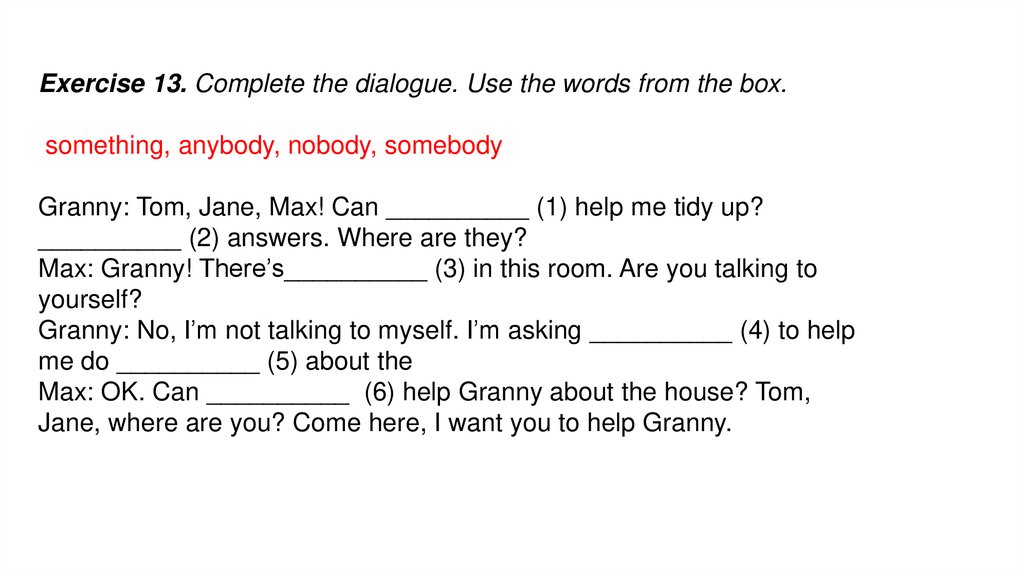
52. Exercise 13. Complete the dialogue. Use the words from the box. something, anybody, nobody, somebody Granny: Tom, Jane, Max!
Exercise 13. Complete the dialogue. Use the words from the box.something, anybody, nobody, somebody
Granny: Tom, Jane, Max! Can __________ (1) help me tidy up?
__________ (2) answers. Where are they?
Max: Granny! There’s__________ (3) in this room. Are you talking to
yourself?
Granny: No, I’m not talking to myself. I’m asking __________ (4) to help
me do __________ (5) about the
Max: OK. Can __________ (6) help Granny about the house? Tom,
Jane, where are you? Come here, I want you to help Granny.
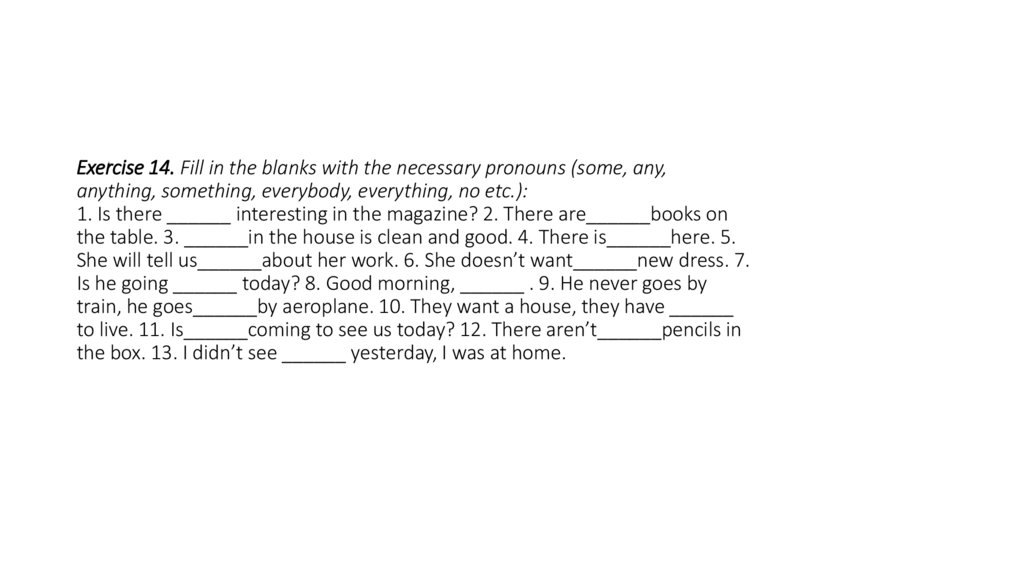
53. Exercise 14. Fill in the blanks with the necessary pronouns (some, any, anything, something, everybody, everything, no etc.):
Exercise 14. Fill in the blanks with the necessary pronouns (some, any,anything, something, everybody, everything, no etc.):
1. Is there ______ interesting in the magazine? 2. There are______books on
the table. 3. ______in the house is clean and good. 4. There is______here. 5.
She will tell us______about her work. 6. She doesn’t want______new dress. 7.
Is he going ______ today? 8. Good morning, ______ . 9. He never goes by
train, he goes______by aeroplane. 10. They want a house, they have ______
to live. 11. Is______coming to see us today? 12. There aren’t______pencils in
the box. 13. I didn’t see ______ yesterday, I was at home.
54.
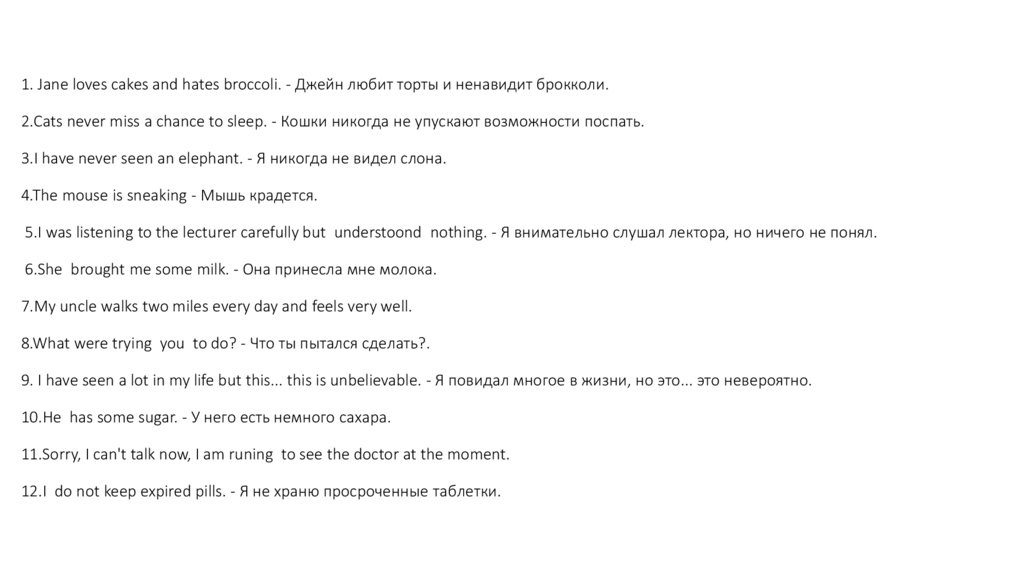
55. 1. Jane loves cakes and hates broccoli. - Джейн любит торты и ненавидит брокколи. 2.Cats never miss a chance to sleep. - Кошки
1. Jane loves cakes and hates broccoli. - Джейн любит торты и ненавидит брокколи.2.Cats never miss a chance to sleep. - Кошки никогда не упускают возможности поспать.
3.I have never seen an elephant. - Я никогда не видел слона.
4.The mouse is sneaking - Мышь крадется.
5.I was listening to the lecturer carefully but understoond nothing. - Я внимательно слушал лектора, но ничего не понял.
6.She brought me some milk. - Она принесла мне молока.
7.My uncle walks two miles every day and feels very well.
8.What were trying you to do? - Что ты пытался сделать?.
9. I have seen a lot in my life but this... this is unbelievable. - Я повидал многое в жизни, но это... это невероятно.
10.He has some sugar. - У него есть немного сахара.
11.Sorry, I can't talk now, I am runing to see the doctor at the moment.
12.I do not keep expired pills. - Я не храню просроченные таблетки.
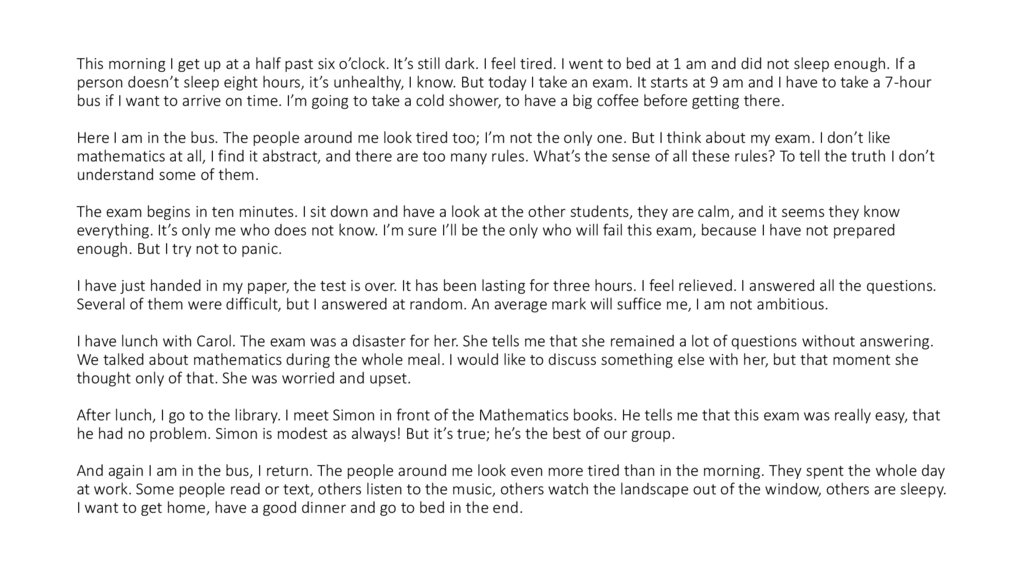
56. This morning I get up at a half past six o’clock. It’s still dark. I feel tired. I went to bed at 1 am and did not sleep
enough. If aperson doesn’t sleep eight hours, it’s unhealthy, I know. But today I take an exam. It starts at 9 am and I have to take a 7-hour
bus if I want to arrive on time. I’m going to take a cold shower, to have a big coffee before getting there.
Here I am in the bus. The people around me look tired too; I’m not the only one. But I think about my exam. I don’t like
mathematics at all, I find it abstract, and there are too many rules. What’s the sense of all these rules? To tell the truth I don’t
understand some of them.
The exam begins in ten minutes. I sit down and have a look at the other students, they are calm, and it seems they know
everything. It’s only me who does not know. I’m sure I’ll be the only who will fail this exam, because I have not prepared
enough. But I try not to panic.
I have just handed in my paper, the test is over. It has been lasting for three hours. I feel relieved. I answered all the questions.
Several of them were difficult, but I answered at random. An average mark will suffice me, I am not ambitious.
I have lunch with Carol. The exam was a disaster for her. She tells me that she remained a lot of questions without answering.
We talked about mathematics during the whole meal. I would like to discuss something else with her, but that moment she
thought only of that. She was worried and upset.
After lunch, I go to the library. I meet Simon in front of the Mathematics books. He tells me that this exam was really easy, that
he had no problem. Simon is modest as always! But it’s true; he’s the best of our group.
And again I am in the bus, I return. The people around me look even more tired than in the morning. They spent the whole day
at work. Some people read or text, others listen to the music, others watch the landscape out of the window, others are sleepy.
I want to get home, have a good dinner and go to bed in the end.