 management
 business
Similar presentations:






Focus List (04.07.2025)
1. Amazon (AMZN)
P/E TTM 33,9x vs its 5-year average of 68.7x, Target Price (Bloomberg cons): $242 (upside potential 9%)Company profile:
• Amazon.com is a global technology and retail giant operating across several key segments,
including e-commerce, cloud computing (via Amazon Web Services), digital advertising,
subscription services, and logistics. AWS is the company's most profitable division, holding
around 31% of the global cloud market in 2024 and serving enterprise, government, and
startup clients worldwide. Amazon's retail operations span both online and physical stores
and are supported by one of the world’s most advanced fulfillment and delivery networks.
The company also generates significant revenue from its high-margin advertising business
and a wide range of subscription offerings.
Investment case:
• In the short term (12–24 months), Amazon’s key revenue and profit drivers include the
stabilization and renewed growth of AWS, driven by rising demand for AI-related cloud services
such as model training and custom chips. The company’s advertising segment is another highmargin growth engine, benefiting from consumer recovery on the back of easing inflation and
increased video content monetization.
• The company continues to deliver robust revenue and profit growth, with AWS remaining a
high-margin engine and advertising revenues expanding rapidly—up 19% yoy in Q1 2025.
• Over the long term, Amazon is positioned to benefit from broader adoption of enterprise AI
solutions through AWS, especially as it develops proprietary infrastructure like Trainium and
Inferentia chips. Global expansion in e-commerce will open new revenue streams. In
healthcare, Amazon's investments in One Medical and Amazon Pharmacy aim to disrupt
traditional models and create recurring, high-margin service income.
The main risks: regulatory pressure, rising competition in cloud computing, margin
challenges in retail, and macroeconomic headwinds.
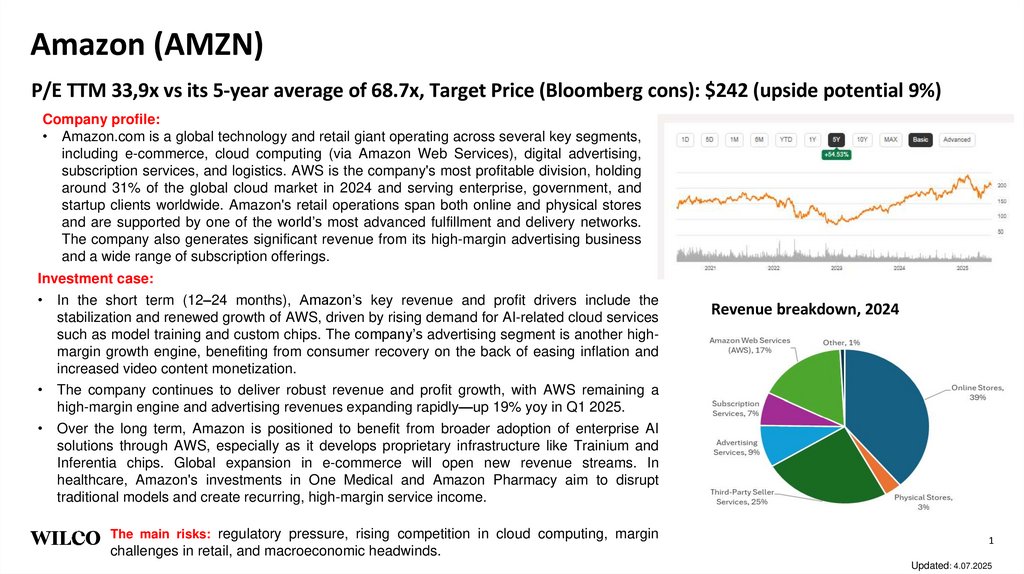
Revenue breakdown, 2024
1
Updated: 4.07.2025
2. OppFi (OPFI)
P/E FWD 11,7x vs its 5-year average of 73.7x, Target Price (Bloomberg cons): $14.6 (upside potential 7%)Company profile:
• OppFi Inc. is a U.S.-based financial technology platform focused on providing accessible credit
products to underbanked and non-prime consumers (those who have limited or poor credit history).
The company leverages data science, AI, and alternative underwriting to approve customers who
may be underserved by traditional banks or credit card issuers. Its flagship product, OppLoans, is a
small-dollar installment loan offering designed to be a more affordable and transparent alternative to
payday loans. OppFi operates under a bank partnership model and uses its proprietary platform to
originate, service, and collect on loans.
Investment case:
• In the short term (6–18 months), OppFi’s performance will be driven primarily by growth in its core
OppLoans product, which remains the company’s main source of revenue. Increasing loan
originations, while maintaining strong credit performance, is key to sustaining top-line growth and
protecting margins. Managing delinquency rates and optimizing collections are especially important in
the current high-rate environment and subprime credit segment. Operational efficiency and disciplined
cost control will also play a critical role in stabilizing earnings. Deepening relationships with partner
banks is also essential to maintaining lending capacity across jurisdictions.
• Looking at the long term, OppFi’s success will depend on its ability to diversify beyond OppLoans.
Emerging products like SalaryTap, which offers payroll-deducted loans, and the OppFi Card, a creditbuilding product, could provide more sustainable, lower-risk revenue streams and reduce reliance on
high-APR installment lending. The company’s proprietary AI-driven underwriting platform is another
critical long-term asset, enabling more precise risk scoring and broader borrower approval without
sacrificing credit quality. OppFi is well-positioned to serve the 60+ million U.S. consumers
underserved by traditional credit systems (currently serves over 2 million applicants).
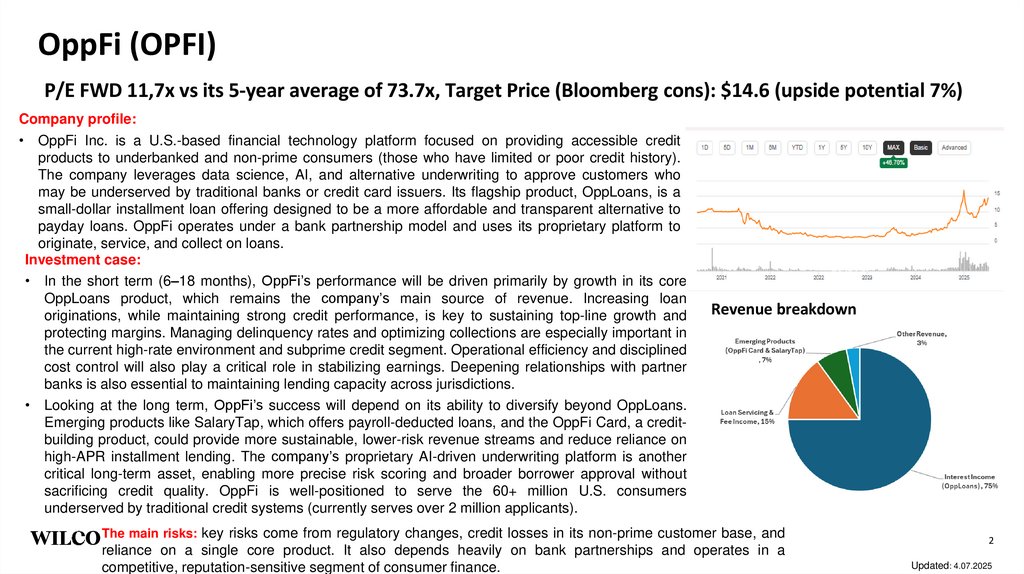
Revenue breakdown
The main risks: key risks come from regulatory changes, credit losses in its non-prime customer base, and
reliance on a single core product. It also depends heavily on bank partnerships and operates in a
competitive, reputation-sensitive segment of consumer finance.
2
Updated: 4.07.2025
3. Novo Nordisk A/S (NVO)
P/E FWD 16,4x vs its 5-year average of 31.0x, Target Price (Bloomberg cons): $85 (upside potential 23%)Company profile:
• Novo Nordisk is a global healthcare company based in Denmark, specializing in the
development and manufacturing of treatments for diabetes, obesity, and other chronic diseases.
Founded in 1923, the company is a market leader in insulin and GLP-1 therapies, with
blockbuster drugs like Ozempic and Wegovy driving significant growth. Novo Nordisk combines
strong R&D capabilities with global scale and a focus on chronic metabolic conditions, making it
one of the most valuable pharmaceutical companies in the world. Its expanding obesity portfolio
and pipeline of cardiometabolic treatments position it for long-term growth.
Investment case:
• In the short term, Novo Nordisk’s revenue growth is driven primarily by surging global demand
for its GLP-1-based therapies, especially Ozempic (for type 2 diabetes) and Wegovy (for
obesity). The company continues to expand production capacity to meet overwhelming demand
in both the U.S. and international markets. Pricing power, strong prescription growth, and
geographic expansion are boosting near-term sales, while newer formulations like once-weekly
insulins and oral GLP-1s also contribute incremental revenue. Strong performance in North
America remains the core engine in the immediate outlook.
• Over the long term, Novo Nordisk’s revenue potential will be supported by its leadership in
obesity treatment, an underpenetrated and rapidly growing global market projected to exceed
$170 billion by the 2030s. The company is also advancing a robust pipeline targeting
cardiovascular, kidney, and Alzheimer’s-related metabolic diseases, aiming to broaden its
therapeutic scope.
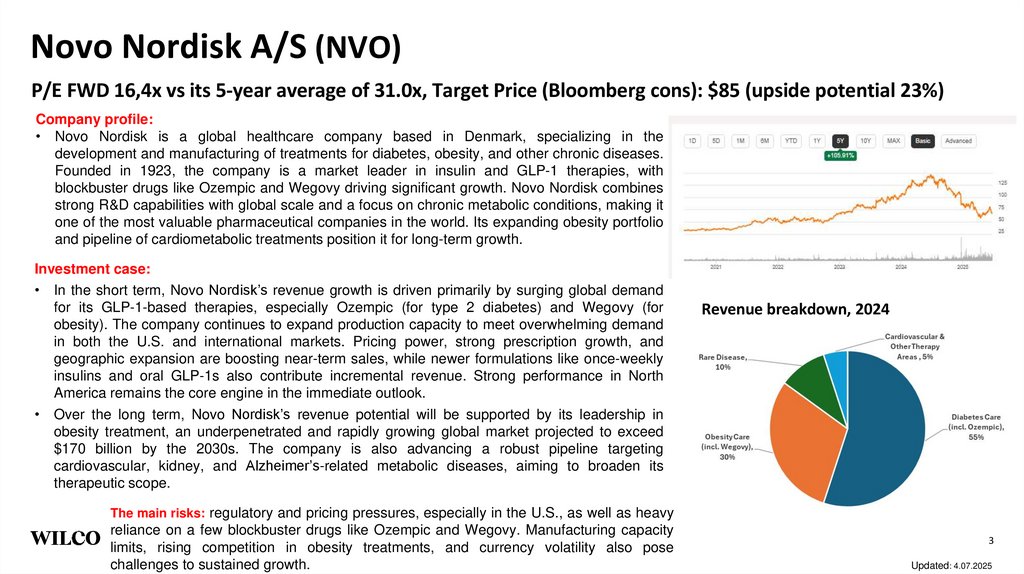
Revenue breakdown, 2024
The main risks: regulatory and pricing pressures, especially in the U.S., as well as heavy
reliance on a few blockbuster drugs like Ozempic and Wegovy. Manufacturing capacity
limits, rising competition in obesity treatments, and currency volatility also pose
challenges to sustained growth.
3
Updated: 4.07.2025
4. The Utilities Select Sector SPDR Fund ETF (XLU)
Investment yield: 2,83%; AUM $18,75 blnETF profile:
• XLU provides exposure to the U.S. utilities sector, including electric, gas, and water utility
companies. It tracks the Utilities Select Sector Index, which is made up of large, stable firms such
as NextEra Energy, Duke Energy, and Southern Company. XLU is commonly used by investors
seeking defensive positioning, stable dividends, and lower volatility—particularly during periods of
economic uncertainty or market downturns. The fund is known for its consistent income
generation and lower beta, making it a popular choice for conservative, income-focused portfolios.
Investment case:
• In the short term, XLU may benefit from a rotation into defensive sectors as investors respond to
economic uncertainty, slowing growth, or market volatility. Utilities are traditionally viewed as safehaven assets due to their stable cash flows and regulated business models, which can support
performance during periods of risk-off sentiment. Additionally, falling interest rates or expectations
of rate cuts tend to boost utility stocks, as lower yields make their dividends more attractive in
relative terms.
• Over the long term, XLU is supported by structural trends such as the transition to clean energy,
electrification, and infrastructure modernization. Utilities are at the center of the energy
transformation, investing in renewables, grid upgrades, and smart infrastructure, which can drive
rate base growth and long-term earnings expansion. As demand for electricity rises—driven by
data centers, EVs, and AI—regulated utilities may benefit from consistent capital investment
opportunities and growing returns.
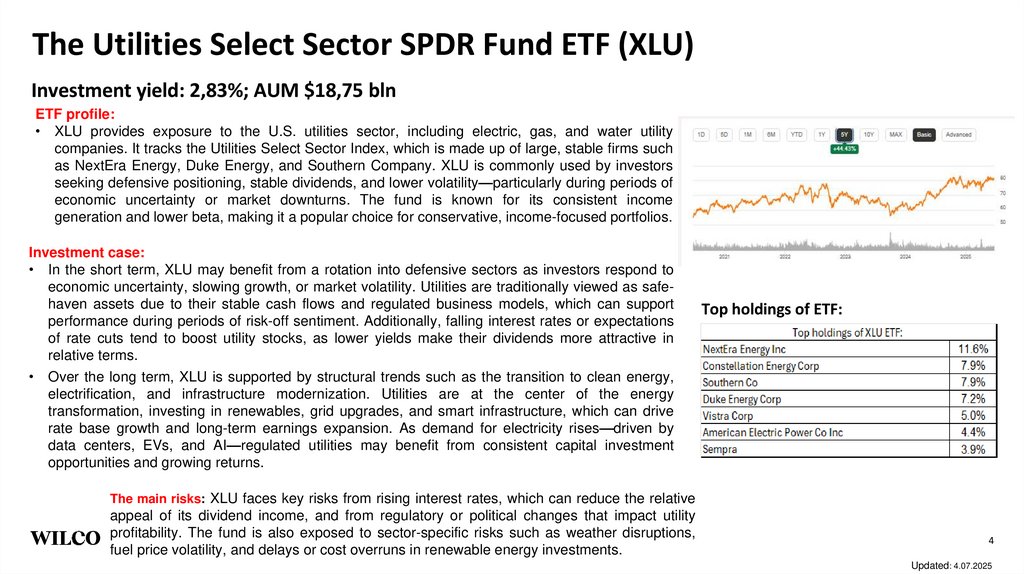
Top holdings of ETF:
The main risks: XLU faces key risks from rising interest rates, which can reduce the relative
appeal of its dividend income, and from regulatory or political changes that impact utility
profitability. The fund is also exposed to sector-specific risks such as weather disruptions,
fuel price volatility, and delays or cost overruns in renewable energy investments.
4
Updated: 4.07.2025
5. VanEck Gold Miners ETF (GDX)
Investment yield: 0,78%; AUM $15.74 blnETF profile:
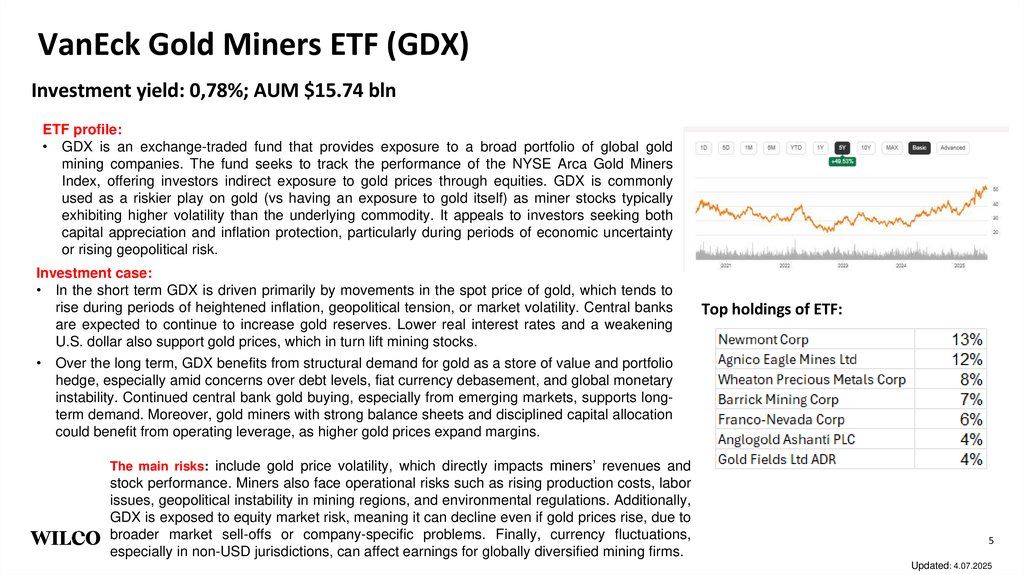
• GDX is an exchange-traded fund that provides exposure to a broad portfolio of global gold
mining companies. The fund seeks to track the performance of the NYSE Arca Gold Miners
Index, offering investors indirect exposure to gold prices through equities. GDX is commonly
used as a riskier play on gold (vs having an exposure to gold itself) as miner stocks typically
exhibiting higher volatility than the underlying commodity. It appeals to investors seeking both
capital appreciation and inflation protection, particularly during periods of economic uncertainty
or rising geopolitical risk.
Investment case:
• In the short term GDX is driven primarily by movements in the spot price of gold, which tends to
rise during periods of heightened inflation, geopolitical tension, or market volatility. Central banks
are expected to continue to increase gold reserves. Lower real interest rates and a weakening
U.S. dollar also support gold prices, which in turn lift mining stocks.
• Over the long term, GDX benefits from structural demand for gold as a store of value and portfolio
hedge, especially amid concerns over debt levels, fiat currency debasement, and global monetary
instability. Continued central bank gold buying, especially from emerging markets, supports longterm demand. Moreover, gold miners with strong balance sheets and disciplined capital allocation
could benefit from operating leverage, as higher gold prices expand margins.
Top holdings of ETF:
The main risks: include gold price volatility, which directly impacts miners’ revenues and
stock performance. Miners also face operational risks such as rising production costs, labor
issues, geopolitical instability in mining regions, and environmental regulations. Additionally,
GDX is exposed to equity market risk, meaning it can decline even if gold prices rise, due to
broader market sell-offs or company-specific problems. Finally, currency fluctuations,
especially in non-USD jurisdictions, can affect earnings for globally diversified mining firms.
5
Updated: 4.07.2025
6. iShares Bitcoin Trust ETF (IBIT)
Investment yield: 0%; AUM $74.5 blnETF profile:
• The IBIT is a U.S.-listed spot Bitcoin ETF launched by BlackRock, designed to provide investors
with direct exposure to the price of Bitcoin without needing to own or manage the cryptocurrency
themselves. It holds physical Bitcoin in custody. IBIT trades on the NASDAQ and is aimed at
both retail and institutional investors seeking Bitcoin exposure within traditional brokerage
accounts. As a product from the world’s largest asset manager, IBIT benefits from strong
credibility, transparent structure, and robust custody arrangements.
Investment case:
• In the short term the price of Bitcoin is likely to be driven by demand from retail and institutional
investors with inflows accelerating as traditional investors seek crypto exposure through regulated
channels. Regulatory clarity and crypto-friendly policies, especially in the U.S. following the 2024
presidential election will boost investor confidence and legitimized Bitcoin as an asset class.
Public companies and even some sovereign entities are expected to increase bitcoin holdings,
with MicroStrategy and others making large purchases, further reducing circulating supply and
signaling long-term confidence in bitcoin’s value. Traditional banks such as JPMorgan are moving
into the crypto industry.
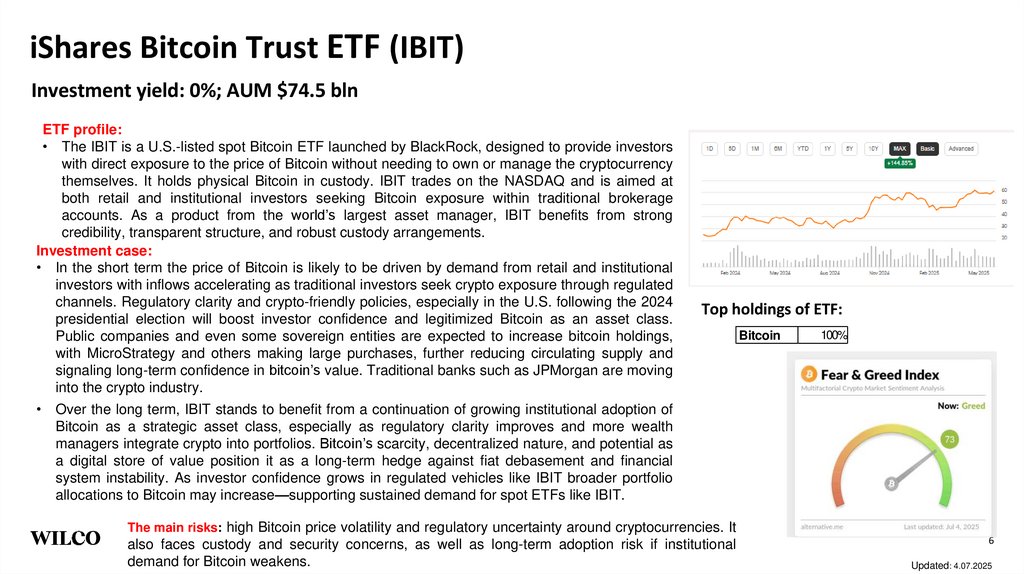
Top holdings of ETF:
Bitcoin
100%
• Over the long term, IBIT stands to benefit from a continuation of growing institutional adoption of
Bitcoin as a strategic asset class, especially as regulatory clarity improves and more wealth
managers integrate crypto into portfolios. Bitcoin’s scarcity, decentralized nature, and potential as
a digital store of value position it as a long-term hedge against fiat debasement and financial
system instability. As investor confidence grows in regulated vehicles like IBIT broader portfolio
allocations to Bitcoin may increase—supporting sustained demand for spot ETFs like IBIT.
The main risks: high Bitcoin price volatility and regulatory uncertainty around cryptocurrencies. It
also faces custody and security concerns, as well as long-term adoption risk if institutional
demand for Bitcoin weakens.
6
Updated: 4.07.2025
7. Siemens Aktiengesellschaft (SIEGY )
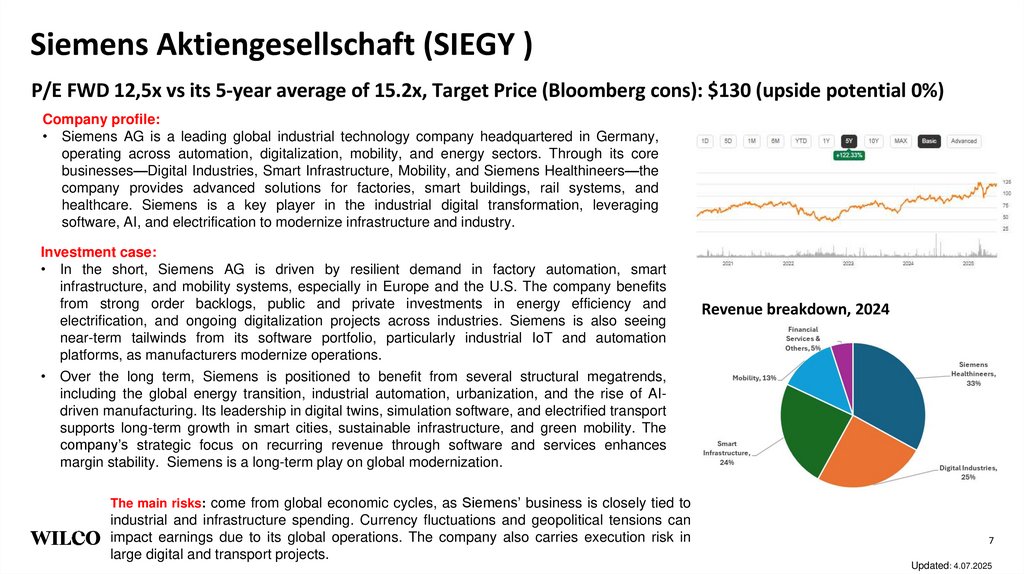
P/E FWD 12,5x vs its 5-year average of 15.2x, Target Price (Bloomberg cons): $130 (upside potential 0%)Company profile:
• Siemens AG is a leading global industrial technology company headquartered in Germany,
operating across automation, digitalization, mobility, and energy sectors. Through its core
businesses—Digital Industries, Smart Infrastructure, Mobility, and Siemens Healthineers—the
company provides advanced solutions for factories, smart buildings, rail systems, and
healthcare. Siemens is a key player in the industrial digital transformation, leveraging
software, AI, and electrification to modernize infrastructure and industry.
Investment case:
• In the short, Siemens AG is driven by resilient demand in factory automation, smart
infrastructure, and mobility systems, especially in Europe and the U.S. The company benefits
from strong order backlogs, public and private investments in energy efficiency and
electrification, and ongoing digitalization projects across industries. Siemens is also seeing
near-term tailwinds from its software portfolio, particularly industrial IoT and automation
platforms, as manufacturers modernize operations.
• Over the long term, Siemens is positioned to benefit from several structural megatrends,
including the global energy transition, industrial automation, urbanization, and the rise of AIdriven manufacturing. Its leadership in digital twins, simulation software, and electrified transport
supports long-term growth in smart cities, sustainable infrastructure, and green mobility. The
company’s strategic focus on recurring revenue through software and services enhances
margin stability. Siemens is a long-term play on global modernization.
Revenue breakdown, 2024
The main risks: come from global economic cycles, as Siemens’ business is closely tied to
industrial and infrastructure spending. Currency fluctuations and geopolitical tensions can
impact earnings due to its global operations. The company also carries execution risk in
large digital and transport projects.
7
Updated: 4.07.2025
8. AppLovin Corporation (APP)
P/E FWD 40x vs its 5-year average of 30x, Target Price (Bloomberg cons): $466 (upside potential 37%)Company profile:
• Applovin Corporation is a leading U.S.-based technology company that specializes in mobile app
monetization and marketing solutions. Through its proprietary platform, AppLovin helps
developers optimize user acquisition, in-app advertising, and revenue generation using advanced
machine learning and real-time analytics. The company operates both a software platform
(including the AXON ad engine) and a portfolio of owned mobile games, giving it vertical
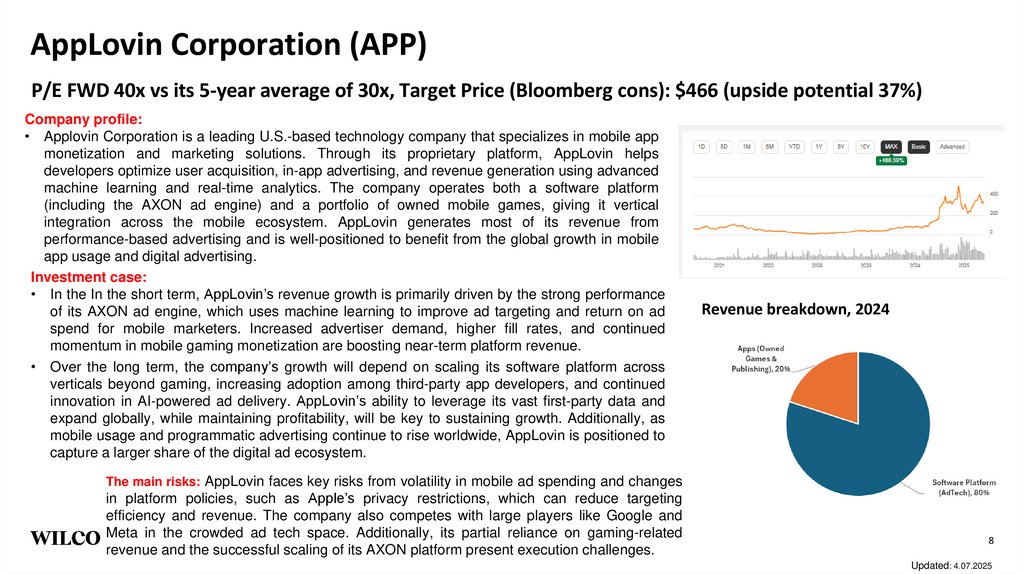
integration across the mobile ecosystem. AppLovin generates most of its revenue from
performance-based advertising and is well-positioned to benefit from the global growth in mobile
app usage and digital advertising.
Investment case:
• In the In the short term, AppLovin’s revenue growth is primarily driven by the strong performance
of its AXON ad engine, which uses machine learning to improve ad targeting and return on ad
spend for mobile marketers. Increased advertiser demand, higher fill rates, and continued
momentum in mobile gaming monetization are boosting near-term platform revenue.
• Over the long term, the company’s growth will depend on scaling its software platform across
verticals beyond gaming, increasing adoption among third-party app developers, and continued
innovation in AI-powered ad delivery. AppLovin’s ability to leverage its vast first-party data and
expand globally, while maintaining profitability, will be key to sustaining growth. Additionally, as
mobile usage and programmatic advertising continue to rise worldwide, AppLovin is positioned to
capture a larger share of the digital ad ecosystem.
Revenue breakdown, 2024
The main risks: AppLovin faces key risks from volatility in mobile ad spending and changes
in platform policies, such as Apple’s privacy restrictions, which can reduce targeting
efficiency and revenue. The company also competes with large players like Google and
Meta in the crowded ad tech space. Additionally, its partial reliance on gaming-related
revenue and the successful scaling of its AXON platform present execution challenges.
8
Updated: 4.07.2025
9. UnitedHealth Group (UNH)
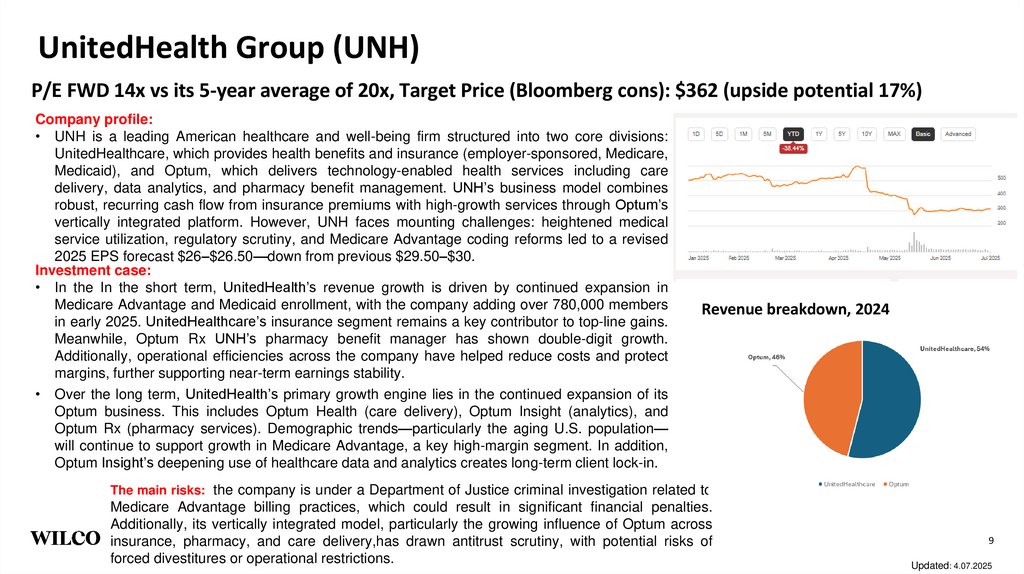
UnitedHealth Group (UNH)P/E FWD 14x vs its 5-year average of 20x, Target Price (Bloomberg cons): $362 (upside potential 17%)
Company profile:
• UNH is a leading American healthcare and well-being firm structured into two core divisions:
UnitedHealthcare, which provides health benefits and insurance (employer-sponsored, Medicare,
Medicaid), and Optum, which delivers technology-enabled health services including care
delivery, data analytics, and pharmacy benefit management. UNH’s business model combines
robust, recurring cash flow from insurance premiums with high-growth services through Optum’s
vertically integrated platform. However, UNH faces mounting challenges: heightened medical
service utilization, regulatory scrutiny, and Medicare Advantage coding reforms led to a revised
2025 EPS forecast $26–$26.50—down from previous $29.50–$30.
Investment case:
• In the In the short term, UnitedHealth’s revenue growth is driven by continued expansion in
Medicare Advantage and Medicaid enrollment, with the company adding over 780,000 members
in early 2025. UnitedHealthcare’s insurance segment remains a key contributor to top-line gains.
Meanwhile, Optum Rx UNH’s pharmacy benefit manager has shown double-digit growth.
Additionally, operational efficiencies across the company have helped reduce costs and protect
margins, further supporting near-term earnings stability.
• Over the long term, UnitedHealth’s primary growth engine lies in the continued expansion of its
Optum business. This includes Optum Health (care delivery), Optum Insight (analytics), and
Optum Rx (pharmacy services). Demographic trends—particularly the aging U.S. population—
will continue to support growth in Medicare Advantage, a key high-margin segment. In addition,
Optum Insight’s deepening use of healthcare data and analytics creates long-term client lock-in.
Revenue breakdown, 2024
The main risks: the company is under a Department of Justice criminal investigation related to
Medicare Advantage billing practices, which could result in significant financial penalties.
Additionally, its vertically integrated model, particularly the growing influence of Optum across
insurance, pharmacy, and care delivery,has drawn antitrust scrutiny, with potential risks of
forced divestitures or operational restrictions.
9
Updated: 4.07.2025
10. CuriosityStream (CURI)
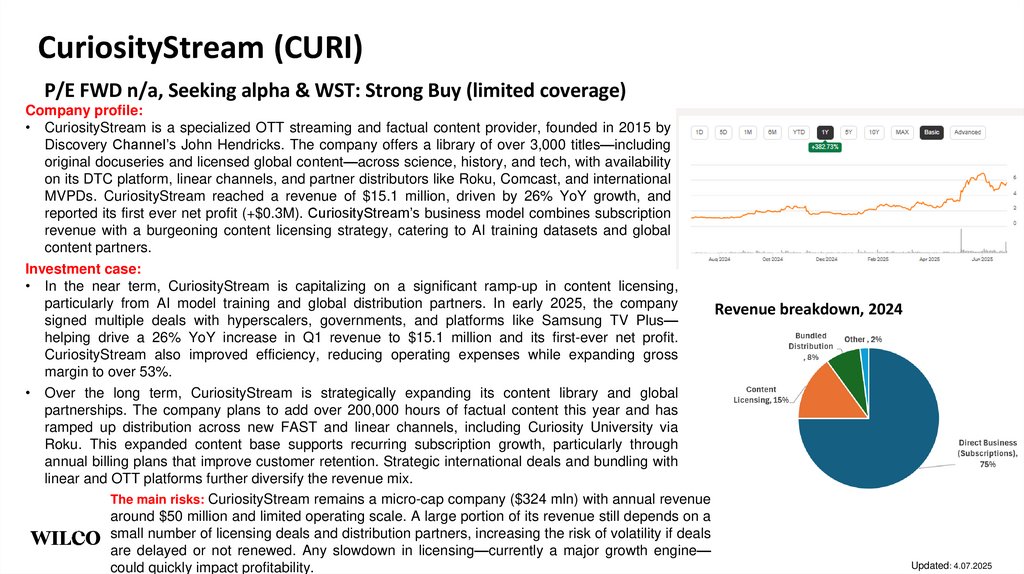
CuriosityStream (CURI)P/E FWD n/a, Seeking alpha & WST: Strong Buy (limited coverage)
Company profile:
• CuriosityStream is a specialized OTT streaming and factual content provider, founded in 2015 by
Discovery Channel’s John Hendricks. The company offers a library of over 3,000 titles—including
original docuseries and licensed global content—across science, history, and tech, with availability
on its DTC platform, linear channels, and partner distributors like Roku, Comcast, and international
MVPDs. CuriosityStream reached a revenue of $15.1 million, driven by 26% YoY growth, and
reported its first ever net profit (+$0.3M). CuriosityStream’s business model combines subscription
revenue with a burgeoning content licensing strategy, catering to AI training datasets and global
content partners.
Investment case:
• In the near term, CuriosityStream is capitalizing on a significant ramp-up in content licensing,
particularly from AI model training and global distribution partners. In early 2025, the company
Revenue breakdown, 2024
signed multiple deals with hyperscalers, governments, and platforms like Samsung TV Plus—
helping drive a 26% YoY increase in Q1 revenue to $15.1 million and its first-ever net profit.
CuriosityStream also improved efficiency, reducing operating expenses while expanding gross
margin to over 53%.
• Over the long term, CuriosityStream is strategically expanding its content library and global
partnerships. The company plans to add over 200,000 hours of factual content this year and has
ramped up distribution across new FAST and linear channels, including Curiosity University via
Roku. This expanded content base supports recurring subscription growth, particularly through
annual billing plans that improve customer retention. Strategic international deals and bundling with
linear and OTT platforms further diversify the revenue mix.
The main risks: CuriosityStream remains a micro-cap company ($324 mln) with annual revenue
around $50 million and limited operating scale. A large portion of its revenue still depends on a
small number of licensing deals and distribution partners, increasing the risk of volatility if deals
are delayed or not renewed. Any slowdown in licensing—currently a major growth engine—
Updated: 4.07.2025
could quickly impact profitability.
11. Global X Uranium ETF (URA)
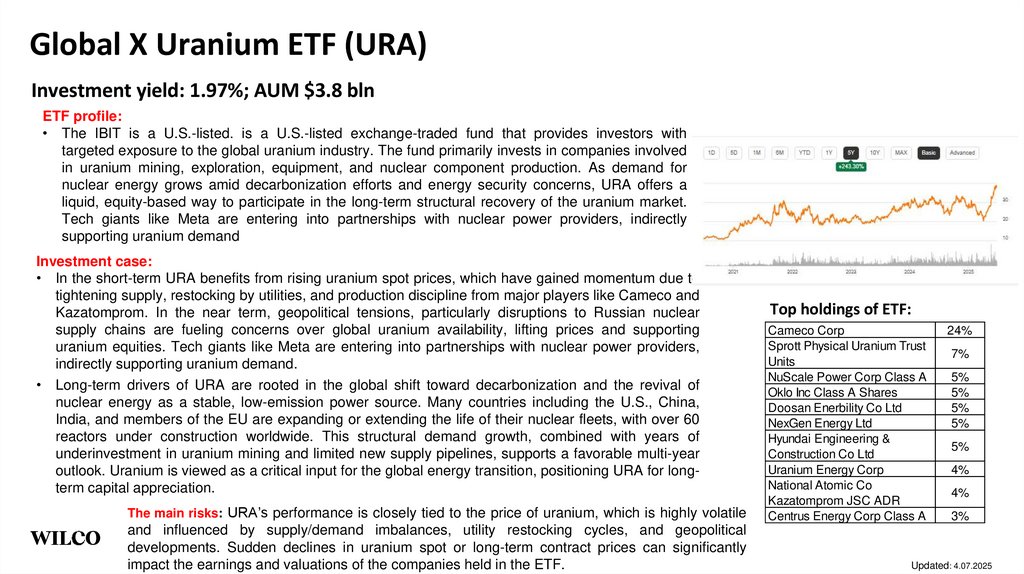
Investment yield: 1.97%; AUM $3.8 blnETF profile:
• The IBIT is a U.S.-listed. is a U.S.-listed exchange-traded fund that provides investors with
targeted exposure to the global uranium industry. The fund primarily invests in companies involved
in uranium mining, exploration, equipment, and nuclear component production. As demand for
nuclear energy grows amid decarbonization efforts and energy security concerns, URA offers a
liquid, equity-based way to participate in the long-term structural recovery of the uranium market.
Tech giants like Meta are entering into partnerships with nuclear power providers, indirectly
supporting uranium demand
Investment case:
• In the short-term URA benefits from rising uranium spot prices, which have gained momentum due to
tightening supply, restocking by utilities, and production discipline from major players like Cameco and
Kazatomprom. In the near term, geopolitical tensions, particularly disruptions to Russian nuclear
supply chains are fueling concerns over global uranium availability, lifting prices and supporting
uranium equities. Tech giants like Meta are entering into partnerships with nuclear power providers,
indirectly supporting uranium demand.
• Long-term drivers of URA are rooted in the global shift toward decarbonization and the revival of
nuclear energy as a stable, low-emission power source. Many countries including the U.S., China,
India, and members of the EU are expanding or extending the life of their nuclear fleets, with over 60
reactors under construction worldwide. This structural demand growth, combined with years of
underinvestment in uranium mining and limited new supply pipelines, supports a favorable multi-year
outlook. Uranium is viewed as a critical input for the global energy transition, positioning URA for longterm capital appreciation.
The main risks: URA’s performance is closely tied to the price of uranium, which is highly volatile
and influenced by supply/demand imbalances, utility restocking cycles, and geopolitical
developments. Sudden declines in uranium spot or long-term contract prices can significantly
impact the earnings and valuations of the companies held in the ETF.
Top holdings of ETF:
Cameco Corp
Sprott Physical Uranium Trust
Units
NuScale Power Corp Class A
Oklo Inc Class A Shares
Doosan Enerbility Co Ltd
NexGen Energy Ltd
Hyundai Engineering &
Construction Co Ltd
Uranium Energy Corp
National Atomic Co
Kazatomprom JSC ADR
Centrus Energy Corp Class A
24%
7%
5%
5%
5%
5%
5%
4%
4%
3%
Updated: 4.07.2025
12. Global X Defense Tech ETF (SHLD)
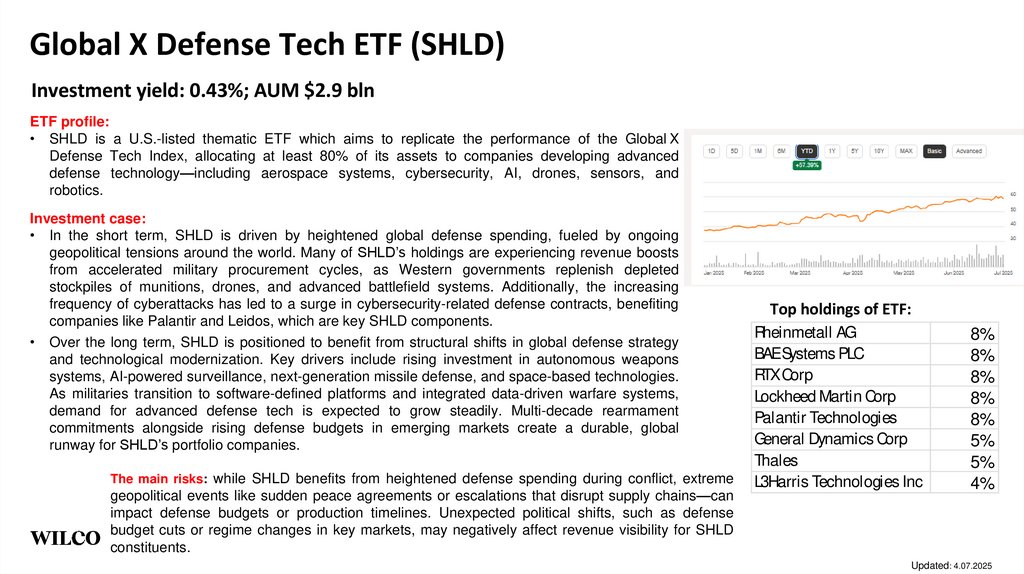
Investment yield: 0.43%; AUM $2.9 blnETF profile:
• SHLD is a U.S.-listed thematic ETF which aims to replicate the performance of the Global X
Defense Tech Index, allocating at least 80% of its assets to companies developing advanced
defense technology—including aerospace systems, cybersecurity, AI, drones, sensors, and
robotics.
Investment case:
• In the short term, SHLD is driven by heightened global defense spending, fueled by ongoing
geopolitical tensions around the world. Many of SHLD’s holdings are experiencing revenue boosts
from accelerated military procurement cycles, as Western governments replenish depleted
stockpiles of munitions, drones, and advanced battlefield systems. Additionally, the increasing
frequency of cyberattacks has led to a surge in cybersecurity-related defense contracts, benefiting
companies like Palantir and Leidos, which are key SHLD components.
• Over the long term, SHLD is positioned to benefit from structural shifts in global defense strategy
and technological modernization. Key drivers include rising investment in autonomous weapons
systems, AI-powered surveillance, next-generation missile defense, and space-based technologies.
As militaries transition to software-defined platforms and integrated data-driven warfare systems,
demand for advanced defense tech is expected to grow steadily. Multi-decade rearmament
commitments alongside rising defense budgets in emerging markets create a durable, global
runway for SHLD’s portfolio companies.
The main risks: while SHLD benefits from heightened defense spending during conflict, extreme
geopolitical events like sudden peace agreements or escalations that disrupt supply chains—can
impact defense budgets or production timelines. Unexpected political shifts, such as defense
budget cuts or regime changes in key markets, may negatively affect revenue visibility for SHLD
constituents.
Top holdings of ETF:
Rheinmetall AG
BAESystems PLC
RTX Corp
Lockheed Martin Corp
Palantir Technologies
General Dynamics Corp
Thales
L3Harris Technologies Inc
8%
8%
8%
8%
8%
5%
5%
4%
Updated: 4.07.2025
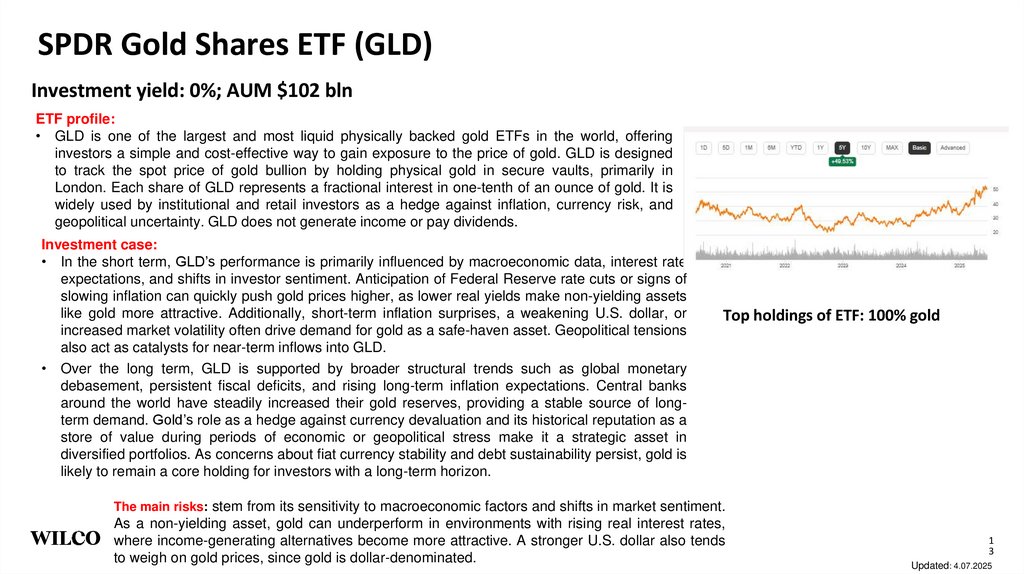
13. SPDR Gold Shares ETF (GLD)
Investment yield: 0%; AUM $102 blnETF profile:
• GLD is one of the largest and most liquid physically backed gold ETFs in the world, offering
investors a simple and cost-effective way to gain exposure to the price of gold. GLD is designed
to track the spot price of gold bullion by holding physical gold in secure vaults, primarily in
London. Each share of GLD represents a fractional interest in one-tenth of an ounce of gold. It is
widely used by institutional and retail investors as a hedge against inflation, currency risk, and
geopolitical uncertainty. GLD does not generate income or pay dividends.
Investment case:
• In the short term, GLD’s performance is primarily influenced by macroeconomic data, interest rate
expectations, and shifts in investor sentiment. Anticipation of Federal Reserve rate cuts or signs of
slowing inflation can quickly push gold prices higher, as lower real yields make non-yielding assets
like gold more attractive. Additionally, short-term inflation surprises, a weakening U.S. dollar, or
increased market volatility often drive demand for gold as a safe-haven asset. Geopolitical tensions
also act as catalysts for near-term inflows into GLD.
• Over the long term, GLD is supported by broader structural trends such as global monetary
debasement, persistent fiscal deficits, and rising long-term inflation expectations. Central banks
around the world have steadily increased their gold reserves, providing a stable source of longterm demand. Gold’s role as a hedge against currency devaluation and its historical reputation as a
store of value during periods of economic or geopolitical stress make it a strategic asset in
diversified portfolios. As concerns about fiat currency stability and debt sustainability persist, gold is
likely to remain a core holding for investors with a long-term horizon.
Top holdings of ETF: 100% gold
The main risks: stem from its sensitivity to macroeconomic factors and shifts in market sentiment.
As a non-yielding asset, gold can underperform in environments with rising real interest rates,
where income-generating alternatives become more attractive. A stronger U.S. dollar also tends
to weigh on gold prices, since gold is dollar-denominated.
1
3
Updated: 4.07.2025