 finance
Similar presentations:








Pricing and Resilience of Commodity Markets
1.
Pricing and Resilience of CommodityMarkets:
Historical Analysis of Metal and Gas Price Dependencies and Their
Business Impact
Author: Ronald Medvedev
Supervisor: Olivier Gallay
UNIL | University of Lausanne
Faculty of Management
Master in Business Analytics
Lausanne, 2025
2.
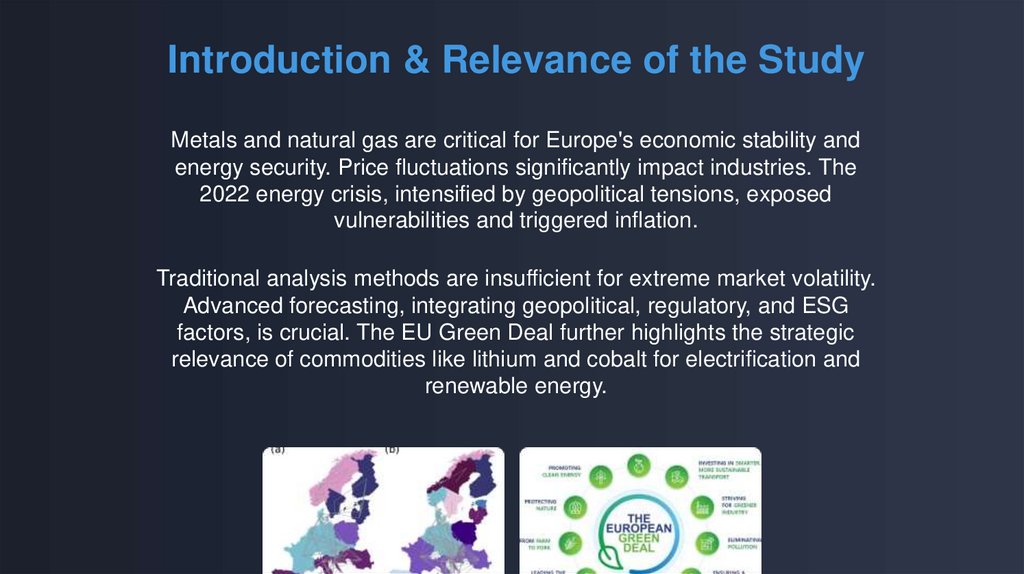
Introduction & Relevance of the StudyMetals and natural gas are critical for Europe's economic stability and
energy security. Price fluctuations significantly impact industries. The
2022 energy crisis, intensified by geopolitical tensions, exposed
vulnerabilities and triggered inflation.
Traditional analysis methods are insufficient for extreme market volatility.
Advanced forecasting, integrating geopolitical, regulatory, and ESG
factors, is crucial. The EU Green Deal further highlights the strategic
relevance of commodities like lithium and cobalt for electrification and
renewable energy.
3.
Research ObjectiveThe core objective of this thesis is to
analyze historical interdependencies between metal and
natural gas prices in Europe
and to
develop forecasting
models that enhance resilience and
support
practical decision-making
for businesses
navigating volatile commodity
markets.
4.
Key Research TasksSystematize theoretical approaches to
commodity pricing and identify core price
drivers.
Analyze key market participants, their
business models, and risk mitigation
strategies.
Review traditional and modern forecasting
methods, assessing their accuracy and
applicability.
Compile and analyze historical price data,
identifying trends, anomalies, and
seasonal effects.
Develop forecasting models using
Random Forest, XGBoost, and LSTM.
Test model performance under shocks
such as COVID-19 and the energy crisis.
Simulate business cases to quantify the
practical value of forecasting models.
Formulate practical recommendations and
explore future research directions,
including ESG integration and XAI.
5.
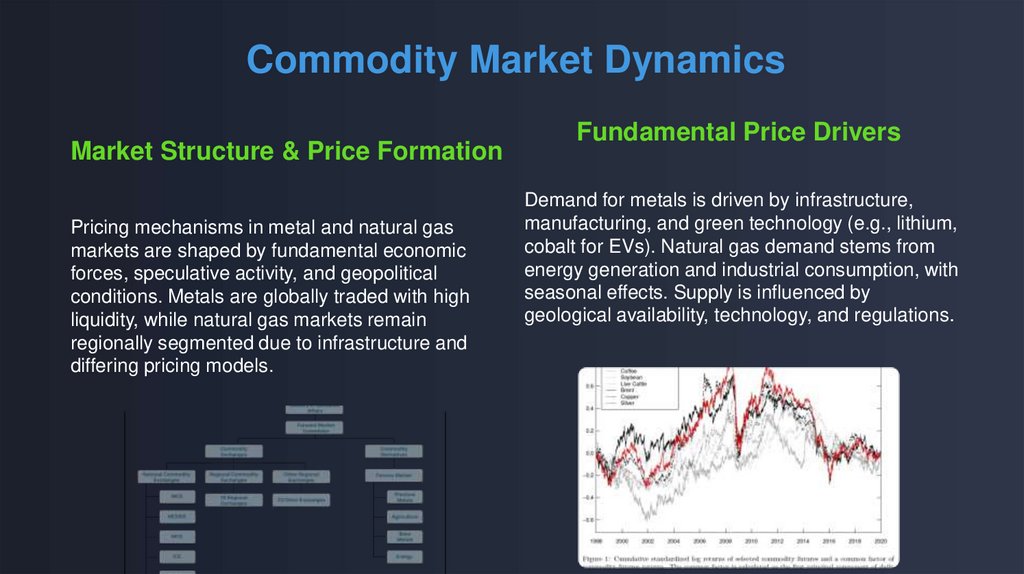
Commodity Market DynamicsMarket Structure & Price Formation
Pricing mechanisms in metal and natural gas
markets are shaped by fundamental economic
forces, speculative activity, and geopolitical
conditions. Metals are globally traded with high
liquidity, while natural gas markets remain
regionally segmented due to infrastructure and
differing pricing models.
Fundamental Price Drivers
Demand for metals is driven by infrastructure,
manufacturing, and green technology (e.g., lithium,
cobalt for EVs). Natural gas demand stems from
energy generation and industrial consumption, with
seasonal effects. Supply is influenced by
geological availability, technology, and regulations.
6.
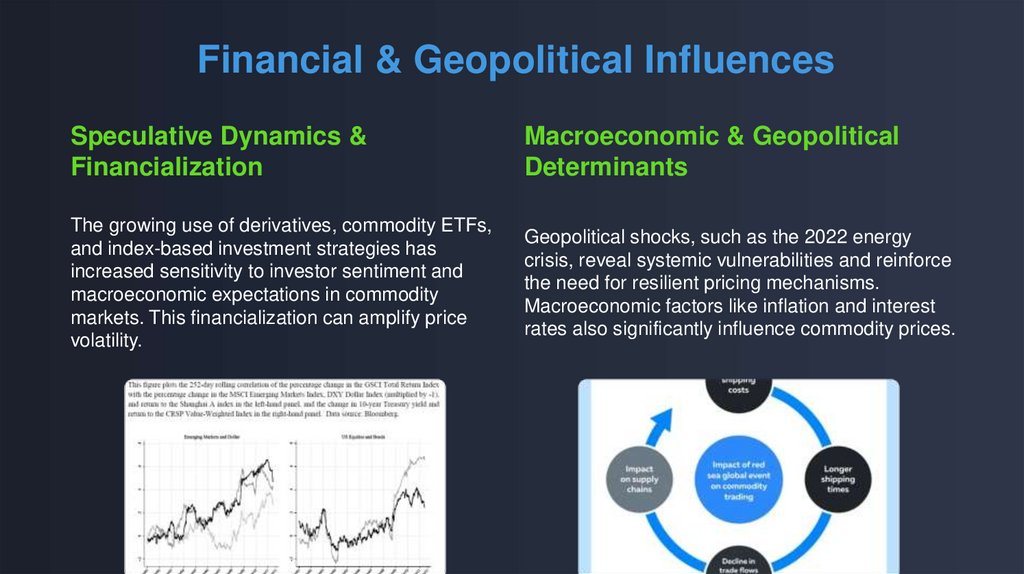
Financial & Geopolitical InfluencesSpeculative Dynamics &
Financialization
Macroeconomic & Geopolitical
Determinants
The growing use of derivatives, commodity ETFs,
and index-based investment strategies has
increased sensitivity to investor sentiment and
macroeconomic expectations in commodity
markets. This financialization can amplify price
volatility.
Geopolitical shocks, such as the 2022 energy
crisis, reveal systemic vulnerabilities and reinforce
the need for resilient pricing mechanisms.
Macroeconomic factors like inflation and interest
rates also significantly influence commodity prices.
7.
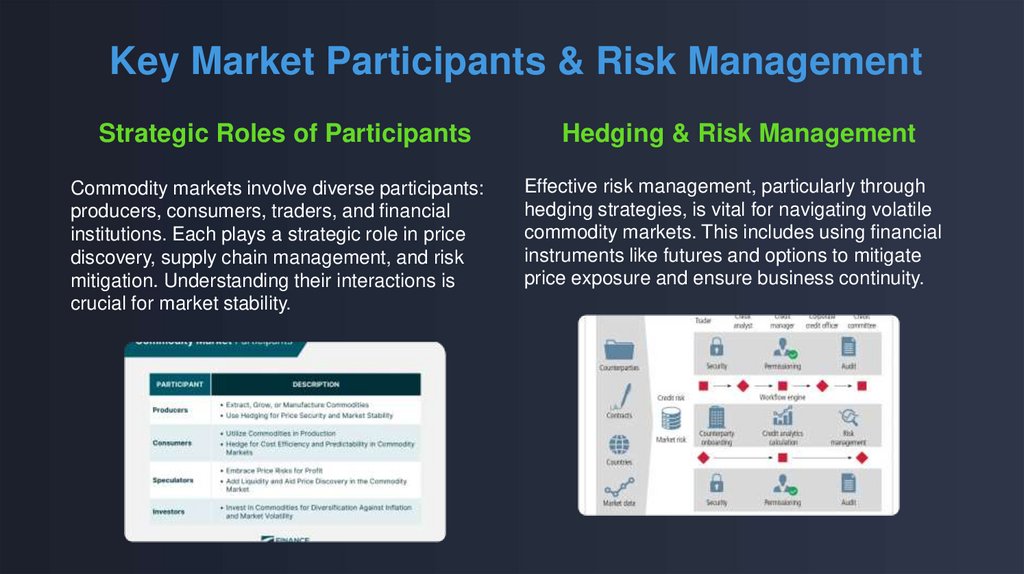
Key Market Participants & Risk ManagementStrategic Roles of Participants
Hedging & Risk Management
Commodity markets involve diverse participants:
producers, consumers, traders, and financial
institutions. Each plays a strategic role in price
discovery, supply chain management, and risk
mitigation. Understanding their interactions is
crucial for market stability.
Effective risk management, particularly through
hedging strategies, is vital for navigating volatile
commodity markets. This includes using financial
instruments like futures and options to mitigate
price exposure and ensure business continuity.
8.
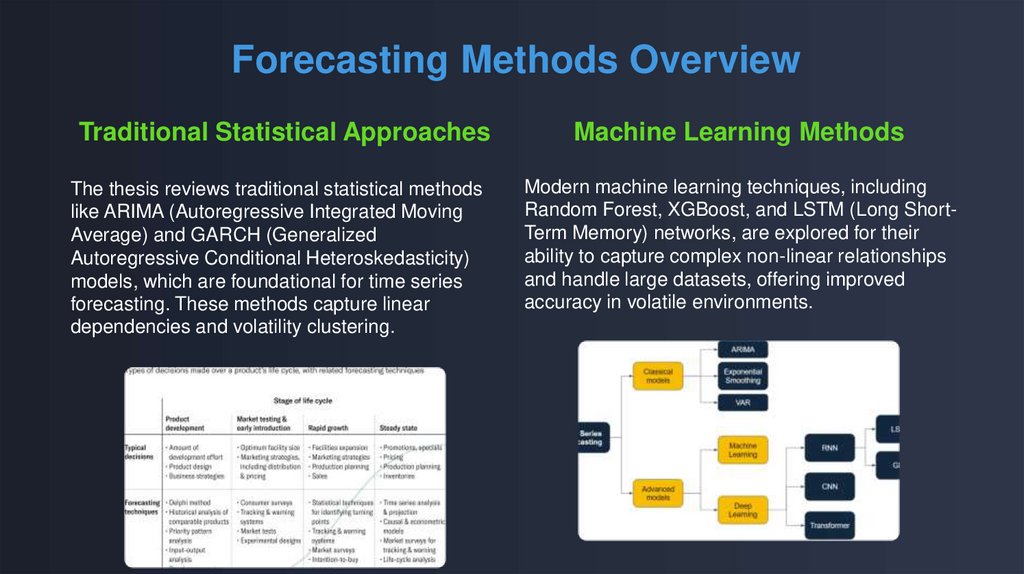
Forecasting Methods OverviewTraditional Statistical Approaches
Machine Learning Methods
The thesis reviews traditional statistical methods
like ARIMA (Autoregressive Integrated Moving
Average) and GARCH (Generalized
Autoregressive Conditional Heteroskedasticity)
models, which are foundational for time series
forecasting. These methods capture linear
dependencies and volatility clustering.
Modern machine learning techniques, including
Random Forest, XGBoost, and LSTM (Long ShortTerm Memory) networks, are explored for their
ability to capture complex non-linear relationships
and handle large datasets, offering improved
accuracy in volatile environments.
9.
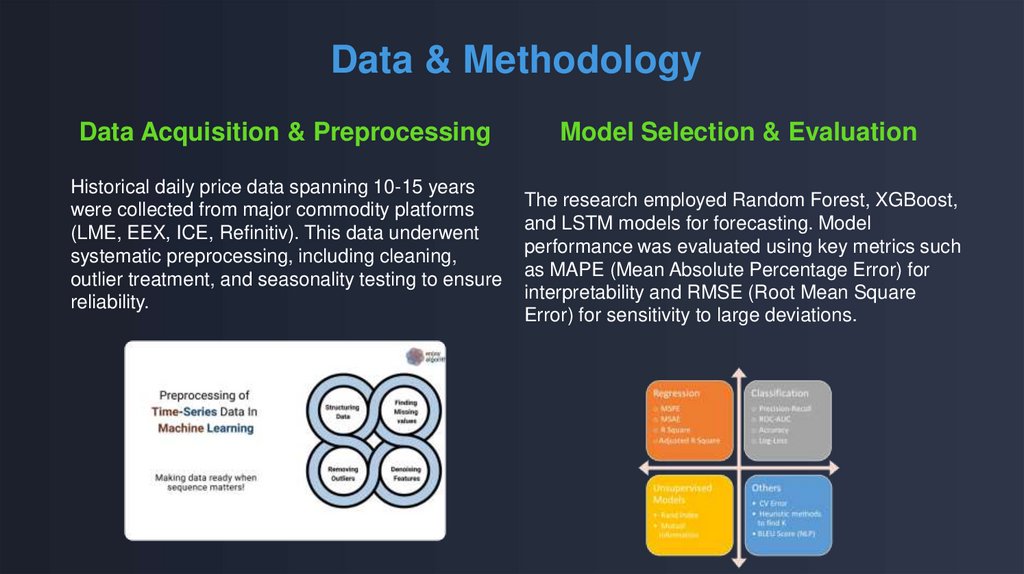
Data & MethodologyData Acquisition & Preprocessing
Historical daily price data spanning 10-15 years
were collected from major commodity platforms
(LME, EEX, ICE, Refinitiv). This data underwent
systematic preprocessing, including cleaning,
outlier treatment, and seasonality testing to ensure
reliability.
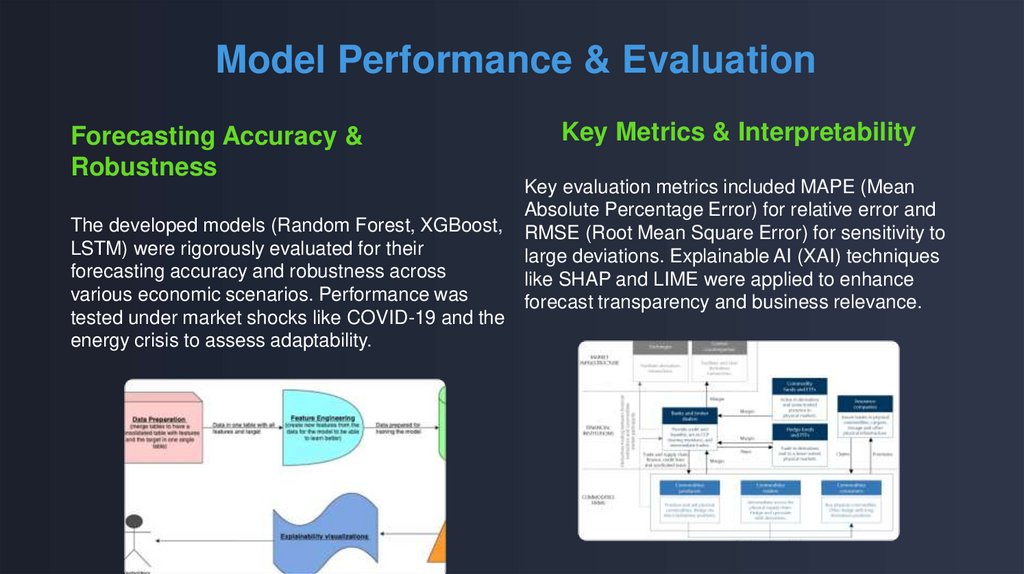
Model Selection & Evaluation
The research employed Random Forest, XGBoost,
and LSTM models for forecasting. Model
performance was evaluated using key metrics such
as MAPE (Mean Absolute Percentage Error) for
interpretability and RMSE (Root Mean Square
Error) for sensitivity to large deviations.
10.
Model Performance & EvaluationForecasting Accuracy &
Robustness
The developed models (Random Forest, XGBoost,
LSTM) were rigorously evaluated for their
forecasting accuracy and robustness across
various economic scenarios. Performance was
tested under market shocks like COVID-19 and the
energy crisis to assess adaptability.
Key Metrics & Interpretability
Key evaluation metrics included MAPE (Mean
Absolute Percentage Error) for relative error and
RMSE (Root Mean Square Error) for sensitivity to
large deviations. Explainable AI (XAI) techniques
like SHAP and LIME were applied to enhance
forecast transparency and business relevance.
11.
Resilience and ESG in Commodity MarketsConceptualizing Resilience
The Rise of ESG Metrics
Resilience in commodity markets refers to the
ability of market systems and participants to adapt
and recover from disruptions, such as geopolitical
shocks, supply chain failures, or extreme weather
events. This thesis emphasizes building robust
strategies against such vulnerabilities.
Environmental, Social, and Governance (ESG)
factors are increasingly influencing commodity
markets. Integrating ESG metrics into forecasting
and risk management is crucial for sustainable
business practices and aligning with global
sustainability goals, such as those outlined in the
EU Green Deal.
12.
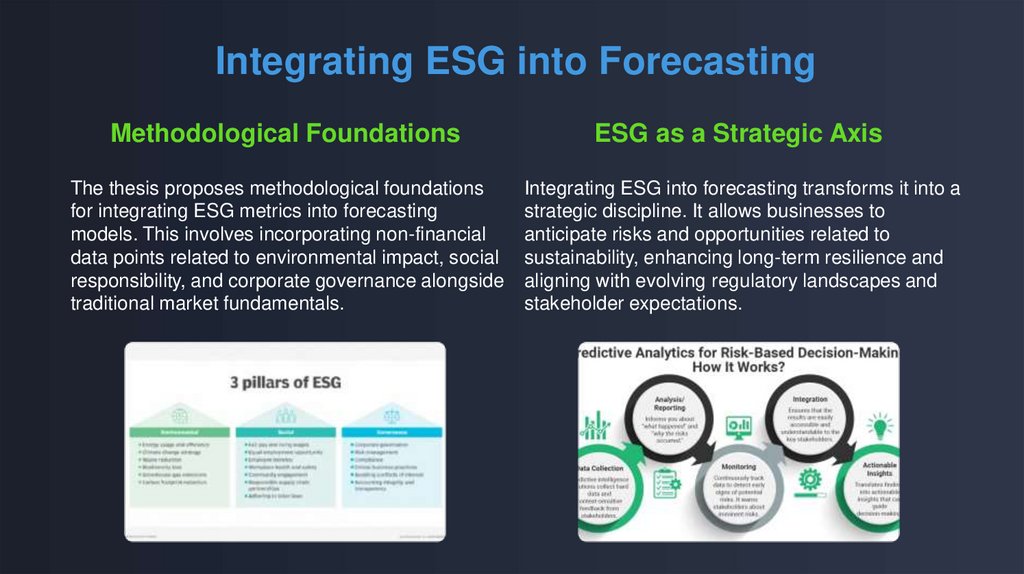
Integrating ESG into ForecastingMethodological Foundations
ESG as a Strategic Axis
The thesis proposes methodological foundations
for integrating ESG metrics into forecasting
models. This involves incorporating non-financial
data points related to environmental impact, social
responsibility, and corporate governance alongside
traditional market fundamentals.
Integrating ESG into forecasting transforms it into a
strategic discipline. It allows businesses to
anticipate risks and opportunities related to
sustainability, enhancing long-term resilience and
aligning with evolving regulatory landscapes and
stakeholder expectations.
13.
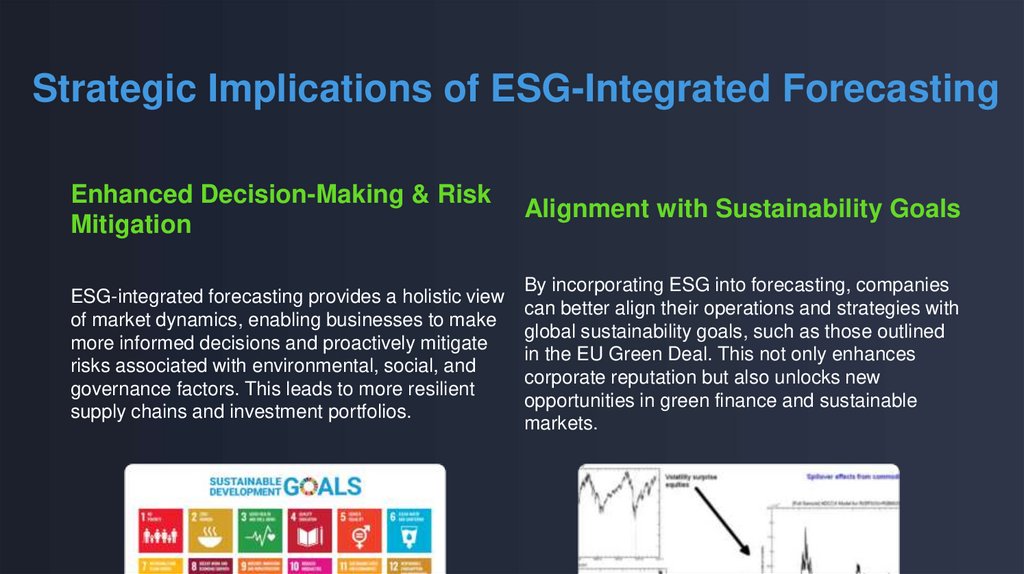
Strategic Implications of ESG-Integrated ForecastingEnhanced Decision-Making & Risk
Mitigation
Alignment with Sustainability Goals
ESG-integrated forecasting provides a holistic view
of market dynamics, enabling businesses to make
more informed decisions and proactively mitigate
risks associated with environmental, social, and
governance factors. This leads to more resilient
supply chains and investment portfolios.
By incorporating ESG into forecasting, companies
can better align their operations and strategies with
global sustainability goals, such as those outlined
in the EU Green Deal. This not only enhances
corporate reputation but also unlocks new
opportunities in green finance and sustainable
markets.
14.
Key Findings & ContributionsInterdependencies & Volatility
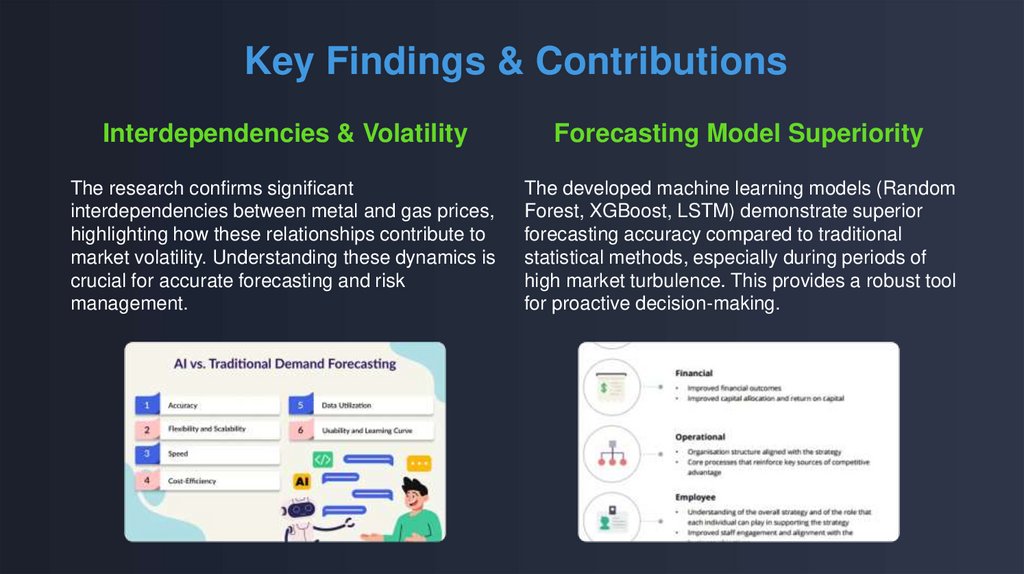
Forecasting Model Superiority
The research confirms significant
interdependencies between metal and gas prices,
highlighting how these relationships contribute to
market volatility. Understanding these dynamics is
crucial for accurate forecasting and risk
management.
The developed machine learning models (Random
Forest, XGBoost, LSTM) demonstrate superior
forecasting accuracy compared to traditional
statistical methods, especially during periods of
high market turbulence. This provides a robust tool
for proactive decision-making.
15.
Practical RecommendationsFor Businesses & Traders
For Policymakers & Regulators
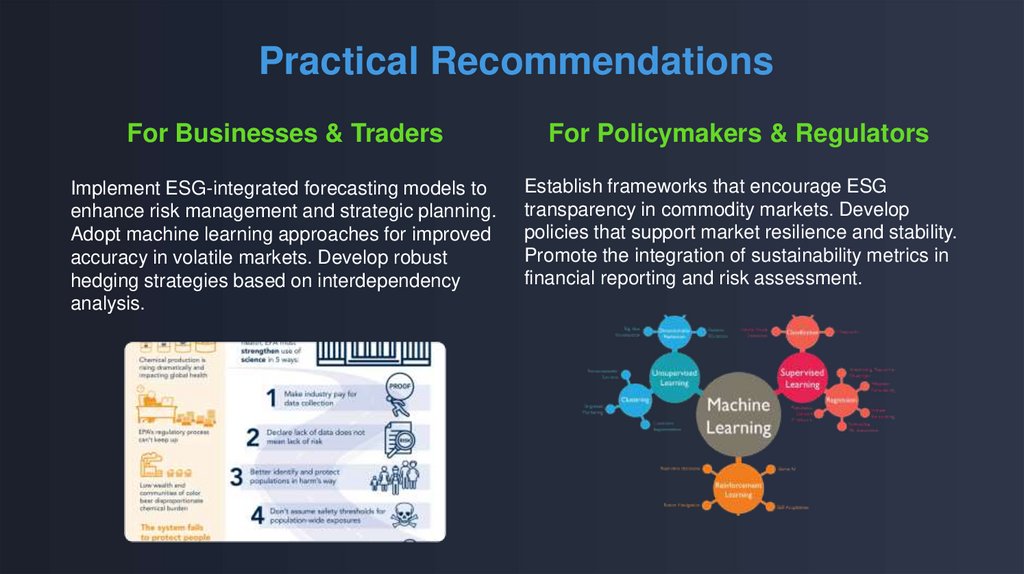
Implement ESG-integrated forecasting models to
enhance risk management and strategic planning.
Adopt machine learning approaches for improved
accuracy in volatile markets. Develop robust
hedging strategies based on interdependency
analysis.
Establish frameworks that encourage ESG
transparency in commodity markets. Develop
policies that support market resilience and stability.
Promote the integration of sustainability metrics in
financial reporting and risk assessment.
16.
Future Research DirectionsAdvanced Model Development
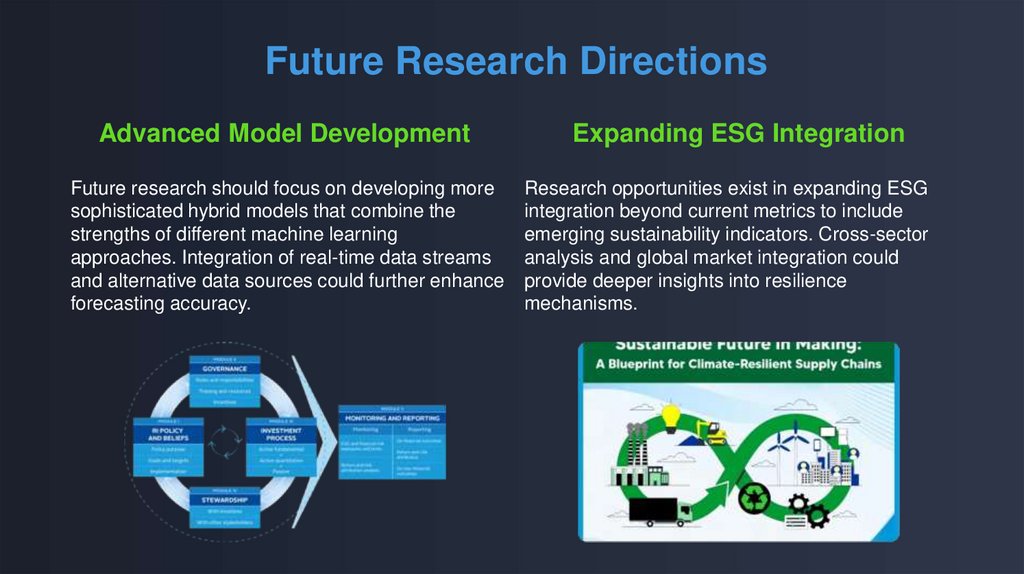
Expanding ESG Integration
Future research should focus on developing more
sophisticated hybrid models that combine the
strengths of different machine learning
approaches. Integration of real-time data streams
and alternative data sources could further enhance
forecasting accuracy.
Research opportunities exist in expanding ESG
integration beyond current metrics to include
emerging sustainability indicators. Cross-sector
analysis and global market integration could
provide deeper insights into resilience
mechanisms.
17.
ConclusionThis thesis demonstrates that integrating ESG factors into
commodity market forecasting creates a powerful framework for
enhanced resilience and sustainable decision-making.
By combining advanced machine learning techniques with ESG metrics, we can better
understand market interdependencies, improve forecasting accuracy, and build more resilient
commodity markets. This research contributes to both academic knowledge and practical
applications in an era of increasing market volatility and sustainability imperatives.
18.
Q&AQuestions & Answers
Thank you for your attention!
I welcome your questions and discussion about this research.
Ready to discuss the implications of ESG-integrated forecasting
for commodity market resilience and sustainability