
 pedagogy
Similar presentations:










Speaking in Public Skills Lesson
1. Speaking in Public Skills Lesson
Photo courtesy of veryveryquietl@flickr.com - granted under creative commons licence – attribution2.
Learning Objective• To improve confidence and technique when giving a
talk in front of an audience.
Success Criteria
• To feel confident about standing up in front of the class.
• To be able to engage with the audience while speaking.
• To be able to project your voice to the back of the room.
3.
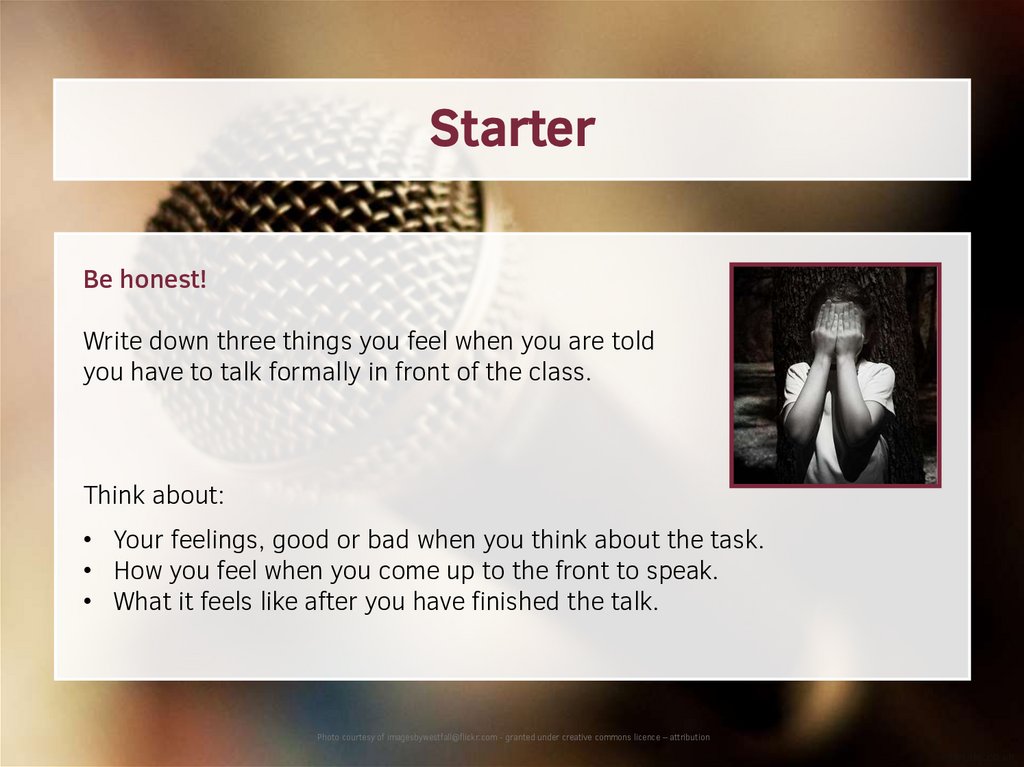
StarterBe honest!
Write down three things you feel when you are told
you have to talk formally in front of the class.
Think about:
• Your feelings, good or bad when you think about the task.
• How you feel when you come up to the front to speak.
• What it feels like after you have finished the talk.
Photo courtesy of imagesbywestfall@flickr.com - granted under creative commons licence – attribution
4.
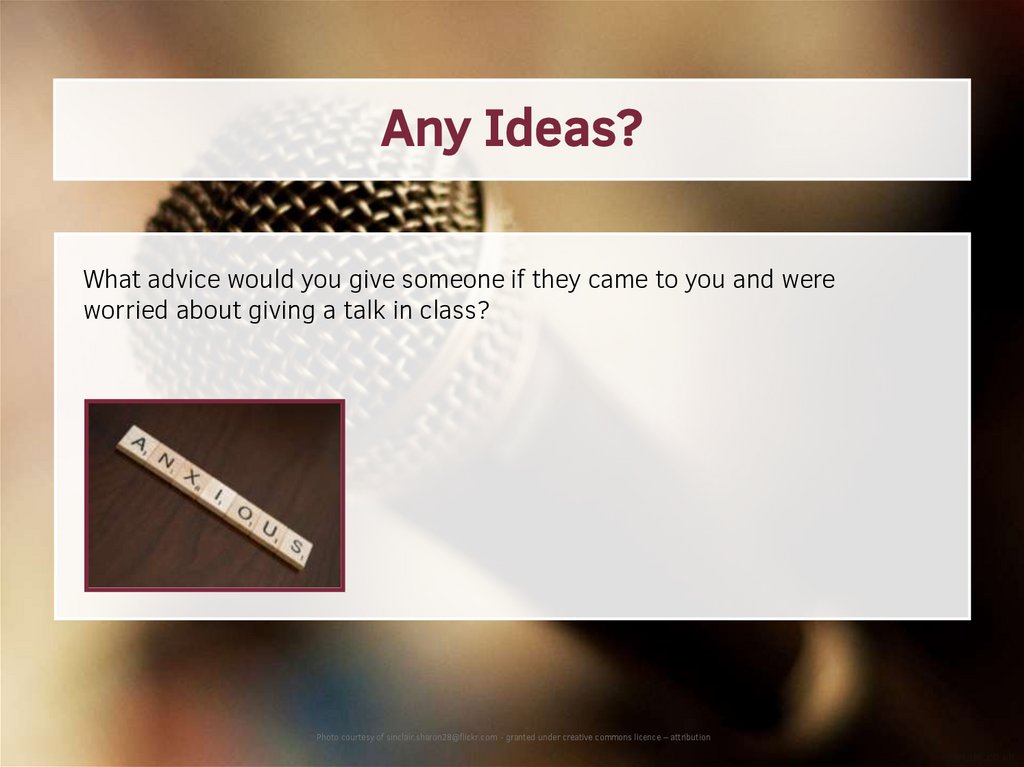
Any Ideas?What advice would you give someone if they came to you and were
worried about giving a talk in class?
Photo courtesy of sinclair.sharon28@flickr.com - granted under creative commons licence – attribution
5.
NervesIt’s normal to feel nervous!
TIPS:
• Prepare well – if you know you are ready,
it is less nerve wracking.
• Take slow, deep breaths before you stand
up to speak.
• Remember your audience wants you to be
successful, they are rooting for you to do well.
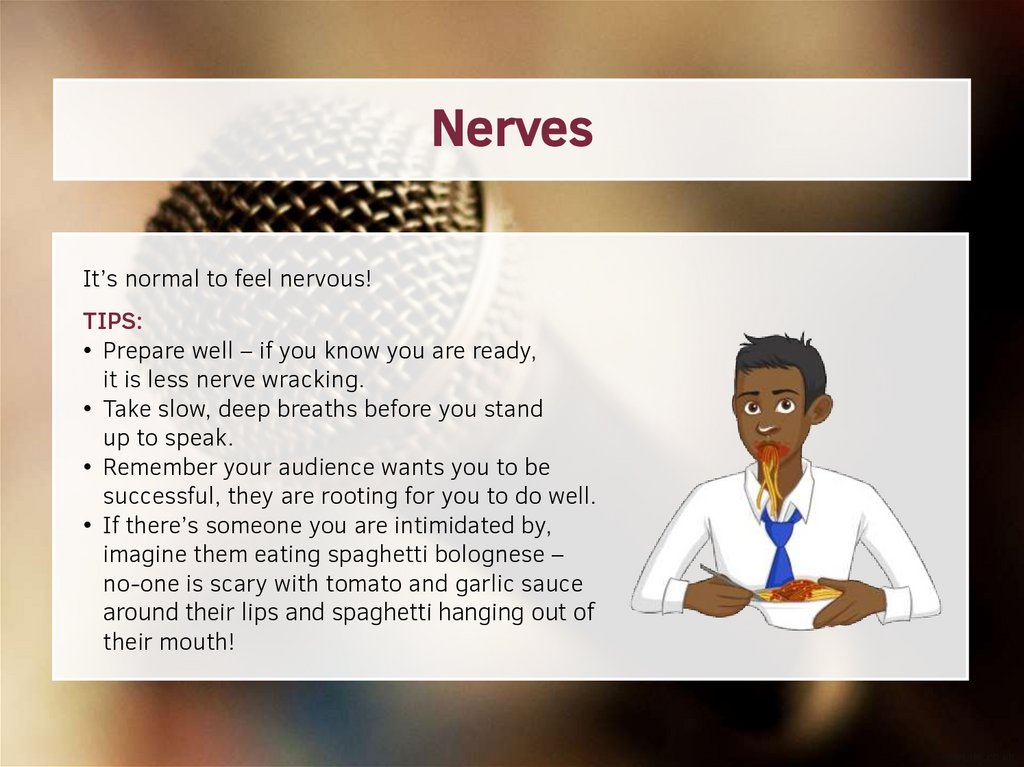
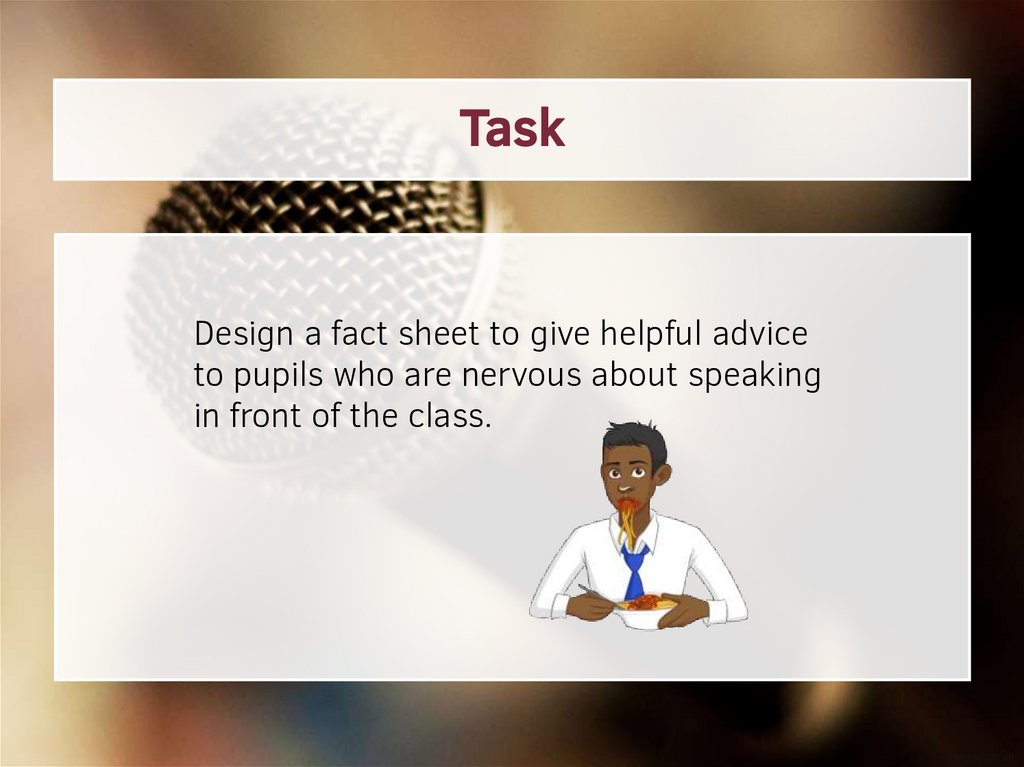
• If there’s someone you are intimidated by,
imagine them eating spaghetti bolognese –
no-one is scary with tomato and garlic sauce
around their lips and spaghetti hanging out of
their mouth!
6.
TechniquesBy learning a few simple tricks and techniques, you can make sure you
feel confident about speaking in front of an audience.
There are two main things:
• How to Stand
• How to Breathe
Of course you can all stand and breathe already, but this is a specific
technique for public speaking.
7.
How to StandIt seems obvious
but it isn’t.
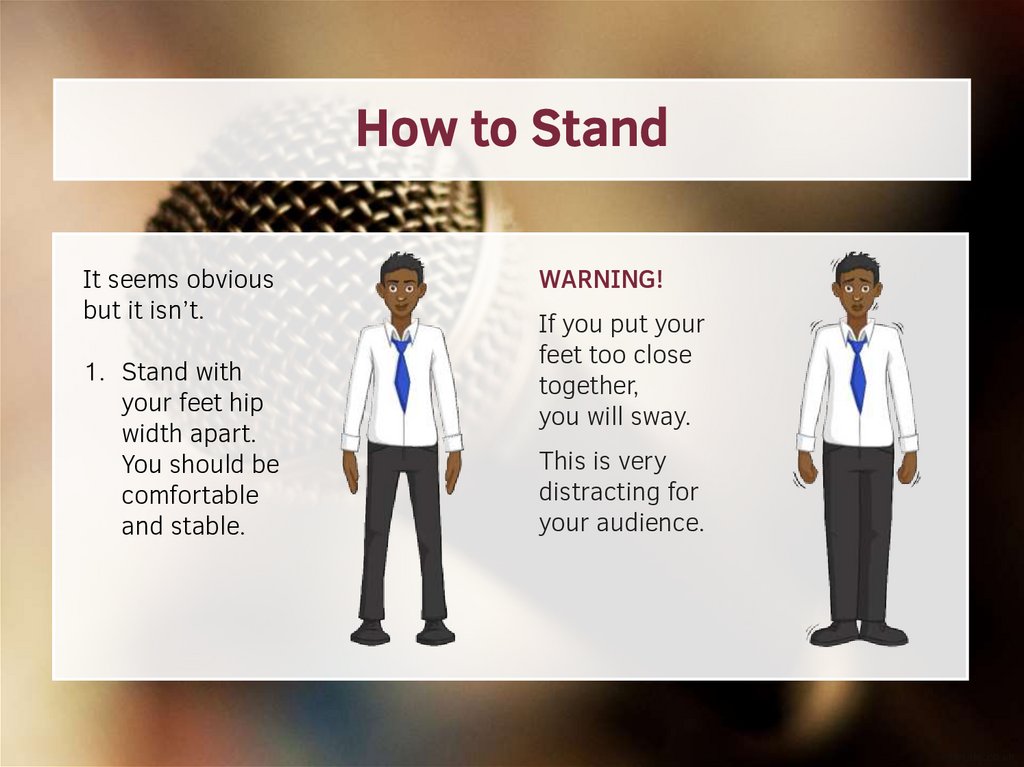
1. Stand with
your feet hip
width apart.
You should be
comfortable
and stable.
WARNING!
If you put your
feet too close
together,
you will sway.
This is very
distracting for
your audience.
8.
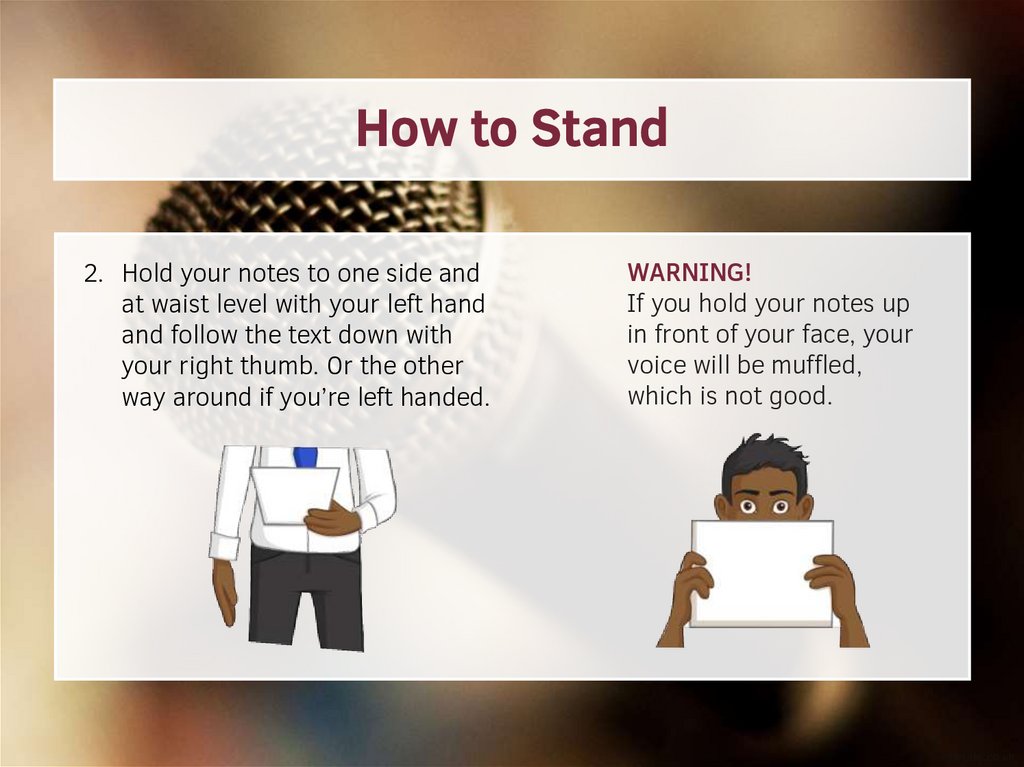
How to Stand2. Hold your notes to one side and
at waist level with your left hand
and follow the text down with
your right thumb. Or the other
way around if you’re left handed.
WARNING!
If you hold your notes up
in front of your face, your
voice will be muffled,
which is not good.
9.
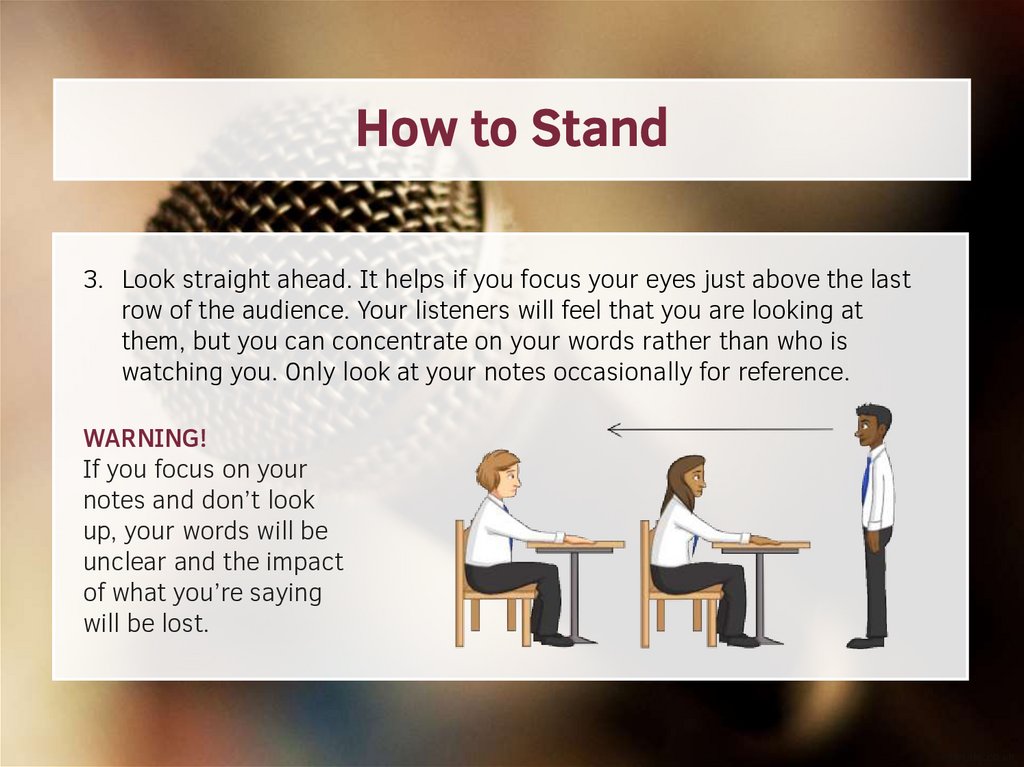
How to Stand3. Look straight ahead. It helps if you focus your eyes just above the last
row of the audience. Your listeners will feel that you are looking at
them, but you can concentrate on your words rather than who is
watching you. Only look at your notes occasionally for reference.
WARNING!
If you focus on your
notes and don’t look
up, your words will be
unclear and the impact
of what you’re saying
will be lost.
10.
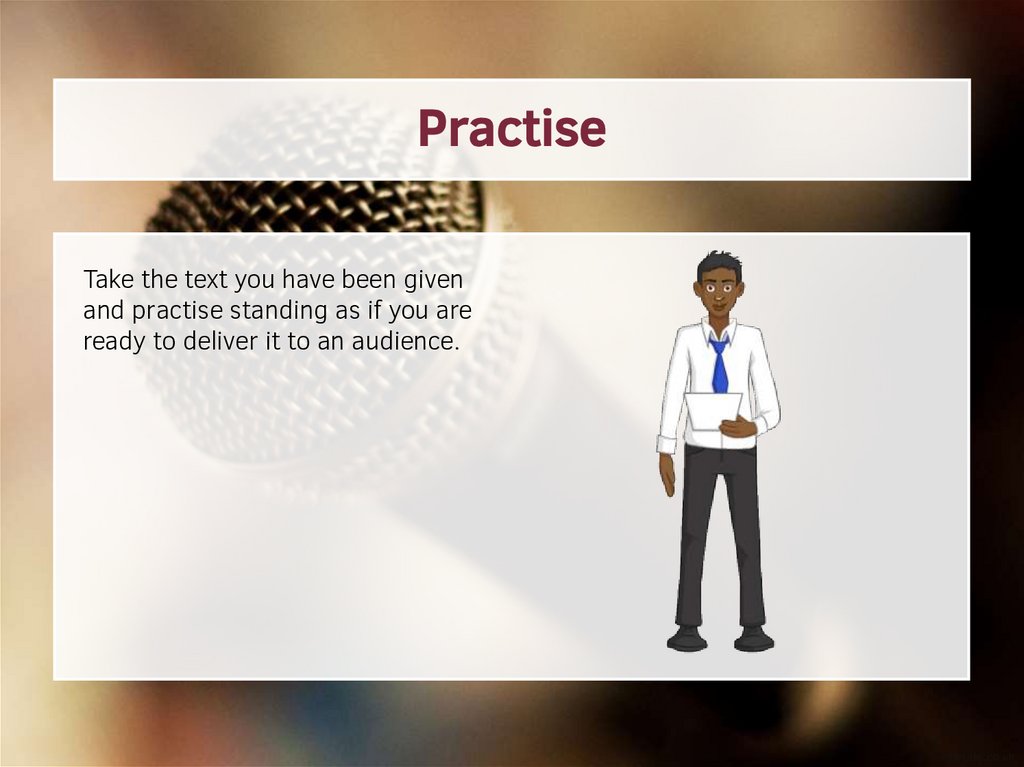
PractiseTake the text you have been given
and practise standing as if you are
ready to deliver it to an audience.
11.
How to BreatheThere’s more to it than breathing in and out. It’s about biology!
Your breath, lungs and diaphragm control the strength and quality of
your voice.
When you are speaking for an audience, you must breathe from your
diaphragm. This helps your voice to travel.
This is called:
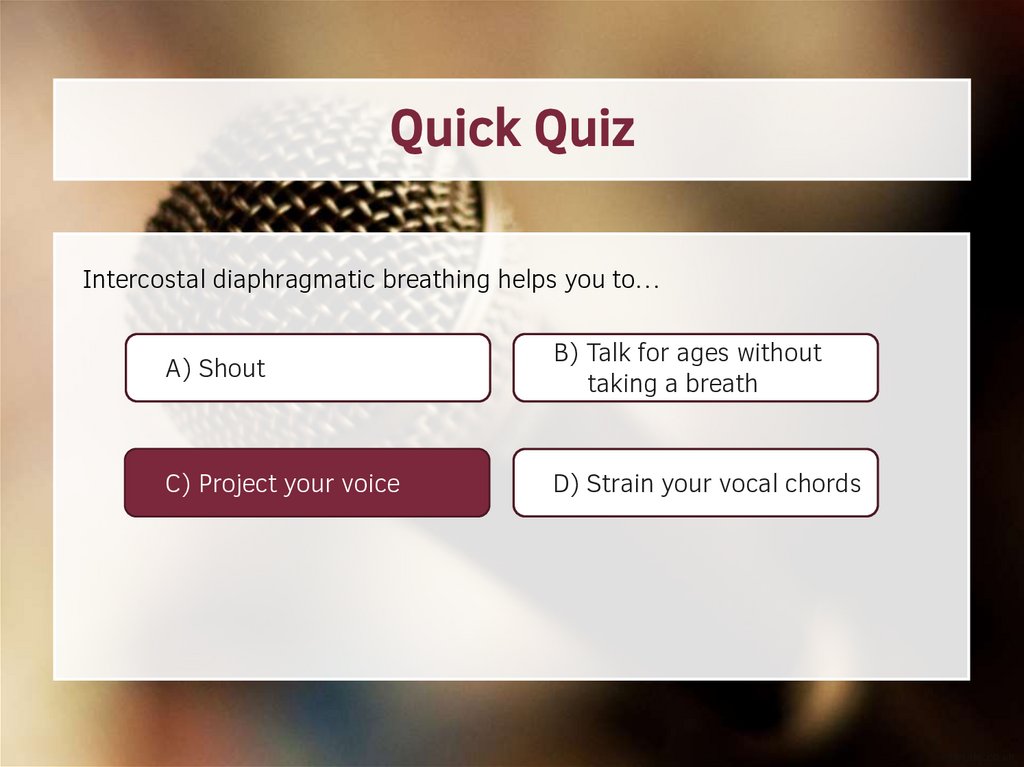
Intercostal diaphragmatic breathing
12.
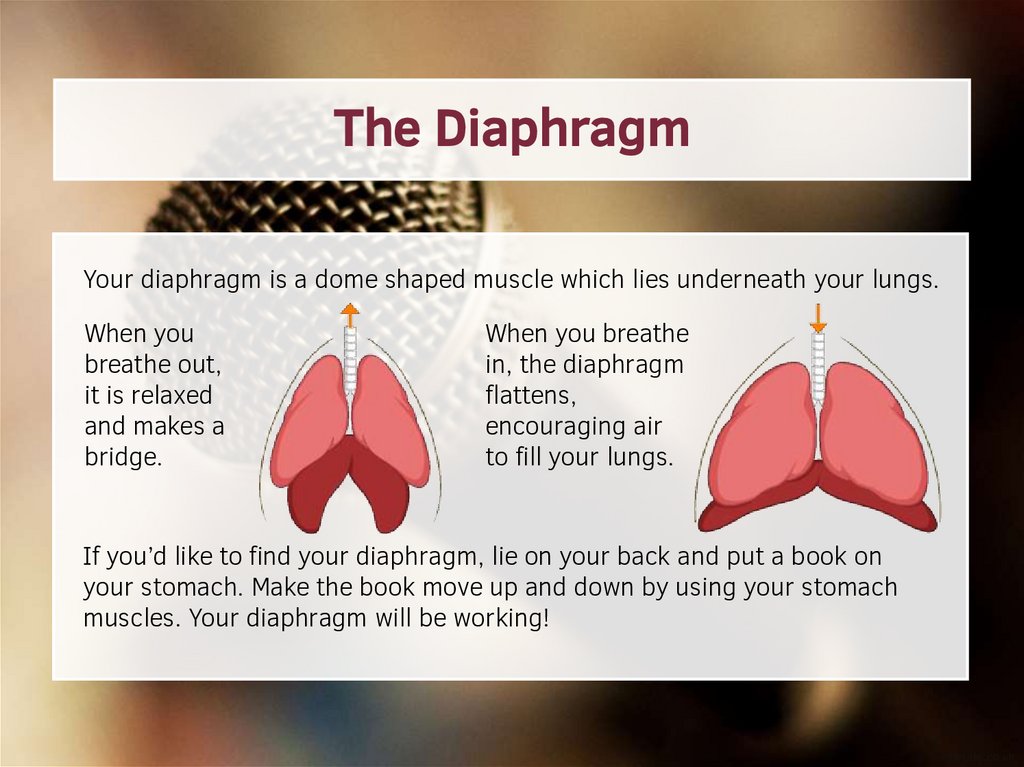
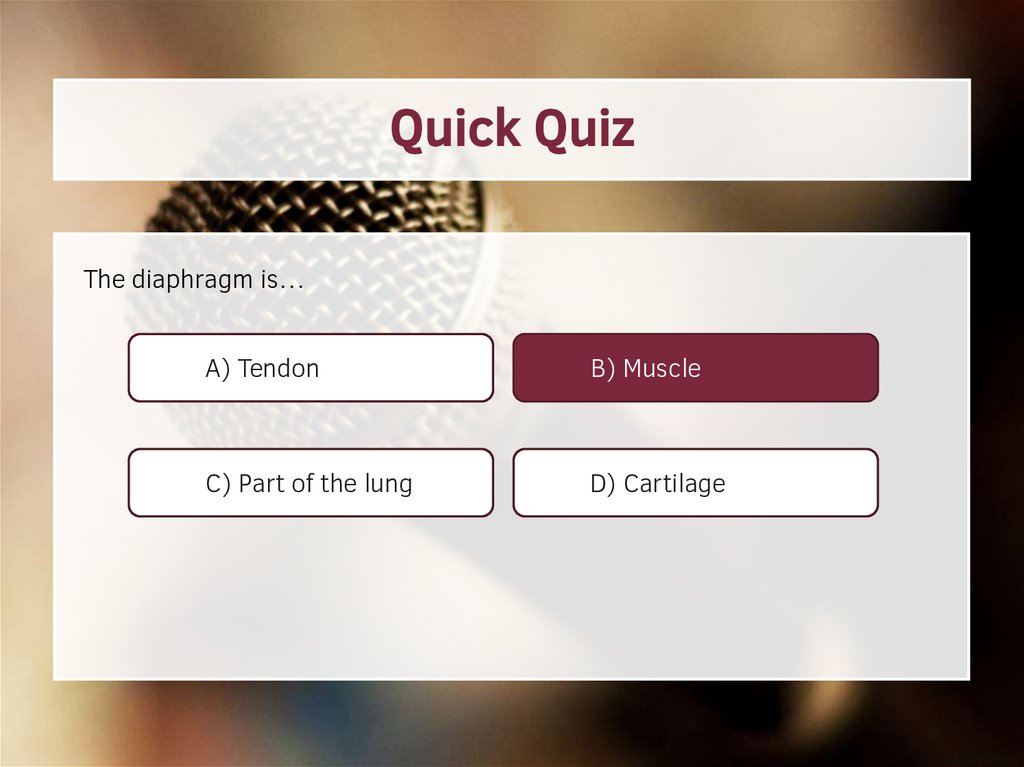
The DiaphragmYour diaphragm is a dome shaped muscle which lies underneath your lungs.
When you
breathe out,
it is relaxed
and makes a
bridge.
When you breathe
in, the diaphragm
flattens,
encouraging air
to fill your lungs.
If you’d like to find your diaphragm, lie on your back and put a book on
your stomach. Make the book move up and down by using your stomach
muscles. Your diaphragm will be working!
13.
Why is it Important?• It is possible to breathe without using your
diaphragm by filling just the top of your lungs.
• This results in short, shallow breaths.
• Your voice is weak when you breathe like this.
• You will also strain your vocal chords and could
end up with an aching throat.
Intercostal Diaphragmatic Breathing
• Makes your voice strong.
• Allows you to project your voice so everyone can hear you.
• Gives you variety in the tone and modulation of your voice.
• Protects your vocal chords so you will not strain them.
14.
How to Breathe• Before you start to speak, check your posture. Make sure your shoulders
are relaxed.
• Take a deep breath – feel your lungs filling up all the way down to your
stomach. Make sure your shoulders don’t hunch up at this point.
• Allow the air to leave your lungs. There is no need to force it.
• Breathe in again and begin.
You’ll be surprised how easy it is to project your voice
to the back of the room!
15.
SummaryTake time to stand in the correct posture and steady your breath before
you start to speak. It will only take a few seconds and it could make the
difference between a good speech and a great speech.
• Stand with feet hip width apart, shoulders relaxed.
• Take a deep breath, filling your lungs to the bottom.
• Let it go.
• Breathe in again and begin!
16.
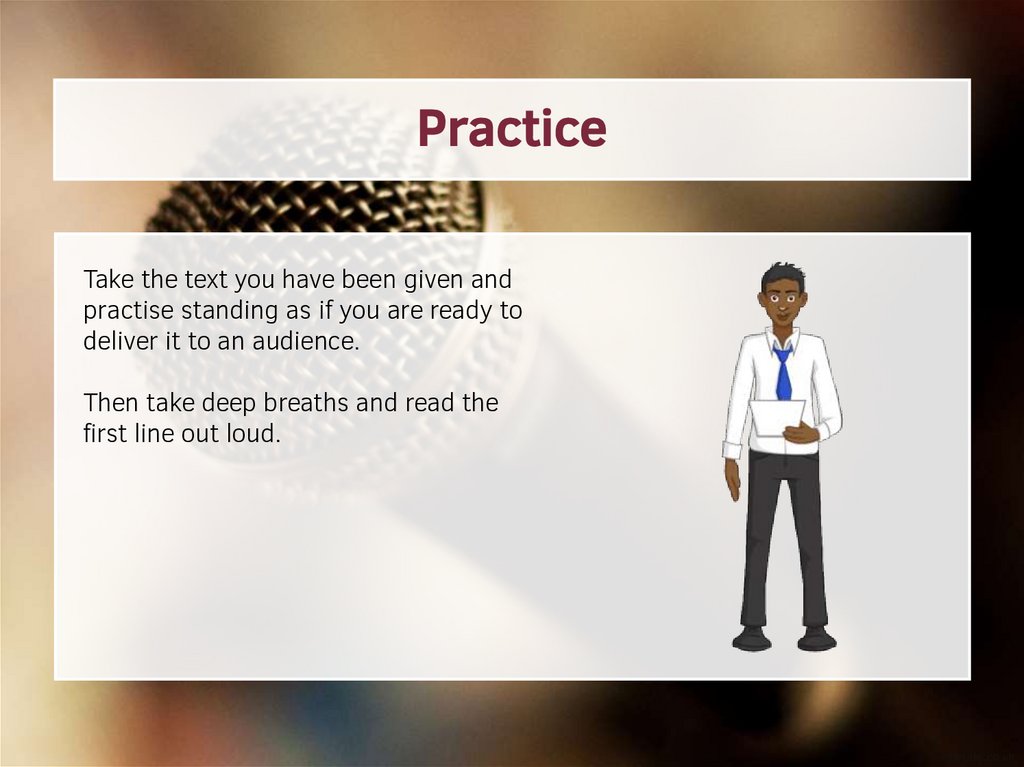
PracticeTake the text you have been given and
practise standing as if you are ready to
deliver it to an audience.
Then take deep breaths and read the
first line out loud.
17.
TaskDesign a fact sheet to give helpful advice
to pupils who are nervous about speaking
in front of the class.
18.
Quick QuizGet ready to show off your knowledge
of public speaking techniques!
19.
Quick QuizThe diaphragm is…
A) Tendon
B) Muscle
C) Part of the lung
D) Cartilage
20.
Quick QuizIntercostal diaphragmatic breathing helps you to…
A) Shout
B) Talk for ages without
taking a breath
C) Project your voice
D) Strain your vocal chords
21.
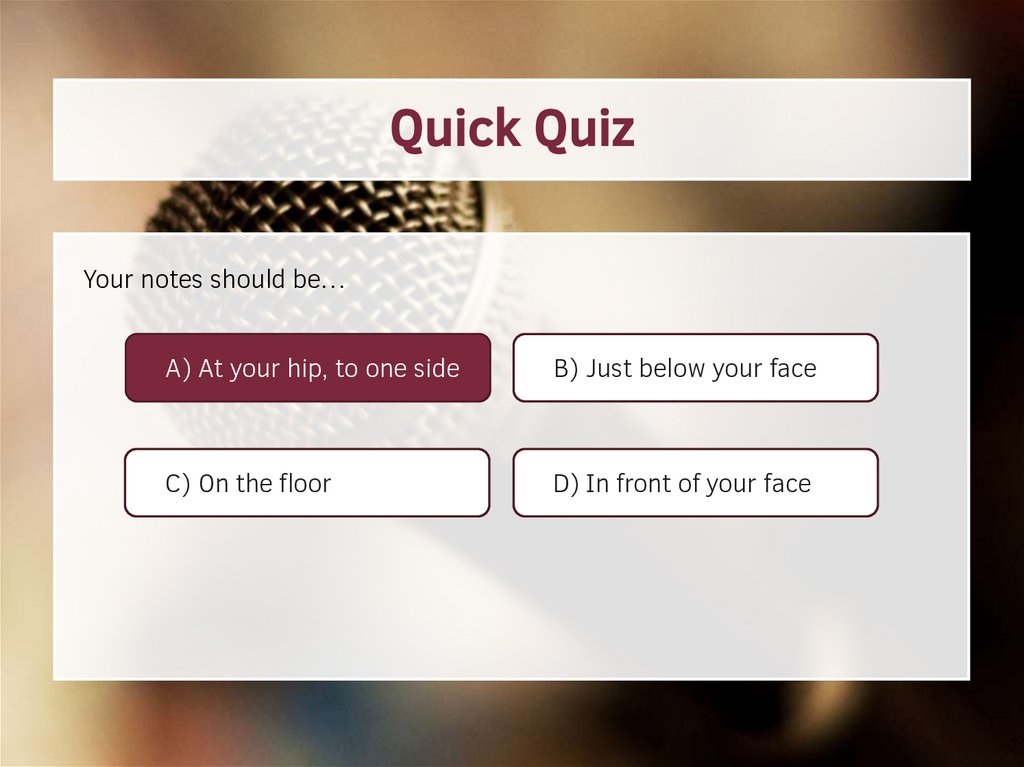
Quick QuizYour notes should be…
A) At your hip, to one side
B) Just below your face
C) On the floor
D) In front of your face
22.
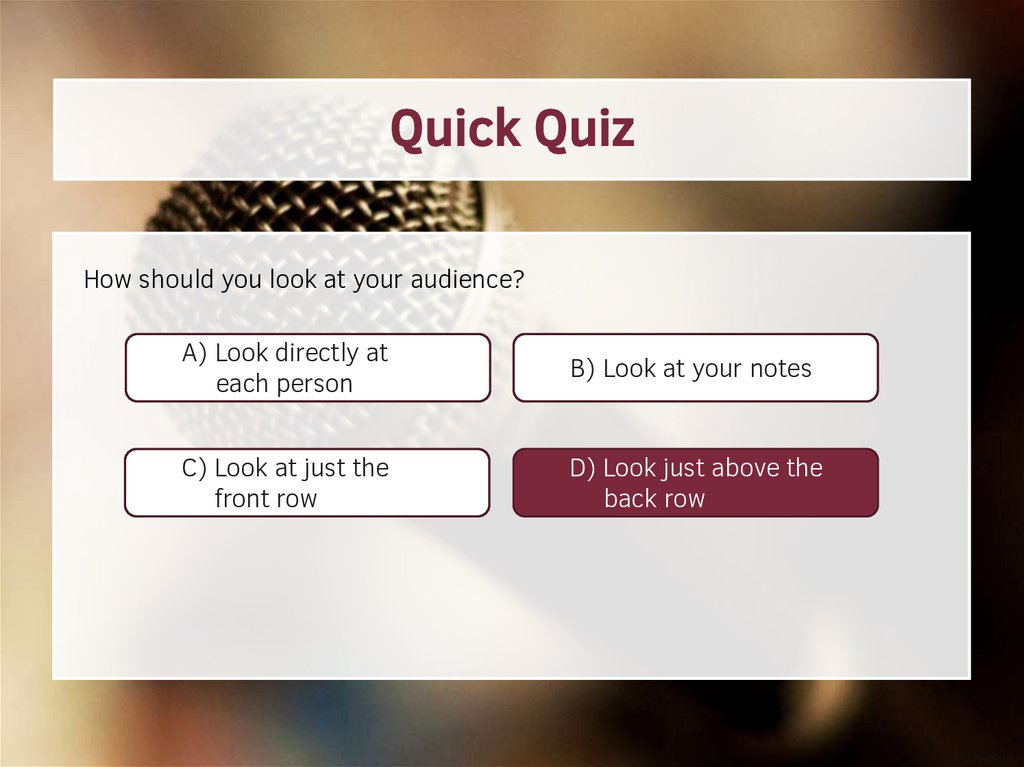
Quick QuizHow should you look at your audience?
A) Look directly at
each person
B) Look at your notes
C) Look at just the
front row
D) Look just above the
back row
23.
Quick QuizHow do you feel about speaking in public?
A) Absolutely terrified
B) Slightly nervous
C) Fairly calm
D) Massively confident
There is no right or wrong answer, it is individual choice!