
 industry
Similar presentations:



Ethical theories
1.
ETHICAL THEORIES2. Case discussion on Accident at a Union Carbide plant in Bhopal, India (1984)
3.
In late 1984, a pressure-relief valve on a tank used to store methylisocyanate (MIC) at a Union Carbide plant in Bhopal, India, accidentally
opened. MIC is a poisonous compound used in the manufacture of
pesticides. When the valve opened, MIC was released from the tank,
and a cloud of toxic gas formed over the area surrounding the plant.
Unfortunately, this neighborhood was very densely populated. Some
two thousand people were killed, and thousands more were injured as a
result of the accident. Many of the injured have remained permanently
disabled. The causes of the accident are not completely clear, but there
appear to have been many contributing factors. Pipes in the plant were
misconnected, and essential safety systems were either broken or had
been taken off-line for maintenance. The effects of the leak were
intensified by the presence of so many people living in close proximity
to the plant. Among the many important issues this case brings up are
questions of balancing risk to the local community with the economic
benefits to the larger community of the state or nation. Undoubtedly,
the presence of this chemical plant brought significant local economic
benefit. However, the accident at the plant also brought disaster to the
local community at an enormous cost in human lives and suffering.
How can we decide if on balance the economic benefit brought
by this plant outweighed the potential safety hazards?
4. Bhopal Case
In order to answer the question, we need aframework for analyzing ethical problems.
In ethical problem solving, knowledge of
ethical theories provide a framework for
understanding and reaching solutions in
ethical problems.
5.
Advantages of Ethical Theories•Ethical theories help a person to arrive at a
decision.
•Ethical theories help us to choose what is
appropriate for the given situation.
•Ethical theories also give us a perspective on
morality.
•Ethical theories assist us in making
reasonable choices.
•Ethical theories are useful in solving some
dilemmas
•https://www.apsed.in/ethical-theories
6.
ETHICAL FUNDAMENTALISMUnder ethical fundamentalism, a
person looks to an outside source for
ethical rules or commands. This may be a
book (e.g., the Bible, the Koran) or a
person (e.g., Karl Marx).
7. DIFFERENT THEORIES OF ETHICS TWO MAIN SCHOOLS
What constitutes good ethical behavior?Teleological Theory – concerned with
consequences or the end goal
The word is derived from the Greek word
‘telos’ which refers to an end.
The ethical good of an action is to be judged
with the effect of the action on others.
8. Teleological Theory
Rightness of action is determined solely bythe amount of good consequences they
produce.
E.g., construction company donates
materials to build shelters for the homeless
which is an important issue
9. Teleological Ethics
Teleological ethics deals with the attainment ofcertain end goals. The most common under this
is Utilitarianism.
Utilitarianism is a moral theory with origins in the
works of Jeremy Bentham (1748–1832) and John
Stuart Mill (1806–1873).
This moral theory dictates that people must choose
the action or follow the rule that provides the
greatest good to society.
10. Theories under the Two Schools
Utilitarianism (teleological) – the ideal isto maximize the total benefit for everyone
involved;(collectivist approach)
Nobody’s particular interest is given more
weight than another, group interest is
important
Distribution shall be equal and fair.
11. Cost–Benefit Analysis
One tool often used, especially when trying todetermine whether a project makes sense, is
cost–benefit analysis.
Fundamentally, this type of analysis is just an
application of utilitarianism.
In cost–benefit analysis, the costs of a project
are assessed, as are the benefits. Only those
projects with the highest ratio of benefits to
costs will be implemented. This principle is
similar to the utilitarian goal of maximizing
the overall good.
12. DIFFERENT THEORIES OF ETHICS TWO MAIN SCHOOLS
Deontological Ethics (Duty-Based Ethics)Deontological ethics - governed by rules and
principles and not by the consequences.
From the Greek word ‘deon’, meaning duty
If we are in a decision where the right of a person
or community is at stake, we should act according
to this ethics
Principle: Actions are morally right or wrong
based on rules and duties, regardless of
consequences. Associated with Immanuel Kant.
13.
14. Duty ethics (Kantian ethics)
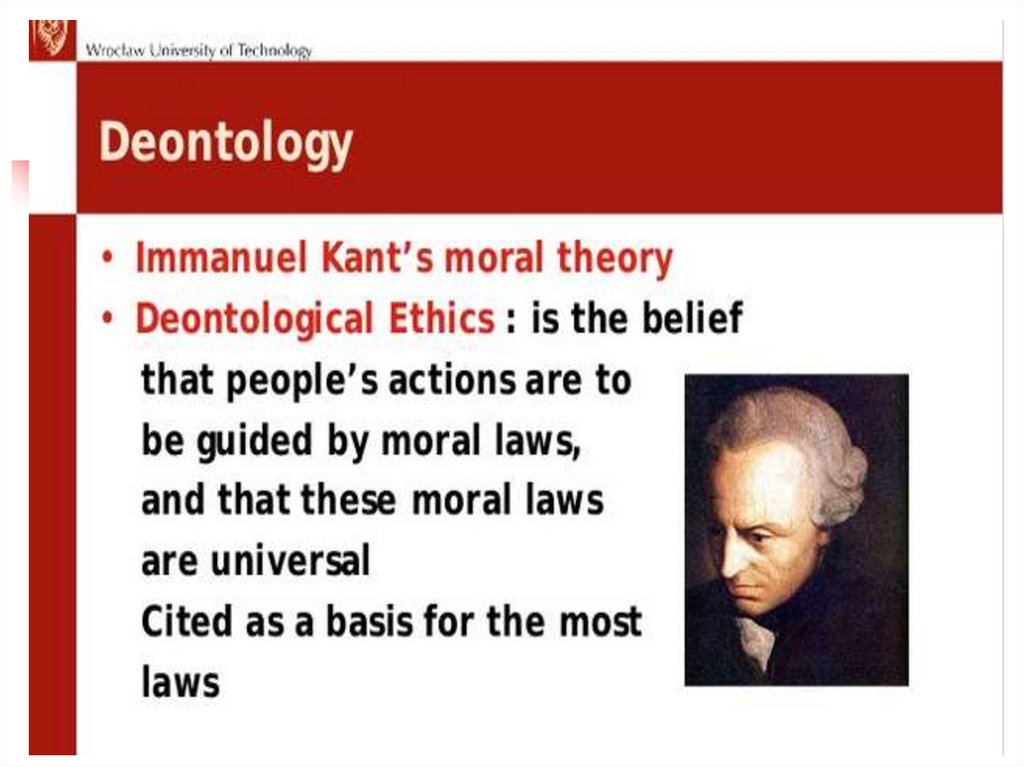
Immanuel Kant (1724–1804) is the bestknown proponent of Kantian ethics, alsocalled duty ethics.
Duty ethics contends that there are duties
that should be performed (for example, the
duty to treat others fairly or the duty not to
injure others) regardless of whether these
acts lead to the most good.
Duty to safety, survival, success, etc.
15. Duty ethics (Kantian ethics)
ExampleAccording to Kantian ethics, keeping a
promise to abide by a contract is a
moral duty even though that contract
turns out to be detrimental to the
obligated party.
16.
The form of action in the Kantiantheory:
Universability – asks if one would
want everyone to perform in the
proposed manner
Whatever is right (or wrong) in one
situation is right (or wrong) in any
relevantly similar situation. (it requires
us to be consistent in our thinking)
E.g., a manager might ask if he or she
would like a similar system which all the
companies apply
17.
The form of action in the Kantiantheory:
Reversibility – looks to if one would want such a
rule applied to oneself
E.g., a manager would decide if he or she would want
to be subjected to a particular break system
in deciding how long a break to give the workers on
an assembly line, a manager might apply this theory
Treat others as you would have them treat you
(Golden Rule).
What would you think if the roles were reversed?
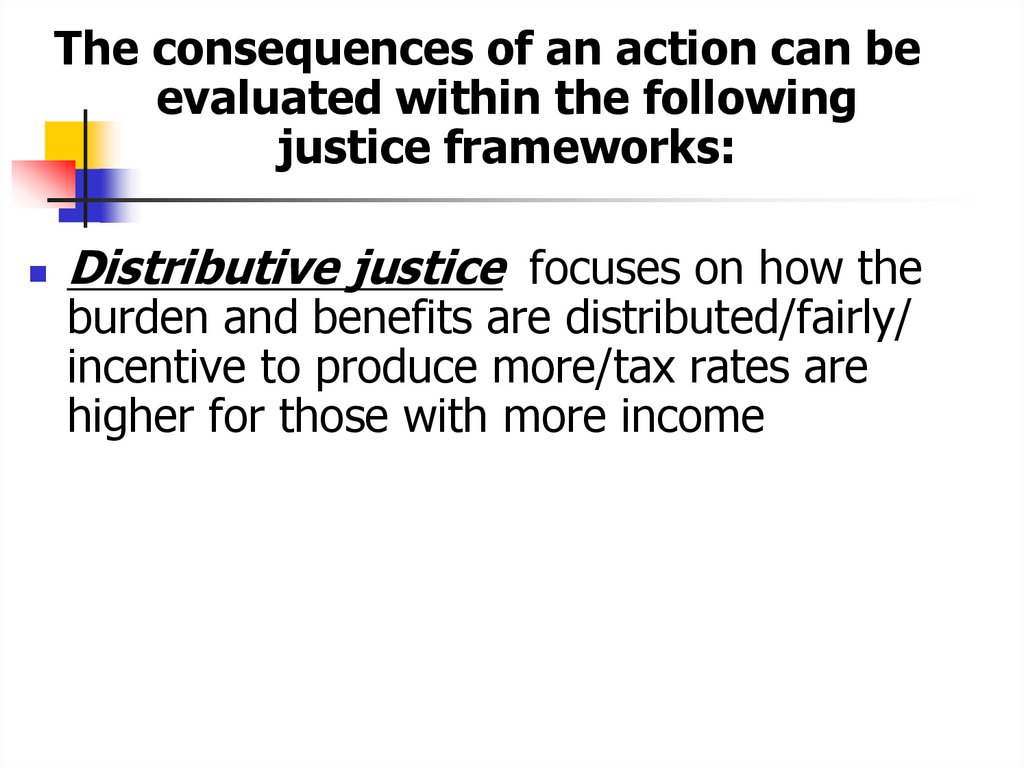
18.
The consequences of an action can beevaluated within the following
justice frameworks:
Distributive justice focuses on how the
burden and benefits are distributed/fairly/
incentive to produce more/tax rates are
higher for those with more income
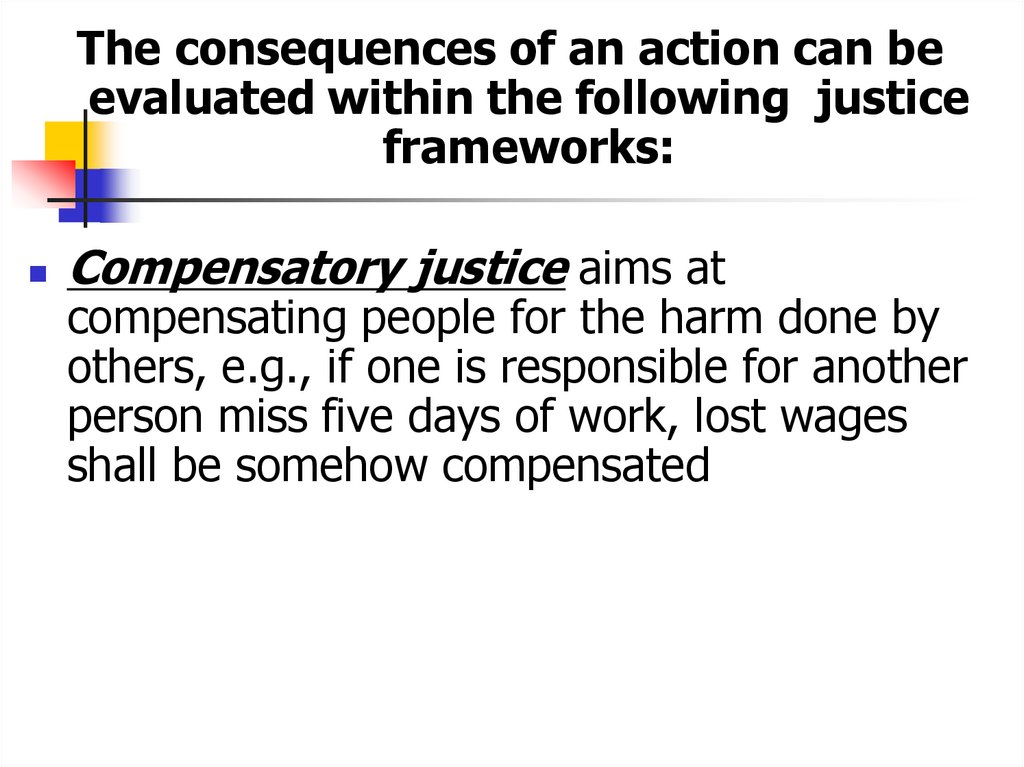
19.
The consequences of an action can beevaluated within the following justice
frameworks:
Compensatory justice aims at
compensating people for the harm done by
others, e.g., if one is responsible for another
person miss five days of work, lost wages
shall be somehow compensated
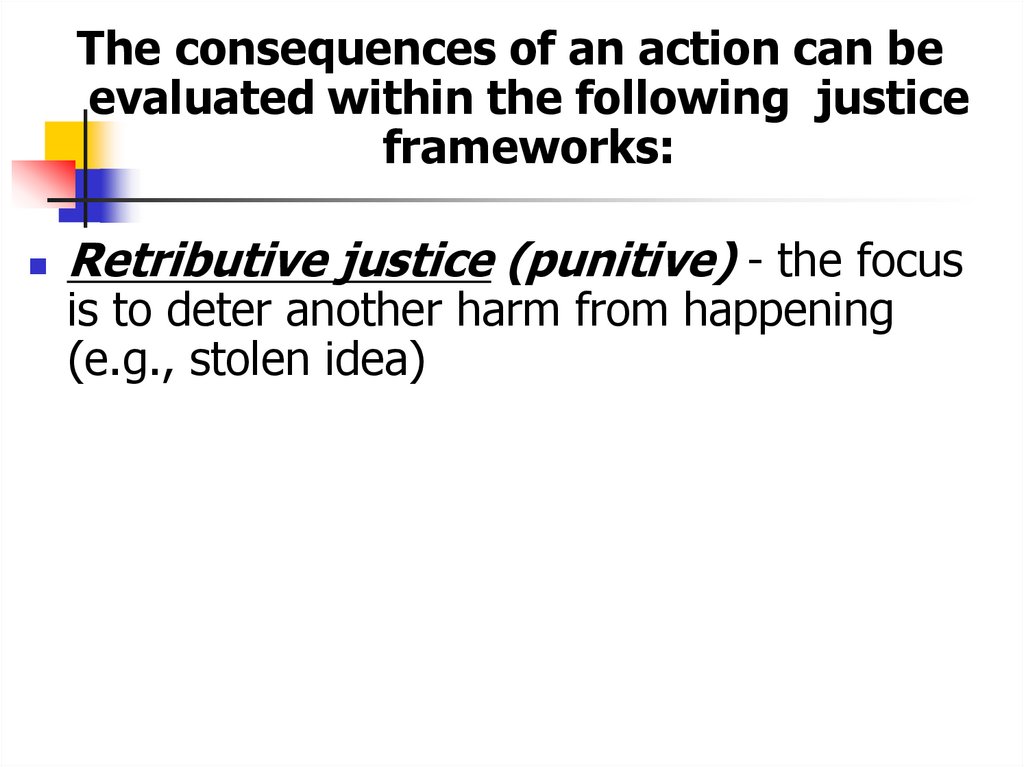
20.
The consequences of an action can beevaluated within the following justice
frameworks:
Retributive justice (punitive) - the focus
is to deter another harm from happening
(e.g., stolen idea)
21.
22. Rights ethics
Rights ethics emphasizes that we allhave moral rights, and any action that
violates these rights is ethically
unacceptable.
Like duty ethics, the ultimate overall
good of the actions is not considered.
23. Virtue ethics
Principle: Morality is about developing goodcharacter traits (virtues) like honesty, courage,
and kindness. Associated with Aristotle.
Virtue ethics regards actions as bad that
display bad character traits (vices).
This ethical theory focuses on the type of
person we should strive to be.
24. Virtue ethics
Virtue ethics focuses on words such asresponsibility, honesty, competence, and
loyalty, which are virtues.
Other virtues might include trustworthiness,
fairness, caring, citizenship, and respect.
Vices could include dishonesty, disloyalty,
irresponsibility, or incompetence.
Virtue ethics is closely tied to personal character.
Personal morality cannot, or at any rate should not,
be separated from professional morality.
25.
Examples of Virtue Ethics in ActionPersonal Life
A friend keeps a promise despite inconvenience,
showing the virtue of trustworthiness.
A student helps a struggling classmate without
expecting a reward, demonstrating kindness.
Professional Ethics
A journalist refuses to publish false news to gain
more readers, prioritizing integrity.
A doctor treats all patients with care, even if some
cannot afford to pay, demonstrating compassion.
26.
Examples of Virtue Ethics in ActionCorporate and Business Ethics
A CEO prioritizes ethical decision-making over
profit maximization, showing responsibility and
justice.
An employee admits to making a mistake rather
than hiding it, displaying honesty.
AI and Technology Ethics
A software developer ensures AI is fair and
unbiased, reflecting the virtue of justice.
A company refuses to sell customer data,
demonstrating respect for privacy.
27. Social responsibility of business
is a duty owed by businesses to act sociallyresponsible in producing and selling goods and
services
Moral minimum
Corporation’s duty is to make profit while
avoiding harm to others
Corporate citizenship
Business has a responsibility to do good and
solve social problems
Stakeholder interest
28. Which Theory to Use?
How do we decide which theory is applicable to a givenproblem?
The good news is that in solving ethical problems, we
don’t have to choose from among these theories.
Rather, we can use all of them to analyze a problem
from different angles and see what result each of the
theories gives us. This allows us to examine a problem
from different perspectives to see what conclusion each
one reaches.
Frequently, the result will be the same even though the
theories are very different.
29. EXAMPLE
Take, for example, a chemical plant near asmall city that discharges a hazardous waste
into the groundwater.
If the city takes its water from wells, the
water supply for the city will be compromised
and significant health problems for the
community may result.
Rights ethics indicates that this pollution is
unethical, since it causes harm to many of
the residents.
30. EXAMPLE
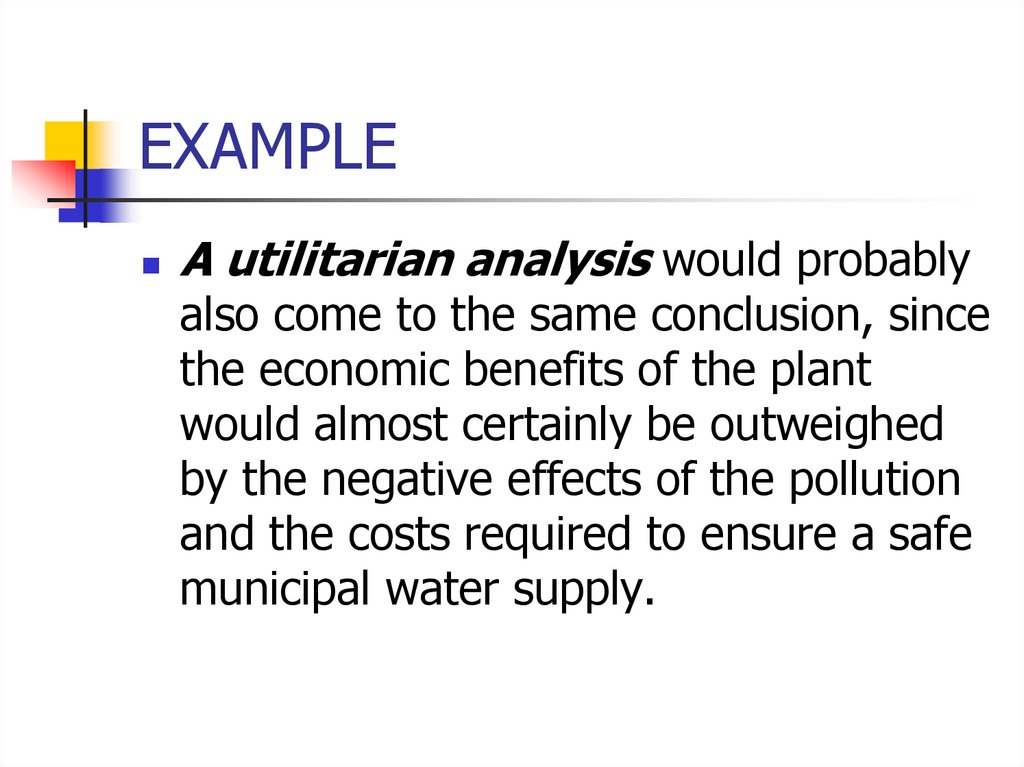
A utilitarian analysis would probablyalso come to the same conclusion, since
the economic benefits of the plant
would almost certainly be outweighed
by the negative effects of the pollution
and the costs required to ensure a safe
municipal water supply.
31. EXAMPLE
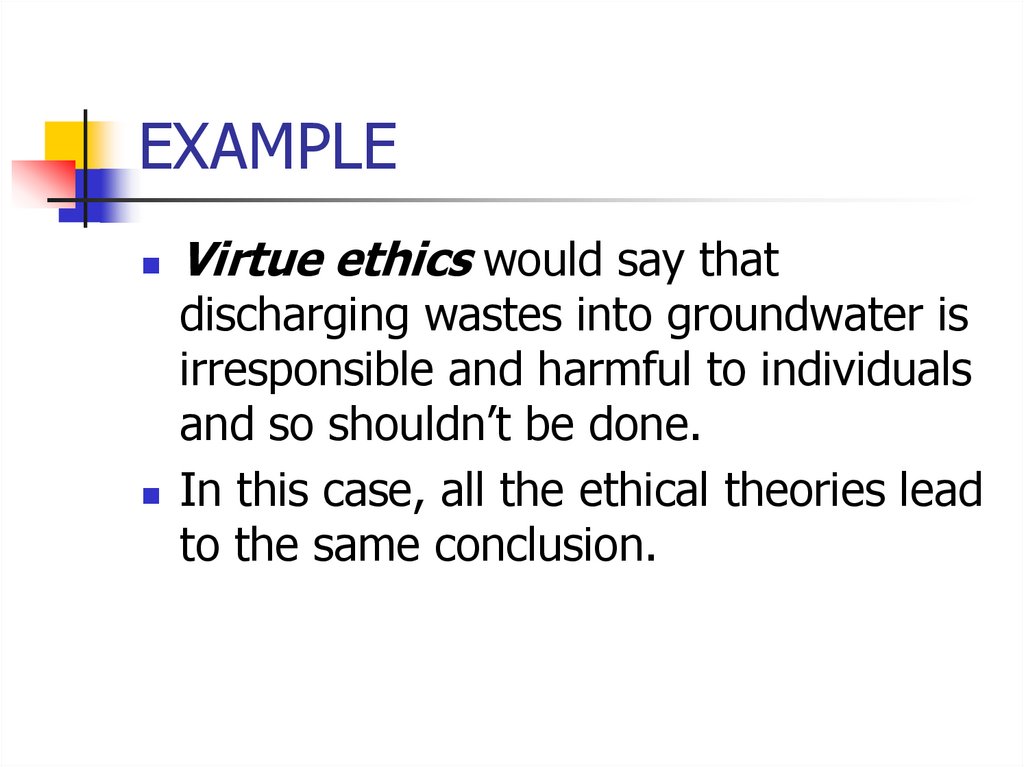
Virtue ethics would say thatdischarging wastes into groundwater is
irresponsible and harmful to individuals
and so shouldn’t be done.
In this case, all the ethical theories lead
to the same conclusion.