



 english
Similar presentations:










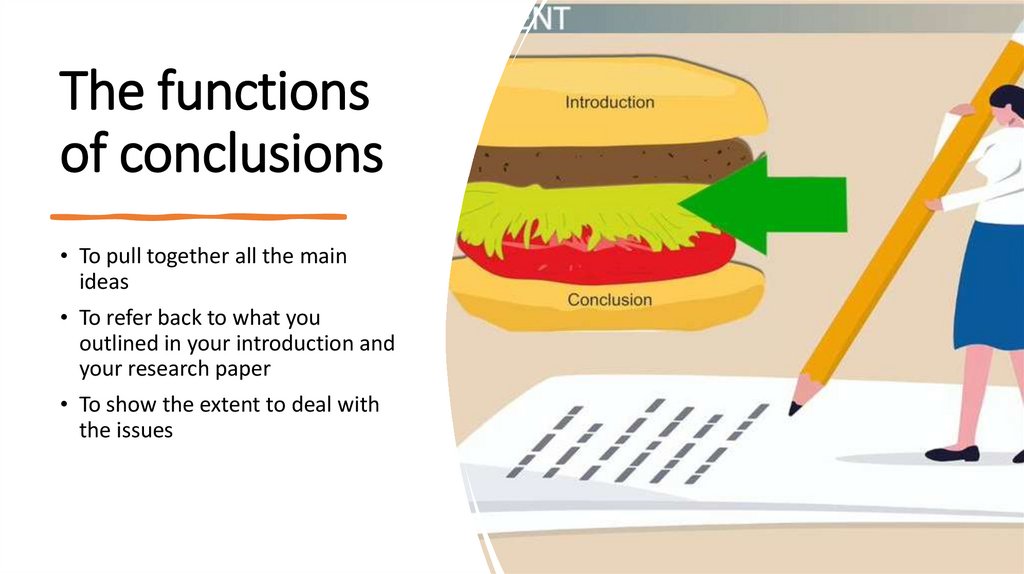
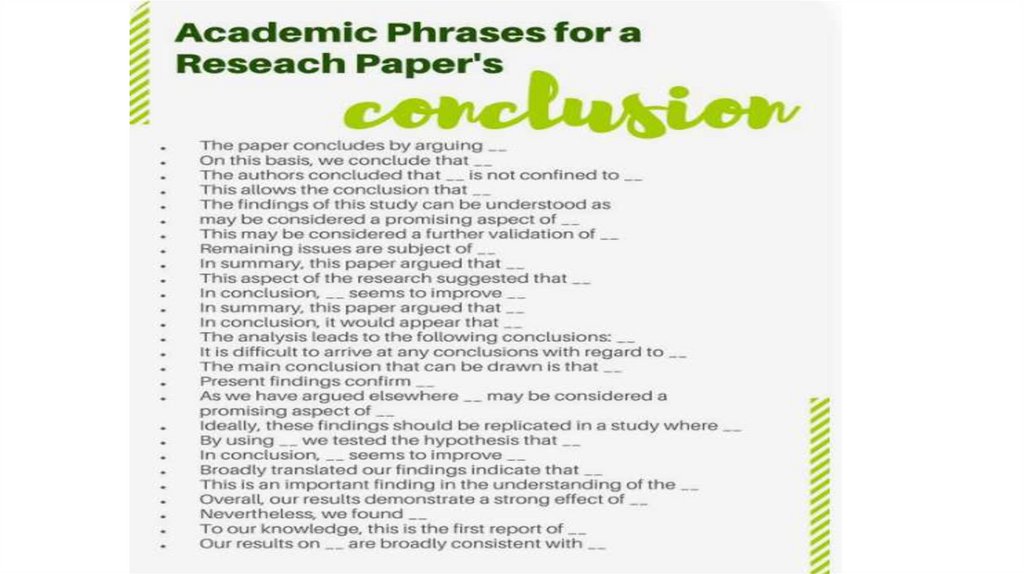
Conclusion. The functions of conclusions
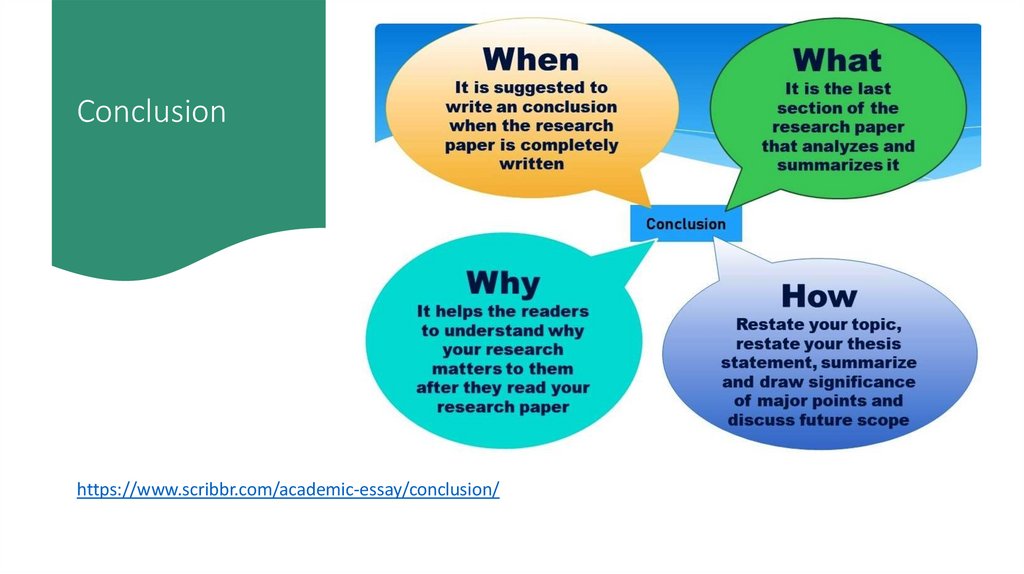
1. Conclusion
https://www.scribbr.com/academic-essay/conclusion/2. The functions of conclusions
• To pull together all the mainideas
• To refer back to what you
outlined in your introduction and
your research paper
• To show the extent to deal with
the issues
3. The Features of Conclusions
4. Logical Conclusion
• To evaluate information and make appropriatejudgments
• This is the final step in the scientific process and
the most important one
• During this step, you carefully examine your
experimental results to determine what exactly
they mean
• The words that indicate a conclusion are because,
since, for, therefore, thus, consequently, only,
eventually etc.
5. A brief Summary
• It is a concise and comprehensive overview of aresearch paper
• It briefly restates the purpose, methods, findings,
conclusions, and relevance of a study, faithfully
recapitulating the major points of the work
• It gives the reader a brief overview of the study
• The questions (why is this study necessary and
important, who were the participants, what conclusions
were drawn from the research, what were the key
findings of the study, what were the methods used,
what kind of relevance does the research have for the
wider world) help you to structure your thoughts in the
summary
6. Comments
• It is your own opinion to give an explanation• The words that indicate comments are whereas,
nevertheless, when, etc.
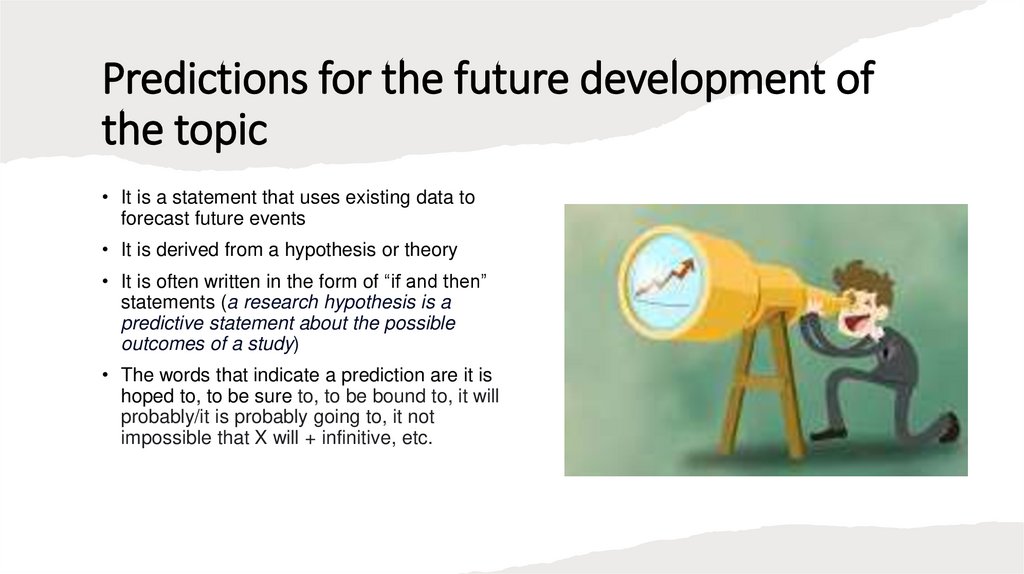
7. Predictions for the future development of the topic
• It is a statement that uses existing data toforecast future events
• It is derived from a hypothesis or theory
• It is often written in the form of “if and then”
statements (a research hypothesis is a
predictive statement about the possible
outcomes of a study)
• The words that indicate a prediction are it is
hoped to, to be sure to, to be bound to, it will
probably/it is probably going to, it not
impossible that X will + infinitive, etc.
8. Mention for the further research
• It refers to future studies that build upon existingknowledge by exploring new aspects, expanding
sample sizes, or investigating related questions
• It is very common to end research papers with the
caveat that further research is needed, further
research is needed to understand the impacts, further
research is needed to demonstrate this, further
research is needed to properly assess these effects,
further research is needed to compare these
accounting measures
• This is particularly true when reporting results on a
topic that's not well studied, and in which there's
not enough literature to form a broad consensus
• It is essential for finding solutions to problems,
expanding knowledge, and advancing our
understanding of the world (it would be interesting
to examine, to find, to follow)
9. Limitations in the research
• It is the weaknesses of the study, based on factors that are often outside ofyour control as the researcher
• Research design limitation (some available procedures may affect your
research outputs)
• Impact limitation (if your research has excellent statistics, but it can suffer
from the influence of increasing findings as researched every day)
• Data or statistical limitation (it is impossible to collect sufficient data for
research or very difficult to get access to the data. This could lead to an
incomplete conclusion to your study)
• Time limitation (the time available to study a research problem might be
constrained by such practical issues)
10.
11.
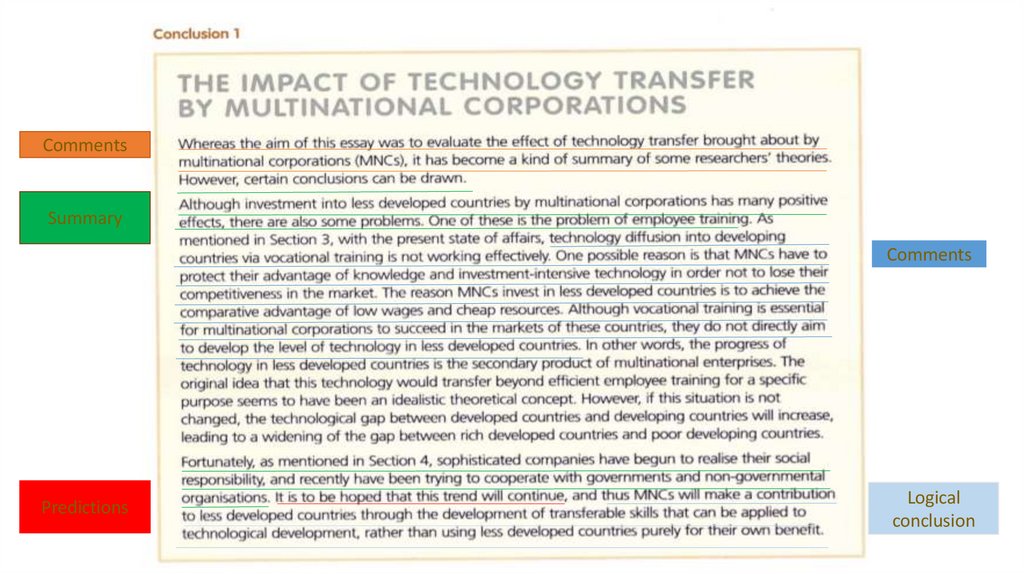
CommentsSummary
Comments
Predictions
Logical
conclusion