
 english
Similar presentations:





Dialogue lists
1.
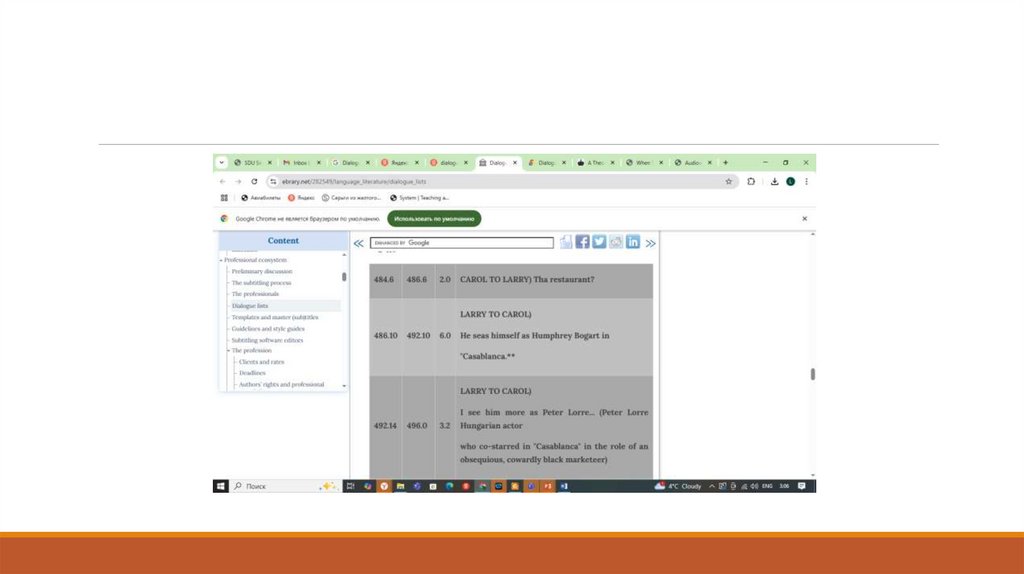
Dialogue lists2.
The main objective of any translation is to reformulate a message originally produced in a SL into anotherlanguage, avoiding any misunderstandings in the process.
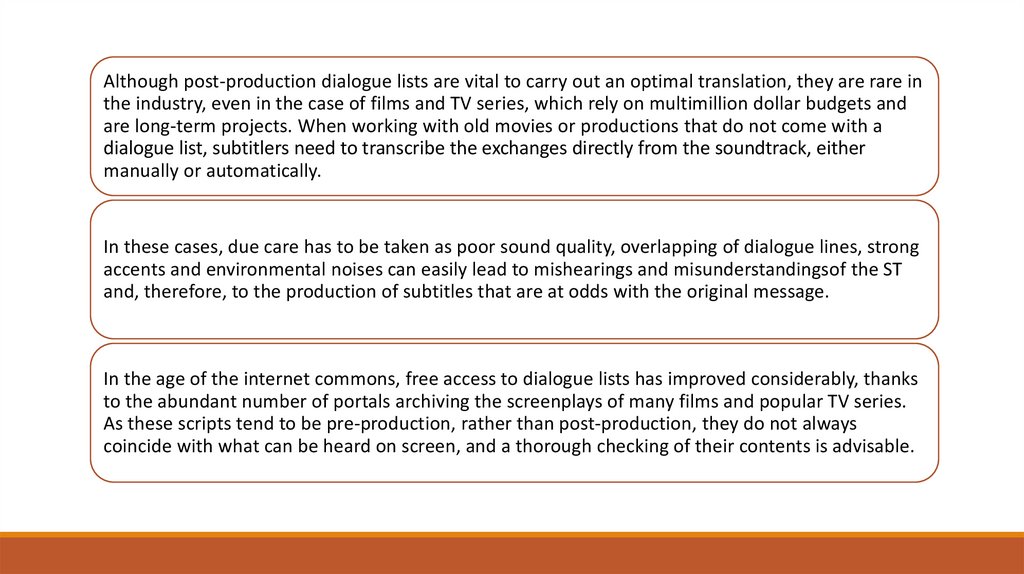
In other translation practices it might arguably be easier to deal with some translational challenges in
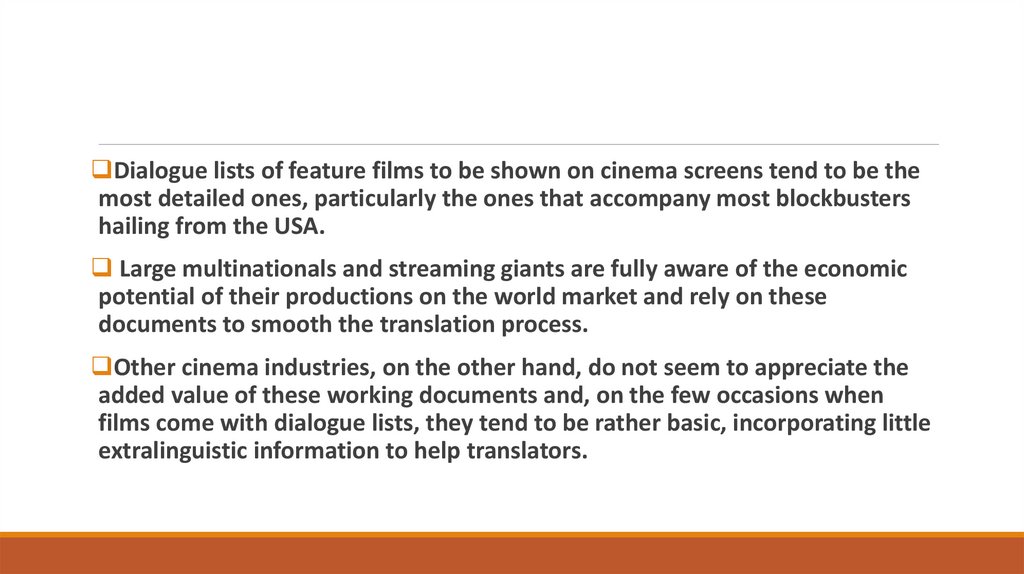
footnotes or by leaving out or radically changing obscure cultural referents or difficult plays on words,
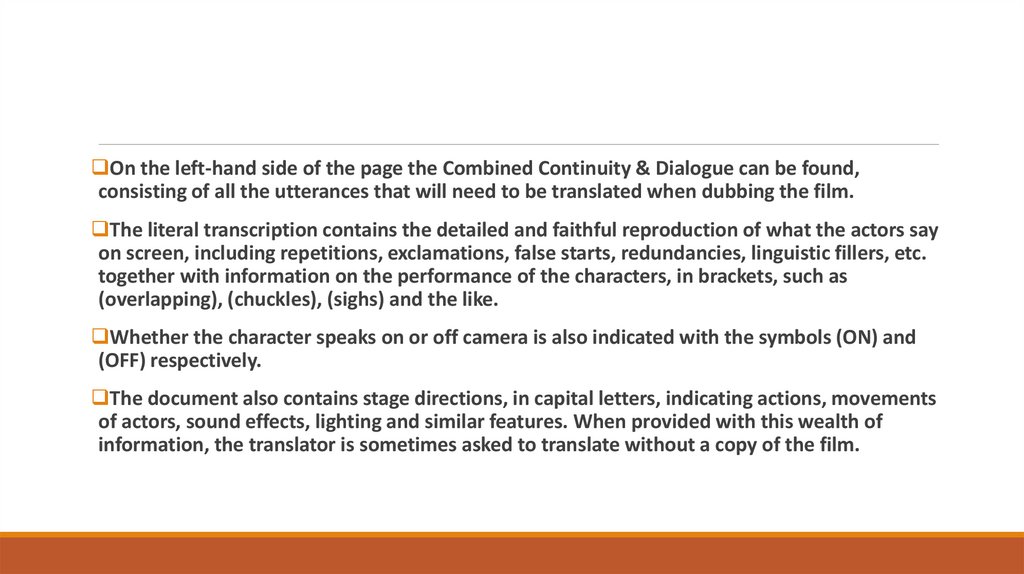
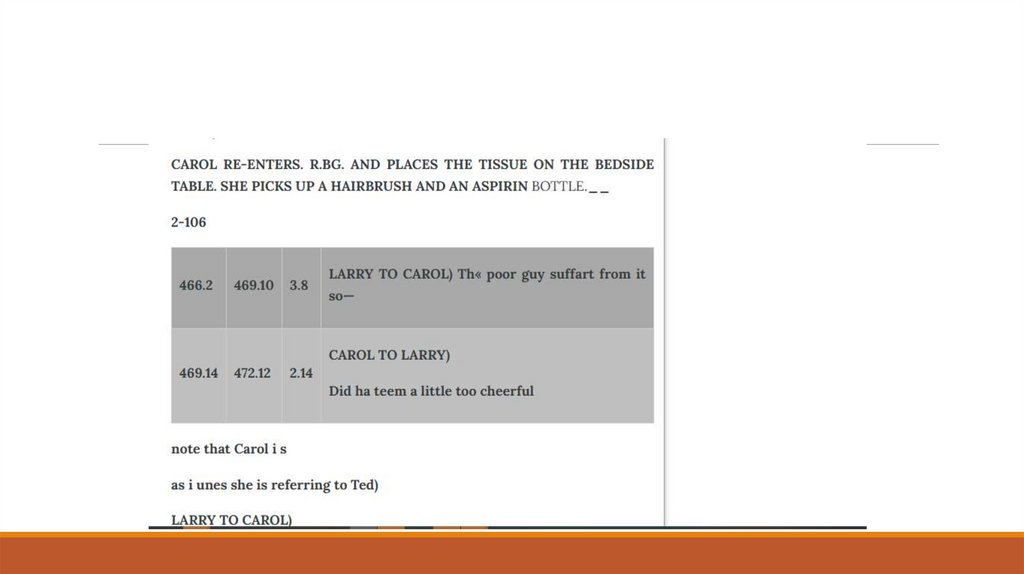
even if this is hardly good translation practice.
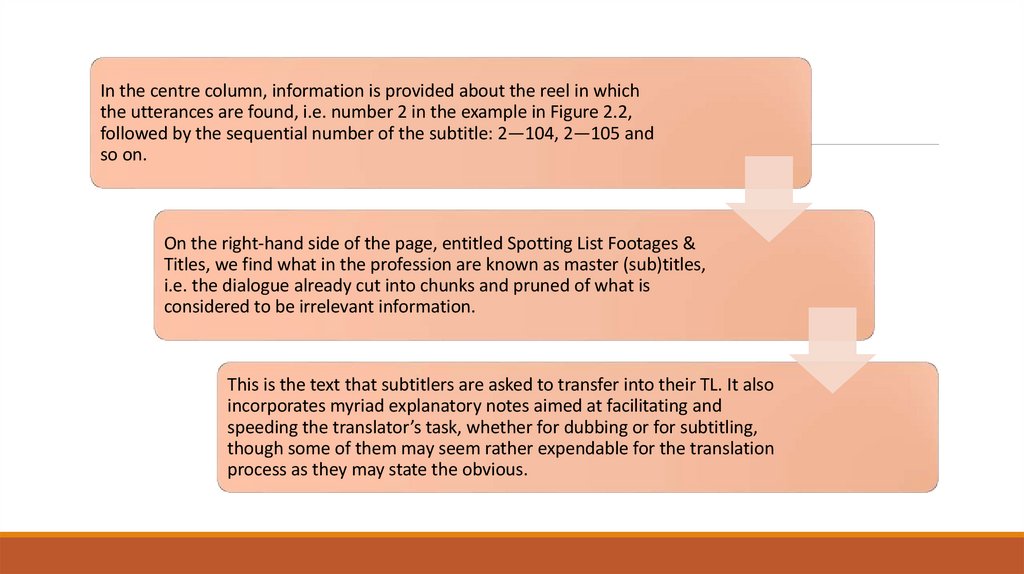
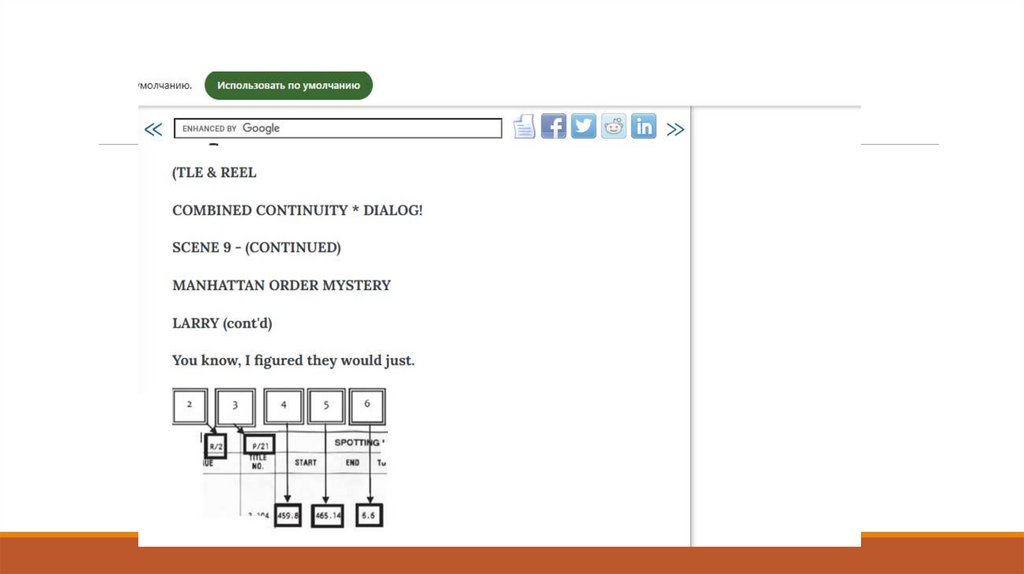
It is more difficult for consumers to spot mistakes or changes in the translation unless they have direct
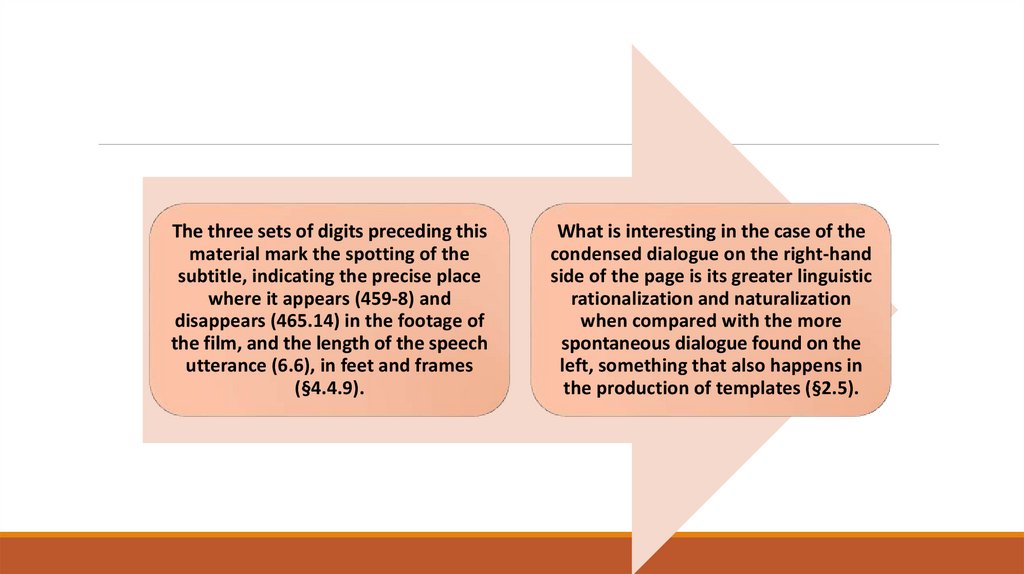
access to the original text, which is not always the case. Yet, this concealment is impossible in a
translation practice as uniquely vulnerable as subtitling, always defined by the concurrent presence of the
original and TTs at all times.
3.
In this context, a good dialogue list is a key document thatfacilitates the task of the audiovisual translator, helping to dispel
potential comprehension mistakes.
As far as nomenclature goes, many terms exist to refer to this type
of document — e.g. screenplay, (as-broadcast) script, dialogue
transcript, combined continuity, etc. — but, despite the minor
differences among them, the umbrella term dialogue list is used in
these pages.
4.
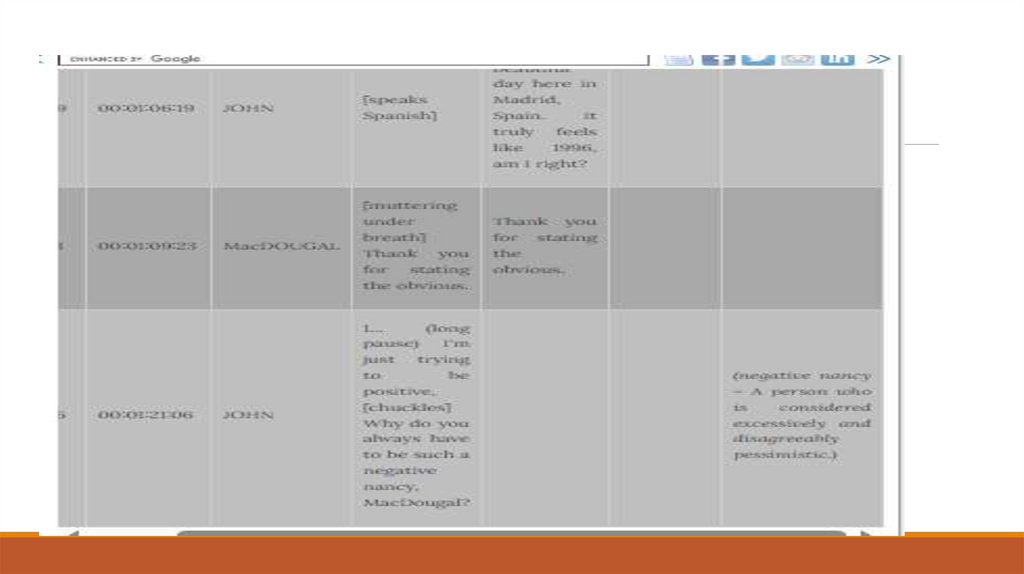
What is a dialogue list?A dialogue list is essentially the
accurate compilation of all the
dialogue exchanges uttered in the
film and is a document usually
supplied by the film producer or
distributor.
Besides a verbatim transcription of all the
dialogue, the ideal list also offers extra
information on implicit socio-cultural
connotations, explains plays on words or
possible ambiguities, transcribes any
written text that appears on screen,
elucidates the meaning of colloquial and
dialectal terms, gives the correct spelling
of all proper names and clarifies implicit
as well as explicit allusions, though not all
dialogue lists are this complete.
5.
The European Broadcasting Union (EBU), resultingfrom the Conference on Dubbing and Subtitling that
took place in Stockholm in 1987, launched a proposal
with general guidelines aimed at homogenizing the
production of these documents (Ivarsson and Carroll
1998).
However, they are only recommendations, and the
professional reality is that these documents follow
many different layouts and vary enormously from
one to the next.
6.
Although post-production dialogue lists are vital to carry out an optimal translation, they are rare inthe industry, even in the case of films and TV series, which rely on multimillion dollar budgets and
are long-term projects. When working with old movies or productions that do not come with a
dialogue list, subtitlers need to transcribe the exchanges directly from the soundtrack, either
manually or automatically.
In these cases, due care has to be taken as poor sound quality, overlapping of dialogue lines, strong
accents and environmental noises can easily lead to mishearings and misunderstandingsof the ST
and, therefore, to the production of subtitles that are at odds with the original message.
In the age of the internet commons, free access to dialogue lists has improved considerably, thanks
to the abundant number of portals archiving the screenplays of many films and popular TV series.
As these scripts tend to be pre-production, rather than post-production, they do not always
coincide with what can be heard on screen, and a thorough checking of their contents is advisable.
7.
Dialogue lists of feature films to be shown on cinema screens tend to be themost detailed ones, particularly the ones that accompany most blockbusters
hailing from the USA.
Large multinationals and streaming giants are fully aware of the economic
potential of their productions on the world market and rely on these
documents to smooth the translation process.
Other cinema industries, on the other hand, do not seem to appreciate the
added value of these working documents and, on the few occasions when
films come with dialogue lists, they tend to be rather basic, incorporating little
extralinguistic information to help translators.
8.
On the left-hand side of the page the Combined Continuity & Dialogue can be found,consisting of all the utterances that will need to be translated when dubbing the film.
The literal transcription contains the detailed and faithful reproduction of what the actors say
on screen, including repetitions, exclamations, false starts, redundancies, linguistic fillers, etc.
together with information on the performance of the characters, in brackets, such as
(overlapping), (chuckles), (sighs) and the like.
Whether the character speaks on or off camera is also indicated with the symbols (ON) and
(OFF) respectively.
The document also contains stage directions, in capital letters, indicating actions, movements
of actors, sound effects, lighting and similar features. When provided with this wealth of
information, the translator is sometimes asked to translate without a copy of the film.
9.
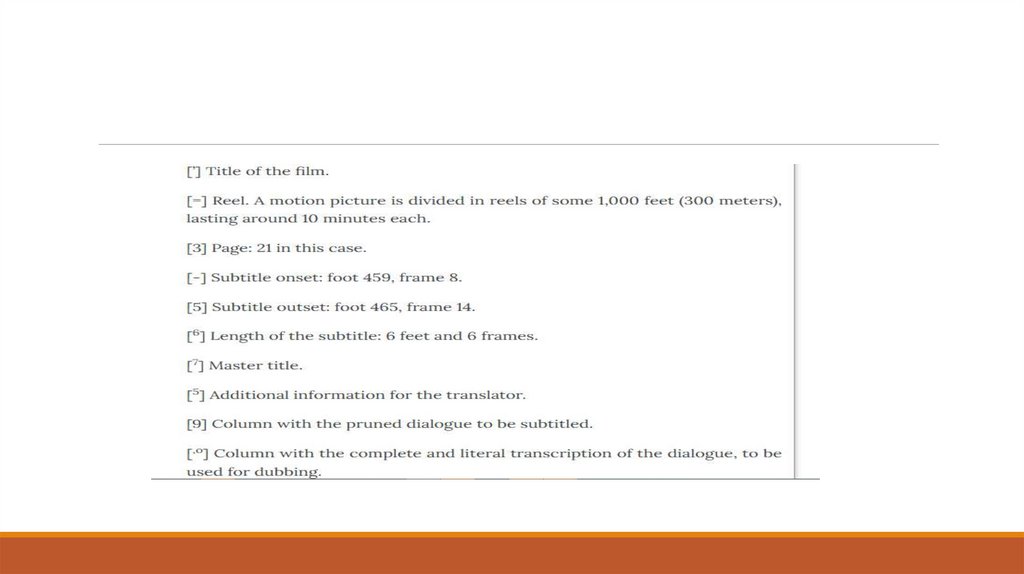
In the centre column, information is provided about the reel in whichthe utterances are found, i.e. number 2 in the example in Figure 2.2,
followed by the sequential number of the subtitle: 2—104, 2—105 and
so on.
On the right-hand side of the page, entitled Spotting List Footages &
Titles, we find what in the profession are known as master (sub)titles,
i.e. the dialogue already cut into chunks and pruned of what is
considered to be irrelevant information.
This is the text that subtitlers are asked to transfer into their TL. It also
incorporates myriad explanatory notes aimed at facilitating and
speeding the translator’s task, whether for dubbing or for subtitling,
though some of them may seem rather expendable for the translation
process as they may state the obvious.
10.
The three sets of digits preceding thismaterial mark the spotting of the
subtitle, indicating the precise place
where it appears (459-8) and
disappears (465.14) in the footage of
the film, and the length of the speech
utterance (6.6), in feet and frames
(§4.4.9).
What is interesting in the case of the
condensed dialogue on the right-hand
side of the page is its greater linguistic
rationalization and naturalization
when compared with the more
spontaneous dialogue found on the
left, something that also happens in
the production of templates (§2.5).
11.
12.
13.
14.
15.
Traditionally, dialogue lists have largely been used only inthe translation of motion pictures to be screened in
cinema theatres, while programmes to be broadcast on TV
or released on DVD or Blu-ray rarely made use of these
working documents and, when they did, they were mere
transcriptions of the dialogue exchanges, with virtually no
additional information for the subtitlers.
16.
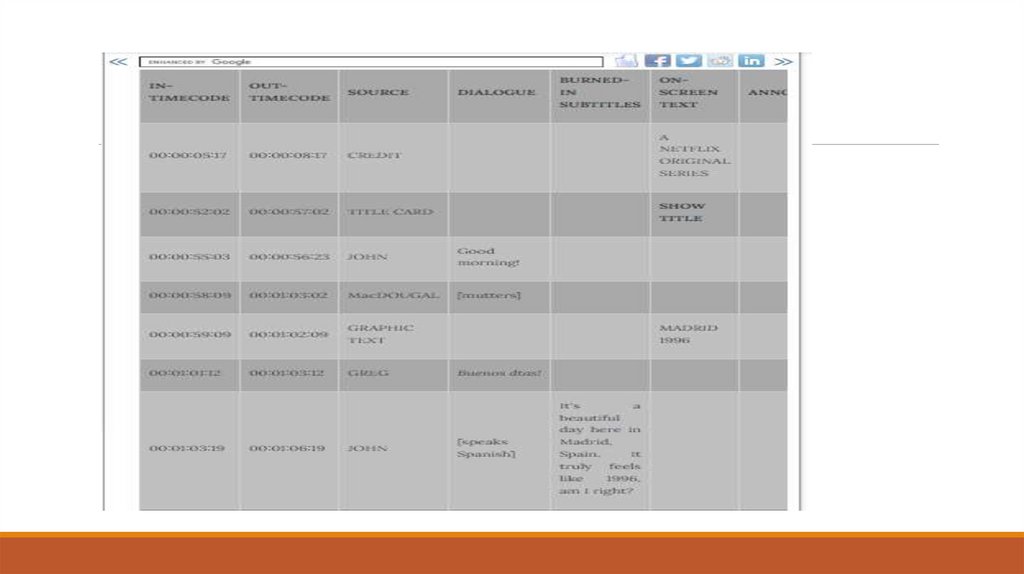
The situation seems to be changing these days and OTTdistributors like Netflix are requesting their media partners to
deliver detailed dialogue lists together with their audiovisual
productions, which have to contain frame-accurate timing,
verbatim transcription of the dialogue and any written text
appearing on screen, be it burned-in subtitles (i.e. any subtitle that
appears in the original film to translate a FL, for instance) or
onscreen text (i.e. main titles, end credits, narrative text, location
call-outs, and other supportive or creative text), as well as
pertinent annotations.
17.
18.
19.
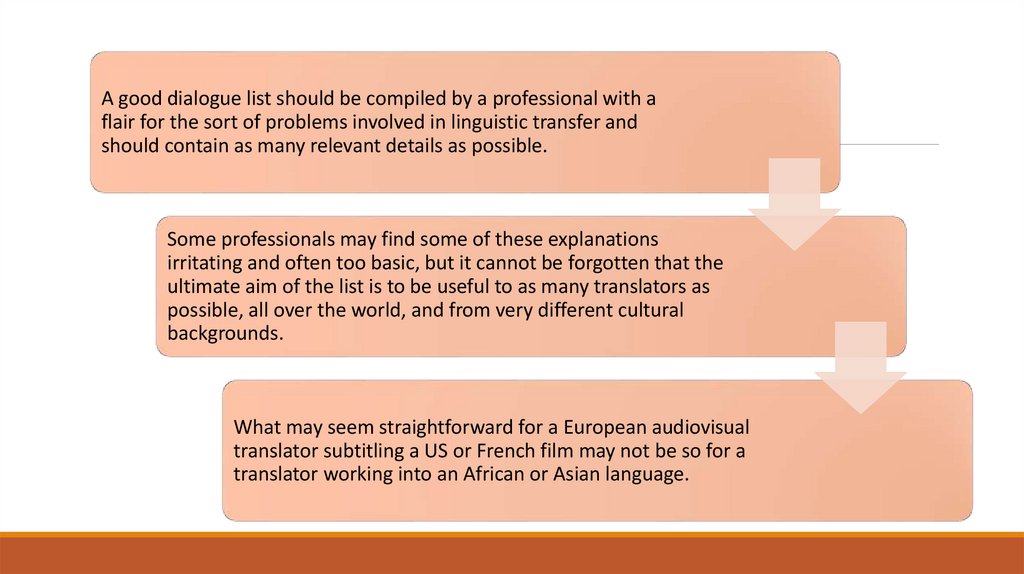
A good dialogue list should be compiled by a professional with aflair for the sort of problems involved in linguistic transfer and
should contain as many relevant details as possible.
Some professionals may find some of these explanations
irritating and often too basic, but it cannot be forgotten that the
ultimate aim of the list is to be useful to as many translators as
possible, all over the world, and from very different cultural
backgrounds.
What may seem straightforward for a European audiovisual
translator subtitling a US or French film may not be so for a
translator working into an African or Asian language.