
 informatics
Similar presentations:








Advanced Encryption Standard (AES)
1. Advanced Encryption Standard (AES)
2. Origins
• clear a replacement for DES was needed• have theoretical attacks that can break it
• have demonstrated exhaustive key search attacks
• can use Triple-DES – but slow, has small blocks
• US NIST issued call for ciphers in 1997
• 15 candidates accepted in Jun 98
• 5 were shortlisted in Aug-99
• Rijndael was selected as the AES in Oct-2000
• issued as FIPS PUB 197 standard in Nov-2001
3. AES Requirements
• private key symmetric block cipher• 128-bit data, 128/192/256-bit keys
• stronger & faster than Triple-DES
• active life of 20-30 years (+ archival use)
• provide full specification & design details
• both C & Java implementations
• NIST have released all submissions & unclassified analyses
4. AES Evaluation Criteria
• initial criteria:• security – effort for practical cryptanalysis
• cost – in terms of computational efficiency
• algorithm & implementation characteristics
• final criteria
• general security
• ease of software & hardware implementation
• implementation attacks
• flexibility (in en/decrypt, keying, other factors)
5. AES Shortlist
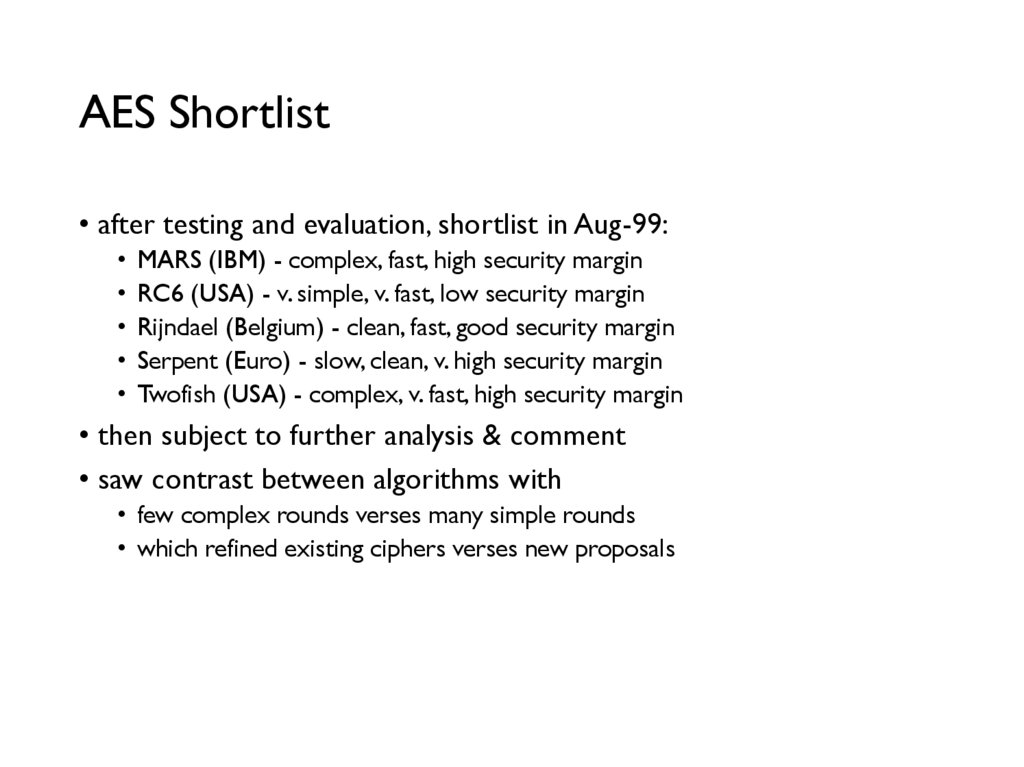
• after testing and evaluation, shortlist in Aug-99:• MARS (IBM) - complex, fast, high security margin
• RC6 (USA) - v. simple, v. fast, low security margin
• Rijndael (Belgium) - clean, fast, good security margin
• Serpent (Euro) - slow, clean, v. high security margin
• Twofish (USA) - complex, v. fast, high security margin
• then subject to further analysis & comment
• saw contrast between algorithms with
• few complex rounds verses many simple rounds
• which refined existing ciphers verses new proposals
6. The AES Cipher - Rijndael
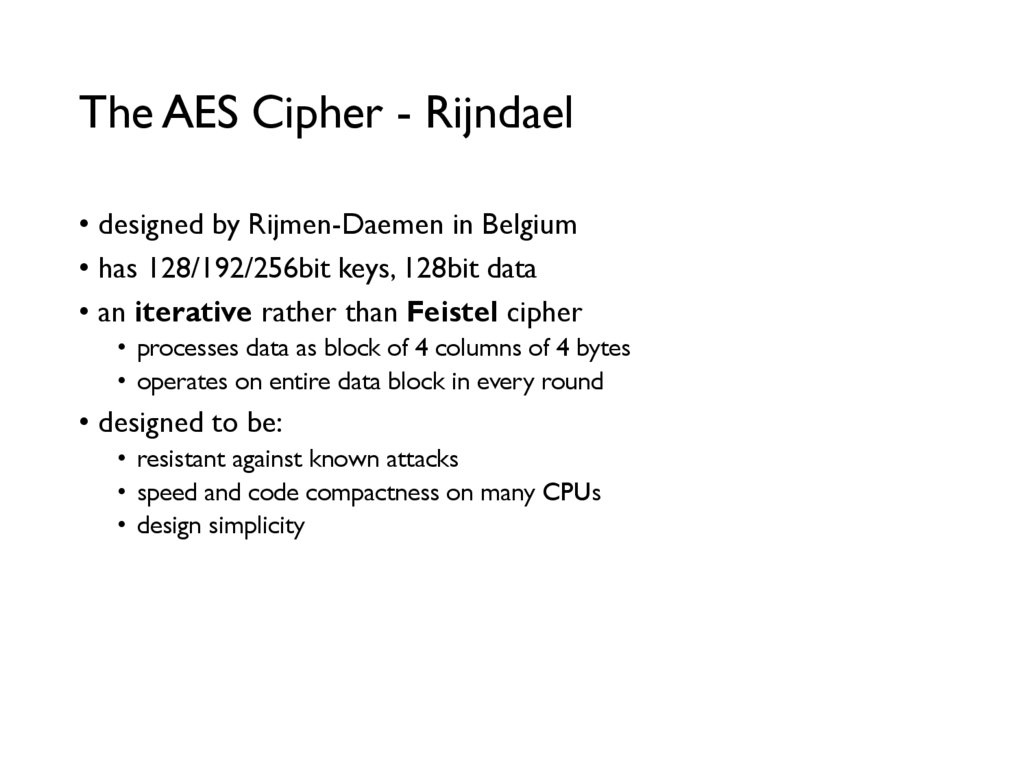
• designed by Rijmen-Daemen in Belgium• has 128/192/256bit keys, 128bit data
• an iterative rather than Feistel cipher
• processes data as block of 4 columns of 4 bytes
• operates on entire data block in every round
• designed to be:
• resistant against known attacks
• speed and code compactness on many CPUs
• design simplicity
7. Rijndael
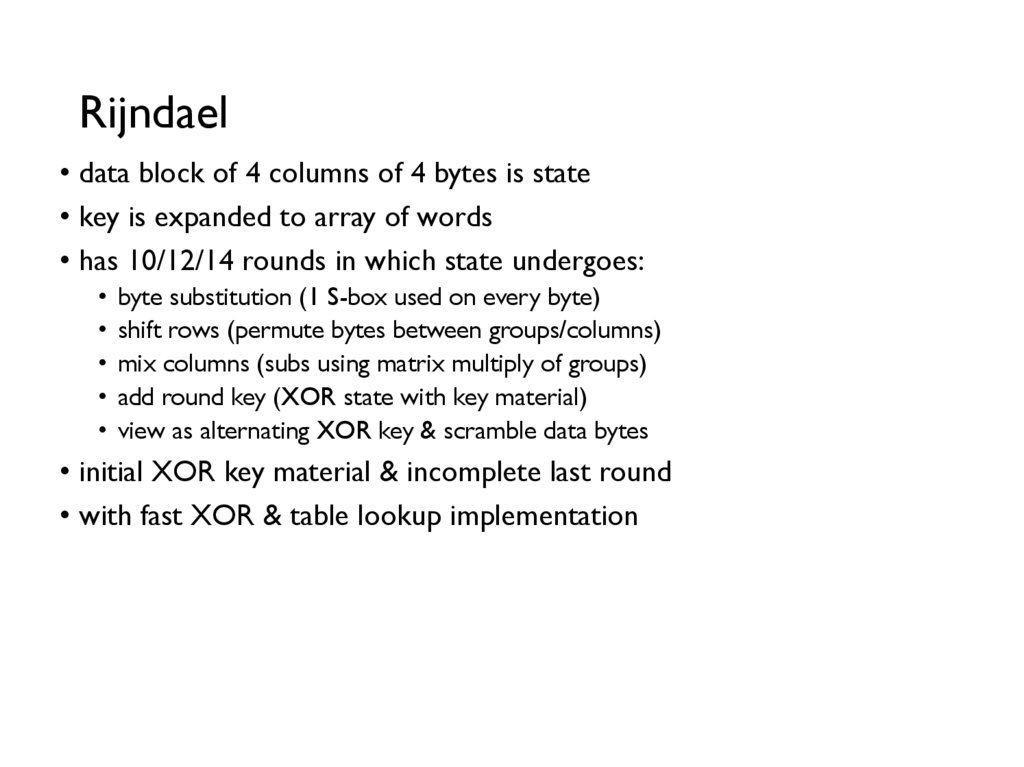
• data block of 4 columns of 4 bytes is state• key is expanded to array of words
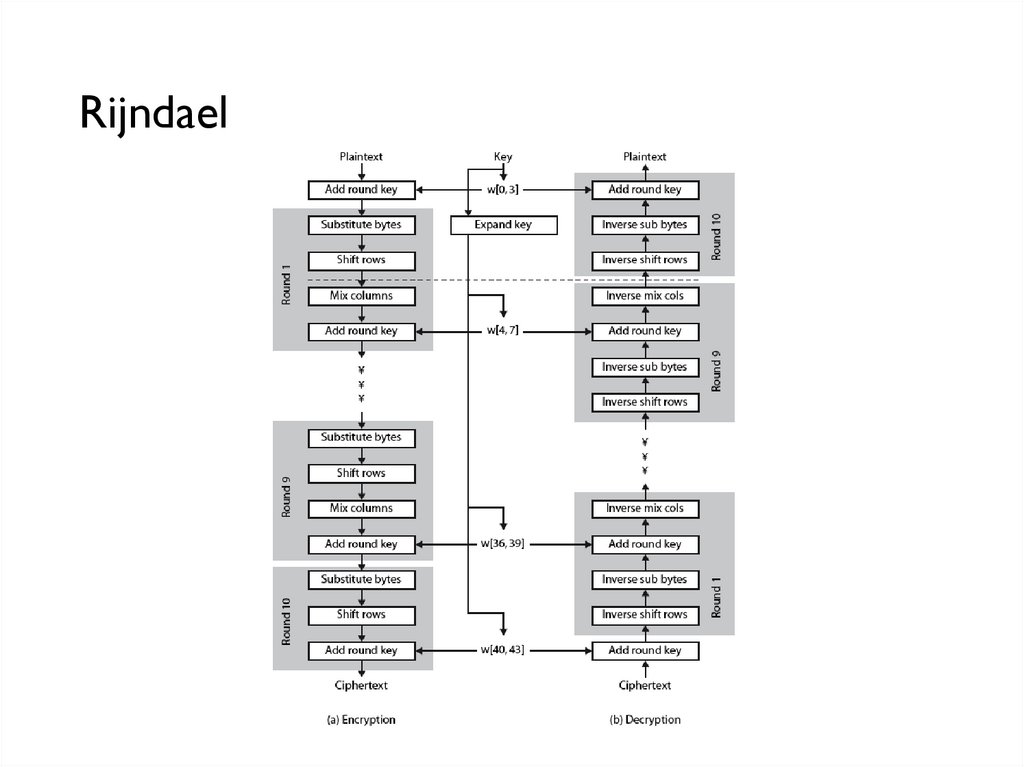
• has 10/12/14 rounds in which state undergoes:
• byte substitution (1 S-box used on every byte)
• shift rows (permute bytes between groups/columns)
• mix columns (subs using matrix multiply of groups)
• add round key (XOR state with key material)
• view as alternating XOR key & scramble data bytes
• initial XOR key material & incomplete last round
• with fast XOR & table lookup implementation
8. Rijndael
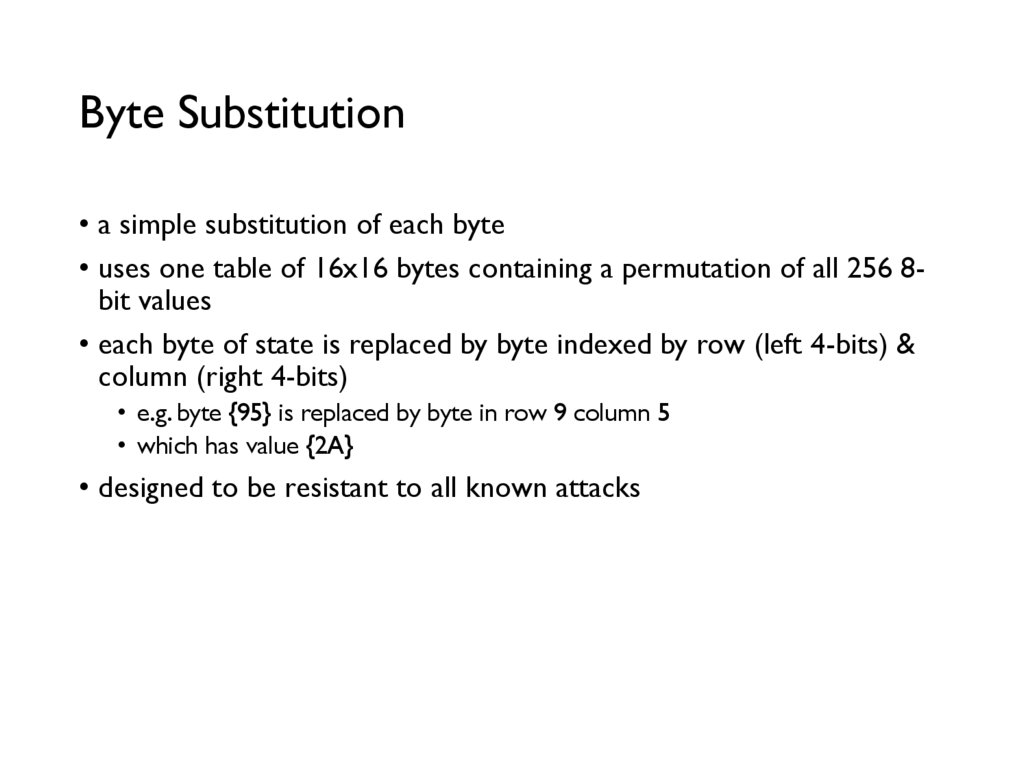
9. Byte Substitution
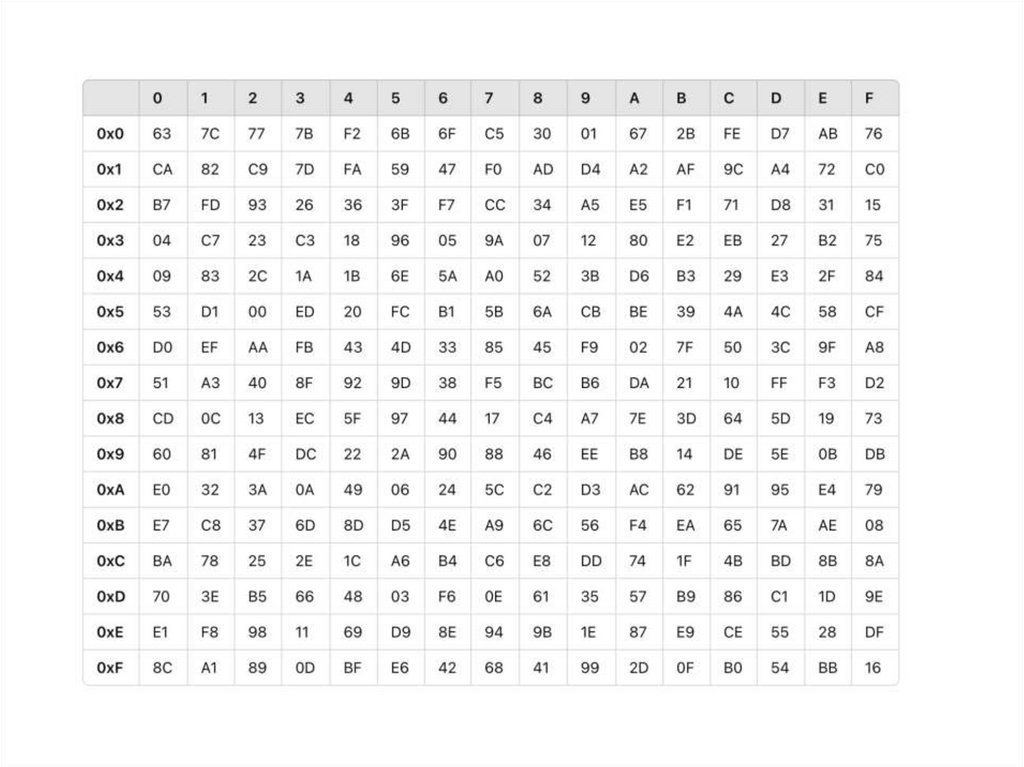
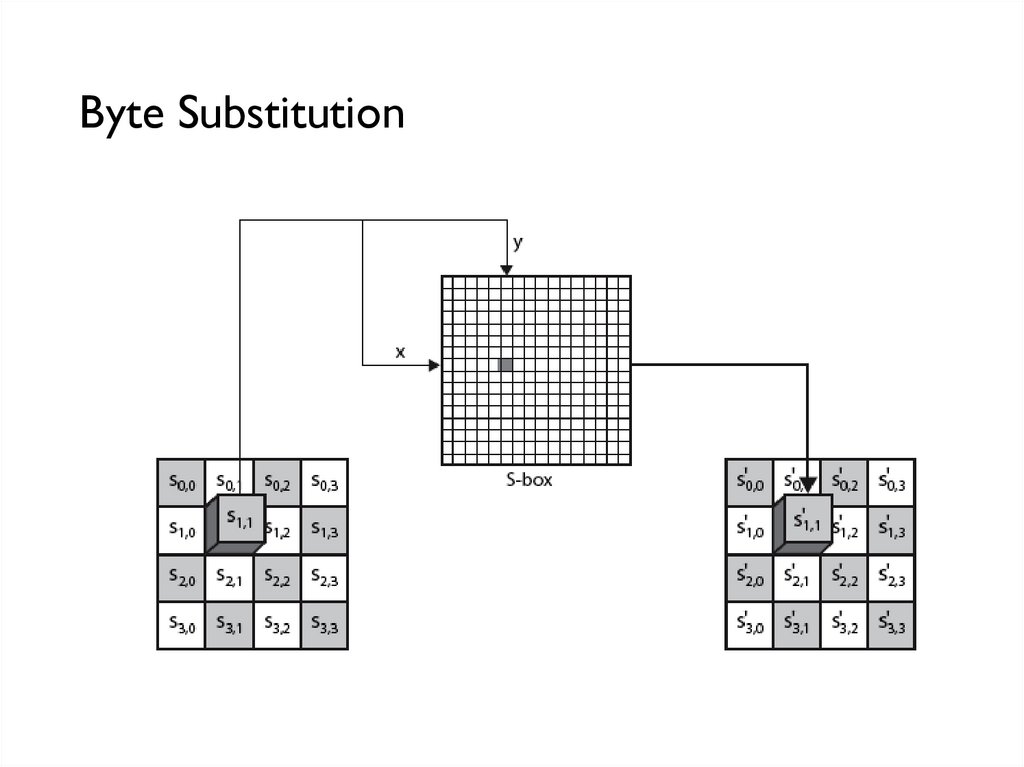
• a simple substitution of each byte• uses one table of 16x16 bytes containing a permutation of all 256 8bit values
• each byte of state is replaced by byte indexed by row (left 4-bits) &
column (right 4-bits)
• e.g. byte {95} is replaced by byte in row 9 column 5
• which has value {2A}
• designed to be resistant to all known attacks
10.
11. Byte Substitution
12. Shift Rows
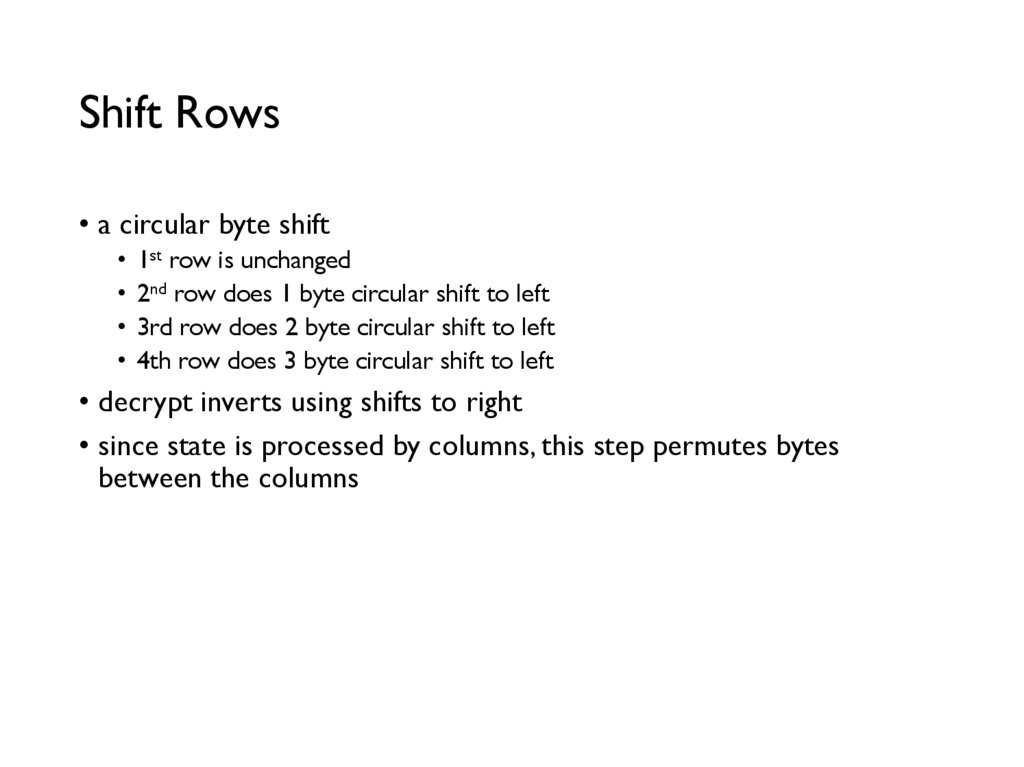
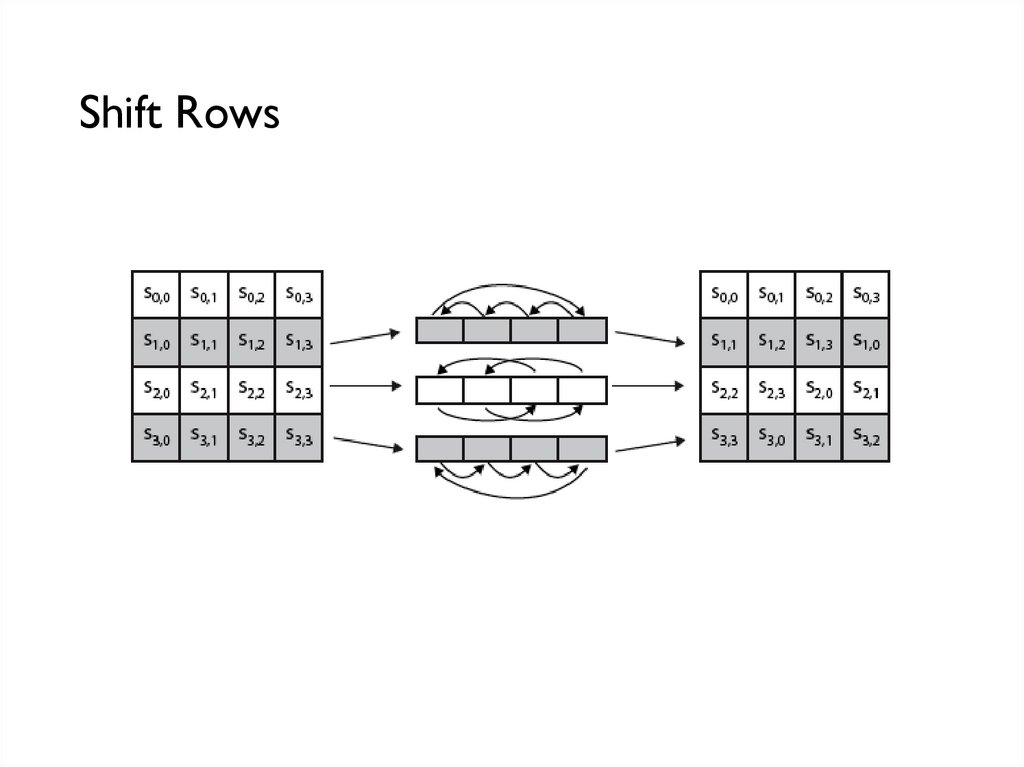
• a circular byte shift• 1st row is unchanged
• 2nd row does 1 byte circular shift to left
• 3rd row does 2 byte circular shift to left
• 4th row does 3 byte circular shift to left
• decrypt inverts using shifts to right
• since state is processed by columns, this step permutes bytes
between the columns
13. Shift Rows
14. Mix Columns
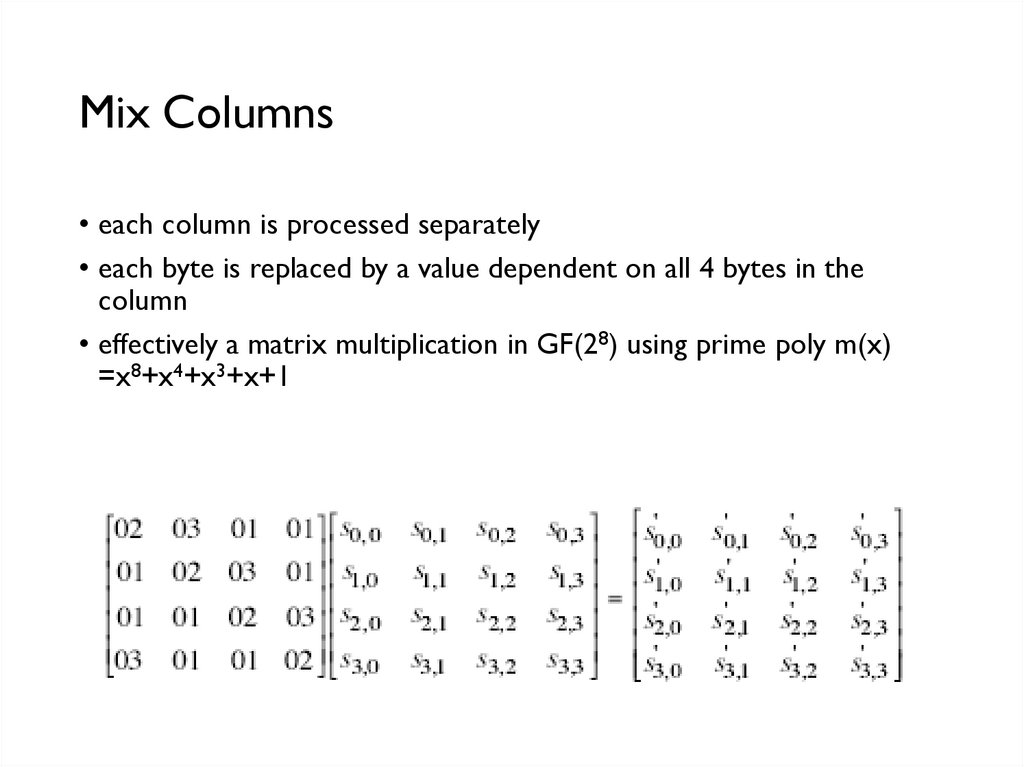
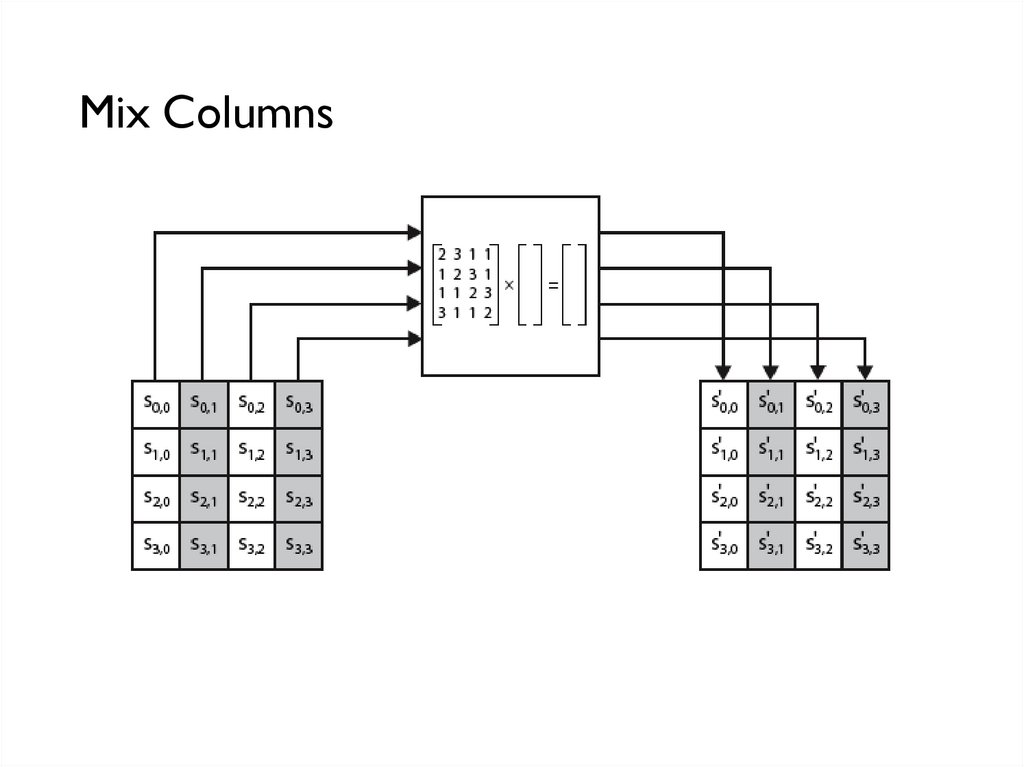
• each column is processed separately• each byte is replaced by a value dependent on all 4 bytes in the
column
• effectively a matrix multiplication in GF(28) using prime poly m(x)
=x8+x4+x3+x+1
15. Mix Columns
16. Mix Columns
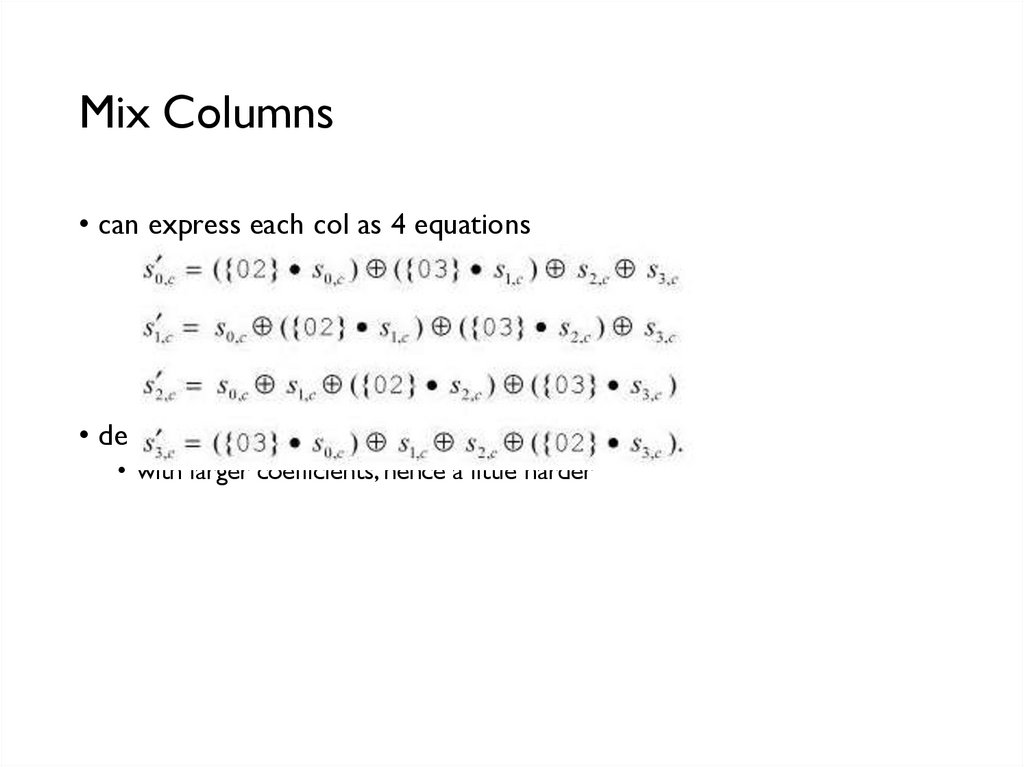
• can express each col as 4 equations• decryption requires use of inverse matrix
• with larger coefficients, hence a little harder
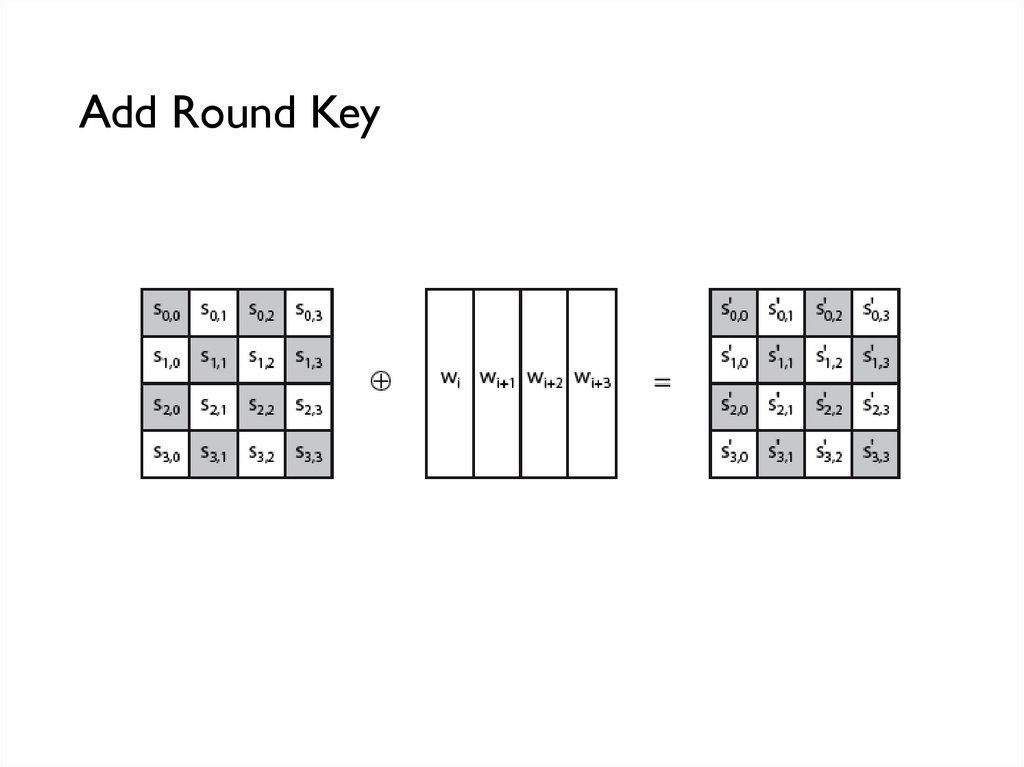
17. Add Round Key
• XOR state with 128-bits of the round key• again, processed by column (though effectively a series of byte
operations)
• inverse for decryption identical
• since XOR own inverse, with reversed keys
• designed to be as simple as possible
• requires other stages for complexity / security
18. Add Round Key
19. AES Key Expansion
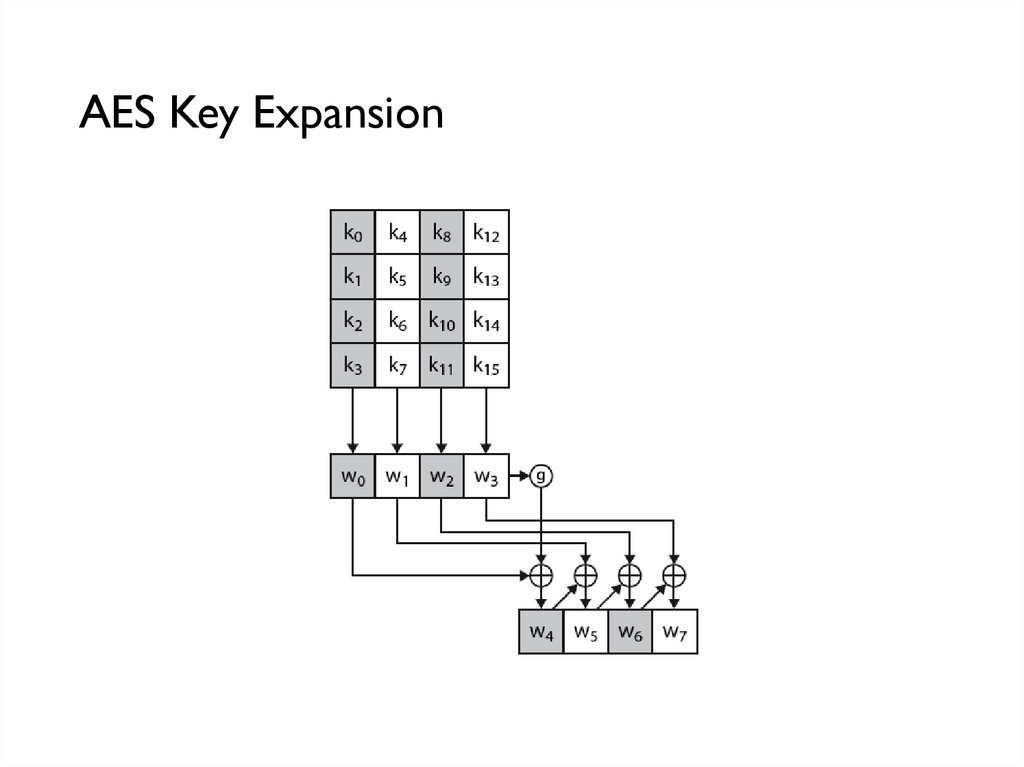
• takes 128-bit (16-byte) key and expands into array of 44/52/60 32-bitwords
• start by copying key into first 4 words
• then loop creating words that depend on values in previous & 4
places back
• in 3 of 4 cases just XOR these together
• 1st word in 4 has rotate + S-box + XOR round constant on previous, before
XOR 4th back
20. AES Key Expansion
21. Key Expansion Rationale
• designed to resist known attacks• design criteria included
• knowing part key insufficient to find many more
• invertible transformation
• fast on wide range of CPU’s
• diffuse key bits into round keys
• simplicity of description
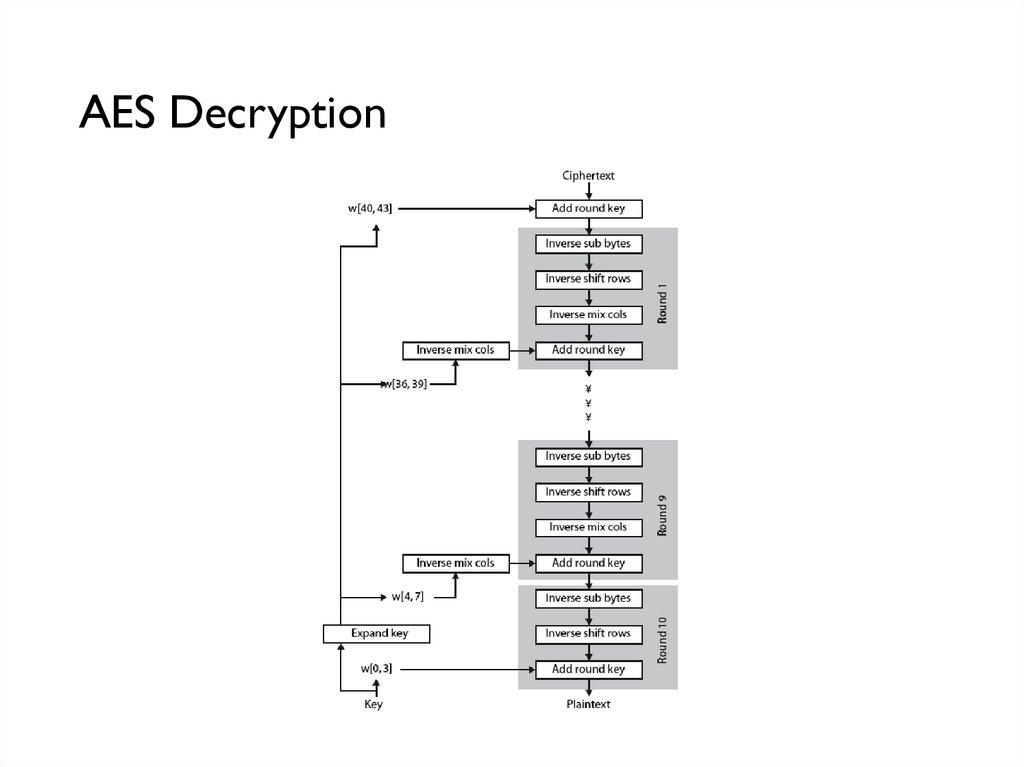
22. AES Decryption
• AES decryption is not identical to encryption since steps done inreverse
• but can define an equivalent inverse cipher with steps as for
encryption
• but using inverses of each step
• with a different key schedule
• works since result is unchanged when
• swap byte substitution & shift rows
• swap mix columns & add (tweaked) round key