





 electronics
Similar presentations:

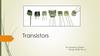

Exploring the operation mechanism of Organic Electrochemical Transistors
1.
Exploring the operation mechanismof Organic Electrochemical
Transistors
By Baurzhan Ilyassov , Ph.D., associate
professor, Astana IT University, Astana,
Kazakhstan
2.
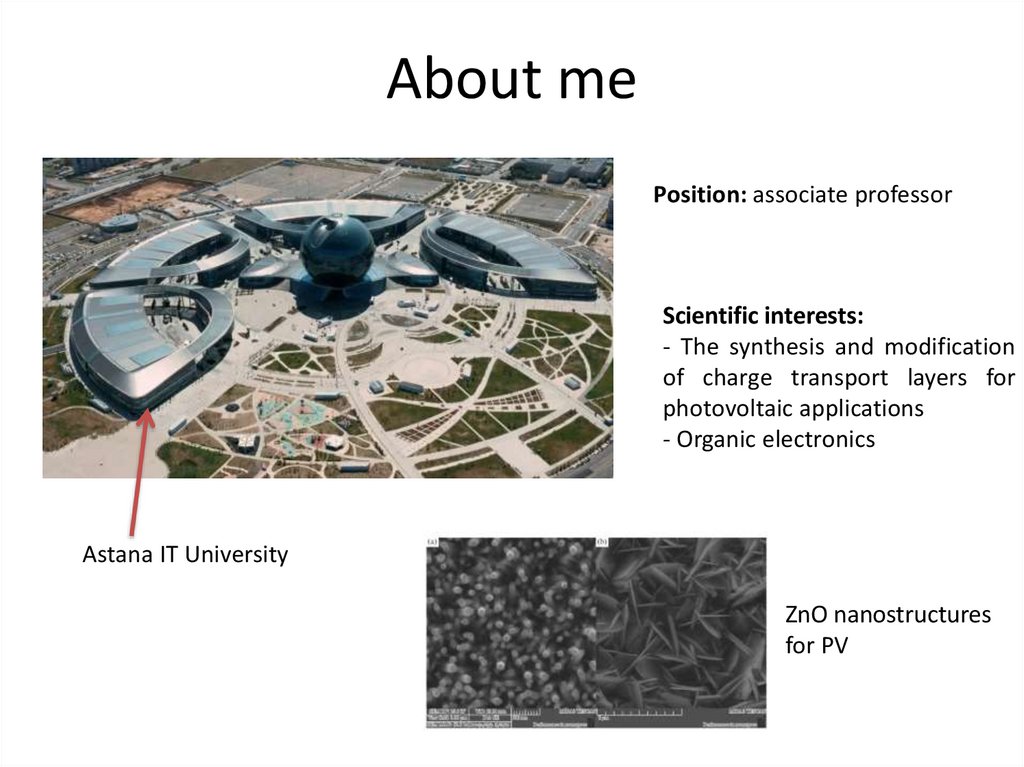
About mePosition: associate professor
Scientific interests:
- The synthesis and modification
of charge transport layers for
photovoltaic applications
- Organic electronics
Astana IT University
ZnO nanostructures
for PV
3.
INAM, UJIThe Research Institute of Advanced
Materials at the University Jaume I
(Institute of Advanced Materials,
INAM) is a center of research in
interdisciplinary
science
and
technology in the fields of physics,
chemistry, and related fields, applied
to advanced materials, with vocation
towards the progress of the
socioeconomic environment and
scientific
excellence
with
international influence and impact.
Funding:
Bolashaq International Scholarship:
Stay in INAM
from 01.11.2023 to 30.10.2024
4.
INAM’s Research GroupsRG1. Active Materials and Systems Research (AMSY) – PI Antonio Guerrero
RG2. Organometallic Chemistry and Homogeneous Catalysis - PI Eduardo Peris
RG3. Electrocatalysis and Energy (ECATEN) PI Francisco Fabregat-Santiago and Elena
Mas Marzá
RG4. Advanced semiconductors – PI Iván Mora-Seró
RG5. Photoactive Materials for Energy - PI Sixto Giménez and Beatriz Julian-Lopez
RG6. Materials for Advanced Sustainable Production - PI Victor Sans Sangorrin
RG7. Bioinspired Supramolecular Chemistry and Materials - PI Beatriu Escuder
RG8. Neurobiotechnology - PI Ana María Sánchez-Pérez
RG9. Computional Biochemistry - PI Vicent Moliner
RG10. Hybrid catalytic Materials - PI Jose Mata and Iván Sorribes
RG11. Dynamic Materials and Self-assembling Systems - NISHANT SINGH
RG12. Spintronics for Advanced Devices Lab - PI Víctor López Domínguez
RG13. GID - Green Investigation & Development - PI Rosario Vidal
5.
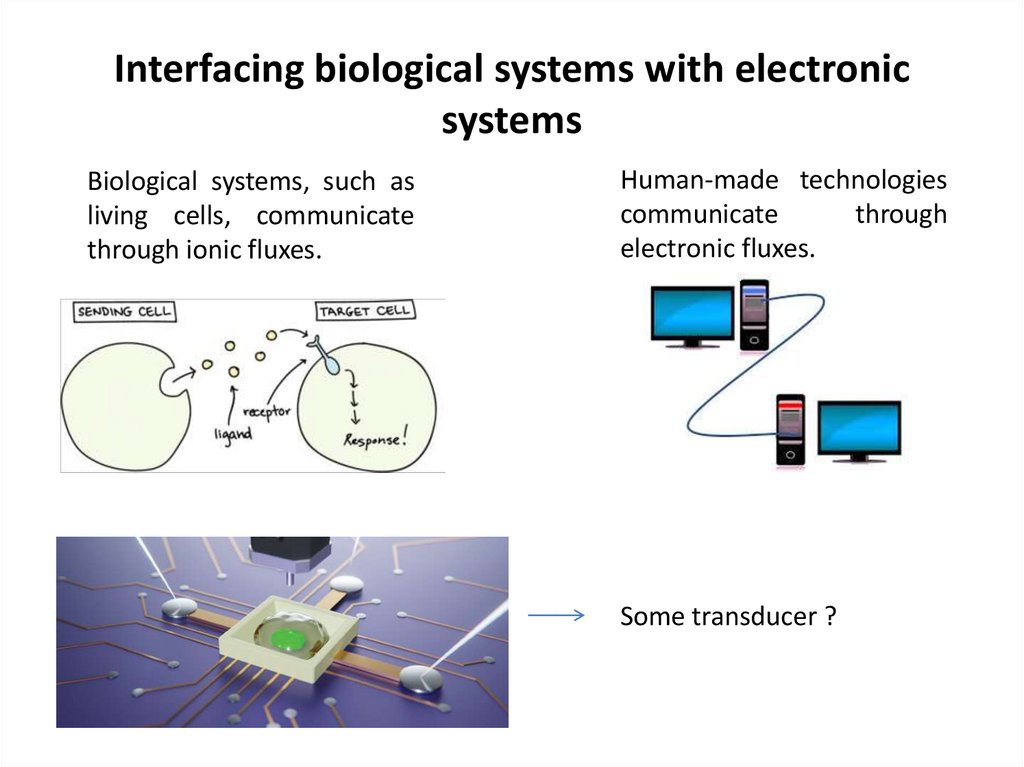
Interfacing biological systems with electronicsystems
Biological systems, such as
living cells, communicate
through ionic fluxes.
Human-made technologies
communicate
through
electronic fluxes.
Some transducer ?
6.
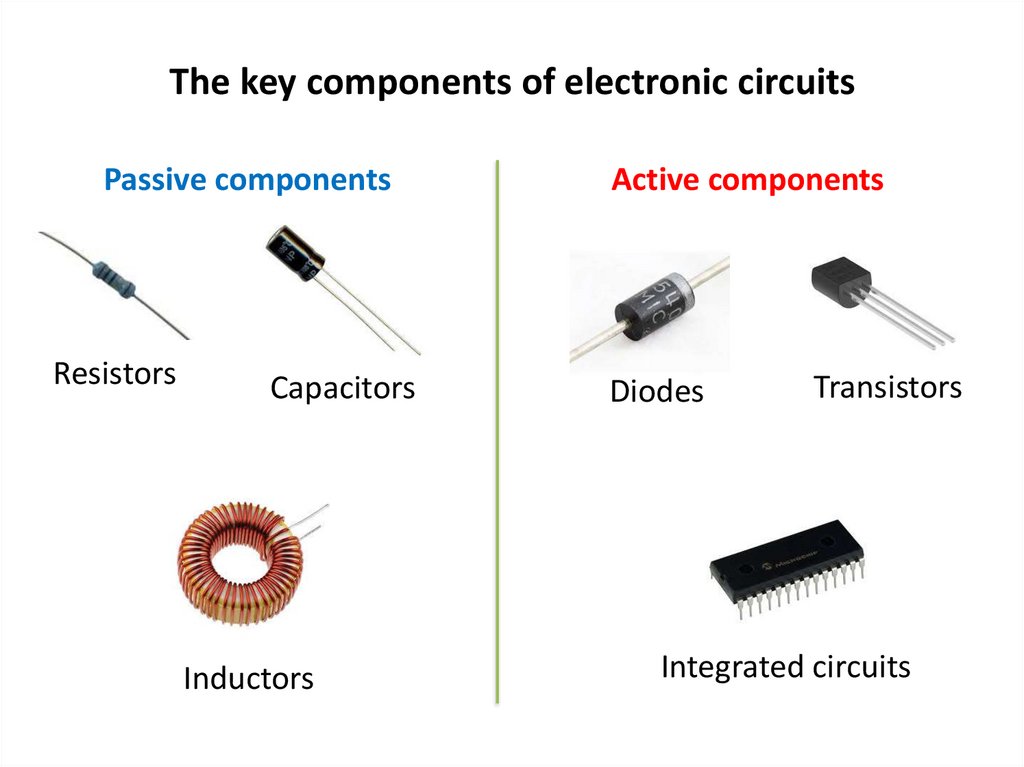
The key components of electronic circuitsPassive components
Resistors
Capacitors
Inductors
Active components
Diodes
Transistors
Integrated circuits
7.
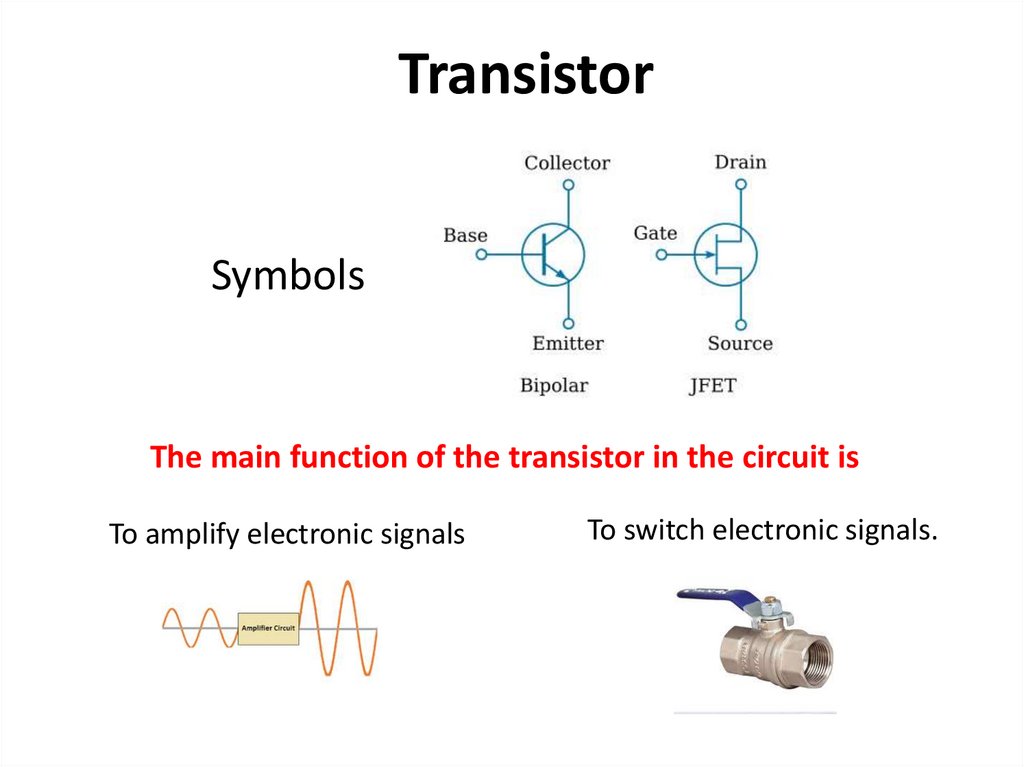
TransistorSymbols
The main function of the transistor in the circuit is
To amplify electronic signals
To switch electronic signals.
8.
Why organic materials ?9.
Organic electrochemical transistors(OECTs)
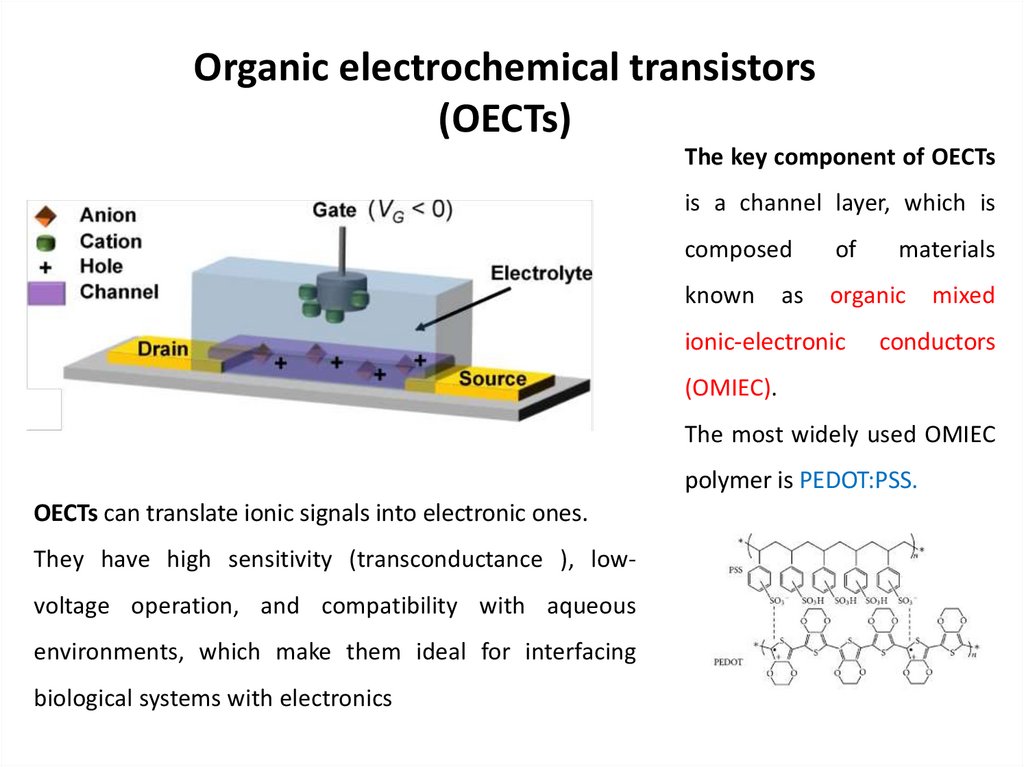
The key component of OECTs
is a channel layer, which is
composed
of
known
organic
as
ionic-electronic
materials
mixed
conductors
(OMIEC).
The most widely used OMIEC
polymer is PEDOT:PSS.
OECTs can translate ionic signals into electronic ones.
They have high sensitivity (transconductance ), lowvoltage operation, and compatibility with aqueous
environments, which make them ideal for interfacing
biological systems with electronics
10.
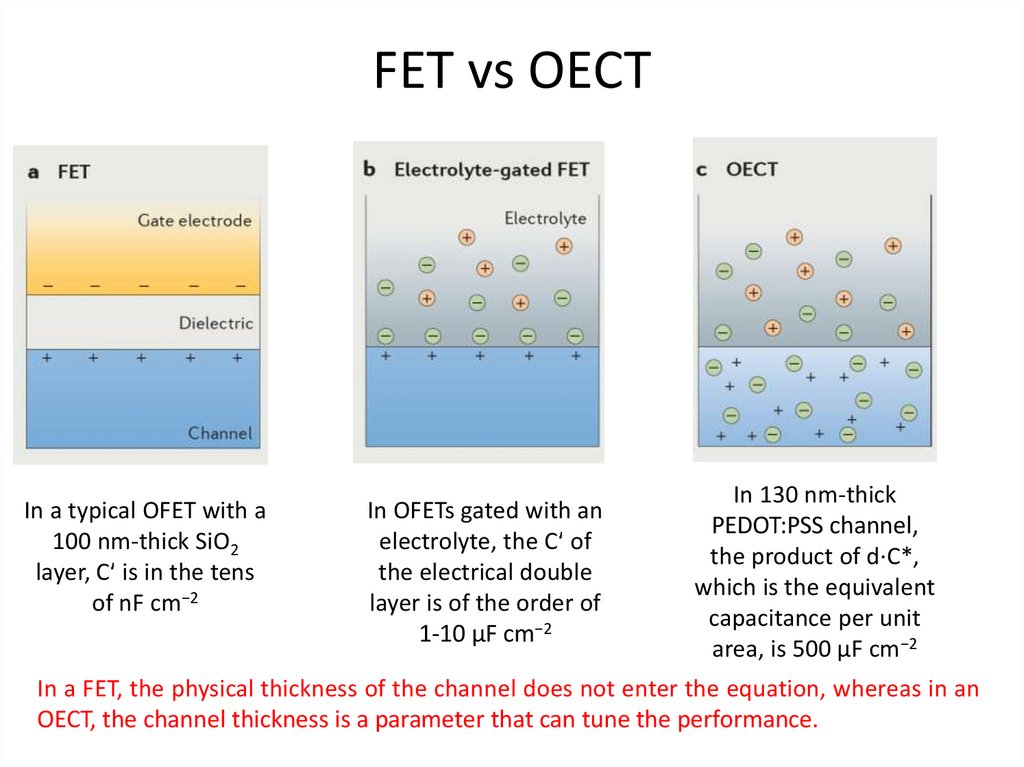
FET vs OECTIn a typical OFET with a
100 nm-thick SiO2
layer, Cʹ is in the tens
of nF cm−2
In OFETs gated with an
electrolyte, the Cʹ of
the electrical double
layer is of the order of
1-10 μF cm−2
In 130 nm-thick
PEDOT:PSS channel,
the product of d∙C*,
which is the equivalent
capacitance per unit
area, is 500 μF cm−2
In a FET, the physical thickness of the channel does not enter the equation, whereas in an
OECT, the channel thickness is a parameter that can tune the performance.
11.
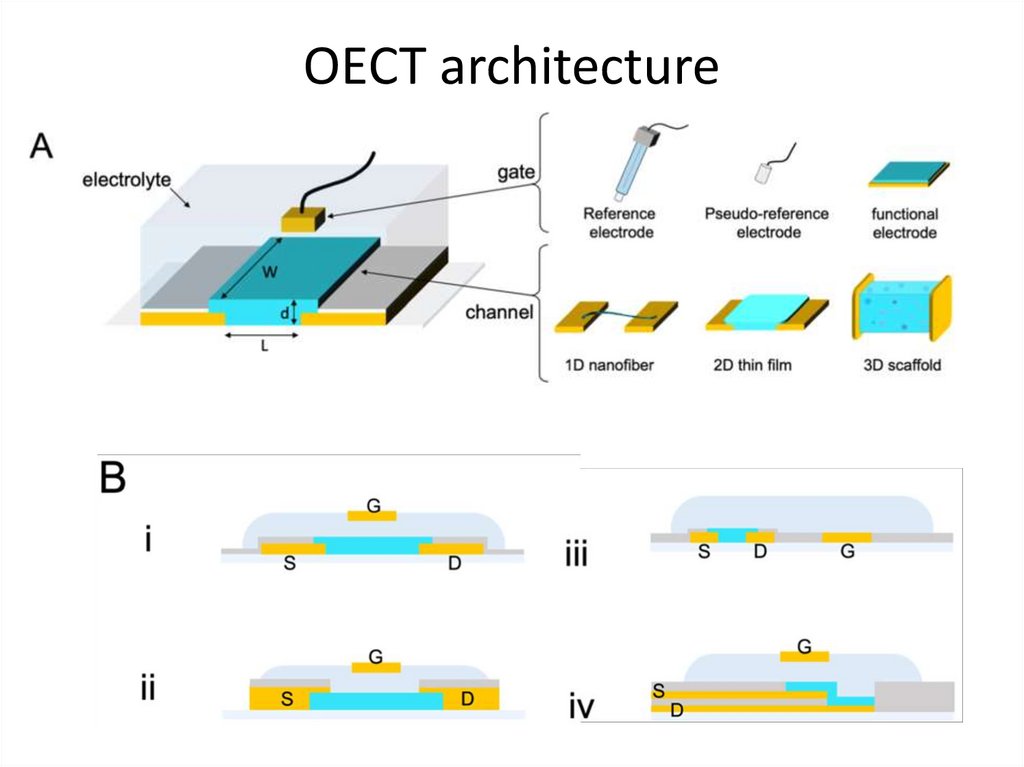
OECT architecture12.
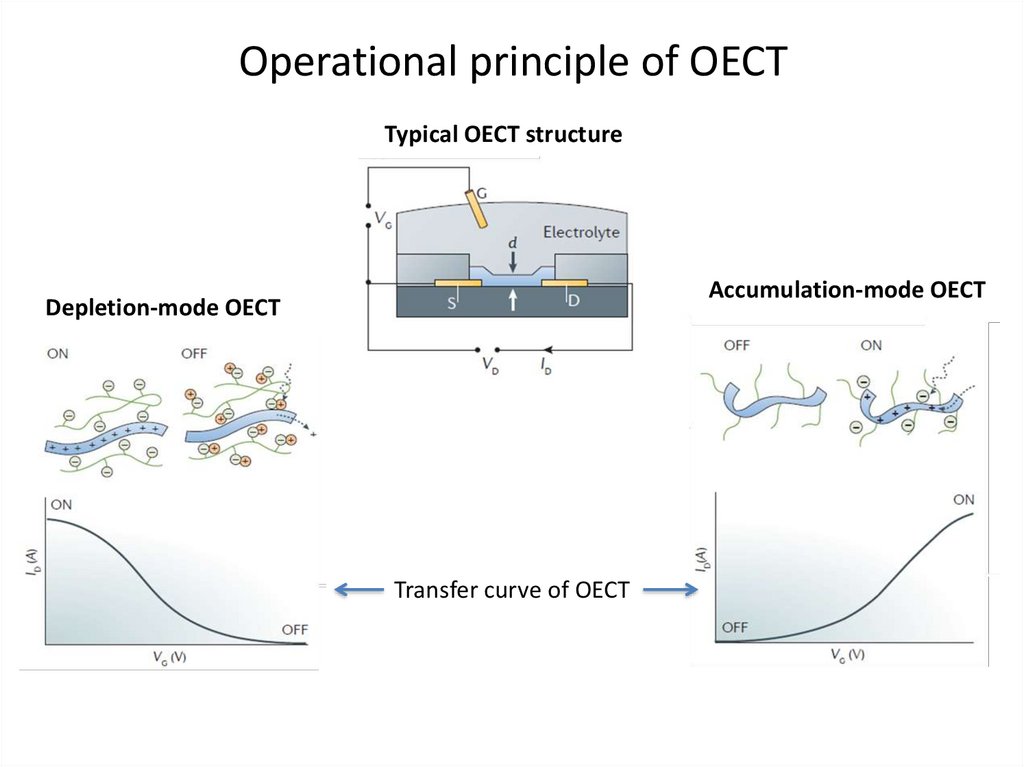
Operational principle of OECTTypical OECT structure
Accumulation-mode OECT
Depletion-mode OECT
Transfer curve of OECT
13.
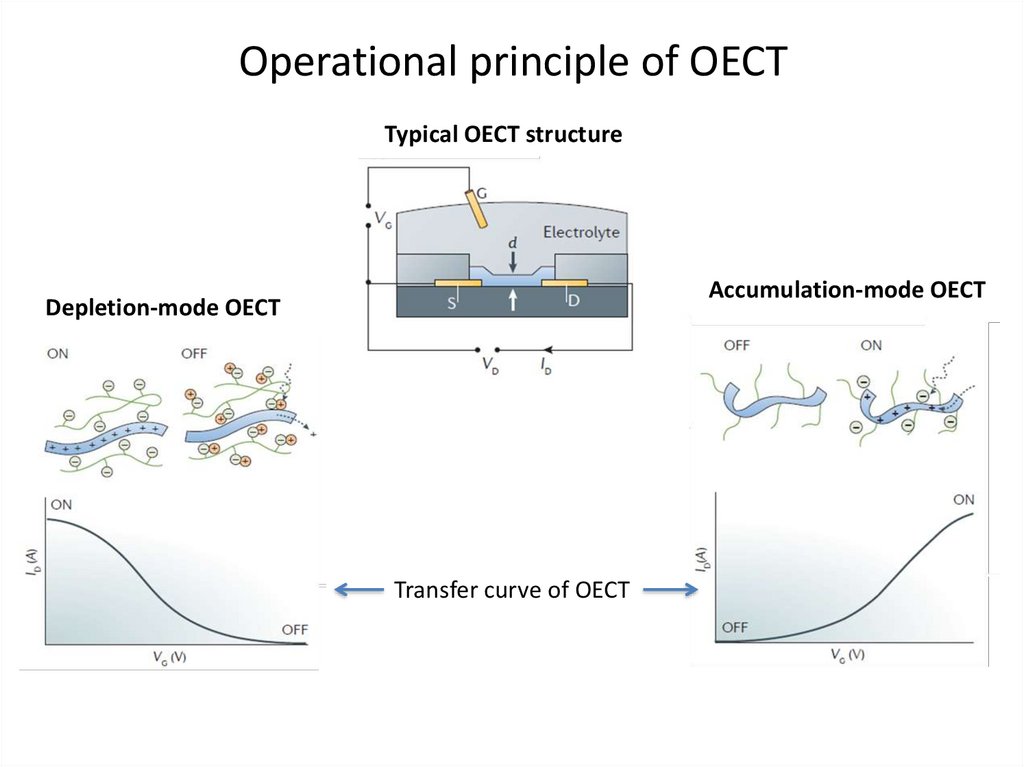
Operational principle of OECTTypical OECT structure
Accumulation-mode OECT
Depletion-mode OECT
Transfer curve of OECT
14.
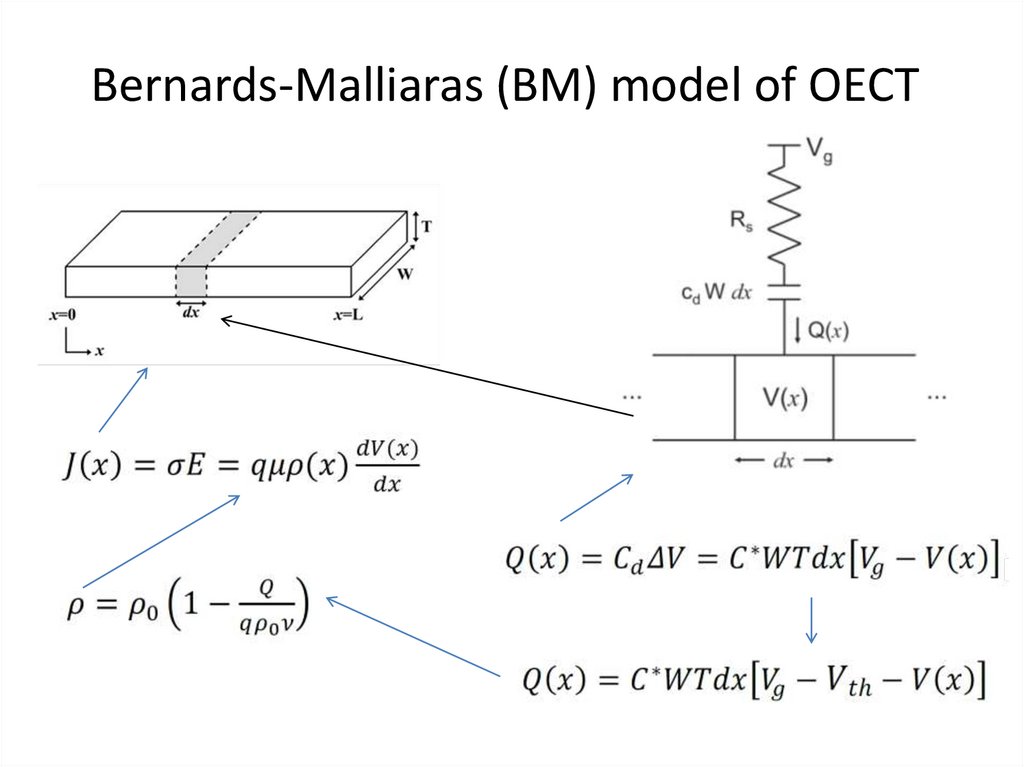
Bernards-Malliaras (BM) model of OECT15.
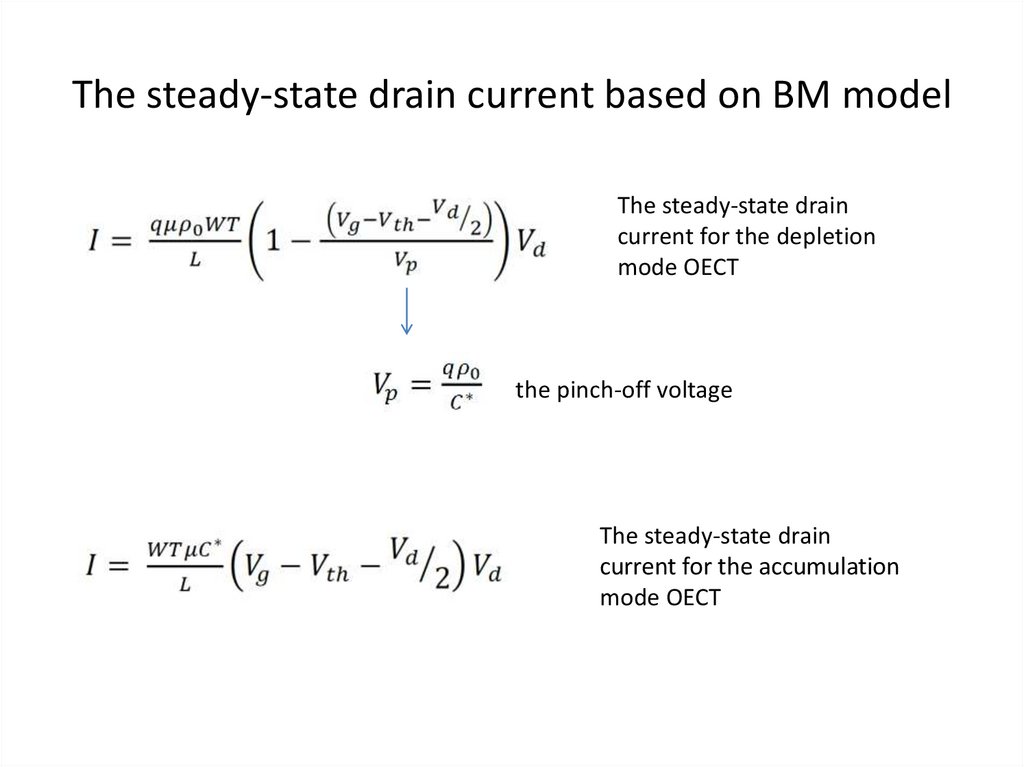
The steady-state drain current based on BM modelThe steady-state drain
current for the depletion
mode OECT
the pinch-off voltage
The steady-state drain
current for the accumulation
mode OECT
16.
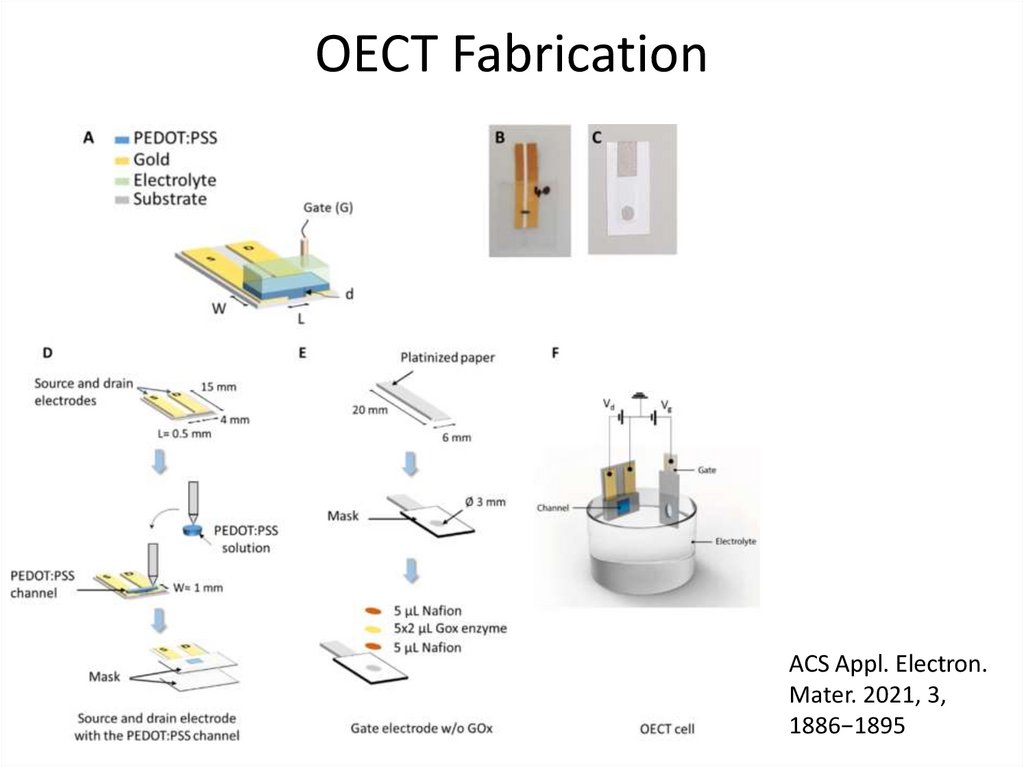
OECT FabricationACS Appl. Electron.
Mater. 2021, 3,
1886−1895
17.
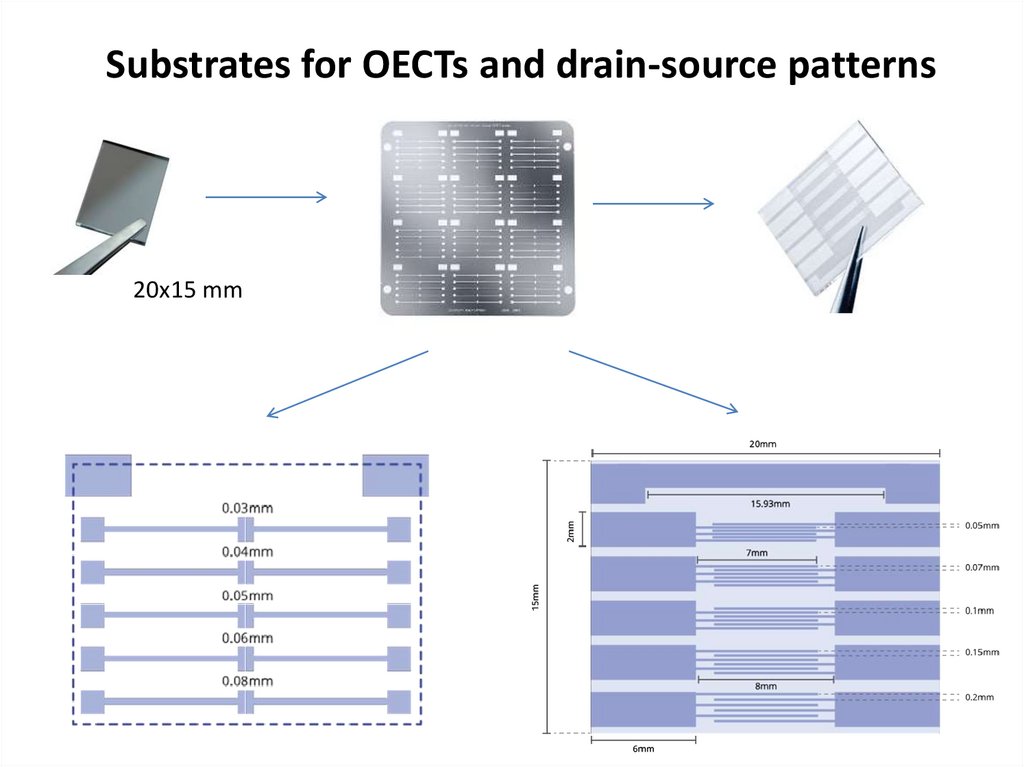
Substrates for OECTs and drain-source patterns20x15 mm
18.
Accumulation mode OECT with a channelcomposed of P3HT
The drain-source electrode is interdigitated Au
or ITO on a glass substrate, with channel
dimensions of W × L: 30 mm × 50 μm, and an
ITO or Au thickness of 100 nm.
Electrolyte: 10-100 mM tetrabutylammonium
hexafluorophosphate in acetonitrile or KCl/NCl
Schematic representation of
P3HT based OECT
The topography of the P3HT layer was
analyzed by AFM.
19.
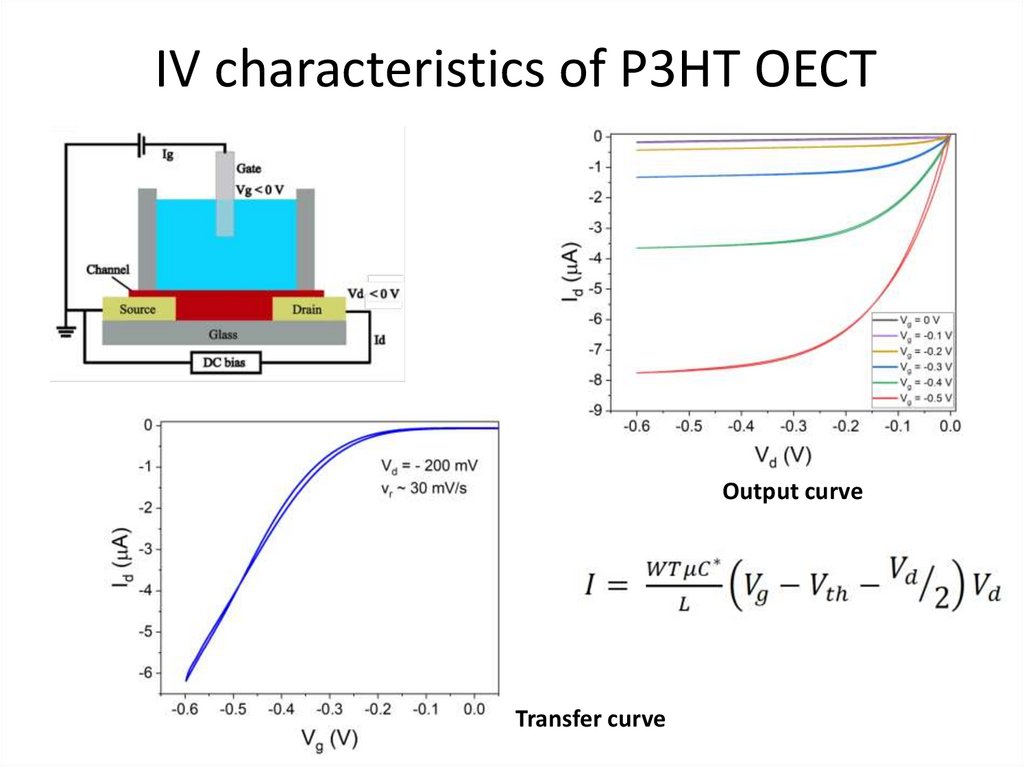
IV characteristics of P3HT OECTOutput curve
Transfer curve
20.
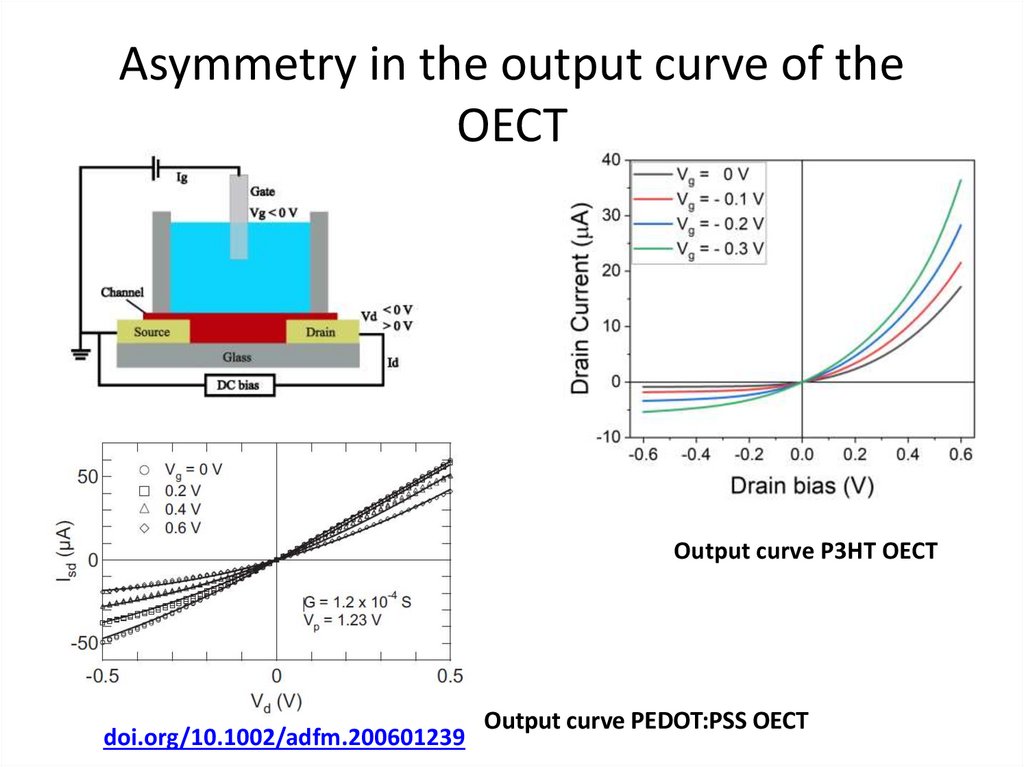
Asymmetry in the output curve of theOECT
Output curve P3HT OECT
doi.org/10.1002/adfm.200601239
Output curve PEDOT:PSS OECT
21.
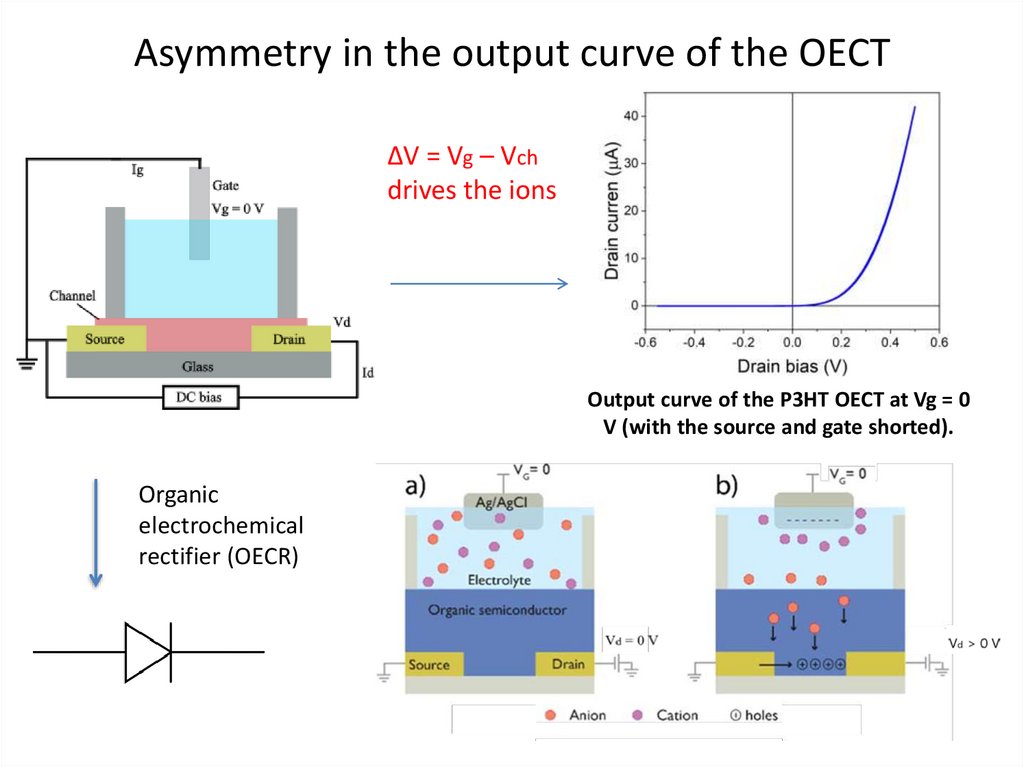
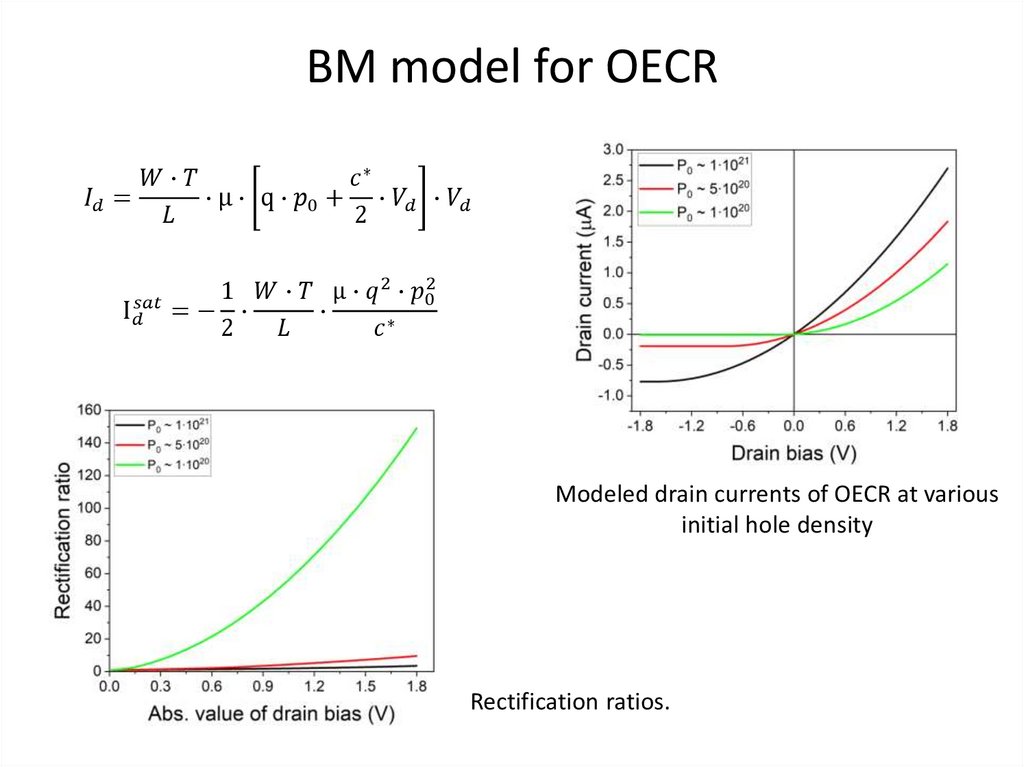
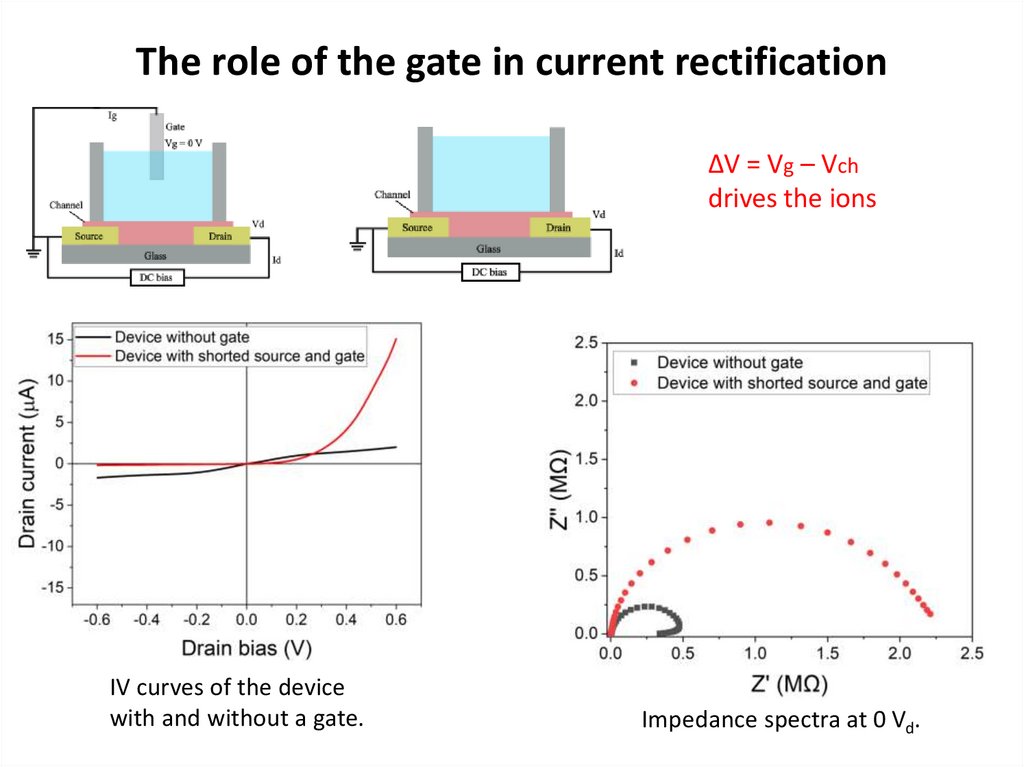
Asymmetry in the output curve of the OECTΔV = Vg – Vch
drives the ions
Output curve of the P3HT OECT at Vg = 0
V (with the source and gate shorted).
Organic
electrochemical
rectifier (OECR)
22.
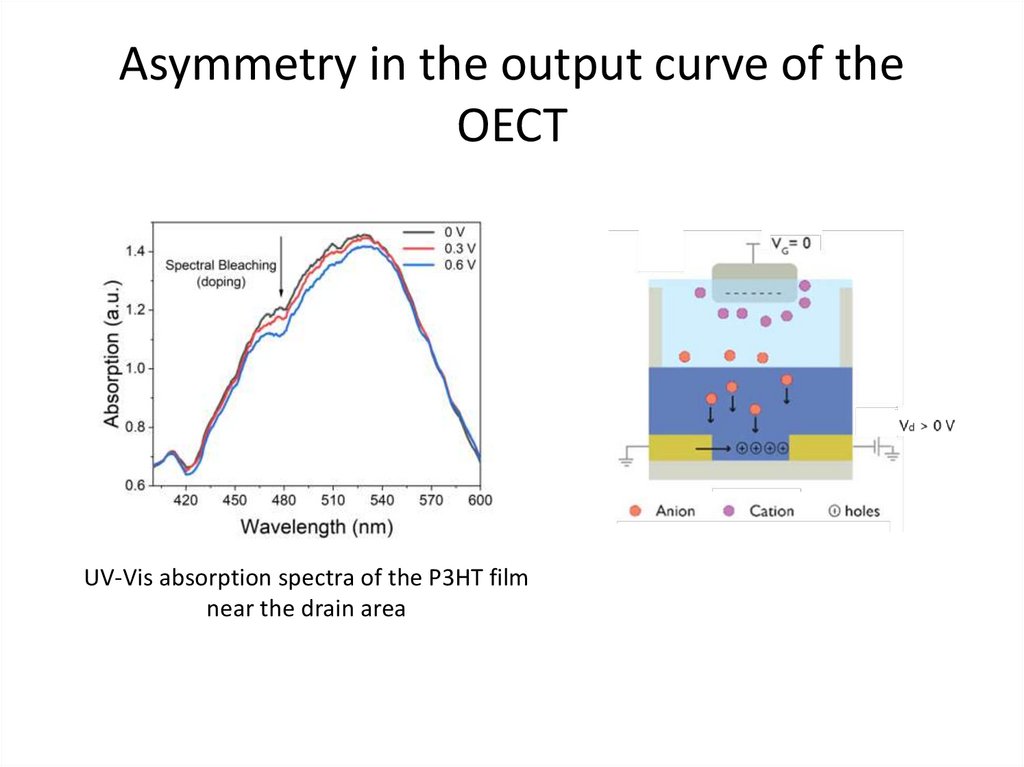
Asymmetry in the output curve of theOECT
UV-Vis absorption spectra of the P3HT film
near the drain area