







 mathematics
Similar presentations:



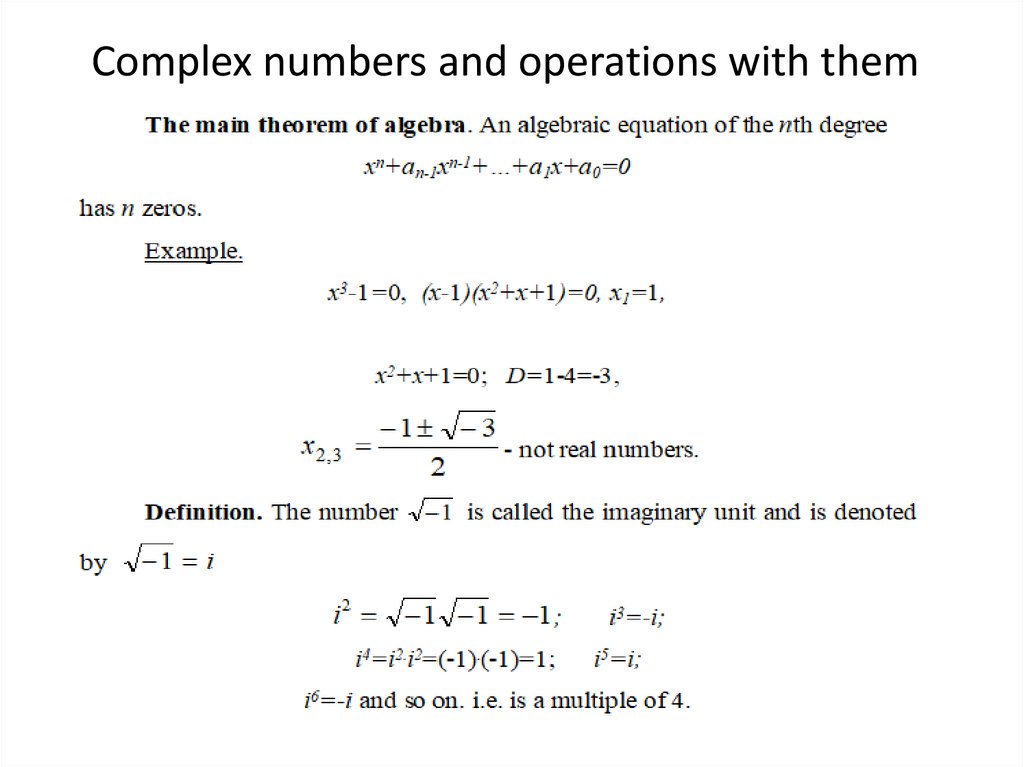
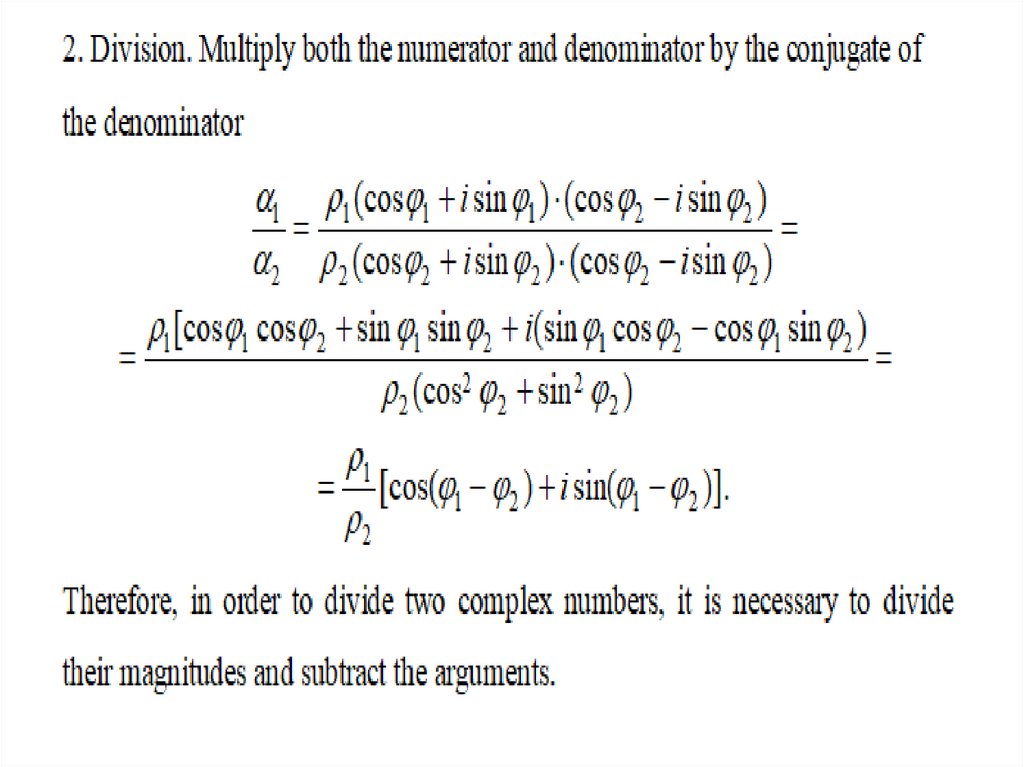
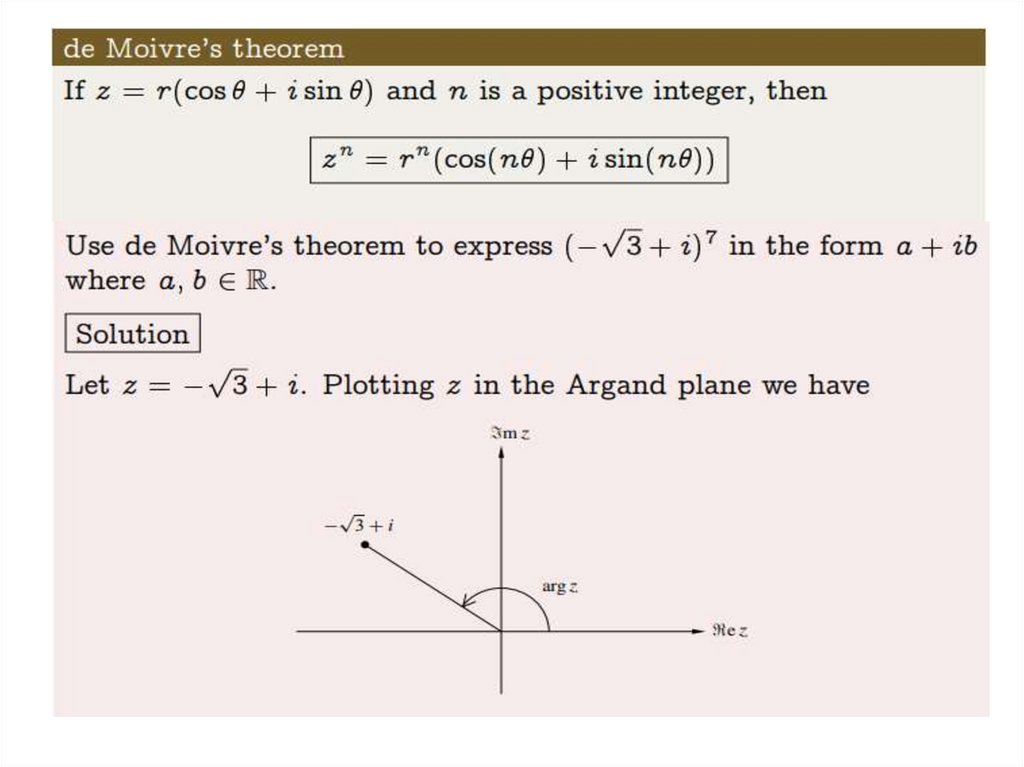
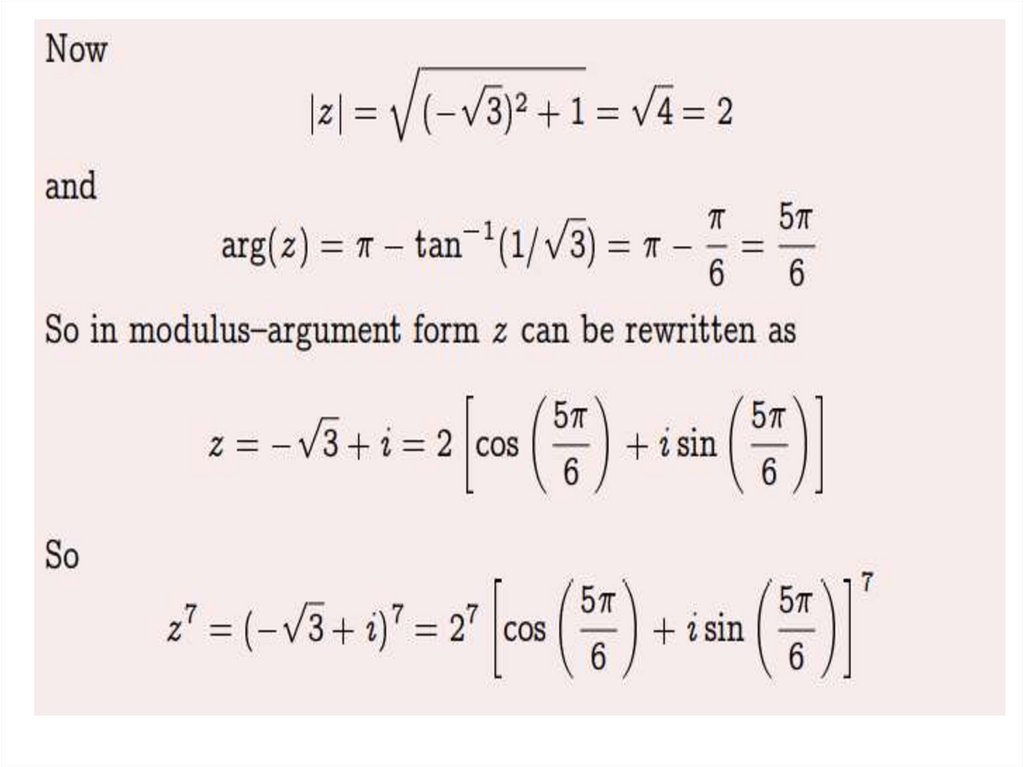
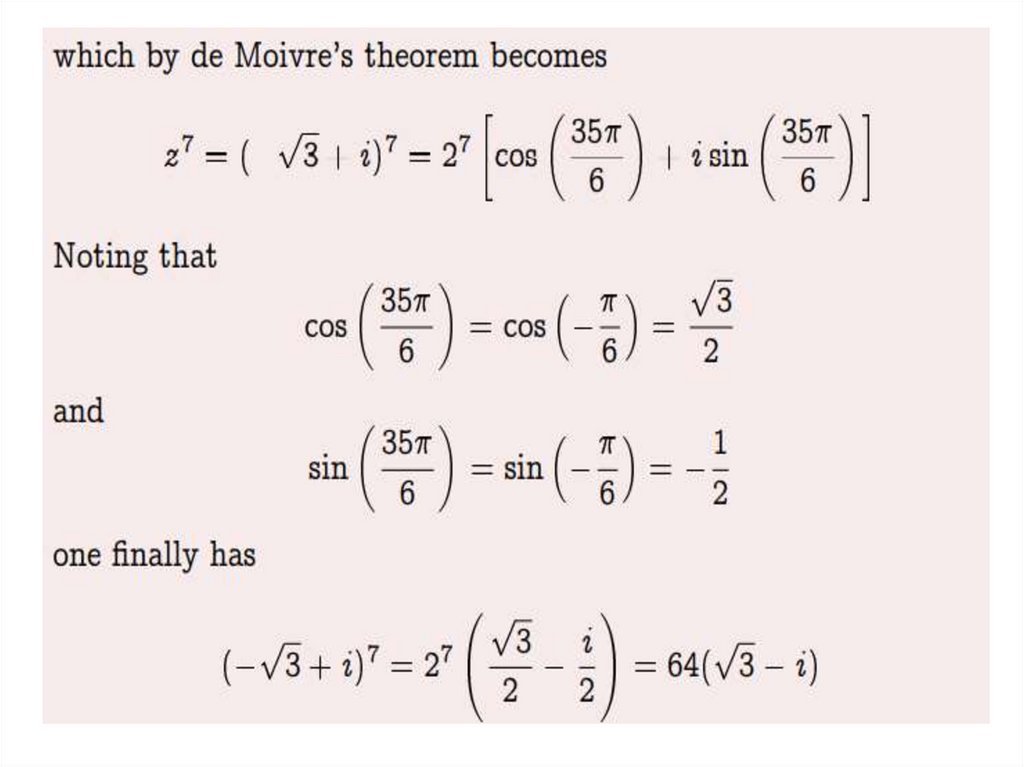
Lecture 3 Complex numbers and operations with them
1.
Lecture 32.
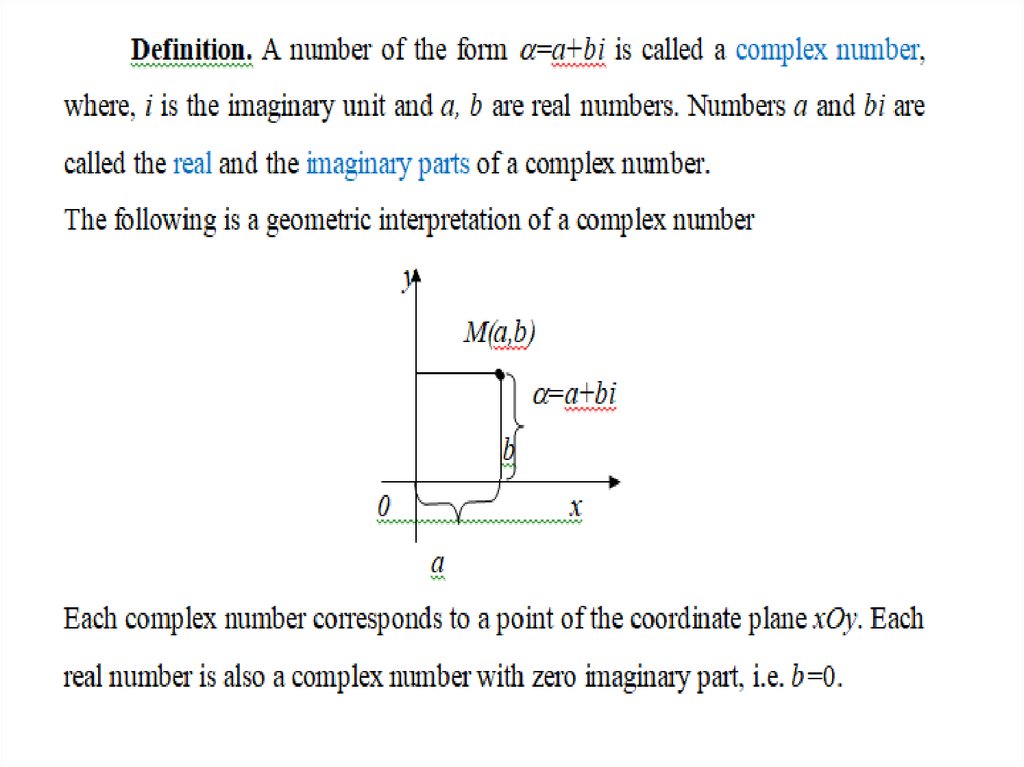
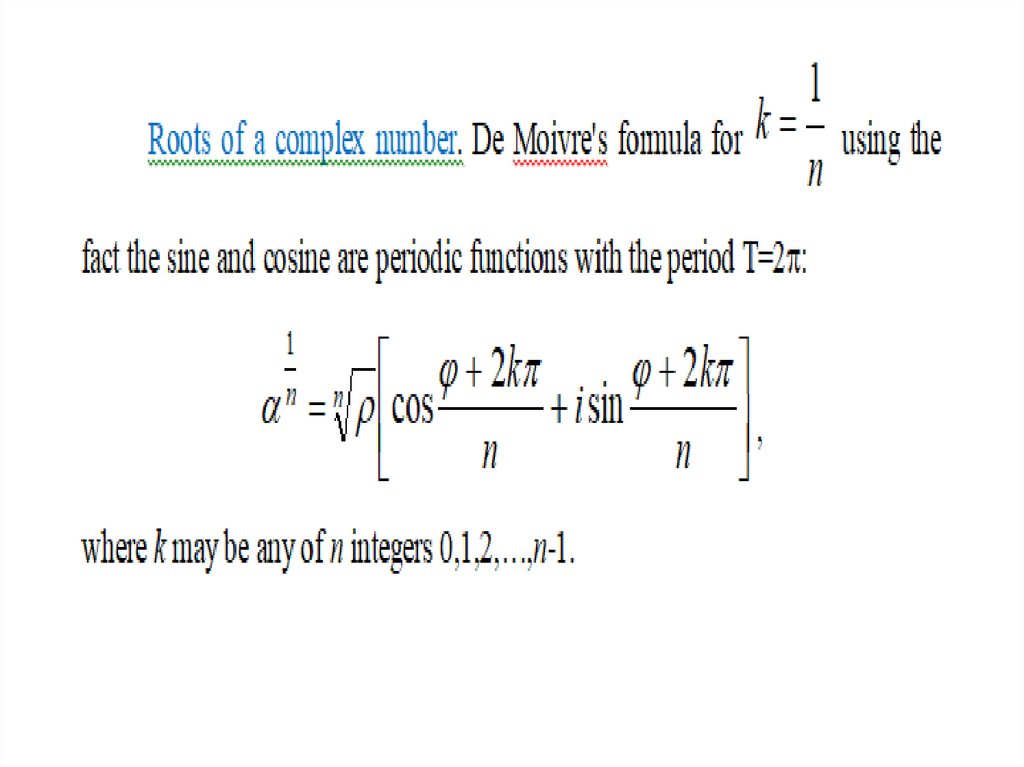
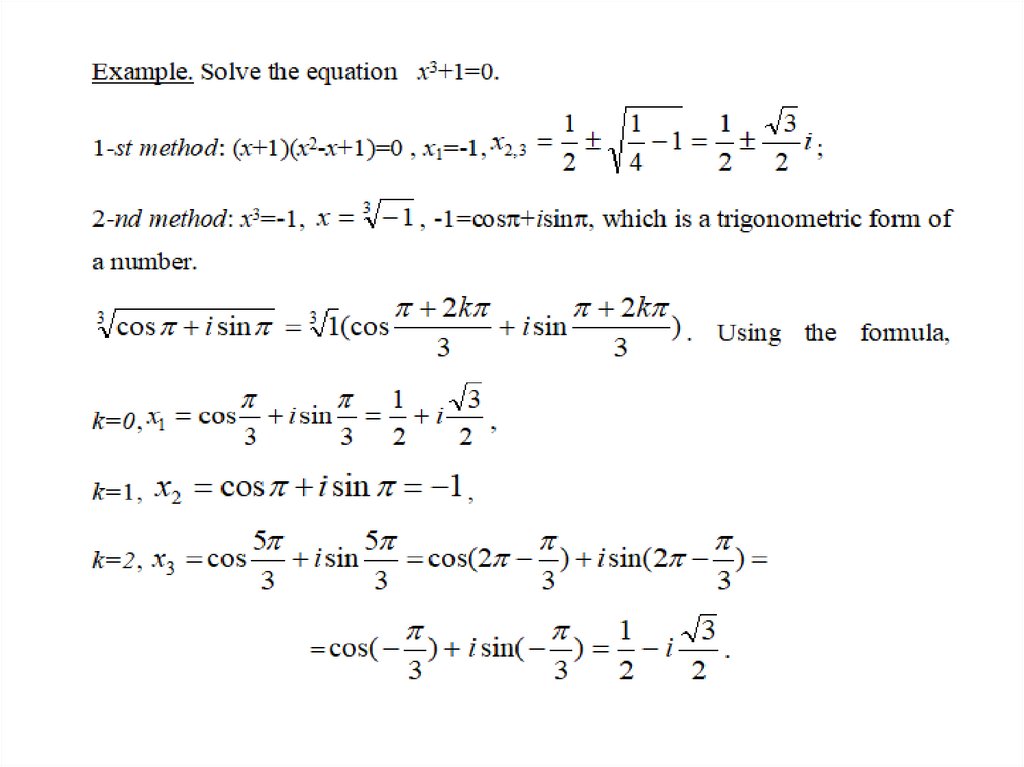
Complex numbers and operations with them3.
4.
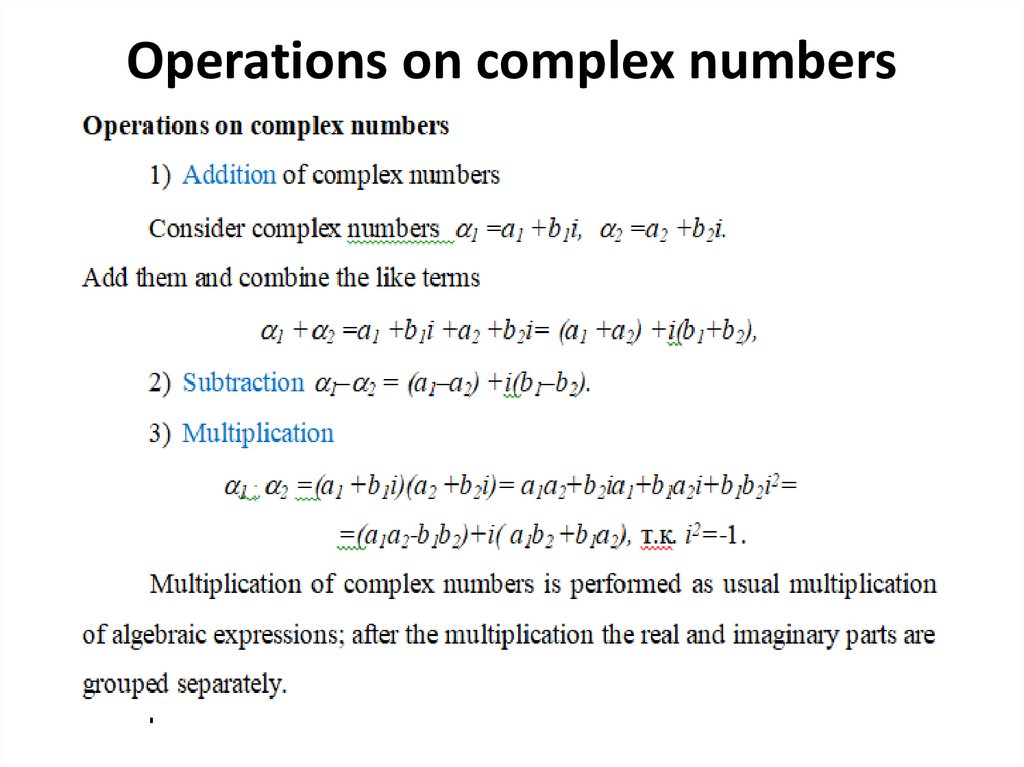
Operations on complex numbers5.
6.
7.
8.
9.
10.
11.
12.
13.
14.
15.
16.
17.
18.
19.
20.
DIFFERENTIALEQUATIONS
21.
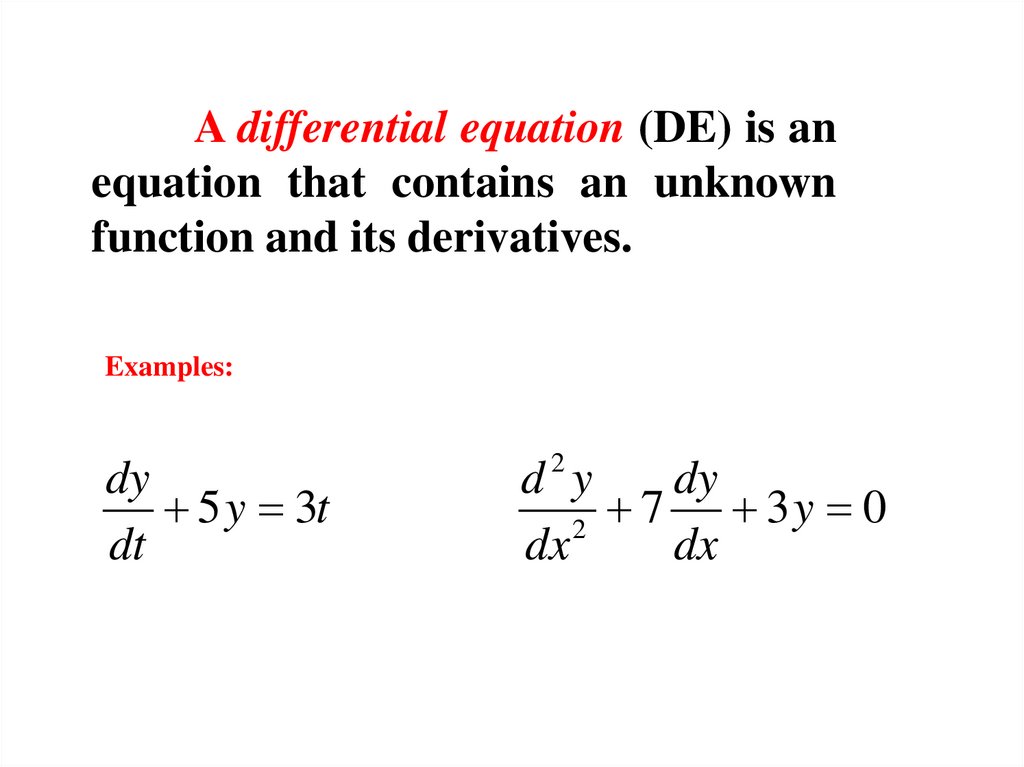
A differential equation (DE) is anequation that contains an unknown
function and its derivatives.
Examples:
dy
5 y 3t
dt
2
d y
dy
7 3y 0
2
dx
dx
22.
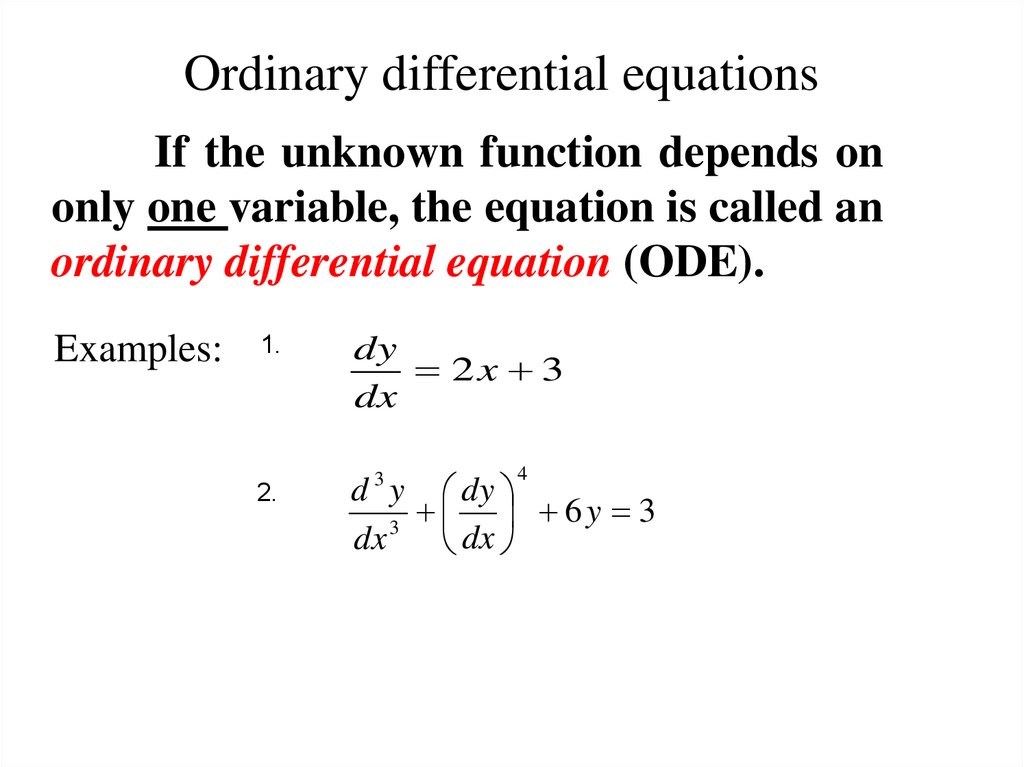
Ordinary differential equationsIf the unknown function depends on
only one variable, the equation is called an
ordinary differential equation (ODE).
Examples:
1.
2.
dy
2x 3
dx
4
d 3 y dy
6y 3
3
dx
dx
23.
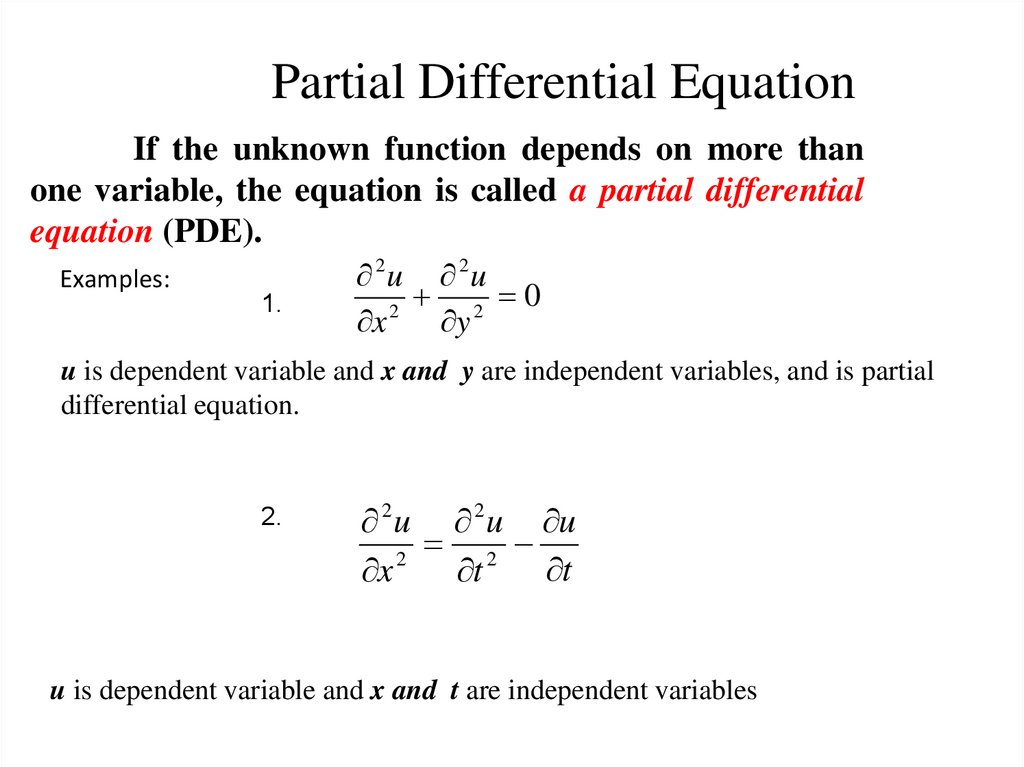
Partial Differential EquationIf the unknown function depends on more than
one variable, the equation is called a partial differential
equation (PDE).
Examples:
1.
2u 2u
2 0
2
x
y
u is dependent variable and x and y are independent variables, and is partial
differential equation.
2.
2 u 2 u u
2
2
t
x
t
u is dependent variable and x and t are independent variables
24.
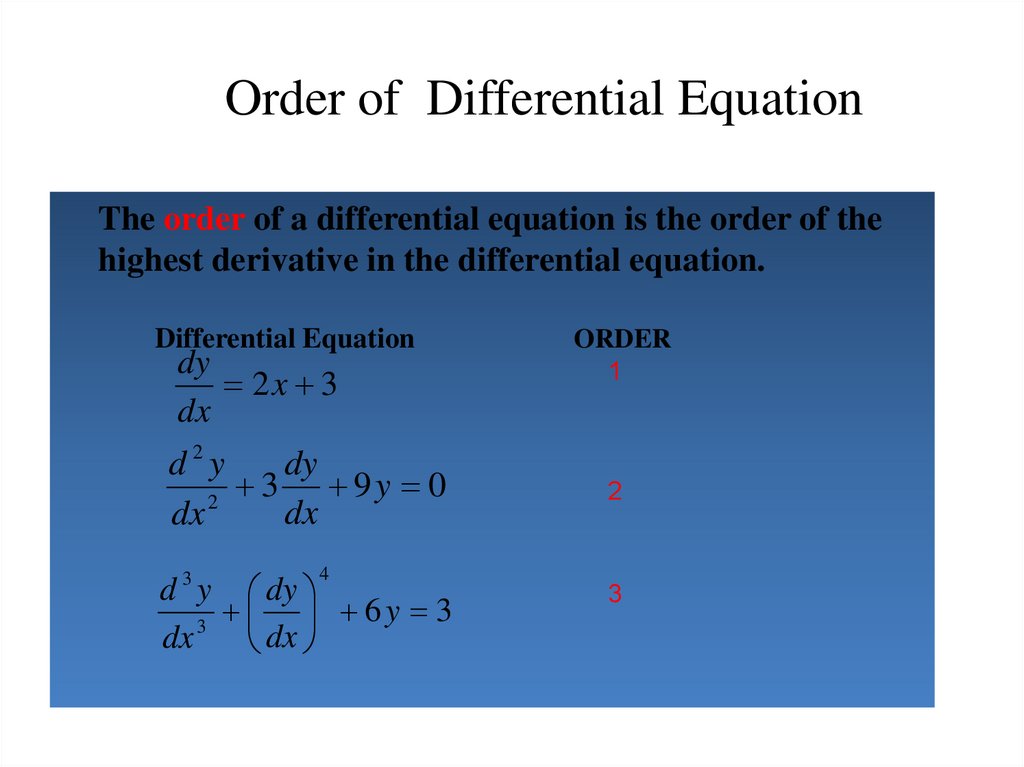
Order of Differential EquationThe order of a differential equation is the order of the
highest derivative in the differential equation.
Differential Equation
dy
2x 3
dx
d2y
dy
3 9y 0
2
dx
dx
4
d y dy
6y 3
3
dx
dx
3
ORDER
1
2
3
25.
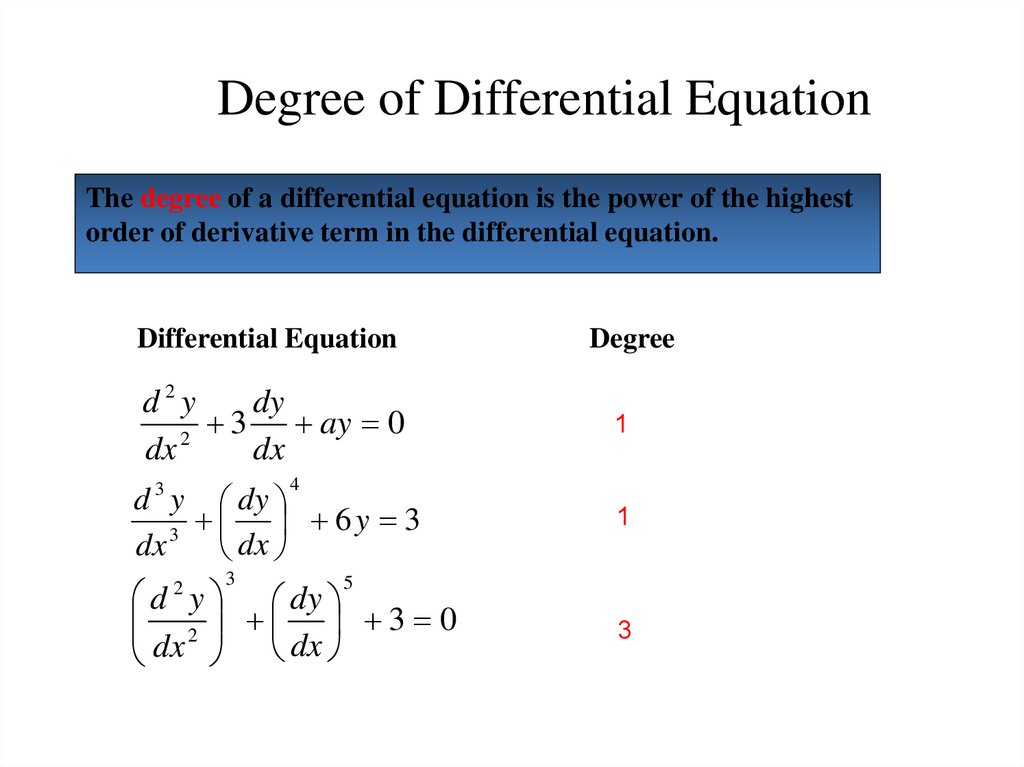
Degree of Differential EquationThe degree of a differential equation is the power of the highest
order of derivative term in the differential equation.
Differential Equation
Degree
d2y
dy
3 ay 0
2
dx
dx
1
4
d 3 y dy
6y 3
3
dx
dx
3
d y dy
2 3 0
dx dx
2
1
5
3
26.
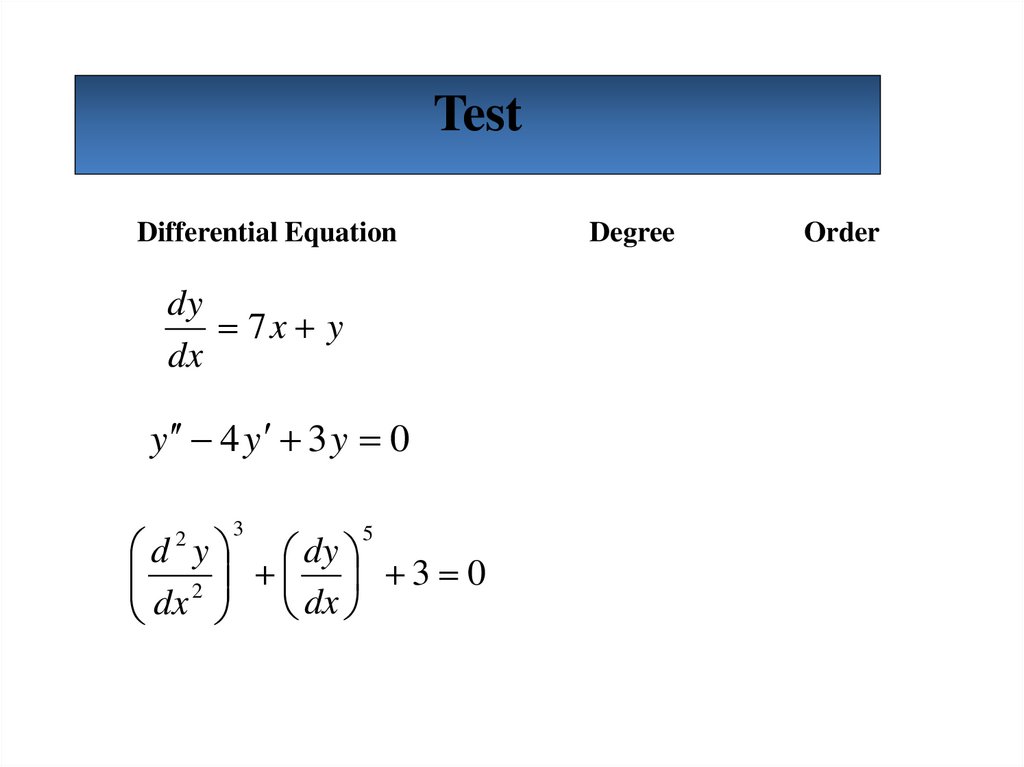
TestDifferential Equation
dy
7x y
dx
y 4 y 3 y 0
3
d y dy
2 3 0
dx dx
2
5
Degree
Order
27.
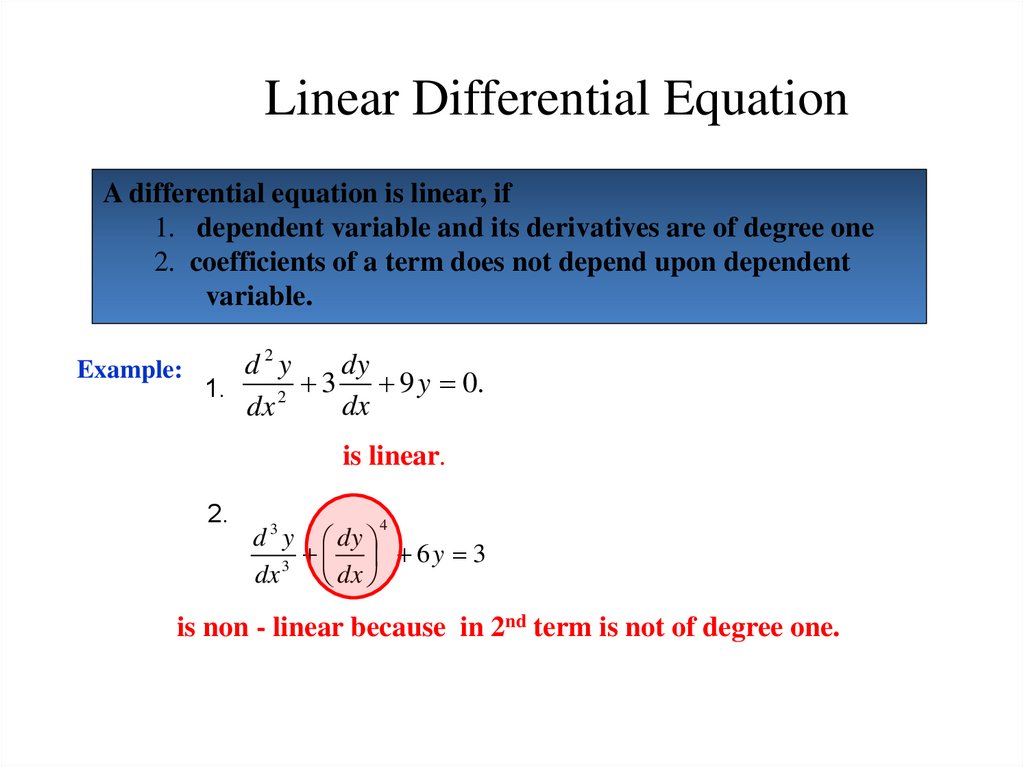
Linear Differential EquationA differential equation is linear, if
1. dependent variable and its derivatives are of degree one
2. coefficients of a term does not depend upon dependent
variable.
Example:
d2y
dy
3
9 y 0.
1.
2
dx
dx
is linear.
2.
4
d 3 y dy
6y 3
3
dx
dx
is non - linear because in 2nd term is not of degree one.
28.
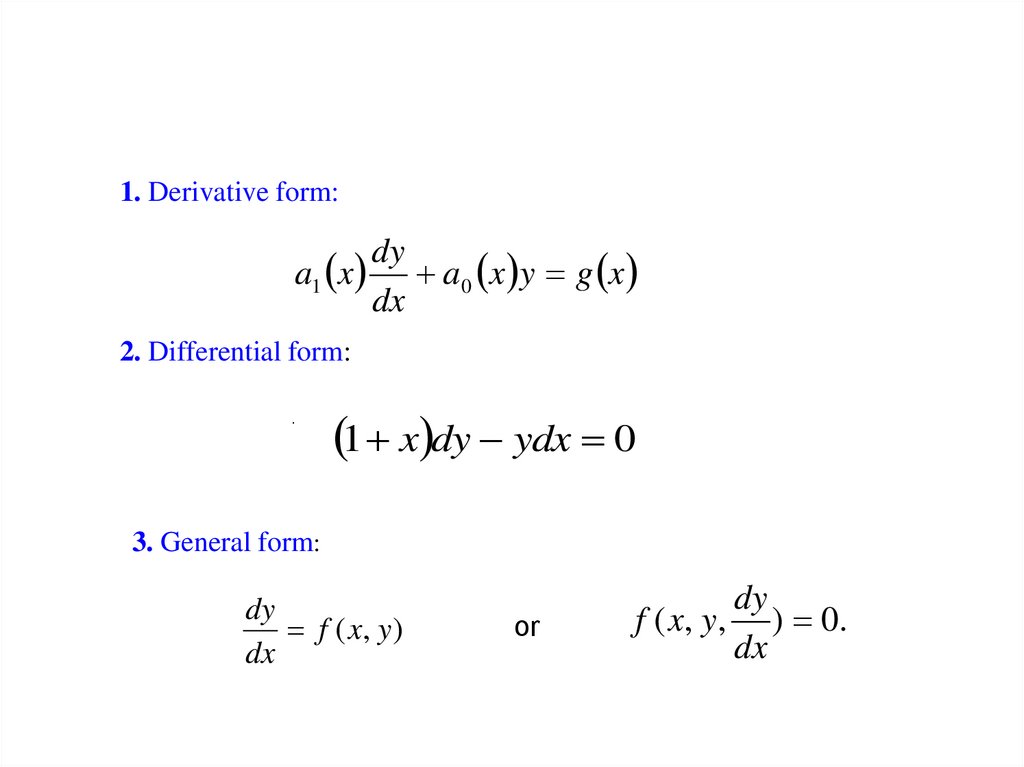
1st – order differential equation1. Derivative form:
dy
a1 x a 0 x y g x
dx
2. Differential form:
.
1 x dy ydx 0
3. General form:
dy
f ( x, y )
dx
or
dy
f ( x , y , ) 0.
dx
29.
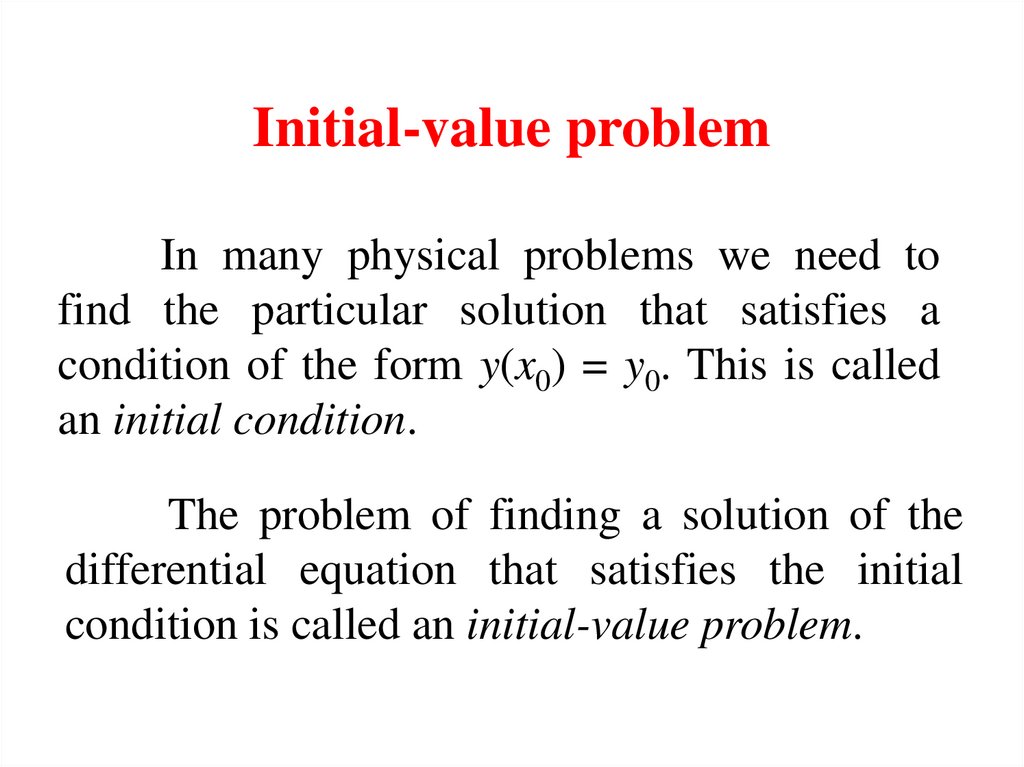
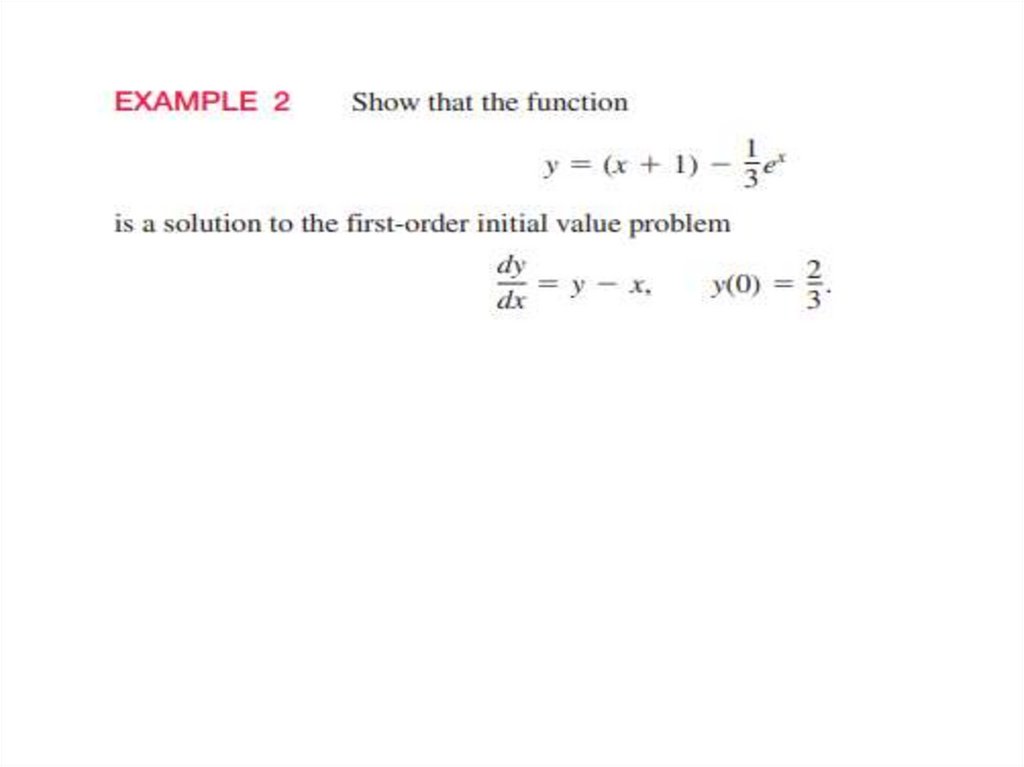
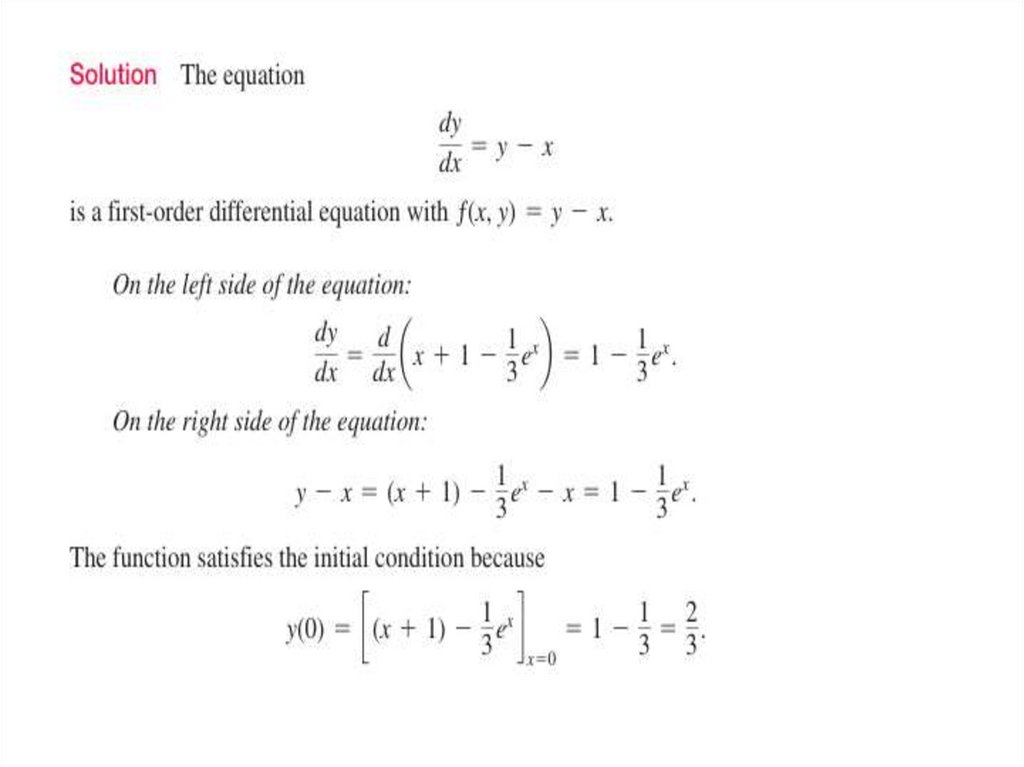
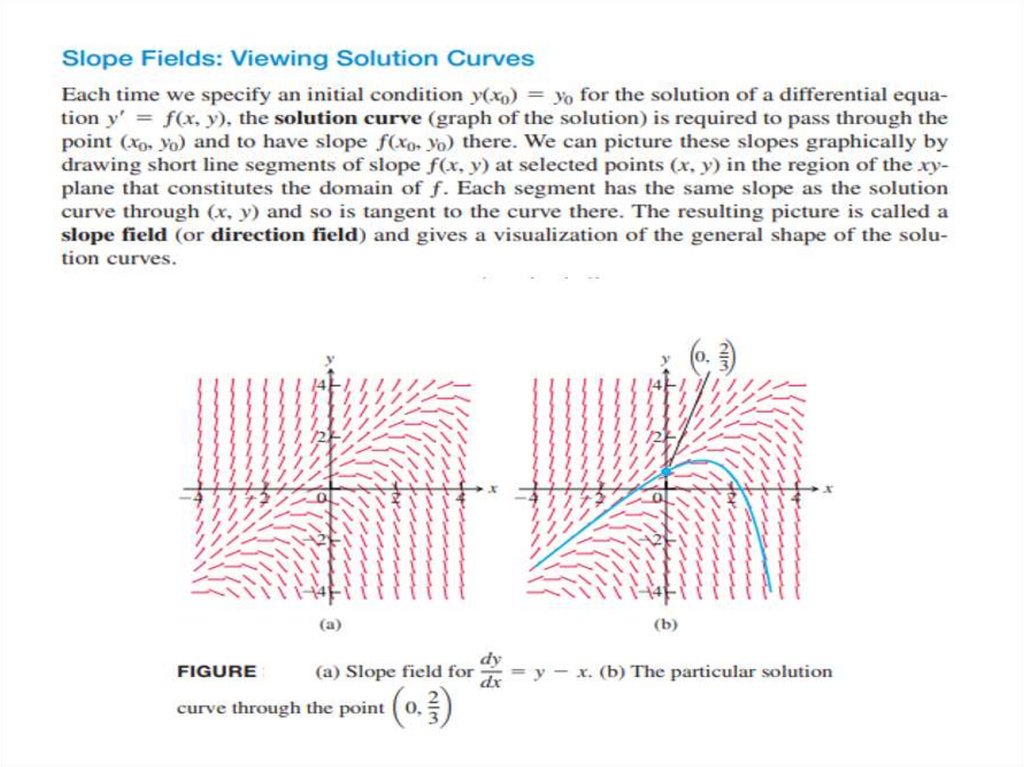
Initial-value problemIn many physical problems we need to
find the particular solution that satisfies a
condition of the form y(x0) = y0. This is called
an initial condition.
The problem of finding a solution of the
differential equation that satisfies the initial
condition is called an initial-value problem.
30.
31.
32.
33.
34.
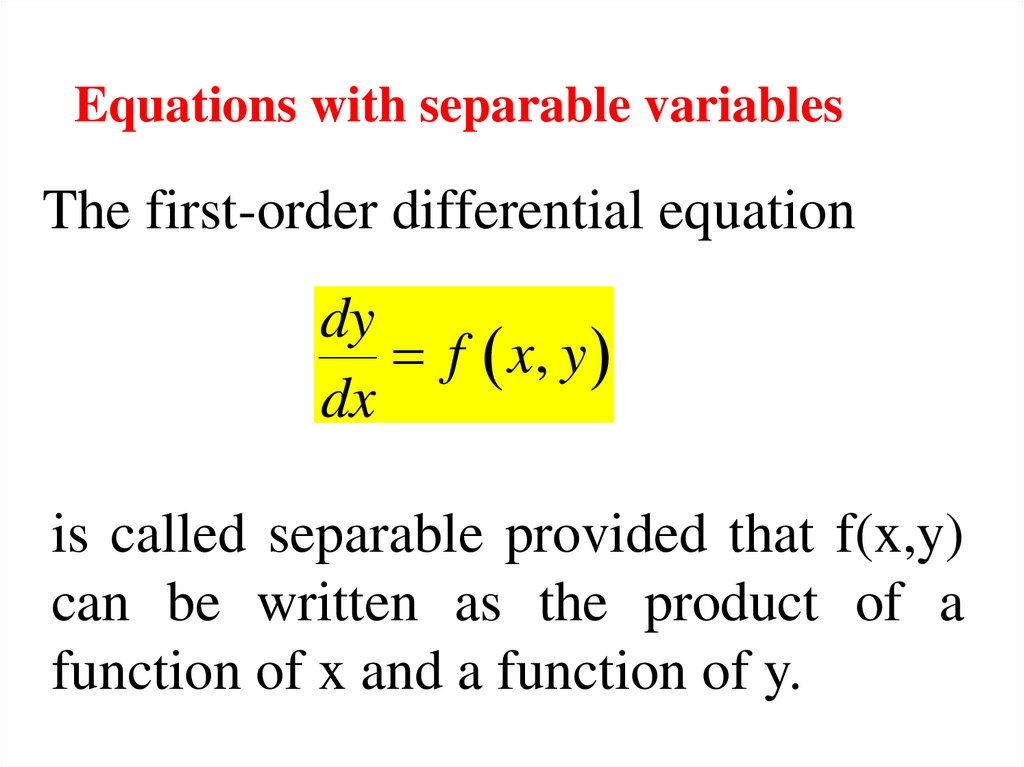
Equations with separable variablesThe first-order differential equation
dy
f x, y
dx
is called separable provided that f(x,y)
can be written as the product of a
function of x and a function of y.
35.
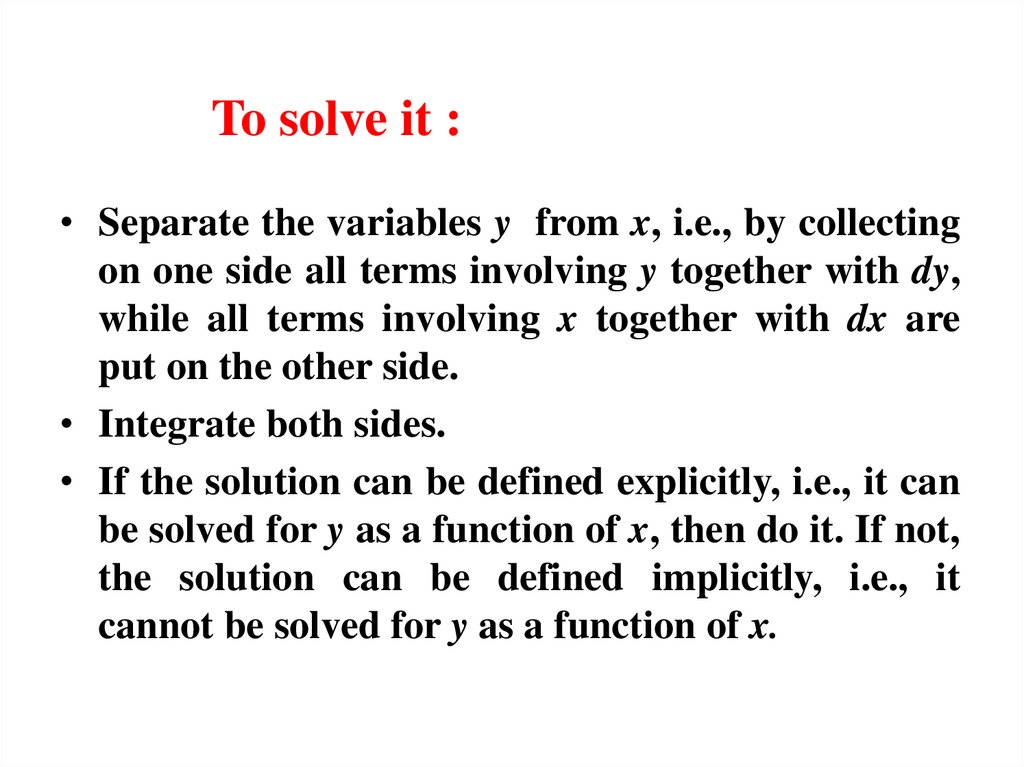
To solve it :• Separate the variables y from x, i.e., by collecting
on one side all terms involving y together with dy,
while all terms involving x together with dx are
put on the other side.
• Integrate both sides.
• If the solution can be defined explicitly, i.e., it can
be solved for y as a function of x, then do it. If not,
the solution can be defined implicitly, i.e., it
cannot be solved for y as a function of x.
36.
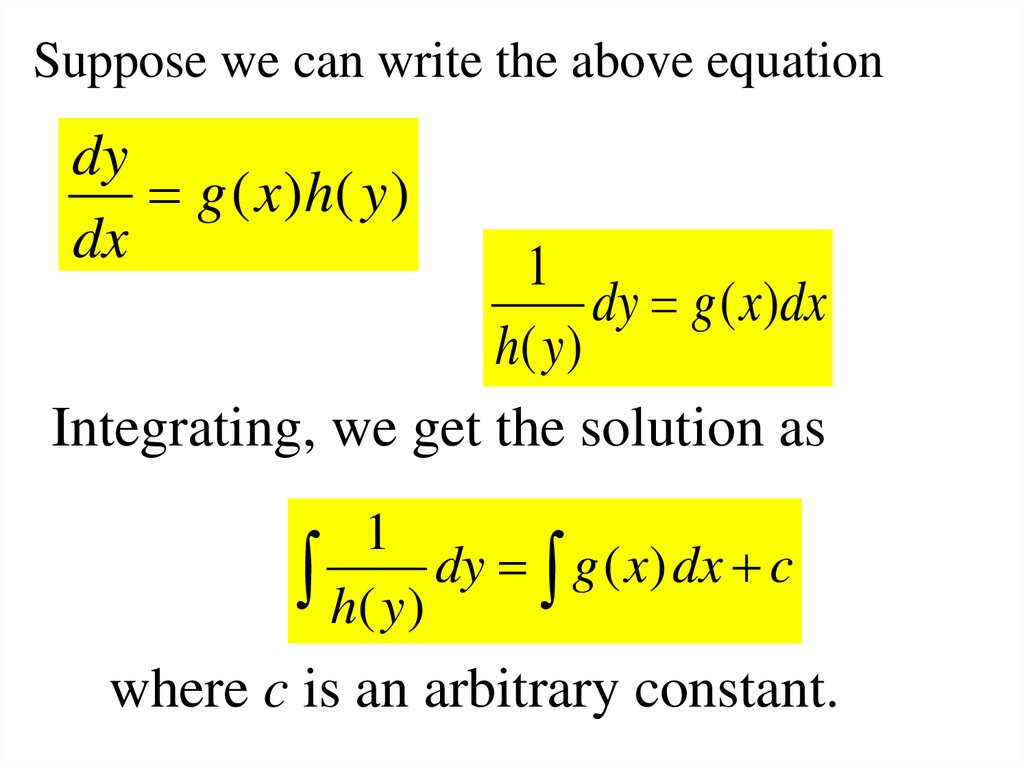
Suppose we can write the above equation asdy
g ( x ) h( y )
dx
1
dy g ( x)dx
h( y )
Integrating, we get the solution as
1
h( y) dy g ( x) dx c
where c is an arbitrary constant.
37.
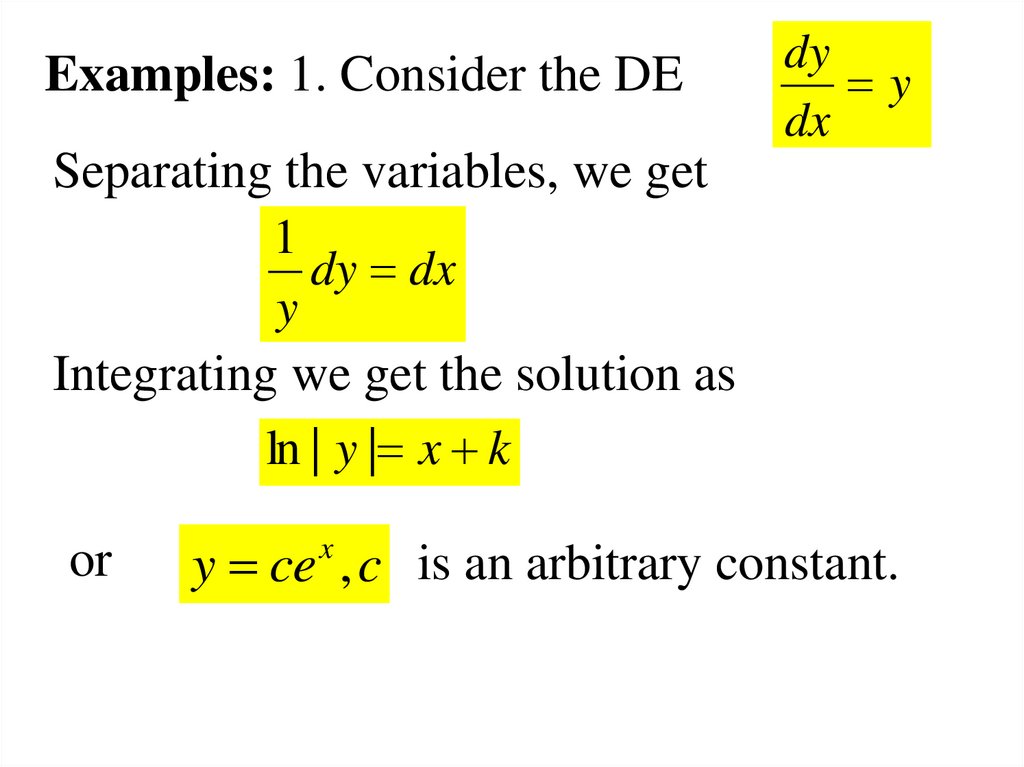
Examples: 1. Consider the DEdy
y
dx
Separating the variables, we get
1
dy dx
y
Integrating we get the solution as
ln | y | x k
or
y ce , c is an arbitrary constant.
x
38.
39.
40.
41.
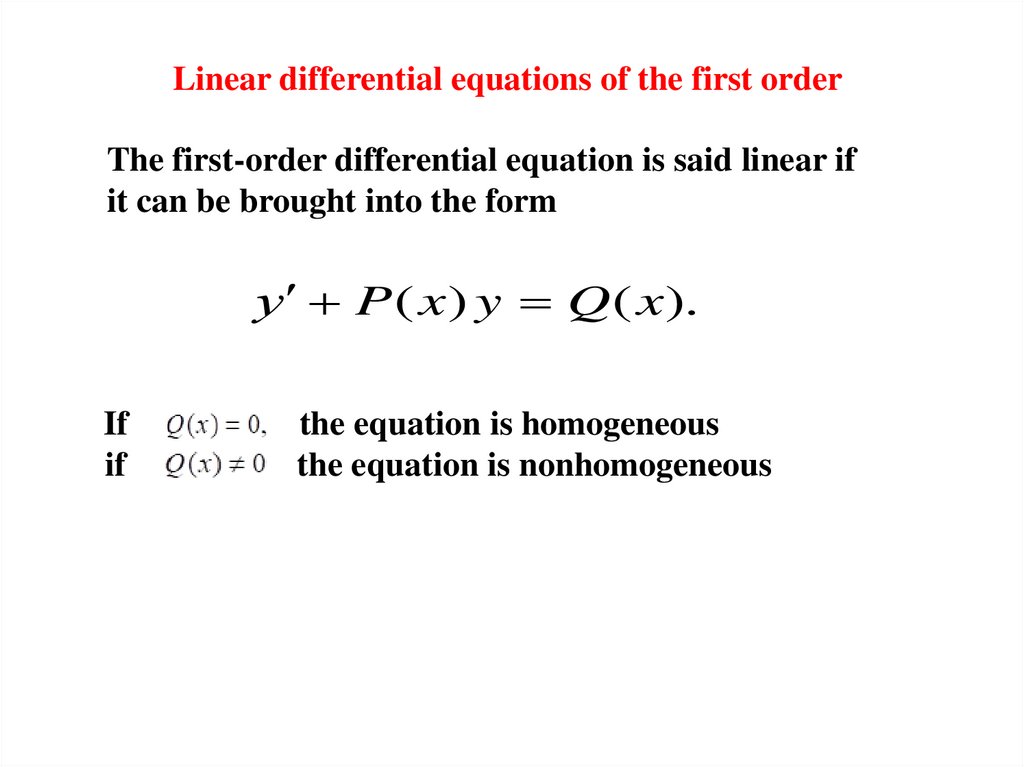
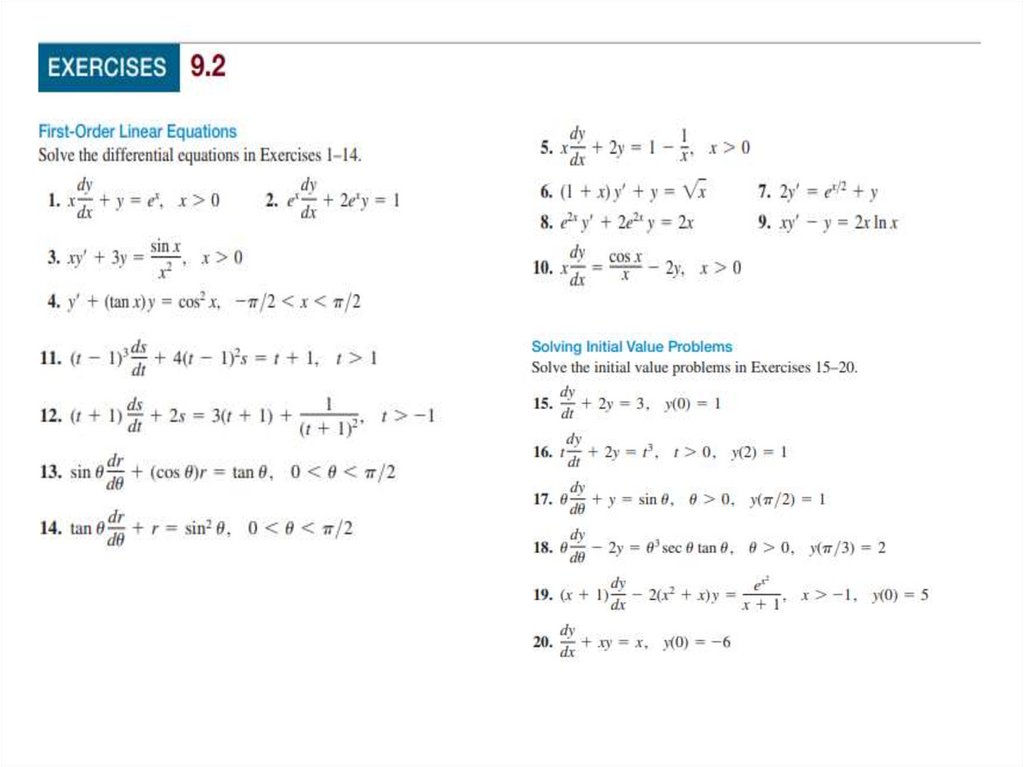
Linear differential equations of the first orderThe first-order differential equation is said linear if
it can be brought into the form
у P ( x ) y Q ( x ).
If
if
the equation is homogeneous
the equation is nonhomogeneous
42.
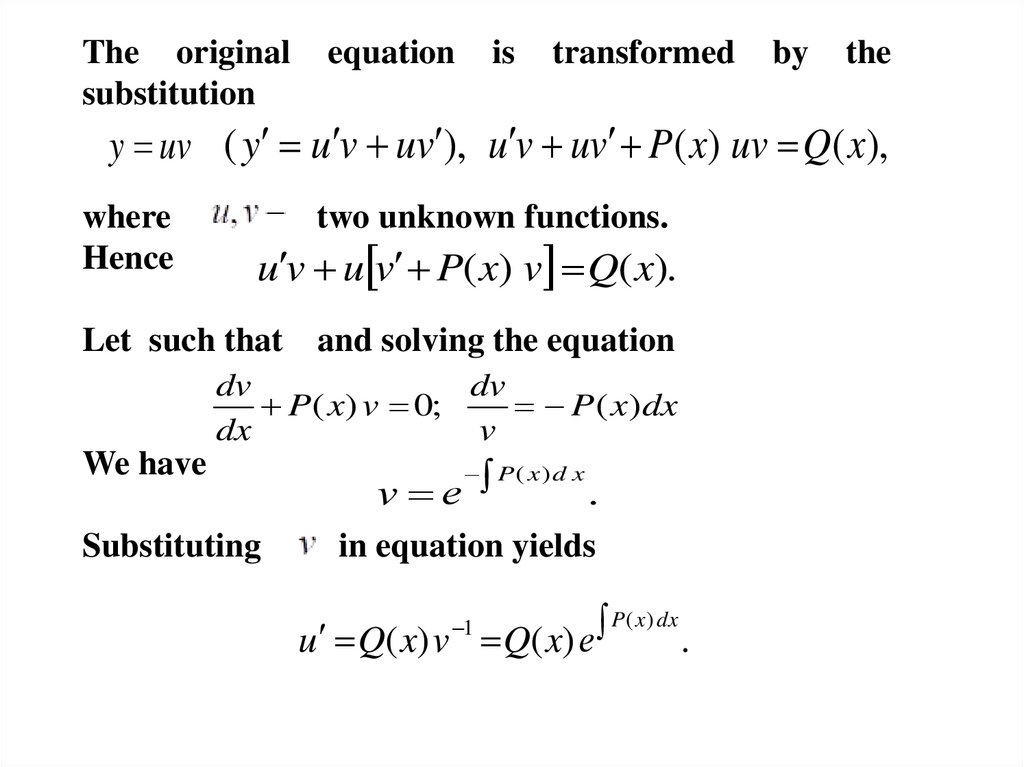
The originalsubstitution
equation
is
transformed
by
the
y uv ( y u v uv ), u v uv P( x) uv Q( x),
where
Hence
two unknown functions.
u v u v P( x) v Q( x).
Let such that
and solving the equation
dv
dv
P( x) v 0;
P( x)dx
dx
v
We have
Substituting
v е
.
in equation yields
P( x)d x
P ( x ) dx
u Q( x) v Q( x) е
.
1
43.
Thereforep ( x ) dx
u C Q( x)e
dx.
The general solution of the original equation
у e
p ( x ) dx
Q( x)e p ( x ) dx dx C .
E.g. Find the general solution
y 2 x y х е
х2
.
44.
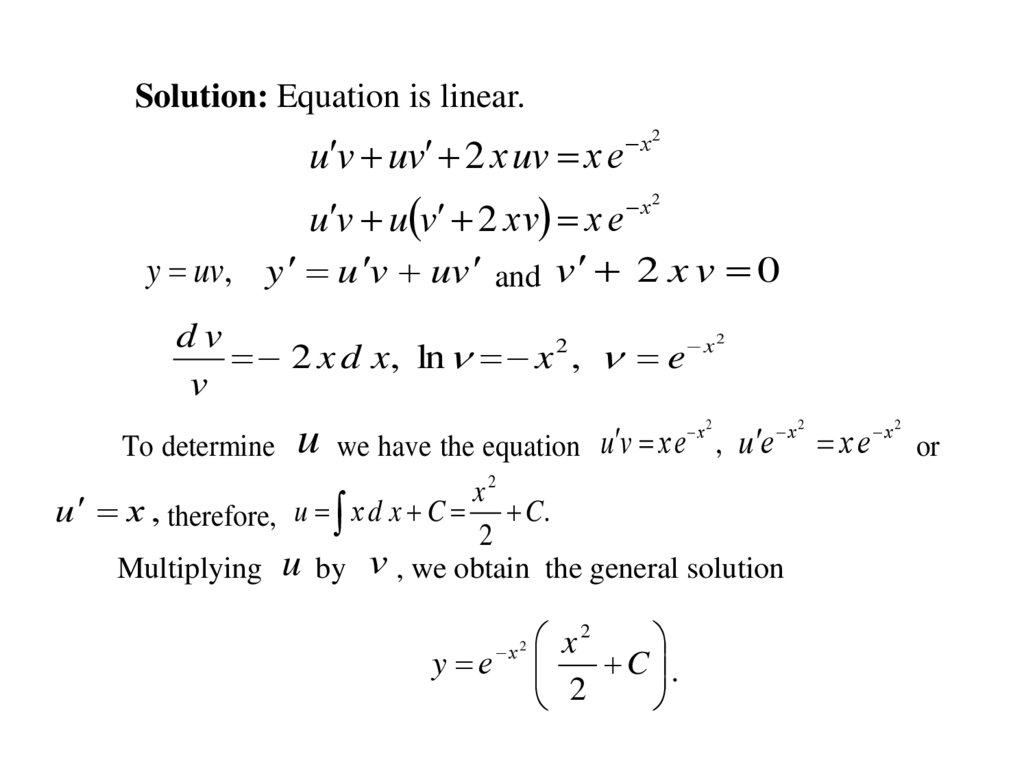
Solution: Equation is linear.u v uv 2 х uv х е
х2
u v u v 2 хv х е
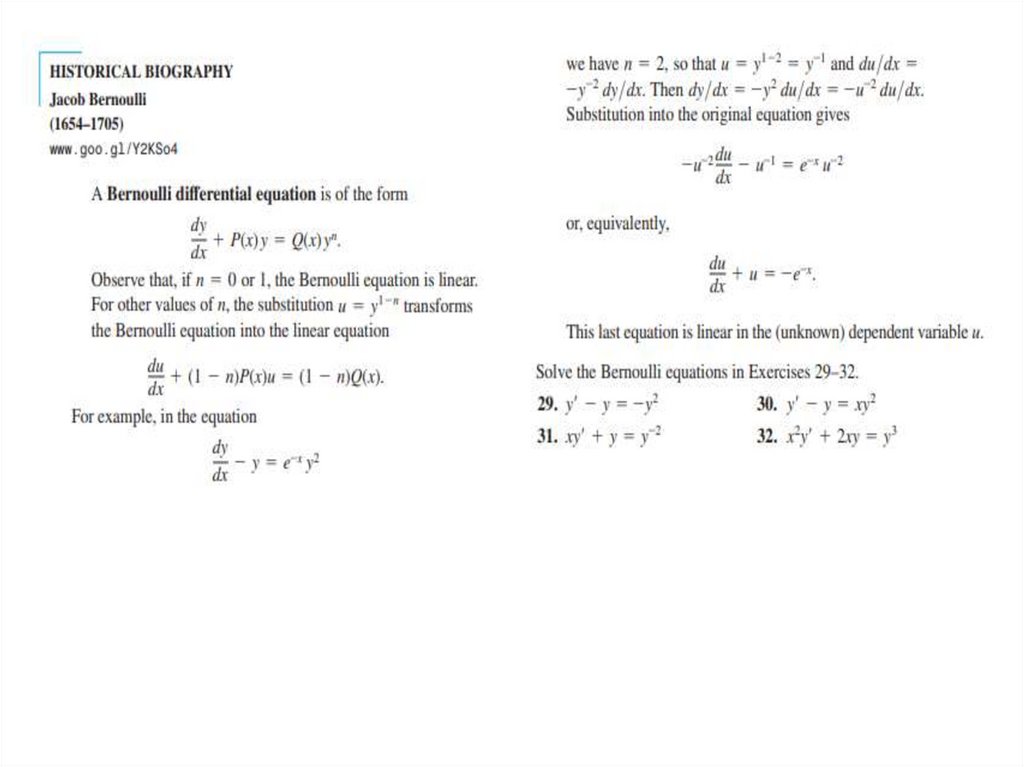
y uv, y u v uv and v 2 x v 0
х2
dv
2
x2
2 x d x, ln x , e
v
To determine
u we have the equation u v х е , u е
х2
х2
x2
u х , therefore, u х d x C C.
2
Multiplying u by v , we obtain the general solution
y е
х2
x2
C .
2
хе
х2
or
45.
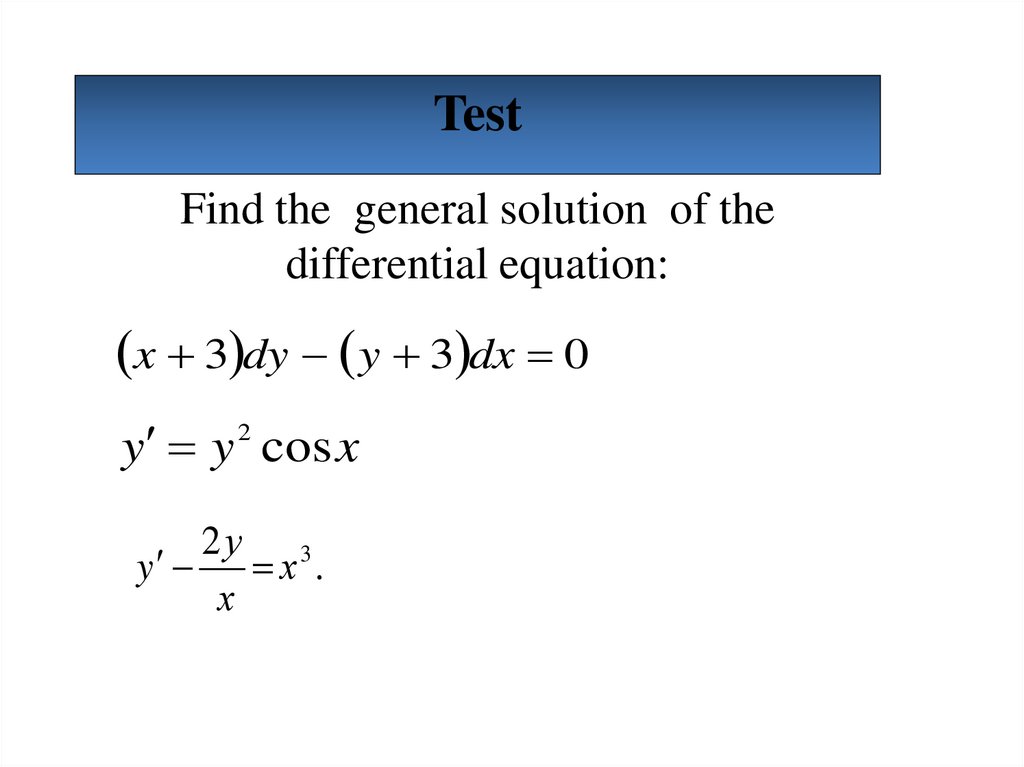
TestFind the general solution of the
differential equation:
x 3 dy y 3 dx 0
2
y y cos x
2у 3
y х .
х