 medicine
Similar presentations:






Transitional Horizon. Lecture 5
1.
2.
Lecture 53.
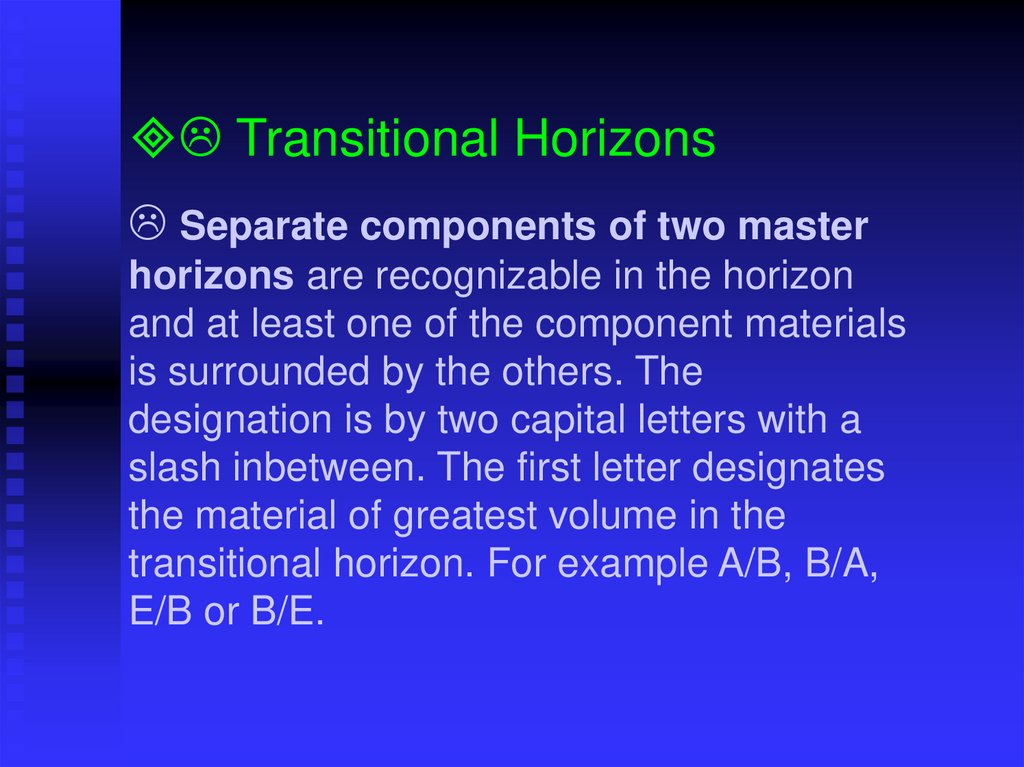
Transitional HorizonsSeparate components of two master
horizons are recognizable in the horizon
and at least one of the component materials
is surrounded by the others. The
designation is by two capital letters with a
slash inbetween. The first letter designates
the material of greatest volume in the
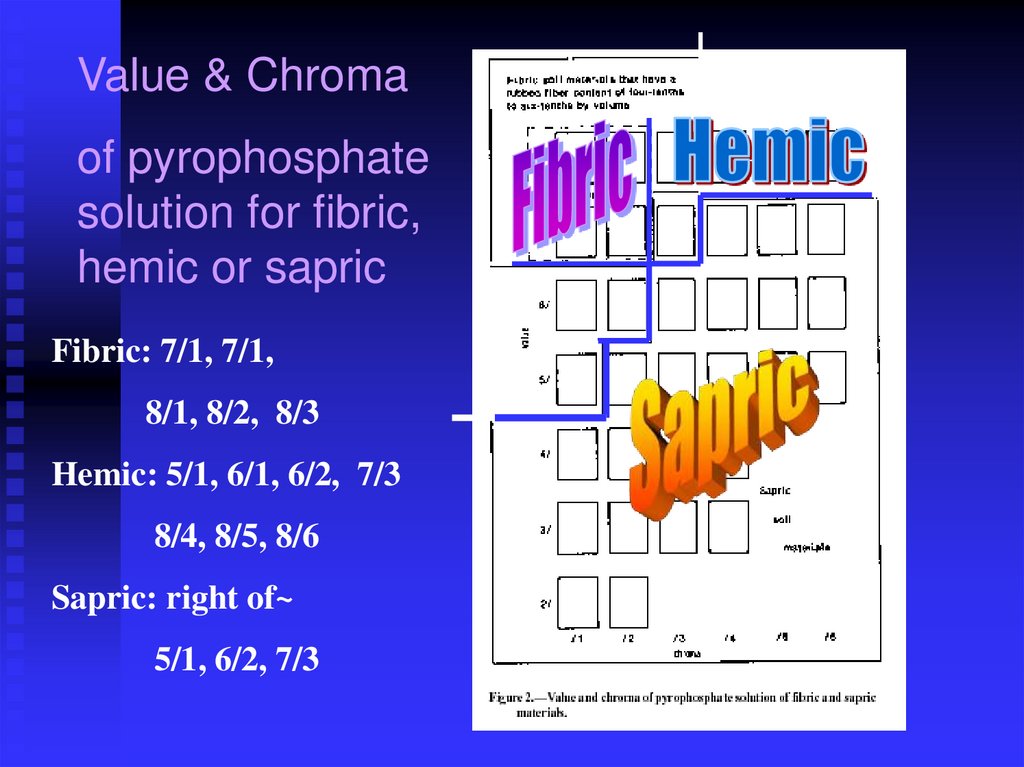
transitional horizon. For example A/B, B/A,
E/B or B/E.
4.
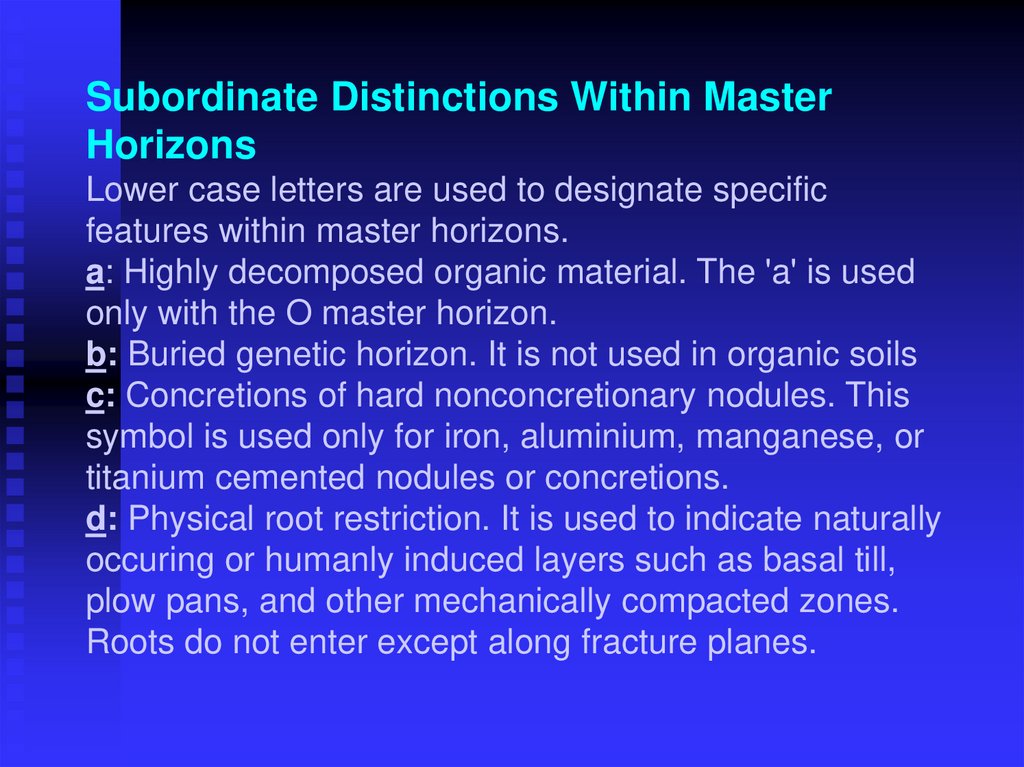
Subordinate Distinctions Within MasterHorizons
Lower case letters are used to designate specific
features within master horizons.
a: Highly decomposed organic material. The 'a' is used
only with the O master horizon.
b: Buried genetic horizon. It is not used in organic soils
c: Concretions of hard nonconcretionary nodules. This
symbol is used only for iron, aluminium, manganese, or
titanium cemented nodules or concretions.
d: Physical root restriction. It is used to indicate naturally
occuring or humanly induced layers such as basal till,
plow pans, and other mechanically compacted zones.
Roots do not enter except along fracture planes.
5.
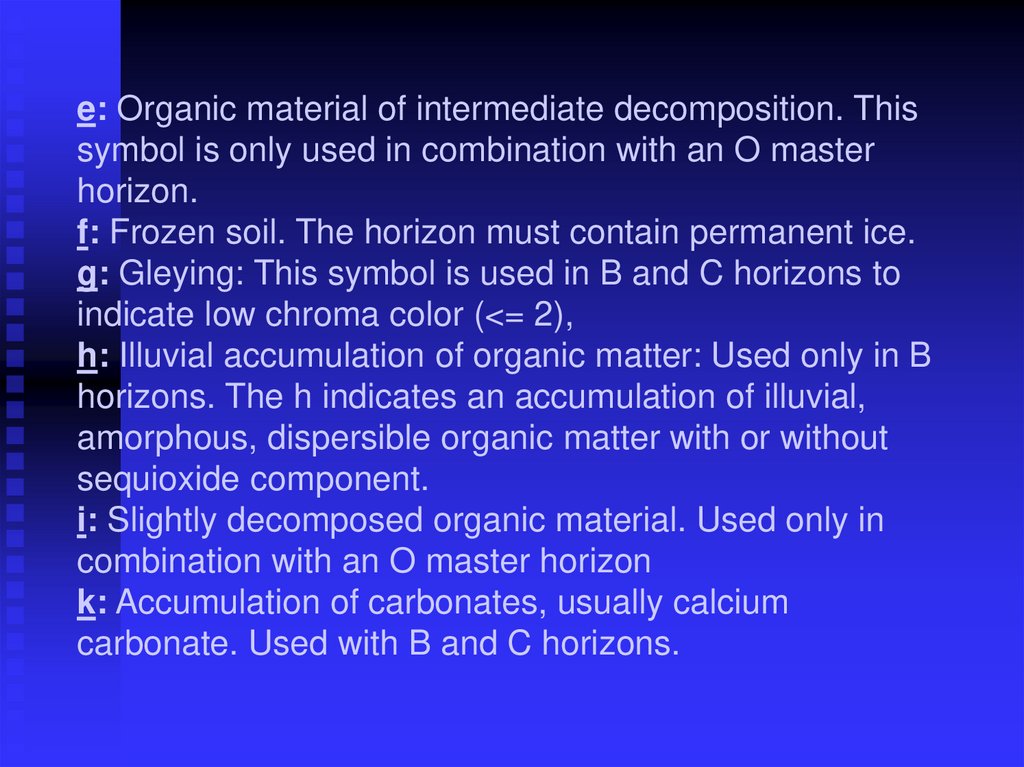
e: Organic material of intermediate decomposition. Thissymbol is only used in combination with an O master
horizon.
f: Frozen soil. The horizon must contain permanent ice.
g: Gleying: This symbol is used in B and C horizons to
indicate low chroma color (<= 2),
h: Illuvial accumulation of organic matter: Used only in B
horizons. The h indicates an accumulation of illuvial,
amorphous, dispersible organic matter with or without
sequioxide component.
i: Slightly decomposed organic material. Used only in
combination with an O master horizon
k: Accumulation of carbonates, usually calcium
carbonate. Used with B and C horizons.
6.
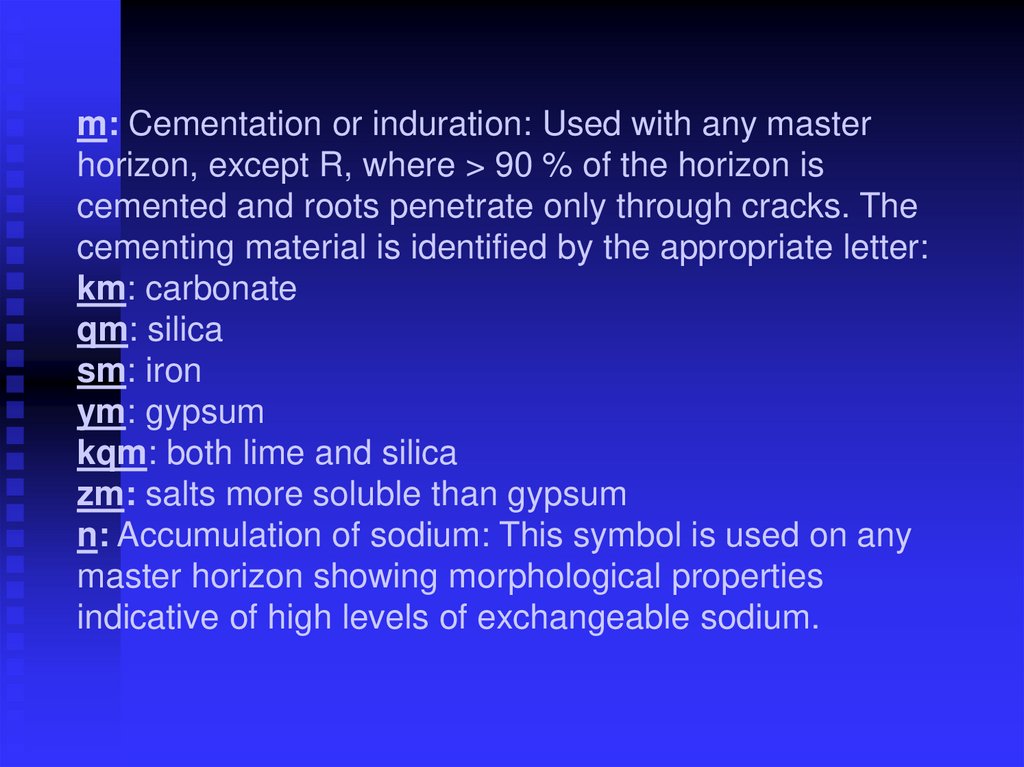
m: Cementation or induration: Used with any masterhorizon, except R, where > 90 % of the horizon is
cemented and roots penetrate only through cracks. The
cementing material is identified by the appropriate letter:
km: carbonate
qm: silica
sm: iron
ym: gypsum
kqm: both lime and silica
zm: salts more soluble than gypsum
n: Accumulation of sodium: This symbol is used on any
master horizon showing morphological properties
indicative of high levels of exchangeable sodium.
7.
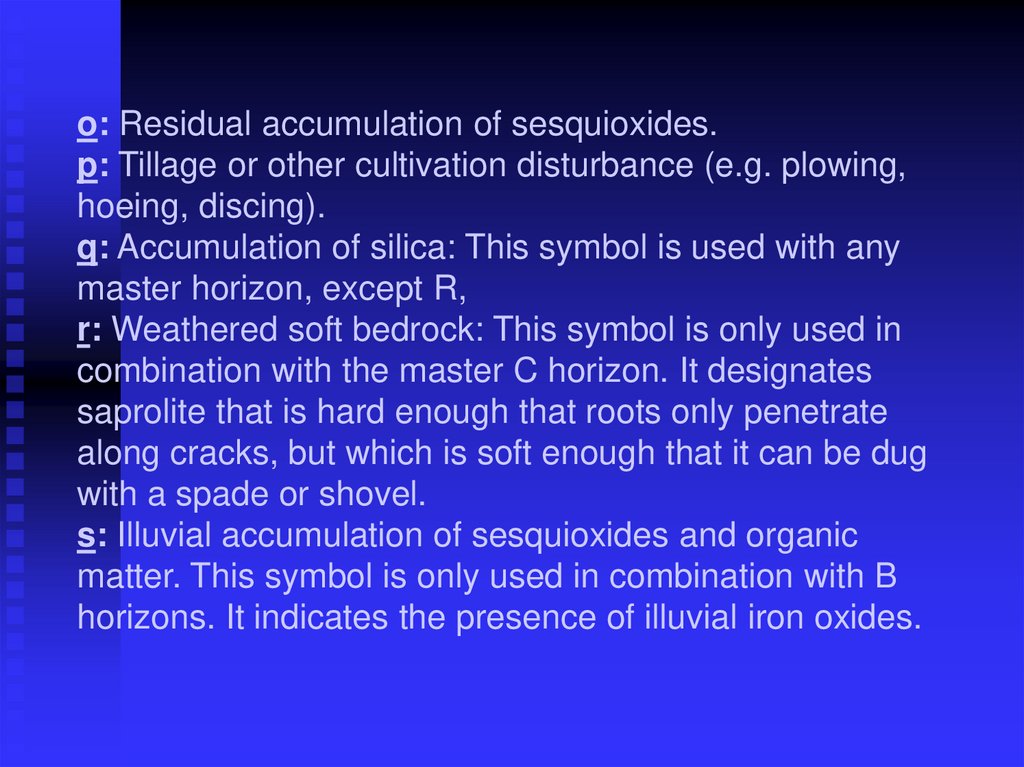
o: Residual accumulation of sesquioxides.p: Tillage or other cultivation disturbance (e.g. plowing,
hoeing, discing).
q: Accumulation of silica: This symbol is used with any
master horizon, except R,
r: Weathered soft bedrock: This symbol is only used in
combination with the master C horizon. It designates
saprolite that is hard enough that roots only penetrate
along cracks, but which is soft enough that it can be dug
with a spade or shovel.
s: Illuvial accumulation of sesquioxides and organic
matter. This symbol is only used in combination with B
horizons. It indicates the presence of illuvial iron oxides.
8.
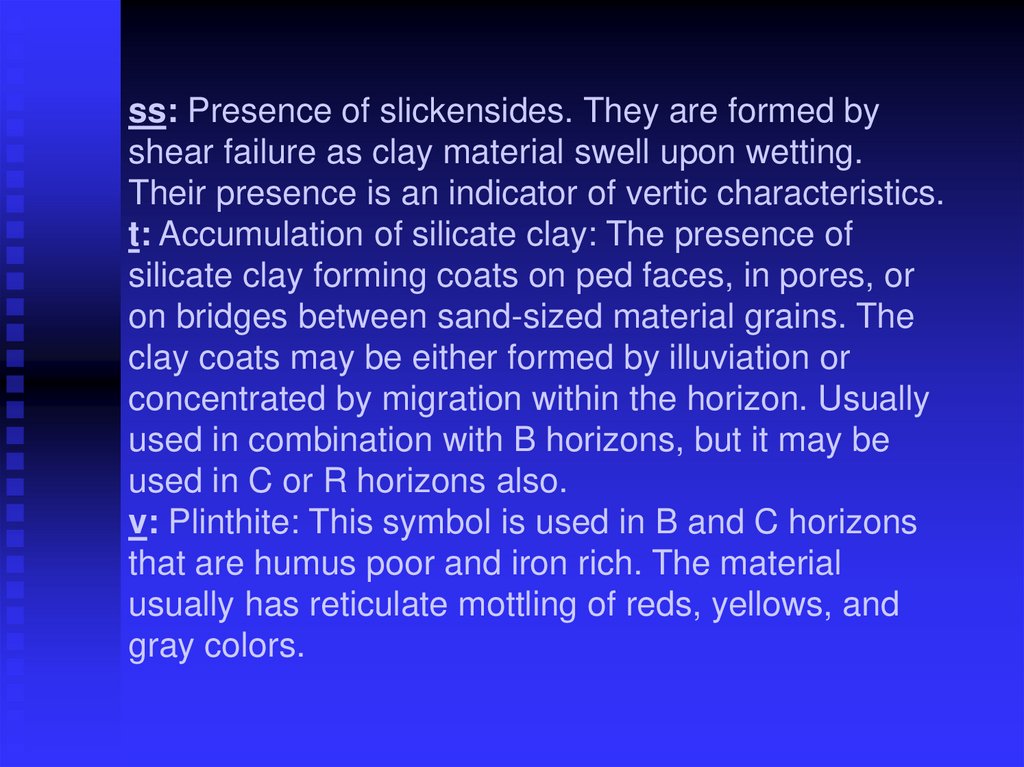
ss: Presence of slickensides. They are formed byshear failure as clay material swell upon wetting.
Their presence is an indicator of vertic characteristics.
t: Accumulation of silicate clay: The presence of
silicate clay forming coats on ped faces, in pores, or
on bridges between sand-sized material grains. The
clay coats may be either formed by illuviation or
concentrated by migration within the horizon. Usually
used in combination with B horizons, but it may be
used in C or R horizons also.
v: Plinthite: This symbol is used in B and C horizons
that are humus poor and iron rich. The material
usually has reticulate mottling of reds, yellows, and
gray colors.
9.
w: Development of color and structure. This symbol isused for B horizons that have developed structure or color
different, usually redder than that of the A or C horizons,
but do not have apparent illuvial accumulations.
x: Fragipan character: This symbol is used to designate
genetically developed firmness, brittleness, or high bulk
density in B or C horizons. No cementing agent is evident.
y: Accumulation of gypsum. This symbol is used in B and
C horizons to indicated genetically accumulated gypsum.
z: Accumulation of salts more soluble than gypsum. This
symbol is used in combination with B and C horizons.
10.
CharacteristicsDiagnostic for Organic Soils
Following is a description of the
characteristics that are used
only with organic soils.
11.
Kinds of Organic Soil MaterialsThree different kinds of organic soil materials
are distinguished in this taxonomy, based on
the degree of decomposition of the plant
materials from which the organic materials are
derived. The three kinds are (1) fibric, (2)
hemic, and (3) sapric. Because of the
importance of fiber content in the definitions of
these materials, fibers are defined before the
kinds of organic soil materials.
12.
FibersFibers are pieces of plant tissue in organic soil
materials (excluding live roots) that:
1. Are large enough to be retained on a 100-mesh
sieve (openings 0.15 mm across) when the
materials are screened; and
2. Show evidence of the cellular structure of the
plants from which they are derived; and
3. Either are 2 cm or less in their smallest
dimension or are decomposed enough to be
crushed and shredded with the fingers.
13.
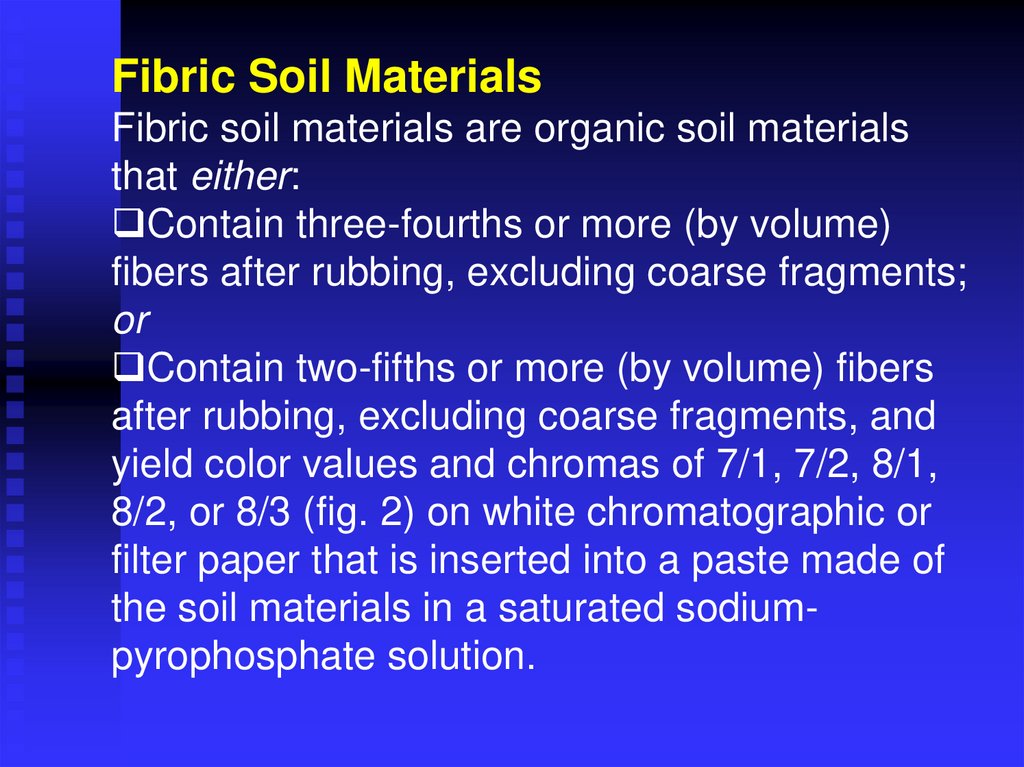
Fibric Soil MaterialsFibric soil materials are organic soil materials
that either:
Contain three-fourths or more (by volume)
fibers after rubbing, excluding coarse fragments;
or
Contain two-fifths or more (by volume) fibers
after rubbing, excluding coarse fragments, and
yield color values and chromas of 7/1, 7/2, 8/1,
8/2, or 8/3 (fig. 2) on white chromatographic or
filter paper that is inserted into a paste made of
the soil materials in a saturated sodiumpyrophosphate solution.
14.
Hemic Soil MaterialsHemic soil materials (Gr. hemi, half; implying
intermediate decomposition) are intermediate in
their degree of decomposition between the less
decomposed fibric and more decomposed
sapric materials. Their morphological features
give intermediate values for fiber content, bulk
density, and water content. Hemic soil materials
are partly altered both physically and
biochemically.
15.
Sapric Soil MaterialsSapric soil materials (Gr. sapros, rotten) are the
most highly decomposed of the three kinds of
organic soil materials. They have the smallest
amount of plant fiber, the highest bulk density,
and the lowest water content on a dry-weight
basis at saturation. Sapric soil materials are
commonly very dark gray to black. They are
relatively stable; i.e., they change very little
physically and chemically with time in comparison
to other organic soil materials.
16.
Sapric materials have the followingcharacteristics:
1. The fiber content, after rubbing, is less than
one-sixth (by volume), excluding coarse
fragments; and
2. The color of the sodium-pyrophosphate
extract on white chromatographic or filter
paper is below or to the right of a line drawn to
exclude blocks 5/1, 6/2, and 7/3 (Munsell
designations, fig. 2).
17.
Value & Chromaof pyrophosphate
solution for fibric,
hemic or sapric
Fibric: 7/1, 7/1,
8/1, 8/2, 8/3
Hemic: 5/1, 6/1, 6/2, 7/3
8/4, 8/5, 8/6
Sapric: right of~
5/1, 6/2, 7/3
18.
Humilluvic MaterialHumilluvic material, i.e., illuvial humus, accumulates
in the lower parts of some organic soils that are acid
and have been drained and cultivated. The humilluvic
material has a C14 age that is not older than the
overlying organic materials. It has very high
solubility in sodium pyrophosphate and rewets very
slowly after drying. Most commonly, it accumulates
near a contact with a sandy mineral horizon.
19.
Limnic MaterialsThe nature of such deposits is considered in the lower
categories of Histosols. Limnic materials include both
organic and inorganic materials that were either (1)
deposited in water by precipitation or through the
action of aquatic organisms, such as algae or diatoms,
or (2) derived from underwater and floating aquatic
plants and subsequently modified by aquatic animals.
They include coprogenous earth (sedimentary peat),
diatomaceous earth, and marl.
20. Thickness of Organic Soil Materials (Control Section of Histosols)
Thickness of Organic Soil Materials(Control Section of Histosols)
Surface Tier
The surface tier of a Histosol extends from
the soil surface to a depth of 60 cm if either
the materials within that depth are fibric and
three-fourths or more of the fiber volume is
derived from Sphagnum or other mosses or
the materials have a bulk density of less
than 0.1.
21.
Subsurface TierThe subsurface tier is normally 60 cm thick. If the
control section ends at a shallower depth (at a densic,
lithic, or paralithic contact or a water layer or in
permafrost), however, the subsurface tier extends
from the lower boundary of the surface tier to the
lower boundary of the control section. It includes
any unconsolidated mineral layers that may be
present within those depths.
22.
Bottom TierThe bottom tier is 40 cm thick unless the control
section has its lower boundary at a shallower depth
(at a densic, lithic, or paralithic contact or a water
layer or in permafrost). If the fibric moss extends to a
depth of 60 cm and is the dominant material within
this depth (threefourths or more of the volume), the
control section is 160 cm thick. If the fibric moss is
thin or absent, the control section extends to a depth
of 130 cm.
23. Lithic Contact
A lithic contact is the boundary between soil and acoherent underlying material. Cracks that can be
penetrated by roots are few
The underlying material must be sufficiently
coherent when moist to make hand-digging with a
spade impractical, although the material may be
chipped or scraped with a spade.
24.
Wassalam w.w.Selamat Siang