 medicine
Similar presentations:



The treatment of disorders of calcium metabolism in children on the data of osteodensitometry
1.
The treatment of disorders of calcium metabolism inchildren on the data of osteodensitometry
Smolensk State medical University, Russia
Ilia Krutikov, Anton Teschenkov, Sofia Kovalenkova
Scientific adviser: Nadezda Krutikova, PhD, Anna Krikova, PharmD, PhD
Introduction
Over the past ten years, attention has been paid to the
problem of osteoporosis and osteopenia in
children because up to 30% of children have a
decrease in bone mineral density. Insufficient
rates of bone calcium are accompanied by a
decrease in the thickness of the cortical layer and
require administration of calcium and vitamin D.
To assess the "quality" of the bone and administer
proper drugs, a quantitative ultrasound method
is of value, based on registering the speed of the
passage of an ultrasonic wave along the cortical
layer of tubular bones. It has high sensitivity,
safety
without
chances
for
subjective
interpretation of results.
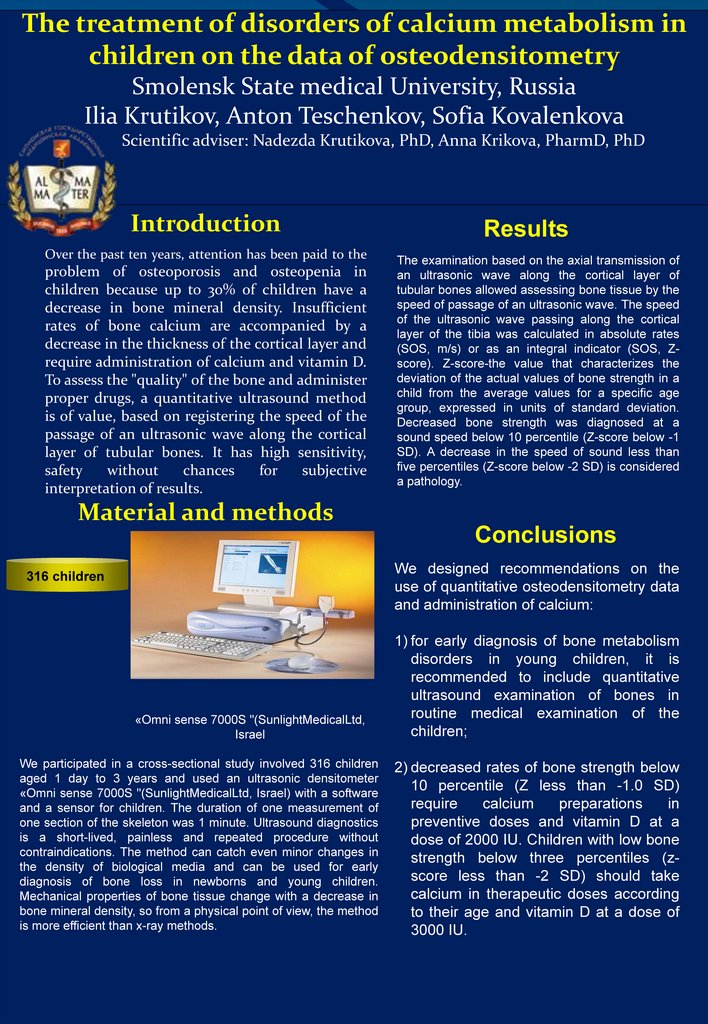
Material and methods
Results
The examination based on the axial transmission of
an ultrasonic wave along the cortical layer of
tubular bones allowed assessing bone tissue by the
speed of passage of an ultrasonic wave. The speed
of the ultrasonic wave passing along the cortical
layer of the tibia was calculated in absolute rates
(SOS, m/s) or as an integral indicator (SOS, Zscore). Z-score-the value that characterizes the
deviation of the actual values of bone strength in a
child from the average values for a specific age
group, expressed in units of standard deviation.
Decreased bone strength was diagnosed at a
sound speed below 10 percentile (Z-score below -1
SD). A decrease in the speed of sound less than
five percentiles (Z-score below -2 SD) is considered
a pathology.
Conclusions
We designed recommendations on the
use of quantitative osteodensitometry data
and administration of calcium:
316 children
«Omni sense 7000S "(SunlightMedicalLtd,
Israel
We participated in a cross-sectional study involved 316 children
aged 1 day to 3 years and used an ultrasonic densitometer
«Omni sense 7000S "(SunlightMedicalLtd, Israel) with a software
and a sensor for children. The duration of one measurement of
one section of the skeleton was 1 minute. Ultrasound diagnostics
is a short-lived, painless and repeated procedure without
contraindications. The method can catch even minor changes in
the density of biological media and can be used for early
diagnosis of bone loss in newborns and young children.
Mechanical properties of bone tissue change with a decrease in
bone mineral density, so from a physical point of view, the method
is more efficient than x-ray methods.
1) for early diagnosis of bone metabolism
disorders in young children, it is
recommended to include quantitative
ultrasound examination of bones in
routine medical examination of the
children;
2) decreased rates of bone strength below
10 percentile (Z less than -1.0 SD)
require
calcium
preparations
in
preventive doses and vitamin D at a
dose of 2000 IU. Children with low bone
strength below three percentiles (zscore less than -2 SD) should take
calcium in therapeutic doses according
to their age and vitamin D at a dose of
3000 IU.