 medicine
Similar presentations:





Tension in sternocleidomastoid muscle depending on the position of the monitor at different angles
1.
2.
Tension in sternocleidomastoid muscle depending onthe position of the monitor at different angles
Authors: Nadīna Rīmere1, Simona Rubine1, Zane Zundāne1, Alise Guļajeva1
Scientific research supervisor: Jeļena Reste MD, PhD2
1 Rīga
2
Stradiņš University, Latvia
Rīga Stradiņš University, Institute for Occupational Safety and Environmental Health (IOSEH), Latvia
22.03.2021.
3.
Objectives• The aim of the study is to evaluate how the posture of the head
affects sternocleidomastoid muscle (SCMM) tension and clarify
the optimal angle for the placement of the computer monitor.
• Pathogenetically, too much tension in sternocleidomastoid
muscle can cause the development of head and neck pain, dizziness,
and fatigue. The wrong positioning of the screen might be related
to these complaints in employees.
4.
Materials and methods3.
A quantitative, cross-sectional study was performed
in healthy participants (the number of respondents
was 41, male-19, female–22; mean age - 25 years).
Measurements of sternocleidomastoid muscle
tension, decrement, stiffness, and relaxation were
obtained by MyotonPro 5.0.0 in the sitting position.
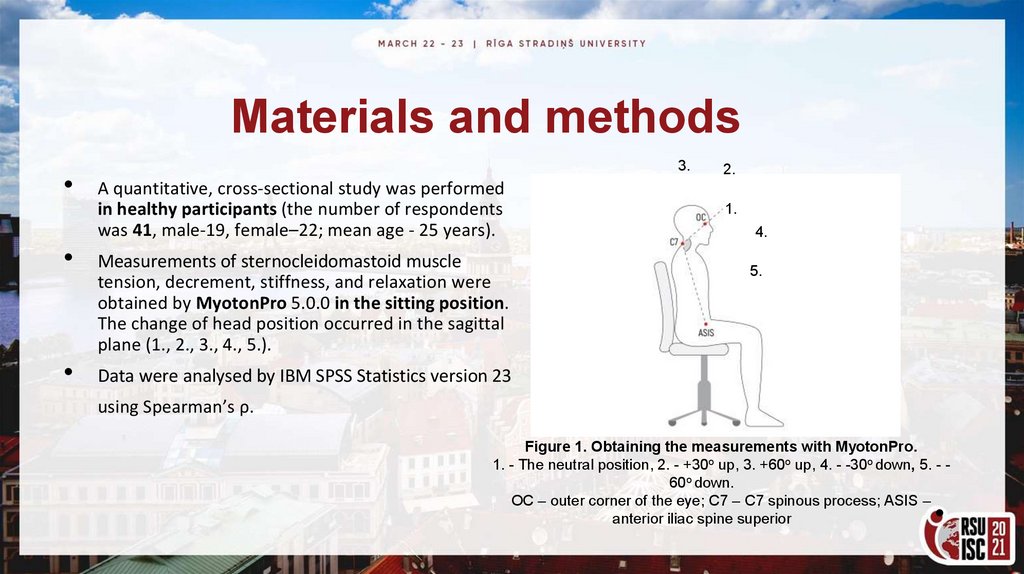
The change of head position occurred in the sagittal
plane (1., 2., 3., 4., 5.).
2.
1.
4.
5.
Data were analysed by IBM SPSS Statistics version 23
using Spearman’s ρ.
Figure 1. Obtaining the measurements with MyotonPro.
1. - The neutral position, 2. - +30o up, 3. +60o up, 4. - -30o down, 5. - 60o down.
OC – outer corner of the eye; C7 – C7 spinous process; ASIS –
anterior iliac spine superior
5.
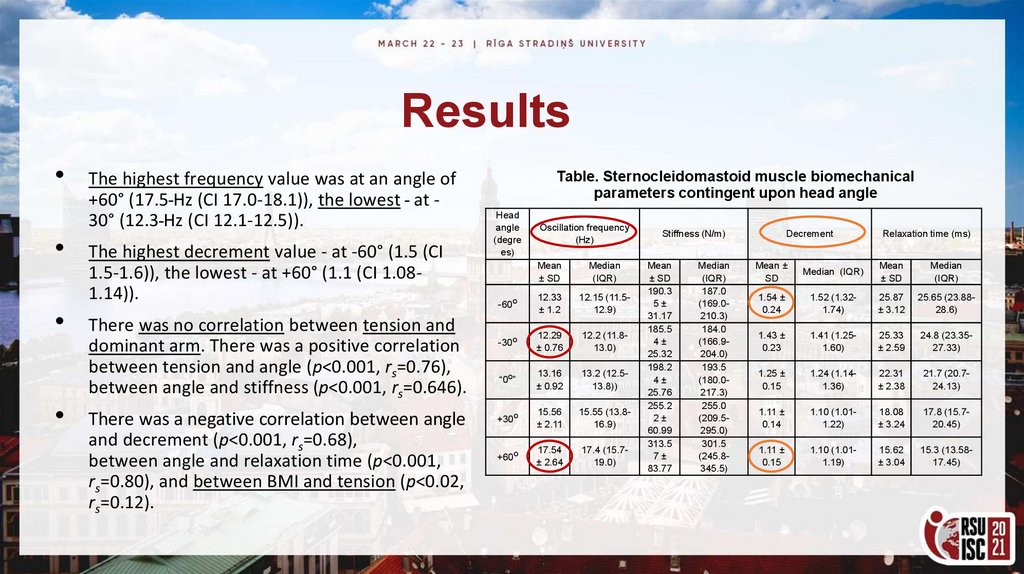
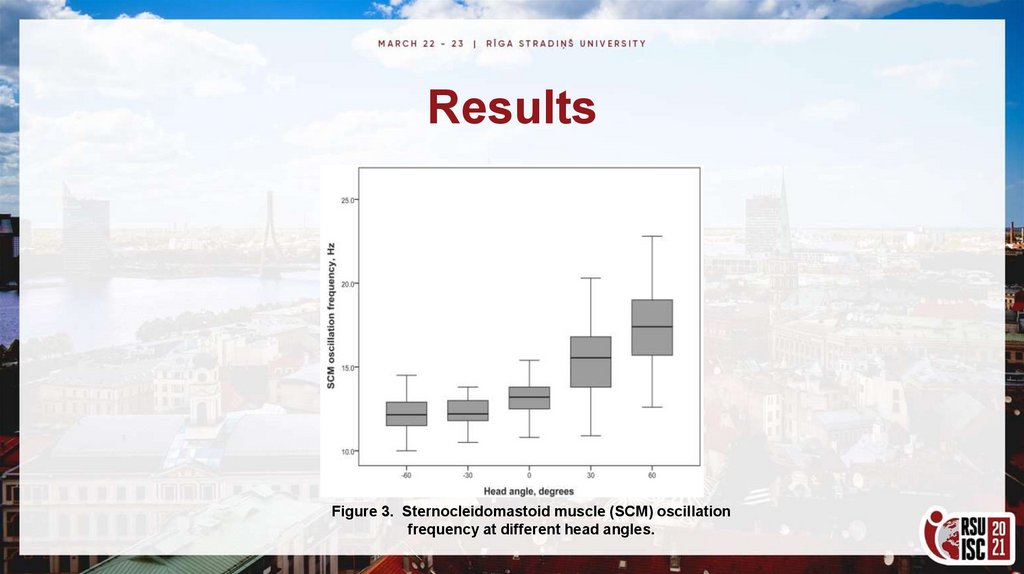
ResultsThe highest frequency value was at an angle of
+60° (17.5 Hz (CI 17.0-18.1)), the lowest at 30° (12.3 Hz (CI 12.1-12.5)).
The highest decrement value - at -60° (1.5 (CI
1.5-1.6)), the lowest - at +60° (1.1 (CI 1.081.14)).
There was no correlation between tension and
dominant arm. There was a positive correlation
between tension and angle (p<0.001, rs=0.76),
between angle and stiffness (p<0.001, rs=0.646).
There was a negative correlation between angle
and decrement (p<0.001, rs=0.68),
between angle and relaxation time (p<0.001,
rs=0.80), and between BMI and tension (p<0.02,
rs=0.12).
Table. Sternocleidomastoid muscle biomechanical
parameters contingent upon head angle
Head
angle
(degre
es)
Oscillation frequency
(Hz)
Mean
± SD
Median
(IQR)
-60o
12.33
± 1.2
12.15 (11.512.9)
-30o
12.29
± 0.76
12.2 (11.813.0)
“0o”
13.16
± 0.92
13.2 (12.513.8))
+30o
15.56
± 2.11
15.55 (13.816.9)
+60o
17.54
± 2.64
17.4 (15.719.0)
Stiffness (N/m)
Mean
± SD
190.3
5±
31.17
185.5
4±
25.32
198.2
4±
25.76
255.2
2±
60.99
313.5
7±
83.77
Median
(IQR)
187.0
(169.0210.3)
184.0
(166.9204.0)
193.5
(180.0217.3)
255.0
(209.5295.0)
301.5
(245.8345.5)
Decrement
Relaxation time (ms)
Mean ±
SD
Median (IQR)
Mean
± SD
Median
(IQR)
1.54 ±
0.24
1.52 (1.321.74)
25.87
± 3.12
25.65 (23.8828.6)
1.43 ±
0.23
1.41 (1.251.60)
25.33
± 2.59
24.8 (23.3527.33)
1.25 ±
0.15
1.24 (1.141.36)
22.31
± 2.38
21.7 (20.724.13)
1.11 ±
0.14
1.10 (1.011.22)
18.08
± 3.24
17.8 (15.720.45)
1.11 ±
0.15
1.10 (1.011.19)
15.62
± 3.04
15.3 (13.5817.45)
6.
ResultsFigure 3. Sternocleidomastoid muscle (SCM) oscillation
frequency at different head angles.
7.
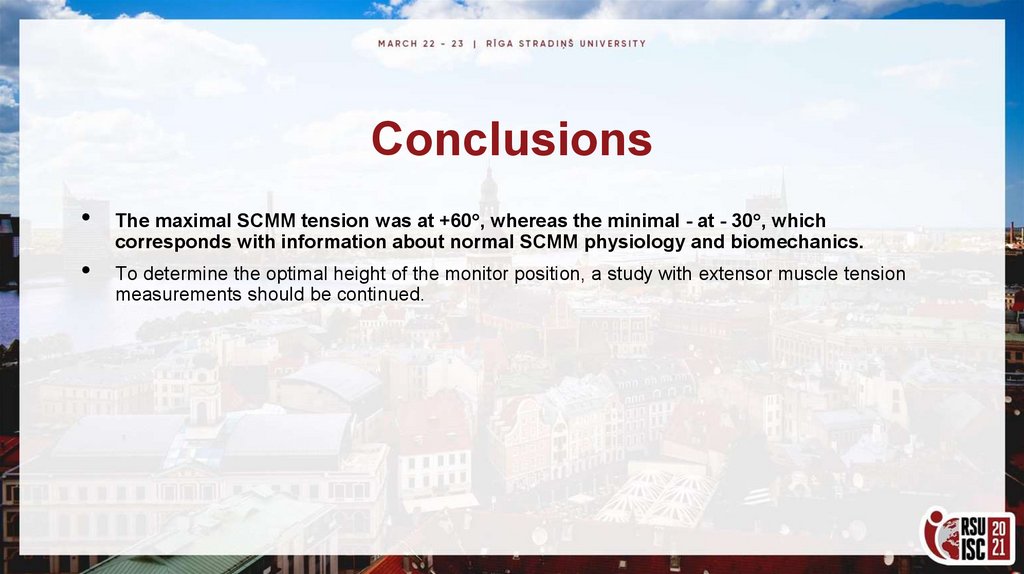
ConclusionsThe maximal SCMM tension was at +60°, whereas the minimal - at - 30°, which
corresponds with information about normal SCMM physiology and biomechanics.
To determine the optimal height of the monitor position, a study with extensor muscle tension
measurements should be continued.
8.
Thank you for your attention!If you have any questions
please feel free to ask!
References and acknowledgment
The study was developed within the RSU vertically integrated projects implemented as a part of
ESF co-financed project Improvement of Governance Processes and Modernisation of Contents of
Study Programmes at Rīga Stradiņš University
(No. 8.2.3.0/18/A/011)