
 philosophy
Similar presentations:





The Emergence of a Culture of Thinking: The Subject and Method of Philosophy
1.
The emergence of a culture ofthinking. The subject and
method of philosophy
2.
• 1. Interpretations of Philosophy.• 2. World outlook, its essence and basic types.
• 3. The structure of philosophy.
• 4. The main question of philosophy and its
main directions.
• 5. Functions of philosophy
3.
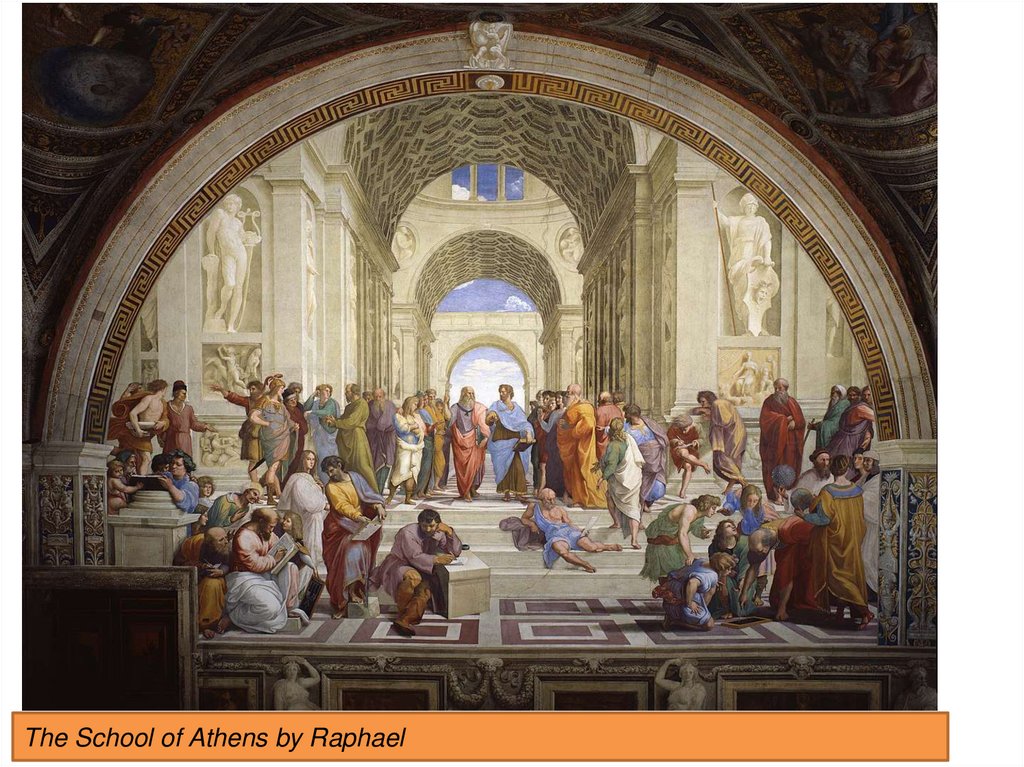
The School of Athens by Raphael4.
What is philosophy?• Throughout the history of every nation, various
religious systems have served as the moral
foundations of society. At the same time, different
world-explaining systems emerged, shaping the
mentality of entire epochs. Philosophical systems—
acting as impulses that form images, modes of
thinking, and meaning—first appeared in three
great civilizations: ancient India, ancient China, and
ancient Greece. This occurred almost
simultaneously in the 6th century BC, a period that
many scholars identify as a time of an
extraordinary explosion of intellectual energy.
5.
1. Interpretations of Philosophy.• The love to wisdom (phileo – love, sofia – wisdom) It is believed
that this word was first used by the ancient Greek philosopher Pythagoras
in the 6th century BC.;
• The search of truth (Pythagoras, Heraclitus…)
• Learning wisdom (sophistry) – “philosophize archly”.
• Knowledge of first principles and causes of being
(Aristotle)
• Thinking (attention to the sense, the meaning of words).
• “Aletheia” – «remove cover» (thinking about things);
• Theory (speculation), based on the principle and word (Logos).
• Art (reference to ideals)
• «Spiritual work» - “work with consciousness” (М.
Mamardashvili)
6.
• The word "philosophy" comes from theancient Greek language, meaning "love of
wisdom." It is generally accepted that this
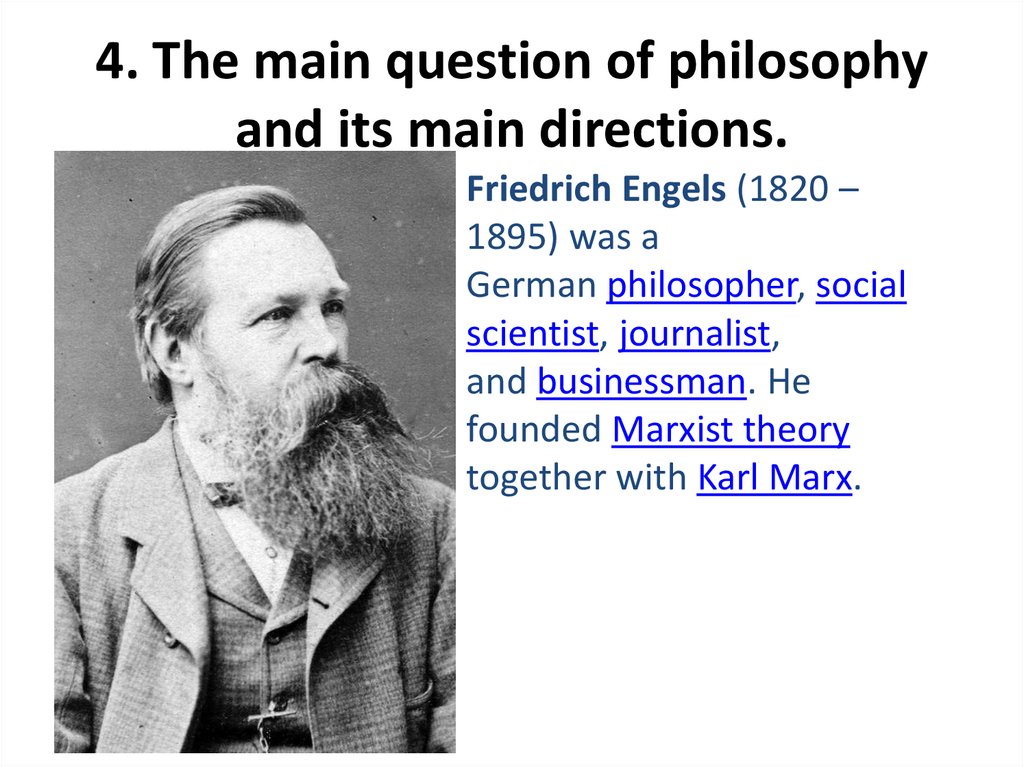
concept was introduced by the ancient Greek
mathematician and philosopher Pythagoras.
For the first time this term, in a meaning close
to the modern one, was used by Socrates.
7.
The ancient Greek thinker and scientist Aristotle (384–
322 BC) proposed a classical approach according to
which philosophy reveals the “first principles of being
and knowledge.” In order to more precisely define the
originality of the subject of philosophy, he introduced the
term metaphysics, referring to a special kind of
knowledge that lies beyond “physics,” that is, beyond the
study of material objects. Thus, philosophy is understood
as a science capable of providing a theoretical explanation
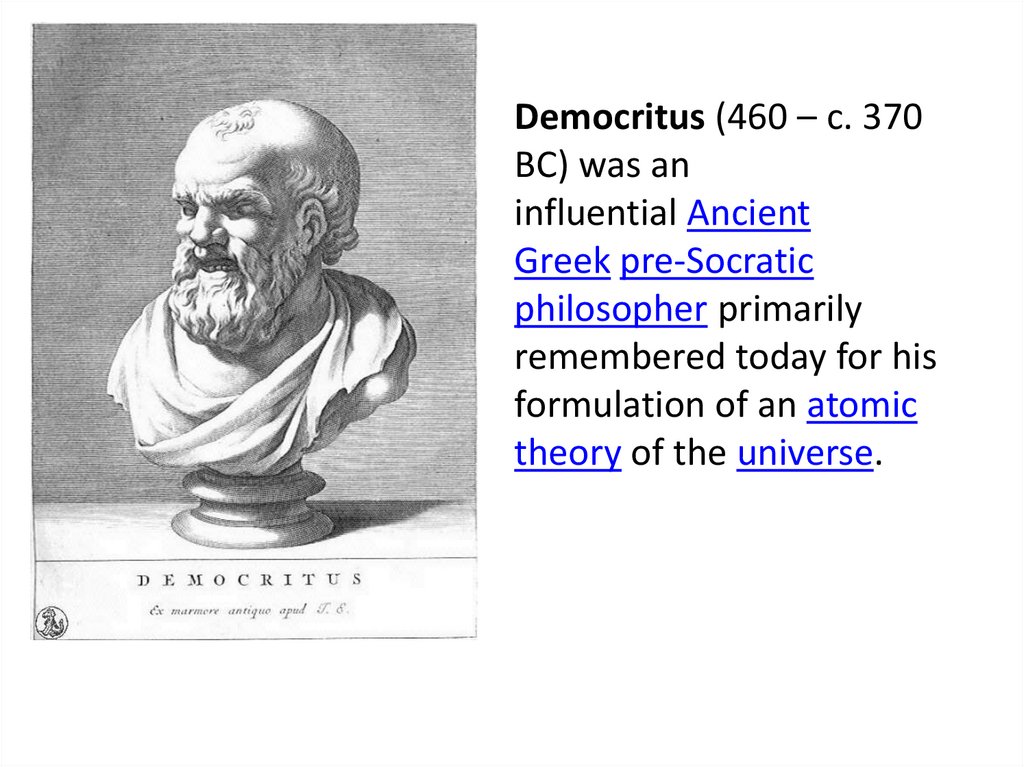
and revealing the deep essence of objects and phenomena.
8.
2. World outlook, its essence andbasic types
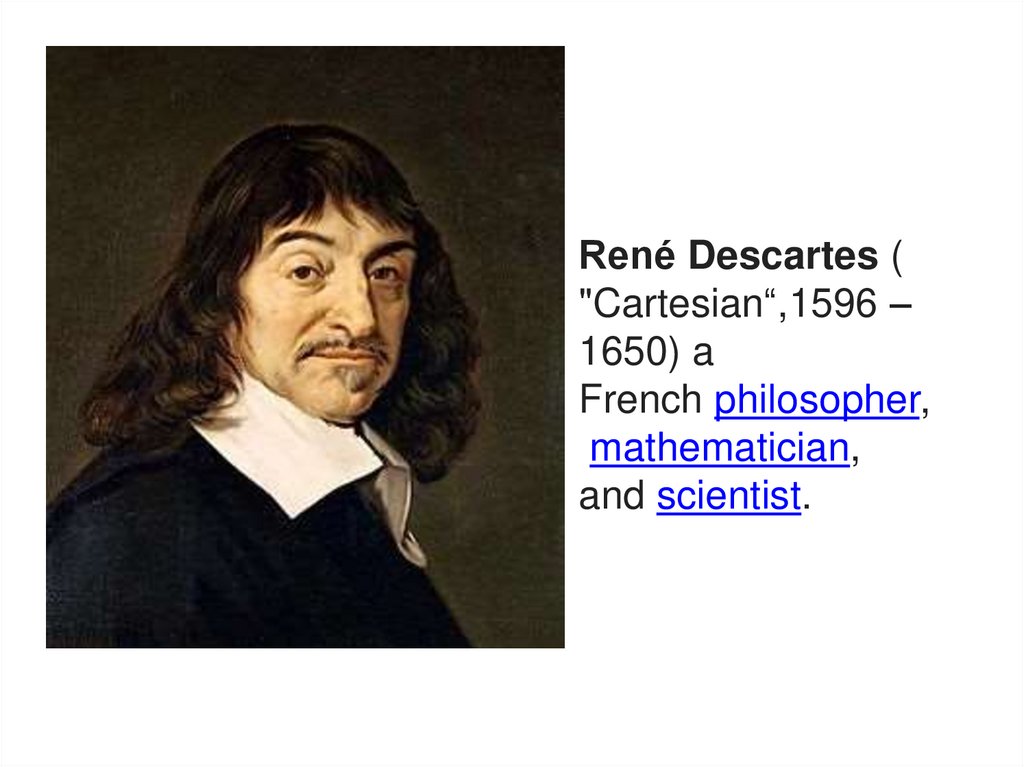
Worldview (or world outlook) is a system of
general views on the world and on humanity’s
place within it. The concept of a “worldview”
is broader than that of “philosophy,” as it
encompasses philosophy as one of its
components. Historically, the main types of
worldview include mythological, religious, and
philosophical (scientific) forms. Both
worldview and philosophy are results of the
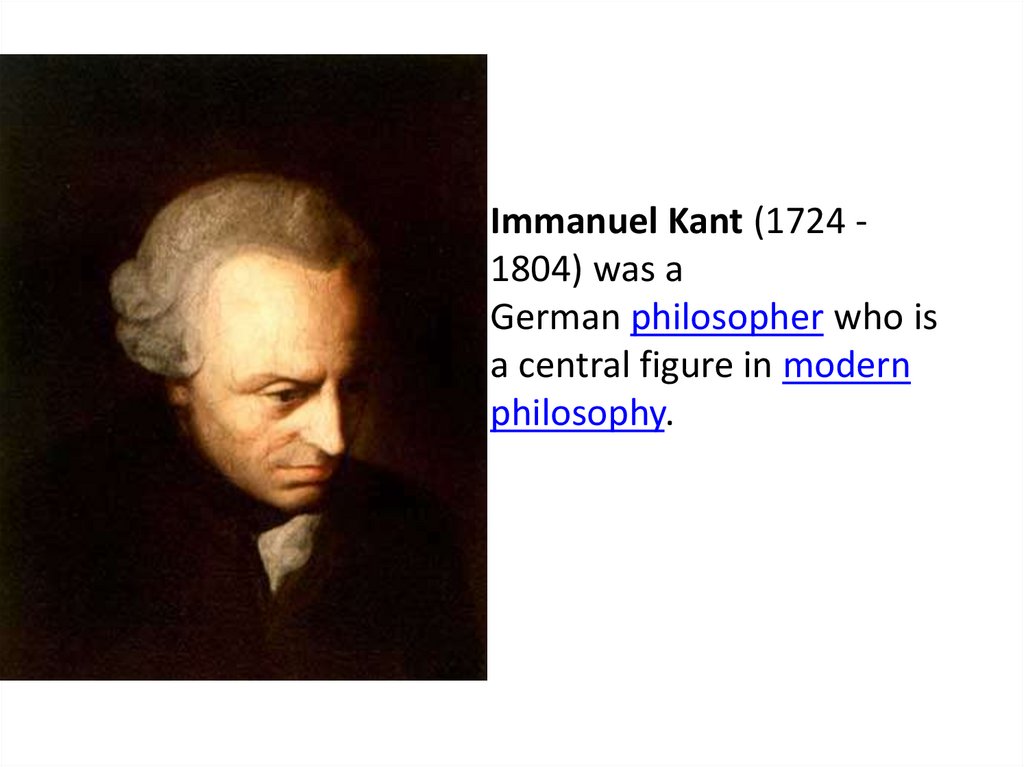
reflection upon reality; however, they differ in
the depth and level of this reflection.
9.
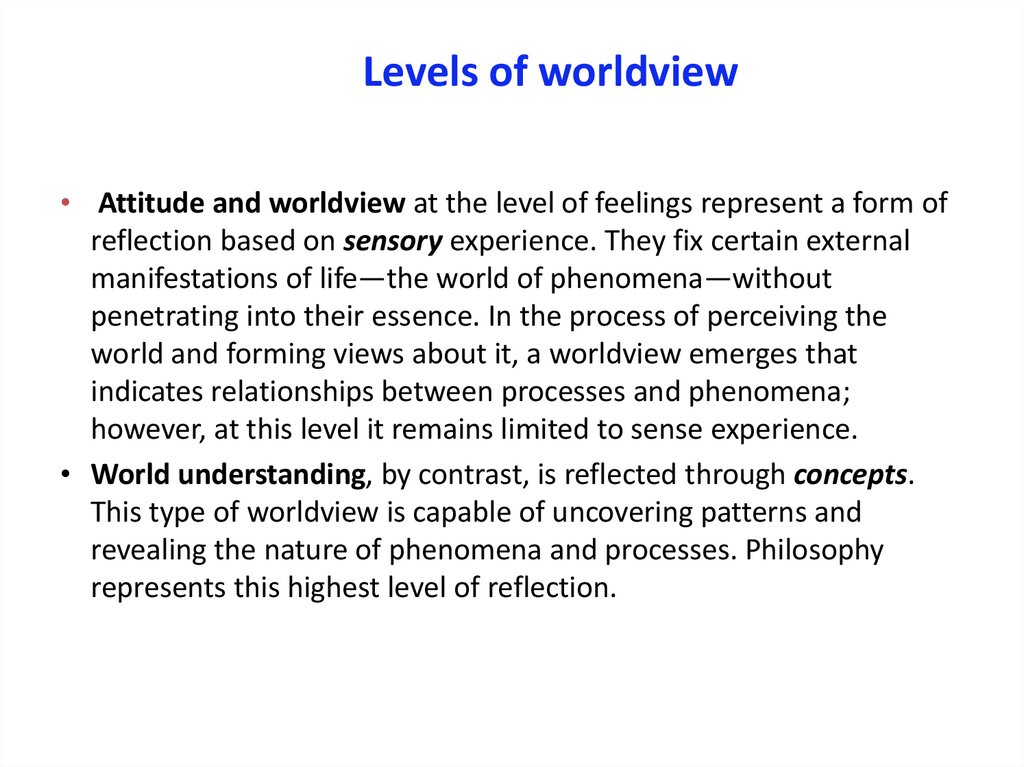
Levels of worldview• Attitude and worldview at the level of feelings represent a form of
reflection based on sensory experience. They fix certain external
manifestations of life—the world of phenomena—without
penetrating into their essence. In the process of perceiving the
world and forming views about it, a worldview emerges that
indicates relationships between processes and phenomena;
however, at this level it remains limited to sense experience.
• World understanding, by contrast, is reflected through concepts.
This type of worldview is capable of uncovering patterns and
revealing the nature of phenomena and processes. Philosophy
represents this highest level of reflection.
10.
Attitude and view of the world11.
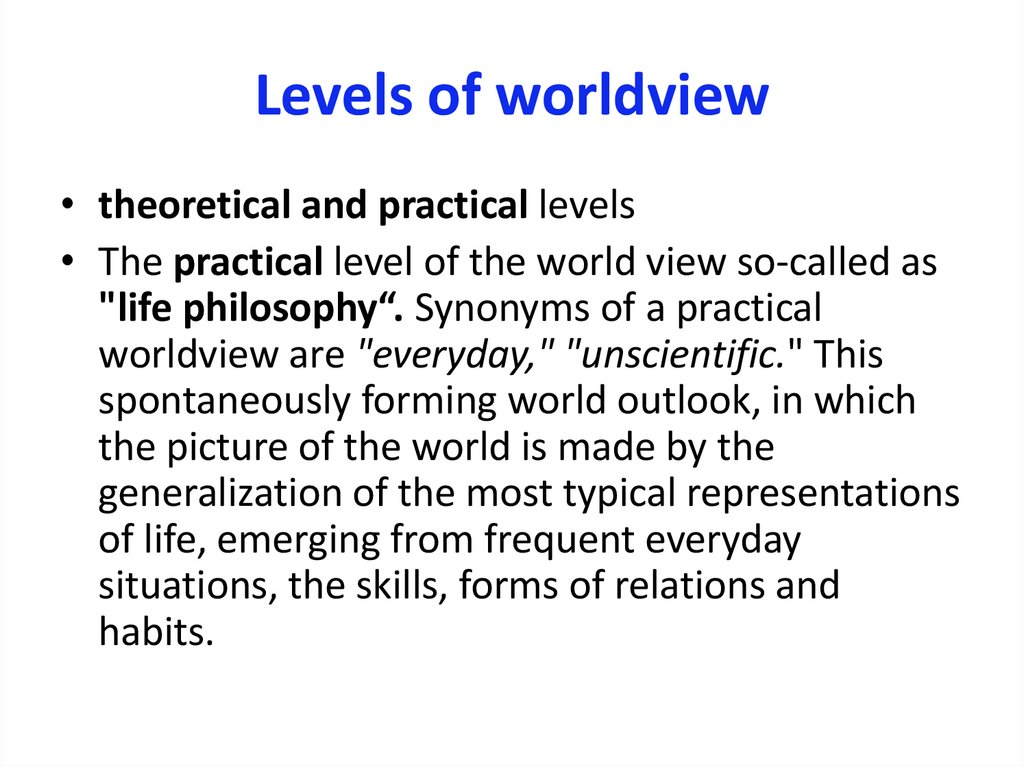
Levels of worldview• theoretical and practical levels
• The practical level of the world view so-called as
"life philosophy“. Synonyms of a practical
worldview are "everyday," "unscientific." This
spontaneously forming world outlook, in which
the picture of the world is made by the
generalization of the most typical representations
of life, emerging from frequent everyday
situations, the skills, forms of relations and
habits.
12.
The theoretical level of worldview includesphilosophy and science. It carries out a special
critical analysis and understanding views that
form thoughts and actions.
13.
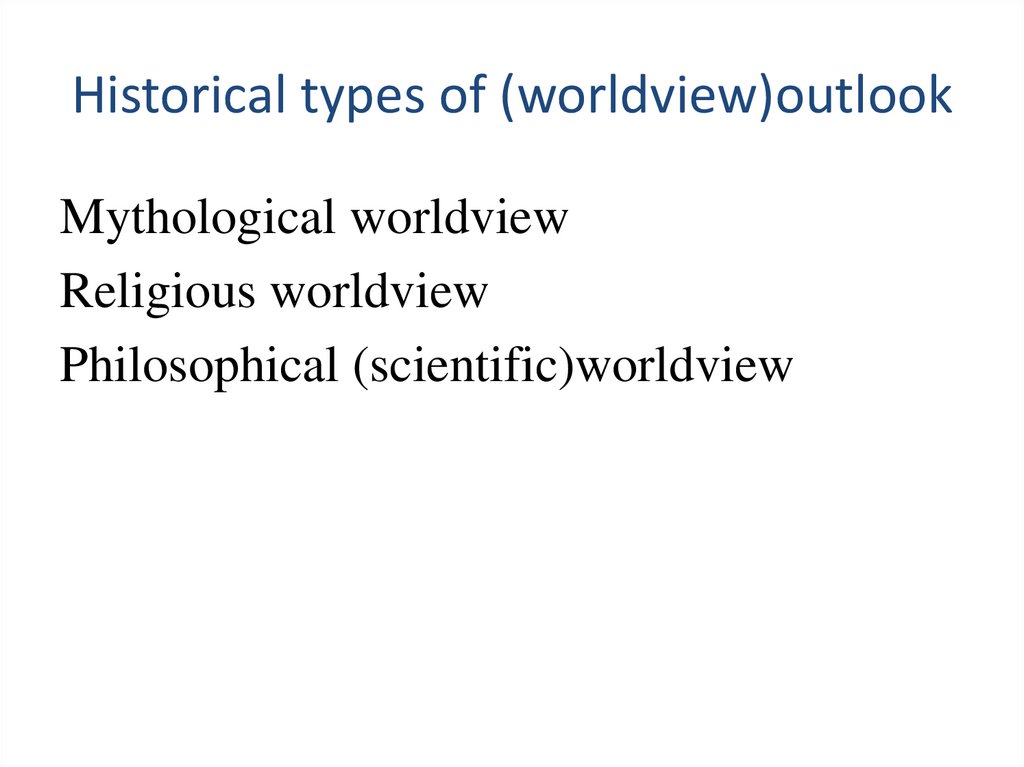
Historical types of (worldview)outlookMythological worldview
Religious worldview
Philosophical (scientific)worldview
14.
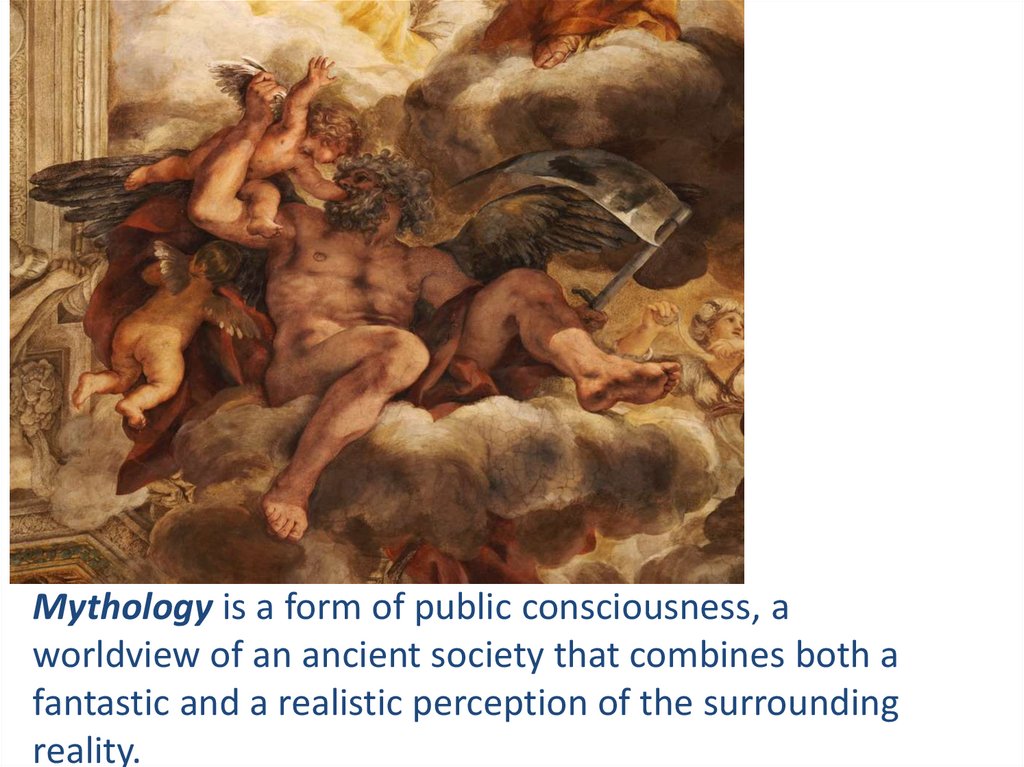
Mythology is a form of public consciousness, aworldview of an ancient society that combines both a
fantastic and a realistic perception of the surrounding
reality.
15.
Mythological worldview• It is a special type of worldview that arises in
the early stages of the development of society.
It is based on the emotional and sensory
perception of the world and is inherent in all
peoples.
16.
main questions of Mythology :• the origin of the universe, the
Earth and man;
• • the explanation of natural
phenomena;
• • life, destiny, death of a person;
human activities and achievements;
• • issues of honor, duty, ethics and
morality.
17.
The main features of the mythologicalworldview
a)
syncretism (undifferentiated consciousness) - a person does not
separate himself and the world around him (nature); humanizing
nature. In the mythological style of thinking, people believe that they
can influence future events. Therefore, magic, fetishism, totemism are
very developed.
b)
the presence of fantastic gods, their communication, interaction with a
person;
c)
Absence of abstract reflections; All knowledge based on the basis of
empirical knowledge (everything that is only confirmed by experience);
figuratively visual explanation of causes and consequences;
associativity of thinking;
traditionalism, the perception of time as a static phenomenon.
The practical focus of the myth on the solution of specific life problems
(farming, protection from the elements, etc.);
d)
e)
f)
g)
18.
Religious19.
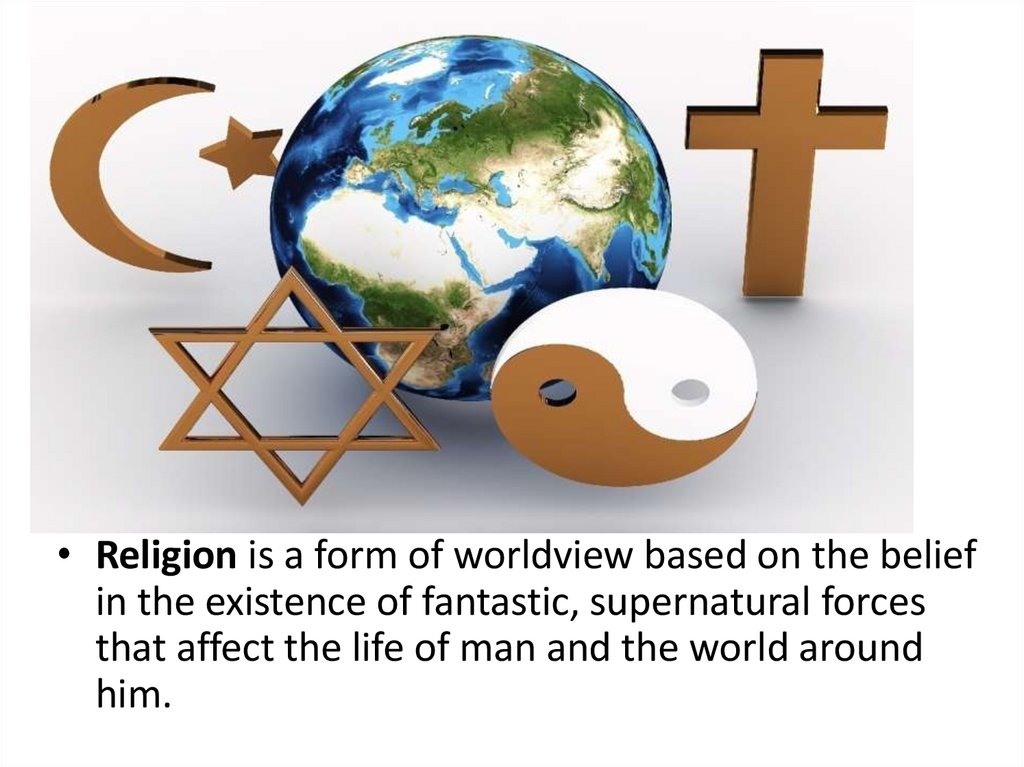
• Religion is a form of worldview based on the beliefin the existence of fantastic, supernatural forces
that affect the life of man and the world around
him.
20.
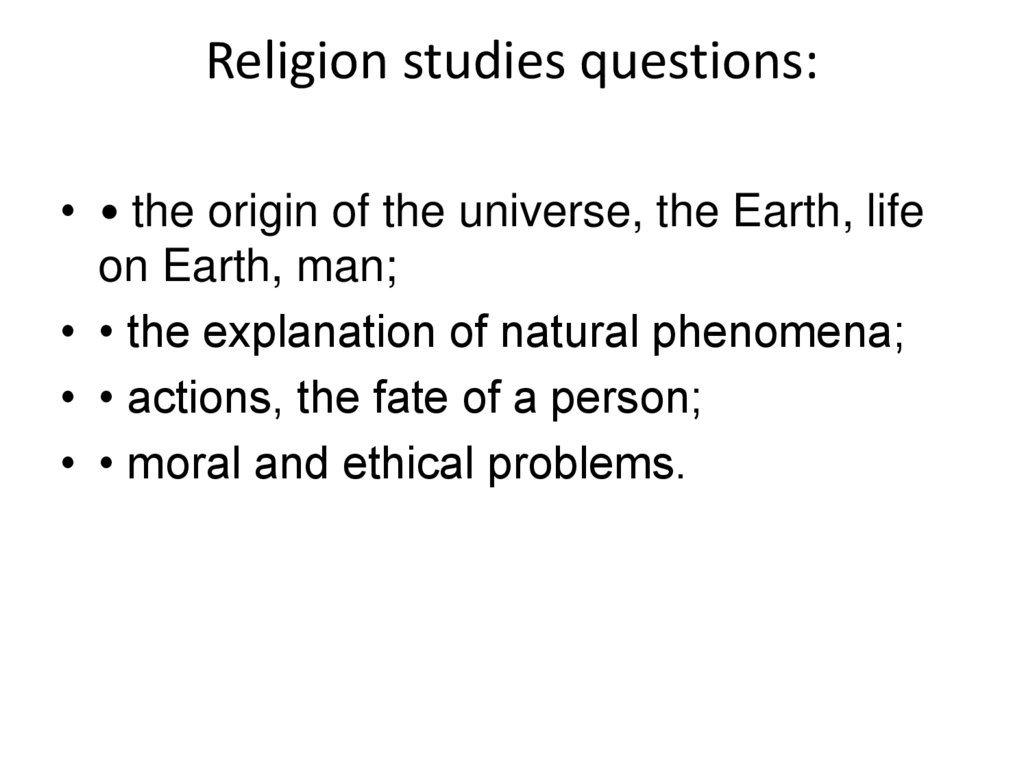
Religion studies questions:• • the origin of the universe, the Earth, life
on Earth, man;
• • the explanation of natural phenomena;
• • actions, the fate of a person;
• • moral and ethical problems.
21.
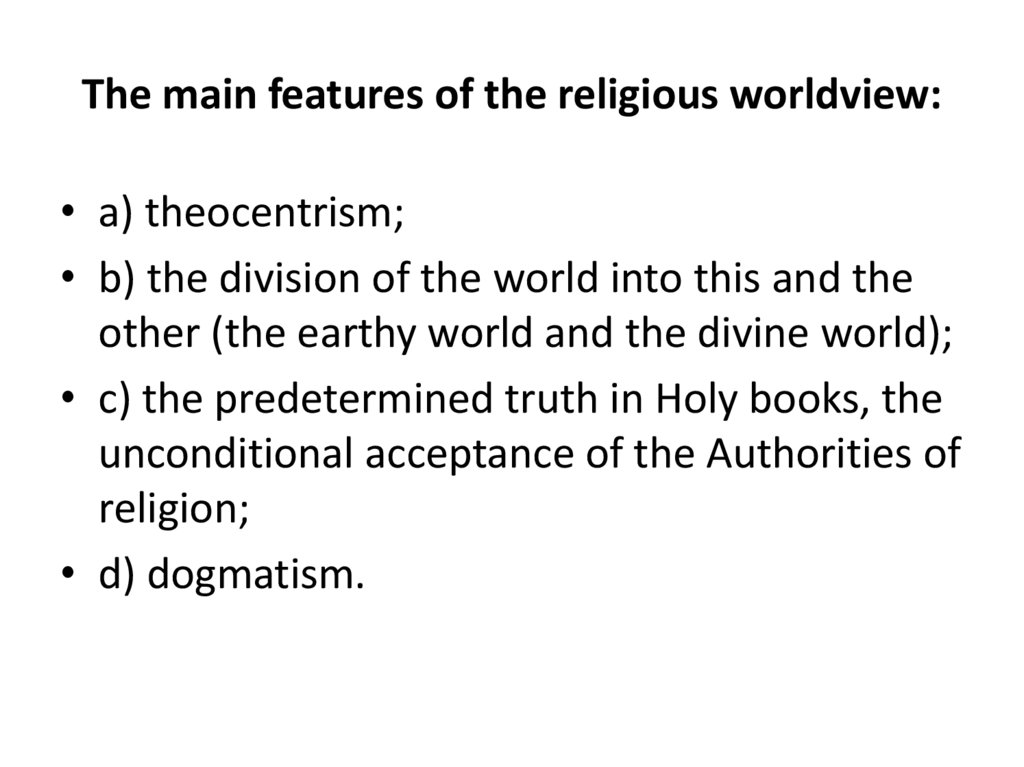
The main features of the religious worldview:• a) theocentrism;
• b) the division of the world into this and the
other (the earthy world and the divine world);
• c) the predetermined truth in Holy books, the
unconditional acceptance of the Authorities of
religion;
• d) dogmatism.
22.
• Theocentrism is manifested in the fact that inthe religious worldview all forms of social and
individual consciousness pass through the
faith in God.
23.
• The religious style of thinking makes a persondifferently understand the meaning of his life.
Everything that happens in a person's life is a
divine design, predestination. If in the
mythological consciousness a person can change
the course of events, influence the future. But in
the religious consciousness the main idea is
humility.
In the early mythological worldview, magic and
fetishism become widespread, while such
phenomena are prohibited in religious thinking.
24.
The main world religions are:• • Christianity;
• • islam;
• • Buddhism.
• The largest and most common in the world national
religions:
• • Shinto;
• • Hinduism;
• • Judaism.
25.
PhilosophyPhilosophy is a special scientific and theoretical type of
worldview. A philosophical worldview differs from religious
and mythological ones in that it is:
• based on knowledge rather than on faith or imagination;
• reflexive, involving the return of thought to itself;
• logical, possessing internal unity and systematic structure;
• grounded in clear concepts and categories.
• Thus, philosophy represents the highest level and form of
worldview, distinguished by rationality, systematic organization,
logical coherence, and theoretical rigor.
26.
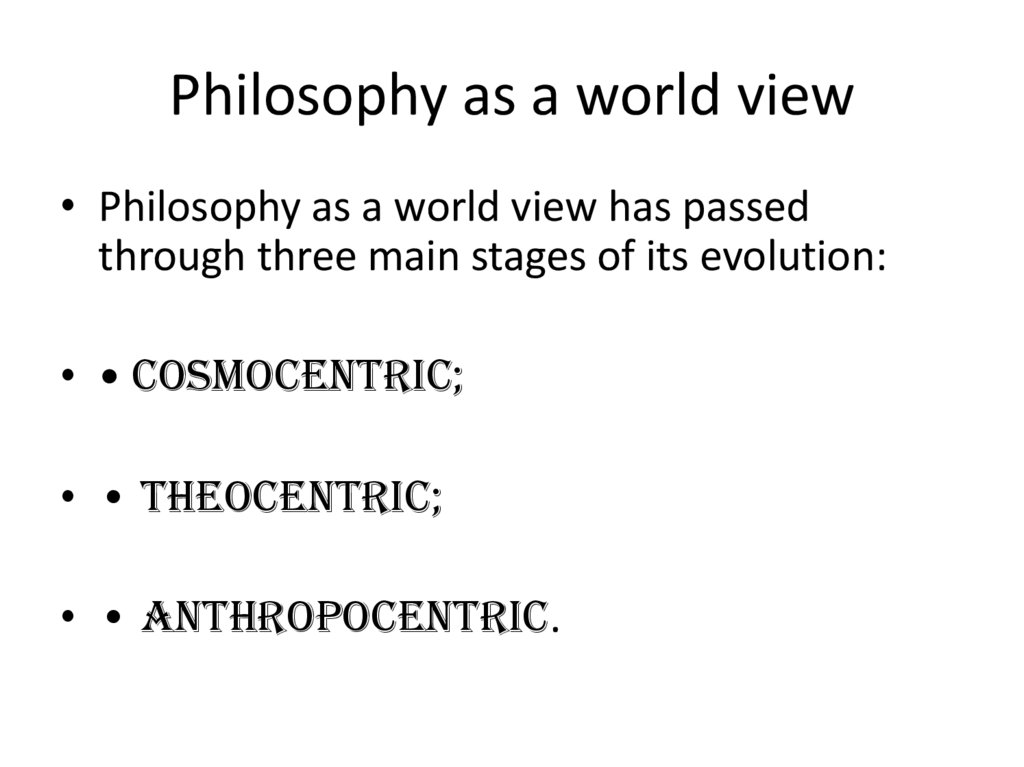
Philosophy as a world view• Philosophy as a world view has passed
through three main stages of its evolution:
• • cosmocentric;
• • theocentric;
• • anthropocentric.
27.
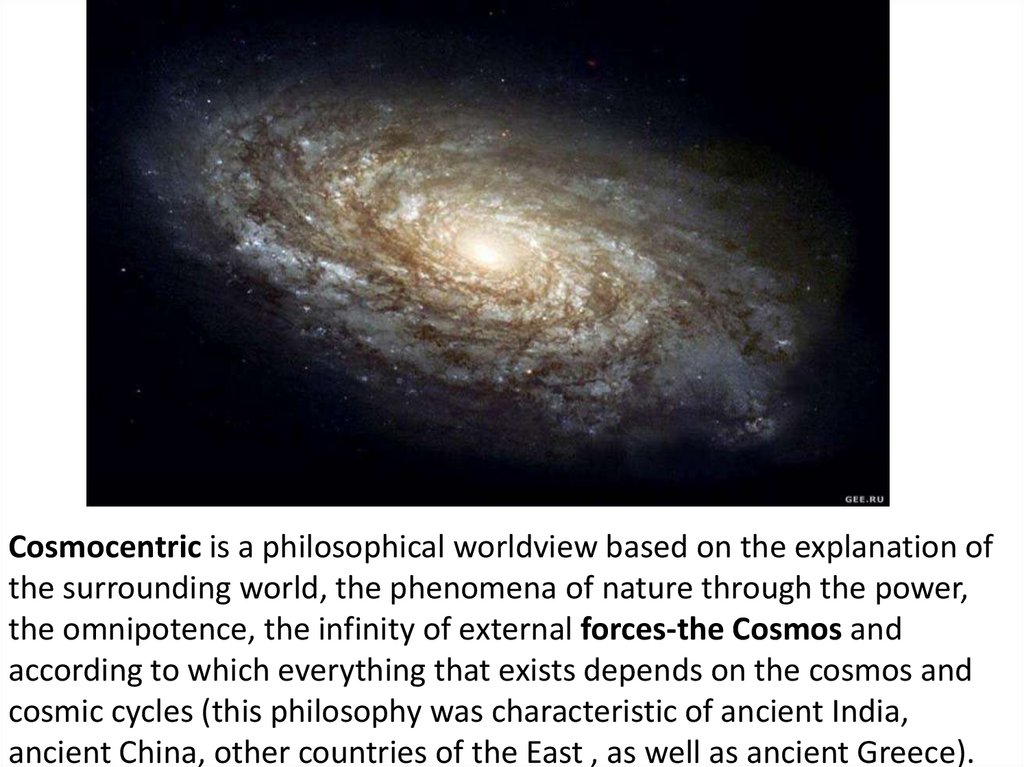
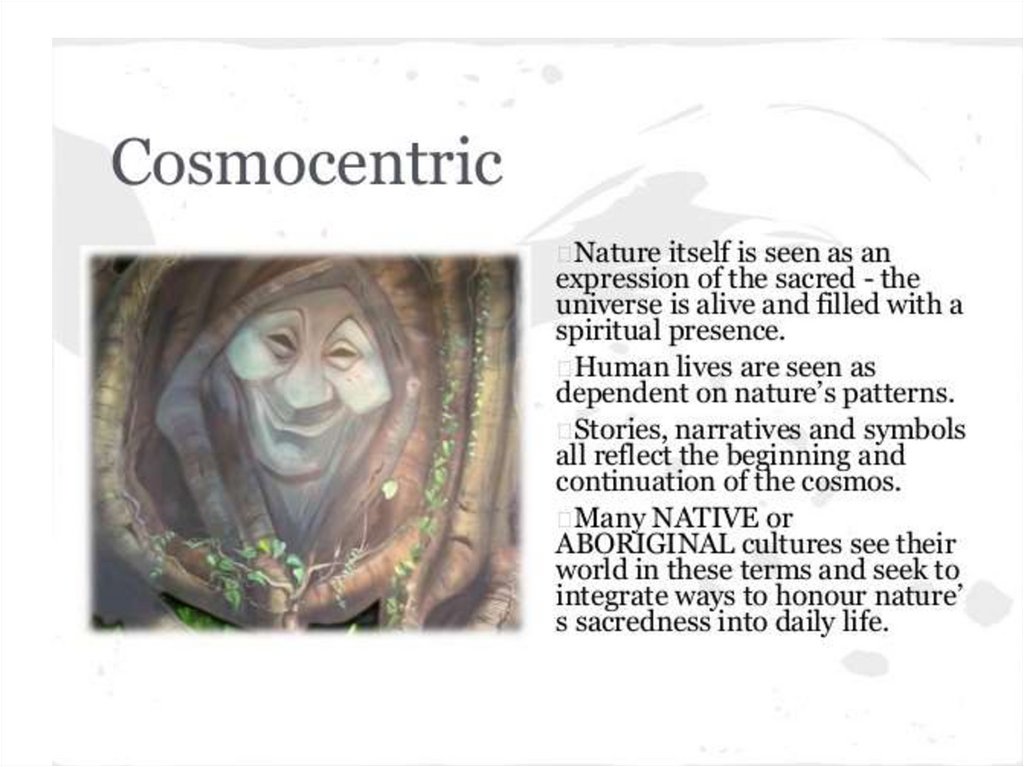
Cosmocentric is a philosophical worldview based on the explanation ofthe surrounding world, the phenomena of nature through the power,
the omnipotence, the infinity of external forces-the Cosmos and
according to which everything that exists depends on the cosmos and
cosmic cycles (this philosophy was characteristic of ancient India,
ancient China, other countries of the East , as well as ancient Greece).
28.
29.
Theocentrism is a type of philosophicalworldview, based on the explanation of all
things through the rule of an inexplicable,
supernatural power - God (was common in
medieval Europe).
30.
• Anthropocentrism is a type of philosophicalworldview centered on the human problem
(Europe of the Renaissance, new and modern
times, modern philosophical schools).
31.
The main specificity of philosophicalknowledge
• has a lot in common with scientific knowledge - an object,
methods, logical-conceptual apparatus;
• however, it is not scientific knowledge in its pure form.
• The main difference between philosophy and all other
sciences is that philosophy is a theoretical worldview, the
ultimate generalization of knowledge previously
accumulated by mankind.
32.
Features of philosophical knowledge:• has a complex structure (includes ontology, gnoseology, logic,
etc.);
• contains the basic ideas and concepts that underlie other
sciences;
• it is a collection of objective knowledge and values, the moral
ideals of its time, is influenced by the epoch;
• studies not only the object of knowledge, but also the
mechanism of cognition itself;
33.
• it is strongly influenced by the doctrinesdeveloped by former philosophers;
• At the same time, dynamically - constantly
developing and updating;
• based on categories - extremely general concepts;
• it is limited by the cognitive abilities of the person
(the cognizing subject), has unsolvable, "eternal"
problems (the origin of being, the primacy of
matter or consciousness, the origin of life, the
immortality of the soul, the presence or
absence of God, its influence on the world),
which today can not be authentically resolved by
logical means.
34.
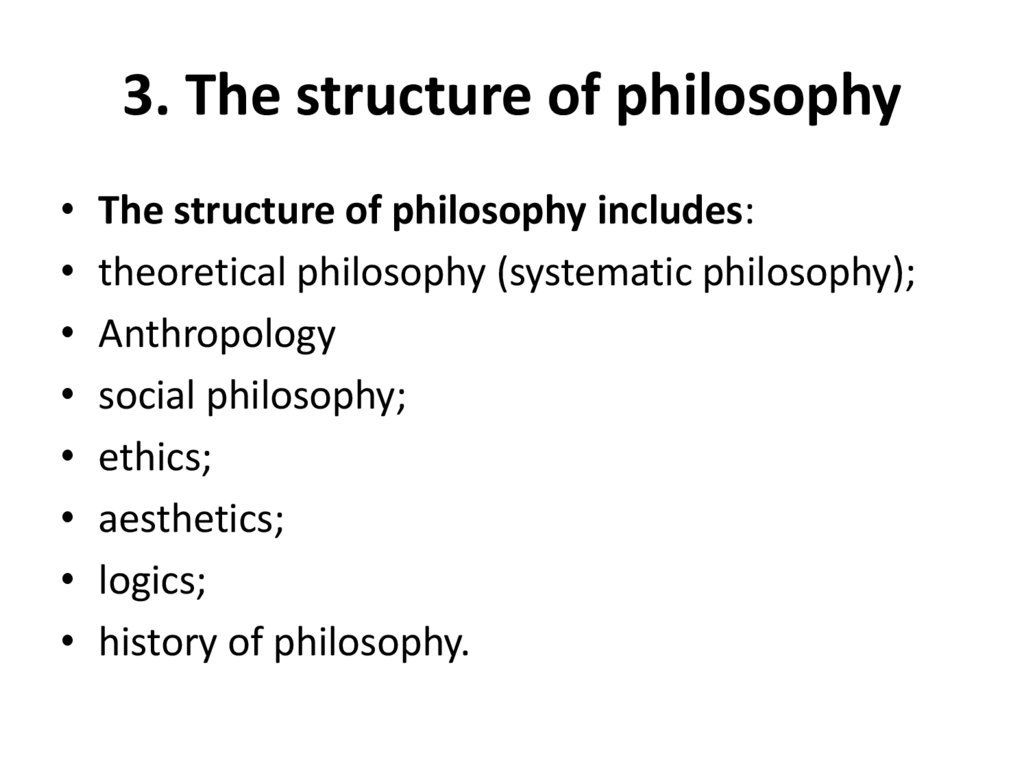
3. The structure of philosophy• The structure of philosophy includes:
• theoretical philosophy (systematic philosophy);
• Anthropology
• social philosophy;
• ethics;
• aesthetics;
• logics;
• history of philosophy.
35.
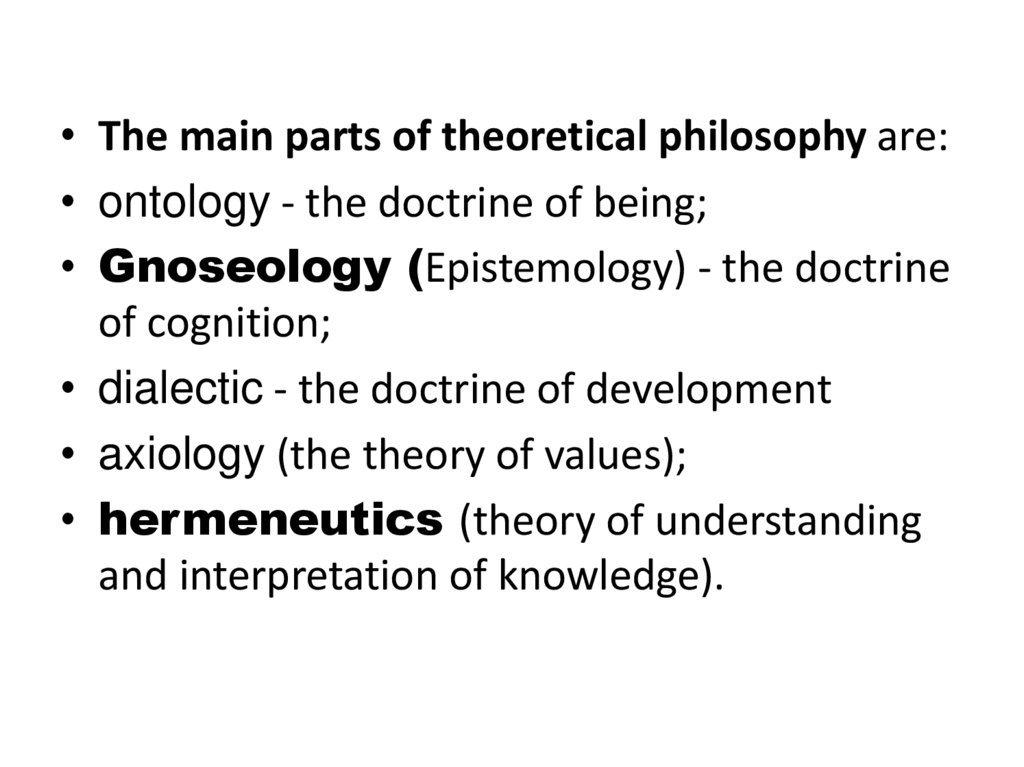
• The main parts of theoretical philosophy are:• ontology - the doctrine of being;
• Gnoseology (Epistemology) - the doctrine
of cognition;
• dialectic - the doctrine of development
• axiology (the theory of values);
• hermeneutics (theory of understanding
and interpretation of knowledge).
36.
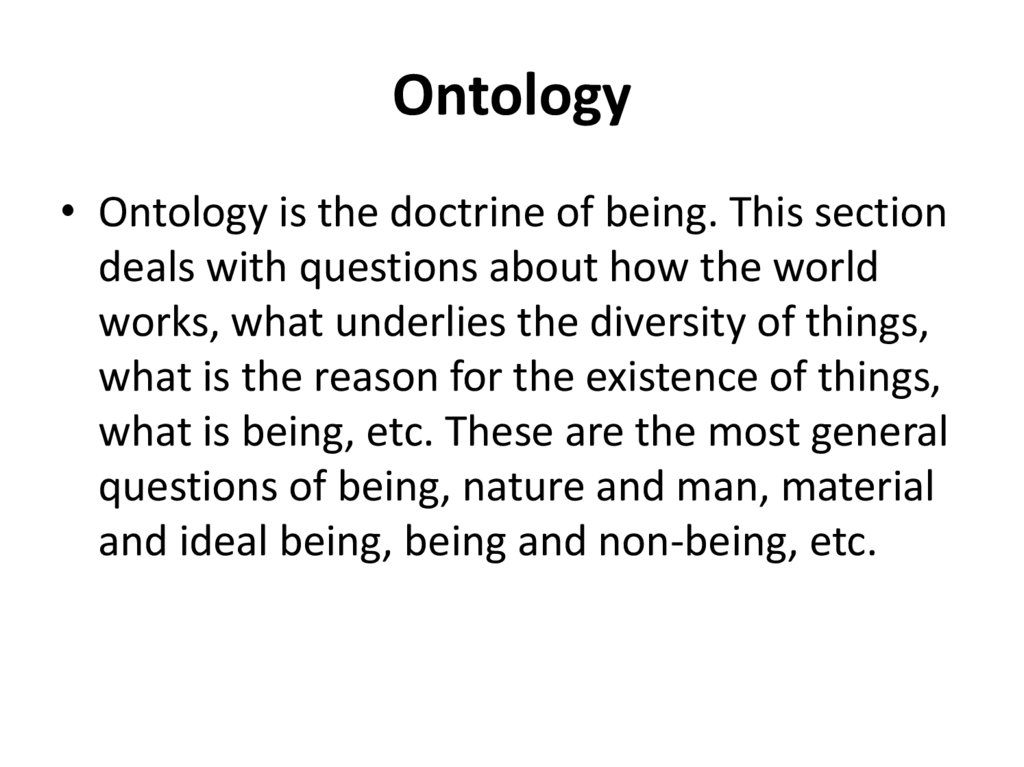
Ontology• Ontology is the doctrine of being. This section
deals with questions about how the world
works, what underlies the diversity of things,
what is the reason for the existence of things,
what is being, etc. These are the most general
questions of being, nature and man, material
and ideal being, being and non-being, etc.
37.
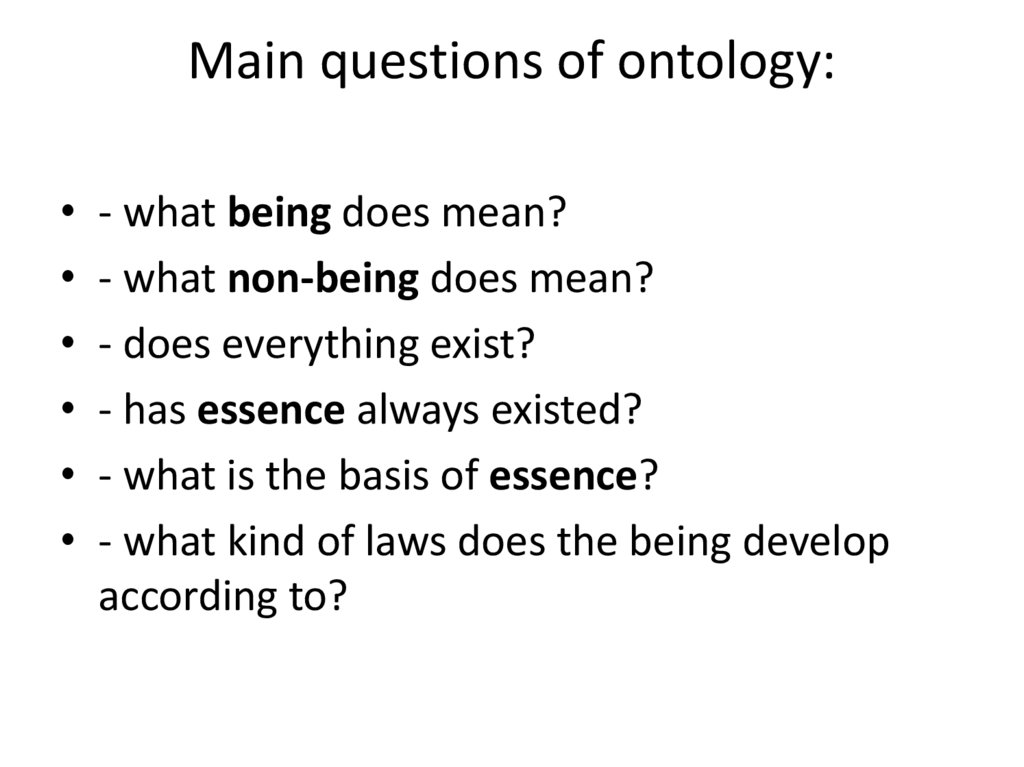
Main questions of ontology:• - what being does mean?
• - what non-being does mean?
• - does everything exist?
• - has essence always existed?
• - what is the basis of essence?
• - what kind of laws does the being develop
according to?
38.
Epistemology• Epistemology is a branch of philosophy concerned
with knowledge: its nature, the possibility and
limits of true knowledge, the methods of cognition,
the forms of knowledge, and the criteria of truth.
In the Western European philosophical tradition,
the field known as gnoseology is referred to as
epistemology, understood as the theory or
doctrine of knowledge. Epistemological questions
occupied a central place in philosophy from the
seventeenth century until the mid-nineteenth
century.
39.
The main questions of epistemology:What can we know?
• By what methods is true knowledge attained?
• Is cognition possible, or is human knowledge fundamentally
limited?
• What is true knowledge?
• What are the criteria of truth?
40.
• On the question of the possibility of cognition and the limits of knowledge,there are two approaches to epistemology.
• Gnoseological optimism is a trend that adheres to the view of the
knowability of the world. The world can be fully known. This position is
held by those who believe that everything can be known. This position can
be in science, in art, as well as in the religious worldview. In science, the
world can be known through painstaking study of physical phenomena,
through experience given to us in sensations. In art, the world is known
through emotions, through the inspired state of a person experiencing a
creative upsurge. In religion (more often in mystical directions, for
example, in Sufism), knowledge of the Creator and the world is recognized
through a certain, specific, mystical experience.
• Epistemological pessimism is a direction in which the knowability of the
world is questioned. This position in philosophy is called "skepticism", the
extreme form - "agnosticism". "Skepticism" casts doubt on the possibility
of knowing objective reality.
41.
Anthropology• Anthropology is a branch of philosophy about
man. The foundations of philosophical
anthropology arose in antiquity, in the
teachings of Socrates, Plato and Aristotle.
There are many different philosophicalanthropological theories that can be grouped
as biological, cultural and religious.
42.
The main questions of anthropology• the origin of man,
• The meaning of men’s life,
• The mean’s purpose.
In the process of the formation of philosophical
traditions, anthropology put forward various concepts
of understanding a person: a reasonable person, a
person as a Divine creation, a natural person, a free
person, a playing person, etc.
The task of philosophical anthropology is to show how
all the structures of human existence (language, state,
traditions, ideas, etc.) influence the affairs and life of a
person.
43.
4. The main question of philosophyand its main directions.
Friedrich Engels (1820 –
1895) was a
German philosopher, social
scientist, journalist,
and businessman. He
founded Marxist theory
together with Karl Marx.
44.
• “The great basic question of all philosophy,especially of more recent philosophy, is that
concerning the relation of thinking and
being”.
• (Frederick Engels. “Ludwig Feuerbach and the End of
Classical German Philosophy”).
45.
• Matter and consciousness (spirit) are twocharacteristics of being. In this connection,
there are two sides to the basic question
of philosophy - ontological and
epistemological.
• The ontological (being) side lies in: what is
primarily matter or consciousness?
• The epistemological (cognitive) side: can we
know the world?
46.
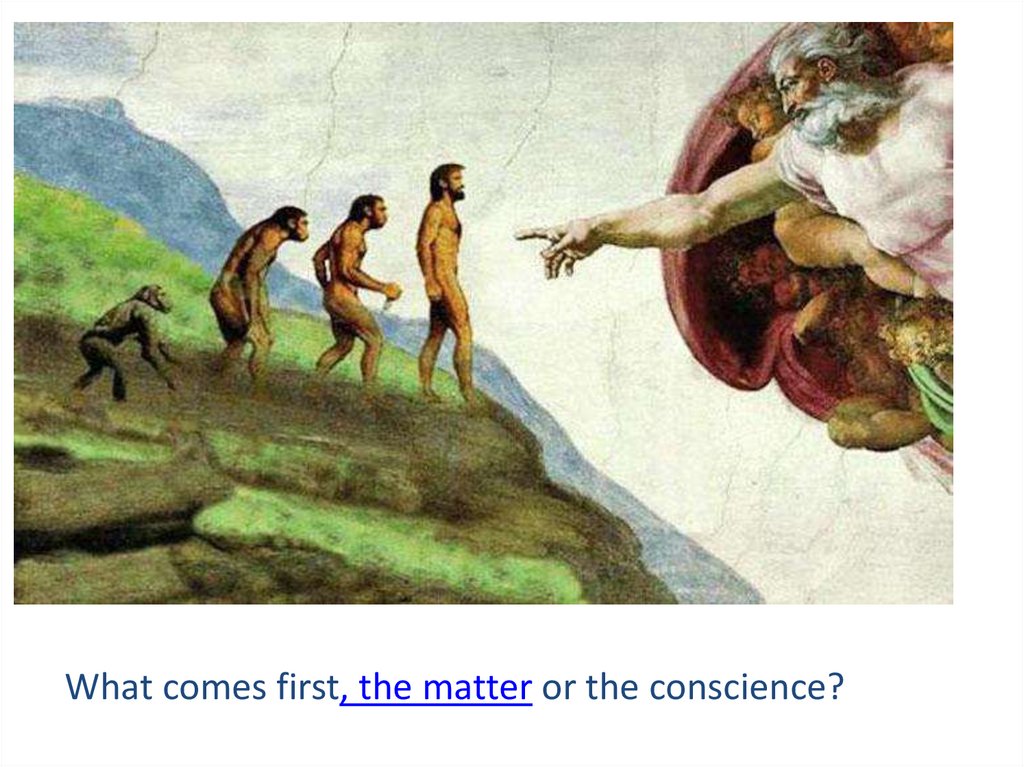
What comes first, the matter or the conscience?47.
The ontological (being) side of the basicquestion of philosophy led to such
directions as:
• objective idealism;
• subjective idealism;
• materialism;
• vulgar materialism;
• dualism;
• Deism;
* pantheism
* pluralism.
48.
• objective idealism: both the external worldand human consciousness are not
independently existing realities. They are the
product of some other, "third" reality - the
highest spiritual primordial (world-mind,
world idea, God, etc.).
• Objective idealism admits the existence of
some higher spiritual reality that generates
everything that exists.
49.
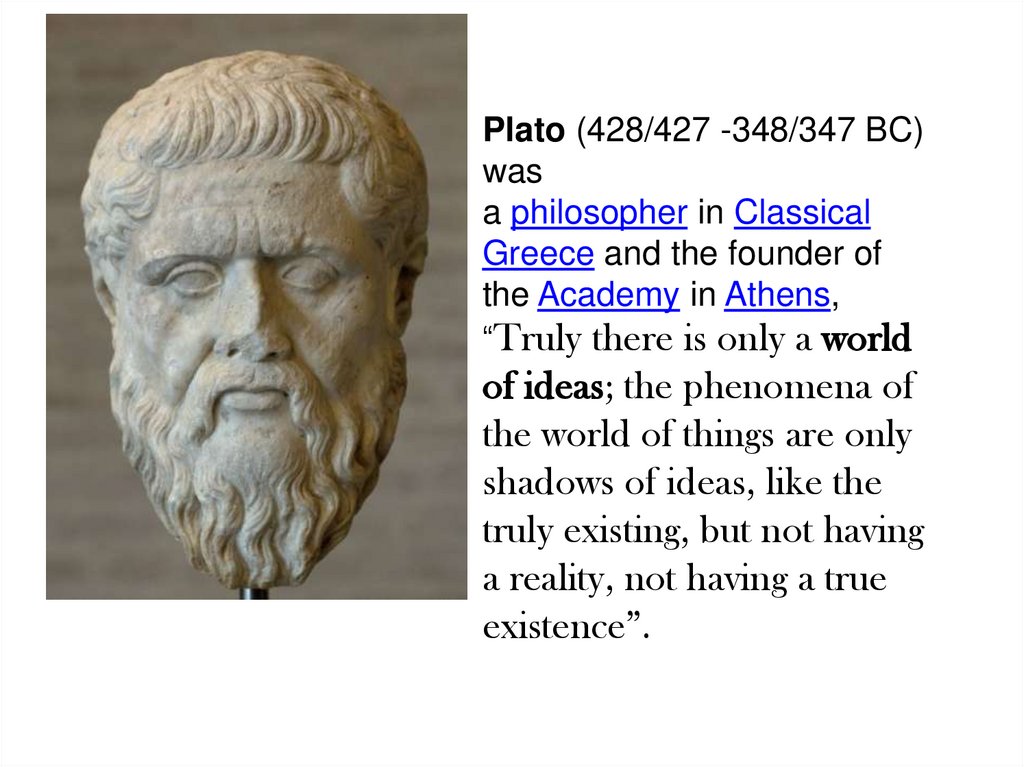
Plato (428/427 -348/347 BC)was
a philosopher in Classical
Greece and the founder of
the Academy in Athens,
“Truly there is only a world
of ideas; the phenomena of
the world of things are only
shadows of ideas, like the
truly existing, but not having
a reality, not having a true
existence”.
50.
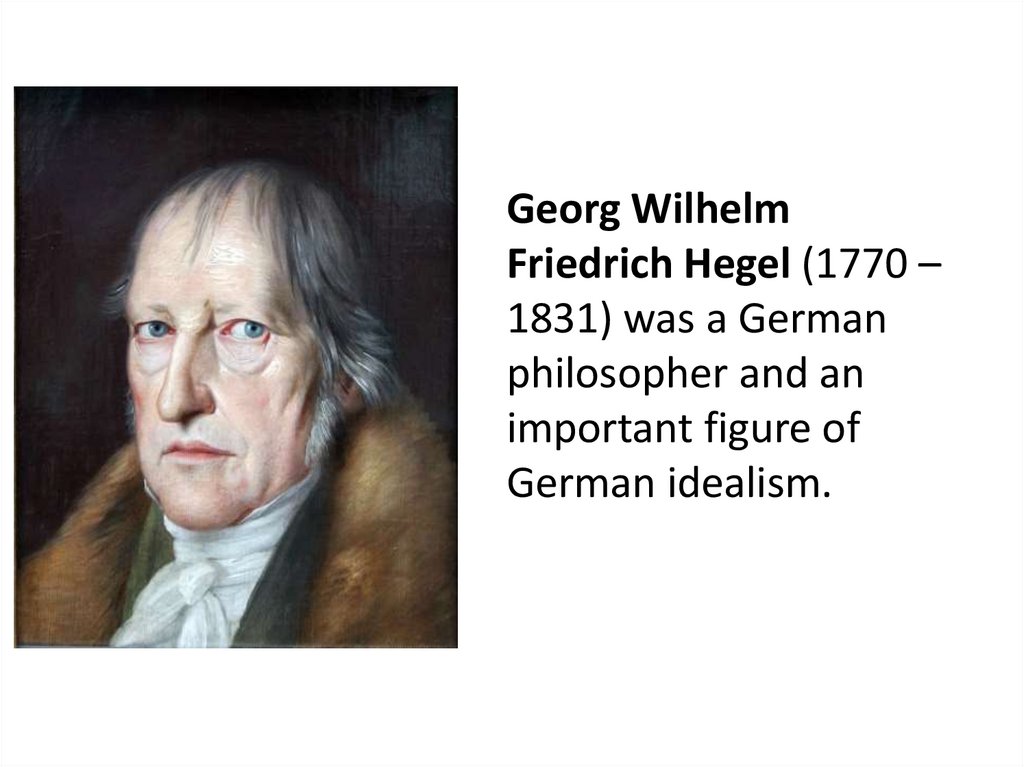
Georg WilhelmFriedrich Hegel (1770 –
1831) was a German
philosopher and an
important figure of
German idealism.
51.
According to the concept of objectiveidealism:
only the idea really exists;
• the idea is primary;
• all the surrounding reality is divided into "the world of ideas" and "the world of things";
• "the world of ideas" (eidos) initially exists in the Universal Reason (Divine Design, etc.);
• "world of things" - the material world does not have an independent existence and is the embodiment of the
"world of ideas";
• every single thing is the embodiment of the idea (eidos) of the given thing (for example, the horse is the
embodiment of the general idea of the horse, the house - the ideas of the house, the ship - the ideas of the ship,
etc.);
• God the Creator plays a big role in transforming the "pure idea" into a concrete thing;
• individual ideas ("the world of ideas") objectively exist independently of our consciousness.
52.
• Subjective idealism: the external world existsonly because of our subjective consciousness
and is the product of its activity, an illusion;
53.
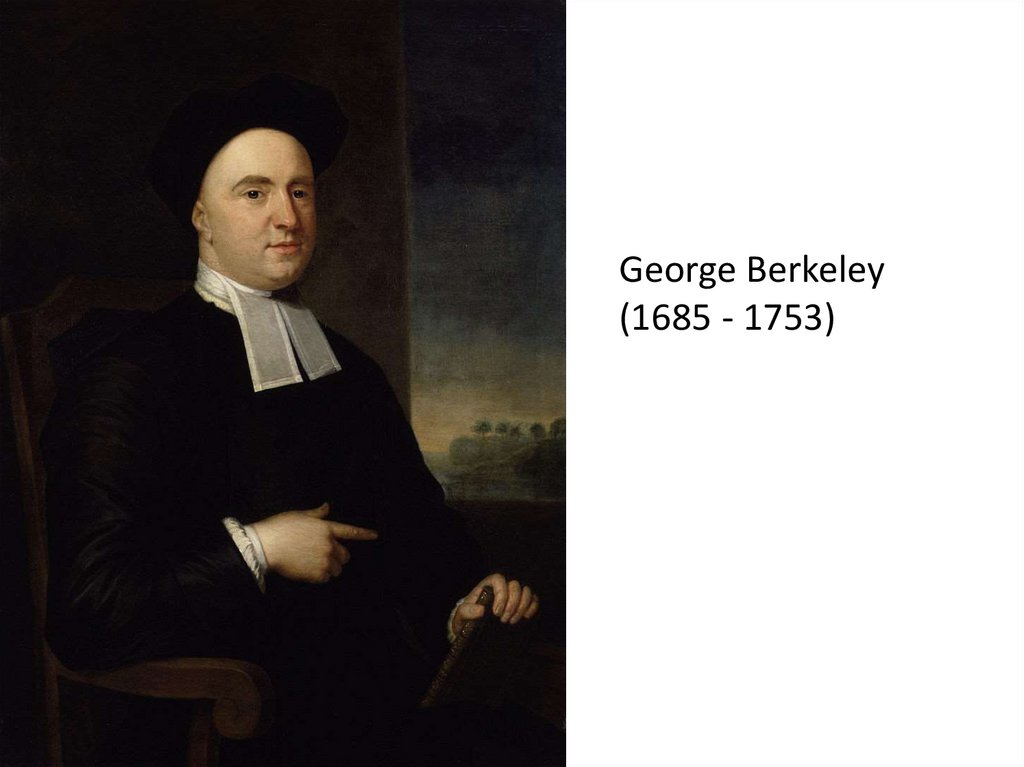
George Berkeley
(1685 - 1753)
54.
Subjective idealism:• everything exists only in the mind (person);
• • ideas exist in the mind of a person;
• • images (ideas) of material things also exist only
in the mind of man through sensory sensations;
• • There is no matter outside of man's
consciousness, no matter, no spirit (ideas).
55.
Materialism• Materialism (the so-called "line of
Democritus") is a trend in philosophy, which
proponents believed that matter is the
primary matter in the relations of matter and
consciousness.
56.
• matter really exists;• matter exists independently of consciousness;
• matter is an independent substance
• matter exists and develops according to its own
internal laws;
• consciousness (spirit) is a property (mode) of
highly organized matter to reflect itself (matter);
• Consciousness is not an independent substance
existing along with matter;
• consciousness is determined by matter (being).
57.
Democritus (460 – c. 370BC) was an
influential Ancient
Greek pre-Socratic
philosopher primarily
remembered today for his
formulation of an atomic
theory of the universe.
58.
• Materialism has a special direction - vulgarmaterialism. Its representatives (Focht, Moleschott)
absolutize the role of matter, are excessively addicted
to the study of matter from the point of view of
physics, mathematics and chemistry, its mechanical
side, ignore consciousness as an entity and its ability
to Influence on matter in return.
• Materialism as the dominant trend of philosophy was
common in democratic Greece, the Hellenistic states,
England during the period of the bourgeois revolution
(XVII century), France of the XVIII century, the USSR
and the socialist countries in the 20th century.
59.
Dualism• Dualism as a philosophical trend was founded by Descartes. The essence
of dualism is that:
• • There are two independent substances - material (possessing the
property of extension) and spiritual (possessing the property of thinking);
• • everything in the world is derived from either one or the other of the
specified substances (material things - from material, ideas - from
spiritual);
• • in man, two substances are combined simultaneously - both material
and spiritual;
• • matter and consciousness (spirit) are two opposing and interrelated
aspects of one
60.
René Descartes ("Cartesian“,1596 –
1650) a
French philosopher,
mathematician,
and scientist.
61.
Deism• Deism is a trend in philosophy whose
supporters (mostly French enlighteners of the
eighteenth century) recognized the existence
of God, who once created the world, no
longer participates in its further development
and does not affect the life and actions of
people (they recognized God, who should only
serve as a moral symbol). Deists also
considered matter spiritualized and did not
oppose matter and spirit (consciousness).
62.
Pantheism• Pantheism is the belief that everything
composes an allencompassing, immanent God or that
the universe (or nature) is identical
with divinity. Pantheists thus do not believe in
a personal or anthropomorphic god, but
believe that interpretations of the term differ.
63.
Pluralism• Pluralism (from Latin pluralis - pluralis) is a
position according to which there is not one
(monism), not two (dualism), but many
essences, substances, existences, etc.
Pluralism was inherent in, for example, the
ancient doctrine of the four elements - air,
earth, fire and water - from which everything
is composed; hierarchy of the Leibniz monads;
philosophy of life, etc.
64.
The epistemological aspect of the basicquestion of philosophy is presented:
• empiricism (sensationalism);
• rationalism.
• irrationalism
• Gnosticism
• agnosticism
65.
• The founder of empiricism is F. Bacon.• Empiricists believed that the basis of
knowledge can lie only in experience and
sensory sensations ("There is nothing in the
mind (in the mind), what would not have been
before in experience and sensory sensations").
66.
• The founder of rationalism (from the Latin ratio the mind) is R. Descartes.• The basic idea of rationalism is that true (true)
knowledge can be deduced only directly from the
mind and does not depend on sensory
experience. (First, there is really only doubt in
everything, and doubt is thought is the activity of
the mind.) Secondly, there are truths that are
obvious to reason (axioms) and do not need any
expert proof - "God exists," " square of equal
angles "," The whole is greater than its part ",
etc.)
67.
Gnosticism• representatives of Gnosticism (as a rule,
materialists) believe that:
• • the world is cognizable;
• • the possibilities of cognition are unlimited.
68.
Agnostics• agnostics(as a rule, idealists):
• • the world is unknowable;
• • the possibilities of cognition are limited by
the cognitive capabilities of the human mind.
69.
Immanuel Kant (1724 1804) was aGerman philosopher who is
a central figure in modern
philosophy.
70.
• According to Kant, the human mind has greatpotential, but these possibilities have their
limits. Based on the finiteness and limitations
of the cognitive capabilities of the human
mind, there are riddles (contradictions) that
will never be solved by a person, for example:
• God exists God does not exist
71.
5. Functions of philosophy• There are several functions of philosophy:
• Worldview. It gives a whole man and a rational outlook, helps him to
critically evaluate themselves and their environment.
• Methodological. It gives a person the knowledge and shows the way how
to get new knowledge. One of the most important methods of philosophy
is dialectical. The dialectic - is the ability to comprehend the object in its
integrity and development, in the unity of its basic properties and the
opposite trends in the multiple relationships with other objects.
• Predictive. It allows you to make forecasts about the future. There are
many examples where the ideas of philosophers much ahead of their
time. For example, the idea of an ancient Chinese philosophy of the
universal nature of links opposing forces of yin and yang is reflected in the
famous "principle of complementarity" Niels Bohr, at the basis of quantum
mechanical picture of the world.
• Synthetic. This function is to establish the relationship between the
spheres of human spiritual creativity.
72.
Questions for self-examinationsWhat is Philosophy and how was the process of
formation of philosophical knowledge?
What are the aim and purpose of Philosophy?
What is the subject of philosophical research?
What is the relation between Philosophy and
Science?
What are the parts of philosophical structure?
What is the range of questions of ontology?
What is the main issue of anthropology?
Explain the construction of a modern picture of
the world, based on the function of Philosophy.