Similar presentations:



Unveiling_the_Unique_Characteristics_of_Eastern_Languages_1
1.
Unveiling the UniqueCharacteristics of Eastern
Languages
2.
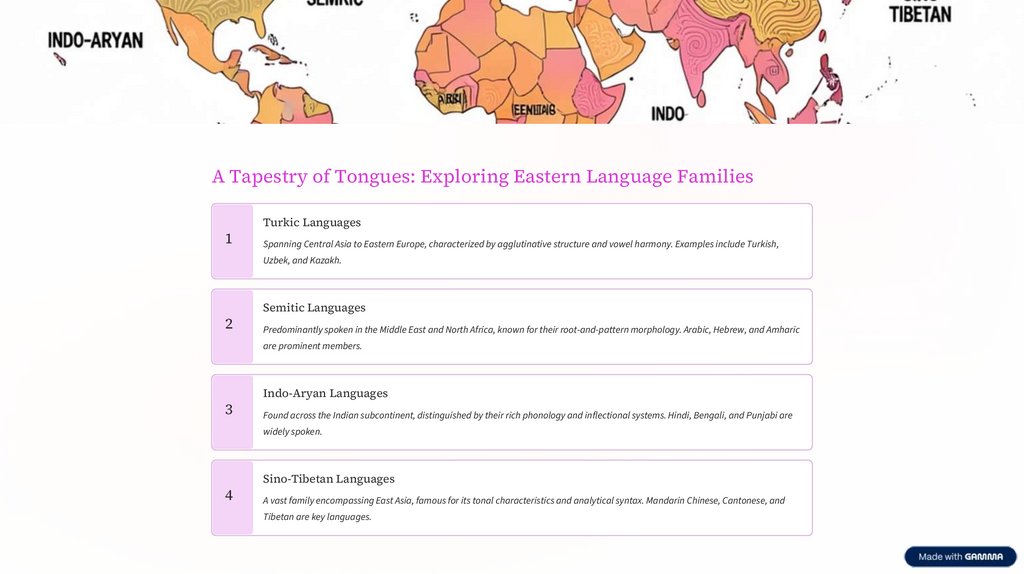
A Tapestry of Tongues: Exploring Eastern Language Families1
Turkic Languages
Spanning Central Asia to Eastern Europe, characterized by agglutinative structure and vowel harmony. Examples include Turkish,
Uzbek, and Kazakh.
2
Semitic Languages
Predominantly spoken in the Middle East and North Africa, known for their root-and-pattern morphology. Arabic, Hebrew, and Amharic
are prominent members.
3
Indo-Aryan Languages
Found across the Indian subcontinent, distinguished by their rich phonology and inflectional systems. Hindi, Bengali, and Punjabi are
widely spoken.
4
Sino-Tibetan Languages
A vast family encompassing East Asia, famous for its tonal characteristics and analytical syntax. Mandarin Chinese, Cantonese, and
Tibetan are key languages.
3.
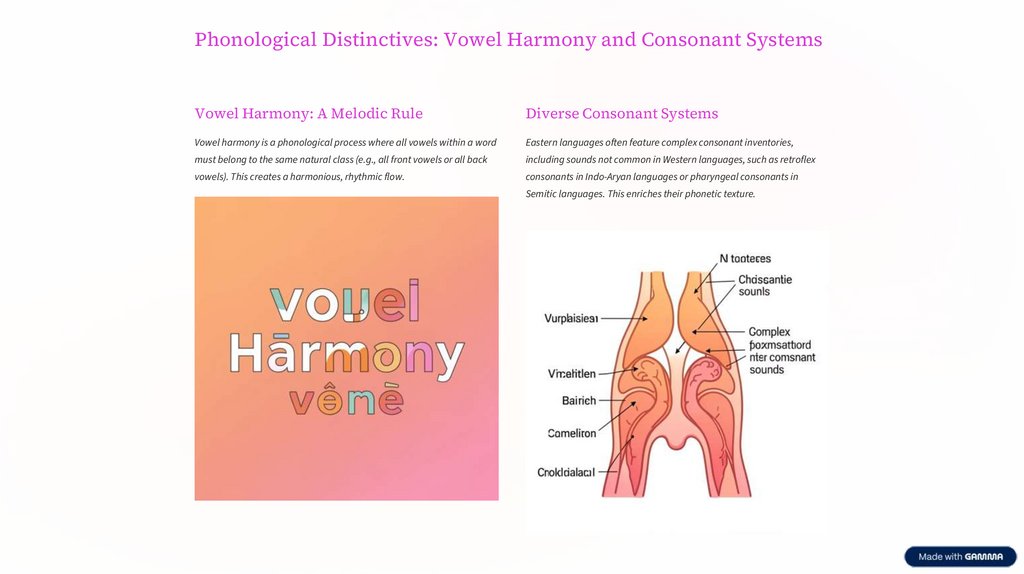
Phonological Distinctives: Vowel Harmony and Consonant SystemsVowel Harmony: A Melodic Rule
Diverse Consonant Systems
Vowel harmony is a phonological process where all vowels within a word
Eastern languages often feature complex consonant inventories,
must belong to the same natural class (e.g., all front vowels or all back
including sounds not common in Western languages, such as retroflex
vowels). This creates a harmonious, rhythmic flow.
consonants in Indo-Aryan languages or pharyngeal consonants in
Semitic languages. This enriches their phonetic texture.
4.
Morphological Richness: Agglutination andInflection
Agglutination
In agglutinative languages (like Turkic), words are formed by adding multiple affixes to a root, each
representing a single grammatical meaning. This allows for long, information-dense words.
Inflection
Inflectional languages (like Indo-Aryan and some Semitic) modify the form of a word to express
grammatical categories such as tense, mood, gender, number, and case, often through internal
vowel changes or fusion of affixes.
These morphological strategies contribute to the compact and nuanced expression of meaning within
Eastern languages.
5.
Syntactic Structures: Word OrderVariation and Case Systems
Flexible Word Order
Many Eastern languages exhibit more flexible word order than
English (SVO), often utilizing Subject-Object-Verb (SOV) or VerbSubject-Object (VSO) structures. This flexibility often serves to
emphasize certain parts of a sentence.
Elaborate Case Systems
Case systems, prevalent in languages like Sanskrit or Russian
(though not strictly Eastern), mark nouns, pronouns, and
adjectives to indicate their grammatical function in a sentence.
This reduces reliance on fixed word order for meaning.
6.
Semantic Nuances: Cultural Context and IdiomaticExpressions
Language is not just a tool for communication; it's a mirror of culture, reflecting its values, history, and worldview through its
semantic depth.
1
2
Cultural Specificity
Rich Idiomatic Landscape
Many Eastern languages possess vocabulary deeply
Idioms and proverbs are particularly abundant, often
rooted in specific cultural practices, philosophies, or
conveying profound wisdom or subtle observations about
social structures that may lack direct equivalents in
human nature and society. Understanding them requires
Western languages.
cultural immersion.
3
Politeness and Respect
Semantic choices often reflect hierarchical relationships and social etiquette, requiring careful consideration of word choice
and phrasing to convey appropriate respect.
7.
Calligraphic Artistry: Writing Systems and AestheticsEastern languages boast a stunning diversity of writing systems, many of
which are revered as high art forms. From the intricate brushstrokes of Chinese
characters to the flowing script of Arabic, calligraphy embodies aesthetic
principles and philosophical depth.
Logographic: Chinese characters (Hanzi) represent words or concepts.
Abugida: Devanagari (for Hindi) where consonants carry an inherent vowel.
Abjad: Arabic and Hebrew, primarily writing consonants.
Syllabic: Japanese Kana (Hiragana and Katakana) represent syllables.
These systems are not merely tools for transcription but integral components of cultural heritage and visual expression.
8.
The Role of Honorifics and Politeness LevelsSocial Hierarchy
Many Eastern languages extensively use
honorifics and varying politeness levels to
indicate social status, age, and respect
between speakers.
Cultural Nuance
Mastering honorifics is a significant part of
achieving fluency and demonstrating
cultural understanding in these linguistic
contexts.
Pronoun and Verb Forms
This is often expressed through specialized
pronouns, verb conjugations, and
vocabulary. Choosing the correct form is
crucial for appropriate social interaction.
Contextual Usage
The appropriate level of politeness can
change depending on the speaker's
relationship, the setting, and the topic of
conversation.
9.
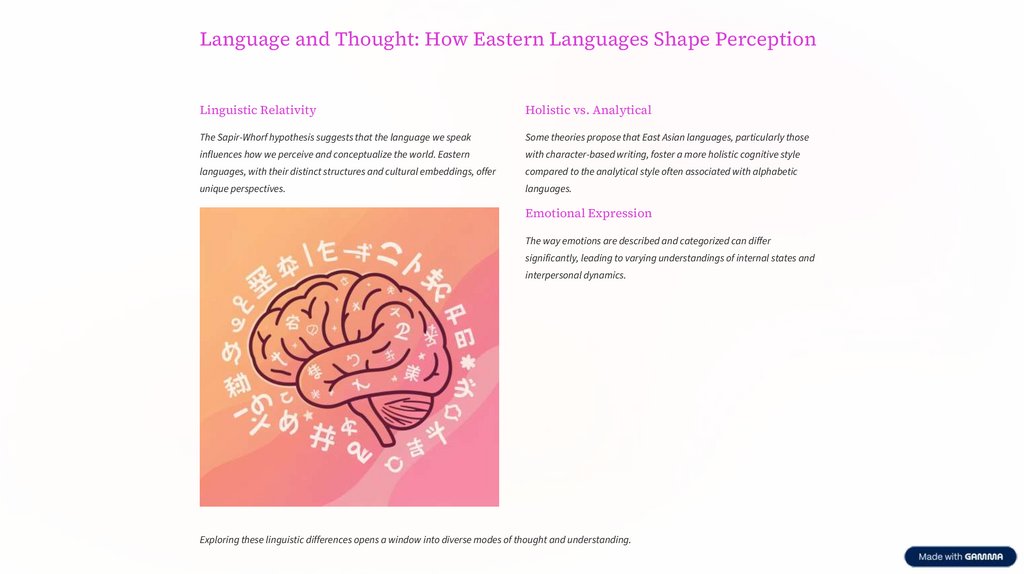
Language and Thought: How Eastern Languages Shape PerceptionLinguistic Relativity
Holistic vs. Analytical
The Sapir-Whorf hypothesis suggests that the language we speak
Some theories propose that East Asian languages, particularly those
influences how we perceive and conceptualize the world. Eastern
with character-based writing, foster a more holistic cognitive style
languages, with their distinct structures and cultural embeddings, offer
compared to the analytical style often associated with alphabetic
unique perspectives.
languages.
Emotional Expression
The way emotions are described and categorized can differ
significantly, leading to varying understandings of internal states and
interpersonal dynamics.
Exploring these linguistic differences opens a window into diverse modes of thought and understanding.
10.
Bridging Cultures Through Linguistic UnderstandingEnhanced Communication
Understanding the unique features of Eastern languages facilitates more effective and respectful cross-cultural communication.
Deeper Cultural Appreciation
Linguistic insights unlock a richer appreciation for the art, literature, philosophy, and social customs of Eastern civilizations.
Building Connections
Embracing linguistic diversity fosters empathy and stronger bonds between people from different backgrounds.
The journey into Eastern languages is a journey into diverse ways of thinking and being, enriching our global understanding.