

 lingvistics
Similar presentations:



Linguistic universals. Lecture 02 linguistic typology
1. LINGUISTIC UNIVERSALS
LECTURE 02LINGUISTIC TYPOLOGY
2. Further reading
Хоккетт Ч. Ф. ПРОБЛЕМА ЯЗЫКОВЫХ УНИВЕРСАЛИЙ // новое взарубежной лингвистике. Вып. V. – М.: Прогресс, 1970.
Успенский Б. Проблема универсалии в языкознании
Гринберг Дж., Осгуд Ч., Дженкинс Дж. МЕМОРАНДУМ О
ЯЗЫКОВЫХ УНИВЕРСАЛИЯХ // новое в зарубежной лингвистике.
Вып. V. – М.: Прогресс, 1970.
Гринберг Дж. НЕКОТОРЫЕ ГРАММАТИЧЕСКИЕ УНИВЕРСАЛИИ,
ПРЕИМУЩЕСТВЕННО КАСАЮЩИЕСЯ ПОРЯДКА ЗНАЧИМЫХ
ЭЛЕМЕНТОВ
Dietmar Zaefferer & David Poeppel. Linguistic Universals as Human
Universals — Divergent Views and Converging Evidence on Language
Congruence and Diversity
Language Universals. Ch.3
Учебные пособия (Аракин, Резвецова, Петрова).
3.
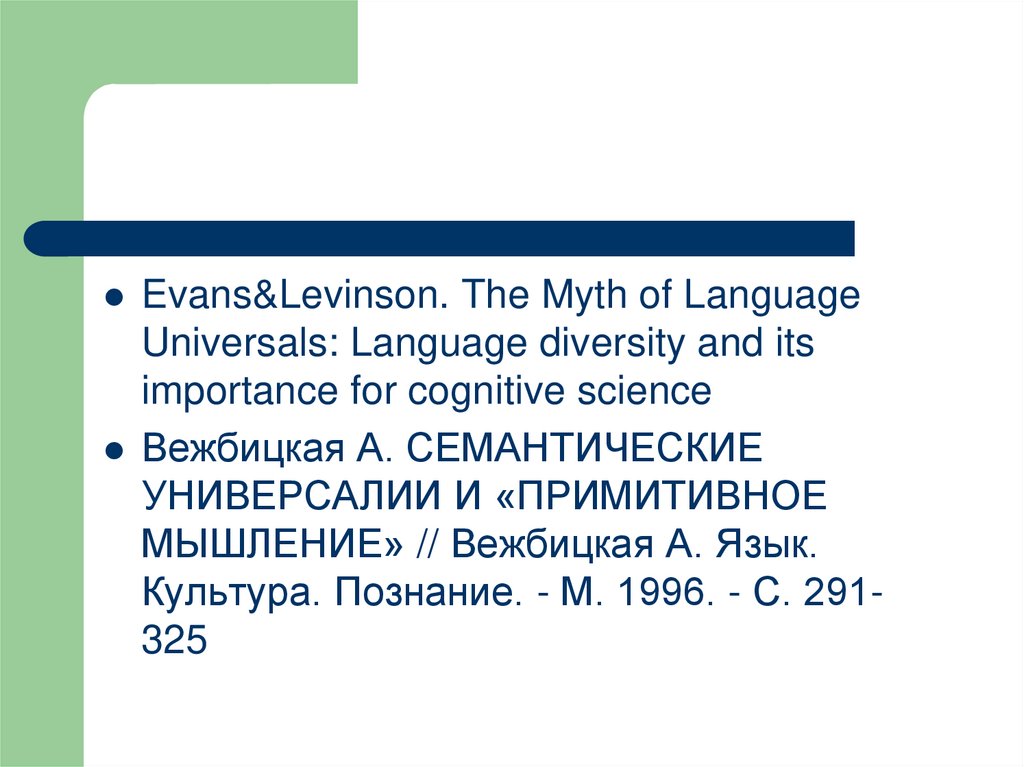
Evans&Levinson. The Myth of LanguageUniversals: Language diversity and its
importance for cognitive science
Вежбицкая А. СЕМАНТИЧЕСКИЕ
УНИВЕРСАЛИИ И «ПРИМИТИВНОЕ
МЫШЛЕНИЕ» // Вежбицкая А. Язык.
Культура. Познание. - М. 1996. - С. 291325
4. LINGUISTIC UNIVERSALS
‘Universal’ is opposed to ‘____’?What is universal about languages?
5. J.H. Greenberg:
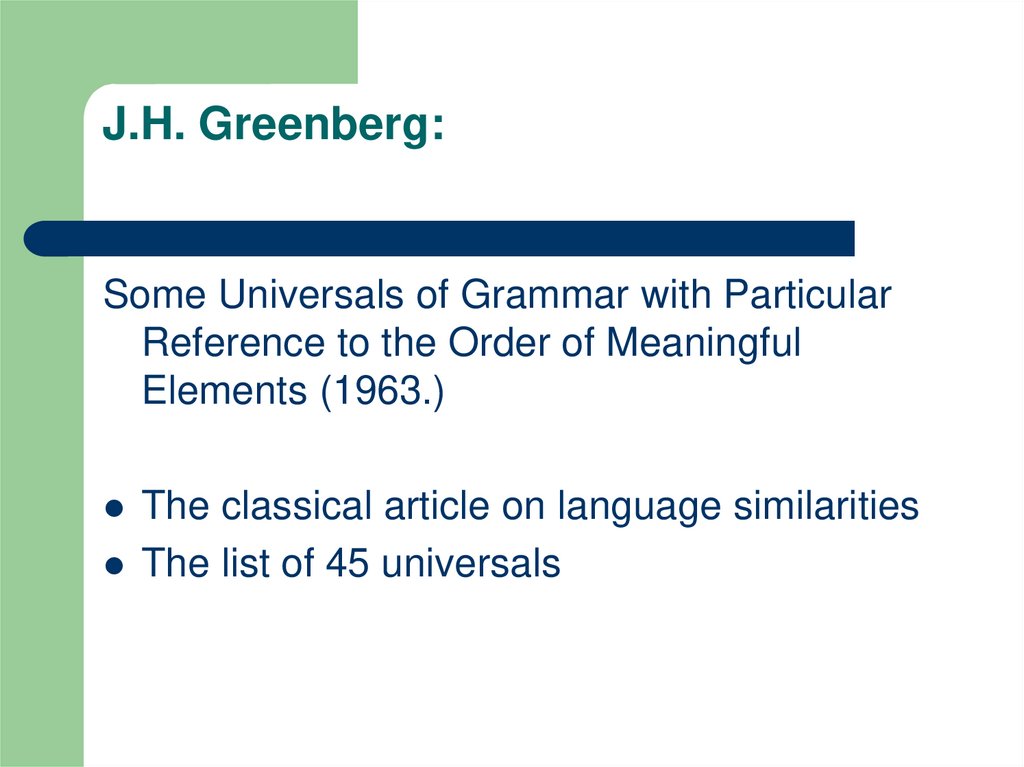
Some Universals of Grammar with ParticularReference to the Order of Meaningful
Elements (1963.)
The classical article on language similarities
The list of 45 universals
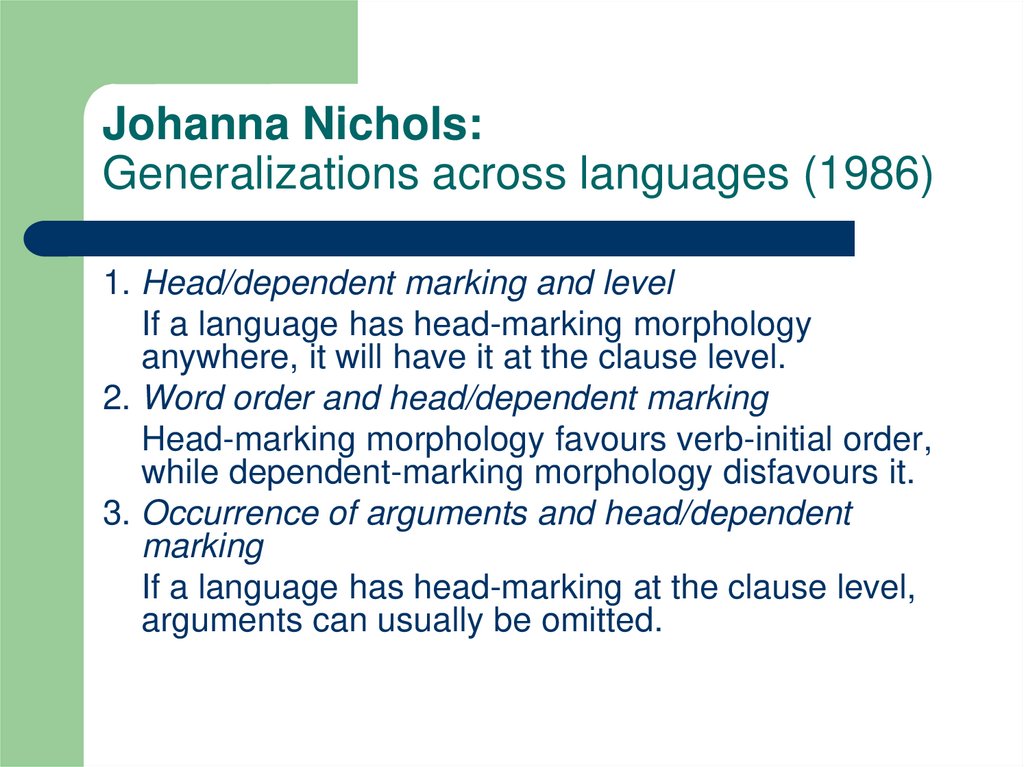
6. Johanna Nichols: Generalizations across languages (1986)
1. Head/dependent marking and levelIf a language has head-marking morphology
anywhere, it will have it at the clause level.
2. Word order and head/dependent marking
Head-marking morphology favours verb-initial order,
while dependent-marking morphology disfavours it.
3. Occurrence of arguments and head/dependent
marking
If a language has head-marking at the clause level,
arguments can usually be omitted.
7. Prof. Victoria Fromkin and R.D. Rodman:
Linguistic Universals (1988)Alternative list of universals
8. Nicholas Evans and Stephen C. Levinson:
The myth of language universals (2009.)Critics on the Greenbergian point of view
9. Halvor Eifring and Rolf Theil
Linguistics for Studentsof Asian and African
Languages (2005.)
10.
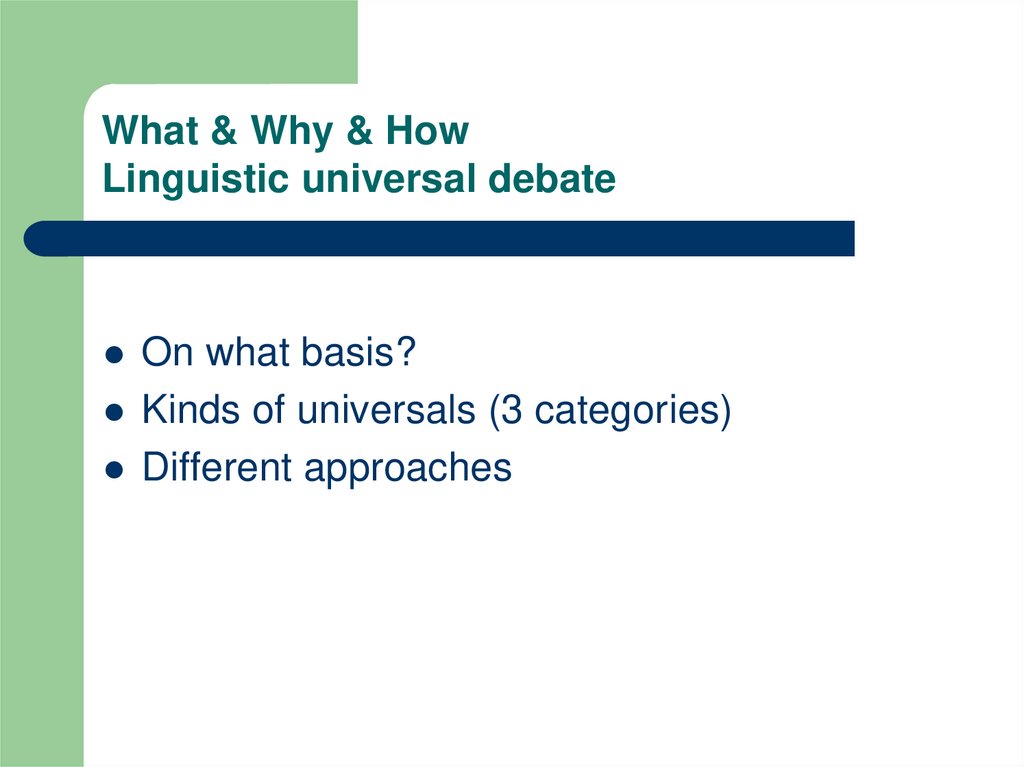
What & Why & HowLinguistic universal debate
On what basis?
Kinds of universals (3 categories)
Different approaches
11. What&Why&How
What&Why&HowMain questions:
(prof. A.E.Kibrik:
‘what-typology vs. why-typology)
What do they have in common?
How do they differ from each other?
Why do they differ from each other?
12. What&Why&How
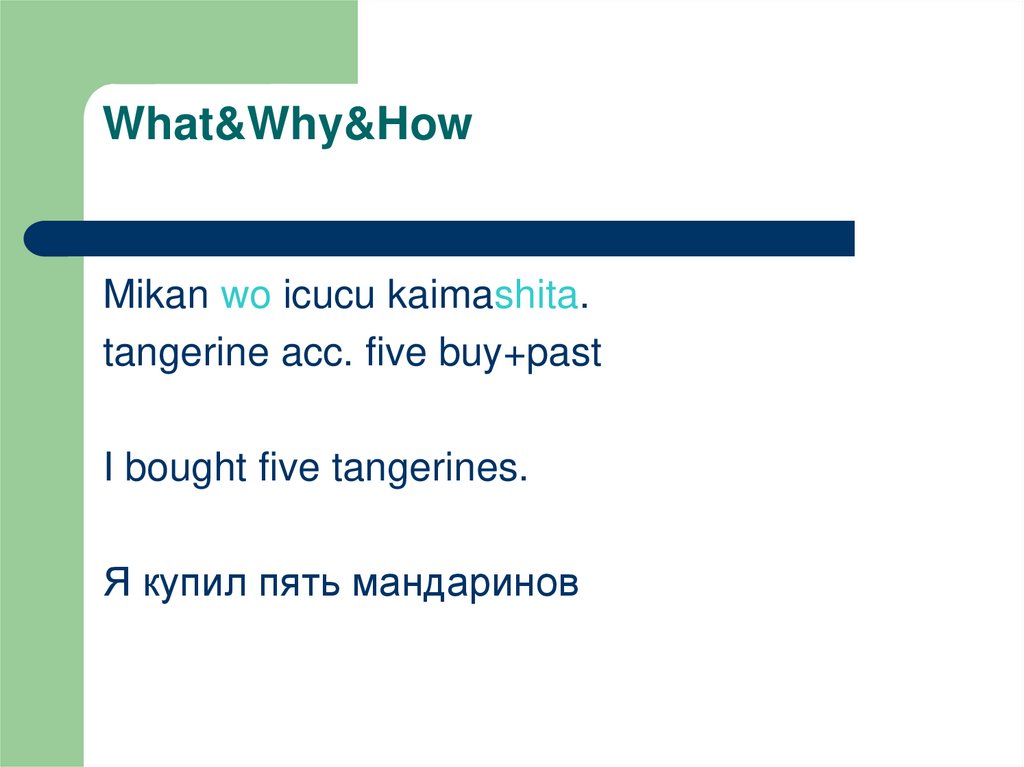
What&Why&HowMikan wo icucu kaimashita.
tangerine acc. five buy+past
I bought five tangerines.
Я купил пять мандаринов
13. What&Why&How: features
What&Why&How: featuresObject, (subject)
Action of buying – verb,
Pronunciation
Word order
Syllables
Consist of words
Words are pronounced
Vowels, consonants
Words are meaningful
Case
Inflection
Connotation
Tangerine – noun
14.
similaritiesdifferences
15. What&Why&How
What&Why&HowLanguage universals
what human languages have in common
Linguistic typology
how languages can be divided into types
16. What&Why&How: explanations
What&Why&How: explanationsWhy do languages have so many things in
common?
Monogenesis hypothesis
Language contact
Innateness hypothesis (innate grammar)
Functional explanations
17. Greenberg
sample of 30 languagessome of them: Finnish, Yoruba, Hindi,
Japanese, Guarani, Maya…
Reasons: convenience, background,
knowledge, nearly complete universal
validity, grammatical traits
Attempt: genetic and areal coverage
18. Evans and Levinson:
Distinct languages: 5000-8000Definitional problems: dialect or distinct language?
Decent description (<10%)
Result: based on max. 500 languages
Almost every new language description guarantees
substantial surprises
A language dies every two weeks
Need: independent sample
How many distinct phylogenetic groups?
Now: non-random sample: <2% of the full range of
human linguistic diversity
19. Kinds of universals
Greenberg’s groupingFromkin and Rodman’s universals
Evans and Levinson: based on validity
Halvor and Rolf: three concepts
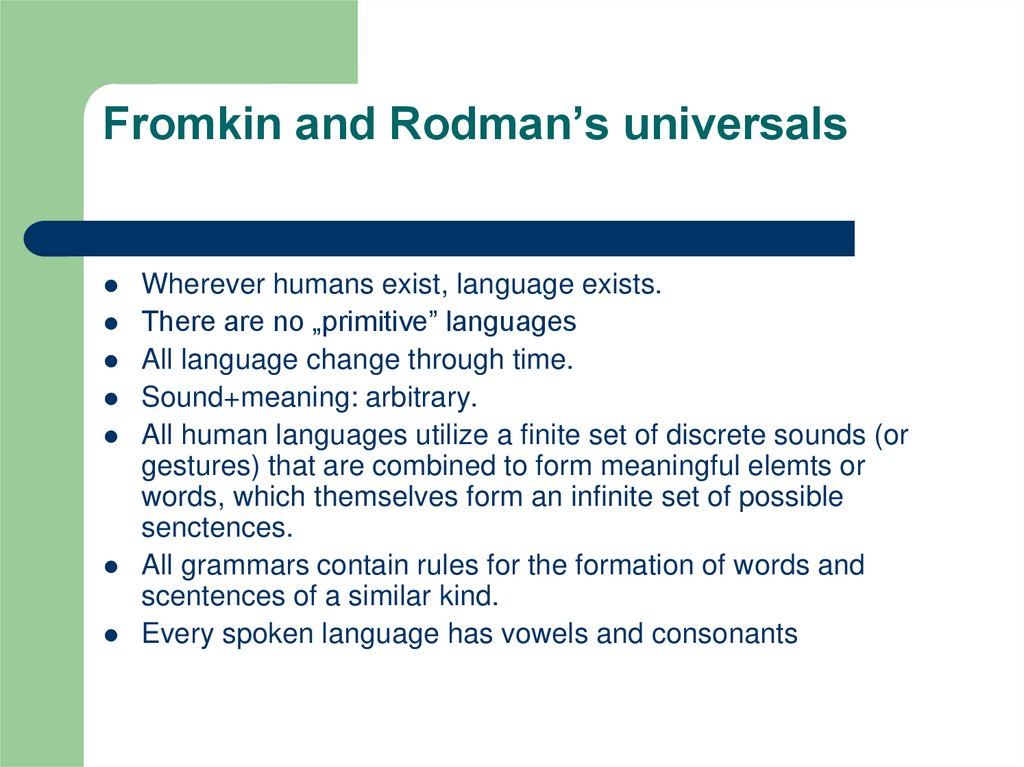
20. Fromkin and Rodman’s universals
Wherever humans exist, language exists.There are no „primitive” languages
All language change through time.
Sound+meaning: arbitrary.
All human languages utilize a finite set of discrete sounds (or
gestures) that are combined to form meaningful elemts or
words, which themselves form an infinite set of possible
senctences.
All grammars contain rules for the formation of words and
scentences of a similar kind.
Every spoken language has vowels and consonants
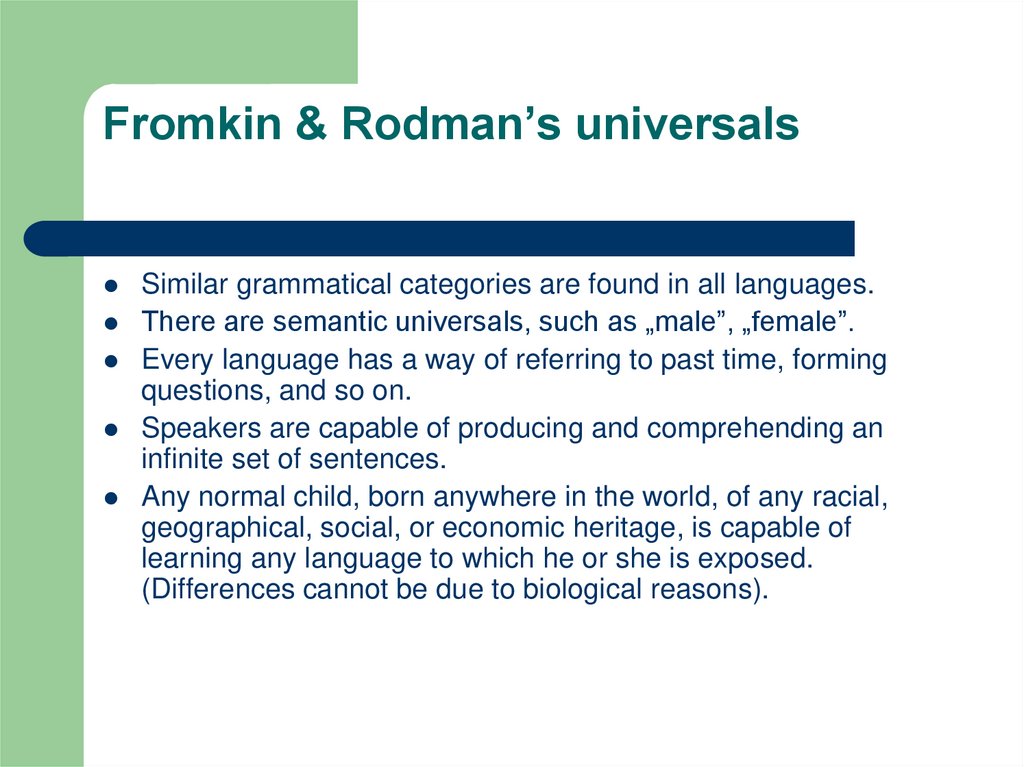
21. Fromkin & Rodman’s universals
Fromkin & Rodman’s universalsSimilar grammatical categories are found in all languages.
There are semantic universals, such as „male”, „female”.
Every language has a way of referring to past time, forming
questions, and so on.
Speakers are capable of producing and comprehending an
infinite set of sentences.
Any normal child, born anywhere in the world, of any racial,
geographical, social, or economic heritage, is capable of
learning any language to which he or she is exposed.
(Differences cannot be due to biological reasons).
22. Kinds of universals – 3 concepts
Lexical universals („I” „You”)Word classes – grammatical (syntax,
morphology)
Speech sounds
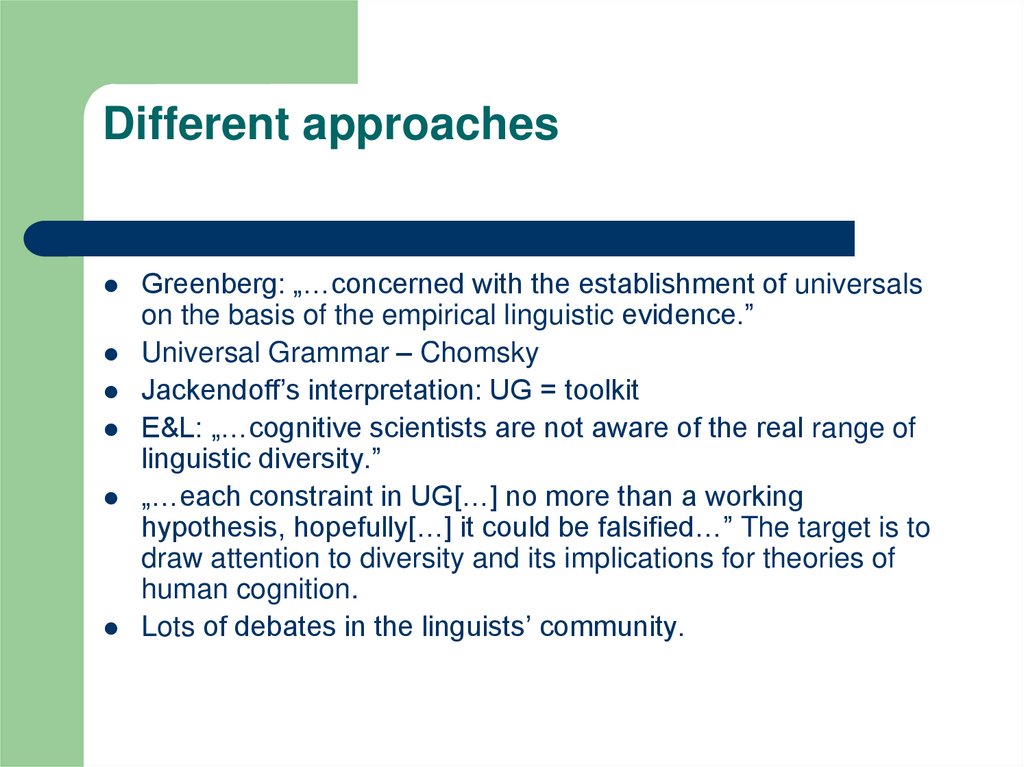
23. Different approaches
Greenberg: „…concerned with the establishment of universalson the basis of the empirical linguistic evidence.”
Universal Grammar – Chomsky
Jackendoff’s interpretation: UG = toolkit
E&L: „…cognitive scientists are not aware of the real range of
linguistic diversity.”
„…each constraint in UG[…] no more than a working
hypothesis, hopefully[…] it could be falsified…” The target is to
draw attention to diversity and its implications for theories of
human cognition.
Lots of debates in the linguists’ community.
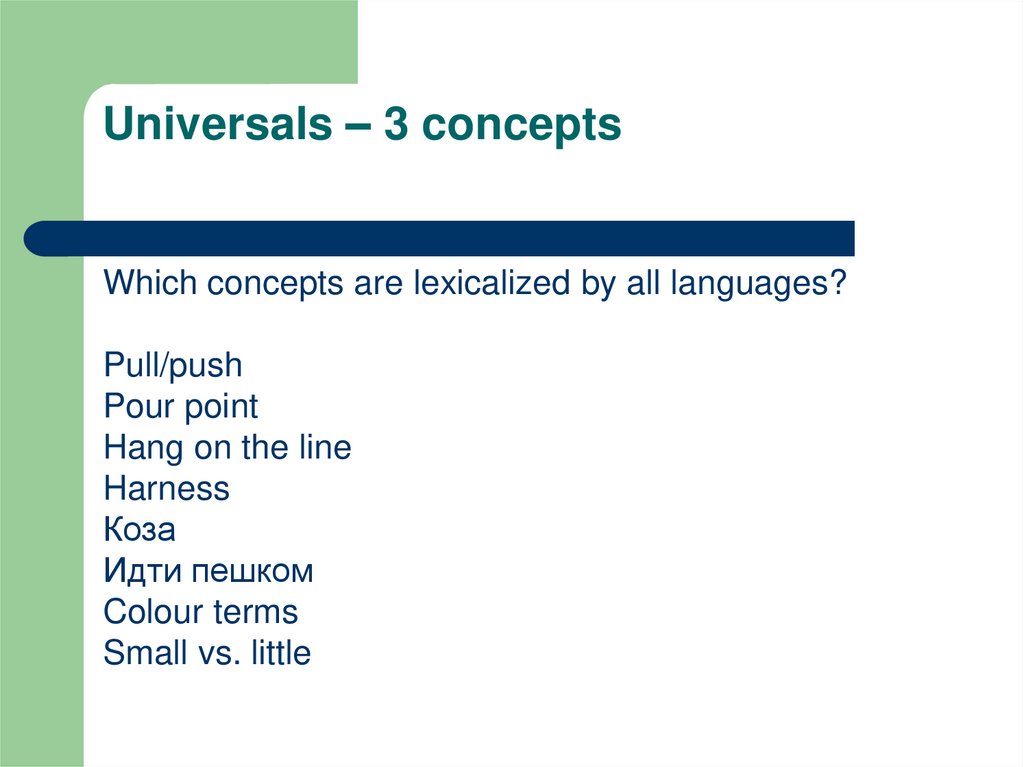
24. Universals – 3 concepts
Which concepts are lexicalized by all languages?Pull/push
Pour point
Hang on the line
Harness
Коза
Идти пешком
Colour terms
Small vs. little
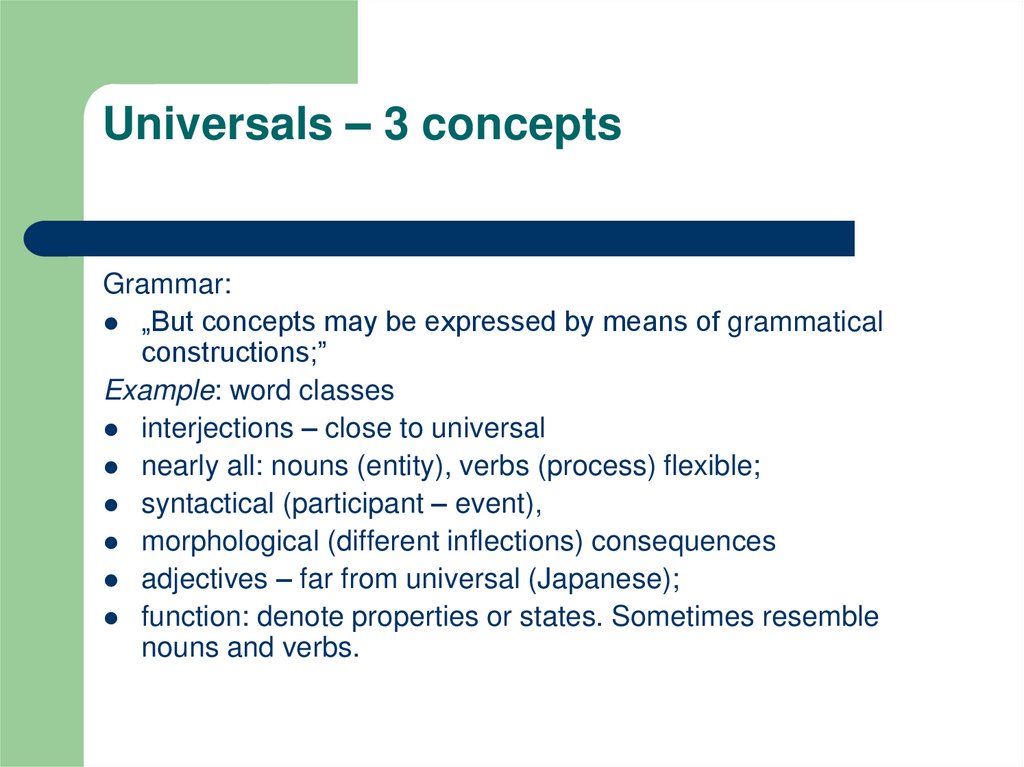
25. Universals – 3 concepts
Grammar:„But concepts may be expressed by means of grammatical
constructions;”
Example: word classes
interjections – close to universal
nearly all: nouns (entity), verbs (process) flexible;
syntactical (participant – event),
morphological (different inflections) consequences
adjectives – far from universal (Japanese);
function: denote properties or states. Sometimes resemble
nouns and verbs.
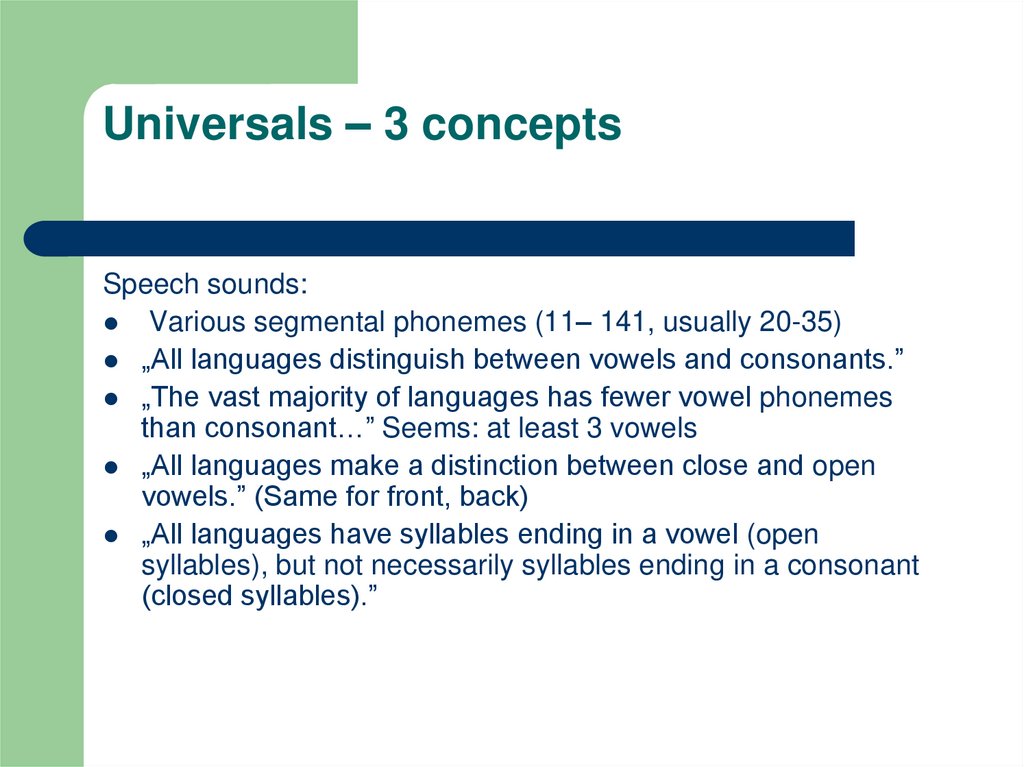
26. Universals – 3 concepts
Speech sounds:Various segmental phonemes (11– 141, usually 20-35)
„All languages distinguish between vowels and consonants.”
„The vast majority of languages has fewer vowel phonemes
than consonant…” Seems: at least 3 vowels
„All languages make a distinction between close and open
vowels.” (Same for front, back)
„All languages have syllables ending in a vowel (open
syllables), but not necessarily syllables ending in a consonant
(closed syllables).”
27. Universals – 3 concepts
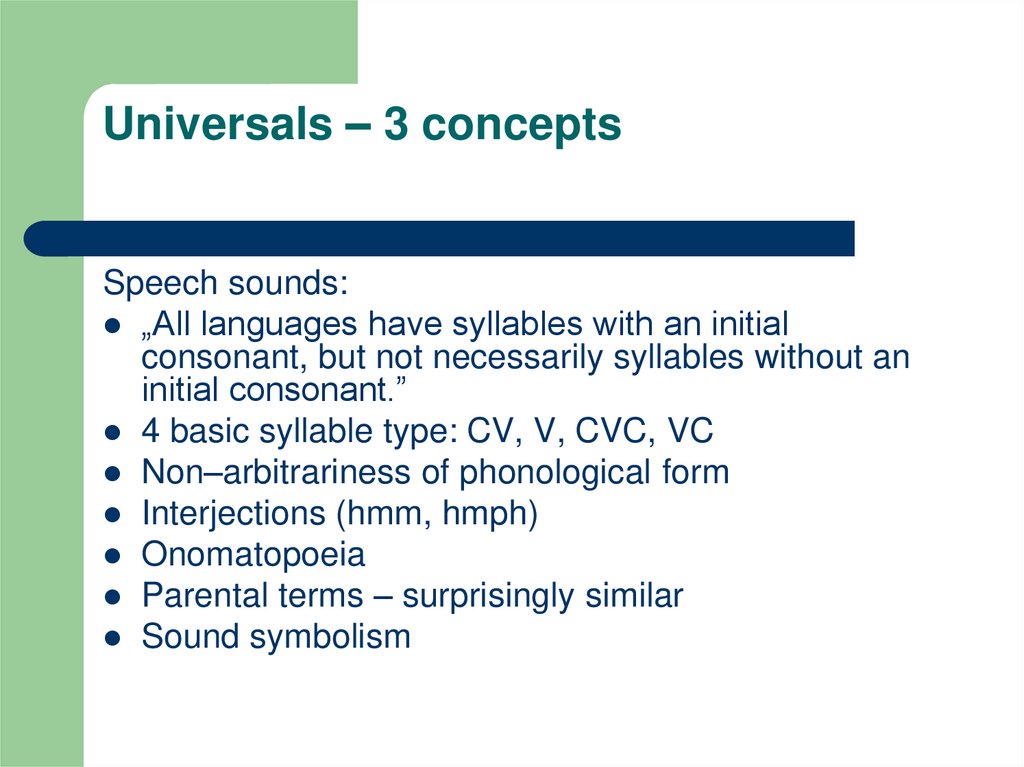
Speech sounds:„All languages have syllables with an initial
consonant, but not necessarily syllables without an
initial consonant.”
4 basic syllable type: CV, V, CVC, VC
Non–arbitrariness of phonological form
Interjections (hmm, hmph)
Onomatopoeia
Parental terms – surprisingly similar
Sound symbolism
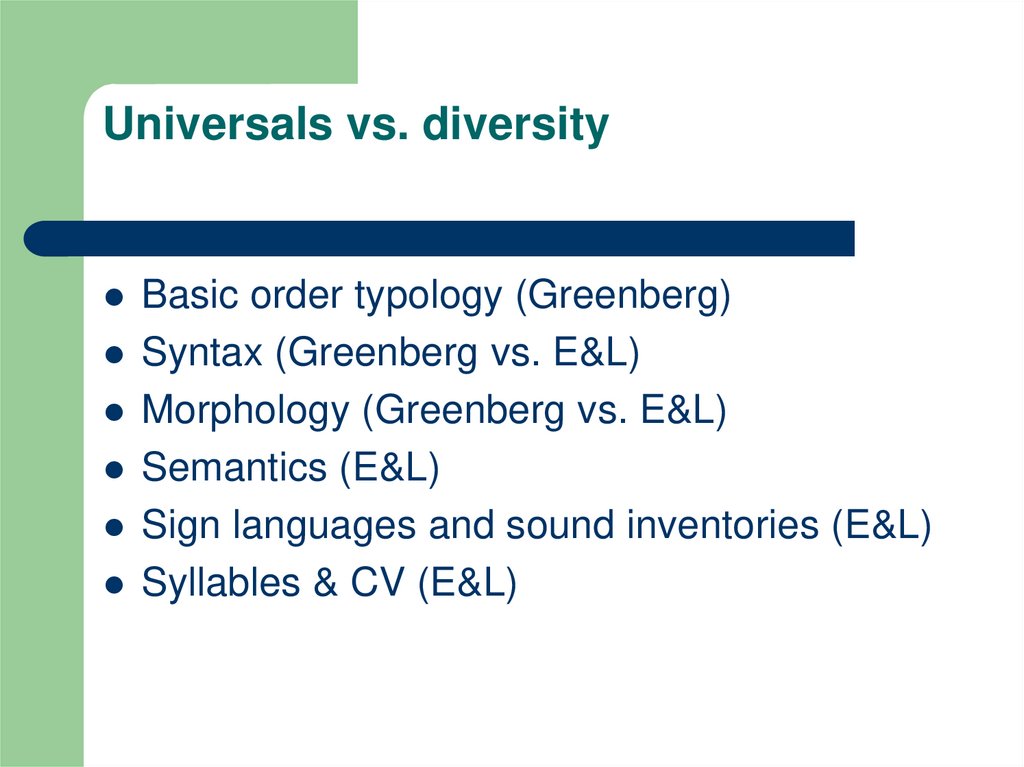
28. Universals vs. diversity
Basic order typology (Greenberg)Syntax (Greenberg vs. E&L)
Morphology (Greenberg vs. E&L)
Semantics (E&L)
Sign languages and sound inventories (E&L)
Syllables & CV (E&L)
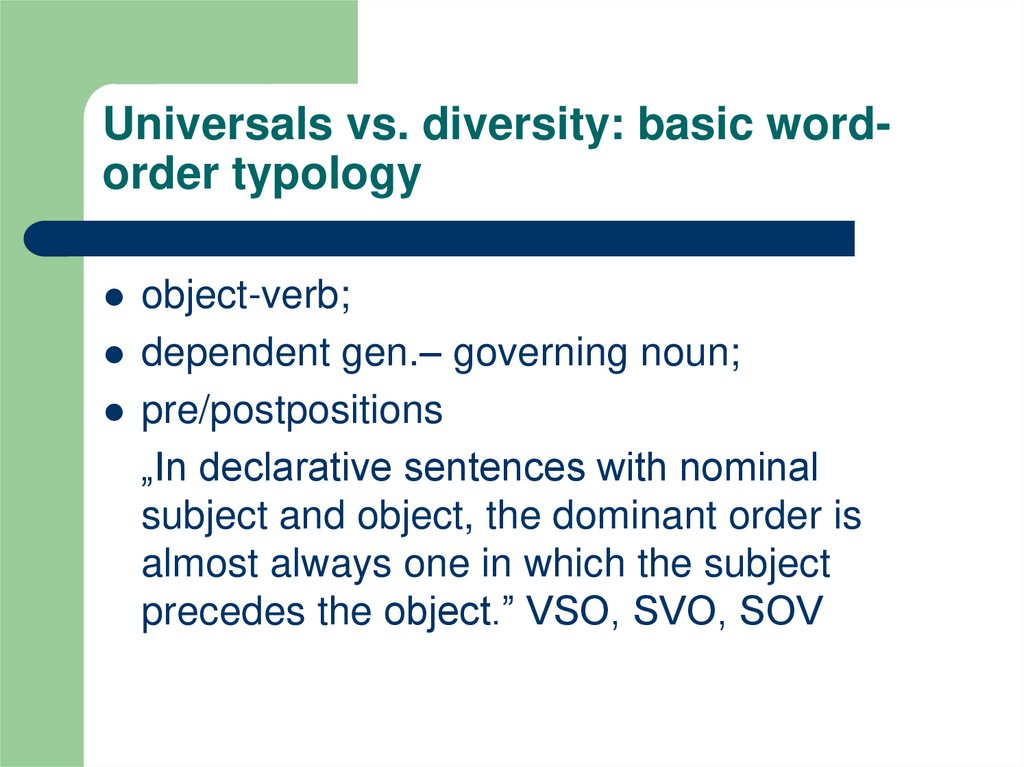
29. Universals vs. diversity: basic word-order typology
Universals vs. diversity: basic wordorder typologyobject-verb;
dependent gen.– governing noun;
pre/postpositions
„In declarative sentences with nominal
subject and object, the dominant order is
almost always one in which the subject
precedes the object.” VSO, SVO, SOV
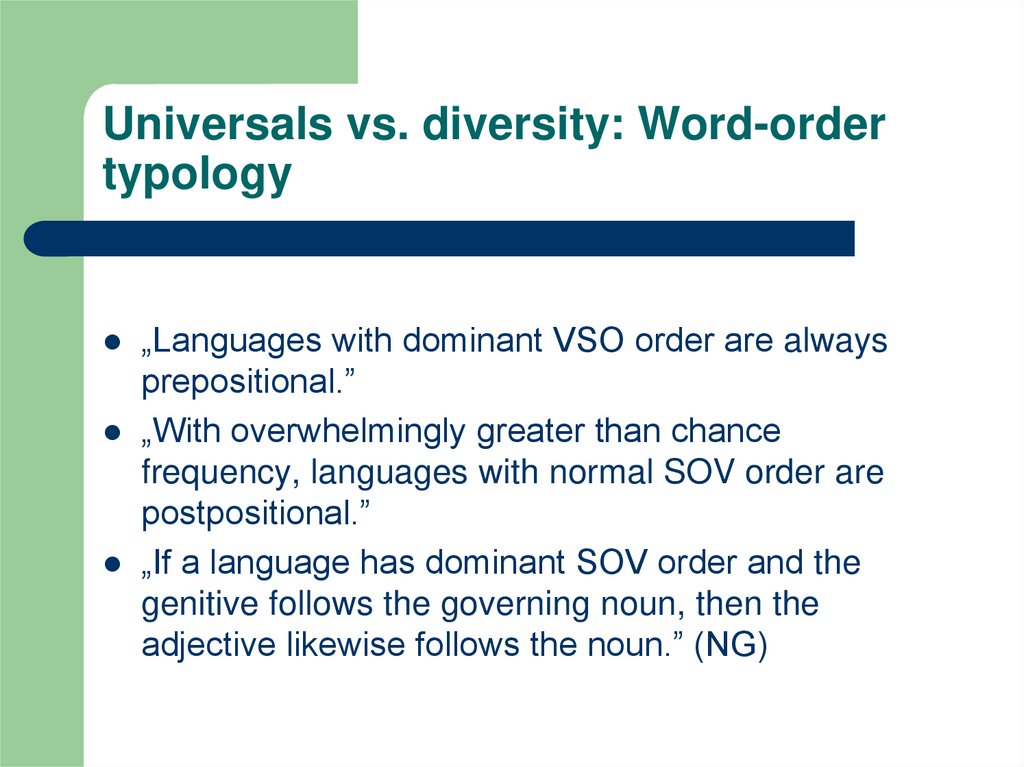
30. Universals vs. diversity: Word-order typology
„Languages with dominant VSO order are alwaysprepositional.”
„With overwhelmingly greater than chance
frequency, languages with normal SOV order are
postpositional.”
„If a language has dominant SOV order and the
genitive follows the governing noun, then the
adjective likewise follows the noun.” (NG)
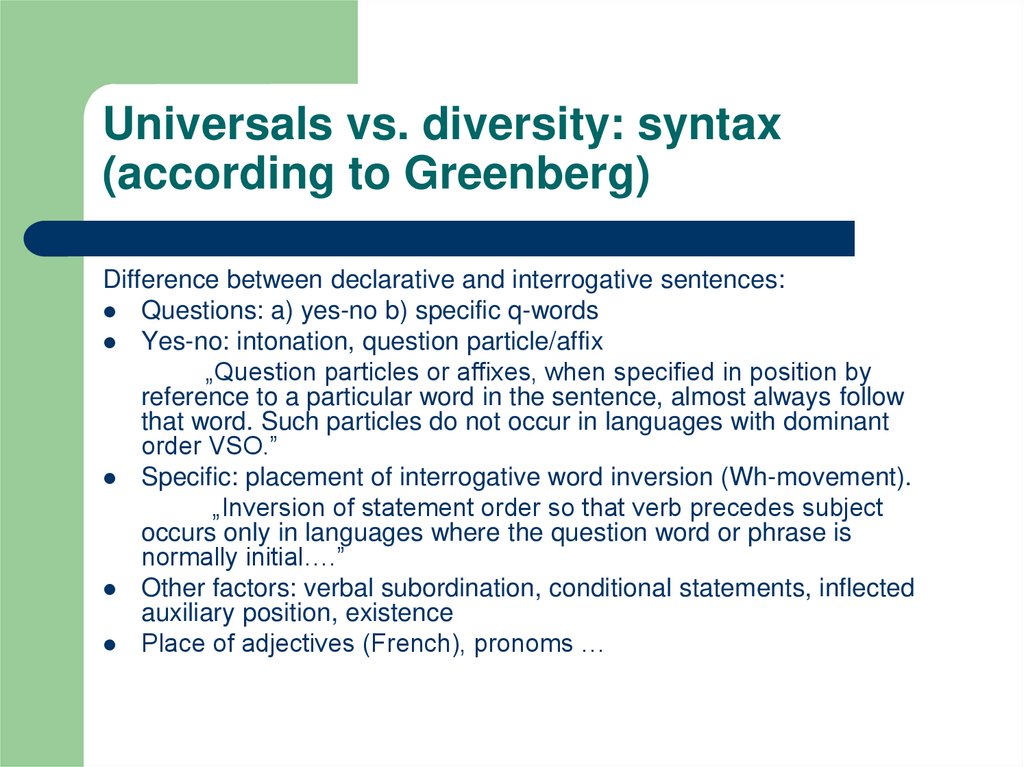
31. Universals vs. diversity: syntax (according to Greenberg)
Difference between declarative and interrogative sentences:Questions: a) yes-no b) specific q-words
Yes-no: intonation, question particle/affix
„Question particles or affixes, when specified in position by
reference to a particular word in the sentence, almost always follow
that word. Such particles do not occur in languages with dominant
order VSO.”
Specific: placement of interrogative word inversion (Wh-movement).
„Inversion of statement order so that verb precedes subject
occurs only in languages where the question word or phrase is
normally initial….”
Other factors: verbal subordination, conditional statements, inflected
auxiliary position, existence
Place of adjectives (French), pronoms …
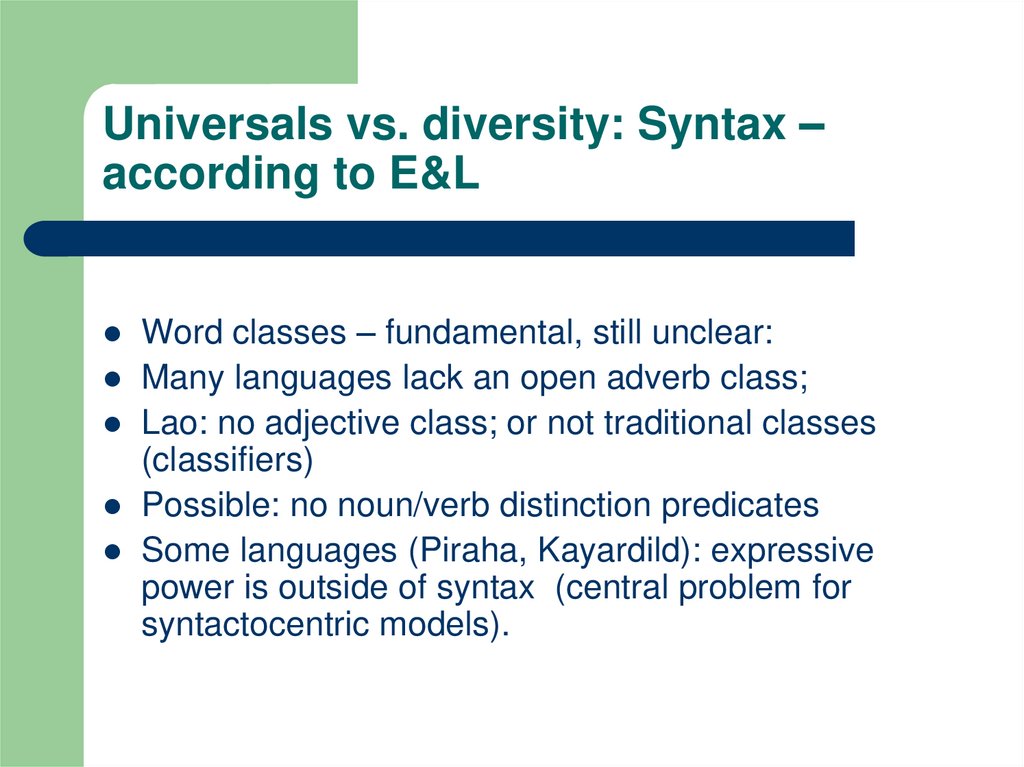
32. Universals vs. diversity: Syntax – according to E&L
Universals vs. diversity: Syntax –according to E&L
Word classes – fundamental, still unclear:
Many languages lack an open adverb class;
Lao: no adjective class; or not traditional classes
(classifiers)
Possible: no noun/verb distinction predicates
Some languages (Piraha, Kayardild): expressive
power is outside of syntax (central problem for
syntactocentric models).
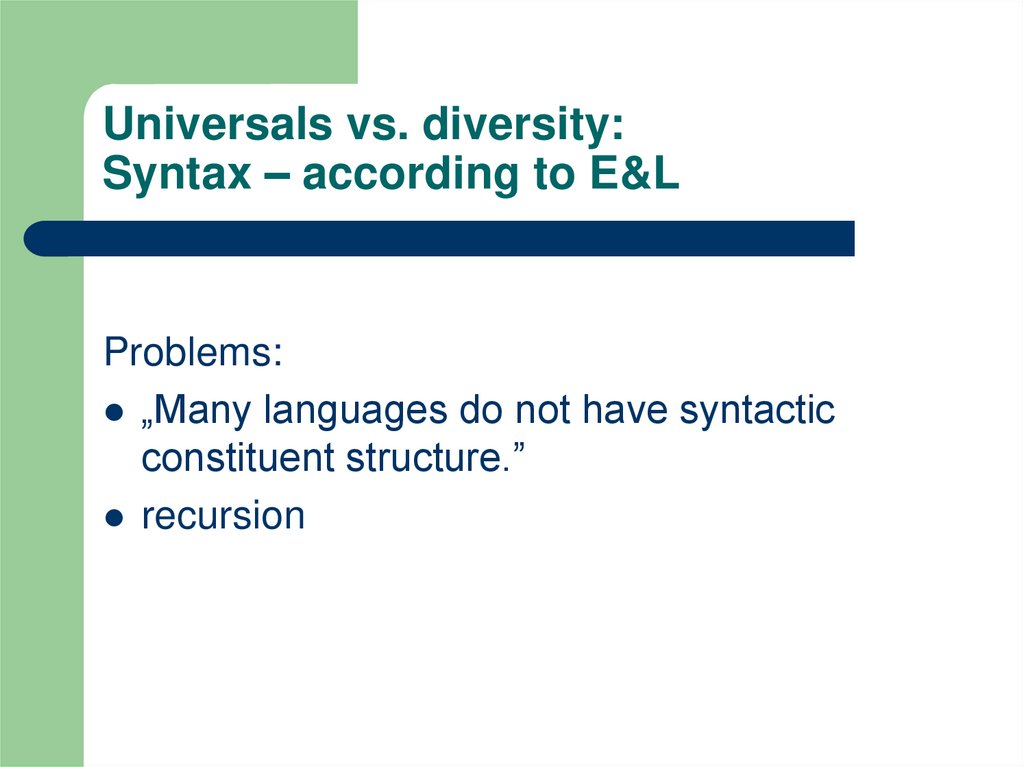
33. Universals vs. diversity: Syntax – according to E&L
Universals vs. diversity:Syntax – according to E&L
Problems:
„Many languages do not have syntactic
constituent structure.”
recursion
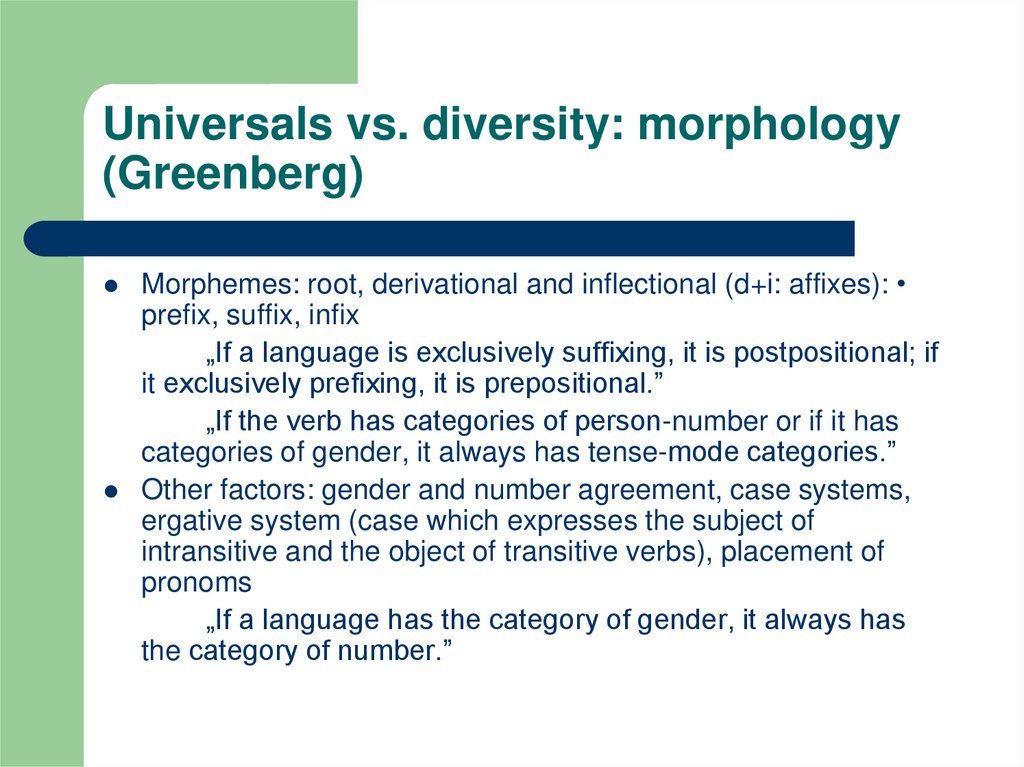
34. Universals vs. diversity: morphology (Greenberg)
Morphemes: root, derivational and inflectional (d+i: affixes):prefix, suffix, infix
„If a language is exclusively suffixing, it is postpositional; if
it exclusively prefixing, it is prepositional.”
„If the verb has categories of person-number or if it has
categories of gender, it always has tense-mode categories.”
Other factors: gender and number agreement, case systems,
ergative system (case which expresses the subject of
intransitive and the object of transitive verbs), placement of
pronoms
„If a language has the category of gender, it always has
the category of number.”
35. Universals vs. diversity: Morphology – according to E&L:
Universals vs. diversity: Morphology –according to E&L:
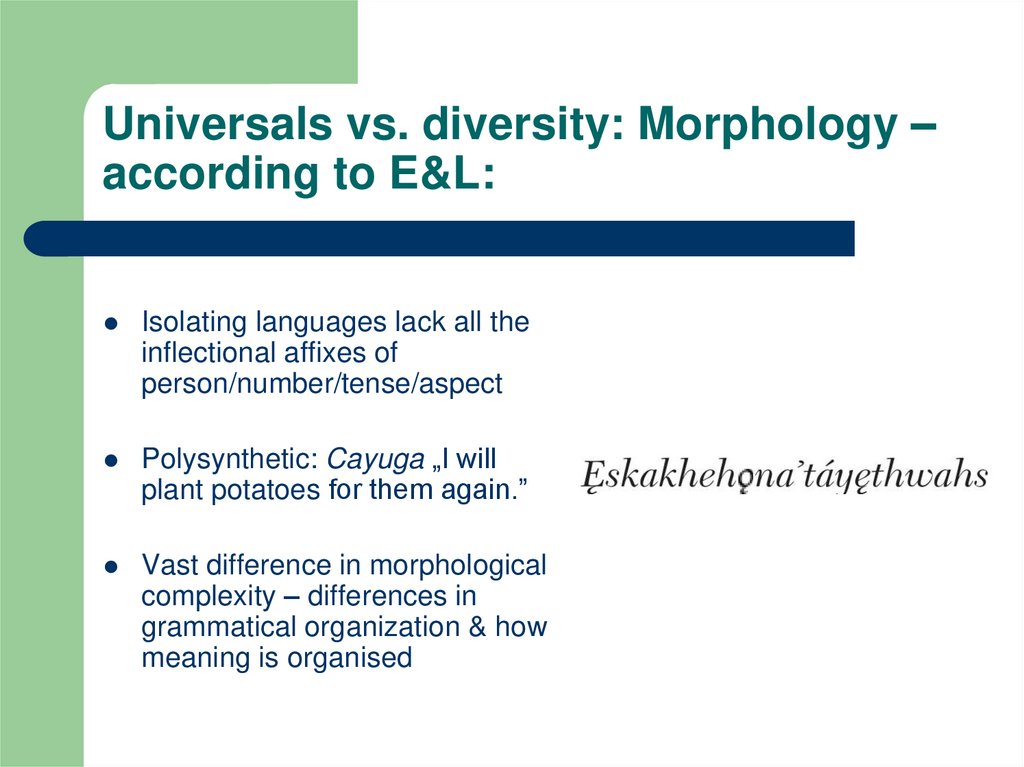
Isolating languages lack all the
inflectional affixes of
person/number/tense/aspect
Polysynthetic: Cayuga „I will
plant potatoes for them again.”
Vast difference in morphological
complexity – differences in
grammatical organization & how
meaning is organised
36. Semantics
J.Fodor - languages directly encode thecategories we think in, these constitute an
innate, universal „language of thought” or
„mentalese”. Learning language: matter of
finding out the local clothing for universalts
E&L: problem: languages differ enormously
in the concepts they provide and way of
coding
37. Universals vs. diversity: Recursion
Hauser: „the only uniquely human component of thefaculty of language.”
Chomsky: basic human property, must be genetic
Many language shows distinct limits or even lack it.
(E&L).
„…may not be found in the syntax of languages, it is
always found in the conceptual structure, that is, the
semantics or pragmatics” (E&L)
Polysynthetic languages – morphological complexity,
little syntactic organization.
38. Universals vs. diversity: Sound inventories and sign languages
There are natural human language without sound system =sign languages (121 doc.ed. – unrelated, complex systems)
Hereditary deafness – cultural adaptation – different conditions
„Is the language capacity modality-neutral?”
Phonology – hand shape, facial expressions and so on
‘Move – hold’ parallels ‘vowels – consonants’ rythm
Based on vocal tracts what speech sound is possible and
distinguishable
Mass diversity: „experts on sound systems are abandoning the
Jakobsonian idea of fixed set…phonological inventories”
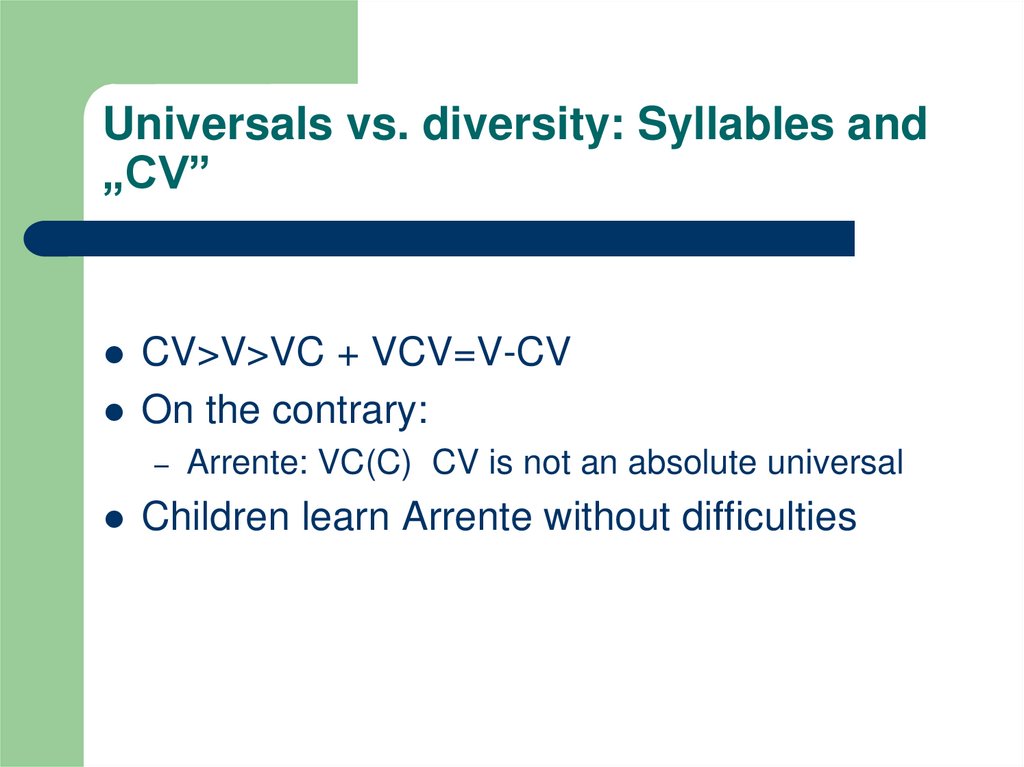
39. Universals vs. diversity: Syllables and „CV”
CV>V>VC + VCV=V-CVOn the contrary:
– Arrente: VC(C)
CV is not an absolute universal
Children learn Arrente without difficulties
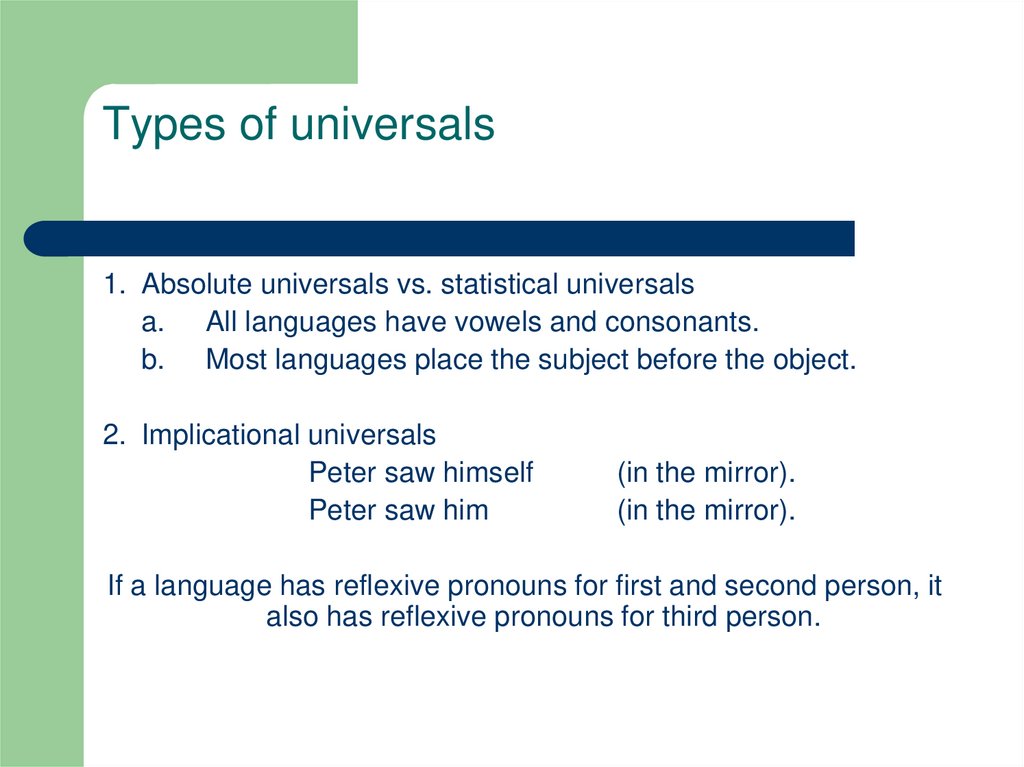
40. Types of universals
1. Absolute universals vs. statistical universalsa. All languages have vowels and consonants.
b. Most languages place the subject before the object.
2. Implicational universals
Peter saw himself
Peter saw him
(in the mirror).
(in the mirror).
If a language has reflexive pronouns for first and second person, it
also has reflexive pronouns for third person.
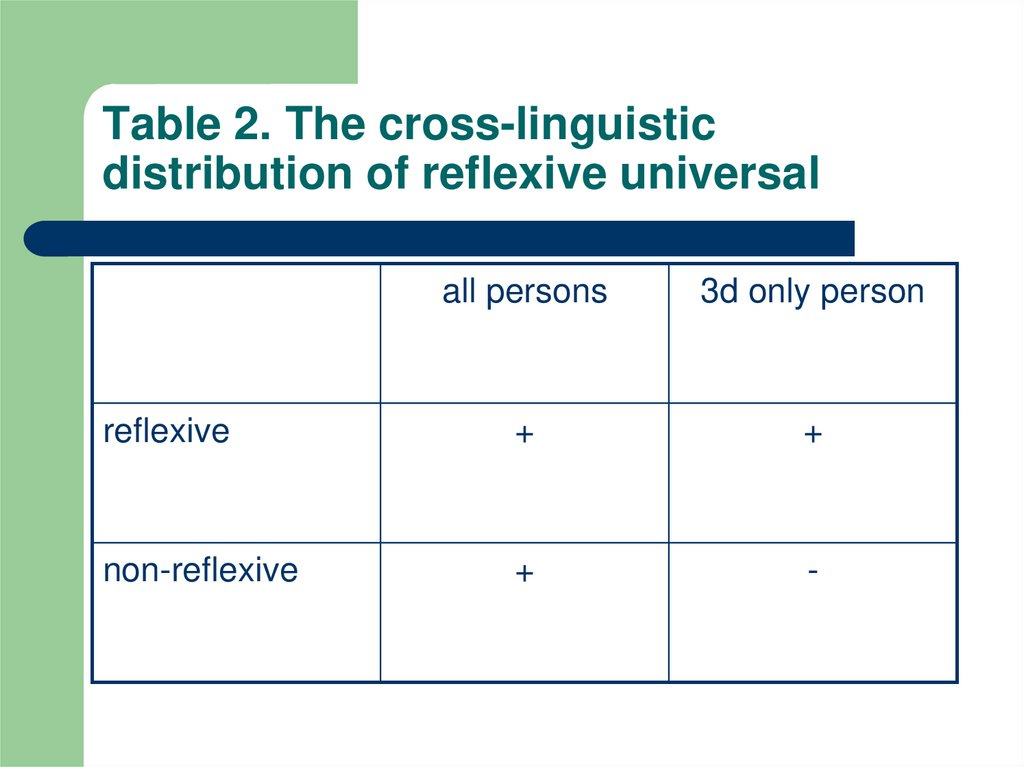
41. Table 2. The cross-linguistic distribution of reflexive universal
all persons3d only person
reflexive
+
+
non-reflexive
+
-
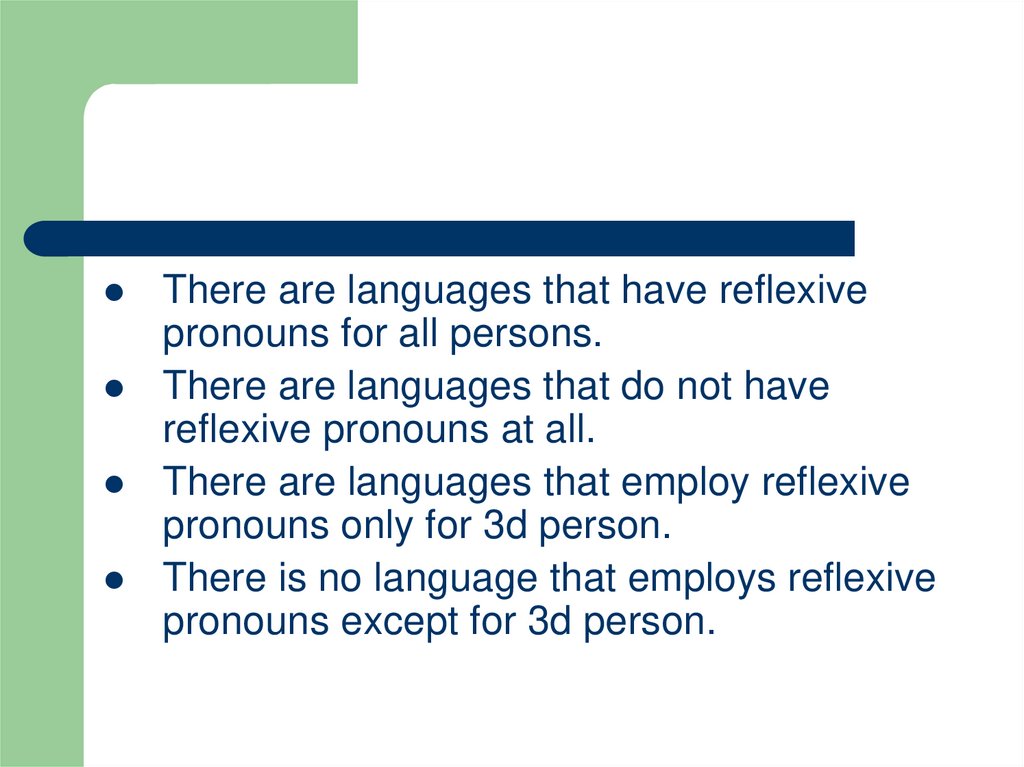
42.
There are languages that have reflexivepronouns for all persons.
There are languages that do not have
reflexive pronouns at all.
There are languages that employ reflexive
pronouns only for 3d person.
There is no language that employs reflexive
pronouns except for 3d person.
43.
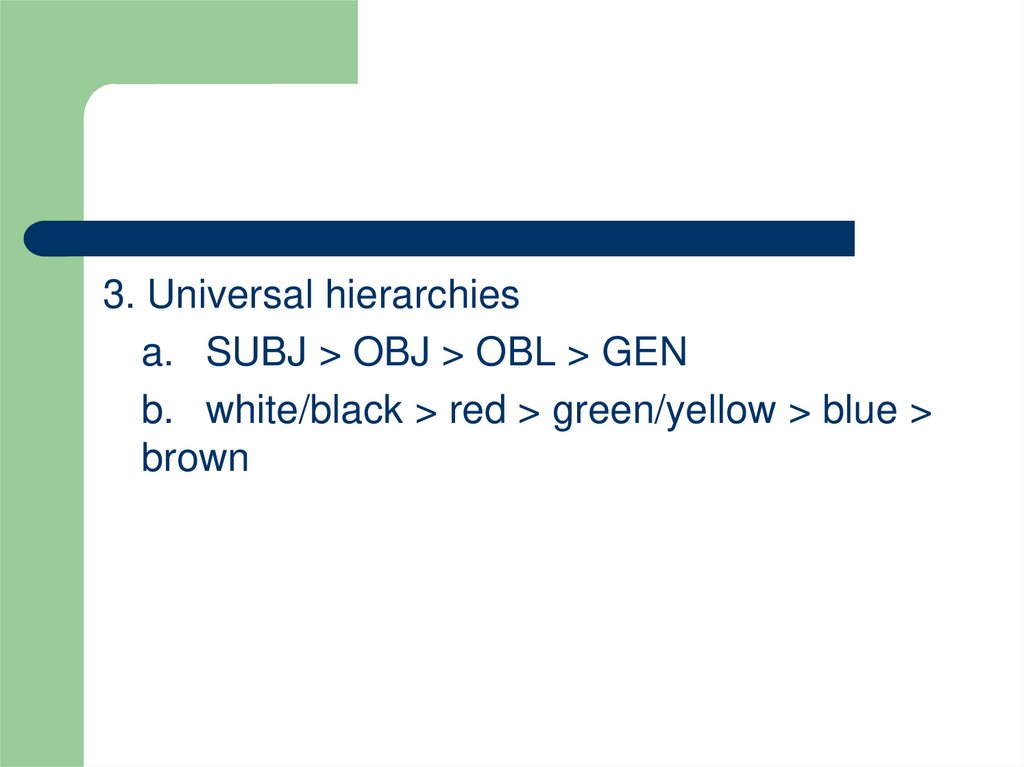
3. Universal hierarchiesa. SUBJ > OBJ > OBL > GEN
b. white/black > red > green/yellow > blue >
brown
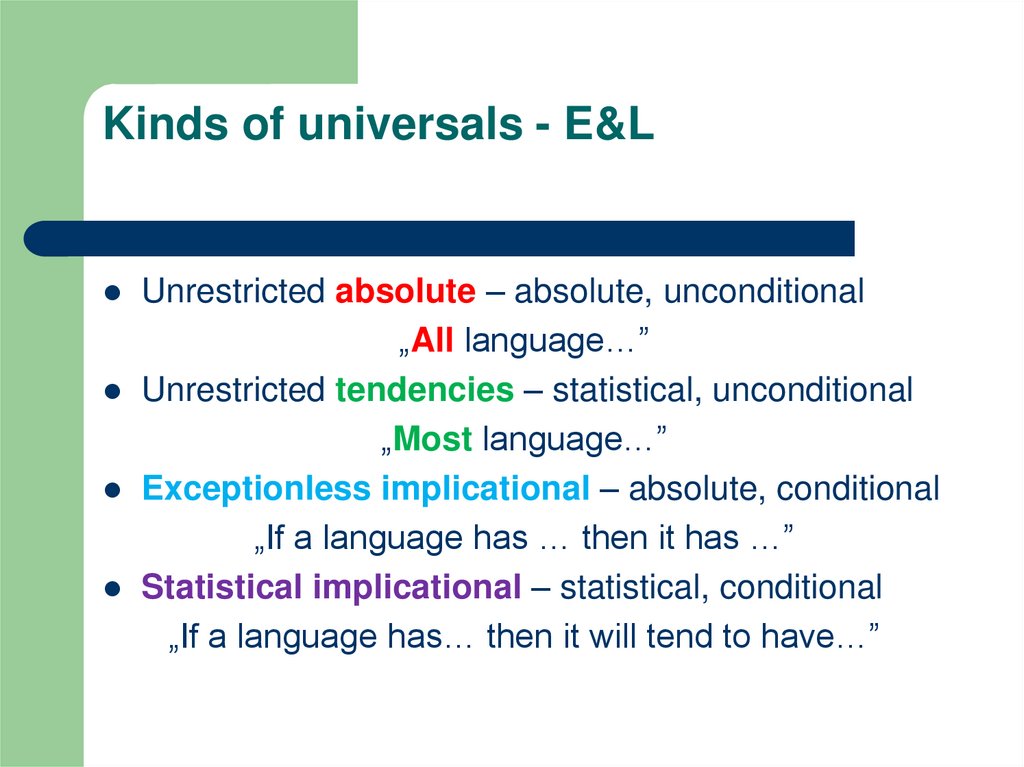
44. Kinds of universals - E&L
Kinds of universals - E&LUnrestricted absolute – absolute, unconditional
„All language…”
Unrestricted tendencies – statistical, unconditional
„Most language…”
Exceptionless implicational – absolute, conditional
„If a language has … then it has …”
Statistical implicational – statistical, conditional
„If a language has… then it will tend to have…”