 english
Similar presentations:




Comparative typolog
1.
COMPARATIVE TYPOLOGY2.
Comparative Linguistics1. General Comparative Linguistics:
-Descriptive (Synchronic) Linguistics
--Comparative Descriptive Linguistics and
Typological Linguistics;
--Historical Linguistics
2. Specialized Comparative Linguistics:
- Genetic Comparative Linguistics;
- Theory of Linguistic Contact;
- Areal Linguistics
3.
Theory of Linguistic Contact1. Theory of Bilingualism:
- Predictive Contrastive Analysis;
- Deep Structure Contrastive Analysis;
- Error Analysis;
- Theory of Translation.
2. Theory of Borrowing;
3. Theory of Areal Convergency :
4.
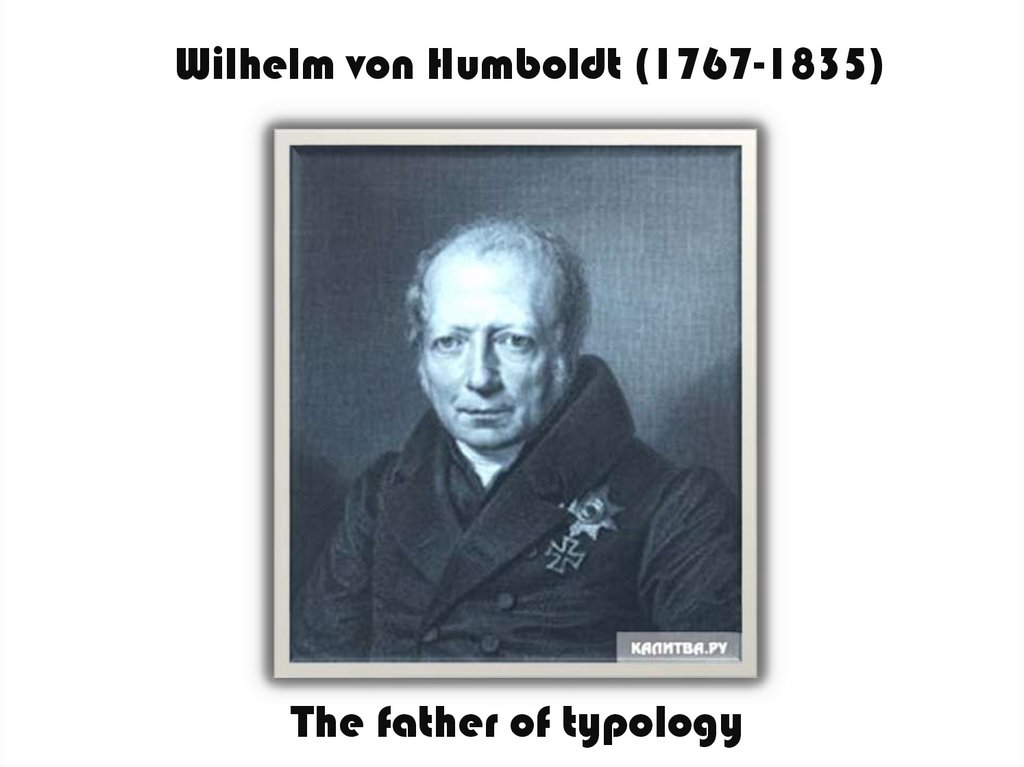
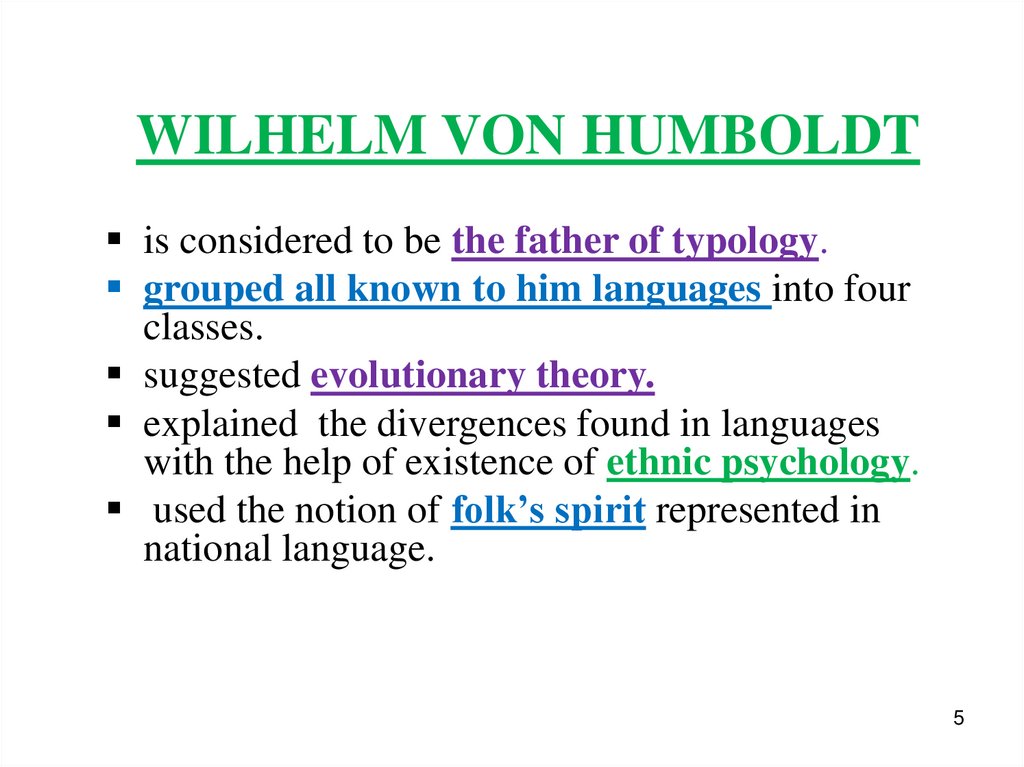
Wilhelm von Humboldt (1767-1835)The father of typology
5.
WILHELM VON HUMBOLDTis considered to be the father of typology.
grouped all known to him languages into four
classes.
suggested evolutionary theory.
explained the divergences found in languages
with the help of existence of ethnic psychology.
used the notion of folk’s spirit represented in
national language.
5
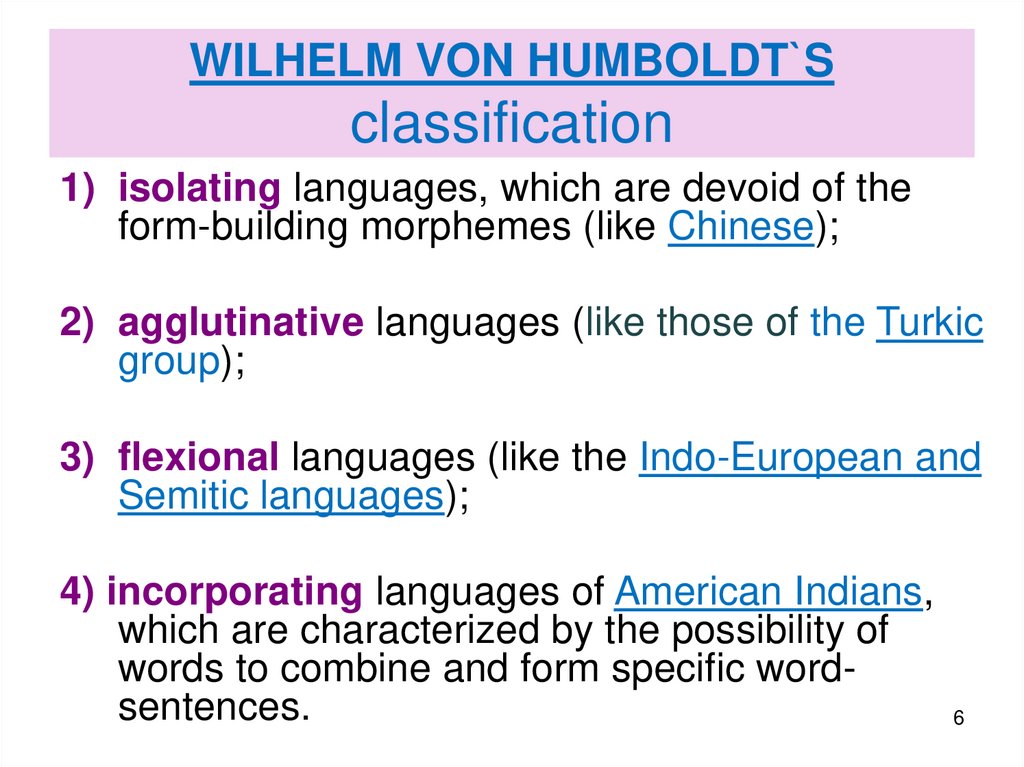
6. WILHELM VON HUMBOLDT`S classification
1) isolating languages, which are devoid of theform-building morphemes (like Chinese);
2) agglutinative languages (like those of the Turkic
group);
3) flexional languages (like the Indo-European and
Semitic languages);
4) incorporating languages of American Indians,
which are characterized by the possibility of
words to combine and form specific wordsentences.
6
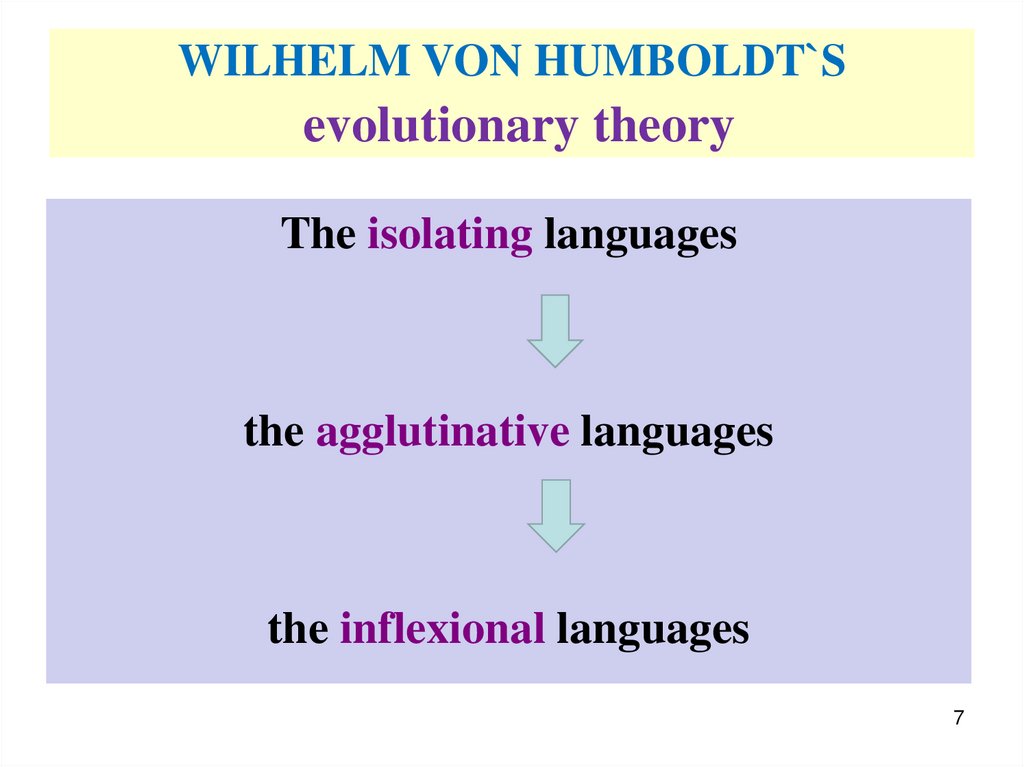
7. WILHELM VON HUMBOLDT`S evolutionary theory
The isolating languagesthe agglutinative languages
the inflexional languages
7
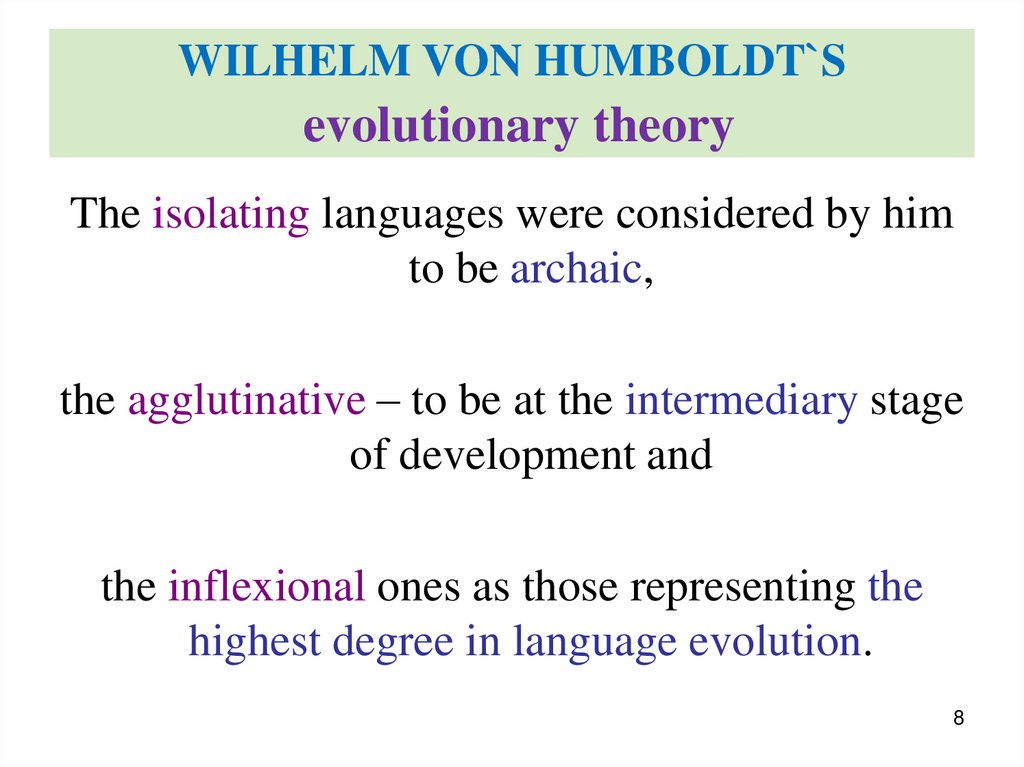
8. WILHELM VON HUMBOLDT`S evolutionary theory
The isolating languages were considered by himto be archaic,
the agglutinative – to be at the intermediary stage
of development and
the inflexional ones as those representing the
highest degree in language evolution.
8
9. 19th century
• IN THE FIRST HALF OF THE 19TH CENTURYTYPOLOGICAL INVESTIGATIONS BASED ON THE
MORPHOLOGICAL PRINCIPLE.
• DIFFERENT STRUCTURAL TYPES OF LANGUAGES
REVEALED AS THE STAGES OF ONE PROCESS OF THE
DEVELOPMENT OF LANGUAGES IN GENERAL AS
THE MOVEMENT FROM LESS PERFECT TO MORE
PERFECT.
9
10. 19th century
1. All through the second half of the 19th century theonly object of typological investigation was
a word / word-form.
1. investigated with an accent on its common and
divergent features with the aim to establish a
universal morphological classification.
2. in some researches the object of investigation
moved from morphology to syntax.
10
11. 20th CENTURY TYPOLOGICAL INVESTIGATIONS:
• MULTILATERAL OR GRADEDTYPOLOGY
• CHARACTEREOLOGICAL TYPOLOGY
• QUANTITATIVE TYPOLOGY
11
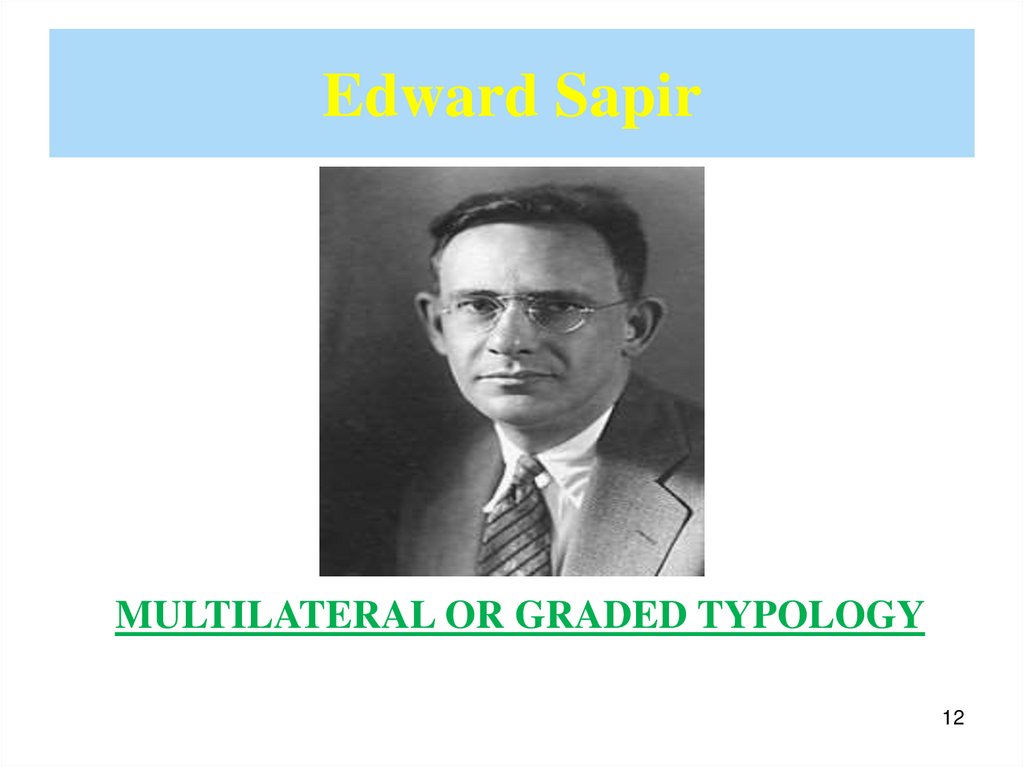
12. Edward Sapir
MULTILATERAL OR GRADED TYPOLOGY12
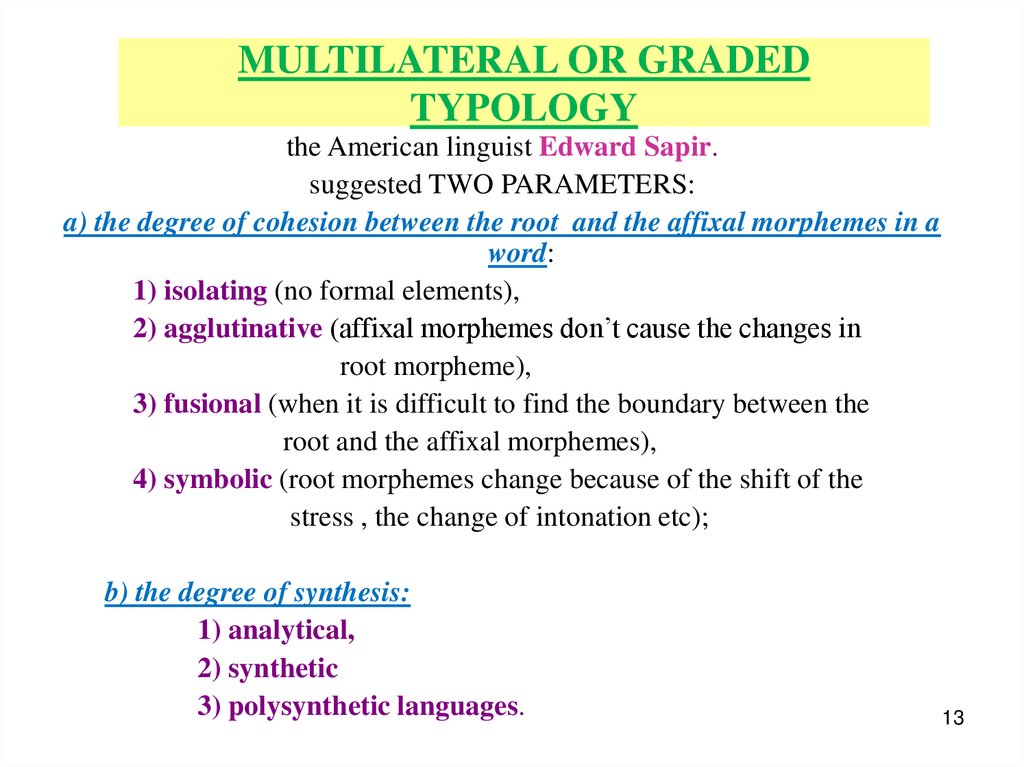
13. MULTILATERAL OR GRADED TYPOLOGY
the American linguist Edward Sapir.suggested TWO PARAMETERS:
a) the degree of cohesion between the root and the affixal morphemes in a
word:
1) isolating (no formal elements),
2) agglutinative (affixal morphemes don’t cause the changes in
root morpheme),
3) fusional (when it is difficult to find the boundary between the
root and the affixal morphemes),
4) symbolic (root morphemes change because of the shift of the
stress , the change of intonation etc);
b) the degree of synthesis:
1) analytical,
2) synthetic
3) polysynthetic languages.
13
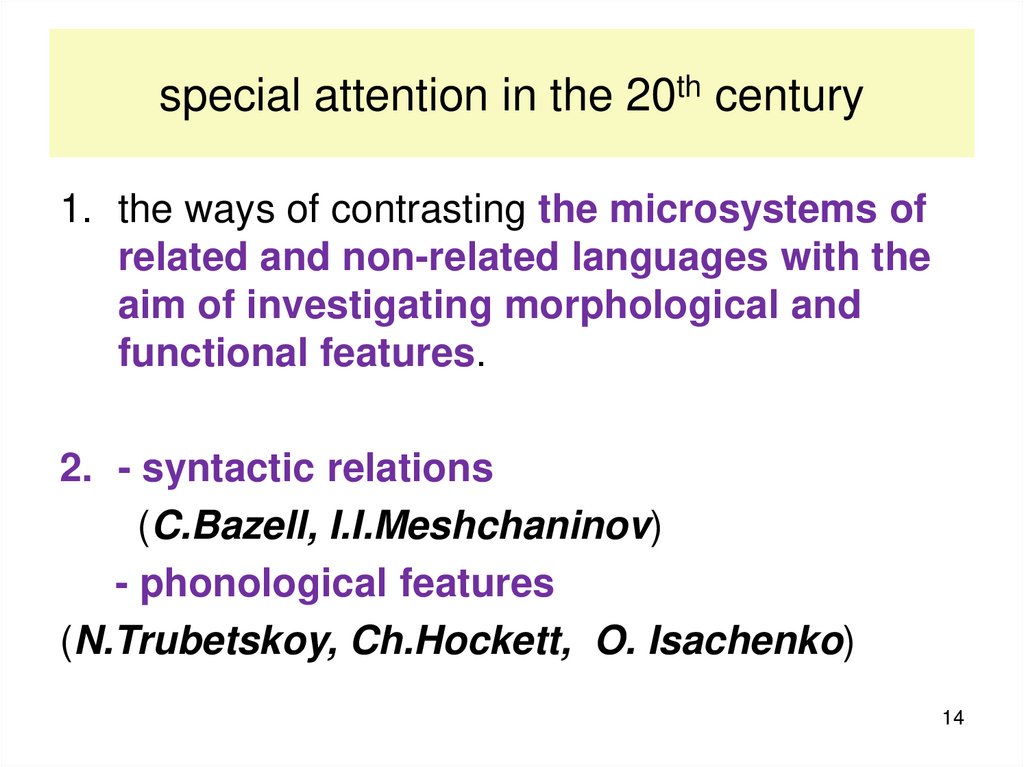
14. special attention in the 20th century
1. the ways of contrasting the microsystems ofrelated and non-related languages with the
aim of investigating morphological and
functional features.
2. - syntactic relations
(C.Bazell, I.I.Meshchaninov)
- phonological features
(N.Trubetskoy, Ch.Hockett, O. Isachenko)
14
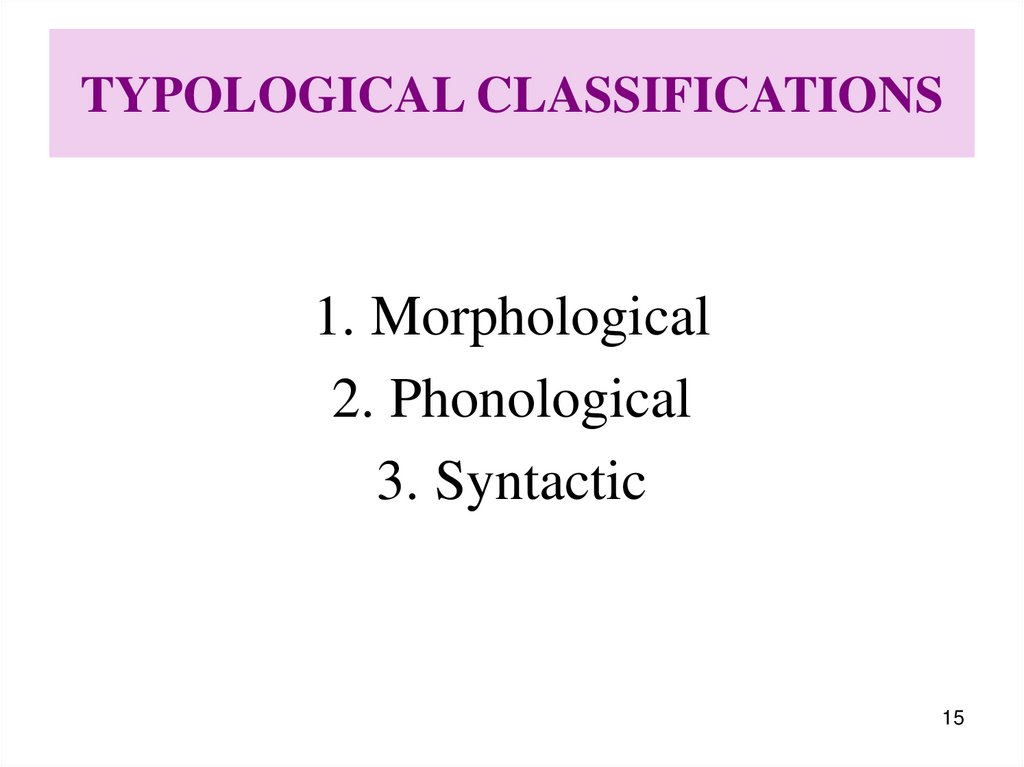
15. TYPOLOGICAL CLASSIFICATIONS
1. Morphological2. Phonological
3. Syntactic
15
16.
MORPHOLOGICALCLASSIFICATION
( W. Humboldt)
16
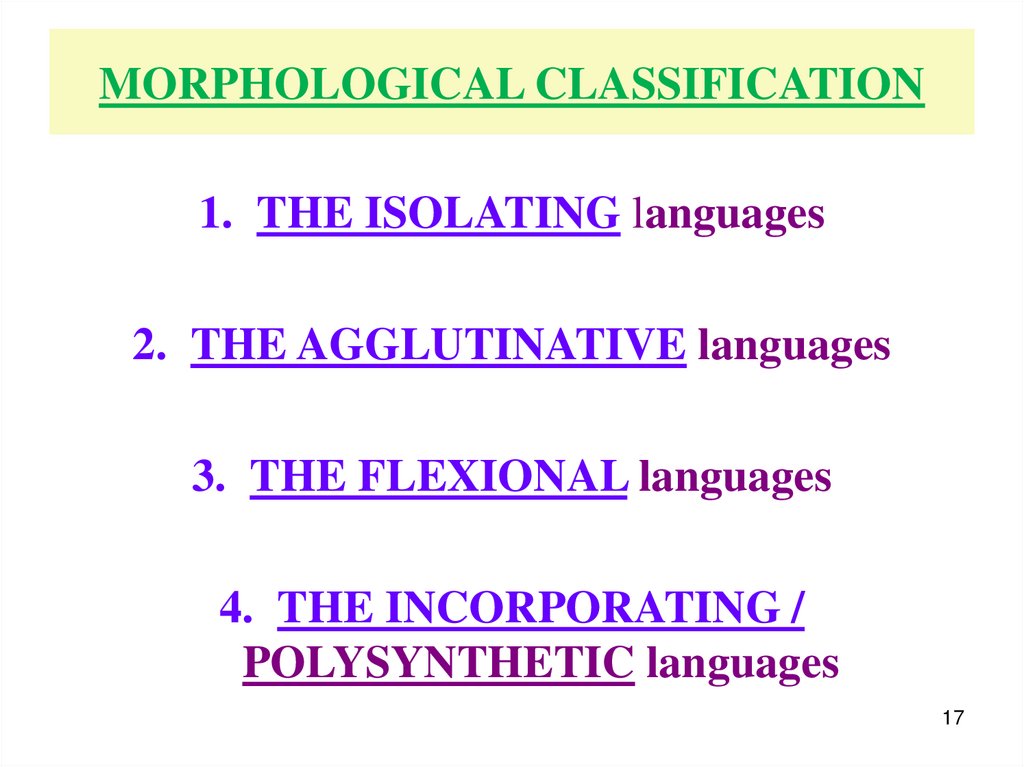
17. MORPHOLOGICAL CLASSIFICATION
1. THE ISOLATING languages2. THE AGGLUTINATIVE languages
3. THE FLEXIONAL languages
4. THE INCORPORATING /
POLYSYNTHETIC languages
17
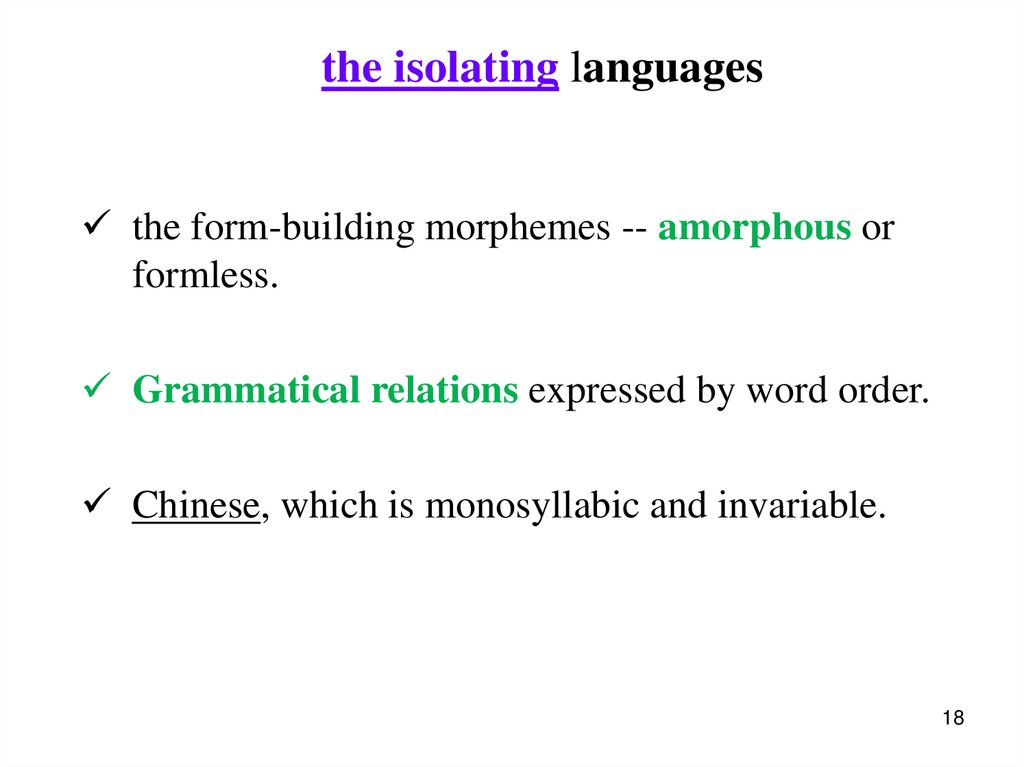
18. the isolating languages
the form-building morphemes -- amorphous orformless.
Grammatical relations expressed by word order.
Chinese, which is monosyllabic and invariable.
18
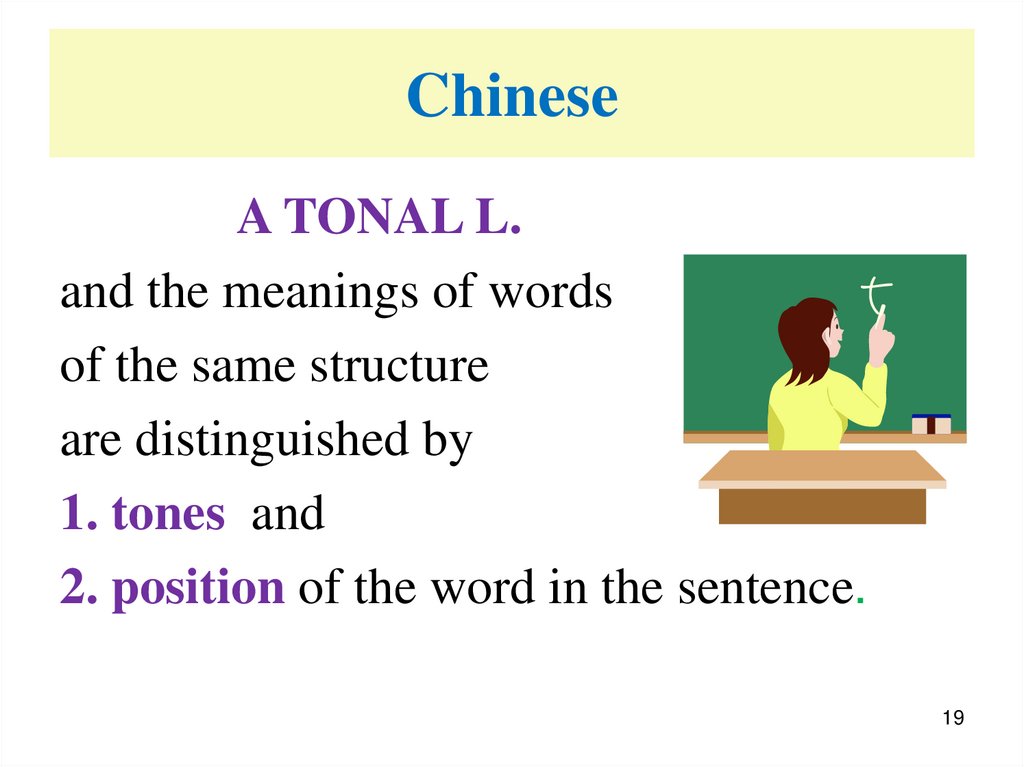
19. Chinese
A TONAL L.and the meanings of words
of the same structure
are distinguished by
1. tones and
2. position of the word in the sentence.
19
20.
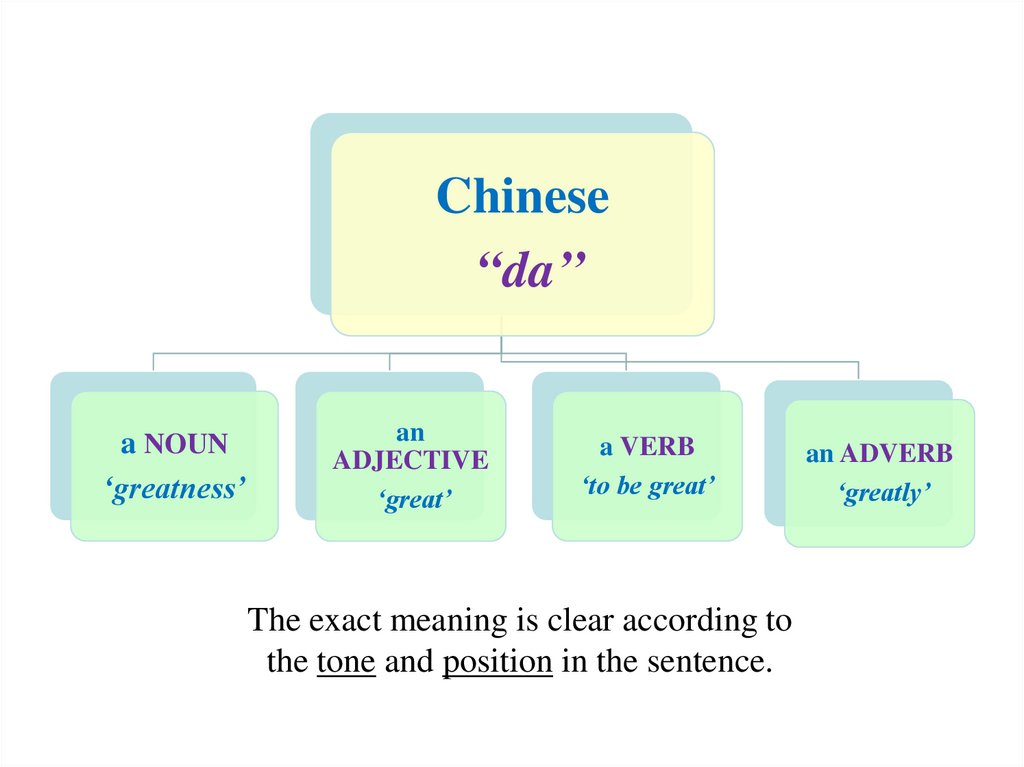
Chinese‘‘da’’
a NOUN
‘greatness’
an
ADJECTIVE
‘great’
a VERB
‘to be great’
The exact meaning is clear according to
the tone and position in the sentence.
an ADVERB
‘greatly’
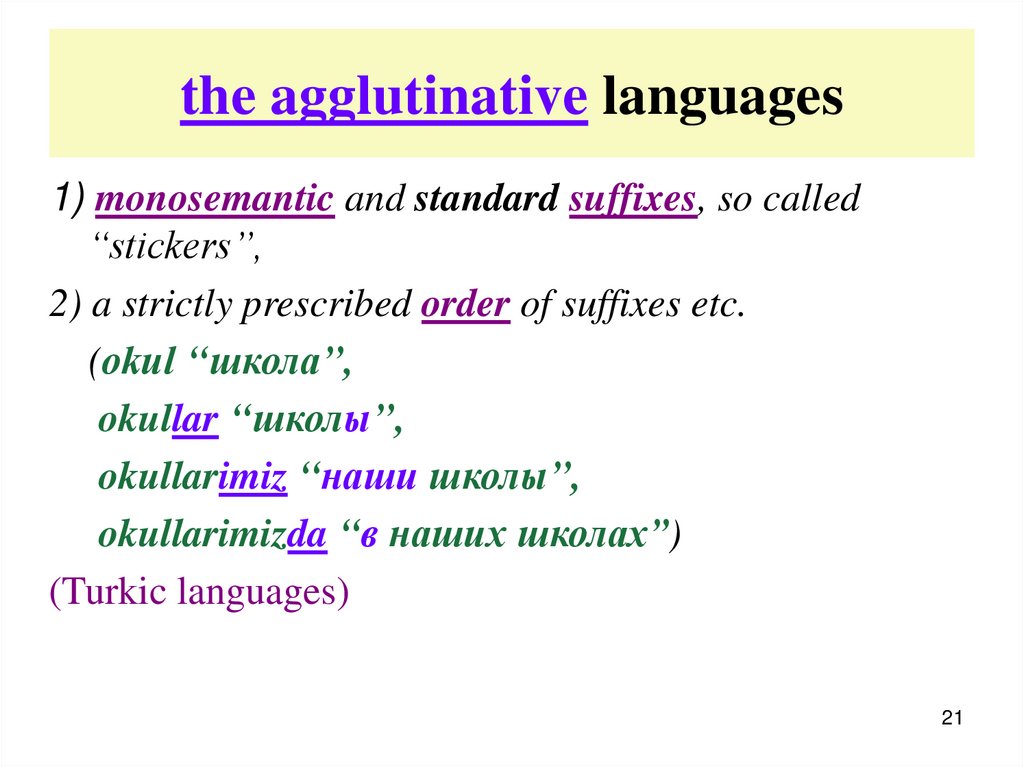
21. the agglutinative languages
1) monosemantic and standard suffixes, so called‘‘stickers’’,
2) a strictly prescribed order of suffixes etc.
(okul ‘‘школа’’,
okullar ‘‘школы’’,
okullarimiz ‘‘наши школы’’,
okullarimizda ‘‘в наших школах”)
(Turkic languages)
21
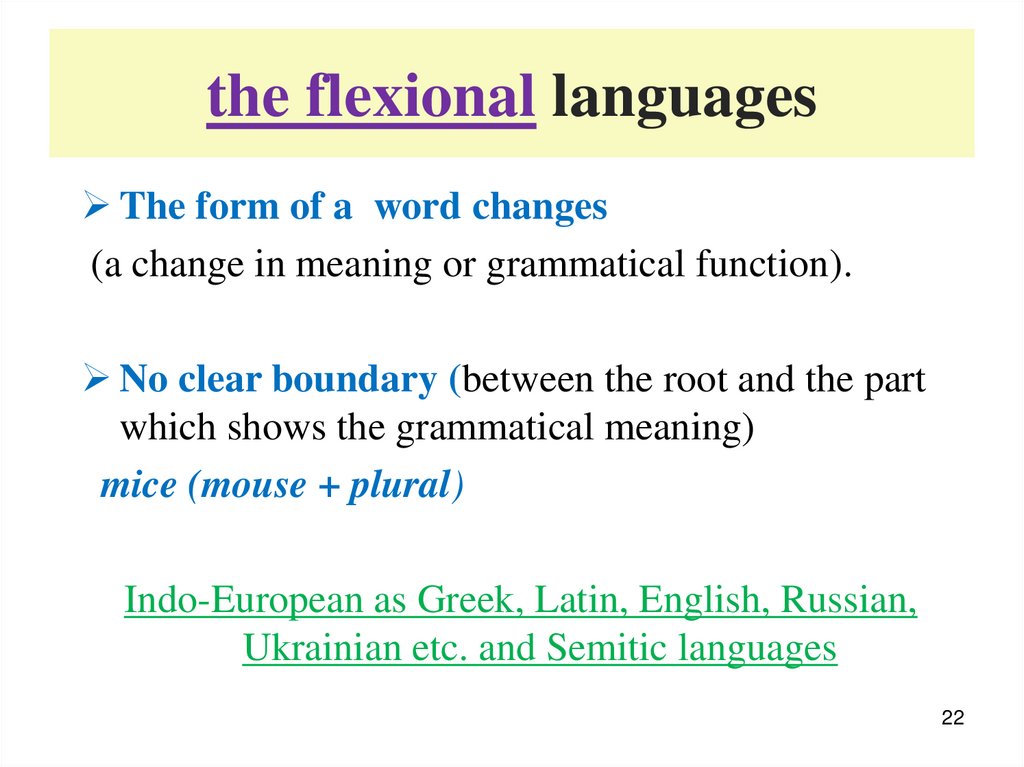
22. the flexional languages
The form of a word changes(a change in meaning or grammatical function).
No clear boundary (between the root and the part
which shows the grammatical meaning)
mice (mouse + plural)
Indo-European as Greek, Latin, English, Russian,
Ukrainian etc. and Semitic languages
22
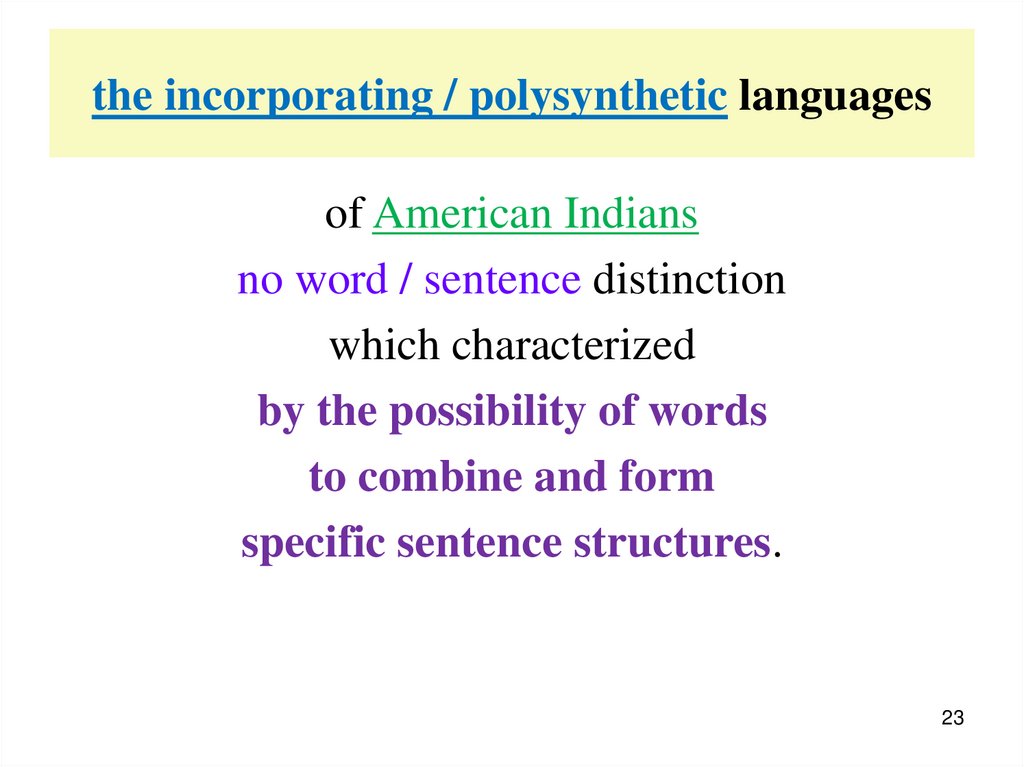
23. the incorporating / polysynthetic languages
of American Indiansno word / sentence distinction
which characterized
by the possibility of words
to combine and form
specific sentence structures.
23
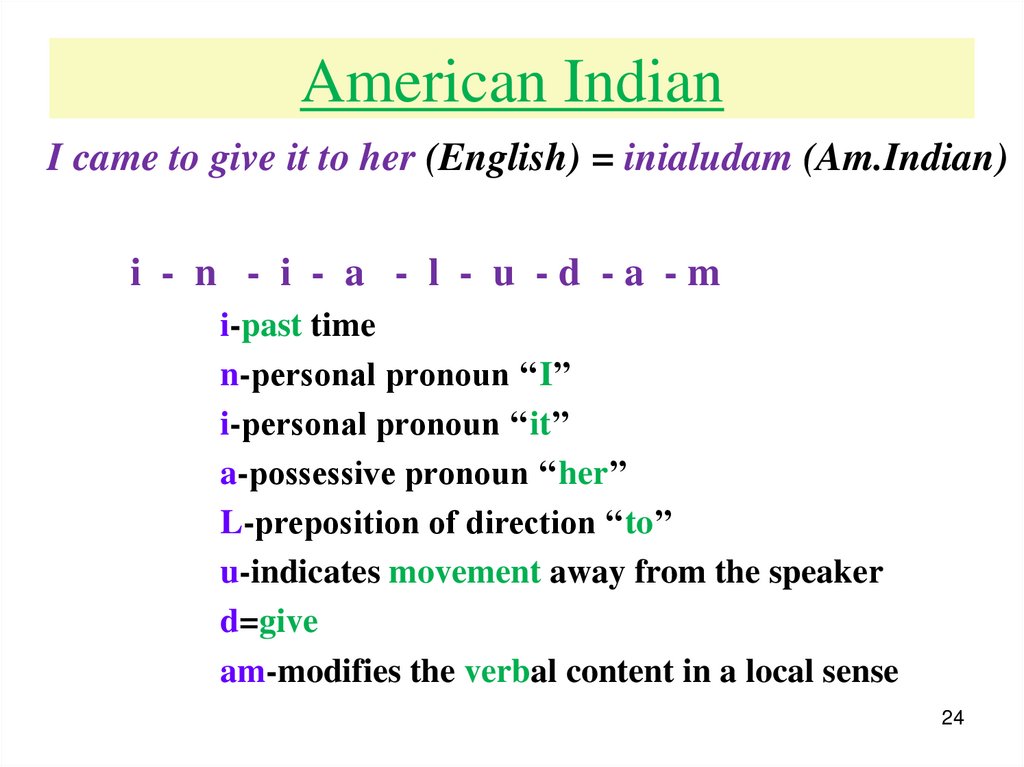
24. American Indian
I came to give it to her (English) = inialudam (Am.Indian)i - n - i - a - l - u -d -a -m
i-past time
n-personal pronoun ‘‘I’’
i-personal pronoun ‘‘it’’
a-possessive pronoun ‘‘her’’
L-preposition of direction ‘‘to’’
u-indicates movement away from the speaker
d=give
am-modifies the verbal content in a local sense
24
25.
PHONOLOGICALCLASSIFICATION
25
26. PHONOLOGICAL CLASSIFICATION (after O. Isachenko)
• CONSONENTAL• VOCALIC
26
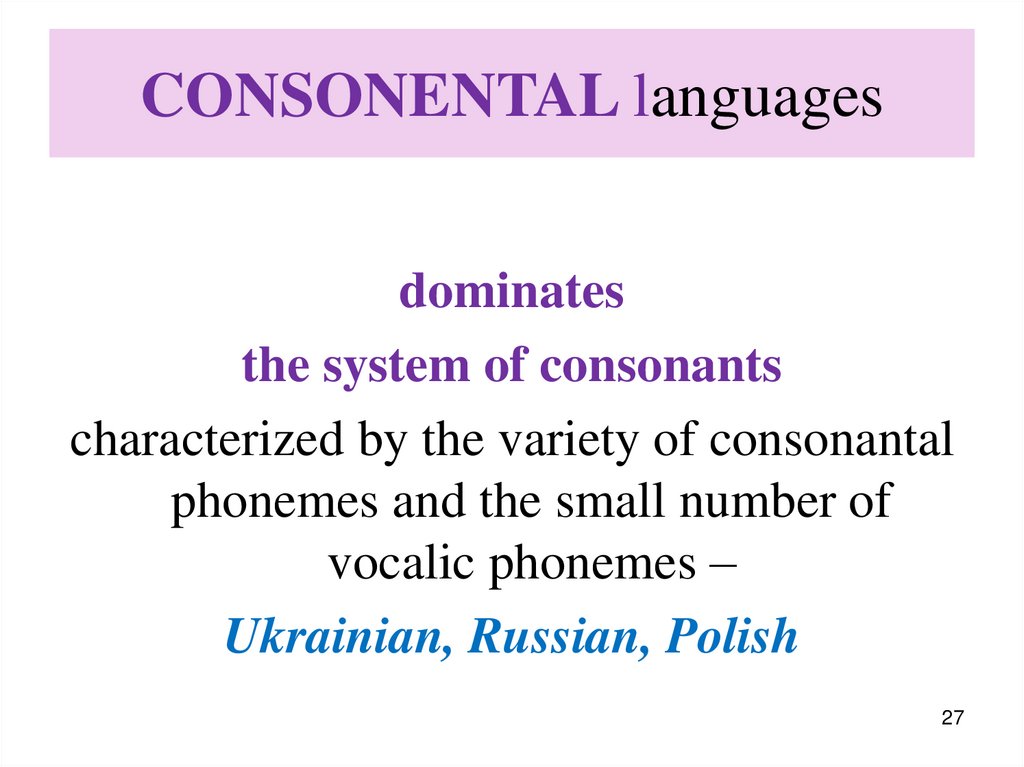
27. CONSONENTAL languages
dominatesthe system of consonants
characterized by the variety of consonantal
phonemes and the small number of
vocalic phonemes –
Ukrainian, Russian, Polish
27
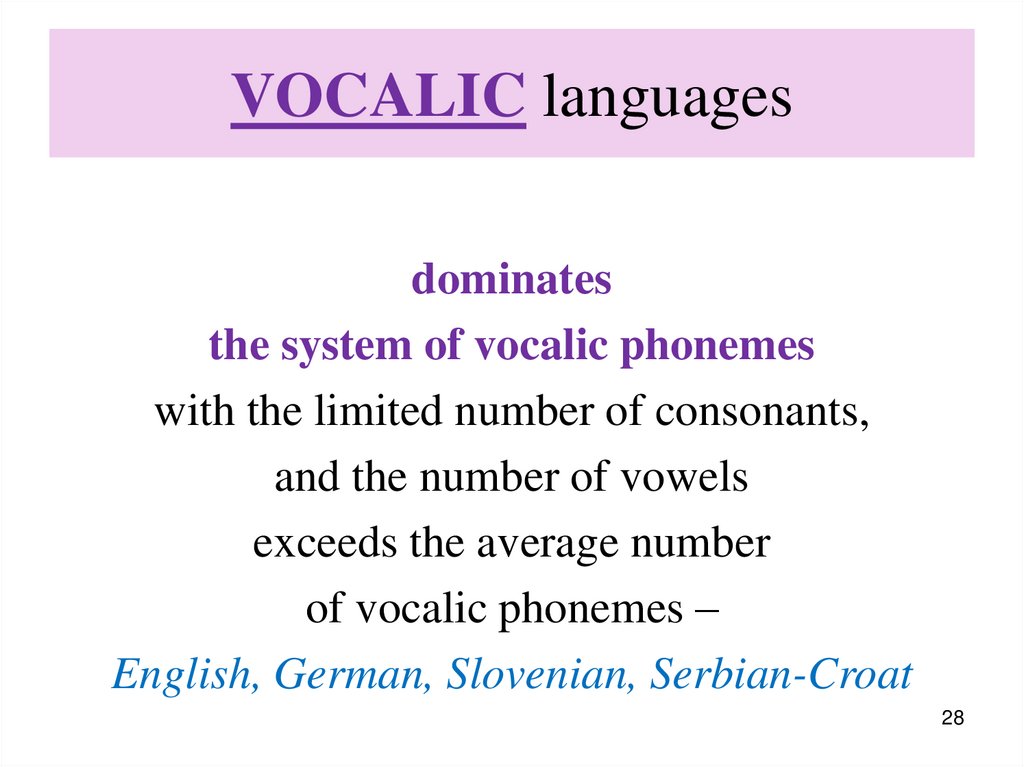
28. VOCALIC languages
dominatesthe system of vocalic phonemes
with the limited number of consonants,
and the number of vowels
exceeds the average number
of vocalic phonemes –
English, German, Slovenian, Serbian-Croat
28
29.
syntactic classifications29
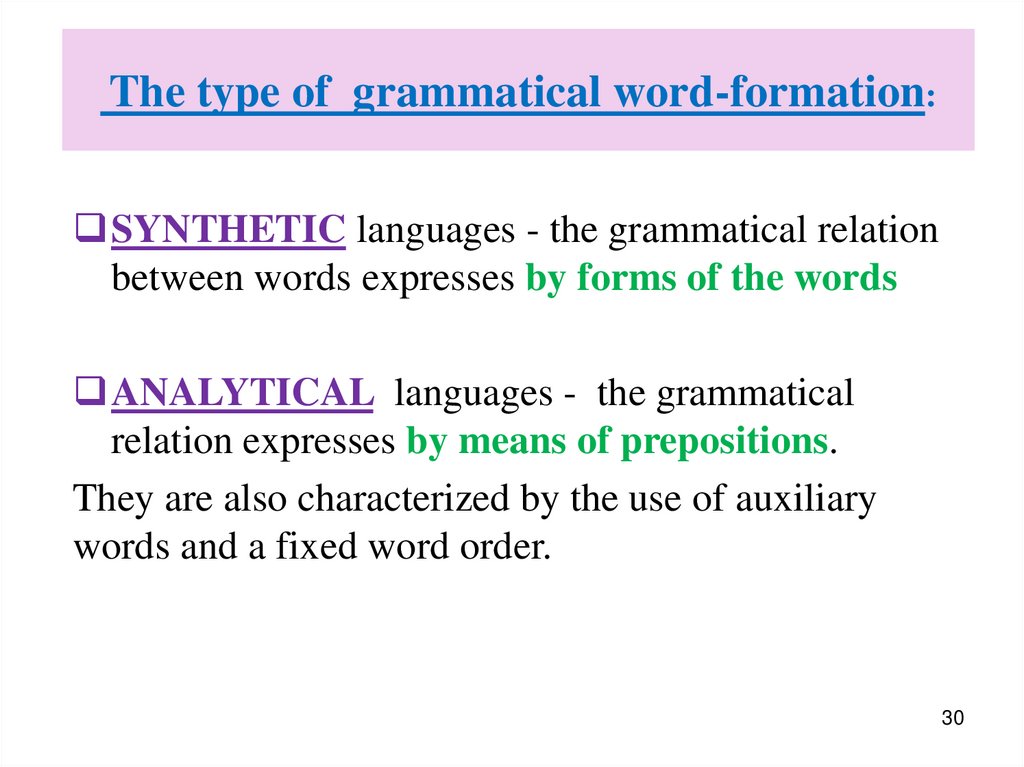
30. The type of grammatical word-formation:
SYNTHETIC languages - the grammatical relationbetween words expresses by forms of the words
ANALYTICAL languages - the grammatical
relation expresses by means of prepositions.
They are also characterized by the use of auxiliary
words and a fixed word order.
30
31.
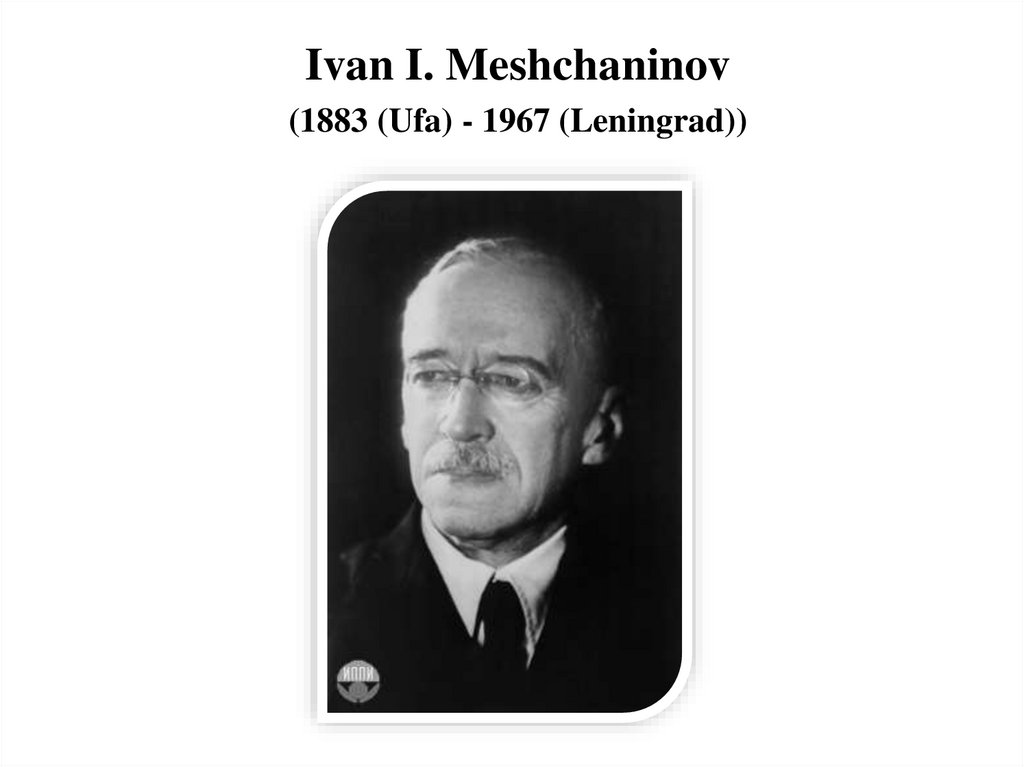
Ivan I. Meshchaninov(1883 (Ufa) - 1967 (Leningrad))
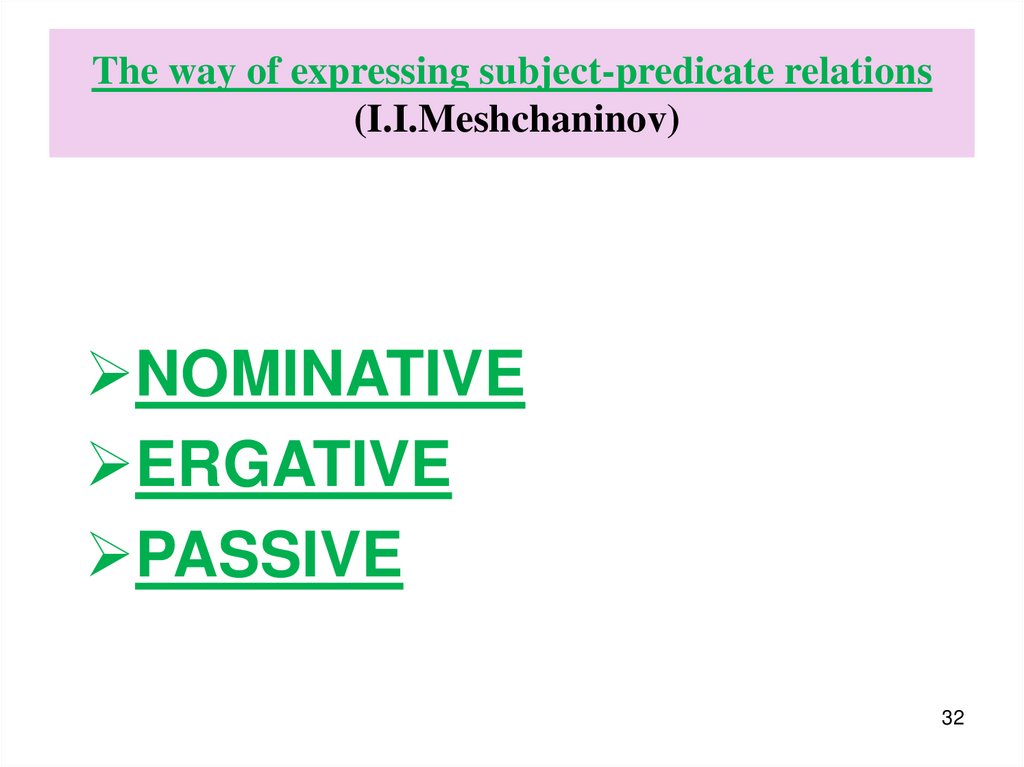
32. The way of expressing subject-predicate relations (I.I.Meshchaninov)
NOMINATIVEERGATIVE
PASSIVE
32
33. NOMINATIVE languages
subject - the doer of the actionand uses only in the Nominative Case
(Indo-European and Semitic L.).
33
34. ERGATIVE languages
1) There is no positional differencebetween the subject and the object.
2) The subject is in the Ergative Case.
34
35. PASSIVE languages
Neither the subject nor the object have specialgrammatical forming up within the syntactic
unit. They merge with the verb-predicate
into a single unit, in which the predicate is a
leading component (incorporative L.).
35
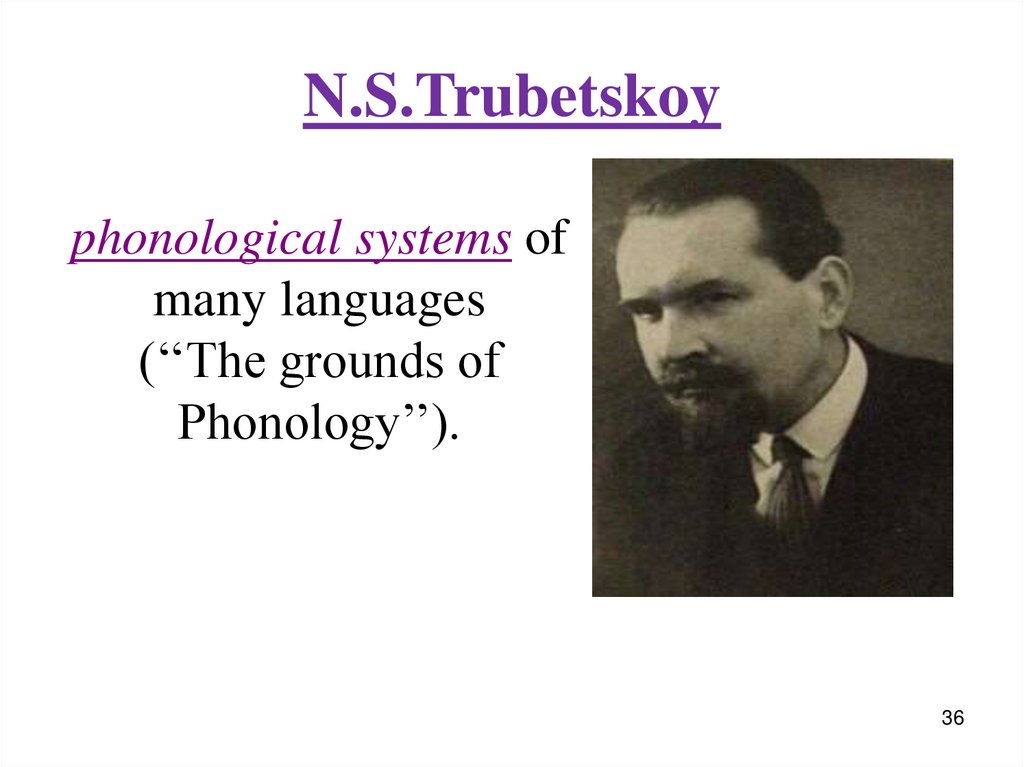
36. N.S.Trubetskoy
phonological systems ofmany languages
(‘‘The grounds of
Phonology’’).
36
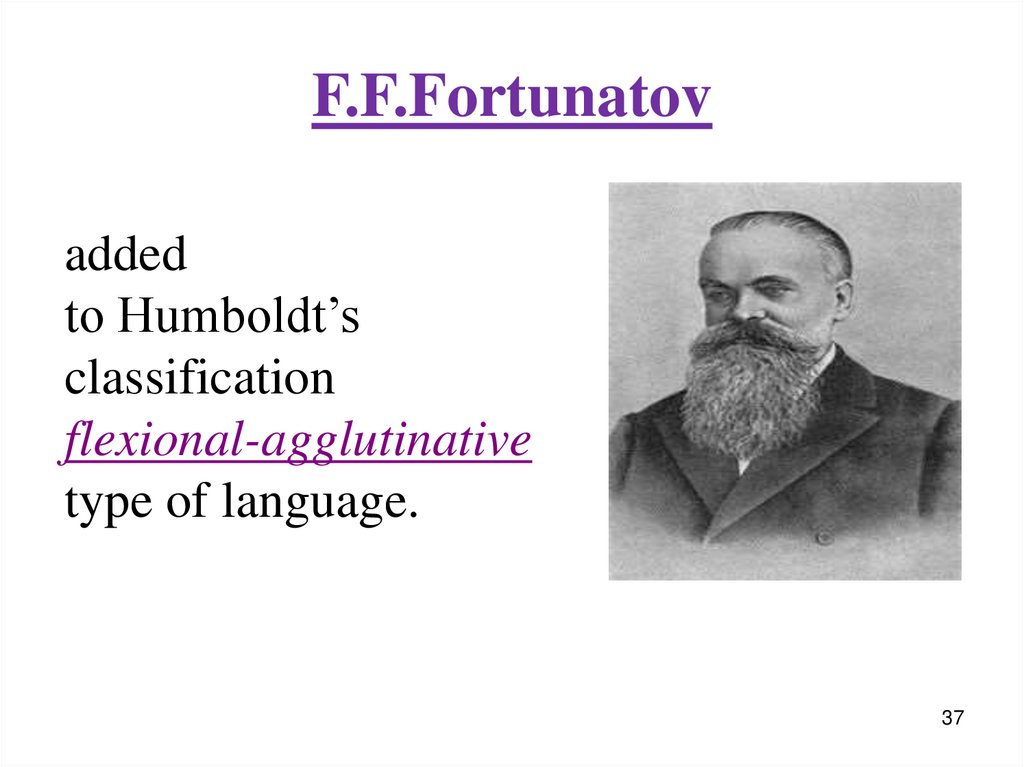
37. F.F.Fortunatov
addedto Humboldt’s
classification
flexional-agglutinative
type of language.
37
38.
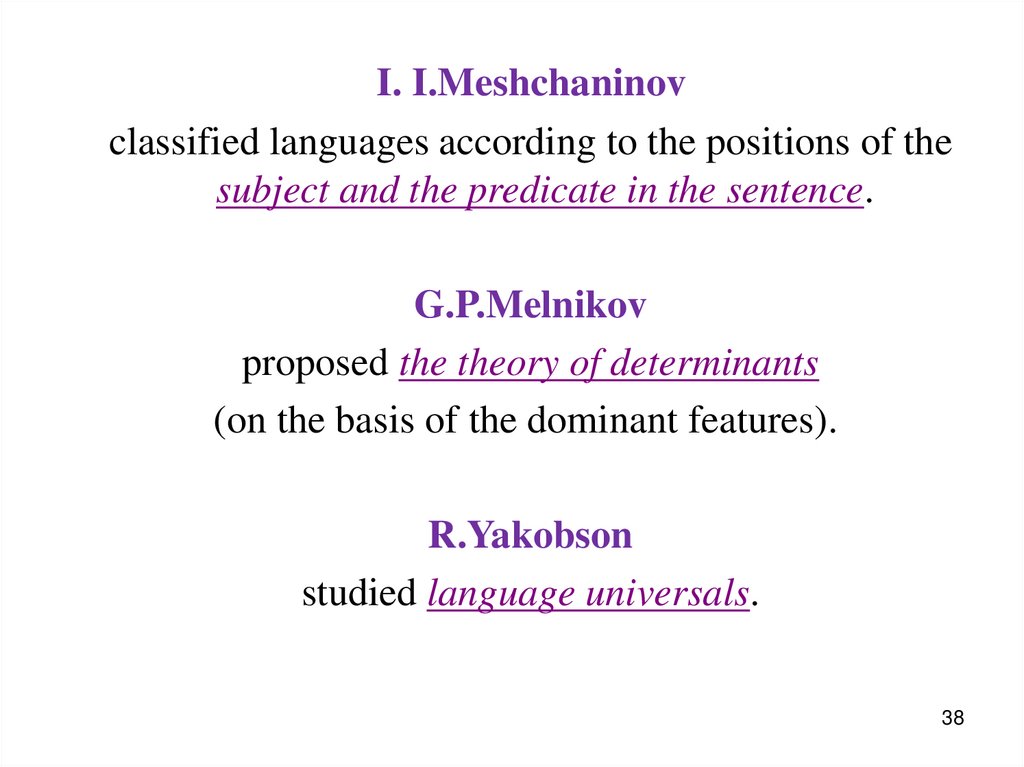
I. I.Meshchaninovclassified languages according to the positions of the
subject and the predicate in the sentence.
G.P.Melnikov
proposed the theory of determinants
(on the basis of the dominant features).
R.Yakobson
studied language universals.
38
39.
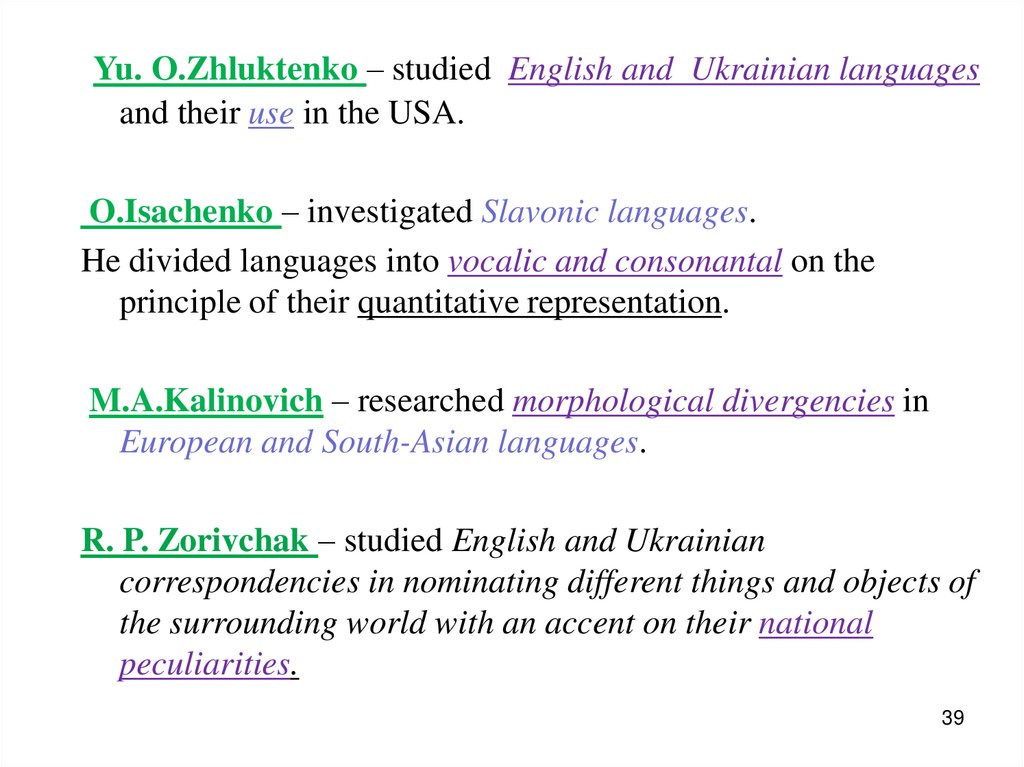
Yu. O.Zhluktenko – studied English and Ukrainian languagesand their use in the USA.
O.Isachenko – investigated Slavonic languages.
He divided languages into vocalic and consonantal on the
principle of their quantitative representation.
M.A.Kalinovich – researched morphological divergencies in
European and South-Asian languages.
R. P. Zorivchak – studied English and Ukrainian
correspondencies in nominating different things and objects of
the surrounding world with an accent on their national
peculiarities.
39