 mechanics
Similar presentations:






Linear Motion
1.
EE007-4-0 Mechanics For EngineersTopic 10 : Linear Motion
EE007-4-0 Mechanics For Engineers
Linear Motion
SLIDE 1
2. TOPIC LEARNING OUTCOMES
At the end of this topic, you should be able to:1. Differentiate position, displacement and distance.
2. Use differentiation or integration to obtain equations for position, velocity and
acceleration and subsequently solve the questions
3. Solve problems on motion with constant acceleration by using kinematics
equations
EE007-4-0 Mechanics For Engineers
Linear Motion
SLIDE 2
3. Contents & Structure
Contents & Structure• Rectilinear Motion – constant acceleration and variable acceleration
EE007-4-0 Mechanics For Engineers
Linear Motion
SLIDE 3
4. Recap From Last Lesson
• Dry FrictionEE007-4-0 Mechanics For Engineers
Linear Motion
SLIDE 4
5. DYNAMICS
Teaching ContentsDYNAMICS
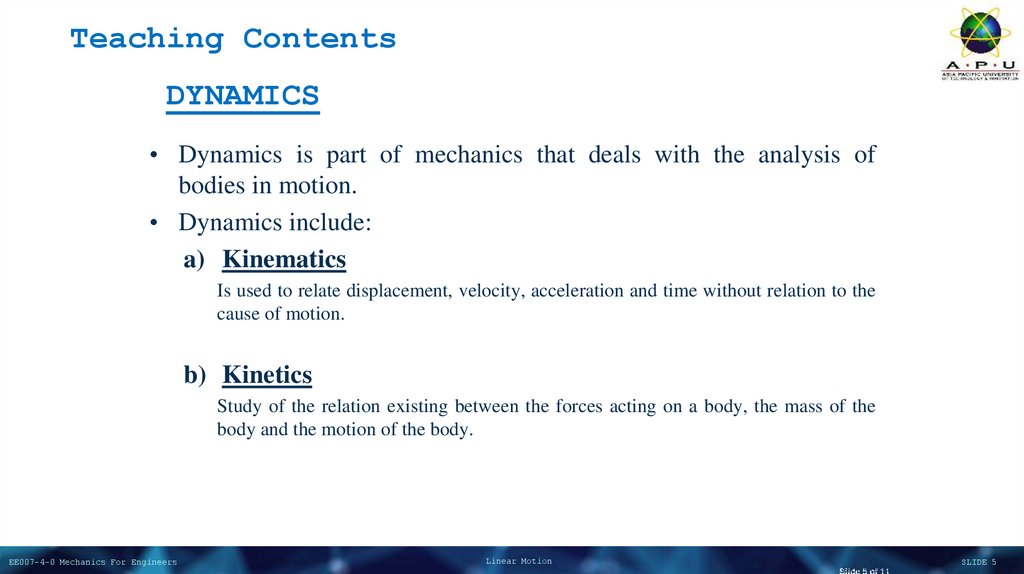
• Dynamics is part of mechanics that deals with the analysis of
bodies in motion.
• Dynamics include:
a) Kinematics
Is used to relate displacement, velocity, acceleration and time without relation to the
cause of motion.
b) Kinetics
Study of the relation existing between the forces acting on a body, the mass of the
body and the motion of the body.
EE007-4-0 Mechanics For Engineers
Linear Motion
‹#›
Slide 55 of
of 24
Slide
11
SLIDE 5
6. RECTILINEAR MOTION
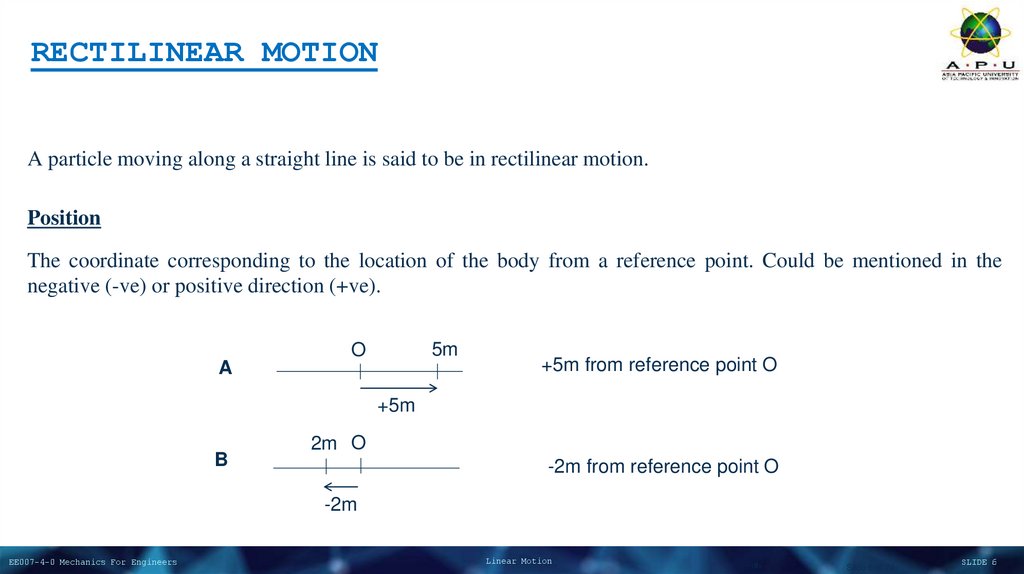
A particle moving along a straight line is said to be in rectilinear motion.Position
The coordinate corresponding to the location of the body from a reference point. Could be mentioned in the
negative (-ve) or positive direction (+ve).
5m
O
A
+5m from reference point O
+5m
B
2m O
-2m from reference point O
-2m
EE007-4-0 Mechanics For Engineers
Linear Motion
‹#›
Slide 6 of 24
SLIDE 6
7. RECTILINEAR MOTION
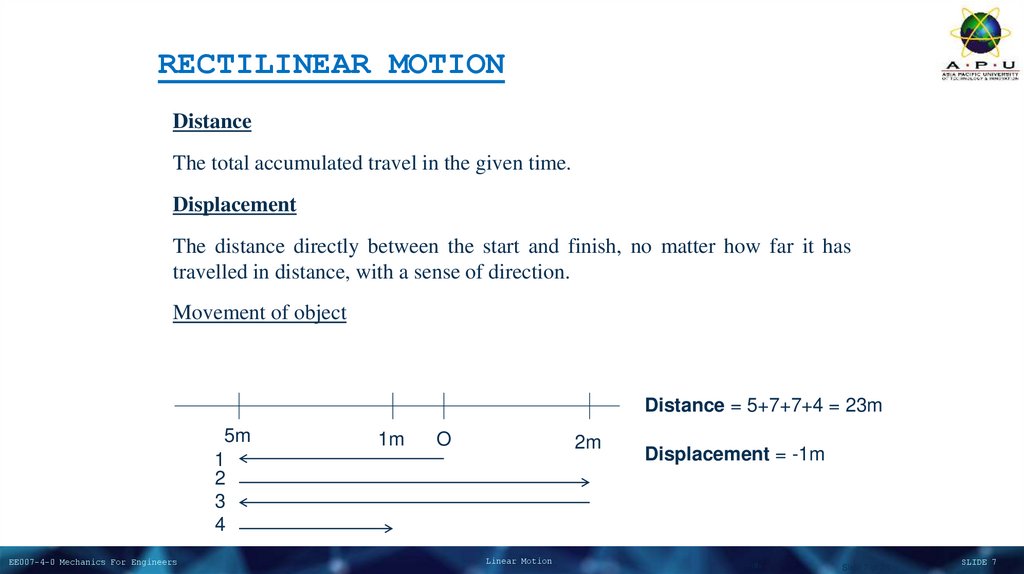
DistanceThe total accumulated travel in the given time.
Displacement
The distance directly between the start and finish, no matter how far it has
travelled in distance, with a sense of direction.
Movement of object
Distance = 5+7+7+4 = 23m
5m
1
2
3
4
EE007-4-0 Mechanics For Engineers
1m
O
2m
Linear Motion
Displacement = -1m
‹#›
Slide 7 of 24
SLIDE 7
8. RECTILINEAR MOTION
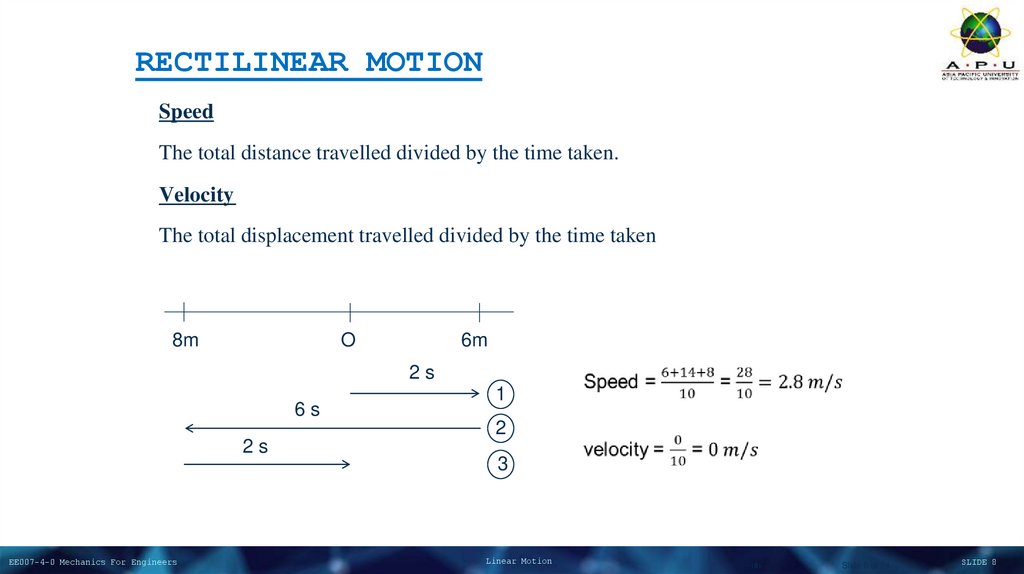
SpeedThe total distance travelled divided by the time taken.
Velocity
The total displacement travelled divided by the time taken
8m
O
6m
2s
6s
1
2
2s
3
EE007-4-0 Mechanics For Engineers
Linear Motion
‹#›
Slide 8 of 24
SLIDE 8
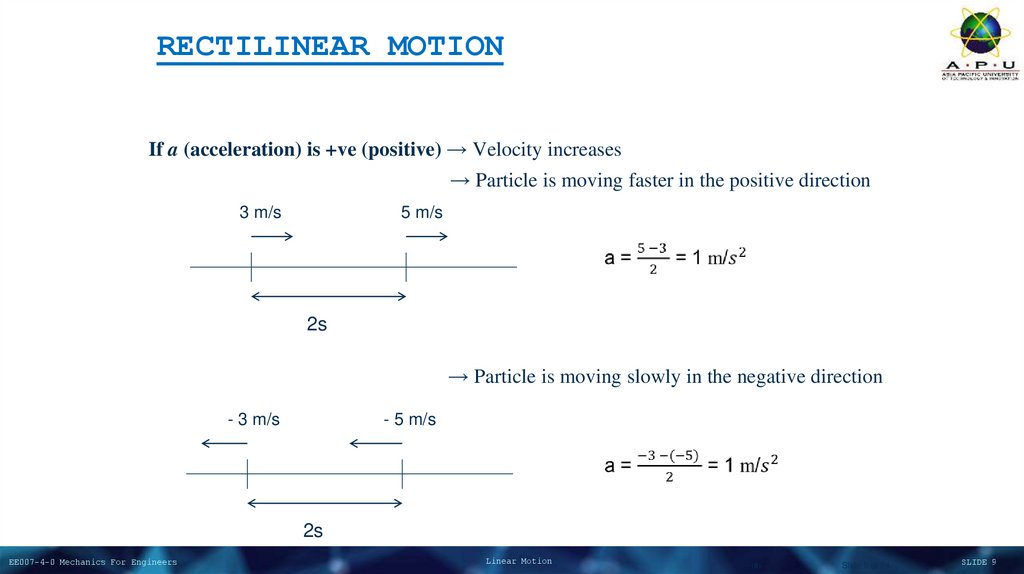
9. RECTILINEAR MOTION
If a (acceleration) is +ve (positive) → Velocity increases→ Particle is moving faster in the positive direction
5 m/s
3 m/s
2s
→ Particle is moving slowly in the negative direction
- 5 m/s
- 3 m/s
2s
EE007-4-0 Mechanics For Engineers
Linear Motion
‹#›
Slide 9 of 24
SLIDE 9
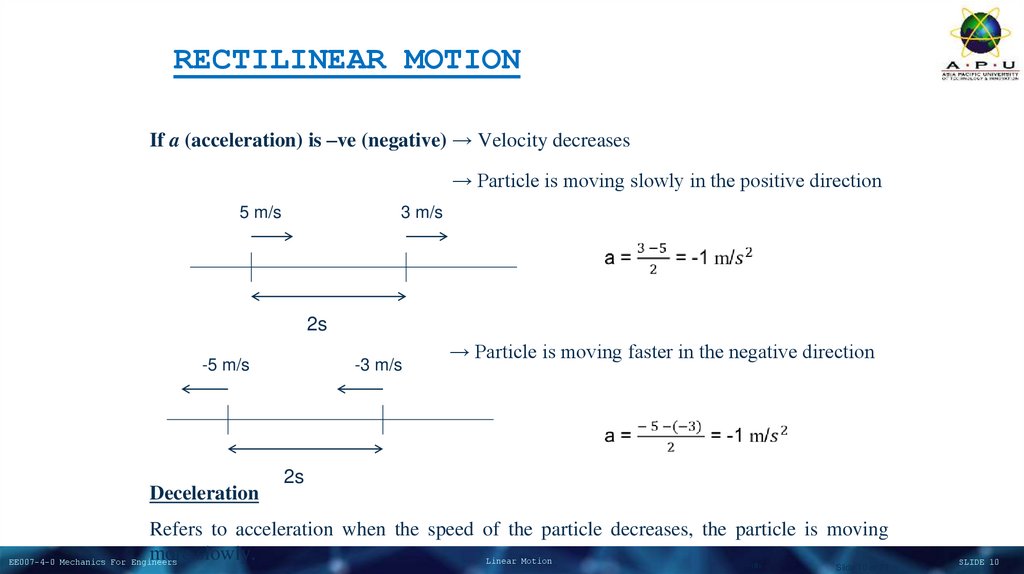
10. RECTILINEAR MOTION
If a (acceleration) is –ve (negative) → Velocity decreases→ Particle is moving slowly in the positive direction
3 m/s
5 m/s
2s
-3 m/s
-5 m/s
Deceleration
→ Particle is moving faster in the negative direction
2s
Refers to acceleration when the speed of the particle decreases, the particle is moving
more slowly.
Linear Motion
EE007-4-0 Mechanics For Engineers
‹#›
Slide 10 of 24
SLIDE 10
11. RECTILINEAR MOTION
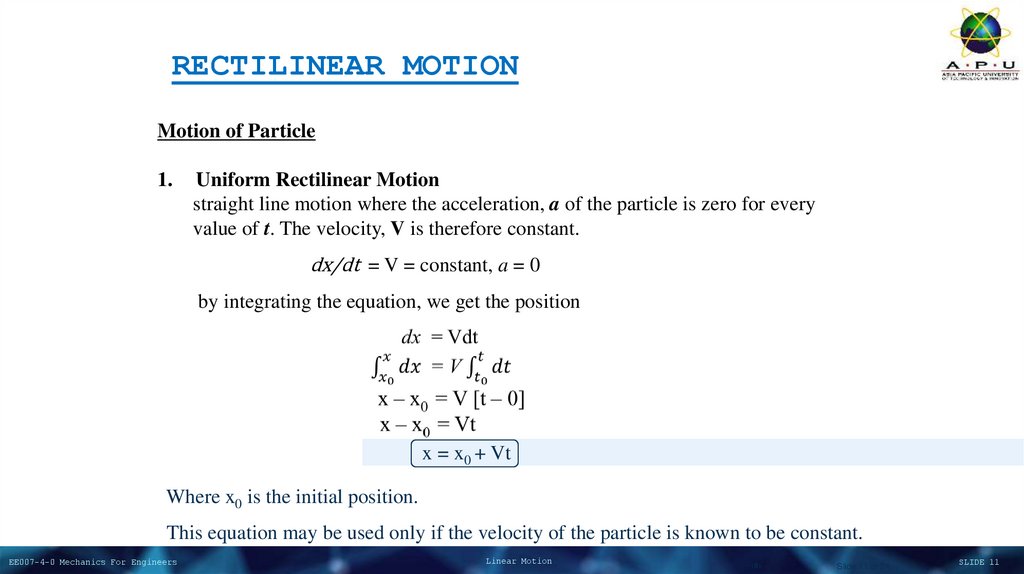
Motion of Particle1.
Uniform Rectilinear Motion
straight line motion where the acceleration, a of the particle is zero for every
value of t. The velocity, V is therefore constant.
dx/dt = V = constant, a = 0
by integrating the equation, we get the position
x = x0 + Vt
Where x0 is the initial position.
This equation may be used only if the velocity of the particle is known to be constant.
EE007-4-0 Mechanics For Engineers
Linear Motion
‹#›
Slide 11 of 24
SLIDE 11
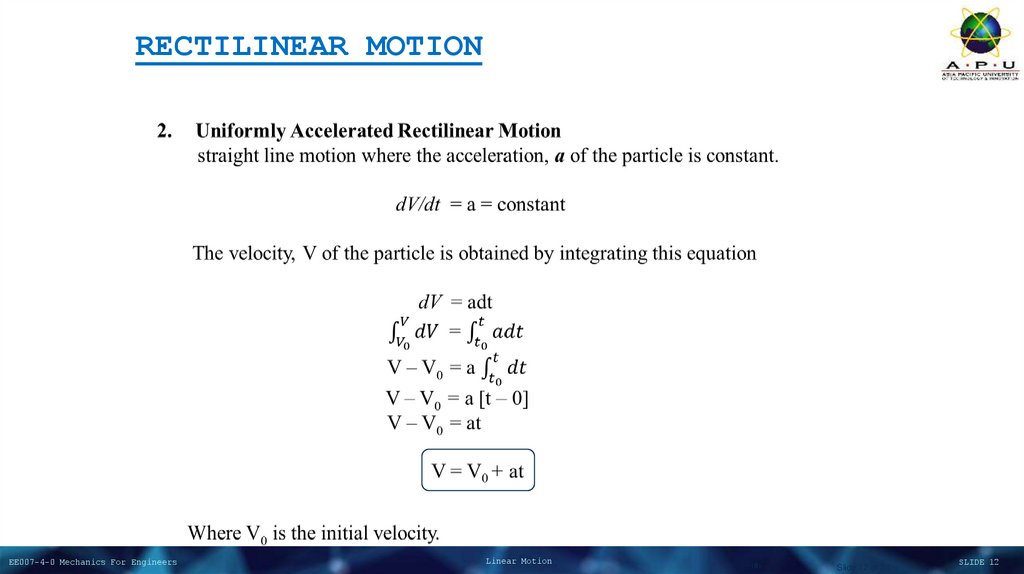
12. RECTILINEAR MOTION
EE007-4-0 Mechanics For EngineersLinear Motion
‹#›
Slide 12 of 24
SLIDE 12
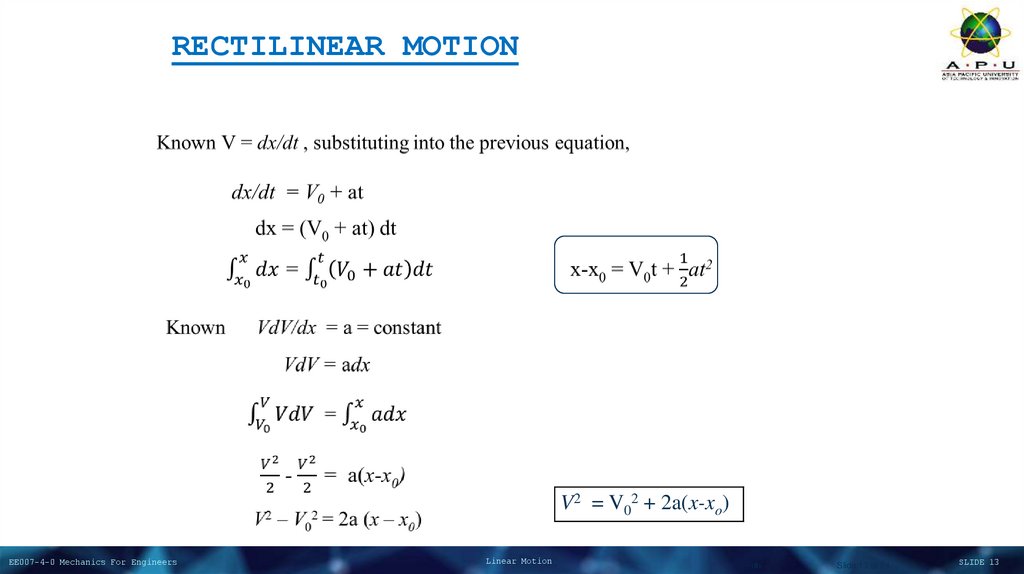
13. RECTILINEAR MOTION
V2 = V02 + 2a(x-xo)EE007-4-0 Mechanics For Engineers
Linear Motion
‹#›
Slide 13 of 24
SLIDE 13
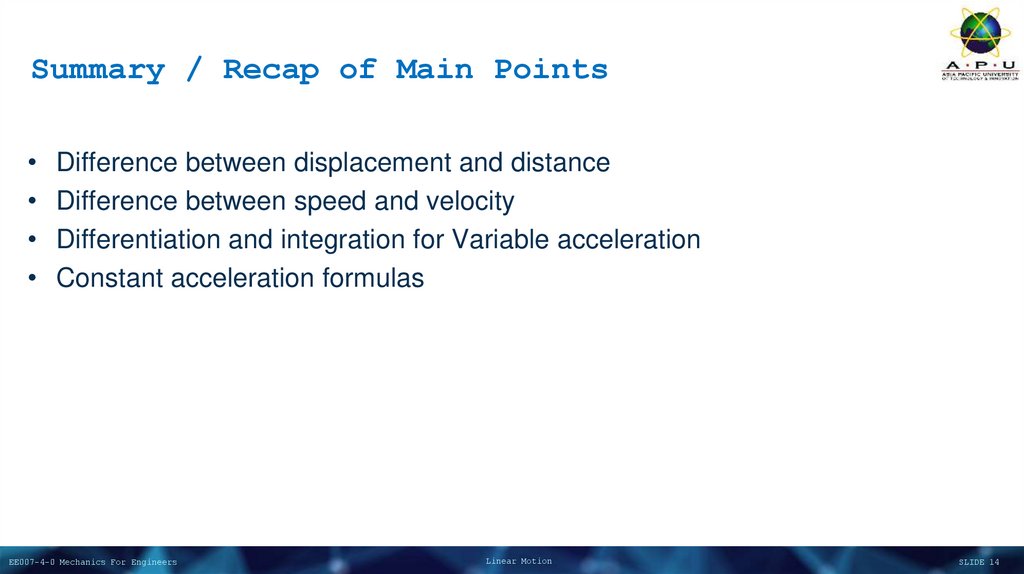
14. Summary / Recap of Main Points
Difference between displacement and distance
Difference between speed and velocity
Differentiation and integration for Variable acceleration
Constant acceleration formulas
EE007-4-0 Mechanics For Engineers
Linear Motion
SLIDE 14
15. What To Expect Next Week
In Class• Angular motion
EE007-4-0 Mechanics For Engineers
Preparation for Class
• Kinematic Equations
Linear Motion
SLIDE 15