 history
Similar presentations:





United Kingdom: An Island Nation with a Rich History and Culture
1. United Kingdom: An Island Nation with a Rich History and Culture
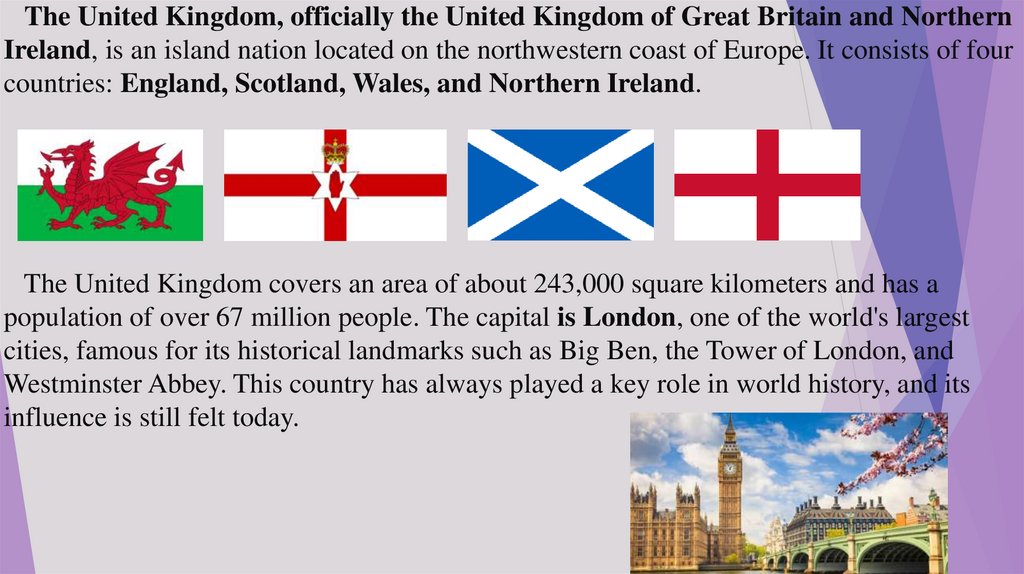
2. The United Kingdom, officially the United Kingdom of Great Britain and Northern Ireland, is an island nation located on the
northwestern coast of Europe. It consists of fourcountries: England, Scotland, Wales, and Northern Ireland.
The United Kingdom covers an area of about 243,000 square kilometers and has a
population of over 67 million people. The capital is London, one of the world's largest
cities, famous for its historical landmarks such as Big Ben, the Tower of London, and
Westminster Abbey. This country has always played a key role in world history, and its
influence is still felt today.
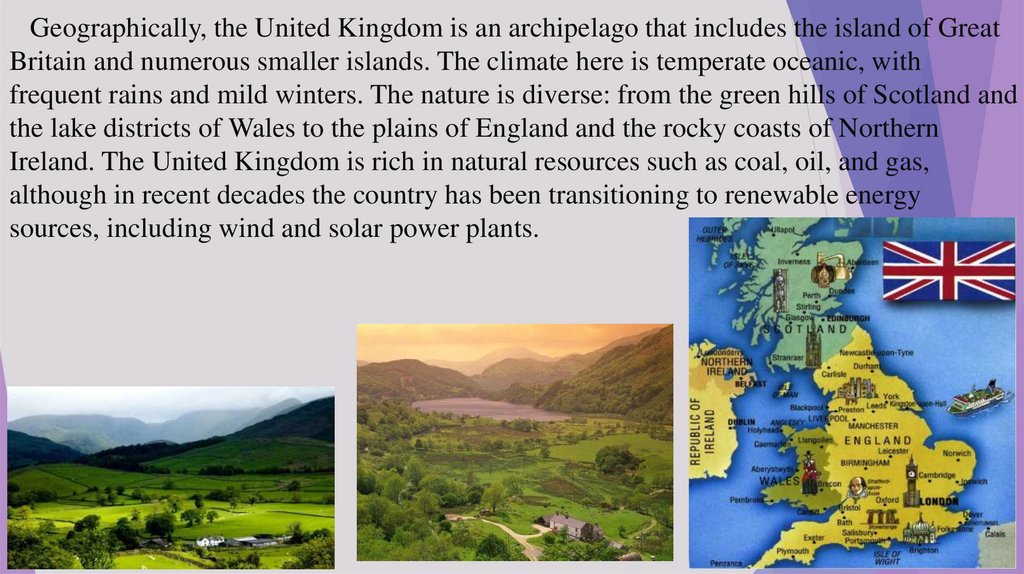
3. Geographically, the United Kingdom is an archipelago that includes the island of Great Britain and numerous smaller islands.
The climate here is temperate oceanic, withfrequent rains and mild winters. The nature is diverse: from the green hills of Scotland and
the lake districts of Wales to the plains of England and the rocky coasts of Northern
Ireland. The United Kingdom is rich in natural resources such as coal, oil, and gas,
although in recent decades the country has been transitioning to renewable energy
sources, including wind and solar power plants.
4. The history of the United Kingdom spans over two thousand years. The Romans conquered Britain in 43 AD, leaving behind roads
and cities. Then came the Angles,Saxons, and Vikings, who formed the basis of English culture. In the Middle Ages, the
country developed as a unified kingdom, but in 1707, England and Scotland united to
form the Kingdom of Great Britain. The 19th century became the era of the British
Empire, which covered a quarter of the Earth's surface, including India, Australia, and
Canada. The Industrial Revolution turned the United Kingdom into a global leader in
manufacturing, trade, and technology. However, the 20th century brought two world wars,
which significantly weakened the empire. After World War II, the process of
decolonization began, and in 1973, the United Kingdom joined the European Union,
although it left in 2020 (Brexit). Today, the country remains a constitutional monarchy,
where King Charles III is the head of state, and the Prime Minister is the head of
government.
5. The culture of the United Kingdom is a mix of traditions and innovations. Literature is represented by masterpieces from
Shakespeare, Dickens, and Jane Austen. Music includesclassics by Bach and Beethoven, as well as modern rock and pop: from The Beatles to
Adele. British humor, tea ceremonies, and holidays such as Christmas with Christmas
trees have become global traditions. Sports are an integral part of life: football, cricket,
tennis, and rugby. Education is highly valued; the universities of Oxford and Cambridge
are among the oldest in the world. However, the country faces challenges such as income
inequality and immigration issues following Brexit.
6. The United Kingdom's economy is one of the largest in the world. London is a financial center, home to banks and stock
The United Kingdom's economy is one of the largest in the world. London is a financialcenter, home to banks and stock exchanges. The country leads in services, technology, and
pharmaceuticals. Tourism brings in billions: tens of millions of tourists visit the United
Kingdom annually, drawn by its history and culture. Despite Brexit, trade with Europe
remains active, and ties with the US and the Commonwealth are strengthening.
The United Kingdom is not just an island, but a symbol of democracy, freedom of
speech, and cultural diversity. Its history teaches us about the importance of unity and
adaptation to change. In the era of globalization, this country continues to influence the
world, combining traditions with modernity. I am confident that the future of the United
Kingdom will be bright if it can address its internal challenges and remain open to the
world.