


 industry
Similar presentations:










Development of an Intelligent System for Predicting Antenna Failures in Medium-Altitude UAVs
1. Development of an Intelligent System for Predicting Antenna Failures in Medium-Altitude UAVs
2. The Critical Need for Predictive Maintenance
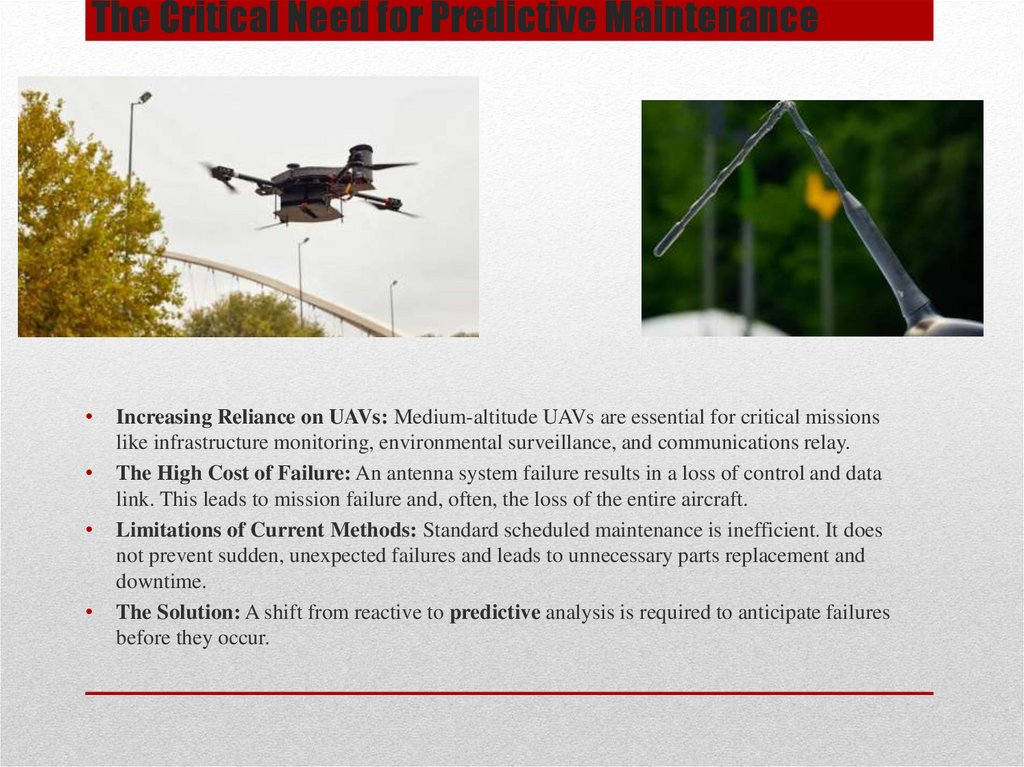
Increasing Reliance on UAVs: Medium-altitude UAVs are essential for critical missions
like infrastructure monitoring, environmental surveillance, and communications relay.
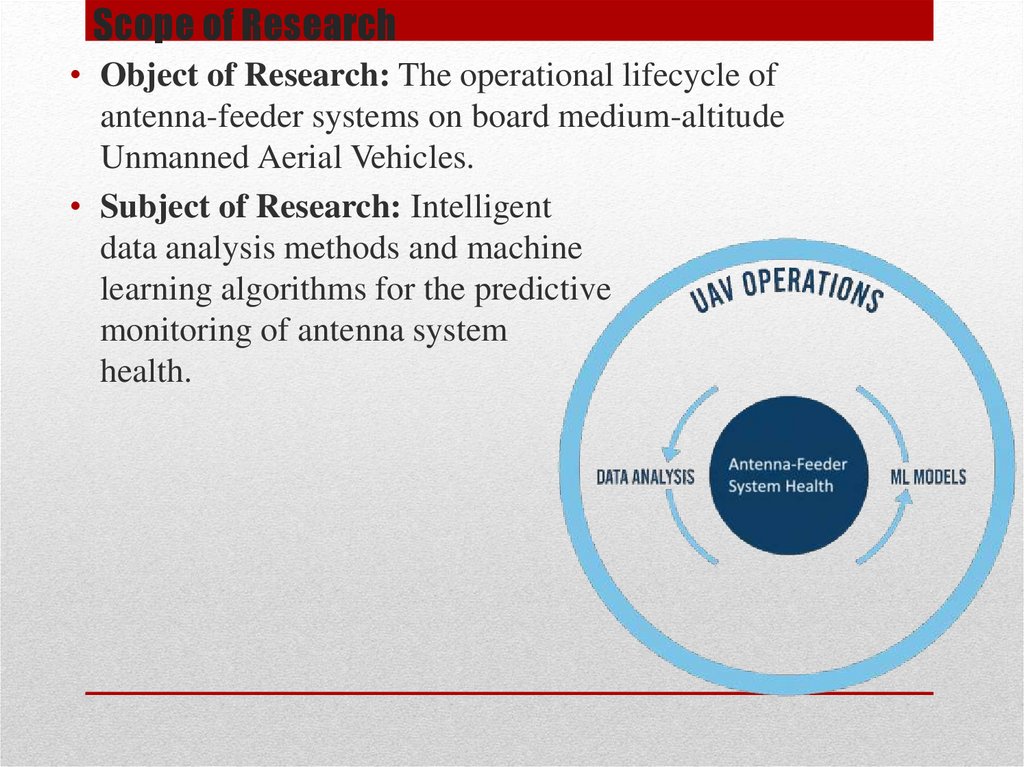
The High Cost of Failure: An antenna system failure results in a loss of control and data
link. This leads to mission failure and, often, the loss of the entire aircraft.
Limitations of Current Methods: Standard scheduled maintenance is inefficient. It does
not prevent sudden, unexpected failures and leads to unnecessary parts replacement and
downtime.
The Solution: A shift from reactive to predictive analysis is required to anticipate failures
before they occur.
3. Goal and Objectives
4. Scope of Research
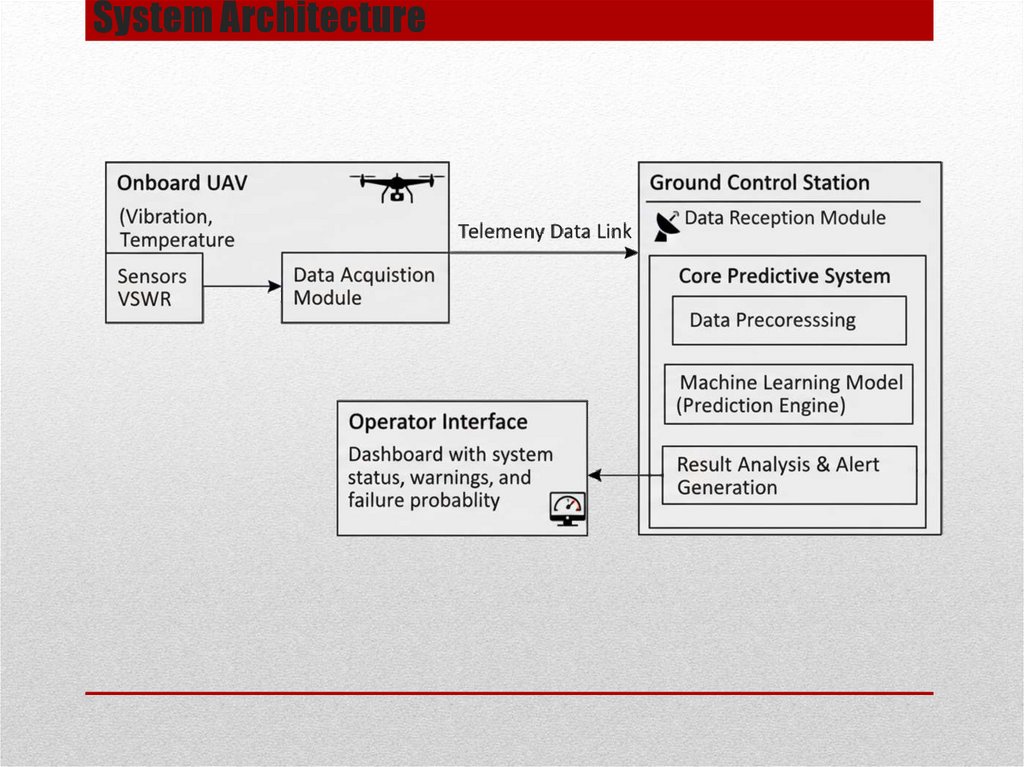
• Object of Research: The operational lifecycle ofantenna-feeder systems on board medium-altitude
Unmanned Aerial Vehicles.
• Subject of Research: Intelligent
data analysis methods and machine
learning algorithms for the predictive
monitoring of antenna system
health.
5. System Architecture
6. Methodology and Model Selection
The core of this project is a time-series classification task. The system must analyze sequential sensordata over time to predict a future state: "Normal Operation" or "Impending Failure." This requires a
model that can understand temporal patterns and dependencies within the data streams.
Several machine learning approaches were considered:
• Statistical Models (e.g., ARIMA): While useful for forecasting, these models often assume linear
relationships and struggle with the complex, non-linear patterns that typically precede equipment
failure.
• Classical Machine Learning (e.g., Random Forest, Gradient Boosting): These models are
powerful but treat each data point independently. They can be adapted to use time-window
features, but they lack a native ability to process the sequential nature of telemetry data, often
missing long-term dependencies.
An LSTM network, a specialized type of Recurrent Neural Network (RNN), was selected as the
optimal solution.
Why LSTM?
• Designed for Sequences: LSTMs are explicitly built to process sequential data, making them
ideal for time-series telemetry from sensors.
• Captures Long-Term Dependencies: Unlike basic RNNs, LSTMs have "memory cells" that
allow them to remember important information over long periods. This is critical for detecting
slow-developing faults, such as gradual temperature increases or creeping changes in signal
quality.
• High Accuracy in Predictive Maintenance: LSTMs have a proven track record in similar
industrial applications, demonstrating superior performance in anomaly detection and failure
prediction.
7. Implementation & Dataset
Implementation & DatasetTraining Data:
The model will be trained on a simulated dataset representing [Number] hours of
flight operations.
Key Features Analyzed:
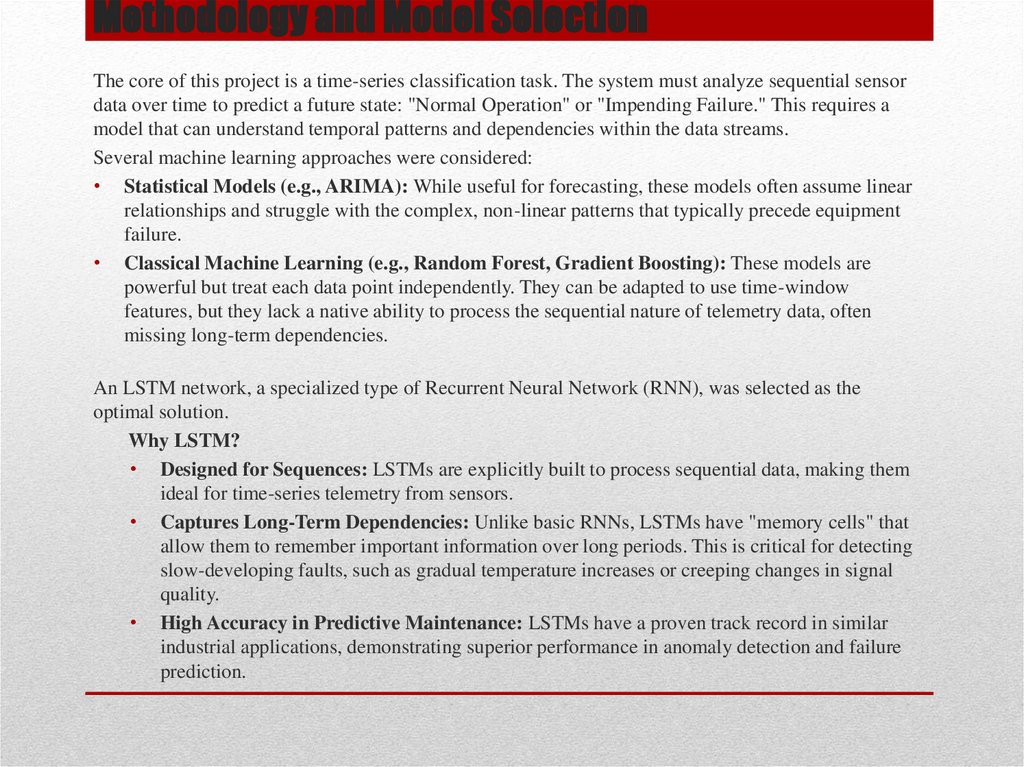
Voltage Standing Wave Ratio (VSWR), Amplifier Temperature, Vibration
Levels, Signal Power, Aircraft Pitch/Roll/Yaw
8. Project Roadmap
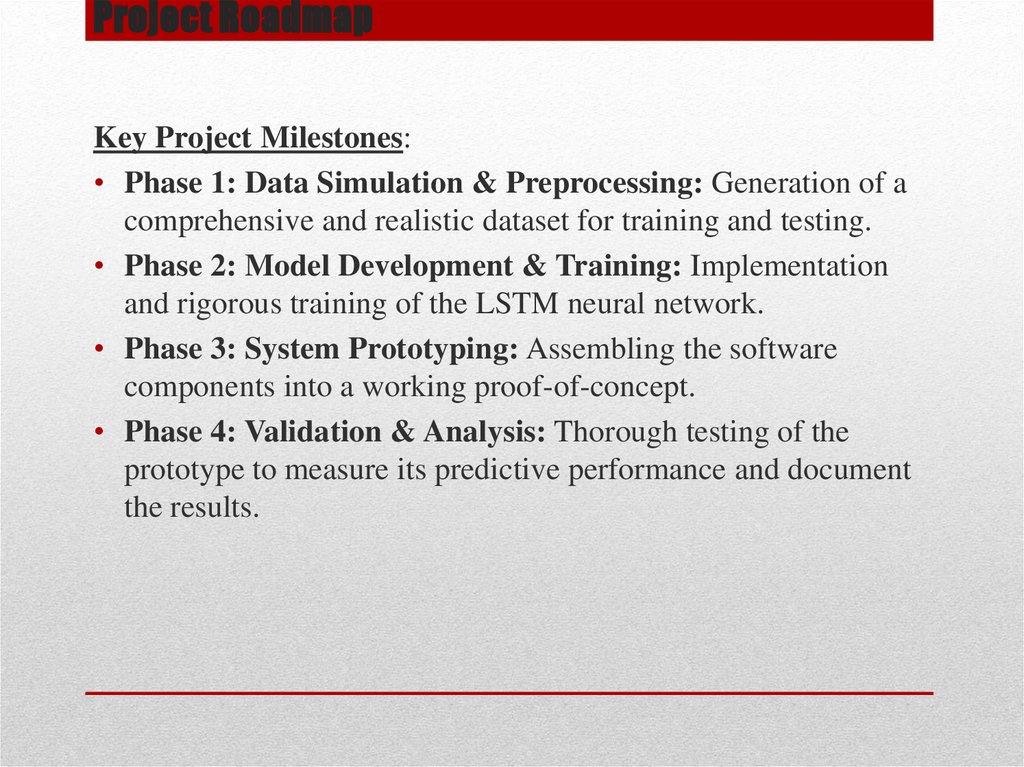
Project RoadmapKey Project Milestones:
• Phase 1: Data Simulation & Preprocessing: Generation of a
comprehensive and realistic dataset for training and testing.
• Phase 2: Model Development & Training: Implementation
and rigorous training of the LSTM neural network.
• Phase 3: System Prototyping: Assembling the software
components into a working proof-of-concept.
• Phase 4: Validation & Analysis: Thorough testing of the
prototype to measure its predictive performance and document
the results.