




 informatics
Similar presentations:









Introduction to Artificial Intelligence
1.
The Evolution of ArtificialIntelligence
by Myself and SlideDeck AI :)
2.
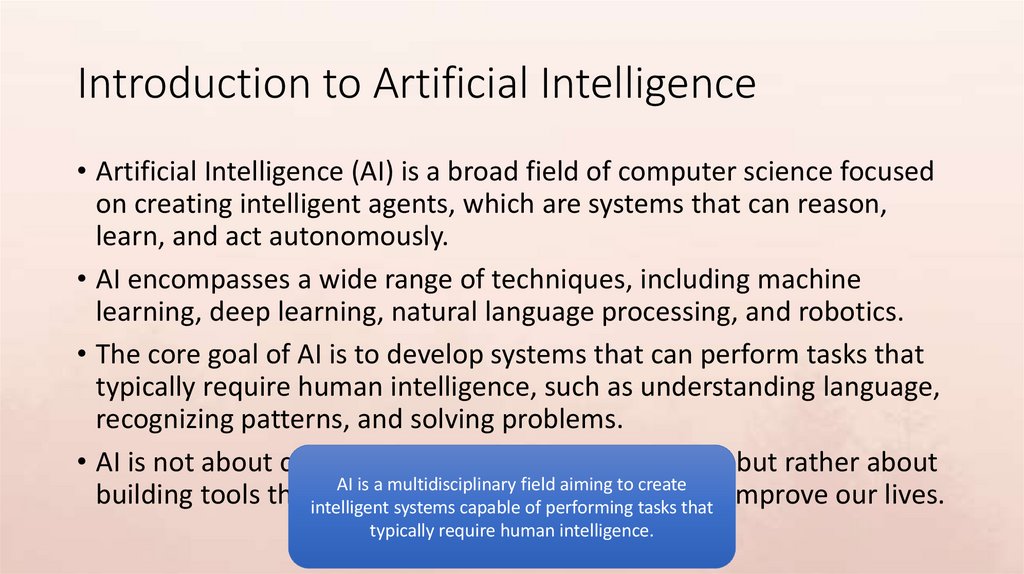
Introduction to Artificial Intelligence• Artificial Intelligence (AI) is a broad field of computer science focused
on creating intelligent agents, which are systems that can reason,
learn, and act autonomously.
• AI encompasses a wide range of techniques, including machine
learning, deep learning, natural language processing, and robotics.
• The core goal of AI is to develop systems that can perform tasks that
typically require human intelligence, such as understanding language,
recognizing patterns, and solving problems.
• AI is not about creating robots that replace humans, but rather about
AI is a multidisciplinary field aiming to create
building tools thatintelligent
augment
human
systems
capable ofcapabilities
performing tasksand
that improve our lives.
typically require human intelligence.
3.
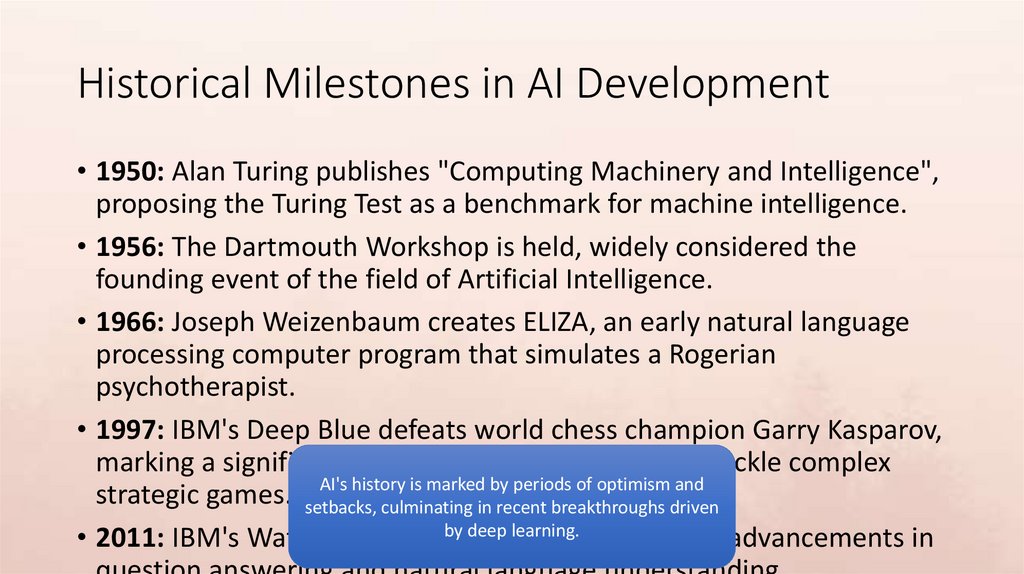
Historical Milestones in AI Development• 1950: Alan Turing publishes "Computing Machinery and Intelligence",
proposing the Turing Test as a benchmark for machine intelligence.
• 1956: The Dartmouth Workshop is held, widely considered the
founding event of the field of Artificial Intelligence.
• 1966: Joseph Weizenbaum creates ELIZA, an early natural language
processing computer program that simulates a Rogerian
psychotherapist.
• 1997: IBM's Deep Blue defeats world chess champion Garry Kasparov,
marking a significant achievement in AI's ability to tackle complex
AI's history is marked by periods of optimism and
strategic games. setbacks, culminating in recent breakthroughs driven
by deep learning.
• 2011: IBM's Watson wins Jeopardy!,
demonstrating advancements in
4.
Key Approaches to AISymbolic AI (GOFAI): This approach relies on
explicit rules and knowledge representation.
It excels in well-defined problems but
struggles with ambiguity and real-world
complexity. Example: Early expert systems for
medical diagnosis.
Machine Learning (ML): Algorithms that
allow computers to learn from data without
explicit programming. Requires large
datasets for training and is widely used in
various applications. Example: Spam filters
learning to identify unwanted emails.
Deep Learning (DL): A subset of ML using
artificial neural networks with multiple
layers. It excels at complex pattern
recognition and has revolutionized fields like
image and speech recognition. Example:
Image recognition systems used in selfdriving cars.
Reinforcement Learning (RL): An agent
5.
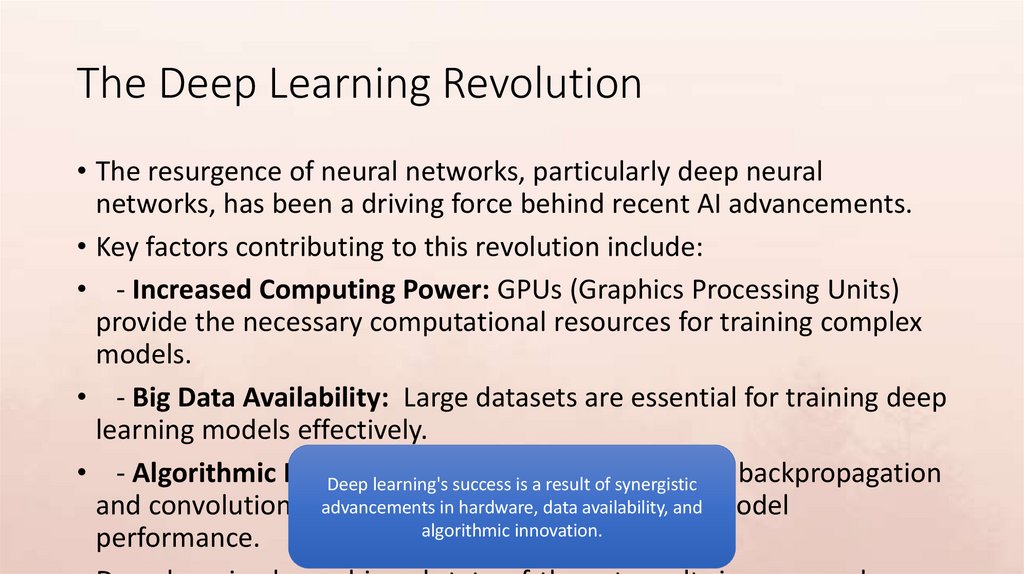
The Deep Learning Revolution• The resurgence of neural networks, particularly deep neural
networks, has been a driving force behind recent AI advancements.
• Key factors contributing to this revolution include:
• - Increased Computing Power: GPUs (Graphics Processing Units)
provide the necessary computational resources for training complex
models.
• - Big Data Availability: Large datasets are essential for training deep
learning models effectively.
• - Algorithmic Improvements:
New
techniques
Deep learning's success
is a result
of synergisticlike backpropagation
advancements
in hardware,
data availability,
and model
and convolutional neural
networks
have
improved
algorithmic innovation.
performance.
6.
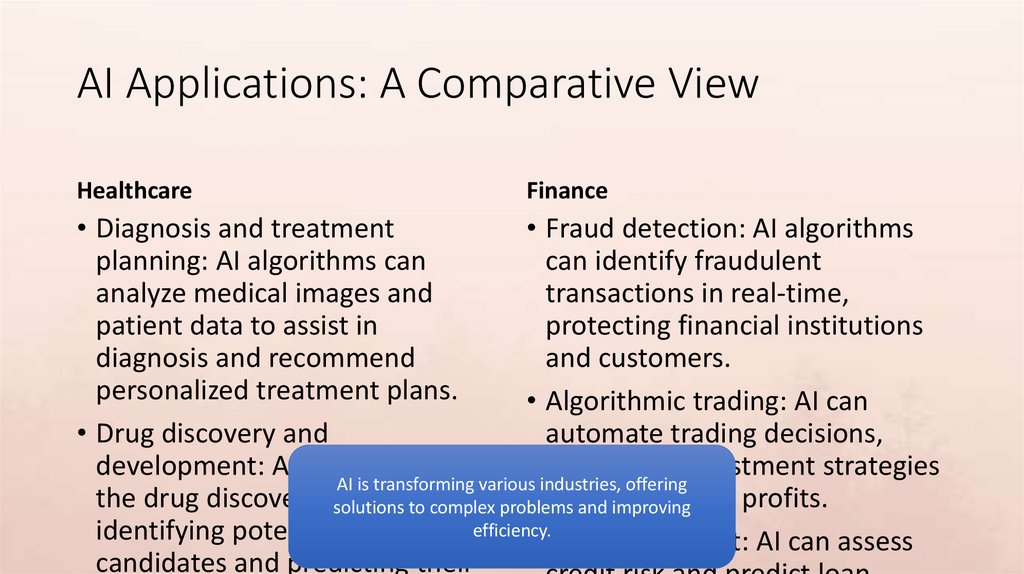
AI Applications: A Comparative ViewHealthcare
Finance
• Diagnosis and treatment
• Fraud detection: AI algorithms
planning: AI algorithms can
can identify fraudulent
analyze medical images and
transactions in real-time,
patient data to assist in
protecting financial institutions
diagnosis and recommend
and customers.
personalized treatment plans.
• Algorithmic trading: AI can
• Drug discovery and
automate trading decisions,
development: AI can accelerate
optimizing investment strategies
AI is transforming various industries, offering
the drug discovery process
andandmaximizing
profits.
solutions to by
complex problems
improving
efficiency.
identifying potential drug
• Risk assessment: AI can assess
candidates and predicting their
7.
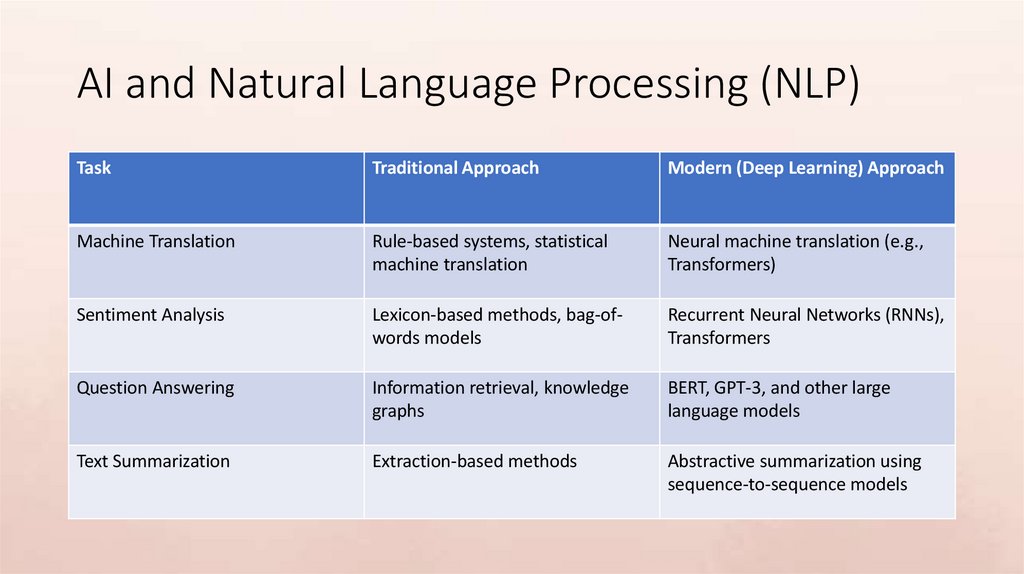
AI and Natural Language Processing (NLP)Task
Traditional Approach
Modern (Deep Learning) Approach
Machine Translation
Rule-based systems, statistical
machine translation
Neural machine translation (e.g.,
Transformers)
Sentiment Analysis
Lexicon-based methods, bag-ofwords models
Recurrent Neural Networks (RNNs),
Transformers
Question Answering
Information retrieval, knowledge
graphs
BERT, GPT-3, and other large
language models
Text Summarization
Extraction-based methods
Abstractive summarization using
sequence-to-sequence models
8.
Ethical Considerationsin AI
Bias: AI systems can perpetuate and amplify
existing biases present in the data they are
trained on, leading to unfair or
discriminatory outcomes.
Fairness: Ensuring that AI systems treat all
individuals and groups equitably, regardless
of their race, gender, or other protected
characteristics.
Transparency: Understanding how AI
systems make decisions (explainable AI - XAI)
is crucial for building trust and accountability.
Accountability: Determining who is
responsible when AI systems make errors or
cause harm is a complex legal and ethical
challenge.
Privacy: Protecting sensitive data used to
train and operate AI systems is essential for
maintaining individual privacy.
Job Displacement: The potential impact of AI
9.
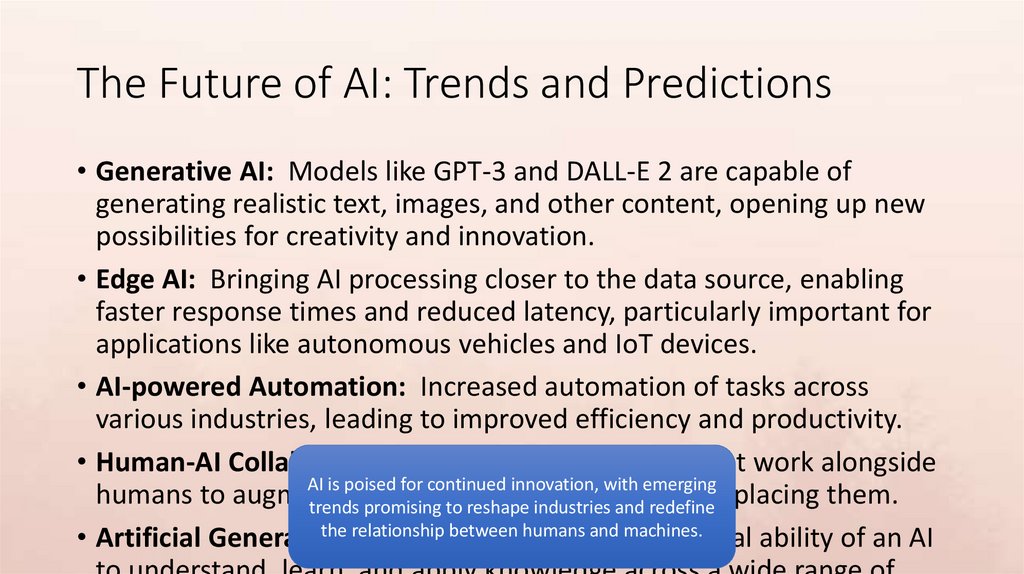
The Future of AI: Trends and Predictions• Generative AI: Models like GPT-3 and DALL-E 2 are capable of
generating realistic text, images, and other content, opening up new
possibilities for creativity and innovation.
• Edge AI: Bringing AI processing closer to the data source, enabling
faster response times and reduced latency, particularly important for
applications like autonomous vehicles and IoT devices.
• AI-powered Automation: Increased automation of tasks across
various industries, leading to improved efficiency and productivity.
• Human-AI Collaboration: Developing AI systems that work alongside
AI is poised for continued innovation, with emerging
humans to augment
their
capabilities,
rather
trends
promising
to reshape industries
and than
redefinereplacing them.
the relationship between humans and machines.
• Artificial General Intelligence
(AGI): The hypothetical ability of an AI
10.
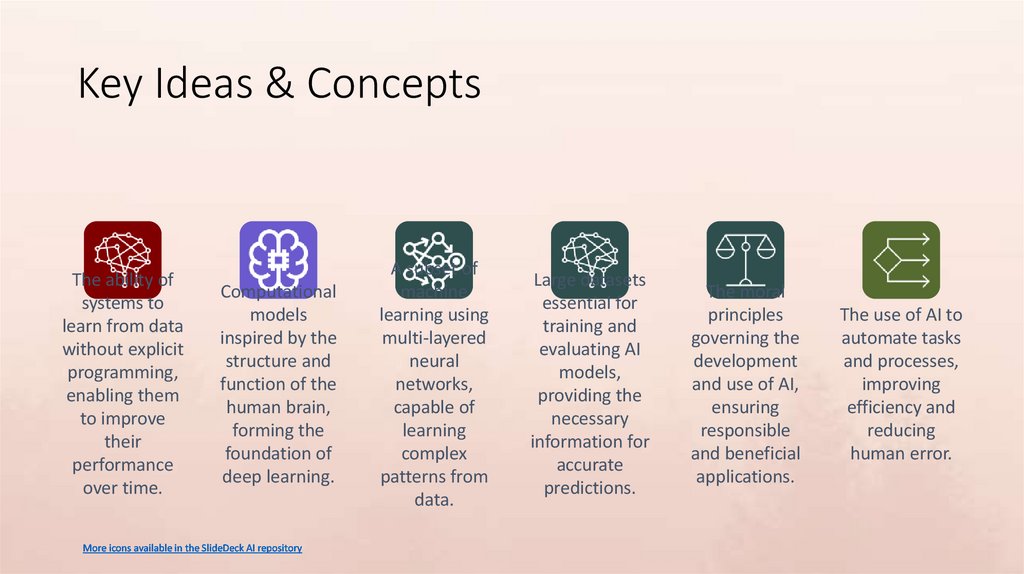
Key Ideas & ConceptsThe ability of
systems to
learn from data
without explicit
programming,
enabling them
to improve
their
performance
over time.
Computational
models
inspired by the
structure and
function of the
human brain,
forming the
foundation of
deep learning.
More icons available in the SlideDeck AI repository
A subset of
machine
learning using
multi-layered
neural
networks,
capable of
learning
complex
patterns from
data.
Large datasets
essential for
training and
evaluating AI
models,
providing the
necessary
information for
accurate
predictions.
The moral
principles
governing the
development
and use of AI,
ensuring
responsible
and beneficial
applications.
The use of AI to
automate tasks
and processes,
improving
efficiency and
reducing
human error.
11.
Challenges andLimitations of AI
Data Dependency: AI models often require
vast amounts of labeled data, which can be
expensive and time-consuming to obtain,
and may not always be available.
Lack of Generalization: AI systems may
struggle to perform well on tasks outside of
their training domain, limiting their
adaptability to new situations.
Explainability: Deep learning models are
often 'black boxes,' making it difficult to
understand their decision-making processes,
hindering trust and accountability.
Robustness: AI systems can be vulnerable to
adversarial attacks – subtle perturbations to
input data that can cause them to make
incorrect predictions, raising security
concerns.
Computational Cost: Training and deploying
complex AI models can require significant
12.
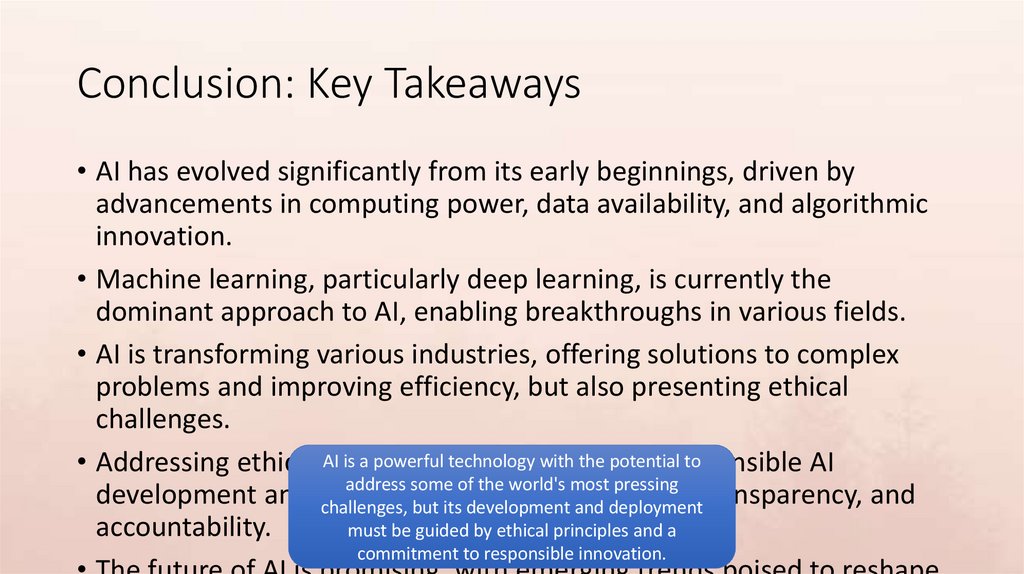
Conclusion: Key Takeaways• AI has evolved significantly from its early beginnings, driven by
advancements in computing power, data availability, and algorithmic
innovation.
• Machine learning, particularly deep learning, is currently the
dominant approach to AI, enabling breakthroughs in various fields.
• AI is transforming various industries, offering solutions to complex
problems and improving efficiency, but also presenting ethical
challenges.
is a powerful technology
with the potential
to
• Addressing ethical AIconsiderations
is crucial
for responsible
AI
address some of the world's most pressing
development and deployment,
ensuringandfairness,
challenges, but its development
deploymenttransparency, and
accountability.
must be guided by ethical principles and a
commitment to responsible innovation.