 medicine
Similar presentations:




Legal foundations of health care, health care system reform and bioethics
1.
Urgench Medical InstituteTopic : " Legal foundations of health care, health care system
reform and bioethics. Professional violations of medical workers,
civil liability, administrative liability, labor law and the activities
of medical workers."
Lecturer : Assistant A.J.Bekchanov
2. In Uzbekistan, the right to engage in medical activities is granted to persons who have received a diploma of graduation from a
higher or secondaryspecialized medical institution. Law on the
citizens'healthcare (Article41).
Permission to engage in this activity for persons who
have received a medical diploma in foreign countries
is determined by the Cabinet of Ministers.
3.
in the specialty for more than 3 years, it is allowed toengage in medical activities after completing
retraining in the relevant educational institutions or
after certification by the certification commission of
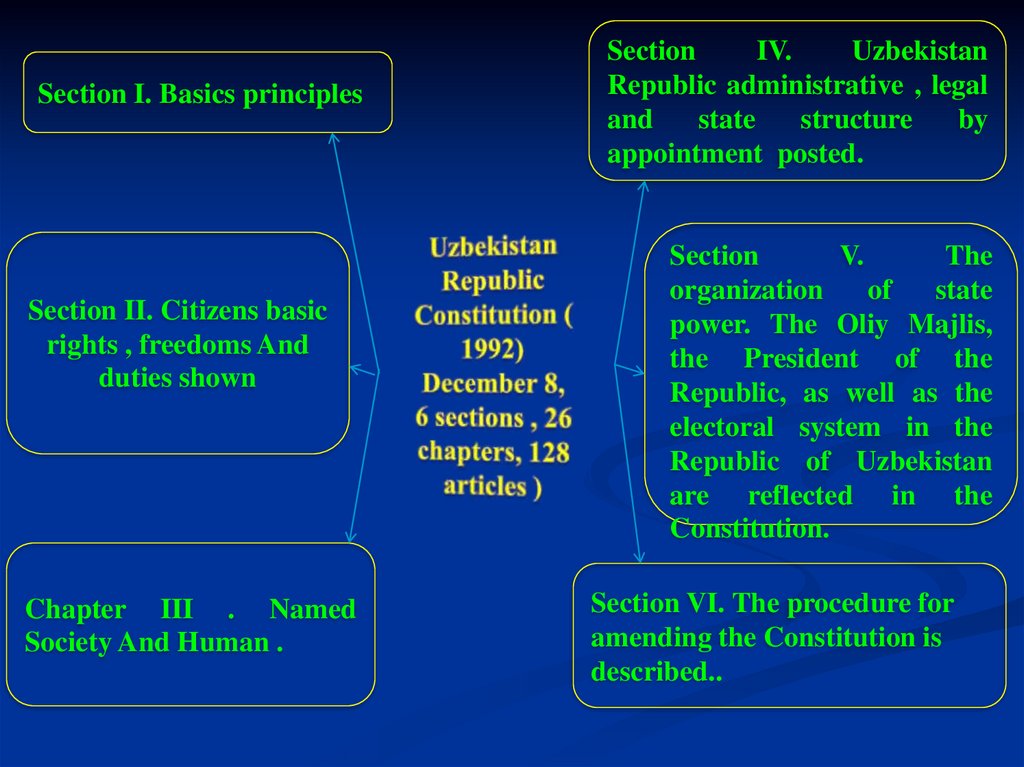
the Ministry of Health of the Republic of Uzbekistan
.
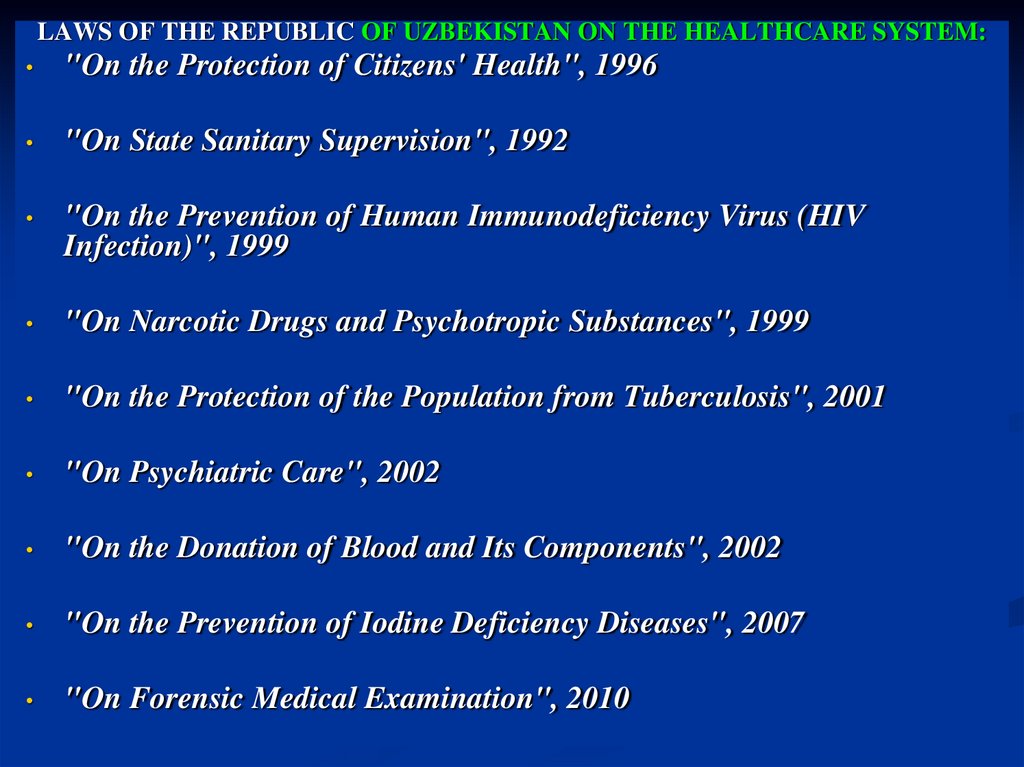
Students of higher and secondary specialized
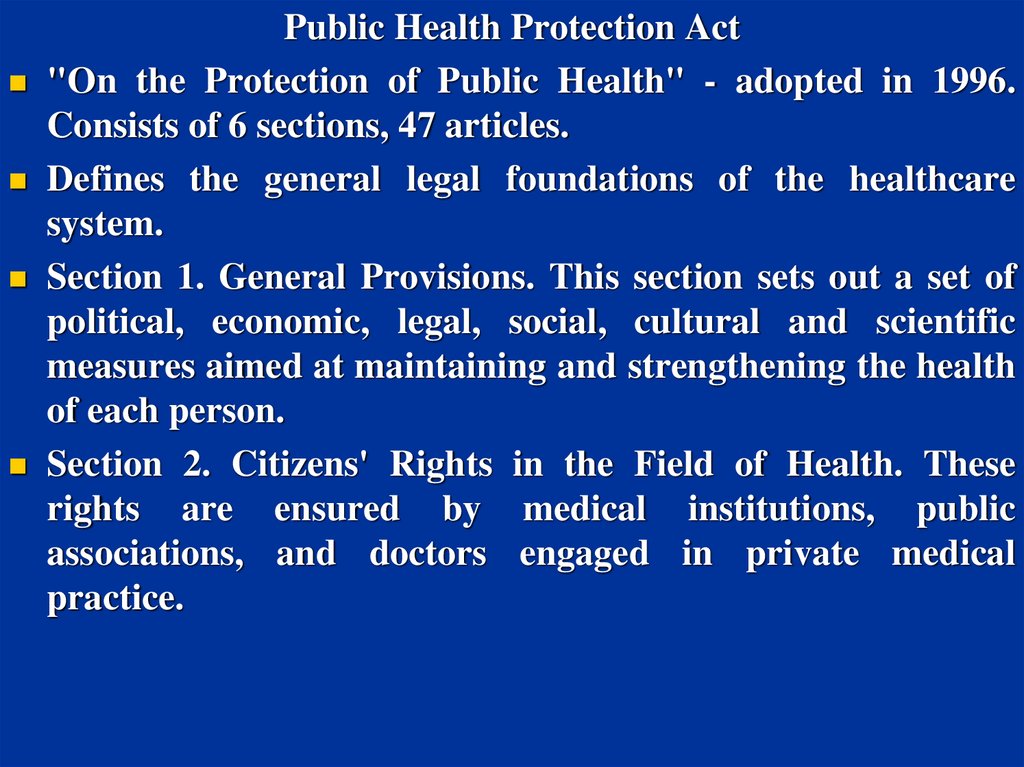
medical educational organizations are allowed to
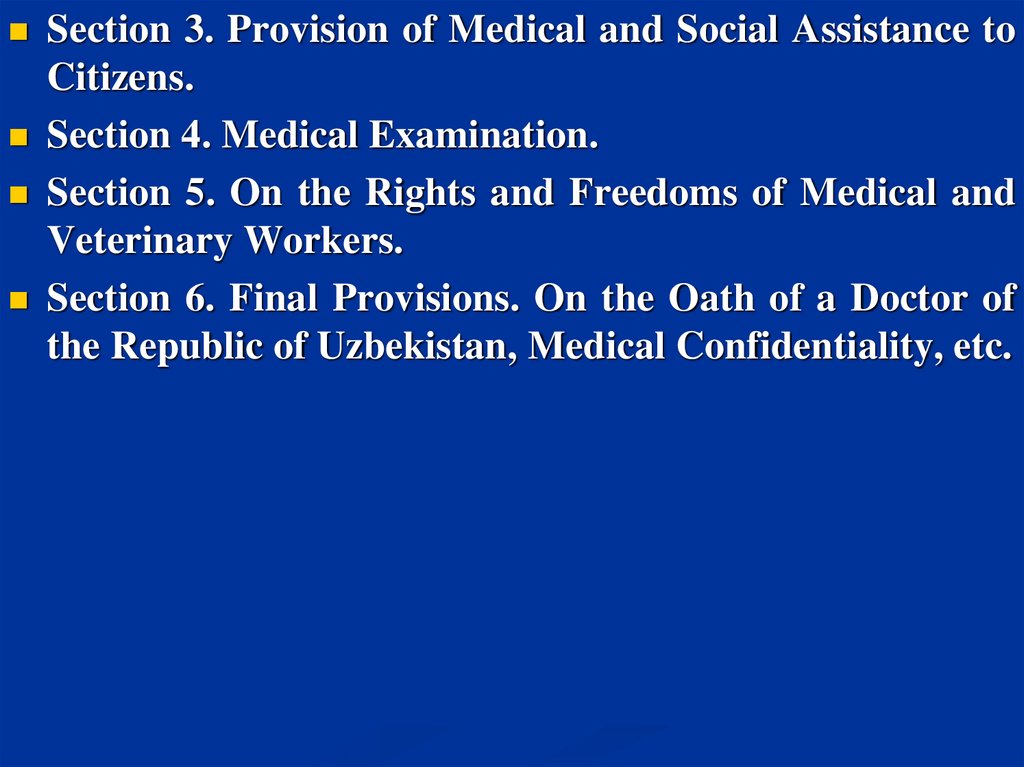
participate in providing medical care to citizens
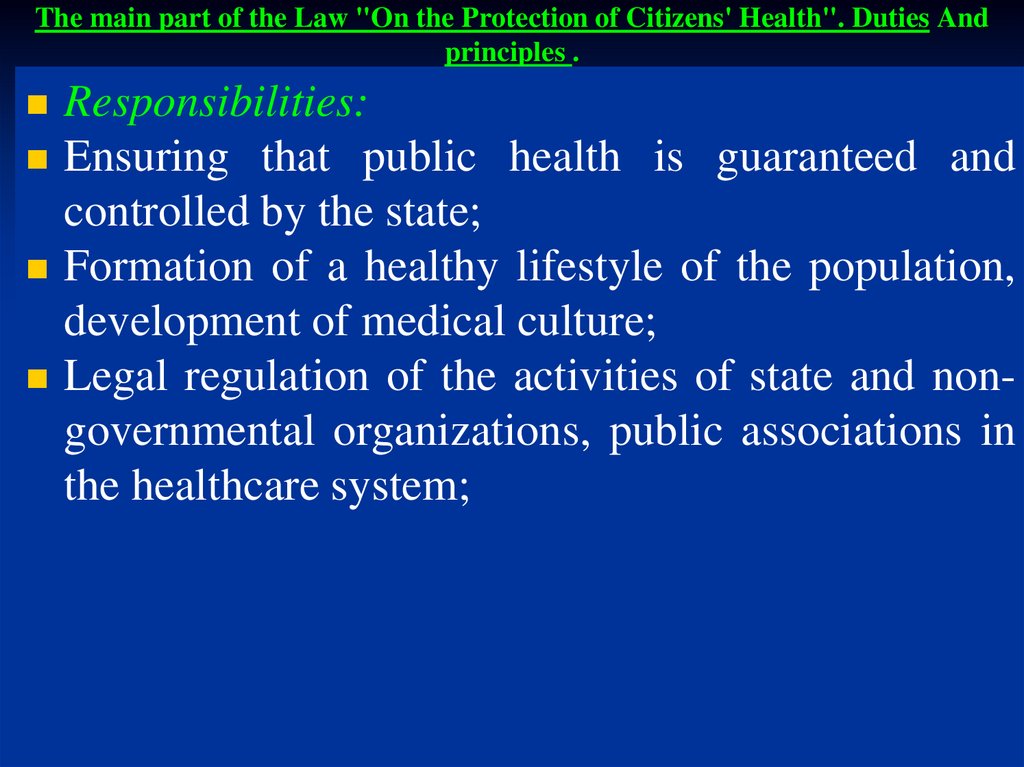
under the supervision of medical workers on the
basis of the educational program.
4. Composition of medical personnel in Uzbekistan:
medical specialists (master's degree andpost-clinical residency)
General practitioners ,
highly educated nurses ,
secondary medical personnel.
5. Currently, they provide the population with primary health care, emergency and urgent medical care, as well as specialized
medical care (only by specialist doctors).
6.
The healthcare system of Uzbekistan:establishes the possibility of functioning of state,
non-state and private medical institutions;
The main task of the medical personnel
working in these medical institutions is the
prevention, diagnosis and treatment of
pathologies of the human body (diseases and
injuries) - rehabilitation.
7.
Every medical worker, regardless of the positionheld and the medical institution, is obliged to know
and observe the following two principles concerning
his professional activity:
1. Moral (ethical) relations of medical activity;
2. Legal basis for medical activity.
The science of the legal foundations of a doctor's
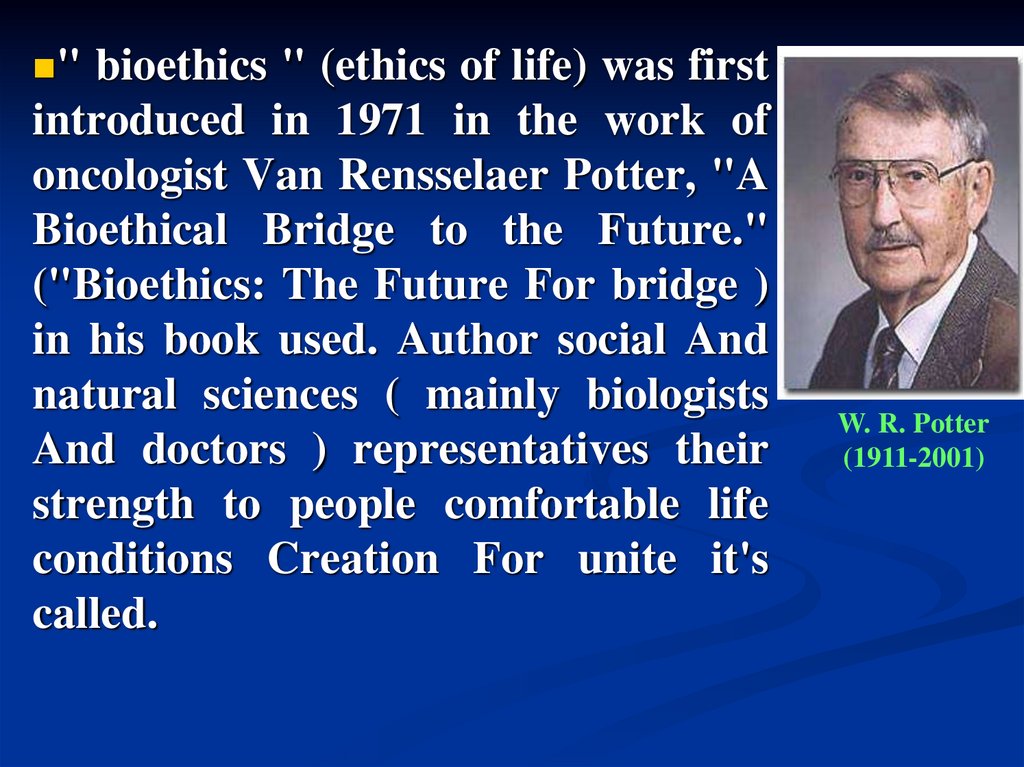
activities consists of these two principles.
8.
This subject has been taughtin Uzbek medical universities
since the 2001-2002 academic
year.
9.
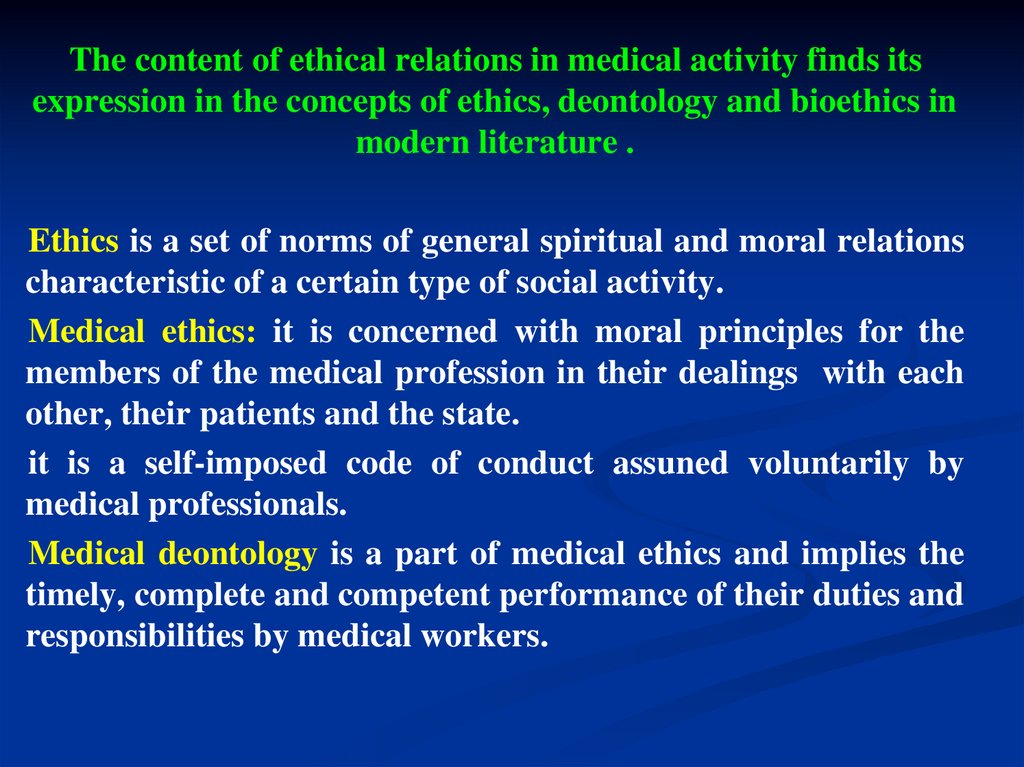
The content of ethical relations in medical activity finds itsexpression in the concepts of ethics, deontology and bioethics in
modern literature .
Ethics is a set of norms of general spiritual and moral relations
characteristic of a certain type of social activity.
Medical ethics: it is concerned with moral principles for the
members of the medical profession in their dealings with each
other, their patients and the state.
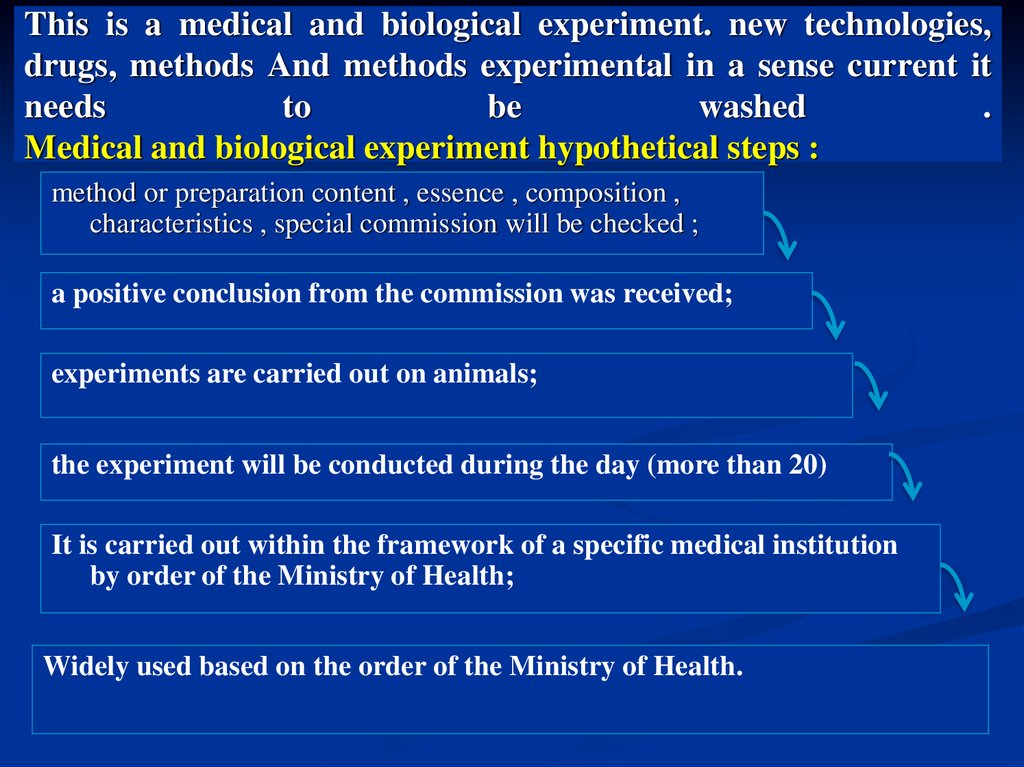
it is a self-imposed code of conduct assuned voluntarily by
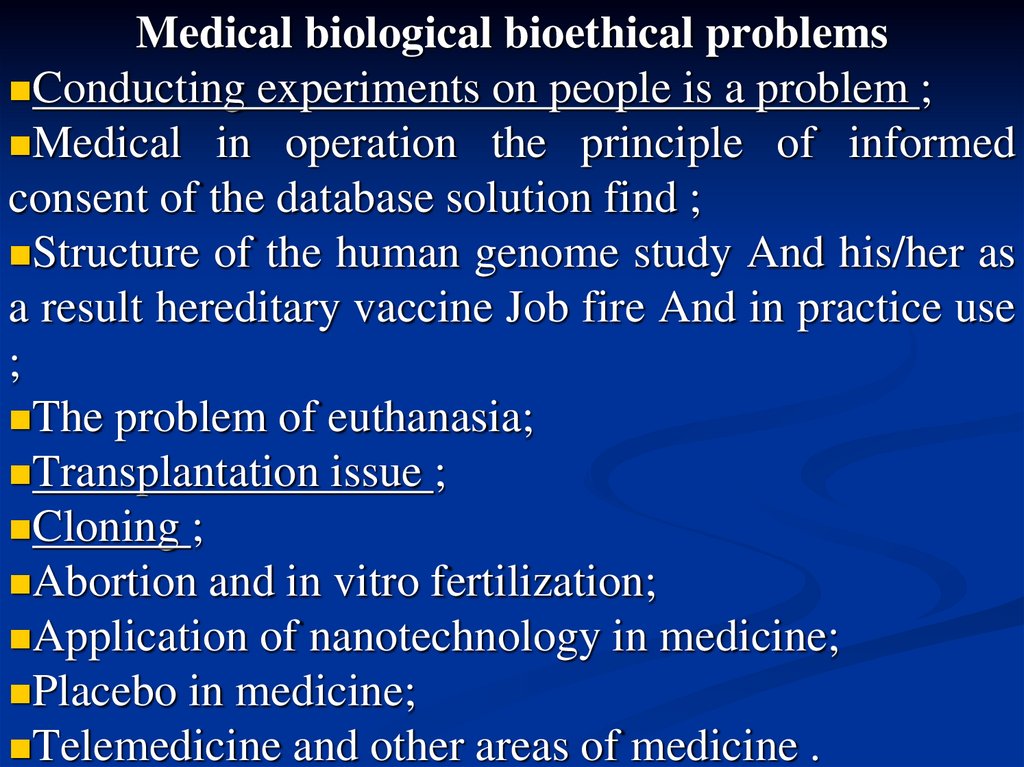
medical professionals.
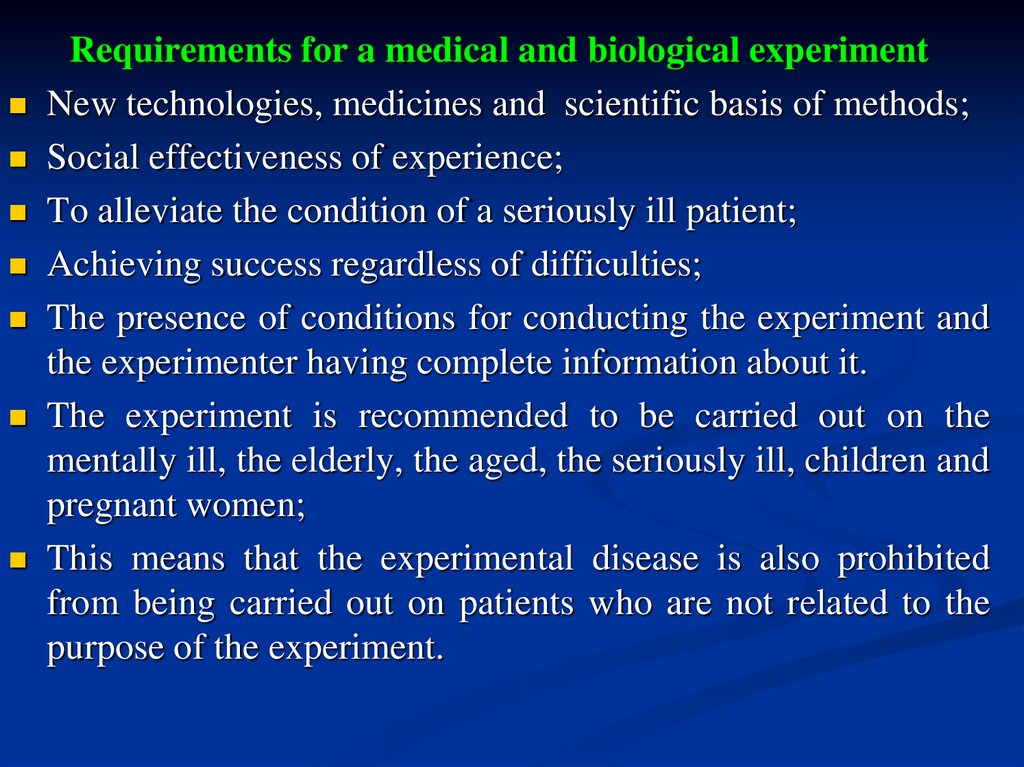
Medical deontology is a part of medical ethics and implies the
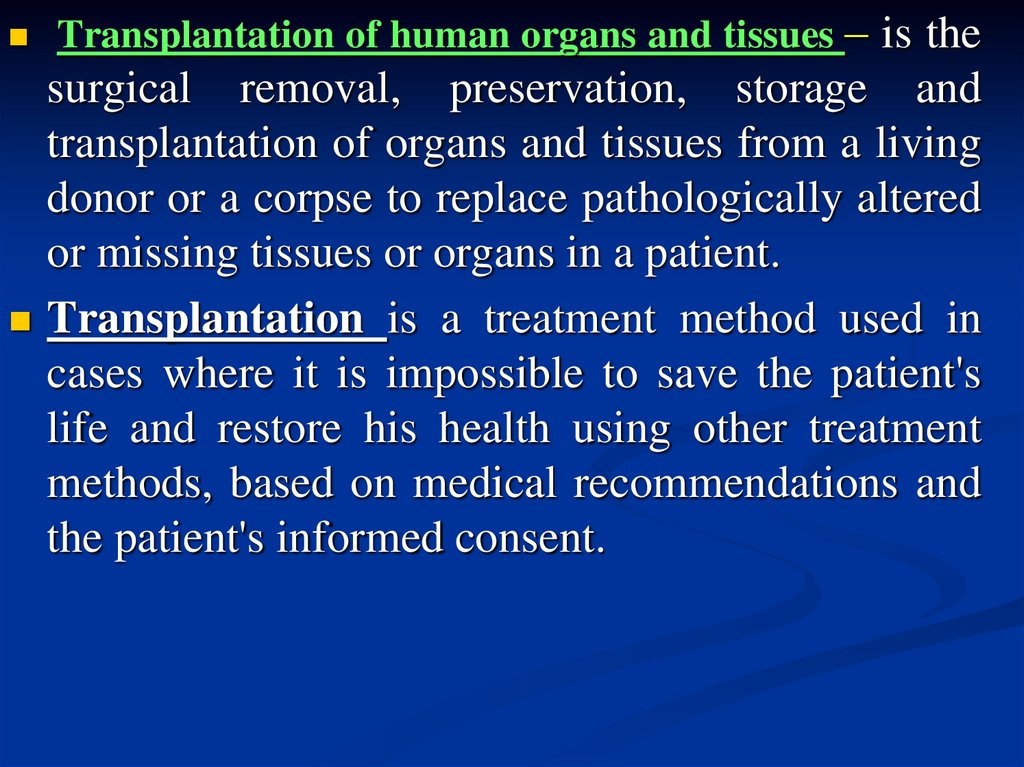
timely, complete and competent performance of their duties and
responsibilities by medical workers.
10.
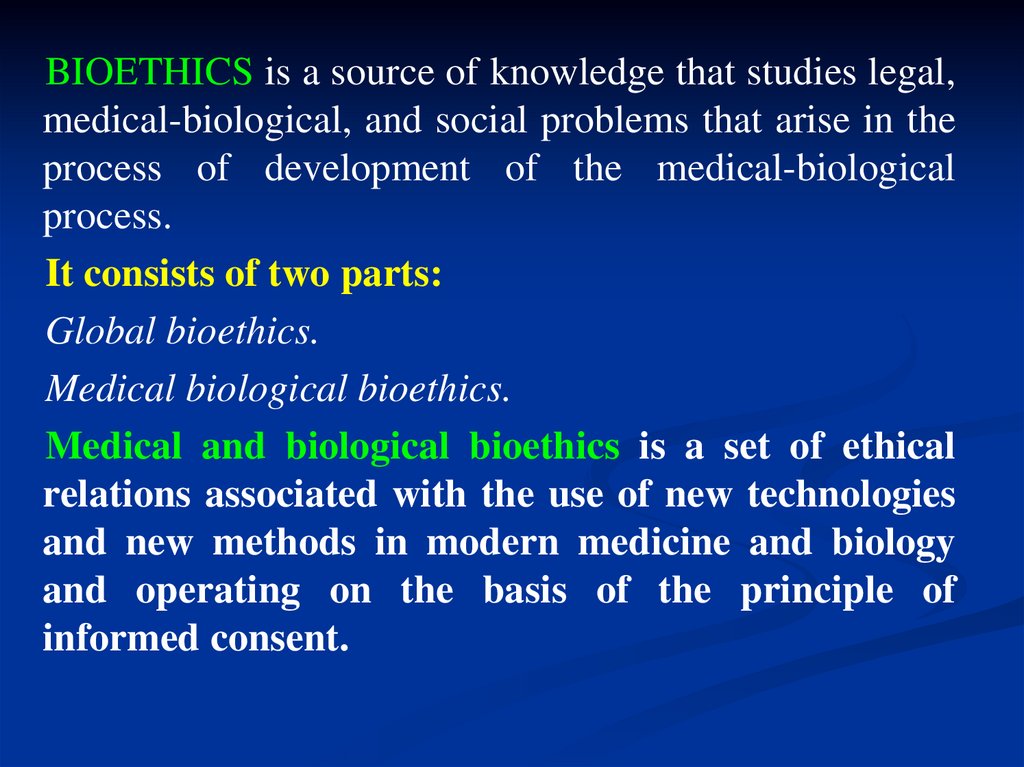
BIOETHICS is a source of knowledge that studies legal,medical-biological, and social problems that arise in the
process of development of the medical-biological
process.
It consists of two parts:
Global bioethics.
Medical biological bioethics.
Medical and biological bioethics is a set of ethical
relations associated with the use of new technologies
and new methods in modern medicine and biology
and operating on the basis of the principle of
informed consent.
11.
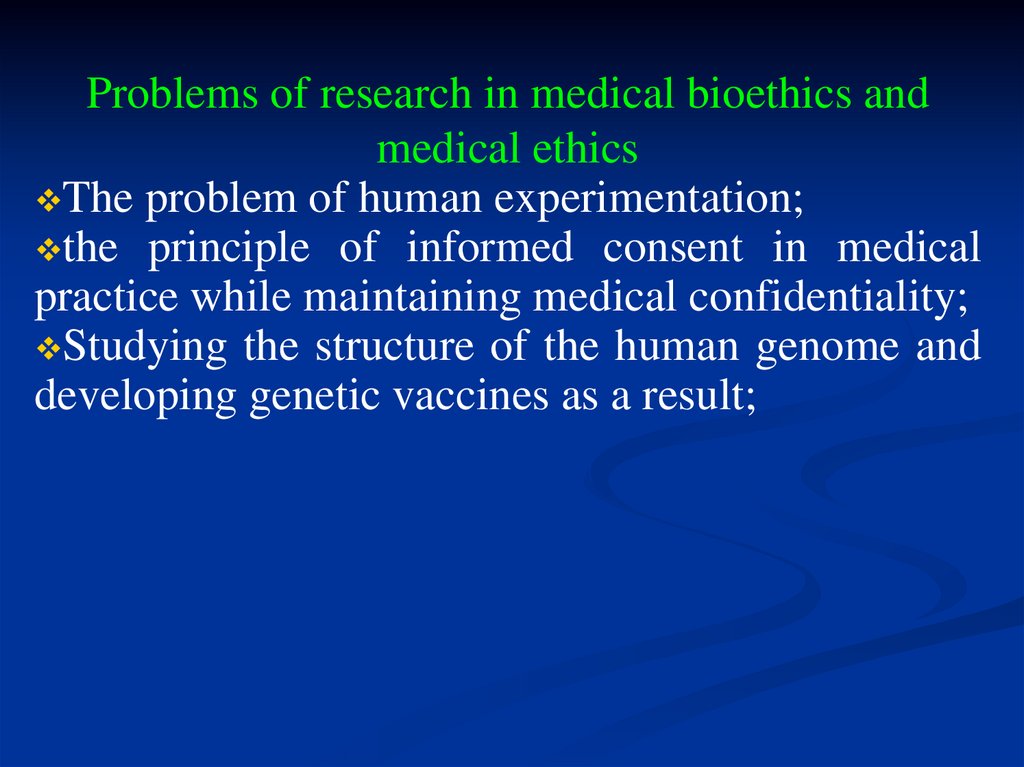
Problems of research in medical bioethics andmedical ethics
The problem of human experimentation;
the principle of informed consent in medical
practice while maintaining medical confidentiality;
Studying the structure of the human genome and
developing genetic vaccines as a result;
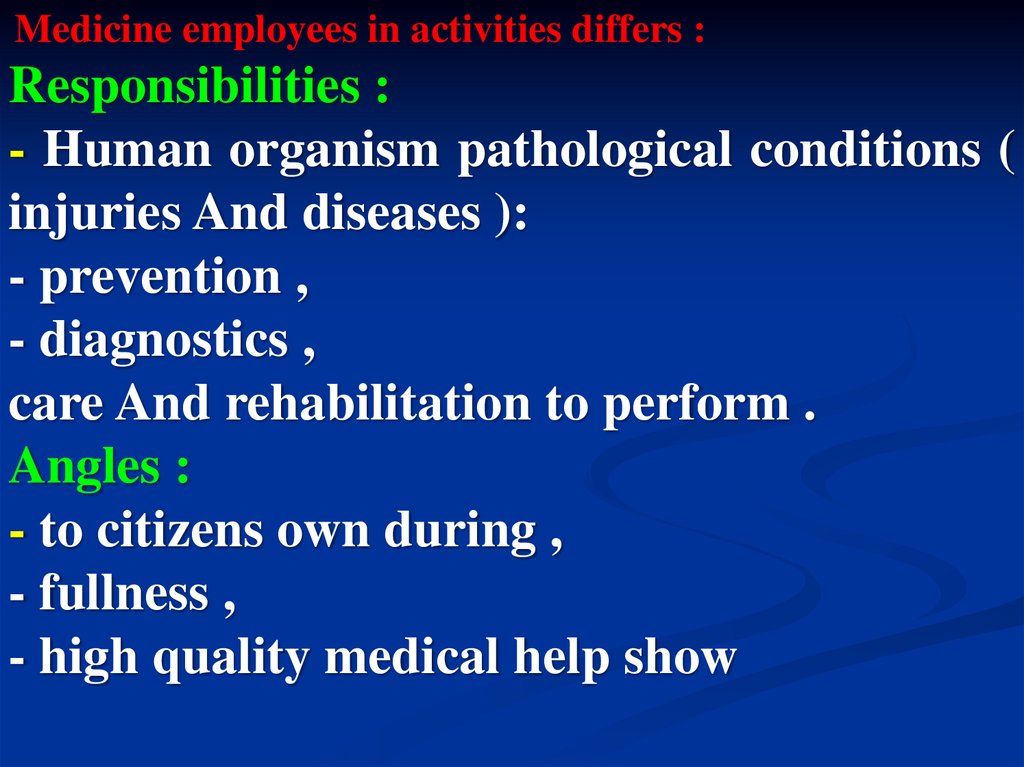
12.
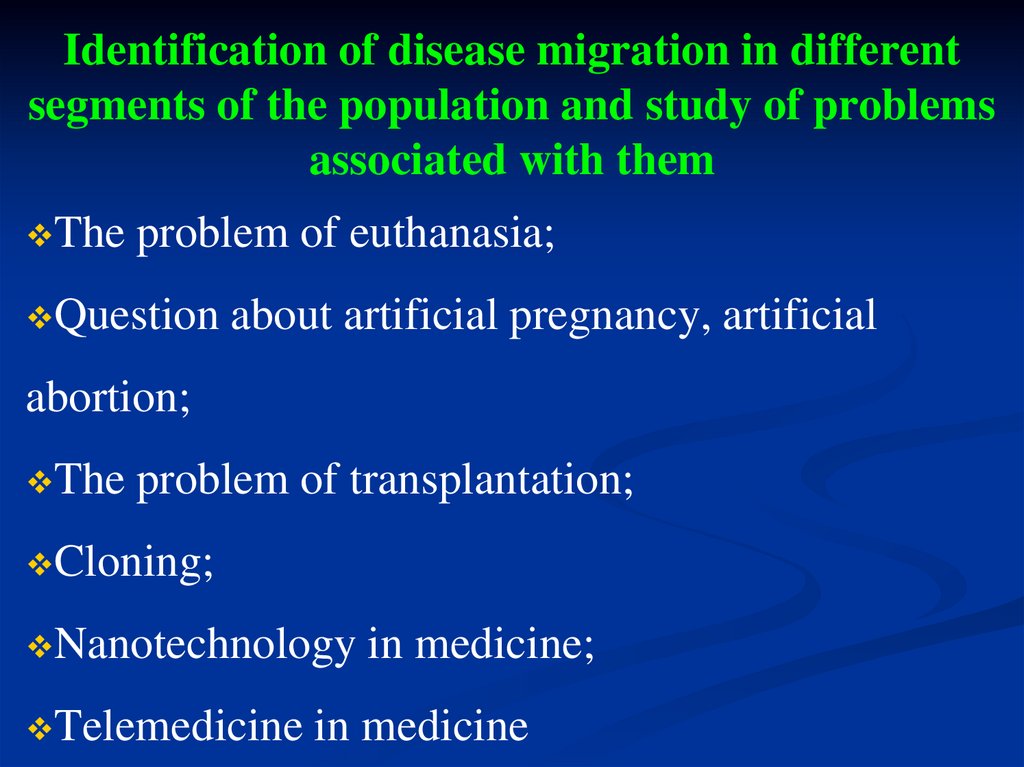
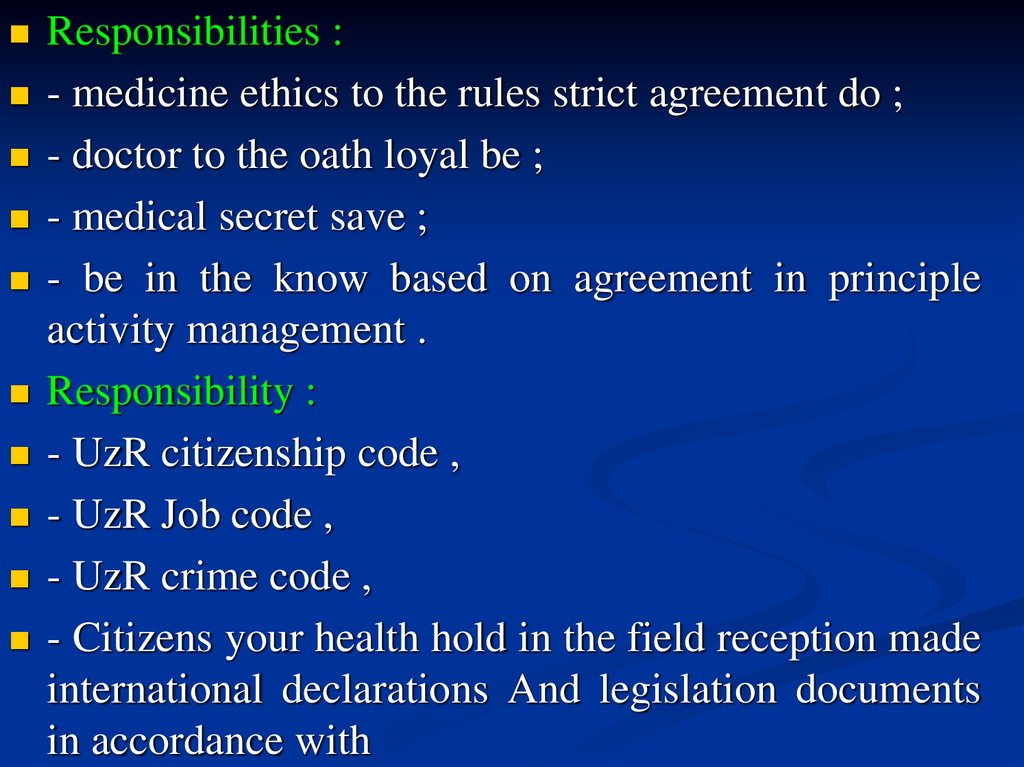
Identification of disease migration in differentsegments of the population and study of problems
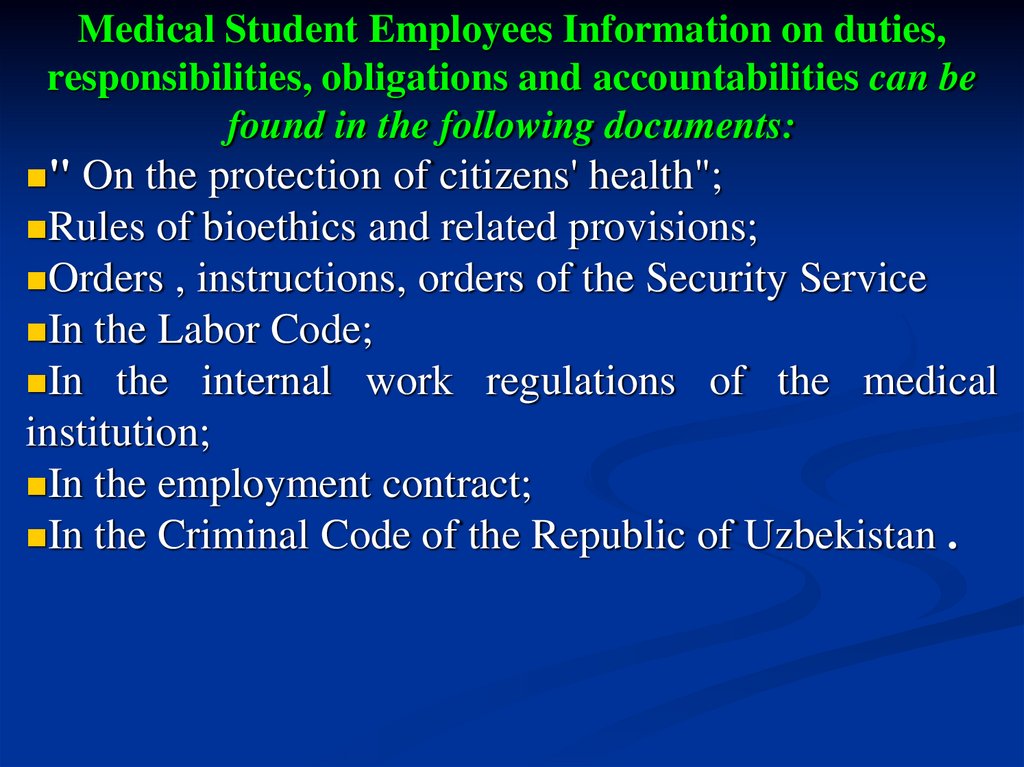
associated with them
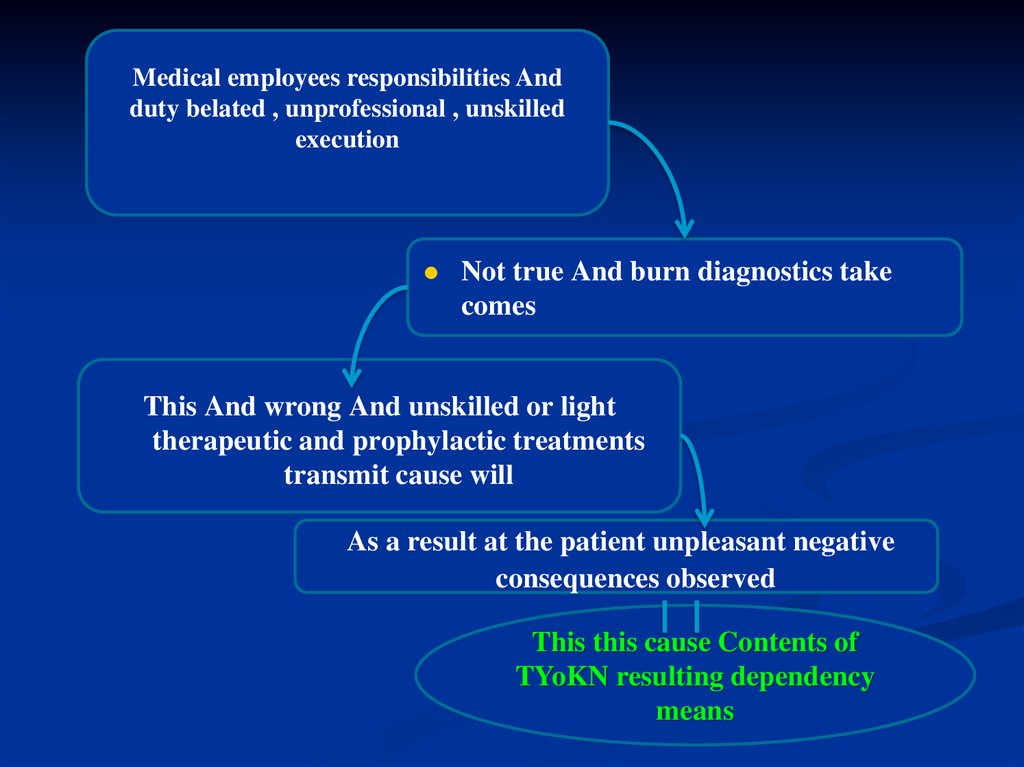
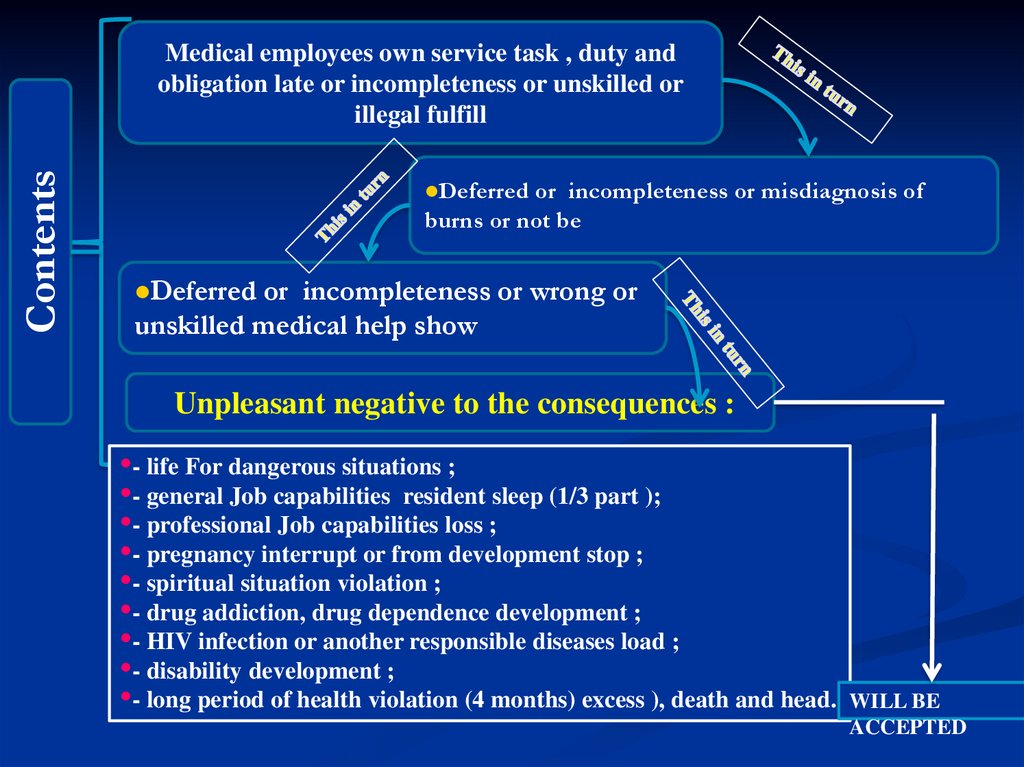
The problem of euthanasia;
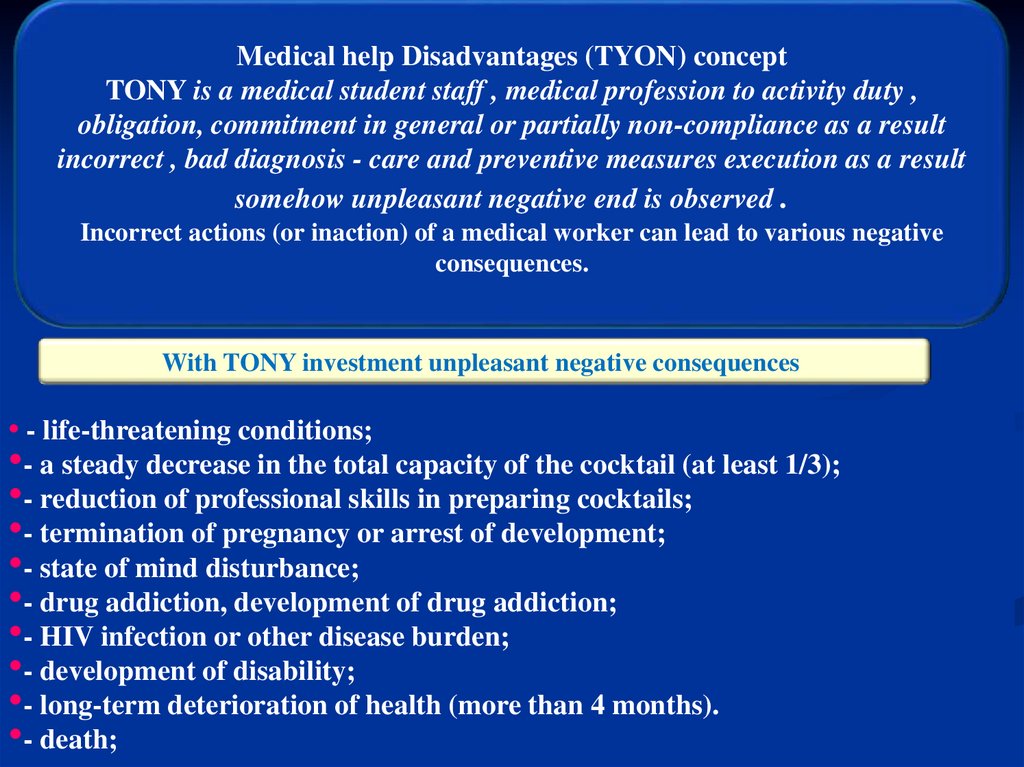
Question about artificial pregnancy, artificial
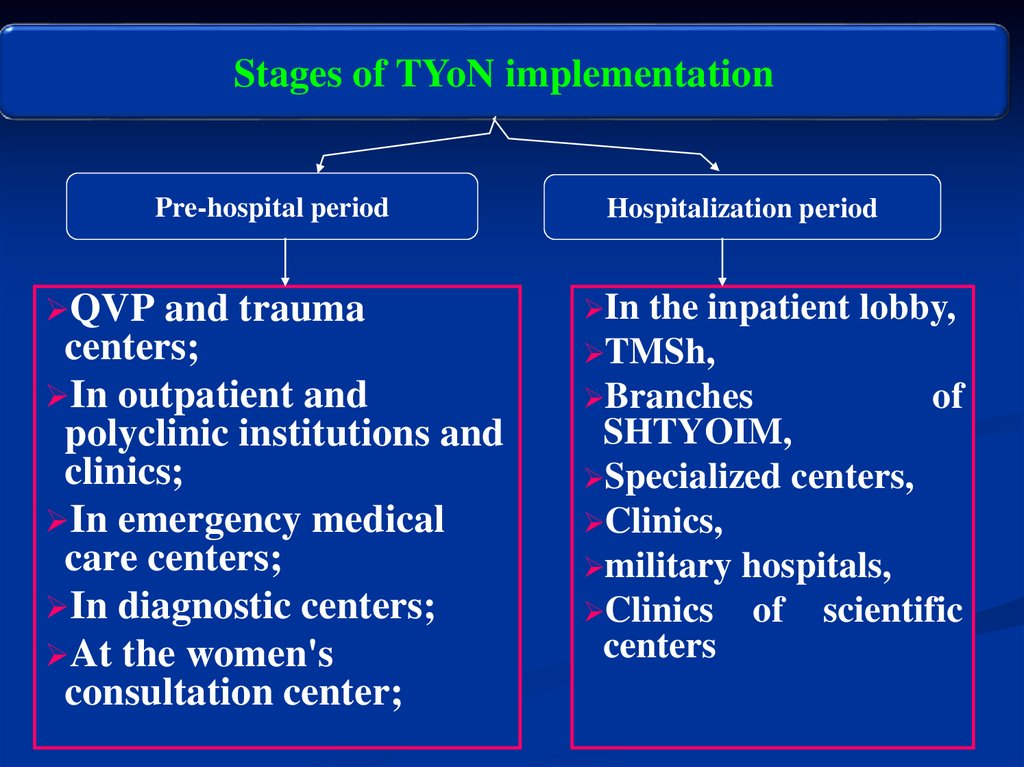
abortion;
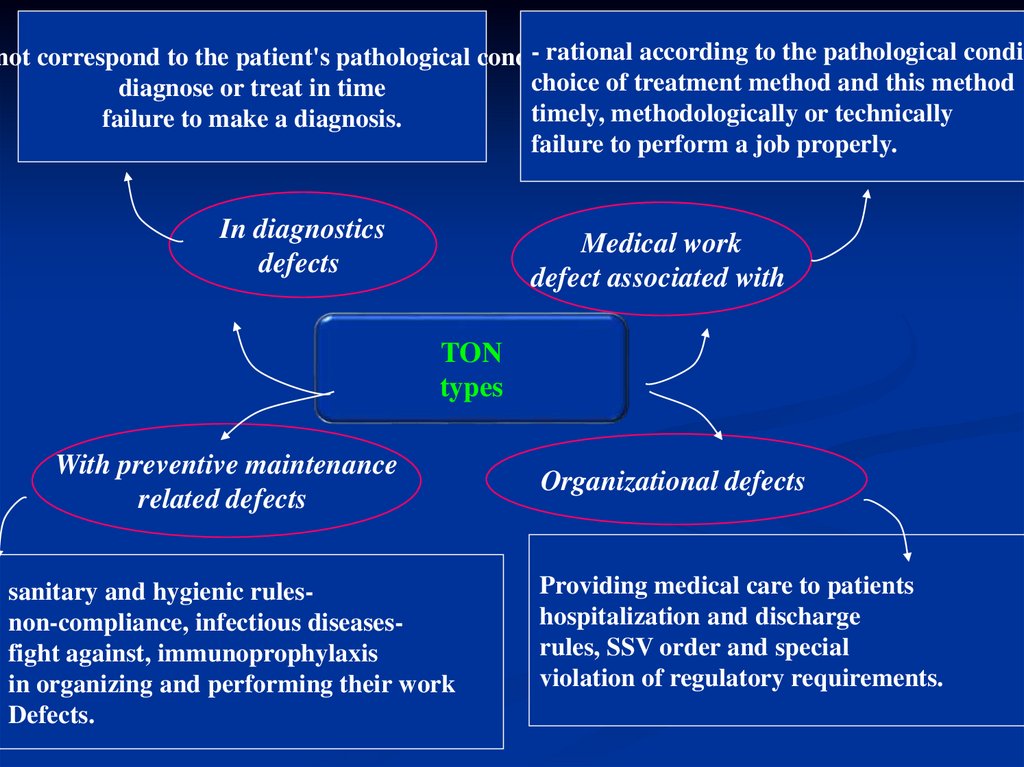
The problem of transplantation;
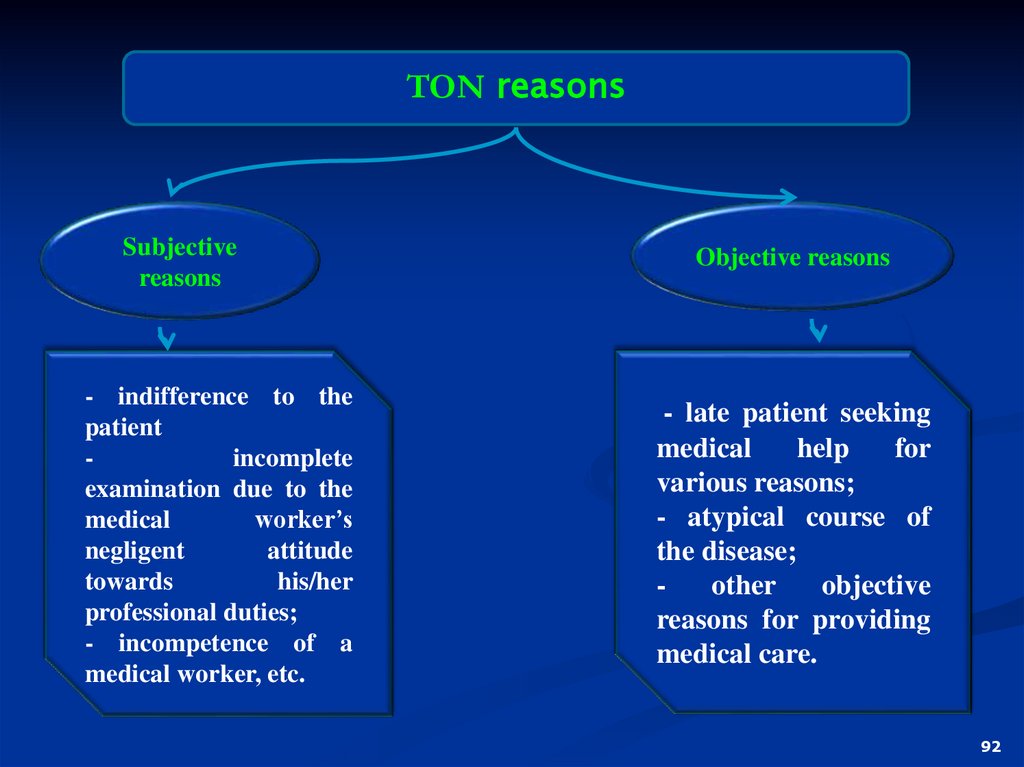
Cloning;
Nanotechnology in medicine;
Telemedicine in medicine
13.
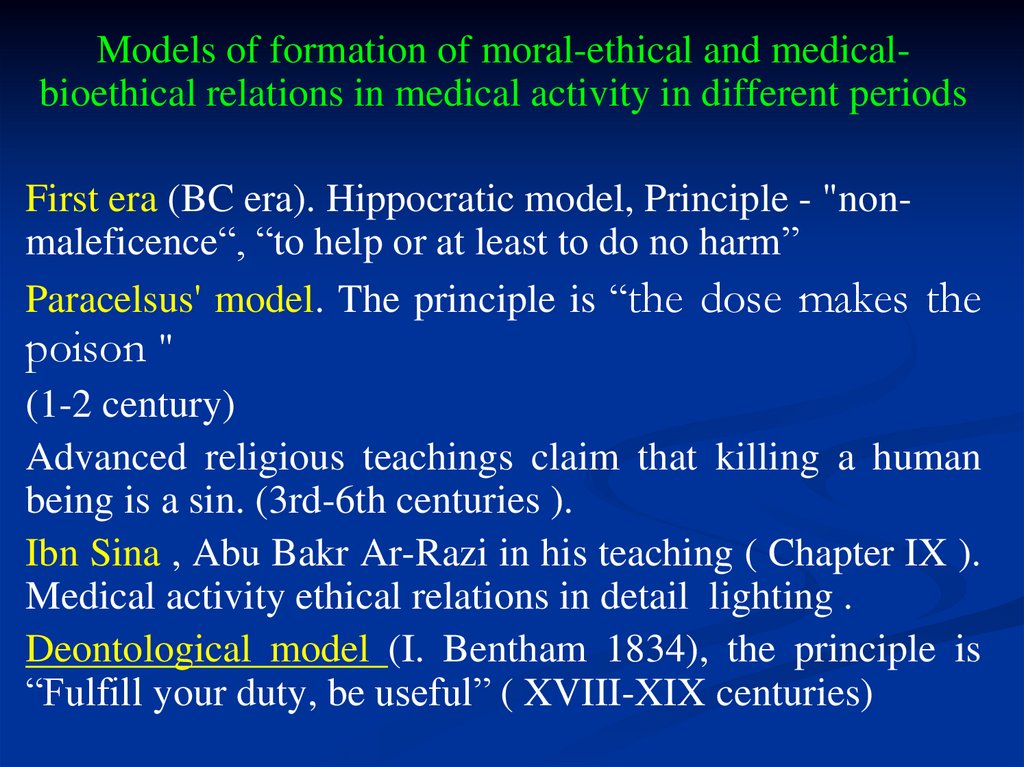
Models of formation of moral-ethical and medicalbioethical relations in medical activity in different periodsFirst era (BC era). Hippocratic model, Principle - "nonmaleficence“, “to help or at least to do no harm”
Paracelsus' model. The principle is “the dose makes the
poison "
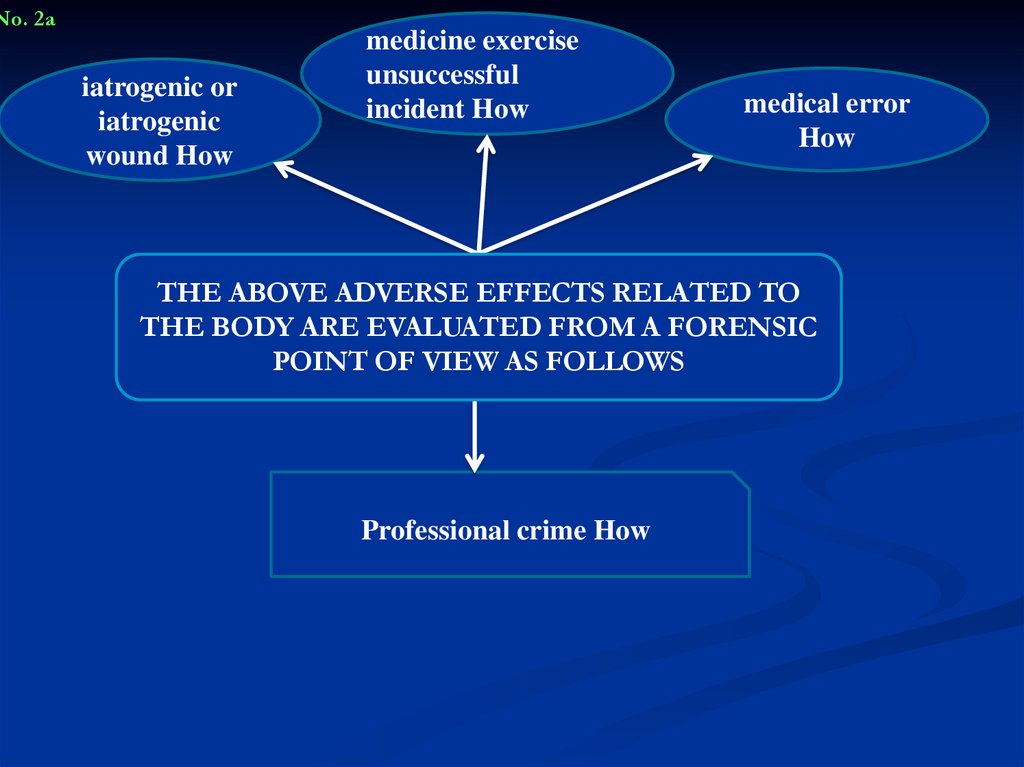
(1-2 century)
Advanced religious teachings claim that killing a human
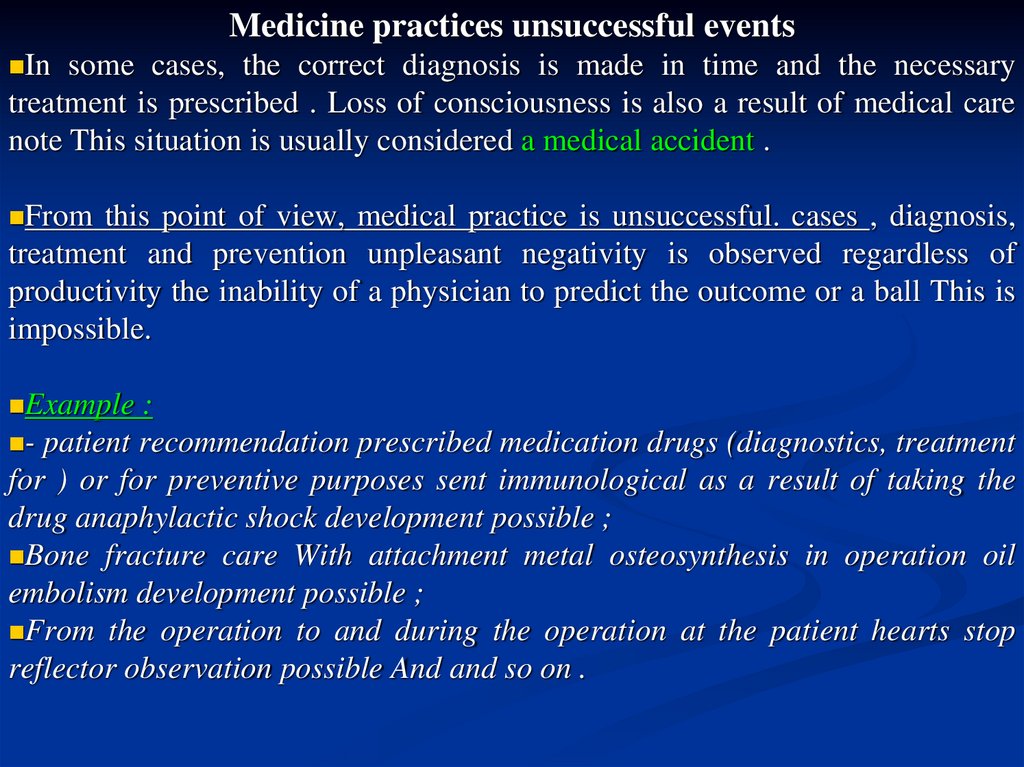
being is a sin. (3rd-6th centuries ).
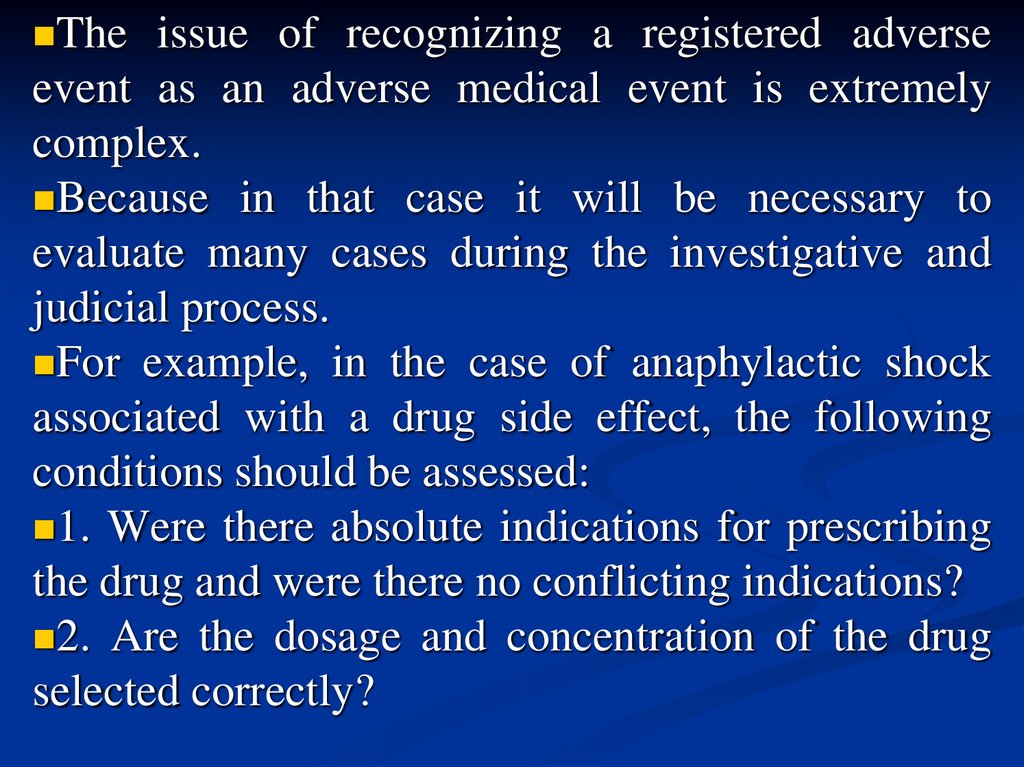
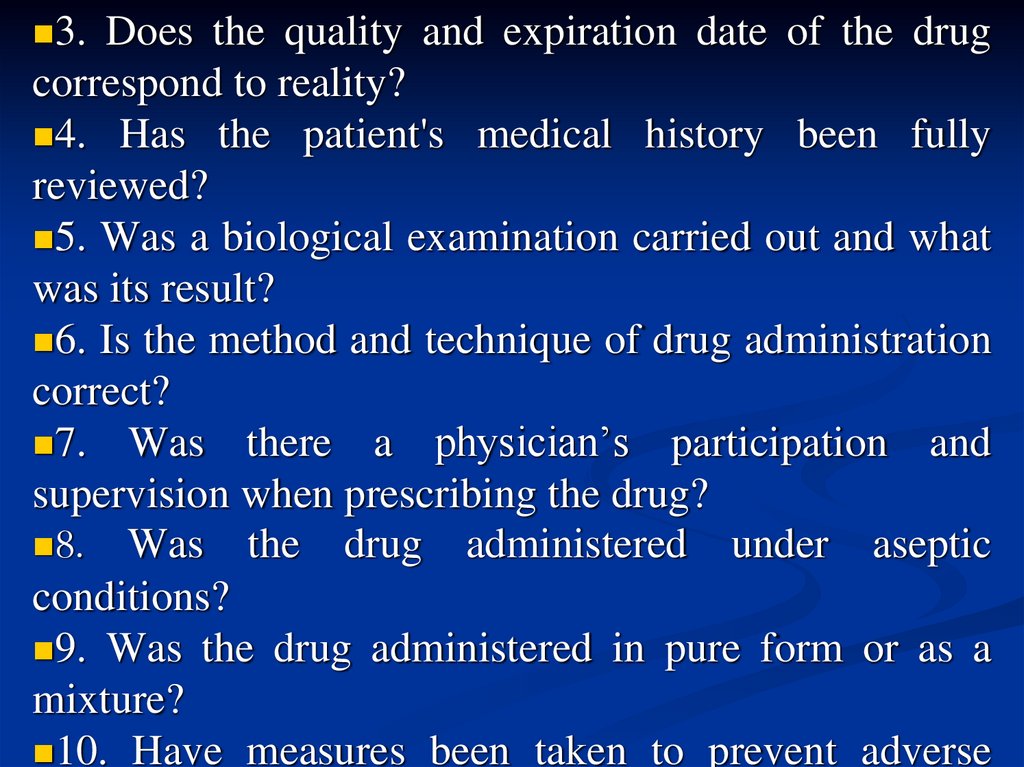
Ibn Sina , Abu Bakr Ar-Razi in his teaching ( Chapter IX ).
Medical activity ethical relations in detail lighting .
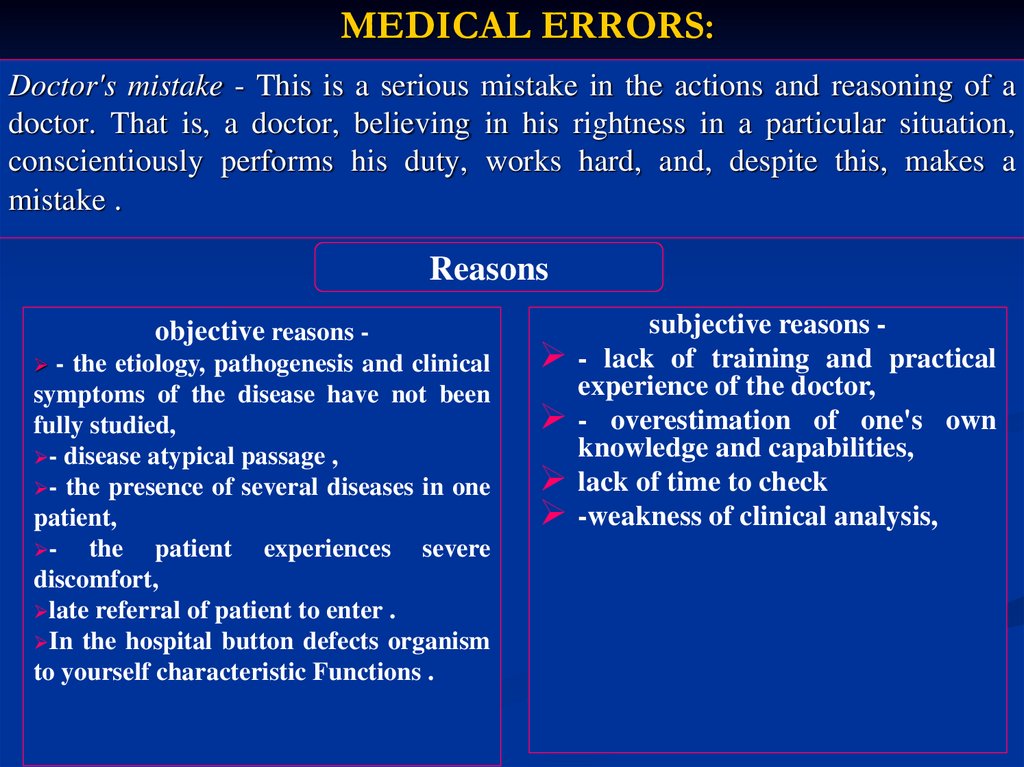
Deontological model (I. Bentham 1834), the principle is
“Fulfill your duty, be useful” ( XVIII-XIX centuries)
14.
The creation of medical associations on a globalscale and the adoption of international declarations
(Geneva, Helsinki, Tokyo) (19th–20th centuries).
Further improvement of ethical relations in
medical practice and the establishment of specific
measures against actions that contradict practice.
Model of Bioethics (XX - XI centuries, R. W.
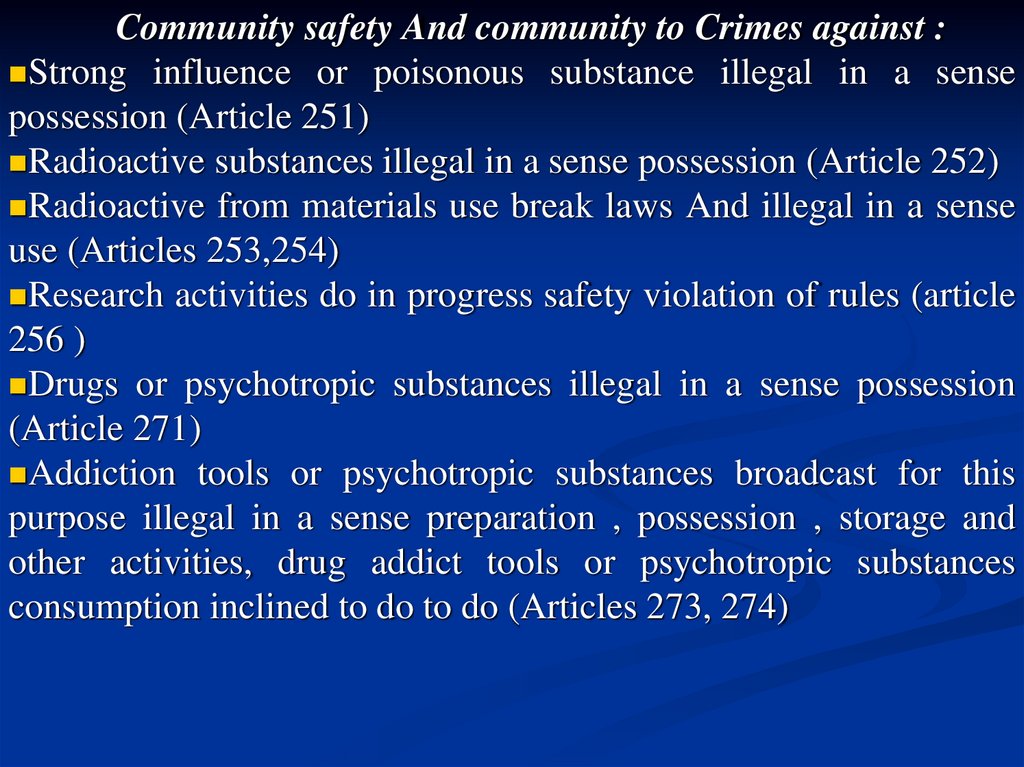
Potter 1970), The principle of formation is
“Performance of official duties, work on the
principle of informed consent.”
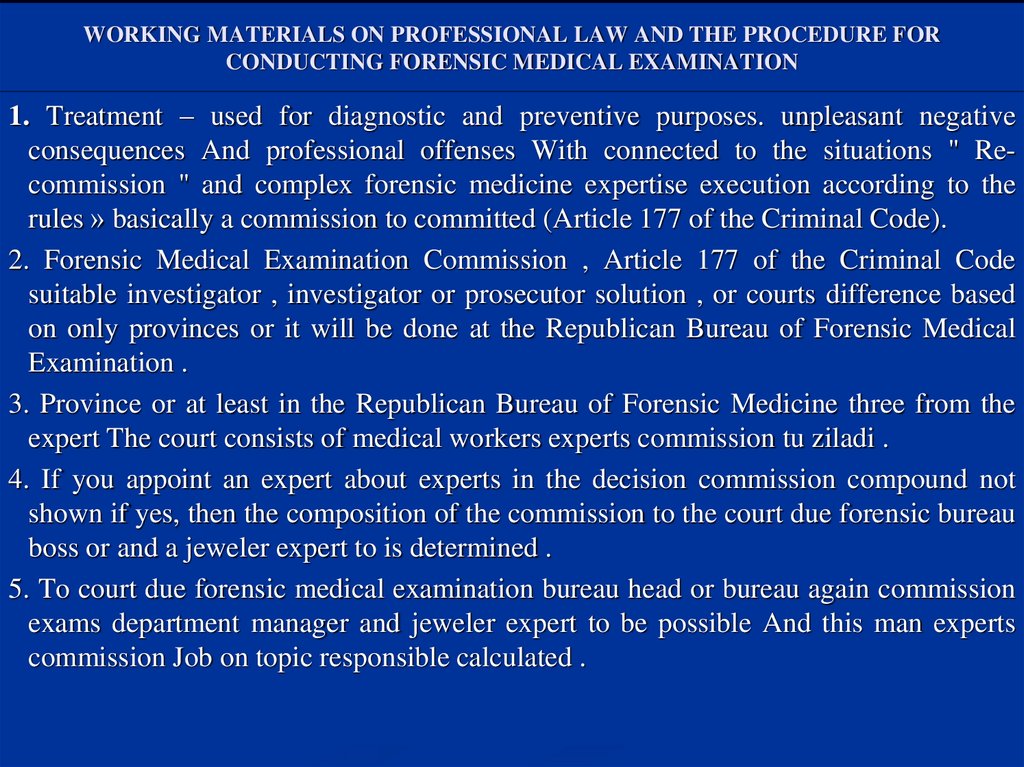
15. Medicine moral and ethical foundations
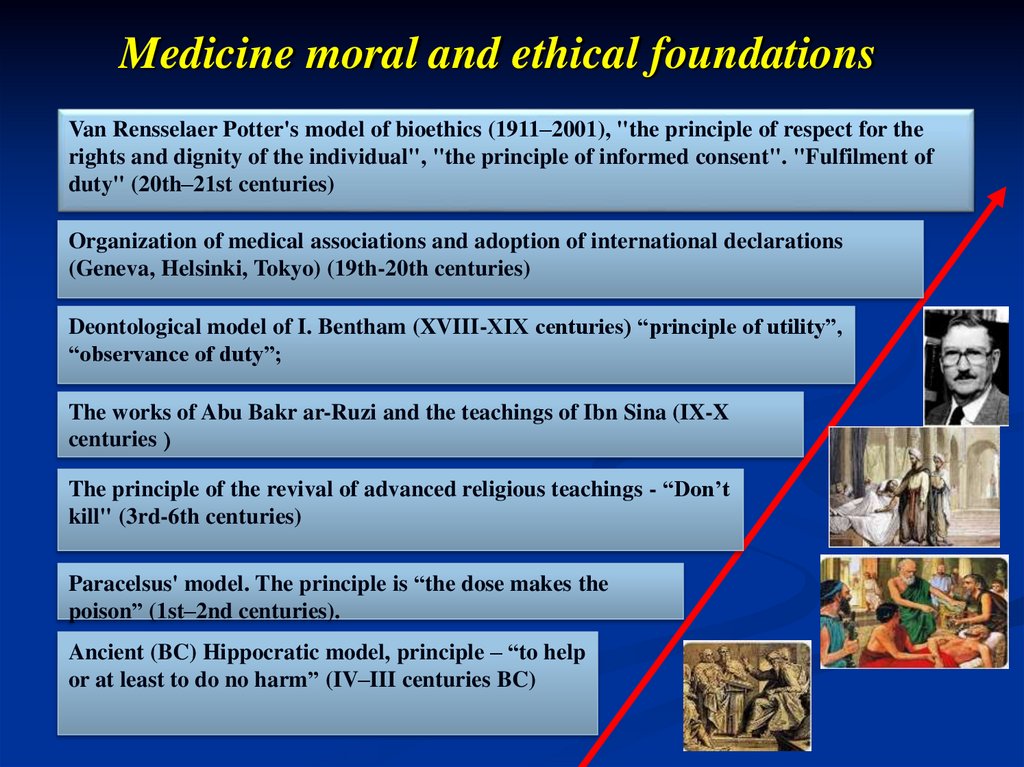
Van Rensselaer Potter's model of bioethics (1911–2001), "the principle of respect for therights and dignity of the individual", "the principle of informed consent". "Fulfilment of
duty" (20th–21st centuries)
Organization of medical associations and adoption of international declarations
(Geneva, Helsinki, Tokyo) (19th-20th centuries)
Deontological model of I. Bentham (XVIII-XIX centuries) “principle of utility”,
“observance of duty”;
The works of Abu Bakr ar-Ruzi and the teachings of Ibn Sina (IX-X
centuries )
The principle of the revival of advanced religious teachings - “Don’t
kill" (3rd-6th centuries)
Paracelsus' model. The principle is “the dose makes the
poison” (1st–2nd centuries).
Ancient (BC) Hippocratic model, principle – “to help
or at least to do no harm” (IV–III centuries BC)
16.
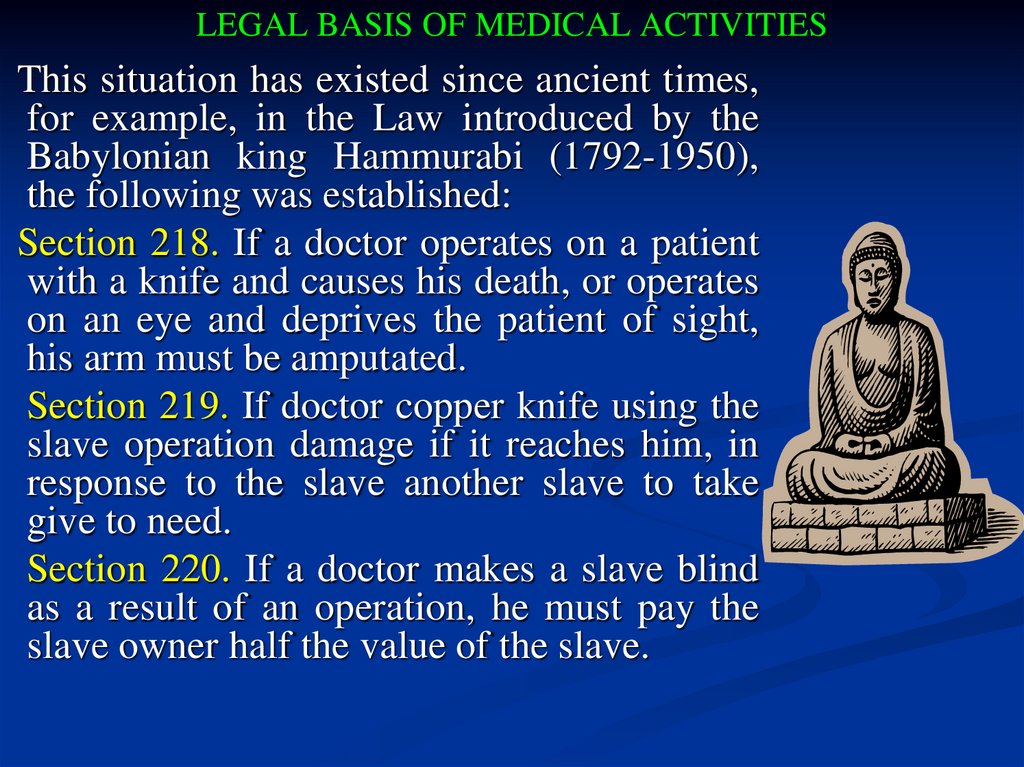
LEGAL BASIS OF MEDICAL ACTIVITIESThis situation has existed since ancient times,
for example, in the Law introduced by the
Babylonian king Hammurabi (1792-1950),
the following was established:
Section 218. If a doctor operates on a patient
with a knife and causes his death, or operates
on an eye and deprives the patient of sight,
his arm must be amputated.
Section 219. If doctor copper knife using the
slave operation damage if it reaches him, in
response to the slave another slave to take
give to need.
Section 220. If a doctor makes a slave blind
as a result of an operation, he must pay the
slave owner half the value of the slave.
17.
In subsequent periods, different laws on democraticmedical practice were adopted in different regions.
The “Unified Medical Law” adopted in Tsarist Russia
was in effect .
After the October Revolution of 1917, all laws, including
those in the field of medical activity, were developed on
the basis of socialist legislation and were in effect
throughout the system until the 1990s.
18.
Afterthe
Republic
of
Uzbekistan
gained
independence, all laws were
revised and in 1992 the
Constitution of the Republic of
Uzbekistan was adopted .
19.
Section I. Basics principlesSection II. Citizens basic
rights , freedoms And
duties shown
Chapter III . Named
Society And Human .
Section
IV.
Uzbekistan
Republic administrative , legal
and
state
structure
by
appointment posted.
Section
V.
The
organization
of
state
power. The Oliy Majlis,
the President of the
Republic, as well as the
electoral system in the
Republic of Uzbekistan
are reflected in the
Constitution.
Section VI. The procedure for
amending the Constitution is
described..
20. GUARANTEES OF HUMAN RIGHTS AND FREEDOMS PROVIDED IN THE CONSTITUTION
Article 43 states that the rights and freedoms ofcitizens are guaranteed by the state;
Article 44 states that the rights and freedoms of
every person are protected by the court;
Article 45 states that the rights of minors,
disabled people and the elderly are protected
by the state;
Article 46 states that women and girls have the
same rights as men.
21.
LAWS OF THE REPUBLIC OF UZBEKISTAN ON THE HEALTHCARE SYSTEM:"On the Protection of Citizens' Health", 1996
"On State Sanitary Supervision", 1992
"On the Prevention of Human Immunodeficiency Virus (HIV
Infection)", 1999
"On Narcotic Drugs and Psychotropic Substances", 1999
"On the Protection of the Population from Tuberculosis", 2001
"On Psychiatric Care", 2002
"On the Donation of Blood and Its Components", 2002
"On the Prevention of Iodine Deficiency Diseases", 2007
"On Forensic Medical Examination", 2010
22.
Public Health Protection Act"On the Protection of Public Health" - adopted in 1996.
Consists of 6 sections, 47 articles.
Defines the general legal foundations of the healthcare
system.
Section 1. General Provisions. This section sets out a set of
political, economic, legal, social, cultural and scientific
measures aimed at maintaining and strengthening the health
of each person.
Section 2. Citizens' Rights in the Field of Health. These
rights are ensured by medical institutions, public
associations, and doctors engaged in private medical
practice.
23.
Section 3. Provision of Medical and Social Assistance toCitizens.
Section 4. Medical Examination.
Section 5. On the Rights and Freedoms of Medical and
Veterinary Workers.
Section 6. Final Provisions. On the Oath of a Doctor of
the Republic of Uzbekistan, Medical Confidentiality, etc.
24. The main part of the Law "On the Protection of Citizens' Health". Duties And principles .
The main part of the Law "On the Protection of Citizens' Health". Duties Andprinciples .
Responsibilities:
Ensuring
that public health is guaranteed and
controlled by the state;
Formation of a healthy lifestyle of the population,
development of medical culture;
Legal regulation of the activities of state and nongovernmental organizations, public associations in
the healthcare system;
25.
Principles:Strict observance of human rights in the field
of health care;
Health care should be accessible to people
from all walks of life;
Priority of preventive directions;
Social protection of citizens in the event of loss
of health;
Unity of medical science and practice.
26. Article 3. Basic principles of protecting citizens' health
Article 3. Basic principles ofprotecting citizens' health
The main principles of protecting the health of
citizens are:
observance of human rights in the field of health
care;
accessibility of medical care for all segments of
the population;
priority of preventive measures;
social protection of citizens in the event of loss
of health;
27. Article 9. Financing of the state health care system
The sources of financing the state health caresystem are:
state budget funds;
mandatory health insurance funds;
funds of target funds intended to protect the
health of citizens;
funds received by medical and preventive
organizations for the provision of medical care
28.
in excess of the volume guaranteed by the stateand the provision of paid services;
voluntary and charitable contributions to health
care institutions from enterprises, institutions,
organizations, public associations and citizens;
bank loans;
other sources not prohibited by law.
29. Article 24. Patient rights
When seeking medical care and receivingmedical care, the patient has the following
rights:
to be treated with respect and courtesy by
medical and service personnel;
to choose a doctor and a medical and preventive
care institution;
to be examined, treated and cared for in
conditions that meet sanitary and hygienic
requirements;
30.
to consult with other specialists at his request inthe manner established by the Ministry of
Health of the Republic of Uzbekistan, and to
receive consultations from them;
to keep secret the request for medical care, the
state of health, the diagnosis and other
information obtained during the examination
and treatment;
to freely consent to medical intervention or
refuse it;
31.
to receive information about his rights andresponsibilities, about his state of health, as well
as to choose persons who may be provided with
information about his state of health in his
interests; to use medical and other services
within the framework of voluntary medical
insurance; In the event of harm to health during
the provision of medical care, compensation for
the damage caused in the manner prescribed by
law;
32.
appointment of a lawyer or other legalrepresentative to protect his rights.
In the event of a violation of his rights, the
patient or his legal representative has the right to
file a complaint directly with the head of the
medical institution or another official, with a
higher management body or with the court.
33. Article 44. Oath of a physician of the Republic of Uzbekistan.
Persons receiving a medical diploma take anoath of the following content:
“Having received the high title of doctor and
entering the medical profession, I solemnly
swear:
to devote all my knowledge and skills to the
treatment of patients and the preservation of
human health;
34.
to provide medical care to every patient,regardless of age, gender, race, nationality,
language, religion, beliefs, social origin and social
status, sparing no time and effort;
to put the patient’s health above personal
interests, to be modest and honest, constantly
improve my knowledge and skills;
to keep medical confidentiality;
always give people kindness and confidence in
their recovery;
35.
to continue the glorious traditions of greatdoctors such as Bukhara and Abu Ali ibn Sina.
I solemnly swear to remain faithful to this oath
until the end of my life.”
Doctors bear legal responsibility for breaking
the oath.
36.
Seminar No. 1. Topic: Stateprograms for reforming the
healthcare system of the
Republic of Uzbekistan and the
main tasks set in them.
37.
In the Republic of Uzbekistan, the requirementsand rules of the ethical principles of medical
activity, as well as the legal basis for activity and
the legislative framework based on democratic
principles of protecting the health of citizens have
been fully developed.
At the same time, a clear plan and state programs
for the development and further improvement of
the health care system were adopted. Their
content is as follows.
38.
I am Boskic: Decree of the President of November10, 1998 "On the comprehensive reform of the
health care system"
The main areas of the program:
Ensuring the constitutional rights of citizens to
receive qualified medical care and social protection;
Creation of an effective system for protecting
maternal and child health;
creation of
39.
Transition from a multi-tier to atwo-tier health care system (KVPTMS ), (polyclinic - central city
hospitals);
Creation of a new structure for the
system of providing emergency and
specialized medical care to the
population (RSTYM and its branches);
•Creation of a market for medical
insurance and medical services,
promotion of the development of
•Bachelor's and Master's degrees in
medical schools system creation and
40.
– Stage: February 26, 2003 “ HealthcareSystem reformation further Decree of the
President on deepening .
II
Program basic How to get there :
.
First on the
improvement ;
step
shown
directions
2. Primary medical and sanitary assistance and
emergency assistance for free provision ;
41.
Specializesin
providing
qualified
specialized medical care to the population,
A) Surgery,
B) Autumn microsurgery,
B) Cardiology,
G) Creation of urological centers,
UAVs of medical universities.
42.
III – Stage: September 19, 2007 “ HealthcareSystem reformation further deepening
and
about development President Decree .
Program basic How to get there :
Initial for medical and sanitary assistance
separately attention treatment , priority of
prevention ;
Motherhood And childhood protection arrival
problem ;
43.
Most high technologies With equippedskilled medical for help planned special
medical centers building verb ;
Specialized diagnostic centers Creation ;
Specialized medical help show planned
private what sector building verb
44.
Decree of the President of November 28, 2011 “Onfurther deepening and development of the reform
The main areas of the program:
Creating broad opportunities for providing primary
health care in rural areas;
Re-equipping and re-equipping district medical
associations with modern equipment using international
financial loans and grants;
Equipping and constantly re-equipping the base of
specialized medical centers of the republic with modern
equipment;
45.
Emergency medical care help demonstration servicemodern mobile medical equipment And contact
tools With equipped motor vehicles With provision ;
Maternal and Child Health National to the model
suitable perinatal , screening centers , maternity
hospitals , pediatric institutions material and
technical
base
further
development
And
reinforcement ;
Aholini popular And responsible from diseases
protection cancer , oncology and tuberculosis
against services institutions material and technical
base reinforcement .
46.
Literature on the topic:Presidential Decrees.
Giyasov Z.A. Legal bases of the
physician’s activity. Tashkent 2012.
Indiaminov S.I. Legal bases of the
physician’s activity. Tashkent 2014.
47.
Lecture No. 2Topic : Bioethics ( medical) bioethics ) content ,
tasks And problems Doctor's duty , doctor's oath ,
medicine Secret . Medical. biological experiment,
transplantation, cloning , abortion and euthanasia
legal and moral (ethical) foundations .
48.
" bioethics " (ethics of life) was firstintroduced in 1971 in the work of
oncologist Van Rensselaer Potter, "A
Bioethical Bridge to the Future."
("Bioethics: The Future For bridge )
in his book used. Author social And
natural sciences ( mainly biologists
And doctors ) representatives their
strength to people comfortable life
conditions Creation For unite it's
called.
W. R. Potter
(1911-2001)
49. Currently, the direction of bioethics:
scientific knowledge like a field ;academic subject How ;
as a social institution;
public as an action is considered and
is being studied.
Bioethics structural parts:
global bioethics,
medical and biological bioethics
50.
Responsibilities of medical and biologicalbioethics:
medical employees And patients between
mutual relationship problem ;
patient rights and obligations ;
medical
employees right, duty And
responsibilities ;
doctor and medical secret ;
in the healthcare sector due state legislation
and international contracts ;
modern solution in medicine ( biology ) not
found problems .
51.
Medical employees And patients betweenmutual attitude in progress :
patient rights ( good) intention - semi-state ) ;
principles of medical ethics consent do ;
medical sincere commitment to carry out (
observance of the medical oath);
Medicine secret Storage is important.
52. Responsibilities of medical staff
Providingtimely, comprehensive and
qualified medical care to all segments of the
population.
Strict observance of human rights and
respect for human dignity in the provision of
medical care.
Promoting the principle of informed consent
in medical practice while maintaining medical
confidentiality.
Loyalty to the medical oath.
53.
Preventingharm to the patient when providing
medical care.
Conscientious attitude of a medical worker
towards his colleagues and exposure of the
activities of unscrupulous medical workers who
deceive patients.
Treat prisoners, detainees and the elderly as if
they were other patients.
Not to participate in actions that discriminate
against prisoners, detainees and persons subject to
arrest.
54.
Medical employees rights :Work legality based on Job giving from the amount
professional let's get ready again training , qualification
increase ;
It will be implemented amplifier government power
appointed to category take For qualification from
certification victory , as well as certification results
based on Job right demand wear ;
level of qualification according to , activity to yourself
characteristic job characteristics complexity , size ,
quality And specific activity results considering take
Job on topic encourage receive ;
Professional non-profit organization society creation
55.
Patients' rights Uzbekistan Article 24 of the FederalSocial Insurance Fund of the Republic of Uzbekistan
(1996):
choose a doctor and a medical institution;
undergo
examination, treatment and care in
conditions that meet sanitary and hygienic
requirements;
consult and receive advice from other specialists
upon his/her request;
information about the request for medical assistance,
his state of health, diagnosis and other information
obtained during his examination and treatment are
kept confidential;
56.
Voluntaryconsent to or refusal of medical
intervention;
use of medical and other services within the
framework of voluntary medical insurance;
in the event of harm to health caused during
the provision of medical care - compensation
for the harm caused in the manner prescribed
by law;
be represented by a lawyer or other legal
representative to protect one's rights
57. Medicine taking the oath (Article 44
Persons receiving a medical diploma take the following oath:"I will receive the high title of doctor and enter the medical profession."
to devote all their knowledge and skills to treating the patient and maintaining
human health;
To provide medical care to every patient, regardless of age, gender, race,
nationality, language, religion, beliefs, social origin and social status, sparing no
time or effort;
put the patient's health above your personal interests, be modest and honest,
constantly improve your knowledge and skills;
maintain medical confidentiality;
to give people confidence that they will always find mercy and healing;
I solemnly swear to continue the glorious traditions of great physicians such as
Bukroth and Abu Ali ibn Sina.
I swear to keep this oath for the rest of my life.
Physicians are liable for breach of oath in accordance with the law.
58.
Medical confidentiality (Article 45 of the Law onthe Federal Medical and Social Service)
requests for medical assistance, his state of health
, diagnosis of the disease , as well as other
information obtained during his examination and
treatment, constitute a medical secret.
59.
Cases in which medical confidentiality maybe disclosed
Disclosure of information constituting a
medical secret without the consent of the
citizen or his legal representative is permitted
on the following grounds:
due to the severity of his condition for the
purpose of examining and treating a citizen
who is unable to express his will;
in case of threat of spread of infectious
diseases, severe poisoning and injuries;
60.
investigation or judicial supervision which willbe held attitude With investigation And
investigation authorities , prosecutor's office and
courts request in accordance with ;
ten four grow old incomplete adult inadequate
to a person help during the show his/her parents
or legal representatives informed do For ;
citizen for your health illegal behavior or
unsuccessful coincidence as a result damage
delivered because suspicion do Basics exists
when will it be .
61. This is a medical and biological experiment. new technologies, drugs, methods And methods experimental in a sense current it
needsto
be
washed
.
Medical and biological experiment hypothetical steps :
method or preparation content , essence , composition ,
characteristics , special commission will be checked ;
a positive conclusion from the commission was received;
experiments are carried out on animals;
the experiment will be conducted during the day (more than 20)
It is carried out within the framework of a specific medical institution
by order of the Ministry of Health;
Widely used based on the order of the Ministry of Health.
62.
Medical biological bioethical problemsConducting experiments on people is a problem ;
Medical in operation the principle of informed
consent of the database solution find ;
Structure of the human genome study And his/her as
a result hereditary vaccine Job fire And in practice use
;
The problem of euthanasia;
Transplantation issue ;
Cloning ;
Abortion and in vitro fertilization;
Application of nanotechnology in medicine;
Placebo in medicine;
Telemedicine and other areas of medicine .
63.
Requirements for a medical and biological experimentNew technologies, medicines and scientific basis of methods;
Social effectiveness of experience;
To alleviate the condition of a seriously ill patient;
Achieving success regardless of difficulties;
The presence of conditions for conducting the experiment and
the experimenter having complete information about it.
The experiment is recommended to be carried out on the
mentally ill, the elderly, the aged, the seriously ill, children and
pregnant women;
This means that the experimental disease is also prohibited
from being carried out on patients who are not related to the
purpose of the experiment.
64.
Transplantation of human organs and tissues – is thesurgical removal, preservation, storage and
transplantation of organs and tissues from a living
donor or a corpse to replace pathologically altered
or missing tissues or organs in a patient.
Transplantation is a treatment method used in
cases where it is impossible to save the patient's
life and restore his health using other treatment
methods, based on medical recommendations and
the patient's informed consent.
65.
There are different types of transplants:autotransplantation - transplantation within one
organism;
allotransplantation or homotransplantation transplantation between organisms of the same
species;
Hetero- or xenotransplantation is transplantation
into an organism of another species.
In an allotransplant, a healthy organ or tissue is
taken from a corpse or a living person.
Once the state of "brain death" was confirmed, it
became possible to use tissue from the deceased's
organs.
66.
Estimated time of biological death of the brain andinternal organs:
Brain (6-8 min);
- Internal organs (12-15 min);
- Bone marrow - (up to 4 hours);
- Muscles (up to 6-8 hours);
- Supporting tissues - skin, tendons, ankle, bone (2024 hours).
Diagnostic criteria for "brain death".
1. Estimated:
Absolute and complete passive state of the organism;
Constant lack of pleasure,
Muscle atony.
67.
In order to achieve the effect mobility And reflexesabsence ,
Forge resident extension and areflexia ,
Blood pressure And body temperature spicy to
decrease ,
Brain activities resident absence ,
symptom ( cat. eye condition from 10-15 minutes
then is observed .
Biological death reliable signs - corpse bodies cold
And from death last early changes appearance be
calculated (from 1.5-2 hours (sing ).
68.
Bone marrow donation and transplantation arethe most commonly performed medical
procedures.
In 1930, the Moscow Center for Emergency
Medical Care performed the first cremation of a
patient's body. The identity of the donor and
recipient was kept secret.
Currently, the extraction of ores and their
components in Uzbekistan is regulated by the
Law “On donor ores and their components”
(1993).
69.
Ethical issues of transplantationArguments of the "supporters":
- transplantation allows us to ensure the right to
life of every person;
- transplantation is recognized as an effective
method of treating irreversible (irreversible)
damage and diseases of the body;
- arguments are given in favor of transplantation
in cases where this method is the only method
of treatment.
70.
Arguments against :Human
Human How moral and spiritual And
spiritual honesty sleeps ( brain , sex) glands
transmission );
- big Job demand this is how it happens operations
Very heavy , negative consequences Danger higher ;
- the body's inability to accept donor organs his/her
to death take arrival possible ;
-possibly organs deception or criminal road With
defenseless from people received be maybe from this
outside organs sale groups appearance be .
71.
Legal basis for transplantationThere are two legal models for organ removal from a corpse:
“presumed consent” (probable consent) and “informed
consent”.
Model 1 - “presumed (probable) consent” - the donor from
whom internal organs are removed cannot declare during his
lifetime that he or his relatives are not against this;
Model 2 – “informed consent” – consent is given by the
donor or his relatives during his lifetime.
This consent requires documentary evidence. For example,
anyone who consents to donate will be given a "donor card" as
a trust document.
This consent is now reflected in the laws of many countries.
72.
Bioethical issues of surrogacy (artificial insemination).-The first artificial insemination was carried out at the end of
the 18th century (1780).
-In 1844, artificial insemination of horses and cattle began.
In 1944, the first human oocyte was successfully obtained, in
vitro fertilization (IVF) was performed, and the first singlecell embryo was obtained.
- In 1978, in England, the first implantation (transfer) of an
embryo obtained by artificial fertilization of an egg and sperm
in a test tube was carried out into the uterine cavity of a
woman suffering from this disease.
- After 9 months, the "test tube girl" was born - Louise
Brown.
73.
Artificialinsemination uses the following methods: 1)
artificial insemination with donor or male sperm; 2) in vitro
fertilization; 3) embryo transfer into the uterine cavity. The
method of artificial insemination with male and donor sperm
is used mainly for male infertility, when a man and a woman
cannot conceive a child due to the Rh factor and other
reasons. This is a well-developed (studied) and popular
method.
The application of this method is technically very complex
and includes the following steps:
Acceleration of egg formation;
Oocyte (egg) retrieval;
Fertilization of an egg in a medium (culture);
Embryo implantation procedures were performed.
74.
Problems of engineering technologiesHistory of the development of technology and its
role;
In the second half of the 20th century, several
discoveries were made based on genetic
engineering;
In 1980, years of effort to "read" the biological
information "written" in genes was successfully
completed;
This work was started by the English scientist F.
Sanger and the American scientist W. Gilbert.
75.
Genetic engineering technology stagesJenny separately take ;
Jenny shown direction in accordance with to the body entrance ;
Jenny volatile with a vector into the body take arrival ;
The body cell again formation ;
Genetically formed organism selectively take
Genetic engineering
Genetic engineering in people usage professional diseases care
For usage maybe . But patient myself care And his/her generations
genome change There is a technical difference between them .
Changing the genome of an adult human animals new genetically
modified breeds delete relatively it 's difficult because this in case
one egg cell embryo no , but rather, in a sense There are many cells
genome change demand It's done .
76.
- This in the case of viral bodies as vectors, a proposal forsubmission of an application worn out . Viral cells big old
Human cells famous percent they come in your generations
information compound to the possibility owner
Gene therapy by using human genome change opportunity .
Small on the scale or genetic engineering infertility basic
types exists filthy in women pregnant be opportunity This is
For healthy woman egg cell is used . As a result, the child
becomes one father And two maternal genotypes offspring
I'll take it .
But Human in the genome to the surface coming changes to
serious ethical issues cause is being .
77.
On topic due literatureGiyasov Z.A. Medical activity legal grounds . Tashkent
, 2012.
Iskanderov A.I. And others. The activities of a
physician : legal grounds . Tashkent , 2005.
Indiaminov S.I. Medical activity legal grounds .
Tashkent , 2014.
Mukhamedova Z.M. -Bioethics. Tashkent , 2006.
Sergeev Yu.D. Legal bases of the physician's activity.
Moscow 2008.
Uzbekistan Republic crime Codex , 1998.
78. Lecture No. 3 TOPIC: Defects in the provision of medical care (DMC): PUMP concept, essence, types , stages, reasons
79.
Procedure for carrying out medical activitiesThe requirements for the right to engage in medical
activities are set out in Article 41, Part 5 of the
Law "On the Protection of Citizens' Health".
According to it, the right to engage in medical
activities is granted to persons who have received a
diploma of graduation from a higher or secondary
specialized medical institution. Permission to
engage in this activity for persons who have
received a diploma of medical education in foreign
countries is determined by the Cabinet of Ministers
.
80.
The right to engage in activities of personswho have not worked for 3 years after
graduating from a higher or secondary
specialized medical institution is determined
by the certification commission of the State
Medical Service. Medical care to citizens by
students of higher or secondary specialized
medical institutions is carried out in
accordance with the curricula, during
training or practice under the supervision of
responsible medical workers.
81. In Uzbekistan therapeutic and prophylactic institutions system types :
State in possession institutions ,Private institutions ,
Another type institutions
Citizens On health care Articles
7, 8, 10 of the law
81
82. TYPES OF MEDICAL AND SOCIAL ASSISTANCE
Law on the Protection of Public HealthArticles 29,30,31:
1. Primary health care — is a basic, convenient and
free type of medical service, which includes:
a) the most common diseases and injuries requiring
emergency care;
b) sanitary-hygienic and anti-epidemic measures,
prevention of major diseases;
c) measures to protect the family, motherhood and
childhood and other types of provision of medical
and sanitary assistance to citizens in their places of
residence.
83.
2.Urgent and urgent medical care . It must be
provided to citizens by medical workers under any
circumstances. Refusal to provide emergency medical
care entails liability established by law.
Emergency medical care is provided by a specialized
emergency medical care service of the healthcare
system in the manner established by the Civil Defense
Agency of the Republic of Uzbekistan.
In the event of a threat to a citizen’s life, a medical
worker has the right to use any type of transport to
transport the patient to a medical facility.
Police officers, firefighters, emergency services, and
transport organizations are required to provide first aid
at the scene of the incident until medical workers
arrive.
84.
3. Specialized medical care - will be shown by aqualified medical worker with higher education.
85.
Medicine employees in activities differs :Responsibilities :
- Human organism pathological conditions (
injuries And diseases ):
- prevention ,
- diagnostics ,
care And rehabilitation to perform .
Angles :
- to citizens own during ,
- fullness ,
- high quality medical help show
86.
Responsibilities :- medicine ethics to the rules strict agreement do ;
- doctor to the oath loyal be ;
- medical secret save ;
-
be in the know based on agreement in principle
activity management .
Responsibility :
- UzR citizenship code ,
- UzR Job code ,
- UzR crime code ,
- Citizens your health hold in the field reception made
international declarations And legislation documents
in accordance with
87.
Medical Student Employees Information on duties,responsibilities, obligations and accountabilities can be
found in the following documents:
" On the protection of citizens' health";
Rules of bioethics and related provisions;
Orders , instructions, orders of the Security Service
In the Labor Code;
In
the internal work regulations of the medical
institution;
In the employment contract;
In the Criminal Code of the Republic of Uzbekistan .
88.
Medical employees responsibilities Andduty belated , unprofessional , unskilled
execution
Not true And burn diagnostics take
comes
This And wrong And unskilled or light
therapeutic and prophylactic treatments
transmit cause will
As a result at the patient unpleasant negative
consequences observed
This this cause Contents of
TYoKN resulting dependency
means
89.
Medical help Disadvantages (TYON) conceptTONY is a medical student staff , medical profession to activity duty ,
obligation, commitment in general or partially non-compliance as a result
incorrect , bad diagnosis - care and preventive measures execution as a result
somehow unpleasant negative end is observed .
Incorrect actions (or inaction) of a medical worker can lead to various negative
consequences.
With TONY investment unpleasant negative consequences
• - life-threatening conditions;
•- a steady decrease in the total capacity of the cocktail (at least 1/3);
•- reduction of professional skills in preparing cocktails;
•- termination of pregnancy or arrest of development;
•- state of mind disturbance;
•- drug addiction, development of drug addiction;
•- HIV infection or other disease burden;
•- development of disability;
•- long-term deterioration of health (more than 4 months).
•- death;
89
90.
Stages of TYoN implementationPre-hospital period
Hospitalization period
QVP and trauma
In the inpatient lobby,
centers;
In outpatient and
polyclinic institutions and
clinics;
In emergency medical
care centers;
In diagnostic centers;
At the women's
consultation center;
TMSh,
Branches
of
SHTYOIM,
Specialized centers,
Clinics,
military hospitals,
Clinics of scientific
centers
91.
- rational according to the pathological conditnot correspond to the patient's pathological condition
choice of treatment method and this method
diagnose or treat in time
timely, methodologically or technically
failure to make a diagnosis.
failure to perform a job properly.
In diagnostics
defects
Medical work
defect associated with
TON
types
With preventive maintenance
related defects
sanitary and hygienic rulesnon-compliance, infectious diseasesfight against, immunoprophylaxis
in organizing and performing their work
Defects.
Organizational defects
Providing medical care to patients
hospitalization and discharge
rules, SSV order and special
violation of regulatory requirements.
92.
TON reasonsSubjective
reasons
- indifference to the
patient
incomplete
examination due to the
medical
worker’s
negligent
attitude
towards
his/her
professional duties;
- incompetence of a
medical worker, etc.
Objective reasons
- late patient seeking
medical
help
for
various reasons;
- atypical course of
the disease;
other
objective
reasons for providing
medical care.
92
93.
Care and in diagnostic procedures unpleasant negative to theconsequences cause future factors : (Tomilin V.V., Sosedko Yu.I. 2000)
Patient ( pregnant) woman ) to the dispensary account within
the specified period do not take ;
Patients , pregnancy pathology filthy birth woman , danger in
the group children house under patronage and since autumn
forgiveness events failure to comply ;
To the patient relatively neglect ( lokaid) in relation to be );
Medical employees incompetence ;
Doctor patient inspection And care in the process of
narrowing possibilities excessive ( high ) price give ;
Disease anamnesis surface study ;
Sick situation weight true Bahamian do not take ;
Alcohol or drug intoxication suspicion be dressed patient
necessary from checks refusal of victory or checks full failure
to comply ;
94.
Diagnosticmeasures And basic laboratory And instrumental
inspection methods failure to comply ;
Diagnostic examination events demand at the level failure to
comply ;
Made inspections results wrong grade ;
This medical in the institution necessary diagnostic tools
pregnancy ;
Advisory ( consultative ) assistance in time do not use ;
Sick medical for help late request the very fact that it was
done ;
Patient situation weight because of inspections do increase O
difficulties ( problems ) arise ;
Rapid progression of the disease because of necessary
inspections fulfill For time insufficiency ;
95.
Lack of patient preparation for surgery;Rare occurrence of the disease in medical practice;
This patient has an asymptomatic and atypical course of the disease;
•The patient's disagreement with the examination and treatment
procedures;
•Features of the anatomical and physiological state of the patient's body;
•Lack of dynamic monitoring of the patient;
•Cargo of essential medicines;
•Failure to comply with medical procedures prescribed by medical
personnel;
•Failure to provide necessary medical care to a seriously ill patient;
•Treatment failure in this patient;
•Violation by the patient of the rules of hospital stay and treatment;
•Errors in medical records;
•Unjustified transfer of a patient from one department to another;
•Early response to a patient's request from the hospital.
96.
On topic due literature :Giyasov Z.A. Medical activity legal grounds . Tashkent ,
2012
Iskanderov A.I. The activity of a doctor : legal grounds .
Tashkent , 2005
Indiaminov S.I. Medical activity legal Basics . Tashkent ,
2014
Sergeev Yu.D. Legal bases of the activity of the doctor.
Moscow, 2008.
97. IV-Subject SUBJECT: Medical help on display with flaws ( tayon ) attachment unpleasant negative consequences medical - legal
grade .98.
ContentsMedical employees own service task , duty and
obligation late or incompleteness or unskilled or
illegal fulfill
Deferred or incompleteness or misdiagnosis of
burns or not be
Deferred or incompleteness or wrong or
unskilled medical help show
Unpleasant negative to the consequences :
•- life For dangerous situations ;
•- general Job capabilities resident sleep (1/3 part );
•- professional Job capabilities loss ;
•- pregnancy interrupt or from development stop ;
•- spiritual situation violation ;
•- drug addiction, drug dependence development ;
•- HIV infection or another responsible diseases load ;
•- disability development ;
•- long period of health violation (4 months) excess ), death and head. WILL BE
ACCEPTED
99. No. 2a
iatrogenic oriatrogenic
wound How
medicine exercise
unsuccessful
incident How
medical error
How
THE ABOVE ADVERSE EFFECTS RELATED TO
THE BODY ARE EVALUATED FROM A FORENSIC
POINT OF VIEW AS FOLLOWS
Professional crime How
100.
Iatrogenic-medical diagnostics and treatment of employees and
preventive maintenance due treatments in performance , as well as sick
or his/her close relatives With was in the conference room yours light
movement because of sick body And for the soul shit delivery It means .
Iatrogenic
trauma And in the form of a disease to ' Often will be
diagnostic and treatment , preventive procedures Nurin execution
iatrogenic to injuries cause will be in this patient light , moderate and
heavy in degrees iatrogenic injuries delivery possible (Articles 104, 105,
109 of the Civil Code of the Republic of Uzbekistan ) .
Intubation in progress teeth fracture , breathing road in members
injuries ;
life during venous catheterization or your perforation ,
spiral burn of the uterus uterus walls perforation ,
In EGDS stomach to the wall wound delivery .
101.
Medicine practices unsuccessful eventsIn
some cases, the correct diagnosis is made in time and the necessary
treatment is prescribed . Loss of consciousness is also a result of medical care
note This situation is usually considered a medical accident .
From this point of view, medical practice is unsuccessful. cases , diagnosis,
treatment and prevention unpleasant negativity is observed regardless of
productivity the inability of a physician to predict the outcome or a ball This is
impossible.
Example :
- patient recommendation prescribed medication drugs (diagnostics, treatment
for ) or for preventive purposes sent immunological as a result of taking the
drug anaphylactic shock development possible ;
Bone fracture care With attachment metal osteosynthesis in operation oil
embolism development possible ;
From the operation to and during the operation at the patient hearts stop
reflector observation possible And and so on .
102.
Theissue of recognizing a registered adverse
event as an adverse medical event is extremely
complex.
Because in that case it will be necessary to
evaluate many cases during the investigative and
judicial process.
For example, in the case of anaphylactic shock
associated with a drug side effect, the following
conditions should be assessed:
1. Were there absolute indications for prescribing
the drug and were there no conflicting indications?
2. Are the dosage and concentration of the drug
selected correctly?
103.
3. Does the quality and expiration date of the drugcorrespond to reality?
4. Has the patient's medical history been fully
reviewed?
5. Was a biological examination carried out and what
was its result?
6. Is the method and technique of drug administration
correct?
7. Was there a physician’s participation and
supervision when prescribing the drug?
8. Was the drug administered under aseptic
conditions?
9. Was the drug administered in pure form or as a
mixture?
10. Have measures been taken to prevent adverse
104. MEDICAL ERRORS:
Doctor's mistake - This is a serious mistake in the actions and reasoning of adoctor. That is, a doctor, believing in his rightness in a particular situation,
conscientiously performs his duty, works hard, and, despite this, makes a
mistake .
Reasons
objective reasons - the etiology, pathogenesis and clinical
symptoms of the disease have not been
fully studied,
- disease atypical passage ,
- the presence of several diseases in one
patient,
the patient experiences severe
discomfort,
late referral of patient to enter .
In the hospital button defects organism
to yourself characteristic Functions .
subjective reasons - lack of training and practical
experience of the doctor,
- overestimation of one's own
knowledge and capabilities,
lack of time to check
-weakness of clinical analysis,
105. Types of medical negligence:
diagnostic errors,technical error
errors in the choice and treatment of treatment
methods,
errors in the organization of medical care,
errors when filling out medical documents,
Ethical errors of medical workers are mainly
related to bioethics.
106.
Professional offensesProfessional crime is medical employees own
professional activity With connected tasks , duties
, obligations appointed order , rule , regulation ,
instruction And to the law in spite of in case ( of
yours) benefit intended in case or indifference
because of ) performance It means .
Professional offenses legal dot into 2 groups is
divided into :
1. Error or knife behavior .
2. Crime .
107.
Made - this society For dangerous No appointed order ,rule , procedure , guidance , regulation , cocktail
contradiction to the law indecent behavior this is situation on
topic in law criminal responsibility not specified . However
every What to the point administrative , disciplinary , moral
punishment application by appointment burned down .
for these reasons in accordance with actions into 3 groups
is divided into :
a) Administrative action - patient stacking , unloading ,
processing rules violation And hk
b) Disciplinary done - medical employee come to work late
from work early go to work absence And hk
c) Citizenship action is treatment diagnostic equipment of
the institution gap , tie materials does not save And another .
108.
Crimeis society And state construction in essence Danger
builder crime to the law in spite of crime for society or citizens
big in quantity damage this is to convey .
Medical activity With connected crimes OZ.R. According to JK
to the following 5 groups How study possible :
1. To life and to health against crimes (Articles 97, 102, 104105, 109, 113-117 of the Civil Code).
2. Towards family, youth , morality against crimes (Articles
124, 125, 133 of the Criminal Code ).
3. Fundamentals of Economics and the ecology of crime
(Articles 190, 193-196, 199 of the Civil Code) With ).
4. Power control And community Associations, body activity to
against crimes (Articles 205-212, 238-239-240 of the Civil
Code).
5. Community safety And community to against crimes
(Articles 251-254, 256, 271-274 of the Civil Code).
109.
To life And to health against to crimes following enters .Medicine employee in euthanasia participation verb .
(Article 97)
Causing serious, moderate and minor bodily injury through
negligence (Articles 104-105, 109) (iatrogenic injury),
Sexual intercourse or the spread of AIDS (Article 113 ),
Criminal in a sense fetus unloading (Article 114)
Forcing a woman to have an abortion (Article 115),
Failure to properly perform one's professional duties
(Article 116),
Creating a danger to the life of a patient or victim (Article
117),
110.
Crimes against family, youth, morality:Changing a child (Article 124)
Acceptance disclosure of secrets (Article
125)
The human body and tissue extraction
(Article 133)
111.
Economy Basics and ecology in the field crimes :Activity to engage in activities without a license (Article
190)
Ecology for your safety due norms and violation of
requirements (Article 193 )
Environment
, natural environment pollution O
information intentionally concealment or break the
demonstration (Article 194)
Neighborhood
natural
environment
pollution
consequences elimination to fail to comply with measures
(Article 195 )
Neighborhood natural environment pollution (Article 196)
Plants diseases or pests With struggle requirements
violation (Article 199)
112.
Power , control and team Associations, bodily activityto the composition Crimes against :
Government or career activity abuse (Article 205 )
Government or career out of scope to the side exit
(article 206)
Good luck in your career ! with a view (article 207 )
Government security (article 208)
Incompetence ( Article 209 )
False testimony investigation or original
investigation information open to do , criminal
proceedings legal participate from responsible task
from execution neck Extortion (Articles 238, 239,
240)
113.
Community safety And community to Crimes against :Strong influence or poisonous substance illegal in a sense
possession (Article 251)
Radioactive substances illegal in a sense possession (Article 252)
Radioactive from materials use break laws And illegal in a sense
use (Articles 253,254)
Research activities do in progress safety violation of rules (article
256 )
Drugs or psychotropic substances illegal in a sense possession
(Article 271)
Addiction tools or psychotropic substances broadcast for this
purpose illegal in a sense preparation , possession , storage and
other activities, drug addict tools or psychotropic substances
consumption inclined to do to do (Articles 273, 274)
114.
On topic due literature :Giyasov Z.A. Medical activity legal Basics . Tashkent ,
2012.
Iskanderov A.I. And other Activities of the doctor of law
Basics . Tashkent , 2005.
Indiaminov S.I. Medical activity legal Basics . Tashkent ,
2014.
Labor and Criminal Codes of the Republic of Uzbekistan
115.
Seminar #2TOPIC: Forensic examination of
adverse events associated with
diagnosis,
treatment
and
prevention in medical practice
116. WORKING MATERIALS ON PROFESSIONAL LAW AND THE PROCEDURE FOR CONDUCTING FORENSIC MEDICAL EXAMINATION
1. Treatment – used for diagnostic and preventive purposes. unpleasant negativeconsequences And professional offenses With connected to the situations " Recommission " and complex forensic medicine expertise execution according to the
rules » basically a commission to committed (Article 177 of the Criminal Code).
2. Forensic Medical Examination Commission , Article 177 of the Criminal Code
suitable investigator , investigator or prosecutor solution , or courts difference based
on only provinces or it will be done at the Republican Bureau of Forensic Medical
Examination .
3. Province or at least in the Republican Bureau of Forensic Medicine three from the
expert The court consists of medical workers experts commission tu ziladi .
4. If you appoint an expert about experts in the decision commission compound not
shown if yes, then the composition of the commission to the court due forensic bureau
boss or and a jeweler expert to is determined .
5. To court due forensic medical examination bureau head or bureau again commission
exams department manager and jeweler expert to be possible And this man experts
commission Job on topic responsible calculated .
117.
6. Experts to the commission solution or reward With together unpleasant negativeconsequence or professional offenses in accordance with investigation
investigation in processes or in court proceedings accumulated Job materials
presentation will be done . With this together sacrifice man , death in case And
dead body again inspection possible .
7. Experts commission Job materials With to find out exit and check incident O
definite to understanding owner medical documents ( only original copy ), corpse
inspection protocol or expert opinions ( acts ), clinical and anatomical conferences ,
events see place forgiveness reports , medical employees instructions And another
documents carefully their research necessary .
8. Working materials discussion do in process experts commission accused
activities of a medical worker with connected conditions considering they get this
is necessary because there is no silence state to the requirements reply without
giving work conditions With connected be perhaps ( eg diagnostic tool equipment
absence ). From this outside , no hush -negative state diseases atypical patient
passage It is too late to see a doctor. request what did he do in the patient separate
medicine to the means relatively allergic reactions development With connected be
possible .
118.
Issues to be resolved by the expertWas the diagnosis made promptly and correctly in the clinic or hospital? If
not, what were the consequences?
To a patient in hospital Are checks carried out in full?
Was the patient hospitalized in a timely manner?
Does the treatment prescribed to the patient correspond to the established
diagnosis?
Are all measures used in the process of combating complications?
This happens when medical care is not provided in sufficient quantity.
How is that? What consequences did this lead to and what further measures
should have been taken?
Possibility of preventing complications was there a complication Is the
patient provided with sufficient support for treatment?
Did the patient receive a timely response from the hospital?
119.
Were there any contraindications to the treatment prescribed to the patient, anddid this treatment lead to the deterioration of the patient's condition and death?
At what stage of the treatment and diagnostic process do errors occur?
Is the severity and course of the disease the main cause of the disease or are the
main causes the errors made during treatment?
Were there indications for surgery?
Was the patient under constant supervision of medical staff during the
postoperative period?
What mistakes were made during the operation and in the postoperative period?
patient resuscitation procedures?
What is the skin like on a citizen's body? What injuries did he sustain, what was
the mechanism of their transmission, and did these injuries cause his death?
What is the cause of death of the deceased? was?