 law
lawSimilar presentations:







Criminal procedural foundations of iatrogenic crimes
1.
"Criminalprocedural
foundations of
iatrogenic
crimes"
Makarova Yana Valeryevna
Kazan Federal University, undergraduate
Email: yana-Makarova-08@mail.ru
Nazarov Sergey Sergeevich
Kazan Federal University, undergraduate
Email: @n_zr_s@mail.ru
2.
• Abstract: The article is devoted tothe investigation of iatrogenic
crimes in Russia. The problems of
legal regulation, the main criminal
procedural and criminalistic
features of the investigation of
such crimes are considered. In
conclusion, the author suggests
creating a safe environment for
discussing medical errors and
developing effective methods for
investigating iatrogenic crimes.
• Research Question :
What aspects are important
to highlight in the effective
investigation of iatrogenic
crimes?
3.
IntroductionAn iatrogenic crime- is a culpable violation of the rules and (or)
standards of medical care committed by an individual with the status
of a medical professional in the course of performing his professional
d u t i e s , c a u s i n g d e a t h o r h a r m t o t h e p a t i e n t 's h e a l t h o r t h r e a t e n i n g t o
cause such consequences.
The relevance of the research is aimed :
C u r r e n t l y, t h e r e i s a n i n c r e a s e i n c o m p l a i n t s a b o u t t h e q u a l i t y o f
medical care in the countr y: citizens are increasingly turning to law
enforcement agencies, courts and other authorities (for example,
healthcare). In 2022, more than 1,800 cases were filed against medical
workers, but only about 200 reached cour t, and only 10% of the
accused were acquitted. In 2023, the number of criminal cases filed
increased by 25%, which confirms an alarming trend. The issues of law
enforcement here go beyond the scope of the criminal process, as they
affect the constitutional rights of citizens to health protection and
protection from unlawful medical inter vention. This determines the
relevance of the work .
The purpose of this study is to conduct : The possibilities of improving
the existing system of legal relations
To a c h i e v e t h e s e g o a l s , t h e f o l l o w i n g t a s k s h a v e b e e n s e t :
1) Reasons for the high сrime statistics in this area
2) studying the experience of foreign countries
4.
Materials & Methods / MethodologicalFramework
• The study uses historical and legal analysis to track the
methods of investigation of iatrogenic crimes. Comparative
analysis is applied to identify differences and similarities in
their legal regulation.
• Examination of regulatory legal acts provides insights into
the frameworks governing these entities, while doctrinal
analysis reviews academic perspectives and judicial
practices.
5.
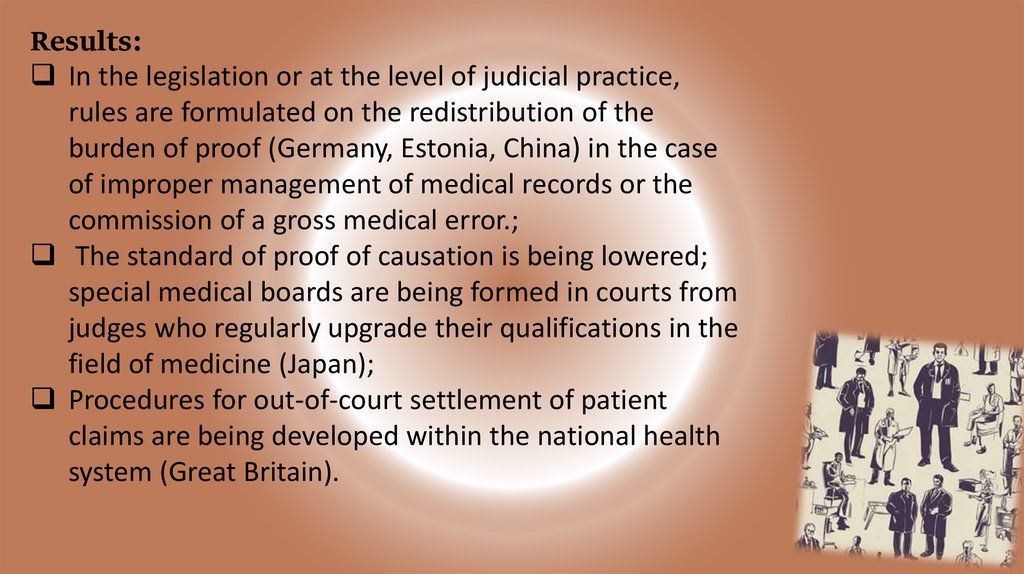
Results:In the legislation or at the level of judicial practice,
rules are formulated on the redistribution of the
burden of proof (Germany, Estonia, China) in the case
of improper management of medical records or the
commission of a gross medical error.;
The standard of proof of causation is being lowered;
special medical boards are being formed in courts from
judges who regularly upgrade their qualifications in the
field of medicine (Japan);
Procedures for out-of-court settlement of patient
claims are being developed within the national health
system (Great Britain).
6.
Discussion• In many countries, as in Russia, the courts consider criminal
cases against medical workers ("medical cases"), without any
exceptions and features, based on the classic compositions of
reckless crimes against life and health - causing death by
negligence, causing serious or other harm to health by
negligence. The criminal legislation of these countries does not
contain a special rule on liability for harm to the life and health
of a patient as a result of a medical error. Relevant acts
(actions, inaction) of medical workers
7.
DiscussionThe reason for contacting the investigating authorities may also be the patient's
lack of information necessary to assess the quality of treatment. Therefore,
another area of reform is to increase transparency in the field of medical care. On
the one hand, the patient is guaranteed the right to receive the necessary
medical documents (medical history, surgery protocol) and explanations from the
attending physician. On the other hand, the doctor gets the opportunity to have
a more open dialogue with the patient and even apologize in case of an
unfavorable outcome without the risk that his words or actions will be used later
as evidence of guilt in making a mistake.
8.
Conclusions and Recommendations• 1)First of all, the Russian legislature should create incentives for doctors and medical
organizations to disclose information about adverse treatment outcomes. Without this, it
is impossible to create a full-fledged information base, conduct reliable analysis of medical
incidents and develop safer options for medical intervention.
• 2) The level of transparency in the patient-doctor relationship can be increased by
decriminalizing medical errors that are not gross, or by including additional grounds for
termination of criminal prosecution in the criminal procedure law if the medical
professional promptly documents the fact of the error and sends information to an
authorized organization (patient safety database operator).. This approach is becoming
increasingly recognized in international practice (Italy, China, Estonia), as the state is
interested both in the safety of medical services and in maintaining qualified medical
personnel.
• 3) It is advisable to supplement the Russian healthcare system with an institution that
ensures the out-of-court settlement of most disputes related to the provision of
substandard medical care to patients , strict accounting of medical errors and crimes, their
official publication and open discussion
9.
List of sources used1. Biktasheva R.R., Gallyamova I.I. Iatrogenic crimes: features of their
commission and investigation // International Journal of Humanities
and Natural Sciences. 2024. No.6-1 (93). pp. 9-14(In Russ).
2. Bessonov A.A. Actual issues of developing methods for
investigating iatrogenic crimes // International Journal of Actual
Problems of Medicine and Biology. 2018. No. 2. pp. 11-13In Russ).
3. Judicial statistics data from the Judicial Department of the Supreme
Court of the Russian Federation // URL: http://cdep.ru/?id=79 (date
of request: 10/20/2024) (In Russ).