


 art
artAnnibale Carracci and Caravaggio
1. Annibale Carracci and Caravaggio
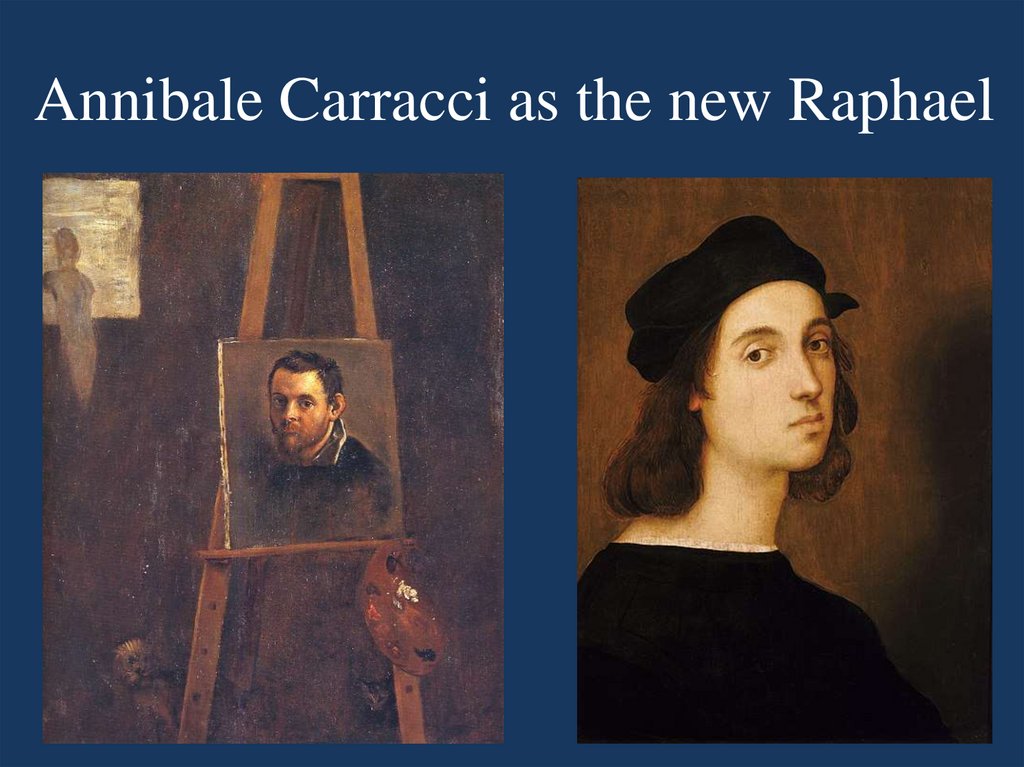
12. Annibale Carracci as the new Raphael
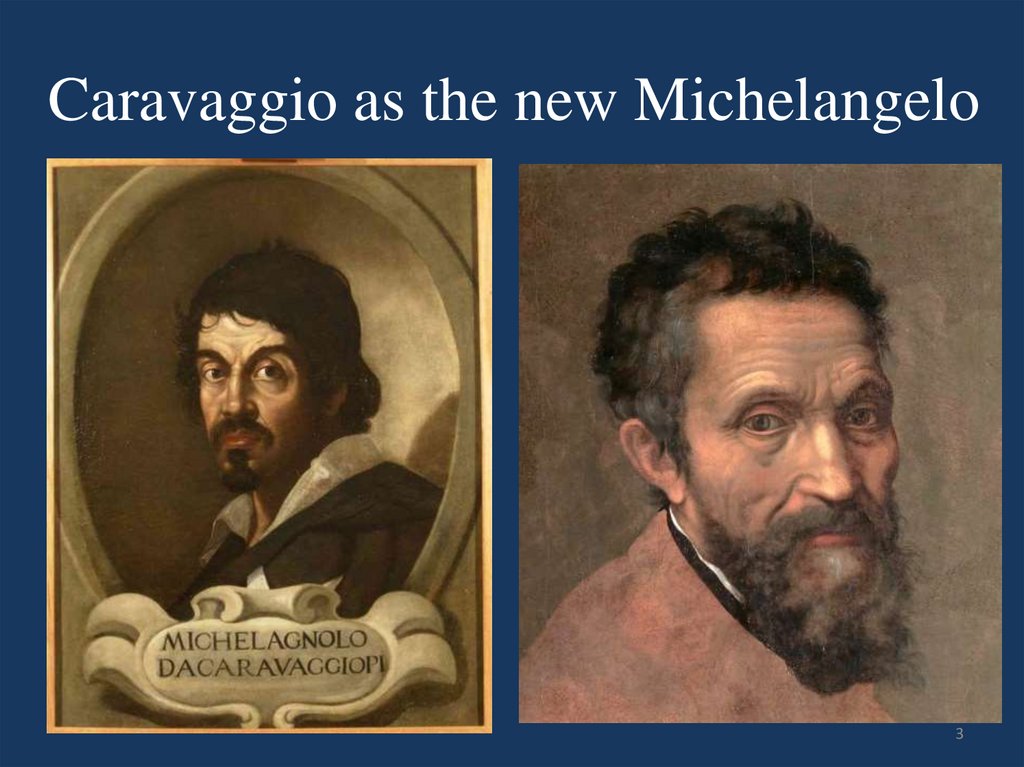
23. Caravaggio as the new Michelangelo
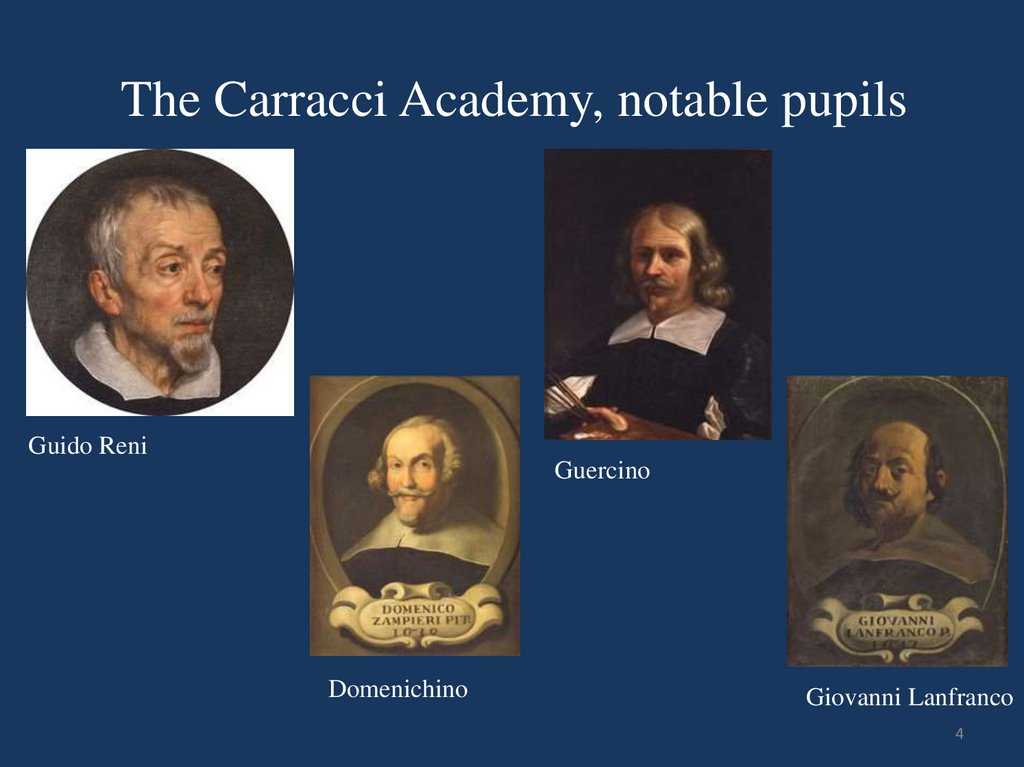
34. The Carracci Academy, notable pupils
Guido ReniGuercino
Domenichino
Giovanni Lanfranco
4
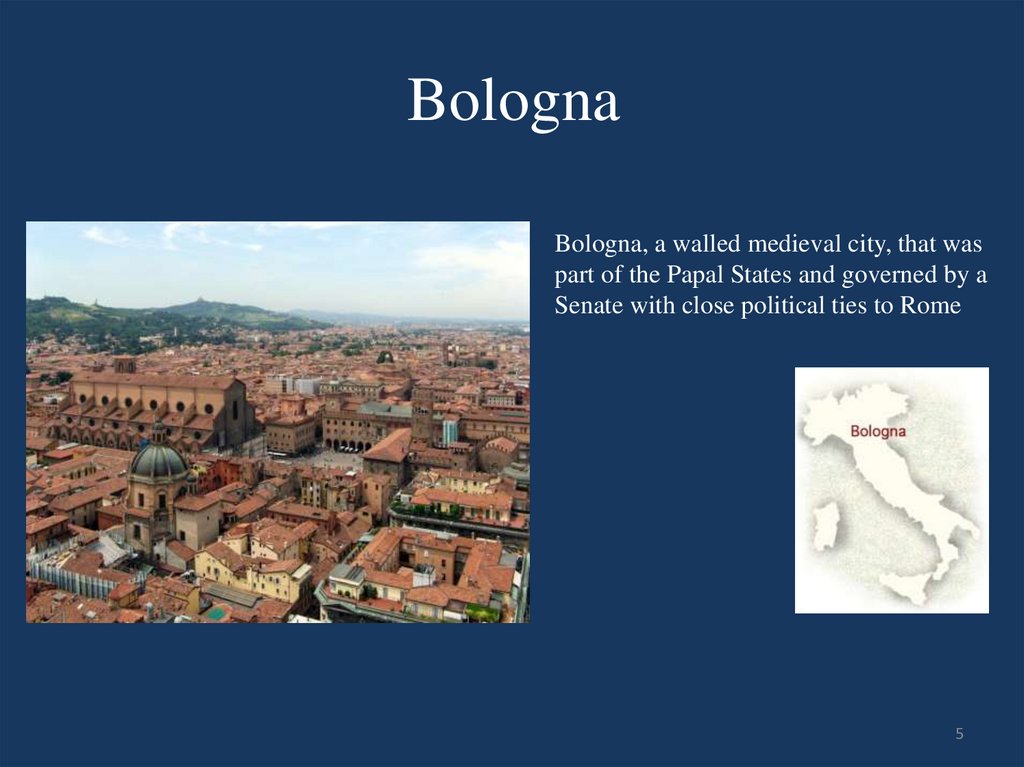
5. Bologna
Bologna, a walled medieval city, that waspart of the Papal States and governed by a
Senate with close political ties to Rome
5
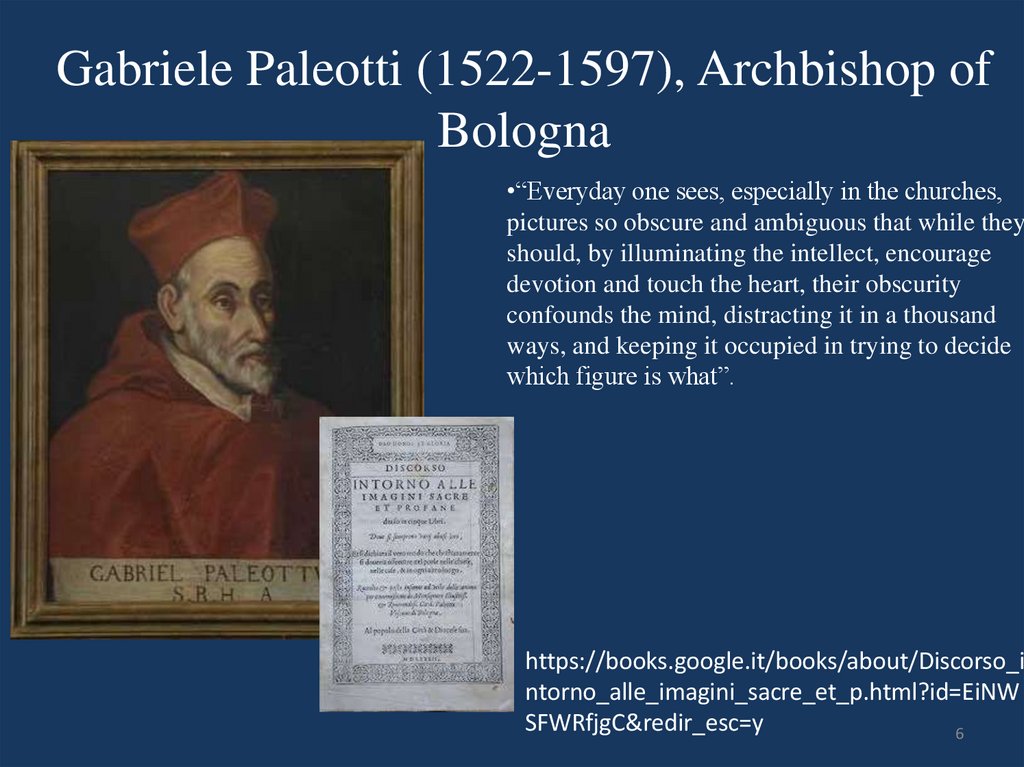
6. Gabriele Paleotti (1522-1597), Archbishop of Bologna
•“Everyday one sees, especially in the churches,pictures so obscure and ambiguous that while they
should, by illuminating the intellect, encourage
devotion and touch the heart, their obscurity
confounds the mind, distracting it in a thousand
ways, and keeping it occupied in trying to decide
which figure is what”.
https://books.google.it/books/about/Discorso_i
ntorno_alle_imagini_sacre_et_p.html?id=EiNW
SFWRfjgC&redir_esc=y
6
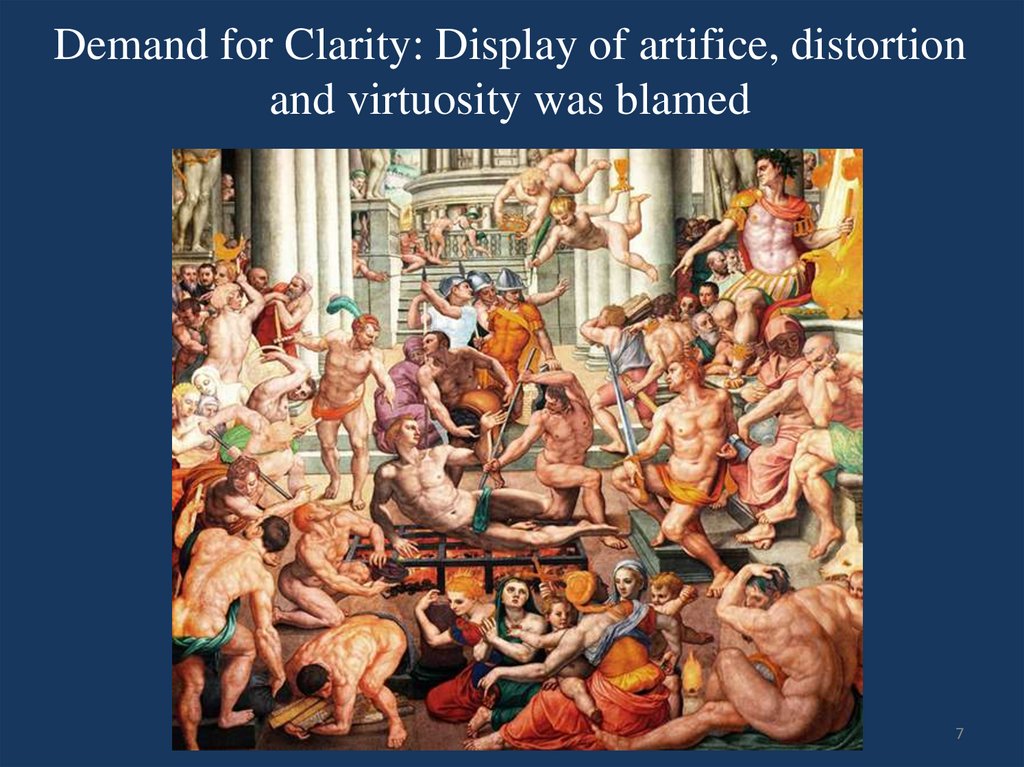
7. Demand for Clarity: Display of artifice, distortion and virtuosity was blamed
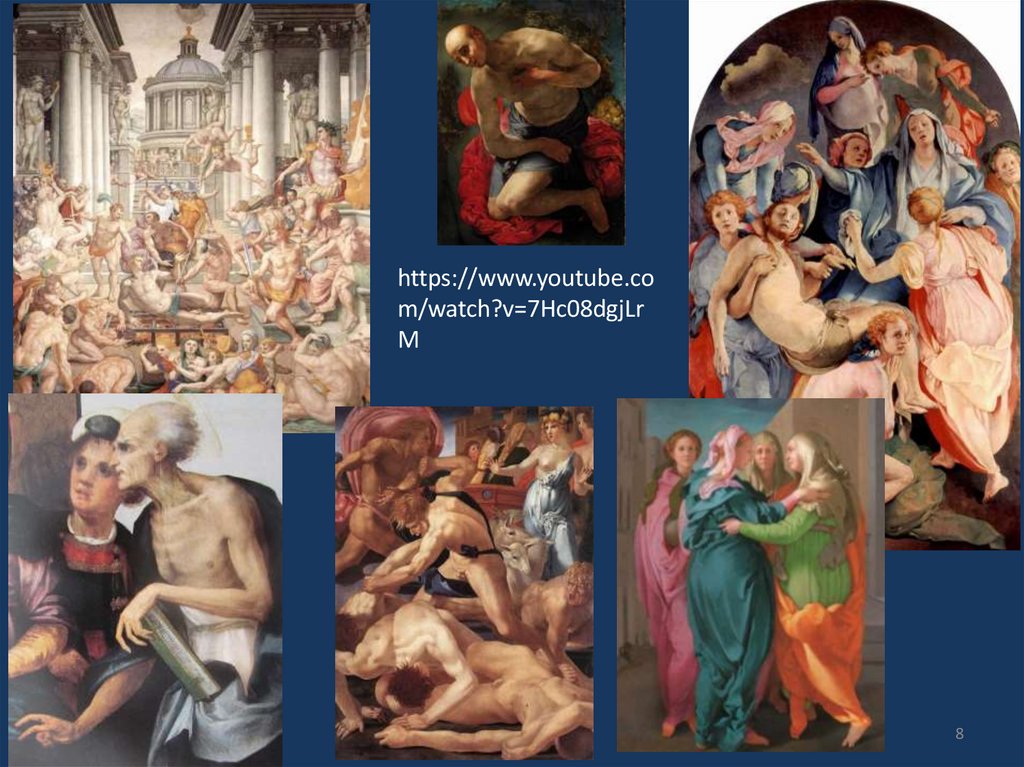
78.
https://www.youtube.com/watch?v=7Hc08dgjLr
M
8
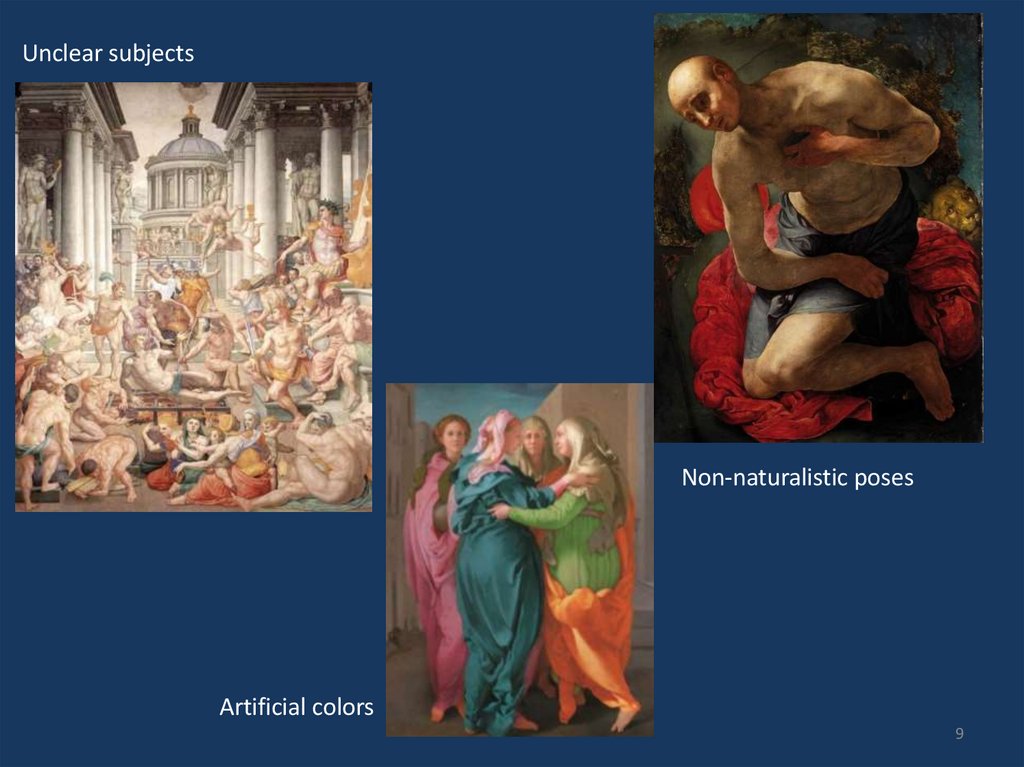
9.
Unclear subjectsNon-naturalistic poses
Artificial colors
9
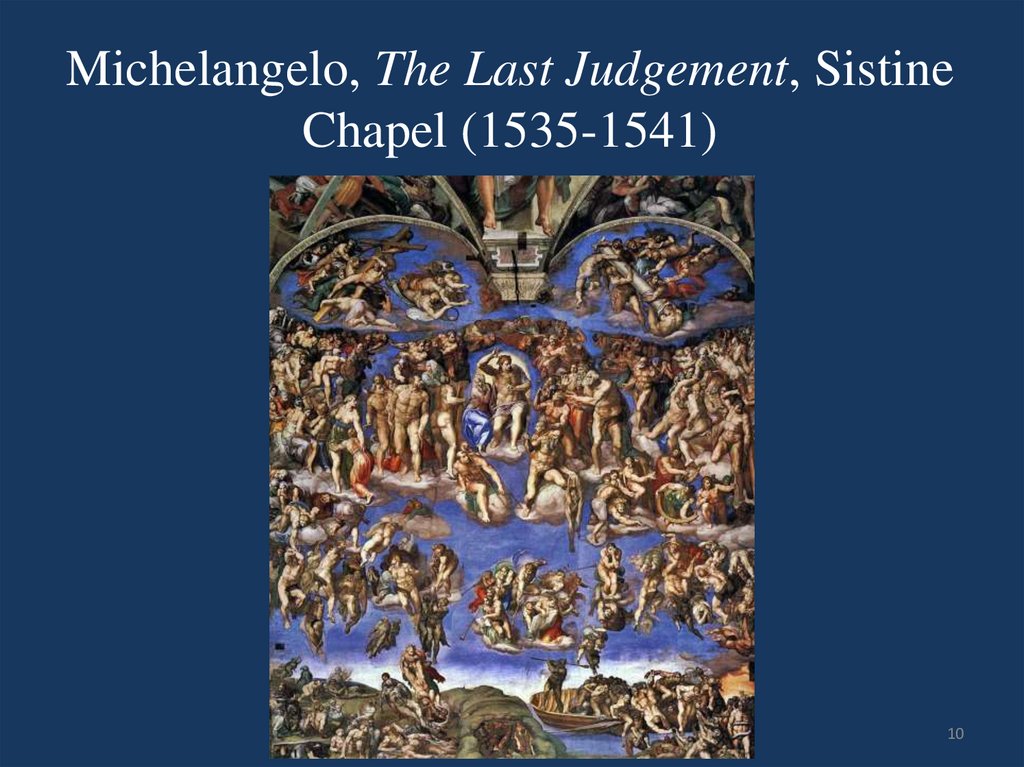
10. Michelangelo, The Last Judgement, Sistine Chapel (1535-1541)
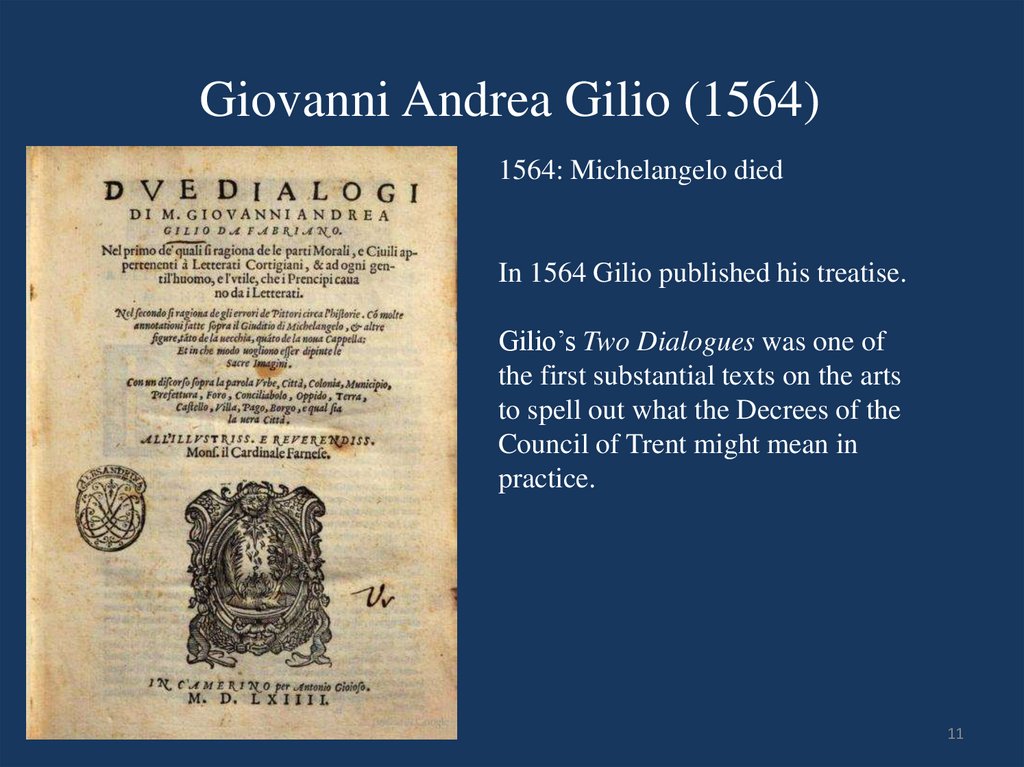
1011. Giovanni Andrea Gilio (1564)
1564: Michelangelo diedIn 1564 Gilio published his treatise.
Gilio’s Two Dialogues was one of
the first substantial texts on the arts
to spell out what the Decrees of the
Council of Trent might mean in
practice.
11
12. Giovanni Andrea Gilio (1564)
For Gilio:This kind of painting was not mere ornament or diversion, but an
instrument for making the truth visible.
It had to be clear, easy to understand by both the learned and the unlearned
and could not deviate in any particular form from authoritative texts or
established pictorial conventions (decorum).
Michelangelo erred greatly, according to Gilio, by incorporating such
figures as Minos and Charon, inventions that came from the poets Dante
and Virgil, rather than from scriptural sources.
12
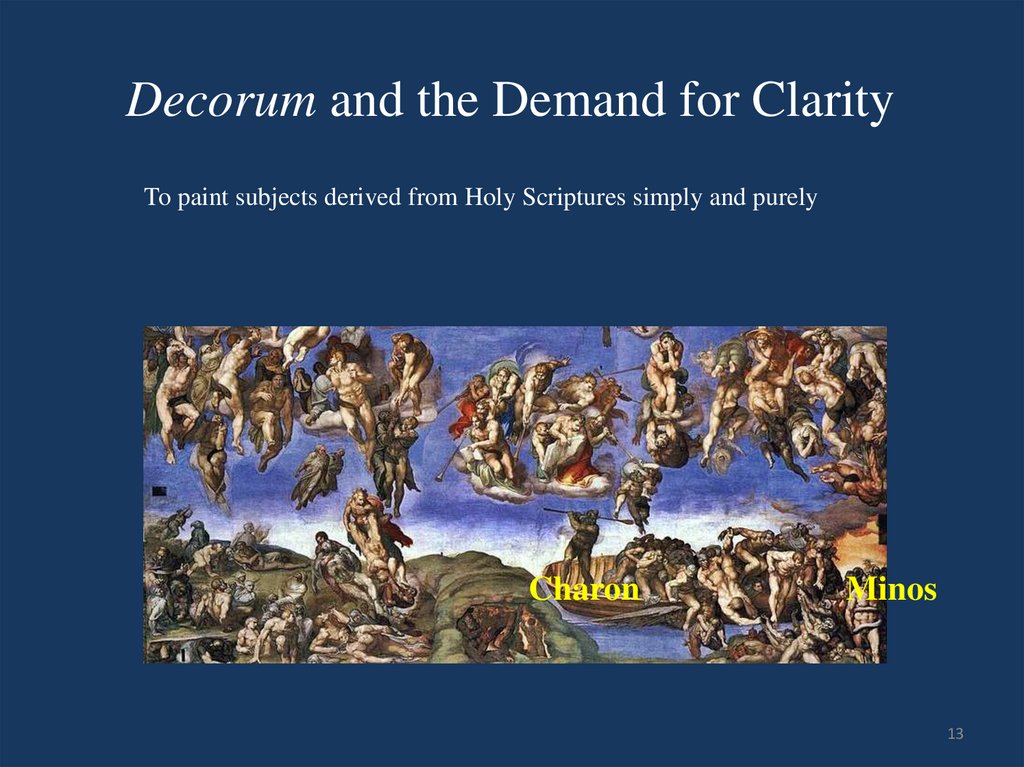
13. Decorum and the Demand for Clarity
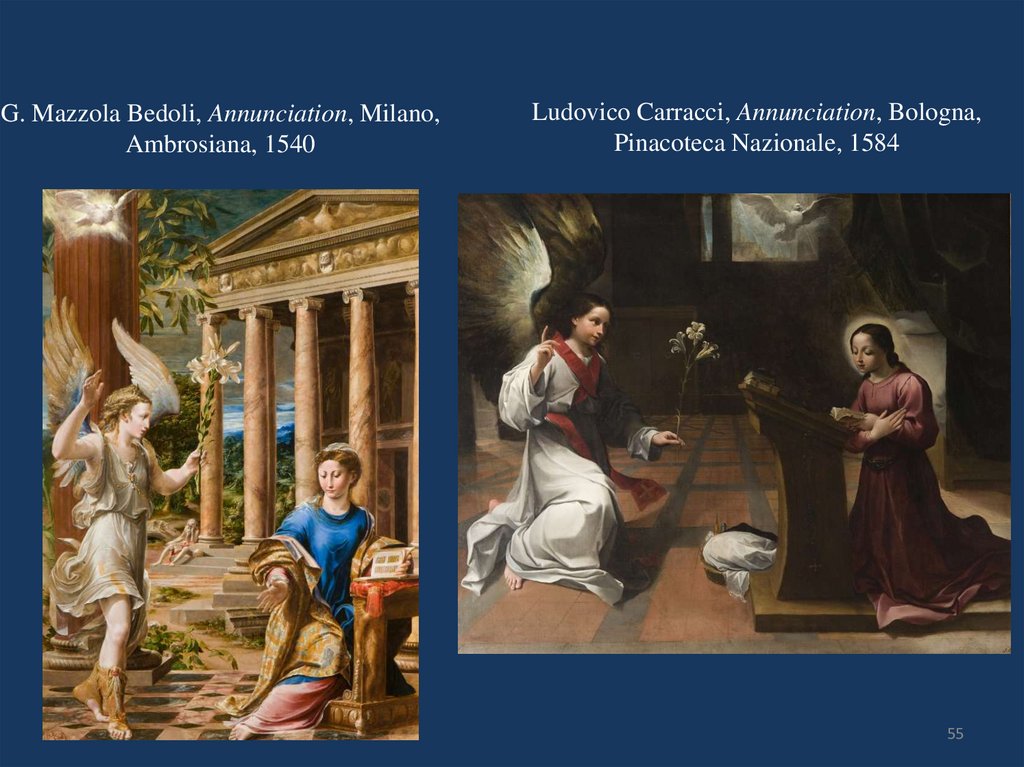
To paint subjects derived from Holy Scriptures simply and purelyCharon
Minos
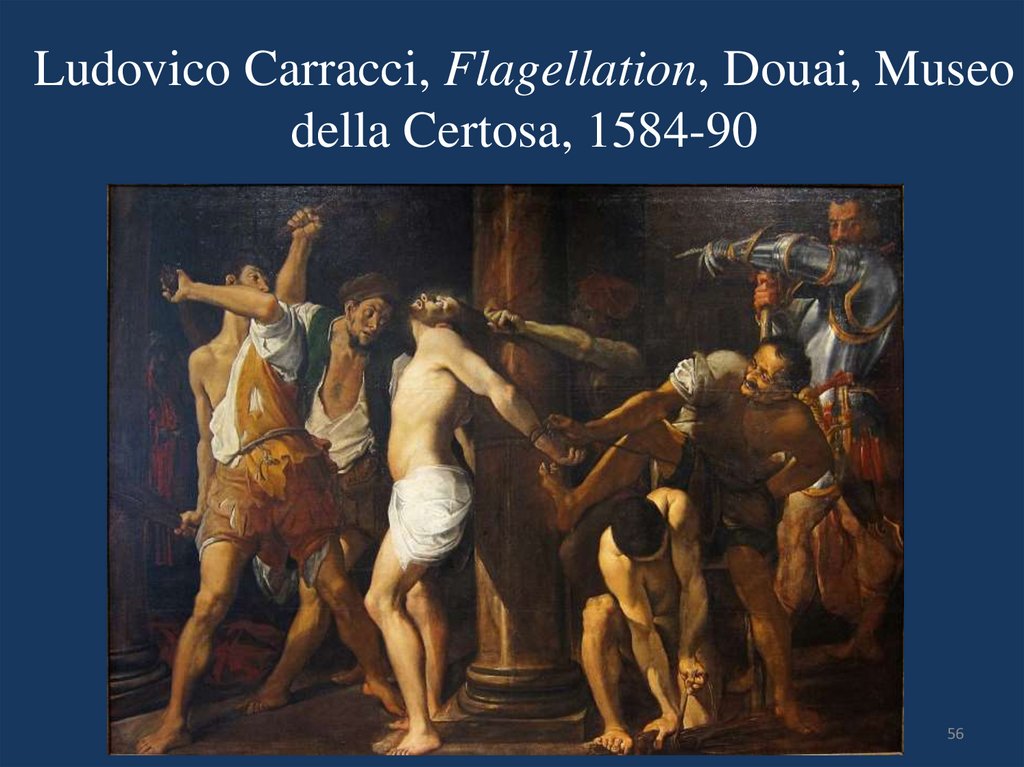
13
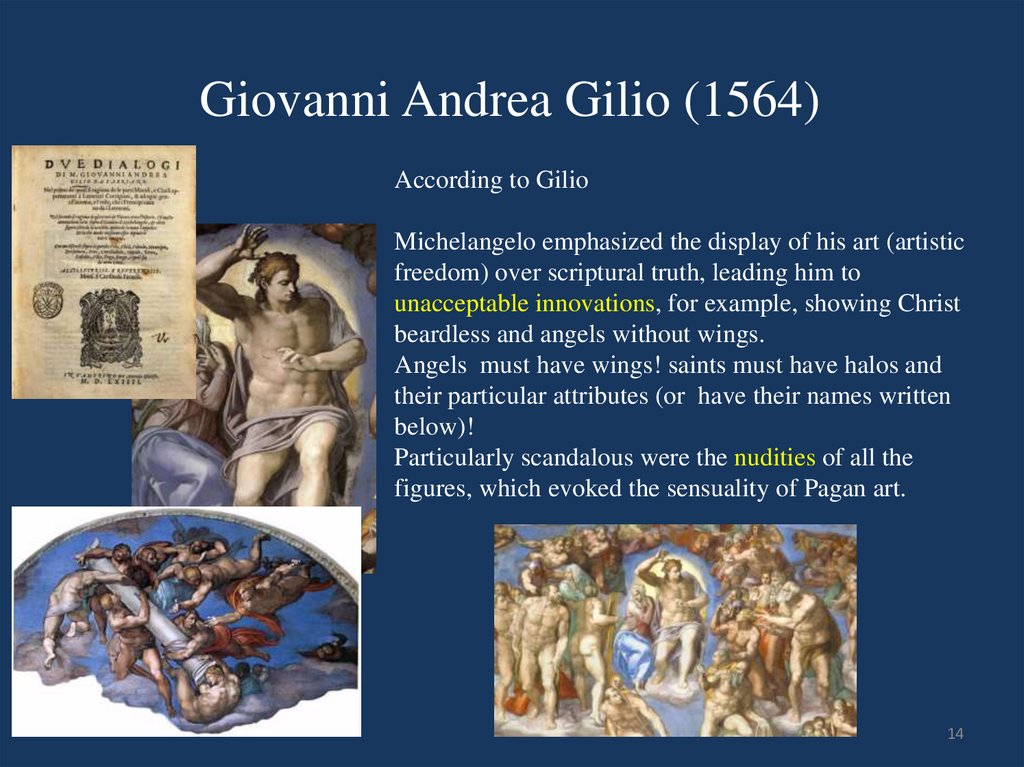
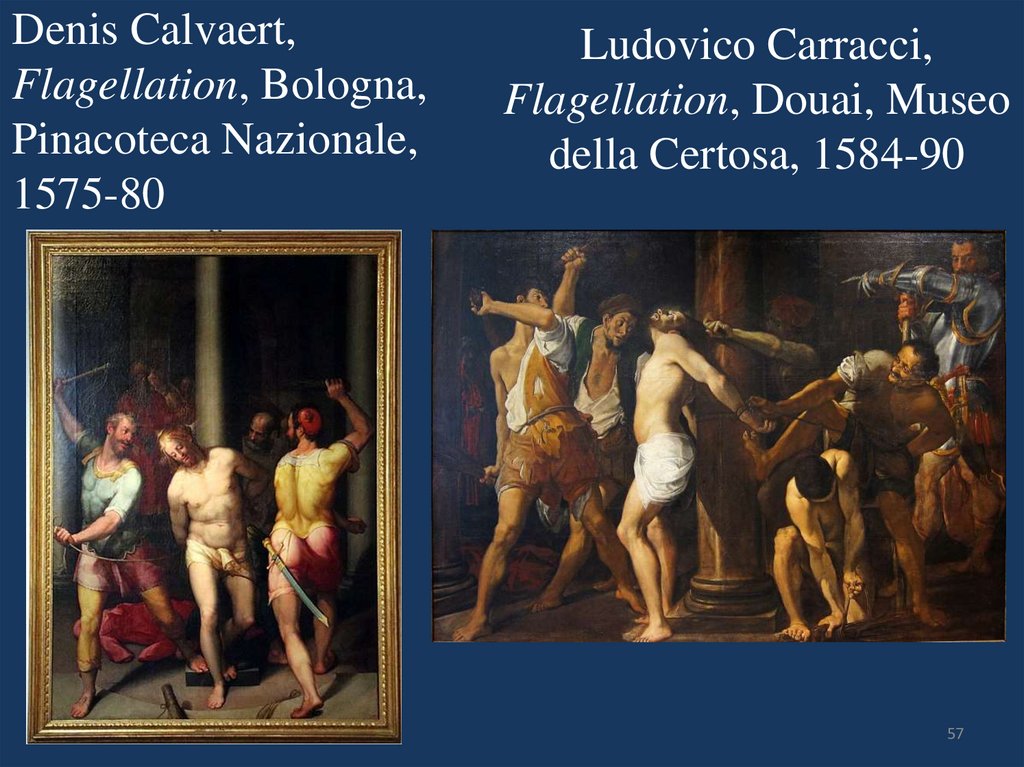
14. Giovanni Andrea Gilio (1564)
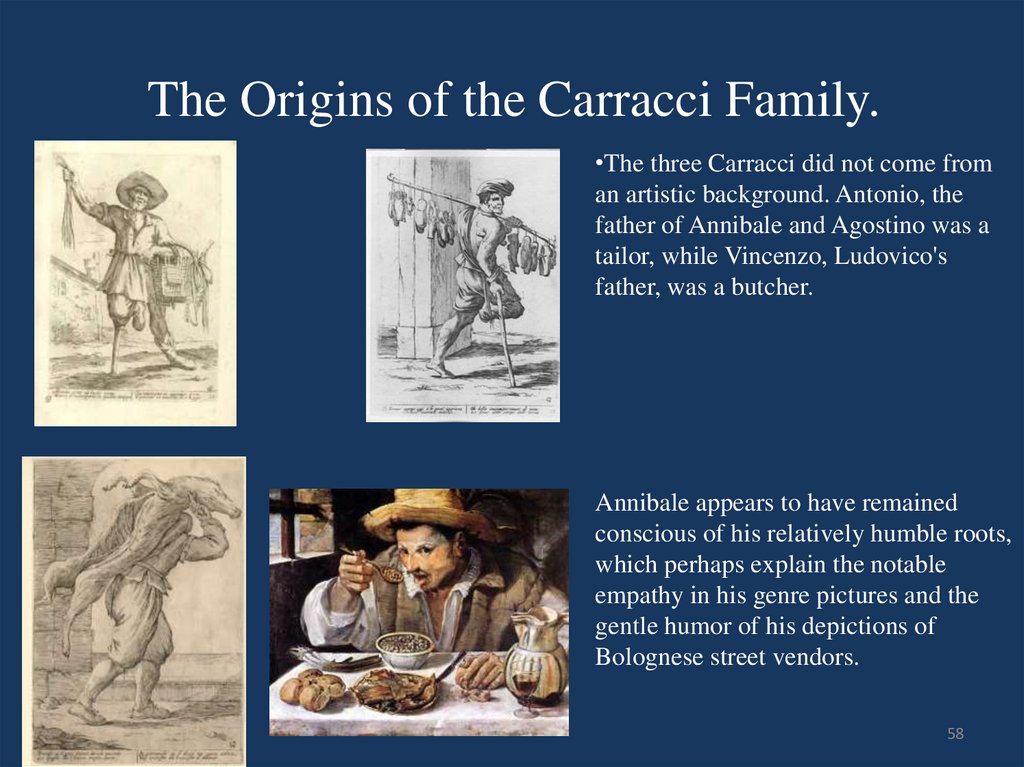
According to GilioMichelangelo emphasized the display of his art (artistic
freedom) over scriptural truth, leading him to
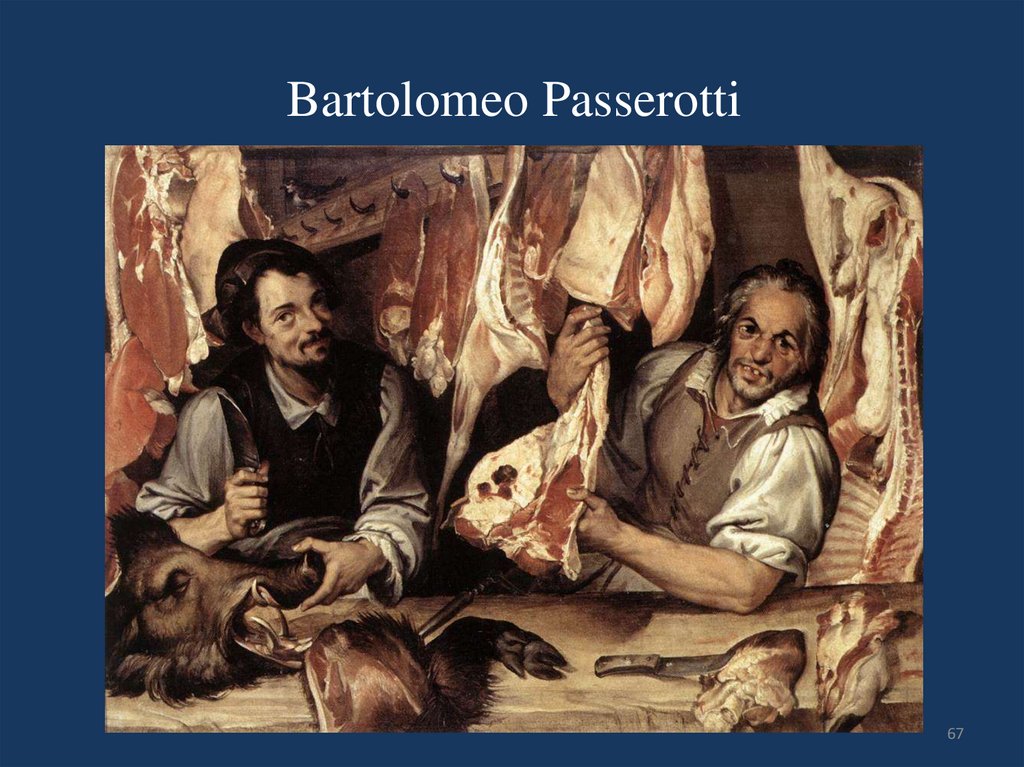
unacceptable innovations, for example, showing Christ
beardless and angels without wings.
Angels must have wings! saints must have halos and
their particular attributes (or have their names written
below)!
Particularly scandalous were the nudities of all the
figures, which evoked the sensuality of Pagan art.
14
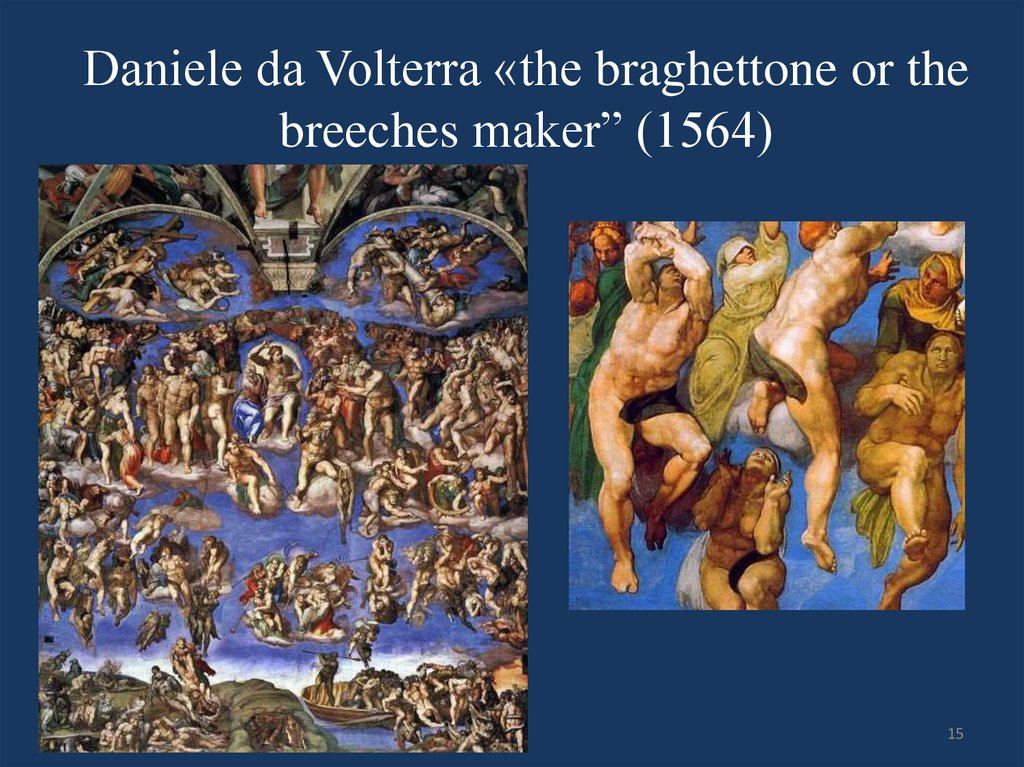
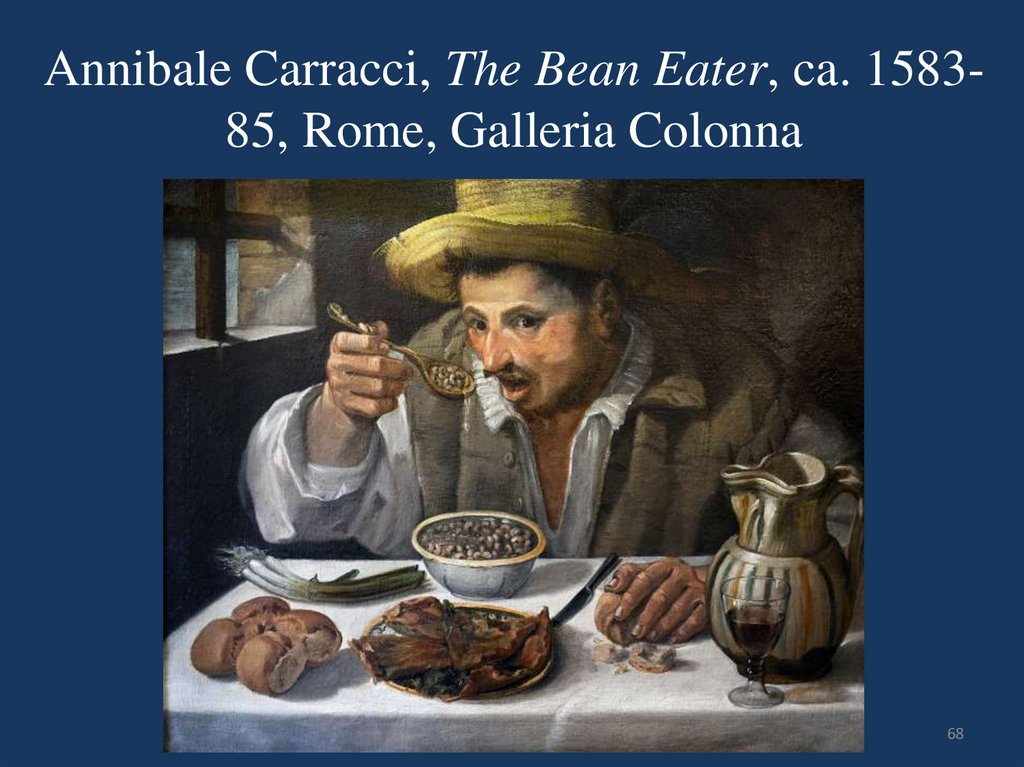
15. Daniele da Volterra «the braghettone or the breeches maker” (1564)
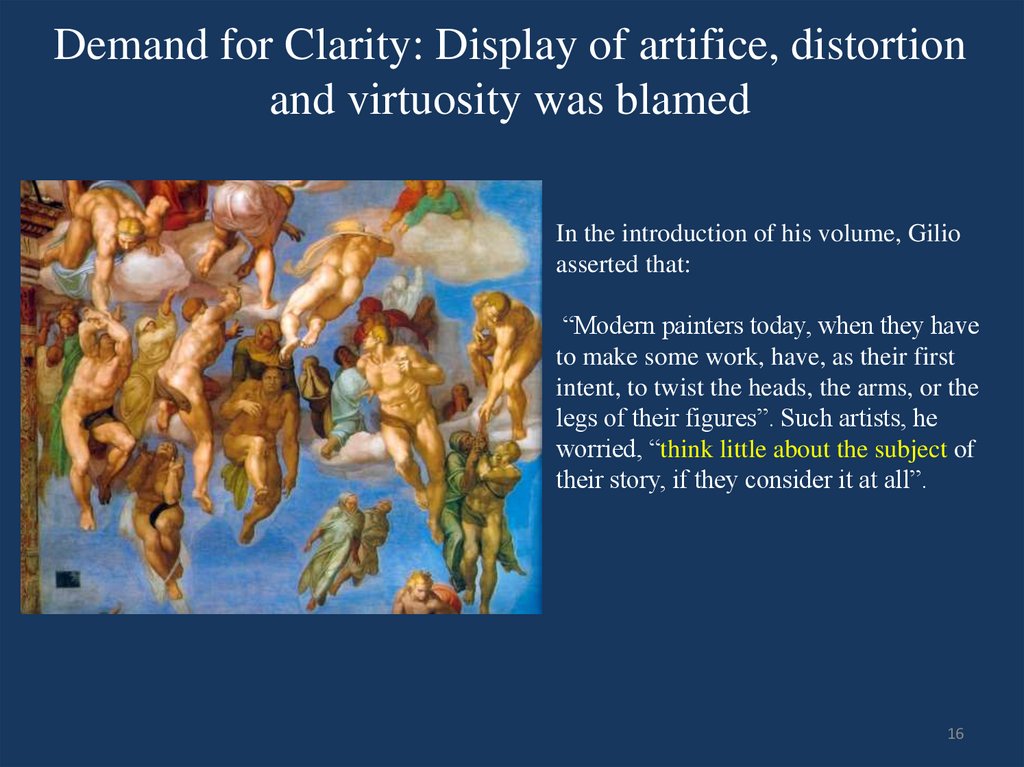
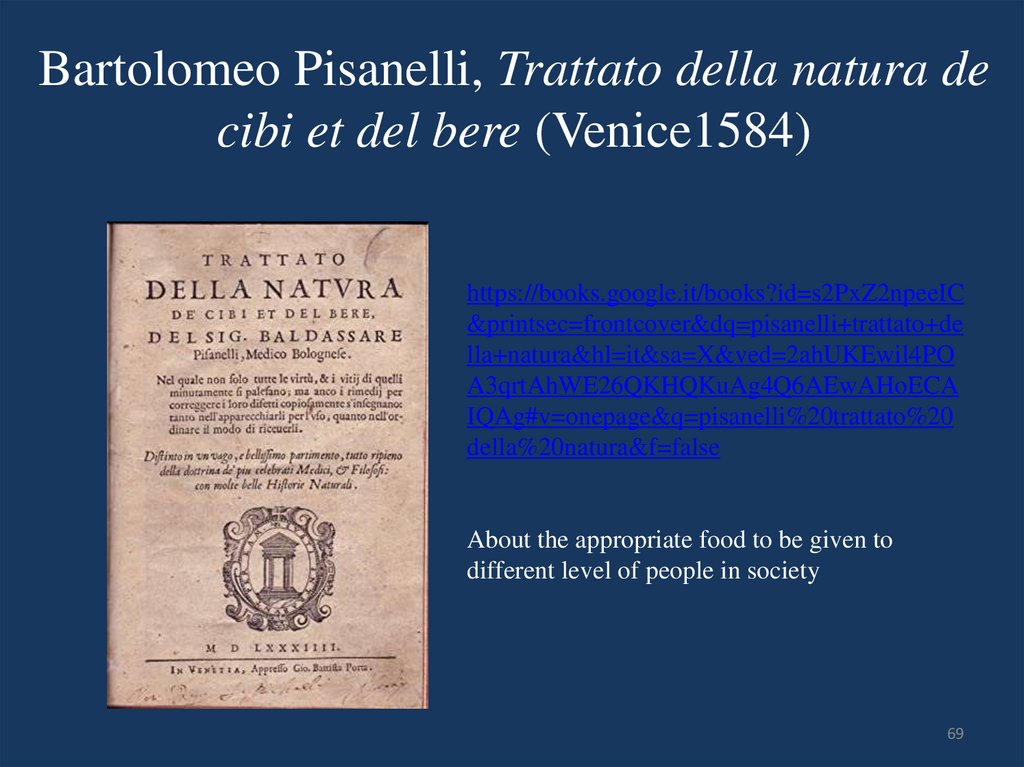
1516. Demand for Clarity: Display of artifice, distortion and virtuosity was blamed
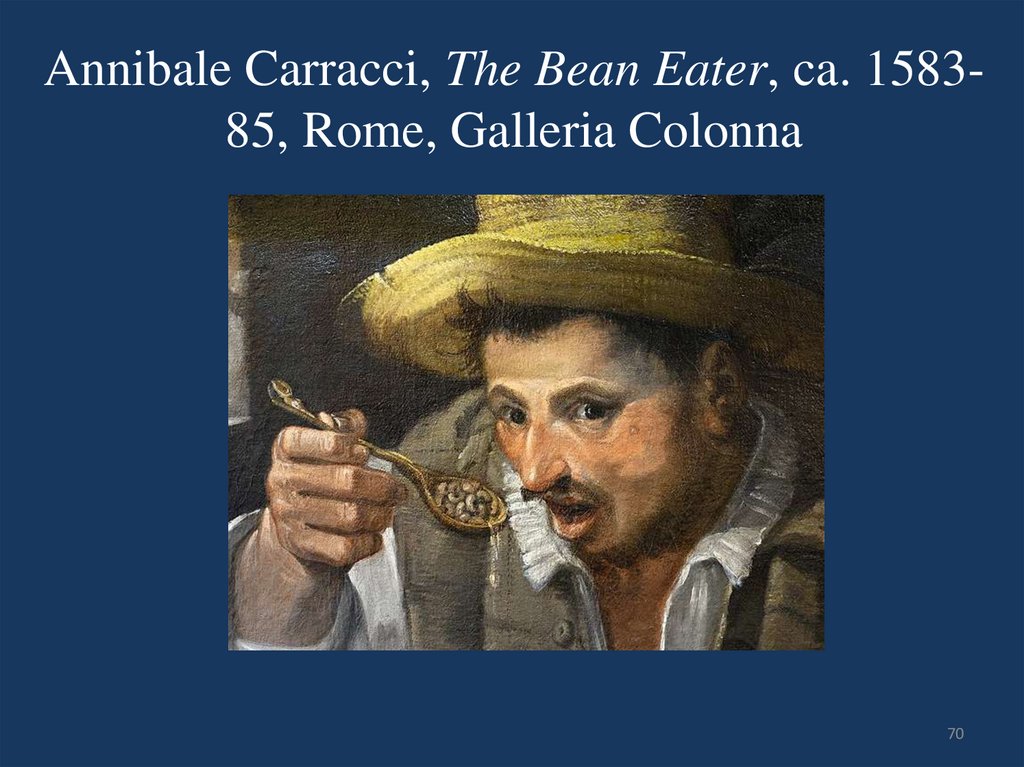
In the introduction of his volume, Gilioasserted that:
“Modern painters today, when they have
to make some work, have, as their first
intent, to twist the heads, the arms, or the
legs of their figures”. Such artists, he
worried, “think little about the subject of
their story, if they consider it at all”.
16
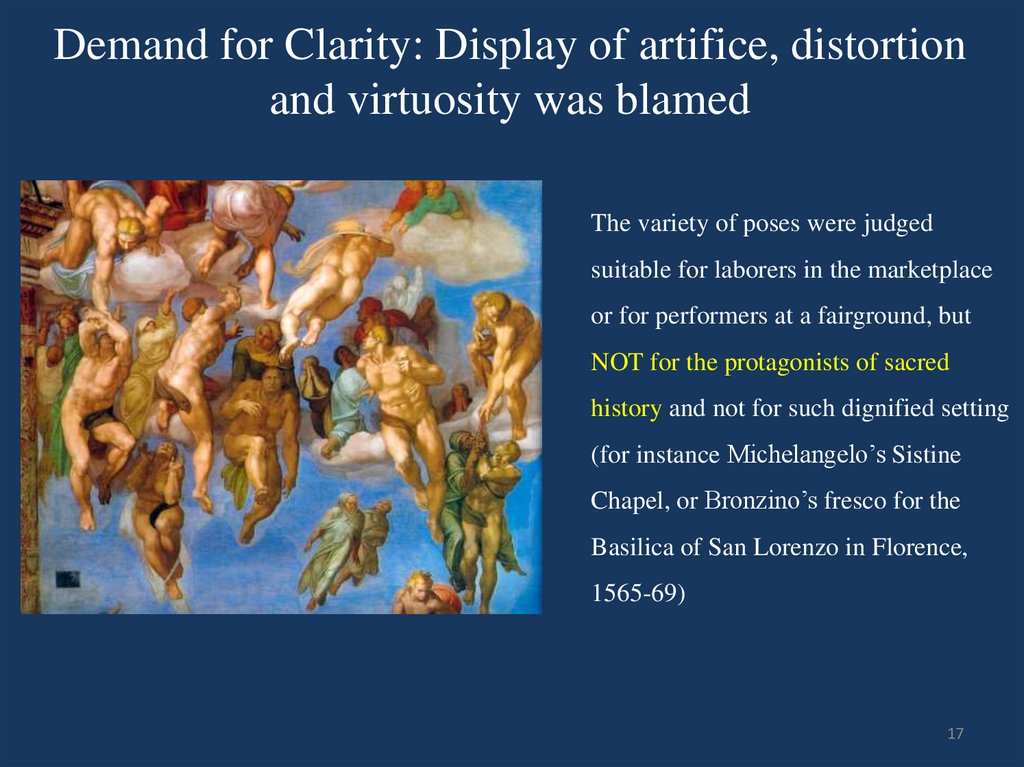
17. Demand for Clarity: Display of artifice, distortion and virtuosity was blamed
The variety of poses were judgedsuitable for laborers in the marketplace
or for performers at a fairground, but
NOT for the protagonists of sacred
history and not for such dignified setting
(for instance Michelangelo’s Sistine
Chapel, or Bronzino’s fresco for the
Basilica of San Lorenzo in Florence,
1565-69)
17
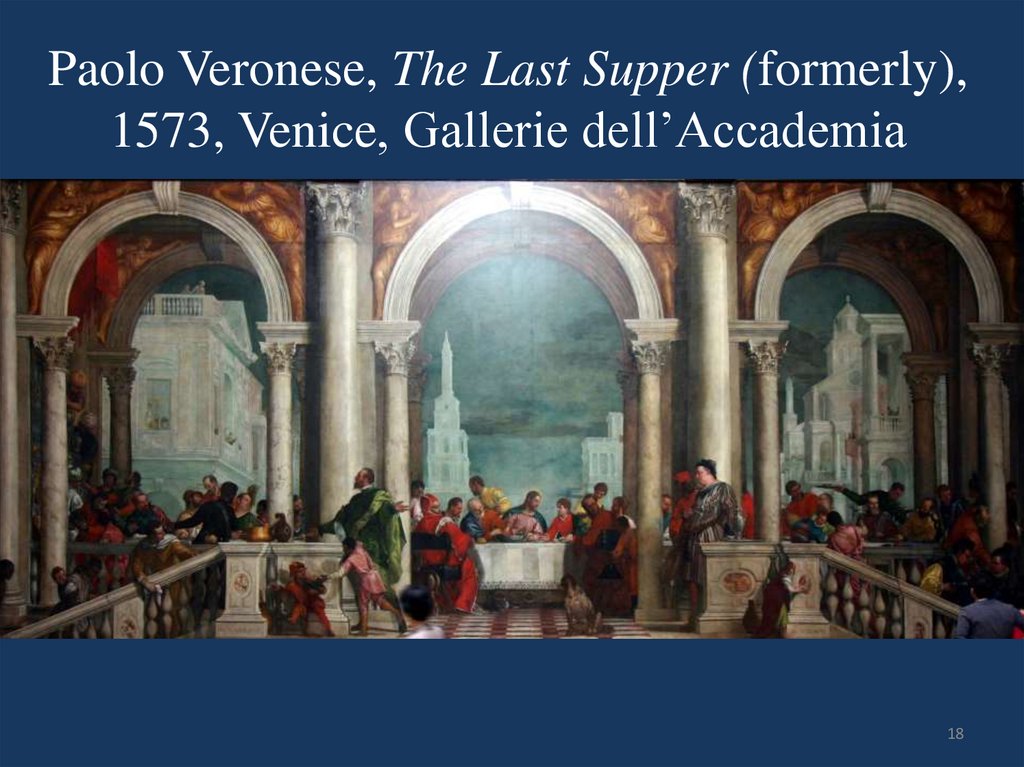
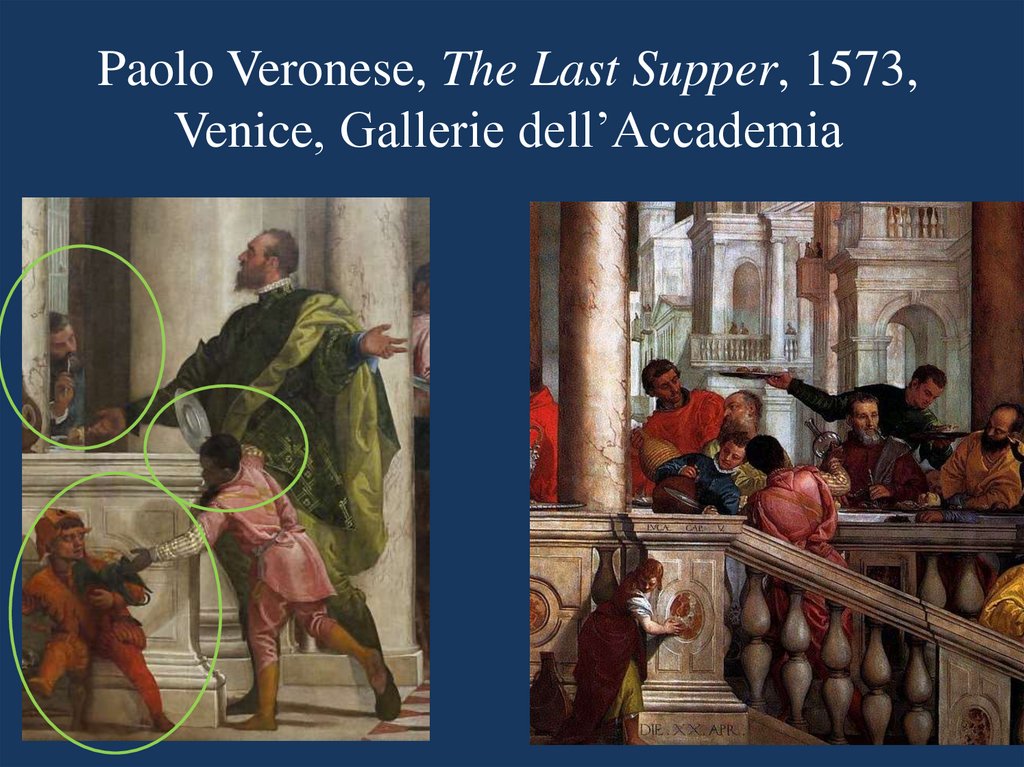
18. Paolo Veronese, The Last Supper (formerly), 1573, Venice, Gallerie dell’Accademia
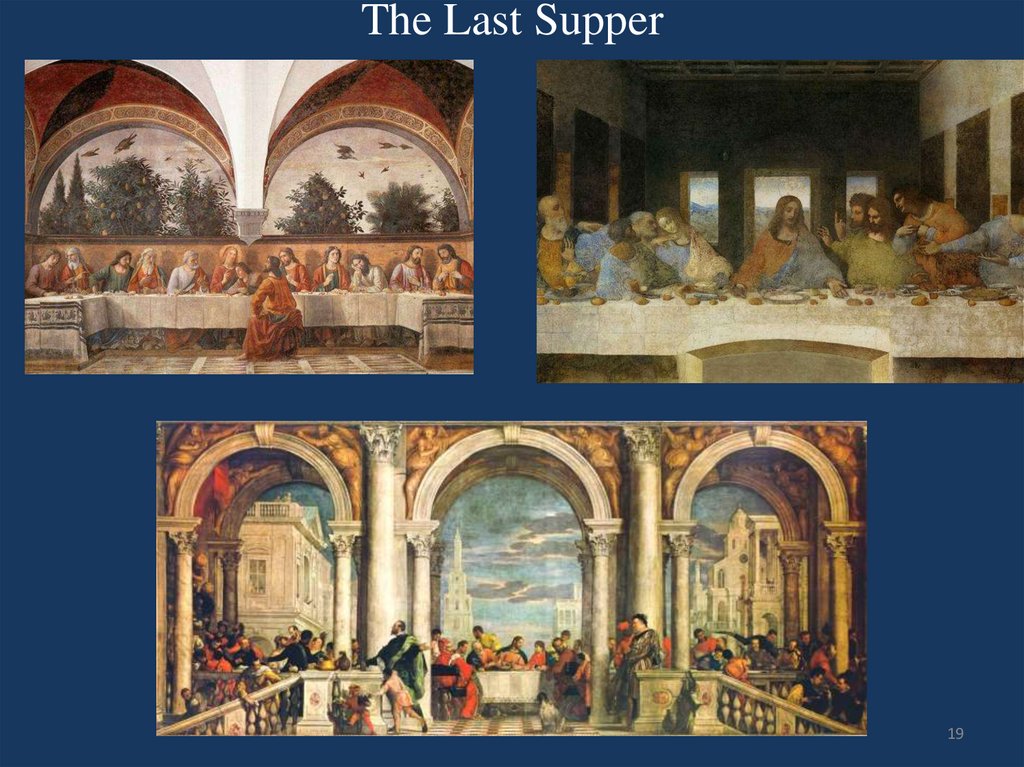
1819. The Last Supper
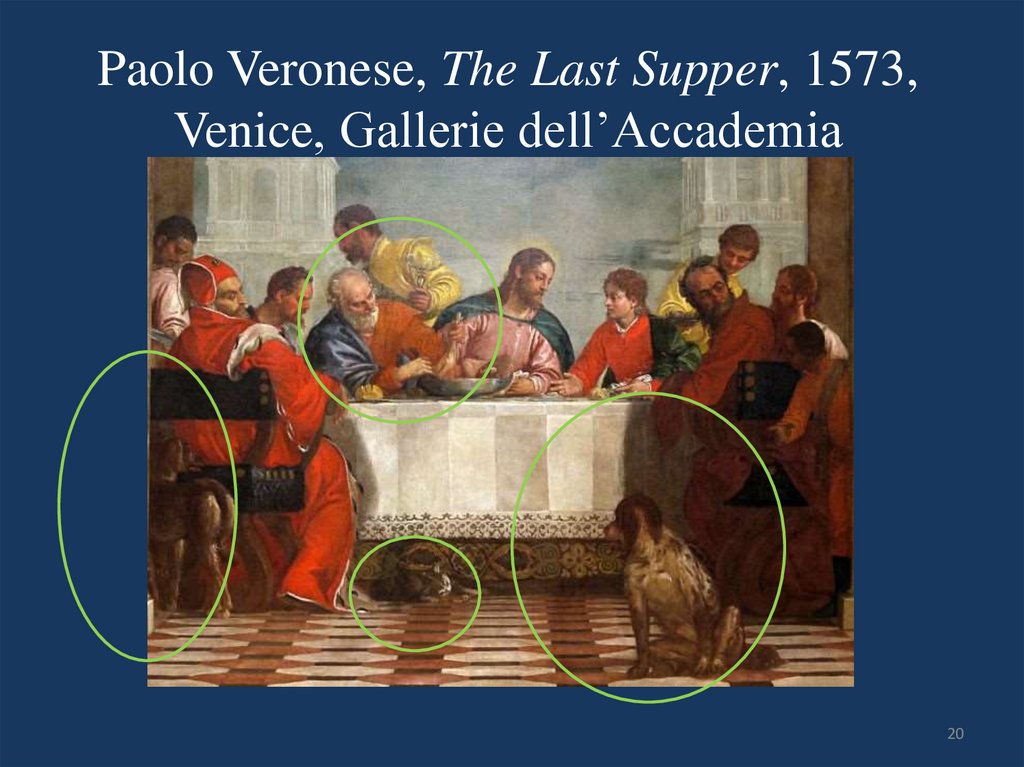
1920. Paolo Veronese, The Last Supper, 1573, Venice, Gallerie dell’Accademia
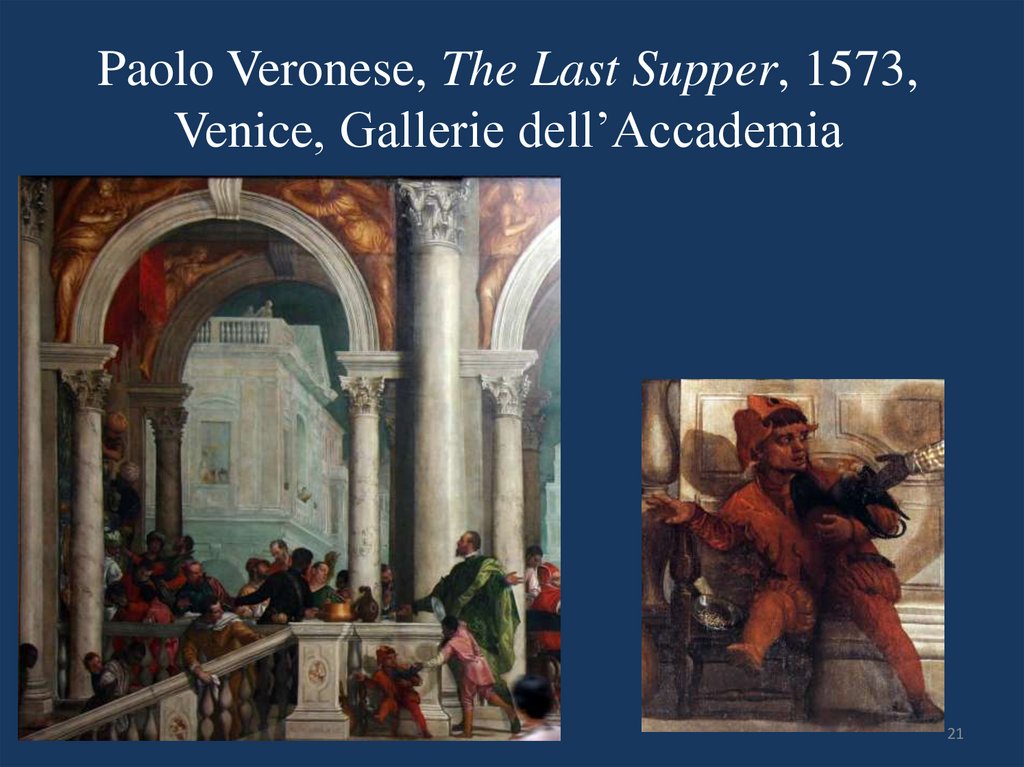
2021. Paolo Veronese, The Last Supper, 1573, Venice, Gallerie dell’Accademia
2122. Paolo Veronese, The Last Supper, 1573, Venice, Gallerie dell’Accademia
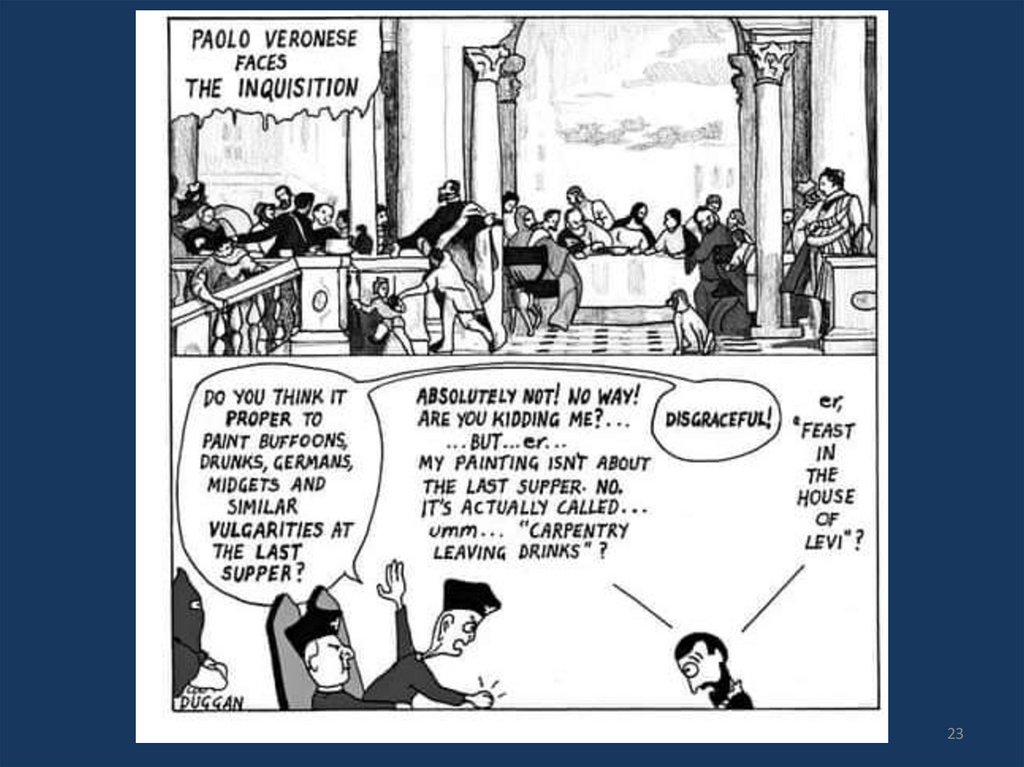
2223.
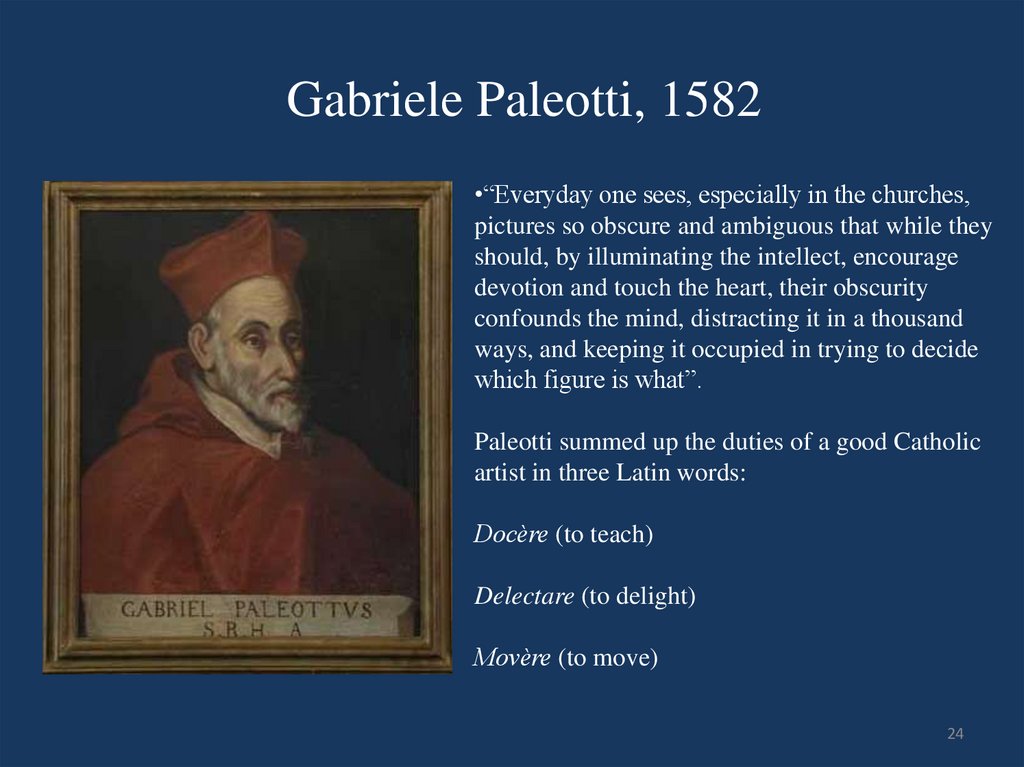
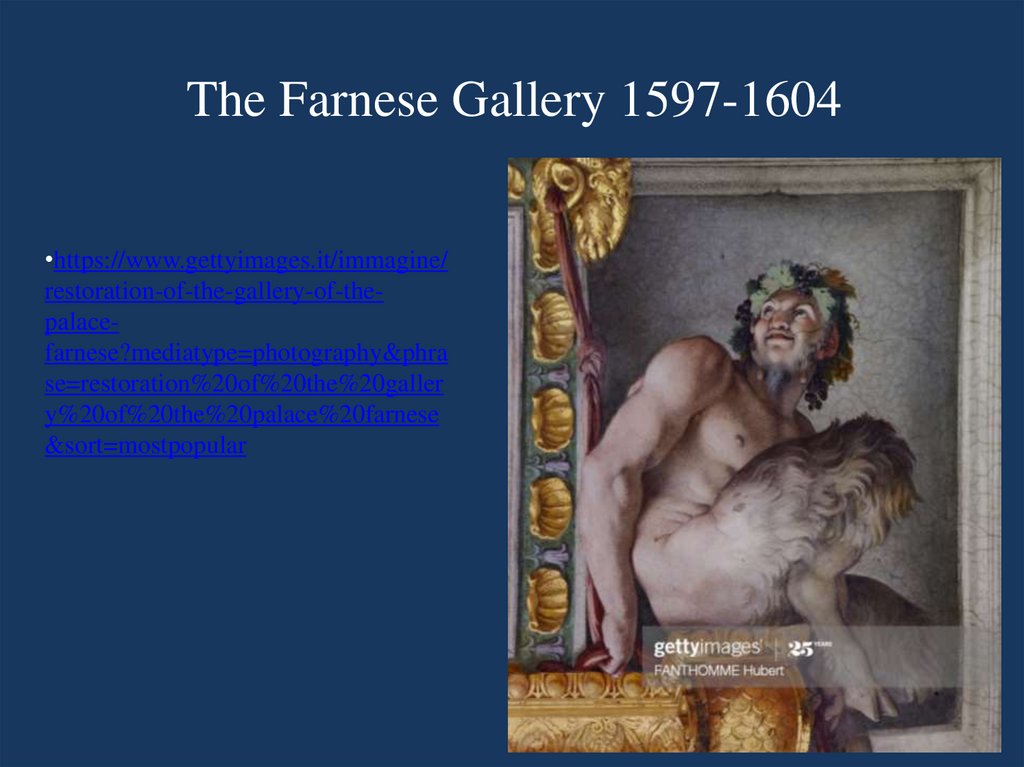
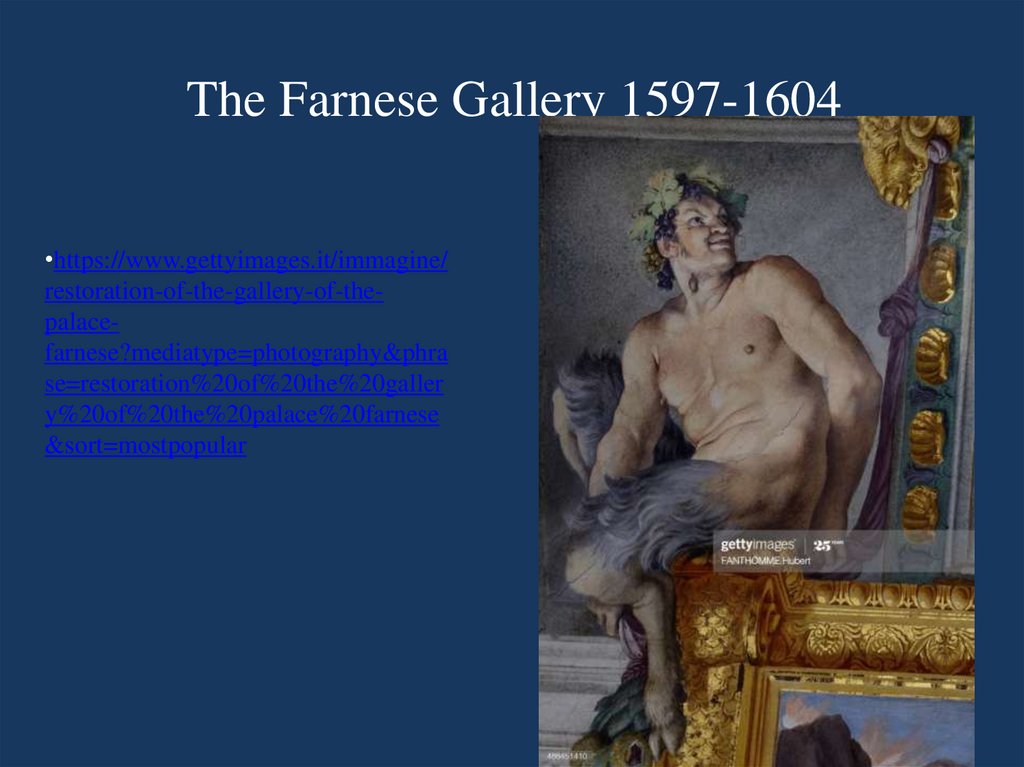
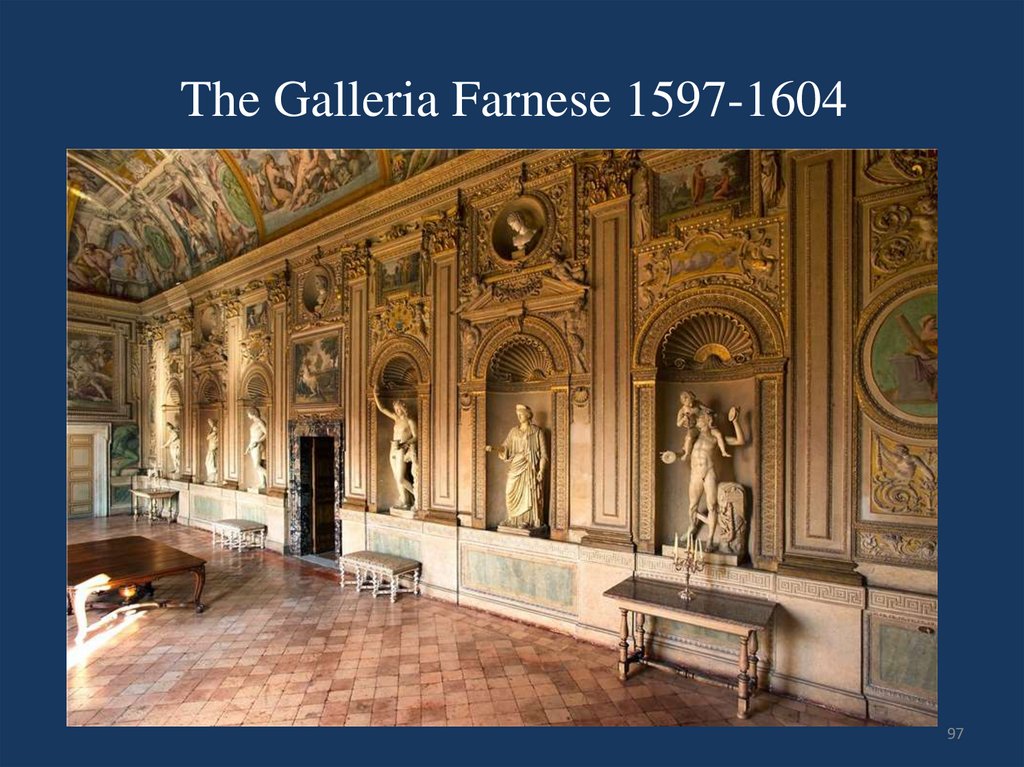
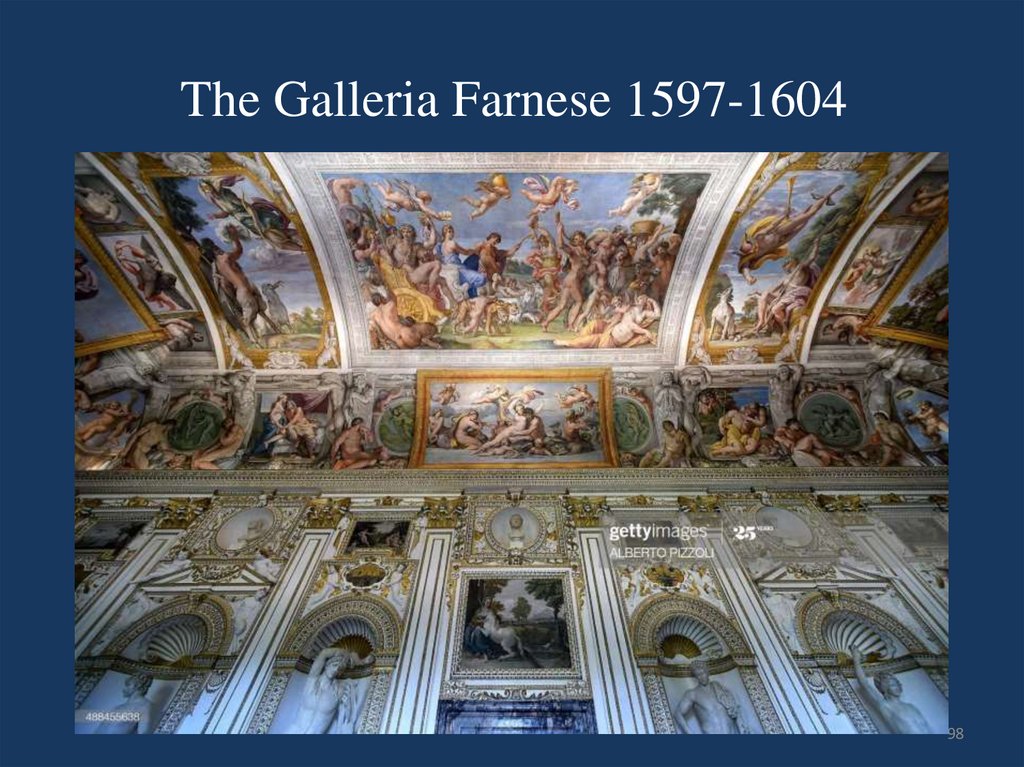
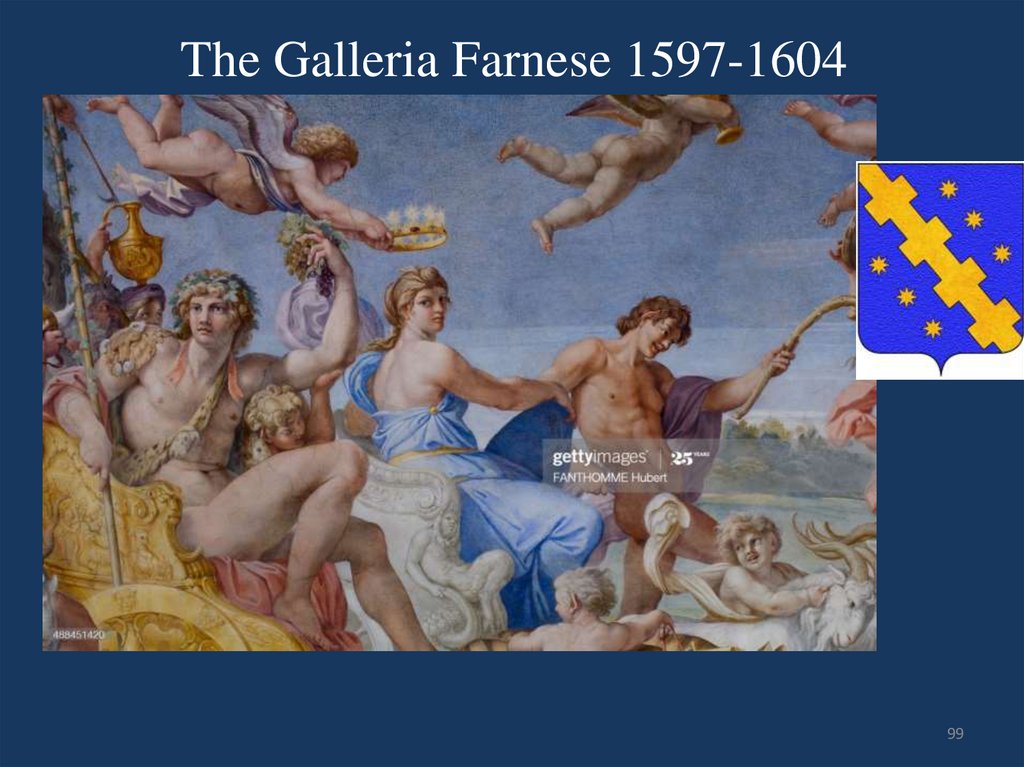
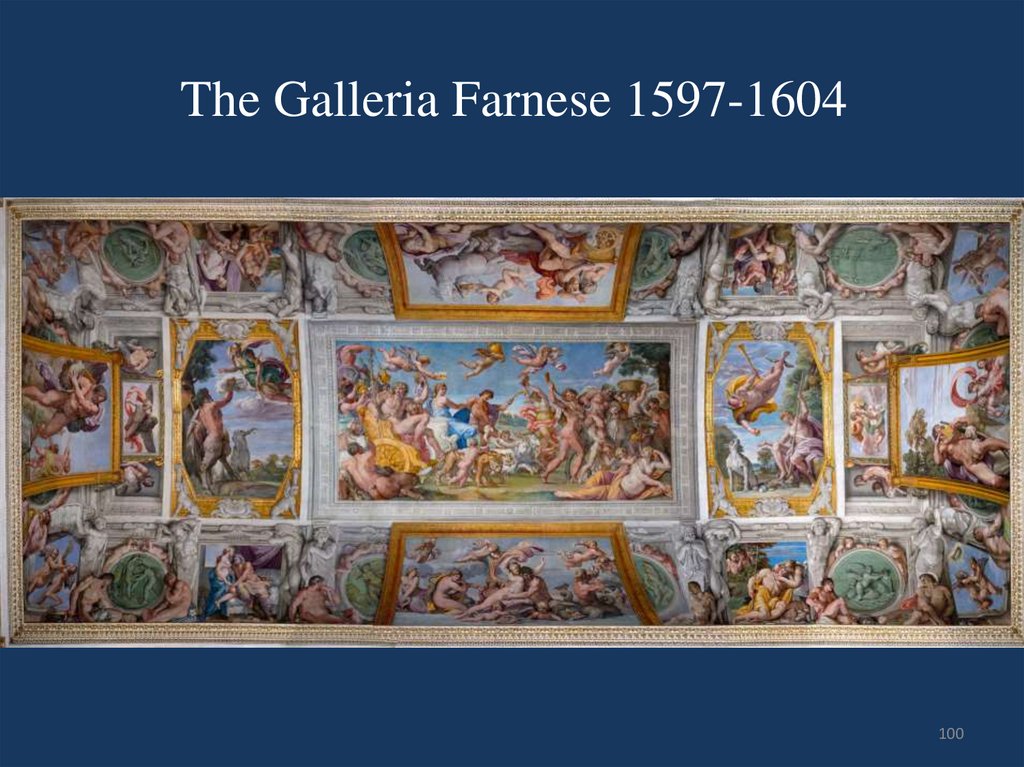
2324. Gabriele Paleotti, 1582
•“Everyday one sees, especially in the churches,pictures so obscure and ambiguous that while they
should, by illuminating the intellect, encourage
devotion and touch the heart, their obscurity
confounds the mind, distracting it in a thousand
ways, and keeping it occupied in trying to decide
which figure is what”.
Paleotti summed up the duties of a good Catholic
artist in three Latin words:
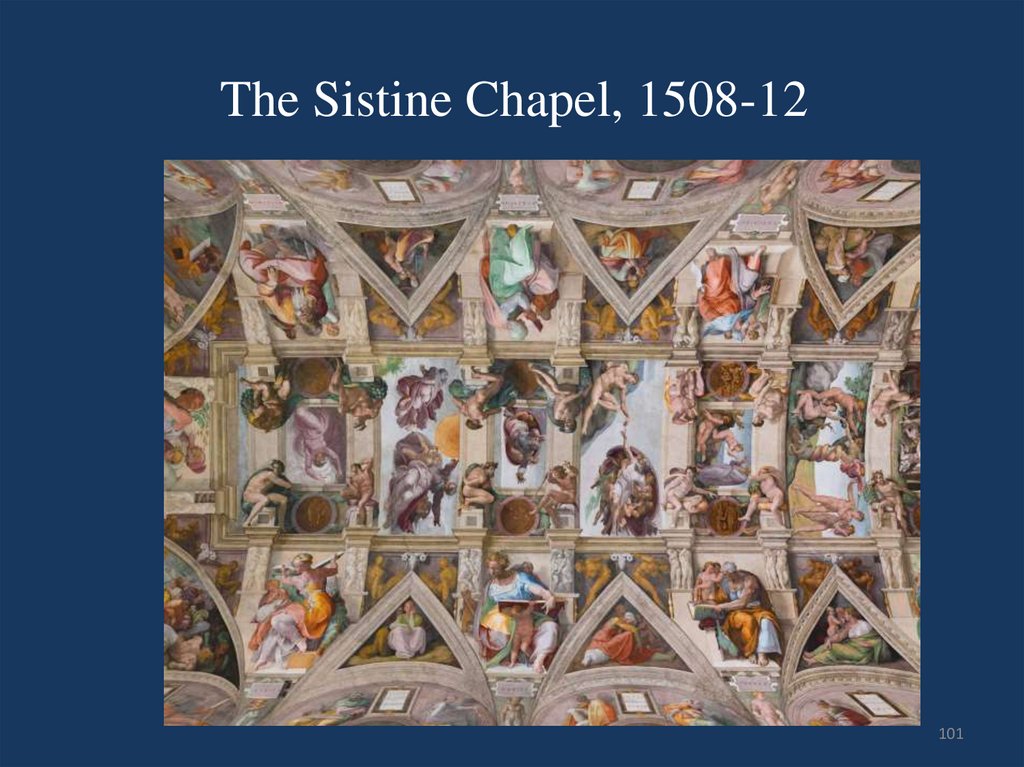
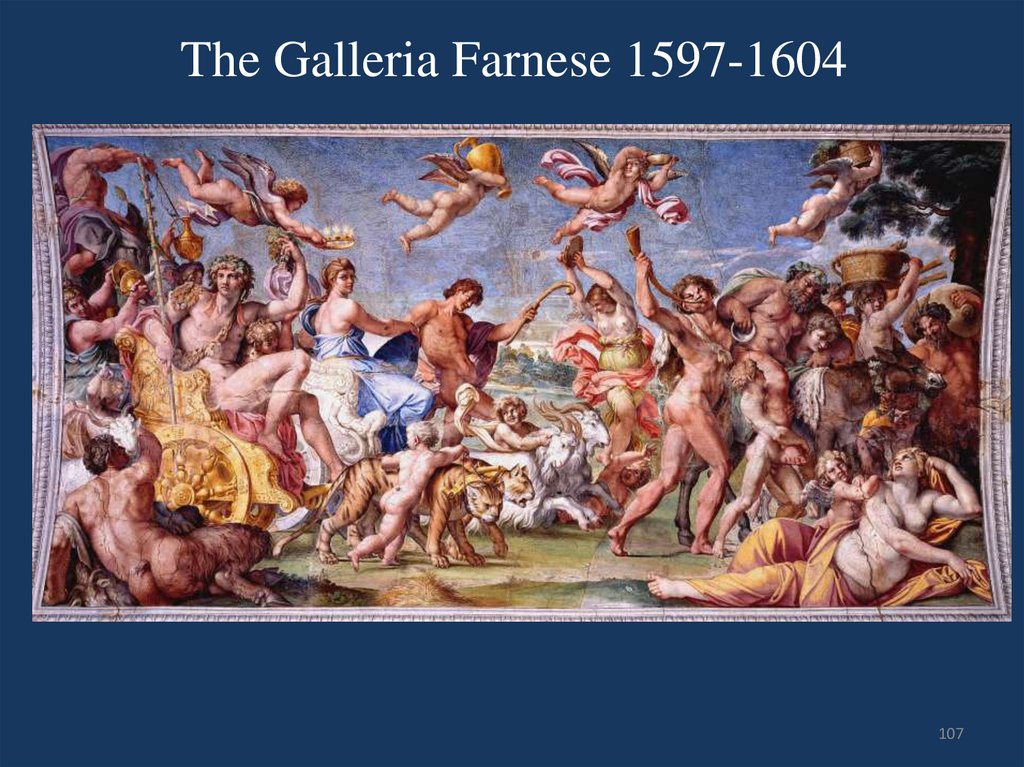
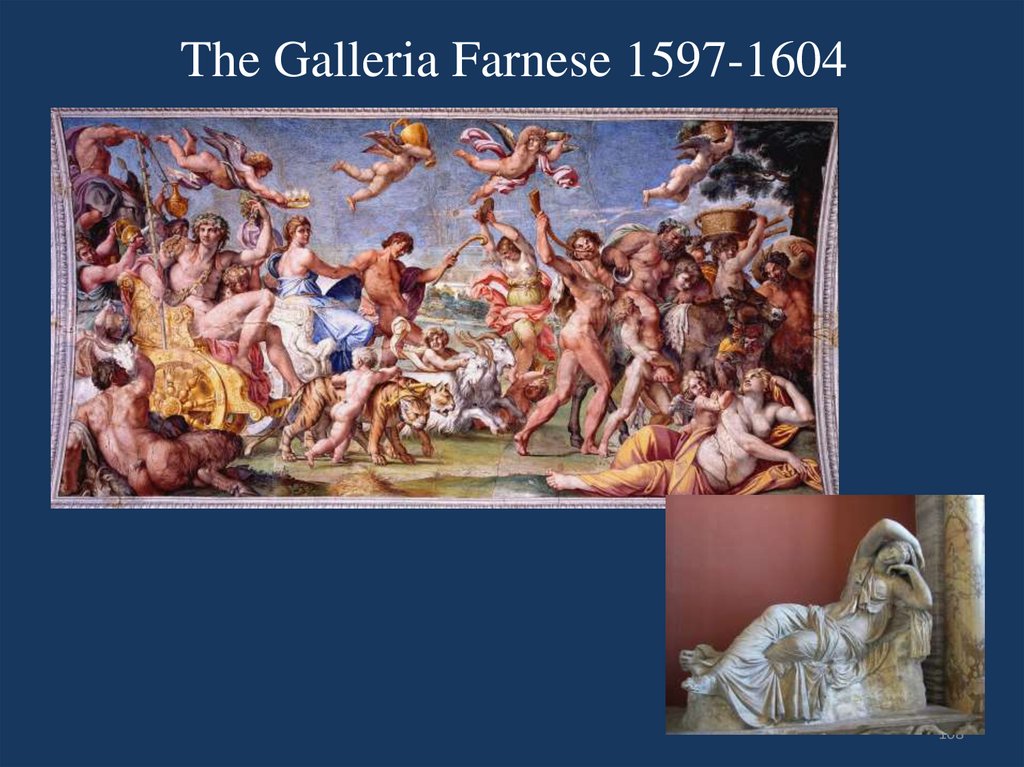
Docère (to teach)
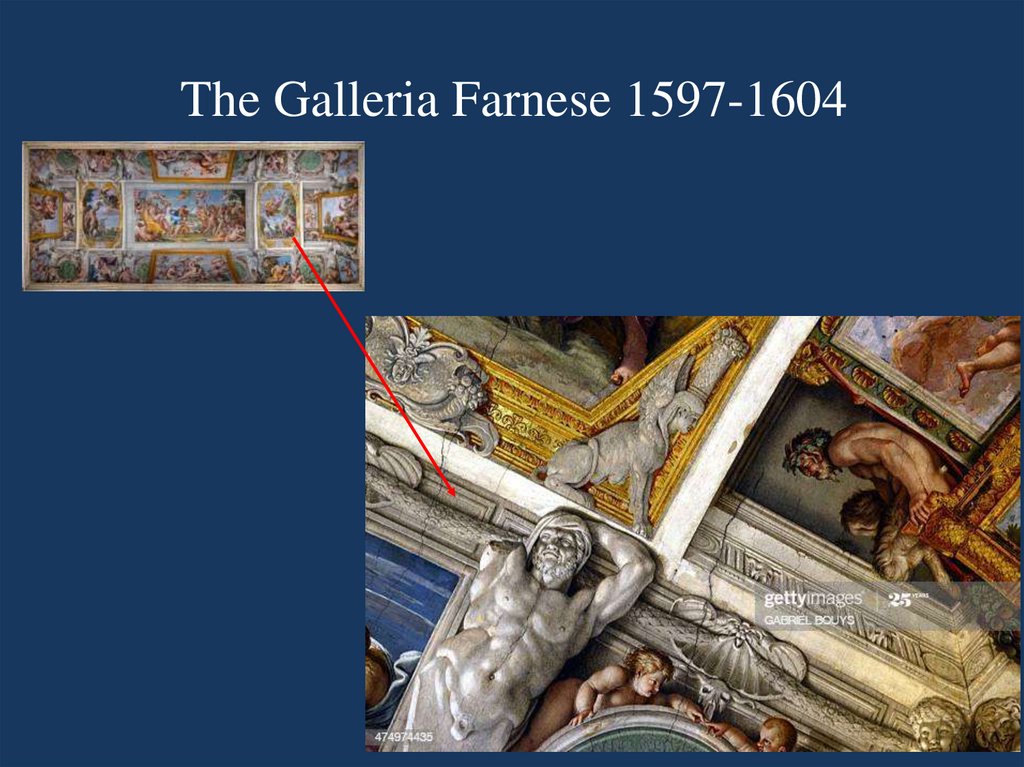
Delectare (to delight)
Movère (to move)
24
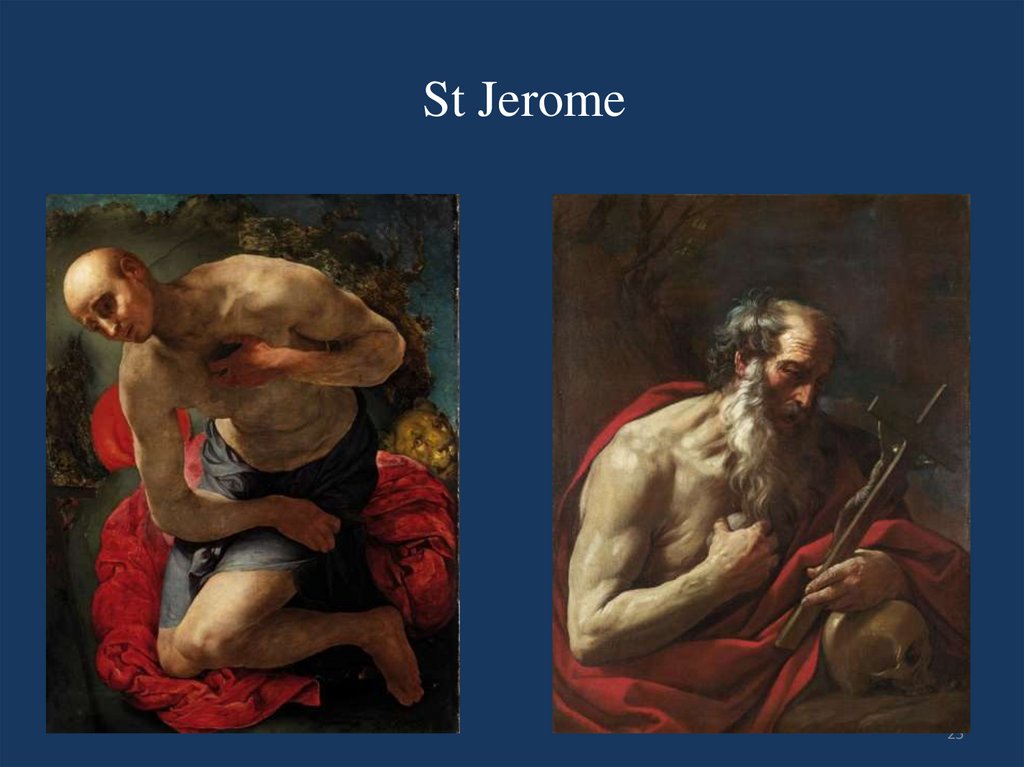
25. St Jerome
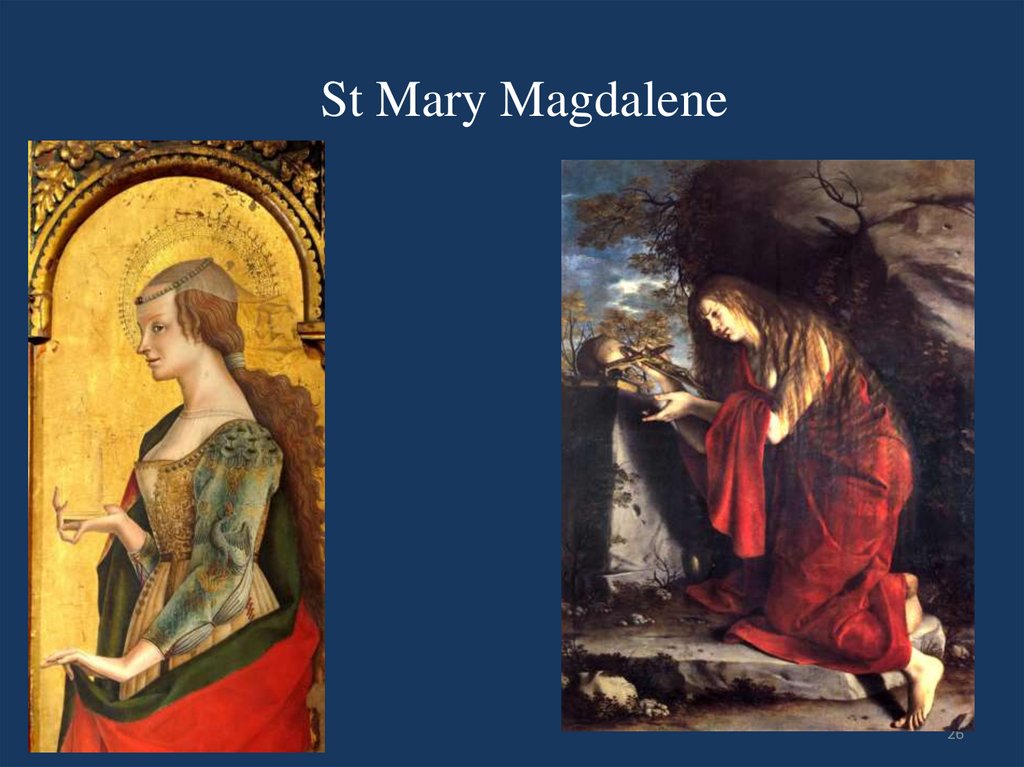
2526. St Mary Magdalene
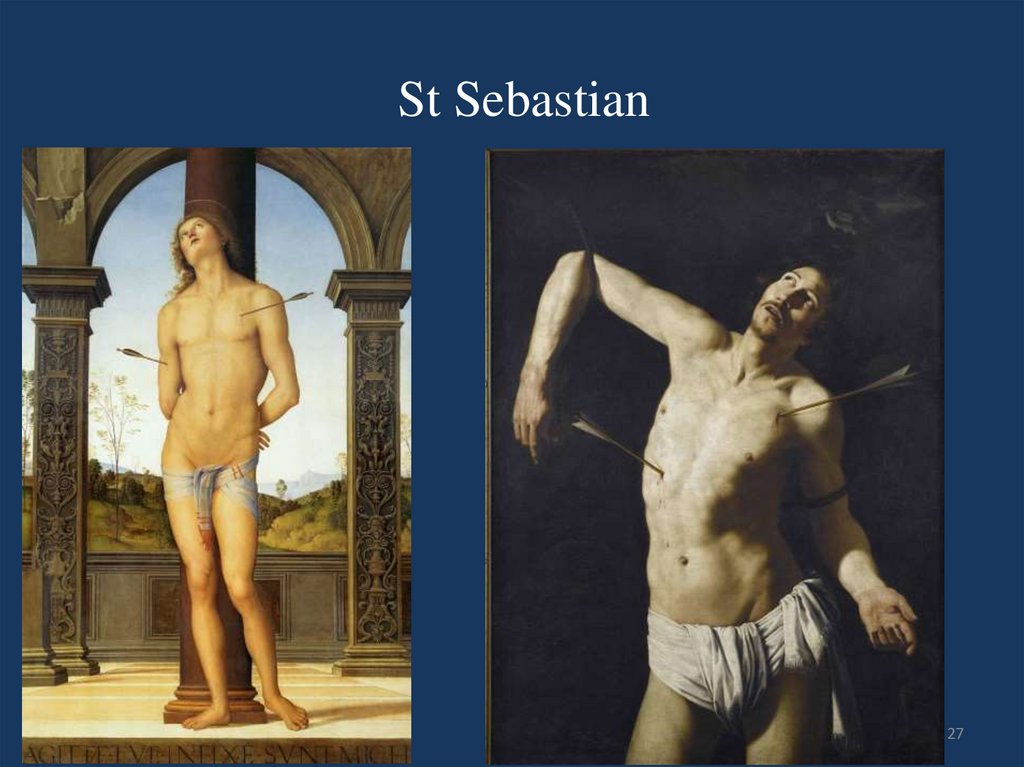
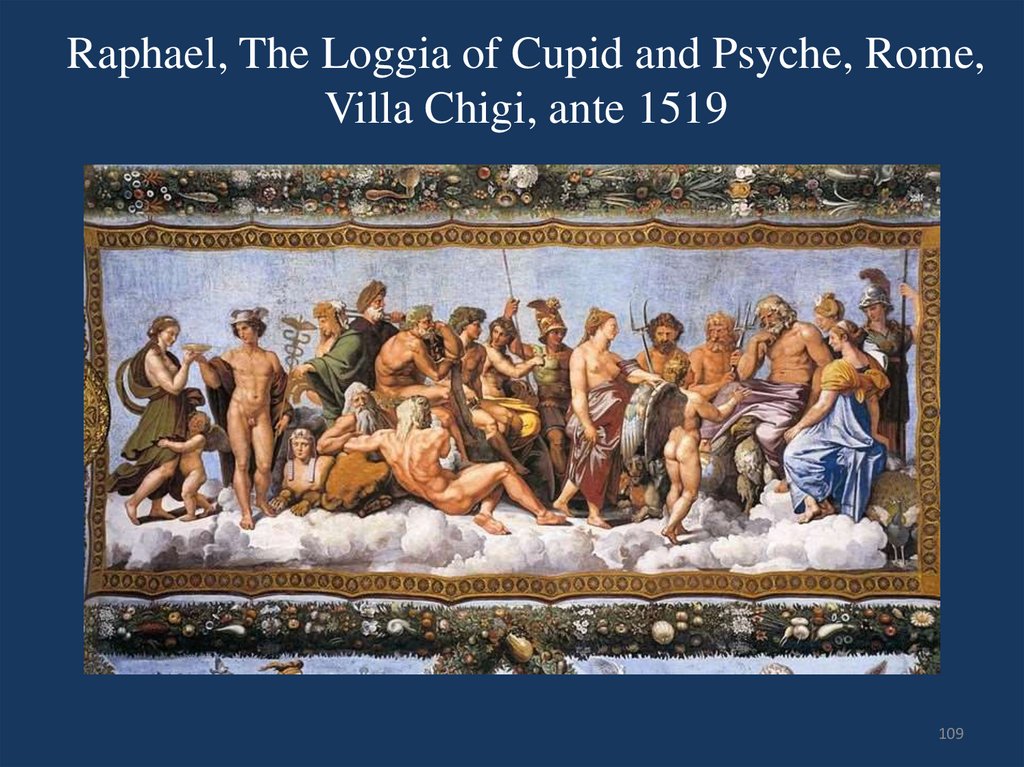
2627. St Sebastian
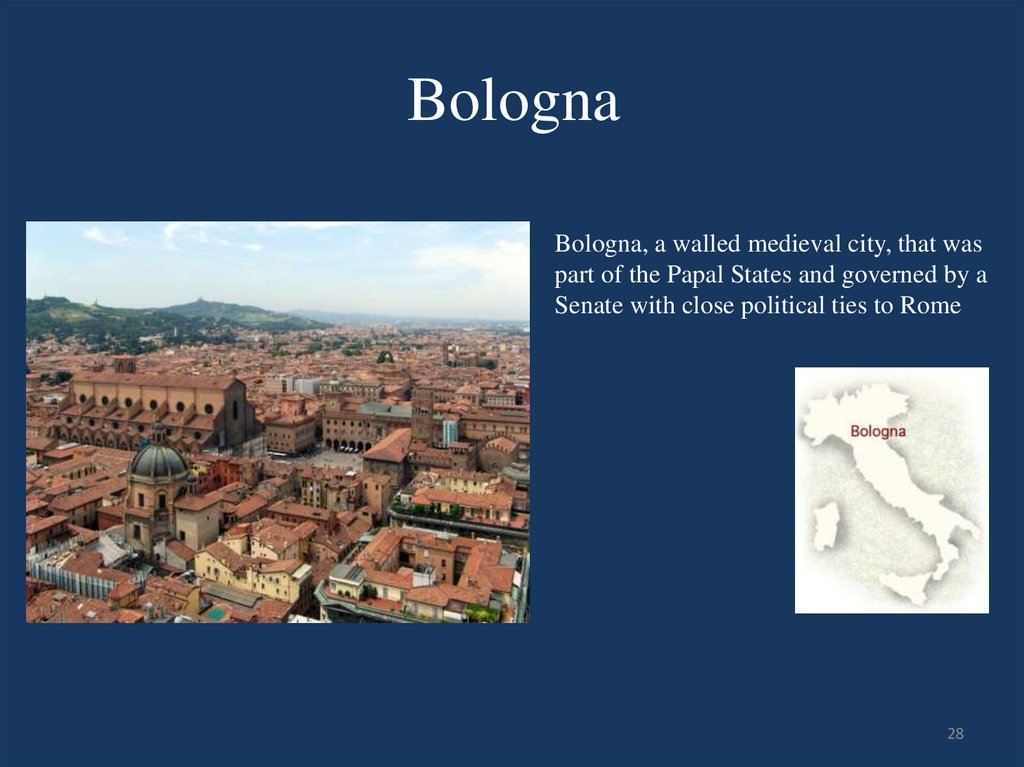
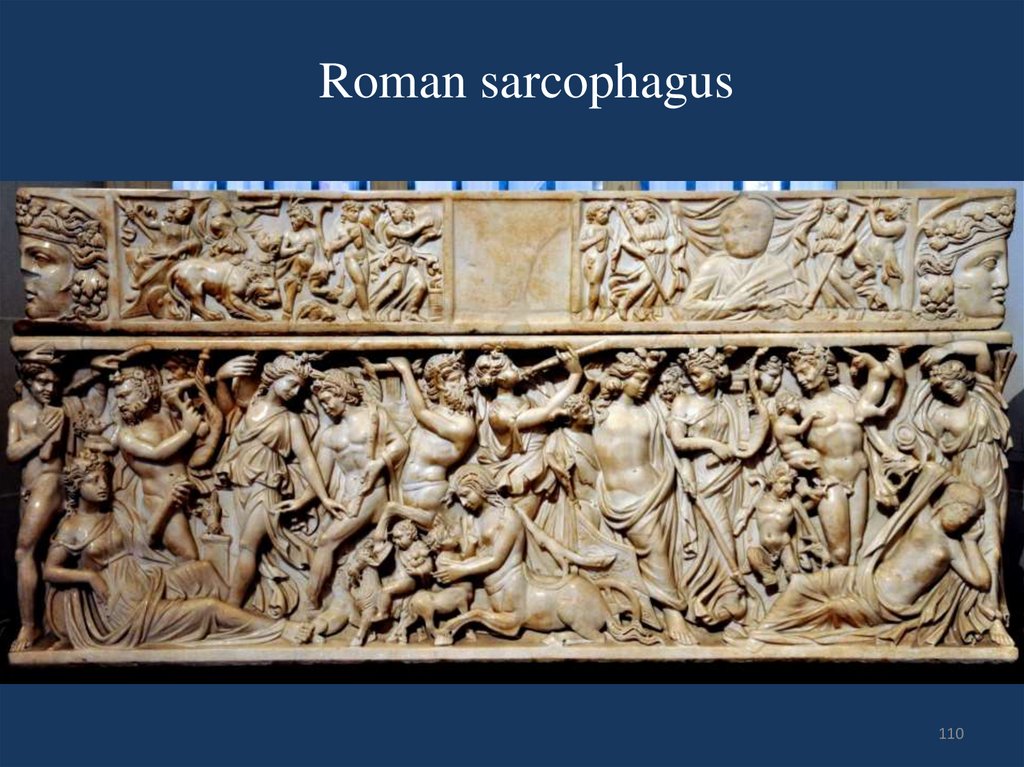
2728. Bologna
Bologna, a walled medieval city, that waspart of the Papal States and governed by a
Senate with close political ties to Rome
28
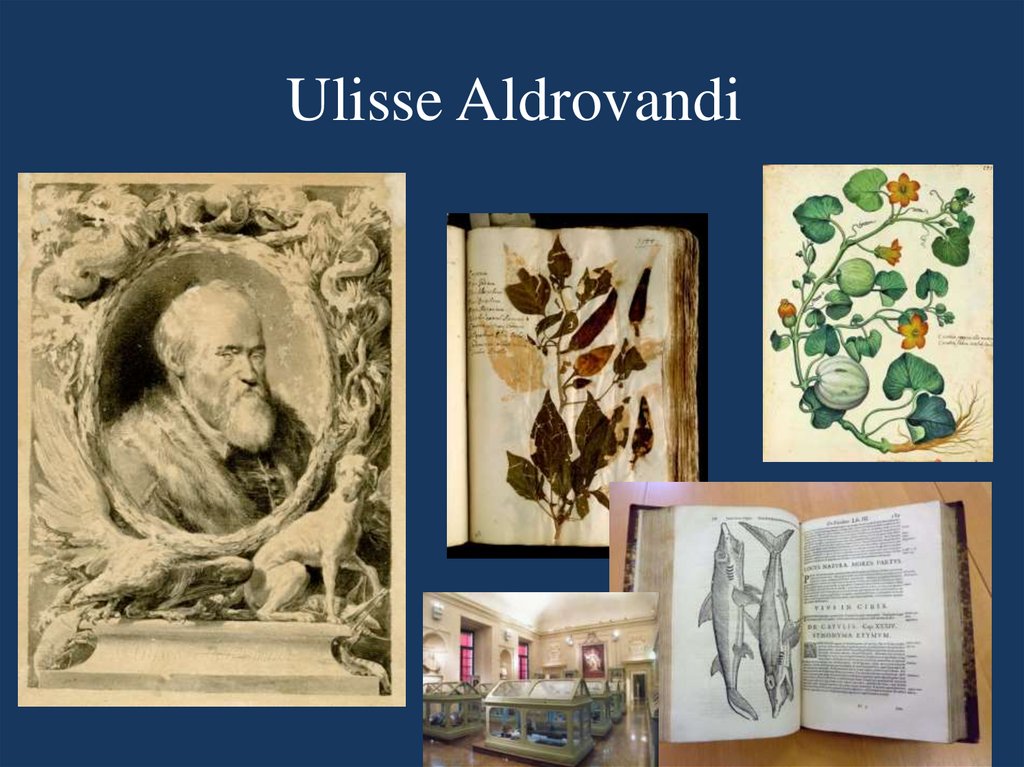
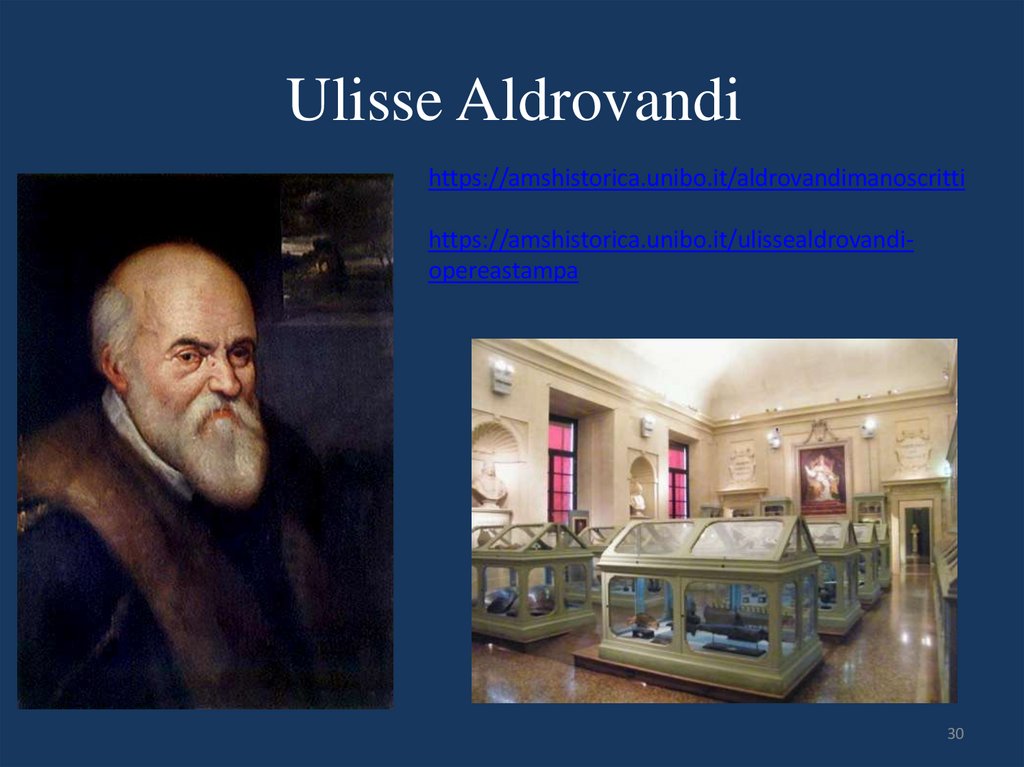
29. Ulisse Aldrovandi
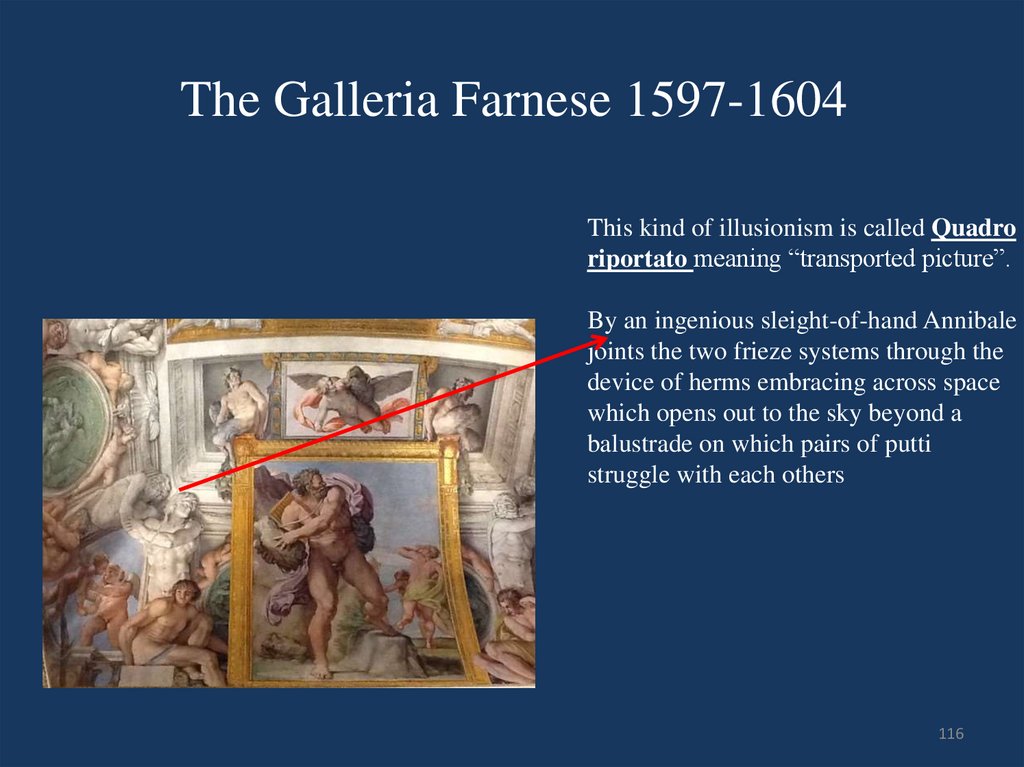
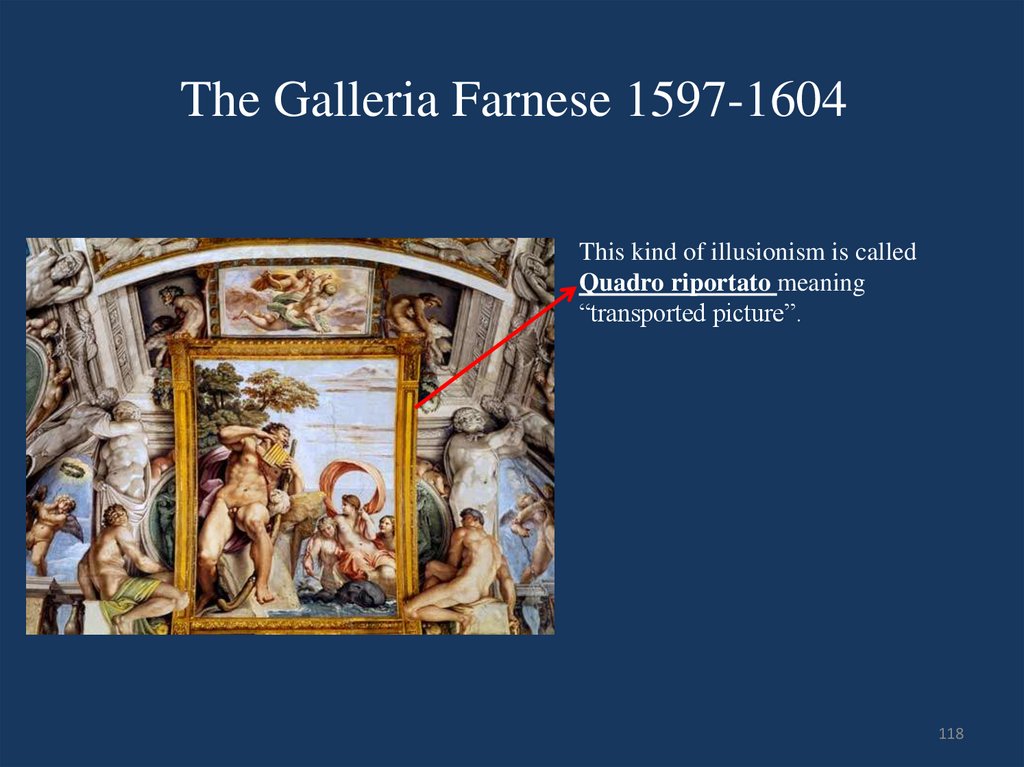
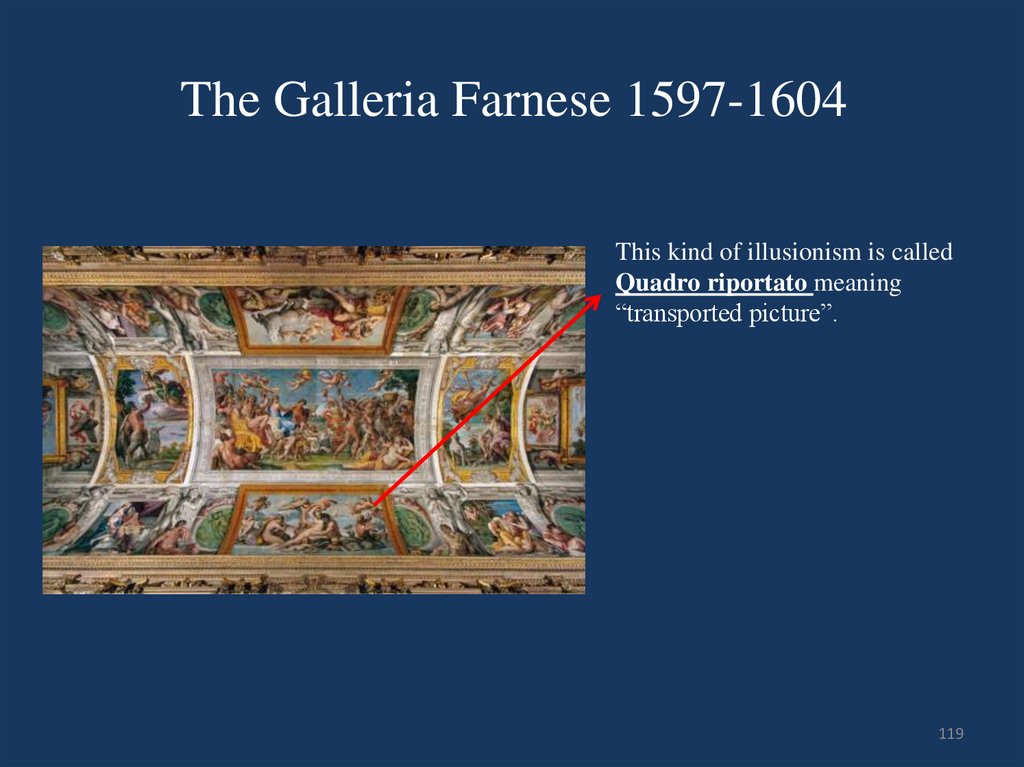
2930. Ulisse Aldrovandi
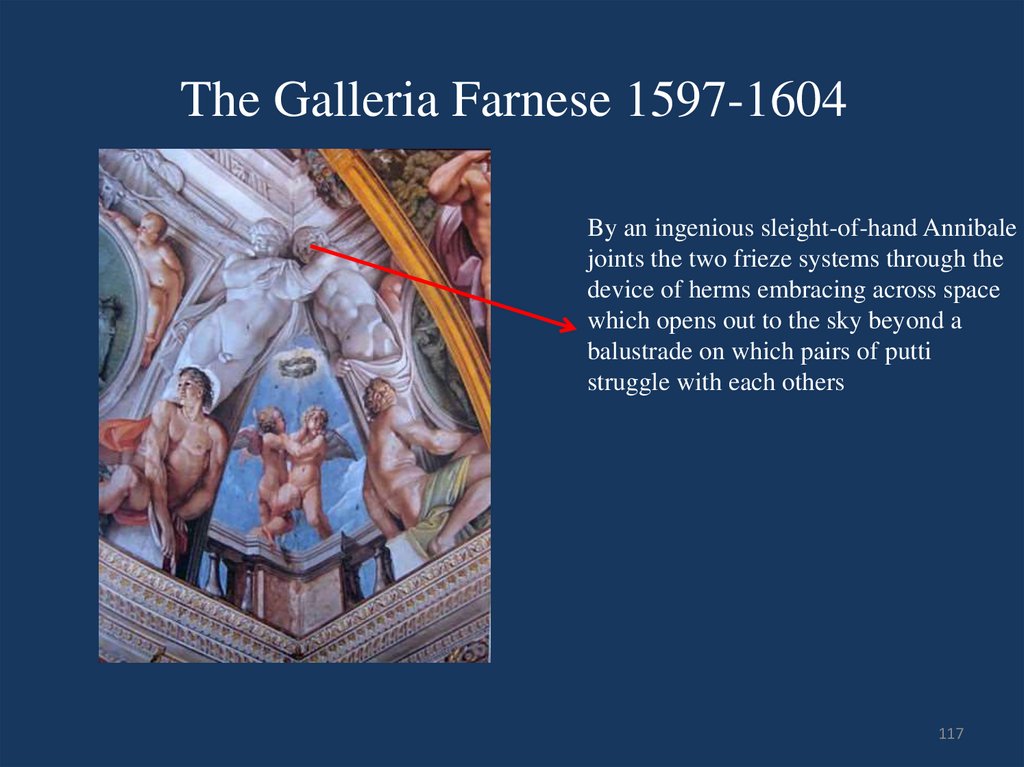
https://amshistorica.unibo.it/aldrovandimanoscrittihttps://amshistorica.unibo.it/ulissealdrovandiopereastampa
30
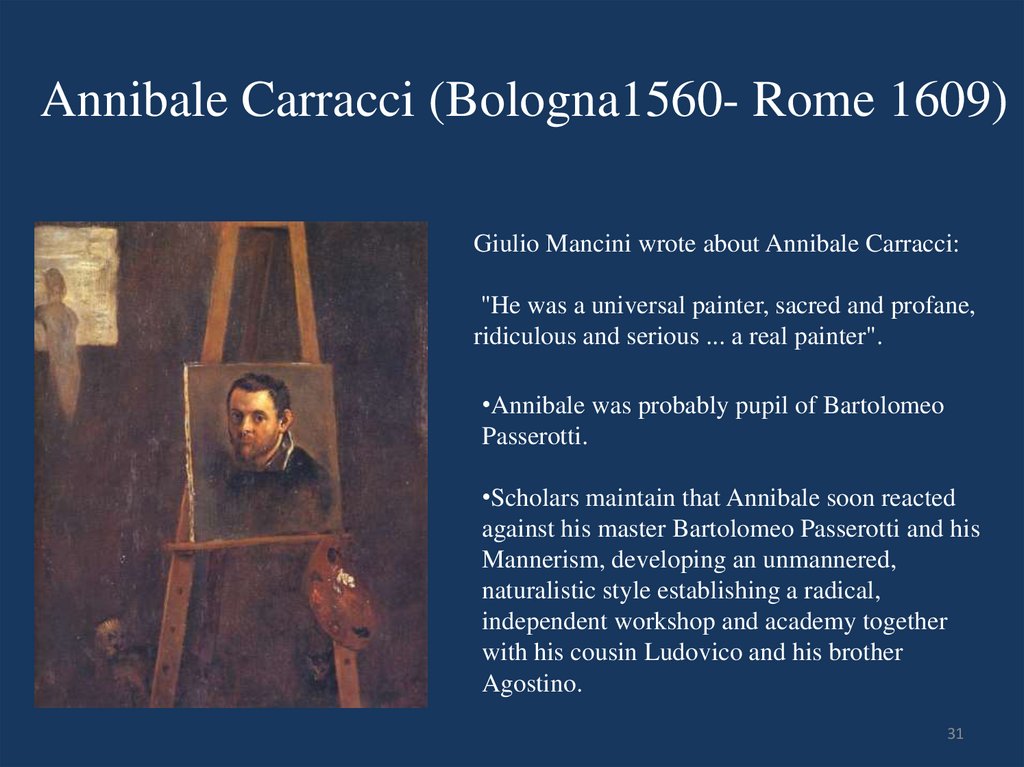
31. Annibale Carracci (Bologna1560- Rome 1609)
Giulio Mancini wrote about Annibale Carracci:"He was a universal painter, sacred and profane,
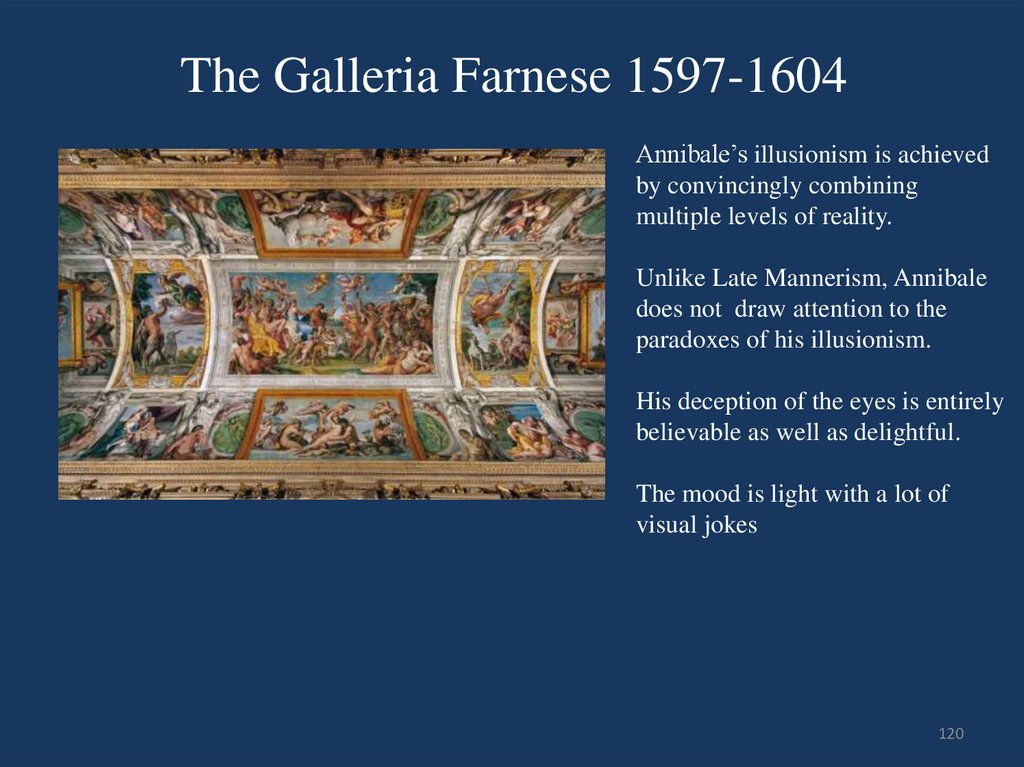
ridiculous and serious ... a real painter".
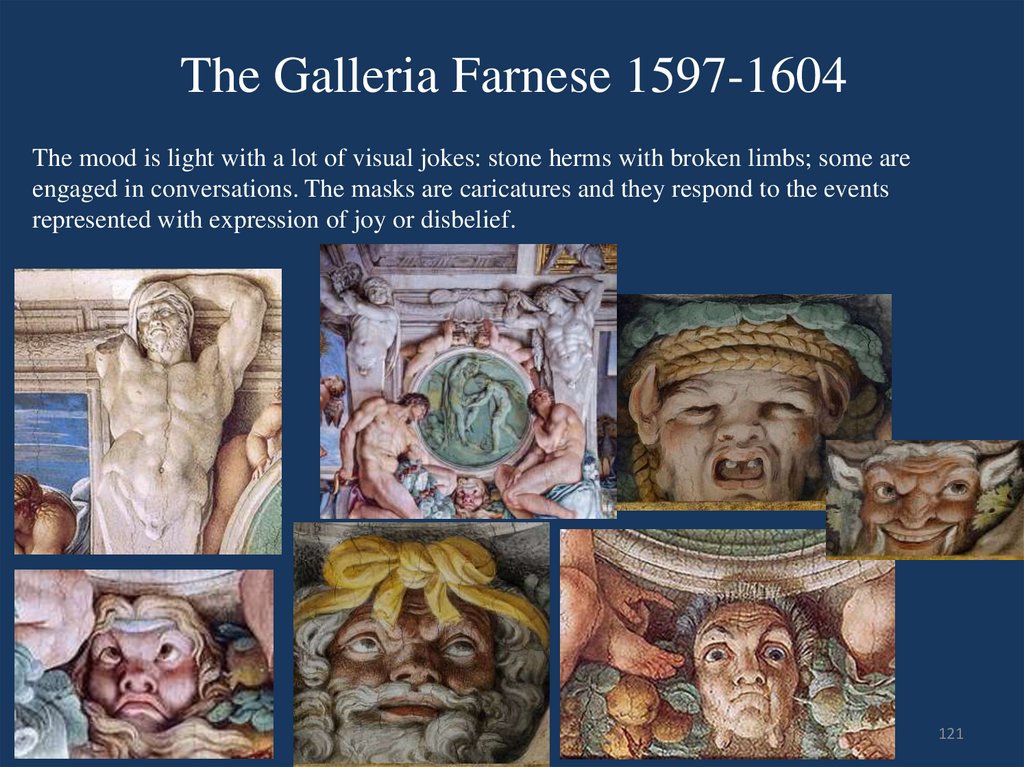
•Annibale was probably pupil of Bartolomeo
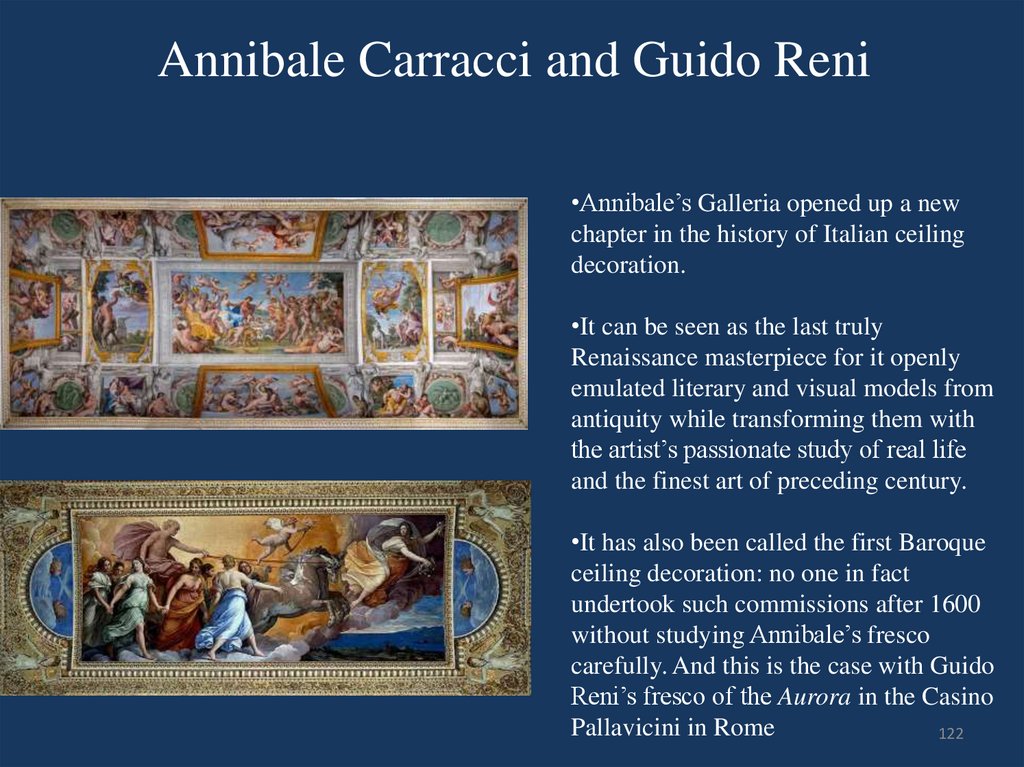
Passerotti.
•Scholars maintain that Annibale soon reacted
against his master Bartolomeo Passerotti and his
Mannerism, developing an unmannered,
naturalistic style establishing a radical,
independent workshop and academy together
with his cousin Ludovico and his brother
Agostino.
31
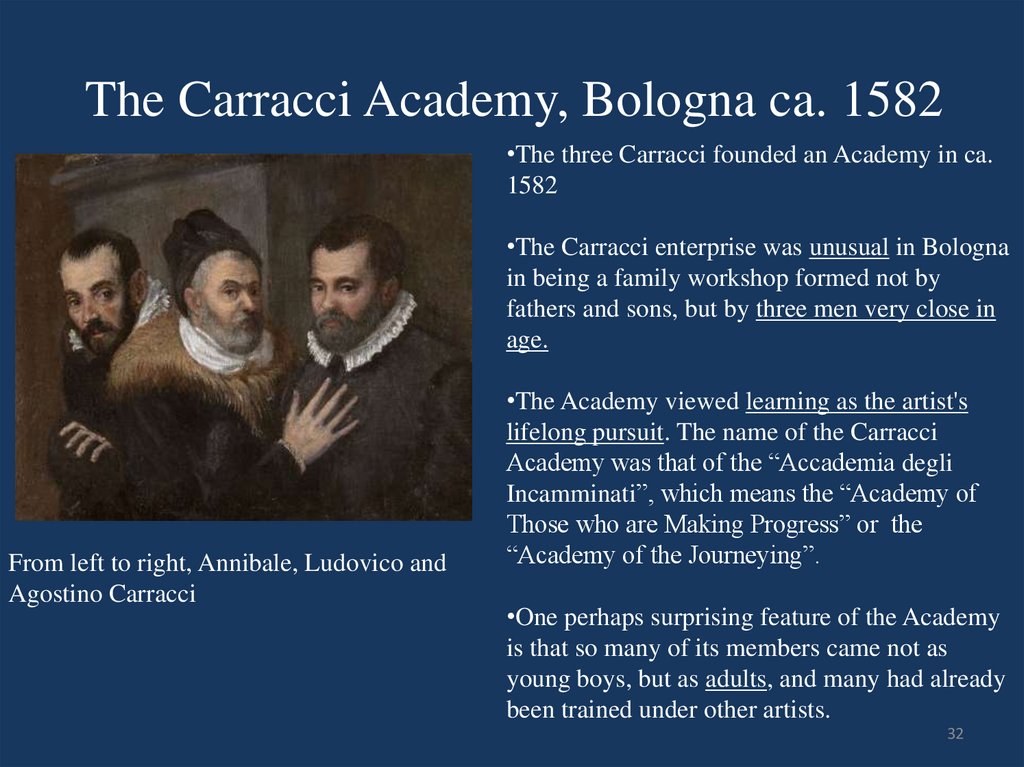
32. The Carracci Academy, Bologna ca. 1582
•The three Carracci founded an Academy in ca.1582
•The Carracci enterprise was unusual in Bologna
in being a family workshop formed not by
fathers and sons, but by three men very close in
age.
From left to right, Annibale, Ludovico and
Agostino Carracci
•The Academy viewed learning as the artist's
lifelong pursuit. The name of the Carracci
Academy was that of the “Accademia degli
Incamminati”, which means the “Academy of
Those who are Making Progress” or the
“Academy of the Journeying”.
•One perhaps surprising feature of the Academy
is that so many of its members came not as
young boys, but as adults, and many had already
been trained under other artists.
32
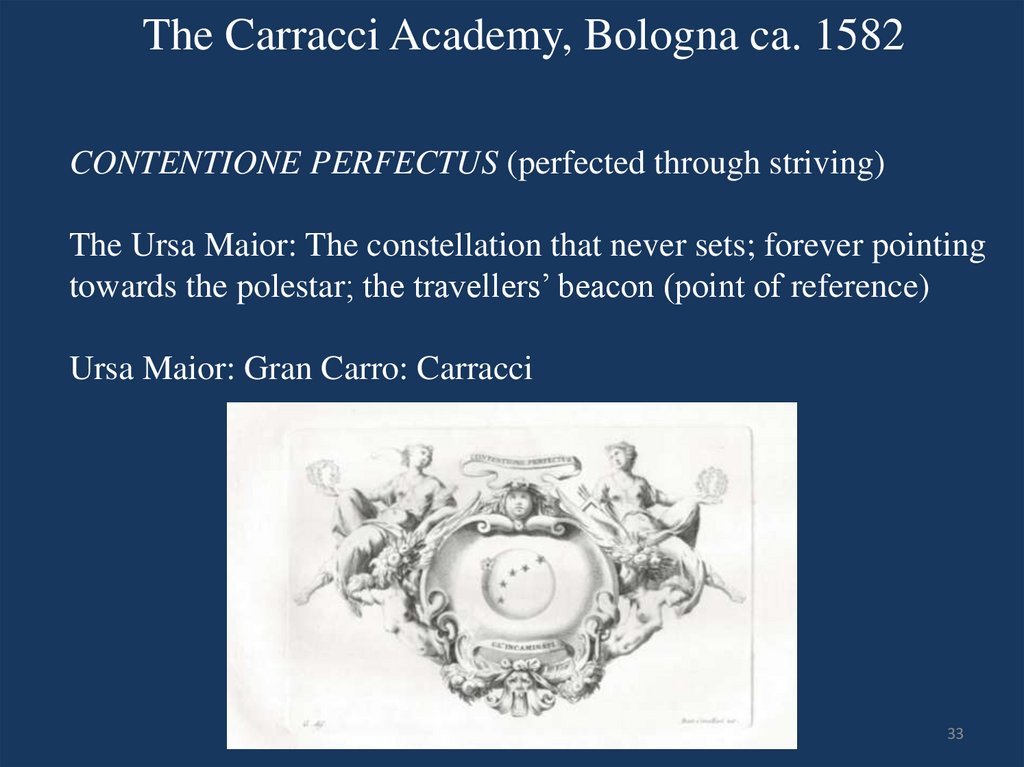
33. The Carracci Academy, Bologna ca. 1582
CONTENTIONE PERFECTUS (perfected through striving)The Ursa Maior: The constellation that never sets; forever pointing
towards the polestar; the travellers’ beacon (point of reference)
Ursa Maior: Gran Carro: Carracci
33
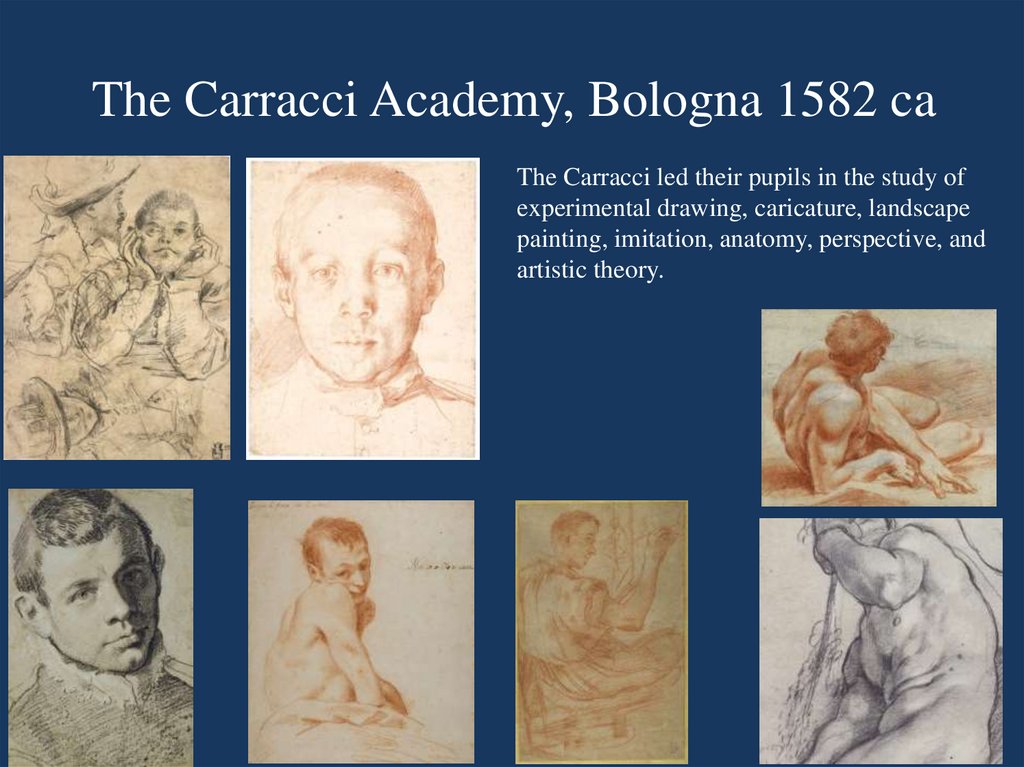
34. The Carracci Academy, Bologna 1582 ca
The Carracci led their pupils in the study ofexperimental drawing, caricature, landscape
painting, imitation, anatomy, perspective, and
artistic theory.
34
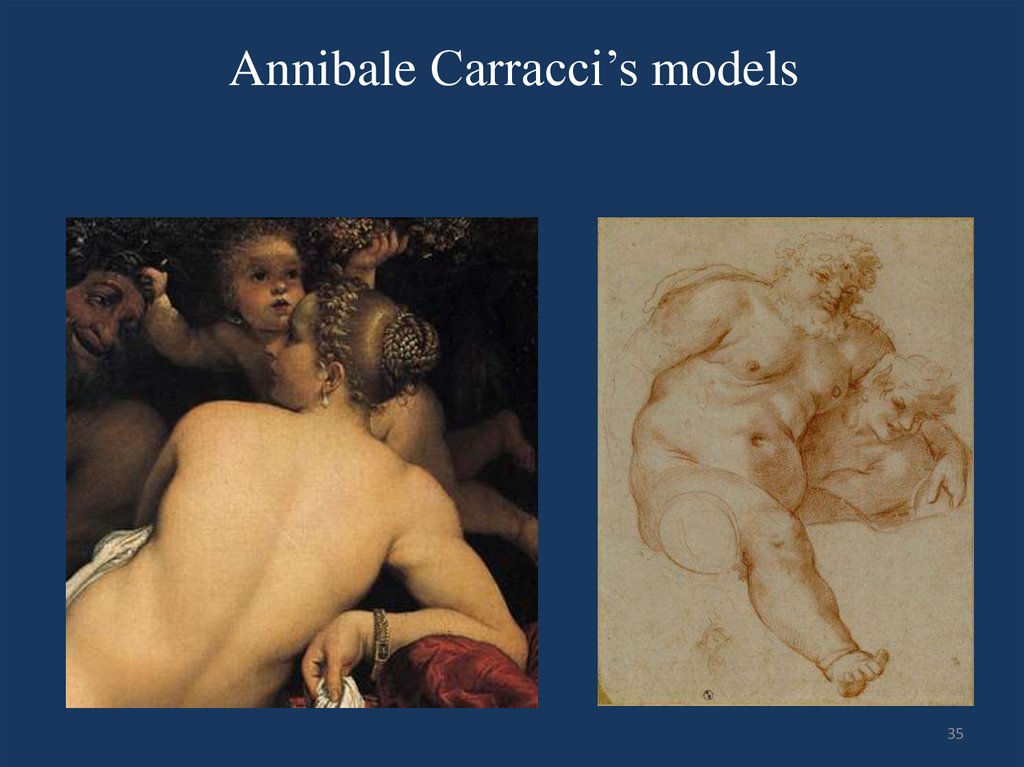
35. Annibale Carracci’s models
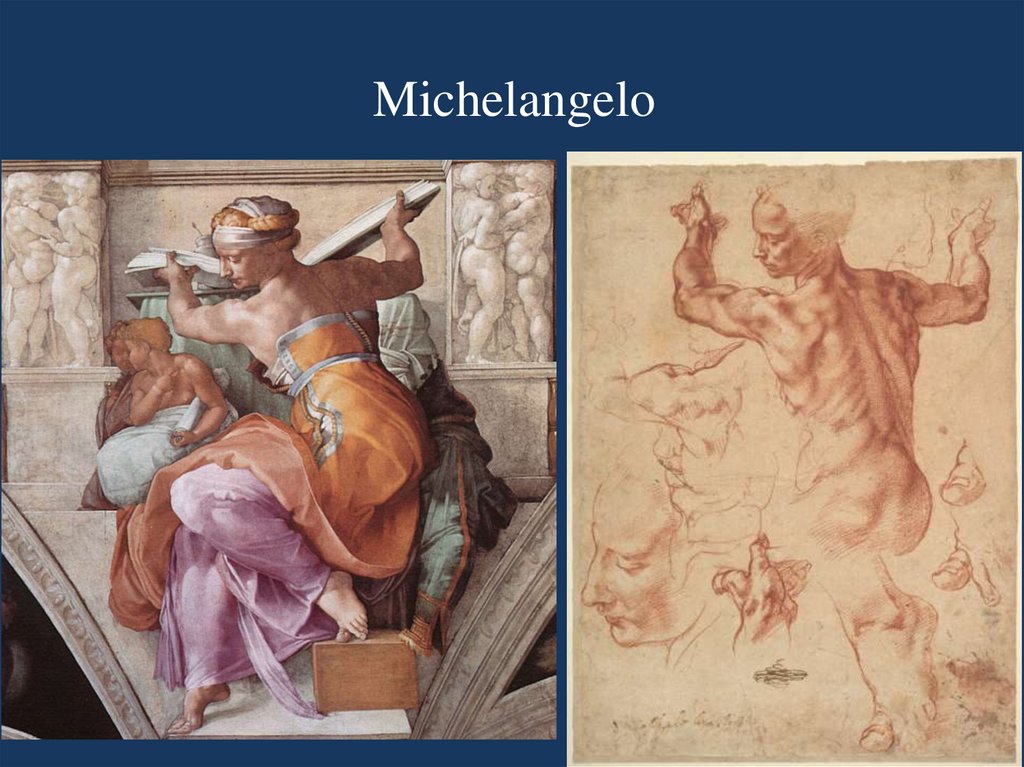
3536. Michelangelo
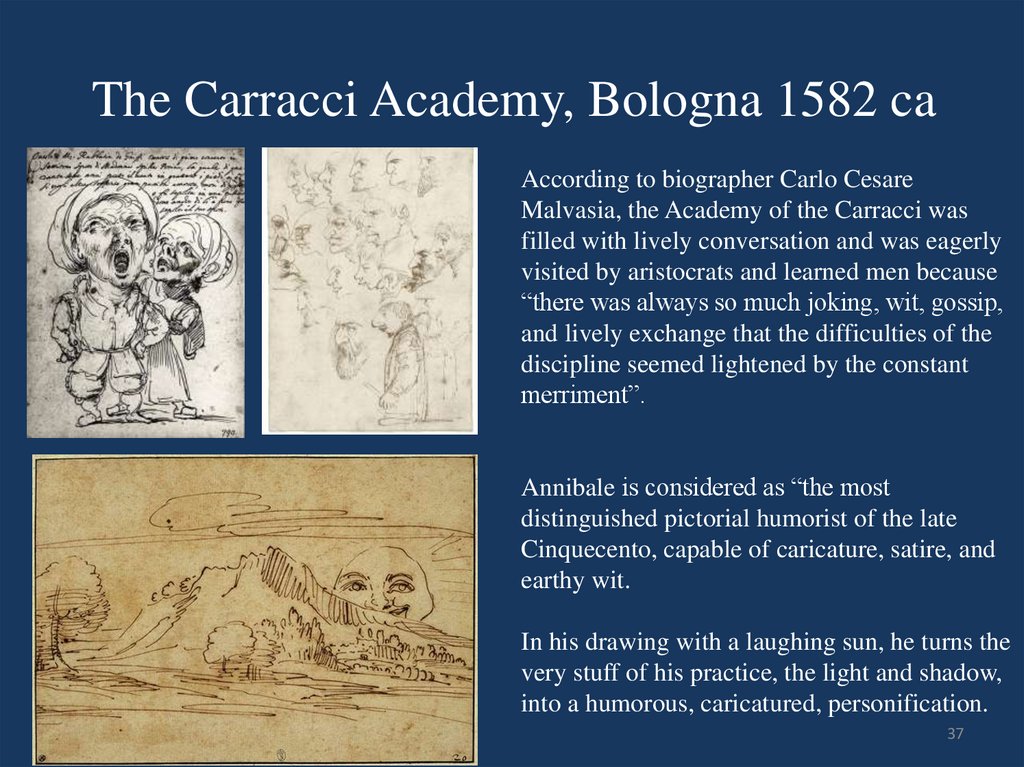
3637. The Carracci Academy, Bologna 1582 ca
According to biographer Carlo CesareMalvasia, the Academy of the Carracci was
filled with lively conversation and was eagerly
visited by aristocrats and learned men because
“there was always so much joking, wit, gossip,
and lively exchange that the difficulties of the
discipline seemed lightened by the constant
merriment”.
Annibale is considered as “the most
distinguished pictorial humorist of the late
Cinquecento, capable of caricature, satire, and
earthy wit.
In his drawing with a laughing sun, he turns the
very stuff of his practice, the light and shadow,
into a humorous, caricatured, personification.
37
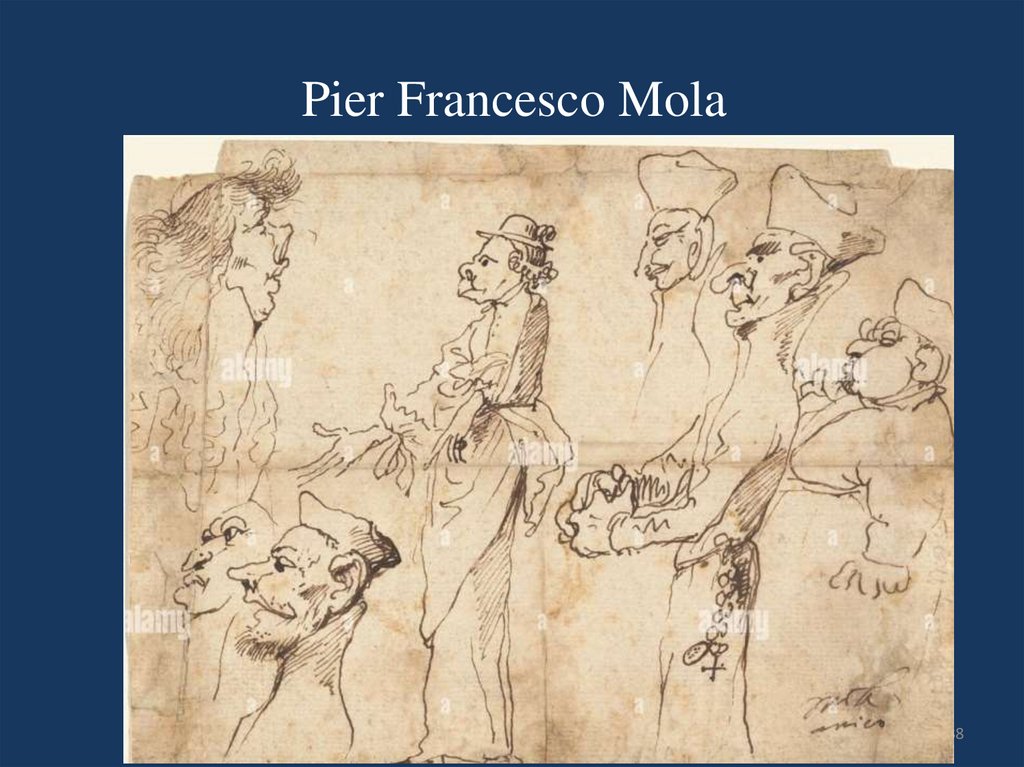
38. Pier Francesco Mola
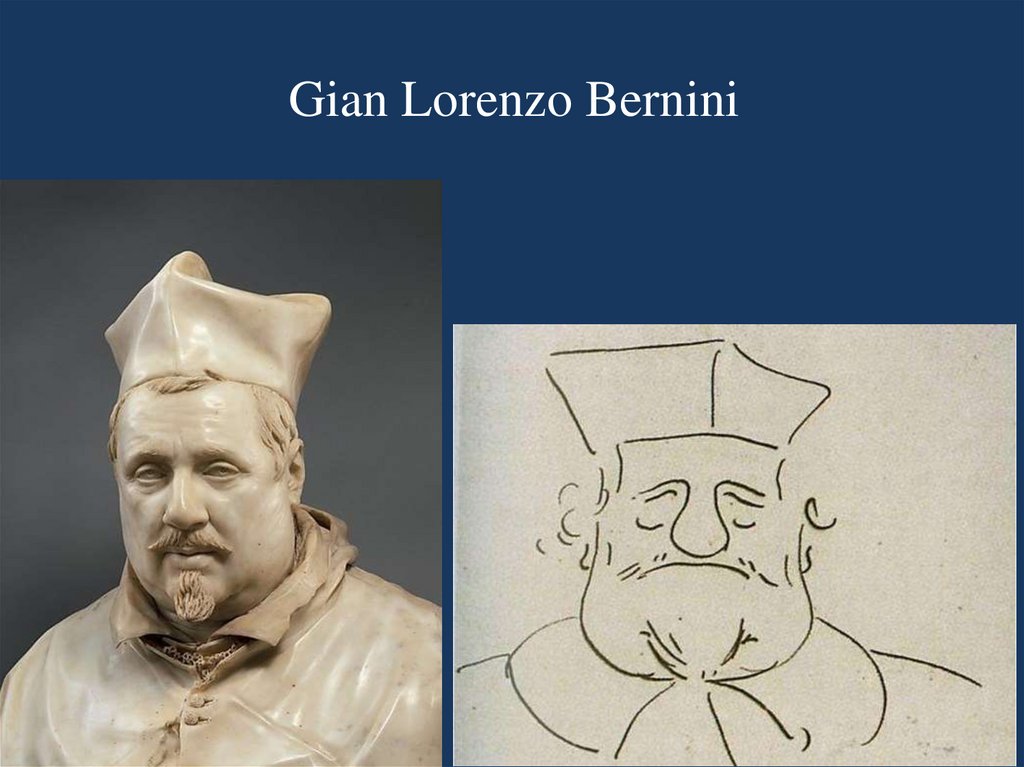
3839. Gian Lorenzo Bernini
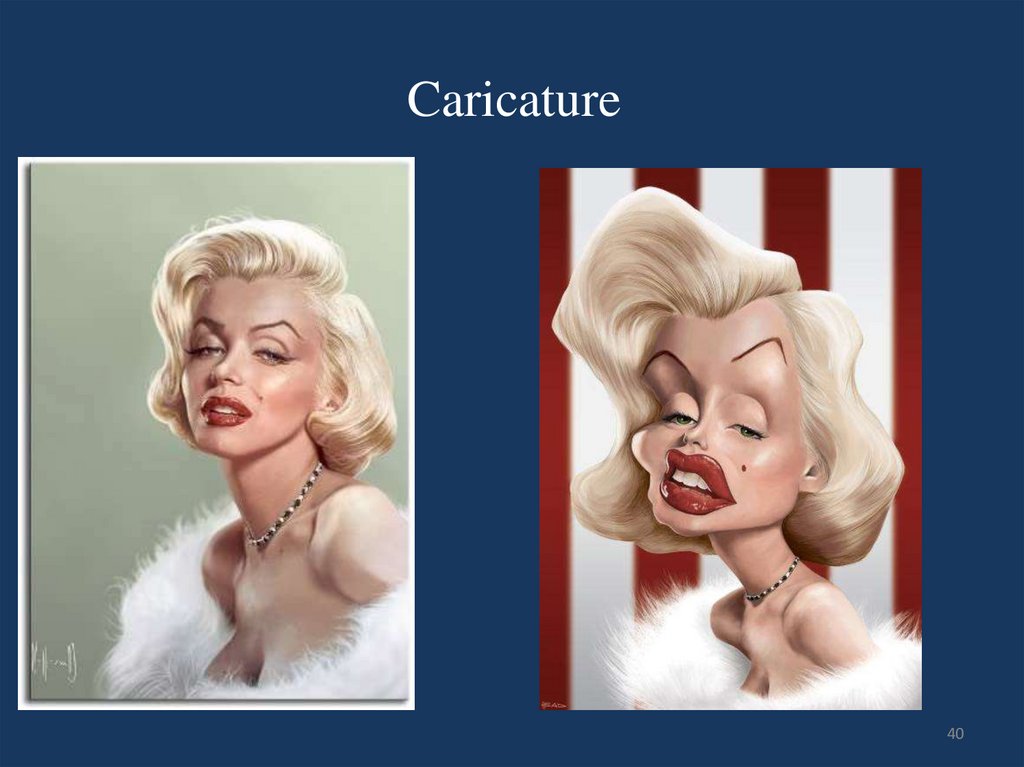
3940. Caricature
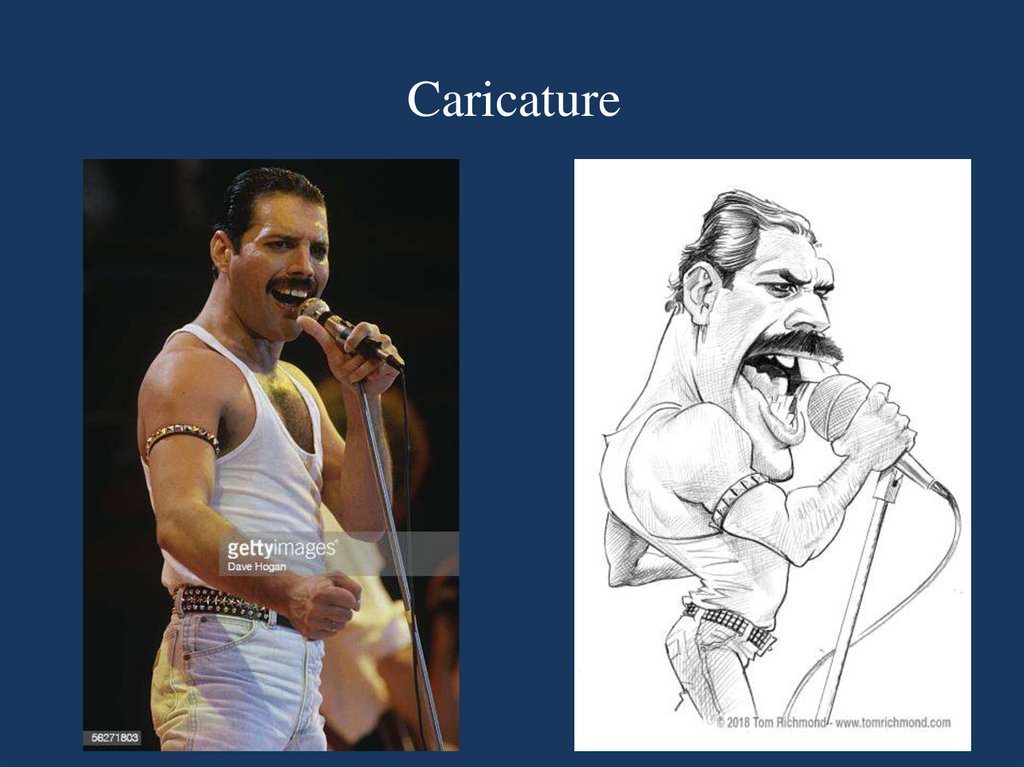
4041. Caricature
4142.
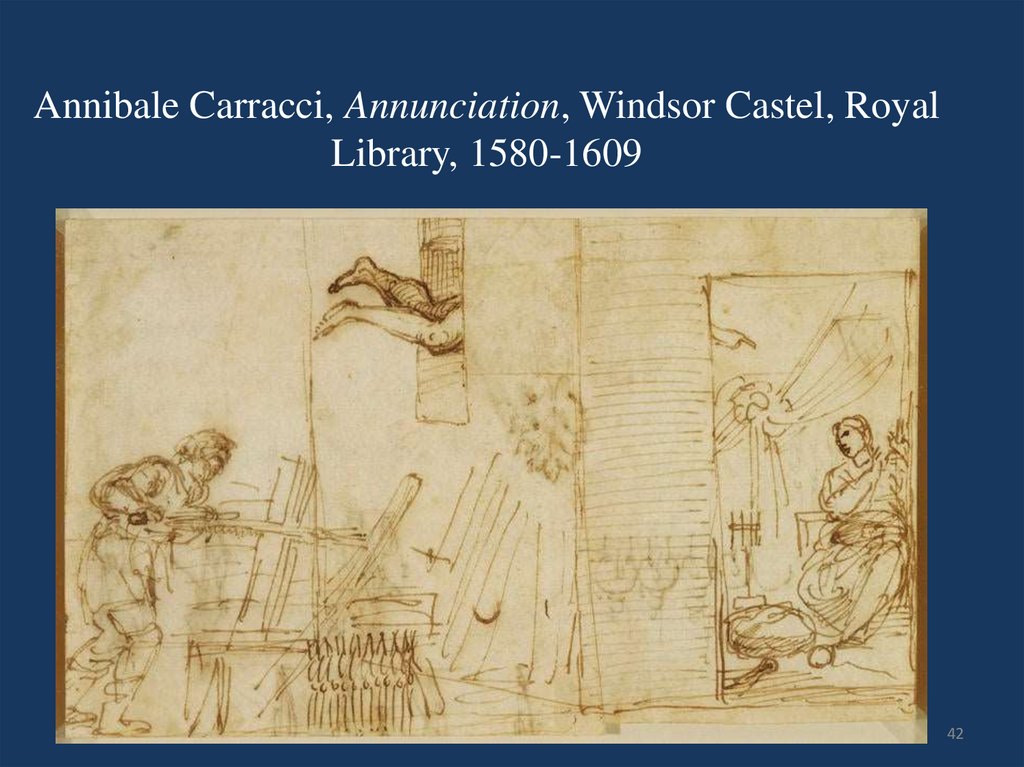
Annibale Carracci, Annunciation, Windsor Castel, RoyalLibrary, 1580-1609
42
43.
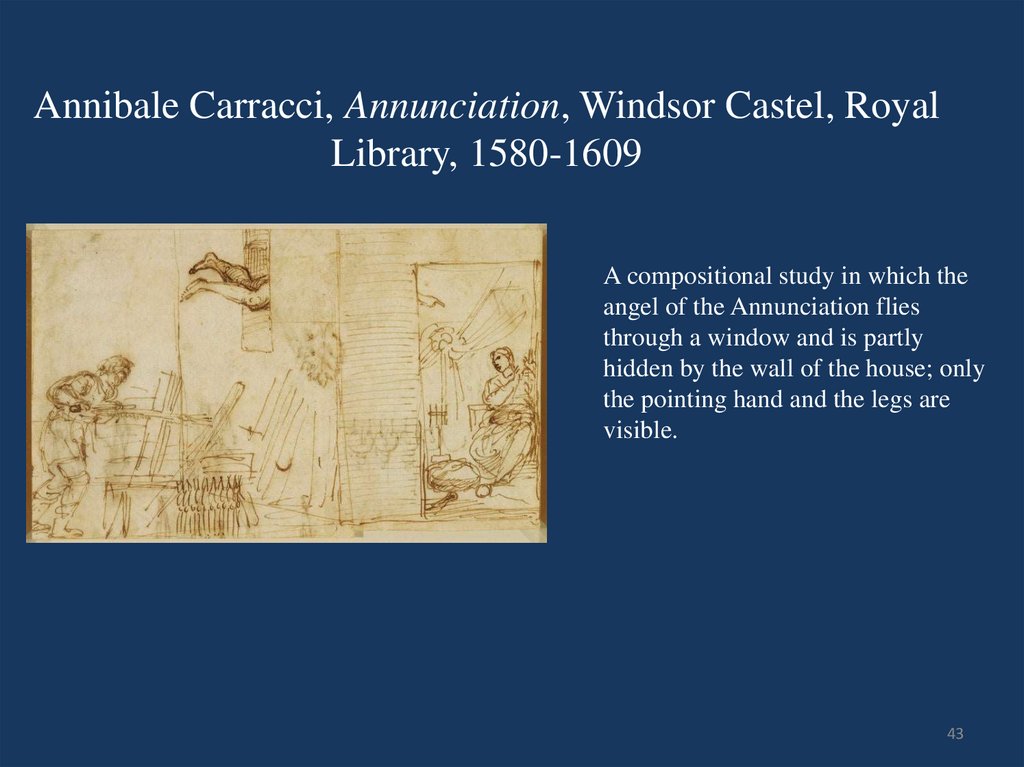
Annibale Carracci, Annunciation, Windsor Castel, RoyalLibrary, 1580-1609
A compositional study in which the
angel of the Annunciation flies
through a window and is partly
hidden by the wall of the house; only
the pointing hand and the legs are
visible.
43
44.
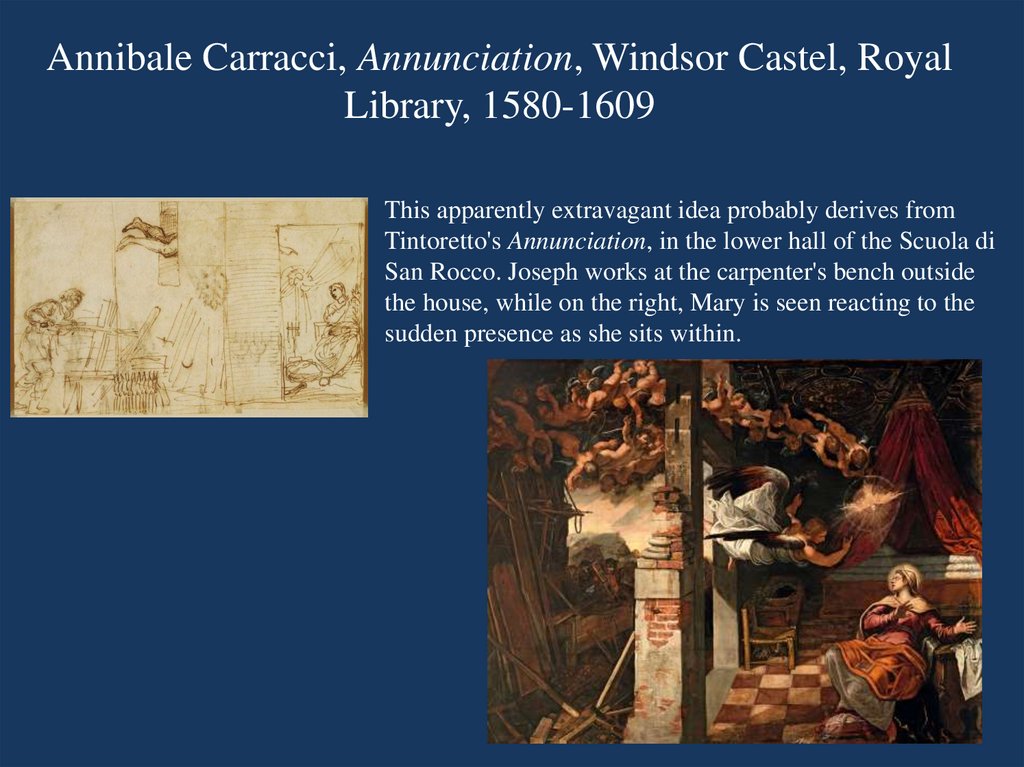
Annibale Carracci, Annunciation, Windsor Castel, RoyalLibrary, 1580-1609
This apparently extravagant idea probably derives from
Tintoretto's Annunciation, in the lower hall of the Scuola di
San Rocco. Joseph works at the carpenter's bench outside
the house, while on the right, Mary is seen reacting to the
sudden presence as she sits within.
44
45. New Genres
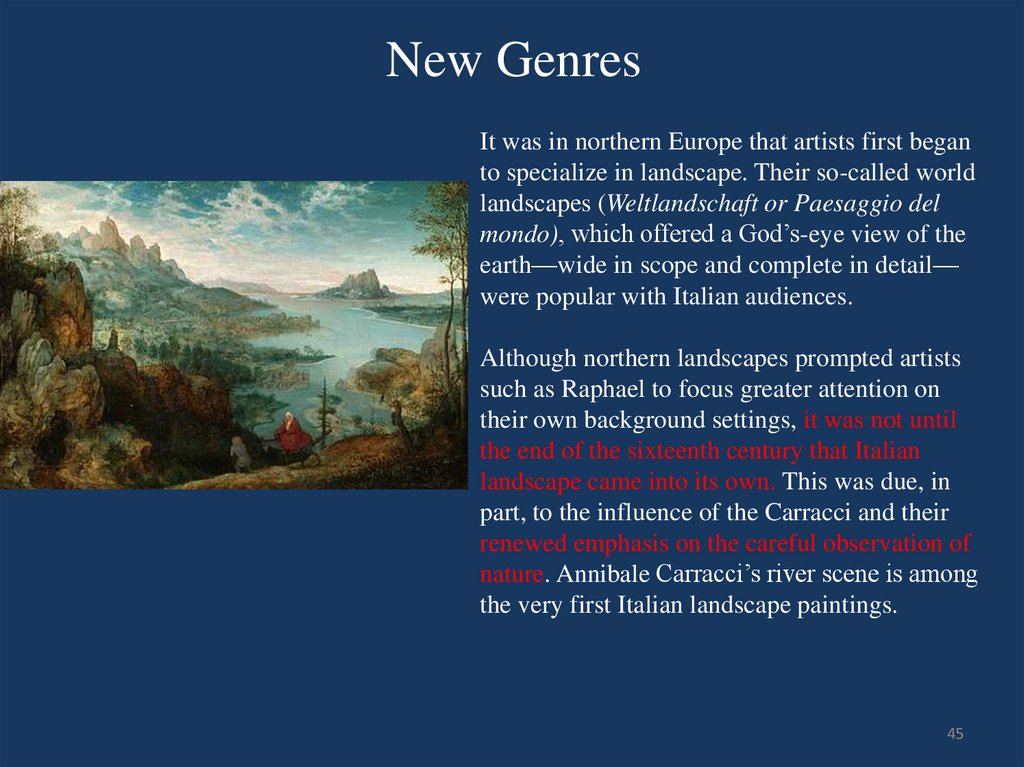
It was in northern Europe that artists first beganto specialize in landscape. Their so-called world
landscapes (Weltlandschaft or Paesaggio del
mondo), which offered a God’s-eye view of the
earth—wide in scope and complete in detail—
were popular with Italian audiences.
Although northern landscapes prompted artists
such as Raphael to focus greater attention on
their own background settings, it was not until
the end of the sixteenth century that Italian
landscape came into its own. This was due, in
part, to the influence of the Carracci and their
renewed emphasis on the careful observation of
nature. Annibale Carracci’s river scene is among
the very first Italian landscape paintings.
45
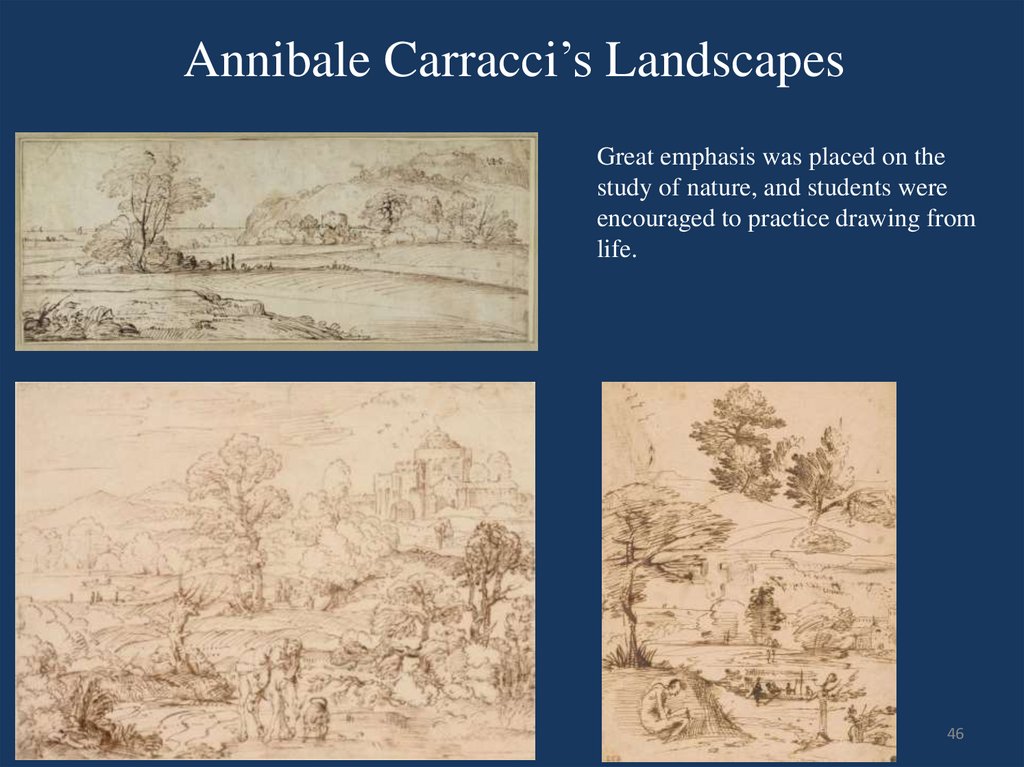
46. Annibale Carracci’s Landscapes
Great emphasis was placed on thestudy of nature, and students were
encouraged to practice drawing from
life.
46
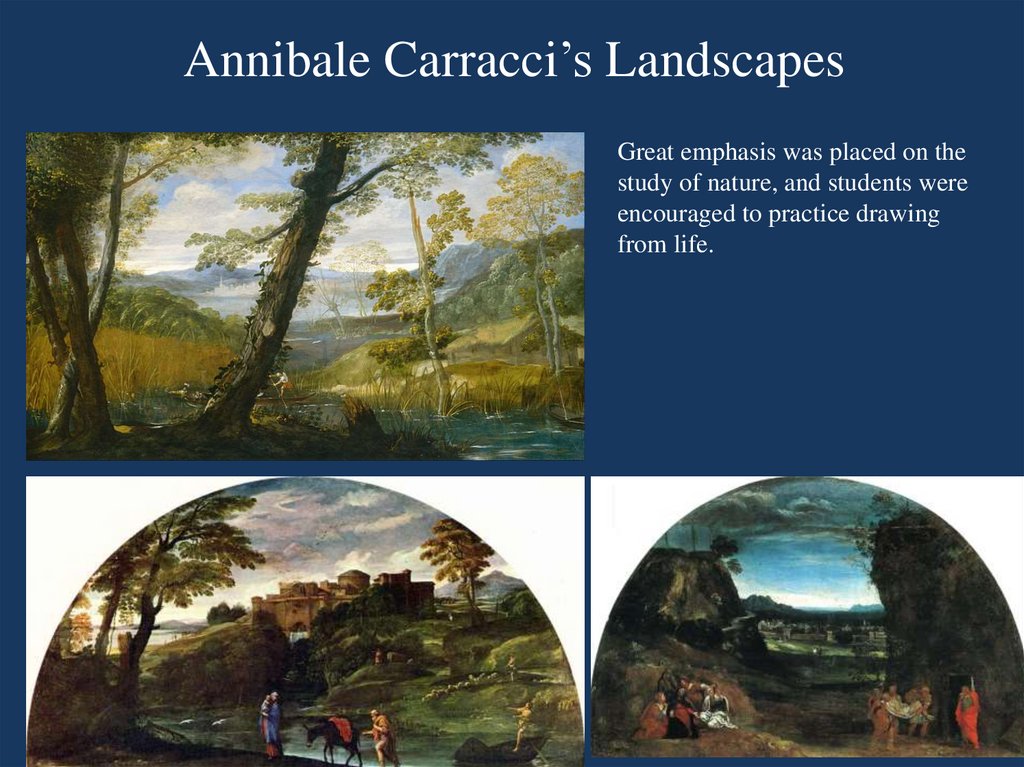
47. Annibale Carracci’s Landscapes
Great emphasis was placed on thestudy of nature, and students were
encouraged to practice drawing
from life.
47
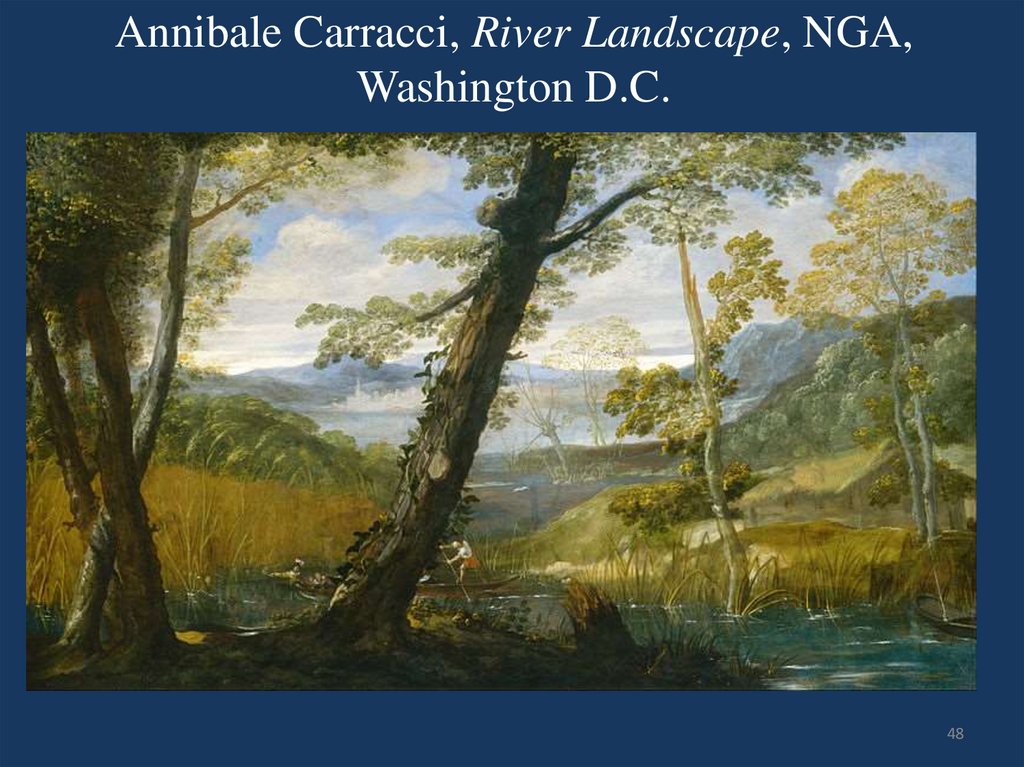
48. Annibale Carracci, River Landscape, NGA, Washington D.C.
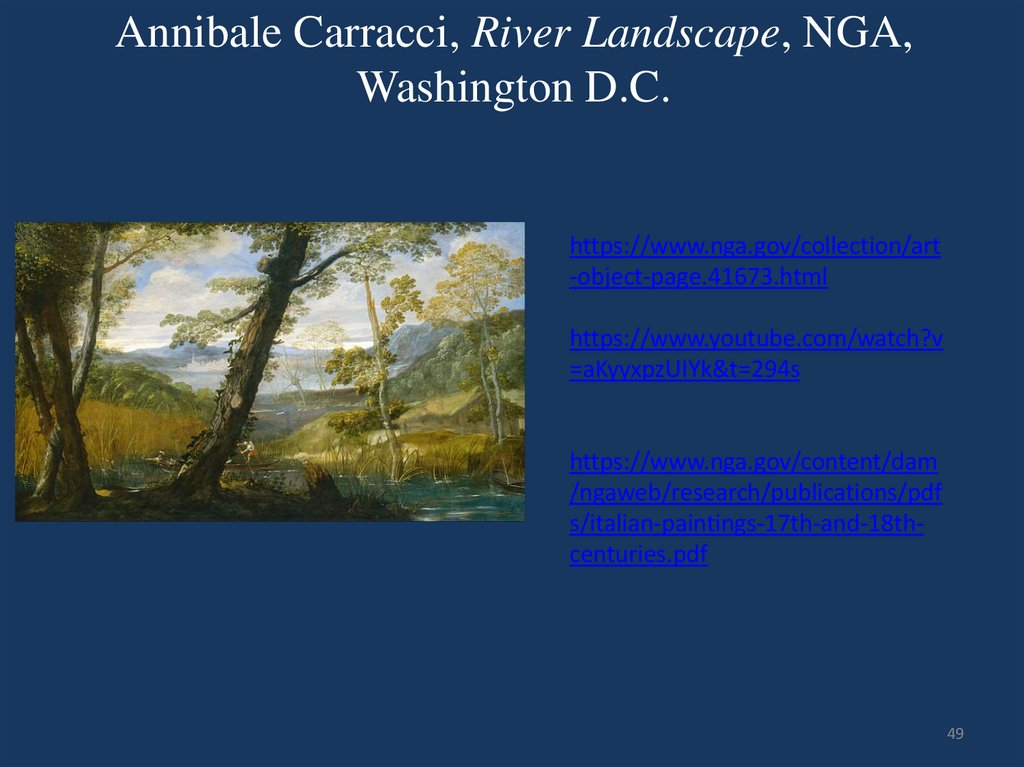
4849. Annibale Carracci, River Landscape, NGA, Washington D.C.
https://www.nga.gov/collection/art-object-page.41673.html
https://www.youtube.com/watch?v
=aKyyxpzUIYk&t=294s
https://www.nga.gov/content/dam
/ngaweb/research/publications/pdf
s/italian-paintings-17th-and-18thcenturies.pdf
49
50. Annibale Carracci, River Landscape, NGA, Washington D.C.
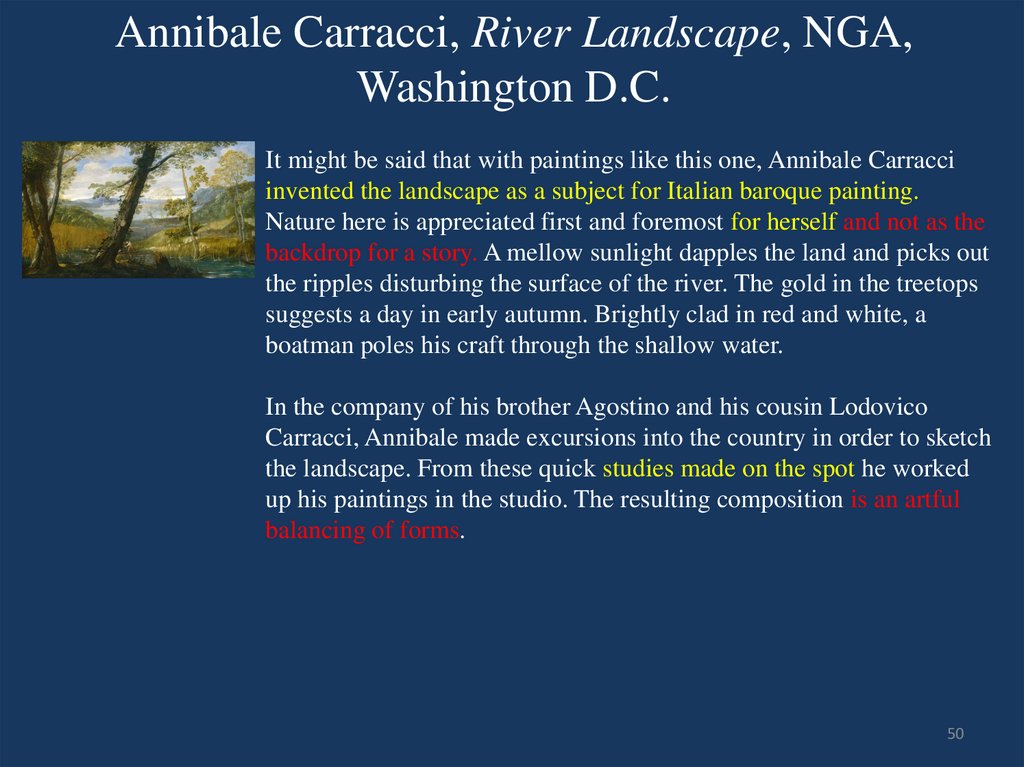
It might be said that with paintings like this one, Annibale Carracciinvented the landscape as a subject for Italian baroque painting.
Nature here is appreciated first and foremost for herself and not as the
backdrop for a story. A mellow sunlight dapples the land and picks out
the ripples disturbing the surface of the river. The gold in the treetops
suggests a day in early autumn. Brightly clad in red and white, a
boatman poles his craft through the shallow water.
In the company of his brother Agostino and his cousin Lodovico
Carracci, Annibale made excursions into the country in order to sketch
the landscape. From these quick studies made on the spot he worked
up his paintings in the studio. The resulting composition is an artful
balancing of forms.
50
51. Annibale Carracci, River Landscape, NGA, Washington D.C.
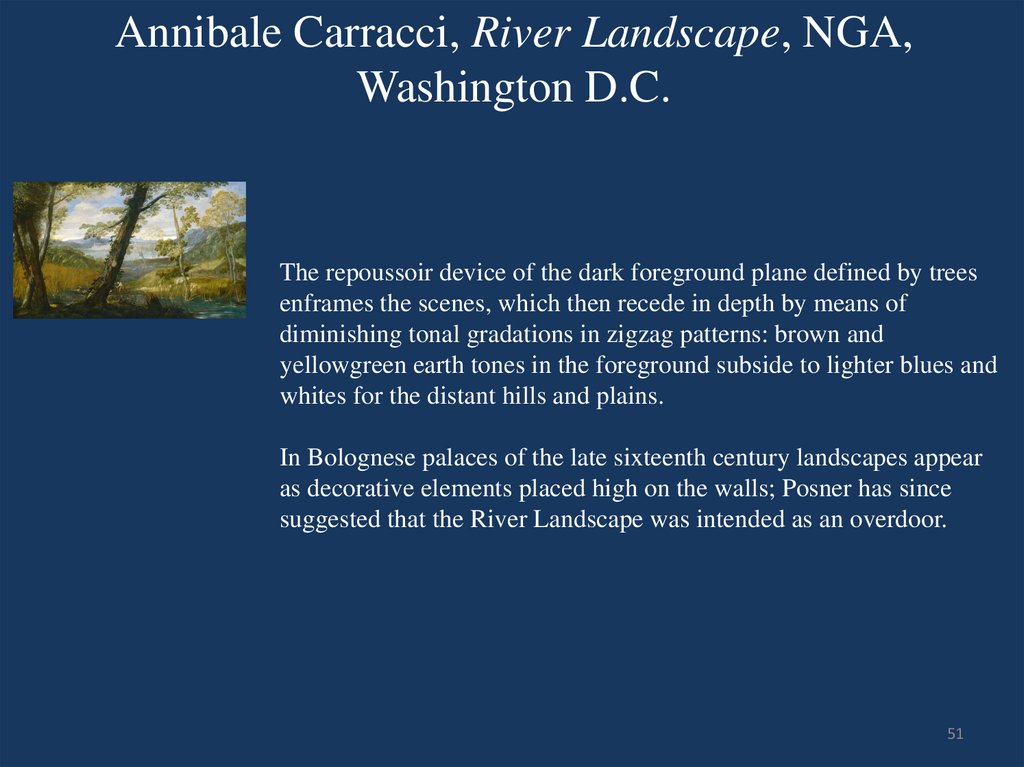
The repoussoir device of the dark foreground plane defined by treesenframes the scenes, which then recede in depth by means of
diminishing tonal gradations in zigzag patterns: brown and
yellowgreen earth tones in the foreground subside to lighter blues and
whites for the distant hills and plains.
In Bolognese palaces of the late sixteenth century landscapes appear
as decorative elements placed high on the walls; Posner has since
suggested that the River Landscape was intended as an overdoor.
51
52. New Genres
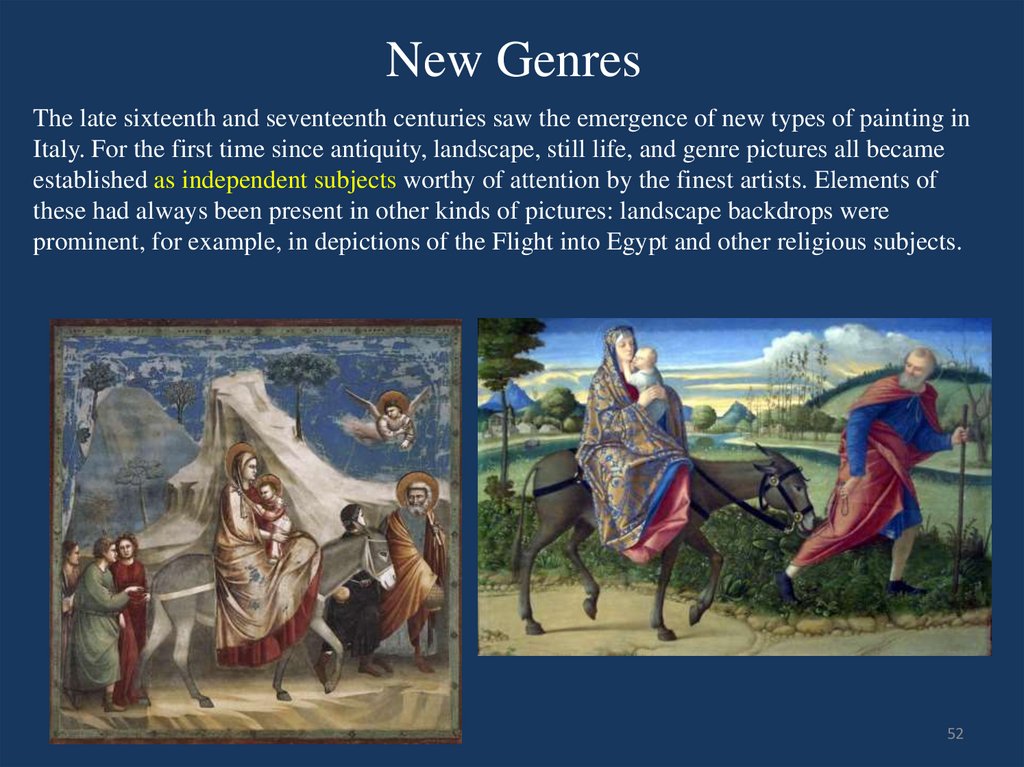
The late sixteenth and seventeenth centuries saw the emergence of new types of painting inItaly. For the first time since antiquity, landscape, still life, and genre pictures all became
established as independent subjects worthy of attention by the finest artists. Elements of
these had always been present in other kinds of pictures: landscape backdrops were
prominent, for example, in depictions of the Flight into Egypt and other religious subjects.
52
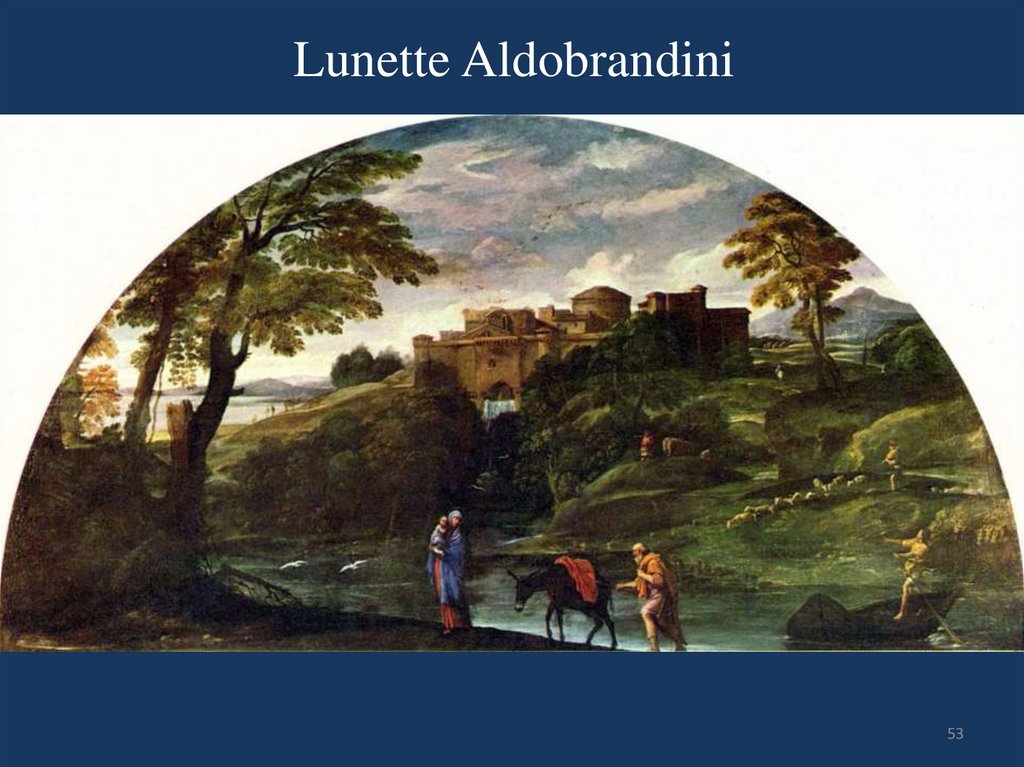
53. Lunette Aldobrandini
5354. Ludovico Carracci, Annunciation, Bologna, Pinacoteca Nazionale, 1584
5455. Ludovico Carracci, Annunciation, Bologna, Pinacoteca Nazionale, 1584
G. Mazzola Bedoli, Annunciation, Milano,Ambrosiana, 1540
Ludovico Carracci, Annunciation, Bologna,
Pinacoteca Nazionale, 1584
55
56. Ludovico Carracci, Flagellation, Douai, Museo della Certosa, 1584-90
5657. Ludovico Carracci, Flagellation, Douai, Museo della Certosa, 1584-90
Denis Calvaert,Flagellation, Bologna,
Pinacoteca Nazionale,
1575-80
Ludovico Carracci,
Flagellation, Douai, Museo
della Certosa, 1584-90
57
58. The Origins of the Carracci Family.
•The three Carracci did not come froman artistic background. Antonio, the
father of Annibale and Agostino was a
tailor, while Vincenzo, Ludovico's
father, was a butcher.
Annibale appears to have remained
conscious of his relatively humble roots,
which perhaps explain the notable
empathy in his genre pictures and the
gentle humor of his depictions of
Bolognese street vendors.
58
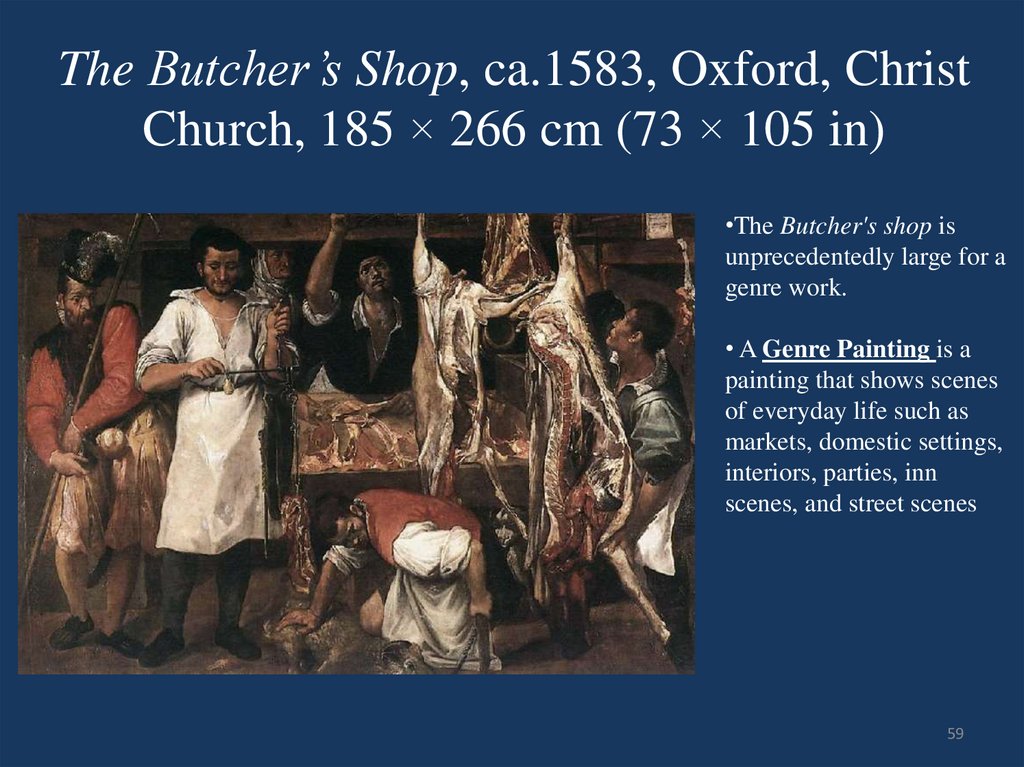
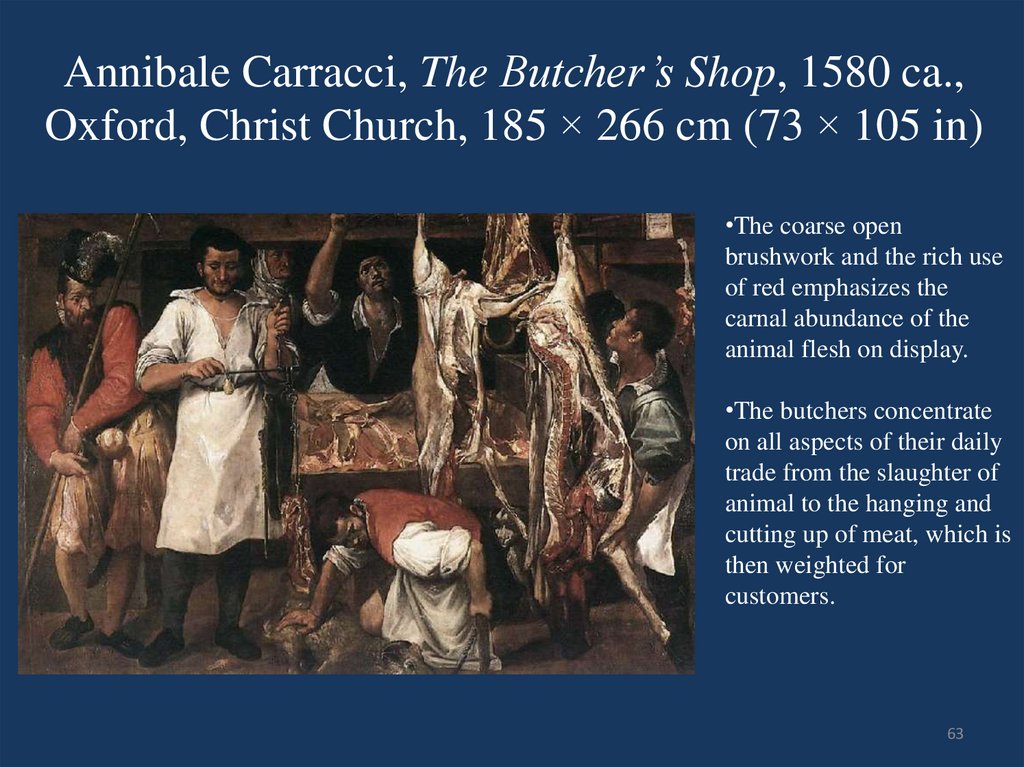
59. The Butcher’s Shop, ca.1583, Oxford, Christ Church, 185 × 266 cm (73 × 105 in)
The Butcher’s Shop, ca.1583, Oxford, ChristChurch, 185 × 266 cm (73 × 105 in)
•The Butcher's shop is
unprecedentedly large for a
genre work.
• A Genre Painting is a
painting that shows scenes
of everyday life such as
markets, domestic settings,
interiors, parties, inn
scenes, and street scenes
59
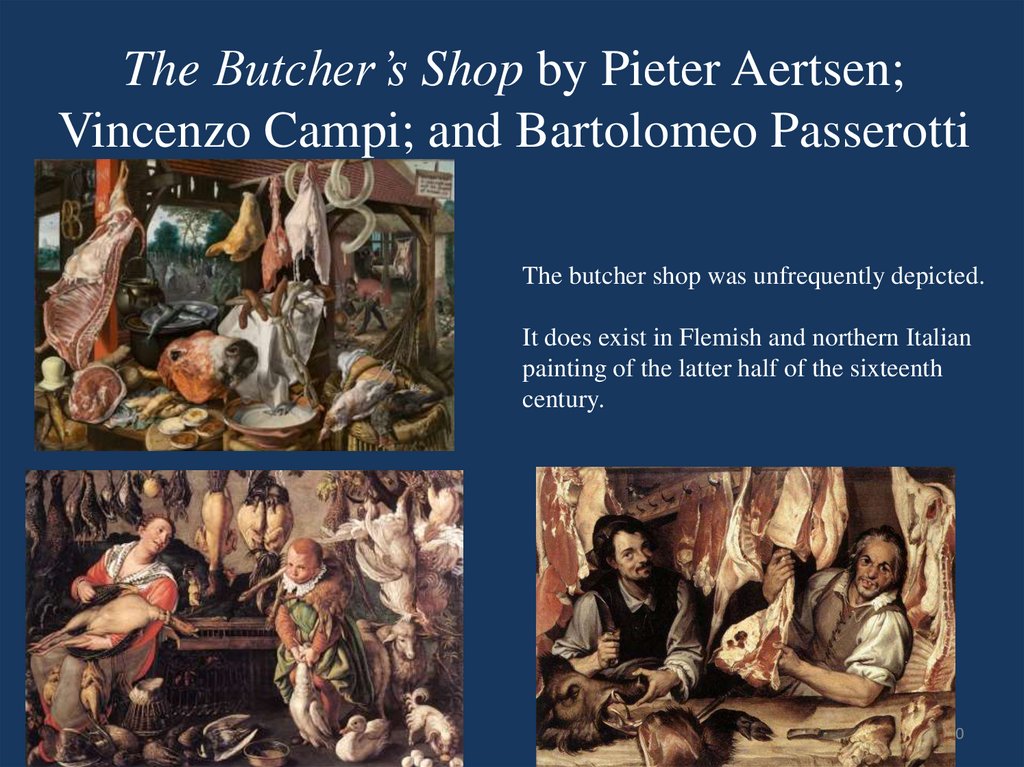
60. The Butcher’s Shop by Pieter Aertsen; Vincenzo Campi; and Bartolomeo Passerotti
The butcher shop was unfrequently depicted.It does exist in Flemish and northern Italian
painting of the latter half of the sixteenth
century.
60
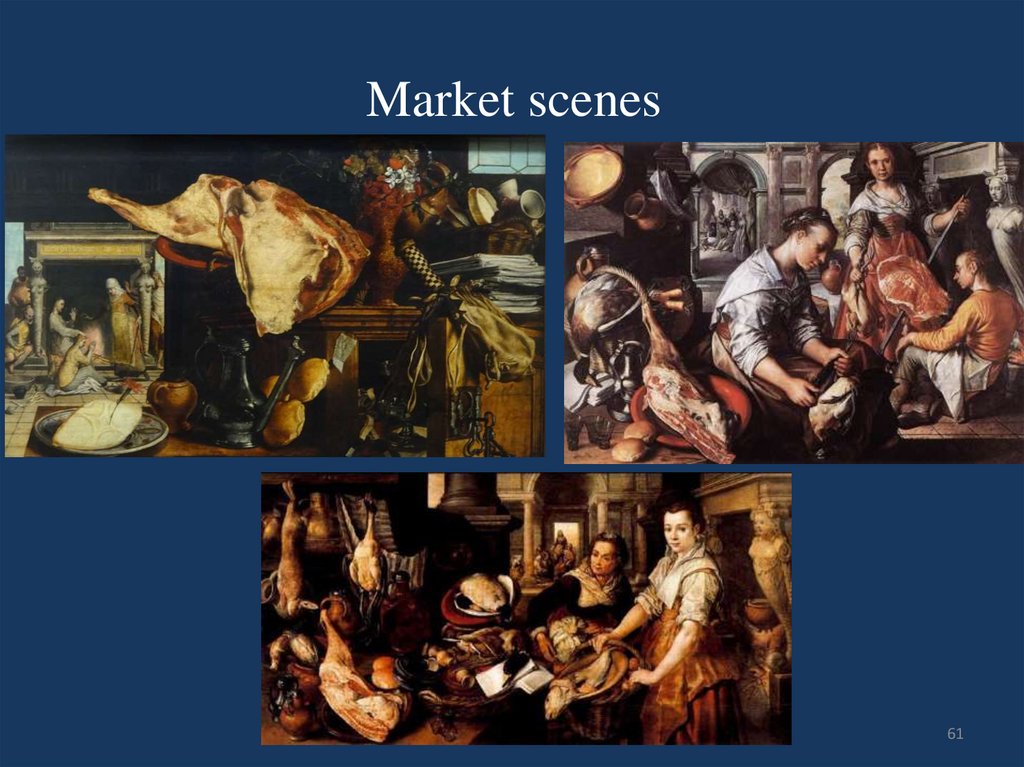
61. Market scenes
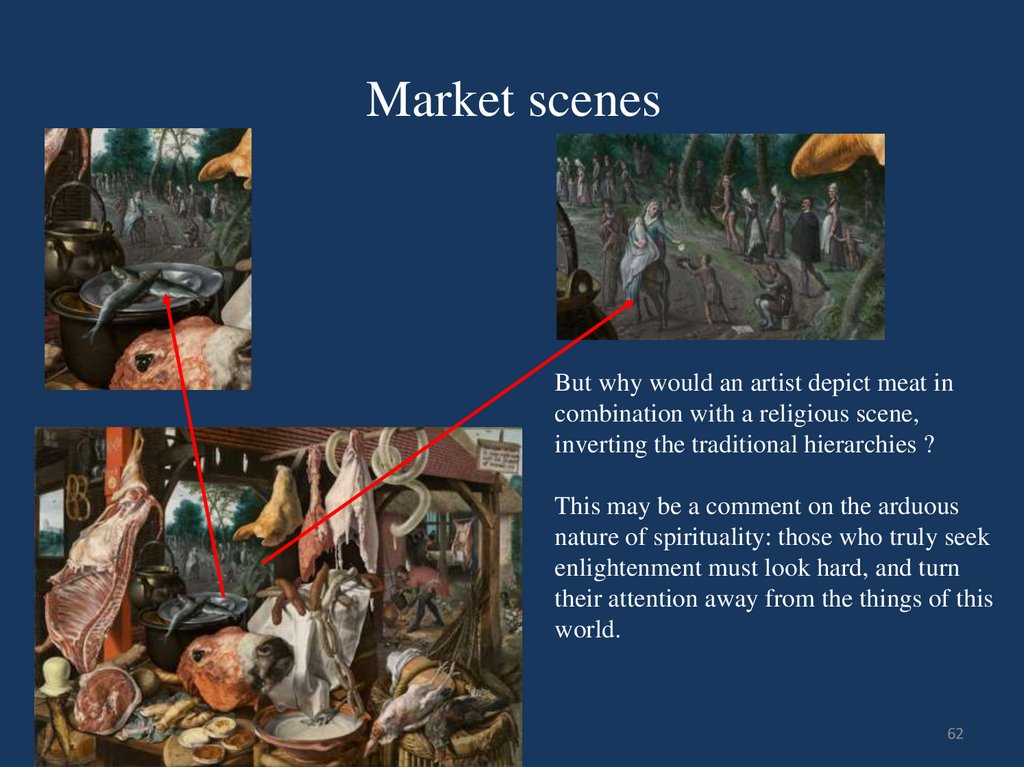
6162. Market scenes
But why would an artist depict meat incombination with a religious scene,
inverting the traditional hierarchies ?
This may be a comment on the arduous
nature of spirituality: those who truly seek
enlightenment must look hard, and turn
their attention away from the things of this
world.
62
63. Annibale Carracci, The Butcher’s Shop, 1580 ca., Oxford, Christ Church, 185 × 266 cm (73 × 105 in)
Annibale Carracci, The Butcher’s Shop, 1580 ca.,Oxford, Christ Church, 185 × 266 cm (73 × 105 in)
•The coarse open
brushwork and the rich use
of red emphasizes the
carnal abundance of the
animal flesh on display.
•The butchers concentrate
on all aspects of their daily
trade from the slaughter of
animal to the hanging and
cutting up of meat, which is
then weighted for
customers.
63
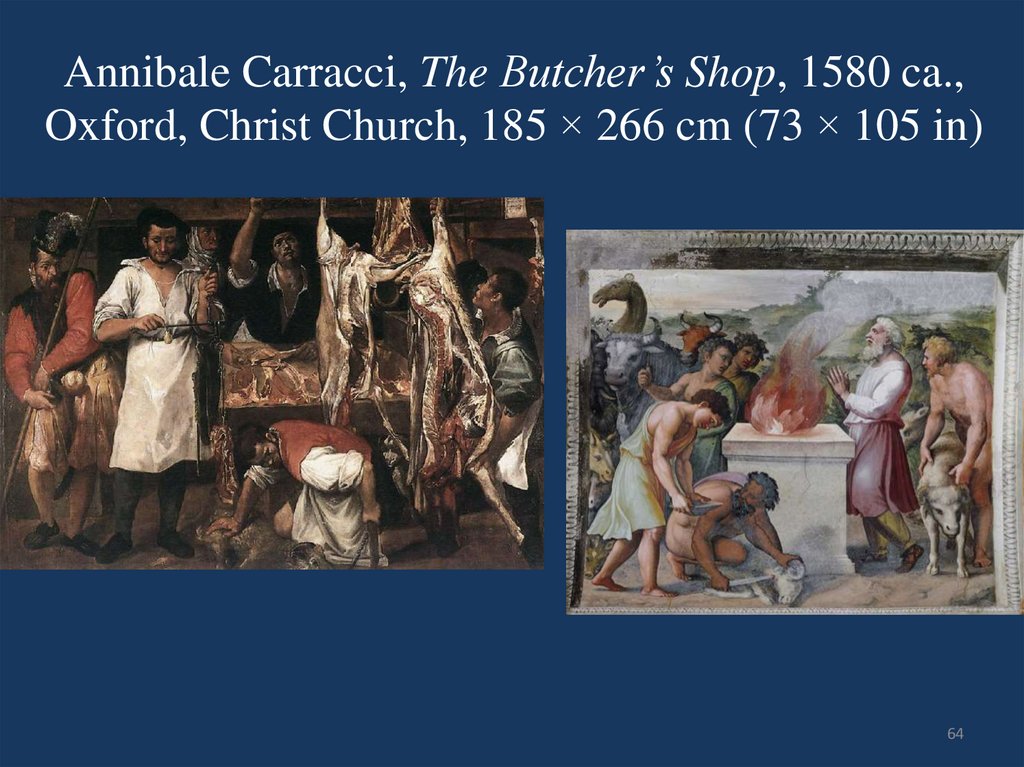
64. Annibale Carracci, The Butcher’s Shop, 1580 ca., Oxford, Christ Church, 185 × 266 cm (73 × 105 in)
Annibale Carracci, The Butcher’s Shop, 1580 ca.,Oxford, Christ Church, 185 × 266 cm (73 × 105 in)
64
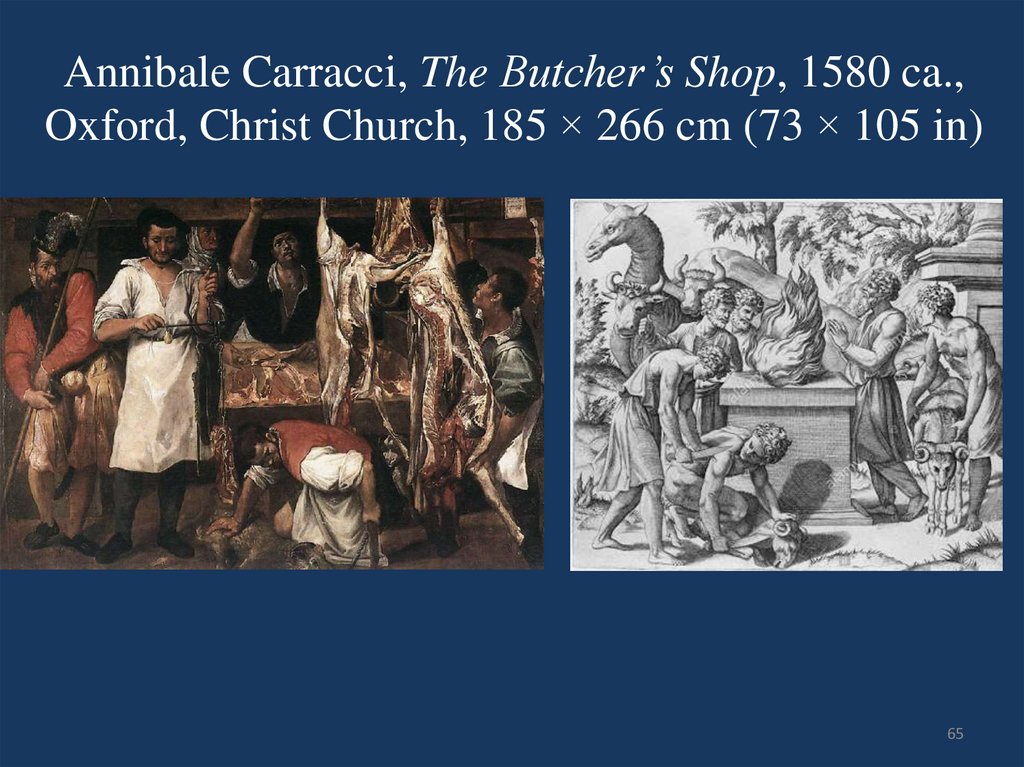
65. Annibale Carracci, The Butcher’s Shop, 1580 ca., Oxford, Christ Church, 185 × 266 cm (73 × 105 in)
Annibale Carracci, The Butcher’s Shop, 1580 ca.,Oxford, Christ Church, 185 × 266 cm (73 × 105 in)
65
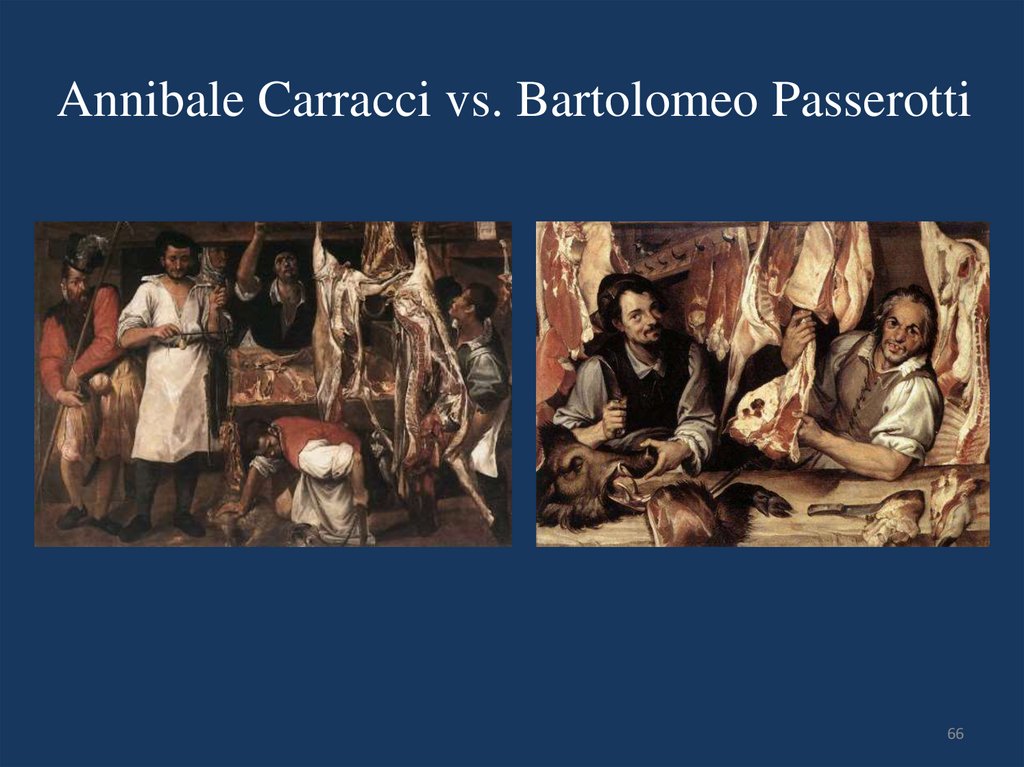
66. Annibale Carracci vs. Bartolomeo Passerotti
6667. Bartolomeo Passerotti
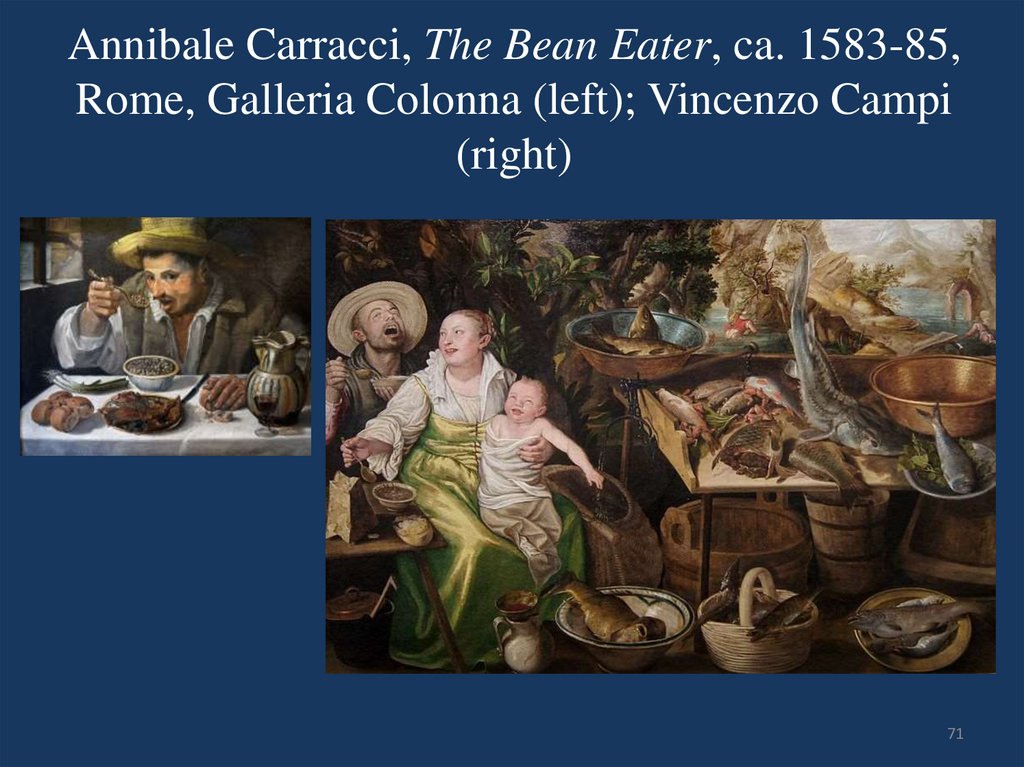
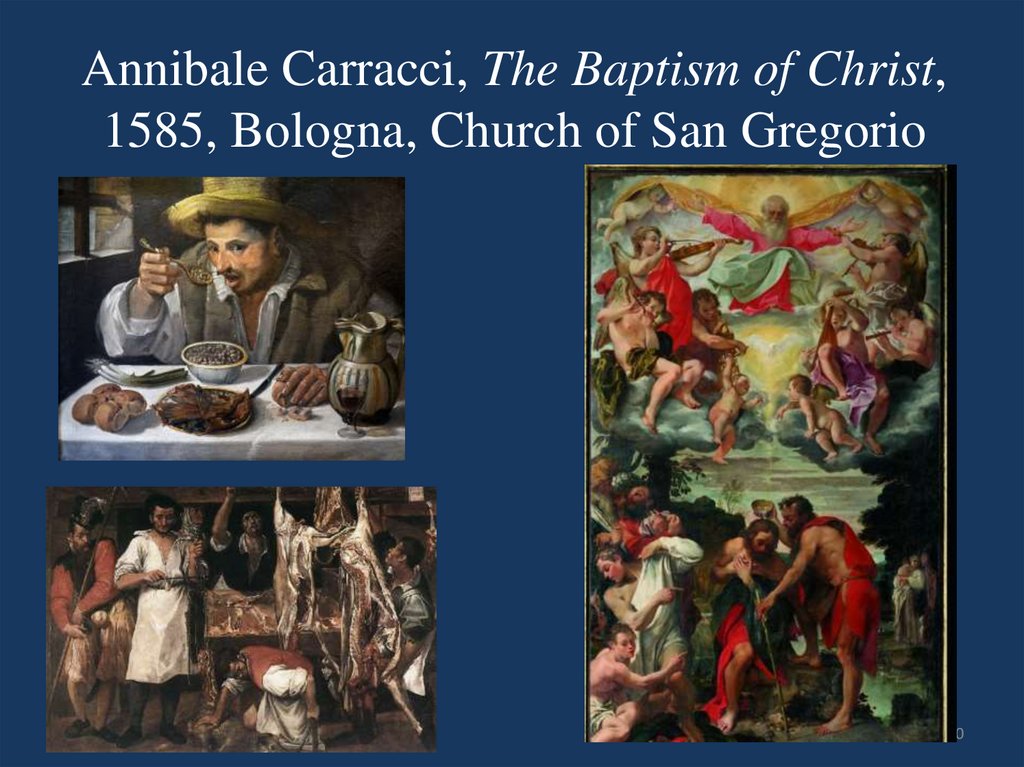
6768. Annibale Carracci, The Bean Eater, ca. 1583-85, Rome, Galleria Colonna
Annibale Carracci, The Bean Eater, ca. 158385, Rome, Galleria Colonna68
69. Bartolomeo Pisanelli, Trattato della natura de cibi et del bere (Venice1584)
https://books.google.it/books?id=s2PxZ2npeeIC&printsec=frontcover&dq=pisanelli+trattato+de
lla+natura&hl=it&sa=X&ved=2ahUKEwil4PO
A3qrtAhWE26QKHQKuAg4Q6AEwAHoECA
IQAg#v=onepage&q=pisanelli%20trattato%20
della%20natura&f=false
About the appropriate food to be given to
different level of people in society
69
70. Annibale Carracci, The Bean Eater, ca. 1583-85, Rome, Galleria Colonna
Annibale Carracci, The Bean Eater, ca. 158385, Rome, Galleria Colonna70
71. Annibale Carracci, The Bean Eater, ca. 1583-85, Rome, Galleria Colonna (left); Vincenzo Campi (right)
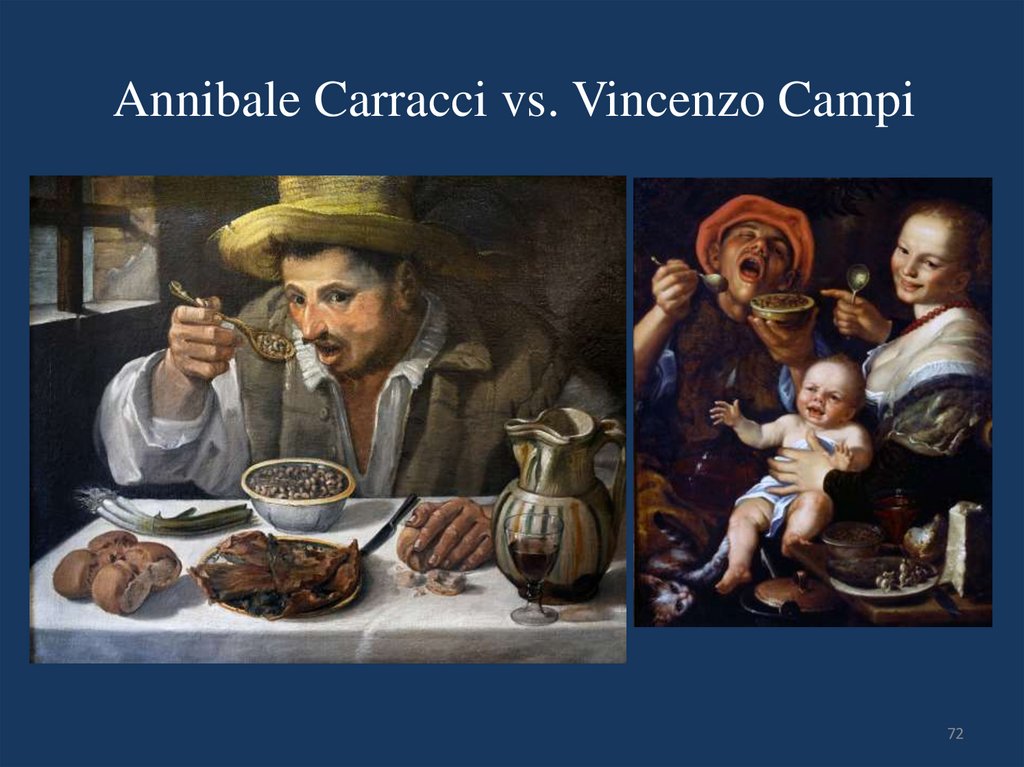
7172. Annibale Carracci vs. Vincenzo Campi
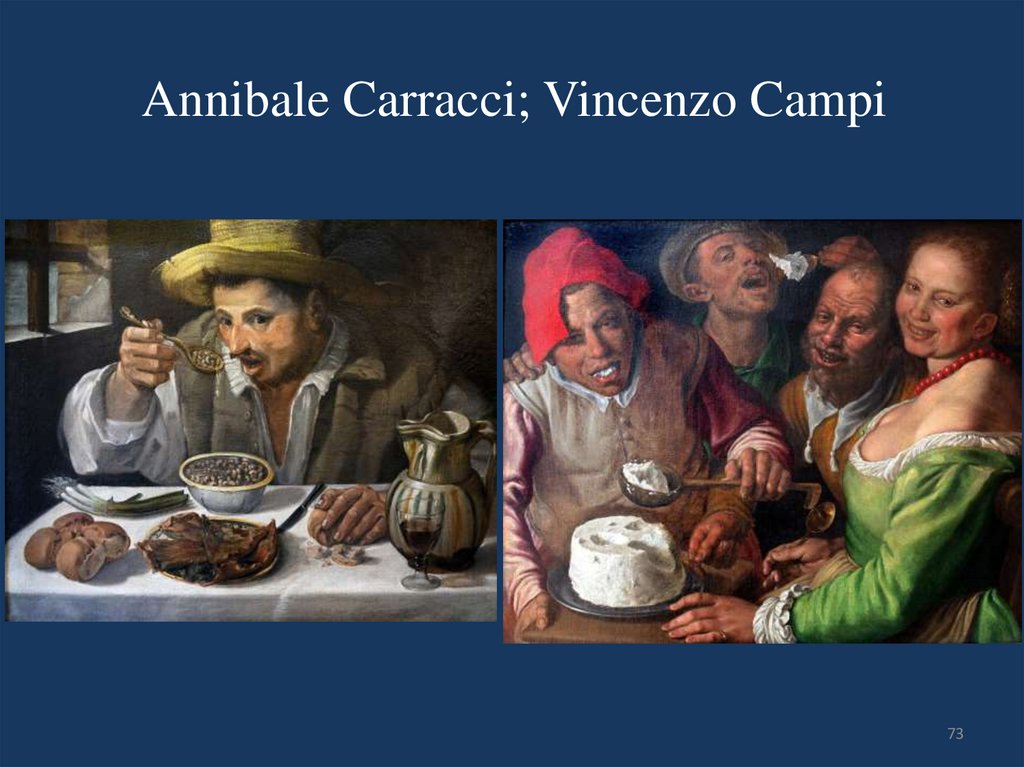
7273. Annibale Carracci; Vincenzo Campi
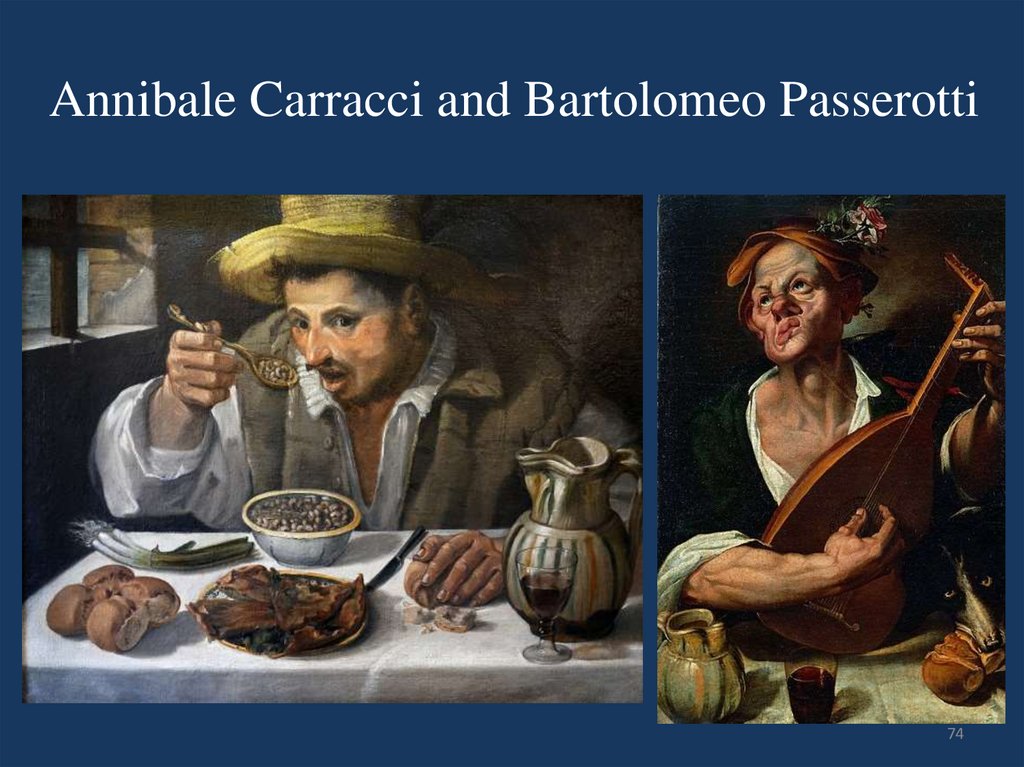
7374. Annibale Carracci and Bartolomeo Passerotti
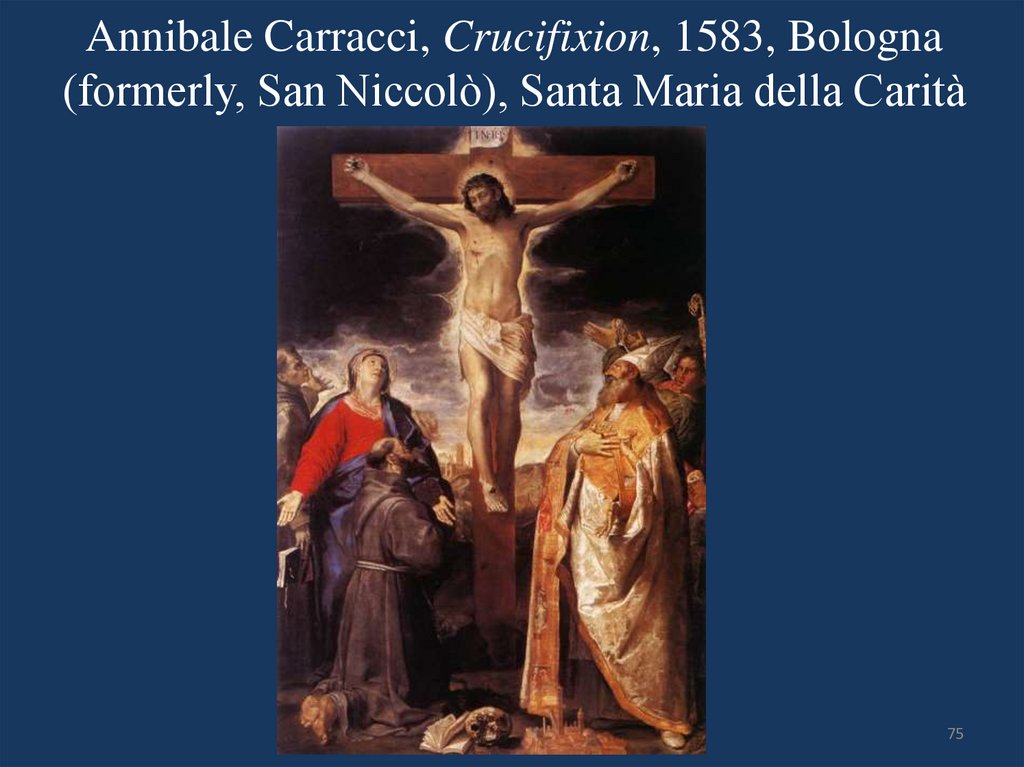
7475. Annibale Carracci, Crucifixion, 1583, Bologna (formerly, San Niccolò), Santa Maria della Carità
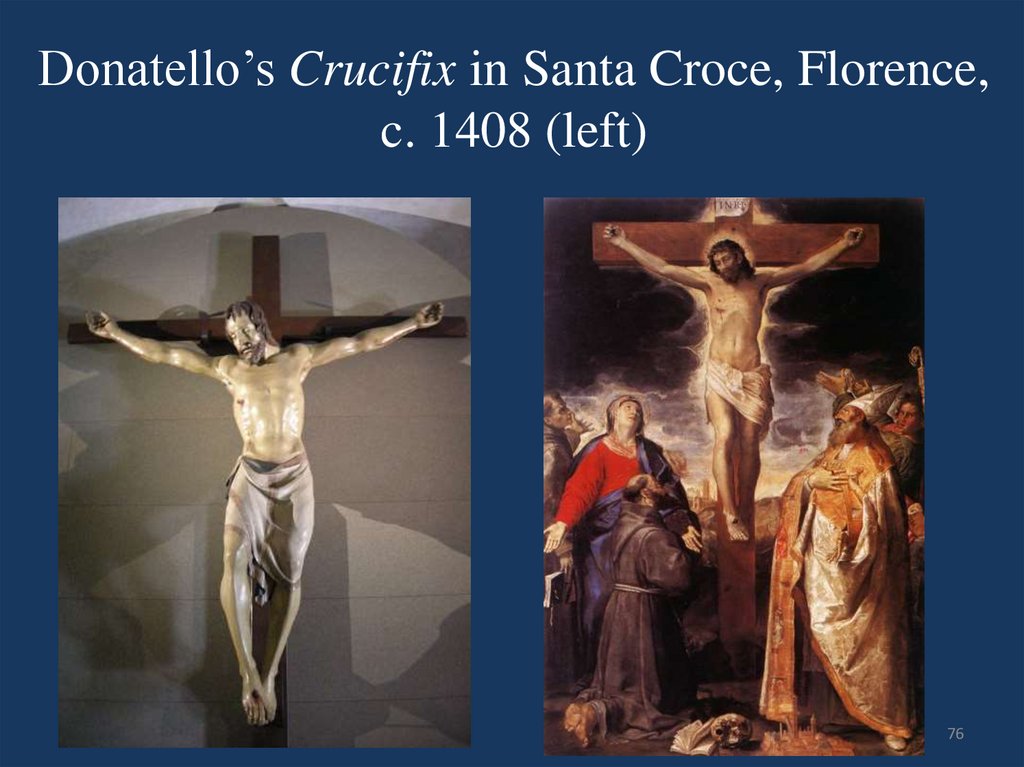
7576. Donatello’s Crucifix in Santa Croce, Florence, c. 1408 (left)
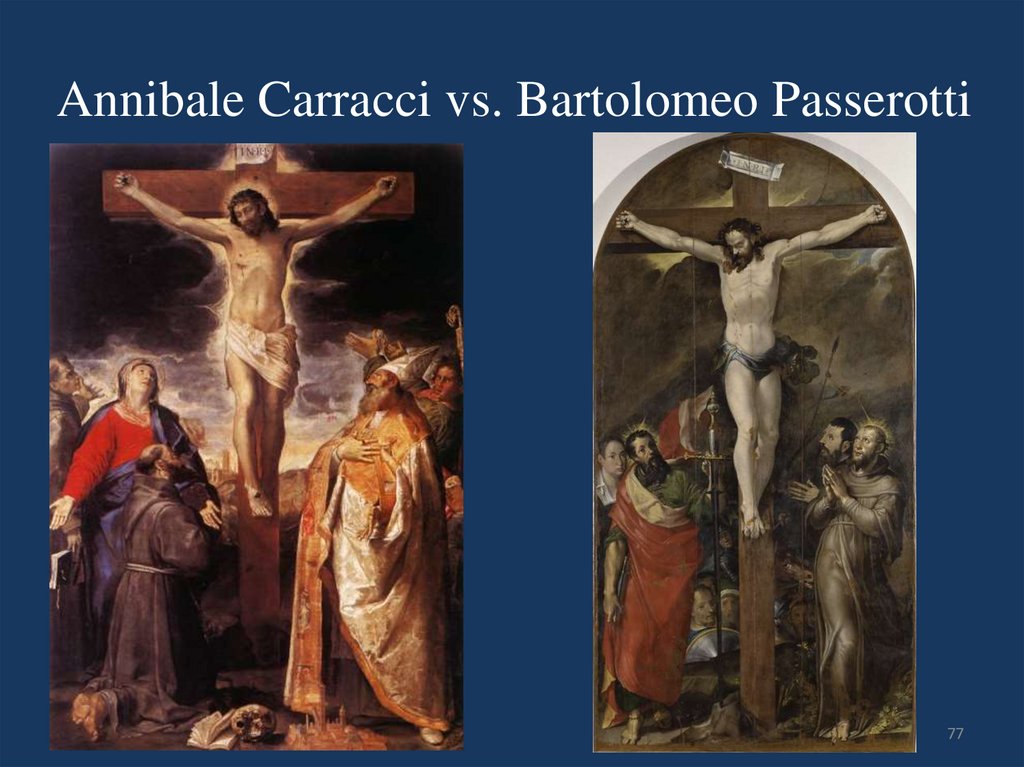
7677. Annibale Carracci vs. Bartolomeo Passerotti
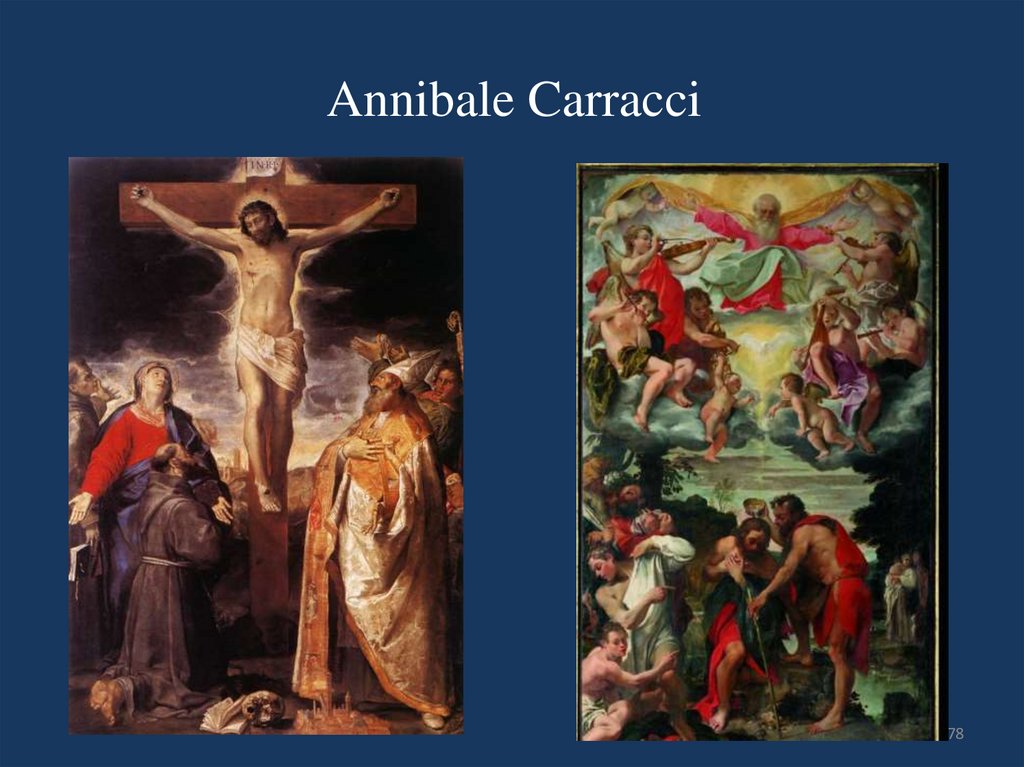
7778. Annibale Carracci
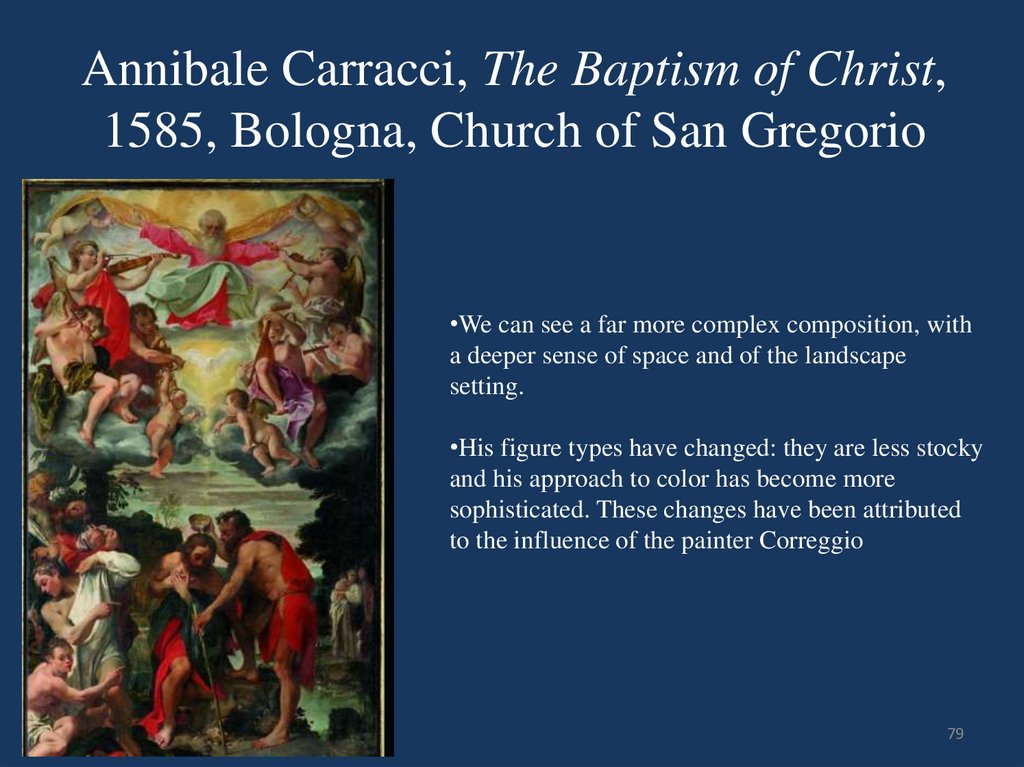
7879. Annibale Carracci, The Baptism of Christ, 1585, Bologna, Church of San Gregorio
•We can see a far more complex composition, witha deeper sense of space and of the landscape
setting.
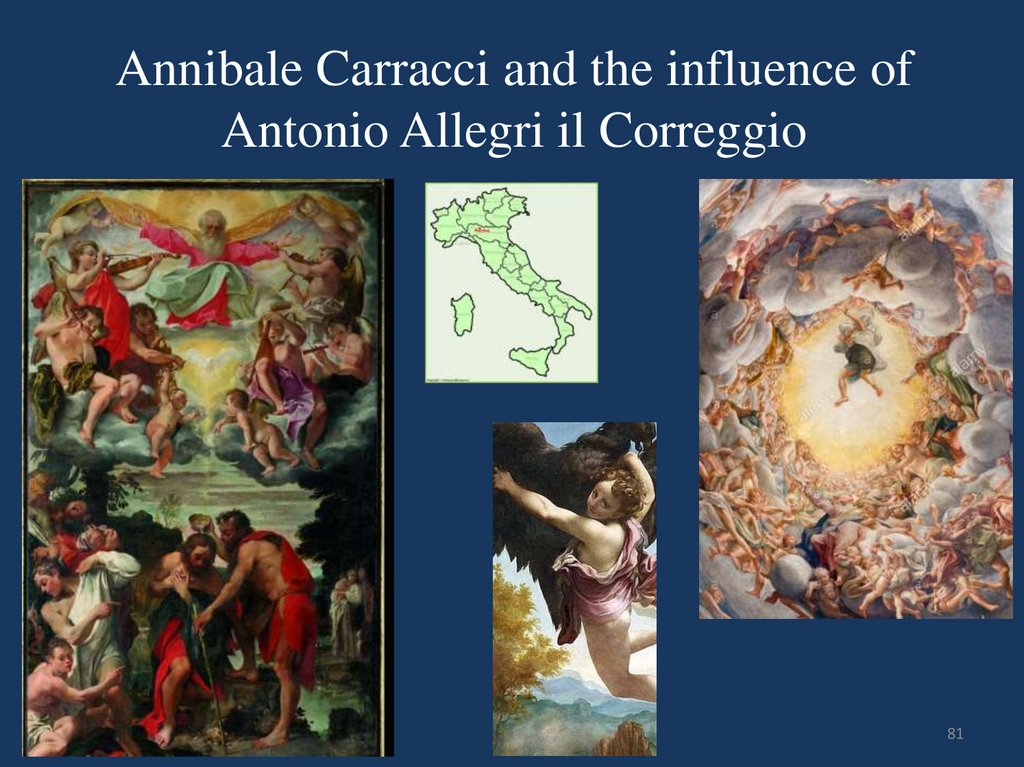
•His figure types have changed: they are less stocky
and his approach to color has become more
sophisticated. These changes have been attributed
to the influence of the painter Correggio
79
80. Annibale Carracci, The Baptism of Christ, 1585, Bologna, Church of San Gregorio
8081. Annibale Carracci and the influence of Antonio Allegri il Correggio
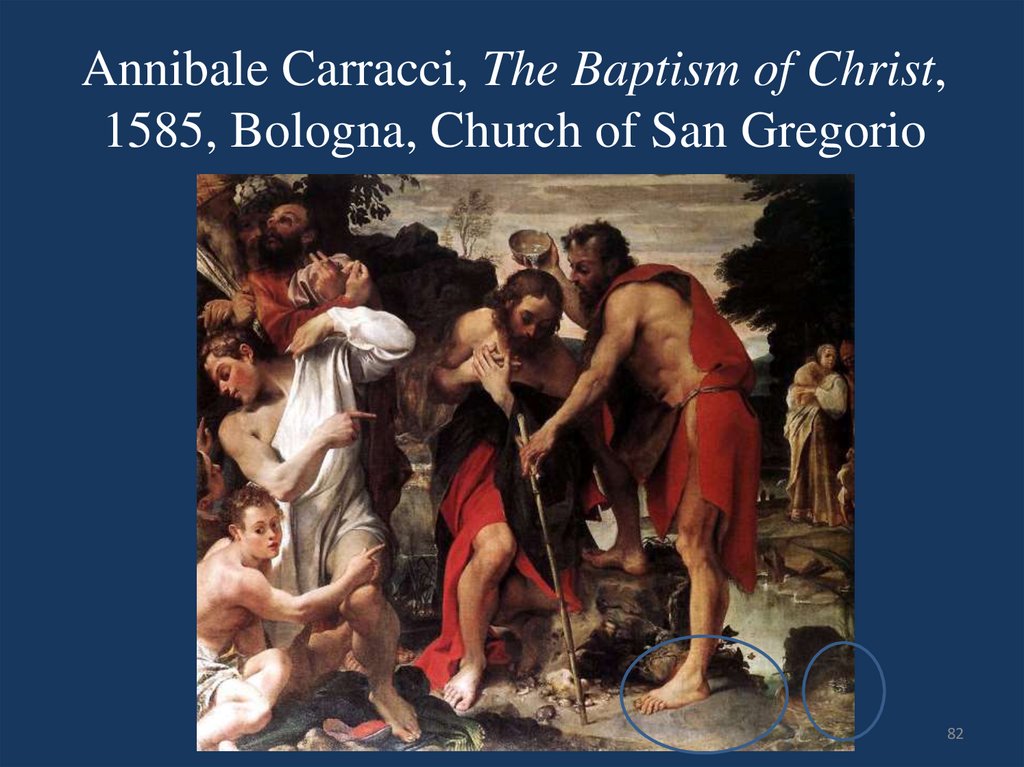
8182. Annibale Carracci, The Baptism of Christ, 1585, Bologna, Church of San Gregorio
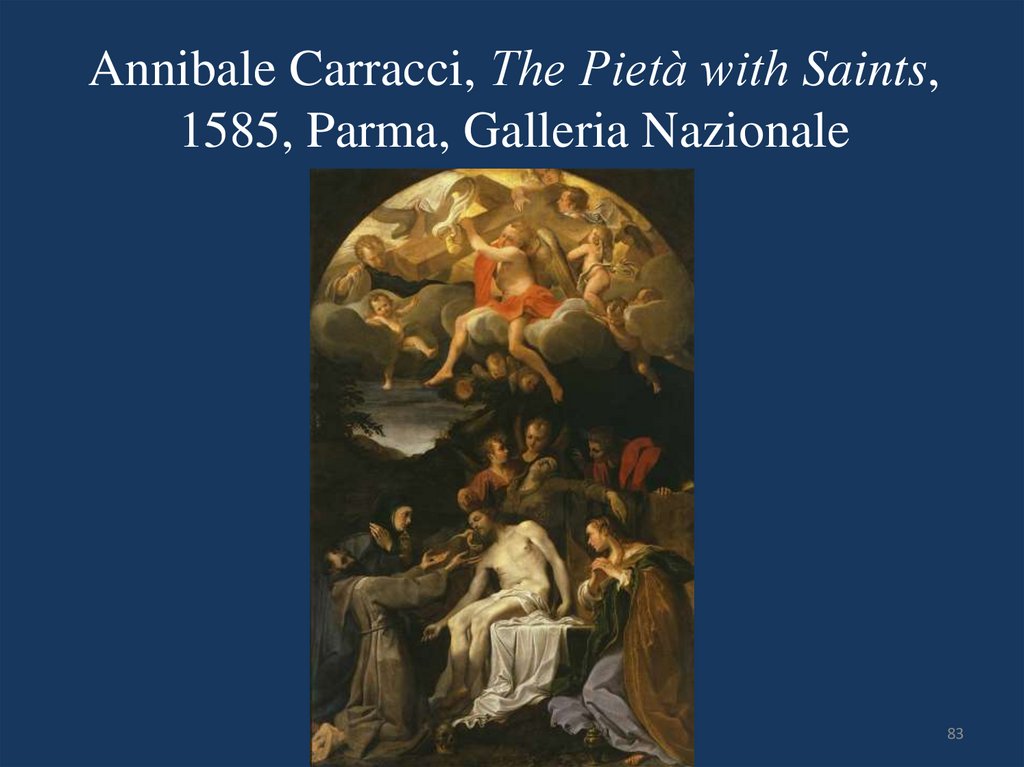
8283. Annibale Carracci, The Pietà with Saints, 1585, Parma, Galleria Nazionale
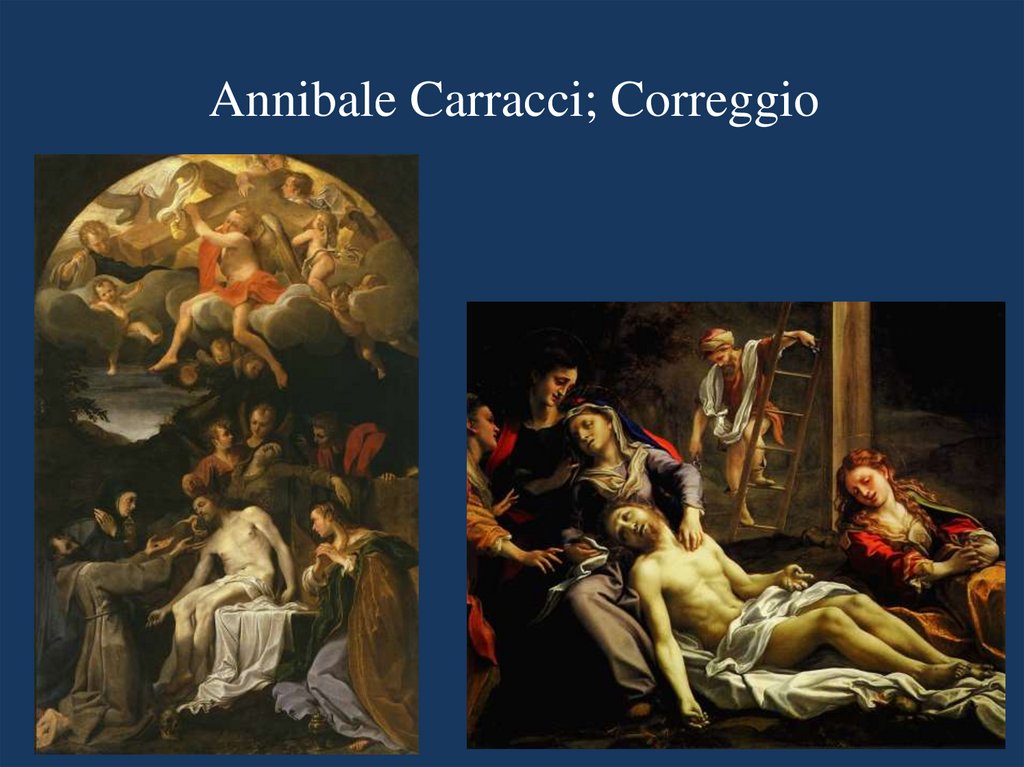
8384. Annibale Carracci; Correggio
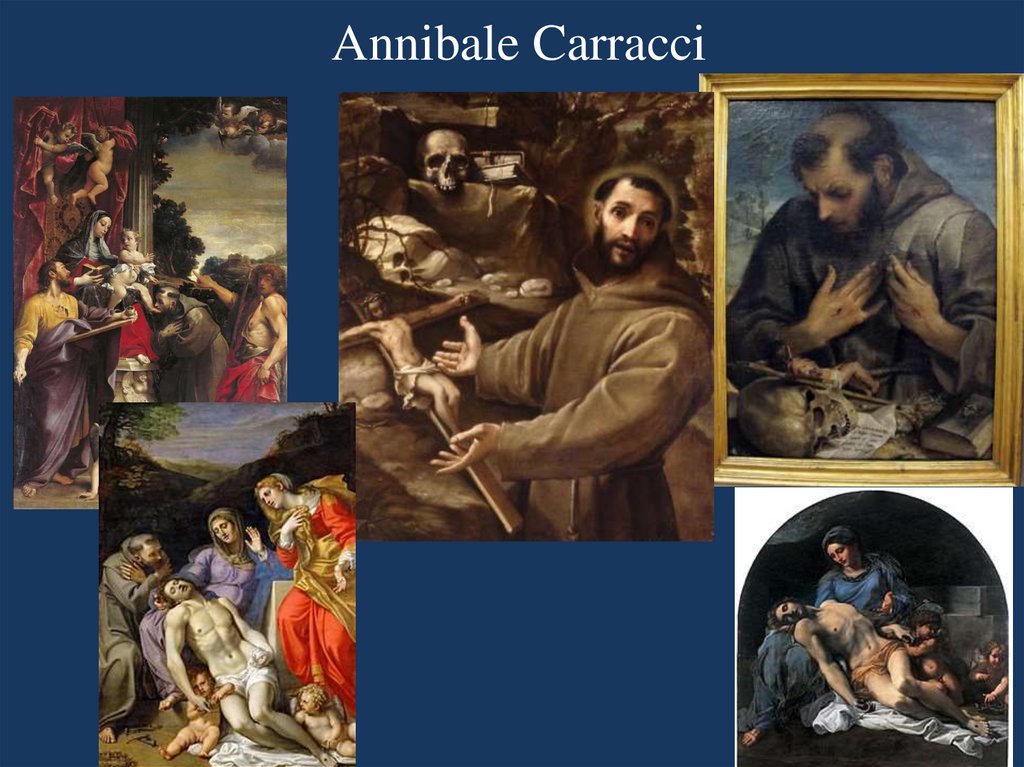
8485. Annibale Carracci
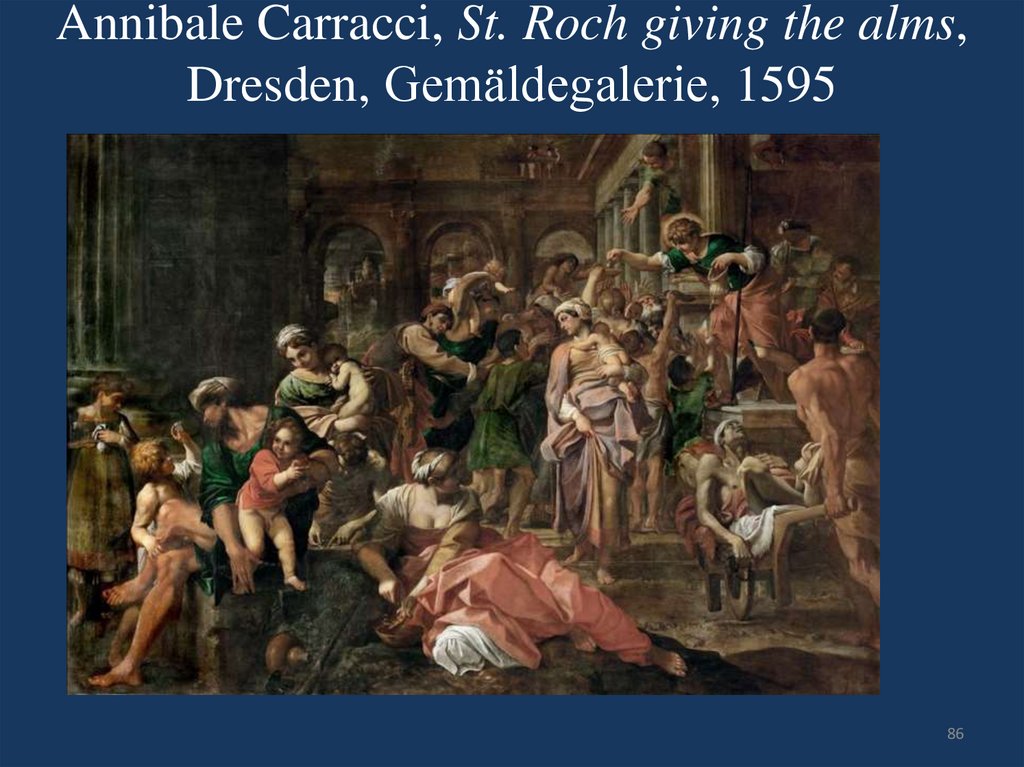
8586. Annibale Carracci, St. Roch giving the alms, Dresden, Gemäldegalerie, 1595
8687. Annibale Carracci
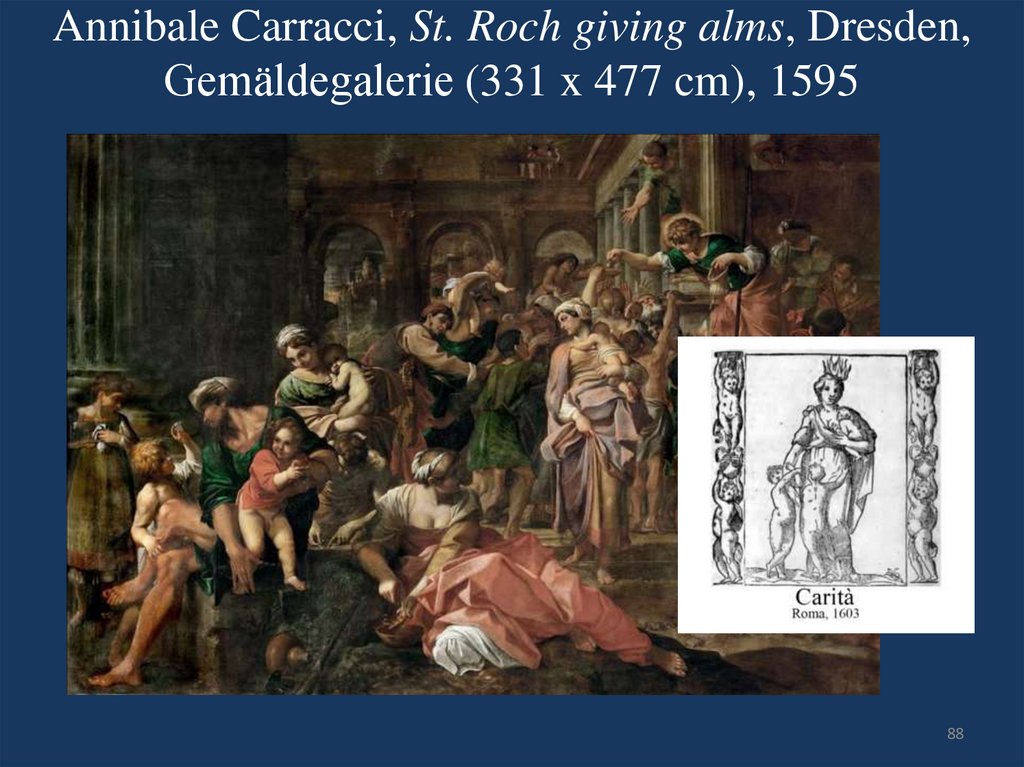
8788. Annibale Carracci, St. Roch giving alms, Dresden, Gemäldegalerie (331 x 477 cm), 1595
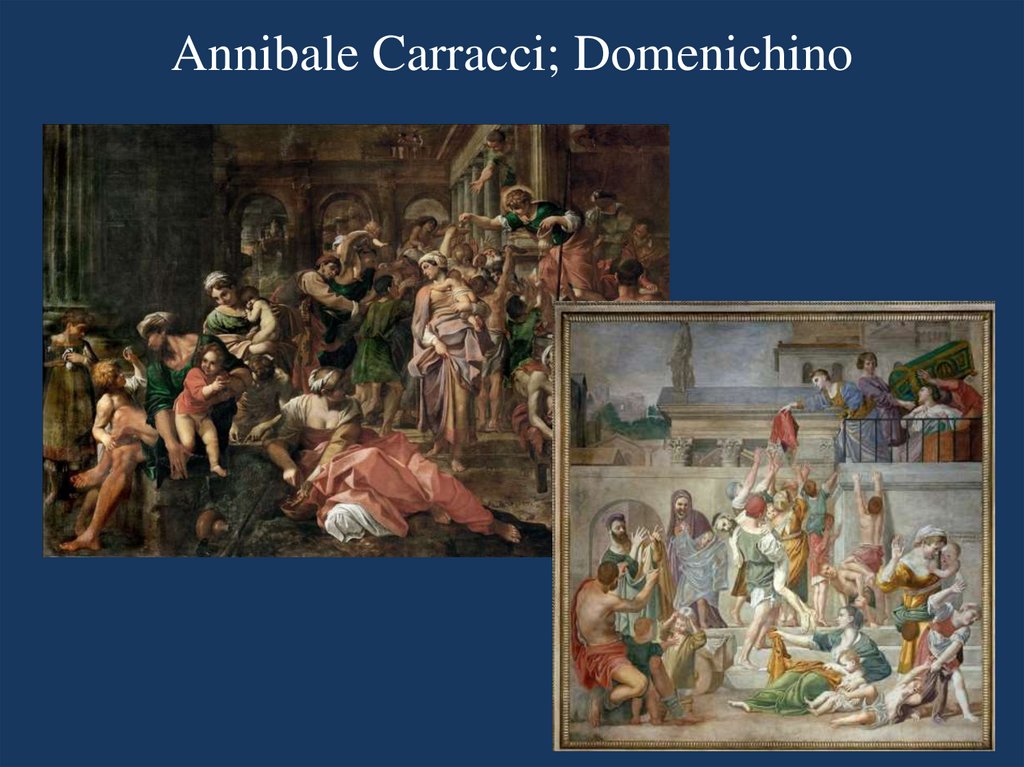
8889. Annibale Carracci; Domenichino
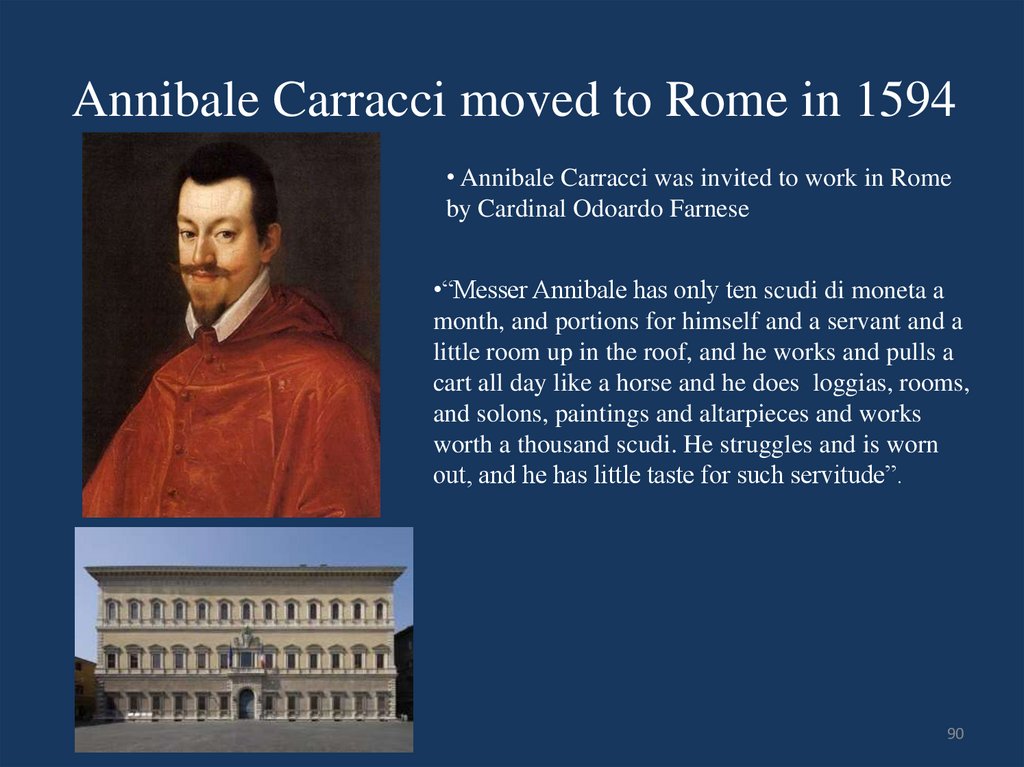
8990. Annibale Carracci moved to Rome in 1594
• Annibale Carracci was invited to work in Romeby Cardinal Odoardo Farnese
•“Messer Annibale has only ten scudi di moneta a
month, and portions for himself and a servant and a
little room up in the roof, and he works and pulls a
cart all day like a horse and he does loggias, rooms,
and solons, paintings and altarpieces and works
worth a thousand scudi. He struggles and is worn
out, and he has little taste for such servitude”.
90
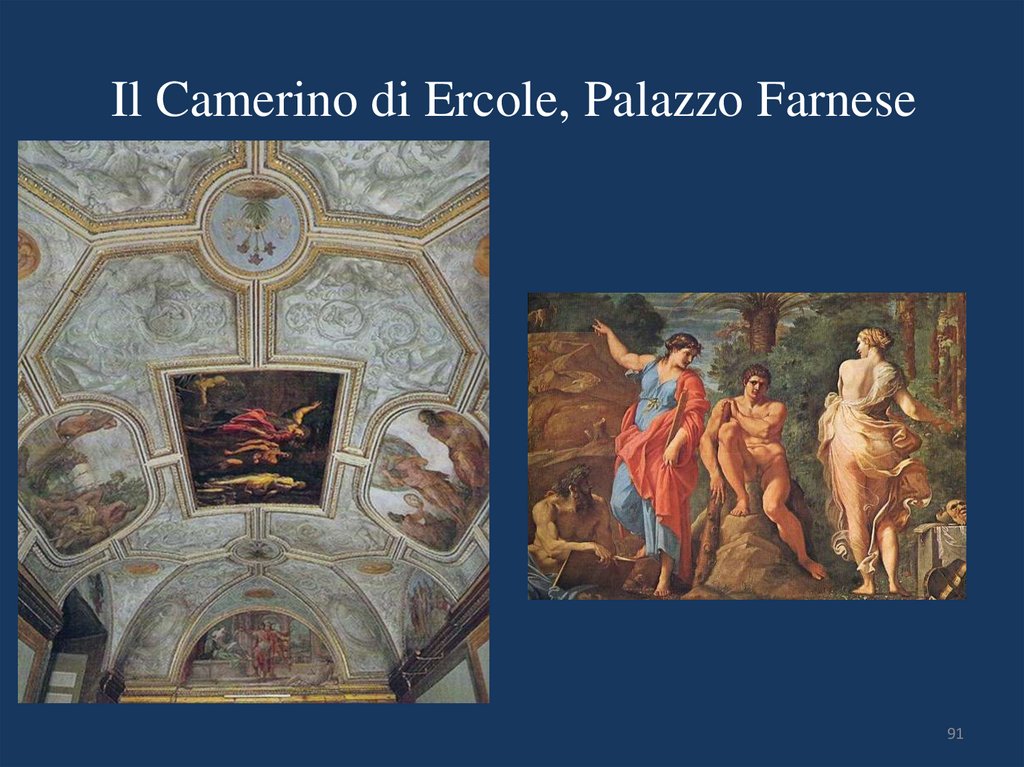
91. Il Camerino di Ercole, Palazzo Farnese
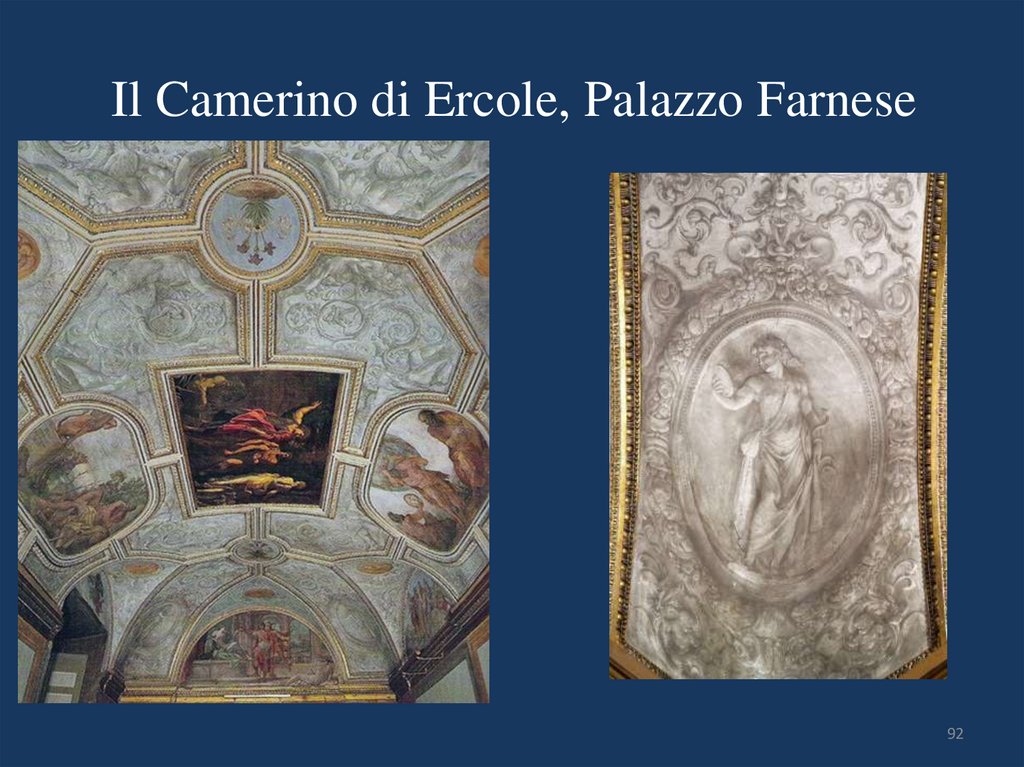
9192. Il Camerino di Ercole, Palazzo Farnese
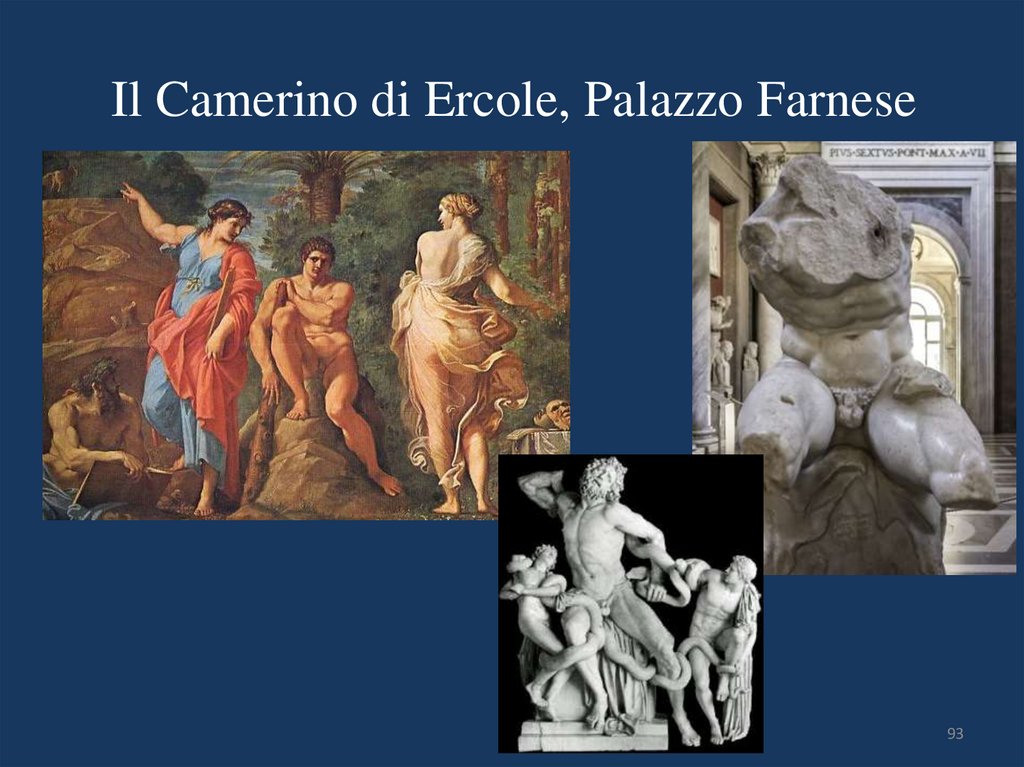
9293. Il Camerino di Ercole, Palazzo Farnese
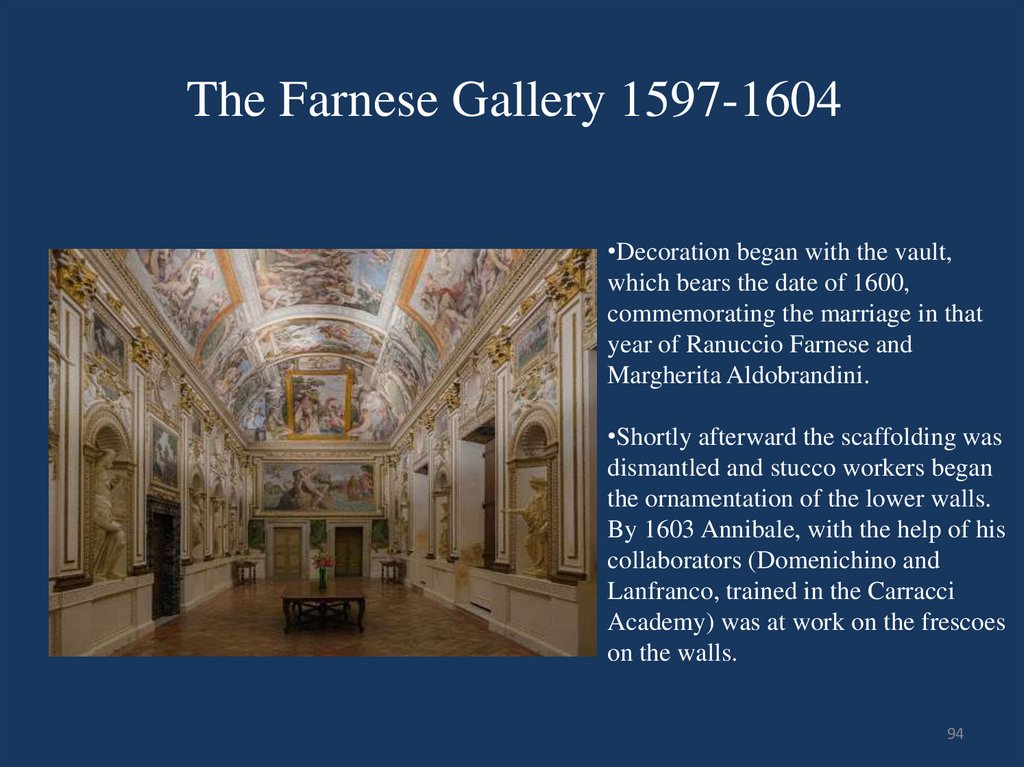
9394. The Farnese Gallery 1597-1604
•Decoration began with the vault,which bears the date of 1600,
commemorating the marriage in that
year of Ranuccio Farnese and
Margherita Aldobrandini.
•Shortly afterward the scaffolding was
dismantled and stucco workers began
the ornamentation of the lower walls.
By 1603 Annibale, with the help of his
collaborators (Domenichino and
Lanfranco, trained in the Carracci
Academy) was at work on the frescoes
on the walls.
94
95. The Farnese Gallery 1597-1604
•https://www.gettyimages.it/immagine/restoration-of-the-gallery-of-thepalacefarnese?mediatype=photography&phra
se=restoration%20of%20the%20galler
y%20of%20the%20palace%20farnese
&sort=mostpopular
95
96. The Farnese Gallery 1597-1604
•https://www.gettyimages.it/immagine/restoration-of-the-gallery-of-thepalacefarnese?mediatype=photography&phra
se=restoration%20of%20the%20galler
y%20of%20the%20palace%20farnese
&sort=mostpopular
96
97. The Galleria Farnese 1597-1604
9798. The Galleria Farnese 1597-1604
9899. The Galleria Farnese 1597-1604
99100. The Galleria Farnese 1597-1604
100101. The Sistine Chapel, 1508-12
101102. The Galleria Farnese 1597-1604
102103. The Galleria Farnese 1597-1604
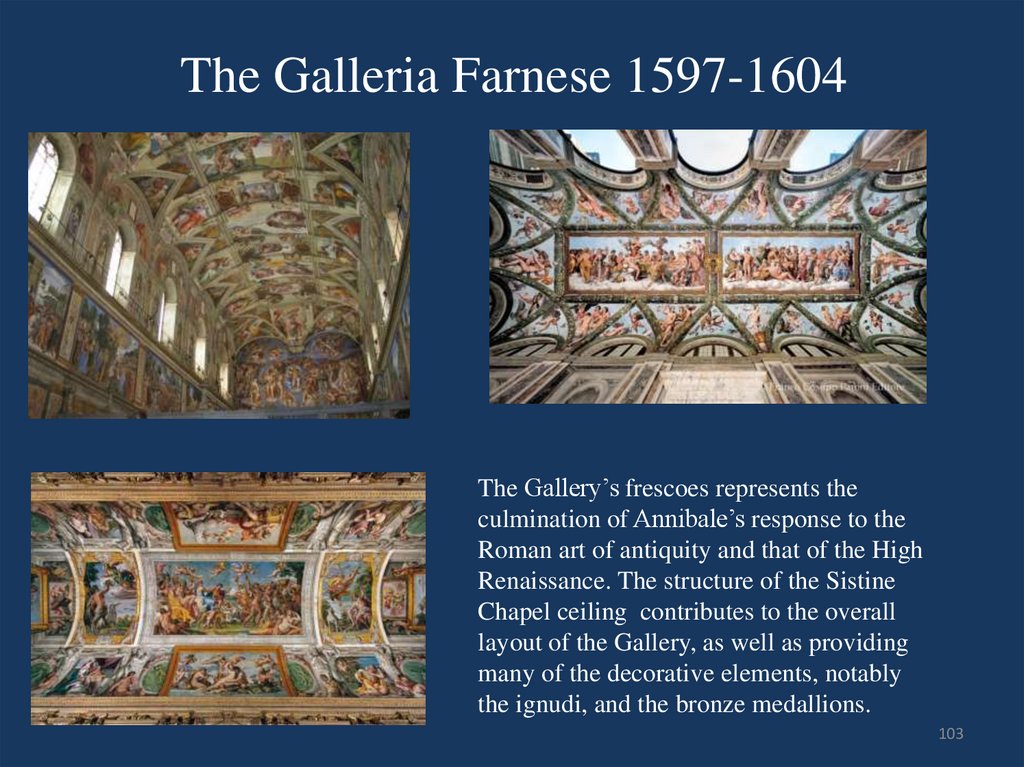
The Gallery’s frescoes represents theculmination of Annibale’s response to the
Roman art of antiquity and that of the High
Renaissance. The structure of the Sistine
Chapel ceiling contributes to the overall
layout of the Gallery, as well as providing
many of the decorative elements, notably
the ignudi, and the bronze medallions.
103
104. The Galleria Farnese 1597-1604
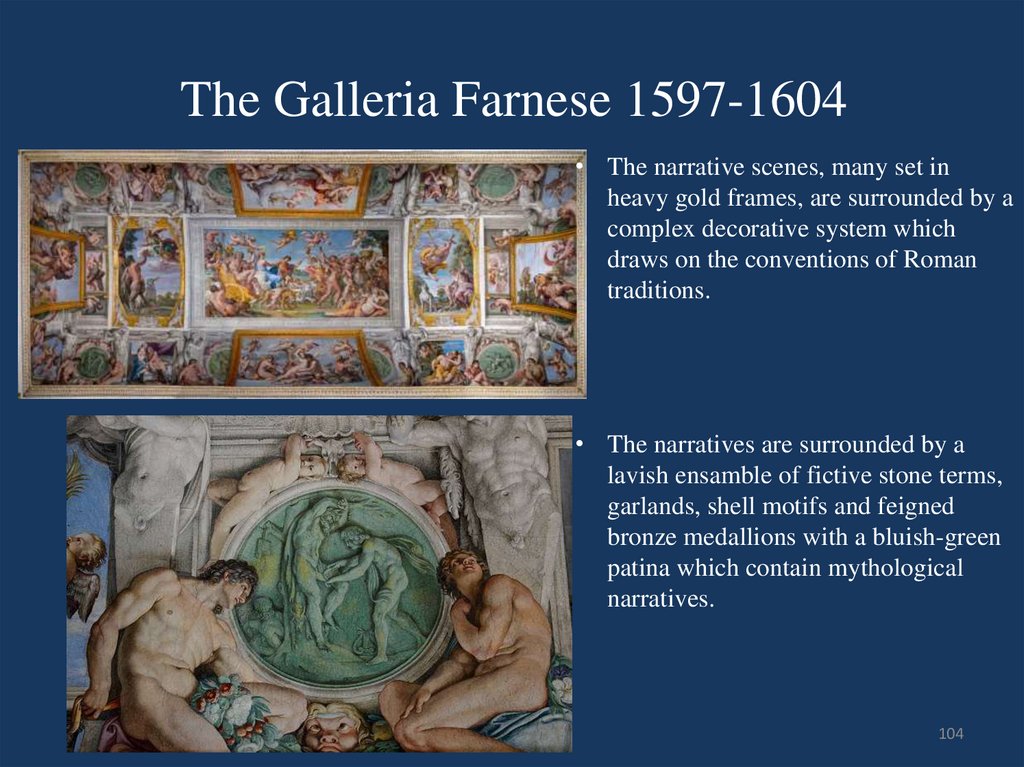
• The narrative scenes, many set inheavy gold frames, are surrounded by a
complex decorative system which
draws on the conventions of Roman
traditions.
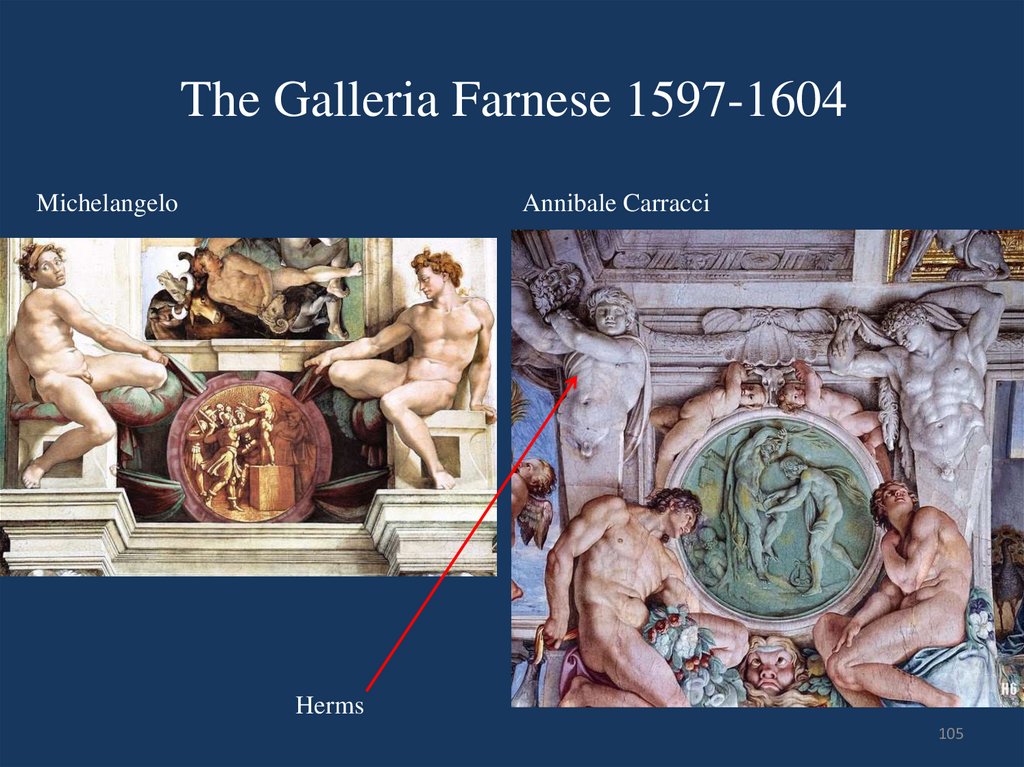
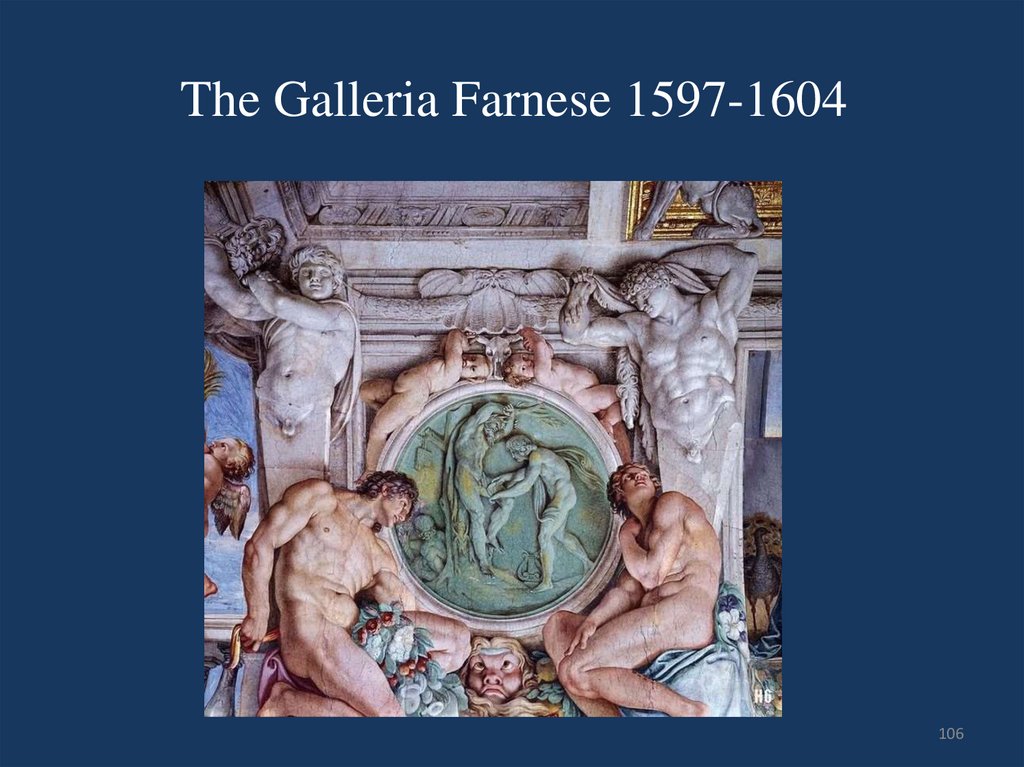
• The narratives are surrounded by a
lavish ensamble of fictive stone terms,
garlands, shell motifs and feigned
bronze medallions with a bluish-green
patina which contain mythological
narratives.
104
105. The Galleria Farnese 1597-1604
MichelangeloAnnibale Carracci
Herms
105
106. The Galleria Farnese 1597-1604
106107. The Galleria Farnese 1597-1604
107108. The Galleria Farnese 1597-1604
108109. Raphael, The Loggia of Cupid and Psyche, Rome, Villa Chigi, ante 1519
109110. Roman sarcophagus
110111. The Galleria Farnese, 1597-1604
111112. The Galleria Farnese 1597-1604
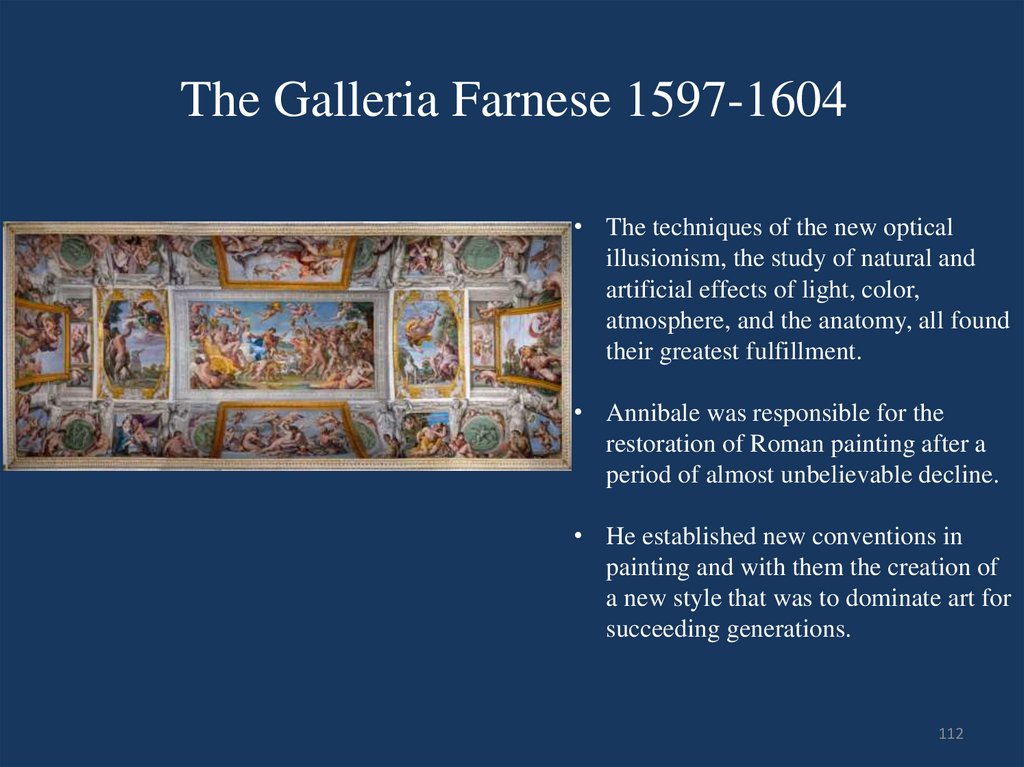
• The techniques of the new opticalillusionism, the study of natural and
artificial effects of light, color,
atmosphere, and the anatomy, all found
their greatest fulfillment.
• Annibale was responsible for the
restoration of Roman painting after a
period of almost unbelievable decline.
• He established new conventions in
painting and with them the creation of
a new style that was to dominate art for
succeeding generations.
112
113. The Galleria Farnese 1597-1604
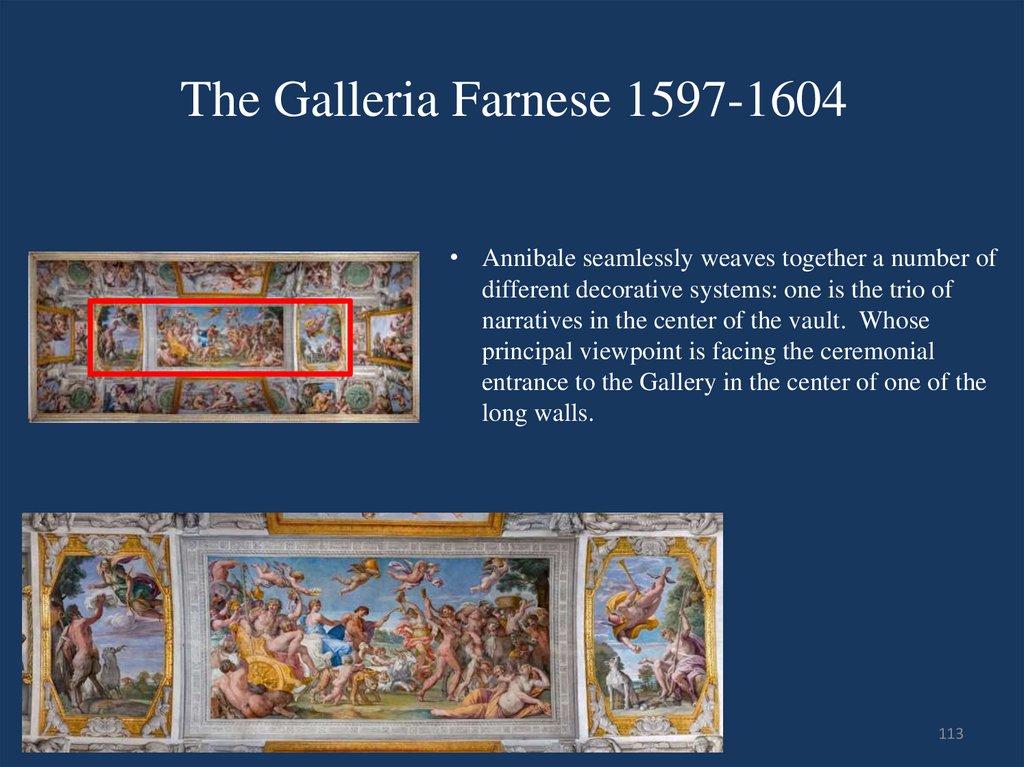
• Annibale seamlessly weaves together a number ofdifferent decorative systems: one is the trio of
narratives in the center of the vault. Whose
principal viewpoint is facing the ceremonial
entrance to the Gallery in the center of one of the
long walls.
113
114. The Galleria Farnese 1597-1604
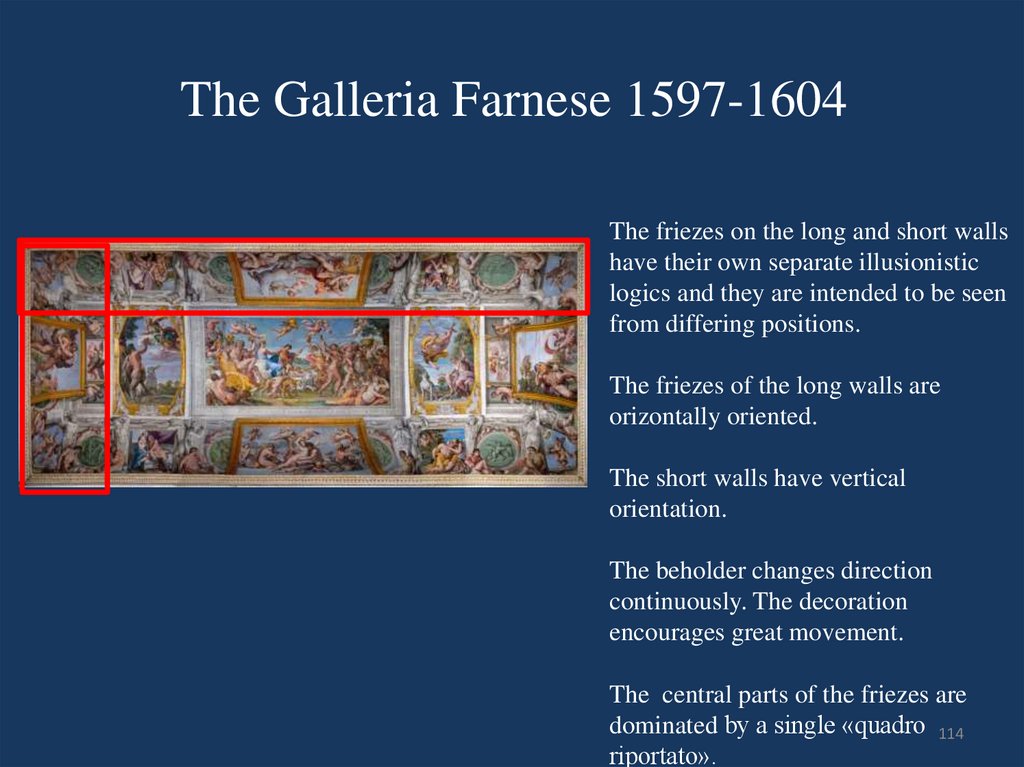
The friezes on the long and short wallshave their own separate illusionistic
logics and they are intended to be seen
from differing positions.
The friezes of the long walls are
orizontally oriented.
The short walls have vertical
orientation.
The beholder changes direction
continuously. The decoration
encourages great movement.
The central parts of the friezes are
dominated by a single «quadro 114
riportato».
115. The Galleria Farnese 1597-1604
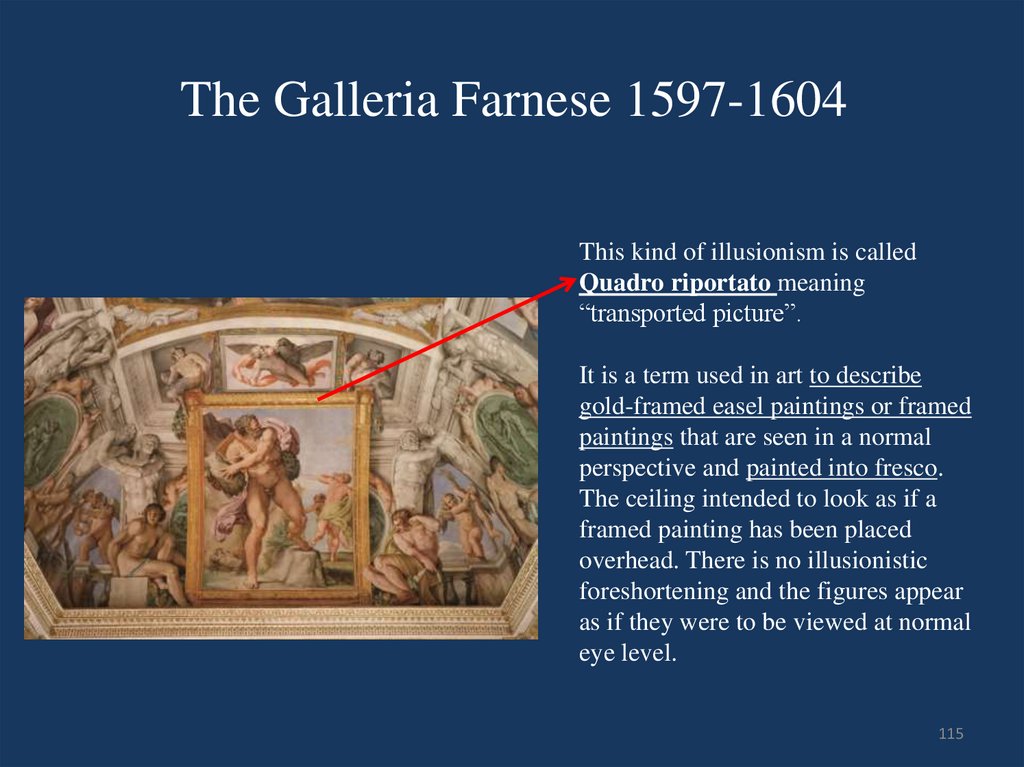
This kind of illusionism is calledQuadro riportato meaning
“transported picture”.
It is a term used in art to describe
gold-framed easel paintings or framed
paintings that are seen in a normal
perspective and painted into fresco.
The ceiling intended to look as if a
framed painting has been placed
overhead. There is no illusionistic
foreshortening and the figures appear
as if they were to be viewed at normal
eye level.
115
116. The Galleria Farnese 1597-1604
This kind of illusionism is called Quadroriportato meaning “transported picture”.
By an ingenious sleight-of-hand Annibale
joints the two frieze systems through the
device of herms embracing across space
which opens out to the sky beyond a
balustrade on which pairs of putti
struggle with each others
116
117. The Galleria Farnese 1597-1604
By an ingenious sleight-of-hand Annibalejoints the two frieze systems through the
device of herms embracing across space
which opens out to the sky beyond a
balustrade on which pairs of putti
struggle with each others
117
118. The Galleria Farnese 1597-1604
This kind of illusionism is calledQuadro riportato meaning
“transported picture”.
118
119. The Galleria Farnese 1597-1604
This kind of illusionism is calledQuadro riportato meaning
“transported picture”.
119
120. The Galleria Farnese 1597-1604
Annibale’s illusionism is achievedby convincingly combining
multiple levels of reality.
Unlike Late Mannerism, Annibale
does not draw attention to the
paradoxes of his illusionism.
His deception of the eyes is entirely
believable as well as delightful.
The mood is light with a lot of
visual jokes
120
121. The Galleria Farnese 1597-1604
The mood is light with a lot of visual jokes: stone herms with broken limbs; some areengaged in conversations. The masks are caricatures and they respond to the events
represented with expression of joy or disbelief.
121
122. Annibale Carracci and Guido Reni
•Annibale’s Galleria opened up a newchapter in the history of Italian ceiling
decoration.
•It can be seen as the last truly
Renaissance masterpiece for it openly
emulated literary and visual models from
antiquity while transforming them with
the artist’s passionate study of real life
and the finest art of preceding century.
•It has also been called the first Baroque
ceiling decoration: no one in fact
undertook such commissions after 1600
without studying Annibale’s fresco
carefully. And this is the case with Guido
Reni’s fresco of the Aurora in the Casino
Pallavicini in Rome
122