 biography
 art
artSimilar presentations:



Raffaello Sanzio da Urbino
1. Raffaello Sanzio da Urbino
RAFFAELLOSANZIO DA
URBINO
Performed by Makarova
Anastasia
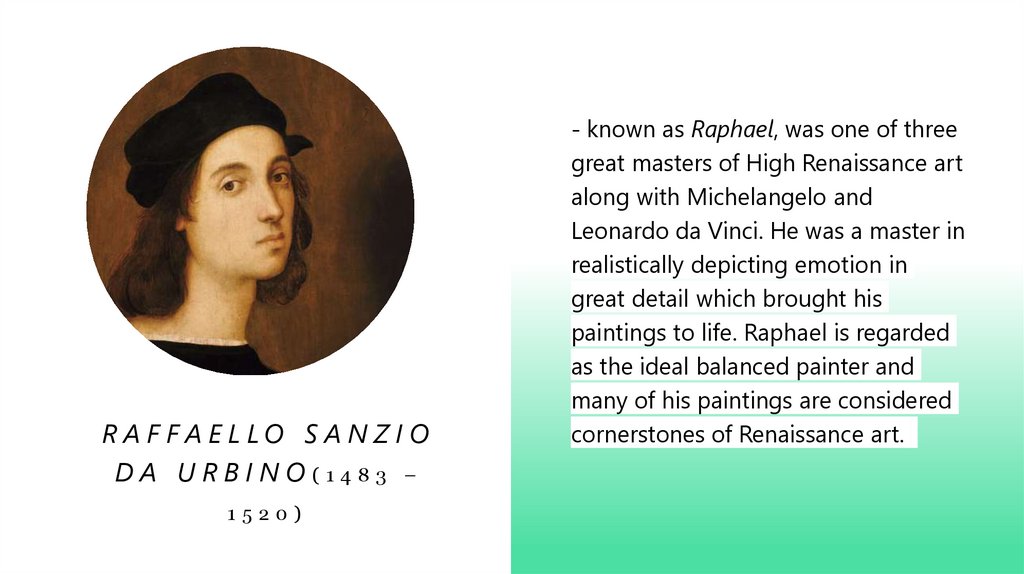
2. Raffaello Sanzio da Urbino(1483 – 1520)
R A F FA E L LO S A N Z I ODA URBINO(1483 –
1520)
- known as Raphael, was one of three
great masters of High Renaissance art
along with Michelangelo and
Leonardo da Vinci. He was a master in
realistically depicting emotion in
great detail which brought his
paintings to life. Raphael is regarded
as the ideal balanced painter and
many of his paintings are considered
cornerstones of Renaissance art.
3.
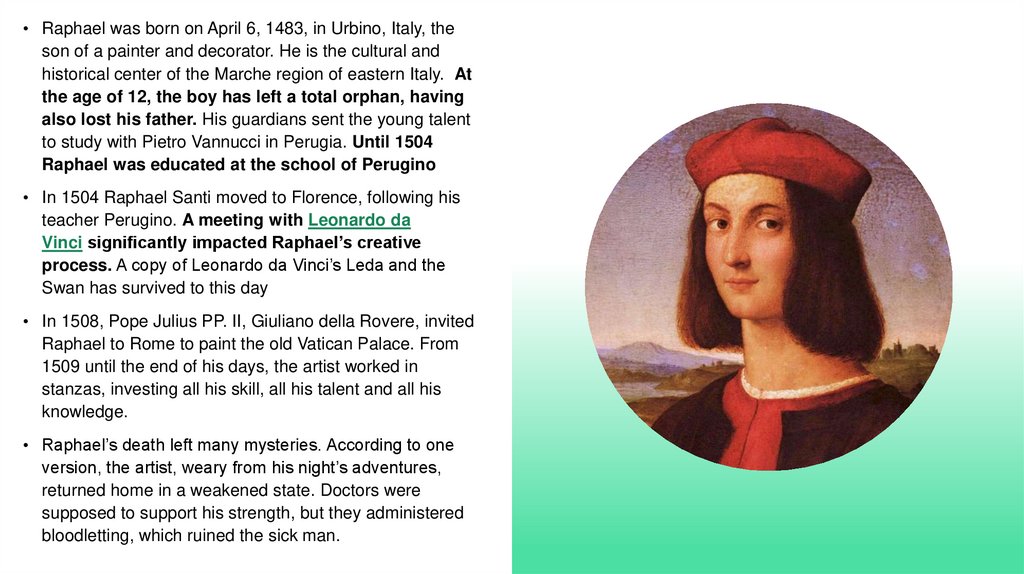
• Raphael was born on April 6, 1483, in Urbino, Italy, theson of a painter and decorator. He is the cultural and
historical center of the Marche region of eastern Italy. At
the age of 12, the boy has left a total orphan, having
also lost his father. His guardians sent the young talent
to study with Pietro Vannucci in Perugia. Until 1504
Raphael was educated at the school of Perugino
• In 1504 Raphael Santi moved to Florence, following his
teacher Perugino. A meeting with Leonardo da
Vinci significantly impacted Raphael’s creative
process. A copy of Leonardo da Vinci’s Leda and the
Swan has survived to this day
• In 1508, Pope Julius PP. II, Giuliano della Rovere, invited
Raphael to Rome to paint the old Vatican Palace. From
1509 until the end of his days, the artist worked in
stanzas, investing all his skill, all his talent and all his
knowledge.
• Raphael’s death left many mysteries. According to one
version, the artist, weary from his night’s adventures,
returned home in a weakened state. Doctors were
supposed to support his strength, but they administered
bloodletting, which ruined the sick man.
4. The Sistine Madonna(1512). Raphael's emotional masterpiece.
THE SISTINE MADONNA(1512).RAPHAEL'S EMOTIONAL
MASTERPIECE.
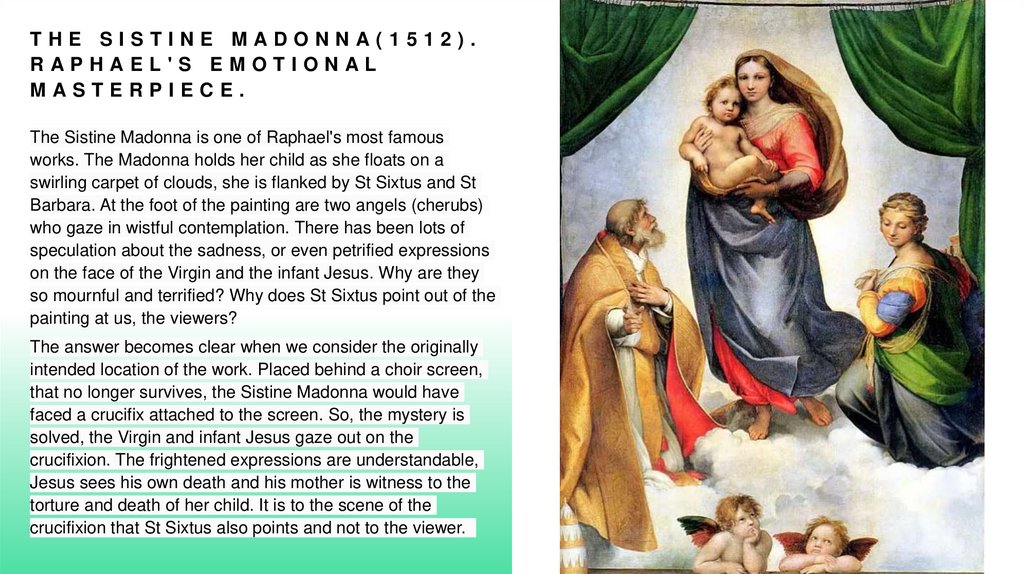
The Sistine Madonna is one of Raphael's most famous
works. The Madonna holds her child as she floats on a
swirling carpet of clouds, she is flanked by St Sixtus and St
Barbara. At the foot of the painting are two angels (cherubs)
who gaze in wistful contemplation. There has been lots of
speculation about the sadness, or even petrified expressions
on the face of the Virgin and the infant Jesus. Why are they
so mournful and terrified? Why does St Sixtus point out of the
painting at us, the viewers?
The answer becomes clear when we consider the originally
intended location of the work. Placed behind a choir screen,
that no longer survives, the Sistine Madonna would have
faced a crucifix attached to the screen. So, the mystery is
solved, the Virgin and infant Jesus gaze out on the
crucifixion. The frightened expressions are understandable,
Jesus sees his own death and his mother is witness to the
torture and death of her child. It is to the scene of the
crucifixion that St Sixtus also points and not to the viewer.
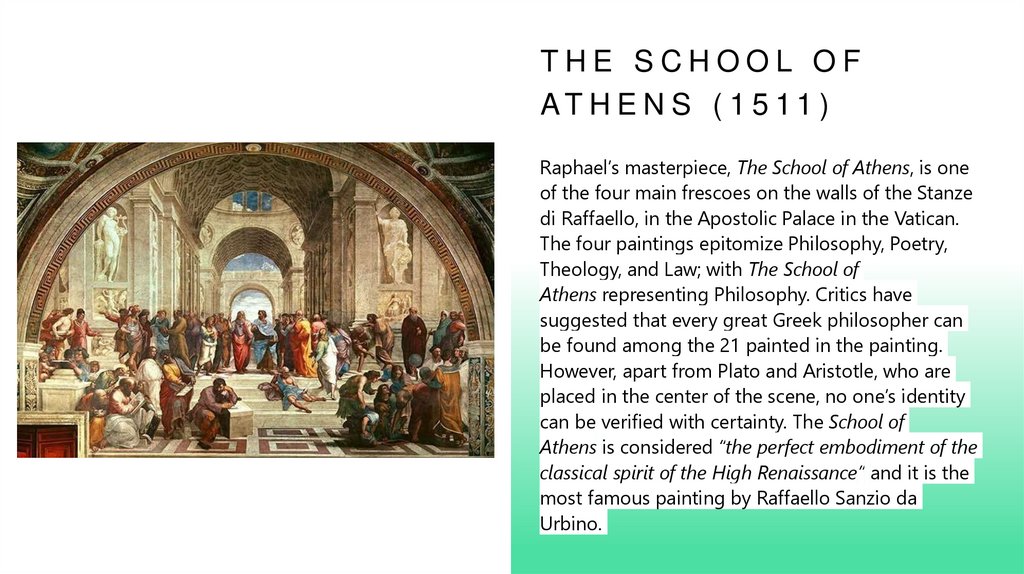
5. The School of Athens (1511)
THE SCHOOL OFAT H E N S ( 1 5 11 )
Raphael’s masterpiece, The School of Athens, is one
of the four main frescoes on the walls of the Stanze
di Raffaello, in the Apostolic Palace in the Vatican.
The four paintings epitomize Philosophy, Poetry,
Theology, and Law; with The School of
Athens representing Philosophy. Critics have
suggested that every great Greek philosopher can
be found among the 21 painted in the painting.
However, apart from Plato and Aristotle, who are
placed in the center of the scene, no one’s identity
can be verified with certainty. The School of
Athens is considered “the perfect embodiment of the
classical spirit of the High Renaissance” and it is the
most famous painting by Raffaello Sanzio da
Urbino.
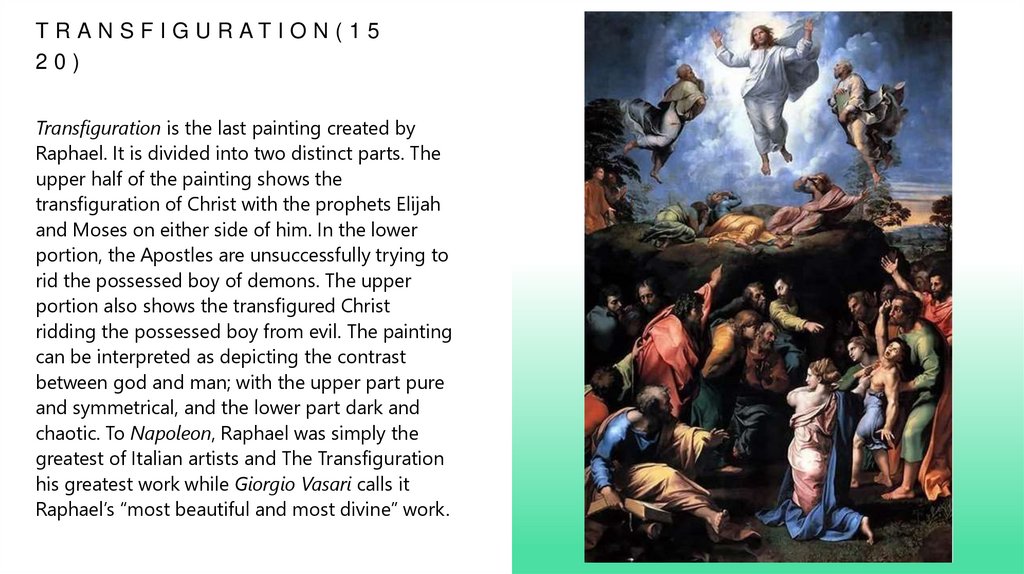
6. Transfiguration(1520)
T R A N S F I G U R AT I O N ( 1 520)
Transfiguration is the last painting created by
Raphael. It is divided into two distinct parts. The
upper half of the painting shows the
transfiguration of Christ with the prophets Elijah
and Moses on either side of him. In the lower
portion, the Apostles are unsuccessfully trying to
rid the possessed boy of demons. The upper
portion also shows the transfigured Christ
ridding the possessed boy from evil. The painting
can be interpreted as depicting the contrast
between god and man; with the upper part pure
and symmetrical, and the lower part dark and
chaotic. To Napoleon, Raphael was simply the
greatest of Italian artists and The Transfiguration
his greatest work while Giorgio Vasari calls it
Raphael’s “most beautiful and most divine” work.