
Similar presentations:








Traditional-Japanese-Architecture
1.
Traditional JapaneseArchitecture
performed by student A. Psareva of group 16a
2.
Fundamentals of Traditional Japanese ArchitectureTraditional Japanese architecture, known as "wafū" or "Nihon kenchiku," is a unique building style shaped by Japan's nature,
religions, and society. Its core principles are harmony with nature, modularity, structural honesty, and flexible spaces.
Harmony with Nature
Modularity
Buildings integrate seamlessly with their natural
Standardized units create flexible, adaptable spaces
surroundings
Structural Honesty
Flexible Spaces
Materials and construction methods are visible and
Interior layouts can be transformed and reconfigured
celebrated
3.
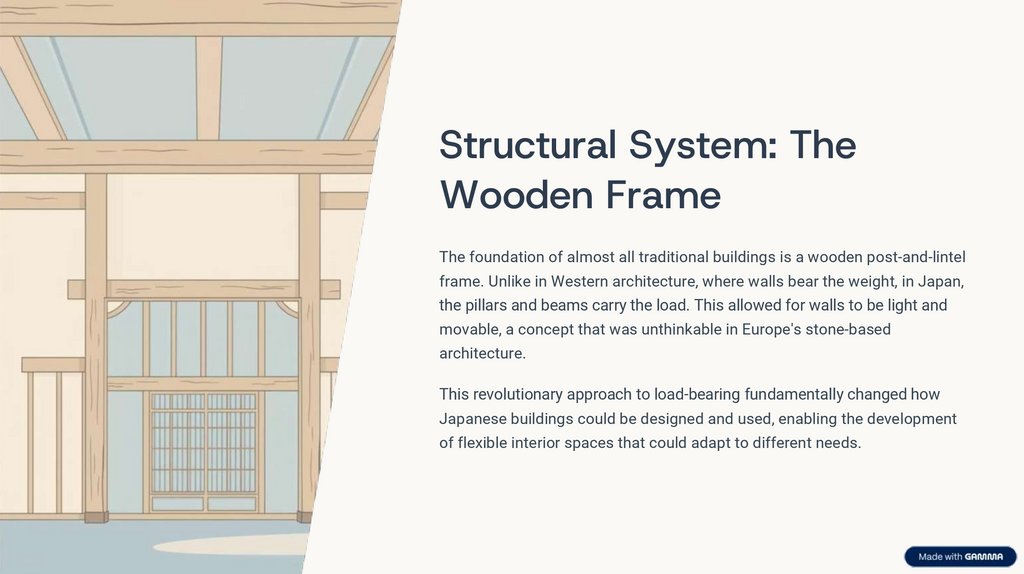
Structural System: TheWooden Frame
The foundation of almost all traditional buildings is a wooden post-and-lintel
frame. Unlike in Western architecture, where walls bear the weight, in Japan,
the pillars and beams carry the load. This allowed for walls to be light and
movable, a concept that was unthinkable in Europe's stone-based
architecture.
This revolutionary approach to load-bearing fundamentally changed how
Japanese buildings could be designed and used, enabling the development
of flexible interior spaces that could adapt to different needs.
4.
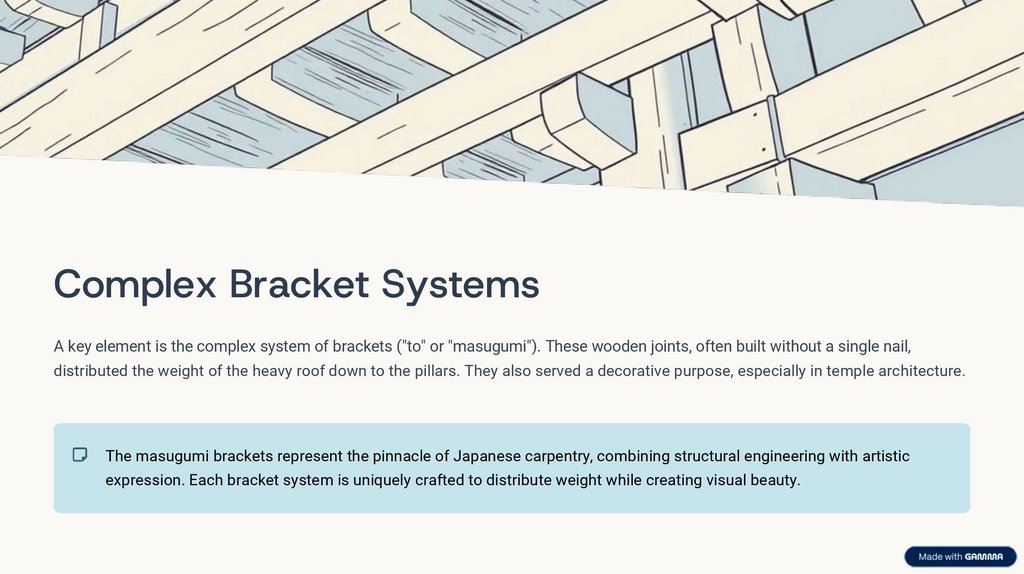
Complex Bracket SystemsA key element is the complex system of brackets ("to" or "masugumi"). These wooden joints, often built without a single nail,
distributed the weight of the heavy roof down to the pillars. They also served a decorative purpose, especially in temple architecture.
The masugumi brackets represent the pinnacle of Japanese carpentry, combining structural engineering with artistic
expression. Each bracket system is uniquely crafted to distribute weight while creating visual beauty.
5.
Materials and Their Aesthetics: WoodWood: The primary material. Cypress, cedar, and pine were commonly used. The wood was not hidden under plaster or paint; its
natural grain was left exposed and appreciated for its beauty and how it aged.
The philosophy of exposing natural materials reflects a deep respect for nature's beauty. Rather than concealing the wood,
Japanese architects celebrated its transformation over time, viewing aging as a form of aesthetic enhancement rather than
deterioration.
6.
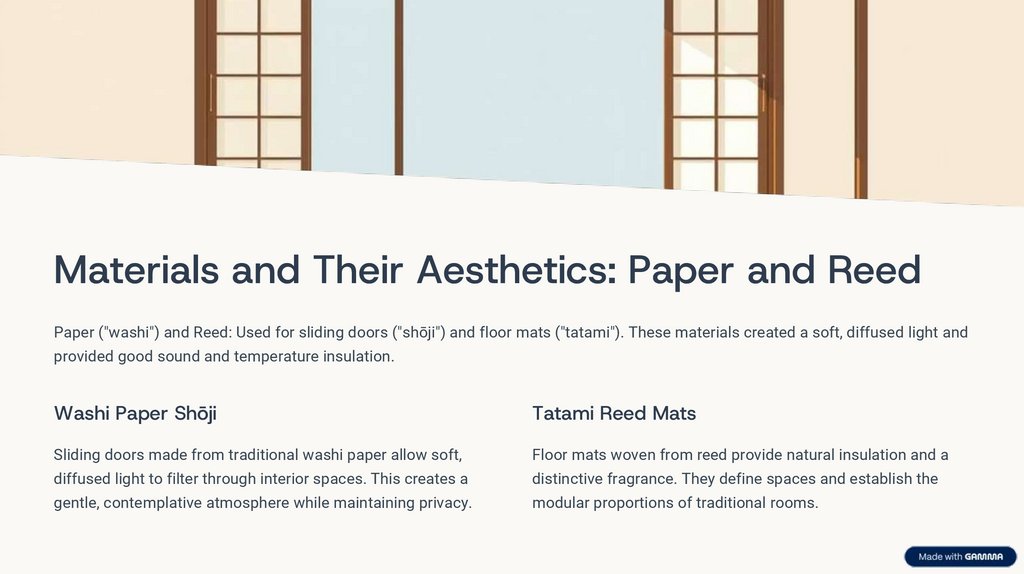
Materials and Their Aesthetics: Paper and ReedPaper ("washi") and Reed: Used for sliding doors ("shōji") and floor mats ("tatami"). These materials created a soft, diffused light and
provided good sound and temperature insulation.
Washi Paper Shōji
Tatami Reed Mats
Sliding doors made from traditional washi paper allow soft,
Floor mats woven from reed provide natural insulation and a
diffused light to filter through interior spaces. This creates a
distinctive fragrance. They define spaces and establish the
gentle, contemplative atmosphere while maintaining privacy.
modular proportions of traditional rooms.
7.
Materials and TheirAesthetics: Stone
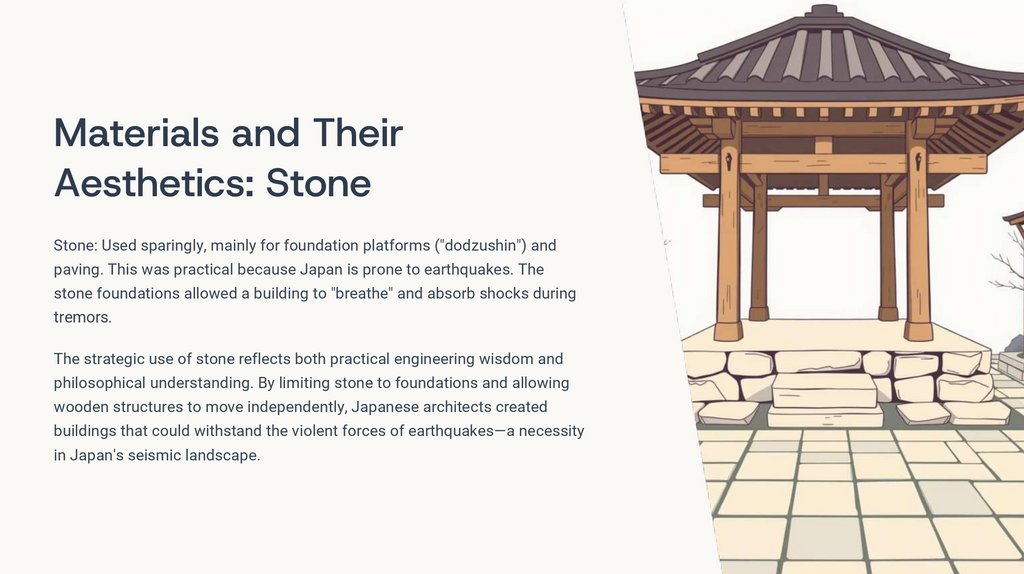
Stone: Used sparingly, mainly for foundation platforms ("dodzushin") and
paving. This was practical because Japan is prone to earthquakes. The
stone foundations allowed a building to "breathe" and absorb shocks during
tremors.
The strategic use of stone reflects both practical engineering wisdom and
philosophical understanding. By limiting stone to foundations and allowing
wooden structures to move independently, Japanese architects created
buildings that could withstand the violent forces of earthquakes—a necessity
in Japan's seismic landscape.
8.
Main Types of BuildingsShinto Shrines ("Jinja")
Buddhist Temples
The most ancient style.
Heavily influenced by mainland Asian
Residential Architecture
("Minka")
Characterized by simple forms and
(Chinese) architecture. Known for
The houses of common people.
the use of unpainted wood. The
their massive, gracefully curved
More utilitarian, they still maintained
archetypal example is the "Shinmei"
roofs, complex bracket systems, and
all the core principles: a wooden
style seen at the Ise Shrine, which
the use of color (vermillion red, gold).
frame, sliding partitions, and a
demonstrates the purity of the
The Horyu-ji temple complex in Nara
connection to the outdoors through a
structural form.
is a famous example.
veranda ("engawa").
9.
Spatial Organization:Flexibility and Connection to
Nature
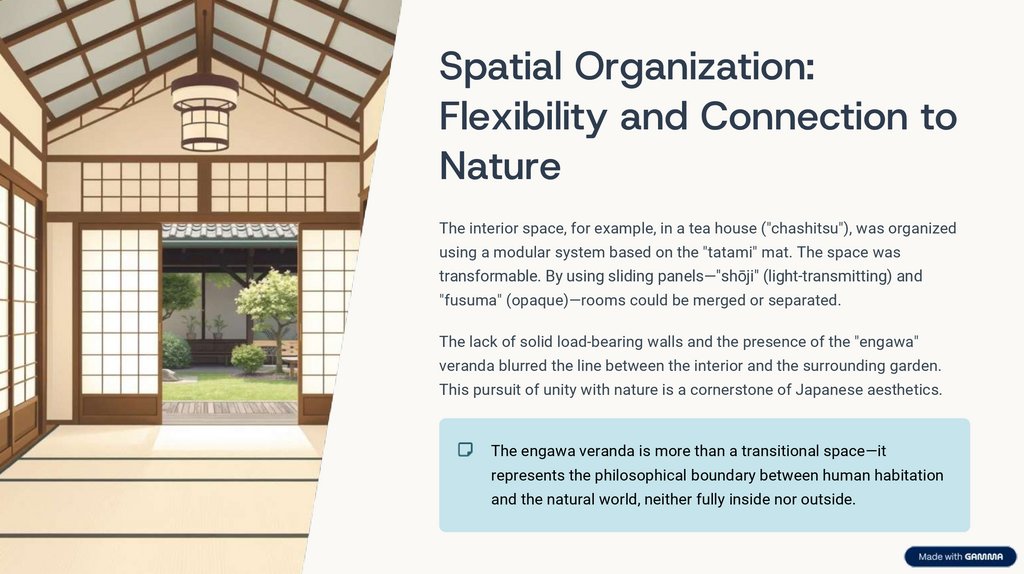
The interior space, for example, in a tea house ("chashitsu"), was organized
using a modular system based on the "tatami" mat. The space was
transformable. By using sliding panels—"shōji" (light-transmitting) and
"fusuma" (opaque)—rooms could be merged or separated.
The lack of solid load-bearing walls and the presence of the "engawa"
veranda blurred the line between the interior and the surrounding garden.
This pursuit of unity with nature is a cornerstone of Japanese aesthetics.
The engawa veranda is more than a transitional space—it
represents the philosophical boundary between human habitation
and the natural world, neither fully inside nor outside.