 english
Similar presentations:








Published by Express Publishing
1.
2.
Published by Express PublishingLiberty House, Greenham Business Park, Newbury,
Berkshire RG19 6HW
Tel.: (0044) 1635 817 363
Fax: (0044) 1635 817 463
e-mail: inquiries@expresspublishing.co.uk
http://www.expresspublishing.co.uk
© Express Publishing, 2012
Design and Illustration © Express Publishing, 2012
Color Illustrations: Victor, Alex © Express Publishing, 2012
First published 2012
Made in EU
All rights reserved. No part of this publication may be reproduced, stored in a retrieval system, or
transmitted in any form , or by any means, electronic, photocopying, or otherwise, without the prior
written permission of the publishers.
This book is not meant to be changed in any way.
ISBN 978-1-4715-0524-9
Acknowledgements
Authors' Acknowledgements
We would like to thank all the staff at Express Publishing who have contributed their skills to producing
this book. Thanks for their support and patience are due in particular to: Alex Newton (Editor in Chief);
Sean Todd (senior editor); Steve Miller (editorial assistant); Richard White (senior production controller);
the Express design team; Sweetspot (recording producers). We would also like to thank those institutions
and teachers who piloted the manuscript, and whose comments and feedback were invaluable in the
production of the book.
Every effort has been made to trace all the copyright holders. If any have been inadvertently
overlooked, the publishers will be pleased to make the necessary arrangements at the first
opportunity.
3.
Virginia EvansJenny Dooley
Tres O'Dell
Express Publishing
4.
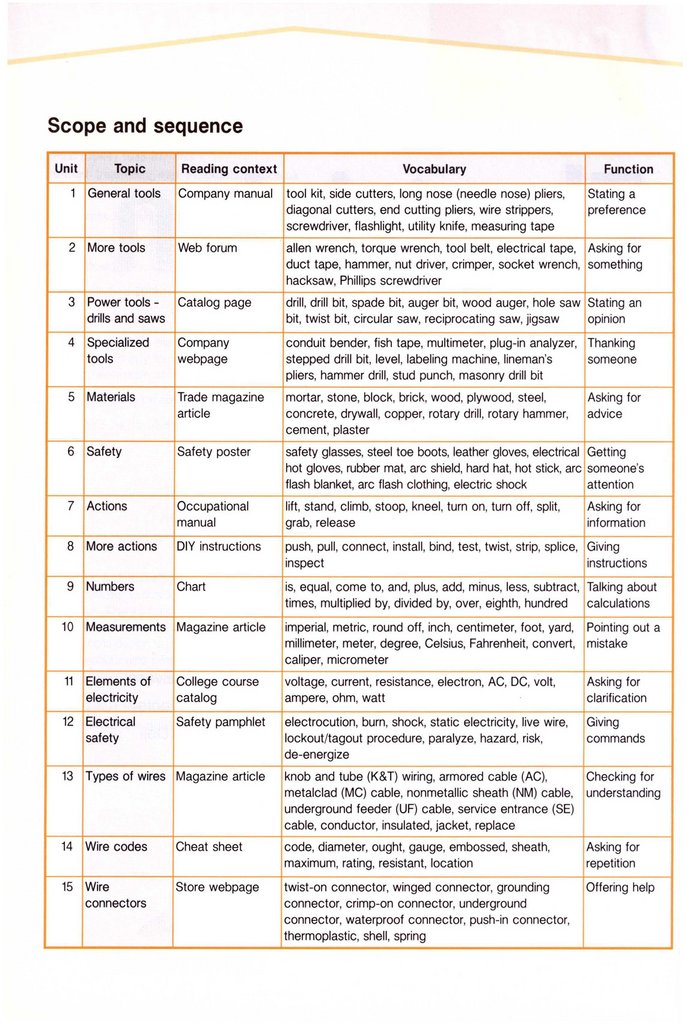
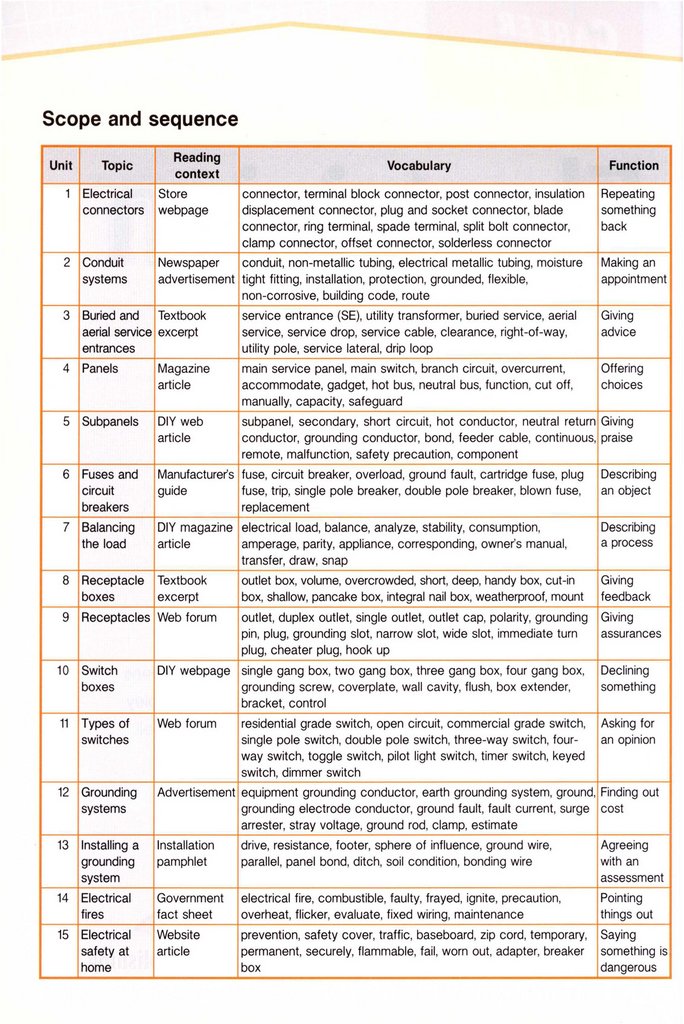
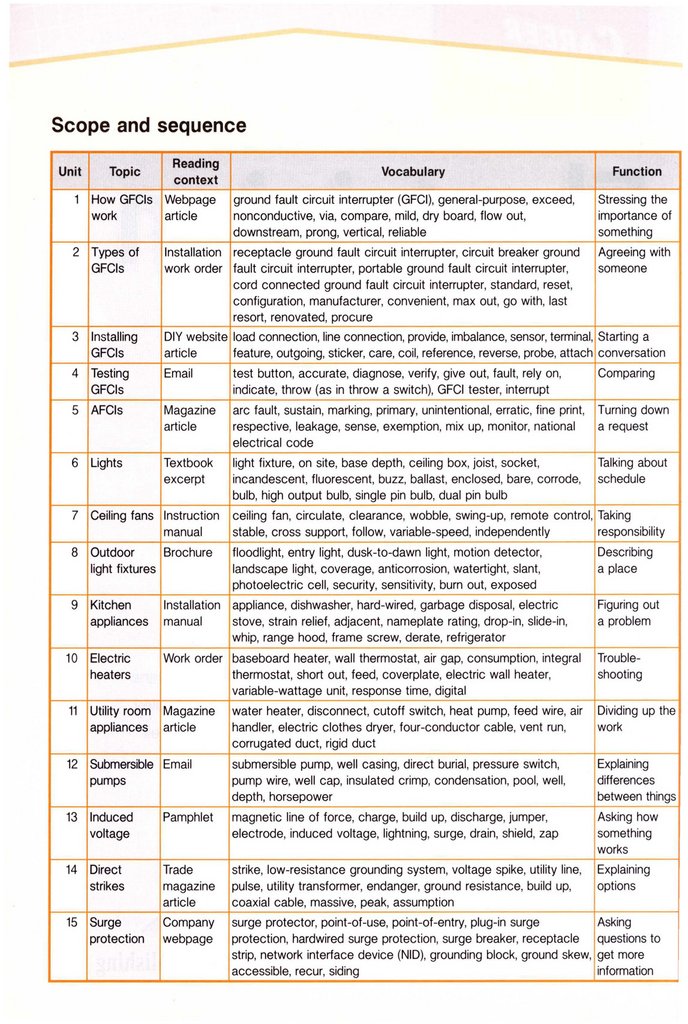
Scope and sequenceUnit
Topic
Reading context
Vocabulary
Function
1 General tools
Company manual
tool kit, side cutters, long nose (needle nose) pliers,
diagonal cutters, end cutting pliers, wire strippers,
screwdriver, flashlight, utility knife, measuring tape
2 More tools
Web forum
allen wrench, torque wrench, tool belt, electrical tape, Asking for
duct tape, hammer, nut driver, crimper, socket wrench, something
hacksaw, Phillips screwdriver
3 Power tools -
Catalog page
drill, drill bit, spade bit, auger bit, wood auger, hole saw Stating an
bit, twist bit, circular saw, reciprocating saw, jigsaw
opinion
Company
webpage
conduit bender, fish tape, multimeter, plug-in analyzer, Thanking
someone
stepped drill bit, level, labeling machine, lineman's
pliers, hammer drill, stud punch, masonry drill bit
5 Materials
Trade magazine
article
mortar, stone, block, brick, wood , plywood, steel,
concrete, drywall, copper, rotary drill, rotary hammer,
cement, plaster
6 Safety
Safety poster
safety glasses, steel toe boots, leather gloves, electrical Getting
hot gloves, rubber mat, arc shield, hard hat, hot stick, arc someone's
flash blanket, arc flash clothing, electric shock
attention
7 Actions
Occupational
manual
lift, stand, climb, stoop, kneel, turn on, turn off, split,
grab, release
8 More actions
DIY instructions
push, pull, connect, install, bind, test, twist, strip, splice, Giving
inspect
instructions
9 Numbers
Chart
is, equal, come to, and, plus, add, minus, less, subtract, Talking about
calculations
times, multiplied by, divided by, over, eighth, hundred
drills and saws
4 Specialized
tools
Stating a
preference
Asking for
advice
Asking for
information
10 Measurements Magazine article
imperial, metric, round off, inch, centimeter, foot, yard, Pointing out a
millimeter, meter, degree, Celsius, Fahrenheit, convert, mistake
caliper, micrometer
11 Elements of
electricity
College course
catalog
voltage, current, resistance, electron, AC, DC, volt,
ampere, ohm, watt
Asking for
clarification
12 Electrical
Safety pamphlet
electrocution, burn, shock, static electricity, live wire,
lockout/tagout procedure, paralyze, hazard, risk,
de-energize
Giving
commands
13 Types of wires Magazine article
knob and tube (K& T) wir.ing, armored cable (AC),
metalclad (MC) cable, nonmetallic sheath (NM) cable,
underground feeder (UF) cable, service entrance (SE)
cable, conductor, insulated, jacket, replace
Checking for
understanding
14 Wire codes
Cheat sheet
code, diameter, ought, gauge, embossed, sheath,
maximum, rating, resistant, location
Asking for
repetition
15 Wire
Store webpage
twist-on connector, winged connector, grounding
connector, crimp-on connector, underground
connector, waterproof connector, push-in connector,
thermoplastic, shell, spring
Offering help
safety
connectors
5.
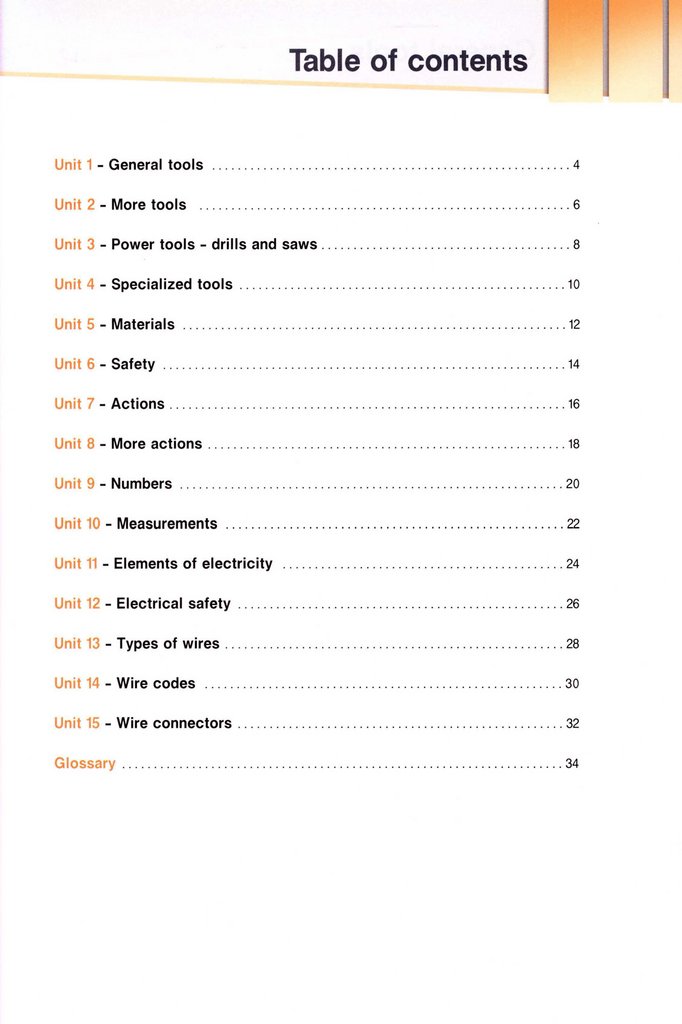
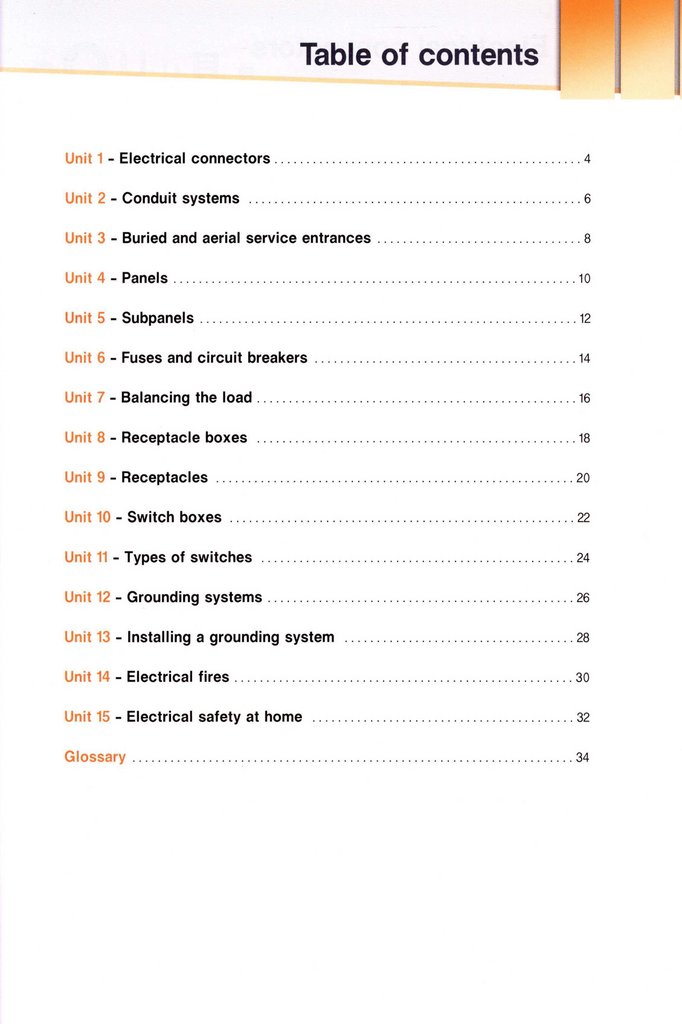
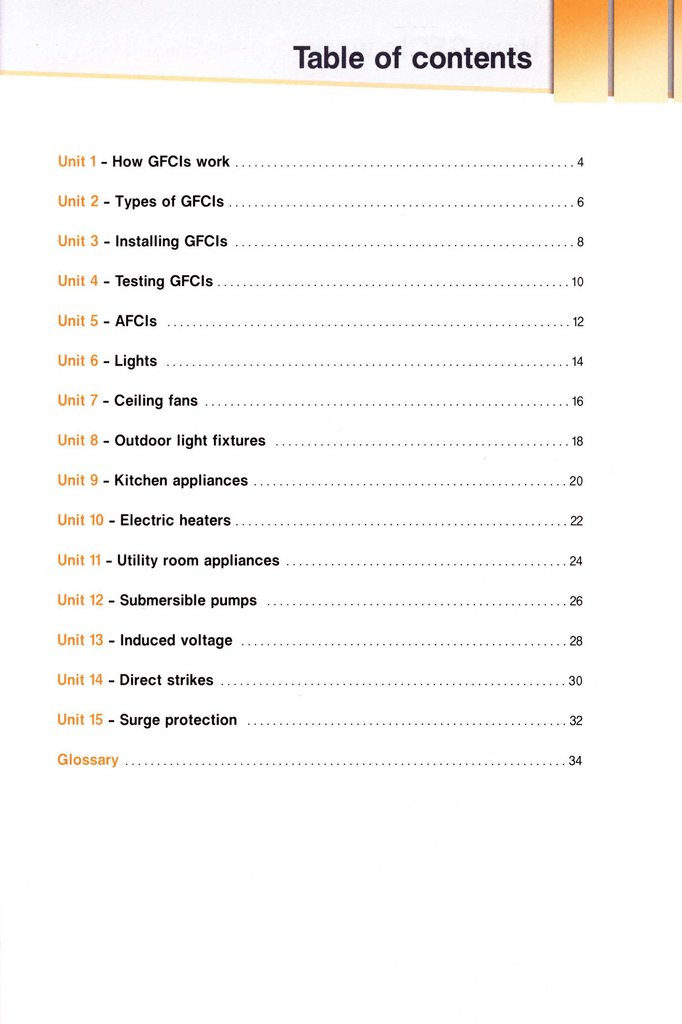
Table of contentsUnit 1 - General tools ...... . .... . .. .......... ......... . . .... . .. . .. . . .. . .. . . .. 4
Unit 2 - More tools ......... ... . ..... ..... . . .. .. . .. . .. . .. .. . .. . .. . . .... .. . .. . 6
Unit 3 - Power tools - drills and saws ...... .. ..... .. . . . . . . . . . . . .... .. . .. . .. . 8
Unit 4 - Specialized tools .. .. .. . .... .... .... ......... . .. . .. . . . .......... ... . 10
Unit 5 - Materials ....... .. . .. .. . . ........ . . . ...... .. . ..... ..... ..... .. . ...... 12
Unit 6 - Safety . .. . . . . .. ....... .. . .. . ......... . . .......... . ....... . .... . .... .. 14
Unit 7 - Actions ... .. ....... ..... . ... .. . . . .. .. . .. ..... ... . ..... . ..... . .. . .. .. . 16
Unit 8 - More actions ....... . ... ....... . .... ......... . .... .. . ...... . ... ..... . 18
Unit 9 - Numbers ....... . .... .. .... .. . ... . .. . ......... . ... ................... 20
Unit 10 - Measurements . .. . .. ...... . . .... . ..... . .. . ... . . ..... . .. . ....... . . .. 22
Unit 11 - Elements of electricity . ... .......... . . .. . . . .. . .. .. ............... . 24
Unit 12 - Electrical safety .... .. .. . . . ... . ......... ... . .. . .. .. . . ....... .. . .... 26
Unit 13 - Types of wires .. . ... . . ........ . ... .. . . ........... ... .. . .. . . .. .. . . .. 28
Unit 14 - Wire codes .. .. ... ... . .. .. ........... ... . .. ........... . . .......... . 30
Unit 15 - Wire connectors . . . ... ...... . ... .. .. . .. . .. ...... .. .... . ...... .. . . . . 32
Glossary . . ....... .. . ... . ...... . . .............. . .. .. . .. . .. . .. .. . . .. . .. .. . .. . .. 34
6.
General toolsGet ready!
0 Before you read the passage, talk about
these questions.
1 How could some of the tools in the pictures
be useful for electricians?
2 Why is it important to have a well-equipped
tool kit?
Reading
f) Read the page from the company manual.
Then, mark the following statements as
true (T) or false (F).
1 _ Employees can buy the tools at hardware
stores.
2 _ Side cutters and diagonal cutters are
needed in the tool kit.
3 _ Wire strippers are used for cutting and
pulling wire.
Vocabulary
8 Write a word that is similar in meaning to
the underlined part.
1kttbot
Electrical Services
1 Jack forgot his pliers that are only used for
cutting wire at the job site.
__ a __ n __ c_t __ r_
2 A small. battery operated light is good for
seeing in dark spaces.
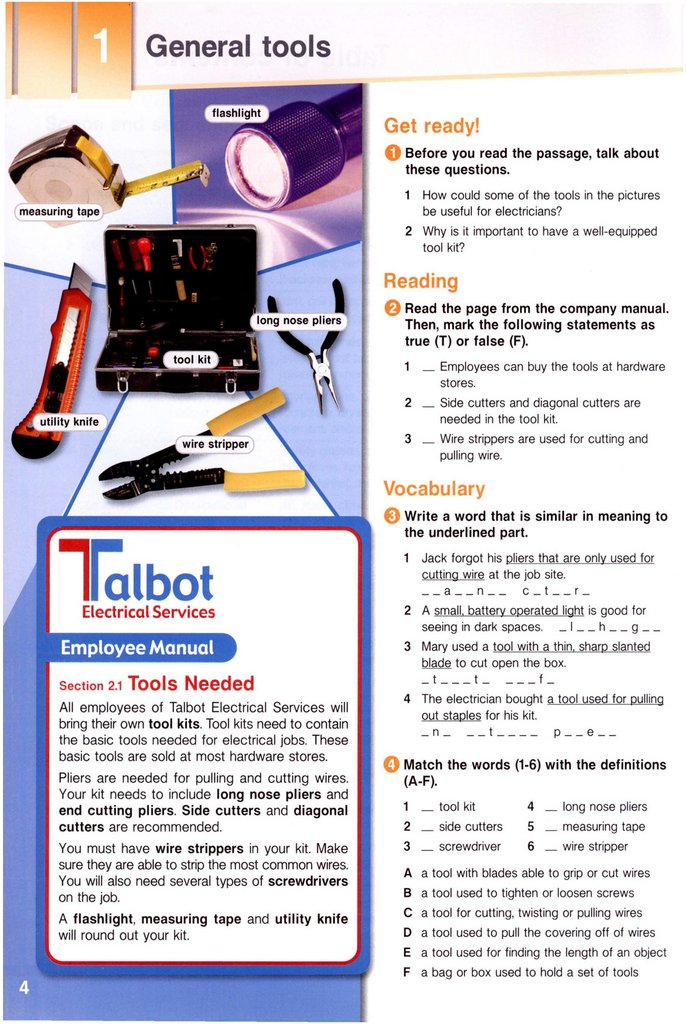
section 2.1 Tools Needed
All employees of Talbot Electrical Services will
bring their own tool kits. Tool kits need to contain
the basic tools needed for electrical jobs. These
basic tools are sold at most hardware stores.
Pliers are needed for pulling and cutting wires.
Your kit needs to include long nose pliers and
end cutting pliers. Side cutters and diagonal
cutters are recommended.
_ I __ h _ _ g __
3 Mary used a tool with a thin, sharp slanted
blade to cut open the box.
_t ___ t ____ f_
4 The electrician bought a tool used for pulling
out staples for his kit.
_n _ _ _ t ____
p __ e __
0 Match the words (1-6) with the definitions
(A-F).
1 _ tool kit
4 _ long nose pliers
2 _ side cutters
5 _ measuring tape
You must have wire strippers in your kit. Make
sure they are able to strip the most common wires.
You will also need several types of screwdrivers
on the job.
3 _ screwdriver
6 _ wire stripper
A flashlight, measuring tape and utility knife
will round out your kit.
C a tool for cutting, twisting or pulling wires
A a tool with blades able to grip or cut wires
B a tool used to tighten or loosen screws
D a tool used to pull the covering off of wires
E a tool used for finding the length of an object
F a bag or box used to hold a set of tools
7.
0 g Listen and read the pagefrom the company manual
again. Which tools are
recommended for the tool kit?
Speaking
0 With a partner, act out the roles below based on Task
7. Then switch roles.
USE LANGUAGE SUCH AS:
Listening
I have to buy some ...
0 g Listen to a conversation
I like to use ...
between two electricians.
Check (.f) the tools that are
mentioned by the electricians.
1 0 screwdrivers
0 side cutters
3 0 flashlight
4 0 diagonal cutters
5 0 wire strippers
2
0 g Listen again and complete
Maybe I'll go with ...
Student A: You are a new electrician. Talk to Student B about:
what tools you need to buy
what kind of tools he or she uses
what you've heard from others about tool brands
Student 8: You are an experienced electrician. Talk to
Student A about tools.
the conversation.
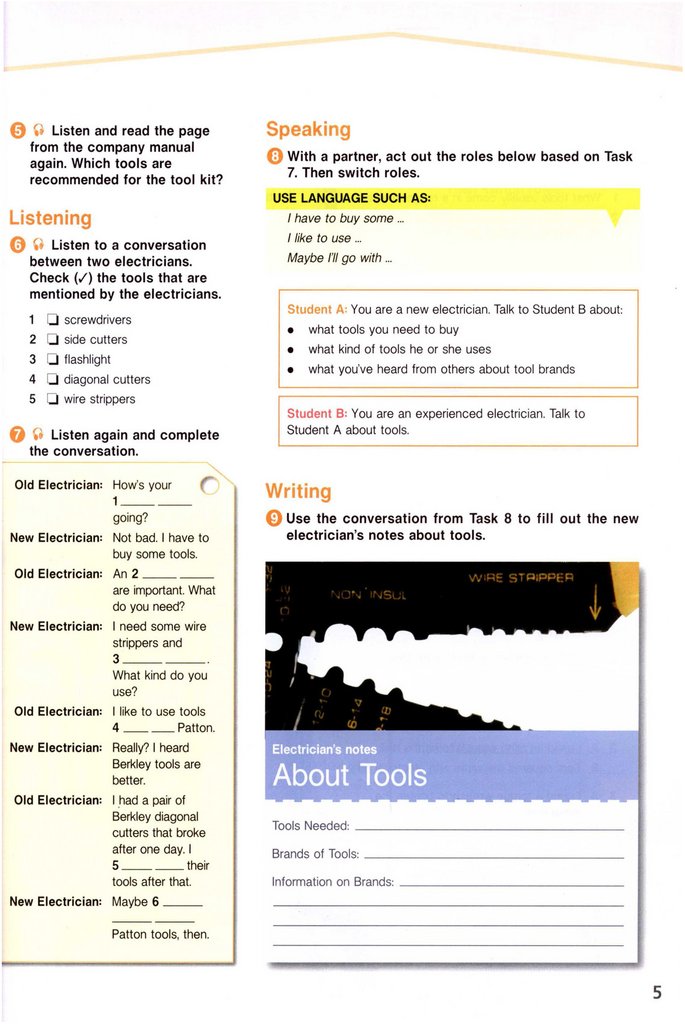
Old Electrician: How's your
1_ _ _ _
Writing
going?
0 Use the conversation from Task 8 to fill out the new
New Electrician: Not bad. I have to
electrician's notes about tools.
buy some tools.
Old Electrician: An2 _ _ _ _
are important. What
do you need?
New Electrician: I need some wire
strippers and
3
What kind do you
use?
Old Electrician: I like to use tools
4 ____ Patton.
New Electrician: Really? I heard
Berkley tools are
better.
Old Electrician: I .had a pair of
Berkley diagonal
cutters that broke
after one day. I
s ____ their
tools after that.
Tools Needed: _ _ _ _ _ _ _ _ _ _ _ _ _ _ _ __
Brands of Tools: _ _ _ _ _ _ _ _ _ _ _ __ __ _
Information on Brands: _ _ __ _ _ _ _ _ _ _ _ __
New Electrician: Maybe 6
Patton tools, then.
5
8.
More toolsGet ready!
0 Before you read the passage, talk about
these questions.
1 What tools usually come in a range of sizes
2 What else might electricians keep in their tool
kits besides actual tools?
Reading
f) Read the web forum. Then, choose the
correct answers.
1 What is the webpage mostly about?
A the best tool kits to buy
B the tools electricians need
C the different types of wrenches
D the kinds of tape electricians use
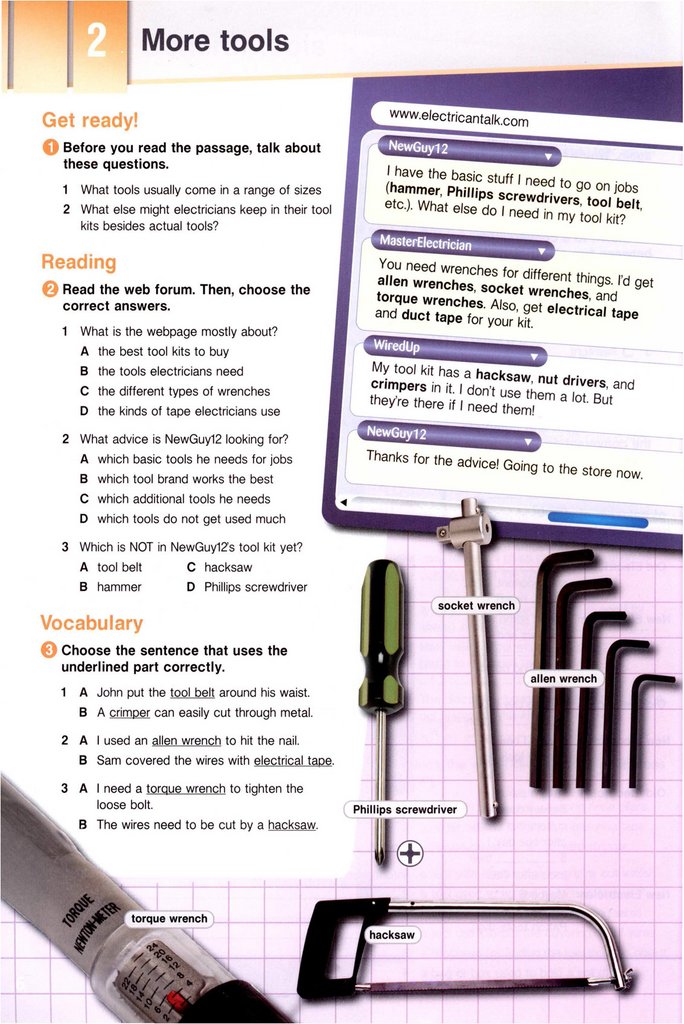
I have the basic stuff I need
.
(hammer, Phillips s
. to go on Jobs
etc.). What else do I c:eewdd~1vers, tool belt,
e in my too/ kit?
You need wrenche f
·
alien wrenches s~ct td1fferent things. I'd get
torque wrench~s
e wrenches, and
and duct tap f . Also, get electrical tape
e or your kit.
My too/ kit has a hacksa
.
crimpers in it I don't
wh nut drivers, and
theVre there if I need~~=~! em a lot. But
2 What advice is NewGuy12 looking tor?
A which basic tools he needs for jobs
B which tool brand works the best
C which additional tools he needs
D which tools do not get used much
3 Which is NOT in NewGuy12's tool kit yet?
A tool belt
C hacksaw
B hammer
D Phillips screwdriver
Vocabulary
E) Choose the sentence that uses the
underlined part correctly.
1 A John put the tool belt around his waist.
B A crimper can easily cut through metal.
2 A I used an alien wrench to hit the nail.
B Sam covered the wires with electrical tape.
3 A I need a torque wrench to tighten the
loose bolt.
The wires need to be cut by a hacksaw.
Thanks for the advicer G .
. o1ng to the store now.
9.
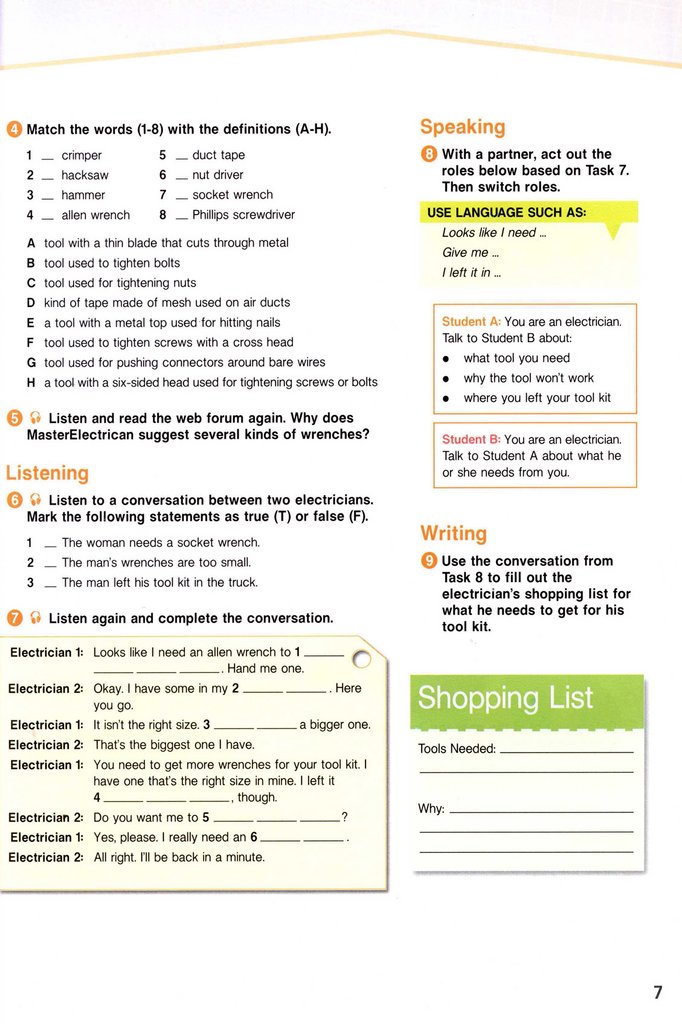
0 Match the words (1-8) with the definitions (A-H).1
crimper
5 _ duct tape
2
hacksaw
6 _ nut driver
3
hammer
7 _ socket wrench
4
alien wrench
8 _ Phillips screwdriver
Speaking
0 With a partner, act out the
roles below based on Task 7.
Then switch roles.
USE LANGUAGE SUCH AS:
Looks like I need ...
A tool with a thin blade that cuts through metal
Give me .. .
B tool used to tighten bolts
I left it in ...
C tool used for tightening nuts
D kind of tape made of mesh used on air ducts
F tool used to tighten screws with a cross head
Student A: You are an electrician.
Talk to Student B about:
G tool used for pushing connectors around bare wires
what tool you need
H a tooLwith a six-sided head used for tightening screws or bolts
why the tool won't work
where you left your tool kit
E a tool with a metal top used for hitting nails
0 " Listen and read the web forum again. Why does
MasterElectrican suggest several kinds of wrenches?
Listening
Student B: You are an electrician.
Talk to Student A about what he
or she needs from you.
0 " Listen to a conversation between two electricians.
Mark the following statements as true (T) or false (F).
1 _ The woman needs a socket wrench.
Writing
2 _ The man's wrenches are too small.
0 Use the conversation from
3 _ The man left his tool kit in the truck.
0 " Listen again and complete the conversation.
Task 8 to fill out the
electrician's shopping list for
what he needs to get for his
tool kit.
Electrician 1: Looks like I need an alien wrench to 1 _ __
___ ___ ___ . Hand me one.
Electrician 2: Okay. I have some in my 2
you go.
. Here
Electrician 1: It isn't the right size. 3 ______ a bigger one.
Electrician 2: That's the biggest one I have.
Electrician 1: You need to get more wrenches for your tool kit. I
have one that's the right size in mine. I left it
4
, though.
Electrician 2: Do you want me to 5 _________ ?
Tools Needed: _ _ _ _ _ _ __
Why: _ _ _ _ _ _ _ _ __
Electrician 1: Yes, please. I really need an 6 ______
Electrician 2: All right. I'll be back in a minute.
7
10.
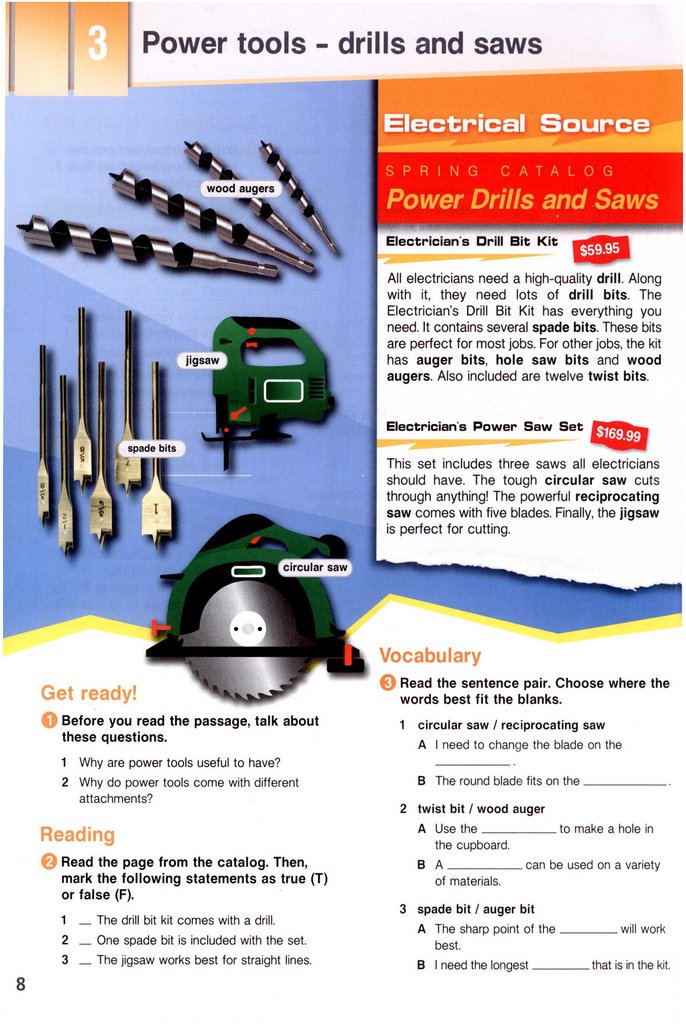
Power tools - drills and sawsAll electricians need a high-quality drill. Along
with it, they need lots of drill bits. The
Electrician's Drill Bit Kit has everything you
need. It contains several spade bits. These bits
are perfect for most jobs. For other jobs, the kit
has auger bits, hole saw bits and wood
augers. Also included are twelve twist bits.
This set includes three saws all electricians
should have. The tough circular saw cuts
through anything! The powerful reciprocating
saw comes with five blades. Finally, the jigsaw
is perfect for cutting.
Vocabulary
Get ready!
0 Before you read the passage, talk about
these questions.
8 Read the sentence pair. Choose where the
words best fit the blanks.
1 circular saw I reciprocating saw
A I need to change the blade on the
1 Why are power tools useful to have?
2 Why do power tools come with different
attachments?
2 twist bit I wood auger
Reading
A Use the
the cupboard.
f) Read the page from the catalog. Then,
B A
of materials.
mark the following statements as true (T)
or false (F).
1 _ The drill bit kit comes with a drill.
8
B The round blade fits on the _ _ _ __
to make a hole in
can be used on a variety
3 spade bit I auger bit
2 _ One spade bit is included with the set.
A The sharp point of the _ _ _ will work
best.
3 _ The jigsaw works best for straight lines.
B I need the longest _ _ _ that is in the kit.
11.
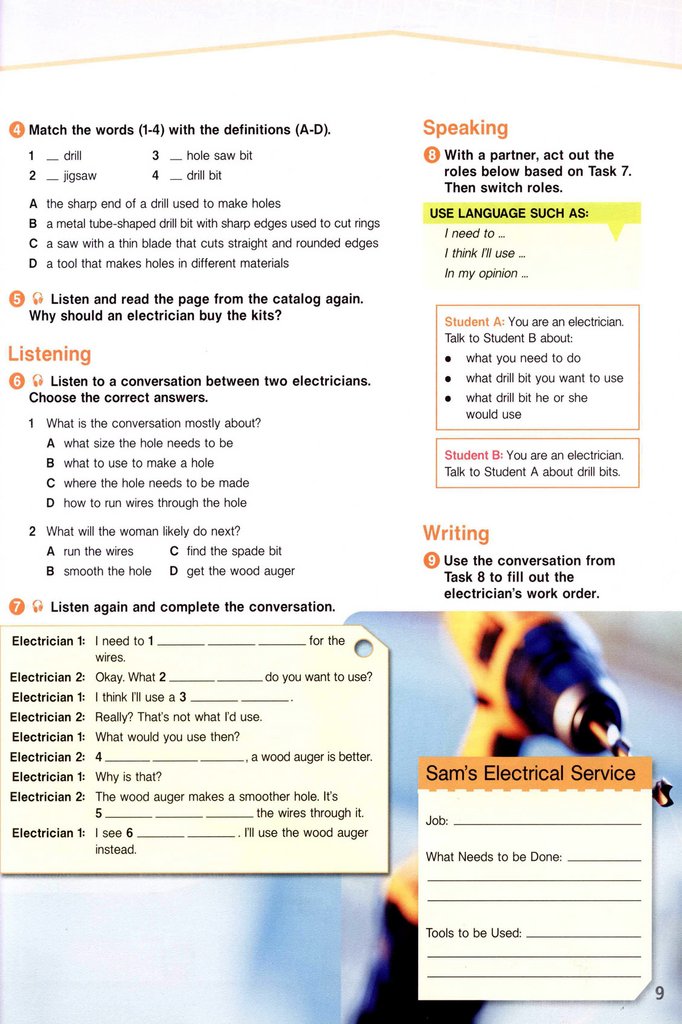
r0 Match the words (1-4) with the definitions (A-D).
1 _ drill
2 _ jigsaw
3 _ hole saw bit
Speaking
(i) With a partner, act out the
roles below based on Task 7.
Then switch roles.
4 _ drill bit
A the sharp end of a drill used to make holes
B a metal tube-shaped drill bit with sharp edges used to cut rings
C a saw with a thin blade that cuts straight and rounded edges
D a tool that makes holes in different materials
USE LANGUAGE SUCH AS:
I need to ...
I think /'II use ...
In my opinion .. .
0 " Listen and read the page from the catalog again.
Why should an electrician buy the kits?
Student A: You are an electrician.
Talk to Student B about:
Listening
what you need to do
0 " Listen to a conversation between two electricians.
what drill bit you want to use
what drill bit he or she
would use
Choose the correct answers.
1 What is the conversation mostly about?
A what size the hole needs to be
Student B: You are an electrician.
Talk to Student A about drill bits.
B what to use to make a hole
C where the hole needs to be made
D how to run wires through the hole
Writing
2 What will the woman likely do next?
A run the wires
B smooth the hole
C find the spade bit
D get the wood auger
f) " Listen again and complete the conversation.
0 Use the conversation from
Task 8 to fill out the
electrician's work order.
Electrician 1: I need to 1 _ _ _ _ _ _ _ _ _ for the
wires.
Electrician 2: Okay. What 2 _ _ _ _ _ _ do you want to use?
Electrician 1: I think I'll use a 3 _ _ _ _ __
Electrician 2: Really? That's not what I'd use.
Electrician 1: What would you use then?
Electrician 2: 4
, a wood auger is better.
Electrician 1: Why is that?
Sam's Electrical Service
Electrician 2: The wood auger makes a smoother hole. It's
5
the wires through it.
Electrician 1: I see 6 _ _ _ _ _ _ . I'll use the wood auger
instead.
What Needs to be Done: _ _ _ __
Tools to be Used: _ _ _ _ _ __
9
12.
Specialized toolsGet ready!
0 Before you read the passage, talk about
these questions.
1 Which specialized tools in the pictures do you
consider most helpful?
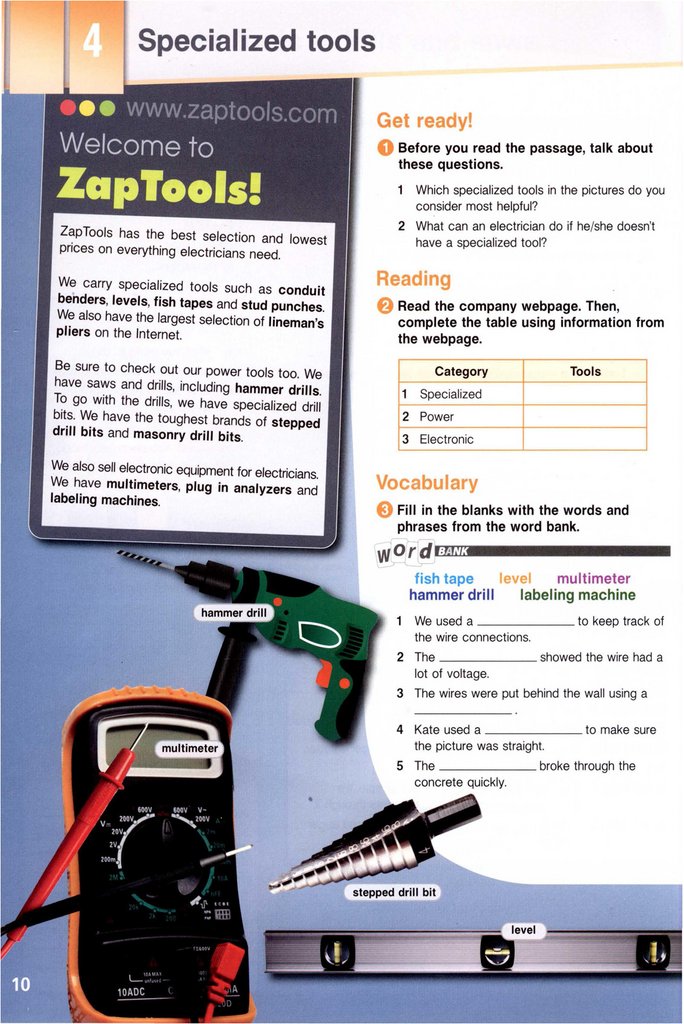
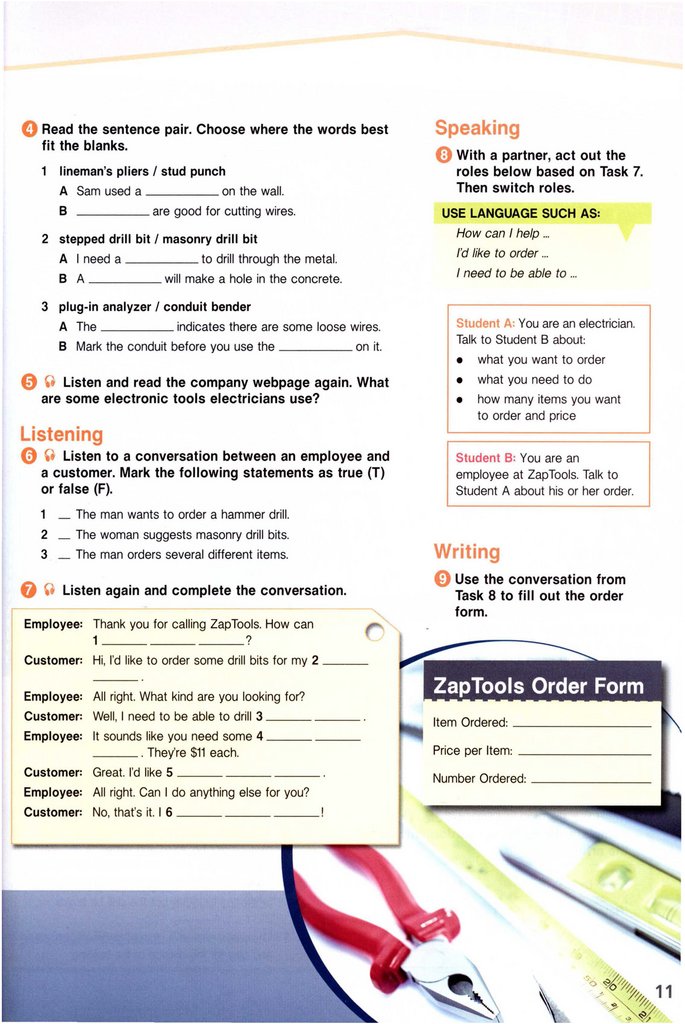
Zap Tools has the best selection and lowest
prices on everything electricians need.
We carry specialized tools such as conduit
benders, levels, fish tapes and stud punches.
We also have the largest selection of lineman's
pliers on the Internet.
Be sure to check out our power tools too. We
have saws and drills, including hammer drills.
To go with the drills, we have specialized drill
bits. We have the toughest brands of stepped
drill bits and masonry drill bits.
We also sell electronic equipment for electricians.
We have multimeters, plug in analyzers and
labeling machines.
2 What can an electrician do if he/she doesn't
have a specialized tool?
Reading
f) Read the company webpage. Then,
complete the table using information from
the webpage.
Category
Tools
1 Specialized
2 Power
3 Electronic
Vocabulary
8 Fill in the blanks with the words and
phrases from the word bank.
yjo[~ ANK
level
multimeter
fish tape
hammer drill
labeling machine
1 We used a _ _ _ _ _ _ to keep track of
the wire connections.
2 The _ _ __ _ _ showed the wire had a
lot of voltage.
3 The wires were put behind the wall using a
4 Kate used a
the picture was straight.
5 The
concrete quickly.
to make sure
broke through the
~·•_e_I---~~-
13.
Q Read the sentence pair. Choose where the words bestfit the blanks.
1
0 With a partner, act out the
lineman's pliers I stud punch
A Sam used a
B
Speaking
roles below based on Task 7.
Then switch roles.
on the wall.
are good for cutting wires.
USE LANGUAGE SUCH AS:
How can I help .. .
2 stepped drill bit I masonry drill bit
I'd like to order ...
A I need a
to drill through the metal.
B A _ _ _ _ _ will make a hole in the concrete.
I need to be able to ...
3 plug-in analyzer I conduit bender
A The
indicates there are some loose wires.
B Mark the conduit before you use the
on it.
0 g Listen and read the company webpage again. What
are some electronic tools electricians use?
Student A: You are an electrician.
Talk to Student B about:
what you want to order
what you need to do
how many items you want
to order and price
Listening
0 g Listen to a conversation between an employee and
a customer. Mark the following statements as true (T)
or false (F).
Student B: You are an
employee at ZapTools. Talk to
Student A about his or her order.
1 _ The man wants to order a hammer drill.
2 _ The woman suggests masonry drill bits.
3 _ The man orders several different items.
f) g Listen again and complete the conversation.
Writing
0 Use the conversation from
Task 8 to fill out the order
form.
! Employee: Thank you for calling ZapTools. How can
1
?
Customer: Hi, I'd like to order some drill bits for my 2 _ __
Employee: All right. What kind are you looking for?
Customer: Well, I need to be able to drill 3 _ _ _ _ __
Item Ordered: _ _ __ __ __ _
Employee: It sounds like you need some 4 _ _ _ _ __
_ _ _ . They're $11 each.
Price per Item: _ _ _ _ _ __ _
Customer: Great. I'd like 5 _ _ _ _ _ _ _ __
Employee: All right. Can I do anything else for you?
Customer: No, that's it. I 6 _ __ _ _ _ _ __
Number Ordered: _ _ _ _ _ __
14.
MaterialsCHOOSING 1HE
RIGH1 ORILL
FOR1HEJ08
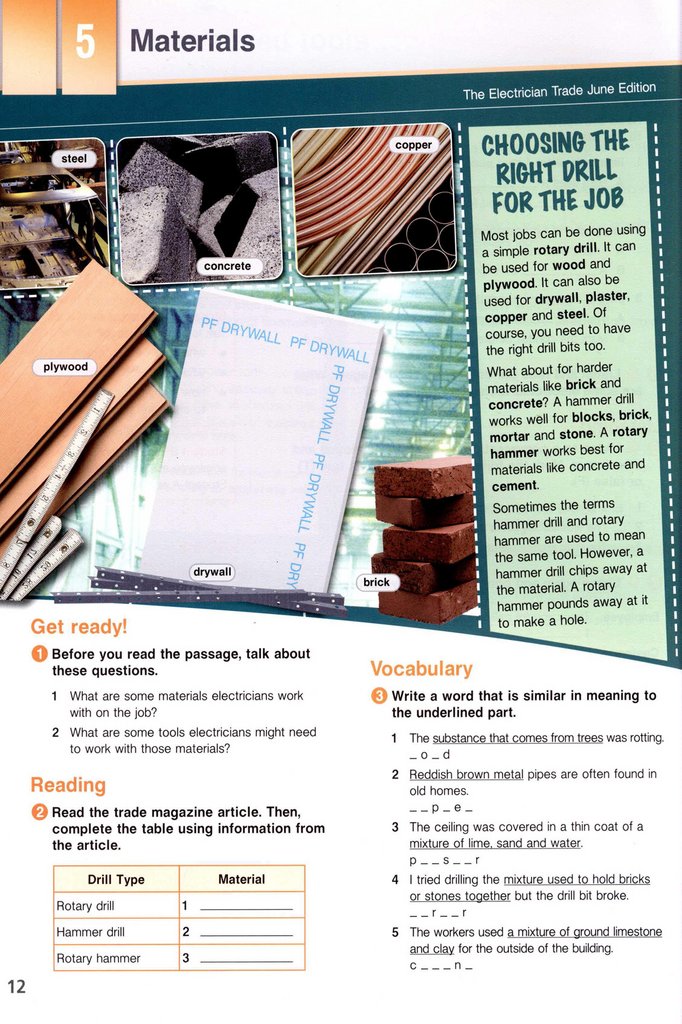
Most jobs can be done using
a simple rotary drill. It can
be used for wood and
plywood. It can also be
used for drywall, plaster,
~==~::;=:$~~11 copper and steel. Of
course, you need to have
.........-"""-.
the right drill bits too.
What about for harder
materials like brick and
Eii~l'!!I-...;:~· concrete? A hammer drill
.....--..~
works well for blocks, brick,
mortar and stone. A rotary
hammer works best for
materials like concrete and
cement.
sometimes the terms
hammer drill and rotary
hammer are used to mean
the same tool. However, a
hammer drill chips away at
the material. A rotary
hammer pounds away at it
to make a hole.
Get ready!
0 Before you read the passage, talk about
these questions.
Vocabulary
1 What are some materials electricians work
with on the job?
f) Write a word that is similar in meaning to
2 What are some tools electricians might need
to work with those materials?
Reading
f) Read the trade magazine article. Then,
complete the table using information from
the article.
Material
Drill Type
12
Rotary drill
1
Hammer drill
2
Rotary hammer
3
the underlined part.
1 The substance that comes from trees was rotting.
_o_d
2 Reddish brown metal pipes are often found in
old homes.
__ p_e_
3 The ceiling was covered in a thin coat of a
mixture of lime. sand and water.
p __ s __ r
4 I tried drilling the mixture used to hold bricks
or stones together but the drill bit broke.
__ r __ r
5 The workers used a mixture of ground limestone
and clay for the outside of the building.
c ___ n_
15.
0 Match the words (1-7) with the definitions (A-G).1 _ block
4 _ brick
2 _ stone
5 _ plywood
3 _ steel
6 _ drywall
7 _ concrete
Speaking
0 With a partner, act out the
roles below based on Task 7.
Then switch roles.
USE LANGUAGE SUCH AS:
A a board made of plaster and covered in paper
B a metal that is made from combining iron and carbon
C a piece of material that is solid with flat surfaces on each side
D a board made of thin layers of wood glued together
I'm not sure ...
You don't want to use ...
Hammer drills are better for ...
E a hard material made with cement, small stones, sand and water
Student A: You are a new
electrician. Talk to Student B
about:
F a block of clay that is baked until it is hard
G the hard substance rocks are made from
0 g Listen and read the trade magazine article again.
What is the difference between a rotary hammer and a
hammer drill?
Listening
0 g Listen to a conversation between an experienced
and a new electrician. Mark the following statements
as true (T) or false (F).
what you need to drill through
w
which drilt you should use
whether you have the right drill
Student B: You are an
experienced electrician. Talk to
Student A about what he or she
needs to do.
1 _ The floor is made of cement.
2 _ The man needs a rotary hammer.
Writing
3 _ The woman lends the man a tool.
f) g Listen again and complete the conversation.
Experienced Electrician: You 1 _ _ _ _ _ _ _ __
0 Use the conversation from
Task 8 to fill out the
electrician's notes about what
to use to drill through the floor.
through this concrete floor.
New Electrician: I'm not sure what to use, though. Can
you help me 2 ______
___ ?
Experienced Electrician: Well, you don't want to use a regular
3
on concrete.
New Electrician: So, I need a 4 _ __ ___
or
rotary hammer, then.
Experienced Electrician: You're on the right track.
Type of Material to be Drilled: _ __
New Electrician: Hammer drills are better for 5 _ __
_ _ _ __ _ , right?
Experienced Electrician: Yes. So, what do you need?
New Electrician: I need to use a rotary hammer. But I
don't have one in my 6 _ __
Possible Drills to Use: _ _ _ _ __
Which Drill to Use and Why: _ _ __
Experienced Electrician: You can borrow mine.
13
16.
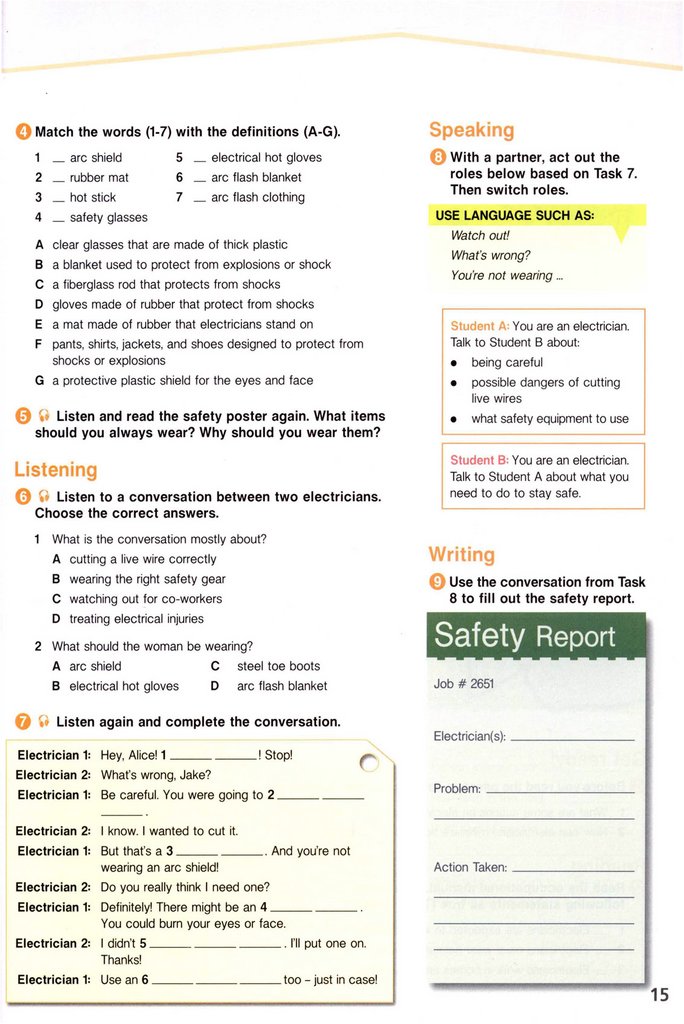
Safety0 Before you read the passage,
talk about these questions.
1 What are some of the dangers
of working on the job?
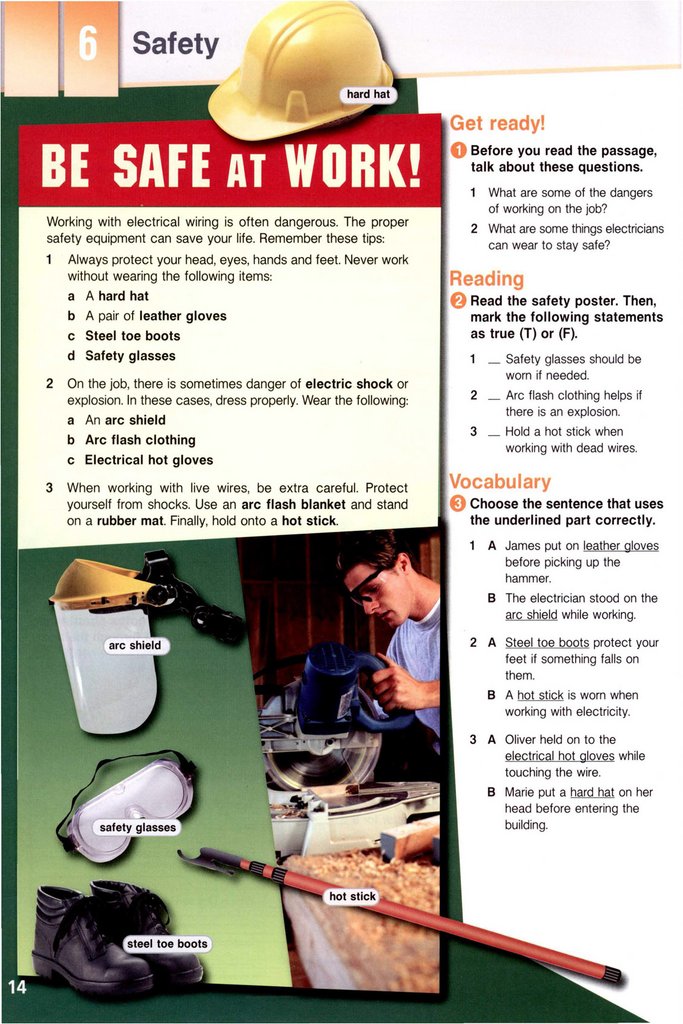
Working with electrical wiring is often dangerous. The proper
safety equipment can save your life. Remember these tips:
1
Always protect your head, eyes, hands and feet. Never work
without wearing the following items:
a A hard hat
b A pair of leather gloves
2
2 What are some things electricians
can wear to stay safe?
Reading
f) Read the safety poster. Then,
c Steel toe boots
mark the following statements
as true (T) or (F).
d Safety glasses
1 _ Safety glasses should be
On the job, there is sometimes danger of electric shock or
explosion. In these cases, dress properly. Wear the following:
a An arc shield
b Arc flash clothing
worn if needed.
2 _ Arc flash clothing helps if
there is an explosion.
3 _ Hold a hot stick when
working with dead wires.
c Electrical hot gloves
3
When working with live wires, be extra careful. Protect
yourself from shocks. Use an arc flash blanket and stand
on a rubber mat. Finally, hold onto a hot stick.
Vocabulary
8 Choose the sentence that uses
the underlined part correctly.
1 A James put on leather gloves
before picking up the
hammer.
B The electrician stood on the
arc shield while working.
2 A Steel toe boots protect your
feet if something falls on
them.
B A hot stick is worn when
working with electricity.
3 A Oliver held on to the
electrical hot gloves while
touching the wire.
B Marie put a hard hat on her
head before entering the
building.
17.
0 Match the words (1-7) with the definitions (A-G).1 _ arc shield
5 _ electrical hot gloves
2 _ rubber mat
6 _ arc flash blanket
3 _ hot stick
7 _ arc flash clothing
Speaking
0 With a partner, act out the
roles below based on Task 7.
Then switch roles.
USE LANGUAGE SUCH AS:
4 _ safety glasses
A clear glasses that are made of thick plastic
B a blanket used to protect from explosions or shock
C a fiberglass rod that protects from shocks
Watch out!
What's wrong?
You're not wearing ...
D gloves made of rubber that protect from shocks
E a mat made of rubber that electricians stand on
F pants, shirts, jackets, and shoes designed to protect from
shocks or explosions
G a protective plastic shield for the eyes and face
0 g Listen and read the safety poster again. What items
Student A You are an electrician.
Talk to Student B about:
being careful
possible dangers of cutting
live wires
what safety equipment to use
should you always wear? Why should you wear them?
Listening
0 g Listen to a conversation between two electricians.
Student 8: You are an electrician.
Talk to Student A about what you
need to do to stay safe.
Choose the correct answers.
1 What is the conversation mostly about?
A cutting a live wire correctly
Writing
B wearing the right safety gear
0 Use the conversation from Task
C watching out for co-workers
8 to fill out the safety report.
D treating electrical injuries
Safety Report
2 What should the woman be wearing?
A arc shield
B electrical hot gloves
C
D
steel toe boots
arc flash blanket
f) g Listen again and complete the conversation.
Job# 2651
Electrician(s): _ _ _ _ _ _ __
Electrician 1: Hey, Alice! 1 ______ !Stop!
Electrician 2: What's wrong, Jake?
Electrician 1: Be careful. You were going to 2 ___ ___
Problem: _ _ _ _ _ _ _ _ __
Electrician 2: I know. I wanted to cut it.
Electrician 1: But that's a 3 _ _ _ _ _ _ .And you're not
wearing an arc shield!
Action Taken: _ _ _ _ _ _ __
Electrician 2: Do you really think I need one?
Electrician 1: Definitely! There might be an 4 ______
You could burn your eyes or face.
Electrician 2: I didn't 5
Thanks!
. I'll put one on.
Electrician 1: Use an 6 _ _ _ _ _ _ ___ too - just in case!
15
18.
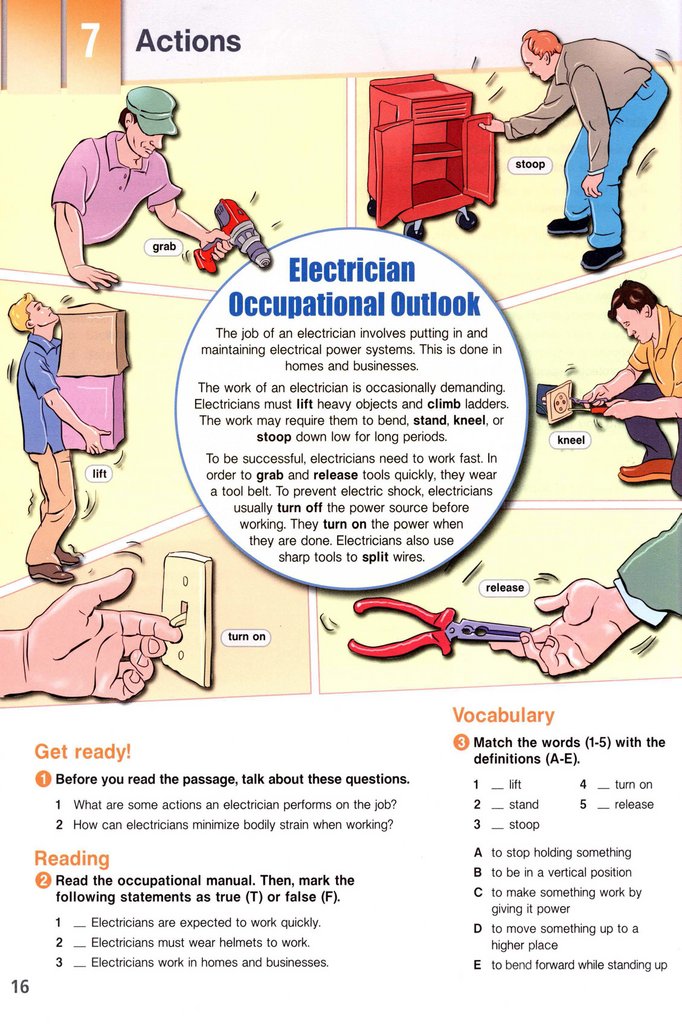
ActionsI
Electrician
Occupational Outlook
The job of an electrician involves putting in and
maintaining electrical power systems. This is done in
homes and businesses.
The work of an electrician is occasionally demanding.
Electricians must lift heavy objects and climb ladders.
The work may require them to bend, stand, kneel, or
stoop down low for long periods.
To be successful, electricians need to work fast. In
order to grab and release tools quickly, they wear
a tool belt. To prevent electric shock, electricians
usually turn off the power source before
working. They turn on the power when
they are done. Electricians also use
sharp tools to split wires.
i.-~~~~~~~~~
( turn on)
Vocabulary
Get ready!
0 Before you read the passage, talk about these questions.
definitions (A-E).
1 -
lift
1 What are some actions an electrician performs on the job?
2 _ stand
2 How can electricians minimize bodily strain when working?
3 _ stoop
Reading
f) Read the occupational manual. Then, mark the
following statements as true (T) or false (F).
1 _ Electricians are expected to work quickly.
2 _ Electricians must wear helmets to work.
3 _ Electricians work in homes and businesses.
16
E) Match the words (1-5) with the
4 _turn on
5 _ release
A to stop holding something
B to be in a vertical position
C to make something work by
giving it power
D to move something up to a
higher place
E to bend forward while standing up
19.
0 Choose the sentence that uses the underlined partcorrectly.
Speaking
0 With a partner, act out the
roles below based on Task 7.
Then switch roles.
A He released the rope and didn't let go.
B The electrician climbed the ladder.
USE LANGUAGE SUCH AS:
2 A She split the check and paid it all herself.
B He can't lift heavy weights since his accident.
I still have a few questions ...
When did you ...
3 A He grabbed the bag and ran away.
What is your favorite ...
B I turned on the light so it would be dark.
4 A He stooped to reach the top of the shelf.
Student A: You are an intern.
Talk to Student B about:
B Please turn off the TV before you leave.
5 A It's hard to stand all day in an uncomfortable chair.
what he or she does each day
B I had to kneel to pick up the papers on the floor.
how long he or she has
done the job
0 " Listen and read the occupational manual again.
the best part of the job for
him or her
How do electricians prevent electric shocks?
Listening
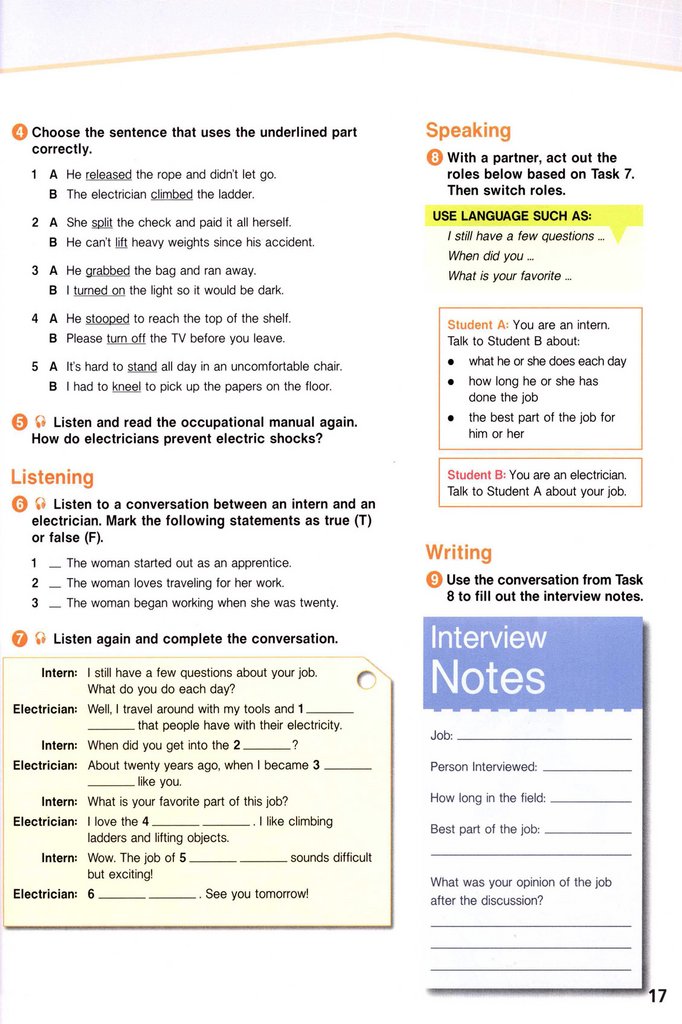
0 " Listen to a conversation between an intern and an
electrician. Mark the following statements as true (T)
or false (F).
1 _ The woman started out as an apprentice.
Student B: You are an electrician.
Talk to Student A about your job.
Writing
0 Use the conversation from Task
2 _ The woman loves traveling for her work.
3 _ The woman began working when she was twenty.
8 to fill out the interview notes.
0 " Listen again and complete the conversation.
Intern: I still have a few questions about your job.
What do you do each day?
Electrician: Well, I travel around with my tools and 1 _ __
_ _ _ that people have with their electricity.
Intern: When did you get into the 2
?
Electrician: About twenty years ago, when I became 3 _ __
_ __ like you.
How long in the field: _ _ _ __
Intern: What is your favorite part of this job?
Electrician: I love the 4
ladders and lifting objects.
Intern: Wow. The job of 5
but exciting!
Electrician: 6
Person Interviewed: _ _ _ __
. I like climbing
Best part of the job: _ _ _ __
sounds difficult
What was your opinion of the job
. See you tomorrow!
after the discussion?
20.
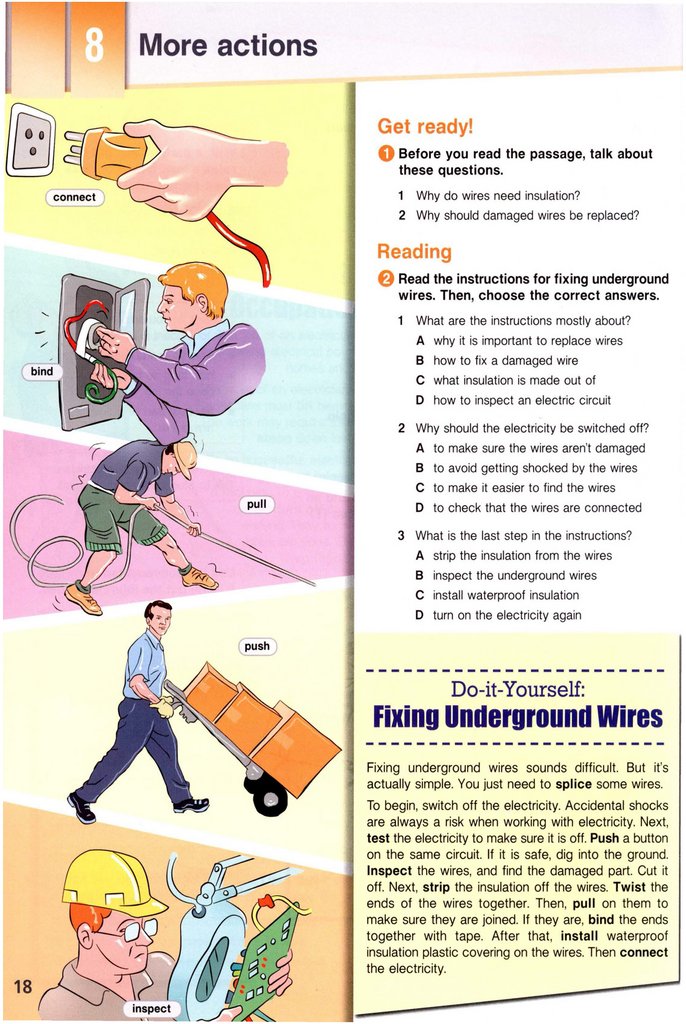
More actions']_-.·[: r·:I• .
' •1
w.
..
I
-
I
I
~
I
L • ~ I
I
Get ready!
0 Before you read the passage, talk about
these questions.
connect
l:i-':.
I
•'
1 Why do wires need insulation?
2 Why should damaged wires be replaced?
Reading
f) Read the instructions for fi xing underground
wires. Then, choose the correct answers.
1 What are the instructions mostly about?
A why it is important to replace wires
B how to fix a damaged wire
C what insulation is made out of
D how to inspect an electric circuit
2 Why should the electricity be switched off?
A to make sure the wires aren't damaged
B to avoid getting shocked by the wires
C to make it easier to find the wires
D to check that the wires are connected
3 What is the last step in the instructions?
A strip the insulation from the wires
B inspect the underground wires
C install waterproof insulation
D turn on the electricity again
Do-it-Yourself:
Fixing Underground Wires
Fixing underground wires sounds difficult. But it's
actually simple. You just need to splice some wires.
To begin, switch off the electric ity. Accidental shocks
are always a risk when working with electricity. Next,
test the electricity to make sure it is off. Push a button
on the same circuit. If it is safe, dig into the ground.
Inspect the wires, and find the damaged part. Cut it
off. Next, strip the insulation off the wires. Twist the
ends of the wires together. Then, pull on them to
make sure they are joined. If they are, bind the ends
together with tape. After that, instal I waterproof
insulation plastic covering on the wires. Then connect
the electricity.
18
21.
VocabularySpeaking
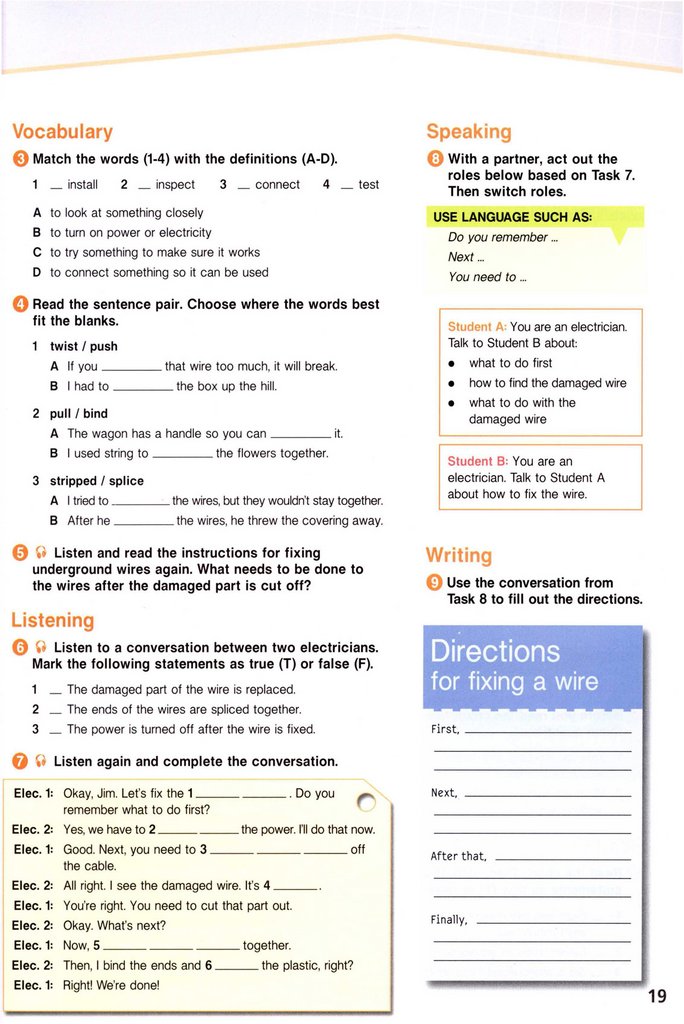
8 Match the words (1-4) with the definitions (A-D).
0 With a partner, act out the
_ install
2 _ inspect
3 _ connect
4 _ test
A to look at something closely
roles below based on Task 7.
Then switch roles.
USE LANGUAGE SUCH AS:
B to turn on power or electricity
Do you remember ...
C to try something to make sure it works
Next ...
D to connect something so it can be used
You need to ...
C) Read the sentence pair. Choose where the words best
fit the blanks.
Student A: You are an electrician.
Talk to Student B about:
1 twist I push
A If you _ _ _ _ that wire too much, it will break.
what to do first
B I had to
how to find the damaged wire
what to do with the
damaged wire
the box up the hill.
2 pull/ bind
A The wagon has a handle so you can _ _ _ _ it.
B I used string to _ _ _ _ the flowers together.
Student B: You are an
3 stripped I splice
A I tried to _ _ _ _ the wires, but they wouldn't stay together.
B After he
electrician. Talk to Student A
about how to fix the wire.
the wires, he threw the covering away.
0 " Listen and read the instructions for fixing
underground wires again. What needs to be done to
the wires after the damaged part is cut off?
Writing
0 Use the conversation from
Task 8 to fill out the directions.
Listening
0 " Listen to a conversation between two electricians.
Mark the following statements as true (T) or false (F).
1 _ The damaged part of the wire is replaced.
2 _ The ends of the wires are spliced together.
3 _ The power is turned off after the wire is fixed.
First, _ _ _ _ _ _ _ _ __
0 " Listen again and complete the conversation.
Next, _ _ _ _ _ _ _ _ __
Elec. 1: Okay, Jim. Let's fix the 1 _ _ _ _ _ _ . Do you
remember what to do first?
Elec. 2: Yes, we have to 2 _ _ _ _ the power. I'll do that now.
Elec. 1: Good. Next, you need to 3
off
the cable.
After that,
Elec. 2: All right. I see the damaged wire. It's 4 _ __
Elec. 1: You're right. You need to cut that part out.
Elec. 2: Okay. What's next?
Elec. 1: Now, 5 _ ____ _ _ _ _ together.
Elec. 2: Then, I bind the ends and 6
Elec. 1: Right! We're done!
Finally,
the plastic, right?
19
22.
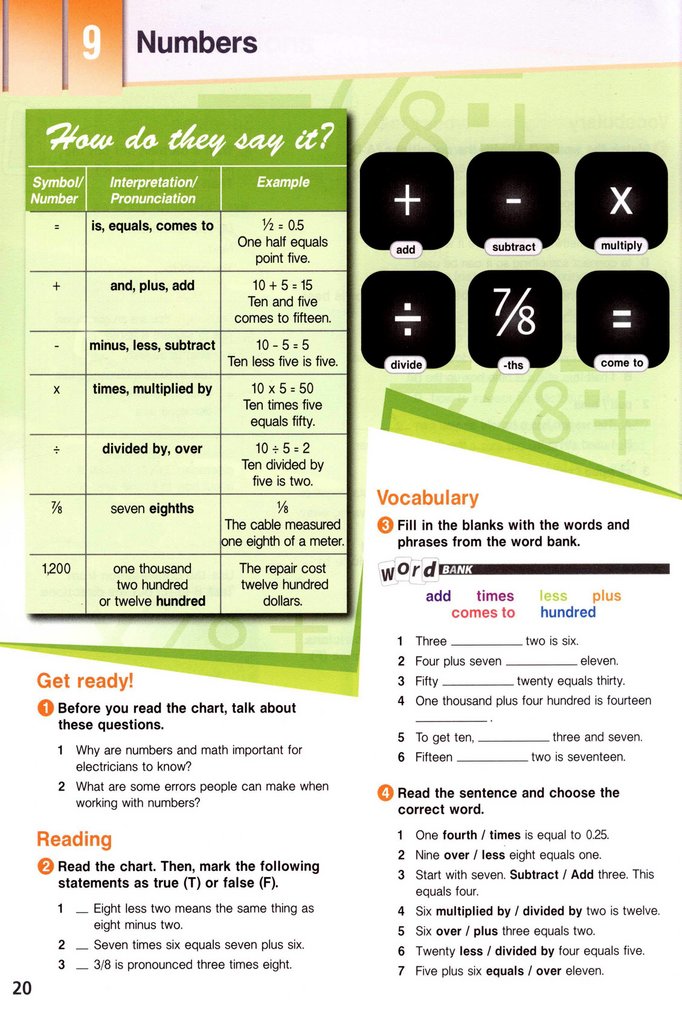
Numbers=
is, equals, comes to
Yi= 0.5
One half equals
point five.
+
and, plus, add
10 + 5 =15
Ten and five
comes to fifteen.
minus, less, subtract
10 - 5 = 5
Ten less five is five.
x
times, multiplied by
10 x 5 = 50
Ten times five
equals fifty.
divided by, over
10 7 5 = 2
Ten divided by
five is two.
Ya
seven eighths
Ya
The cable measured
one eighth of a meter.
1,200
one thousand
two hundred
or twelve hundred
The repair cost
twelve hundred
dollars.
Vocabulary
8 Fill in the blanks with the words and
phrases from the word bank.
~
BANK
add
times
comes to
les
plus
hundred
1 Three _ _ _ _ two is six.
2 Four plus seven
Get ready!
3 Fifty
0 Before you read the chart, talk about
4 One thousand plus four hundred is fourteen
these questions.
1 Why are numbers and math important for
electricians to know?
2 What are some errors people can make when
working with numbers?
Reading
f) Read the chart. Then, mark the following
20
eleven.
twenty equals thirty.
s To get ten, _ _ _ _ three and seven.
6 Fifteen
two is seventeen.
0 Read the sentence and choose the
correct word.
1 One fourth I times is equal to 0.25.
2 Nine over I less eight equals one.
statements as true (T) or false (F).
3 Start with seven. Subtract I Add three. This
equals four.
1 _ Eight less two means the same thing as
eight minus two.
4 Six multiplied by I divided by two is twelve.
5 Six over I plus three equals two.
2 _ Seven times six equals seven plus six.
6 Twenty less I divided by four equals five.
3 _ 3/8 is pronounced three times eight.
7 Five plus six equals I over eleven.
23.
0 g Listen and read the chart again. Whatare some ways to describe a total amount
after subtracting numbers?
Speaking
(i) With a partner, act out the roles below
based on Task 7. Then switch roles.
USE LANGUAGE SUCH AS:
Listening
0 g Listen to a conversation between two
electricians. Choose the correct answers.
Can you help me ...
There are ... checks.
Yeah, I multiplied ...
1 What is the conversation mostly about?
A
how much money electricians make
B why the deposit slip total is in error
C
the number of checks being deposited
D
the mistake the man made in adding
2 What did the man do wrong?
Student A: You are an electrician. Ask
Student B about:
a problem with a deposit slip
amount of cash deposited
how you counted the checks
A He miscounted the number of checks.
B
He wrote down the wrong total.
C
He forgot to add in one of the checks.
D He made an error in multiplication.
Student 8: You are Student A's co-worker.
Help Student A find the correct total for the
deposit slip.
8 g Listen again and complete the
conversation.
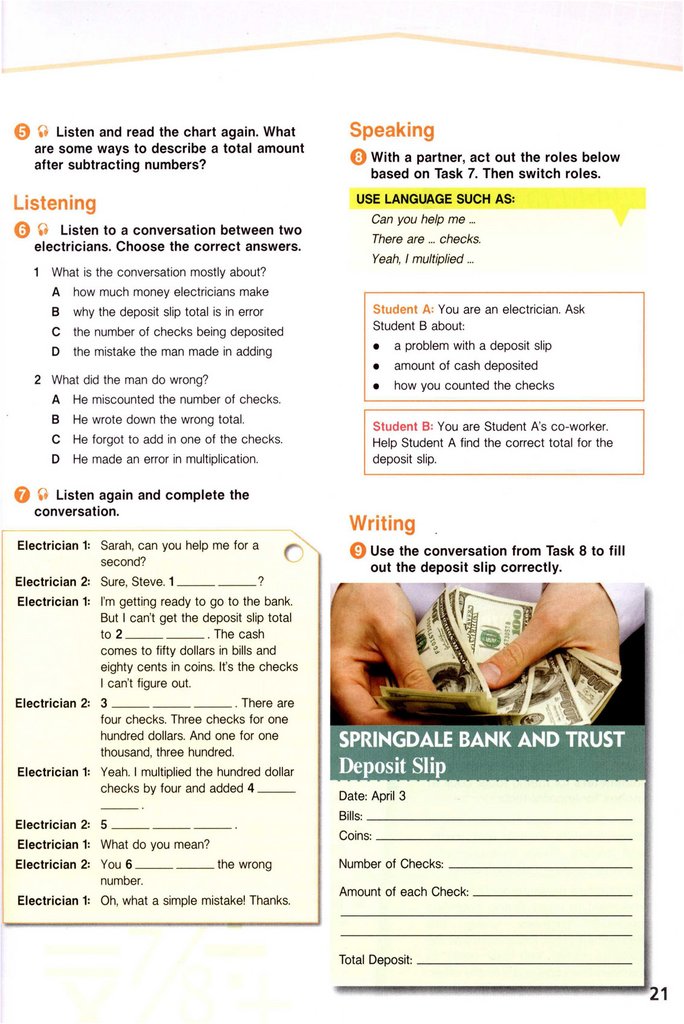
r Electrician 1:
Writing
Sarah, can you help me for a
second?
0 Use the conversation from Task 8 to fill
out the deposit slip correctly.
Electrician 2: Sure, Steve.1 _ _ _ _ ?
Electrician 1: I'm getting ready to go to the bank.
But I can't get the deposit slip total
to 2 _ _ _ _ . The cash
comes to fifty dollars in bills and
eighty cents in coins. It's the checks
I can't figure out.
Electrician 2: 3 _ _ _ _ __
. There are
four checks. Three checks for one
hundred dollars. And one for one
thousand, three hundred.
Electrician 1: Yeah. I multiplied the hundred dollar
checks by four and added 4 _ _
--·
Electrician 2: 5 _ _ _ _ _ _ ,
Date: April 3
Bills: _ _ _ _ _ _ _ _ _ _ _ _ _ _ _ __
Coins: _ _ _ _ _ _ _ _ _ _ _ _ _ _ __
Electrician 1: What do you mean?
Electrician 2: You 6 _ _ _ _ the wrong
number.
Electrician 1: Oh, what a simple mistake! Thanks.
Number of Checks: _ _ _ _ _ _ _ _ _ _ __
Amount of each Check: _ _ _ _ _ _ _ _ __
Total Deposit: _ _ _ _ _ _ _ _ _ _ _ _ __
24.
MeasurementsGet ready!
0 Before you read the passage, talk about these questions.
1 What kinds of measurements are used by electricians?
2 What can happen if measurements aren't accurate?
Reading
f.) Read the magazine article about measurements. Then,
mark the following statements as true (T) or false (F).
1 _ Millimeters are often used in building plans.
2 _ Inches are used for imperial tools.
3 _ Using the wrong size tool can cause injury.
Vocabulary
E) Match the words (1-8) with the definitions (A-H).
1 _degree
5 _convert
2 _ yard
6 _Celsius
3 _imperial
7 _ centimeter
4 _ round off
8 _ micrometer
A to change from one system into another
B a metric measure of length or distance
c a unit used to measure temperature
D to damage a screw or bolt
E a tool that measures small distances
F the system that uses inches
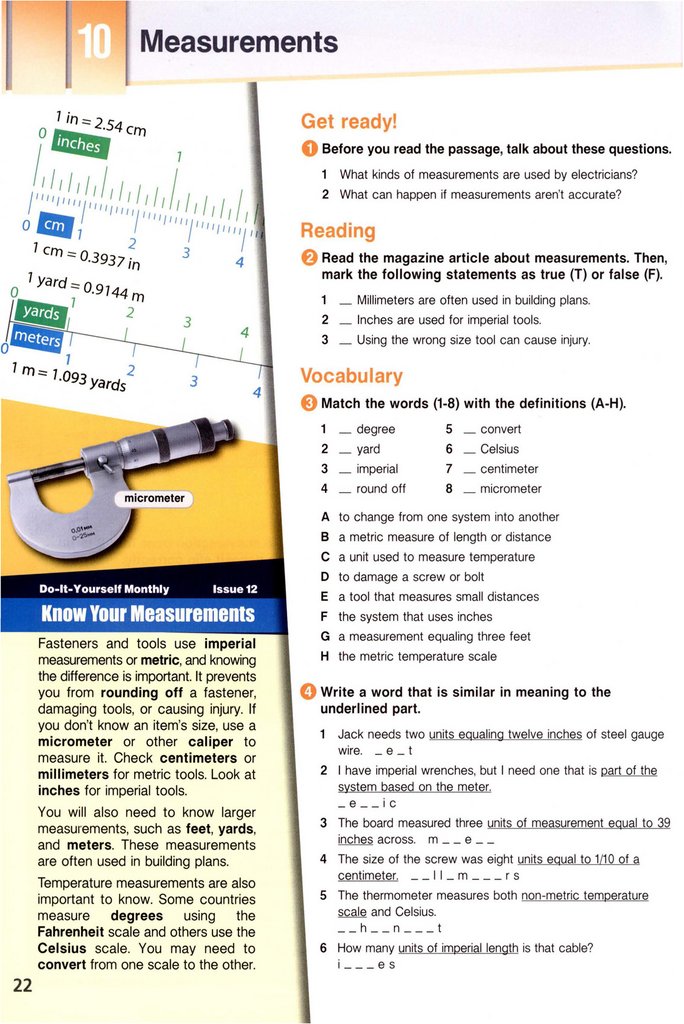
Fasteners and tools use imperial
measurements or metric, and knowing
the difference is important. It prevents
you from rounding off a fastener,
damaging tools, or causing injury. If
you don't know an item's size, use a
micrometer or other caliper to
measure it. Check centimeters or
millimeters for metric tools. Look at
inches for imperial tools.
You will also need to know larger
measurements, such as feet, yards,
and meters. These measurements
are often used in building plans.
Temperature measurements are also
important to know. Some countries
measure
degrees
using
the
Fahrenheit scale and others use the
Celsius scale. You may need to
convert from one scale to the other.
22
G a measurement equaling three feet
H the metric temperature scale
0 Write a word that is simi lar in meaning to the
underlined part.
1 Jack needs two units equaling twelve inches of steel gauge
wire. _ e _ t
2 I have imperial wrenches, but I need one that is part of the
system based on the meter.
_e __ ic
3 The board measured three units of measurement equal to 39
inches across. m __ e __
4 The size of the screw was eight units equal to 1/10 of a
centimeter. __ I I _ m ___ r s
5 The thermometer measures both non-metric temperature
scale and Celsius.
__ h __ n ___ t
6 How many units of imperial length is that cable?
i ___ es
25.
0 g Listen and read the magazine articleSpeaking
about measurements again. What are
some reasons you should make sure you
have the right size tool for a job?
0 With a partner, act out the roles below
based on Task 7. Then switch roles.
USE LANGUAGE SUCH AS:
Listening
My wrench keeps slipping ...
0 g Listen to a conversation between two
I'm pretty sure ...
You can't use a ... with a ...
electricians. Choose the correct answers.
1 What is the conversation mostly about?
A why metric tools are better than imperial
B the reason why a tool is not working right
Student A: You are an electrician. Talk to
Student B about:
C what size wrench to use on certain jobs
a problem repairing a panel box
D types of tools to keep in a tool kit
using the correct tool
making sure of the correct measurement
system
2 What is the problem?
A The wrench and bolt are different sizes.
B The man forgot his wrenches in the tool kit.
Student B: You are an electrician. Talk to
Student A about using proper size tools.
C The man cannot tighten the bolt enough.
D The wrench is slippery in the man's hand.
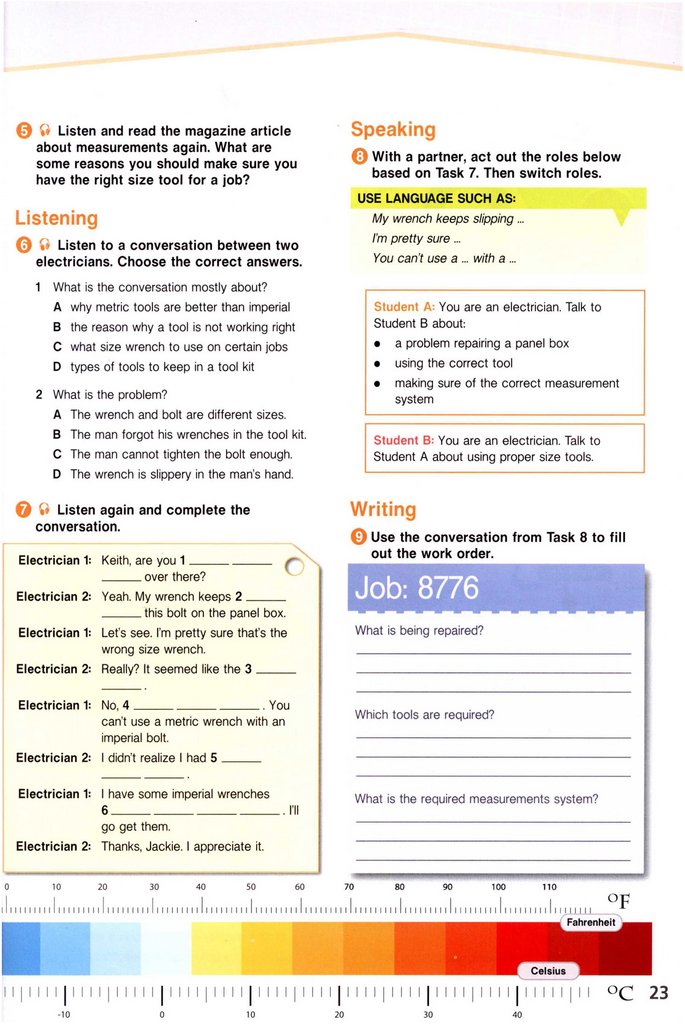
0 g Listen again and complete the
Writing
conversation.
0 Use the conversation from Task 8 to fill
r Electrician 1: Keith, are you 1 _ __ __ _
out the work order.
___ over there?
Electrician 2: Yeah. My wrench keeps 2 _ __
___ this bolt on the panel box.
What is being repaired?
Electrician 1: Let's see. I'm pretty sure that's the
wrong size wrench.
Electrician 2: Really? It seemed like the 3 _ __
Electrician 1: No, 4 _ __ ___ ___ . You
can't use a metric wrench with an
imperial bolt.
Which tools are required?
Electrician 2: I didn't realize I had 5 _ __
,
Electrician 1: I have some imperial wrenches
What is the required measurements system?
. I'll
6
go get them.
Electrician 2: Thanks, Jackie. I appreciate it.
0
10
20
40
30
50
60
70
80
90
100
110
1111111 1 11111 1 1111 1 1111111 1 1 1 11 1 111111 1 111111111 1 111111111 1 11111111
-10
0
10
20
30
40
oc 23
26.
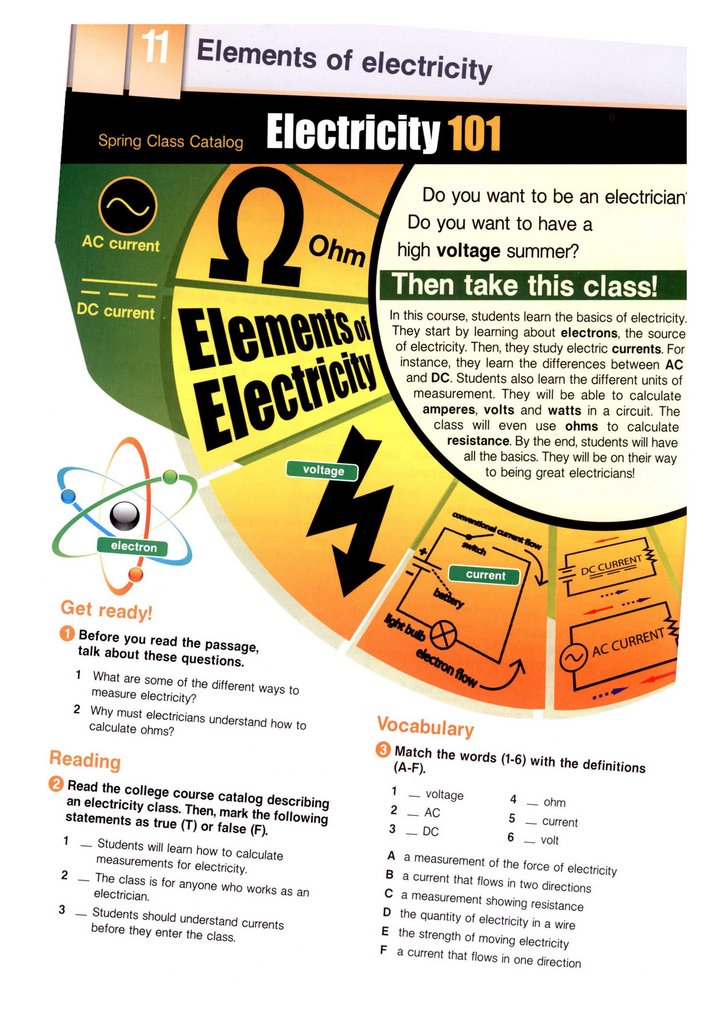
Elements of electricity.. ?
Do you want to be an electnc1an.
Do you want to have a
high voltage summer?
n take this class.
1
basics of electricity.
In this course, stude.nts ear~tthe
electrons, the source
sta~ . ~~arn1~e~~~udy
by
electric currents. For
They
of electricity. en, th differences between AC
instance, they learn I e I n the different units of
and DC. Student~~ so :i ~r be able to calculate
measurement~lts e:nd watts in a circuit. The
amperes,
.v even use ohms to calculate
.
class will
By the end ' students
will
.
resistance.
.
h · have
wa
all the basics. They will b~ ?n t' eir
Y
to being great electricians.
Get ready!
0 Before you read the passage,
talk about these questions.
1 What are some of the different ways to
measure electricity?
2 Why must electricians understand how to
calculate ohms?
Reading
f) Read the college course catalog describing
an electricity class. Then, mark the following
statements as true (T) or false (F).
1 _ Students will learn how to calculate
measurements for electricity.
2 _ The class is for anyone who works as an
electrician.
24
3 _ Students should understand currents
before they enter the class.
Vocabulary
$ (A-F).
Match the words (1-6) with the definitions
1 _ voltage
2 - AC
3 _ DC
4 _ ohm
5 _ current
6 _ volt
A a measurement of the force of electricity
8 a current that flows in two directions
C a measurement showing resistance
D the quantity of electricity in a wire
E the strength of moving electricity
F a current that flows in one direction
27.
0 Fill in the blanks with the words from the word bank.Speaking
BANK
~
electron
0 With a partner, act out the
resistance
watt
roles below based on Task 7.
Then switch roles.
amperes
USE LANGUAGE SUCH AS:
1 A(n) _ _ _ _ is too small to see without a powerful
microscope.
I still don't understand ...
Do you remember ...
2 Many wires are made out of copper because of its low
What do you mean?
3 A(n) _ _ _ _ measures how much electrical power is
being used.
Student A: You are a teacher.
Talk to Student B about:
4 A common way to measure electric current is _ _ __
0 g Listen and read the college course catalog
describing an electricity class again. What kinds of
calculations will students learn to do?
Listening
0 g Listen to a class about electricity. Mark the
the topic of the lesson
what the letters AC and DC
stand for
the difference between AC
and DC
Student 8: You are a student.
Talk to Student A about what
you don't understand about the
types of currents.
following statements as true (T) or false (F).
1 _ The woman doesn't understand the difference between
two types of currents.
2 _ Remembering what the letters stand for helps the woman.
3 _ The woman is learning about AC and DC for the first time.
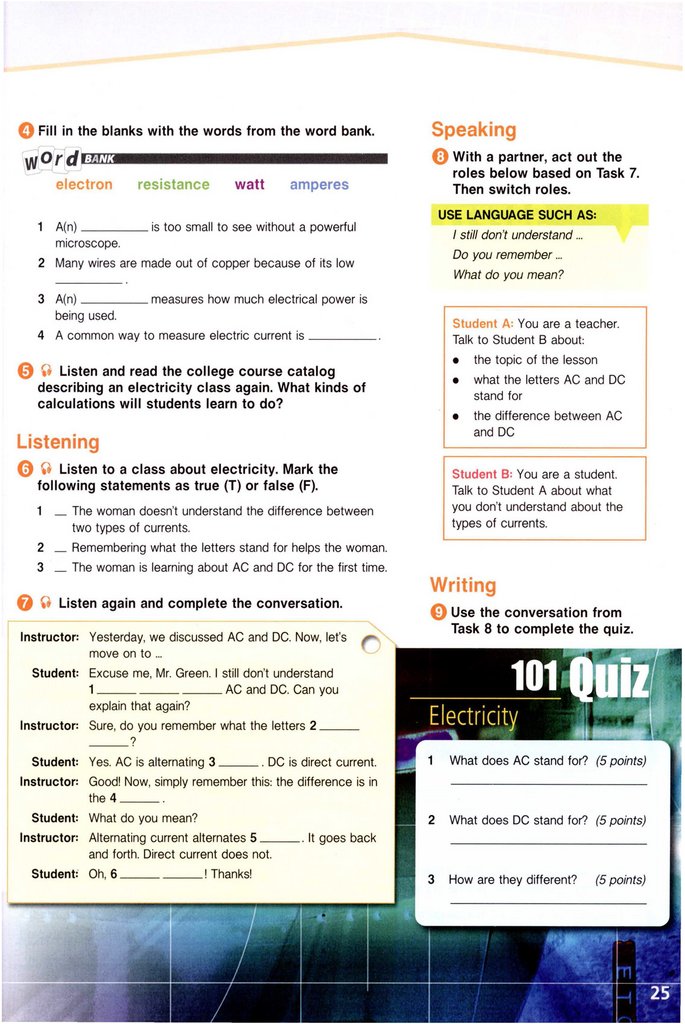
f) g Listen again and complete the conversation.
Writing
0 Use the conversation from
Task 8 to complete the quiz.
Instructor: Yesterday, we discussed AC and DC. Now, let's
move on to ...
Student: Excuse me, Mr. Green. I still don't understand
1
AC and DC. Can you
explain that again?
Instructor: Sure, do you remember what the letters 2 _ __
___ ?
Student: Yes. AC is alternating 3
What does AC stand for? (5 points)
. DC is direct current.
Instructor: Good! Now, simply remember this: the difference is in
the 4 _ __
Student: What do you mean?
2
What does DC stand for? (5 points)
3
How are they different?
Instructor: Alternating current alternates 5 ___ . It goes back
and forth. Direct current does not.
Student:· Oh, 6
! Thanks!
(5 points)
28.
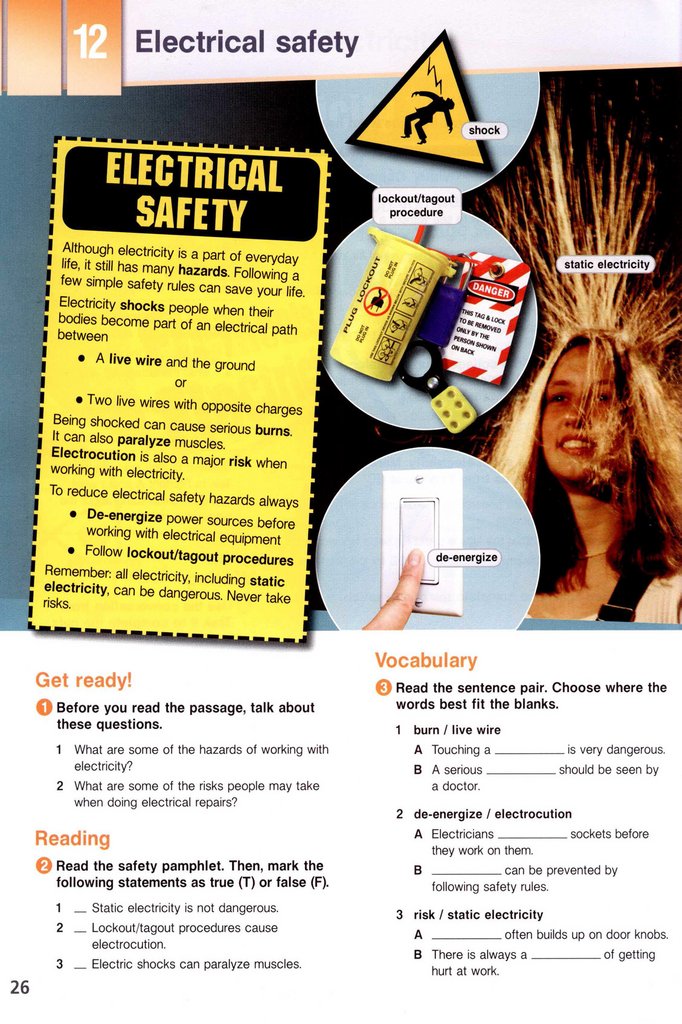
Electrical safetyVocabulary
Get ready!
0 Before you read the passage, talk about
these questions.
1 What are some of the hazards of working with
electricity?
2 What are some of the risks people may take
when doing electrical repairs?
E) Read the sentence pair. Choose where the
words best fit the blanks.
1 burn I live wire
A Touching a _ _ __
is very dangerous.
B A serious
should be seen by
a doctor.
2 de-energize I electrocution
Reading
A Electricians
f) Read the safety pamphlet. Then, mark the
B
following statements as true (T) or false (F).
1 _ Static electricity is not dangerous.
2 _ Lockout/tagout procedures cause
electrocution.
3 _ Electric shocks can paralyze muscles.
26
sockets before
they work on them.
can be prevented by
following safety rules.
3 risk I static electricity
A
often builds up on door knobs.
B There is always a
hurt at work.
of getting
29.
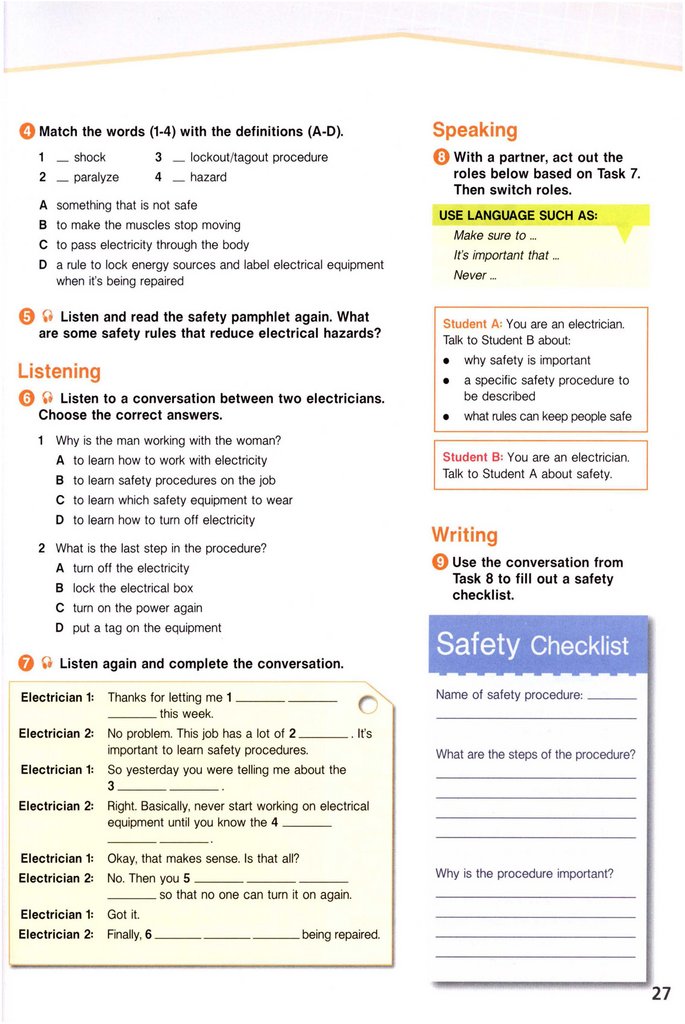
0 Match the words (1-4) with the definitions (A-D).1 _ shock
3 _ lockout/tagout procedure
2 _ paralyze
4 _ hazard
A something that is not safe
B to make the muscles stop moving
Speaking
0 With a partner, act out the
roles below based on Task 7.
Then switch roles.
USE LANGUAGE SUCH AS:
Make sure to ...
C to pass electricity through the body
It's important that ...
D a rule to lock energy sources and label electrical equipment
when it's being repaired
0 " Listen and read the safety pamphlet again. What
are some safety rules that reduce electrical hazards?
Listening
Never ...
Student A: You are an electrician.
Talk to Student B about:
why safety is important
a specific safety procedure to
be described
what rules can keep people safe
0 " Listen to a conversation between two electricians.
Choose the correct answers.
1 Why is the man working with the woman?
A to learn how to work with electricity
8 to learn safety procedures on the job
Student 8: You are an electrician.
Talk to Student A about safety.
C to learn which safety equipment to wear
D to learn how to turn off electricity
2 What is the last step in the procedure?
A turn off the electricity
8 lock the electrical box
Writing
0 Use the conversation from
Task 8 to fill out a safety
checklist.
C turn on the power again
D put a tag on the equipment
0 " Listen again and complete the conversation.
Electrician 1:
Thanks for letting me 1 _ _ _ _ __
_ _ _ this week.
Electrician 2:
No problem. This job has a lot of 2 _ _ _ . It's
important to learn safety procedures.
Electrician 1:
So yesterday you were telling me about the
3 _ _ _ _ __
Electrician 2:
Right. Basically, never start working on electrical
equipment until you know the 4 _ __
Electrician 1:
Okay, that makes sense. Is that all?
Electrician 2:
No. Then you 5 _ _ _ _ _ _ _ __
_ _ _ so that no one can turn it on again.
Electrician 1:
Got it.
Electrician 2:
Finally, 6 _ _ _ _ _ _ _ _ _ being repaired.
Name of safety procedure: _ __
What are the steps of the procedure?
Why is the procedure important?
27
30.
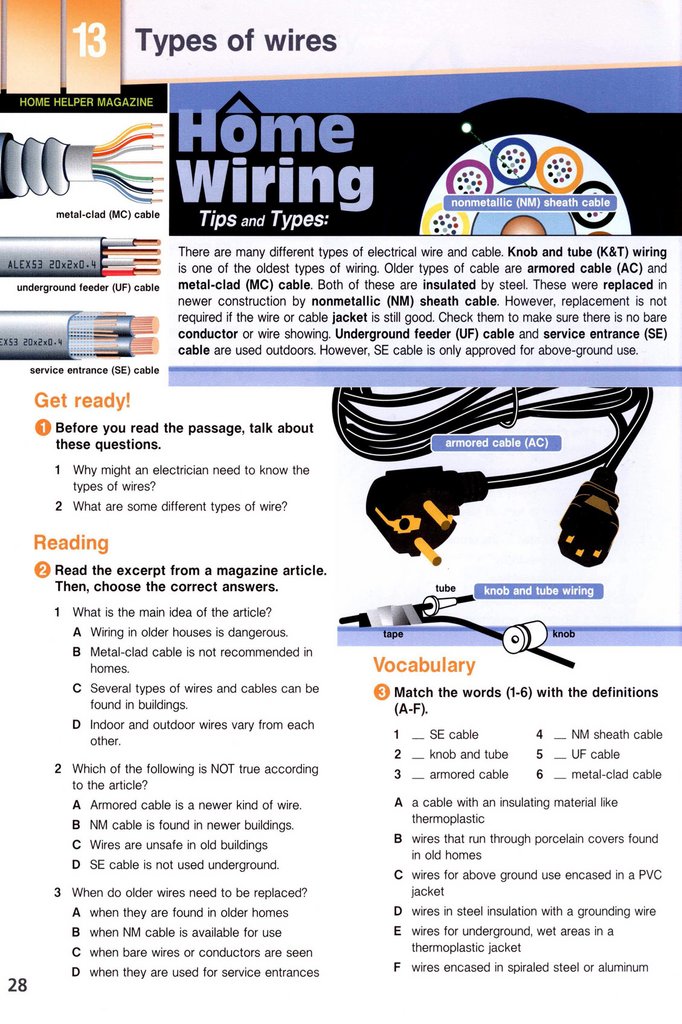
Types of wiresunderground feeder (UF) cable
~ XS3 2Dx2xa.~
There are many different types of electrical wire and cable. Knob and tube (K& T) wiring
is one of the oldest types of wiring. Older types of cable are armored cable (AC) and
metal-clad (MC) cable. Both of these are insulated by steel. These were replaced in
newer construction by nonmetallic (NM) sheath cable. However, replacement is not
required if the wire or cable jacket is still good. Check them to make sure there is no bare
conductor or wire showing. Underground feeder (UF) cable and service entrance (SE)
cable are used outdoors. However, SE cable is only approved for above-ground use.
service entrance (SE) cable
Get ready!
0 Before you read the passage, talk about
these questions.
1 Why might an electrician need to know the
types of wires?
2 What are some different types of wire?
Reading
f) Read the excerpt from a magazine article.
Then, choose the correct answers.
tube
knob and tube wiring
1 What is the main idea of the article?
A Wiring in older houses is dangerous.
B Metal-clad cable is not recommended in
homes.
C Several types of wires and cables can be
found in buildings.
D Indoor and outdoor wires vary from each
other.
2 Which of the following is NOT true according
to the article?
A Armored cable is a newer kind of wire.
B NM cable is found in newer buildings.
C Wires are unsafe in old buildings
D SE cable is not used underground.
f) Match the words (1-6) with the definitions
(A-F).
1 _ SE cable
4 _ NM sheath cable
2 _ knob and tube
5 _ UF cable
3 _ armored cable
6 _ metal-clad cable
A a cable with an insulating material like
thermoplastic
B wires that run through porcelain covers found
in old homes
3 When do older wires need to be replaced?
C wires for above ground use encased in a PVC
jacket
A when they are found in older homes
D wires in steel insulation with a grounding wire
B when NM cable is available for use
E wires for underground, wet areas in a
C when bare wires or conductors are seen
28
Vocabulary
D when they are used for service entrances
thermoplastic jacket
F wires encased in spiraled steel or aluminum
31.
C) Read the sentence pair. Choose where thewords best fit the blanks.
0 With a partner, act out the roles below
1 conductor I jacket
based on Task 7. Then switch roles.
A It looks like the
B The
Speaking
is bare.
is cracked.
We're worried whether or not ...
It looks like you've got ...
2 required I insulated
A Modern wires should always be _ _ __
B UF or SE cable are
wiring.
USE LANGUAGE SUCH AS:
It depends on ...
for outdoor
0 g Listen and read the excerpt from the
magazine article again. When do you not
need to replace older types of wiring?
Student A: You are an electrician. Talk to
Student B about:
what Student B is worried about
what type of wiring he or she has
the condition of the wiring
Listening
0 g Listen to a conversation between a
homeowner and an electrician. Mark the
following statements as true (T) or false (F).
Student B: You are a new homeowner. Talk to
the electrician about your wiring.
1 _ The homeowner has lived in the house for
many years.
Writing
2 _ The wiring is nonmetallic sheath cable.
0 Use the conversation from Task 8 to fill
3 _ The electrician will replace the wiring
tomorrow.
out the customer feedback form.
0 g Listen again and complete the
conversation.
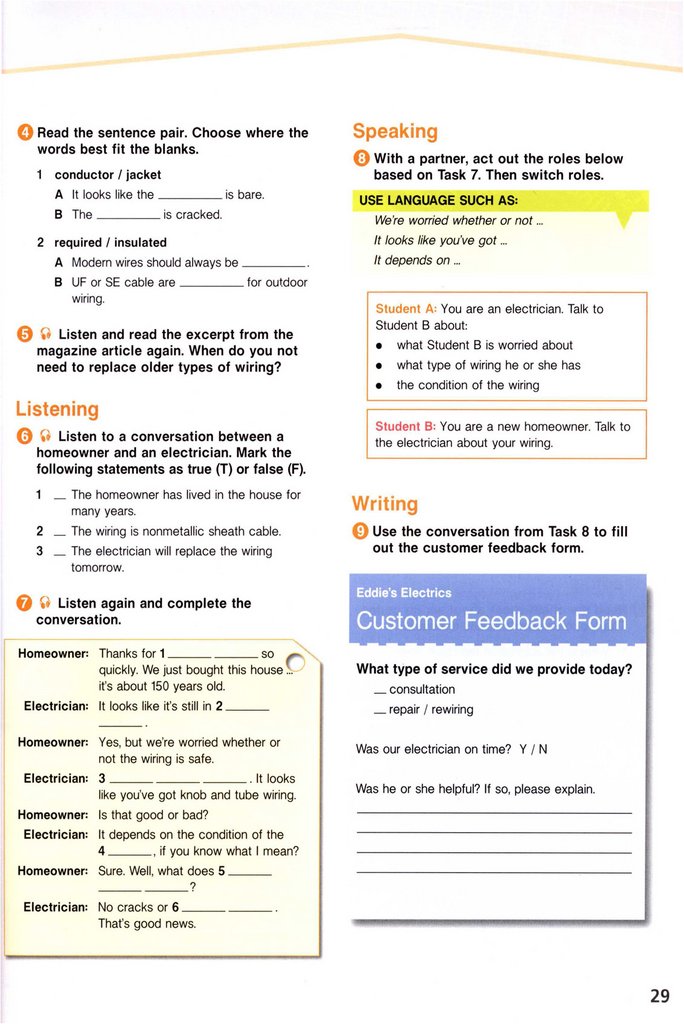
j Homeowner: Thanks for 1
so
quickly. We just bought this house ...
it's about 150 years old.
Electrician: It looks like it's still in 2 _ __
Homeowner: Yes, but we're worried whether or
not the wiring is safe.
What type of service did we provide today?
_ consultation
_ repair I rewiring
Was our electrician on time? Y I N
Electrician: 3 _ _ _ _ _ _ _ _ _ . It looks
like you've got knob and tube wiring.
Was he or she helpful? If so, please explain.
Homeowner: Is that good or bad?
Electrician: It depends on the condition of the
4
, if you know what I mean?
Homeowner: Sure. Well, what does 5 _ __
______ ?
Electrician: No cracks or 6 _ _ _ _ __
That's good news.
29
32.
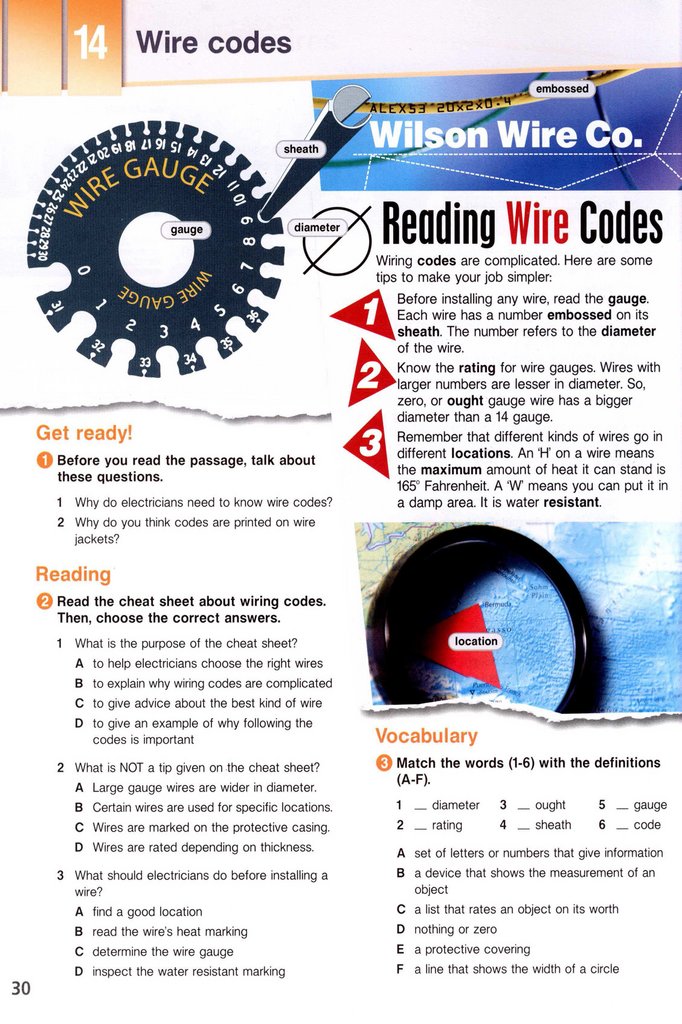
Wire codes~ w~n~!~.i!~am!~1~eHe~!~a~eS
tips to make your job simpler:
Before installing any wire, read the gauge.
Each wire has a number embossed on its
sheath. The number refers to the diameter
of the wire.
Know the rating for wire gauges. Wires with
larger numbers are lesser in diameter. So,
zero, or ought gauge wire has a bigger
diameter than a 14 gauge.
Get ready!
0 Before you read the passage, talk about
these questions.
1 Why do electricians need to know wire codes?
Remember that different kinds of wires go in
different locations. An 'H' on a wire means
the maximum amount of heat it can stand is
165° Fahrenheit. A 'W' means you can put it in
a damp area. It is water resistant.
2 Why do you think codes are printed on wire
jackets?
Reading
f) Read the cheat sheet about wiring codes.
Then, choose the correct answers.
1 What is the purpose of the cheat sheet?
A to help electricians choose the right wires
B to explain why wiring codes are complicated
C to give advice about the best kind of wire
D to give an example of why following the
codes is important
2 What is NOT a tip given on the cheat sheet?
A Large gauge wires are wider in diameter.
30
Vocabulary
t) Match the words (1-6) with the definitions
(A-F).
B Certain wires are used for specific locations.
1 _ diameter
3 _ ought
5 _ gauge
C Wires are marked on the protective casing.
2 _ rating
4 _ sheath
6 _code
D Wires are rated depending on thickness.
A set of letters or numbers that give information
3 What should electricians do before installing a
wire?
B a device that shows the measurement of an
object
A find a good location
C a list that rates an object on its worth
B read the wire's heat marking
D nothing or zero
C determine the wire gauge
E a protective covering
D inspect the water resistant marking
F a line that shows the width of a circle
33.
0 Fill in the blanks with the words from theword bank.
Speaking
0 With a partner, act out the roles below
\Wl9/d]
BANK
based on Task 7. Then switch roles.
maximum
resistant
embossed location
1 I want to keep the _ _ _ _ of the party a
secret.
USE LANGUAGE SUCH AS:
What kind of ...
I think ...
We probably need ...
2 The
amount of weight for the
ride is 250 pounds.
Student A: You are an electrician. Talk to
Student B about:
3 The wires are heat _ _ _ _ up to 200
degrees.
where the wire will go
4 I had the watch _ _ __
what is the best wire gauge
what special markings the wire should have
with her name.
0 " Listen and read the cheat sheet about
wiring codes again. What does it mean if
a wire is embossed with an 'H' or a 'W'?
Listening
Student B: You are an electrician. Talk to
Student A about why a certain kind of wire is
best for the location.
0 " Listen to a conversation between two
electricians. Mark the following
statements as true (T) or false (F).
_ The wire the electricians are installing
needs to be protected from rain.
Writing
0 Use the conversation from Task 8 to fill
out the work record.
2 _ The electricians disagree about the right
wire gauge.
3 _ The wire is going to be buried.
0 " Listen again and complete the
conversation.
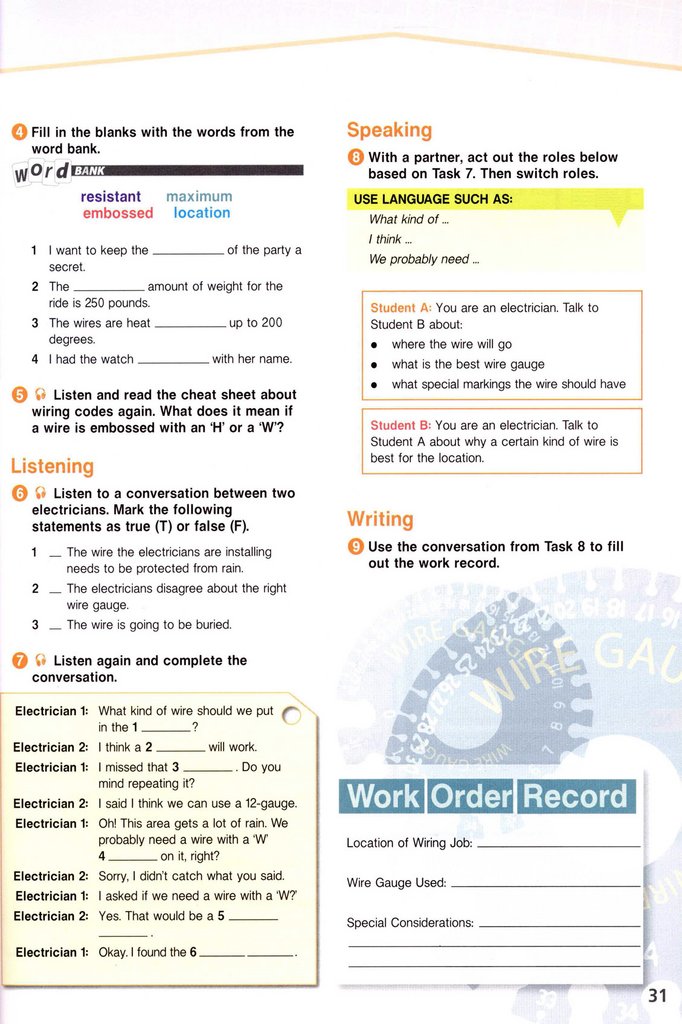
Electrician 1: What kind of wire should we put
in the 1
?
Electrician 2: I think a 2
will work.
Electrician 1: I missed that 3 _ _ _ . Do you
mind repeating it?
Record
Electrician 2: I said I think we can use a 12-gauge.
Work
Electrician 1: Oh! This area gets a lot of rain. We
probably need a wire with a 'W'
4
on it, right?
Location of Wiring Job: _ _ _ _ __ _ __ _
Electrician 2: Sorry, I didn't catch what you said.
Wire Gauge Used: _ _ _ _ _ _ _ _ _ _ __
Electrician 1: I asked if we need a wire with a 'W?'
Electrician 2: Yes. That would be a 5 _ __
Special Considerations: _ _ _ _ _ _ _ __ _
Electrician 1: Okay. I found the 6 _ _ _ ___
31
34.
Wire connectorswinged connector
''
''
''
' >--------------\
/
=
=
=
=
~
I
\
push-in connector
\
\
adjustable
type
\
\
I
\
I
waterproof connector
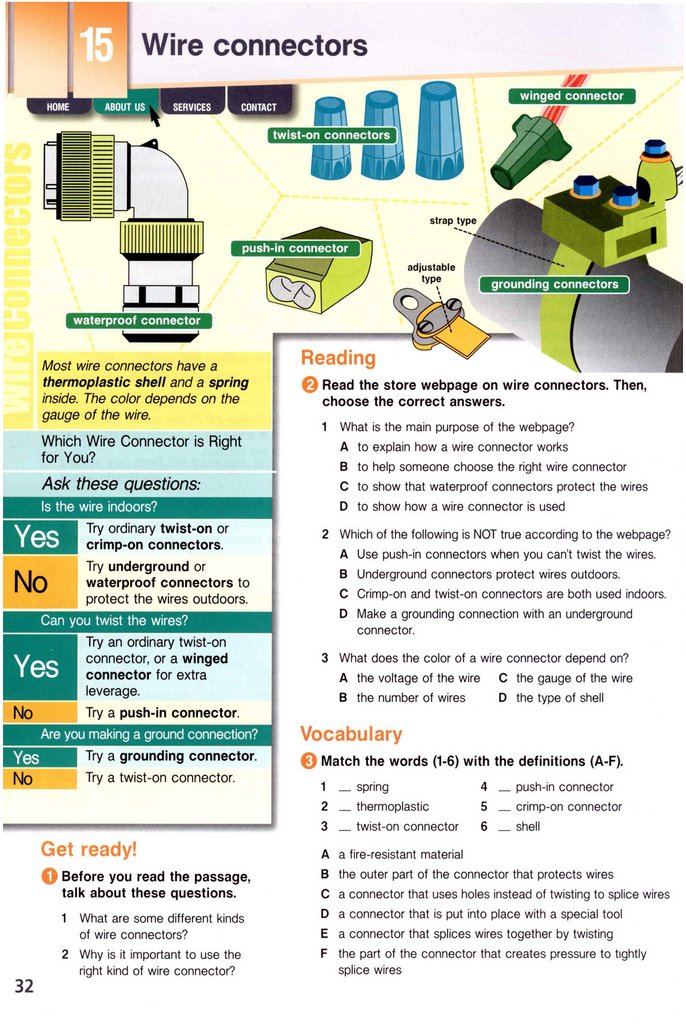
Most wire connectors have a
thermoplastic shell and a spring
inside. The co/or depends on the
gauge of the wire.
Reading
f} Read the store webpage on wire connectors. Then,
choose the correct answers.
1 What is the main purpose of the webpage?
Which Wire Connector is Right
for You?
A to explain how a wire connector works
B to help someone choose the right wire connector
Ask these questions:
C to show that waterproof connectors protect the wires
Is the wire indoors?
D to show how a wire connector is used
Ell
No
Try ordinary twist-on or
crimp-on connectors.
Try underground or
waterproof connectors to
protect the wires outdoors.
Can you twist the wires?
Try an ordinary twist-on
connector, or a winged
connector for extra
leverage.
2 Which of the following is NOT true according to the webpage?
A Use push-in connectors when you can't twist the wires.
B Underground connectors protect wires outdoors.
C Crimp-on and twist-on connectors are both used indoors.
D Make a grounding connection with an underground
connector.
3 What does the color of a wire connector depend on?
A the voltage of the wire
C the gauge of the wire
B the number of wires
D the type of shell
Vocabulary
f) Match the words (1-6) with the definitions (A-F).
No
32
Try a twist-on connector.
1 _spring
4 _ push-in connector
2 _ thermoplastic
5 _ crimp-on connector
3 _ twist-on connector
6 _shell
Get ready!
A a fire-resistant material
0 Before you read the passage,
B the outer part of the connector that protects wires
talk about these questions.
C a connector that uses holes instead of twisting to splice wires
1 What are some different kinds
of wire connectors?
D a connector that is put into place with a special tool
E a connector that splices wires together by twisting
2 Why is it important to use the
right kind of wire connector?
F the part of the connector that creates pressure to tightly
splice wires
35.
C) Read the sentence pair. Choose where the words bestfit the blanks.
0 With a partner, act out the
1 waterproof connector I underground connector
A He needed a(n)
bury.
for the wires he planned to
roles below based on Task 7.
Then switch roles.
USE LANGUAGE SUCH AS:
B It is best to use a _ _ _ _ when there's a possibility
wires may get wet.
2 grounding connector I winged connector
A Using a
B A
Speaking
Welcome to ...
I'm looking for a ...
I thought ...
is a good way to prevent shocks.
is easier to tighten than other types.
0 g Listen and read the store webpage on wire
connectors again. Why is it best to use an
underground connector or a waterproof connector
when a wire is outside?
Student A: You are a store
clerk. Talk to Student B about:
what he or she needs
your recommendation
why another product is not
needed
Listening
0 " Listen to a conversation between a store clerk and
customer. Mark the following statements as true (T) or
false (F).
Student B: You are a customer.
Talk to Student A about what
product you should buy.
_ The customer wants to wire the lights on her deck.
2 _ The salesperson says the customer needs a twist-on
connector.
Writing
3 _ The salesperson will show the customer where to find the
0 Use the conversation from
right connector.
Task 8 to fill out the customer
feedback form.
Listen again and complete the conversation.
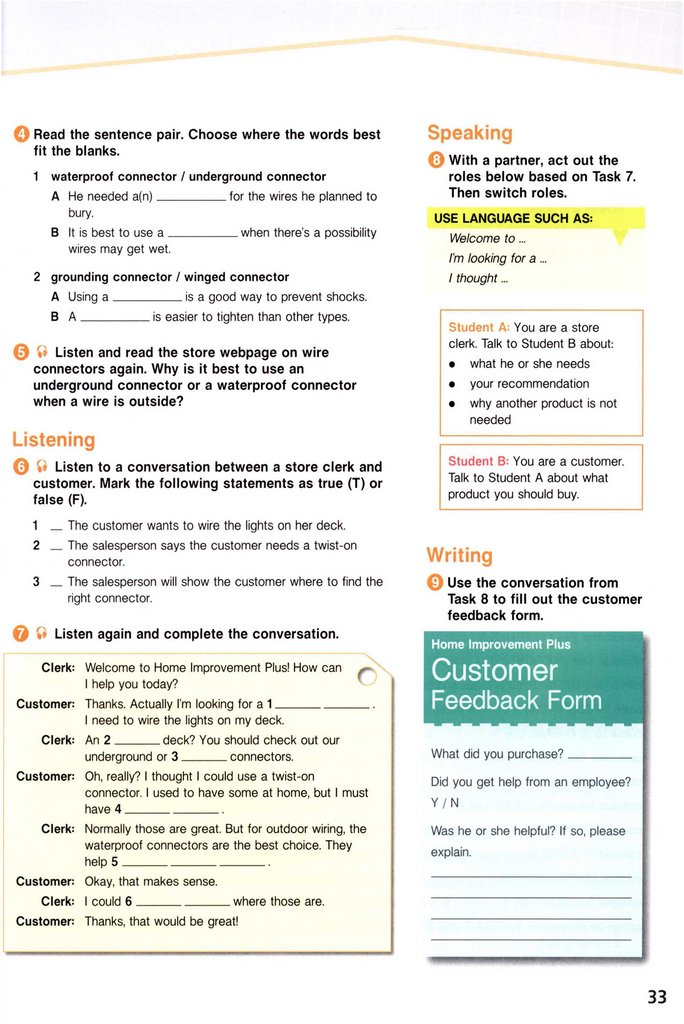
Clerk: Welcome to Home Improvement Plus! How can
I help you today?
Customer: Thanks. Actually I'm looking for a 1 _ _ _ _ __
I need to wire the lights on my deck.
Clerk: An 2
deck? You should check out our
underground or 3
connectors.
Customer: Oh, really? I thought I could use a twist-on
connector. I used to have some at home, but I must
have 4 _ _ _ _ _ __
Clerk: Normally those are great. But for outdoor wiring, the
waterproof connectors are the best choice. They
help 5 ___________
What did you purchase? _ _ __
Did you get help from an employee?
Y/ N
Was he or she helpful? If so, please
explain.
Customer: Okay, that makes sense.
Clerk: I could 6
where those are.
Customer: Thanks, that would be great!
33
36.
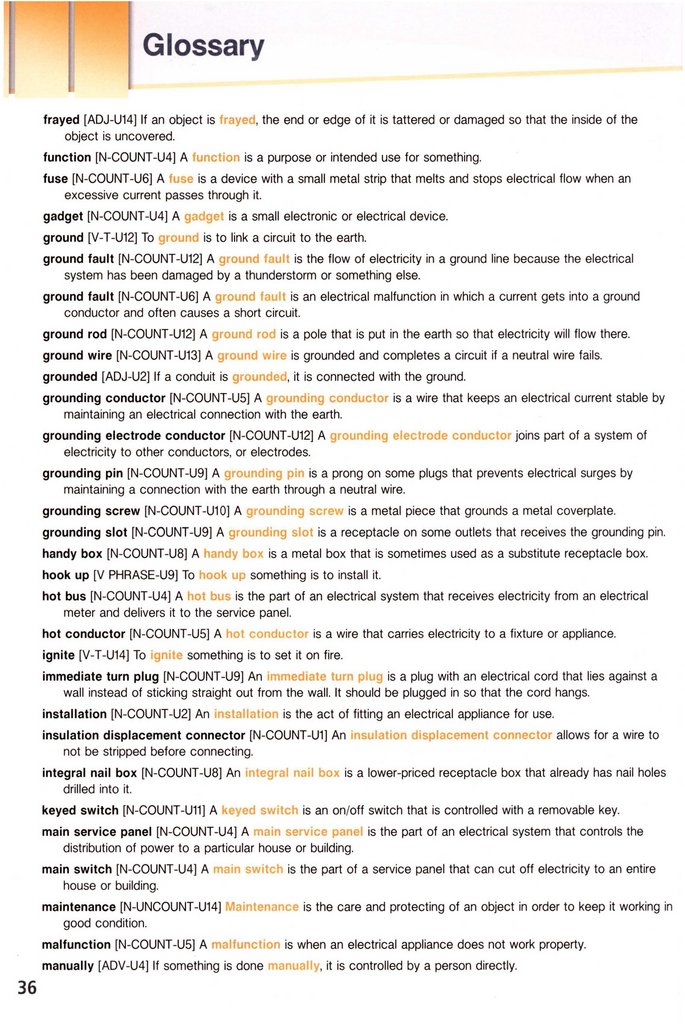
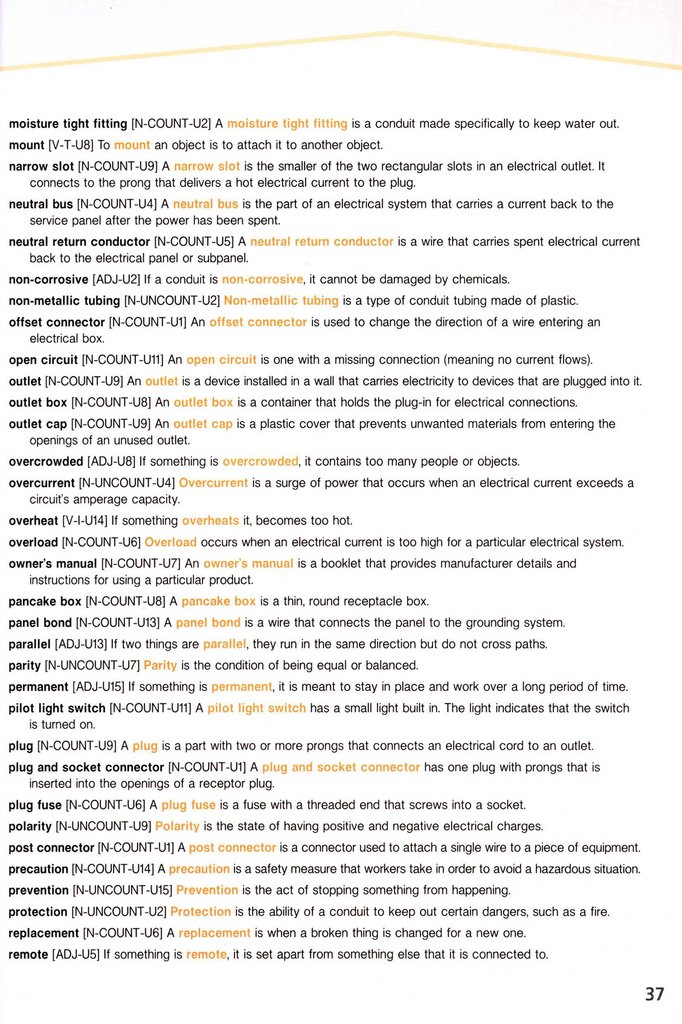
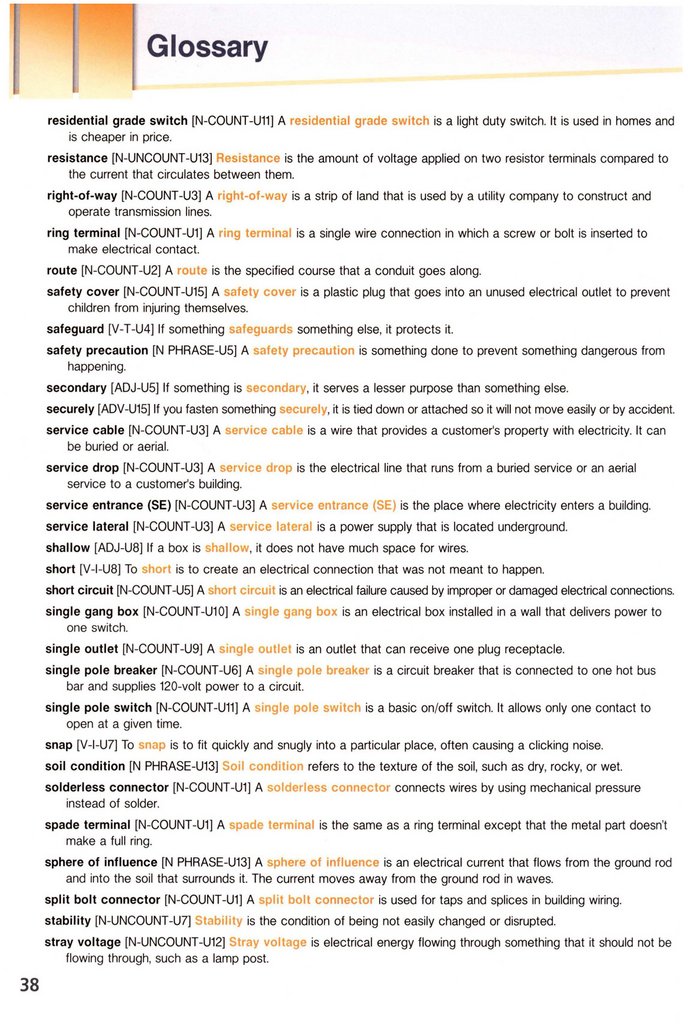
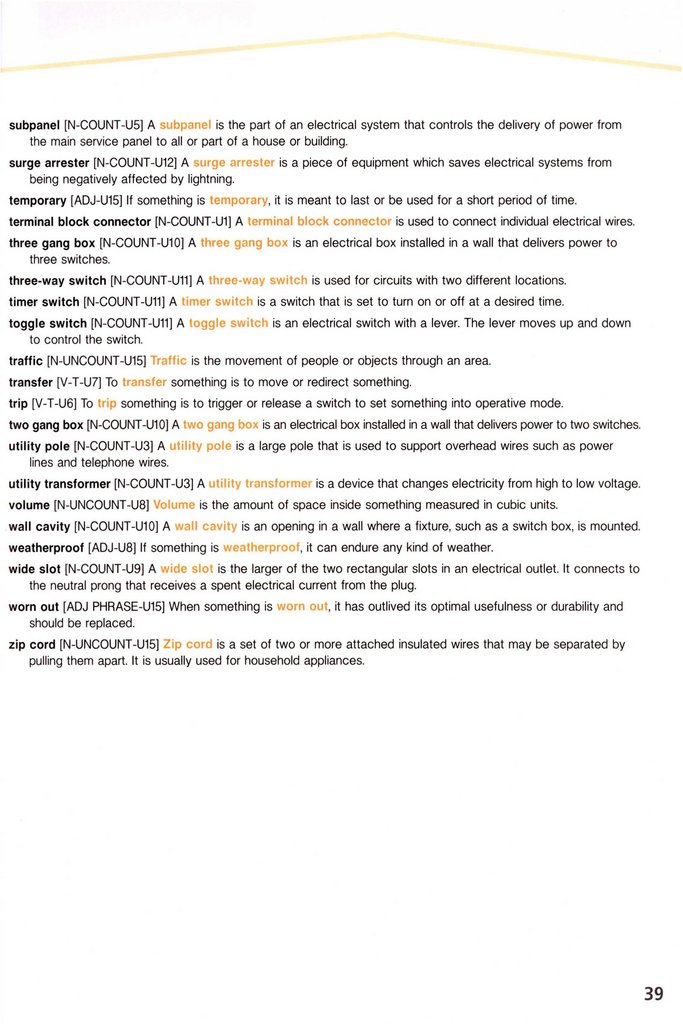
GlossaryAC [N-UNCOUNT-U11] AC, or alternating current, is a type of electric current that constantly flows back and forth in
different directions.
add [V-T-U9] To add numbers is to combine them.
allen wrench [N-COUNT-U2] An allen wrench is an L-shaped piece of metal with a six-sided head used to tighten
screws and bolts.
ampere [N-COUNT-U11] An ampere is a unit of measurement for electricity.
and [CONJ-U9] And is used when combining or adding numbers. For example, one and one equals two.
arc flash blanket [N-COUNT-U6] An arc flash blanket is a blanket electricians use to protect themselves from
electrical blasts and fires.
arc flash clothing [N-UNCOUNT-U6] Arc flash clothing is pants, shirts, jackets, and shoes designed to protect
electricians from electric shock.
arc shield [N-COUNT-U6] An arc shield is a protective plastic shield for the eyes and face that fits onto a hard hat.
armored cable (AC) [N-COUNT-U13] An armored cable (AC) is a wire encased in a spiraled steel insulation with
no grounding wires.
auger bit [N-COUNT-U3] An auger bit is a bit that cuts into wood. These bits are usually from 17 to 25 centimeters long.
bind [V-T-U8] To bind is to put two things together with rope or tape.
block [N-COUNT-U5] A block is a piece of stone, wood or other material that is solid with flat surfaces on each side.
brick [N-COUNT-U5] A brick is a block of clay that is baked until it is hard and used for building.
burn [N-COUNT-U12] A burn is a painful injury to the body caused by heat.
caliper [N-COUNT-U10] A caliper is a small measuring device.
Celsius [N-UNCOUNT-U1 OJ Celsius is the metric temperature scale where water freezes at 0 degrees and boils at
100 degrees.
cement [N-UNCOUNT-U5] Cement is a mixture of ground limestone and clay.
centimeter [N-COUNT-U10] A centimeter is a metric unit that measures length or distance, equal to ten millimeters.
circular saw [N-COUNT-U3] A circular saw is an electric or gas-operated saw with a round blade.
climb [V-T-U?] To climb is to ascend or move up towards the top of something.
code [N-COUNT-U14] A code is a set of numbers or letters that gives information about something.
come to [V PHRASE-U9] To come to a number is to equal that number.
concrete [N-UNCOUNT-U5] Concrete is a hard material made by combining cement, small stones, sand and water.
conductor [N-COUNT-U13] A conductor is a wire. It is the metal part of a cable that carries electricity.
conduit bender [N-COUNT-U4] A conduit bender is an instrument that twists objects made of metal.
connect [V-T -U8] To connect is to plug in or turn on electricity or power.
convert [V-T-U1 OJ To convert something is to change it from one state or mode into another.
copper [N-UNCOUNT -US] Copper is a reddish brown metal that is often used for pipes or wires.
crimper [N-COUNT-U2] A crimper is a tool used for pushing connectors around bare wires.
crimp-on connector [N-COUNT-U15] A crimp-on connector is a type of connector that is fixed in place by using
a crimping tool.
current [N-COUNT-U11] A current is the quantity of electricity that is flowing in a wire at a specific time.
34
37.
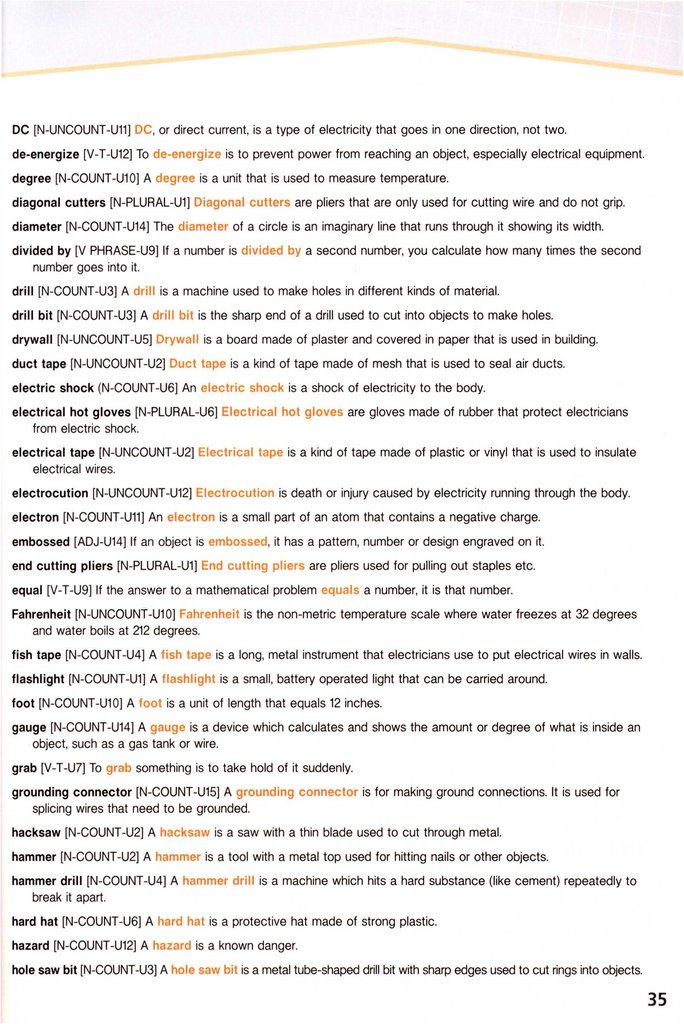
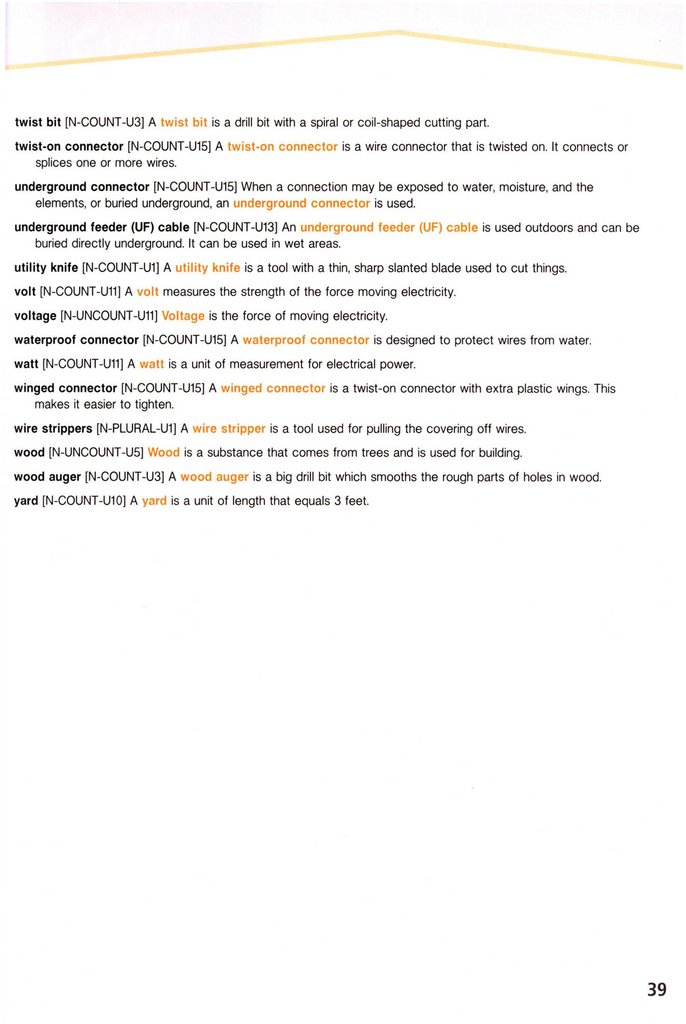
DC [N-UNCOUNT-U11J DC, or direct current, is a type of electricity that goes in one direction, not two.de-energize [V-T-U12J To de-energize is to prevent power from reaching an object, especially electrical equipment.
degree [N -COUNT-U10J A degree is a unit that is used to measure temperature.
diagonal cutters [N-PLURAL-U1J Diagonal cutters are pliers that are only used for cutting wire and do not grip.
diameter [N-COUNT-U14J The diameter of a circle is an imaginary line that runs through it showing its width.
divided by [V PHRASE-U9J If a number is divided by a second number, you calculate how many times the second
number goes into it.
drill [N-COUNT-U3J A drill is a machine used to make holes in different kinds of material.
drill bit [N-COUNT-U3J A drill bit is the sharp end of a drill used to cut into objects to make holes.
drywall [N-UNCOUNT-USJ Drywall is a board made of plaster and covered in paper that is used in building.
duct tape [N-UNCOUNT-U2J Duct tape is a kind of tape made of mesh that is used to seal air ducts.
electric shock (N-COUNT-U6J An electric shock is a shock of electricity to the body.
electrical hot gloves [N-PLURAL-U6J Electrical hot gloves are gloves made of rubber that protect electricians
from electric shock.
electrical tape [N-UNCOUNT-U2J Electrical tape is a kind of tape made of plastic or vinyl that is used to insulate
electrical wires.
electrocution [N-UNCOUNT-U12J Electrocution is death or injury caused by electricity running through the body.
electron [N-COUNT-U11J An electron is a small part of an atom that contains a negative charge.
embossed [ADJ-U14J If an object is embossed, it has a pattern, number or design engraved on it.
end cutting pliers [N-PLURAL-U1J End cutting pliers are pliers used for pulling out staples etc.
equal [V-T-U9J If the answer to a mathematical problem equals a number, it is that number.
Fahrenheit [N-UNCOUNT-U1 OJ Fahrenheit is the non-metric temperature scale where water freezes at 32 degrees
and water boils at 212 degrees.
fish tape [N-COUNT-U4 J A fish tape is a long, metal instrument that electricians use to put electrical wires in walls.
flashlight [N-COUNT-U1J A flashlight is a small, battery operated light that can be carried around.
foot [N-COUNT-U1 OJ A foot is a unit of length that equals 12 inches.
gauge [N-COUNT-U14J A gauge is a device which calculates and shows the amount or degree of what is inside an
object, such as a gas tank or wire.
grab [V-T-U?J To grab something is to take hold of it suddenly.
grounding connector [N-COUNT-U15J A grounding connector is for making ground connections. It is used for
splicing wires that need to be grounded.
hacksaw [N-COUNT-U2J A hacksaw is a saw with a thin blade used to cut through metal.
hammer [N-COUNT-U2J A hammer is a tool with a metal top used for hitting nails or other objects.
hammer drill [N-COUNT-U4J A hammer drill is a machine which hits a hard substance (like cement) repeatedly to
break it apart.
hard hat [N-COUNT -U6J A hard hat is a protective hat made of strong plastic.
hazard [N-COUNT-U12J A hazard is a known danger.
hole saw bit [N-COUNT-U3J A hole saw bit is a metal tube-shaped drill bit with sharp edges used to cut rings into objects.
35
38.
Glossaryhot stick [N-COUNT-U6] A hot stick is a fiberglass rod that electricians use to protect themselves from shocks
when they are working with wires.
hundred [N-COUNT-U9] A hundred is combined with another number to express numbers in the thousands. For
example, the number 2,300 could be stated twenty-three hundred.
imperial [ADJ-U10] If something is imperial, it involves the system of measurement based on the inch and the pound.
inch [N-COUNT-U1 OJ An inch is an imperial unit that measures length or distance.
inspect [V-T-U8] To inspect is to look at or analyze something carefully.
install [V-T-U8] To install is to arrange, connect or put something in a certain place so you can use it.
insulated [ADJ-U13] If a wire is insulated, then it is protected from touching other wires. This helps prevent fires
and short circuiting.
is [V-T-U9] If something is something else, they are equal.
jacket [N-COUNT-U13] A jacket is the insulated sheath that protects the wires from touching each other or getting
too hot.
jigsaw [N-COUNT-U3] A jigsaw is an electric or gas-operated saw with a thin blade, which cuts straight and
rounded edges into objects.
kneel [V-l-U7] To kneel is to support oneself on one or both knees.
knob and tube (K& T) wiring [N-UNCOUNT-U13] Knob and tube (K& T) wiring is wires encased in porcelain knobs
and tubes. It is usually found in older homes.
labeling machine [N-COUNT-U4] A labeling machine is an instrument electricians use to make labels for different
objects.
leather gloves [N-PLURAL-U6] Leather gloves are gloves that are made of leather and used to protect the hands.
less [PREP-U9] Less is used when taking a number away from another.
level [N-COUNT-U4] A level is a tool electricians use to ensure they install things in a straight line.
lift [V-T-U7] To lift something is to move it to a higher position.
lineman's pliers [N-PLURAL-U4] Lineman's pliers are tools workers use to twist and slice wires.
live wire [N-COUNT-U12] A live wire is a wire with electrical energy running through it.
location [N-COUNT-U14] A location is a place or site.
lockout/tagout procedure [N-COUNT-U12] A lockout/tagout procedure is when a lock is placed on a power
source after it has been turned off and a label is placed on the equipment to show that it has been locked.
long nose (needle nose) pliers [N-PLURAL-U1] Long nose pliers are pliers with long blades able to grip or cut
through wires.
masonry drill bit [N-COUNT-U4] A masonry drill bit is a bit that is made to drill through hard surfaces like stone
or concrete. It is usually used with a hammer drill.
maximum [ADJ-U14] Maximum is the most of something that is achievable.
measuring tape [N-COUNT-U1] A measuring tape is a tool with a long piece of thin metal, paper or plastic with
numbers on it.
metal-clad (MC) cable [N-UNCOUNT-U13] Metal-clad (MC) cable is wires encased in steel insulation, and it has a
green ground wire inside the metal jacket.
meter [N-COUNT-U10] A meter is a unit of length that measures 100 centimetres or 39 inches.
metric [ADJ-U10] If something is metric, it involves the system of measurement based on the meter and the kilogram.
36
39.
micrometer [N-COUNT-U1 OJ A micrometer is a type of caliper with a calibrated screw used to measure small distances.millimeter [N-COUNT-U10] A millimeter is a metric unit that measures length or distance, equal to 1/10 of a centimeter.
minus [PREP-U9] Minus is used when taking away a number from another.
mortar [N-UNCOUNT-US] Mortar is a mixture of sand, water and lime used to hold bricks or stones in place.
multimeter [N-COUNT-U4] A multimeter is a device used to determine a wire's amount of voltage and power.
multiplied by [V PHRASE-U9] If a number is multiplied by another, it is added onto itself that number of times.
nonmetallic (NM) sheath cable [N-UNCOUNT-U13] Nonmetallic (NM) sheath cable is wires in a non-metal jacket.
The jacket is made of a material like thermoplastic.
nut driver [N-COUNT-U2] A nut driver is a tool used for tightening nuts.
ohm [N-COUNT-U11] An ohm is a unit of measurement showing electrical resistance.
ought [N-UNCOUNT-U14] Ought is nothing or nil.
over [PREP-U9] If one number over another number, it is divided by that number.
paralyze [V-T-U12] To paralyze is to freeze the muscles so they cannot move.
Phillips screwdriver [N-COUNT-U2] A Phillips screwdriver is a tool used to tighten screws that have a cross-shaped
head.
plaster [N-UNCOUNT-US] Plaster is a mixture of lime, sand and water used in buildings to cover walls and ceilings.
plug-in analyzer [N-COUNT-U4] A plug-in analyzer is a machine used to check circuits to make sure they are
correctly installed and safe.
plus [PREP-U9] Plus is used when adding numbers.
plywood [N-UNCOUNT-US] Plywood is a board made of thin layers of wood that are glued together.
pull [V-T-U8] To pull is to put force on an object in order to move it closer to you.
push [V-T-U8] To push is to put force on an object in order to move it away from you.
push-in connector [N-COUNT-U15] Instead of twisting, wires are pushed in through holes in the push-in connector.
rating [N-COUNT-U14] A rating is a list grading and comparing objects on their worth, usefulness or value.
reciprocating saw [N-COUNT-U3] A reciprocating saw is an electric or gas-operated saw that has a few
different blades which can be switched.
release [V-T-U7] To release something is to let it free or let it go.
replace [V-T-U13] To replace is to take away an old wire and put a new wire in its place.
resistance [N-UNCOUNT-U11] Electrical resistance is the way certain substances work against electricity.
resistant [ADJ-U14] If an object is resistant, it is not affected by certain things such as heat or water.
risk [N-COUNT-U12] A risk is a chance that something bad will happen.
rotary drill [N-COUNT-US] A rotary drill is a drill that moves in circles to cut something.
rotary hammer [N-COUNT-US] A rotary hammer hits things hard, while turning, to drill into something.
round off [V PHRASE-U10] To round off a screw or bolt is to damage it so that it cannot be moved properly with
normal tools.
rubber mat [N-COUNT -U6] A rubber mat is a mat made of rubber that electricians stand on to protect themselves
from electric shock.
37
40.
Glossarysafety glasses [N-UNCOUNT-U6] Safety glasses are clear glasses made of thick plastic that protect electricians'
eyes from flashes and dangerous materials.
screwdriver [N-COUNT-U1] A screwdriver is a tool used to tighten or loosen screws.
service entrance (SE) cable [N-COUNT-U13] A service entrance (SE) cable is used tor wiring outside and above
ground.
sheath [N-COUNT-U14] A sheath is a plastic casing that protects wires.
shell [N-COUNT-U15] A shell is a covering used on connectors to protect wires. It is usually made of tire resistant
thermoplastic.
shock [V-T-U12] To shock is to pass electricity through the body.
side cutters [N-PLURAL-U1] Side cutters are a type of pliers used tor cutting, twisting or pulling wires.
socket wrench [N-COUNT-U2] A socket wrench is a tool used to tighten bolts.
spade bit [N-COUNT-U3] A spade bit is a narrow bit with a sharp tip and edges.
splice [V-T-U8] To splice is to join two wires by twisting them and connecting the ends.
split [V-T-U7] To split something is to separate it or divide it into more than two parts.
spring [N-COUNT-U15] A spring is a device inside the shell of a connector. The spring creates pressure which
tightly splices the wires together.
stand [V-T-U7] To stand is to be in a vertical position.
static electricity [N-UNCOUNT-U12] Static electricity is an electrical charge made by friction.
steel [N-UNCOUNT-US] Steel is a metal that is made from combining iron and carbon.
steel toe boots [N-PLURAL-U6] Steel toe boots are boots with a layer of steel in the front so that workers' feet
won't be hurt by objects that tall.
stepped drill bit [N-COUNT-U4] A stepped drill bit is a drill bit that is used to drill through metal, plastic or wood.
stone [N-UNCOUNT -US] Stone is the hard substance rocks are made from, and is often used in buildings.
stoop [V-l-U7] To stoop is to stand with the top halt of the body bent forward.
strip [V-T-U8] To strip is to take the plastic covering oft wires so that only the metal is left.
stud punch [N-COUNT-U4] A stud punch is a device that cuts holes tor wires to go through.
subtract [V-T-U9] To subtract a number is to take it away from another number.
test [V-T -US] To test is to turn something on or try something to see it it works.
eighth [N-COUNT-U9] An eighth is one of eight equal parts of something.
thermoplastic [ADJ-U15] Thermoplastic describes the tire resistant material that is used to make connector shells.
times [PREP-U9] Times is used when multiplying numbers.
tool belt [N-COUNT-U2] A tool belt is a belt with loops tor carrying tools while working on a job.
tool kit [N-COUNT-U1] A tool kit is a bag or box used to hold a set of tools.
torque wrench [N-COUNT-U2] A torque wrench is a tool that can be adjusted to create different amounts of
force when turning a bolt.
turn off [V PHRASE-T-U7] To turn something off is to make it cease operating or stop working.
turn on [V PHRASE-T-U7] To turn something on is to make it operate or start working.
twist [V-T-U8] To twist something is to turn it or bend it.
38
41.
twist bit [N-COUNT-U3] A twist bit is a drill bit with a spiral or coil-shaped cutting part.twist-on connector [N-COUNT-U15] A twist-on connector is a wire connector that is twisted on. It connects or
splices one or more wires.
underground connector [N-COUNT-U15] When a connection may be exposed to water, moisture, and the
elements, or buried underground, an underground connector is used.
underground feeder (UF) cable [N-COUNT-U13] An underground feeder (UF) cable is used outdoors and can be
buried directly underground. It can be used in wet areas.
utility knife [N-COUNT-U1] A utility knife is a tool with a thin, sharp slanted blade used to cut things.
volt [N-COUNT-U11] A volt measures the strength of the force moving electricity.
voltage [N-UNCOUNT-U11] Voltage is the force of moving electricity.
waterproof connector [N-COUNT-U15] A waterproof connector is designed to protect wires from water.
watt [N-COUNT-U11] A watt is a unit of measurement for electrical power.
winged connector [N-COUNT-U15] A winged connector is a twist-on connector with extra plastic wings. This
makes it easier to tighten.
wire strippers [N-PLURAL-U1] A wire stripper is a tool used for pulling the covering off wires.
wood [N-UNCOUNT-U5] Wood is a substance that comes from trees and is used for building.
wood auger [N-COUNT-U3] A wood auger is a big drill bit which smooths the rough parts of holes in wood.
yard [N-COUNT-U1 OJ A yard is a unit of length that equals 3 feet.
39
42.
Virginia EvansJenny Dooley
Tres O'Dell
4JJU~
Express Publishing
43.
Scope and sequenceUnit
Topic
1 Electrical
connectors
2 Conduit
systems
Reading
context
Store
webpage
Vocabulary
Function
connector, terminal block connector, post connector, insulation
displacement connector, plug and socket connector, blade
connector, ring terminal, spade terminal, split bolt connector,
clamp connector, offset connector, solderless connector
Repeating
something
back
Newspaper
conduit, non-metallic tubing, electrical metallic tubing, moisture
advertisement tight fitting, installation, protection, grounded, flexible,
non-corrosive, building code, route
3 Buried and
Textbook
aerial service excerpt
entrances
Making an
appointment
service entrance (SE), utility transformer, buried service, aerial
service, service drop, service cable, clearance, right-of-way,
utility pole, service lateral, drip loop
Giving
advice
Offering
choices
4 Panels
Magazine
article
main service panel, main switch, branch circuit, overcurrent,
accommodate, gadget, hot bus, neutral bus, function, cut off,
manually, capacity, safeguard
5 Subpanels
DIY web
article
subpanel, secondary, short circuit, hot conductor, neutral return Giving
conductor, grounding conductor, bond, feeder cable, continuous, praise
remote, malfunction, safety precaution, component
6 Fuses and
Manufacturer's fuse, circuit breaker, overload, ground fault, cartridge fuse, plug
fuse, trip, single pole breaker, double pole breaker, blown fuse,
guide
replacement
Describing
an object
DIY magazine electrical load, balance, analyze, stability, consumption,
article
amperage, parity, appliance, corresponding, owner's manual,
transfer, draw, snap
Describing
a process
Textbook
excerpt
outlet box, volume, overcrowded, short, deep, handy box, cut-in
box, shallow, pancake box, integral nail box, weatherproof, mount
Giving
feedback
outlet, duplex outlet, single outlet, outlet cap, polarity, grounding
pin, plug, grounding slot, narrow slot, wide slot, immediate turn
plug, cheater plug, hook up
Giving
assurances
DIY webpage single gang box, two gang box, three gang box, four gang box,
grounding screw, coverplate, wall cavity, flush, box extender,
bracket, control
Declining
something
Web forum
Asking for
an opinion
circuit
breakers
7 Balancing
the load
8 Receptacle
boxes
9 Receptacles Web forum
10 Switch
boxes
11 Types of
switches
12 Grounding
systems
13 Installing a
grounding
system
14 Electrical
fires
15 Electrical
safety at
home
residential grade switch, open circuit, commercial grade switch,
single pole switch, double pole switch, three-way switch, fourway switch, toggle switch, pilot light switch, timer switch, keyed
switch, dimmer switch
Advertisement equipment grounding conductor, earth grounding system, ground, Finding out
grounding electrode conductor, ground fault, fault current, surge cost
arrester, stray voltage, ground rod, clamp, estimate
Installation
pamphlet
drive, resistance, footer, sphere of influence, ground wire,
parallel, panel bond, ditch, soil condition, bonding wire
Agreeing
with an
assessment
Government
fact sheet
electrical fire, combustible, faulty, frayed, ignite, precaution,
overheat, flicker, evaluate, fixed wiring, maintenance
Pointing
things out
Website
article
prevention, safety cover, traffic, baseboard, zip cord, temporary,
permanent, securely, flammable, fail, worn out, adapter, breaker
box
Saying
something is
dangerous
44.
Table of contentsUnit 1 - Electrical connectors ..... . . .. . .... . .. .. . ..... . ..... . .. . . .. . . .. . .. . .. 4
Unit 2 - Conduit systems ........ .. .... . ... . .. . . . ... . ............... . . . .. . . .. 6
Unit 3 - Buried and aerial service entrances .. .. . . ......... ... . ..... . . . . .... 8
Unit 4 - Panels ... . .. . ... . .. . .... .... . .. . ....................... . .. . .. . .. . . .. . 10
Unit 5 - Subpanels . ...... ..... .... .. . . ........ . ..... . ..... . ..... . . .. . .. .. . .. . 12
Unit 6 - Fuses and circuit breakers . .. . ... . . ..... . ..... . .. . . ... . . . .. . ....... 14
Unit 7 - Balancing the load . . ..... ..... .... .. . .. . .. . .. . .. . .. . . .. . . .. . . ..... . . 16
Unit 8 - Receptacle boxes ............ . .. . .. . ........... . .. . .. . ....... . . .... 18
Unit 9 - Receptacles .......................... . . .. ..... . ... .. ...... . .... . ... 20
Unit 10 - Switch boxes ... ....... . .. . . .. .. ...... . .. . .. .. . . .. .............. .. . 22
Unit 11 - Types of switches ........ .. ...... . ............. . .. . ... . .... . . .. . .. 24
Unit 12 - Grounding systems .... . . ... ...... .. . . ............ . ...... . ...... . . . 26
Unit 13 - Installing a grounding system .. . ..... .. . .................... . . .. . 28
Unit 14 - Electrical fires . ........ . . .. ... . .. .. .. .. . .. ....... .. .... . . . .. . .. ... . 30
Unit 15 - Electrical safety at home . ... . .. .. .. . .. . .. . .. . .. . .. . .. . .. .. . . .. .. . 32
Glossary ... ....................... . . ... .. . ...... . . . .. . .. . .. . .. . .. ............ 34
45.
Electrical connectorssolderless terminals
HOME
ABOUT US
-
SERVICES
www.donselectricalsupply.com
li Don's Electrical Supply
!!
ii
i
Dan's Electrical Supply has all the connectors you need at great
prices. Whatever the connection, we have the connector!
II
:: Are you looking to connect wires to equipment? We have many
II
H connectors to serve your needs. We carry post connectors,
::
blade connectors, ring terminals, and spade terminals.
!i
Or perhaps you need to connect wires to other wires. If this is the
case, we can provide you with a variety of solderless connectors.
We have terminal block connectors, plug and socket connectors,
and clamp connectors.
We also have some other items for more specific types of
connections:
Insulation displacement connectors are available if you don't
want to strip wires.
For connecting larger size wire, we have split bolt connectors.
For changing the wiring on your electrical box, offset connectors
are available.
You can place an order online anytime at www.donselectricalsupply.com.
You can also call us at 1-800-376-8532 between 8:00 a.m. and 8:00 p.m.
II
::
II
11
Get ready!
0 Before you read the passage, talk about these questions.
1
What are some different kinds of wire connectors?
2 When is it acceptable for electricians to substitute one kind
of connector for another?
0 Place the words and phrases
from the word bank under the
correct headings.
BANK
Reading
f) Read the store webpage about connectors. Then, mark
the following statements as true (T) or false (F).
1 _ Split bolt connectors are used for changing wires on
electrical boxes.
2 _ Insulation displacement connectors make stripping wires
unnecessary.
terminal block connector
post connector
clamp connector
blade connector
ring terminal spade terminal
plug and socket connector
3 _ Post connectors splice two different wires.
Connects Wires to Equipment
Vocabulary
f) Match the words (1-4) with the definitions (A-D).
1 _ offset connector
3 _ split bolt connector
2 _ clamp connector 4 _ insulation displacement connector
Connects Wires Together
A connects wires without stripping them
B uses a V-shaped ring to connect wires
C changes the direction of a wire
D used for taps and splices in building wiring
4
46.
0 g Listen and read the store webpageabout connectors again. Why are there so
many different types of connectors?
Speaking
G With a partner, act out the roles below
based on Task 7. Then switch roles.
USE LANGUAGE SUCH AS:
Listening
0 g Listen to a conversation between an
electrician and a supplier. Choose the
correct answers.
First of all ...
What about ...
I'll take ...
What is the purpose of the conversation?
B to find out which connectors are in stock
Student A: You are an electrician. Talk to
Student B about:
C to learn how to use each kind of connector
why you need connectors
D to compare the prices of connectors
what kinds of connectors you need
the price of the connectors
A to place an order for different connectors
2 Why does the man order a post connector?
A to connect two different kinds of wires
B to connect a wire to some speakers
Student B: You are a supplier. Talk to Student A
about the different kinds of connectors.
C to cap off the end of a spliced wire
D to connect a large wire
0 g Listen again and complete the
conversation.
Writing
0 Use the conversation from Task 8 to fill
out the purchase order.
Electrician: I have 1 _ __ _ __
_ _ _ that I need to order.
Supplier: Okay. We have all types of connectors.
Electrician: Good. First of all, I need something to
2
to
some large speakers. What about a
post connector?
Supplier: That would work. I'll just check
availability. You said 3 _ __
_ _ _ , right? Okay, I do have
right now.
those 4
Electrician: Great. I'll take a pack of those. I also
need to connect some wires. Do you
have any 5
?
Supplier: We sure do. What kind do you need?
Electrician: I'll take two packs of 6 _ __
_ __ please, and four packs of
socket connectors.
blade terminals
Item: _ _ _ _ _ _ _ _ _ _ _ _ _ _ __
Quantity: _ _ _ _ _ _ _ _ _ _ _ _ __
Item: _ _ _ _ _ _ _ _ _ _ _ _ _ _ __
Quantity: _ _ _ _ _ _ _ _ _ _ _ _ __
Total price: _ _ _ _ _ _ _ _ _ _ _ _ __
Reason for Order: _ _ _ _ _ _ _ _ _ __
Additional Information: _ _ _ _ _ _ _ _ __
solderless connector
5
47.
Conduit systemsNeed
GND
symbol
CONDUIT
installation?
Look no further! My name is Gary Parsons and I am a
highly qualified electrician.
First off, I have all types of conduit tubing. Choose nonmetallic tubing or electrical metallic tubing for your
home or business. I will give recommendations based
on your needs.
What's most important is that I have the know-how to
do any type of job. For those tough routes, I have
flexible conduits. For homes with complicated
building codes, I can use grounded connectors.
Have corrosion, fire, or water issues in your home? No
problem! Many of my conduits have protection
against these. For example, moisture tight fittings
are especially made to keep water out. I also have a
variety of non-corrosive conduits.
The bottom line is that I understand the needs of your
specific installation. And if you're not happy with my
work, I'll give you your money back!
Get ready!
0 Before you read the passage, talk about
these questions.
1 Why do electricians use conduits?
Vocabulary
2 How are different types of conduits used?
@) Match the words (1-6) with the definitions
(A-F).
Reading
1 _ route
4 _ non-corrosive
f) Read the newspaper advertisement for
2 _grounded
5 _ moisture tight fitting
conduit installation. Then, mark the
following statements as true (T) or
fa lse (F).
3 _ protection
6 _ electrical metallic tubing
1 _ The electrician recommends non-metallic
tubing instead of metallic tubing.
6
A the ability to keep out dangers
B a conduit made of steel or aluminum
C a specified course or path
2 _ Flexible conduits are needed in homes with
complicated building codes.
D not damageable by chemicals
3 _ Moisture tight fittings offer extra protection.
F connected to the earth
E a conduit designed to keep water out
48.
0 Read the sentence and choose the correct word.1 We need a flexible I noncorrosive conduit to run the wire
around that corner.
2 This wiring job violates the city's protection I building code.
3 The electrician chose non-metallic tubing I electrical
metallic tubing because she prefers working with plastic.
4 You should install a route I conduit to protect those wires.
0 g Listen and read the newspaper advertisement for
conduit installation again. Why would an electrician
use flexible conduits?
Listening
Speaking
0 With a partner, act out the
roles below based on Task 7.
Then switch roles.
USE LANGUAGE SUCH AS:
What kind of ...
I think ... would be fine.
I'll bring some ... and also some ...
Student A: You are an electrician.
Talk to Student B about:
conduit installation and site
conditions
types of conduits needed
when you can arrive at the
jobsite
0 g Listen to a conversation between an electrician
and a building owner. Choose the correct answers.
1 What is the purpose of the conversation?
A to determine if conduits are necessary
B to compare different types of conduits
C to set up a conduit installation
D to describe the advantages of a conduit
Student B: You are a building
owner. Talk to Student A about
a conduit installation.
2 Why is the man bringing moisture tight fittings?
A Some areas are exposed to water.
B They work best with non-metallic tubing.
Writing
C The conduits must fit around corners.
0 Use the conversation from
D They work better than flexible conduits.
Task 8 to fill out the
electrician's work order.
0 g Listen again and complete the conversation.
_ _ _ _ _ _ works well
Electrician: 1 _ __
most of the time. Do you have any areas with
heavy exposure to chemicals or water?
Building Owner: Not too many. We may need some 2 _ __
_ _ _ _ _ _ , but not a lot.
Electrician: Okay. I'll bring some of those and also some
3
in case we need to get
around any corners.
Building Owner: Sounds good. When would be a good time for
you 4
?
Garv Parsons
ELECTRIC
Work Order
Account #: 7759
Job Start Time: _ _ _ _ _ _ __
Building Conditions: _ _ _ _ __
Electrician: How about Wednesday morning? I have a job in
the 5
, but I could come by
around 11:00.
Building Owner: 11:00 in the morning isn't a good time. What
about 3:00 on Wednesday afternoon?
Electrician: 3:00 in the afternoon 6 _ _ _ _ __
_ _ _ . I'll see you then!
Products Needed: _ _ _ _ _ __
49.
Buried and aerial service entrancesGet ready!
Reading
0 Before you read the passage, talk about
f} Read the textbook excerpt on buried and
these questions.
1
What are the advantages and disadvantages
of a buried service entrance?
2 What are the advantages and disadvantages
of an aerial service entrance?
G tility po1e)
aerial service entrances. Then, complete the
table using information from the excerpt.
Service
Entrance
Advantages
Buried
Aerial
Vocabulary
E) Match the words (1-5) with the definitions
(A-E).
1 _drip loop
4 _ service entrance
2 _ utility pole
5 _ utility transformer
3 _ service drop
A a place where electricity enters a building
Buried
and Aerial
Service 0
Entrances \~d}
B a line that carries electricity to a building
C a post that supports overhead wires
D a bend in electrical wires to a building
E a device that converts voltage from high to low
Fill in the blanks with the correct words
and phrases from the word bank.
BANK
Buried service and aerial service entrances both have
advantages and disadvantages. Buried service entrances
are preferred by some customers. This is because rightof-way requirements are smaller. There are also no
clearance problems with buried services. Utility poles
are not necessary. There are no service cables crossing
the roof of the building. Also, there is no visible service
drop. Fewer trees have to be cut down for a buried
service entrance.
Some customers prefer aerial service entrances instead.
Problems with the service entrance (SE) are easier to
see with an aerial service. Also, installing aerial services
does not damage landscaping. There is little risk of cutting
through aerial utilities and they are cheaper.
Aerial service entrances require a drip loop for incoming
wires. A utility transformer and a service lateral are
required for buried service.
8
buried service
aerial service
clearance
service lateral
right-of-way
1 The
provides power to the
underground service entrance.
2 We installed
up the landscaping.
to avoid digging
3 The power company has a(n) _ _ __ _
across my property.
4 The truck did not have enough _ _ _ __
to pass under the wires.
5 Some people prefer
because
they don't like seeing electrical cables.
50.
0 " Listen and read the textbook excerpton buried and aerial service entrances
again. What is one reason someone might
choose a buried instead of an aerial
service entrance?
Speaking
0 With a partner, act out the roles below
based on Task 7. Then switch roles.
USE LANGUAGE SUCH AS:
There are two types ...
Listening
Is there a difference in ...
0 " Listen to a conversation between a
The ... is more popular because ...
customer and an electrician. Choose the
correct answers.
Student A: You are a customer. Talk to
Student B about:
1 What is the purpose of the conversation?
A to discuss the cost of a service entrance
B to explain how to install a service entrance
types of service entrances
a cost comparison
C to describe the purpose of a service entrance
advantages of a type of service entrance
D to compare different types of service
entrances
Student B: You are an electrician. Talk to
2 What will the woman likely do next?
Student A about types of service entrances.
A She will decide to take the cheapest option.
B She will consult another electrician.
C She will choose a buried service entrance.
Writing
D She will ask for the man's advice.
0 Use the conversation from Task 8 to fill
0 " Listen again and complete the
out the customer's memo to the electrician.
conversation.
Customer: I'm not sure what kind of electrical
1
I want installed
at my home.
Electrician: Well, there are two types of services:
buried and aerial.
Customer: What's the 2 _ _ _ _ __
those two?
Electrician: A buried service goes under the
ground. An aerial service is above
ground and 3 _ _ _ _ __
Customer: Is there a difference in the cost?
Electrician: Yes. It costs more to install a
4
because more
work is required.
Customer: Which one would 5 _ _ _ _ _ _ ?
Electrician: In my experience, the buried service is
6
because there
are fewer wires around your home.
I would prefer the _ _ _ _ _ _ service entrance
because _ _ _ _ _ _ _ _ _ _ _ _ _ __
even though it _ _ _ _ _ _ _ _ _ _ _~
51.
PanelsReading
:
smart
tmP~!.1'.~.1'.~~~-~~~
!~~No.D
-----['-=:::::::::::::: ____________________________________ _ f) Read the magazine article on service
GET POWERED!
j _l!-:_c!~i~~t! ~~ _!~~~ ~~!'- ~~'!'~ _
I
I
I
I
I
I
I
I
I
Today's increased use of high-powered appliances and
gadgets means you can't risk installing a substandard
electrical system.
Before starting installation, you should understand
electrical safety functions. The main service panel
is what safeguards your system from dangerous
malfunctions. This panel houses the main switch,
where you can manually stop the flow of electricity.
More importantly, it cuts off power to all branch
circuits automatically when it detects hazardous
power levels.
When choosing electrical components, parts with high
capacity are nearly always better. If you can install a
circuit with higher amperage, or two hot bus bars
instead of one, then go ahead. Having higher capacity
than you need poses no dangers. If the capacity is too
low, however, you risk overcurrent, which can lead to
fire or electric shock. You should also make sure your
neutral bus can safely accommodate the spent
current as it returns to the seNice entrance conductor.
panels. Then, mark the following
statements as true (T) or false (F).
1 _ The main switch must be switched manually.
2 _ Two neutral bus bars are better than one.
3 _ An electrical system with higher capacity
carries increased risk of overcurrent.
Vocabulary
8 Match the words (1-5) with the definitions
(A-E).
1 _ cut off
4 _ manually
2 _function
5 _ overcurrent
3 _ main service panel
A controlled by a person directly
B a part that controls power distribution
C a purpose or intended use
D an excessive surge of power
E to stop something abruptly
0 Place the words and phrases from the word
bank under the correct headings.
~
BANK
Get ready!
main switch
hot bus
branch circuit
neutral bus
Carries Current
Stops Current
0 Before you read the passage, talk about
these questions.
1 In your country, how does today's technology
affect the need for electricity?
2 What is a safety concern when installing an
electrical system?
10
52.
0 g Listen and read the magazine articleon service panels again. Why might
someone choose to have more electrical
capacity than needed?
Speaking
(i) With a partner, act out the roles below
based on Task 7. Then switch roles.
USE LANGUAGE SUCH AS:
Listening
We need to decide ...
0 g Listen to a conversation between an
I definitely want ...
electrician and a homeowner. Choose the
correct answers.
There is ... but it's probably ...
A to discuss the advantages of lower capacity
Student A: You are an electrician. Talk to
Student B about:
B to determine the capacity of a certain panel
new service panel options
C to choose the proper amperage for a panel
available capacity
D to review the cost of a new installation
his or her decision and reason(s)
What is the purpose of the conversation?
2 Why does the woman want a particular type
of panel?
A It is the same panel she had before.
Student B: You are a homeowner. Talk to
Student A about new service panel options.
B It is the most popular type of panel.
C It is cheaper than the other panels.
D It is the best panel for her family's needs.
0 g Listen again and complete the
Writing
0 Use the conversation from Task 8 to fill
out the electrician's work order.
conversation.
Electrician: We need to decide what kind of
1
you need for
your main service panel.
Homeowner: Okay. What are my options?
Electrician: Well, you have a couple of choices.
For a 2 _ _ _ _ __
_ __ , we usually install a 100amp electrical panel, but there's also
a 150-amp available.
Homeowner: I definitely want 3 _ __
Customer: Ms. Larson
Product to Install: _ _ _ _ _ _ _ _ _ _ __
Customer's Preference: _ _ _ _ _ _ _ _ __
Reason for Preference: _ _ _ _ _ _ _ _ __
_ _ _ . Is 150-amp the highest?
Electrician: There is a 200-amp, but it's probably
4 _ _ _ _ _ _ _ __
_ __ . Also, it'll be a little more
expensive.
Homeowner: That's fine. My family uses a lot of
5
. In our old
house, the main breaker kept cutting
off our power because we were
using too much.
Electrician: Okay, Ms. Larson, 200-amp it is. I'll
6
and
give you an estimate this afternoon.
11
53.
Neutral (\fl{hitSubpanels
Grounc
SUB PANEL
I
I
www.do-it-yourself .corn
I
I
~------------------------------------ - -- ·
Home Installations > Electrical > Subpanel Overview
"Hot" conductor
..=.. Source
Load
"Neutral" conductor
Ground
point
--------------------------------------~
I
wire
l
therm ocompression bonding
You should install a subpanel when you need
electricity in a shed or other remote unit away
from the electrical meter. While these panels are
secondary, they require the same safety
precautions as a main panel.
The subpanel needs the same basic components
as a main panel, but is wired a little differently. Do
not bond the neutral return conductor to the
grounding conductor. This ensures that spent
currents traveling back to the panel do not get
carried through the grounding conductor and
cause a short circuit. Also to avoid malfunctions,
the hot conductor must be continuous.
When all the conductors are properly wired, you
will install a feeder cable to bring electricity from
the main panel. You can also install a dedicated
main breaker for the subpanel. This isn't necessary
though, since its overcurrent protection is in the
main panel.
bonding process
II ~~------------------------------------
--------------------------------------~--------------------------------------------------------~
~~G~e~t~re_a_d,y~! ~~!~~~
talk about these questions.
I
MAIN PANELBOARD
1 What are some reasons to
install a secondary electrical panel?
2 What are some elements of a secondary
electrical panel?
Reading
f) Read the DIY web article on subpanels.
Then, mark the following statements as
true (T) or false (F).
1 _ A subpanel and main panel require similar
safety measures.
2 _ All of a subpanel's conductors should be
bonded together.
3 _ A subpanel must have its own main breaker.
12
...qm• !
~
0 Before you read the passage,
Vocabulary
f) Match the words (1-5) with the
definitions (A-E).
1 _bond
4 _ feeder cable
2 _ subpanel
5 _ grounding
3 _ neutral return conductor
A a wire that carries spent electrical current
B a secondary panel that delivers electricity to a
particular area
C a wire that delivers electricity to a panel
D a wire that maintains connection with the earth
E to fasten two parts together
54.
0 Fill in the blanks with the correct words and phrasesfrom the word bank.
short circuit
remote
hot conductor
secondary
continuous
Speaking
0 With a partner, act out the
roles below based on Task 7.
Then switch roles.
USE LANGUAGE SUCH AS:
1 The light receives electricity from the _ _ _ __
Can you take a look ...
2 The conductors must have _ _ __ _ connections to
maintain electrical flow.
Don't we have to ...
Remember, the ... gets its ...
3 A _ _ __ _ panel is called a subpanel.
4 A disrupted electrical connection causes a _ __ __
5 Jim installed a subpanel in the _ _ _ _ _ shed behind
the house.
0 g listen and read the DIY web article on subpanels
again. Where does a subpanel get its electricity?
Student A: You are an electrician.
Talk to Student B about:
installing a subpanel
requirements for subpanels
what happens during electrical
surges
Listening
0 g listen to a conversation between two electricians.
Choose the correct answers.
Student 8: You are an
electrician. Talk to Student A
about installing a subpanel.
1 What is the purpose of the conversation?
A to decide whether to install a main breaker
B to correct an installation error
Writing
C to discuss why a part was not installed
0 Use the conversation from
D to find out the homeowner's preferences
2 Which part does NOT need to be installed?
A subpanel
C main breaker
B main panel
D cutoff panel
Task 8 to complete the
electrician's notes about
subpanels.
f) g listen again and complete the conversation.
Electrician 2: Let me see ... It looks fine to me. You did a
1 _ _ _ _ __
Electrician 1: But when we wired the main panel yesterday, we
installed a 2
. Don't we have
to do the same thing here?
Electrician 2: No, but that's a good question. A main breaker is
3
for a subpanel. In this case, the
homeowner didn't need one.
Electrician 1: But isn't that unsafe? What if there's an 4 _ __
___?
Electrician 2: Remember, 5 _ _ _ _ _ _ gets its
electricity from the main panel.
When installing a subpanel, it is NOT
necessary to install a ...
Electrician 1: Oh, so if the power is 6 _ _ _ _ _ _ at the
main panel, it will be cut off here, too.
In case of a power surge, ...
13
55.
Fuses and circuit breakersGet ready!
Reading
0 Before you read the passage, talk about
f) Read the manufacturer's guide on fuses
and circuit breakers. Then, complete the
table using information from the guide.
these questions.
1
Why are fuses and circuit breakers important?
I
I
2 What are some different types of fuses?
'
I
'
''
When to replace or not to replace
Part
,''
,,,'
Fuse
I
I
I
Circuit
Breaker
I
I
I
I
''
'
I
I
I
\
\
cartridge fuse
\
\
\\
\
\
0 Write a word that is similar in meaning to
\
\
\
:
the underlined part.
I
I
I
I
'
circuit breaker
:
I
'
1 An electrical surge might 1r.iggfil the circuit
breaker.
2 Make sure to get a new type of fuse that
screws into a socket.
j
'
I
_ri_
_ I_ g
___ e
3 After the power went out, I discovered a fuse
with a melted metal strip.
b __ w_ f __ _
'
\
\
\
\
\
\
\
\
'----------------------------------------------------------, ...
,tf#,,,.,,
, ZYX Electrical Supply
Electrical overload can result from various factors,
such as a short circuit from a ground fault. Your
fuses or circuit breakers protect your system from
these excessive currents. If you need a new fuse or
circuit breaker for your ZYX panel, use our handy
replacement guide.
4 A breaker connected to two hot bus bars
supplies 240-volt power to a circuit.
_ou __ e _ol_ b __ ak __
0 Read the sentence pair. Choose where the
words best fit the blanks.
1
circuit breaker I cartridge fuse
A A
is usually made out of
glass and metal.
Fuses
B You don't need to replace a _ _ _ __
ZYX no longer makes panels with fuses, but we carry
replacement fuses for our older models. If your fuse
is encased in a tube with metal end caps, check out
our cartridge fuses. If you can unscrew the fuse from
its socket, you need a plug fuse. All blown fuses
must be replaced since they cannot be reused.
every time there is a power surge.
2 ground fault I single pole breaker
A The
can only handle 120-
volts.
B The short circuit was caused by a
Circuit Breakers
:
!
,:
\
Newer ZYX panels have circuit breakers instead of
fuses. Unlike fuses, circuit breakers do not need
replacement every time they are tripped. But broken
or worn out breakers occasionally require replacement.
Our breaker diagrams will help you determine if you
need a single pole or double pole breaker.
.....~,,,,.
''-~====~~~---
14
3 overload I fuse
A The power went out because of an
electrical _ _ _ _ __
B You need to replace the _ _ _ _ __
as soon as it is blown.
56.
0 g Listen and read the manufacture'sguide on fuses and circuit breakers again.
Why would someone prefer to use circuit
breakers instead of fuses?
Speaking
0 With a partner, act out the roles below
based on Task 7. Then switch roles.
USE LANGUAGE SUCH AS:
Listening
I need to order ...
0 g Listen to a conversation between a
That's a(n) ... so it shouldn't have ...
company representative and a customer.
Mark the fol lowing statements as true (T)
or false (F).
It looks like .. .
1 _ The man needs to replace a circuit breaker.
Student A: You are a company representative.
Talk to Student B about:
2 _ Parts are no longer available for the man's
older panel.
a replacement part
the type of part needed
3 _ The woman does not think the man needs
a replacement.
what is wrong with the part
8 g Listen again and complete the
conversation.
Representative: Thanks for calling ZYX. How
1 _ _ _ _ _ _ _ __
___?
Customer: Hello. I think I need to order a
2
for my
electrical panel.
Representative: I can certainly help you with that.
is your
3
panel?
Customer: Let's see ... It's number 717-TF.
Representative: Okay ... That's a 4 _ __
_ _ _ , so it shouldn't have
fuses. Are you sure you don't
need a circuit breaker?
Student 8 : You are a customer. Talk to
Student A about a replacement part.
Writing
0 Use the conversation from Task 8 to fill
out the representative's call record.
customer:
Charles Johnson
Reason tor Call: - - - - - - - - - - -
New Part Ordered? Y I N
Customer: What's the difference?
Representative: A fuse has a metal strip that
melts and 5 _ _ _ _ __
_ _ _ . Is that what you have?
If Yes, why was a new part needed?
Customer: Not really. It looks like a little
6
that flips
back and forth.
•mt1
11
j'
" lilt'~ -
B 16
4W1
15
57.
Balancing the load0 Before you read the passage, talk about
these questions.
1 What happens when too many appliances
draw power from the same source?
A HEA_LTH~ B~LANCE
-
-
"
........
........
/
"// 111111\\\,,
_I~
-r
Installing your own electrical system can be tricky.
While circuit breakers stop overload from harming
your system, it is best to avoid overload in the first
place. To maintain stability, you must balance your
electrical load. This will prevent too much electricity
from flowing through a single circuit at one time.
First, you should analyze your electrical consumption.
Are you using more electricity on one side of your
main panel than the other? To check this, add up
how much power each side draws. If you don't
know how much electricity a household appliance
uses, consult the owner's manual.
If one side's amperage is more than ten percent
greater than the other, balancing is required. To
achieve parity, you must transfer some of the load
to the corresponding breaker on the lower side.
You may need a screwdriver to remove the
breakers, but most will simply snap back into place.
2 How does balancing a load improve an
electrical system?
f) Read the DIY magazine article on
balancing a load. Then, complete the table
using information from the article.
Step
Description
Calculating
Total Amperage
Determining if
Balance Needed
Balancing the
Load
Vocabulary
f) Match the words (1-7) with the definitions
(A-G).
1 _parity
2 _balance
3 _amperage
4 _owner's manual
5 _appliance
6 _ corresponding
7 _ electrical load
A an electric machine used in a household
B related or connected to something
C total power drawn by an electrical panel
D a condition of being equal
E to make sides equal
F measurement of electrical current
G a booklet including product information
58.
0 Read the sentence pair. Choose where the words bestfit the blanks.
Speaking
(!) With a partner, act out the
1 draw I snap
A The two sides of the panel
the same
amount of power.
roles below based on Task 7.
Then switch roles.
USE LANGUAGE SUCH AS:
B The circuit breaker should
right into place.
As soon as I ... then the ...
First, you need to find out ...
2 transfer I analyze
A The electrician is coming to
the problem
So I might need to ...
with the service panel.
B We have to
some of the breakers to avoid
Student A: You are an electrician.
Talk to Student B about:
another power outage.
3 stability I consumption
A The family's power
what is causing a power
outage
calculating amperage
balancing an electrical load
has increased in recent
months.
B To maintain
, you should balance the load.
0 g Listen and read the DIY magazine article on
balancing a load again. How does an electrician
determine if an electrical load needs balancing?
Student 8: You are an electrician.
Talk to Student A about balancing
an electrical load.
Listening
0 g Listen to a conversation between two electricians.
Mark the following statements as true (T) or false (F).
1 _ The dishwasher needs to be disconnected from the panel.
2 _ The woman believes that the electrical load needs balancing.
3 _ Breakers may need to be transferred from the high side
to the low side.
Writing
0 Use the conversation from
Task 8 to complete the
instructions for balancing
a load.
t) g Listen again and complete the conversation.
Electrician 1: First, you'll need to find out the amperage of all
the appliances and fixtures. Do you have the
1
?
Electrician 2: Yes, they're right here.
Electrician 1: Good. Next, you're going to 2 _ _ _ _ __
_ _ _ on e'ach side of the main panel.
Electrician 2: Okay. So 3 _ _ _ _ _ _ _ _ _ tell us?
Electrician 1: Well, the totals on each side should 4 _ __
_ _ _ , at least roughly.
Use the appliance owner's manuals
to calculate ...
Electrician 2: So I might need to transfer some of the breakers
from the high side 5 _ _ _ _ _ _ _ __
___ ?
Electrician 1: 6 _ _ _ _ _ _ _ _ _ . Try that and then
run the dishwasher again.
Compare the amperage of each side
to determine ...
Transfer circuit breakers to ...
59.
Receptacle boxesGet ready!
0 Before you read the passage, talk about these questions.
1 What are some different kinds of receptacle boxes?
2 What should electricians try to avoid in receptacle boxes?
Reading
f) Read the textbook excerpt about receptacle boxes.
Then, choose the correct answers.
1
What is the main idea of the excerpt?
A to explain the different kinds of receptacle boxes
B to discuss why volume is important
C to compare handy boxes and outlet boxes
D to describe how to install a receptacle box
2 What can you infer about installing receptacle boxes outdoors?
A They are too shallow to comfortably hold a lot of wires.
B They are more difficult to install than indoor installations.
C They can be unsafe if they aren't protected from the weather.
D They work best when used for temporary purposes.
3 Why do electricians use handy boxes?
A to mount a temporary installation
B to make sure outdoor wires are protected
Receptacle boxes are containers that
hold electric wire connections. They vary
in shape, size, material make-up, and
function. Box choices include outlet
boxes, pancake boxes, cut-in boxes,
and others. Electricians choose boxes
based on the installation they are doing.
For example, some electricians use
handy boxes for temporary installations.
But handy boxes are unreliable for longterm usage. Integral nail boxes, or
something similar, work better for
permanent installations.
Size and material also influence which
receptacle box electricians use. The box
needs to have the right volume to be
safe. A shallow box can overcrowd the
wires. Overcrowded wires can easily
short out. The box needs to be deep
enough to comfortably hold all the wires.
The box's material make-up also affects
its safety. For example, an outside box
must be weatherproof. An electrician
must always check this when mounting
a box outside.
18
C to keep wires from getting overcrowded
D to mount a permanent installation
Vocabulary
Q Match the words (1-6) with the definitions (A-F).
1 _ pancake box
4 _ overcrowded
2 _ handy box
5 _ volume
3 _ deep
6 _ integral nail box
A a receptacle box that already has nail holes drilled into it
B describing the space from the front of something to the
back of it
C a metal box sometimes used as a substitute receptacle box
D containing too many items
E a thin, round receptacle box
F the amount of space inside something measured in cubic units
60.
0 Read the sentence pair. Choose where the words bestfit the blanks.
0 With a partner, act out the
1 short I mount
A If there is a _ _ _ _ _ , someone could be shocked.
B She needed tools to
the receptacle box.
2 cut-in box I weatherproof box
A A
B A
Speaking
protects wires from rain and heat.
was used in the wall in the hallway.
roles below based on Task 7.
Then switch roles.
USE LANGUAGE SUCH AS:
I need to figure out ...
You'll want to ...
... is your best option
3 outlet box I shallow
A They wanted another _ _ _ _ _ installed in their
home.
B If a receptacle box is too _ _ _ _ _ , it can be unsafe.
0 g Listen and read the textbook excerpt about
receptacle boxes again. How do electricians choose
the right receptacle box?
Student A: You are a teacher.
Talk to Student B about:
what kind of receptacle box
to use
steps to install a receptacle
box
how to make sure the
installation is safe
Listening
0 g Listen to a conversation between a teacher and a
student. Mark the following statements as true (T) or
false (F).
Student B: You are a student.
Talk to Student A about how to
install a receptacle box.
1 _ The teacher is explaining how to insulate wires.
2 _ The teacher thinks the handy box is too shallow.
3 _ The student is learning how to install a receptacle box.
0 g Listen again and complete the conversation.
Writing
0 Use the conversation from
Task 8 and the textbook
excerpt to complete the quiz.
Teacher: Okay, today you're going to install a 1 _ __
_ __ into a wall.
Student: So, first I need to figure out what kind of box to use. A
2
would work.
Teacher: No. You'll want to use a box that is 3 _ _ _ _ __
Student: Okay. So what you're saying is that I need a different
box. Hmm ... what about a cut-in box?
Receptacle Box
Teacher: Right. A cut-in box is 4 _ _ _ __ _ _ __
And why is that?
What is the best kind of box to use in a
wall that is already built? (10 points)
Student: Because cut-in boxes work well in walls that are
5 ___ _ _ _
What is the first thing to check before
you install the box? (10 points)
Teacher: Good. Now, what's the first thing you need to check?
Student: 6
of the cut-in box. That way, the
wires aren't overcrowded.
What is the second thing you need to
check before you install the box?
(10 points)
Teacher: Excellent. What's the second thing you need to check?
Why? (5 points)
Student: That the wires are insulated properly
61.
Receptaclesgrounding slot
www .homehelp.com
HomeHelp Forums
Get ready!
0 Before you read the passage, talk about
these questions.
1 In your country, what kinds of outlets are most
common?
2 What is a danger of using a damaged outlet?
Reading
f) Read the web forum about a problem with
a receptacle. Then, choose the correct
answers.
1 What is the main point in the web forum?
A suggesting ways to avoid dead outlets
B describing different types of receptacles
C giving instructions for installing a plug
D explaining the functions of plugs and outlets
2 Which is NOT a recommendation made on the
web page?
A Use outlet caps for unused outlets.
B Avoid using immediate turn plugs.
C Install an outlet with a grounding slot.
D Check for tripped circuit breakers.
3 Which part was not properly connected?
20
0 : I have a dead outlet in my kitchen. The problem started
when I hooked up my washing machine. The plug has a
grounding pin, but the outlet does not have a grounding
slot. I also wanted to plug in a lamp, but the outlet is only a
single outlet. I used a cheater plug to make a duplex
outlet that takes a grounding pin. What went wrong?
A: Check your service panel for tripped breakers. The
problem was likely caused by a short circuit. Since the
grounding pin was only connected to the cheater plug, you
had limited protection against electrical surges. Consider
having an electrician install an outlet with a grounding slot.
If the washing machine has an immediate turn plug, ensure
the new outlet is not installed upside down.
In general, always make sure outlets maintain proper
polarity. A problem with the narrow slot might prevent
electricity from getting through to a device. A problem with
the wide slot could cause the device not to work. Outlet
caps keep outlets clean when not in use.
Vocabulary
f) Match the words (1-6) with the definitions
(A-F).
1 _ plug
4 _ grounding pin
2 _ narrow slot
5 _ grounding slot
3 _ single outlet
6 _ immediate turn plug
A a prong on some plugs that prevents surges
B a part that provides a hot current to a plug
C a part with two or more prongs
D a plug with a cord that lies against a wall
A immediate turn plug
C grounding pin
E one plug receptacle
B grounding slot
D cheater plug
F a receptacle that receives a grounding pin
62.
0 Fill in the blanks with thecorrect words and phrases
from the word bank.
duplex outlet
wide slot
outlet
cheater plug
outlet cap
polarity
0 Q Listen again and complete the conversation.
I
Electrician: Your refrigerator has an 1
_ _ _ , and it's plugged in upside down.
Homeowner: Is that dangerous?
Electrician: It can be. You see, the 2 _ _ _ _ __
_ _ _ _ _ _ pulls down on the plug and
dislodges the grounding pin.
Homeowner: I'm sorry, I don't know much about this stuff. What
?
3
1 You need a(n) _ _ _ __ _
to use a three-pronged plug with
a two-slot outlet.
Electrician: It means you have 4 _ _ _ _ _ _ against surges
2 Without a(n) _ _ _ _ __ _
Homeowner: Can you 5 _ _ _ _ _ _ ?
dirt might get into the outlet slots.
3 I need a(n) _ _ _ __ __
to hook up both the toaster and
the coffee maker.
4 The
is connected
to a neutral wire.
5 Hot and neutral slots are both
needed to maintain
and electrical shock.
Electrician: Don't worry, I'll take care of it. I just need to reinstall
the outlet with the grounding slot 6 _ __
Speaking
0 With a partner, act out the roles below based on
Task 7. Then switch roles.
USE LANGUAGE SUCH AS:
6 The surge occurred when one
_ _ _ _ _ _ _ received
an excessive electrical load.
0 Q Listen and read the web
forum about a problem with a
receptacle again. What should
be considered when installing
an outlet for an immediate turn
plug?
It means you have ... against ...
I just need to reinstall ...
Student A: You are an electrician. Talk to Student B about:
a problem with a plug
how to fix the problem
the cause of the problem
Student B: You are a homeowner. Talk to Student A about a
problem with a plug.
Listening
0 Q Listen to a conversation
between an electrician and a
homeowner. Mark the following
statements as true (T) or
false (F).
Writing
0 Use the conversation from Task 8 to fill out the
electrician's work summary.
1 _ The woman is concerned
because there was severe
damage to the electrical
system.
2 _ The woman will install a new
immediate turn plug.
Problem: _ _ _ _ _ _ _ _ _ _ _ _ _ _ _ _ _ __
3 _ The outlet's grounding slot
should be towards the bottom.
Cause of Problem: - - - - - - - - - - - - - - - Describe Solution: _ _ _ _ _ _ _ _ _ _ _ _ _ _ __
21
63.
Switch boxes,., ':.U""'q,""'
'
'
Do It Right
Home Installations > Electrical > Switch Boxes
Different switch box sizes serve different
purposes. For a typical room with one light, a
single gang box will do. This is the easiest box
to install in a narrow space beside a door. To
control two switches from the same place, use
a two gang box. A room with a light and a
ceiling fan might require two switches. For more
switches, three gang boxes and four gang
boxes are available. But make sure you have
enough room for larger boxes before attempting
installation. Large boxes may also require
additional brackets to ensure they are mounted
securely.
Your box should be positioned so that the
coverplate is flush with the wall. If this is not
possible, use a box extender to seal the wall
cavity. This safety measure prevents flammable
materials from coming in contact with the
electricity.
We recommend using plastic boxes to reduce
the risk of electrical malfunction. But if you must
use a metal box, always ground it with a metal
grounding screw.
Vocabulary
Q Match the words (1-5) with the
definitions (A-E).
1 _ flush
4 _ bracket
2 _ control
5 _ single gang box
3 _ three gang box
A a box that provides power to one switch
B to have power over something
C an attachment that secures to a wall
D having a surface level with another surface
E a box that provides power to three switches
Get ready!
0 Before you read the passage, talk about
these questions.
1 What are some different types of switch boxes?
2 What situations might require different switch
boxes?
0 Read the sentence pair. Choose where the
words best fit the blanks.
1 coverplate I wall cavity
A The electrician installed a box inside the
B A properly fitted _ __ _ _ __
prevents fire from breaching a wall.
Reading
f) Read the DIY webpage on switch boxes.
Then, mark the following statements as
true (T) or false (F).
1 _ A room with a light and a ceiling fan most
likely needs a single gang box.
2 _ A grounding screw ensures the wall cavity
is sealed.
3 _ A coverplate should be flush with the wall
as a safety measure.
22
2 four gang box I two gang box
A A
can accommodate
several appliances or fixtures.
B For a room with a light and a ceiling fan, a
_ _ _ _ _ _ _ _ is appropriate.
3 box extender I grounding screw
A Use a
if the switch is
not flush with the wall.
B Use a _ __ _ _ _ _ _ if the switch
box is made out of metal.
64.
0 g Listen and read the DIY webpage onswitch boxes again. Why might someone
need a box for multiple switches?
Speaking
G With a partner, act out the roles below
based on Task 7. Then switch roles.
USE LANGUAGE SUCH AS:
Listening
0 g Listen to a conversation between a
Where are you putting ...
There's a light ... and another light ...
store clerk and a homeowner. Choose the
correct answers.
Let me show you ...
1 What is the purpose of the conversation?
A to determine if a box extender is needed
B to compare different types of switches
Student A: You are a store clerk. Talk to
Student B about:
C to find the right switch box for a project
the switch box he or she needs
D to learn how to install a switch box
where the switch box will be installed
other products needed
2 What will the man likely do next?
A charge the woman for the purchase
B find an appropriate switch box
Student B: You are a homeowner. Talk to
Student A about the switch box you need.
C show the woman a coverplate
D recommend a good box extender
Writing
0 g Listen again and complete the
0 Use the conversation from Task 8 to fill
conversation.
out the clerk's product recommendation.
Homeowner: I'm looking for a 1 _ __
_ _ _ . I'm not sure which one
to get.
LEON' S
Store clerk: Well, let's 2 _ _ _ _ __
Electrical Supply
_ _ _ _ _ _ for you. Where
are you putting the box?
Homeowner: I need it for the switches next to my
3 _ _ _ _ __
Store clerk: And how many switches do you
Product Type:
Switch box
Product Recommended and Why: _ _ _ _ __
need to control?
Homeowner: Let's see ... There's the 4 _ __
_ _ _ _ _ _ , and another
light for the entryway inside. Oh, and
the ceiling fan in the entryway.
Store clerk: It sounds like you need a
5
. Do
you need anything else?
Homeowner: I'm not sure. Do you have
6
?
Additional Products Needed: _ _ _ _ _ _ __
65.
Types of switchesthree-way switch
Get ready!
0 Before you read the passage, talk about
these questions.
1 What are some types of switches?
2 What is a rea'son for installing a dimmer
switch?
Reading
f) Read the web forum on switches. Then,
choose the correct answers.
1 What is the purpose of the web page?
A to suggest different types of switches
B to explain why to use one particular switch
C to compare three- and four-way switches
D to describe installation methods for several
switches
2 Which of the following is NOT suggested by
members of the forum?
residential grade switch
A toggle switch
C dimmer switch
B double pole switch
D four-way switch
3 What advice does ElectricalGuy give?
A use a dimmer switch to control brightness
NewGuy: I'm wiring my own switches for the first
B avoid an open circuit whenever possible
time. I know about single pole switches. I know
about three-way switches and four-way switches
too, but each location only needs one switch. Does
anyone have any other suggestions?
HandyGal: You could also use a toggle switch.
ElectricalGuy: You could use a timer switch if
you need lights to go on and off at certain times. Or
maybe a dimmer switch would suit your needs if
you need varying levels of brightness.
WiredUp: It depends on the type of building
you're wiring. A residential grade switch is good for
a home. Use a commercial grade switch for bigger
buildings.
ElectricalGuy: I installed a keyed switch for
extra security. It was easier than I thought it would
be.
HandyGal: I tried installing a pilot light switch
last month. I had trouble with an open circuit though.
HandyGal: A double pole switch is an option
for higher-voltage fixtures.
C install a commercial grade switch
D get a switch that controls multiple locations
Vocabulary
8 Match the words (1-8) with the definitions
(A-H).
1 _ timer switch
2 _ toggle switch
3 _ four-way switch
4 _ pilot light switch
5
6
7
8
_ three-way switch
_ single pole switch
_ double pole switch
_ residential grade switch
A a switch used mostly in homes
B a switch that controls two circuits
C a switch that allows control at two locations
D a switch that controls one circuit
E a switch with a light that indicates it is on
F a switch that goes on and off at certain times
G a switch with an up-and-down lever
four-way switch
H a switch that allows control at more than two
locations
66.
0 Read the sentence pair. Choose where thewords best fit the blanks.
Speaking
0 With a partner, act out the roles below
1 open circuit I commercial grade switch
A All the wires must be properly connected
to avoid a(n) _ _ _ _ _ _ __
B We installed a new _ _ __ _ __ _
on the factory's main floor.
based on Task 7. Then switch roles.
USE LANGUAGE SUCH AS:
This room has ...
A switch at ... seems like ...
A ... would be a good choice.
2 dimmer switch I keyed switch
A A
is useful in areas
that need extra security.
B I want to turn down the brightness, but we
don't have a _ __ _ _ __ _
0 g Listen and read the web forum on
switches again. Why might someone use
a three-way switch?
Listening
Student A: You are a contractor. Talk to
Student B about:
installing a switch
the features of a particular room
the type of switch needed
Student B: You are an electrician. Talk to
Student A about installing a switch.
0 g Listen to a conversation between a
contractor and an electrician. Mark the
following statements as true (T) or false (F).
1 _ The man and woman disagree about using
a single pole switch.
Writing
0 Use the conversation from Task 8 to fill
out the electrician's notes.
2 _ The light needs to be controlled from two
places.
3 _ The man plans to install a three-way switch.
f) g Listen again and complete the
conversation.
~.
Electrician: The other rooms have 1
_ _ _ _ _ _ . I don't think
that's a good choice for this room.
Contractor: 2
. So
what else are you thinking of using?
Electrician: Well, the room has 3 _ __
Contractor: People will go 4 _ _ _ _ __
_ _ _ of the room using both doors.
Electrician: Exactly. A switch at 5 _ _ _
_ _ _ seems like a good idea.
Describe Area of Installation: _ _ _ _ _ __
Contractor: I think that would be the best thing to do.
Electrician: I'm sure a 6 _ __
_ _ _ would be a good choice.
Product Needed: _ _ _ _ _ _ _ _ _ _ __
25
67.
Grounding systems~~~
Wilton Electrical Monufocturers
Reading
f) Read the advertisement for earth grounding systems.
Then, mark the following statements as true (T) or
false (F).
ground rod
1 _ The company charges a fee for estimates.
2 _ A grounding system protects homes from lightning strikes.
3 _ Surge arresters are used to complete a grounding system.
Wilton Electrical Manufacturers
specializes in protecting your property
from lightning strikes. We have a wide
range of products that keep you and your
possessions safe. We also offer free
installation of our earth grounding
systems. Our professional electricians are
experts at grounding electrical systems.
A grounding system protects your home
from fault currents, stray voltage and
ground faults. Currently, we are running
a special on our grounding system
packages. Each package includes
equipment grounding conductors,
ground rods, and grounding electrode
conductors. Additional equipment such
as surge arresters and clamps are also
included.
Call us at 1-800-345-7298 today to
schedule a free estimate. One of our
electricians will come out to your property.
He or she will determine what size kit you
need. The electrician will also explain how
a grounding system works. If you have
any questions, he or she will answer them.
Vocabulary
@) Match the words (1-6) with the definitions (A-G).
1 _ fault current
4 _ grounding electrode
2 _ ground rod
conductor
3 _ equipment grounding
5 _ ground fault
6 _ grounding
conductor
A the flow of electricity in a ground line
B an irregular electrical current
C connects part of a system of electricity to other conductors
D a conductor joining a piece of metal to a grounding
electrode conductor
E a pole that is put in the earth so electricity flows into it
F linking a circuit to the earth
G the flow of electricity in a ground line
0 Fill in the blanks with the correct words and phrases
from the word bank.
~~ BANK
earth grounding system
clamp
stray voltage
surge arrester
estimate
0 Before you read the passage,
talk about these questions.
1 What are some parts of a
grounding system?
2 What kinds of businesses in
your area offer free estimates?
Why do you think so many
businesses offer them?
26
1 Coming into contact with _ _ _ _ _ _ _ _ could cause
serious injury.
2 Businesses use a(n)
to measure the
electrical capability of the ground against conductors.
3 A(n)
lightning strikes.
protects electrical systems from
4 The electrician wrote a(n) _ _ _ _ _ _ _ for the customer.
5 He used a(n)
to put the wires together.
68.
0 g Listen and read the advertisement forearth grounding systems again. Why is it
important to install an earth grounding
system?
Speaking
0 With a partner, act out the roles below
based on Task 7. Then switch roles.
USE LANGUAGE SUCH AS:
Listening
I was wondering ...
0 g Listen to a conversation between a
What is the price range for ...
customer service rep and a customer.
Choose the correct answers.
And those prices include ... right?
1 What is the purpose of the conversation?
A to learn what is covered under a warranty
Student A: You are a customer service
representative. Talk to Student B about:
B to complain about a company's services
the different packages offered for
grounding systems
a price range for the package
what is included in the price
C to discuss the price of an installation
D to find out how to install a grounding system
2 Which item is NOT free of charge?
A a warranty
C installation
B the package
D an estimate
Student B: You are a customer. Talk to
Student A about installing a grounding system.
0 g Listen again and complete the
conversation.
Writing
Customer: I just saw your advertisement
for 1
. I was
wondering how much a system
costs.
0 Use the conversation from Task 8 to
complete the advertisement.
Cust Serv Rep: Well, we have 2 _ __
_ _ _ _ _ _ . That's why we
offer a free estimate. So one of
our electricians can come out to
your property and see which
package will work best for you.
Customer: What is the 3 _ _ _ _ __
for the packages?
Cust Serv Rep: Would the system be for a
4 _ _ _ _ _ _ _ __
property?
Customer: Oh, residential.
Cust Serv Rep: Let's see ... residential packages
5
$400 to $800.
Customer: And those prices include
installation, right?
Cust Serv Rep: Yes, ma'am.
Customer: Is there any 6 _ _ _ _ __
with those prices, or is at additional
cost?
to • •••••••••••••••
Then call ... today!
We offer ... so call today so
Our prices include ...
27
69.
Installing a grounding system~h~n i~stalling a grounding system, keep
e
a~1c components in mind. Consider
~he .soil condition where the system will
~ rnsta~led. You will have to create a
ditch to install the system. The co dl
of the soil will determine how you n ' ion
with this step.
proceed
.
Consider the types of materials o
use tor the installation A groundyw~ ~111
a t ·
·
ire 1s
Y~rcal part of the system Al
bonding wire a d f
.
so,
n a ooter are important
I
e ements A pa I b
.
·
ne ond rs necessary to
clonn~ct the grounding system to the
e ectncal panel.
You must be aware of resistance
between terminals Th
.
·
e continuous
.curr~nt of electricity must also be ke t
in mind. You should know the
P
le 1 th
·
current
ve
at will drive through a w·
Remember
· .
ire.
k
.
t~ avoid 1nterterence by
eep1ng certain wires parallel to
h
~ther. Also, ~e~ain components mus~~~t
e placed w1th1n its sphere of influence.
0 Before you read the passage, talk about
these questions.
1 What is the importance of ground wires?
2 What are some safety considerations when
installing grounding systems?
Reading
f) Read the pamphlet on installing a grounding
system. Then, mark the following statements
as true (T) or false (F).
1 _ Ground installation is unnecessary with the
right soil conditions.
2 _ It is important to know a wire's expected
level of current.
3 _ Wires should never be installed parallel to
each other.
28
Vocabulary
E) Write a word that is similar in meaning
to the underlined part.
1 The electrician measured the amount of
current that moves by force through the wire.
d __ v_s
2 An electrical system is not stable without a
neutral wire connected to the earth.
_r_u_d _ir_
3 The wires should be running in the same
direction but not crossing to avoid short circuits.
_a __ ll_I
4 We need to replace the part that connects
the service panel to the grounding system.
p __ el _on_
70.
C) Read the sentence pair. Choose where thewords best fit the blanks.
Speaking
0 With a partner, act out the roles below
based on Task 7. Then switch roles.
1 ditch I footer
A We must dig a
the grounding system.
to install
B This
should be connected
to the grounding system with rebar.
USE LANGUAGE SUCH AS:
Did you check ...
We've got the ... and the ...
What about the ...
2 sphere of influence I bonding wire
A The short circuit occurred because the
_ _ _ _ _ was not installed correctly.
B Make sure this ground system is outside the
_ _ _ __ of the other system.
3 soil condition I resistance
A Do you know how strong the _ __ __
of this electrical terminal is?
B Check the _ _ _ __
start digging.
before you
Student A: You are an electrician. Talk to
Student B about:
a grounding system installation
soil condition
parts needed for installation
Student B: You are an electrician. Talk to
Student A about a grounding system
installation.
0 g Listen and read the pamphlet on
installing a grounding system again. How
does soil condition affect grounding
installation?
Writing
0 Use the conversation from Task 8 to fill
out the electrician's work report.
Listening
0 g Listen to a conversation between two
electricians. Check (.f) the items that need
to be installed.
0 ground wire
2 0 footer
1
0 bonding wire
4 0 panel bond
3
0 g Listen again and complete the
conversation.
Electrician 1: Did you check the 1 _ __
_ _ _ in the installation area?
Electrician 2: I did. The soil isn't full of rocks and
it's not dry either. It's wet, but
2 _ _ _ _ _ _ _ __
Electrician 1: Do you think we can 3 _ __
_ _ _ _ __ without a problem?
Electrician 2: I do. It's a 4
the installation.
for
Electrician 1: Have we got 5 _ _ _ __
_ _ _ to get started?
_
Electrician 2: I think so. We've got the ground wire
and the 6 _ _ _ _ __
Type of Installation: _ _ _ _ _ _ __ __
Describe Soil Condition: _ _ _ _ _ _ _ __
Parts to be Installed: _ _ _ _ _ _ _ _ __
71.
Electrical firesGet ready!
0 Before you read the passage, talk about
these questions.
1 What are some causes of electrical fires?
2 What are some ways to prevent electrical fires?
Reading
f} Read the government fact sheet on
electrical fires. Then, mark the following
statements as true (T) or false (F).
1 _ Electrical fires can be caused by faulty wiring.
2 _ Replacing light bulbs that flicker is not
necessary.
3 _ Electrical fires are more frequent during
summer months.
Vocabulary
E) Match the words (1-5) with the definitions
(A-E).
1 _ fixed wiring
4 _ evaluate
2 _ combustibles
5 _ ignite
3 _ faulty
A not working properly
B wiring secured to a wall
C to set fire to something
D objects that can quickly catch on fire
E to decide on an object's usefulness
30
Thousands of electrical fires happen every year.
Last year alone, there were around 28,000 electrical
fires. These fires caused about one billion dollars in
damages. These fires are caused by different things:
1 Faulty wiring causes electrical fires.
2 Frayed wires often ignite other objects.
3 Sometimes people place combustibles
too close to electrical appliances. This also
causes fires.
However, electrical fires can be prevented. As an
electrician, you must take appropriate precautions.
In every building:
1 Proper maintenance for wiring is important.
Always evaluate all wires. Make sure they
are not frayed or damaged.
2 If possible, install fixed wiring. Make sure
wiring is in areas where it will not overheat.
3 Replace any light bulbs that flicker.
The winter months are the most dangerous for
electrical fires. People are indoors more, which
means an increase in electrical use. People use
their heaters, lights and appliances more during the
winter season.
72.
0 Read the sentence pair. Choose where the words bestfit the blanks.
Speaking
0 With a partner, act out the
1 maintenance I electrical fires
A
roles below based on Task 7.
Then switch roles.
are caused by faulty wiring.
B It is important for wires to have proper _ _ _ _ __
USE LANGUAGE SUCH AS:
Let's begin in ...
2 overheat I flicker
A Do not place wiring in an area where it can _ _ _ __
Can you install ...
B Bulbs that
Do you see ...
should be replaced immediately.
3 combustibles I fixed wiring
Student A: You are an
electrician. Talk to Student B
about the changes you will
make to a room in a building.
A Whenever possible, it is best to install _ _ _ __
B People sometimes place
too close to
appliances.
0 " Listen and read the government fact sheet on
Student 8: You are an inspector.
Talk to Student A about:
electrical fires again. What are the most common
causes of electrical fires?
the bulbs that need changing
Listening
installing fixed wiring
0 " Listen to a conversation between an electrician
fixing frayed wires
and an inspector. Choose the correct answers.
1 What is the purpose of the conversation?
A to determine what bulbs need replacing
B to check for combustibles
Writing
0 Use the conversation from
Task 8 to fill out the changes
recommended by the
inspector.
C to do a safety inspection of the building
D to replace any frayed wires
2 What will the electrician likely do next?
A remove all combustibles from the building
B contact the previous owner of the building
C make the changes that the inspector wants
D replace every light bulb in the building
0 " Listen again and complete the conversation.
Room Inspected: _ _ _ _ _ __
Electrician: Hello, Inspector Cane. I'm ready to get started.
Inspector: Great. Let's begin in the boiler room. I already saw
some 1
there.
Electrician: That's 2 _ _ _ _ _ _ . We'll fix it right away.
Inspector: Wonderful. It also looks like some 3 _ __
Electrician: 4 _ _ _ _ _ _ . The apartment building needs
to
Inspector Recommendations:
1
2
3
s _________
Inspector: Do you see 6 _ _ _ _ _ _ here?
31
73.
Electrical safety at home0 Before you read the passage,
talk about these questions.
1 What are some ways to practice electrical safety?
2 What types of electrical hazards can occur at home?
f) Read the website article on electrical safety. Then,
mark the following statements as true (T) or false (F).
1 _ Wires can be nailed or stapled to a baseboard.
Electrical safety is an important part of
fire prevention. Unused outlets within
reach of small children need to have
safety covers. These prevent kids from
putting fingers or objects in the outlets.
Areas with lots of traffic need extra
attention. Flammable items near wires
increase the risk. Be sure that any wires
are securely out of the way. Do not nail
or staple them to the wall or baseboard.
Also, do not use three-prong adapters to
plug appliances into two-prong plugs.
Look for temporary repairs that previous
residents may have done. Sometimes
people use zip cord to replace wire.
Cheap repairs like this can lead to fires.
A heavier wire is required for a safe,
permanent repair. Also check for worn
out wires or electrical devices. Breaker
boxes also need checking regularly. In the
event of an electrical short or overcurrent,
a breaker should trip and cut off the
power supply. If it fails to do so, it could
get overheated and cause a fire. A
professional electrician will find anything
that is likely to fail. And he or she will
replace it with the correct equipment.
2 _ Placing flammable items near wires increases the risk of fire.
3 _ Replacing wires with zip cord is not dangerous.
Vocabulary
Q Match the words (1-5) with the definitions (A-E).
1 _ flammable
4 _ zip cord
2 __ temporary
5 _ fail
3 _ permanent
A works over a long period of time
B will burst into flames when heated
C to not work correctly
D for a short period of time
E two attached wires that can be pulled apart
0 Read the sentence pair. Choose where the words best
fit the blanks.
1
securely I worn out
A
wires should be replaced.
B The outlet cover was
fastened to the wal l.
2 baseboard I safety covers
A Protect children by covering unused outlets with
B Wires should not be nailed to the _ _ _ __ or wall.
adapter
3 traffic I adapters
A Extra attention should be given to an area with a lot of
B Using the wrong kind of _ _ _ _ _ can be dangerous.
74.
0 g Listen and read the website article on electricalsafety again. What are some ways to decrease the
risk of an electrical fire?
Listening
0 g Listen to a conversation between an electrician
Speaking
0 With a partner, act out the
roles below based on Task 7.
Then switch roles.
USE LANGUAGE SUCH AS:
I've noticed some ...
and an owner. Choose the correct answers.
Can you install ...
1 What is the purpose of the conversation?
I'll need to ...
A to look for loose wires
B to locate and remove all fire hazards
Student A: You are an electrician.
Talk to Student B about:
C to test the breaker box
D to carry out a full electrical inspection
removing flammable objects
near exposed wires
A install fire extinguishers
the problem with zip cords
B take the electrician's advice
why a failed breaker is a
hazard
2 What will the owner likely do next?
C hire another electrician
D make temporary repairs to the wiring
Student 8: You are an owner.
Talk to Student A about the
changes you will make to the
building.
f) " Listen again and complete the conversation.
Electrician: You know, 1 _ _ _ _ _ _ like this often
have many fire hazards.
Owner: Yes, I've noticed a few 2 _ _ _ _ _ _ in the
lobby.
Electrician: That's bad news. There are inflammable curtains
nearby. I'll 3
on that
first thing after the inspection.
Writing
0 Use the conversation from
Task 8 to fill out the
suggestions given by the
electrician.
Owner: Do you see any problems?
Electrician: It looks like somebody made a 4 _ _ _ _ __
with zip cord here. This could lead to trouble.
Owner: What's wrong with that?
Electrician: If you plug something into this outlet, it might start a
fire.
Owner: Oh, that would be bad. What else do we need to
look at?
Electrician: Let's see the 5 _ _ _ _ _ _ . I'll need to test
each breaker.
Owner: What happens if they don't work?
Electrician: A breaker that 6 _ _ _ _ _ _ _ _ _ will
get very hot. It may start a fire.
2
3
33
75.
Glossaryaccommodate [V-T-U4J If something can accommodate something else, it has enough capacity.
adapter [N-COUNT-U15J An adapter is a device that allows devices with different types of connectors to be linked
together.
aerial service [N-COUNT-U3J An aerial service refers to a service entrance that is installed outside a building.
amperage [N-UNCOUNT-U?J Amperage is the measurement of electrical current, expressed in amperes or amps.
analyze [V-T-U?J To analyze something is to carefully examine the nature of something.
appliance [N-COUNT-U?J An appliance is an electric machine that is used for a particular household purpose.
balance [V-T-U?J To balance something is to make each side of something equal.
baseboard [N-COUNT-U15J A baseboard covers the gap between the wall and the floor.
blade connector [N-COUNT-U1J A blade connector is a single wire connection in which a blade is inserted into
the blade's holder.
blown fuse [N-COUNT-U6J A blown fuse is a fuse in which the metal strip has melted to stop the flow of
electricity. A blown fuse cannot be reused and must be replaced to restore the current.
bond [V-T-USJ To bond something is to fasten two or more parts together.
bonding wire [N-COUNT-U13J A bonding wire is a wire connected to the ground system. It is used to help form an
electrically conductive path that allows an electrical current to flow uninterrupted.
box extender [N-COUNT-U1 OJ A box extender is a part that fits around a switch if the switch is not flush with the wall.
bracket [N-COUNT-U1 OJ A bracket is an attachment that is used to secure something to a wall.
branch circuit [N-COUNT-U4J A branch circuit is a part of an electrical system that carries electricity from the
main service panel to a particular area or fixture.
breaker box [N-COUNT-U14 J A breaker box is an electrical box that distributes electricity through a house or
building after passing through protective circuit breakers within the box.
building code [N-COUNT-U2J A building .code is a set of rules used for the structural safety of buildings.
buried service [N-COUNT-U3J A buried service refers to a service entrance that is installed underground.
capacity [N-UNCOUNT-U4J Capacity is the maximum amount of electricity that can flow through an appliance.
cartridge fuse [N-COUNT -U6J A cartridge fuse is a fuse encased in a cylinder with metal caps on each end.
cheater plug [N-COUNT-U9J A cheater plug is an adapter that connects a plug with a grounding pin to an outlet
without a grounding slot.
circuit breaker [N-COUNT-U6J A circuit breaker is a switch that is tripped to stop electrical flow when it detects
an excessive current.
clamp [N-COUNT-U12J A clamp is a tool used to grasp two wires in order to conduct electricity through them.
clamp connector [N-COUNT-U1] A clamp connector uses a V-shaped ring to attach a connector to a cable.
clearance [N-UNCOUNT-U3J Clearance is the required distance that must be maintained between a building and a utility.
combustible [N-COUNT-U14] A combustible is an object that can catch on fire easily.
commercial grade switch [N-COUNT-U11J A commercial grade switch is a heavy duty switch. It is used in large
buildings and is higher in price.
component [N-COUNT-USJ A component is a small part of an electrical appliance.
conduit [N-COUNT-U2J A conduit is a tube put around electrical wiring for protection and routing.
connector [N-COUNT-U1] A connector is something that links two pieces of electrical equipment.
consumption [N-UNCOUNT-U?J Consumption is the amount of something used.
continuous [ADJ-USJ If something is continuous, it exists without stopping or being broken.
control [V-T-U10J To control something is to have power over the action or occurrence of something.
34
76.
corresponding [ADJ-U7] If something is corresponding, it is related to or connected to something else.coverplate [N-COUNT-U10] A coverplate is a flat piece that fits around a switch to cover the wall cavity and switch box.
cut off [V PHRASE-T-U4] To cut off something is to stop or take away something abruptly.
cut-in box [N-COUNT-U8] A cut-in box is a receptacle box that is used in a wall that has already been built.
deep [ADJ-U8] Deep describes the space of something from the front of it to the back of it.
dimmer switch [N-COUNT-U11] A dimmer switch allows for more control over a light setting. It changes the
brightness of a light instead of simply turning it off or on.
ditch [N-COUNT-U13] A ditch is a narrow trench that is made in the ground through digging.
double pole breaker [N-COUNT-U6] A double pole breaker is a circuit breaker that is connected to two hot bus
bars and supplies 240-volt power to a circuit.
double pole switch [N-COUNT-U11] A double pole switch is used to turn two independent circuits on or off at the
same time.
draw [V-T-U7] To draw something is to bring something towards something else.
drip loop [N-COUNT-U3] A drip loop is a loop formed by incoming electrical wires that connect to a customer's building.
drive [V-l-U13] To drive is to cause movement through some sort of force.
duplex outlet [N-COUNT-U9] A duplex outlet is an outlet that can receive two plug receptacles.
earth grounding system [N-COUNT-U12] An earth grounding system is an electrical system that measures the
electrical capability of conductors against the electrical capability of the ground.
electrical fire [N-COUNT-U14] An electrical fire is a fire that starts from an electrical source.
electrical load [N-COUNT-U7] An electrical load is the total amount of power, or amperage, being drawn by an
electrical panel.
electrical metallic tubing [N-UNCOUNT-U2] Electrical metallic tubing is a type of conduit tubing made of
coated steel or aluminum.
equipment grounding conductor [N-COUNT-U12] An equipment grounding conductor is a conductor joining a
piece of metal that does not conduct electricity to a grounding electrode conductor.
estimate [N -COUNT-U12] An estimate is a statement that tells someone how much money will be charged for
someone else to do a certain amount of work.
evaluate [V-T-U14] To evaluate is to assess the state, usefulness or value of something.
fail [V-l-U15] To fail is for a device to not operate or not operate properly.
fault current [N-COUNT-U12] A fault current is an electrical current that is irregular in any way. For example, it
may become disrupted at one point.
faulty [ADJ-U14] If an object or machine is faulty, it is not working properly.
feeder cable [N-COUNT-U5] A feeder cable is a wire that delivers electricity to a panel.
fixed wiring [N-UNCOUNT-U14] Fixed wiring is wiring that is fastened or connected to a wall or another object so
that it will not move.
flammable [ADJ-U15] If something is flammable, it will burst into flames when it gets very hot.
flexible [ADJ-U2] If a conduit is flexible, it can be bent in different directions.
flicker [V-l-U14] To flicker is to shine in a shaky way, or to change in brilliance.
flush [ADJ-U10] If something is flush, its surface is level with the surface of something else.
footer [N-COUNT-U13] A footer is connected to the grounding system using rebar. It is a low-resistance ground.
four gang box [N-COUNT-U10] A four gang box is an electrical box installed in a wall that delivers power to four switches.
four-way switch [N-COUNT-U11] A four-way switch allows a circuit to be controlled at three or more different locations.
35
77.
Glossaryfrayed [ADJ-U14] If an object is frayed, the end or edge of it is tattered or damaged so that the inside of the
object is uncovered.
function [N-COUNT-U4] A function is a purpose or intended use for something.
fuse [N-COUNT-U6] A fuse is a device with a small metal strip that melts and stops electrical flow when an
excessive current passes through it.
gadget [N-COUNT -U4] A gadget is a small electronic or electrical device.
ground [V-T-U12] To ground is to link a circuit to the earth.
ground fault [N-COUNT-U12] A ground fault is the flow of electricity in a ground line because the electrical
system has been damaged by a thunderstorm or something else.
ground fault [N-COUNT-U6] A ground fault is an electrical malfunction in which a current gets into a ground
conductor and often causes a short circuit.
ground rod [N-COUNT-U12] A ground rod is a pole that is put in the earth so that electricity will flow there.
ground wire [N-COUNT-U13] A ground wire is grounded and completes a circuit if a neutral wire fails.
grounded [ADJ-U2] If a conduit is grounded, it is connected with the ground.
grounding conductor [N-COUNT-U5] A grounding conductor is a wire that keeps an electrical current stable by
maintaining an electrical connection with the earth.
grounding electrode conductor [N-COUNT-U12] A grounding electrode conductor joins part of a system of
electricity to other conductors, or electrodes.
grounding pin [N-COUNT-U9] A grounding pin is a prong on some plugs that prevents electrical surges by
maintaining a connection with the earth through a neutral wire.
grounding screw [N-COUNT-U10] A grounding screw is a metal piece that grounds a metal coverplate.
grounding slot [N-COUNT-U9] A grounding slot is a receptacle on some outlets that receives the grounding pin.
handy box [N-COUNT-U8] A handy box is a metal box that is sometimes used as a substitute receptacle box.
hook up [V PHRASE-U9] To hook up something is to install it.
hot bus [N-COUNT-U4] A hot bus is the part of an electrical system that receives electricity from an electrical
meter and delivers it to the service panel.
hot conductor [N-COUNT-U5] A hot conductor is a wire that carries electricity to a fixture or appliance.
ignite [V-T-U14] To ignite something is to set it on fire.
immediate turn plug [N-COUNT-U9] An immediate turn plug is a plug with an electrical cord that lies against a
wall instead of sticking straight out from the wall. It should be plugged in so that the cord hangs.
installation [N-COUNT-U2] An installation is the act of fitting an electrical appliance for use.
insulation displacement connector [N-COUNT-U1] An insulation displacement connector allows for a wire to
not be stripped before connecting.
integral nail box [N-COUNT-U8] An integral nail box is a lower-priced receptacle box that already has nail holes
drilled into it.
keyed switch [N-COUNT-U11] A keyed switch is an on/off switch that is controlled with a removable key.
main service panel [N-COUNT-U4] A main service panel is the part of an electrical system that controls the
distribution of power to a particular house or building.
main switch [N-COUNT-U4] A main switch is the part of a service panel that can cut off electricity to an entire
house or building.
maintenance [N-UNCOUNT-U14] Maintenance is the care and protecting of an object in order to keep it working in
good condition.
malfunction [N-COUNT-U5] A malfunction is when an electrical appliance does not work property.
manually [ADV-U4] If something is done manually, it is controlled by a person directly.
36
78.
moisture tight fitting [N-COUNT-U2] A moisture tight fitting is a conduit made specifically to keep water out.mount [V-T-U8] To mount an object is to attach it to another object.
narrow slot [N-COUNT-U9] A narrow slot is the smaller of the two rectangular slots in an electrical outlet. It
connects to the prong that delivers a hot electrical current to the plug.
neutral bus [N-COUNT-U4] A neutral bus is the part of an electrical system that carries a current back to the
service panel after the power has been spent.
neutral return conductor [N-COUNT-US] A neutral return conductor is a wire that carries spent electrical current
back to the electrical panel or subpanel.
non-corrosive [ADJ-U2] If a conduit is non-corrosive, it cannot be damaged by chemicals.
non-metallic tubing [N-UNCOUNT-U2] Non-metallic tubing is a type of conduit tubing made of plastic.
offset connector [N-COUNT-U1] An offset connector is used to change the direction of a wire entering an
electrical box.
open circuit [N-COUNT-U11] An open circuit is one with a missing connection (meaning no current flows).
outlet [N-COUNT-U9] An outlet is a device installed in a wall that carries electricity to devices that are plugged into it.
outlet box [N-COUNT-U8] An outlet box is a container that holds the plug-in for electrical connections.
outlet cap [N-COUNT-U9] An outlet cap is a plastic cover that prevents unwanted materials from entering the
openings of an unused outlet.
overcrowded [ADJ-U8] If something is overcrowded, it contains too many people or objects.
overcurrent [N-UNCOUNT-U4] Overcurrent is a surge of power that occurs when an electrical current exceeds a
circuit's amperage capacity.
overheat [V-l-U14] If something overheats it, becomes too hot.
overload [N-COUNT-U6] Overload occurs when an electrical current is too high for a particular electrical system.
owner's manual [N-COUNT-U7] An owner's manual is a booklet that provides manufacturer details and
instructions for using a particular product.
pancake box [N-COUNT-U8] A pancake box is a thin, round receptacle box.
panel bond [N-COUNT-U13] A panel bond is a wire that connects the panel to the grounding system.
parallel [ADJ-U13] If two things are parallel, they run in the same direction but do not cross paths.
parity [N-UNCOUNT-U?] Parity is the condition of being equal or balanced.
permanent [ADJ-U15] If something is permanent, it is meant to stay in place and work over a long period of time.
pilot light switch [N-COUNT-U11] A pilot light switch has a small light built in. The light indicates that the switch
is turned on.
plug [N-COUNT-U9] A plug is a part with two or more prongs that connects an electrical cord to an outlet.
plug and socket connector [N-COUNT-U1] A plug and socket connector has one plug with prongs that is
inserted into the openings of a receptor plug.
plug fuse [N-COUNT-U6] A plug fuse is a fuse with a threaded end that screws into a socket.
polarity [N-UNCOUNT-U9] Polarity is the state of having positive and negative electrical charges.
post connector [N-COUNT-U1] A post connector is a connector used to attach a single wire to a piece of equipment.
precaution [N-COUNT-U14] A precaution is a safety measure that workers take in order to avoid a hazardous situation.
prevention [N-UNCOUNT-U15] Prevention is the act of stopping something from happening.
protection [N-UNCOUNT-U2] Protection is the ability of a conduit to keep out certain dangers, such as a fire.
replacement [N-COUNT-U6] A replacement is when a broken thing is changed for a new one.
remote [ADJ-US] If something is remote, it is set apart from something else that it is connected to.
37
79.
Glossaryresidential grade switch [N-COUNT-U11] A residentia l grade switch is a light duty switch. It is used in homes and
is cheaper in price.
resistance [N-UNCOUNT-U13] Resistance is the amount of voltage applied on two resistor terminals compared to
the current that circulates between them.
right-of-way [N-COUNT-U3] A right-of-way is a strip of land that is used by a utility company to construct and
operate transmission lines.
ring terminal [N-COUNT-U1] A ring terminal is a single wire connection in which a screw or bolt is inserted to
make electrical contact.
route [N-COUNT-U2] A route is the specified course that a conduit goes along.
safety cover [N-COUNT-U15] A safety cover is a plastic plug that goes into an unused electrical outlet to prevent
children from injuring themselves.
safeguard [V-T-U4] If something safeguards something else, it protects it.
safety precaution [N PHRASE-US] A safety precaution is something done to prevent something dangerous from
happening.
secondary [ADJ-US] If something is secondary, it serves a lesser purpose than something else.
securely [ADV-U15] If you fasten something securely, it is tied down or attached so it will not move easily or by accident.
service cable [N-COUNT-U3] A service cable is a wire that provides a customer's property with electricity. It can
be buried or aerial.
service drop [N-COUNT-U3] A service drop is the electrical line that runs from a buried service or an aerial
service to a customer's building.
service entrance (SE) [N-COUNT-U3] A service entrance (SE) is the place where electricity enters a building.
service lateral [N-COUNT-U3] A service lateral is a power supply that is located underground.
shallow [ADJ-U8] If a box is shallow, it does not have much space for wires.
short [V-1-US] To short is to create an electrical connection that was not meant to happen.
short circuit [N-COUNT-US] A short circuit is an electrical failure caused by improper or damaged electrical connections.
single gang box [N -COUNT-U10] A single gang box is an electrical box installed in a wall that delivers power to
one switch.
single outlet [N-COUNT-U9] A single outlet is an outlet that can receive one plug receptacle.
single pole breaker [N-COUNT-U6] A single pole breaker is a circuit breaker that is connected to one hot bus
bar and supplies 120-volt power to a circuit.
single pole switch [N-COUNT-U11] A single pole switch is a basic on/off switch. It allows only one contact to
open at a given time.
snap [V-l-U7] To snap is to fit quickly and snugly into a particular place, often causing a clicking noise.
soil condition [N PHRASE-U13] Soil condition refers to the texture of the soil, such as dry, rocky, or wet.
solderless connector [N-COUNT-U1] A solderless connector connects wires by using mechanical pressure
instead of solder.
spade terminal [N-COUNT-U1] A spade terminal is the same as a ring terminal except that the metal part doesn't
make a full ring.
sphere of influence [N PHRASE-U13] A sphere of influence is an electrical current that flows from the ground rod
and into the soil that surrounds it. The current moves away from the ground rod in waves.
split bolt connector [N-COUNT-U1] A split bolt connector is used for taps and splices in building wiring.
stability [N-UNCOUNT-U7] Stability is the condition of being not easily changed or disrupted.
stray voltage [N-UNCOUNT-U12] Stray voltage is electrical energy flowing through something that it should not be
flowing through, such as a lamp post.
38
80.
subpanel [N-COUNT-US] A subpanel is the part of an electrical system that controls the delivery of power fromthe main service panel to all or part of a house or building.
surge arrester [N -COUNT-U12] A surge arrester is a piece of equipment which saves electrical systems from
being negatively affected by lightning.
temporary [ADJ-U15] If something is temporary, it is meant to last or be used for a short period of time.
terminal block connector [N-COUNT-U1] A terminal block connector is used to connect individual electrical wires.
three gang box [N-COUNT-U10] A three gang box is an electrical box installed in a wall that delivers power to
three switches.
three-way switch [N-COUNT-U11] A three-way switch is used for circuits with two different locations.
timer switch [N-COUNT-U11] A timer switch is a switch that is set to turn on or off at a desired time.
toggle switch [N-COUNT-U11] A toggle switch is an electrical switch with a lever. The lever moves up and down
to control the switch.
traffic [N-UNCOUNT-U15] Traffic is the movement of people or objects through an area.
transfer [V-T-U7] To transfer something is to move or redirect something.
trip [V-T-U6] To trip something is to trigger or release a switch to set something into operative mode.
two gang box [N-COUNT-U10] A two gang box is an electrical box installed in a wall that delivers power to two switches.
utility pole [N-COUNT-U3] A utility pole is a large pole that is used to support overhead wires such as power
lines and telephone wires.
utility transformer [N-COUNT-U3] A utility transformer is a device that changes electricity from high to low voltage.
volume [N-UNCOUNT-U8] Volume is the amount of space inside something measured in cubic units.
wall cavity [N-COUNT-U1 O] A wall cavity is an opening in a wall where a fixture, such as a switch box, is mounted.
weatherproof [ADJ-U8] If something is weatherproof, it can endure any kind of weather.
wide slot [N-COUNT-U9] A wide slot is the larger of the two rectangular slots in an electrical outlet. It connects to
the neutral prong that receives a spent electrical current from the plug.
worn out [ADJ PHRASE-U15] When something is worn out, it has outlived its optimal usefulness or durability and
should be replaced.
zip cord [N-UNCOUNT-U15] Zip cord is a set of two or more attached insulated wires that may be separated by
pulling them apart. It is usually used for household appliances.
39
81.
Virginia EvansJenny Dooley
Tres O'Dell
~u~
Express Publishing
82.
Scope and sequenceUnit
Topic
Reading
context
1 How GFCls Webpage
work
2 Types of
GFCls
3 Installing
GFCls
4 Testing
Vocabulary
Function
ground fault circuit interrupter (GFCI), general-purpose, exceed,
nonconductive, via, compare, mild, dry board, flow out,
downstream, prong, vertical, reliable
Stressing the
importance of
something
Installation receptacle ground fault circuit interrupter, circuit breaker ground
work order fault circuit interrupter, portable ground fault circuit interrupter,
cord connected ground fault circuit interrupter, standard, reset,
configuration, manufacturer, convenient, max out, go with, last
resort, renovated, procure
Agreeing with
someone
article
DIY website load connection, line connection, provide, imbalance, sensor, terminal, Starting a
feature, outgoing, sticker, care, coil, reference, reverse, probe, attach conversation
article
test button, accurate, diagnose, verify, give out, fault, rely on,
indicate, throw (as in throw a switch), GFCI tester, interrupt
Comparing
5 AFCls
Magazine
article
arc fault, sustain, marking, primary, unintentional, erratic, fine print,
respective, leakage, sense, exemption, mix up, monitor, national
electrical code
Turning down
a request
6
Lights
Textbook
excerpt
light fixture, on site, base depth, ceiling box, joist, socket,
incandescent, fluorescent, buzz, ballast, enclosed, bare, corrode,
bulb, high output bulb, single pin bulb, dual pin bulb
Talking about
schedule
7
Ceiling fans Instruction
manual
GFCls
8 Outdoor
Brochure
floodlight, entry light, dusk-to-dawn light, motion detector,
landscape light, coverage, anticorrosion, watertight, slant,
photoelectric cell, security, sensitivity, burn out, exposed
Describing
a place
Installation
manual
appliance, dishwasher, hard-wired, garbage disposal, electric
stove, strain relief, adjacent, nameplate rating, drop-in, slide-in,
whip, range hood, frame screw, derate, refrigerator
Figuring out
a problem
light fixtures
9
Kitchen
appliances
10 Electric
heaters
Work order baseboard heater, wall thermostat, air gap, consumption, integral
thermostat, short out, feed, coverplate, electric wall heater,
variable-wattage unit, response time, digital
11 Utility room Magazine
appliances
Dividing up the
work
submersible pump, well casing, direct burial, pressure switch,
pump wire, well cap, insulated crimp, condensation, pool, well,
depth, horsepower
Explaining
differences
between things
Pamphlet
magnetic line of force, charge, build up, discharge, jumper,
electrode, induced voltage, lightning, surge, drain, shield, zap
Asking how
something
works
Trade
magazine
article
strike, low-resistance grounding system, voltage spike, utility line,
pulse, utility transformer, endanger, ground resistance, build up,
coaxial cable, massive, peak, assumption
Explaining
options
Company
webpage
surge protector, point-of-use, point-of-entry, plug-in surge
Asking
questions to
protection, hardwired surge protection, surge breaker, receptacle
strip, network interface device (NID), grounding block, ground skew, get more
information
accessible, recur, siding
article
pumps
voltage
14 Direct
strikes
15 Surge
protection
Troubleshooting
water heater, disconnect, cutoff switch, heat pump, feed wire, air
handler, electric clothes dryer, four-conductor cable, vent run,
corrugated duct, rigid duct
12 Submersible Email
13 Induced
ceiling fan, circulate, clearance, wobble, swing-up, remote control, Taking
responsibility
stable, cross support, follow, variable-speed, independently
83.
Table of ·contentsUnit 1 - How GFCls work ..... . . . .. ... . .... . .. . ..... . .. . ..... . .... . ....... . ... 4
Unit 2 - Types of GFCls . . .. . . ... . ............... . ........ . ...... .. . ... ... . . .. 6
Unit 3 - Installing GFCls .. . . . . ... . . . ...... . ................. . . . ... . .. . ... . .. . 8
Unit 4 - Testing GFCls . .... . ..... . . . . . .. . ... . . . .. .. .. . ....... . .. . .. . ....... . . 10
Unit 5 - AFCls . . . . ... . .. . .. . ... .. . ............ . ................ . ...... . .. . . .. 12
Unit 6 - Lights .. ... .... . ... . . ... . . .... . .. . ................. .. .. . .. . ... . .. . .. . 14
Unit 7 - Ceiling fans ... . . .. . ...... .. . .. .. . ... . ....... . ..... .. .. .. . .. . .. . .. . . . 16
Unit 8 - Outdoor light fixtures . .. .. ......... . ........... . ........ .. . ..... . .. 18
Unit 9 - Kitchen appliances ... ......... . . .... .. . ..... . .. .. .. . .. . .. . ...... .. . 20
Unit 10 - Electric heaters .. . .... .. . .. .. ...... . .. . ......... . .. . . .. ... ..... . .. . 22
Unit 11 - Utility room appliances .. ... . ... . ... . . . ............................ 24
Unit 12 - Submersible pumps . . .. ..... . .. ....... .. . . .... .. . .. . .. . . .. . .. . . . . . 26
Unit 13 - Induced voltage .. ........ .. . .. ... ...... .... .. .. .. . ... . .. .. . ... . .. . 28
Unit 14 - Direct strikes . . ...... ... ........ . .. . .. .. . .. . .. . ....... . .. . .. . .. .. . . 30
Unit 15 - Surge protection .. .. . . . . . . . ... .. . . . .. . .. ..... . .. . .. . .. . ... . . . .. .. . 32
Glossary .. .... . . ....... .. ... .. .. ... . . ....... . .. . ... . .. .. . .. .. . .. . .. . . .. .. . ... 34
84.
How GFCls workGet ready!
0 Before you read the passage,
talk about these questions.
1 What kind of slots do GFCls have?
2 What are some basic characteristics of GFCls?
Reading
f} Read the webpage article on GFCls. Then,
choose the correct answers.
A ground fault circuit interrupter (GFCI) is a type
of safety outlet. It is somewhat similar to a 120-volt
general-purpose circuit. They have vertical slots
where the prongs of an electrical cord are inserted.
One slot is neutral and the other is hot. That being
said, a GFCI is very different than a fuse.
Understanding the way a GFCI works is not very
difficult. First, power goes to the load on the black
wire. It will flow out through the load, returning via
the white wire. A GFCI will compare the two currents
going to and from the load. The current is supposed
to be equal at all times. If the current changes, even
in a mi ld way, the circuit will open. This is what
prevents electric shock from occurring.
GFCls are generally very reliable devices. However,
they can be fooled. For example, electricity will flow
downstream if you trick the device. This can be
done by standing on a nonconductive surface like
a dry board. Doing this places your body between
the black and white wires. The current can then
exceed its usual flow. This means the GFCI will not
open the circuit.
•
ground fault circuit interrupter
-I
1 What is the main idea of the webpage?
A the difference between a GFCI and a fuse
B how to fool GFCls into malfunctioning
C how GFCls work with electrical currents
D why GFCls are more reliable than other outlets
2 Which of the following is NOT a part of the
function of a GFCI?
A It compares the flow of an electrical current.
B It replaces the use of fu ses in homes.
C It prevents electric shocks from occurring.
D It opens the circuit if the current is not
balanced.
3 Why are GFCls important for home safety?
A They reduce the risk of electric shock.
B They cause electricity to flow downstream.
C They increase the electrical current.
D They work in wet or dry conditions.
Vocabulary
t) Match the words (1-8) with the definitions
(A-H).
I
1 _mild
5 _ general-purpose
2 _prong
3 _exceed
4 _via
6 _flow out
7 _ nonconductive
8 _ compare
A something that is pointed or projected
B to flow or spill forth
C to do something by way of a particular route
D an object without the capability of conducting
E to examine two or more items
F able to be used in many ways
G a substance that is not severe or extreme
4
to go beyond in quantity or quality
85.
0 Read the sentence pair. Choose where the words bestfit the blanks.
G With a partner, act out the
1 general-purpose I compare
A 120-volt circuits are _ _ __ _ __ circuits.
B A GFCI will
two currents.
roles below based on Task 7.
Then switch roles.
USE LANGUAGE SUCH AS:
It's really necessary because ...
2 prongs I flow out
A Power will
Speaking
through the load.
B GFCls have slots where the
of electrical
They compare ... and will ...
But will it cost more to ...
cords are inserted.
3 reliable I vertical
A The prong slots for the outlet should be _ _ _ _ __
B Baker brand power tools are more _ _ _ _ _ __
than the other brand.
0 ~ Listen and read the webpage article on GFCls
Student A: You are an electrician.
Talk to Student B about:
why installing GFCls is
important
the cost involved
testing the device
again. What are the main characteristics of GFCls?
Listening
0 \I Listen to a conversation between a homeowner
Student 8: You are a customer.
Talk to Student A about installing
GFCls in your home.
and an electrician. Mark the following statements as
true (T) or false (F).
1 _ GFCls are not very expensive devices.
Writing
2 _ GFCls should be tested every month.
0 Use the conversation from
3 _ GFCls are different from regular outlets.
Task 8 to fill out the
electrician's work report.
0 \I Listen again and complete the conversation.
Homeowner: Is installing GFCls really all that important?
Electrician: It's 1
prevent electric shock.
because they can
Homeowner: But don't all 2
special?
do that? Why are these so
O'Nell's Electrical
Electrician's
i
Work Report
Electrician: GFCls are actually different. They compare
3
and will shut off if the currents change.
Account # : 7759
Homeowner: But will it cost more to install them?
Items Installed: _ _ _ _ _ __
:
'
1'
:
I
Electrician: GFCls are actually 4 _ _ _ _ _ _ devices.
Homeowner: How reliable are they?
Customer's Concerns: _ _ _ __
Electrician: They're 5
very reliable. But you should
still test all your GFCls regularly.
.
Homeowner: How often is that?
Electrician: Usually it's 6 _ __
Advice Given: _ _ _ _ _ __
'
'
5
86.
Types of GFClsGet ready!
Reading
0 Before you read the passage, talk about
f) Read the installation work order. Then,
these questions.
choose the correct answers.
1 What type of GFCls should be installed in a
1 What is the purpose of the work order?
room where water is used?
A to explain the different types of GFCls that
2 Why should electricians know about the
various types of GFCls?
are to be installed in a home
B to describe how GFCls should be installed
in a home
C to give instructions on explaining GFCls to
a homeowner
D to warn of difficulties installing GFCls in
locations around a home
2 Which of the following is NOT needed
according to the work order?
A a receptacle ground fault circuit interrupter
B a cord connected ground fault circuit
interrupter
C a reset button and a test button on the
receptacle GFCls
D a portable ground fault circuit interrupter
3 What is the customer worried about?
Description:
A the building was not renovated correctly
Installation of six ground fault circuit interrupters (GFCls) in a
residential building. This building was recently renovated.
B an electrical max out might occur
Work Description:
C the different configurations of each GFCI
• Install a standard type receptacle
ground fault circuit interrupter in
-...!!_Ceptacle GFCI
the bathroom. This GFCI must have
a reset button and a test button.
Install a second receptacle GFCI in
the kitchen. A third receptacle GFCI
must be installed in the laundry
RESET
room.
• Install a circuit breaker ground
I
fault circuit interrupter in the main
J
panel box. Go with the model that
was already procured from the
manufacturer. The main panel box
is located in the basement.
• Provide a cord connected ground fault circuit interrupter.
Offer a portable ground fault circuit interrupter as a last
D the GFCI manufacturer is not the same as
the panel's
1-1.1 I
Vocabulary
mD
8 Match the words (1-6) with the definitions
-1
l ,,
resort.
Notes:
• The configuration of each type of GFCI is different. Check
which specific type is ordered for each room before installing.
• The home owner is concerned about an electrical max out
in the bathroom. Find a convenient time to explain the
installation's safety features. Make sure the customer
understands how the receptacle GFCI works.
• Explain the function of the portable and cord connected
GFCls. The customer is unsure which type she wants to use.
Be sure to give a detailed explanation of each type.
(A-F).
1 _ configuration
4 _ last resort
2 _standard
5 _ go with
3 _ manufacturer
6 _ convenient
A to choose
B regarded as being common or customary
c a solution to be used after all others have
been rejected
D suitable for a particular purpose
E the arrangement of parts of an object
F a person or group that produces particular things
87.
Q Read the sentence pair. Choose where the words bestfit the blanks.
0 With a partner, act out the
1 max out I go with
A You should _ _ _ _ _ _ _ the model you already
purchased.
B The customer was concerned about an electrical
_ _ _ _ _ _ in the laundry room.
2 configuration I reset
A The
Speaking
roles below based on Task 7.
Then switch roles.
USE LANGUAGE SUCH AS:
What kind of GFCI .. .
It isn't specified in .. .
I'm thinking we should go with ...
of the two GFCls was different.
B All GFCls must have a _ _ _ _ _ _ _ button.
3 procured I renovate
A The electrician
online seller.
the GFCI from an
B James decided to buy the old house and
_ _ _ _ _ _ it.
0 g Listen and read the installation work order again.
Where do the receptacle ground fault circuit
interrupters need to be installed?
Listening
Student A: You are an electrician.
Talk to Student B about:
the importance of GFCI types
why standard GFCls are used
why the device should suit
the installation
Student B: You are an
electrician. Talk to Student A
about what device should be
installed and why.
0 g Listen to a conversation between two electricians.
Mark the fol lowing statements as true (T) or false (F).
Writing
1 _ It doesn't matter what type of GFCI is installed.
0 Use the conversation from
2 _ Appliances like hairdryers will not trip a circuit.
3 _ A standard GFCI device can be installed in a bathroom.
Task 8 to fill out the
electrician's work order.
0 g Listen again and complete the conversation.
Electrician 1: The 1 _ _ _ is the last room we have to
work on.
Electrician 2: 2 _______ of GFCI are we going to go with?
Electrician 1: Let me see ... it isn't 3
in the work order.
Electrician 2: Well, what's the most 4
to install?
Customer's Location:
Electrician 1: Actually, I think we should install what would
5
in the bathroom. It's better
to be safe than sorry.
Electrician 2: I guess you're right. Do you have any 6 _ _ _ ?
Number of GFCls Installed:
Electrician 1: I'm thinking we should go with a receptacle ground
fault circuit interrupter.
Electrician 2: That's a standard type to use for a bathroom, right?
Features Needed:
7
88.
Installing GFClsTurn off power; use the "tester" feature to ensure power is off.
2 Unscrew receptacle box and slowly pull it away from wall.
3 Label the load connection and line connection terminals with
a sticker.
4 Cut the insulation so 75% of the copper conductors show.
5 Gently tug outgoing wires from receptacle box so that they don't
touch.
6 Turn power on, then touch the probe to the copper ground wire.
7 To identify the line wires, touch the red probe to all black wires. The wire
that lights the tester attaches to the line brass terminal. Make sure to take
special care that you don't reverse any wires.
8 Disconnect the power again.
9 Attach the black load hot wire to the brass line screw.
10 Attach the white load neutral wire to the silver line screw.
11 Attach the ground wire to the green ground screw.
12 Carefully place and screw new GFCI into existing wall box.
13 Turn on power and press the reset button.
Vocabulary
Q Match the words (1-6) with
If the GFCI doesn't stop current imbalances, the sensors or coil may
be damaged. Call an electrician or use the manufacturer's instructions
provided as a reference.
the definitions (A-F).
1 _ provide
4 _ line connection
2 _ terminal
5 _ coil
Get ready!
3 _ load connection
6 _ imbalance
0 Before you read the passage, talk about
A the place used to connect two or more wires
these questions.
B occurs when there is more electric current
going out than in
1 When installing a GFCI, what should you do
with the black load hot wire?
2 Why do people try to install GFCls themselves?
Reading
f.) Read the DIY website article on installing
GFCls. Then, choose the correct answers.
1 What is the article mostly about?
C to give or supply something
D links wires to the electrical panel and provides
the power
E links the object using electricity to the outlet
and is the connection that uses power
F a transformer that sends a warning signal
0 Read the sentence pair. Choose where the
A working with different types of wires
words best fit the blanks.
B how to install a GFCI yourself
1
C learning to identify GFCI wires
reference I care
A Take special
to make sure
the power is off before beginning work.
D removing a receptacle GFCI
B The manufacturer's instructions are meant
2 How are line wires identified?
to be a _ _ _ _ __
A by reading the manufacturer's instructions
B by pulling on the outgoing wires
2
A A _ _ _ _ _ _ can distinguish changes
C by touching a red probe to black wires
in its environment.
D by using the stickers on the wires
B The outlet did not work because Kate
_ _ __ _ the wires.
3 How do you make sure the power is off before
installation?
A Remove the wires from the receptacle box.
B Use the "tester'' button on the GFCI.
C Use a probe to detect any electrical currents.
D Press the reset feature on the GFCI.
8
sensor I reversed
3
feature I probe
A The reset button is a _ _ _ _ _ _ on
receptacle GFCls.
B The electrician used a _ _ _ _ _ _ to
test the voltage.
89.
0 g Listen and read the DIY website articleon installing GFCls again. What are some
important things to remember during the
installation process?
Speaking
G With a partner, act out the roles below
based on Task 7. Then switch roles.
USE LANGUAGE SUCH AS:
Listening
What can I ...
0 g Listen to a conversation between a
How do I tell ...
customer and an electrician. Mark the
following statements as true (T) or false (F).
I can come by ...
1 _ Reversed wires can cause problems.
Student A: You are an electrician. Talk to the
customer about:
2 _ The manufacturer's instructions do not
show which wires are which.
3 _ The man offers to come by and help the
woman.
what the problem is
what might be causing the problem
how he or she can fix the problem
f) g Listen again and complete the
conversation.
Electrician: Deerfield Electric. This is Paul
speaking. How can I help you?
Student B: You are a customer. Talk to
Student A about the problems you are having
installing your GFCI.
Customer: Hi, Paul. This is Olivia Stanley.
Electrician: Oh, hi, Ms. Stanley. It's 1 _ __
- - - - - - · How are you?
Customer: I'm doing very well, thanks. How's
business lately?
Writing
0 Use the conversation from Task 8 to fill
out the call log.
Electrician: It's doing great.
Customer: I'm glad to hear it. I'm calling because
I'm having a 2 _ _ _ _ __
Electrician: Okay. What can I help you with?
Customer: Well, I tried to 3 _ _ _ _ __
_ _ _ myself, but it's not working
correctly. I'm not sure what I did wrong.
Electrician: The first thing you should check is
your wiring. You may have 4 _ __
Customer: Reversed the wires?
Electrician: Yes. If you confused the 5 _ __
_ _ _ _ _ _ connections, the
GFCI won't work.
Customer: Oh. How do I tell which is which?
Electrician: The instructions that came with the
GFCI should show you. Or if you
pref er, I can 6
this
afternoon and look at it.
Reason for Call:
Problem:
Steps Taken:
9
90.
Testing GFClsTEST
RESET
test button
-I
Get ready!
0 Before you read the passage, talk about
these questions.
1 How can GFCls be tested?
2 Why should GFCls be tested on a regular basis?
I
Reading
8 Read the email about a customer's
problem. Then, mark the following
statements as true (T) or false (F).
1 _ Differences in currents can be caused by
appliances.
2 _ The test button on a GFCI should interrupt
the power.
3 _ GFCls must be replaced often.
Vocabulary
Q Match the words (1-6) with the definitions
(A-F).
Dear Mr. Haskell,
Thanks for your email regarding problems with your
GFCI. A GFCI may work well for a long time.
Suddenly, you can't rely on it anymore. Over time, a
GFCI will become more sensitive to differences in
currents. These differences can be caused by
things like hair dryers and space heaters. If this is
happening to you, it can mean your GFCI is giving
out. To verify this, follow these steps:
1
Throw the switch for an appliance near the GFCI.
2
Push the test button. This should interrupt the
power. If it stays on, you might need a new
GFCI. However, it might go off. You might not be
able to reset it. This indicates that there is a
fault in the circuit.
If all of this sounds too difficult, there's another
option. You can buy a GFCI tester. It will diagnose
the problem for you. The diagnosis is usually very
accurate. GCFI testers are available at most
hardware stores. You just plug it into the outlet and
it will give you a reading. It will tell you if there are
wiring problems and/or the condition of the GFCI.
Based on the tester's readings, you may need to
replace the GFCI.
Sincerely,
Bill Buchanan
10
1 _ indicate
3 _ test button
2 _ interrupt
4 _ accurate
5 _ GFCI
A a device used to test the flow of electricity
B a button that checks if a device is working
C to change or stop a current
D to point toward something
E something that is correct
0 Read the sentence pair. Choose where the
words best fit the blanks.
1
diagnose/ fault
A An electrician is able to _ _ _ _ __
electrical problems.
B If there is a(n)
in a current,
the electricity may not work correctly.
2 throw I verify
A The first step is to
its
switch to see if it turns on.
B I wanted to
the work order
was correct.
3 rely on I give out
A He hoped the heater wouldn't
_ _ _ _ _ _ during the winter.
B I can always _ _ _ _ _ _ my co-worker
for good advice.
91.
0 " Listen and read the email about acustomer's problem again. Why does the
customer need a GFCI tester?
Speaking
Q With a partner, act out the roles below
based on Task 7. Then switch roles.
USE LANGUAGE SUCH AS:
Listening
0 " Listen to a conversation between a
customer and a store employee. Mark the
following statements as true (T) or false (F).
I've been having trouble with .. .
They range in price from ... to ...
What's the difference between ...
1 _ The man wants to purchase a new GFCI.
2 _ The red GFCI tester diagnoses problems.
3 _ The man is a professional electrician.
0 " Listen again and complete the
conversation.
Student A: You are an employee. Talk to
Student B about:
the products available
the price of the product
which one you recommend
Employee: Are you looking for 1 _ __
_ __ ?
Customer: No, I'm looking for a tester I can just
plug into the outlet so I can 2 _ __
_ _ _ what's wrong with it.
Employee: We have several different kinds to
choose from. They 3 _ __
_ _ _ _ _ _ from $7 to $200 or
Writing
0 Use the conversation from Task 8 to write a
hardware store advertisement. Write about:
more.
Customer: Well, I'm not a professional electrician,
so I don't need a really fancy one. Let's
say ... below $20?
Employee: These two 4
they're both under $20.
Student 8: You are a customer. Talk to
Student A about a GFCI problem.
, and
why a customer might need a GFCI tester
how they work
the differences between them
the price range of GFCI testers
Customer: What is the 5 _ _ _ _ _ _ them?
Employee: Well, the blue one only indicates there
is a problem with your GFCI. The red
one will 6
what's
wrong with it.
Customer: Are both of them accurate?
Employee: Yes, they both work well.
Customer: Okay. Which one do you recommend?
Employee: The 7
. It does
more, and it's less expensive.
Customer: That's the one I'll buy, then. Thanks for
your help.
Employee: You're welcome.
neutral
hot wires
ground
11
92.
AFC lsGet ready!
Reading
0 Before you read the passage, talk about
f) Read the magazine article about AFCls and
these questions.
1
How often do you think electrical
codes should be updated? Why?
2 Why is it important to have an
AFCI installed in your home?
GFCls. Then, choose the correct answers.
1 What is the passage mostly about?
A the changes in electrical codes over time
B the conditions that lead to arc faults
C the correct way to install an AFCI
D the differences between AFCls and GFCls
2 What is NOT true about AFCls according to
the article?
A Older homes already have them installed.
B Their main use is to prevent electrical fires.
C An electrical code requires them in
bathrooms.
D They are easy for electricians to install.
What's the Difference?
People often mix up arc fault circuit interrupters
(AFCls) and ground fault circuit interrupters (GFCls).
This is unintentional, but it is not surprising at all. AFCls
and GFCls have similar markings. Their respective
functions are very similar as well. Both devices help to
sustain regular electrical currents. Furthermore, both
are preventive in nature.
However, these devices have very different purposes.
People realize this when they read the fine print on
the product packages. GFCls protect people from
getting shocked. However, the primary function of
AFCls is to stop electrical fires from happening. To do
this, AFCls monitor electrical currents for arc faults.
When AFCls sense erratic currents or electrical
leakage from ground, neutral or hot wires, they interrupt
the power.
Unlike GFCls, AFCls are relatively new devices. However,
they are quickly becoming very popular. In fact, the
national electrical code states that AFCls need to be
installed in bedrooms. There are no exemptions, unless
the outlet powers medical machinery.
Most homes that were built in the past already have
GFCls. They do not have the advantages of AFCls,
though. This can be easily changed. Just call an
electrician. Protect your home and family from electrical
fires.
3 What is one reason people confuse AFCls
with GFCls?
A Both have similar appearances.
B Both are used to monitor arc faults.
C Both are new devices on the market.
D Both can be found in older homes.
Vocabulary
8 Match the words (1-7) with the definitions
(A-G).
1 _ sense
5 _ primary
2 _ leakage
6 _ unintentional
3 _ erratic
7 _ sustain
4 _ marking
A to keep something working
B unpredictable in movement
C to feel by use of the senses
D first in level or importance
E the escape of electricity from a system
F a mark that identifies an object
G not done on purpose
93.
0 Read the sentence pair. Choose where the words bestfit the blanks.
0 With a partner, act out the
1 sustain I respective
A Both girls won prizes in their
B He could not
subjects.
such a quick pace.
roles below based on Task 7.
Then switch roles.
USE LANGUAGE SUCH AS:
I want a ... installed here.
2 exemption I fine print
A He got a(n) _ _ _ _ _ _ from the test because he
I think what you really need is ...
It's recommended that ...
was ill.
B Always read the _ _ __ _ _ before you sign a
contract.
3 monitoring I mixed up
A Alice
Speaking
the wires, so the device did not
work.
B _ __ _ _ _ electrical systems for problems can help
prevent fires.
0 g Listen and read the magazine article about AFCls
and GFCls again. How do AFCls differ from GFCls?
Listening
Student A: You are a homeowner.
Talk to Student B about:
what the problem is
the product you would like
installed
why you want the product
Student 8: You are an
electrician. Talk to Student A
about what product he or she
should install.
0 g Listen to a conversation between an electrician
and a homeowner. Mark the following statements as
true (T) or false (F).
1 _ The electrician recommends installing a GFCI.
2 _ AFCls are more expensive to install than GFCls.
3 _ Owners of older homes should install AFCls in their
bedrooms.
Writing
0 Use the conversation from
Task 8 to fill out a customer
comment card.
0 g Listen again and complete the conversation.
Homeowner: Thank you for coming. Sparks have been coming
out of 1
in my bedroom.
Electrician: Okay, which outlet is it?
Homeowner: It's the one next to the dresser. Will 2 _ __
_ _ _ _ _ _ here stop it from sparking?
What work did you request?
Electrician: Maybe. But I think what you really need is to put it
on3 _ _ _ _ _ _ _ __
Homeowner: AFCls are 4
GFCI installed here.
, though. I want a
Electrician: I can't do that. It's not safe. You need an AFCI.
5
in this wall is quite old. There
are some electrical problems.
Was the electrician helpful?
Homeowner: I didn't know that.
Electrician: It can cause an arc fault, leading to an 6 _ __
13
94.
LightsGet ready!
Vocabulary
0 Before you read the passage,
f) Match the words (1-8) with the definitions (A-H).
talk about these questions.
1 _ base depth
2 _ high output bulb
1 What are some kinds of light
fixtures that you are familiar with?
3 _
2 What are some things that
ceiling box
incandescent
6 _ enclosed
7 _ fluorescent
8 _ dual pin bulb
4 _ light fixture
should be considered before
installing light fixtures?
5 _
A being surrounded or closed in on all sides
B a bulb with two pins on each side
Reading
C the space that must be allowed for a ceiling fixture
f) Read the textbook excerpt on
D a lighting unit that has one or more bulbs and a socket
E a device used to anchor light fixtures
light fixtures. Then, mark the
following statements as true
(T) or false (F).
G being able to emit light when it is heated
1 _ Incandescent fixtures are
H a bulb that produces brighter light due to high wattage
F being able to emit light through radiation
known to flicker.
0 Fill in the blanks with the correct words and phrases
2 _ Fixtures need to be installed
away from joists.
3 _
\
Fluorescent bulbs can
be bare or enclosed.
Light Fixtures
~9f!l BANK
I
buzzing
on site
socket
ballast
bare
single pin bulb
(
INTRODUCTION TO ELECTRICAL WORK
There is a basic process involved in the installation
of a light fixture. To begin, the type of fixture must
be selected. There are a number of different fixture
types, including incandescent or fluorescent.
Planning for a fixture installation will make the job
much easier. Before you begin, you can decide what
type of ceiling box to use. Knowing the location of
a joist is also an important part of planning. Some
fixtures must be installed in the location of a joist.
Also, you should keep the fixture you choose on site.
This will allow you to make proper measurements.
Fixture height and base depth are some important
measurement types.
The type of bulb you choose will depend on the
fixture type. Fluorescent fixtures have designs that
depend on the length of the bulb. They also have
designs with a bulb that is enclosed or bare. High
output bulbs are different than single pin and dual
pin bulbs. Keep in mind that some fluorescent
fixtures come with problems. The bulbs are known
to buzz or flicker. However, these problems can be
fixed by changing the ballast. The socket in a
fluorescent bulb is also known to corrode.
14
from the word bank.
1 The light was _ _ _ _ _ _ _ loudly and distracting
the workers.
2 The light bulb does not fit in the _ _ _ _ _ _ __
3 We need to find a cover for the _ _ _ _ _ _ _ _ bulb.
4 The electrician adjusted the _ _ _ _ _ _ _ _ and the
flickering stopped.
5 The fluorescent fixture has one opening so it needs a
6 The metal at the base of the fixture was
7 The workers left the materials _ _ _ _ _ _ _ _ until the
job was finished.
95.
0 g Listen and read the textbook excerpton light fixtures again. What should be
left on site and why?
Listening
0 g Listen to a conversation between a
building owner and an electrician. Choose
the correct answers.
Speaking
(i) With a partner, act out the roles below
based on Task 7. Then switch roles.
USE LANGUAGE SUCH AS:
What type of light fixture would you
recommend for ...
They usually ...
There are some ... but ...
1 What is the purpose of the conversation?
A to compare two different light fixtures in a
building
Student A: You are a building owner. Talk to
Student B about:
B to give the pros and cons of a specific
light fixture
C to discuss when the building will be ready
for use
what kind of light fixture he or she
recommends
why he or she recommends it
if the recommended fixture is reliable
D to explain how to fix problems with
fluorescent fixtures
2 What will the woman likely do next?
A return to her office
B place an order for the light fixtures
Student B: You are an electrician. Talk to
Student A about what light fixture you
recommend.
C install fluorescent light fixtures
D give the owner an estimate of the cost
0 g Listen again and complete the
conversation.
Owner: What type of 1 _ _ _ _ __
would you recommend for the office
area?
Electrician: Well, fluorescent fixtures 2 _ __
_ _ _ _ _ _ offices.
Owner: Why is that?
Electrician: They usually 3 _ _ _ _ __
than other fixtures. They also provide
a lot of light.
Owner: Are they reliable fixtures?
Writing
0 Use the conversation from Task 8 to fill
out the building owner's notes on the pros
and cons of a recommended light fixture.
type of light fixture
recommended:
Pros: - - - - - - - - - . : ; - - -
Electrician: There are some 4 _ _ _ _ __
but most offices use them anyway.
Owner: What kind of problems?
Electrician: Sometimes the bulbs make a
5
or they flicker.
It's a typical problem.
Cons:------------
Fixes:-------------
Owner: What if that happens? Can it be fixed?
Electrician: Usually the ballast just needs
6
. After
that, the buzz and flickering goes away.
15
96.
Ceiling fansImportant: Failure to follow these instructions
during installation may present a safety hazard.
1 Before you begin, make sure you have enough
space to install your ceiling fan. Without proper
clearance, the fan may break or cause damage
to surrounding walls and fixtures when operated.
2
3
Locate an appropriate cross support. We
recommend mounting the fan independently
from the included ceiling box so it stays stable.
A fan towards the middle of the room will
circulate the air most effectively.
Hang the fan with the included metal ceiling box
(see page 4 for detailed instructions). Homebreeze
Model UJ790 is a swing-up fan, so you will be
able to wire the fan easily after you hang it.
4
Wire the fan, or have an electrician wire it for you
(see page 6 for detailed instructions).
5
Swing the fan into place and secure the final
screws in the ceiling box.
6
Test the fan to make sure that it does not wobble.
The UJ790 is a variable-speed fan, so use the
highest speed setting to perform this test. You will
need two AA batteries to operate the remote
control.
f) Read the instruction manual on a ceiling
fan. Then, complete the table using
information from the manual.
Step
Description
Before
Installation
Installation
After Installation
Vocabulary
E) Write a word that is similar in meaning to
the underlined part.
1 This light fixture should be installed without
relying on other parts to the ceiling beam.
_nd ___ nd __ tl_
2 If the fan moves back and forth unsteadily, it
is not installed correctly.
w __ b I _ s
3 We need a fan that is capable of operating
Get ready!
0 Before you read the passage, talk about
these questions.
1 How does a ceiling fan work?
2 What should be considered when installing
a ceiling fan?
16
fast or slow to use in the wintertime.
__ ri_bl_-_p __ d
4 Before installation, the electrician located the
solid beam in the ceiling.
c __ ss
_u __ or_
5 Tighten the screws to keep each fixture
securely in one place.
_t_b_e
97.
C) Fill in the blanks with the correct words and phrasesfrom the word bank.
0 With a partner, act out the
\~
roles below based on Task 7.
Then switch roles.
BANK
circulate
follow
Speaking
remote control
swing-up
ceiling fan
clearance
USE LANGUAGE SUCH AS:
I tested the ...
Do you have enough
to install a fan here?
2 You must always
the instructions.
3 The bedroom lights are operated by _ _ _ _ _ __
The ... is fine, but look what
happens ...
I should have ...
4 The purpose of a fan is to _ _ __ _ _ _ air.
5 This
fan is easy to wire after hanging.
6 The
makes the kitchen cooler.
0 " Listen and read the instruction manual on a ceiling
fan again. What is the final step after installation?
Listening
0 " Listen to a conversation between two electricians.
Mark the following statements as true (T) or false (F).
Student A: You are an electrician.
Talk to Student B about:
an error while installing fan
possible consequences
what action is needed
S~udent 8: You are an
electrician. Talk to Student A
about a fan installation error.
1 _ The wrong type of light fixture was installed.
2 _ The woman's mistake caused a serious electrical malfunction.
3 _ The woman forgot to test the fans after installation.
0 " Listen again and complete the conversation.
Writing
0 Use the conversation from
Task 8 to write the electrician's
work report. Write about:
Electrician 1: There seems to be something wrong with the
way the 1
are attached.
item installed
Electrician 2: Really? I tested the lights and they seem okay.
nature of installation error
Electrician 1: Well, the wiring is fine, but 2 _ _ _ _ __
_ _ _ when I turn on the fan at high speed.
why hazardous
steps taken to correct problem
Electrician 2: Oh, I see what you mean. The whole thing
3 _ _ _ _ _ _ _ __
Electrician 1: A fan wobbling like that won't 4 _ __
_ _ _ _ _ _ properly. Or it could cause
more serious problems, like electrical malfunction
or damage to the fan.
Electrician 2: I know, I know. That was my fault. I should have
5
right away to
make sure they were stable.
Electrician 1: That's okay, Karen. Now that you've seen what
happens, I'm sure you'll remember next time.
Electrician 2: I will. And I'll 6
right
away to tighten those light fixtures and make sure
they're secure.
17
98.
Outdoor light fixturesGet ready!
Reading
0 Before you read the passage, talk about
f) Read the brochure on outdoor light
these questions.
What are different reasons for installing lights
outdoors?
2 What are some types of outdoor lights?
fixtures. Then, mark the following
statements as true (T) or false (F).
1 _ Floodlights are recommended for the
purpose of security.
2 _ Motion detectors automatically turn off lights
during the day.
3 _ Landscape lights can improve the
appearance of a yard at night.
Vocabulary
Lumalo has been providing practical
outdoor lighting for more than 30 years.
Whether you're looking to beautify your
surroundings or ensure safety around
your home, Lumalo has the light for you.
Safety - Security is often the
primary purpose of outdoor lighting. Our
ultra-bright floodlights create a
daytime-like
environment
with
maximum coverage, so you can
monitor the area around your home or
business 24 hours a day. To conserve
energy, you may want a dusk-to-dawn
light. Our special photoelectric cells
respond to sunlight and automatically
adjust your lighting. We also carry
motion detectors with specialized
sensitivity to trigger lights only when
people or cars come and go.
Beauty - Who says the outdoors
can only be enjoyed during the day? At
Lumalo, we understand the importance
of a pleasant evening outdoors. Check
out our low-voltage landscape lights
for affordable ways to liven up your
yard or patio. We also have a variety of
tasteful entry lights to help you get in
and out with style.
The Lumalo Guarantee Let Lumalo's expert technicians handle
your installation needs. We make sure
any exposed fixtures are watertight
and treated with anticorrosion
compounds. We also provide custom
fittings to match the slant of surfaces
where lights are installed. We'll even
come back to replace bulbs when they
burn out.
18
8 Match the words (1-7) with the definitions
(A-G).
1 _slant
2 _ burn out
3 _coverage
5 _ entry light
6 _ motion detector
7 _ photoelectric cell
4 _ dusk-to-dawn light
A a sensor that measures light
B a device that senses movement
C an angle not up and down or side to side
D a light illuminating a door or path
E to stop functioning
_....___.l
l_!andscape light
F an area reached by something
G a light that turns on automatically at night
0 Read the sentence pair. Choose where the
words best fit the blanks.
1
dusk-to-dawn lighy
anticorrosion I watertight
A The electrician used a(n) _ _ _ _ __
product to preserve the metal fixtures.
B We need
floodlights
since they will be out it the rain.
sensitivity I security
A Bright lights are better for _ _ _ _ __
than dim lights.
B Motion detectors have special
_ _ __ _ _ to movement.
landscape light I floodlight
A A
is often low-voltage to
conserve energy.
B A
is appropriate for
illuminating a large area.
99.
0 g Listen and read the brochure onoutdoor light fixtures again. What is the
difference between a motion detector
and a photoelectric cell?
Speaking
0 With a partner, act out the roles below
based on Task 7. Then switch roles.
USE LANGUAGE SUCH AS:
Listening
You requested ... Is that right?
0 g Listen to a conversation between an
No, I ordered ...
electrician and a homeowner. Choose the
correct answers.
Can you come ...
1 What is the purpose of the conversation?
A to place an order for outdoor light fixtures
Student A: You are an electrician. Talk to
Student B about:
B to explain differences between two fixtures
an order for outdoor light fixtures
C to give directions to an installation center
products ordered
D to confirm an order and installation schedule
his or her address
2 What product does the man need?
A a light that responds to movement
B a light that stays on during dark hours
Student B: You are a homeowner. Talk to
Student A about an order for outdoor light
fixtures.
C a light that conserves energy
D a light that illuminates a front door
0 g Listen again and complete the
conversation.
Writing
0 Use the conversation from Task 8 to fill
out the call log.
Electrician: Let's see ... It looks like we have
everything here. You requested
three floodlights with 1 _ __
_ _ _ . Is that right?
Homeowner: No, the floodlights are supposed to
be2 _ __
- - - - - - · I want the
lights to stay on all night.
Electrician: Oh, I'm sorry. I was looking at the
wrong box. This 3 _ __
_ _ _ _ _ _ :three
floodlights equipped with
photoelectric cells.
Homeowner: Yes, that's it. 4 _ _ _ _ __
_ _ _ _ __ this afternoon
for the installation?
Electrician: Certainly. I'm available after 3:30 p.m.
What is 5
?
Luma lo
Call Log
Reason for Call: _ _ _ _ _ _ _ _ _ _ __
Type and Number of Lights: _ _ _ _ _ __
Additional Features: - - - - - - - - - - -
Location:----- - - - - - - - - -
Homeowner: I'm at 211 2nd Street. 6 _ __
_ _ _ _ _ _ Highway 17, just
past the high school. Look for the
brick driveway on the left.
19
100.
Kitchen appliancesGet ready!
Reading
0 Before you read the passage, talk about
f) Read the manual on appliance installation.
these questions.
Then, choose the correct answers.
1 What are some different appliances found in a
kitchen?
1 What is the purpose of the manual?
2 Why is it important that appliances be wired
correctly?
Installation Made Easy
A to explain how to install different appliances
B to describe appliances commonly found in
a kitchen
C to show there are various types of appliance
installation methods
D to compare different kinds of wiring used in
appliance installation
2 Which of the following is NOT mentioned in
the manual?
A A range hood is installed next to a stove.
B There is more than one type of wiring for a
garbage disposal.
C A strain relief device is used on appliance
cords.
D A nameplate rating is found on the back of
an appliance.
3 When is a splice box needed?
A when an appliance is undergoing derating
B when there is a whip for a range hood
When installing kitchen appliances, it is important to
note the different types. How you approach each
installation is determined by the type of appliance.
There are a number of possible appliance installations.
Each comes with its own procedure and specific use
of tools. The procedure for installing a dishwasher is
different than installing a garbage disposal . When
installing a garbage disposal, there are two different
wiring types. It can be hard-wired through a plug and
cord or simply wired.
~ An electric stove might be a slide-in type. Similarly, a
range hood might be a drop-in type. This will affect
the way the appliances are installed. A range hood is
installed adjacent to the stove. The drop-in type of this
appliance has a whip. You will need a splice box to
connect it to the incoming power cable. Also, a frame
screw is used for mounting the range hood.
There are a number of other factors to consider when
installing appliances. Some appliances will need a
strain relief device attached to the cord. Also, an
appliance's nameplate rating must be taken into
consideration. Be aware of any appliances that might
be experiencing derating.
C when there is a slide-in electric stove
D when a garbage disposal needs hard-wiring
Vocabulary
t) Match the words (1-6) with the definitions
(A-F).
_ hard-wired
4 _ strain relief
2 _whip
5 _ frame screw
3 _ derate
6 _ drop-in
A a fastener used to attach metal studs to a track
B a device that reduces tension on an electrical
cord
C coming directly from a source and unable to
be modified
D a pigtail of wires that hangs from an appliance
E being ready for use and only needs to be
lifted into place
F to reduce the power that flows into a device
or appliance
frame screws
20
101.
Q Read the sentence pair.Choose where the words best
fit the blanks.
1 garbage disposal I range hood
A There is food jammed in the
t) g Listen again and complete the conversation.
Electrician 1: Okay, I think the 1 _ _ _ _ _ _ is
installed properly now.
Electrician 2: You'd better 2 _ _ _ _ _ _ to see if it works.
Electrician 1: I'll try it now.
B The
was
installed over the oven.
Electrician 2: It's not turning on.
Electrician 1: I'm sure we did everything right. Did we 3 _ __
______?
2 dishwasher I electric stove
A The burners on the
_ _ _ _ _ _ are not
heating up.
B The water tube to the
_ _ _ _ _ _ is clogged.
Electrician 2: I don't think so.
Electrician 1: The appliance is 4
installed it correctly, didn't we?
. We
Electrician 2: We definitely did. I checked everything a second
time anyway. The installation looked fine to me.
Electrician 1: Maybe something went wrong with the 5 _ __
3 nameplate rating I appliances
A Check the _ _ _ _ __
to see the amperage
needed to power the stove.
B The
for
the kitchen will be delivered
tomorrow afternoon.
4 adjacent I slide-in
A We need to make sure the
space is wide enough for the
_ _ _ _ _ _ stove.
B The work order says the
stove should be
Electrician 2: I checked that too. Everything is installed properly.
Electrician 1: What could possibly be wrong?
Electrician 2: Did you check the breaker 6 _ _ _ _ __
_ _ _ ? Maybe it's turned off.
Speaking
(i) With a partner, act out the roles below based on
Task 7. Then switch roles.
USE LANGUAGE SUCH AS:
You'd better test it ...
Did we ...
refrigerator.
Maybe something went wrong with ...
0 g Listen and read the
installation manual again. What
should you consider when
installing kitchen appliances?
Listening
0 g Listen to a conversation
between two electricians.
Mark the fol lowing statements
as true (T) or false (F).
_ The electricians are installing
a dishwasher.
2 _ The woman double checked
the installation.
3 _ The appliance didn't turn on
as it wasn't wired correctly.
Student A: You are an electrician. Talk to Student B about:
testing the appliance
what the problem is
fixing the problem
Student B: You are an electrician. Talk to Student A about
the appliance installation.
Writing
0 Use the conversation from Task 8 to write an
electrician's work report. Write about:
the item installed
problems encountered after installation
and steps taken to correct problems
21
102.
Electric heatersGet ready!
0 Before you read the passage, talk about
these questions.
1 What are some parts of an electric heater?
2 What are some different types of electric heater?
Reading
f) Read the work order for a heater
installation. Then, mark the following
statements as true (T) or false (F).
Company:
Jobsite:
Cook Heating Company
Harris Residence
17 Long Street, Baxter, NY 48323
(806) 555-2341
Phone:
Date Requested: October 26
Issued by:
Bill Johnson
Job: The customer has an electric wall heater.
However, he would like a baseboard heater installed
in his living room. It is a large, open room, and it is
connected to the kitchen. So, install a variablewattage unit too. The customer has already agreed
to this. He requested the coverplate for the heater be
white so it matches the paint in the living room. He also
wants our newest model of digital wall thermostat.
Special Instructions:
1 For this job, there are multiple hot wires. Be
careful not to touch the feeds.
2
Remember not to obstruct the air gap.
3
One of the customer's appliances has been
shorting out. Check that out, too.
Notes: On the phone, the customer mentioned that he
is worried about his energy consumption. So, ask him
if he'd like us to install an integral thermostat instead
of a regular wall thermostat. Tell him there's no
difference in the response time of the two devices.
This could be an opportunity to make a big sale.
1 _ The customer currently has a baseboard
heater.
2 _ The electrician needs to check one of the
appliances.
3 _ The response time between the thermostats
is different.
Vocabulary
8 Choose the sentence that uses the
underlined part correctly.
1 A The cover plate will help energy consumption.
B The air_ggg between the heater and wall
should be one inch.
2 A The toaster began to short out after two
months.
B Jack adjusted the temperature using the
feeds.
3 A Our energy consumption goes up during
the winter.
B The variable wattage unit goes over the
heater's elements.
4 A The baseboard heater needs to be
installed near the ceiling.
B A digital thermometer displays the
temperature in numbers.
22
103.
0 Match the words (1-6) with the definitions (A-F).1 _ electric wall heater
4 _ wall thermostat
2 _ integral thermostat
5 _ response time
3 _ baseboard heater
6 _ variable wattage unit
A the amount of time it takes a heater to heat up after it is
turned on
B a unit on the wall that adjusts the temperature of a heating
system
Speaking
0 With a partner, act out the
roles below based on Task 7.
Then switch roles.
USE LANGUAGE SUCH AS:
I have a complaint about ...
Well, the system is supposed to ...
And because it's ... I can't ...
C a heating system that varies the amount of wattage it uses
D a heating unit in the wall which usually uses a fan
E a power-saving device which automatically turns the heater
on and off
F a heating system located above the lowest part of the walls
0 g Listen and read the work order for a heater
installation again. What should the electrician suggest
to the customer? Why?
Listening
0 g Listen to a conversation between a customer
Student A: You are a customer.
Talk to Student B about:
what your complaint is
what the problem is with the
device
what you want to do about it
Student B: You are a customer
service representative. Talk to
Student A about the problem he
or she is having.
service representative (CSR) and a customer. Mark the
following statements as true (T) or false (F).
1 _ The man has a problem with a heater.
2 _ An electrician is going to the man's house immediately.
3 _ The man decides to get a wall thermostat.
f) g Listen again and complete the conversation.
Customer: I have a complaint about the 1 _ _ _ _ __
you installed in my house.
CSR: What seems to be the problem, sir?
Writing
0 Use the conversation from
Task 8 to fill out the customer
service representative's cal I
log.
Cook Heating Company
Call Log
Customer: Well, the system is supposed to turn on and off
2
, right?
CSR: Yes, as a 3 _ __
_ _ _ , it should do that.
Reason for Call: _ _ _ _ _ __
Customer: It doesn't seem to be turning on at all. The room is
always cold.
CSR: Oh, that's not good.
Customer: No, it's not. And because it's automatic, I can't
4
the settings.
Specific Problem: _ _ _ _ _ __
CSR: I'm so sorry it isn't working. We'll send someone over
right away to replace it.
Customer: Thanks, but I don't want it 5 _ __
CSR: Okay. Would you like a different thermostat instead?
Customer: Yes. I'd like a regular 6
will be easier to manage.
. I think it
Steps Taken: _ _ _ __ _ __
~
104.
Utility room appliancesGet ready!
Reading
0 Before you read the passage, talk about
8 Read the magazine article about installing
these questions.
1 What are some appliances commonly found in
utility rooms?
2 What safety features should be fitted when
utility room appliances. Then, choose the
correct answers.
1 What is the article mostly about?
A how to tell the difference between a rigid
duct and a corrugated duct
installing an electric clothes dryer?
cutoff switch
B why certain installations should be done by
an electrician
C how to install various utility room appliances
D which home appliances reduce energy costs
2 Which of the following is NOT a suggestion
made in the article?
A making sure the dryer's vent run is short
B purchasing a 120-volt water heater
C installing a cutoff switch for an appliance
four-conductor cable
D hiring an electrician to run a feed wire
3 Why is it important to use a rigid duct for
Understanding
the UTILITY ROOM
installing an electric clothes dryer?
A to use the least amount of energy
B to reduce the cost of installation
C to minimize the possibility of fires
D to prevent the miswiring of the appliance
Installations Vocabulary
Installing utility room appliances requires attention to detail. Also,
as with any installation, knowledge of the tools and procedures
8 Match the words (1-7) with the definitions
is important.
(A-G).
The water heater is one of the easiest appliances to install. A
1 _ cutoff switch
5 _ corrugated duct
2 _heat pump
6 _ air handler
The heat pump will usually be wired by the installer. The pump
3 _rigid duct
7 _ four-conductor cable
has a main unit and also an outside unit. {The outside unit is
4 _ vent run
240-volt model is usually recommended. This is because it uses
half the current of the 120-volt model.
the air handler.) Both units will require a disconnect. If the heat
pump is not already wired, an electrician can help. The
electrician will run a feed wire to both units.
A a device that has a blower as well as heating
and cooling parts
The electric clothes dryer installation is one of the most
B has four insulated hot wires as well as a ground
difficult. It can be easily miswired because it is both 120 and
C connects an electric clothes dryer to the
outside ventilation system
240 volts. The neutral and ground also adds to this confusion.
This means it is important to have a four-conductor cable.
The cable will ensure the dryer is up to code. Also, certain
safety precautions should be followed during the installation
process. Installing a cutoff switch is an important example. To
minimize fire risks, ensure the vent run is as short as possible.
The type of duct installation is also important for fire prevention.
Use a rigid duct instead of a corrugated duct.
D is a flexible duct that has a shape consisting
of ridges and grooves
E a smooth-walled duct that allows for thermal
insulation and noise absorption
F moves lower temperature heat from one location
to another location at a higher temperature
G a mechanism that is used to shut down a device
24
105.
0 Read the sentence pair. Choose where the words bestfit the blanks.
Speaking
0 With a partner, act out the
water heater I disconnect
A When our _ _ _ _ _ _ broke, we had to take cold
showers.
B I want to _ __ _ _ _ the TV so it won't be on all the
time.
2 feed wire I electric clothes dryer
roles below based on Task 7.
Then switch roles.
USE LANGUAGE SUCH AS:
We have to install ...
Maybe it would be better if we ...
I'll do the ...
A If the
is damaged, the appliance it is
connected to will not work.
B My grandma dried her clothes outside because she did
not have a(n) _ _ _ _ __
Student A: You are an electrician.
Talk to Student B about:
what needs to be installed
0 g Listen and read the magazine article about installing
how to split up the work
utility room appliances again. Why is the electric
clothes dryer installation one of the most difficult?
what will be installed last
Listening
0 g Listen to a conversation between two electricians.
Student B: You are an
electrician. Talk to Student A
about which tasks you'll do.
Mark the following statements as true (T) or false (F).
1 _ The electricians will install the dryer first.
2 _ By dividing the work, the electricians think they'll get done
quicker.
3 _ Whoever finishes first will start on the last appliance to
be installed.
Writing
0 Use the conversation from
Task 8 to write a work report.
Write about:
0 g Listen again and complete the conversation.
the appliances that needed to
be installed
Electrician 1: Well, we have a lot of work to get done in this
room.
why and how the work is divided
what appliance was installed last
Electrician 2: Definitely. The 1
installed. So does the heat pump.
Electrician 1: We've got 2 _ _ _ _ __
has to be
the dryer too.
Electrician 2: We should do that one last.
Electrician 1: Maybe it would be better if we 3
we'll do. We can decide what to do first.
what
Electrician 2: Actually, it would be even better if we divided the
work4 _ _ _ _ __
Electrician 1: You're right. Things will 5
way.
that
Electrician 2: Okay, well, I'll do the water heater and you can do
the heat pump.
Electrician 1: That sounds good to me.
Electrician 2: Then we'll have 6 _ _ _ _ _ _ to do last.
electric clothes dryer
25
106.
Submersible pumpsGet ready!
0 Before you read the passage, talk about
these questions.
1 What are some parts of a submersible pump
installation?
2 What kinds of customers might need a
submersible pump installed?
pump wire
Dear Ms. Warren,
I
can
certainly
install
submersible pump on your
property. However, there are
some guidelines and regulations
that must be followed. I will
outline a few of these to give
you a better idea. That way
you will know about the procedure before it begins.
To start, the pump and well casing
must be grounded. This is code procedure and is
absolutely necessary. Also, the wel I wiring has to be
appropriate for direct burial. This cable will run from
the pressure switch to the starter, then to the well.
Again, it is important that well wiring is listed as pump
wire. Underground feeder cable is not acceptable.
The gauge for these cables will depend on the depth
of the well. The horsepower of the pump is also a
depending factor for the gauge.
A two-wire or three-wire pump is considered
standard. However, a two-wire pump is easier and
cheaper to install. A splice must be made under the
wel I cap to the pump cable. This can be done with
an insulated crimp or a wire connector. If a wire
connector is used, the skirts must be pointed
downward. This will ensure condensation will not
pool in the connector.
Sincerely,
Robert Burke
Burke Electrical Services
Reading
f) Read the email about submersible pumps.
Then, mark the following statements as
true (T) or false (F).
1 _ Pump horsepower helps determine cable
gauge.
2 _ Underground feeder cable can be used in
place of pump wire.
3 _ The casing of the submersible well must
be grounded.
Vocabulary
Q Match the words (1-7) with the definitions
(A-G).
1 _ well casing
5 _ submersible pump
2 _ pressure switch
6 _ well cap
7 _ direct burial
3 _ pump wire
4 _ insulated crimp
A a type of wire that has been joined through
heating
B cable or wire that is installed directly in the earth
C a type of safety device that is activated by
pressure
D prevents solid material and insects from getting
in the well
E a tube-shaped lining of a well
-E
N
l
F a type of pump that is cased in a protective
housing along with its electric motor
G wire that can be used under water
26
107.
0 Read the sentence pair. Choose where the words bestfit the blanks.
0 With a partner, act out the
1 well I condensation
A They had to dig a
house.
B
Speaking
to get water for the
roles below based on Task 7.
Then switch roles.
USE LANGUAGE SUCH AS:
built up on the car windows overnight.
I want to ...
What's the difference?
2 pool I depth
A It's hard to guess the _ _ _ _ _ _ of the water just
by looking.
B If you let the hose drip, water will _ _ _ __ _ on the
ground.
0 g Listen and read the email about submersible pumps
again. What kinds of regulations are important to
remember during installation?
Listening
0 g Listen to a conversation between a homeowner
and an electrician. Mark the following statements as
true (T) or false (F).
What about ...
Student A: You are a homeowner.
Talk to Student B about:
where to install a
submersible pump
the difference between two
pumps
safety measures
Student 8: You are an electrician.
Talk to Student A about how a
submersible pump is installed.
_ The well will be 140 ft away from the house.
2 _ Three-wire pumps are easier to install than two-wire pumps.
3 _ Regulations state that the pump must be grounded.
0 g Listen again and complete the conversation.
Homeowner: Okay. What about 1 _ _ _ __ _
___?
Electrician: A pump can be two-wire or three-wire. Those are
the2 _ _ _ _ __
Writing
0 Use the conversation from
Task 8 to write the electrician's
work report. Write about:
the location of the submersible
pump
the kind of pump chosen for
installation
safety measures taken
Homeowner: What's the difference?
Electrician: Both work fine. But the 3 _ __
_ _ _ might be the best choice.
Homeowner: Why is that?
Electrician: Two-wire pumps are easier to install. They're also
cheaper.
Homeowner: What kind of 4
project?
are there on this type of
Electrician: There are standard code requirements. The pump
and well casing must be grounded. The well wiring
must be suitable for 5 _ _ _ _ __
Homeowner: What about safety?
Electrician: A pressure switch is a necessary part of the
installation. It will respond to regular amounts of
pressure. But the starter will stop the pump if
there's 6 _ _ _ _ __
27
108.
Induced voltageGet ready!
Reading
0 Before you read the passage, talk about
f) Read the pamphlet on induced voltage.
these questions.
1 What effect do you think lightning has on
electrical lines?
2 What are some safety precautions that should
be taken when working with items that have
charge build up?
Then, mark the following statements as
true (T) or false (F).
1 _ Lightning can be dangerous even from a
distance.
2 _ A jumper is used to drain electric build up.
3 _ Grounding electrodes discharge electricity.
Vocabulary
Q Write a word that is similar in meaning to
the underlined part.
1 The electrician was struck suddenly by the
electric build up on the cable.
__ p __ d
2 The cable's metal device that is used to
protect an object was rusty.
_ h __ I _
3 The electrical current went through the
conductor of electricity and into the ground.
___ c ___ d_
4 The lightning created imaginary lines that exist
in a field of force during the storm.
m __ n ______ n_e __ f
__ r_e
5 A lightning bolt can relieve itself of electrical
charge from cloud to cloud or from a cloud to
the ground. __ s ___ r __
0 Fill in the blanks with the correct words
and phrases from the word bank.
\~d~BANK
drained
surge
lightning
induced voltage
build up
jumper
charge
1 The
strikes during the storm
damaged the power lines.
2 The electrician used a(n)
to
close the electrical circuit.
3 Do not touch the cable until the charge has
been _ _ _ __
4 The
of static electricity can
result in an electrical shock.
5 If two objects have a positive electrical
_ _ _ _ _ , they will repel each other.
6 A
of electricity can damage
electronic devices in the home.
7
from far away lightning is a
possible safety hazard when working outdoors.
109.
0 g Listen and read the pamphlet on induced voltageagain. What happens if a person touches a cable with
electrical build up?
Listening
0 g Listen to a conversation between a student and an
Speaking
0 With a partner, act out the
roles below based on Task 7.
Then switch roles.
USE LANGUAGE SUCH AS:
instructor. Choose the correct answers.
I'm still a little confused
about ...
1 What is the purpose of the conversation?
Well, take ... , for example.
A to clarify a topic previously discussed
Let's say you're working with ...
B to define a vocabulary term
C to argue a difference of opinion
Student A: You are a student.
Talk to Student B about:
D to compare two concepts
2 What is the man confused about?
A how to use a jumper
what you are confused about
how magnetic lines of force
work
how lightning can cause
shocks from a distance
B how lines of magnetic force work
C how lightning can produce charges
D how a charge discharges through a person
G g Listen again and complete the conversation.
Student: I'm still a little confused about the principle of
Student 8: You are an instructor.
Answer Student A's questions
about induced voltage.
1 _ _ _ _ __
Instructor: Okay, what part is confusing you?
Student: I guess it's the whole concept of 2 _ _ _ _ __
_ _ _ _ _ _ . Can you tell me how it works?
Instructor: V\fell, take lightning, for example. Even from
3
, the magnetic lines of force
are dangerous.
Student: So, a charge could zap you even from far away?
Instructor: Exactly.
Student: But how does it happen?
Writing
0 Use the conversation from
Task 8 to write the student's
notes. Write about:
the topic of the discussion
the concepts of the topic being
discussed
Instructor: Let's say you're working with a buried 4 _ _ _
- - - · There's a thunderstorm far away from your
location. Do you think you should work with the cable?
Student: No, not if lightning can 5
away.
from far
Instructor: That's right.
Student: What happens?
Instructor: There's a 6 _ _ _ _ _ _ in the cable's metal
shield. It creates a charge.
29
110.
Direct strikesGet ready!
Vocabulary
0 Before you read the passage, talk about
8 Write a word that is similar in meaning to
these questions.
the underlined part.
1 What do grounding systems protect
households from?
1 The electrical cable with an inner conductor
needs to be replaced for the Internet to work
again.
_ _ a _ _ _ I c _ b __
2 How can electricity from lighting strikes enter
the home?
2 The electric company installed a device used to
transfer electricity from one circuit to another.
__ i __ t_ t __ _ _ f ___ e _
Reading
8 Read the trade magazine article on
electrical build up. Then, mark the following
statements as true (T) or false (F).
1 _ Voltage spikes can enter a home through
utility lines.
2 _ Utility transformers and poles are used to
keep the neutral grounded.
3 _ A ground resistance reading of 0 ohms
means there is no electrical pulse.
ELECTRICIAN'S WEEKLY
Direct
Strike
Damage
A low-resistance grounding
system is a vital household
component. Although rare, it is
important to consider the danger
of a direct strike from lightning.
Direct strikes can cause serious
damage
to
your
property.
Additionally, voltage build up can
occur on household appliances and
wires, causing serious damage. These
voltage spikes can endanger objects and
devices within the home. Surges are another threat
to household appliances. They can enter through a utility line
such as a telephone line. They have also been known to enter
through power and coaxial cables. Also, a surge can occur
when power utility providers work on their lines. Surges through
these utility lines can cause massive amounts of damage.
However, it is possible to limit surges from these lines. Clipping
surges at their peaks and sending them to earth is effective.
The neutral is grounded at different locations. The utility
transformer and various poles serve to ground the neutral.
However, this does not mean no pulse enters the home. It also
does not mean there is no pulse at all. Many believe the pulse
is zero because the ground resistance is 0 ohms. This
assumption is incorrect. Despite what some think, there is no
such thing as a perfect ground.
30
3 Home electronics can be put at risk by power
surges.
__ d _ _ g ___ _
4 Many homeowners make ideas that something
is true with no proof about how electricity works.
___ u __ t __ n_
5 The storm caused a very large power outage
in the city.
m ___ i __
6 The wire that is provided by a utility company
was damaged when the homeowner dug in
the wrong spot.
_ t _ _ i_ _
I __ e
7 The business installed a device that protects
equipment from fault currents to protect their
expensive electronics.
__ w
__ s __ t ___ _
_ r ___ d __ _
s __ t _ _
C) Read the sentence pair. Choose where the
words best fit the blanks.
1 build up I ground resistance
A
of voltage can result in
electrical shocks.
B The electrician used a tester to measure
the _ _ _ _ __ _
2 peak I voltage spike
A The lighting caused a _ _ _ _ _ __
to occur.
B The voltage reached its _ _ _ _ _ __
of 169 volts.
3 strike I pulse
A The lightning _ _ _ _ _ _ _ hit very
close to the house.
B A strong electrical _ _ __ _ __
caused a voltage spike.
111.
0 \I Listen and read the trade magazinearticle on electrical build up again. What
can voltage build up do?
Speaking
0 With a partner, act out the roles below
based on Task 7. Then switch roles.
USE LANGUAGE SUCH AS:
Listening
0 \I Listen to a conversation between an
electrician and a homeowner. Choose the
correct answers.
I'm concerned about ...
How can I make sure .. .
First, it is important that ...
1 What is the conversation mostly about?
A the different types of surge protection
B the effect direct strikes have on homes
Student A: You are a homeowner. Talk to
Student B about:
C the ways to prevent damage from direct
strikes
how to prevent damage from direct strikes
how grounding systems work
D the costs of a low resistance grounding
system
other options for protecting your home
from electrical surges
2 What will the man likely do next?
A install a low resistance grounding system
B inspect the utility lines for proper grounding
Student 8: You are an electrician. Talk to
Student A about what he or she can do to
protect his or her home.
C fix the electrical damage to the appliances
D talk about ways to prevent electrical damage
Writing
f) \I Listen again and complete the
0 Use the conversation from Task 8 to write
conversation.
Homeowner: I'm concerned about another
1
affecting
my home.
~
Electrician: Well, the first step is to properly
protect it.
the electrician's notes. Write about:
what problem the customer has
why you recommend a grounding system
other possible solutions
Homeowner: How can I make sure my home isn't
2
the next time?
Electrician: There are a few options. First, it is
important that everything is
connected to a 3 _ __
Homeowner: What does that do?
Electrician: Basically, it takes a current away
from your home and puts it
4 _ _ _ _ _ _ _ __
Homeowner: So my appliances won't get
5
like they just did?
Electrician: That's right.
Homeowner: What else can be done?
Electrician: We could try to stop the surges from
coming through the 6 _ __
31
112.
Surge protectionhardwired surge
protection
receptacle strip
Get ready!
0 Before you read the passage,
talk about these questions.
1 What are some different types
of surge protection?
2 Where are some places where
surge protection should be used?
Reading
f.) Read the company webpage
about surge protectors. Then,
choose the correct answers.
1 Which of the following is NOT a
type of surge protection?
A network interface device
B surge breaker
C receptacle strip
D ground skew
2 What is the difference between
plug-in and hardwired surge
protectors?
grounding block
s=a
Our surge protectors devices are some of the best on the market.
We have devices for the major types of protection against surges. All
our products are now accessible through our online catalog.
Point-of-entry protection will defend your home against surges.
Without it, a single voltage spike can affect everything in your home.
There are two specific types: plug-in surge protection and hardwired
surge protection. Plug-in surge protection is the easiest to install. Also,
it is usually the best option. Plug-in surge protection uses a surge
breaker that installs in your service panel. You only need to deal with
one wire. Hardwired surge protection involves stripped wires that
connect into a device. It is either encased in a metal box or bare.
Point-of-use protection is considered the second stage of surge
protection. It protects more sensitive appliances such as computers
and fax machines. This type of protection comes on a receptacle
' strip with a long cord. There are common issues associated with
point-of-use protection. A ground skew is a recurring problem.
Phone and coaxial cable protection is also important. The network
interface device (NID) is mounted on the siding of the home. It
provides surge protection and is also an interface point. It should be
noted that a grounding block is not entirely necessary.
Vocabulary
Q Match the words (1-8) with the definitions (A-H).
1 _ surge protector
2 _ ground skew
5 _ point of use
3 _recur
7 _ grounding block
4 _siding
8 _ surge breaker
6 _ point of entry
A a device that prevents massive electrical surges coming
through a utility line
B a device used to connect two coaxial cables to the earth
C a stage of surge protection that occurs at the place
electronics are used
A Hardwired surge protectors
have interface points.
D an appliance that protects a device from voltage spikes
B Plug-in surge protectors
E an event caused when connected appliances are plugged
into different circuits
offer point-of-use protection.
32
...
Surge
Saver
C Hardwired surge protectors
have multiple wires.
F a stage of surge protection that occurs where electricity
enters a building
D Plug-in surge protectors
require grounding blocks.
G boards or shingles that are used as surface material
H to happen again several times
113.
0 Write a word that is similar in meaning to the underlinedpart.
Speaking
0 With a partner, act out the
1 The device where the cables for the telephone are located
was installed yesterday.
_e ____ k _n ___ f _____ v_c_
2 The surge protector that is located on the service panel was
installed quickly. _ I __ - _ n s __ g _
_ _ o __ c __ _
3 A device that prevents massive surges from coming in
through the utility line would have saved the electronics from
shorting out. _ u __ e b ___ k __
4 Janet bought a unit that has plug in outlets and contains
surge protection circuits to protect her TV and DVD player
from surges. __ c __ t _ _ _ _ _ t __ p
5 The surge protection with wires that are stripped and
connected to a device was installed next to the main panel.
roles below based on Task 7.
Then switch roles.
USE LANGUAGE SUCH AS:
What type of ...
What type are you ...
Do you want to use ... or ...
Student A: You are a salesperson.
Talk to Student B about:
what he or she is looking for
what kind of surge protection
installation he or she wants
whether he or she wants plugin or hardwired protection
__ r ____ e __ u_g_ p ____ c __ _
0 g Listen and read the company webpage about surge
protectors again. What is the second stage of surge
protection?
Listening
0 g Listen to a conversation between a customer and
Student B: You are a customer.
Talk to Student A about what
kind of surge protection you
should buy.
a salesperson. Mark the following statements as true
(T) or false (F).
1 _ The man only wants point-of-entry protection.
Writing
2 _ The woman suggests hardwired protection.
0 Use the conversation from
3 _ The man is going to buy a surge breaker.
Task 8 to complete the
customer feedback form.
0 g Listen again and complete the conversation.
C: I'm going to install some 1 _ _ _ _ _ _ _ __
in my home. I'm looking to buy some equipment for the
installation.
S: What 2 _ _ _ _ _ _ _ _ _ do you need? Is it
tools you're looking for?
Salesperson's Name:
C: No, I'm sorry, that's not what I meant. I need the proper
devices for surge protection.
S: What type of installation is it? 3 _ _ _ __ _ _ __
or point-of-entry?
C: 4
of-entry installation.
. But I'm going to start with the point-
$: Okay. So, you'll be starting with the 5 _ _ _ _ __
C:
S:
C:
S:
ltem(s) Needed:
Yes, that's right.
Do you want to use plug-in protection or 6
Was the salesperson knowledgeable
about the products?
protection?
Is plug-in protection the type that's easier to install?
Yes, it is.
33
114.
Glossaryaccessible [ADJ-U15] If something is accessible, it can be used or reached with ease.
accurate [ADJ-U4] If a piece of information is accurate, it is correct.
adjacent [ADJ-U9] If something is adjacent to a particular object, it means it is near or close to it.
air gap [N-COUNT-U10] An air gap is the space between a heater and the wall through which air can flow.
air handler [N-COUNT-U11] An air handler is a device that has a blower as well as heating and cooling parts. It
controls how much air is sent out in an air conditioner or heater.
anticorrosion [ADJ-U8] If something is enticorrosion, it protects a metal surface from breaking down due to
chemical processes.
appliance [N-COUNT-U9] An appliance is a device that performs a specific task. It is usually for household use.
arc fault [N-COUNT-U5] An arc fault is an electrical surge or interruption that can cause fires.
assumption [N-COUNT-U14] An assumption is something you think is probably true even though there is no proof
that it is.
attach [V-T-U3] To attach something is to join it to something else.
ballast [N-COUNT-U6] A ballast controls the voltage of electrical gas discharge lights (such as fluorescent lights).
bare [ADJ-U6] If an object is bare, it is not covered and is open to view.
base depth [N-UNCOUNT-U6] Base depth is the amount of depth that must be allowed when installing a fixture in
a ceiling. It is an important part of the measurements for an installation.
baseboard heater [N-COUNT-U1 OJ A baseboard heater is a heating system located around the perimeter of a
room above the lowest part of the walls.
build up [N-COUNT-U13] A build up is a steady increase in the amount or level of something.
build up [N-UNCOUNT-U14] Build up refers to an increase in material or an accumulation of material.
bulb [N-COUNT-U6] A bulb is an electric device that gets hot and gives off light when electricity passes through it.
burn out [V PHRASE-I-US] To bum out is to stop functioning.
buzz [V-l-U6] To buzz is to emit a type of low, vibrating, humming sound.
care [N-UNCOUNT-U3] The care of a device or object is the equipment needed or actions required to keep it in
working order.
ceiling box [N-COUNT-U6] A ceiling box is used to anchor light fixtures. It serves as a junction box where the
fixture's wires meet.
ceiling fan [N-COUNT-U7] A ceiling fan is a device with rotating blades that is attached to a ceiling and is used
to move air around a room.
charge [N-COUNT-U13] A charge is the amount of stored electricity an object holds.
circuit breaker ground fault circuit interrupter [N-COUNT-U2] A circuit breaker ground fault circuit interrupter
protects against a ground fault and a circuit overload.
circulate [V-T-U7] To circulate something is to move something continuously throughout a space.
clearance [N-UNCOUNT-U7] Clearance is the amount of space in which something can move without touching
something else.
coaxial cable [N-COUNT-U14] A coaxial cable is an electrical cable with an inner conductor. It is used for radios,
cable TV signals, and Internet connections.
coil [N-COUNT-U3] A GFCI coil is a transformer that sends a warning signal when the sensor detects a change in
the electrical current.
compare [V-T-U1] To compare is to examine two or more items (objects, people, ideas) so that similarities and
differences can be noted.
condensation [N-UNCOUNT -U12] Condensation is the process by which something turns from a gaseous state to
a liquid one.
configuration [N-UNCOUNT-U2] Configuration is the arrangement of the parts of an object.
consumption [N-UNCOUNT-U10] Consumption is the act of making use of or consuming a resource.
34
115.
convenient [ADJ-U2J If something is convenient, it is suitable or well-suited for a particular purpose.cord connected ground fault circuit interrupter [N-COUNT-U2J A cord connected ground fault circuit interrupter
is a GFCI combined with an extension cord. It is useful for receptacles that do not have the protection of a GFCI.
corrode [V-T-U6J To corrode metal is for a chemical reaction to take place that slowly destroys the metal.
corrugated duct [N-COUNT-U11J A corrugated duct is a flexible duct that has a shape consisting of ridges and grooves.
coverplate [N-COUNT-U10J A coverplate is a piece of metal that covers the elements in a heating unit.
coverage [N-UNCOUNT-U8J Coverage is the amount of an area that is reached or covered by something.
cross support [N -COUNT-U?J A cross support is a solid beam that forms part of the structure of a ceiling.
cutoff switch [N-COUNT-U11J A cutoff switch is a mechanism that is used to completely shut down or disable a device.
depth [N-UNCOUNT-U12J Depth refers to the dimension an object takes. It is usually downward from an upper surface.
derate [V-l -U9J If electrical devices derate, then the power rating of those devices is reduced.
diagnose [V-T-U4J To diagnose an electrical problem is to discover what kind of problem it is by inspecting it.
digital [ADJ-U10J If something is digital, it displays data in the form of numbers.
direct burial [N-UNCOUNT-U12J Direct burial refers to a cable or wire that is installed directly in the earth.
discharge [V-l-U13J To discharge means to relieve an object of a charge.
disconnect [N-COUNT-U11J A disconnect is an act of disconnecting an object by mechanical means.
dishwasher [N-COUNT-U9J A dishwasher is a machine that is used for washing kitchen dishes and utensils automatically.
downstream [ADV-U1J If something is downstream, it is in the latter part of a system or process.
drain [V-T-U13J To drain means to withdraw a substance gradually.
drop-in [ADJ-U9J If an object is described as being drop-in, it is ready for use and only needs to be lifted and
placed in an opening.
dry board [N-COUNT-U1J A dry board is a white, glossy surface that is used for making non-permanent markings.
dual pin bulb [N-COUNT-U6J A dual pin bulb for fluorescent bulbs has two pins on each side that allows
electricity to power the light.
dusk-to-dawn light [N-COUNT-U8J A dusk-to-dawn light is a light that automatically turns on when it senses
darkness and turns off when it senses sunlight.
electric clothes dryer [N-COUNT-U11J An electric clothes dyer is an appliance that removes moisture from a
load of clothing using electricity to generate heat.
electric stove [N-COUNT-U9J An electric stove uses electricity to produce heat for cooking and baking.
electric wall heater [N-COUNT-U1 OJ An electric wall heater is a heating unit in the wall which usually uses a fan
to make hot air flow through a room.
electrode [N-COUNT-U13J An electrode is a conductor. A current goes through it in order to enter or leave a non-metallic
object.
enclosed [ADJ-U6J If an object is enclosed, it is surrounded or closed in on all sides.
endanger [V-T-U14J To endanger means to create a dangerous situation or put something at risk.
entry light [N-COUNT-U8J An entry light is a light that illuminates an area outside a door or along a path to a door.
erratic [ADJ-U5J If something is erratic, it is irregular or unpredictable in the way it moves.
exceed [V-T-U1J To exceed is to go beyond in quantity or quality.
exemption [N-COUNT-U5J An exemption is the state of being excused from something that most people must do.
exposed [ADJ-U8J If something is exposed it is visible or unprotected.
fault [N-COUNT-U4 J A fault is an irregular electrical current.
feature [N-COUNT-U3J A feature is a part of something that is important.
feed [N-COUNT-U1 OJ A feed is a wire that gives or passes electricity to a heating system.
feed wire [N-COUNT-U11J A feed wire is a wire that brings a current to a device.
35
116.
Glossaryfine print [N-UNCOUNT-U5] Fine print is the small writing containing important information that is often found at
the bottom of documents.
floodlight [N-COUNT-U8] A floodlight is a very bright light that illuminates a wide area.
flow out [V PHRASE-l-U1] To flow out means to come out of something, like a liquid.
fluorescent [ADJ-U6] If a light fixture is fluorescent, it emits light through exposure to radiation from an external source.
follow [V-T-U?] To follow something is to act in accordance or agreement with something.
four-conductor cable [N-COUNT-U11] A four-conductor cable has four insulated hot wires as well as a ground.
frame screw [N-COUNT-U9] A frame screw is used to fasten metal studs to a track.
garbage disposal [N-COUNT-U9] A garbage disposal is a type of kitchen appliance that is used for disposing of
garbage. It is an electric device that is usually installed under a kitchen sink.
general-purpose [ADJ-U1] If something is general-purpose, it can be used in many ways and is not restricted to
one function.
GFCI tester [N-COUNT-U4] A GFCI tester is a device used to test the flow of electricity through circuits.
give out [V PHRASE-U4] To give out is to quit or shut off.
go with [V PHRASE-U2] To go with is to choose.
ground fault circuit interrupter (GFCI) [N-COUNT-U1] A ground fault circuit interrupter (GFCI) is a circuit breaker
that is fast-acting. If it senses an imbalance in an electrical current, it shuts off the electricity immediately.
ground resistance [N-UNCOUNT-U14] Ground resistance is the opposition of the earth to the current that flows
through it.
ground skew [N -COUNT-U15] A ground skew occurs when interconnected appliances are plugged into different
circuits. In this situation, the appliances might not work properly at all times.
grounding block [N-COUNT-U15] A grounding block is a device used to connect two coaxial cables to the earth.
It helps to prevent surges.
hardwired [ADJ-U9] If something is hardwired, it usually comes directly from a source and cannot be modified.
hardwired surge protection [N-UNCOUNT-U15] Hardwired surge protection is a type of protection with wires
that are stripped and connected into a device. Some are encased in a metal box.
heat pump [N-COUNT-U11] A heat pump takes lower temperature heat from one location and moves it to another
location at a higher temperature.
high output bulb [N-COUNT-U6] A high output bulb is a type of bulb that produces brighter light due to high wattage.
horsepower [N-UNCOUNT-U12] Horsepower is a measure of how powerful an electrical device is.
imbalance [N-COUNT-U3) An imbalance occurs when there is more electric current going out of the device than
there is coming back in.
incandescent [ADJ-U6] If a light fixture is incandescent, it emits light when it is heated.
independently [ADV-U?] If something exists independently, it does not rely on other things in order to function.
indicate [V-T-U4) To indicate is to point toward or specify something.
induced voltage [N-UNCOUNT-U13] Induced voltage is voltage that is generated in a conductor when it has been
subjected to a moving magnetic field.
insulated crimp [N-COUNT-U12] An insulated crimp is a type of wire that has been joined through heating.
integral thermostat [N-COUNT-U10] An integral thermostat is a power-saving device which automatically turns
the heater on and off when necessary.
interrupt [V-T-U4] To interrupt an electrical current is to change or stop it.
joist [N-COUNT-U6] A joist is a beam made of wood, steel, or concrete. It is set parallel from wall to wall to
support a ceiling or a floor.
jumper [N-COUNT-U13] A jumper is a short length of conductor. It is used to make a temporary connection
between the terminals of a circuit or to completely bypass a circuit.
36
117.
landscape light [N-COUNT-U8] A landscape light is a low-voltage light that illuminates an outdoor area, usually ina manner that is visually appealing.
last resort [N PHRASE-U2] A last resort is a solution to be used after all others have been rejected or have failed.
leakage [N-UNCOUNT-US] Leakage is the escape of electricity from an electrical system.
light fixture [N-COUNT-U6] A light fixture is a lighting unit that has one or more lamps, a socket, and various
other parts that hold it in place.
lightning [N-UNCOUNT-U13] Lightning is an electric spark discharge that occurs in the atmosphere. It can occur
within a cloud, between clouds, or between a cloud and the ground.
line connection [N-COUNT-U3] A line connection links wires to the electric panel and is the connection that
provides the power.
load connection [N-COUNT-U3] A load connection links the object using electricity to the outlet and is the
connection that uses the power.
low-resistance grounding system [N-COUNT-U14] A low-resistance grounding system protects a device such
as a power transformer or generator from fault currents.
magnetic line of force [N-COUNT-U13] A magnetic line of force is an imaginary line that exists in a field of force.
The direction of the line at any point represents the direction of the force at that point.
manufacturer [N-COUNT-U2] A manufacturer can be a person, a group of people, or a company that make or
produce particular things.
marking [N-COUNT-US] A marking is a mark or symbol that identifies an object.
massive [ADJ -U14] If something is massive, it is very large in size.
max out [N-COUNT-U2] A max out is when the limit of a certain capacity is reached.
mild [ADJ-U1] If a substance is mild, it is not severe or extreme.
mix up [V PHRASE-US] To mix up something is to confuse it with something else.
monitor [V-T-US] To monitor something is to check or watch it to find out what is happening.
motion detector [N-COUNT-U8] A motion detector is a device that activates a light when it senses movement.
nameplate rating [N-COUNT-U9] Nameplate rating refers to the maximum operating rating that has been applied
to a piece of electrical equipment by the manufacturer. This includes amps, volts, and other specifications.
national electrical code [N PHRASE-US] The national electrical code is a set of rules for how to install electrical
equipment.
network interface device (NID) [N-COUNT-U1S) A network interface device (NID) is mounted on the side of a
house. It is where the cables for the telephone go in and the wire for the house telephone goes out.
nonconductive [ADJ-U1] If an object is nonconductive, it does not have the capability of conducting.
on site [ADV PHRASE-U6] If a work project is on site, it takes place on the site or is located at the site.
outgoing [ADJ-U3] If a wire or current is outgoing, it is going away from the source that created or contains it.
peak [N-COUNT-U14] A peak is the time when something is at its highest level.
photoelectric cell [N-COUNT-U8] A photoelectric cell is a sensor that measures the amount of light in a particular area.
plug-in surge protection [N-UNCOUNT-U1S] Plug-in surge protection covers those surge protectors that are
simply pushed into place on the service panel.
point-of-entry [ADJ-U1S] If something is point-of-entry it is the first stage of surge protection that occurs where
electricity enters a building. A point-of-entry protection system stops voltage spikes from affecting an entire house.
point-of-use [ADJ-U1S] If something is point-of-use it is a stage of surge protection that occurs at the place
electronics are used. It provides protection for more sensitive components such as home electronics, personal
computers, fax machines, and other appliances.
pool [V-l-U12] To pool means to bring together in one place.
portable ground fault circuit interrupter [N -COUNT-U2] A portable ground fault circuit interrupter is used
when it is not practical to install a GFCI. It contains circuitry in a plastic enclosure. It also has receptacle slots
in the front and plug blades in the back.
37
118.
Glossarypressure switch [N-COUNT-U12] A pressure switch is a type of safety device. It is activated by specific amounts
of pressure.
primary [ADJ-U5] If something is primary, it is first in level or importance.
probe [N-COUNT -U3] A probe is a piece of equipment used for getting information about something.
procure [V-T-U2] To procure something is to get it from someone or someplace.
prong [N-COUNT-U1] A prong is something that is pointed and projected.
provide [V-T-U3] To provide is to give or supply something.
pulse [N-COUNT-U14] A pulse is a series of disturbances in voltage or current. It usually occurs at regular intervals.
pump wire [N-UNCOUNT-U12] Pump wire is a type of wire that can be used under water.
range hood [N-COUNT -U9] A range hood is an exhaust hood that is located over a kitchen range hood. It leads to
a vent that exhausts unwanted fumes.
receptacle ground fault circuit interrupter [N-COUNT-U2] A receptacle ground fault circuit interrupter combines
a single GFCI device within one or more receptacle outlets. A receptacle type fits into a standard outlet box.
receptacle strip [N-COUNT-U15] A receptacle strip is a unit that has plug-in outlets and contains surge protection
circuits.
recur [V-l -U15] To recur means that something happens again.
reference [N-COUNT -U3] A reference is a guide someone goes to when they need help with a particular task.
refrigerator [N-COUNT-U9] A refrigerator is an electrical kitchen appliance which keeps food and drink stored in it cool.
reliable [ADJ-U1] If something is reliable, it can be trusted to do what it is expected to do.
rely on [V PHRASE-U4] To rely on someone or something is to depend on that person or thing.
remote control [N-COUNT-U7] A remote control is a device that is used to control a machine or electronic
equipment at a distance.
renovate [V-T-U2] To renovate something is to make it look new again by repairing or improving it.
reset [ADJ-U2] Reset refers to a device's ability to have its settings changed by using a control mechanism so that
it is ready to be used again.
respective [ADJ-U5] If two things belong to respective categories, they belong to two particular and different categories.
response time [N-COUNT-U10] A response time is the amount of time it takes a heater to heat up after it is turned on.
reverse [V-T-U3] To reverse is to change the usual order of the parts of something.
rigid duct [N-COUNT-U11] A rigid duct is a type of duct that allows for thermal insulation and noise absorption. It is
smooth-walled.
security [N-UNCOUNT-US] Security is the condition of being protected from danger.
sense [V-T -U5] To sense is to feel or detect by the use of the senses.
sensitivity [N-UNCOUNT-US] Sensitivity is the level of ability to measure the changes or qualities of something.
sensor [N-COUNT-U3] A sensor is an object that distinguishes changes in its environment.
shield [N-COUNT-U13] A shield is a device that is used to protect a person or an object.
short out [V PHRSE-U10] To short out is to make a wire or electrical device have a short circuit.
siding [N-UNCOUNT-U15] Siding is boards or shingles that are used as surface material for the outside of a building.
single pin bulb [N-COUNT-U6] A single pin bulb for fluorescent bulbs has one pin on each side that allows
electricity to power the bulb.
slant [N-COUNT-US] A slant is the angle of a surface that is not straight up and down or side to side.
slide-in [ADJ-U9] If an object is described as being slide-in, it is ready for use and only needs to be pushed into place.
socket [N-COUNT-U6] A socket supports a light fixture and allows it to connect with an electrical current.
stable [ADJ-U7] If something is stable, it stays securely in one place and cannot be moved easily.
standard [ADJ-U2] If something is standard, it is regarded as being common or customary.
sticker [N-COUNT-U3] A sticker is a paper with one adhesive side that clings to another surface.
38
119.
strain relief [N-COUNT-U9] A strain relief refers to a device that is attached to an electrical cord. It reduces theamount of strain on the cord.
strike [N-COUNT-U14] A strike is the act or instance of hitting something. A lightning strike is when lightning hits an
object or person.
submersible pump [N-COUNT-U12] A submersible pump is a type of pump that is cased in a protective housing
along with its electric motor. The casing allows the unit to be used under water.
surge [ADJ-U13] If something surges it moves strongly, in a wavelike forward motion.
surge breaker [N-COUNT-U15] A surge breaker is installed in the main service panel and serves to prevent
massive surges from coming in through the utility line.
surge protector [N-COUNT -U15] A surge protector is an appliance that protects a device from voltage spikes. It
regulates the voltage supplied to that device.
sustain [V-T-U5] To sustain is to continue to maintain something or keep it working.
swing-up [ADJ-U7] If a fan is swing-up, it can be hung at an angle during wiring and then swung into place to
complete installation.
terminal [N-COUNT-U3] A terminal is the place used to connect two or more wires.
test button [N-COUNT-U4] A test button is a button that you can push in order to test or check whether a device
is working.
throw [V-T-U4] To throw is to move a switch in order to turn something on or off.
unintentional [ADJ-U5] If something is unintentional, it is not done on purpose.
utility line [N-COUNT-U14] A utility line is a wire that is provided and owned by a utility company. It carries a
power supply.
utility transformer [N-COUNT-U14] A utility transformer is a device used to transfer electric energy from one
circuit to another and causes change in voltage or currents.
variable-speed [ADJ-U7] If something is variable-speed, it has settings that allow a user to operate it faster or
more slowly.
variable-wattage unit [N-COUNT-U1 OJ A variable-wattage unit is a heating system that can vary the amount of
wattage it uses and is ideal tor huge rooms or whole houses.
vent run [N-COUNT-U11] A vent run connects an electric clothes dryer to the outside ventilation system.
verify [V-T-U4] To verify is to test or check something to make sure that it is correct.
vertical [ADJ-U1] If something is vertical, it is upright or running lengthwise up and down.
via [PREP-U1] Via means to do something by way of a particular route.
voltage spike [N-COUNT-U14] A voltage spike is a sudden increase of voltage. It can cause serious damage to
electronic circuits.
wall thermostat [N-COUNT-U10] A wall thermostat is a unit on the wall that allows homeowners to read and
adjust the temperature of a heating system.
water heater [N-COUNT-U11) A water heater generates heat by heating incoming cold water from a water main or well.
watertight [ADJ-U8] If something is watertight, water cannot pass through it.
well [N-COUNT -U12] A well is a hole that is bored or drilled into the earth in order to obtain a substance such as
water or oil.
well cap [N-COUNT-U12] A well cap is installed on the top of a well casing. It prevents solid material and insects
from getting in the well.
well casing [N-COUNT-U12] A well casing is a tube-shaped lining of a well that is either bored or drilled.
whip [N-COUNT-U9] A whip is found in drop-in types of range hoods and electric stoves. It is a pigtail of wires that
hangs from the unit.
wobble [V-1-U?] To wobble is to move back and forth unsteadily.
zap [V-T-U13] To zap means to strike suddenly or instantly.
39
120.
Career Paths: Electrician is a new educational resource for electrical professionals whowant to improve their English communication in a work environment. Incorporating careerspecific vocabulary and contexts, each unit offers step-by-step instruction that immerses
students in the four key language components: reading , listening , speaking , and writing.
Career Paths: Electrician addresses topics including electrical concepts , types of wires ,
electrical service entrances, installing appliances, and wire codes.
The series is organized into three levels of difficulty and offers a minimum of 400
vocabulary terms and phrases. Every unit includes a test of reading comprehension ,
vocabulary , and listening skills, and leads students through written and oral production.
Included Features:
• A variety of realistic reading passages
• Career-specific dialogues
• 45 reading and listening comprehension checks
• Over 400 vocabulary terms and phrases
• Guided speaking and writing exercises
• Complete glossary of terms and phrases
The Teacher's book contains a full answer key and audio scripts.
The audio CDs contain all recorded material in American English and British English.
Books 1-3 of Career Paths: Electrician are rated for the Common European Framework
of Reference for Languages at A 1, A2 and B 1 respectively.
4'Wl~
Express Publishing
ISBN 978-1-4715-0524-9
111111111111111111111111
9 781471 505249