
Similar presentations:







Lecture+09
1. Kant’s Moral Theory
Course: Introduction to Ethics (PHI 105)Instructor: Mohammed Awad
Semester: Fall 2025
2. Introduction
Immanuel Kant (1724–1804) as a central figure in
deontological ethics.
Deontology is a Greek
word.
Introduction
Kant: morality grounded in
reason, not consequences.
2
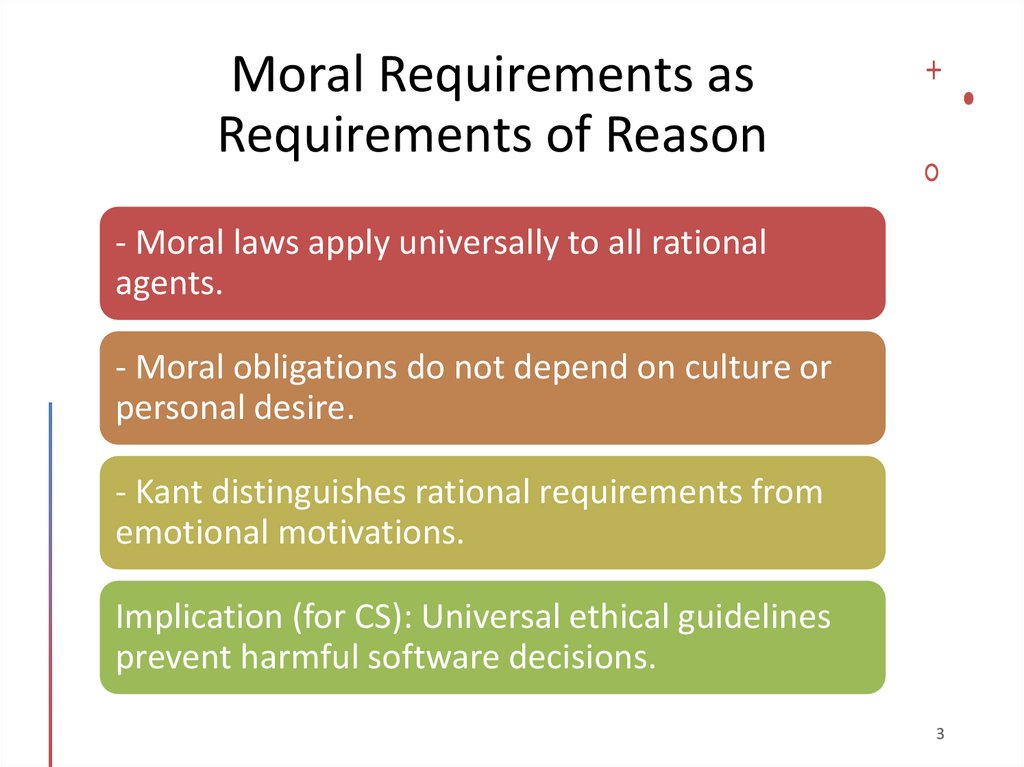
3. Moral Requirements as Requirements of Reason
- Moral laws apply universally to all rationalagents.
- Moral obligations do not depend on culture or
personal desire.
- Kant distinguishes rational requirements from
emotional motivations.
Implication (for CS): Universal ethical guidelines
prevent harmful software decisions.
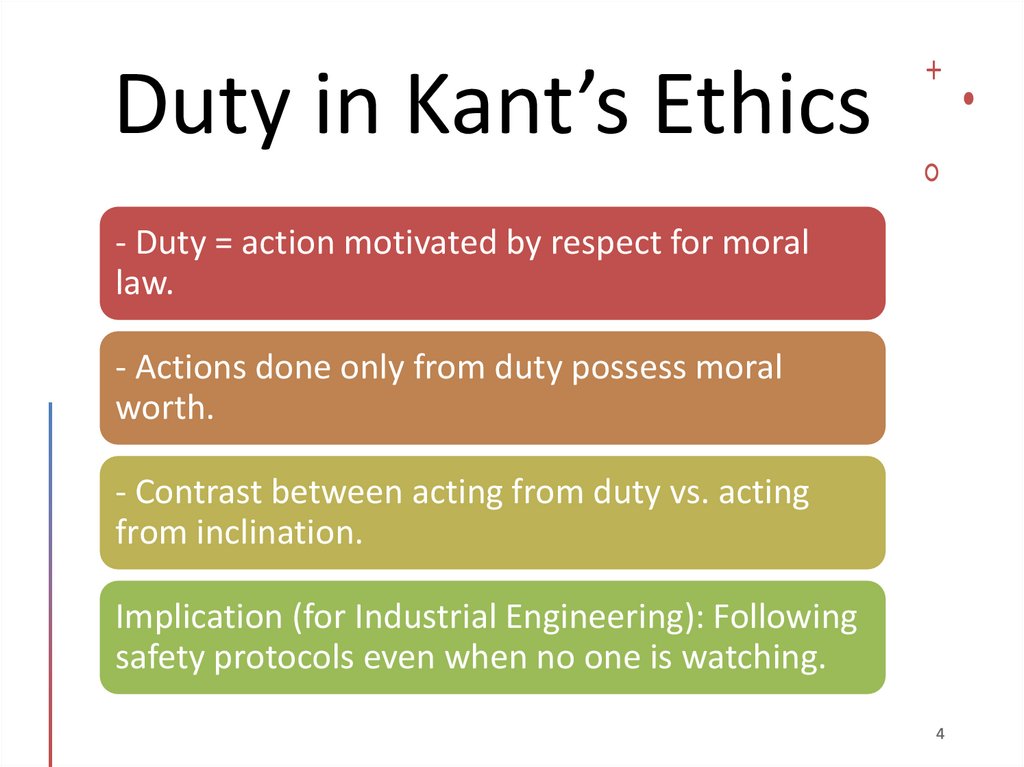
4. Duty in Kant’s Ethics
- Duty = action motivated by respect for morallaw.
- Actions done only from duty possess moral
worth.
- Contrast between acting from duty vs. acting
from inclination.
Implication (for Industrial Engineering): Following
safety protocols even when no one is watching.
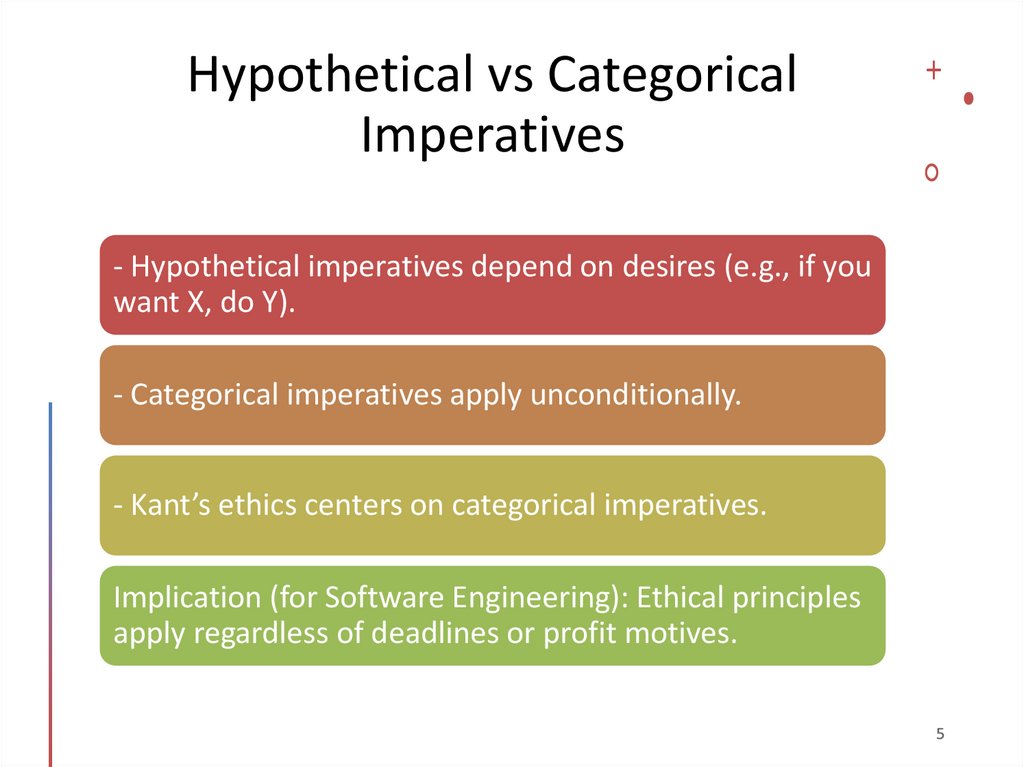
5. Hypothetical vs Categorical Imperatives
- Hypothetical imperatives depend on desires (e.g., if youwant X, do Y).
- Categorical imperatives apply unconditionally.
- Kant’s ethics centers on categorical imperatives.
Implication (for Software Engineering): Ethical principles
apply regardless of deadlines or profit motives.
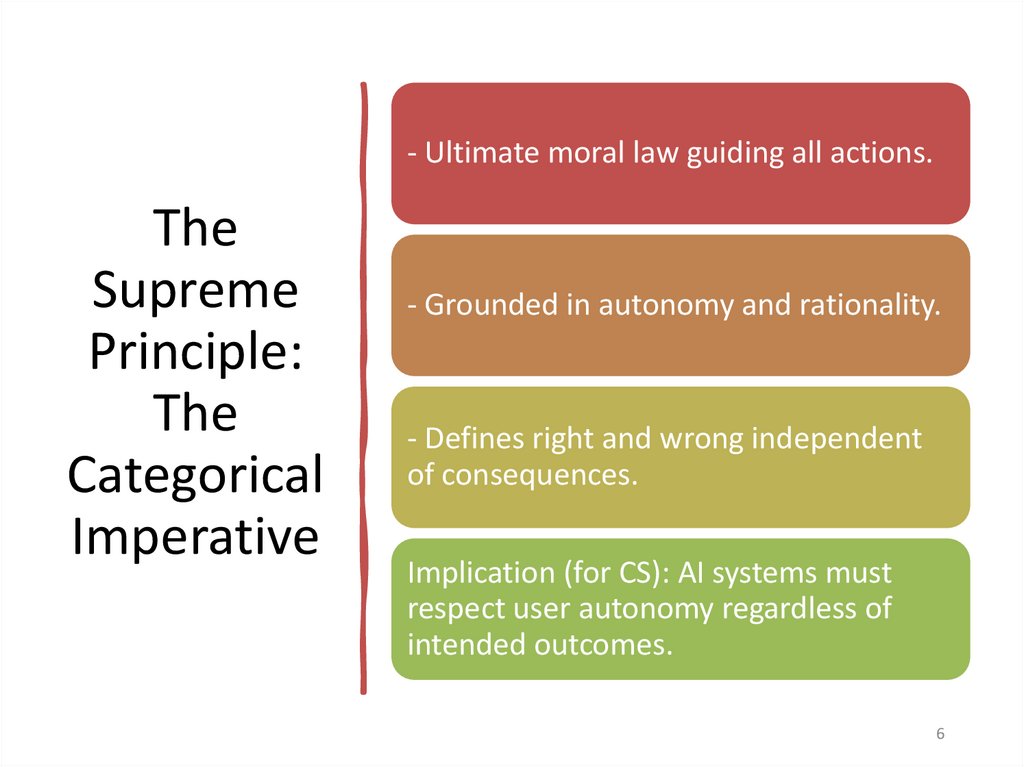
6. The Supreme Principle: The Categorical Imperative
- Ultimate moral law guiding all actions.The
Supreme
Principle:
The
Categorical
Imperative
- Grounded in autonomy and rationality.
- Defines right and wrong independent
of consequences.
Implication (for CS): AI systems must
respect user autonomy regardless of
intended outcomes.
6
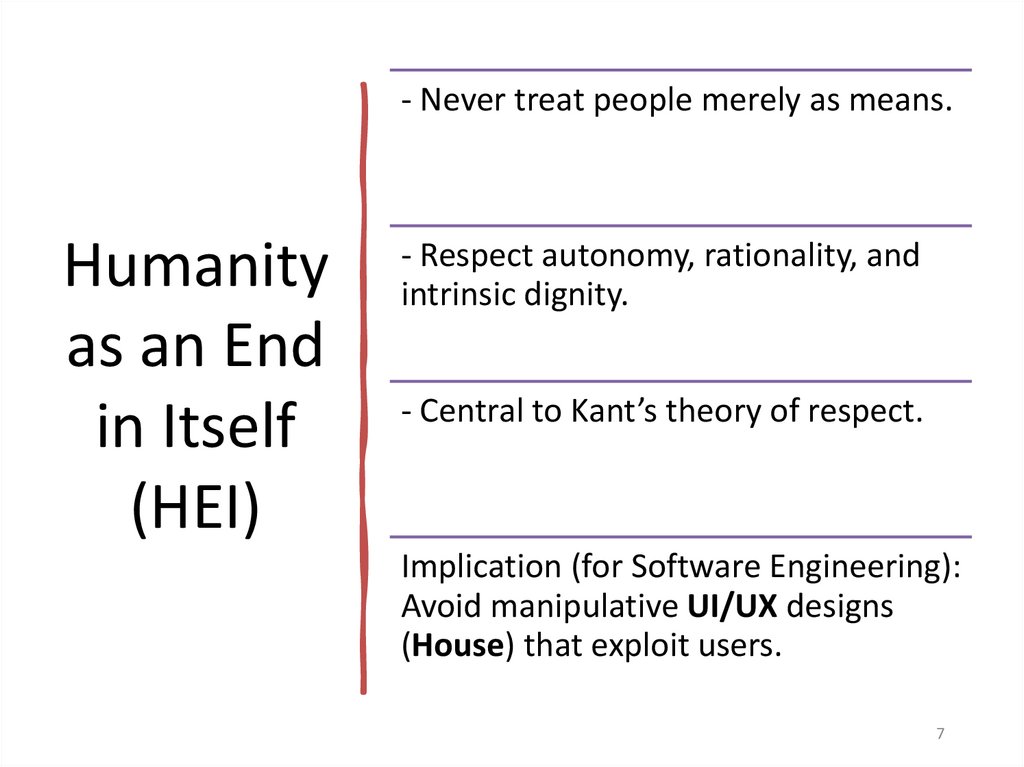
7. Humanity as an End in Itself (HEI)
- Never treat people merely as means.Humanity
as an End
in Itself
(HEI)
- Respect autonomy, rationality, and
intrinsic dignity.
- Central to Kant’s theory of respect.
Implication (for Software Engineering):
Avoid manipulative UI/UX designs
(House) that exploit users.
7
8. Perfect and Imperfect Duties
- Perfect duties: absolute (e.g., do notlie).
Perfect
and
Imperfect
Duties
- Imperfect duties: flexible (e.g., help
others).
- These duties define moral obligations
toward self and others.
Implication (for Industrial Engineering):
Perfect = zero-tolerance safety rules;
Imperfect = continuous improvement.
8
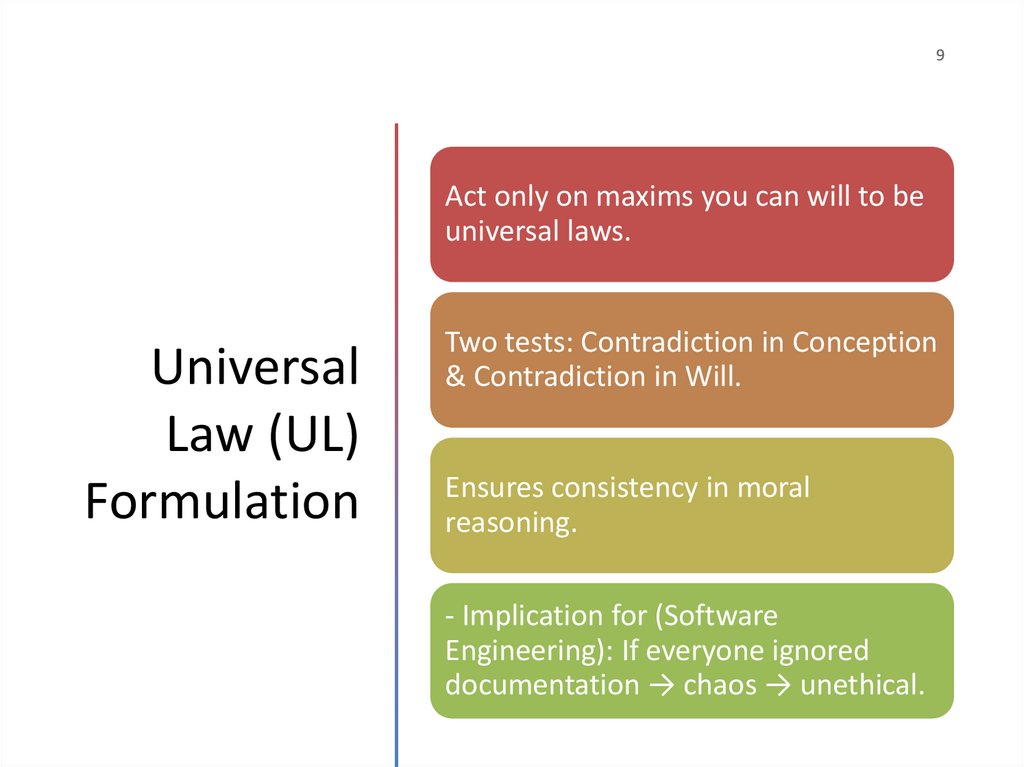
9. Universal Law (UL) Formulation
Act only on maxims you can will to beuniversal laws.
Universal
Law (UL)
Formulation
Two tests: Contradiction in Conception
& Contradiction in Will.
Ensures consistency in moral
reasoning.
- Implication for (Software
Engineering): If everyone ignored
documentation → chaos → unethical.
10. Example: False Promising
- Kant rejects lying evenfor personal gain.
Implication (for Industrial
Engineering): Falsifying
test reports undermines
the entire system’s
reliability.
11. Kant’s Theory of Value
- Autonomy and rationality givehumans dignity.
- Good will = moral worth.
- Virtue = strength to act from duty
despite obstacles.
Implication (for CS): Ethical
developers act from moral
commitment, not convenience.
12. Autonomy and Moral Law
- Freedom is a precondition formorality.
Autonomy
and Moral
Law
- Autonomy grounds all moral
obligations.
Implication (for Software
Engineering): Open-source
contributors act autonomously
toward community benefit.
13. The Highest Good
- Ideal combination of virtue andhappiness.
The
Highest
Good
- Achieving full moral virtue
requires lifelong effort.
Implication (for Industrial
Engineering): Sustainable design
aligns virtue (ethics) with
happiness (efficiency).
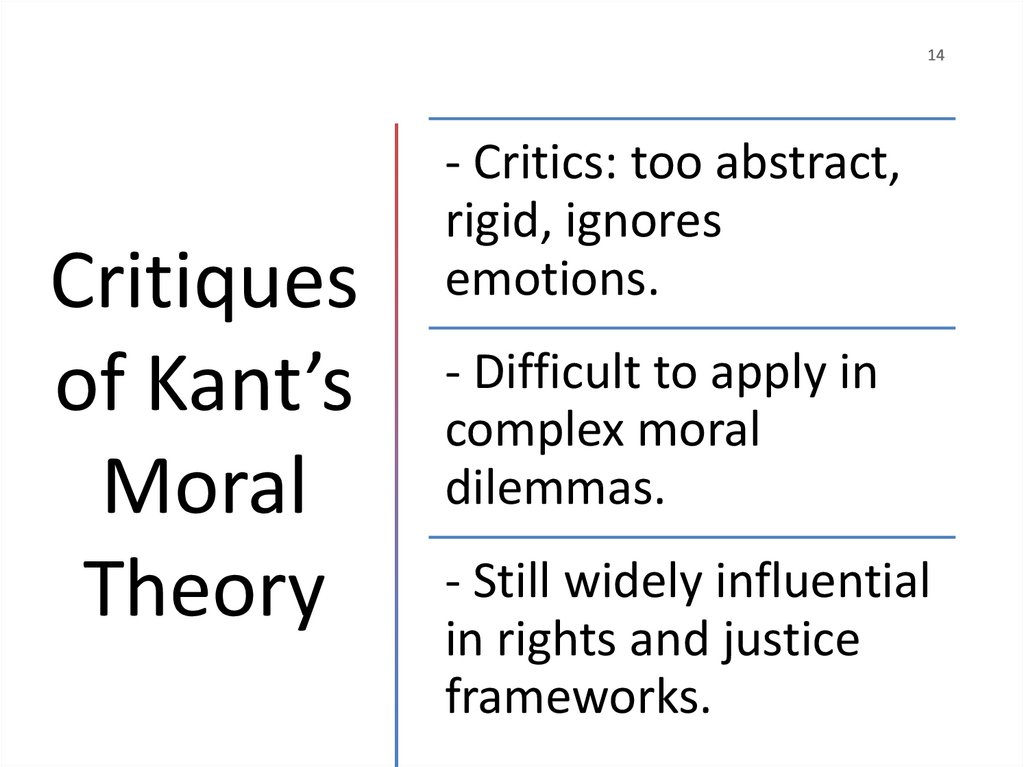
14. Critiques of Kant’s Moral Theory
- Critics: too abstract,rigid, ignores
emotions.
- Difficult to apply in
complex moral
dilemmas.
- Still widely influential
in rights and justice
frameworks.
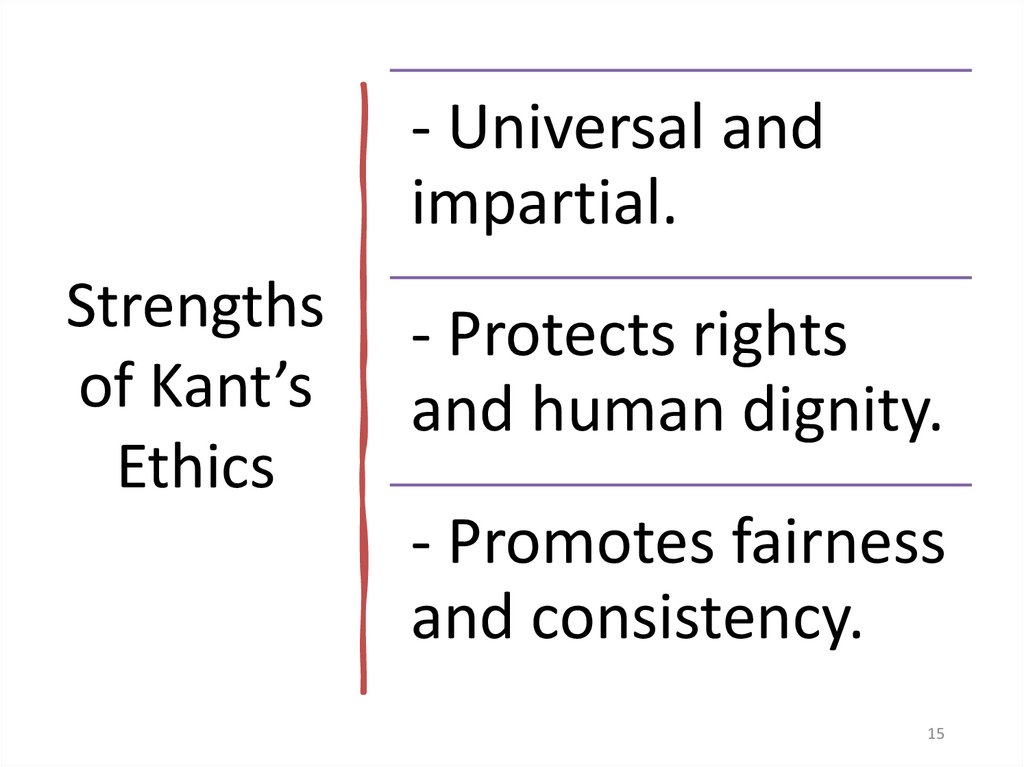
15. Strengths of Kant’s Ethics
- Universal andimpartial.
Strengths
of Kant’s
Ethics
- Protects rights
and human dignity.
- Promotes fairness
and consistency.
15
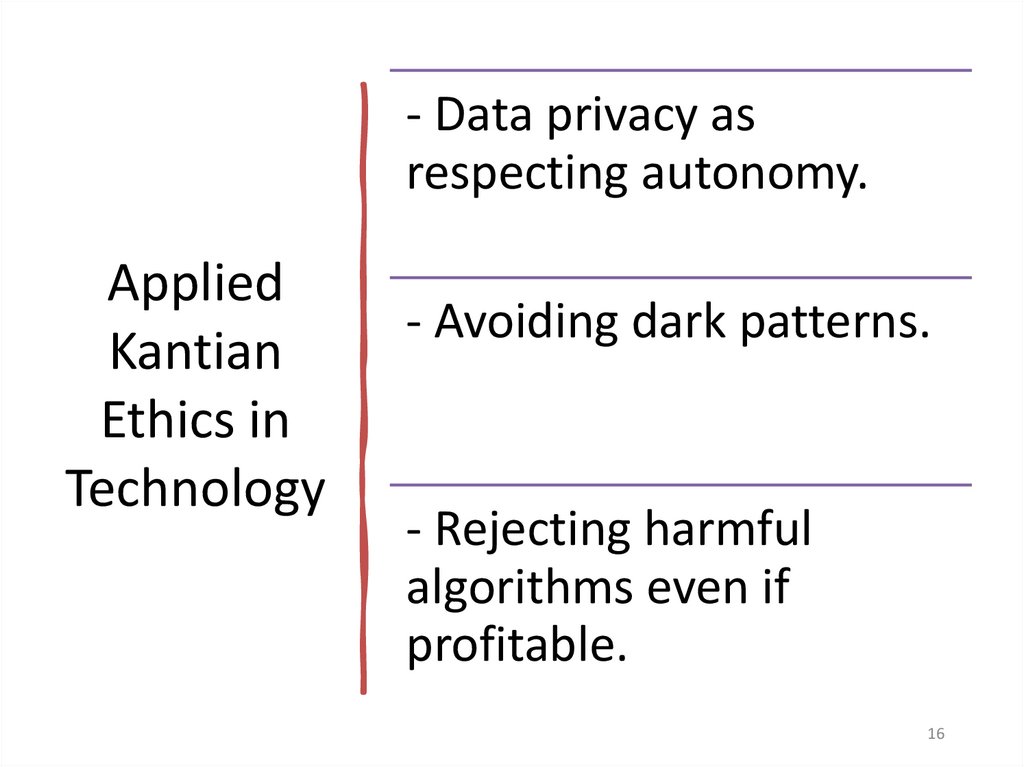
16. Applied Kantian Ethics in Technology
- Data privacy asrespecting autonomy.
Applied
Kantian
Ethics in
Technology
- Avoiding dark patterns.
- Rejecting harmful
algorithms even if
profitable.
16
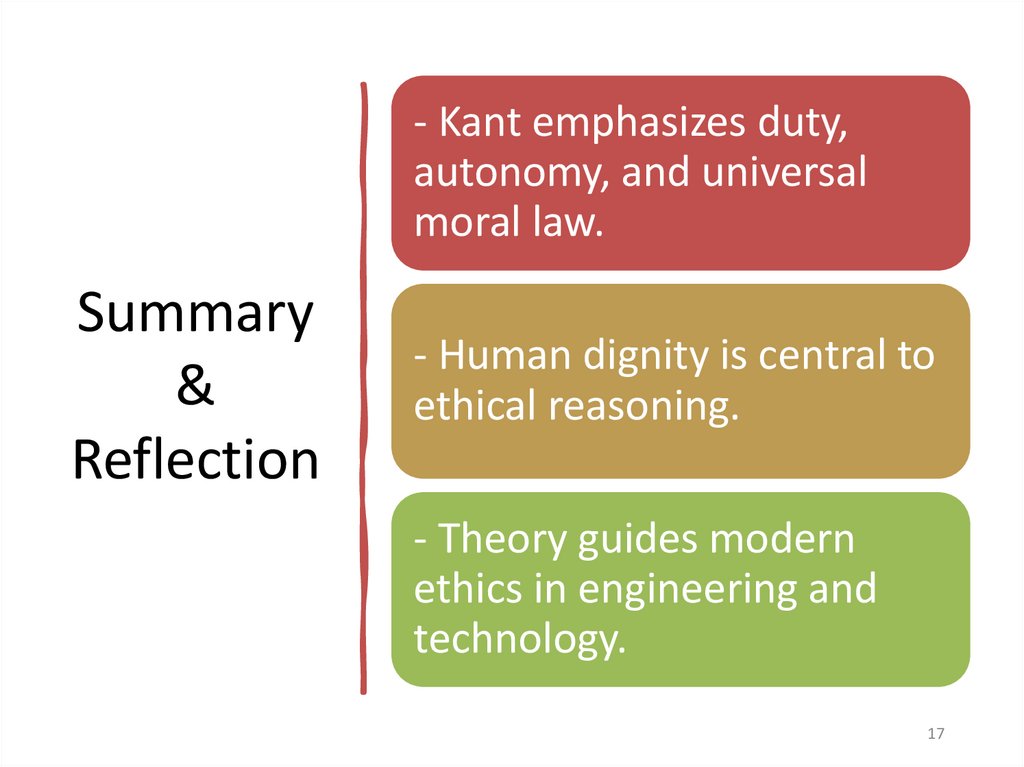
17. Summary & Reflection
- Kant emphasizes duty,autonomy, and universal
moral law.
Summary
&
Reflection
- Human dignity is central to
ethical reasoning.
- Theory guides modern
ethics in engineering and
technology.
17
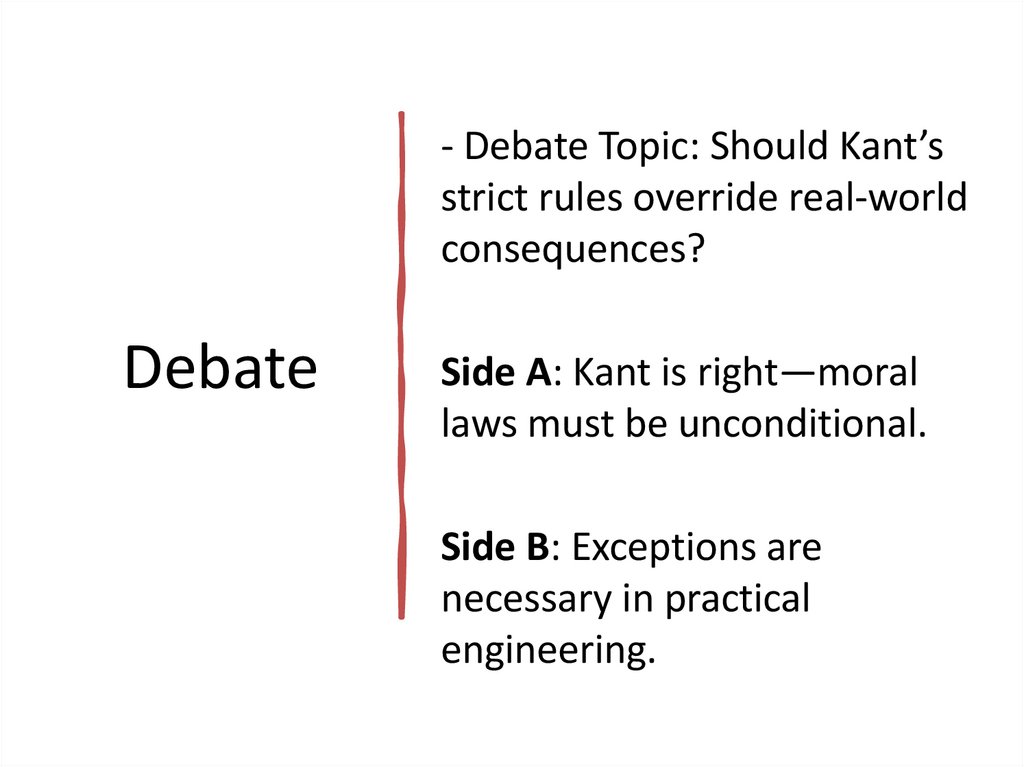
18. Debate
- Debate Topic: Should Kant’sstrict rules override real-world
consequences?
Debate
Side A: Kant is right—moral
laws must be unconditional.
Side B: Exceptions are
necessary in practical
engineering.