Similar presentations:






Презентация Акулов Д.С
1.
Harnessing Artificial IntelligenceTechnologies in Transportation by
2025
Exploring AI's transformative impact on transportation safety, efficiency, and regulation.
Akulov D.S
The use of artificial intelligence technologies in transport
Siberian Transport University
2.
Background and Contextof AI Integration in
Transportation
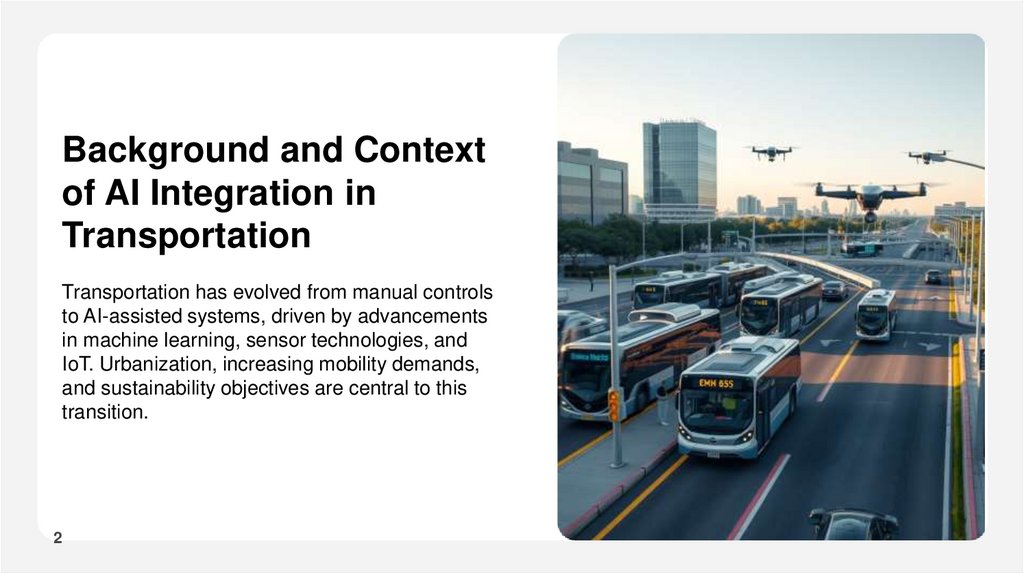
Transportation has evolved from manual controls
to AI-assisted systems, driven by advancements
in machine learning, sensor technologies, and
IoT. Urbanization, increasing mobility demands,
and sustainability objectives are central to this
transition.
2
3.
Autonomous Vehicles: Capabilities and ImplementationStatus
Enabling
Technologies
AI-Driven Evolution
of Transportation
AI in Public Transport
Management Systems
Leading Global AI
Transportation Projects and
Technologies
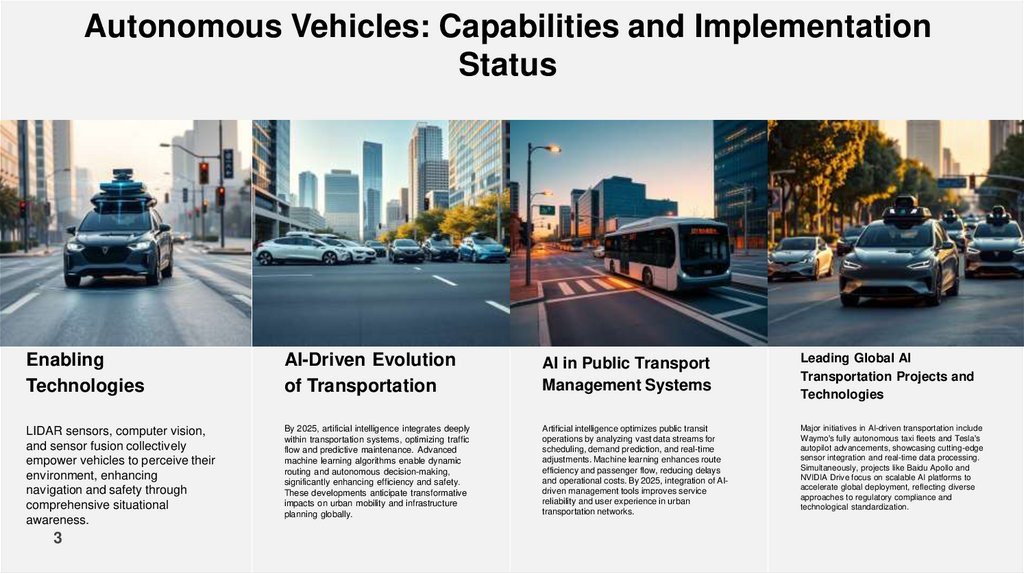
LIDAR sensors, computer vision,
and sensor fusion collectively
empower vehicles to perceive their
environment, enhancing
navigation and safety through
comprehensive situational
awareness.
By 2025, artificial intelligence integrates deeply
within transportation systems, optimizing traffic
flow and predictive maintenance. Advanced
machine learning algorithms enable dynamic
routing and autonomous decision-making,
significantly enhancing efficiency and safety.
These developments anticipate transformative
impacts on urban mobility and infrastructure
planning globally.
Artificial intelligence optimizes public transit
operations by analyzing vast data streams for
scheduling, demand prediction, and real-time
adjustments. Machine learning enhances route
efficiency and passenger flow, reducing delays
and operational costs. By 2025, integration of AIdriven management tools improves service
reliability and user experience in urban
transportation networks.
Major initiatives in AI-driven transportation include
Waymo's fully autonomous taxi fleets and Tesla's
autopilot advancements, showcasing cutting-edge
sensor integration and real-time data processing.
Simultaneously, projects like Baidu Apollo and
NVIDIA Drive focus on scalable AI platforms to
accelerate global deployment, reflecting diverse
approaches to regulatory compliance and
technological standardization.
3
4.
Projected Growth of AI-Enabled TransportationMarket (2020-2025)
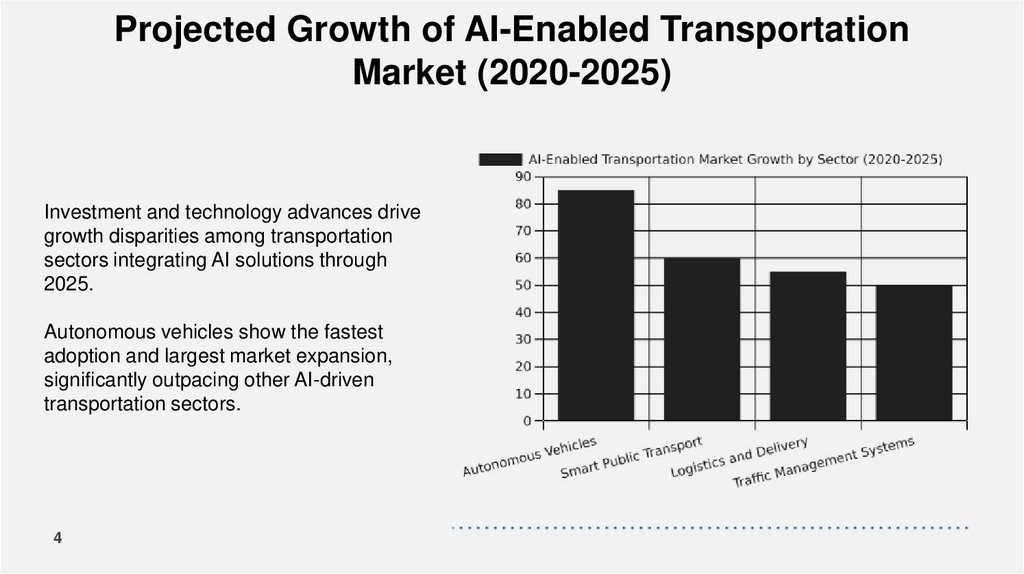
Investment and technology advances drive
growth disparities among transportation
sectors integrating AI solutions through
2025.
Autonomous vehicles show the fastest
adoption and largest market expansion,
significantly outpacing other AI-driven
transportation sectors.
4
5.
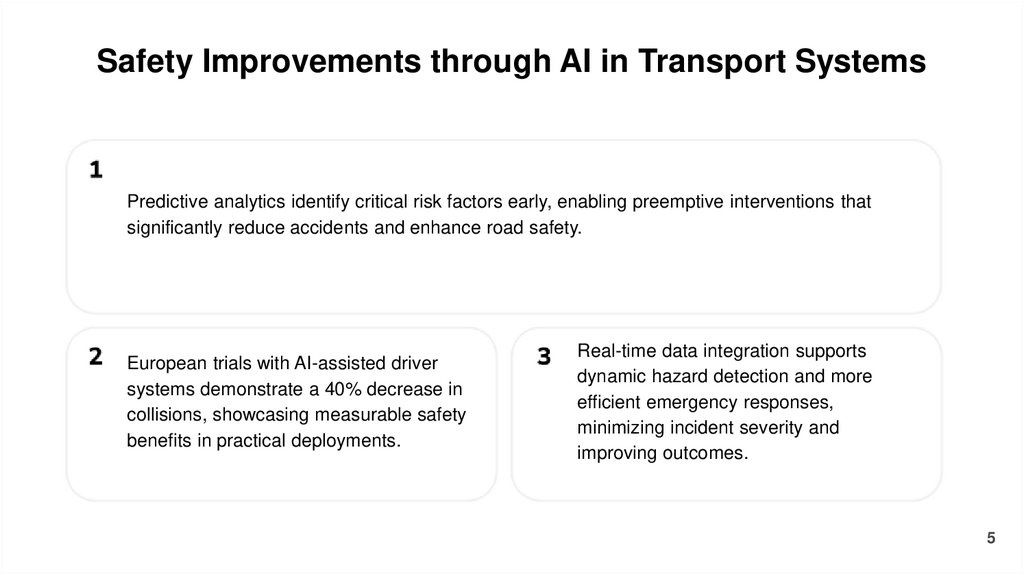
Safety Improvements through AI in Transport SystemsPredictive analytics identify critical risk factors early, enabling preemptive interventions that
significantly reduce accidents and enhance road safety.
European trials with AI-assisted driver
systems demonstrate a 40% decrease in
collisions, showcasing measurable safety
benefits in practical deployments.
Real-time data integration supports
dynamic hazard detection and more
efficient emergency responses,
minimizing incident severity and
improving outcomes.
5
6.
Comparison of AI Technologies in Public TransitSystems
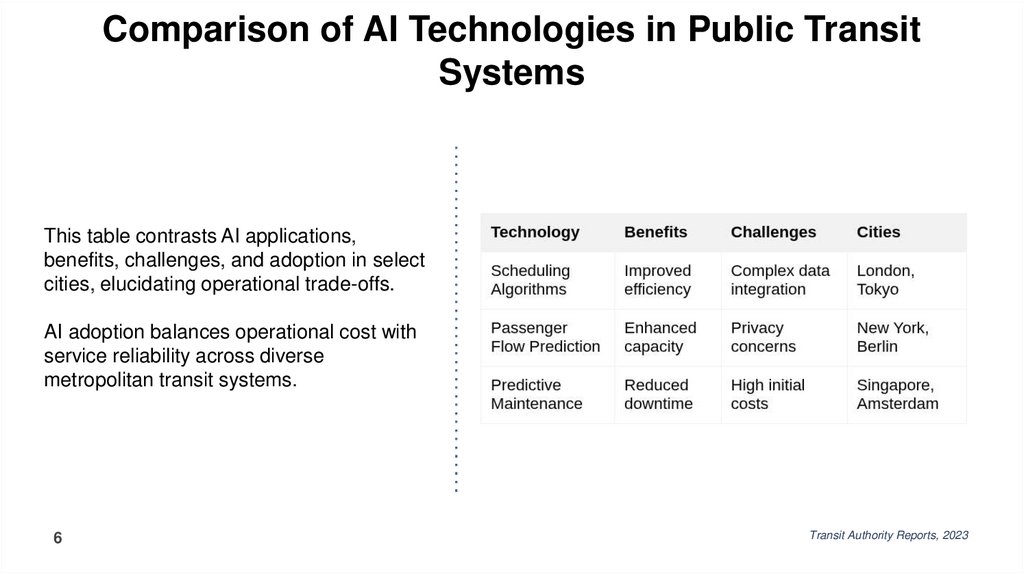
This table contrasts AI applications,
benefits, challenges, and adoption in select
cities, elucidating operational trade-offs.
AI adoption balances operational cost with
service reliability across diverse
metropolitan transit systems.
6
Transit Authority Reports, 2023
7.
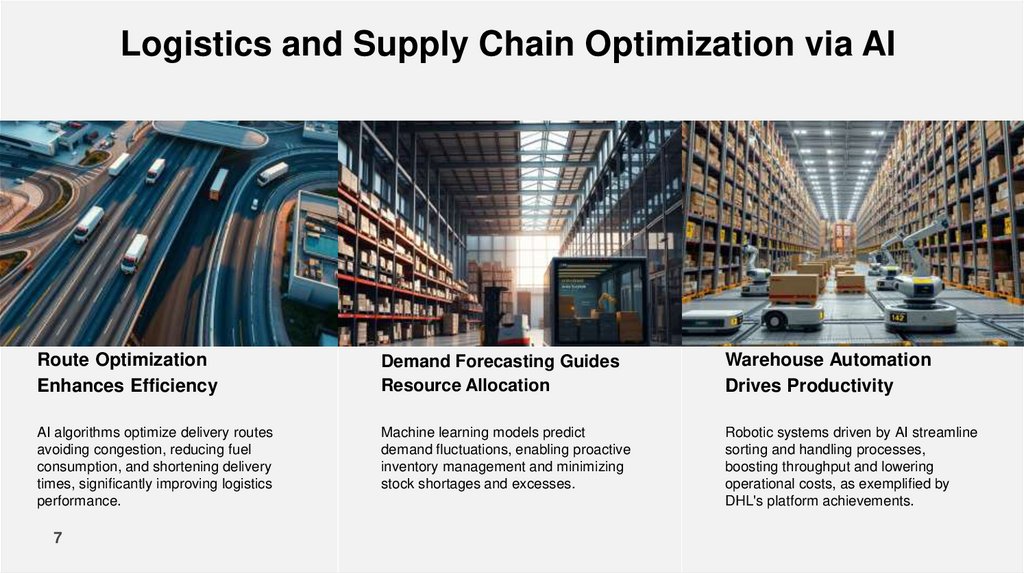
Logistics and Supply Chain Optimization via AIRoute Optimization
Enhances Efficiency
Demand Forecasting Guides
Resource Allocation
Warehouse Automation
Drives Productivity
AI algorithms optimize delivery routes
avoiding congestion, reducing fuel
consumption, and shortening delivery
times, significantly improving logistics
performance.
Machine learning models predict
demand fluctuations, enabling proactive
inventory management and minimizing
stock shortages and excesses.
Robotic systems driven by AI streamline
sorting and handling processes,
boosting throughput and lowering
operational costs, as exemplified by
DHL's platform achievements.
7
8.
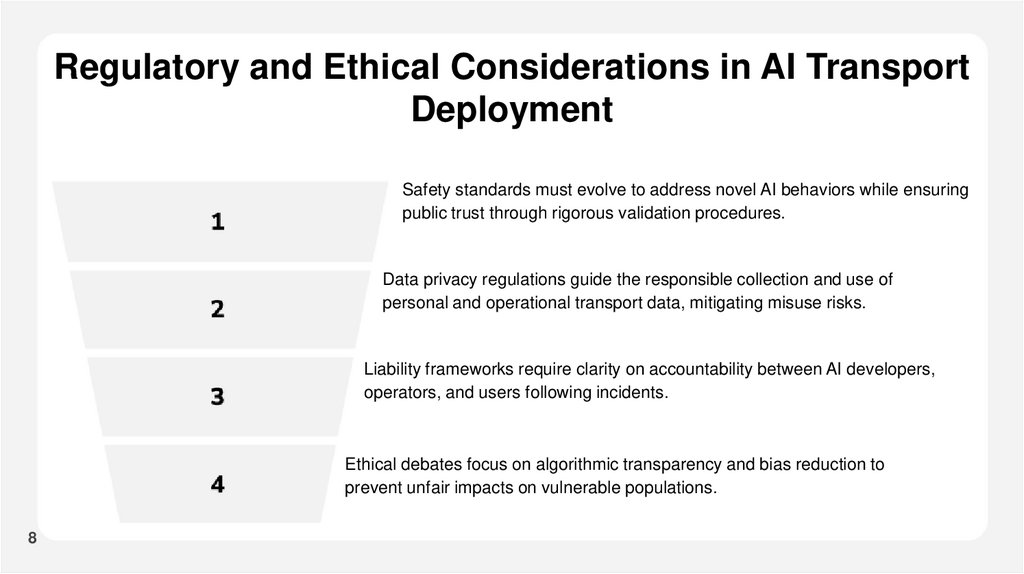
Regulatory and Ethical Considerations in AI TransportDeployment
Safety standards must evolve to address novel AI behaviors while ensuring
public trust through rigorous validation procedures.
Data privacy regulations guide the responsible collection and use of
personal and operational transport data, mitigating misuse risks.
Liability frameworks require clarity on accountability between AI developers,
operators, and users following incidents.
Ethical debates focus on algorithmic transparency and bias reduction to
prevent unfair impacts on vulnerable populations.
8
9.
Environmental Impact Projections of AI in TransportSystems
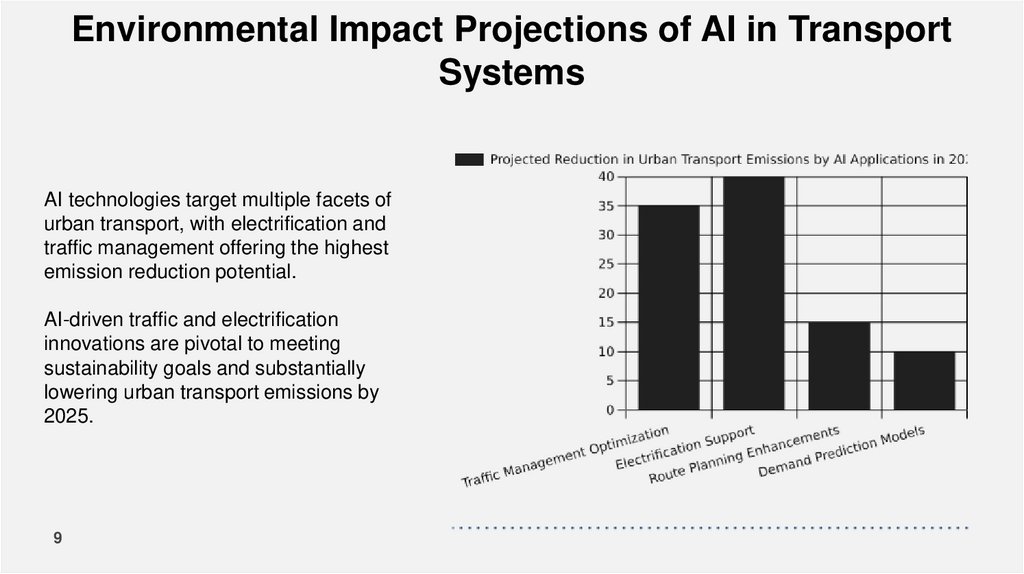
AI technologies target multiple facets of
urban transport, with electrification and
traffic management offering the highest
emission reduction potential.
AI-driven traffic and electrification
innovations are pivotal to meeting
sustainability goals and substantially
lowering urban transport emissions by
2025.
9
10.
Synthesizing AI’s Role in ShapingFuture Transportation
AI holds transformative potential to improve safety, efficiency, and sustainability, demanding balanced
innovation alongside robust regulatory and interdisciplinary collaboration.