 management
Similar presentations:





Collaboration in a multicultural environment (Managing first meetings, small talk) Week 8. Practice 1-2 Term 1, 2025-2026
1. Professional English
School of General EducationDisciplines
Professional English
Topic: Collaboration in a multicultural environment
(Managing first meetings, small talk)
Week 8. Practice 1-2
Term 1, 2025-2026
2. Objectives:
• to identify communicationstrategies for handling first
meetings
• to comprehend different attitudes
to small talk and personal
relationships at work
• to manage different styles of
small talk
• to understand challenges of
working in a multicultural team
3. Warm up
How might people fromone culture differ
from people with
different cultural
backgrounds?
Warm
up
Have you ever
experienced another
culture? Where?
What must one keep in
mind when working
with people from
other cultures?
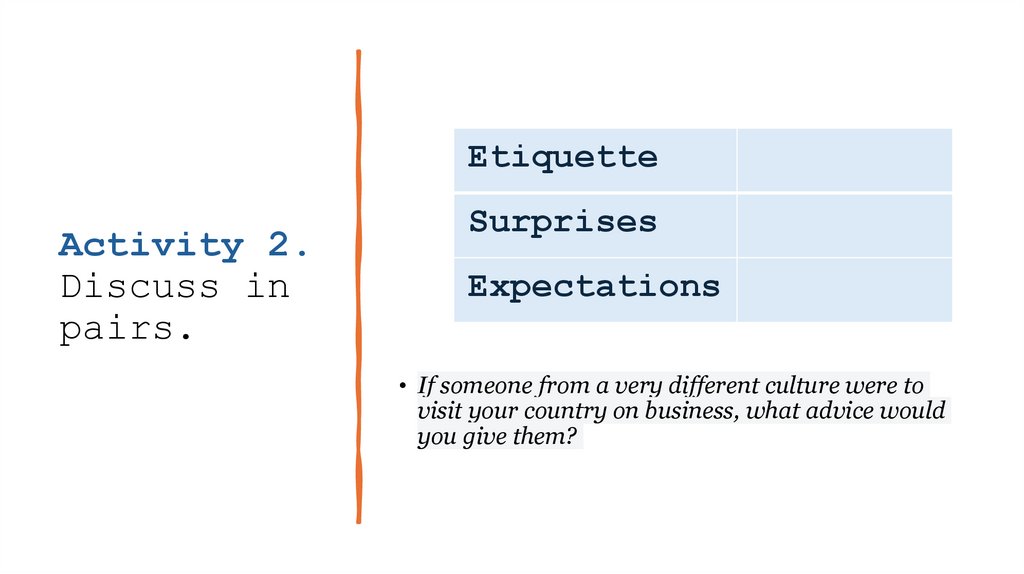
4. Activity 2. Discuss in pairs.
EtiquetteActivity 2.
Discuss in
pairs.
Surprises
Expectations
• If someone from a very different culture were to
visit your country on business, what advice would
you give them?
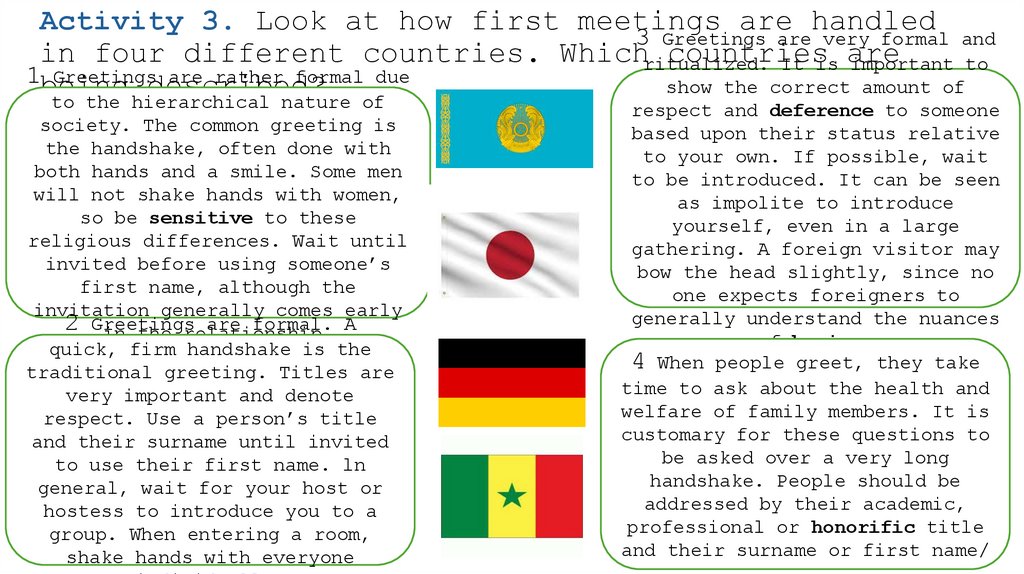
5. Activity 3. Look at how first meetings are handled in four different countries. Which countries are being described?
Activity 3. Look at how first meetings are handled3 Greetings are very formal and
in four different countries. Whichritualized.
countries
It is are
important to
1being
Greetings are rather formal due
show the correct amount of
described?
to the hierarchical nature of
society. The common greeting is
the handshake, often done with
both hands and a smile. Some men
will not shake hands with women,
so be sensitive to these
religious differences. Wait until
invited before using someone’s
first name, although the
invitation generally comes early
2 Greetings
are formal. A
in the relationship.
quick, firm handshake is the
traditional greeting. Titles are
very important and denote
respect. Use a person’s title
and their surname until invited
to use their first name. ln
general, wait for your host or
hostess to introduce you to a
group. When entering a room,
shake hands with everyone
respect and deference to someone
based upon their status relative
to your own. If possible, wait
to be introduced. It can be seen
as impolite to introduce
yourself, even in a large
gathering. A foreign visitor may
bow the head slightly, since no
one expects foreigners to
generally understand the nuances
of bowing.
4 When people greet, they take
time to ask about the health and
welfare of family members. It is
customary for these questions to
be asked over a very long
handshake. People should be
addressed by their academic,
professional or honorific title
and their surname or first name/
6. Activity 4. Small talk. What do you think?
• You just need plenty of practice to be good atsmall talk.
• I am an expert, I don’t need to do small talk.
• Small talk isn’t real talk.
• As long as you know English grammar and plenty
of English words you shouldn’t have any trouble
with small talk in English.
• You only need small talk if you meet people at
parties.
7. Activity 5. Think-Pair-Share
Activity 5. ThinkPair-ShareWhy is small talk
important?
• What topics are
appropriate for a
small talk?
• What topics are
inappropriate for a
small talk?
In which work
situations do we use
small talk?
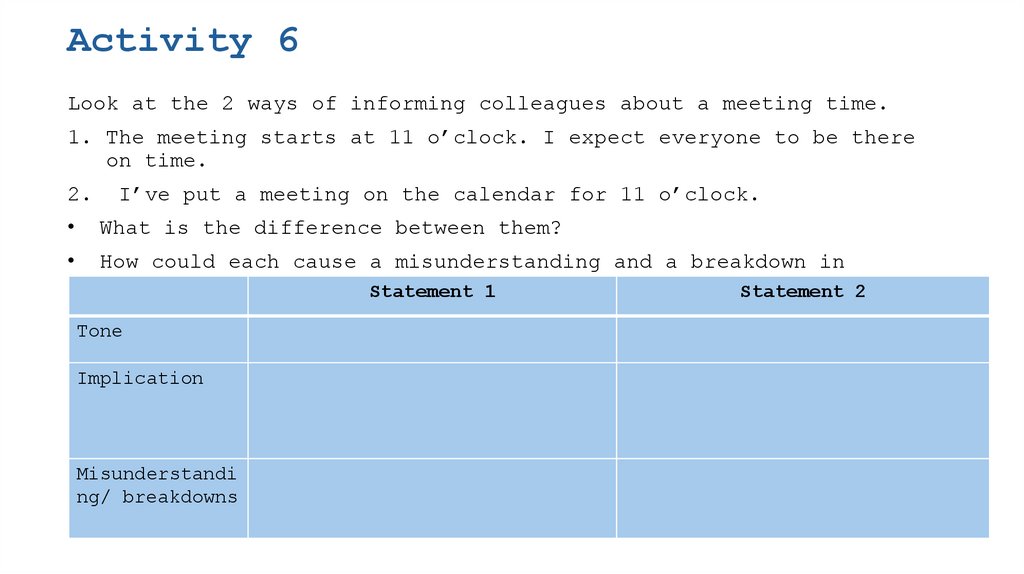
8. Activity 6
Look at the 2 ways of informing colleagues about a meeting time.1. The meeting starts at 11 o’clock. I expect everyone to be there
on time.
2.
I’ve put a meeting on the calendar for 11 o’clock.
What is the difference between them?
How could each cause a misunderstanding and a breakdown in
communication?
Statement 1
Statement 2
Tone
Implication
Misunderstandi
ng/ breakdowns
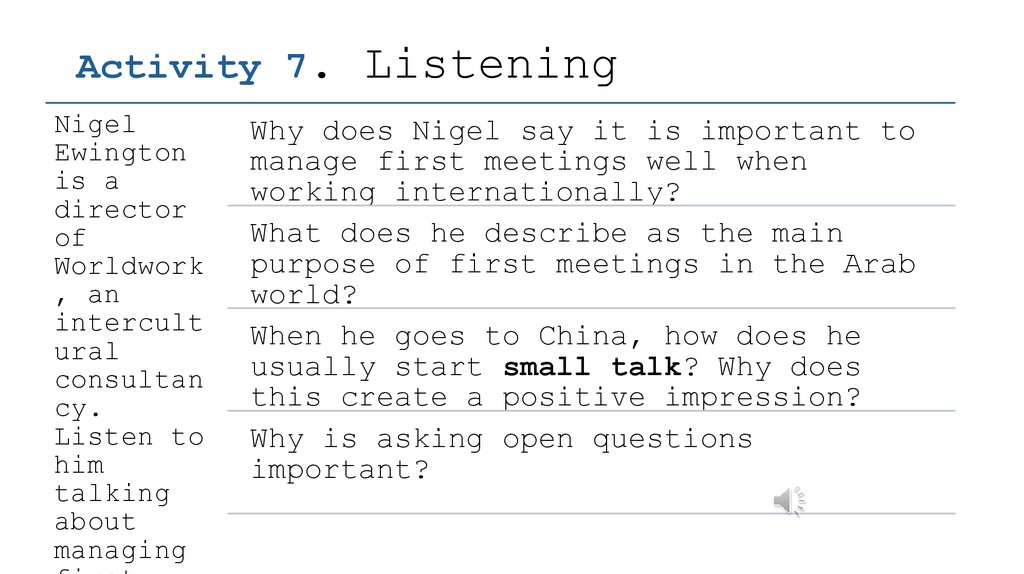
9. Activity 7. Listening
Activity 7.Nigel
Ewington
is a
director
of
Worldwork
, an
intercult
ural
consultan
cy.
Listen to
him
talking
about
managing
Listening
Why does Nigel say it is important to
manage first meetings well when
working internationally?
What does he describe as the main
purpose of first meetings in the Arab
world?
When he goes to China, how does he
usually start small talk? Why does
this create a positive impression?
Why is asking open questions
important?
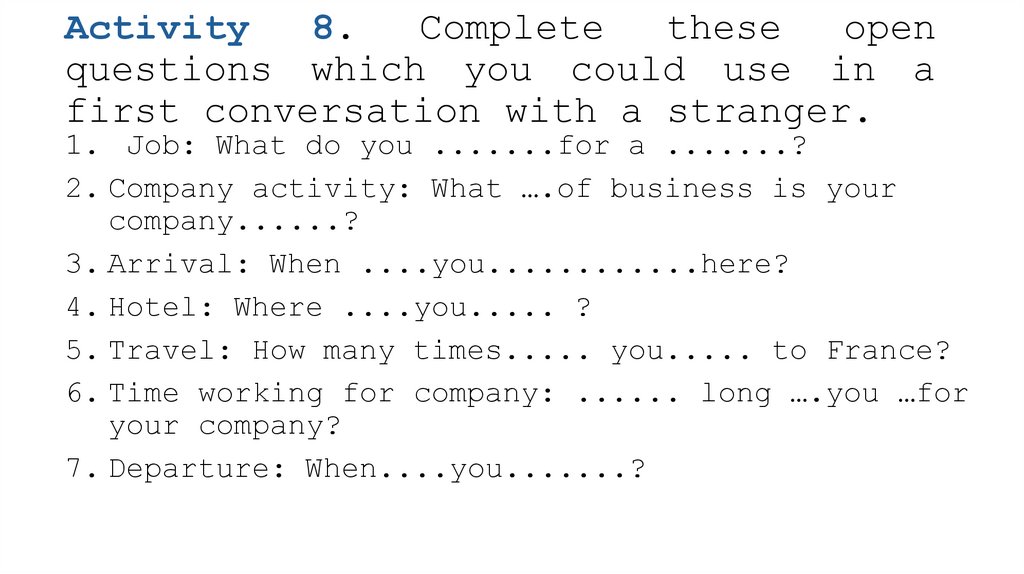
10. Activity 8. Complete these open questions which you could use in a first conversation with a stranger.
1. Job: What do you .......for a .......?2. Company activity: What ….of business is your
company......?
3. Arrival: When ....you............here?
4. Hotel: Where ....you..... ?
5. Travel: How many times..... you..... to France?
6. Time working for company: ...... long ….you …for
your company?
7. Departure: When....you.......?
11. Reading. Managing Multicultural Teams. Part 1.
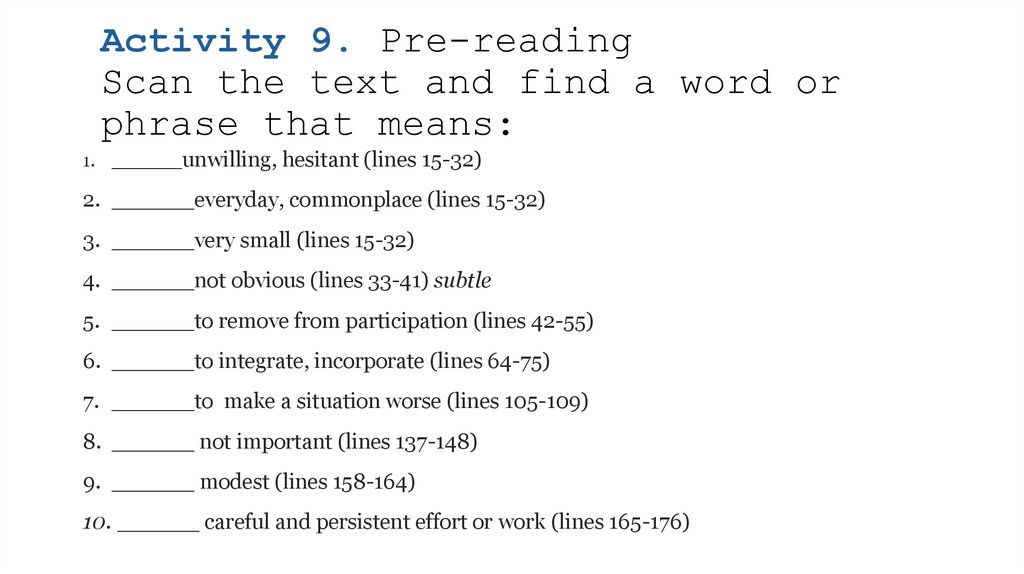
12. Activity 9. Pre-reading Scan the text and find a word or phrase that means:
1. ______unwilling, hesitant (lines 15-32)2. ______everyday, commonplace (lines 15-32)
3. ______very small (lines 15-32)
4. ______not obvious (lines 33-41) subtle
5. ______to remove from participation (lines 42-55)
6. ______to integrate, incorporate (lines 64-75)
7. ______to make a situation worse (lines 105-109)
8. ______ not important (lines 137-148)
9. ______ modest (lines 158-164)
10. ______ careful and persistent effort or work (lines 165-176)
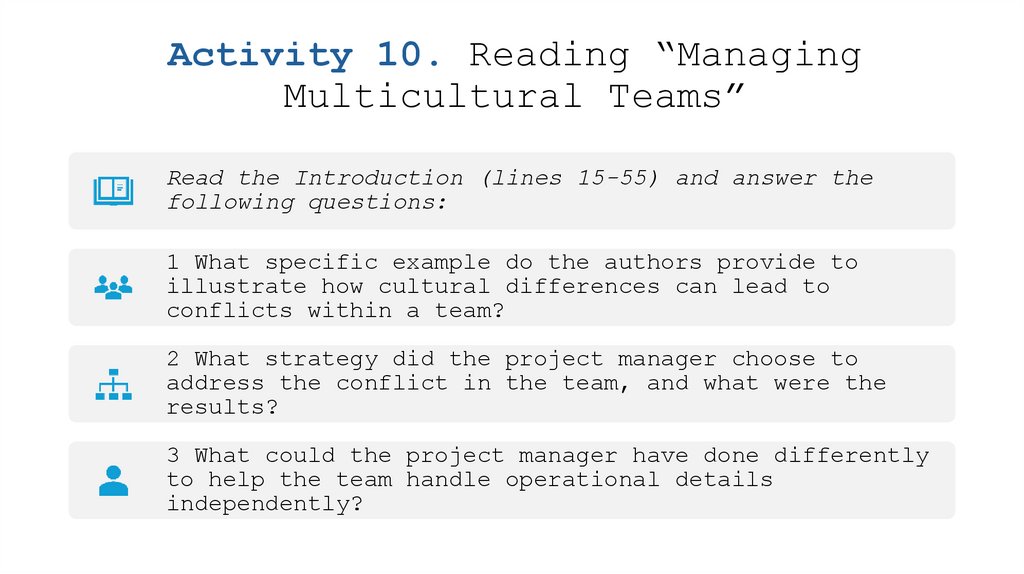
13. Activity 10. Reading “Managing Multicultural Teams”
Read the Introduction (lines 15-55) and answer thefollowing questions:
1 What specific example do the authors provide to
illustrate how cultural differences can lead to
conflicts within a team?
2 What strategy did the project manager choose to
address the conflict in the team, and what were the
results?
3 What could the project manager have done differently
to help the team handle operational details
independently?
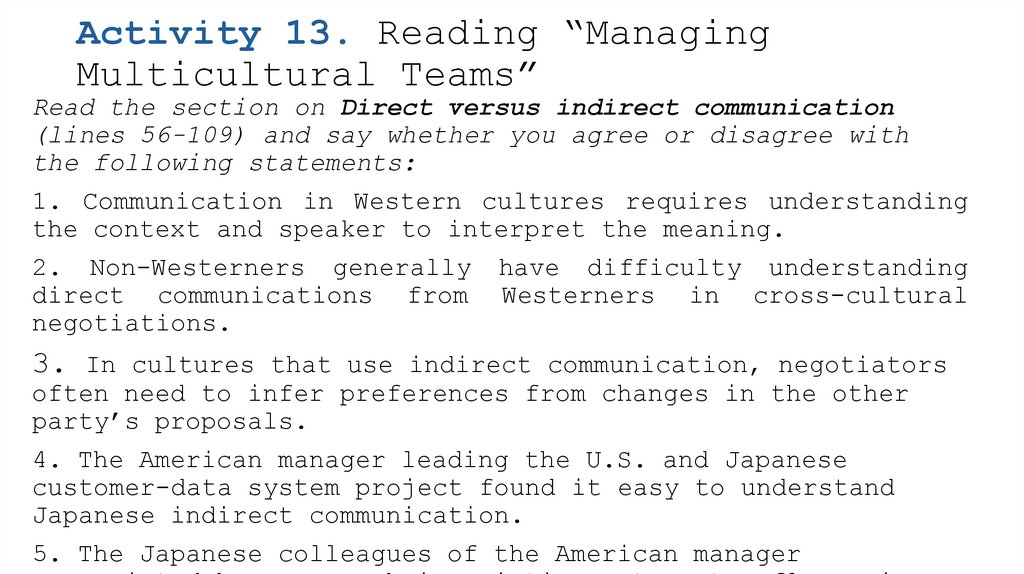
14. Activity 13. Reading “Managing Multicultural Teams”
Read the section on Direct versus indirect communication(lines 56-109) and say whether you agree or disagree with
the following statements:
1. Communication in Western cultures requires understanding
the context and speaker to interpret the meaning.
2. Non-Westerners generally have difficulty understanding
direct communications from Westerners in cross-cultural
negotiations.
3. In cultures that use indirect communication, negotiators
often need to infer preferences from changes in the other
party’s proposals.
4. The American manager leading the U.S. and Japanese
customer-data system project found it easy to understand
Japanese indirect communication.
5. The Japanese colleagues of the American manager
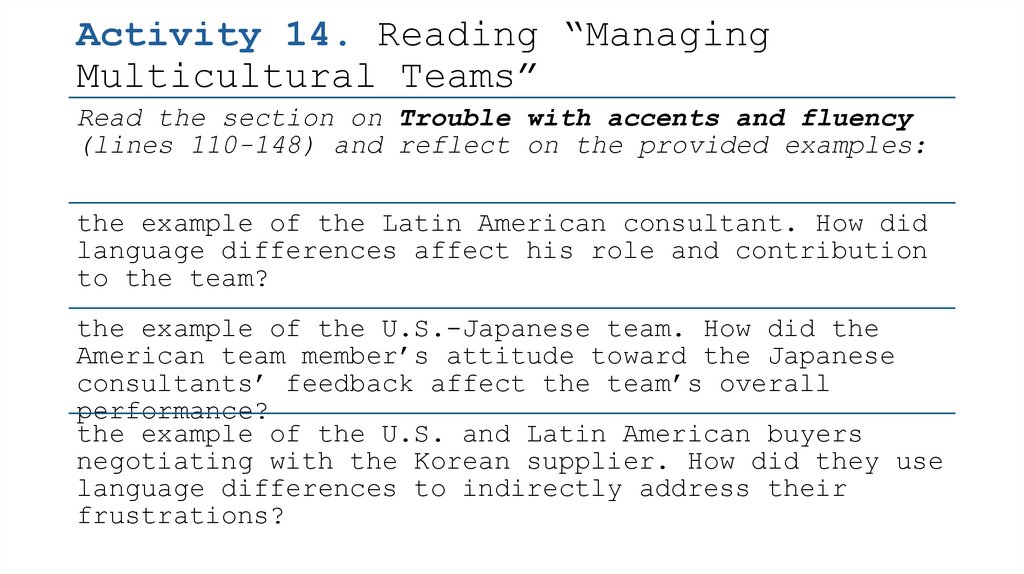
15. Activity 14. Reading “Managing Multicultural Teams”
Read the section on Trouble with accents and fluency(lines 110-148) and reflect on the provided examples:
the example of the Latin American consultant. How did
language differences affect his role and contribution
to the team?
the example of the U.S.-Japanese team. How did the
American team member’s attitude toward the Japanese
consultants’ feedback affect the team’s overall
performance?
the example of the U.S. and Latin American buyers
negotiating with the Korean supplier. How did they use
language differences to indirectly address their
frustrations?
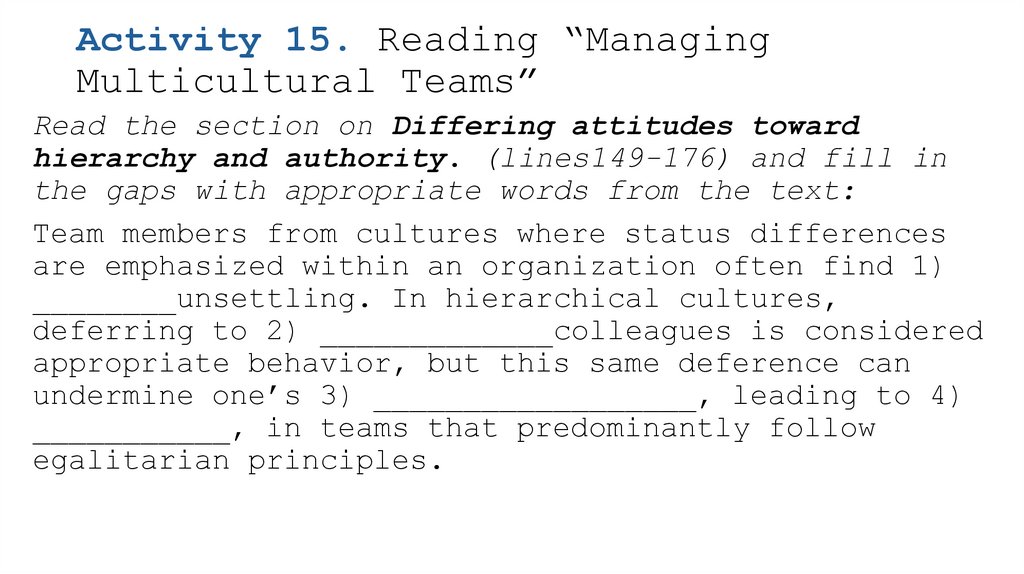
16. Activity 15. Reading “Managing Multicultural Teams”
Read the section on Differing attitudes towardhierarchy and authority. (lines149-176) and fill in
the gaps with appropriate words from the text:
Team members from cultures where status differences
are emphasized within an organization often find 1)
________unsettling. In hierarchical cultures,
deferring to 2) _____________colleagues is considered
appropriate behavior, but this same deference can
undermine one’s 3) __________________, leading to 4)
___________, in teams that predominantly follow
egalitarian principles.
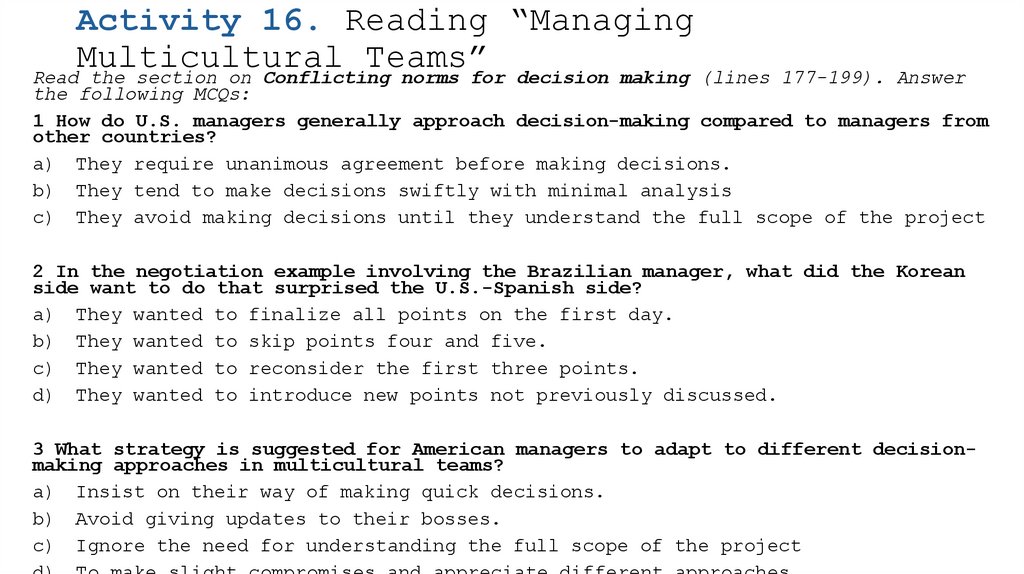
17. Activity 16. Reading “Managing Multicultural Teams”
Read the section on Conflicting norms for decision making (lines 177-199). Answerthe following MCQs:
1 How do U.S. managers generally approach decision-making compared to managers from
other countries?
a) They require unanimous agreement before making decisions.
b) They tend to make decisions swiftly with minimal analysis
c) They avoid making decisions until they understand the full scope of the project
2 In the negotiation example involving the Brazilian manager, what did the Korean
side want to do that surprised the U.S.-Spanish side?
a) They wanted to finalize all points on the first day.
b) They wanted to skip points four and five.
c) They wanted to reconsider the first three points.
d) They wanted to introduce new points not previously discussed.
3 What strategy is suggested for American managers to adapt to different decisionmaking approaches in multicultural teams?
a) Insist on their way of making quick decisions.
b) Avoid giving updates to their bosses.
c) Ignore the need for understanding the full scope of the project
18.
School of General EducationDisciplines
Endterm Assignment
(research article analysis: poster presentation)
19. Step 1. Group forming
Form the teamsGroup size: 2-3 members
per team
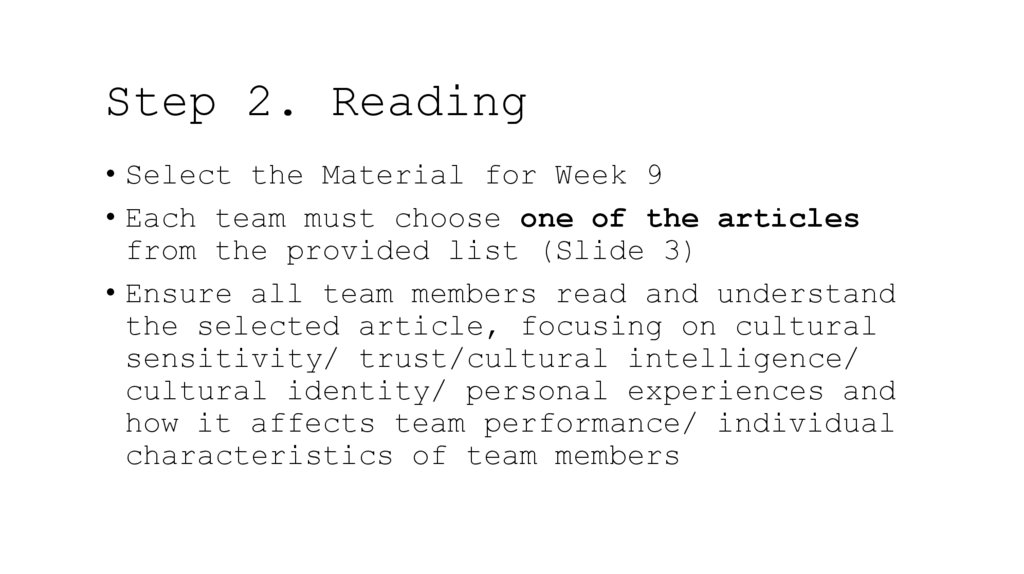
20. Step 2. Reading
• Select the Material for Week 9• Each team must choose one of the articles
from the provided list (Slide 3)
• Ensure all team members read and understand
the selected article, focusing on cultural
sensitivity/ trust/cultural intelligence/
cultural identity/ personal experiences and
how it affects team performance/ individual
characteristics of team members
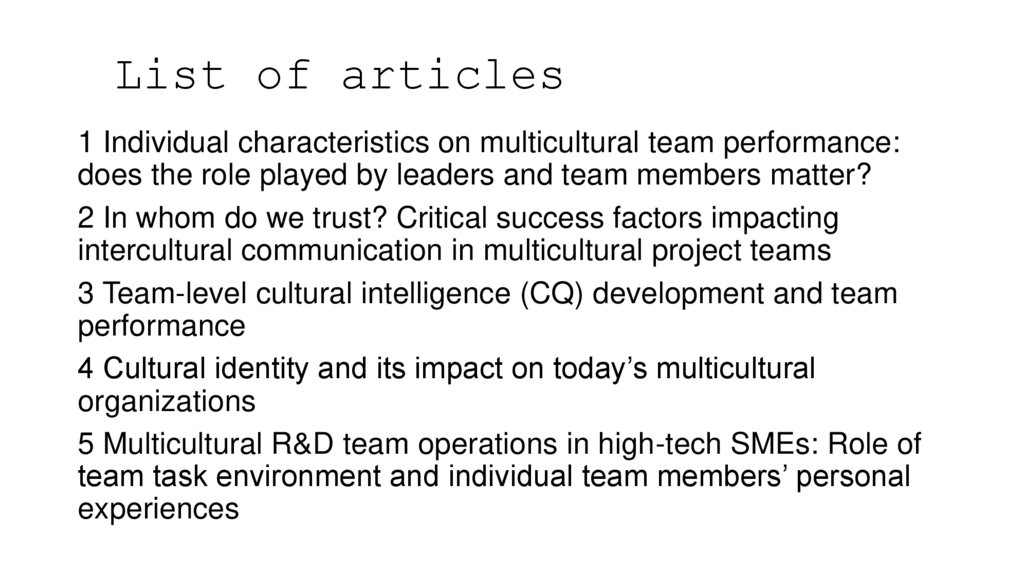
21. List of articles
1 Individual characteristics on multicultural team performance:does the role played by leaders and team members matter?
2 In whom do we trust? Critical success factors impacting
intercultural communication in multicultural project teams
3 Team-level cultural intelligence (CQ) development and team
performance
4 Cultural identity and its impact on today’s multicultural
organizations
5 Multicultural R&D team operations in high-tech SMEs: Role of
team task environment and individual team members’ personal
experiences
22. Step 3. Analyze
• Provide definitions of the key termsnecessary for understanding the topic.
• Analyze how cultural sensitivity/
trust/cultural intelligence/ cultural
identity/ personal experiences impacts team
performance. Support your arguments with the
evidence from the article.
23. Step 4. Reflect
• Express your personal reflections, youragreement/ disagreement with the authors’
opinions.
24. Step 5. Prepare and present
• Visualize your analysis and reflectionsthrough a poster
• Your poster should reflect the key insights
you have taken from the reading material.
• Use visuals, data, and quotes from the
article to support your points.
25.
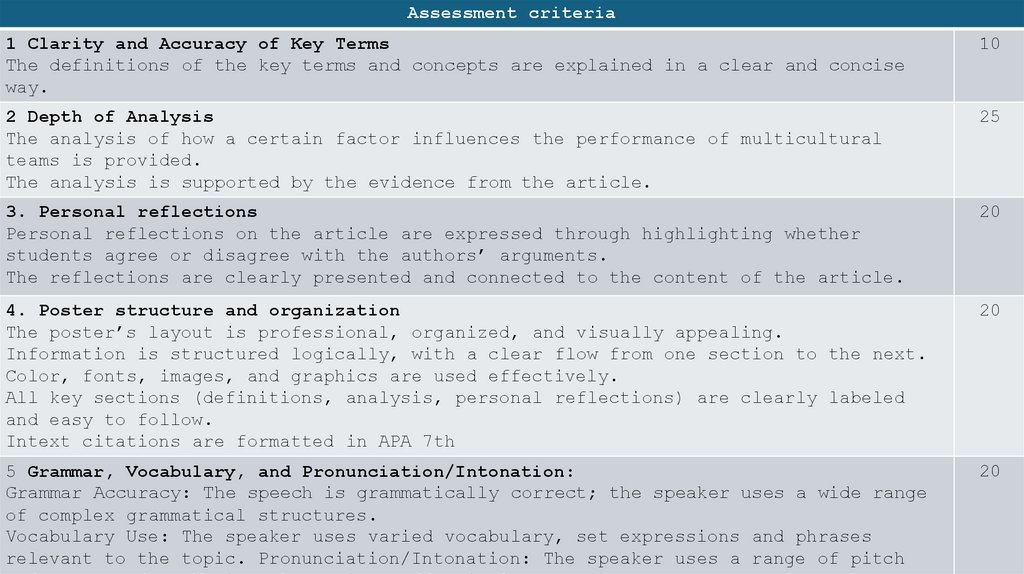
Assessment criteria1 Clarity and Accuracy of Key Terms
The definitions of the key terms and concepts are explained in a clear and concise
way.
10
2 Depth of Analysis
The analysis of how a certain factor influences the performance of multicultural
teams is provided.
The analysis is supported by the evidence from the article.
25
3. Personal reflections
Personal reflections on the article are expressed through highlighting whether
students agree or disagree with the authors’ arguments.
The reflections are clearly presented and connected to the content of the article.
20
4. Poster structure and organization
The poster’s layout is professional, organized, and visually appealing.
Information is structured logically, with a clear flow from one section to the next.
Color, fonts, images, and graphics are used effectively.
All key sections (definitions, analysis, personal reflections) are clearly labeled
and easy to follow.
Intext citations are formatted in APA 7th
20
5 Grammar, Vocabulary, and Pronunciation/Intonation:
Grammar Accuracy: The speech is grammatically correct; the speaker uses a wide range
of complex grammatical structures.
Vocabulary Use: The speaker uses varied vocabulary, set expressions and phrases
relevant to the topic. Pronunciation/Intonation: The speaker uses a range of pitch
20
26. Home task
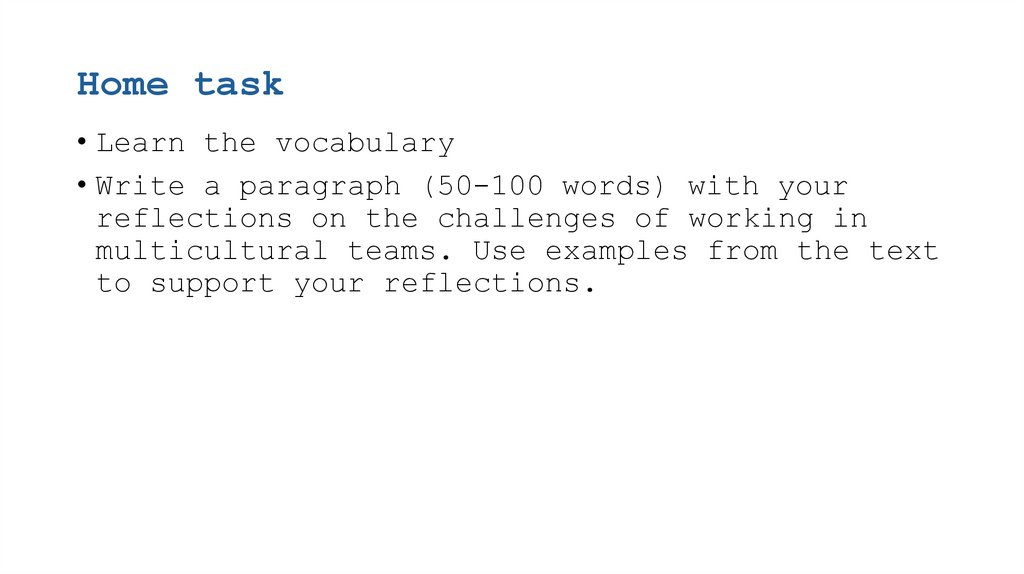
• Learn the vocabulary• Write a paragraph (50-100 words) with your
reflections on the challenges of working in
multicultural teams. Use examples from the text
to support your reflections.