 industry
Similar presentations:









Globalization Defined
1.
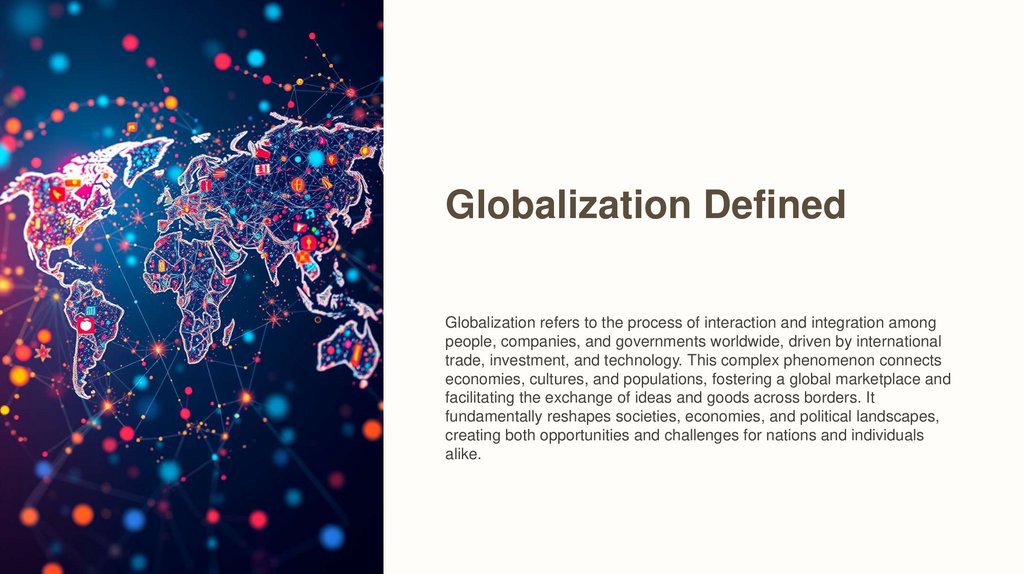
Globalization DefinedGlobalization refers to the process of interaction and integration among
people, companies, and governments worldwide, driven by international
trade, investment, and technology. This complex phenomenon connects
economies, cultures, and populations, fostering a global marketplace and
facilitating the exchange of ideas and goods across borders. It
fundamentally reshapes societies, economies, and political landscapes,
creating both opportunities and challenges for nations and individuals
alike.
2.
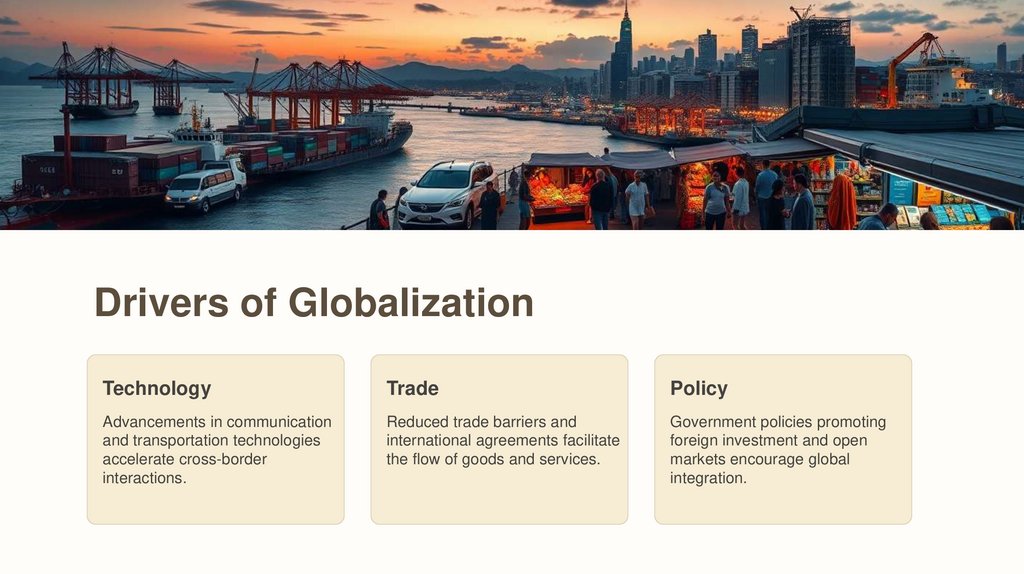
Drivers of GlobalizationTechnology
Trade
Policy
Advancements in communication
and transportation technologies
accelerate cross-border
interactions.
Reduced trade barriers and
international agreements facilitate
the flow of goods and services.
Government policies promoting
foreign investment and open
markets encourage global
integration.
3.
Pros of GlobalizationEconomic Growth
Innovation
Globalization stimulates economic growth by increasing
trade, foreign direct investment, and access to larger
markets, leading to more efficient resource allocation and
increased productivity across nations. This
interconnectedness allows countries to specialize in
producing goods and services where they have a
comparative advantage, further boosting global economic
output.
The free flow of information, ideas, and technology across
borders fosters innovation and knowledge sharing,
accelerating scientific and technological advancements.
Collaboration between researchers and businesses
worldwide leads to faster problem-solving and the
development of new solutions for global challenges.
Consumer Benefits
Consumers gain access to a wider variety of goods and
services at potentially lower prices due to increased
competition and economies of scale. This global
marketplace provides greater choice and can lead to
improved quality as companies strive to meet diverse
consumer demands across different regions.
4.
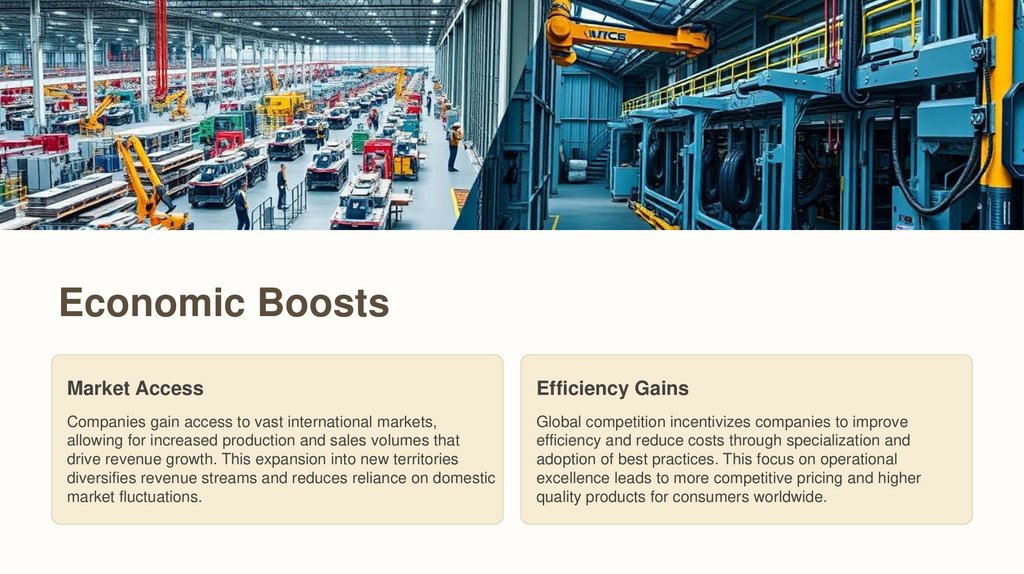
Economic BoostsMarket Access
Efficiency Gains
Companies gain access to vast international markets,
allowing for increased production and sales volumes that
drive revenue growth. This expansion into new territories
diversifies revenue streams and reduces reliance on domestic
market fluctuations.
Global competition incentivizes companies to improve
efficiency and reduce costs through specialization and
adoption of best practices. This focus on operational
excellence leads to more competitive pricing and higher
quality products for consumers worldwide.
5.
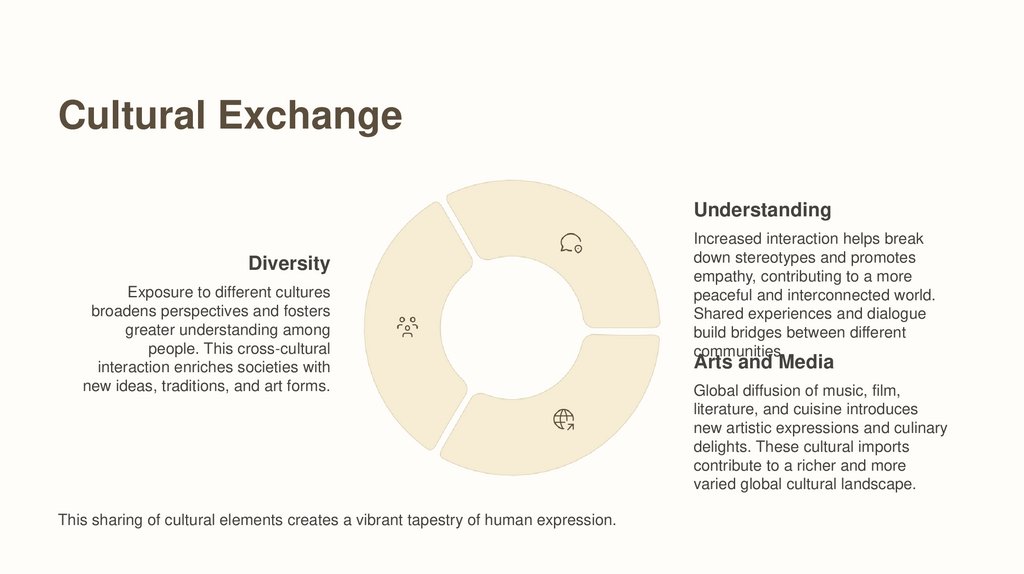
Cultural ExchangeUnderstanding
Diversity
Exposure to different cultures
broadens perspectives and fosters
greater understanding among
people. This cross-cultural
interaction enriches societies with
new ideas, traditions, and art forms.
This sharing of cultural elements creates a vibrant tapestry of human expression.
Increased interaction helps break
down stereotypes and promotes
empathy, contributing to a more
peaceful and interconnected world.
Shared experiences and dialogue
build bridges between different
communities.
Arts and Media
Global diffusion of music, film,
literature, and cuisine introduces
new artistic expressions and culinary
delights. These cultural imports
contribute to a richer and more
varied global cultural landscape.
6.
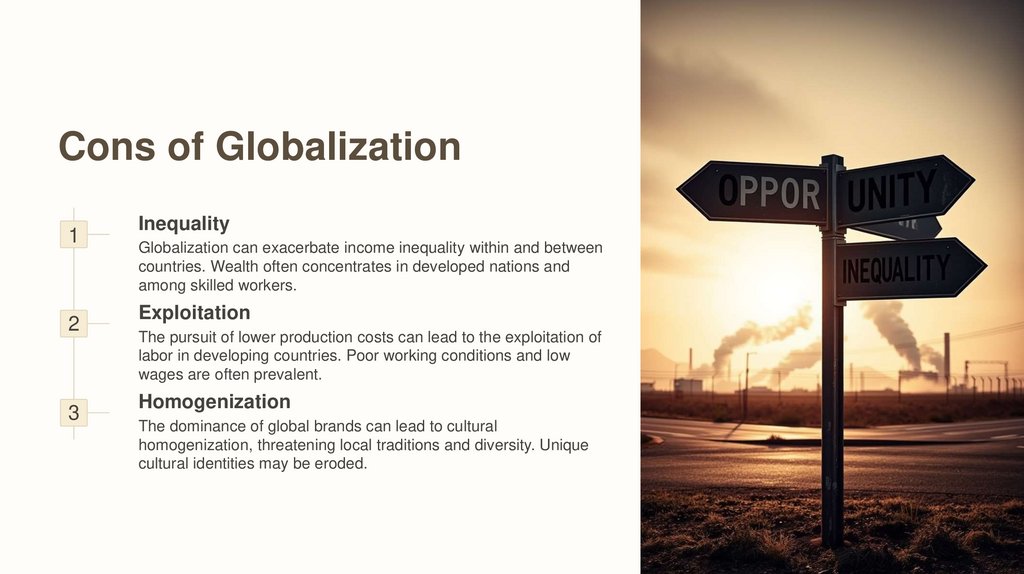
Cons of Globalization1
2
3
Inequality
Globalization can exacerbate income inequality within and between
countries. Wealth often concentrates in developed nations and
among skilled workers.
Exploitation
The pursuit of lower production costs can lead to the exploitation of
labor in developing countries. Poor working conditions and low
wages are often prevalent.
Homogenization
The dominance of global brands can lead to cultural
homogenization, threatening local traditions and diversity. Unique
cultural identities may be eroded.
7.
Job DisplacementOutsourcing
Automation
Skills Gap
Companies may move production or
services to countries with lower labor
costs, resulting in job losses in
higher-cost regions. This
phenomenon, often termed
outsourcing, impacts industries and
communities reliant on
manufacturing or service sector
employment.
Technological advancements,
particularly automation and artificial
intelligence, can replace human
workers in various sectors. While
increasing efficiency, this trend raises
concerns about future employment
opportunities and the need for
workforce adaptation.
The globalized economy demands
new skills, and a mismatch between
available workforce skills and
industry needs can lead to structural
unemployment. Continuous learning
and retraining become essential for
workers to remain competitive.
8.
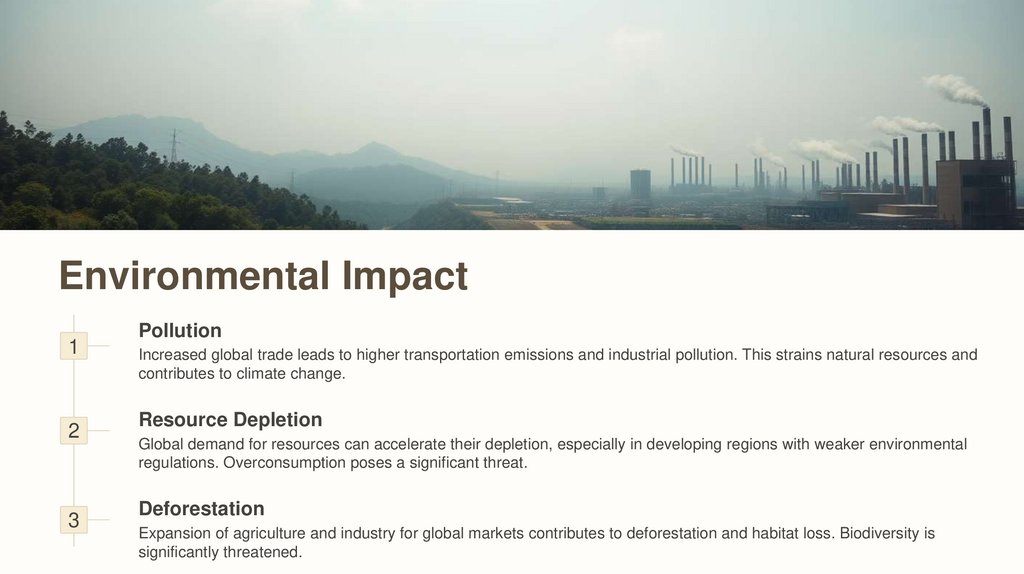
Environmental Impact1
2
3
Pollution
Increased global trade leads to higher transportation emissions and industrial pollution. This strains natural resources and
contributes to climate change.
Resource Depletion
Global demand for resources can accelerate their depletion, especially in developing regions with weaker environmental
regulations. Overconsumption poses a significant threat.
Deforestation
Expansion of agriculture and industry for global markets contributes to deforestation and habitat loss. Biodiversity is
significantly threatened.
9.
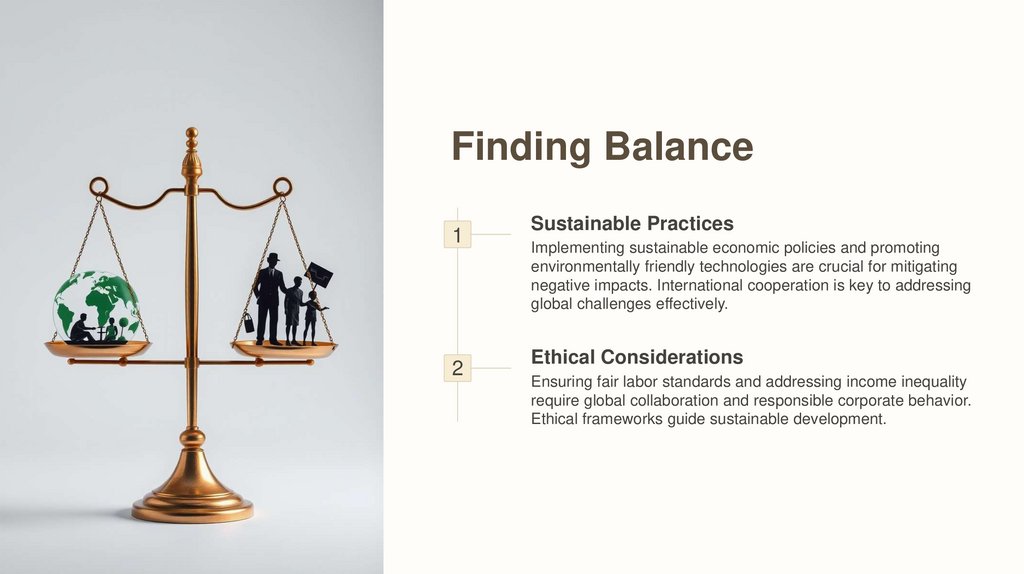
Finding Balance1
2
Sustainable Practices
Implementing sustainable economic policies and promoting
environmentally friendly technologies are crucial for mitigating
negative impacts. International cooperation is key to addressing
global challenges effectively.
Ethical Considerations
Ensuring fair labor standards and addressing income inequality
require global collaboration and responsible corporate behavior.
Ethical frameworks guide sustainable development.
10.
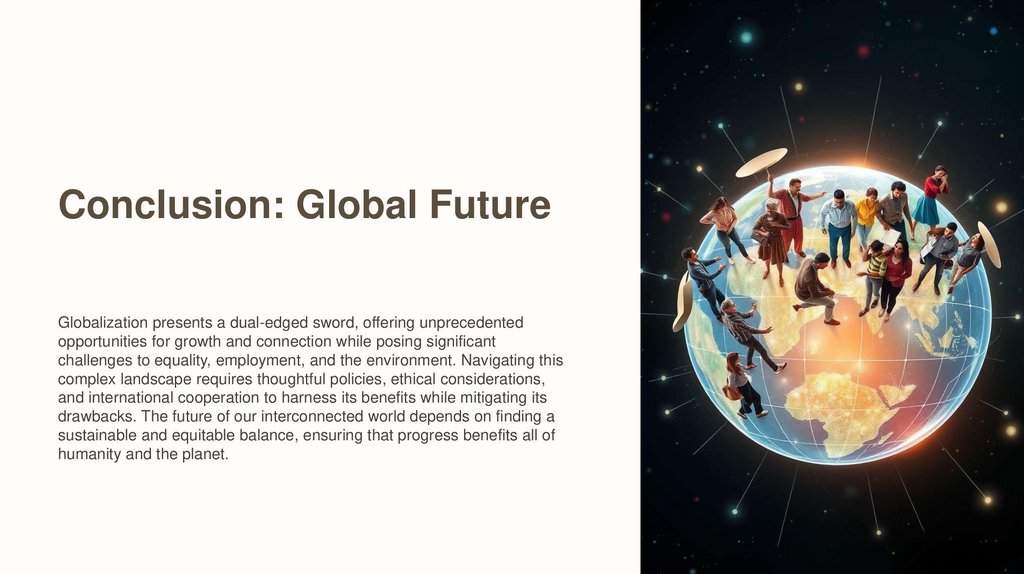
Conclusion: Global FutureGlobalization presents a dual-edged sword, offering unprecedented
opportunities for growth and connection while posing significant
challenges to equality, employment, and the environment. Navigating this
complex landscape requires thoughtful policies, ethical considerations,
and international cooperation to harness its benefits while mitigating its
drawbacks. The future of our interconnected world depends on finding a
sustainable and equitable balance, ensuring that progress benefits all of
humanity and the planet.