
 education
Similar presentations:









Project objective
1. PROJECT OBJECTIVE
To establish a world-class Executive MBA (EMBA) Program at the Graduate School of Business andEntrepreneurship (GSBE) under the Cabinet of Ministers of the Republic of Uzbekistan, modeled on
leading U.S. business schools, aimed at developing strategic, innovative, and ethical leaders across
state-owned, quasi-state-owned, and private enterprises through advanced training in leadership,
communication, problem-solving, and decision-making.
2. What do we offer?
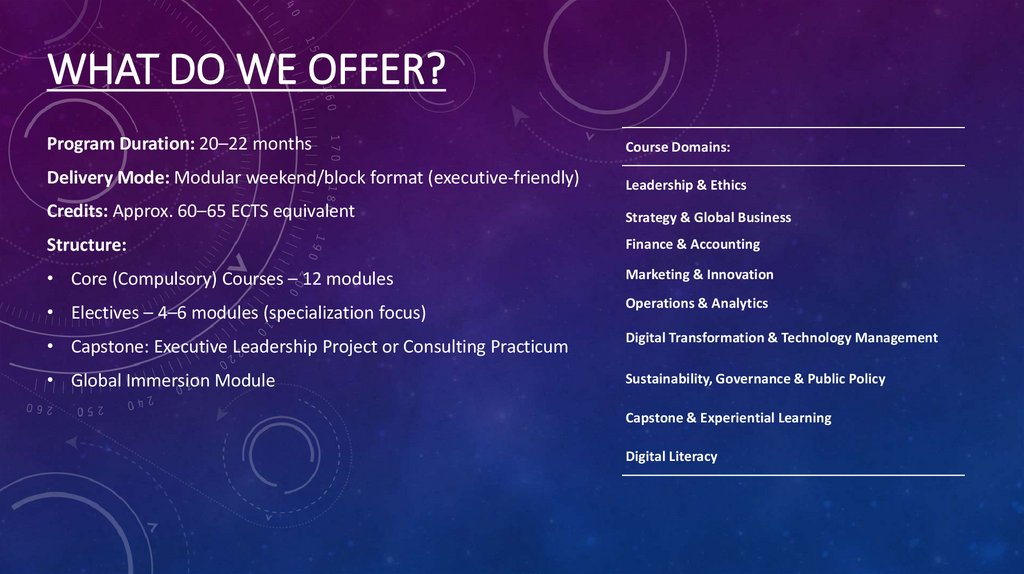
WHAT DO WE OFFER?Program Duration: 20–22 months
Course Domains:
Delivery Mode: Modular weekend/block format (executive-friendly)
Leadership & Ethics
Credits: Approx. 60–65 ECTS equivalent
Strategy & Global Business
Structure:
Finance & Accounting
• Core (Compulsory) Courses – 12 modules
Marketing & Innovation
• Electives – 4–6 modules (specialization focus)
Operations & Analytics
• Capstone: Executive Leadership Project or Consulting Practicum
Digital Transformation & Technology Management
• Global Immersion Module
Sustainability, Governance & Public Policy
Capstone & Experiential Learning
Digital Literacy
3. EMBA Teaching Philosophy
EMBA TEACHING PHILOSOPHYThe GSBE Executive MBA follows an American-style, experience-based approach that develops ethical,
innovative, and globally minded leaders for Uzbekistan.
Learning by Doing: Case studies, simulations, and real projects drive practical decision-making.
Ethics & Innovation: Every course integrates responsible leadership and creative problem-solving.
Global & Local Focus: U.S. faculty and Uzbek cases ensure global standards with local relevance.
Lifelong Growth: Coaching and peer learning foster reflection and continuous leadership development.
4. Target audience
TARGET AUDIENCEThe GSBE Executive MBA is designed for experienced professionals and executives from state-owned, quasi-stateowned, and private enterprises who are leading change within Uzbekistan’s evolving economy.
• State-Owned Enterprises (SOEs) - Senior and mid-level managers.
• Quasi-State Enterprises - Leaders from government-linked corporations, development agencies, and strategic
holding companies.
• Private Sector Executives - Entrepreneurs, business owners, and corporate managers.
The program targets professionals with 5–10 years of leadership experience, and offers a platform to connect
public and private leaders, fostering collaboration, knowledge exchange, and innovation across sectors.
5. Implementation plan
IMPLEMENTATION PLANKey Activities
Phase 1
Concept &
Benchmarking
• Define EMBA vision, objectives, and target audience
• EMBA Concept Paper
• Benchmark U.S. EMBA programs (Wharton, Kellogg, and MIT Sloan)
• Benchmarking Report
• Conduct market demand assessment among corporations and ministries
• Market Demand Study
• Prepare Concept Note and Benchmarking Report
Months 1–3
(Q1–Q2
2026)
GSBE
TBD
Phase 2
Curriculum Design &
Academic Model
• Design modular curriculum (12–15 core, 3–4 electives)
• Integrate U.S.-style pedagogy (case method, simulations)
• Develop course descriptions and learning outcomes
• Align with NQF and global standards
• Curriculum Framework
• Course Catalogue
• Learning Outcomes Matrix
Months 4–6
(Q3 2026)
GSBE
TBD
• Identify and train local and international faculty
• Faculty Development Plan
Phase 3
• Conduct faculty development workshops
• Signed MoUs with partner
Faculty Development &
• Establish MoUs with U.S. business schools for visiting faculty, knowledge schools
Partnership Building
sharing, and dual-degree options
• Visiting faculty roster
Months 6–9
(Q3–Q4
2026)
GSBE
TBD
Phase 4
Accreditation &
Licensing
Months 9–
12 (Q4
2026–Q1
2027)
GSBE
TBD
• First EMBA Cohort Enrolled
Months 13–
• Midterm and Final Evaluation
24 (Q2
Reports
2027–Q1
• Policy Brief on Lessons Learned
2028)
GSBE
TBD
• Prepare regulatory and accreditation documentation
• Align program with Ministry of Higher Education and NQF standards
• Develop internal Quality Assurance (QA) system and evaluation tools
• Launch pilot intake (25–30 executives)
Phase 5
• Deliver modular courses (weekend/blended)
Pilot Cohort Launch &
• Implement mentoring, leadership labs, and consulting projects
Evaluation
• Conduct midterm and final evaluation
Expected Outputs
• Accreditation Readiness Package
• Internal QA Framework
• Ministry License Application
Timeline
Lead
U.S. Embassy
Responsibility
Role
Phase