
 music
musicSimilar presentations:









Description of Instrument/ Device: Music center SHARP CD-C570
1.
ZHUKOVSKY AVIATION COLLEGEDescription of Instrument/ Device: Music center SHARP CD-C570
Professionally-oriented English
Designed by 2d-year student Poliakov Ivan
Development of Electronic Systems and Devices
Р-72
2.
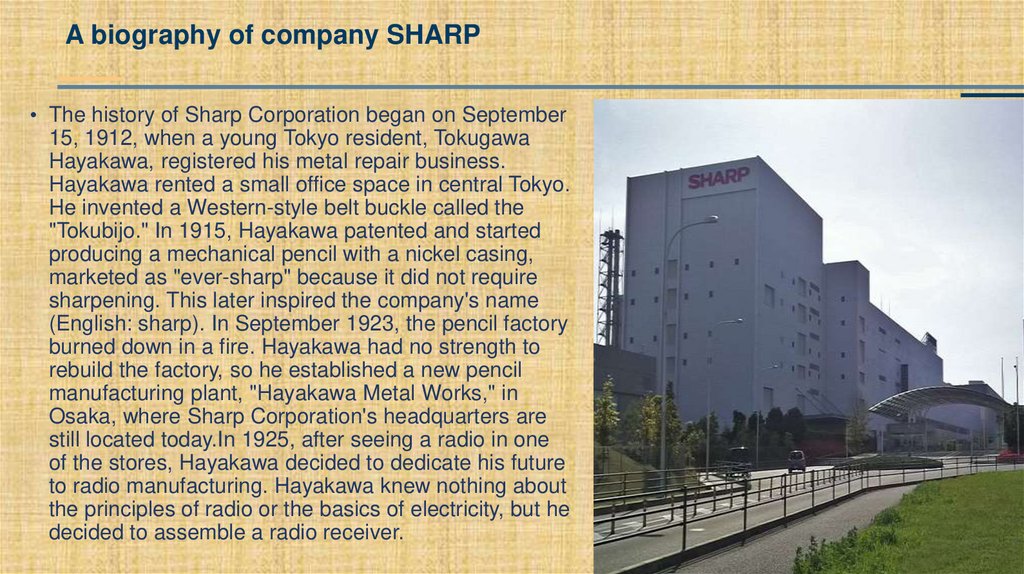
A biography of company SHARP• The history of Sharp Corporation began on September
15, 1912, when a young Tokyo resident, Tokugawa
Hayakawa, registered his metal repair business.
Hayakawa rented a small office space in central Tokyo.
He invented a Western-style belt buckle called the
"Tokubijo." In 1915, Hayakawa patented and started
producing a mechanical pencil with a nickel casing,
marketed as "ever-sharp" because it did not require
sharpening. This later inspired the company's name
(English: sharp). In September 1923, the pencil factory
burned down in a fire. Hayakawa had no strength to
rebuild the factory, so he established a new pencil
manufacturing plant, "Hayakawa Metal Works," in
Osaka, where Sharp Corporation's headquarters are
still located today.In 1925, after seeing a radio in one
of the stores, Hayakawa decided to dedicate his future
to radio manufacturing. Hayakawa knew nothing about
the principles of radio or the basics of electricity, but he
decided to assemble a radio receiver.
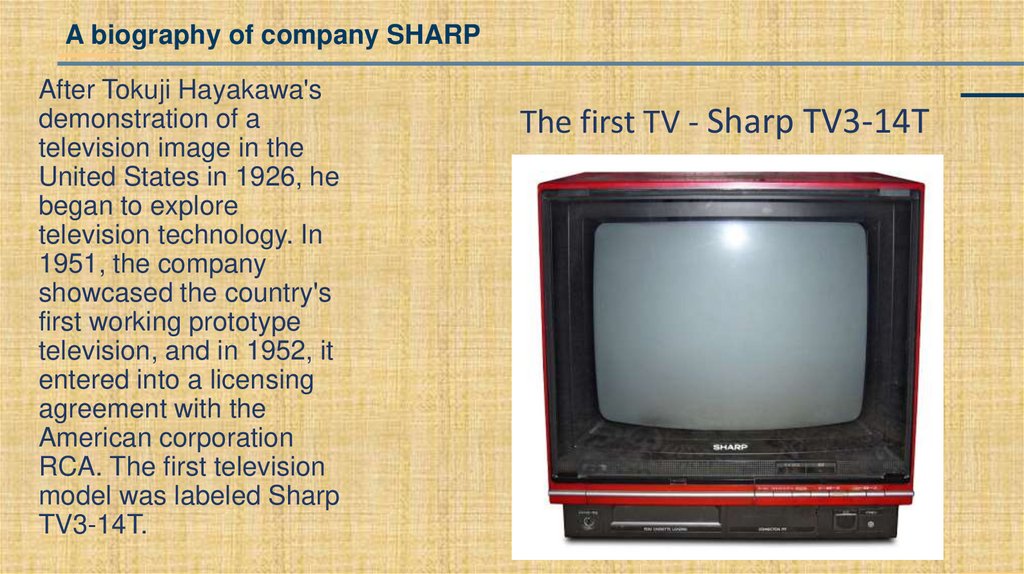
3. The first TV - Sharp TV3-14T
A biography of company SHARPAfter Tokuji Hayakawa's
demonstration of a
television image in the
United States in 1926, he
began to explore
television technology. In
1951, the company
showcased the country's
first working prototype
television, and in 1952, it
entered into a licensing
agreement with the
American corporation
RCA. The first television
model was labeled Sharp
TV3-14T.
The first TV - Sharp TV3-14T
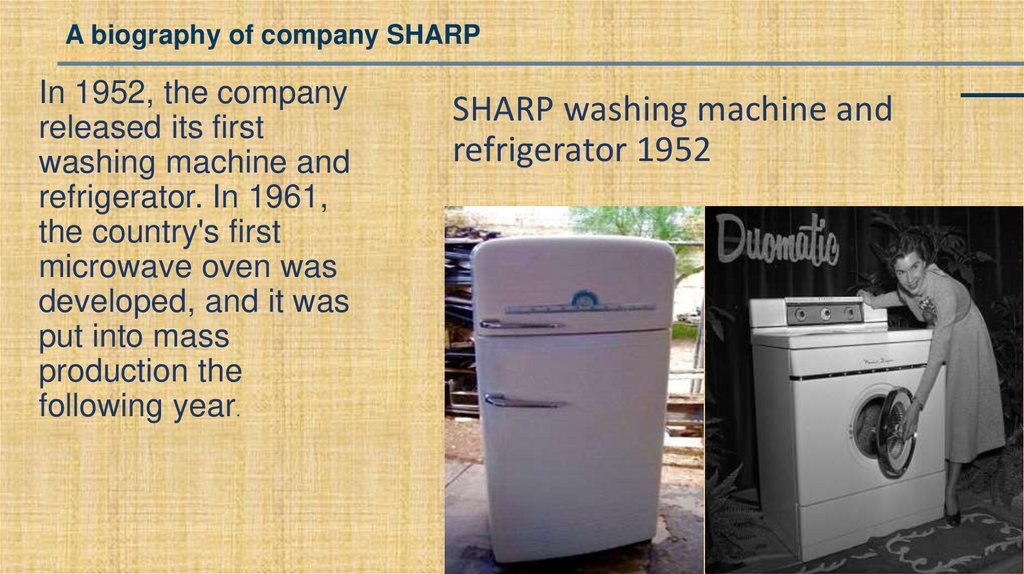
4. SHARP washing machine and refrigerator 1952
A biography of company SHARPIn 1952, the company
released its first
washing machine and
refrigerator. In 1961,
the country's first
microwave oven was
developed, and it was
put into mass
production the
following year.
SHARP washing machine and
refrigerator 1952
5.
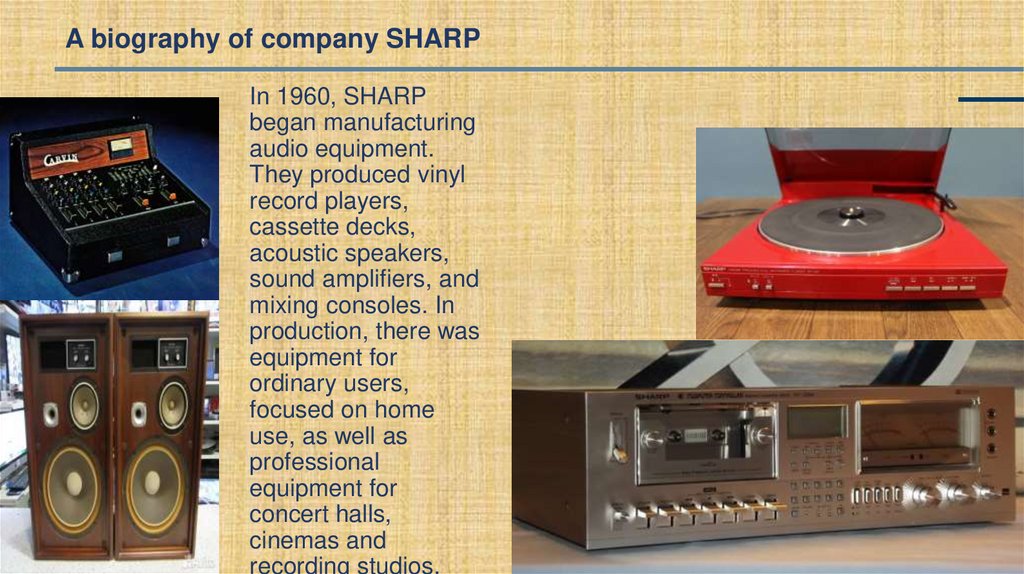
A biography of company SHARPIn 1960, SHARP
began manufacturing
audio equipment.
They produced vinyl
record players,
cassette decks,
acoustic speakers,
sound amplifiers, and
mixing consoles. In
production, there was
equipment for
ordinary users,
focused on home
use, as well as
professional
equipment for
concert halls,
cinemas and
recording studios.
6.
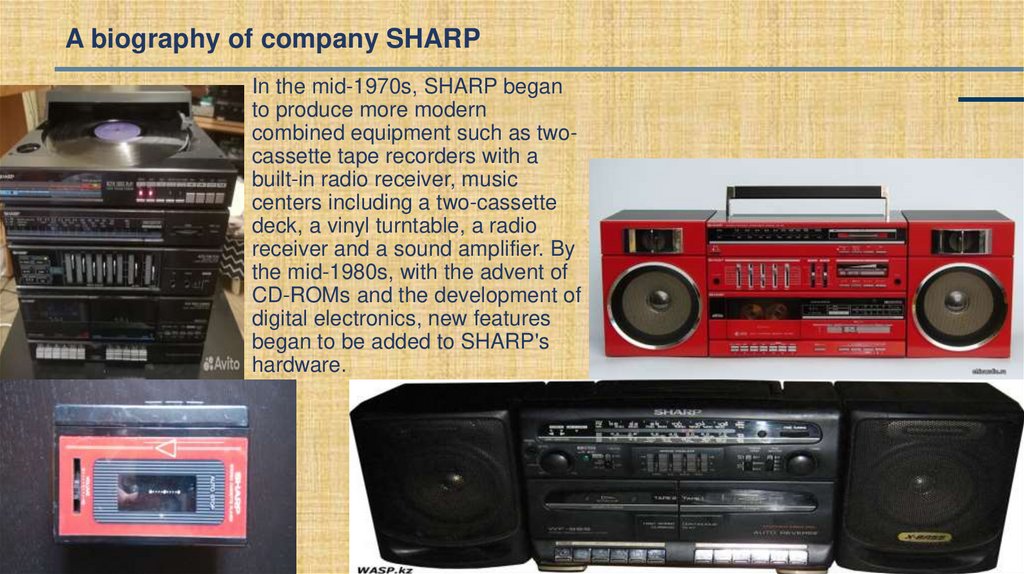
A biography of company SHARPIn the mid-1970s, SHARP began
to produce more modern
combined equipment such as twocassette tape recorders with a
built-in radio receiver, music
centers including a two-cassette
deck, a vinyl turntable, a radio
receiver and a sound amplifier. By
the mid-1980s, with the advent of
CD-ROMs and the development of
digital electronics, new features
began to be added to SHARP's
hardware.
7.
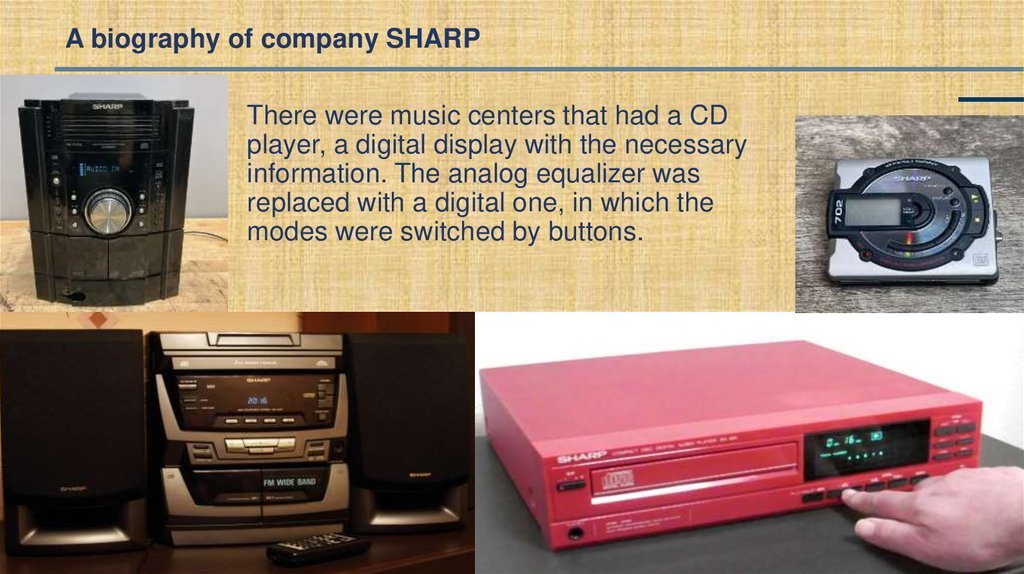
A biography of company SHARPThere were music centers that had a CD
player, a digital display with the necessary
information. The analog equalizer was
replaced with a digital one, in which the
modes were switched by buttons.
8.
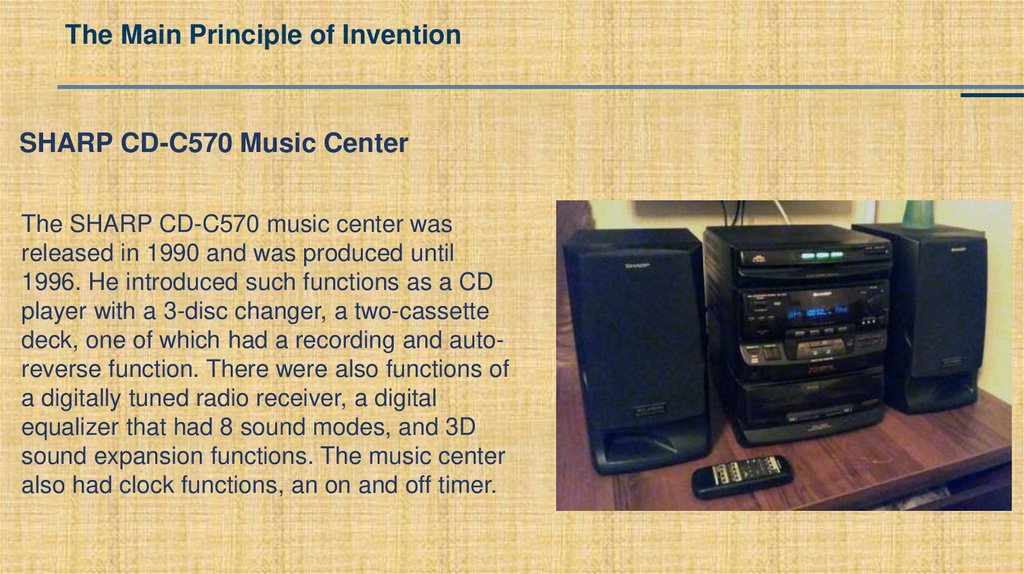
The Main Principle of InventionSHARP CD-C570 Music Center
The SHARP CD-C570 music center was
released in 1990 and was produced until
1996. He introduced such functions as a CD
player with a 3-disc changer, a two-cassette
deck, one of which had a recording and autoreverse function. There were also functions of
a digitally tuned radio receiver, a digital
equalizer that had 8 sound modes, and 3D
sound expansion functions. The music center
also had clock functions, an on and off timer.
9.
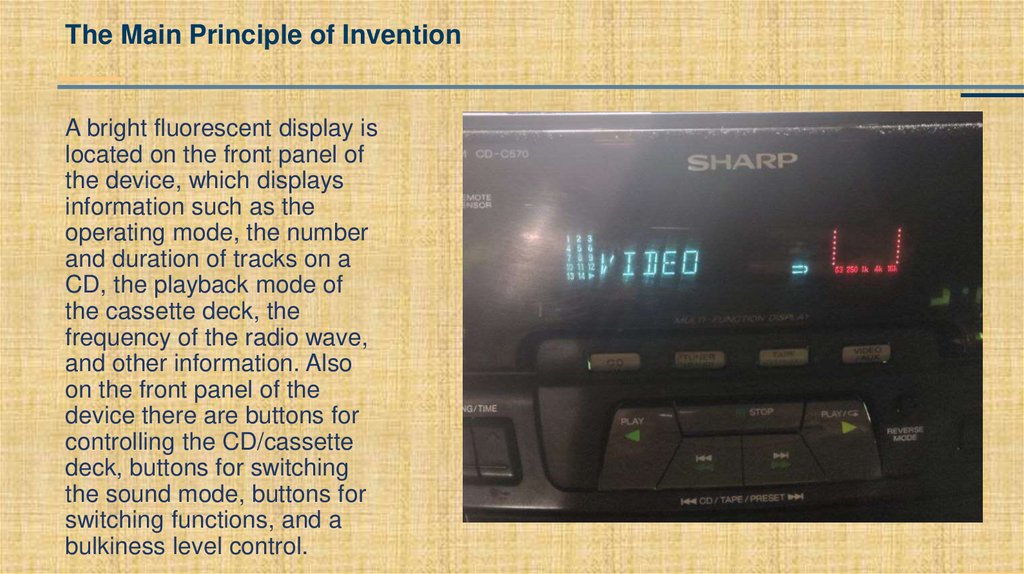
The Main Principle of InventionA bright fluorescent display is
located on the front panel of
the device, which displays
information such as the
operating mode, the number
and duration of tracks on a
CD, the playback mode of
the cassette deck, the
frequency of the radio wave,
and other information. Also
on the front panel of the
device there are buttons for
controlling the CD/cassette
deck, buttons for switching
the sound mode, buttons for
switching functions, and a
bulkiness level control.
10.
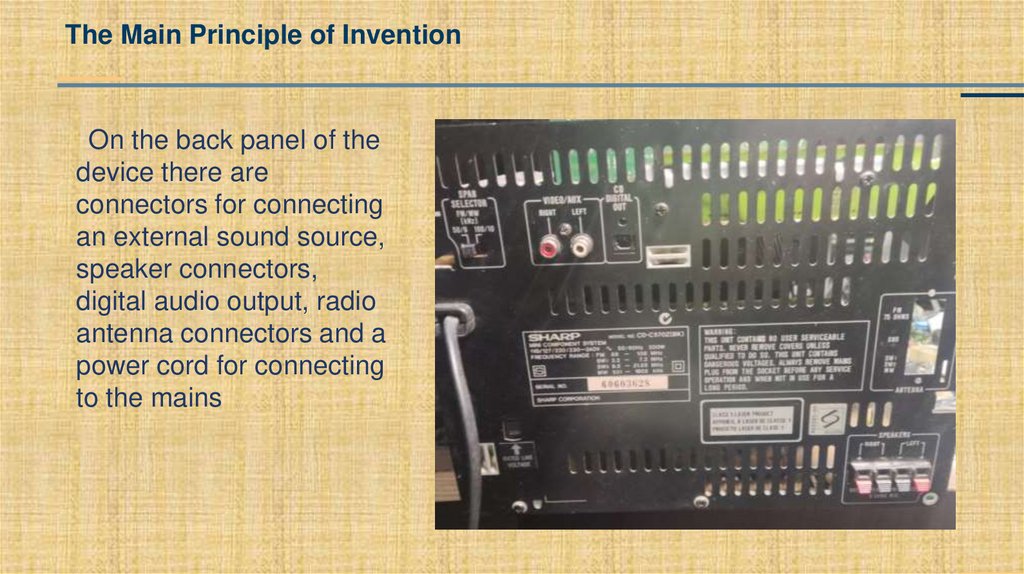
The Main Principle of InventionOn the back panel of the
device there are
connectors for connecting
an external sound source,
speaker connectors,
digital audio output, radio
antenna connectors and a
power cord for connecting
to the mains
11.
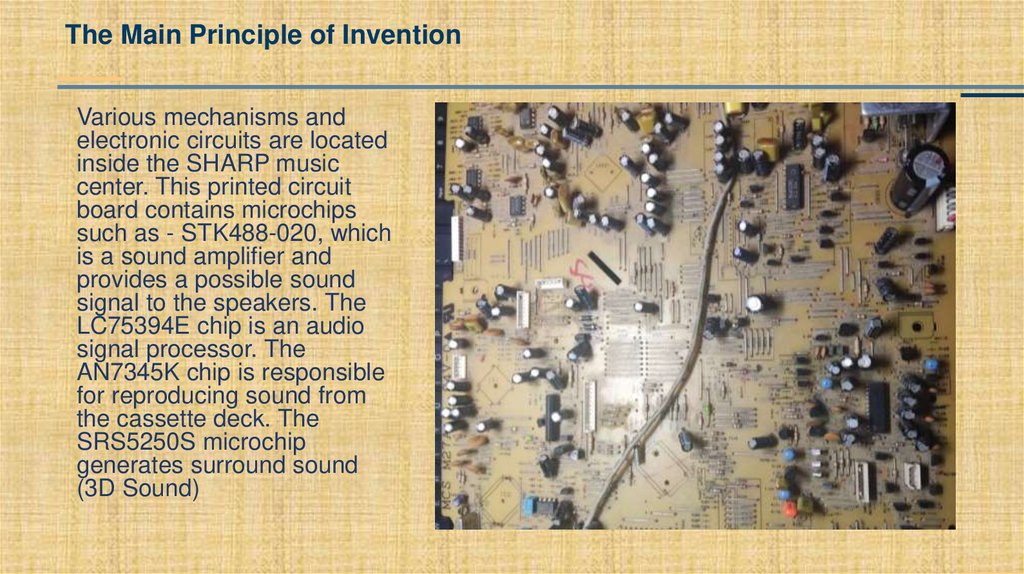
The Main Principle of InventionVarious mechanisms and
electronic circuits are located
inside the SHARP music
center. This printed circuit
board contains microchips
such as - STK488-020, which
is a sound amplifier and
provides a possible sound
signal to the speakers. The
LC75394E chip is an audio
signal processor. The
AN7345K chip is responsible
for reproducing sound from
the cassette deck. The
SRS5250S microchip
generates surround sound
(3D Sound)
12.
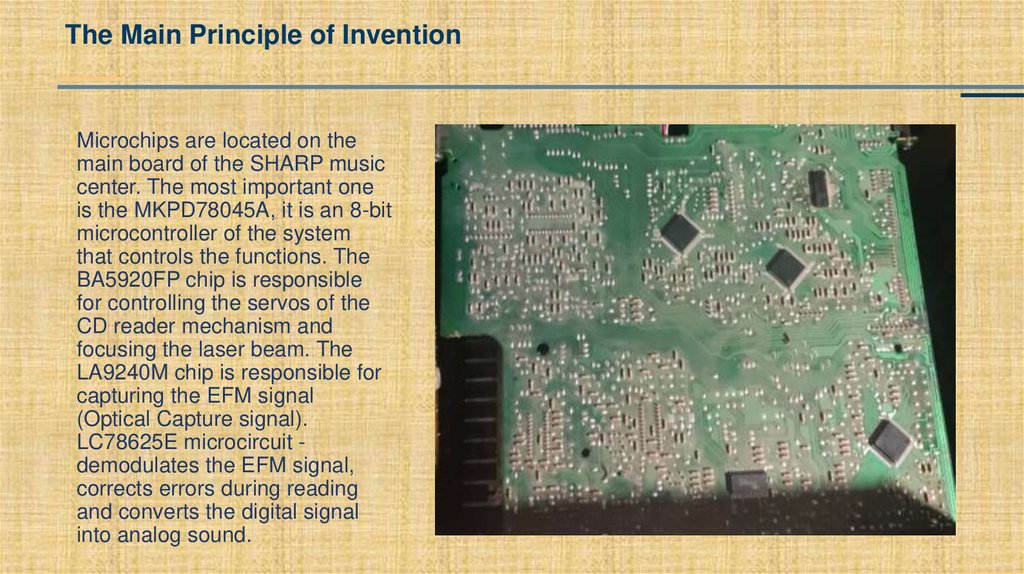
The Main Principle of InventionMicrochips are located on the
main board of the SHARP music
center. The most important one
is the MKPD78045A, it is an 8-bit
microcontroller of the system
that controls the functions. The
BA5920FP chip is responsible
for controlling the servos of the
CD reader mechanism and
focusing the laser beam. The
LA9240M chip is responsible for
capturing the EFM signal
(Optical Capture signal).
LC78625E microcircuit demodulates the EFM signal,
corrects errors during reading
and converts the digital signal
into analog sound.
13.
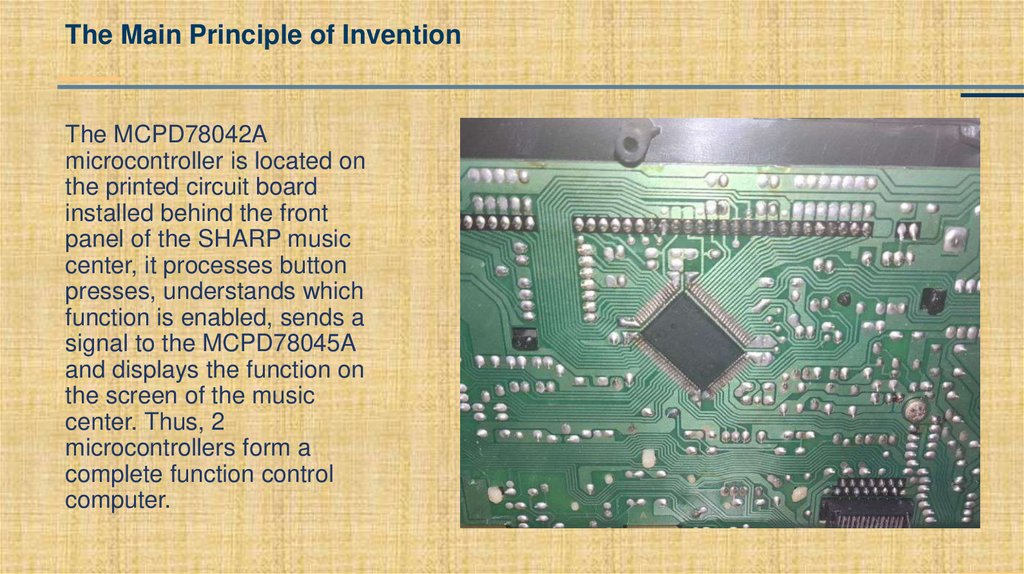
The Main Principle of InventionThe MCPD78042A
microcontroller is located on
the printed circuit board
installed behind the front
panel of the SHARP music
center, it processes button
presses, understands which
function is enabled, sends a
signal to the MCPD78045A
and displays the function on
the screen of the music
center. Thus, 2
microcontrollers form a
complete function control
computer.
14.
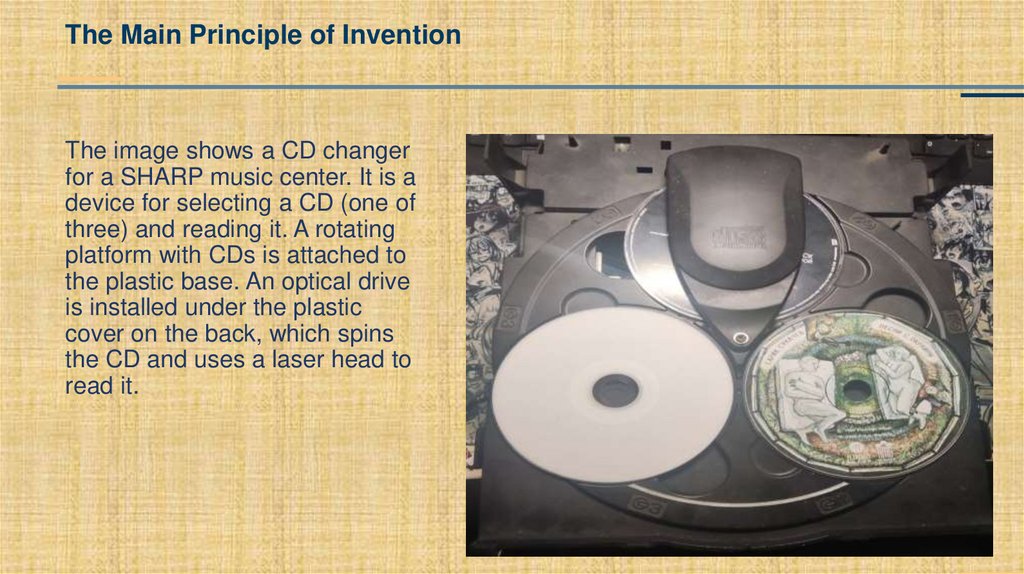
The Main Principle of InventionThe image shows a CD changer
for a SHARP music center. It is a
device for selecting a CD (one of
three) and reading it. A rotating
platform with CDs is attached to
the plastic base. An optical drive
is installed under the plastic
cover on the back, which spins
the CD and uses a laser head to
read it.
15.
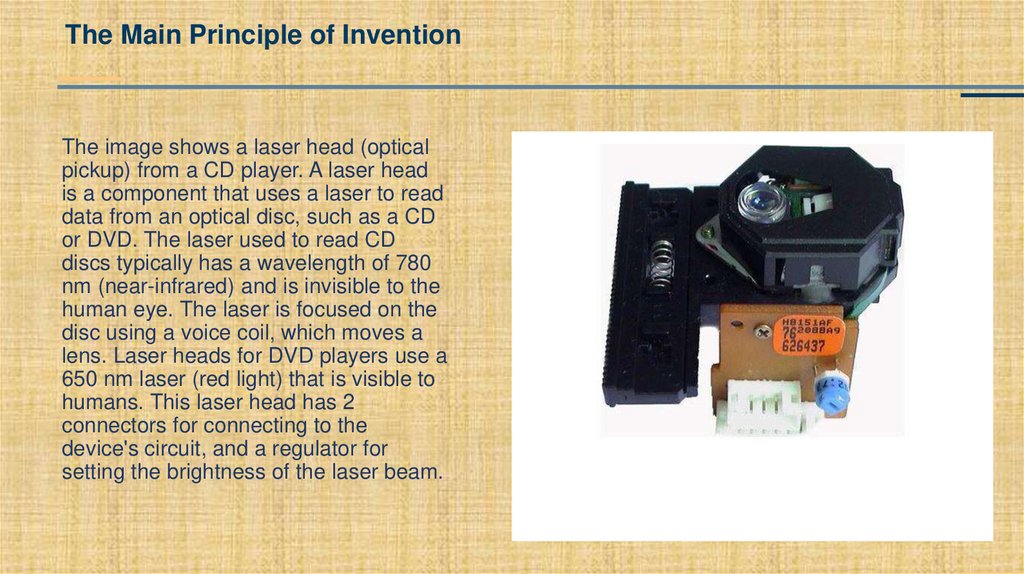
The Main Principle of InventionThe image shows a laser head (optical
pickup) from a CD player. A laser head
is a component that uses a laser to read
data from an optical disc, such as a CD
or DVD. The laser used to read CD
discs typically has a wavelength of 780
nm (near-infrared) and is invisible to the
human eye. The laser is focused on the
disc using a voice coil, which moves a
lens. Laser heads for DVD players use a
650 nm laser (red light) that is visible to
humans. This laser head has 2
connectors for connecting to the
device's circuit, and a regulator for
setting the brightness of the laser beam.
16.
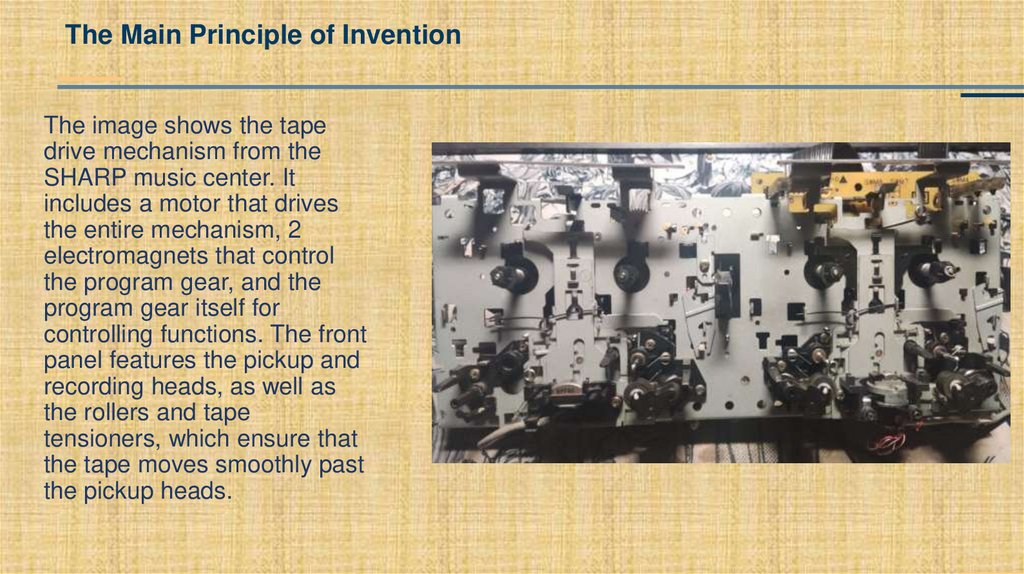
The Main Principle of InventionThe image shows the tape
drive mechanism from the
SHARP music center. It
includes a motor that drives
the entire mechanism, 2
electromagnets that control
the program gear, and the
program gear itself for
controlling functions. The front
panel features the pickup and
recording heads, as well as
the rollers and tape
tensioners, which ensure that
the tape moves smoothly past
the pickup heads.