
 management
Similar presentations:










Service Support
1.
Service Support*how it works
August’25
2.
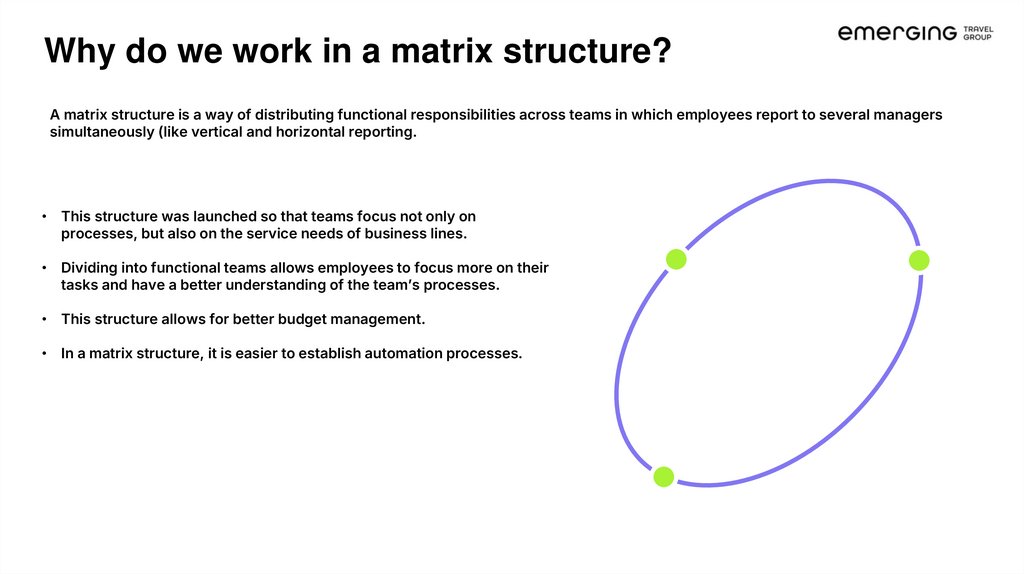
Why do we work in a matrix structure?A matrix structure is a way of distributing functional responsibilities across teams in which employees report to several managers
simultaneously (like vertical and horizontal reporting.
• This structure was launched so that teams focus not only on
processes, but also on the service needs of business lines.
• Dividing into functional teams allows employees to focus more on their
tasks and have a better understanding of the team’s processes.
• This structure allows for better budget management.
• In a matrix structure, it is easier to establish automation processes.
3.
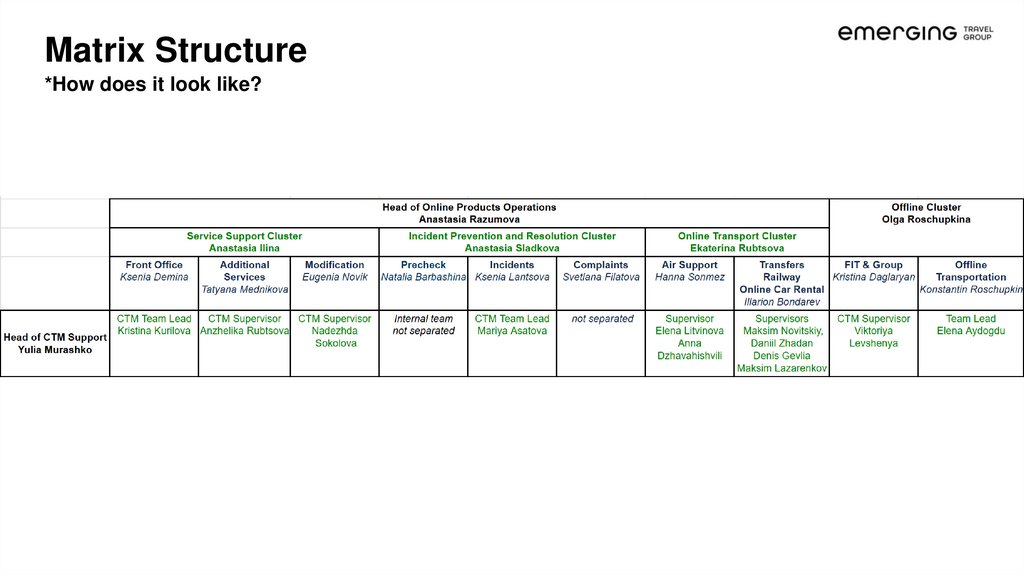
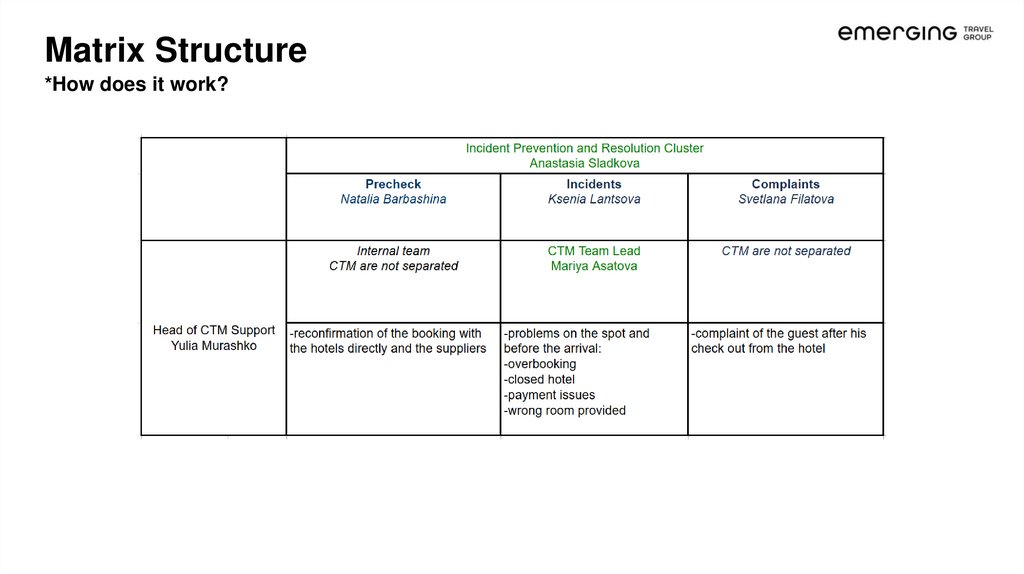
Matrix Structure*How does it look like?
4.
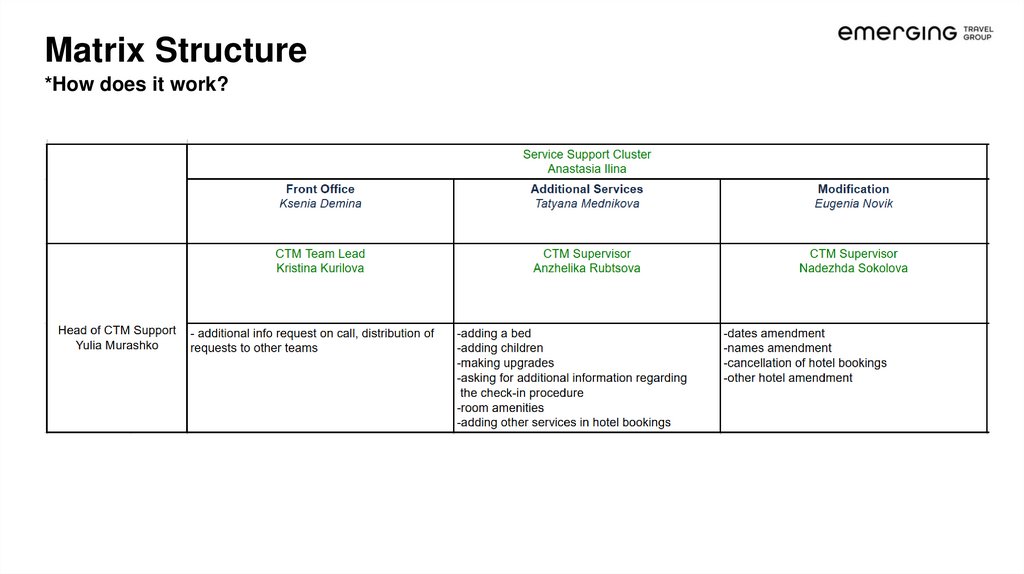
Matrix Structure*How does it work?
5.
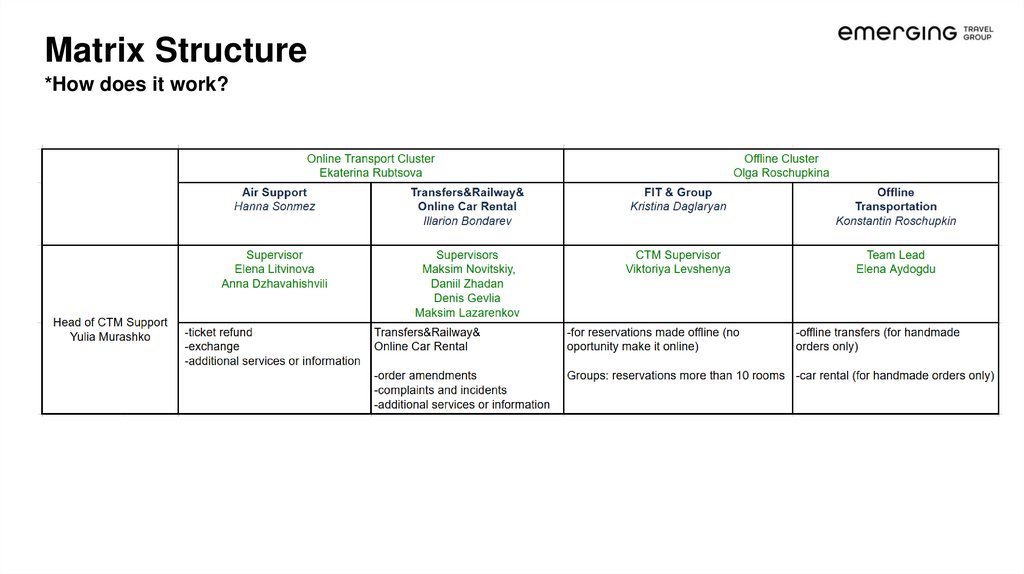
Matrix Structure*How does it work?
6.
Matrix Structure*How does it work?
7.
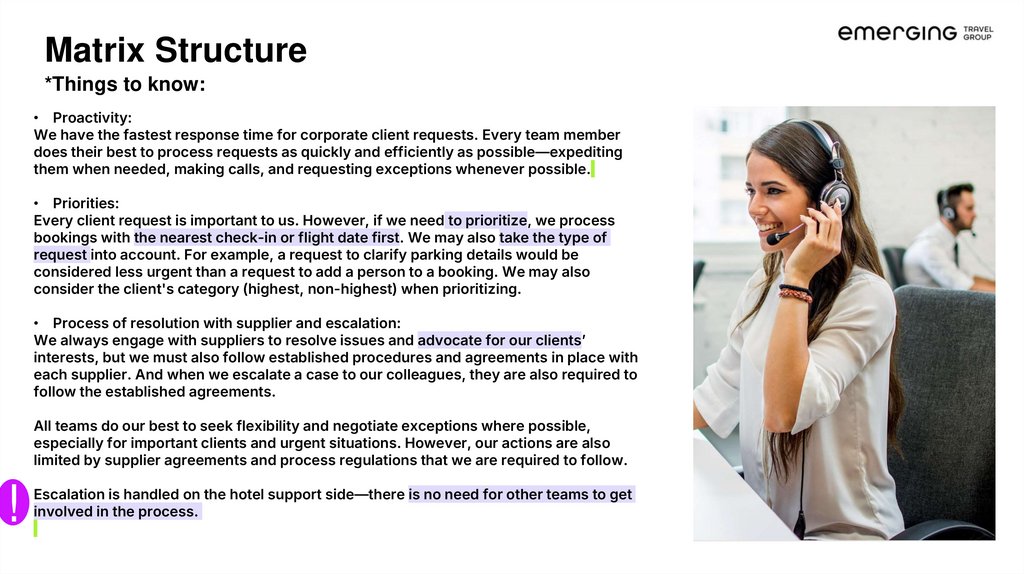
Matrix Structure*Things to know:
• Proactivity:
We have the fastest response time for corporate client requests. Every team member
does their best to process requests as quickly and efficiently as possible—expediting
them when needed, making calls, and requesting exceptions whenever possible.
• Priorities:
Every client request is important to us. However, if we need to prioritize, we process
bookings with the nearest check-in or flight date first. We may also take the type of
request into account. For example, a request to clarify parking details would be
considered less urgent than a request to add a person to a booking. We may also
consider the client's category (highest, non-highest) when prioritizing.
• Process of resolution with supplier and escalation:
We always engage with suppliers to resolve issues and advocate for our clients’
interests, but we must also follow established procedures and agreements in place with
each supplier. And when we escalate a case to our colleagues, they are also required to
follow the established agreements.
All teams do our best to seek flexibility and negotiate exceptions where possible,
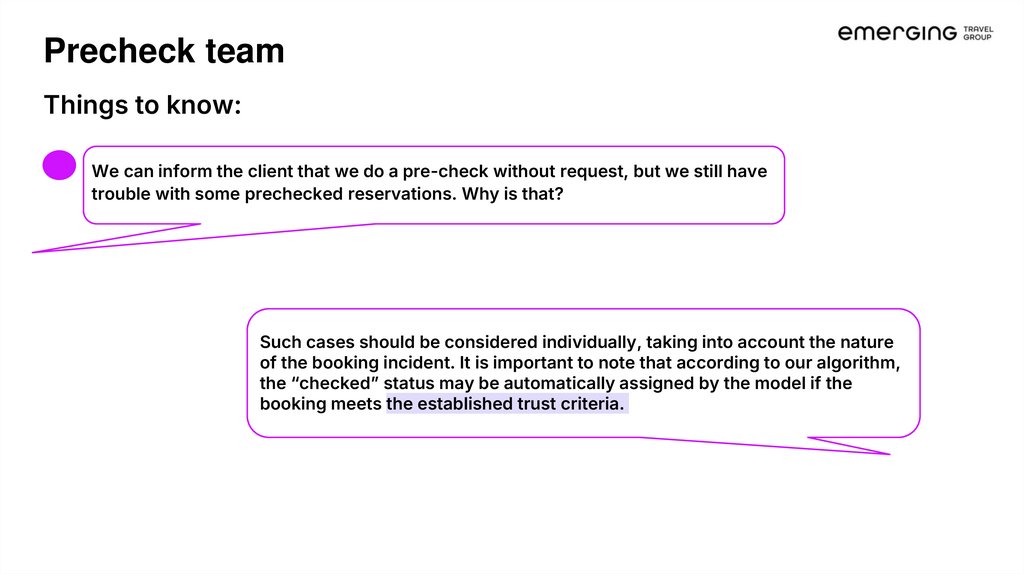
especially for important clients and urgent situations. However, our actions are also
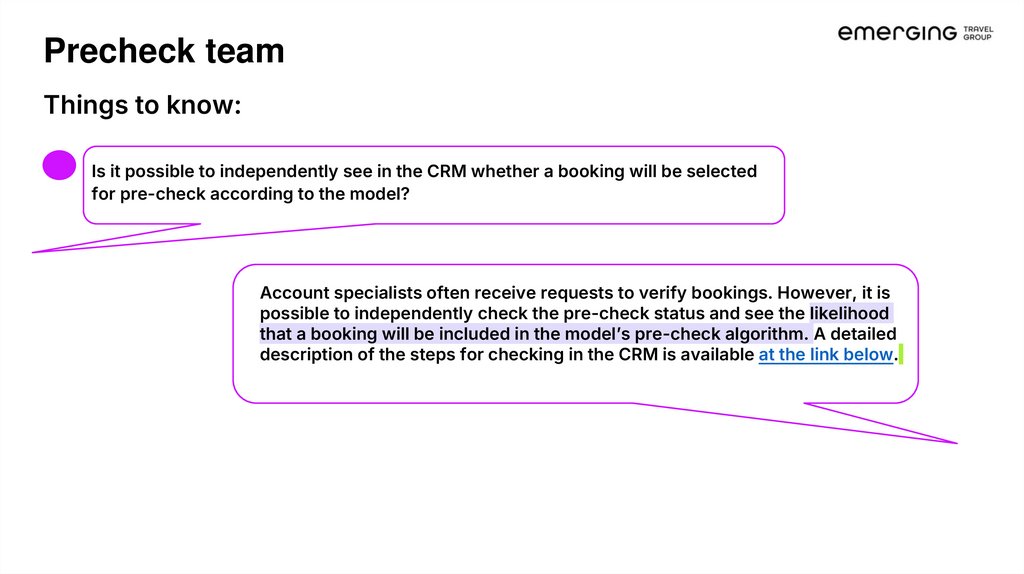
limited by supplier agreements and process regulations that we are required to follow.
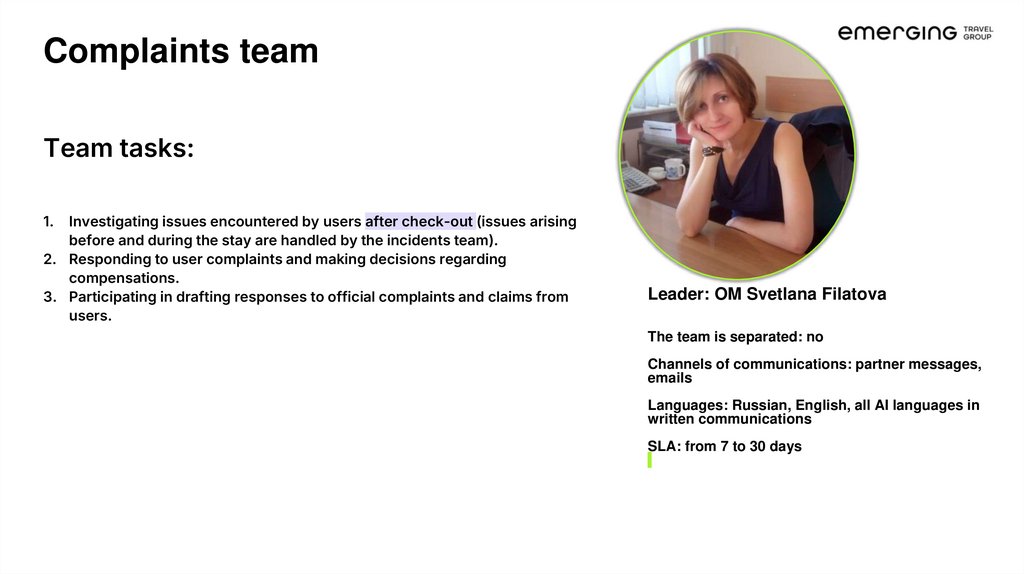
!
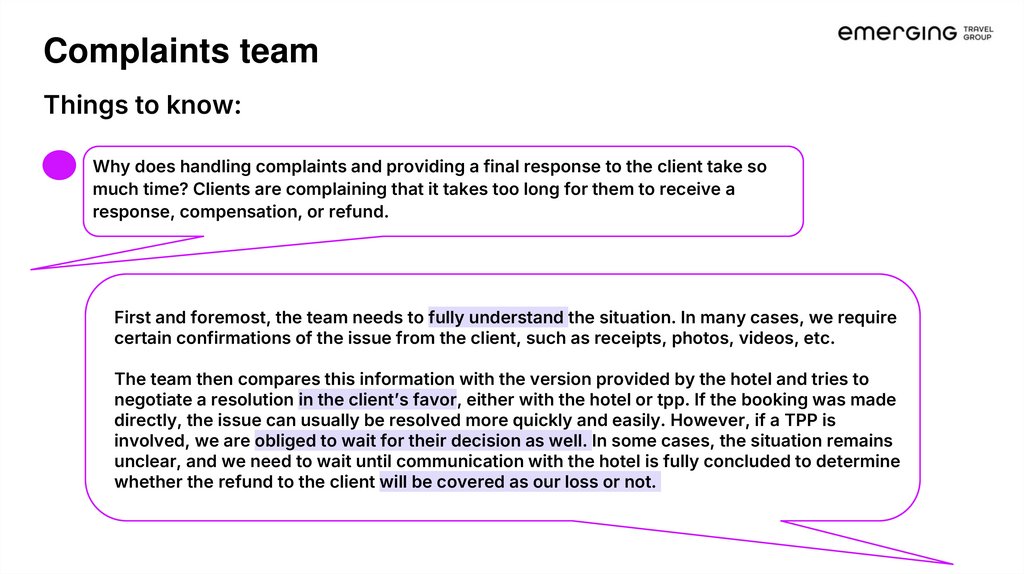
Escalation is handled on the hotel support side—there is no need for other teams to get
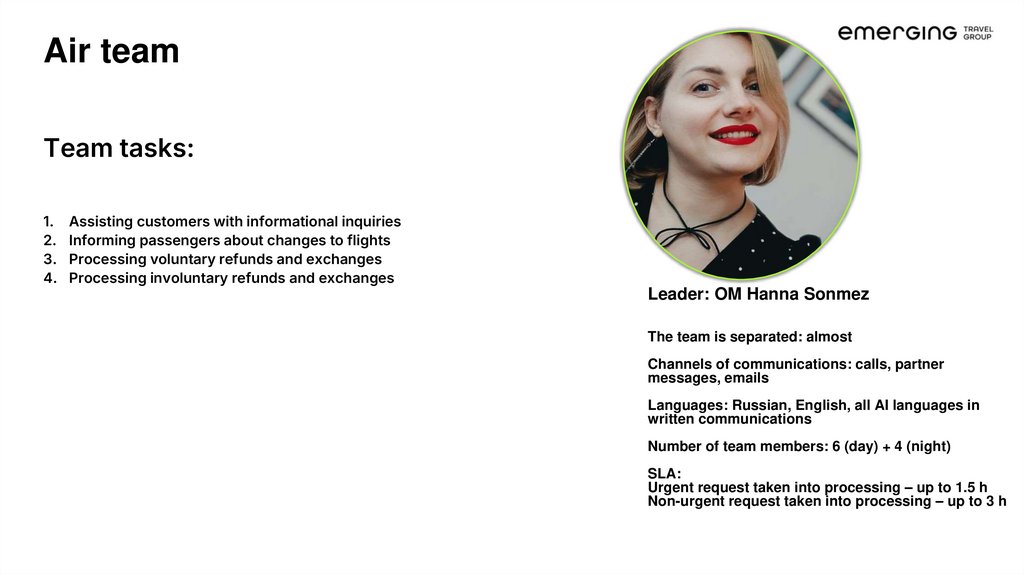
involved in the process.
8.
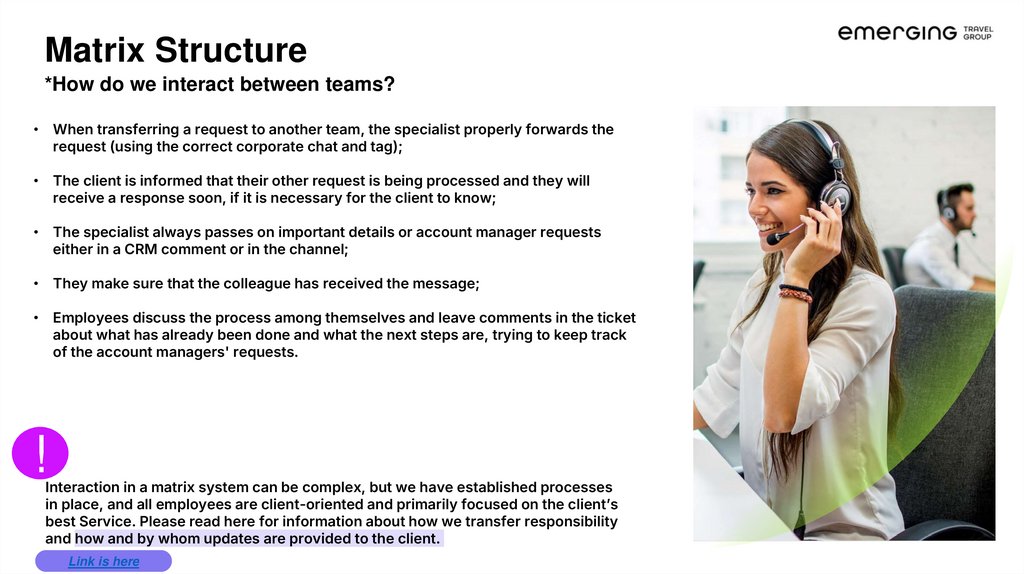
Matrix Structure*How do we interact between teams?
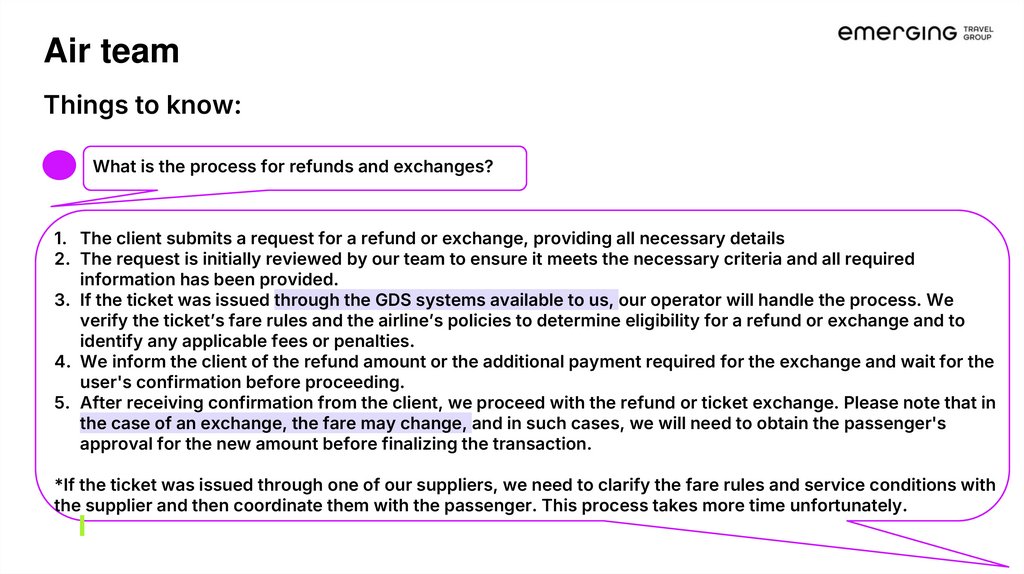
• When transferring a request to another team, the specialist properly forwards the
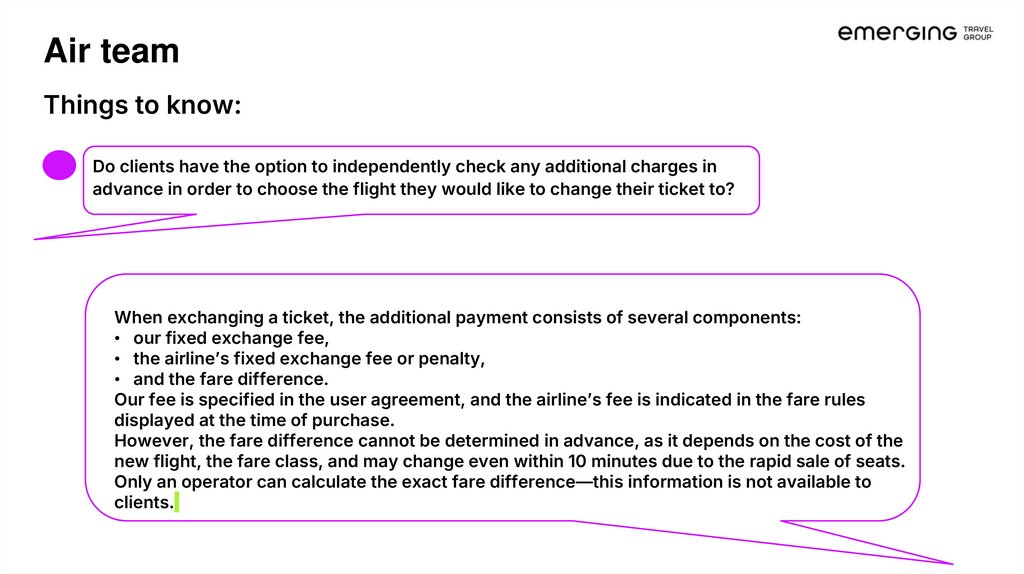
request (using the correct corporate chat and tag);
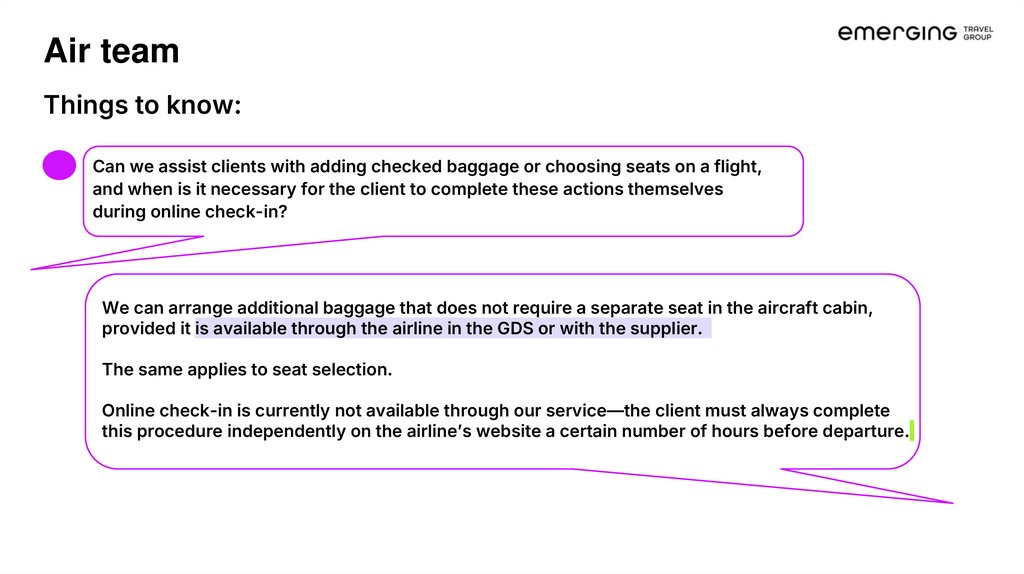
• The client is informed that their other request is being processed and they will
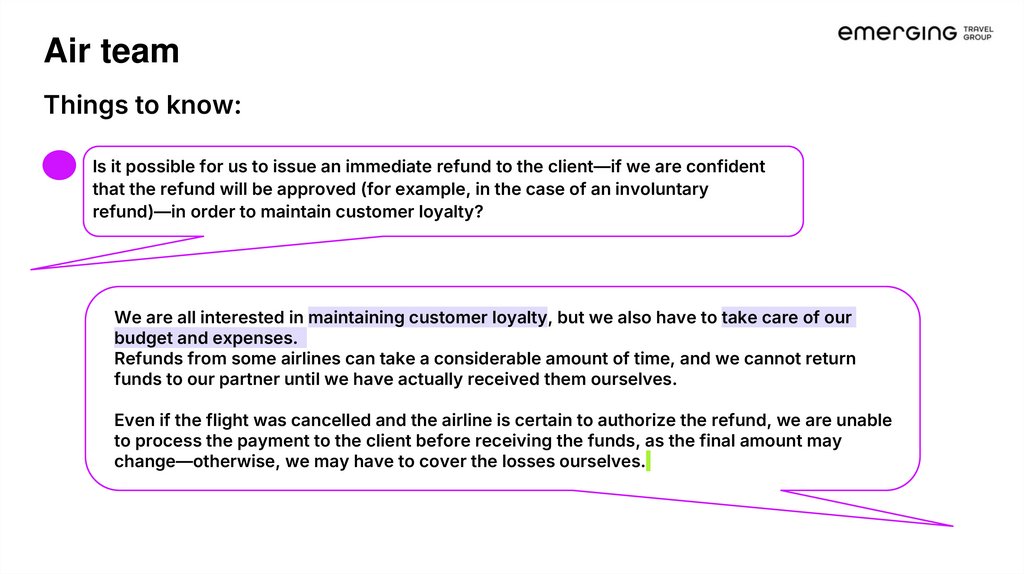
receive a response soon, if it is necessary for the client to know;
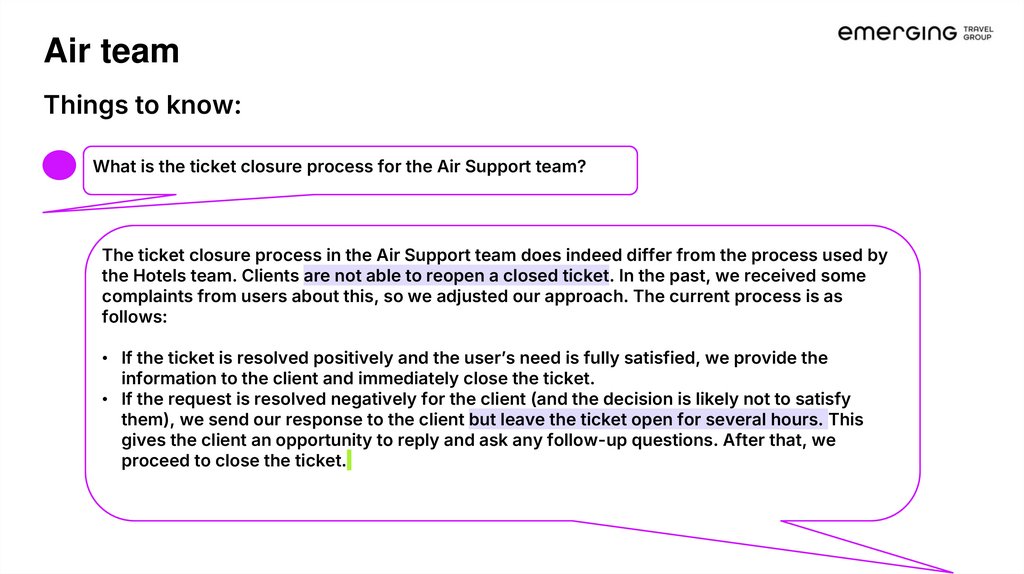
• The specialist always passes on important details or account manager requests
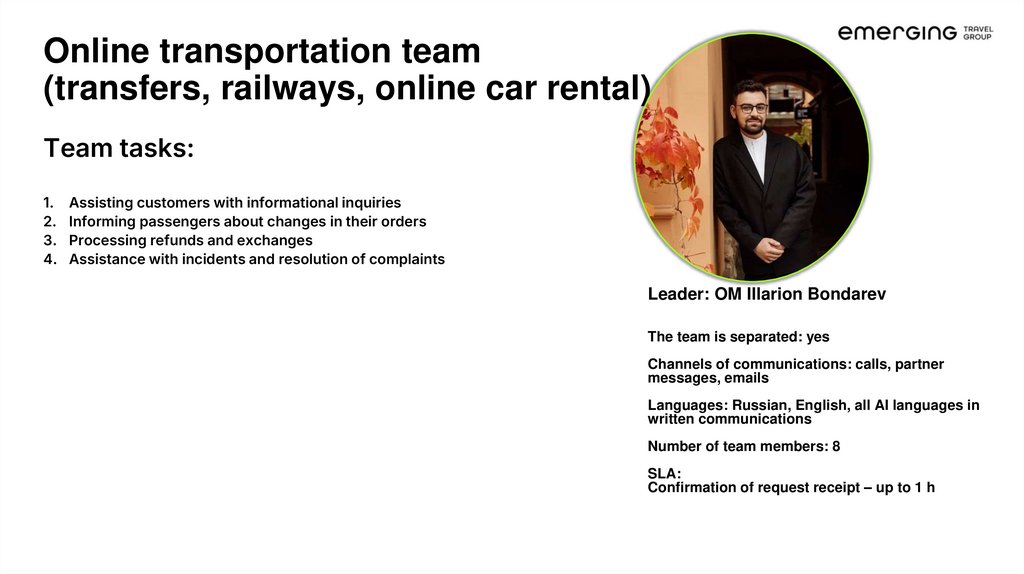
either in a CRM comment or in the channel;
• They make sure that the colleague has received the message;
• Employees discuss the process among themselves and leave comments in the ticket
about what has already been done and what the next steps are, trying to keep track
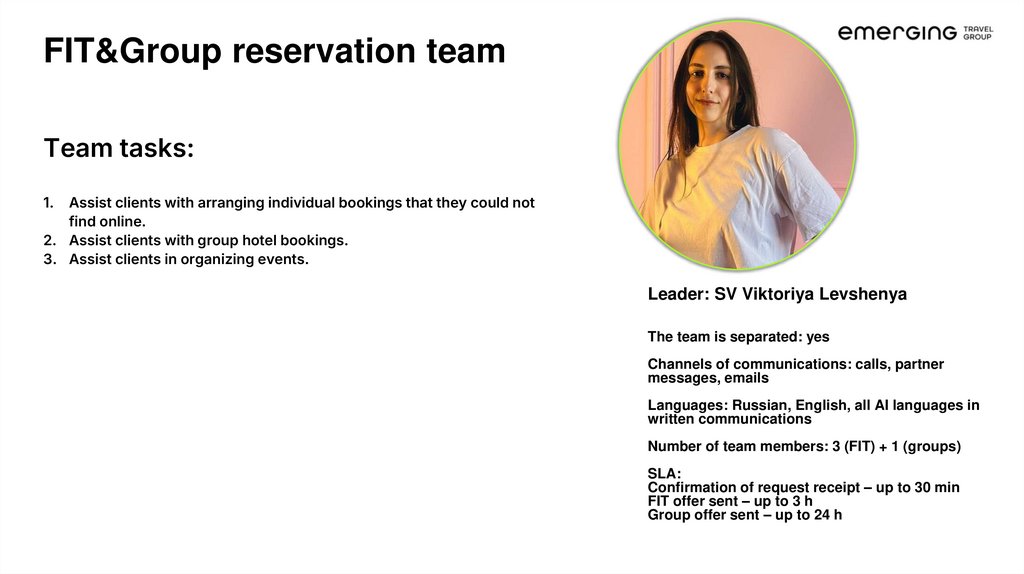
of the account managers' requests.
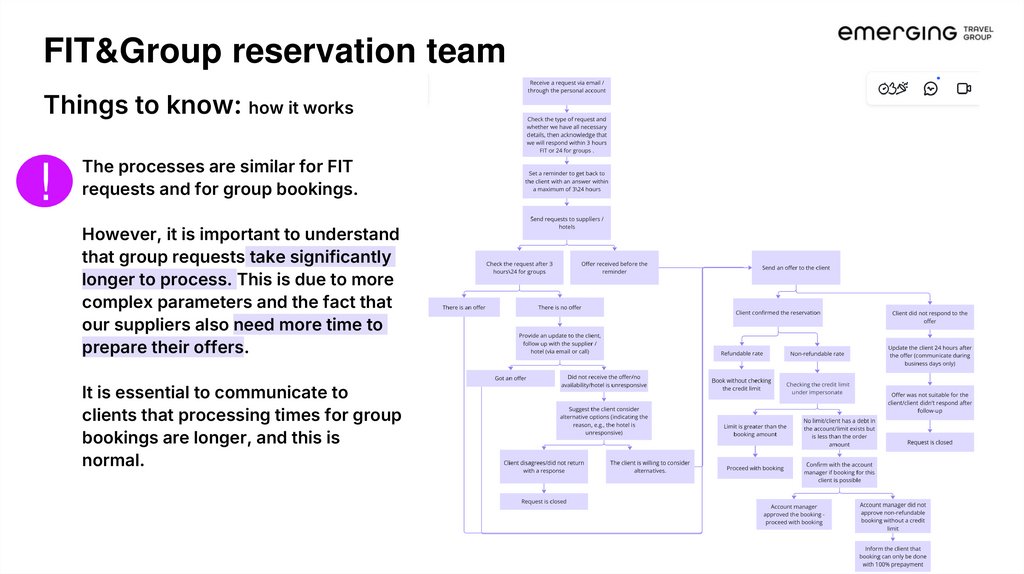
!
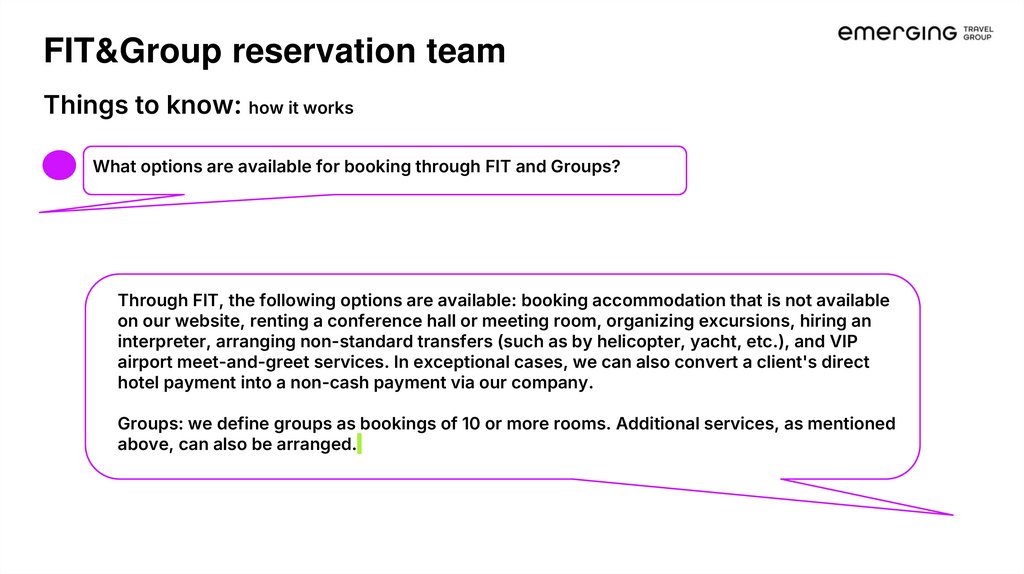
Interaction in a matrix system can be complex, but we have established processes
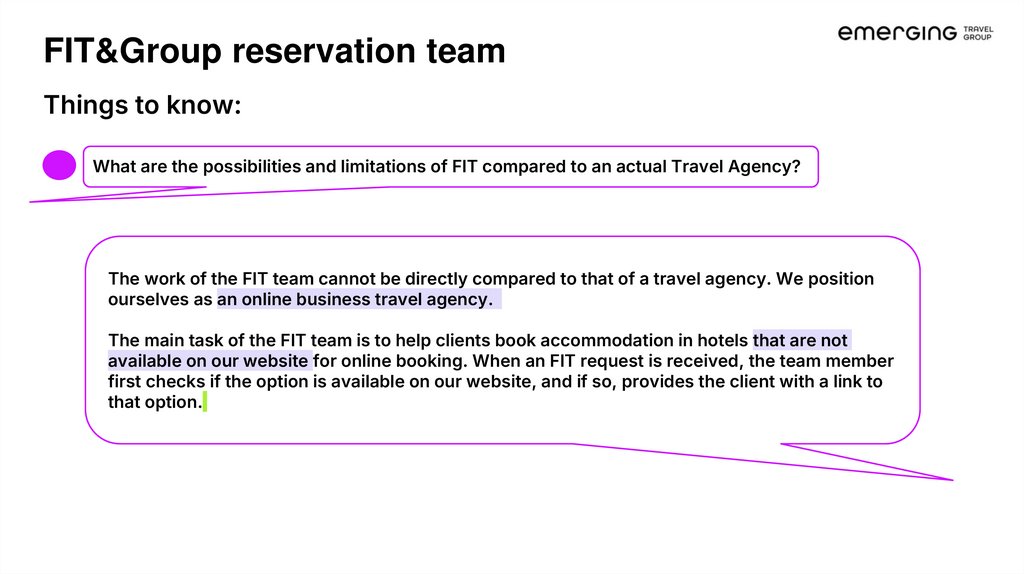
in place, and all employees are client-oriented and primarily focused on the client’s
best Service. Please read here for information about how we transfer responsibility
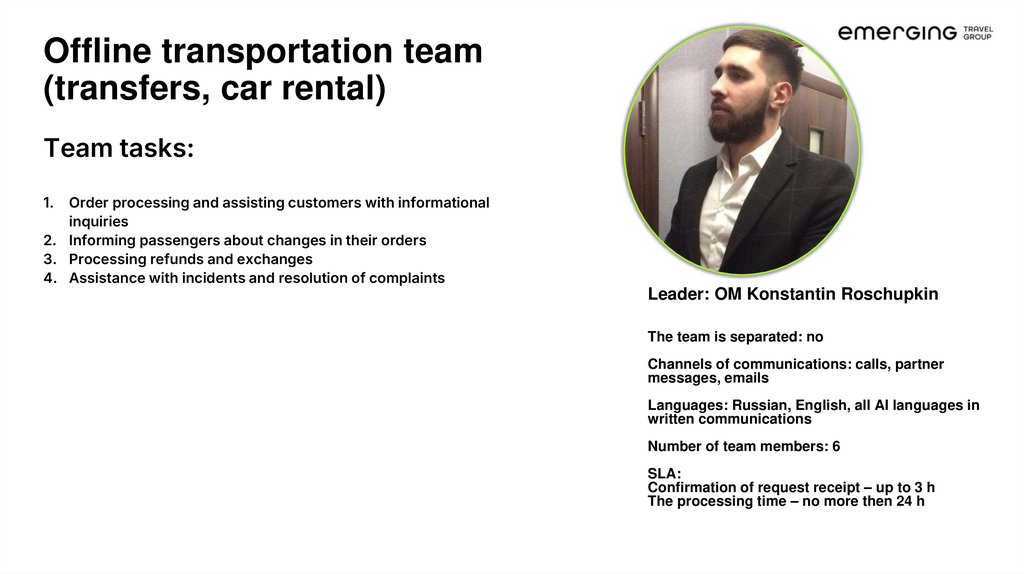
and how and by whom updates are provided to the client.
Link is here
9.
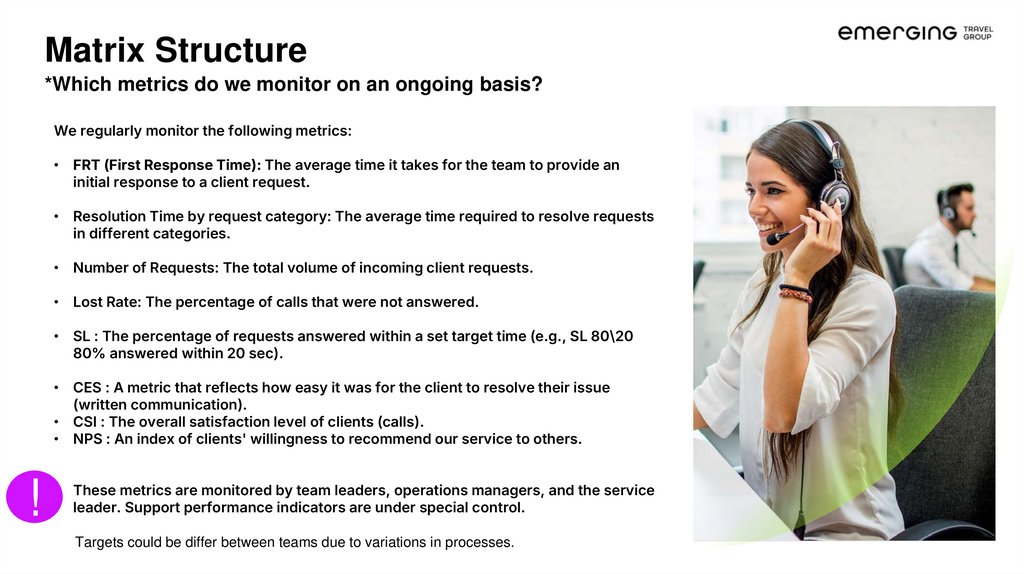
Matrix Structure*Which metrics do we monitor on an ongoing basis?
We regularly monitor the following metrics:
• FRT (First Response Time): The average time it takes for the team to provide an
initial response to a client request.
• Resolution Time by request category: The average time required to resolve requests
in different categories.
• Number of Requests: The total volume of incoming client requests.
• Lost Rate: The percentage of calls that were not answered.
• SL : The percentage of requests answered within a set target time (e.g., SL 80\20
80% answered within 20 sec).
• CES : A metric that reflects how easy it was for the client to resolve their issue
(written communication).
• CSI : The overall satisfaction level of clients (calls).
• NPS : An index of clients' willingness to recommend our service to others.
!
• These metrics are monitored by team leaders, operations managers, and the service
leader. Support performance indicators are under special control.
Targets could be differ between teams due to variations in processes.
10.
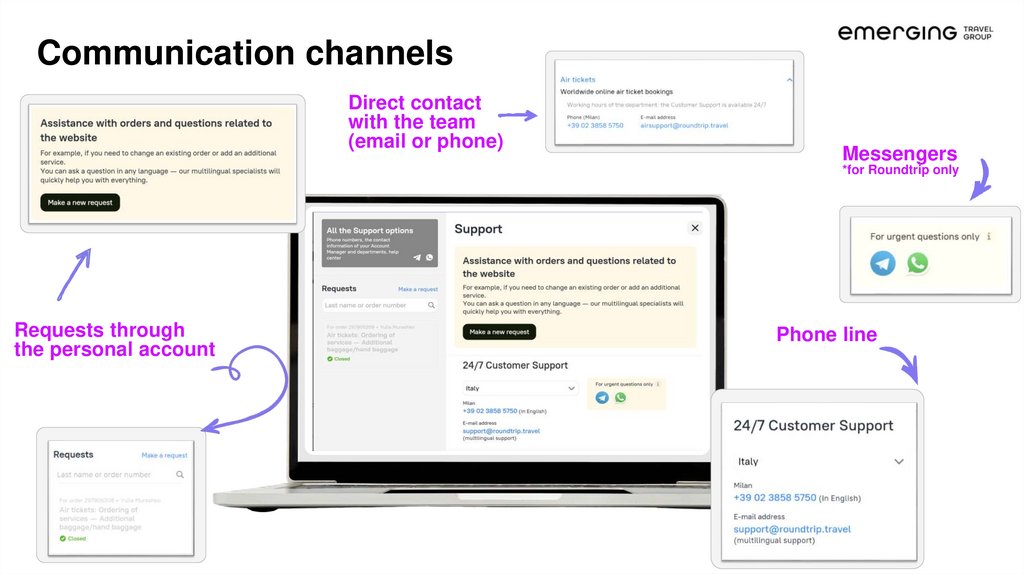
Communication channelsDirect contact
with the team
(email or phone)
Messengers
*for Roundtrip only
Requests through
the personal account
Phone line
11.
Supported languagesSupport on calls: English, Russian, (Front Office- *Kazakh, Italian-soon)
Written communication: English, Russian, + all AI languages
Spanish
Arabic
Polish
Italian
Portuguese
French
German
Romanian
Hebrew
Serbian
Turkish
Chinese
Armenian
Azerbaijani
Bulgarian
Czech
Dutch
Georgian
Greek
Hungarian
Japanese
Kazakh
Korean
Latvian
Lithuanian
Slovak
Slovenian
Thai
Ukrainian
Vietnamese
12.
Tone of voiceWe have chosen a soft business communication style as our tone
of voice with users.
For the Komandirovki brand, we did significant work on this at the
beginning of 2024.
For the Roundtrip brand, we just have finished it this August.
We have Guidebook, training courses for newbies, and daily-use
documents in place. There is also a tool in our CRM for selecting the
communication style.
All employees strive to follow the established standards.
Compliance is monitored by our quality control team, team leaders,
and service leader.
!
Guide book link is here
Style guides for daily use – link is here
13.
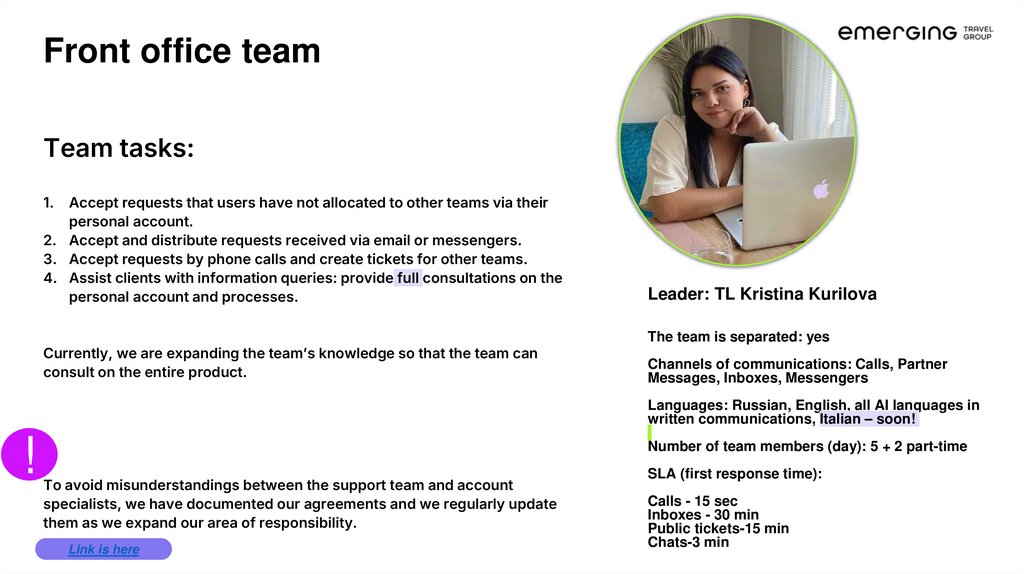
Front office teamTeam tasks:
1.
Accept requests that users have not allocated to other teams via their
personal account.
2. Accept and distribute requests received via email or messengers.
3. Accept requests by phone calls and create tickets for other teams.
4. Assist clients with information queries: provide full consultations on the
personal account and processes.
Leader: TL Kristina Kurilova
The team is separated: yes
Currently, we are expanding the team’s knowledge so that the team can
consult on the entire product.
Channels of communications: Calls, Partner
Messages, Inboxes, Messengers
Languages: Russian, English, all AI languages in
written communications, Italian – soon!
!
Number of team members (day): 5 + 2 part-time
To avoid misunderstandings between the support team and account
specialists, we have documented our agreements and we regularly update
them as we expand our area of responsibility.
Link is here
SLA (first response time):
Calls - 15 sec
Inboxes - 30 min
Public tickets-15 min
Chats-3 min
14.
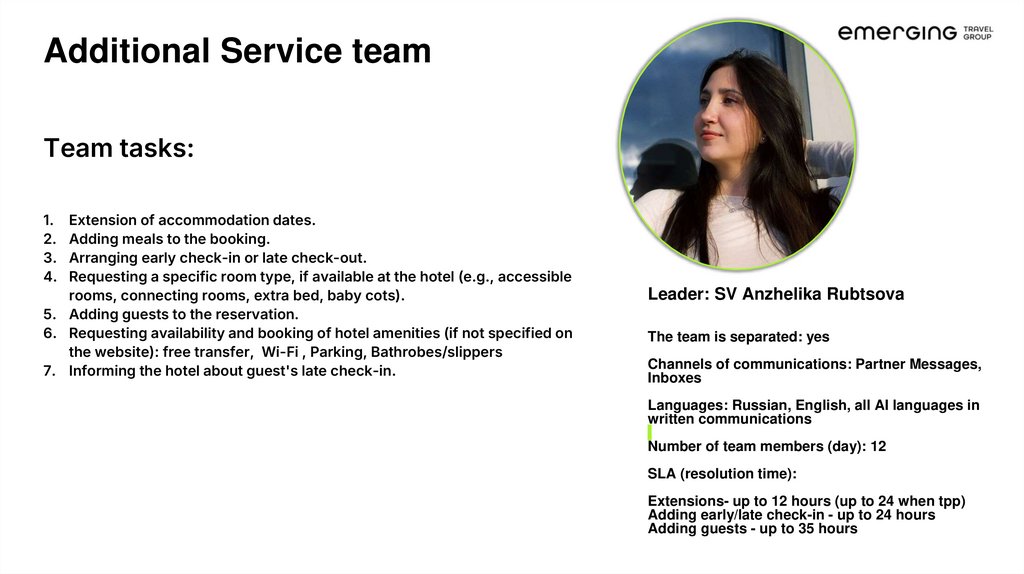
Additional Service teamTeam tasks:
1.
2.
3.
4.
Extension of accommodation dates.
Adding meals to the booking.
Arranging early check-in or late check-out.
Requesting a specific room type, if available at the hotel (e.g., accessible
rooms, connecting rooms, extra bed, baby cots).
5. Adding guests to the reservation.
6. Requesting availability and booking of hotel amenities (if not specified on
the website): free transfer, Wi-Fi , Parking, Bathrobes/slippers
7. Informing the hotel about guest's late check-in.
Leader: SV Anzhelika Rubtsova
The team is separated: yes
Channels of communications: Partner Messages,
Inboxes
Languages: Russian, English, all AI languages in
written communications
Number of team members (day): 12
SLA (resolution time):
Extensions- up to 12 hours (up to 24 when tpp)
Adding early/late check-in - up to 24 hours
Adding guests - up to 35 hours
15.
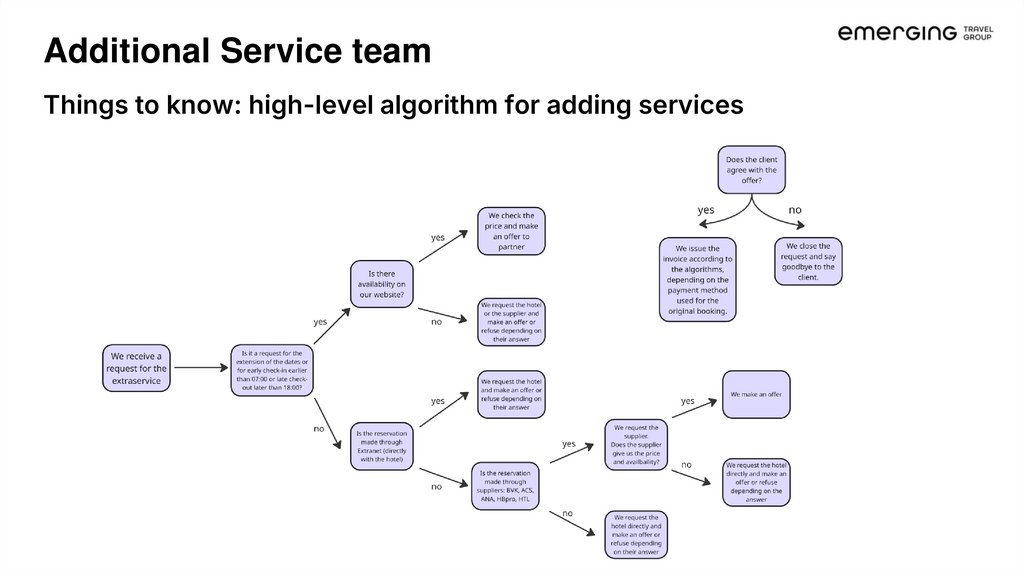
Additional Service teamThings to know: high-level algorithm for adding services
16.
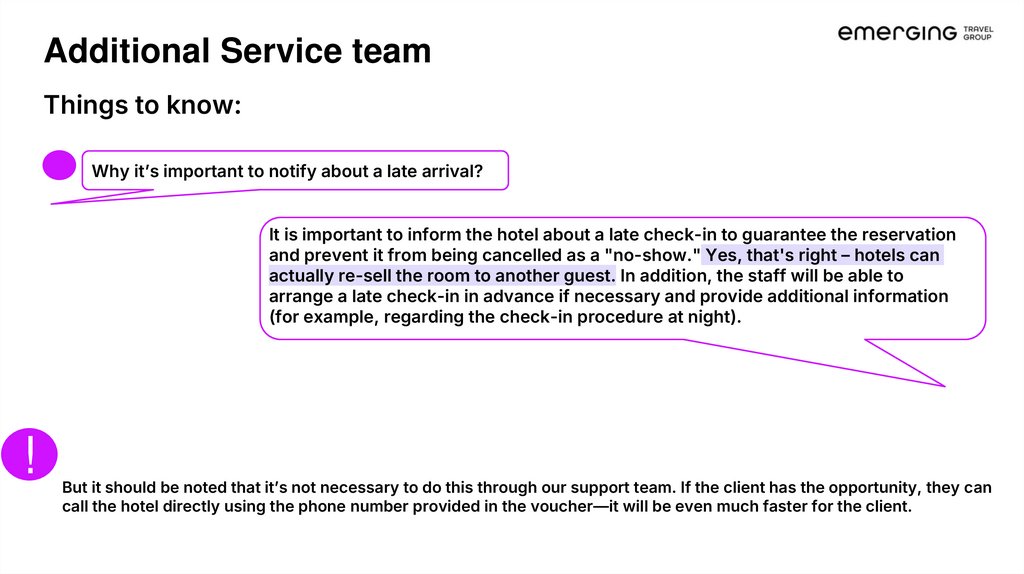
Additional Service teamThings to know:
Why it’s important to notify about a late arrival?
It is important to inform the hotel about a late check-in to guarantee the reservation
and prevent it from being cancelled as a "no-show." Yes, that's right – hotels can
actually re-sell the room to another guest. In addition, the staff will be able to
arrange a late check-in in advance if necessary and provide additional information
(for example, regarding the check-in procedure at night).
!
But it should be noted that it’s not necessary to do this through our support team. If the client has the opportunity, they can
call the hotel directly using the phone number provided in the voucher—it will be even much faster for the client.
17.
Additional Service teamThings to know:
Why is it not always possible to arrange early check-in or late
check-out for a guest?
It’s not always possible to arrange early check-in or late check-out because the
room may still be occupied by previous guests or not ready for check-in (cleaning
and preparation are required). This depends on the hotel’s occupancy and internal
check-in/check-out policies. For our part, we always do our best to arrange this
service for the client. In some cases, the hotel may offer accommodation in a
different room or even offer an upgrade to a higher room category (for an additional
fee, of course.).
18.
Additional Service teamThings to know:
Why can’t we ask hotels general questions without a reservation?
We can’t always know in advance which supplier will be used for the booking (the
booking page may show seemingly identical offers, but there can be differences in
the rates). In cases where there is no booking yet, hotel staff can only provide
general information not related to a specific order, which may later lead to
misunderstandings or outdated information for the client. That’s why each request is
considered individually: the employee analyzes the situation and determines
whether it’s possible to clarify details and provide accurate information to the client.
Most often, we prefer not to confirm specific information in advance in order to avoid
misunderstandings. For example, details such as “whether breakfast is included” or
“whether there is direct access to the pool from a specific room” are usually part of
the selected rate.
19.
Additional Service teamThings to know:
How is the control of automatic upsells carried out, and is there a responsible
employee who monitors their automatic cancellation in case the main order is
cancelled?
In case of automatic cancellation or if the order is cancelled by the client, a ticket is
created for the Additional Services team in order to cancel the additional services.
If it’s an online upsell (additional services selected by the client at the booking
stage), the cancellation conditions match those of the main accommodation.
For other services, the cancellation rules may differ—all specific conditions are
communicated to the client when the offer is sent.
20.
Additional Service teamThings to know:
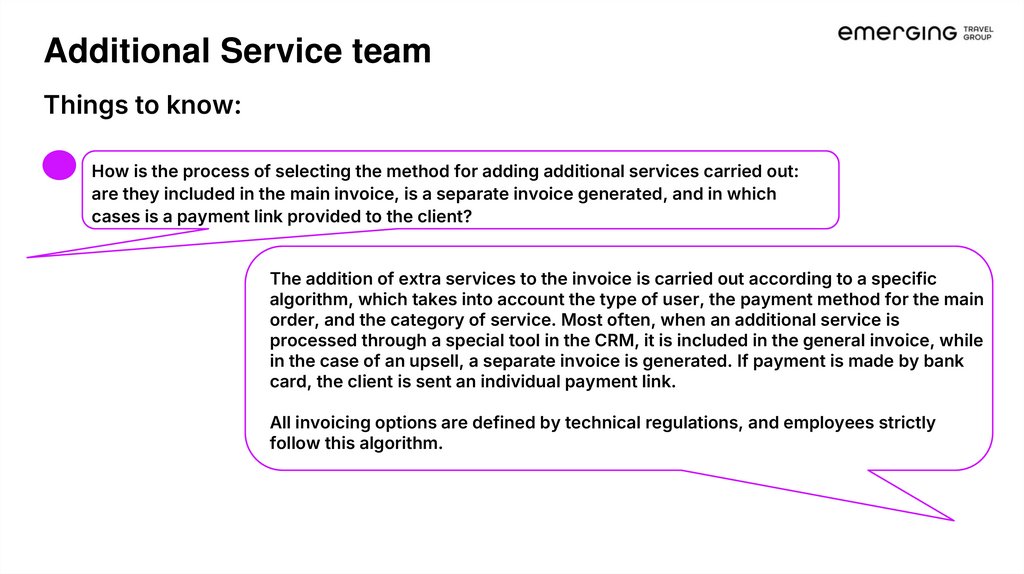
How is the process of selecting the method for adding additional services carried out:
are they included in the main invoice, is a separate invoice generated, and in which
cases is a payment link provided to the client?
The addition of extra services to the invoice is carried out according to a specific
algorithm, which takes into account the type of user, the payment method for the main
order, and the category of service. Most often, when an additional service is
processed through a special tool in the CRM, it is included in the general invoice, while
in the case of an upsell, a separate invoice is generated. If payment is made by bank
card, the client is sent an individual payment link.
All invoicing options are defined by technical regulations, and employees strictly
follow this algorithm.
21.
Additional Service teamThings to know:
How is the process of selecting the method for adding additional services carried out:
are they included in the main invoice, is a separate invoice generated, and in which
cases is a payment link provided to the client?
The addition of extra services to the invoice is carried out according to a specific
algorithm, which takes into account the type of user, the payment method for the main
order, and the category of service. Most often, when an additional service is
processed through a special tool in the CRM, it is included in the general invoice, while
in the case of an upsell, a separate invoice is generated. If payment is made by bank
card, the client is sent an individual payment link.
All invoicing options are defined by technical regulations, and employees strictly
follow this algorithm.
22.
Additional Service teamThings to know:
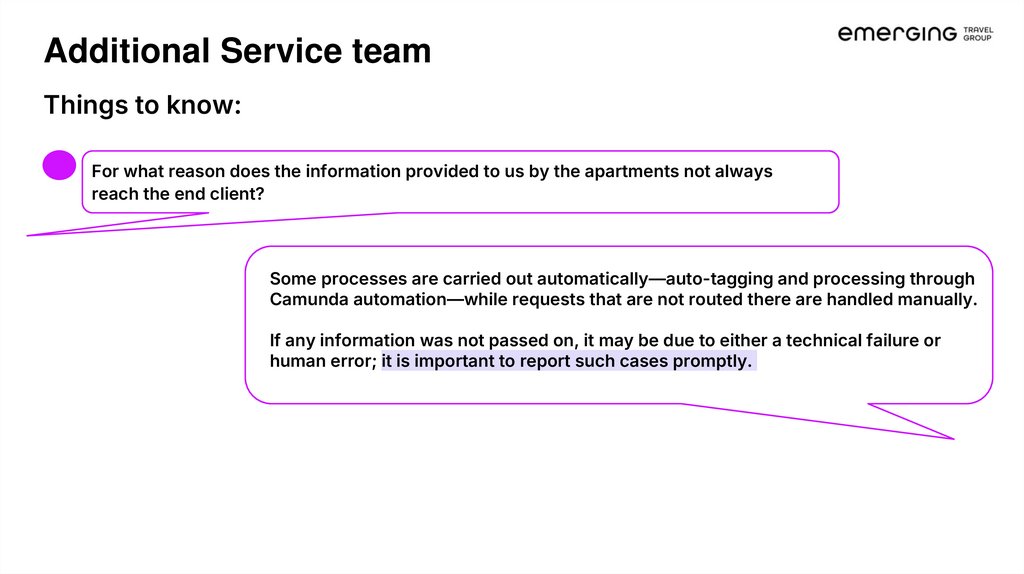
For what reason does the information provided to us by the apartments not always
reach the end client?
Some processes are carried out automatically—auto-tagging and processing through
Camunda automation—while requests that are not routed there are handled manually.
If any information was not passed on, it may be due to either a technical failure or
human error; it is important to report such cases promptly.
23.
Additional Service teamThings to know:
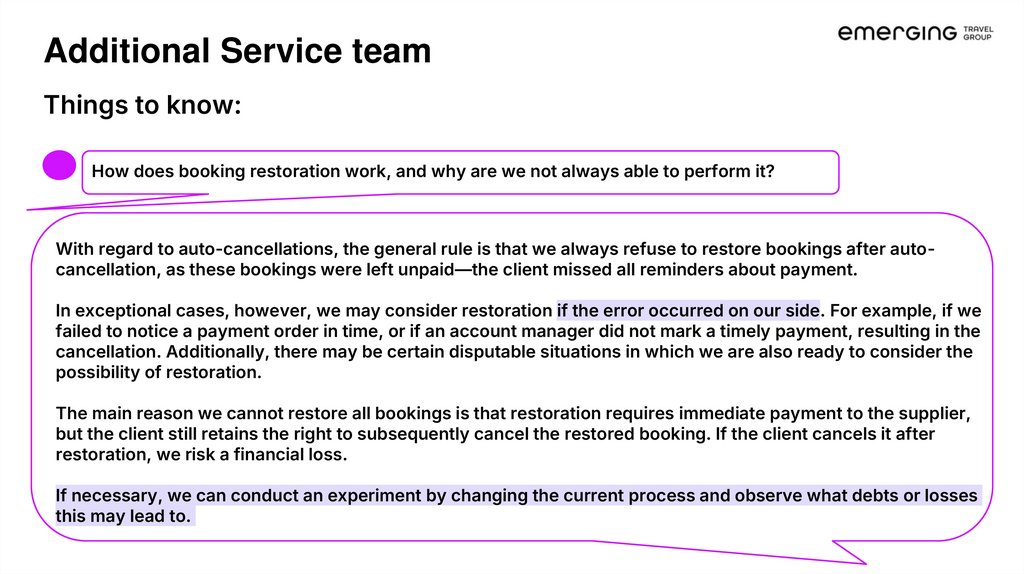
How does booking restoration work, and why are we not always able to perform it?
With regard to auto-cancellations, the general rule is that we always refuse to restore bookings after autocancellation, as these bookings were left unpaid—the client missed all reminders about payment.
In exceptional cases, however, we may consider restoration if the error occurred on our side. For example, if we
failed to notice a payment order in time, or if an account manager did not mark a timely payment, resulting in the
cancellation. Additionally, there may be certain disputable situations in which we are also ready to consider the
possibility of restoration.
The main reason we cannot restore all bookings is that restoration requires immediate payment to the supplier,
but the client still retains the right to subsequently cancel the restored booking. If the client cancels it after
restoration, we risk a financial loss.
If necessary, we can conduct an experiment by changing the current process and observe what debts or losses
this may lead to.
24.
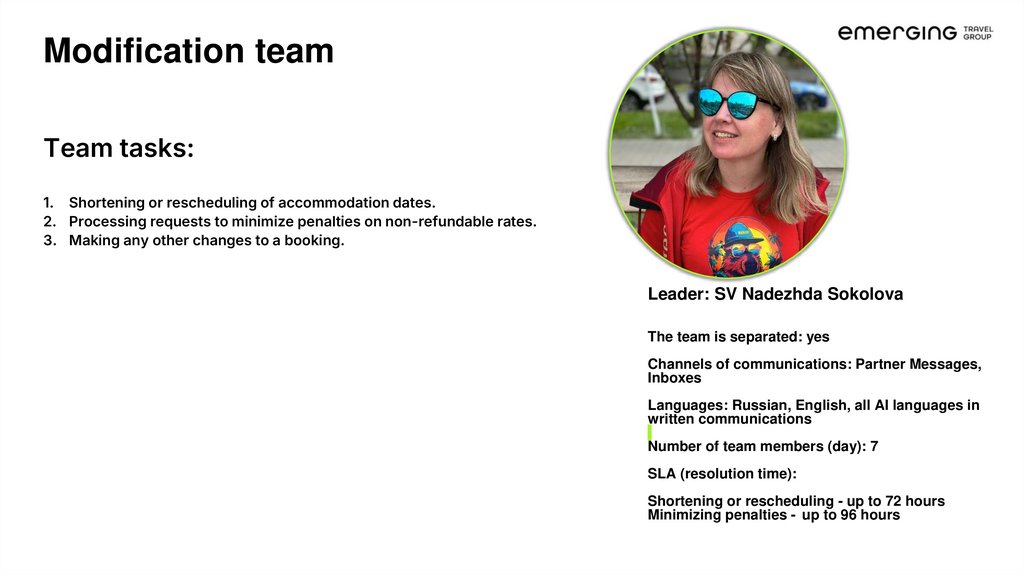
Modification teamTeam tasks:
1. Shortening or rescheduling of accommodation dates.
2. Processing requests to minimize penalties on non-refundable rates.
3. Making any other changes to a booking.
Leader: SV Nadezhda Sokolova
The team is separated: yes
Channels of communications: Partner Messages,
Inboxes
Languages: Russian, English, all AI languages in
written communications
Number of team members (day): 7
SLA (resolution time):
Shortening or rescheduling - up to 72 hours
Minimizing penalties - up to 96 hours
25.
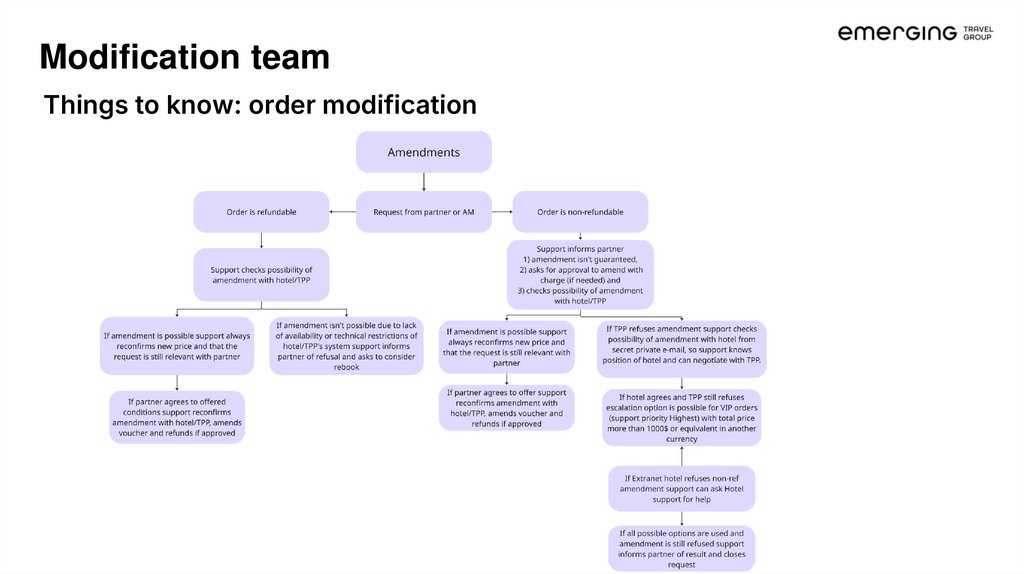
Modification teamThings to know: order modification
26.
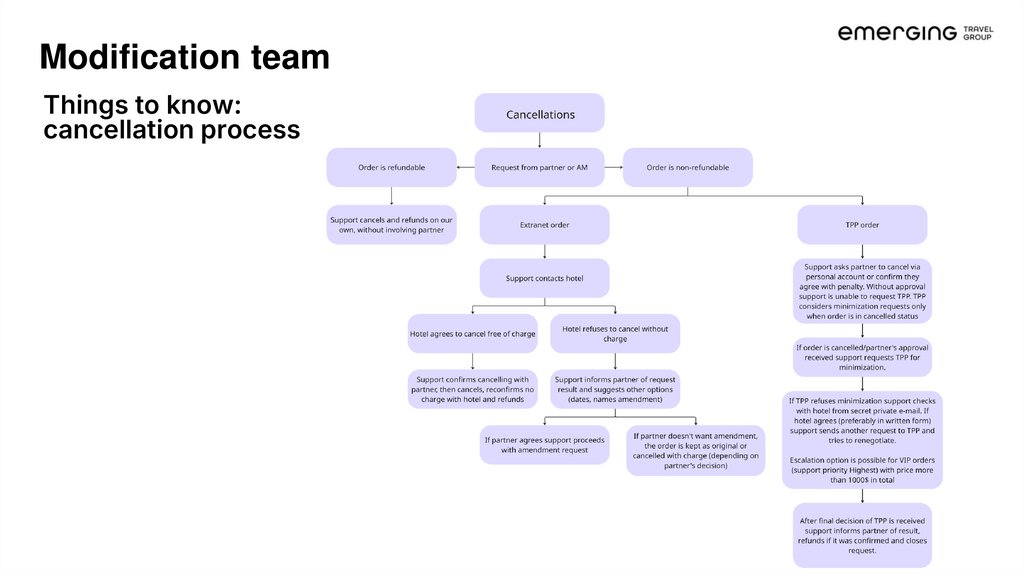
Modification teamThings to know:
cancellation process
27.
Modification teamThings to know:
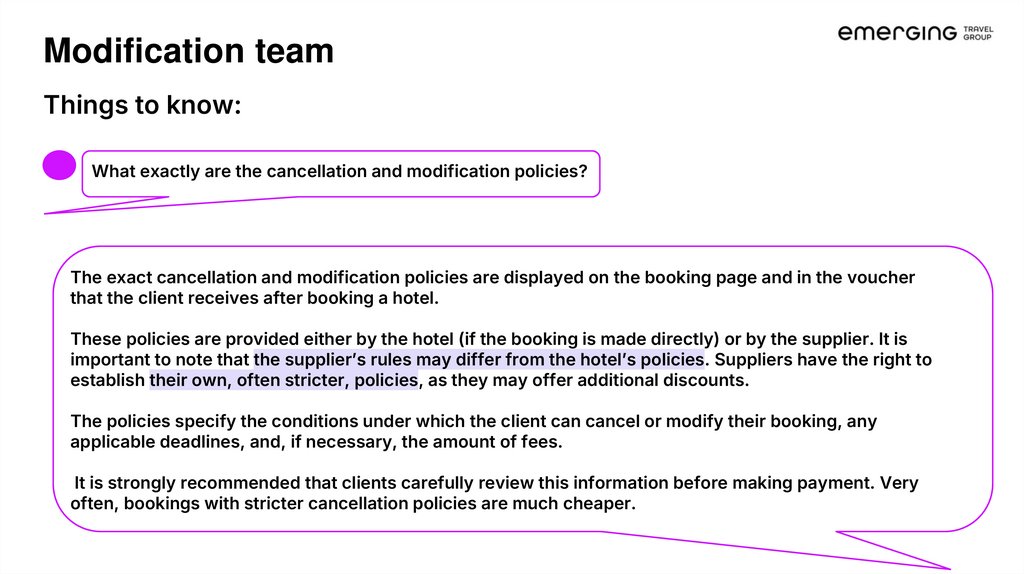
What exactly are the cancellation and modification policies?
The exact cancellation and modification policies are displayed on the booking page and in the voucher
that the client receives after booking a hotel.
These policies are provided either by the hotel (if the booking is made directly) or by the supplier. It is
important to note that the supplier’s rules may differ from the hotel’s policies. Suppliers have the right to
establish their own, often stricter, policies, as they may offer additional discounts.
The policies specify the conditions under which the client can cancel or modify their booking, any
applicable deadlines, and, if necessary, the amount of fees.
It is strongly recommended that clients carefully review this information before making payment. Very
often, bookings with stricter cancellation policies are much cheaper.
28.
Modification teamThings to know:
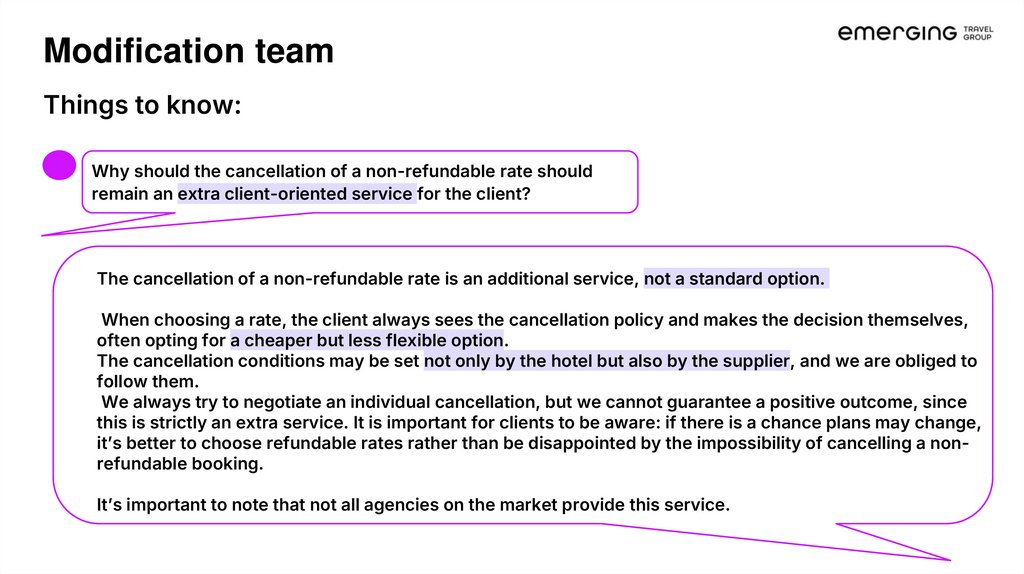
Why should the cancellation of a non-refundable rate should
remain an extra client-oriented service for the client?
The cancellation of a non-refundable rate is an additional service, not a standard option.
When choosing a rate, the client always sees the cancellation policy and makes the decision themselves,
often opting for a cheaper but less flexible option.
The cancellation conditions may be set not only by the hotel but also by the supplier, and we are obliged to
follow them.
We always try to negotiate an individual cancellation, but we cannot guarantee a positive outcome, since
this is strictly an extra service. It is important for clients to be aware: if there is a chance plans may change,
it’s better to choose refundable rates rather than be disappointed by the impossibility of cancelling a nonrefundable booking.
It’s important to note that not all agencies on the market provide this service.
29.
Modification teamThings to know:
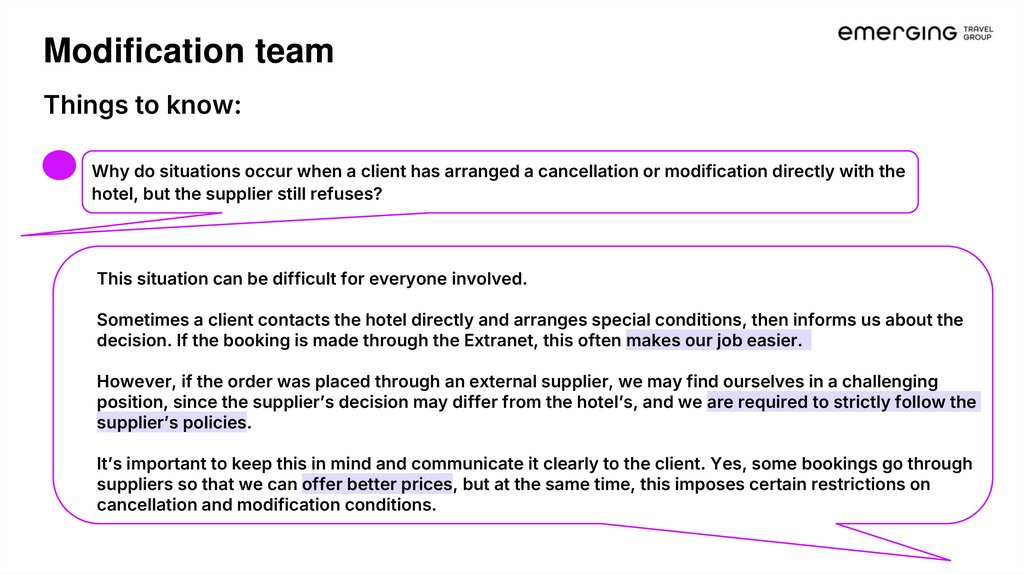
Why do situations occur when a client has arranged a cancellation or modification directly with the
hotel, but the supplier still refuses?
This situation can be difficult for everyone involved.
Sometimes a client contacts the hotel directly and arranges special conditions, then informs us about the
decision. If the booking is made through the Extranet, this often makes our job easier.
However, if the order was placed through an external supplier, we may find ourselves in a challenging
position, since the supplier’s decision may differ from the hotel’s, and we are required to strictly follow the
supplier’s policies.
It’s important to keep this in mind and communicate it clearly to the client. Yes, some bookings go through
suppliers so that we can offer better prices, but at the same time, this imposes certain restrictions on
cancellation and modification conditions.
30.
Modification teamThings to know:
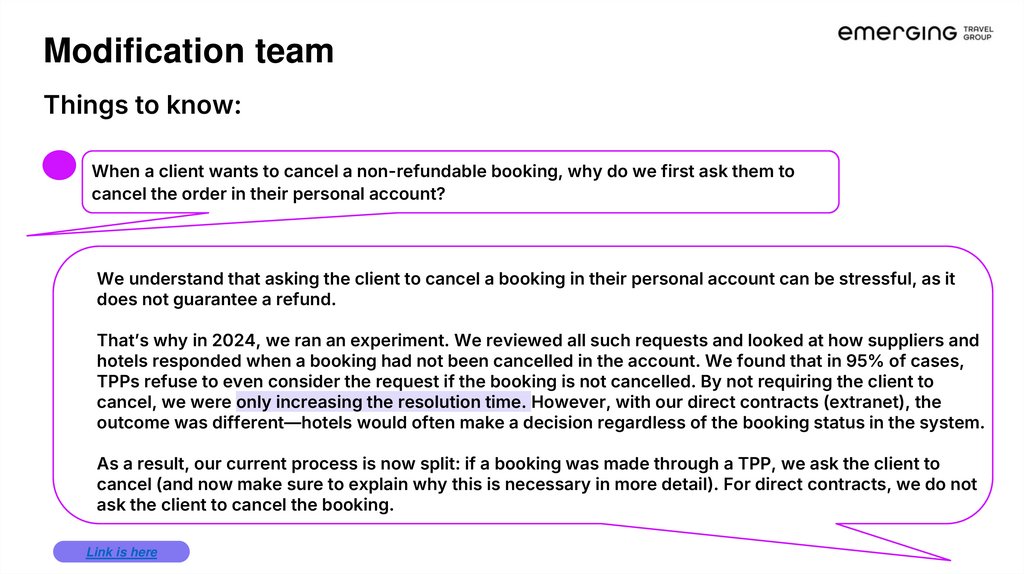
When a client wants to cancel a non-refundable booking, why do we first ask them to
cancel the order in their personal account?
We understand that asking the client to cancel a booking in their personal account can be stressful, as it
does not guarantee a refund.
That’s why in 2024, we ran an experiment. We reviewed all such requests and looked at how suppliers and
hotels responded when a booking had not been cancelled in the account. We found that in 95% of cases,
TPPs refuse to even consider the request if the booking is not cancelled. By not requiring the client to
cancel, we were only increasing the resolution time. However, with our direct contracts (extranet), the
outcome was different—hotels would often make a decision regardless of the booking status in the system.
As a result, our current process is now split: if a booking was made through a TPP, we ask the client to
cancel (and now make sure to explain why this is necessary in more detail). For direct contracts, we do not
ask the client to cancel the booking.
Link is here
31.
Modification teamThings to know:
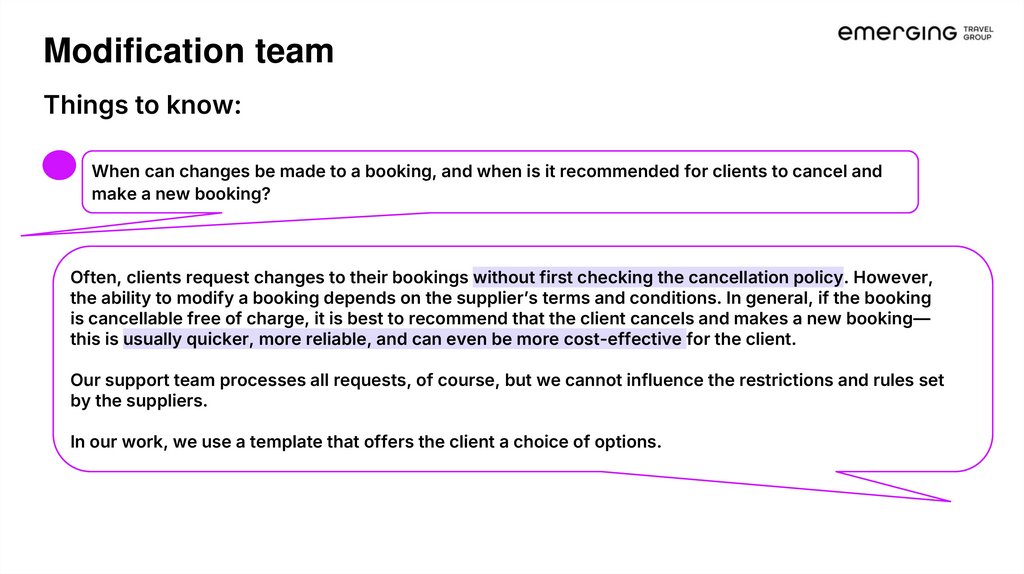
When can changes be made to a booking, and when is it recommended for clients to cancel and
make a new booking?
Often, clients request changes to their bookings without first checking the cancellation policy. However,
the ability to modify a booking depends on the supplier’s terms and conditions. In general, if the booking
is cancellable free of charge, it is best to recommend that the client cancels and makes a new booking—
this is usually quicker, more reliable, and can even be more cost-effective for the client.
Our support team processes all requests, of course, but we cannot influence the restrictions and rules set
by the suppliers.
In our work, we use a template that offers the client a choice of options.
32.
Modification teamThings to know:
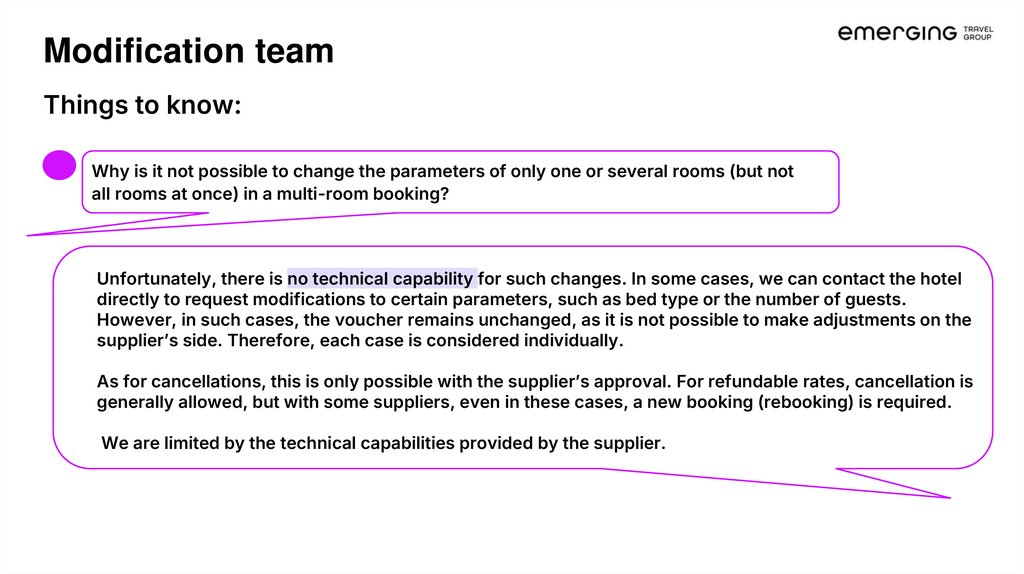
Why is it not possible to change the parameters of only one or several rooms (but not
all rooms at once) in a multi-room booking?
Unfortunately, there is no technical capability for such changes. In some cases, we can contact the hotel
directly to request modifications to certain parameters, such as bed type or the number of guests.
However, in such cases, the voucher remains unchanged, as it is not possible to make adjustments on the
supplier’s side. Therefore, each case is considered individually.
As for cancellations, this is only possible with the supplier’s approval. For refundable rates, cancellation is
generally allowed, but with some suppliers, even in these cases, a new booking (rebooking) is required.
We are limited by the technical capabilities provided by the supplier.
33.
Modification teamThings to know:
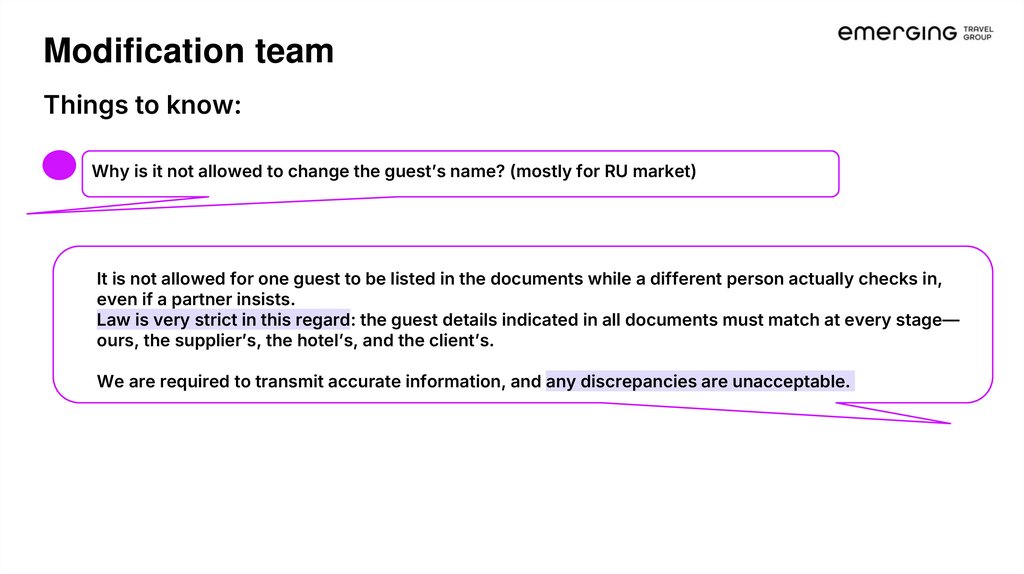
Why is it not allowed to change the guest’s name? (mostly for RU market)
It is not allowed for one guest to be listed in the documents while a different person actually checks in,
even if a partner insists.
Law is very strict in this regard: the guest details indicated in all documents must match at every stage—
ours, the supplier’s, the hotel’s, and the client’s.
We are required to transmit accurate information, and any discrepancies are unacceptable.
34.
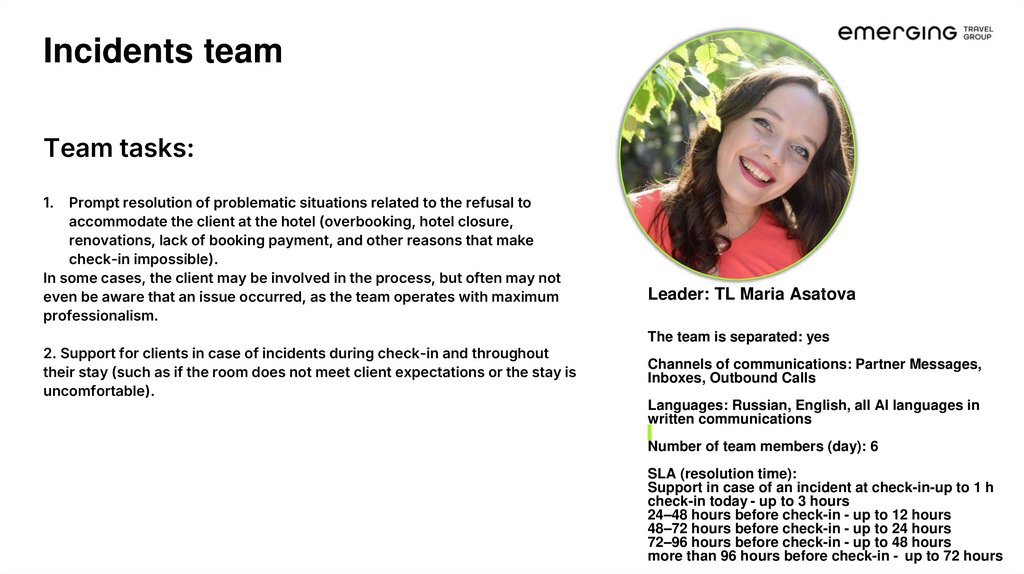
Incidents teamTeam tasks:
1.
Prompt resolution of problematic situations related to the refusal to
accommodate the client at the hotel (overbooking, hotel closure,
renovations, lack of booking payment, and other reasons that make
check-in impossible).
In some cases, the client may be involved in the process, but often may not
even be aware that an issue occurred, as the team operates with maximum
professionalism.
Leader: TL Maria Asatova
The team is separated: yes
2. Support for clients in case of incidents during check-in and throughout
their stay (such as if the room does not meet client expectations or the stay is
uncomfortable).
Channels of communications: Partner Messages,
Inboxes, Outbound Calls
Languages: Russian, English, all AI languages in
written communications
Number of team members (day): 6
SLA (resolution time):
Support in case of an incident at check-in-up to 1 h
check-in today - up to 3 hours
24–48 hours before check-in - up to 12 hours
48–72 hours before check-in - up to 24 hours
72–96 hours before check-in - up to 48 hours
more than 96 hours before check-in - up to 72 hours
35.
Incidents teamThings to know:
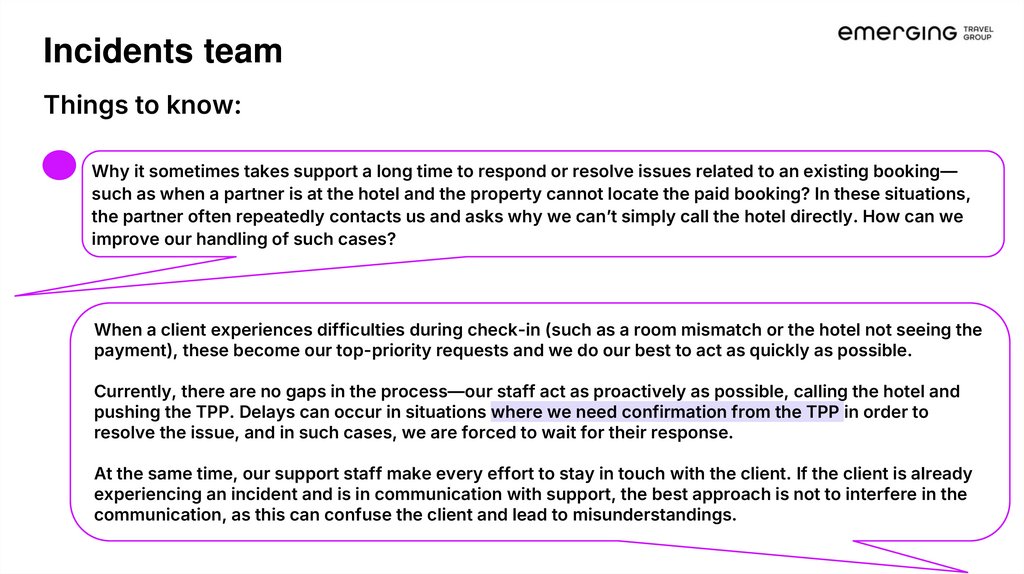
Why it sometimes takes support a long time to respond or resolve issues related to an existing booking—
such as when a partner is at the hotel and the property cannot locate the paid booking? In these situations,
the partner often repeatedly contacts us and asks why we can’t simply call the hotel directly. How can we
improve our handling of such cases?
When a client experiences difficulties during check-in (such as a room mismatch or the hotel not seeing the
payment), these become our top-priority requests and we do our best to act as quickly as possible.
Currently, there are no gaps in the process—our staff act as proactively as possible, calling the hotel and
pushing the TPP. Delays can occur in situations where we need confirmation from the TPP in order to
resolve the issue, and in such cases, we are forced to wait for their response.
At the same time, our support staff make every effort to stay in touch with the client. If the client is already
experiencing an incident and is in communication with support, the best approach is not to interfere in the
communication, as this can confuse the client and lead to misunderstandings.
36.
Incidents teamThings to know:
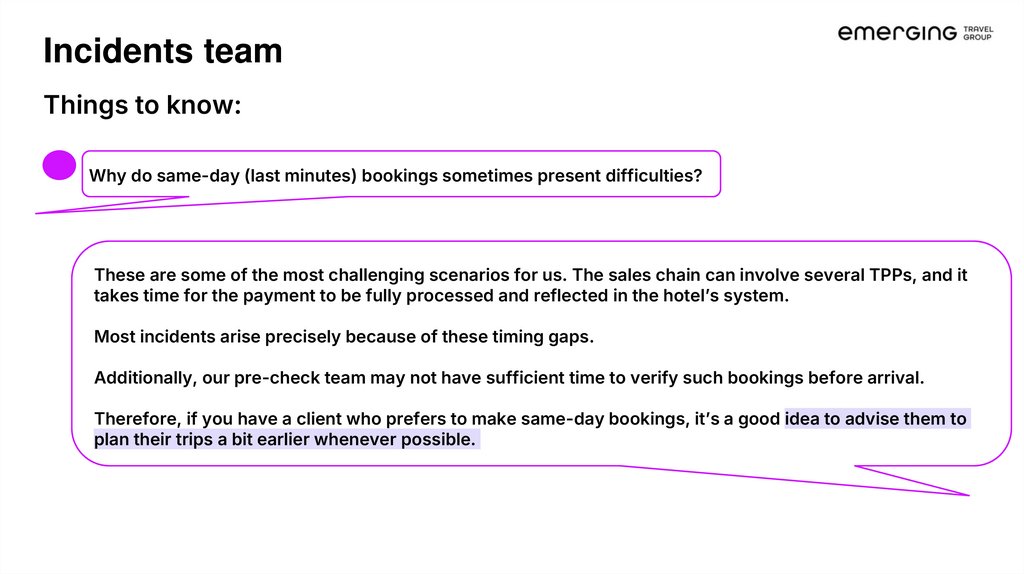
Why do same-day (last minutes) bookings sometimes present difficulties?
These are some of the most challenging scenarios for us. The sales chain can involve several TPPs, and it
takes time for the payment to be fully processed and reflected in the hotel’s system.
Most incidents arise precisely because of these timing gaps.
Additionally, our pre-check team may not have sufficient time to verify such bookings before arrival.
Therefore, if you have a client who prefers to make same-day bookings, it’s a good idea to advise them to
plan their trips a bit earlier whenever possible.
37.
Incidents teamThings to know:
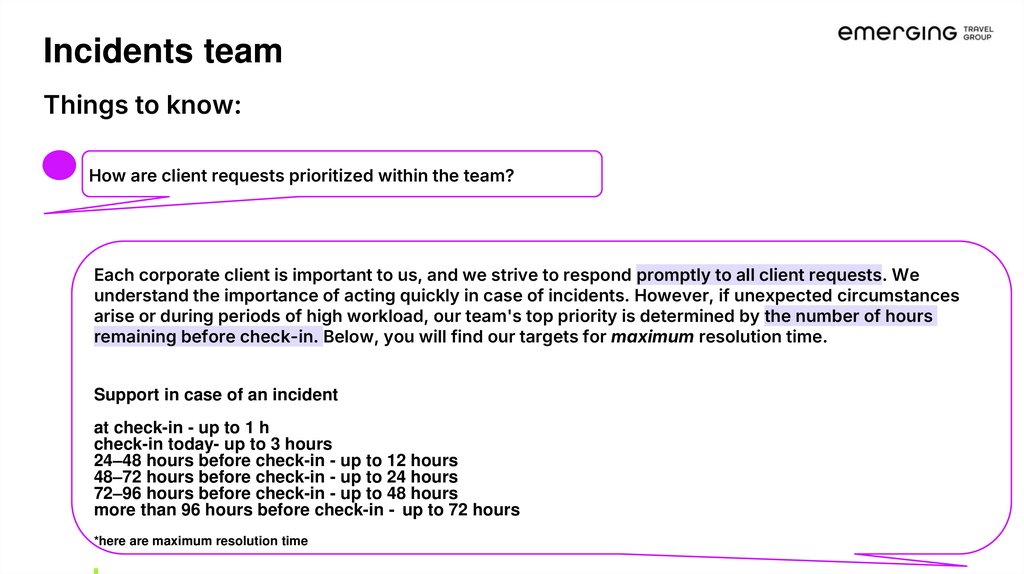
How are client requests prioritized within the team?
Each corporate client is important to us, and we strive to respond promptly to all client requests. We
understand the importance of acting quickly in case of incidents. However, if unexpected circumstances
arise or during periods of high workload, our team's top priority is determined by the number of hours
remaining before check-in. Below, you will find our targets for maximum resolution time.
Support in case of an incident
at check-in - up to 1 h
check-in today- up to 3 hours
24–48 hours before check-in - up to 12 hours
48–72 hours before check-in - up to 24 hours
72–96 hours before check-in - up to 48 hours
more than 96 hours before check-in - up to 72 hours
*here are maximum resolution time
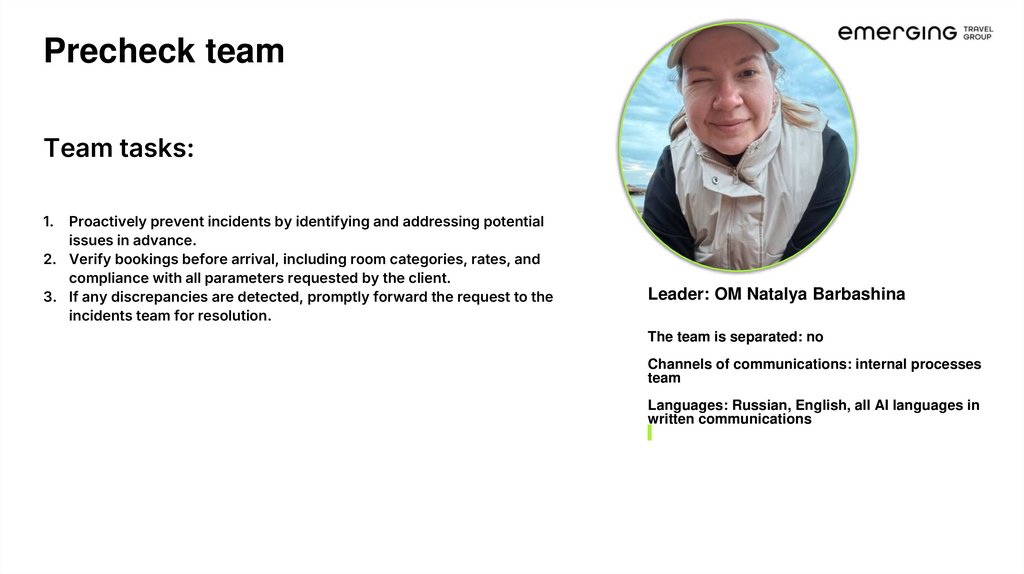
38.
Precheck teamTeam tasks:
1.
Proactively prevent incidents by identifying and addressing potential
issues in advance.
2. Verify bookings before arrival, including room categories, rates, and
compliance with all parameters requested by the client.
3. If any discrepancies are detected, promptly forward the request to the
incidents team for resolution.
Leader: OM Natalya Barbashina
The team is separated: no
Channels of communications: internal processes
team
Languages: Russian, English, all AI languages in
written communications
39.
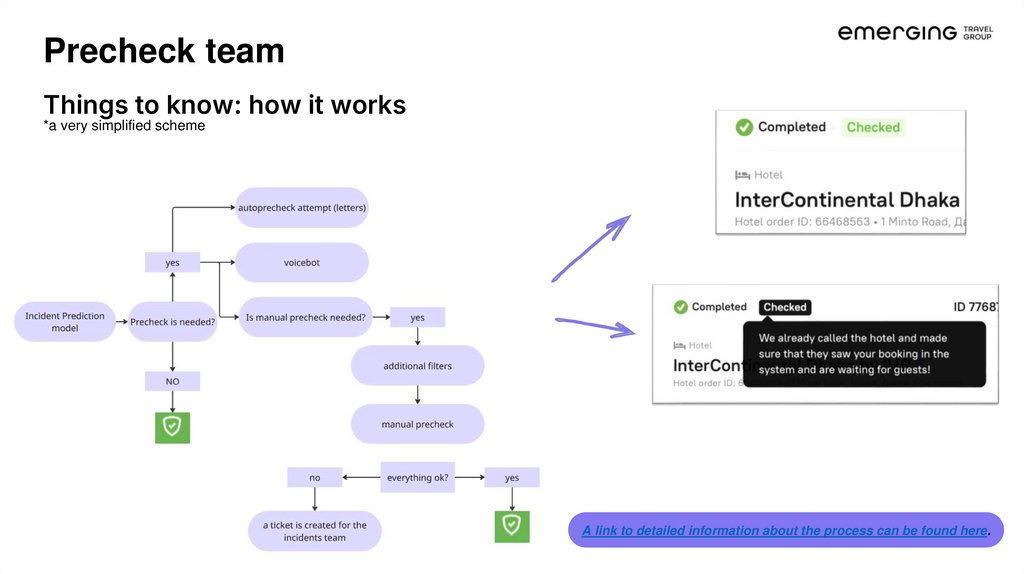
Precheck teamThings to know: how it works
*a very simplified scheme
A link to detailed information about the process can be found here.
40.
Precheck teamThings to know:
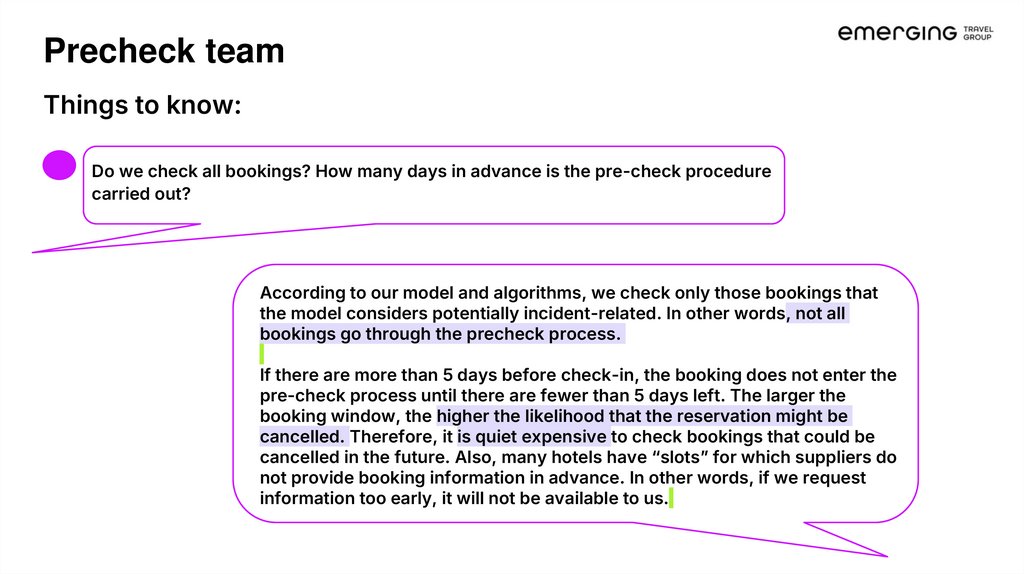
Do we check all bookings? How many days in advance is the pre-check procedure
carried out?
According to our model and algorithms, we check only those bookings that
the model considers potentially incident-related. In other words, not all
bookings go through the precheck process.
If there are more than 5 days before check-in, the booking does not enter the
pre-check process until there are fewer than 5 days left. The larger the
booking window, the higher the likelihood that the reservation might be
cancelled. Therefore, it is quiet expensive to check bookings that could be
cancelled in the future. Also, many hotels have “slots” for which suppliers do
not provide booking information in advance. In other words, if we request
information too early, it will not be available to us.
41.
Precheck teamThings to know:
We can inform the client that we do a pre-check without request, but we still have
trouble with some prechecked reservations. Why is that?
Such cases should be considered individually, taking into account the nature
of the booking incident. It is important to note that according to our algorithm,
the “checked” status may be automatically assigned by the model if the
booking meets the established trust criteria.
42.
Precheck teamThings to know:
Is it possible to independently see in the CRM whether a booking will be selected
for pre-check according to the model?
Account specialists often receive requests to verify bookings. However, it is
possible to independently check the pre-check status and see the likelihood
that a booking will be included in the model’s pre-check algorithm. A detailed
description of the steps for checking in the CRM is available at the link below.
43.
Complaints teamTeam tasks:
1.
Investigating issues encountered by users after check-out (issues arising
before and during the stay are handled by the incidents team).
2. Responding to user complaints and making decisions regarding
compensations.
3. Participating in drafting responses to official complaints and claims from
users.
Leader: OM Svetlana Filatova
The team is separated: no
Channels of communications: partner messages,
emails
Languages: Russian, English, all AI languages in
written communications
SLA: from 7 to 30 days
44.
Complaints teamThings to know:
Why does handling complaints and providing a final response to the client take so
much time? Clients are complaining that it takes too long for them to receive a
response, compensation, or refund.
First and foremost, the team needs to fully understand the situation. In many cases, we require
certain confirmations of the issue from the client, such as receipts, photos, videos, etc.
The team then compares this information with the version provided by the hotel and tries to
negotiate a resolution in the client’s favor, either with the hotel or tpp. If the booking was made
directly, the issue can usually be resolved more quickly and easily. However, if a TPP is
involved, we are obliged to wait for their decision as well. In some cases, the situation remains
unclear, and we need to wait until communication with the hotel is fully concluded to determine
whether the refund to the client will be covered as our loss or not.
45.
Air teamTeam tasks:
1.
2.
3.
4.
Assisting customers with informational inquiries
Informing passengers about changes to flights
Processing voluntary refunds and exchanges
Processing involuntary refunds and exchanges
Leader: OM Hanna Sonmez
The team is separated: almost
Channels of communications: calls, partner
messages, emails
Languages: Russian, English, all AI languages in
written communications
Number of team members: 6 (day) + 4 (night)
SLA:
Urgent request taken into processing – up to 1.5 h
Non-urgent request taken into processing – up to 3 h
46.
Air teamThings to know:
What is void (cancellation) of a ticket, and in which situations can it be applied?
Voiding a ticket means cancelling it, usually within a limited time after issuance (typically up to
00:00 midnight or just a few hours if the flight is tomorrow, depending on the airline's rules.
In this case, a full refund is generally provided, and no penalties or fees are charged. This
procedure can be used, for example, if the ticket was issued by mistake, the details were
entered incorrectly, or the passenger's plans changed immediately after purchase.
If the time for voiding the ticket has expired - standard refund rules and penalties may apply.
It is important to note that this is an extra service, applied only in exceptional cases and not
available for all tickets. It is highly recommended that clients carefully check all flight details
before issuing a ticket.
47.
Air teamThings to know:
What is a voluntary refund and exchange, and how does it differ from an involuntary one?
A voluntary refund or exchange occurs when a customer chooses to cancel or change their
booking for personal reasons (for example, a change in travel plans). In these cases, the terms and
conditions of the service provider or fare rules apply, and the customer may be subject to penalties
or fees.
An involuntary refund or exchange, on the other hand, takes place when the changes or
cancellations are caused by circumstances beyond the customer’s control—such as flight
cancellations, schedule changes, illness.
In such cases, the customer is usually entitled to a full refund or a penalty-free exchange, if the
passenger provides supporting documents.
The request for a refund is reviewed by the airline (not by us), and the processing time can take
anywhere from 30 to 180 days. Our role is limited to forwarding the documents to the airline, and
unfortunately, we are unable to expedite the process on our side.
48.
Air teamThings to know:
What is the process for refunds and exchanges?
1. The client submits a request for a refund or exchange, providing all necessary details
2. The request is initially reviewed by our team to ensure it meets the necessary criteria and all required
information has been provided.
3. If the ticket was issued through the GDS systems available to us, our operator will handle the process. We
verify the ticket’s fare rules and the airline’s policies to determine eligibility for a refund or exchange and to
identify any applicable fees or penalties.
4. We inform the client of the refund amount or the additional payment required for the exchange and wait for the
user's confirmation before proceeding.
5. After receiving confirmation from the client, we proceed with the refund or ticket exchange. Please note that in
the case of an exchange, the fare may change, and in such cases, we will need to obtain the passenger's
approval for the new amount before finalizing the transaction.
*If the ticket was issued through one of our suppliers, we need to clarify the fare rules and service conditions with
the supplier and then coordinate them with the passenger. This process takes more time unfortunately.
49.
Air teamThings to know:
Do clients have the option to independently check any additional charges in
advance in order to choose the flight they would like to change their ticket to?
When exchanging a ticket, the additional payment consists of several components:
• our fixed exchange fee,
• the airline’s fixed exchange fee or penalty,
• and the fare difference.
Our fee is specified in the user agreement, and the airline’s fee is indicated in the fare rules
displayed at the time of purchase.
However, the fare difference cannot be determined in advance, as it depends on the cost of the
new flight, the fare class, and may change even within 10 minutes due to the rapid sale of seats.
Only an operator can calculate the exact fare difference—this information is not available to
clients.
50.
Air teamThings to know:
Can we assist clients with adding checked baggage or choosing seats on a flight,
and when is it necessary for the client to complete these actions themselves
during online check-in?
We can arrange additional baggage that does not require a separate seat in the aircraft cabin,
provided it is available through the airline in the GDS or with the supplier.
The same applies to seat selection.
Online check-in is currently not available through our service—the client must always complete
this procedure independently on the airline’s website a certain number of hours before departure.
51.
Air teamThings to know:
Is it possible for us to issue an immediate refund to the client—if we are confident
that the refund will be approved (for example, in the case of an involuntary
refund)—in order to maintain customer loyalty?
We are all interested in maintaining customer loyalty, but we also have to take care of our
budget and expenses.
Refunds from some airlines can take a considerable amount of time, and we cannot return
funds to our partner until we have actually received them ourselves.
Even if the flight was cancelled and the airline is certain to authorize the refund, we are unable
to process the payment to the client before receiving the funds, as the final amount may
change—otherwise, we may have to cover the losses ourselves.
52.
Air teamThings to know:
What is the ticket closure process for the Air Support team?
The ticket closure process in the Air Support team does indeed differ from the process used by
the Hotels team. Clients are not able to reopen a closed ticket. In the past, we received some
complaints from users about this, so we adjusted our approach. The current process is as
follows:
• If the ticket is resolved positively and the user’s need is fully satisfied, we provide the
information to the client and immediately close the ticket.
• If the request is resolved negatively for the client (and the decision is likely not to satisfy
them), we send our response to the client but leave the ticket open for several hours. This
gives the client an opportunity to reply and ask any follow-up questions. After that, we
proceed to close the ticket.
53.
Online transportation team(transfers, railways, online car rental)
Team tasks:
1.
2.
3.
4.
Assisting customers with informational inquiries
Informing passengers about changes in their orders
Processing refunds and exchanges
Assistance with incidents and resolution of complaints
Leader: OM Illarion Bondarev
The team is separated: yes
Channels of communications: calls, partner
messages, emails
Languages: Russian, English, all AI languages in
written communications
Number of team members: 8
SLA:
Confirmation of request receipt – up to 1 h
54.
Online transportation teamThings to know:
Transfers: how much in advance are tasks assigned to the final driver? How can
final customer know who is their final driver if not all providers give the final
drivers phone number?
The timing of the assignment of the final driver depends on the internal processes of the local
operator (carrier) and the specifics of the route or region. As a rule, the carrier is assigned 24
hours before the trip, and sometimes even closer to the transfer time, especially in large cities
or with major carriers. Driver contact details are usually available closer to the time of
departure.
If the supplier does not provide the contact details of the final driver in advance, they usually
provide either the support service number or the contact details of the local dispatcher. In this
case, the final information may be sent to the client via SMS or messengers.
55.
Online transportation teamThings to know:
Why do we experience incidents with transfers? Why is the service sometimes unsatisfactory, and
why are suppliers in certain countries of such low quality?
There are several reasons why incidents occur with transfer services and why the overall service level may
vary, especially depending on the country or region. Local suppliers often differ in their processes, standards,
and training, which can directly affect the client experience.
In some countries, the infrastructure or regulations for transfer services may not be as well-developed or
controlled, leading to inconsistency in quality.
Cultural differences and varying perceptions of high service standards can also play a role. For example, a
client from Europe may not receive the same level of service they are accustomed to when traveling in some
Southern or Asian countries.
Additionally, factors such as high demand, driver shortages, challenging routes, or communication issues can
increase the risk of incidents.
!
It is important to remember that a transfer is simply a convenient way to get from the airport or train station to your
destination (with flight tracking service included), but it is not a luxury service.
56.
Online transportation teamThings to know:
If an important client has had a negative experience with a transfer (possibly more than once), is it
technically possible to block a specific supplier for that particular user?
Yes, of course, this is possible.
However, we will first check the overall incident rate of the supplier, as well as confirm whether the
supplier is the only one in the region or just one of the major providers.
It’s important to conduct this analysis, as taking such a significant step could affect the availability of
offers and potentially decrease the number of bookings (for example, if prices become much higher
or offers disappear altogether).
57.
FIT&Group reservation teamTeam tasks:
1.
Assist clients with arranging individual bookings that they could not
find online.
2. Assist clients with group hotel bookings.
3. Assist clients in organizing events.
Leader: SV Viktoriya Levshenya
The team is separated: yes
Channels of communications: calls, partner
messages, emails
Languages: Russian, English, all AI languages in
written communications
Number of team members: 3 (FIT) + 1 (groups)
SLA:
Confirmation of request receipt – up to 30 min
FIT offer sent – up to 3 h
Group offer sent – up to 24 h
58.
FIT&Group reservation teamThings to know: how it works
!
The processes are similar for FIT
requests and for group bookings.
However, it is important to understand
that group requests take significantly
longer to process. This is due to more
complex parameters and the fact that
our suppliers also need more time to
prepare their offers.
It is essential to communicate to
clients that processing times for group
bookings are longer, and this is
normal.
59.
FIT&Group reservation teamThings to know: how it works
What options are available for booking through FIT and Groups?
Through FIT, the following options are available: booking accommodation that is not available
on our website, renting a conference hall or meeting room, organizing excursions, hiring an
interpreter, arranging non-standard transfers (such as by helicopter, yacht, etc.), and VIP
airport meet-and-greet services. In exceptional cases, we can also convert a client's direct
hotel payment into a non-cash payment via our company.
Groups: we define groups as bookings of 10 or more rooms. Additional services, as mentioned
above, can also be arranged.
60.
FIT&Group reservation teamThings to know:
What are the possibilities and limitations of FIT compared to an actual Travel Agency?
The work of the FIT team cannot be directly compared to that of a travel agency. We position
ourselves as an online business travel agency.
The main task of the FIT team is to help clients book accommodation in hotels that are not
available on our website for online booking. When an FIT request is received, the team member
first checks if the option is available on our website, and if so, provides the client with a link to
that option.
61.
FIT&Group reservation teamThings to know:
Question: working offline with our FIT team for hotel reservations, is it possible to
work with email for all their bookings?
We communicate with clients through the channel they have chosen, and we are generally fine
with switching channels if the client requests. If the client contacts us by email, we continue the
conversation there; if they reach out via a ticket, we do not move them to email but continue
communicating through the ticket. We never conduct correspondence through messengers.
62.
Offline transportation team(transfers, car rental)
Team tasks:
1.
Order processing and assisting customers with informational
inquiries
2. Informing passengers about changes in their orders
3. Processing refunds and exchanges
4. Assistance with incidents and resolution of complaints
Leader: OM Konstantin Roschupkin
The team is separated: no
Channels of communications: calls, partner
messages, emails
Languages: Russian, English, all AI languages in
written communications
Number of team members: 6
SLA:
Confirmation of request receipt – up to 3 h
The processing time – no more then 24 h
63.
Transportation team:car rental (online and offline)Things to know:
What clients need to know to ensure a smooth car rental experience (based on past incidents)?
Information for the client:
• To get the car the driver should present to the rental company: voucher, ID, driver ID (international +
national), physical personal credit card for deposit pre-authorization on the name of the main driver (not Visa
Electron or Maestro).
• All our reservations are always fully prepaid.
• All additional services purchased on the spot (they are confirmed by the signature in the rental agreement)
are non-refundable.
• The client book a car for a certain period, but you have to arrive for pick up at a time mentioned in the
voucher. The grace period for picking up the car is 29 minutes. If the client cannot pick up the car within this
period, the client must notify the rental company of the delay. Otherwise, the rental company reserves the
right to cancel the reservation as a no-show after the grace period expires.
• If the client purchased an Excess Refund insurance on our website. Please note that from the rental
company's perspective, the client has a basic insurance. That's ok. Excess Refund coverage is providing by
our company. Your client does not need to purchase any additional insurances on the spot, even if rental
company insists: all mandatory insurances are already included.
64.
Thank you for your attention!Sign up your company