









 education
Similar presentations:










Chevening
1. CHEVENING
2. Contents
1.Congratulations!
2.
Visas and immigration
3.
Accommodation and rent
4.
Journey to the UK
5.
Finances and cash cards
6.
Health and wellbeing
7.
Universities and academia
8.
Stay involved with Chevening
9.
Who to contact for support
10. Chevening Fellowships
3. PRE-DEPARTURE
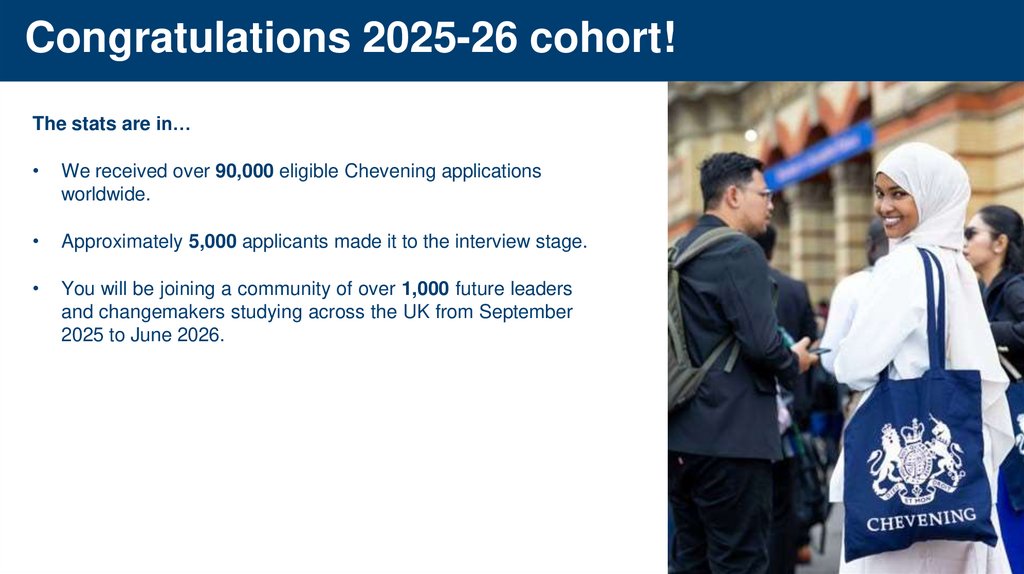
4. Congratulations 2025-26 cohort!
The stats are in…We received over 90,000 eligible Chevening applications
worldwide.
Approximately 5,000 applicants made it to the interview stage.
You will be joining a community of over 1,000 future leaders
and changemakers studying across the UK from September
2025 to June 2026.
5. Checklist
Have you…Downloaded your digital Final Award Letter (FAL) from
ASAMS and stored it securely?
Applied for your student visa? (Do NOT apply for your visa
until you have received your FAL and CAS, as you will not be
able to apply without these)
Booked your UK flight? (Your POUK will share flight booking
instructions and travel agency contact details)
Started looking for (and reserving) accommodation?
Started planning your finances?
6. VISAS AND
7. Introduction to eVisas
• UKVI is changing the way it issues visas. BiometricResidence Permits and other physical documents, such as
vignettes (visa stickers), are being phased out and replaced
by a digital immigration status called an ‘eVisa’.
• There is lots of information on our website about the visa
process and the documents you are required to provide:
o Applying for a student visa
o Immigration FAQs
o Full step-by-step guide of the online application
o Student visa document check list
• There are also accessible versions of the guidance for those
who use screen readers.
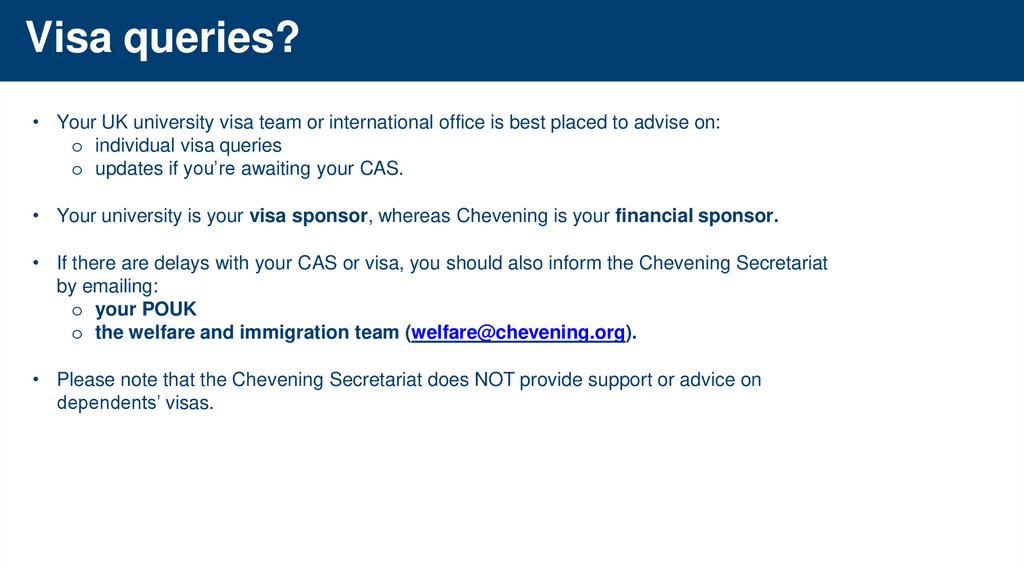
8. Visa queries?
• Your UK university visa team or international office is best placed to advise on:o individual visa queries
o updates if you’re awaiting your CAS.
• Your university is your visa sponsor, whereas Chevening is your financial sponsor.
• If there are delays with your CAS or visa, you should also inform the Chevening Secretariat
by emailing:
o your POUK
o the welfare and immigration team (welfare@chevening.org).
• Please note that the Chevening Secretariat does NOT provide support or advice on
dependents’ visas.
9. ACCOMMODATION
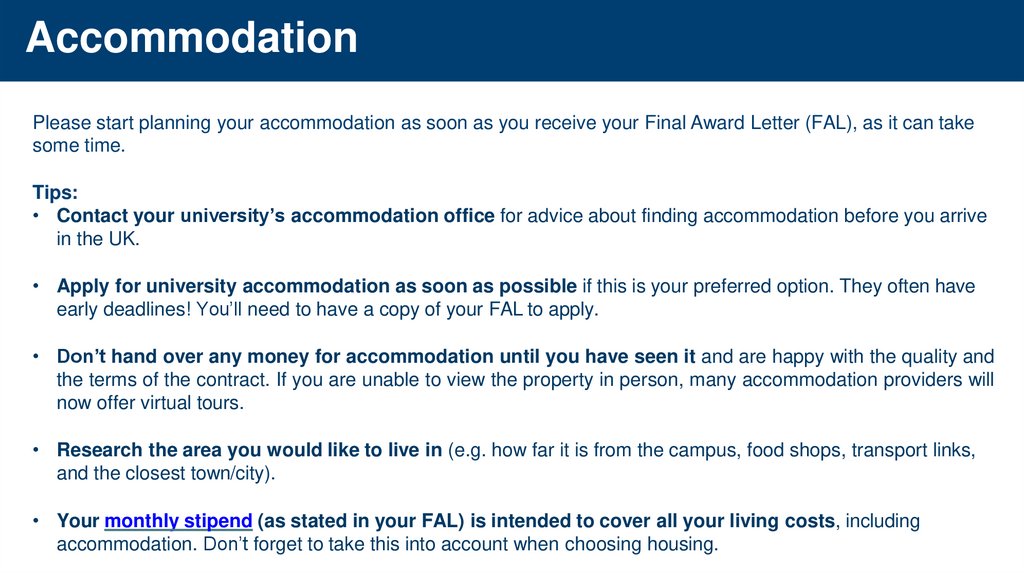
10. Accommodation
Please start planning your accommodation as soon as you receive your Final Award Letter (FAL), as it can takesome time.
Tips:
• Contact your university’s accommodation office for advice about finding accommodation before you arrive
in the UK.
• Apply for university accommodation as soon as possible if this is your preferred option. They often have
early deadlines! You’ll need to have a copy of your FAL to apply.
• Don’t hand over any money for accommodation until you have seen it and are happy with the quality and
the terms of the contract. If you are unable to view the property in person, many accommodation providers will
now offer virtual tours.
• Research the area you would like to live in (e.g. how far it is from the campus, food shops, transport links,
and the closest town/city).
• Your monthly stipend (as stated in your FAL) is intended to cover all your living costs, including
accommodation. Don’t forget to take this into account when choosing housing.
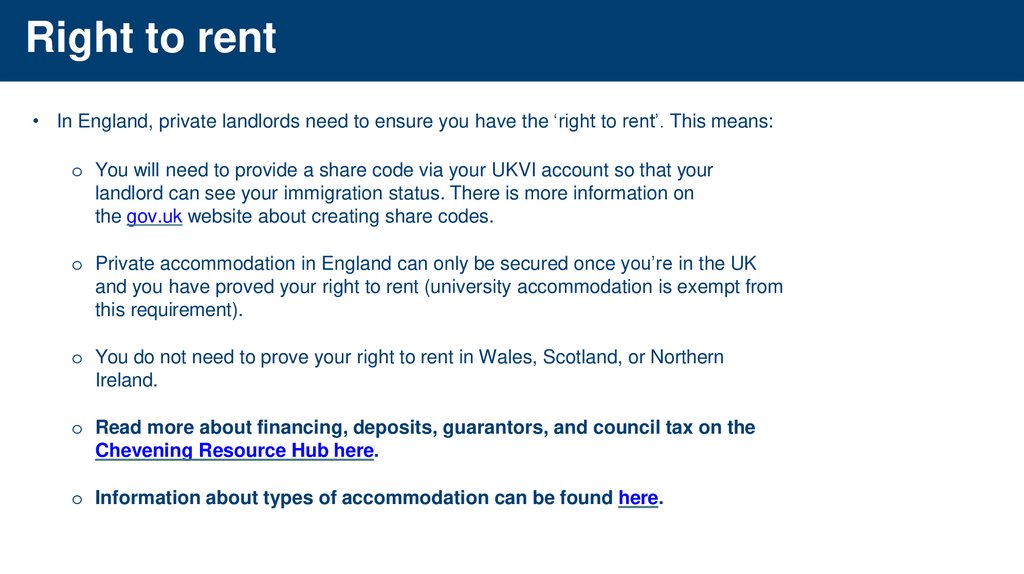
11. Right to rent
• In England, private landlords need to ensure you have the ‘right to rent’. This means:o You will need to provide a share code via your UKVI account so that your
landlord can see your immigration status. There is more information on
the gov.uk website about creating share codes.
o Private accommodation in England can only be secured once you’re in the UK
and you have proved your right to rent (university accommodation is exempt from
this requirement).
o You do not need to prove your right to rent in Wales, Scotland, or Northern
Ireland.
o Read more about financing, deposits, guarantors, and council tax on the
Chevening Resource Hub here.
o Information about types of accommodation can be found here.
12. JOURNEY
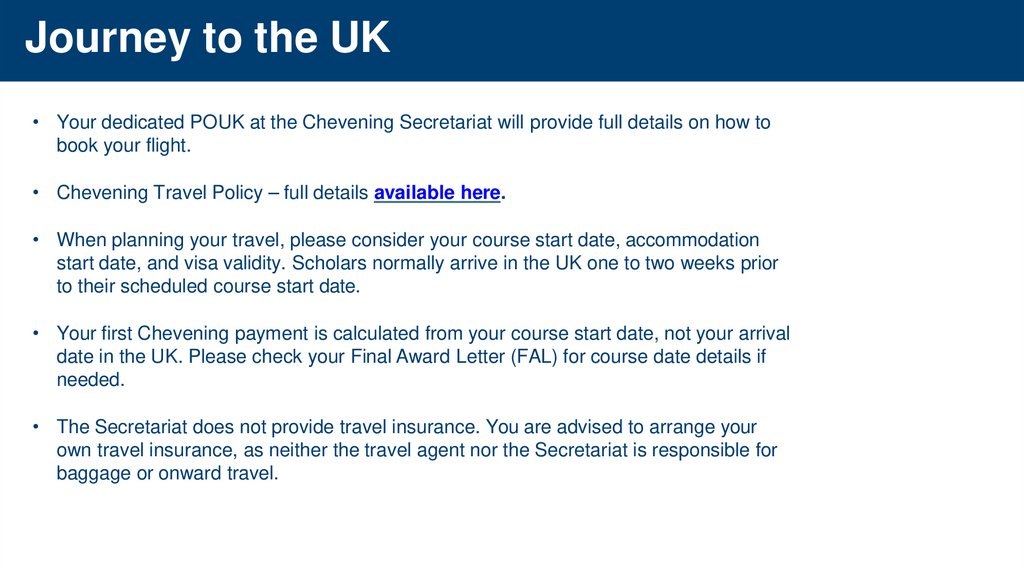
13. Journey to the UK
• Your dedicated POUK at the Chevening Secretariat will provide full details on how tobook your flight.
• Chevening Travel Policy – full details available here.
• When planning your travel, please consider your course start date, accommodation
start date, and visa validity. Scholars normally arrive in the UK one to two weeks prior
to their scheduled course start date.
• Your first Chevening payment is calculated from your course start date, not your arrival
date in the UK. Please check your Final Award Letter (FAL) for course date details if
needed.
• The Secretariat does not provide travel insurance. You are advised to arrange your
own travel insurance, as neither the travel agent nor the Secretariat is responsible for
baggage or onward travel.
14. Journey to the UK (continued)
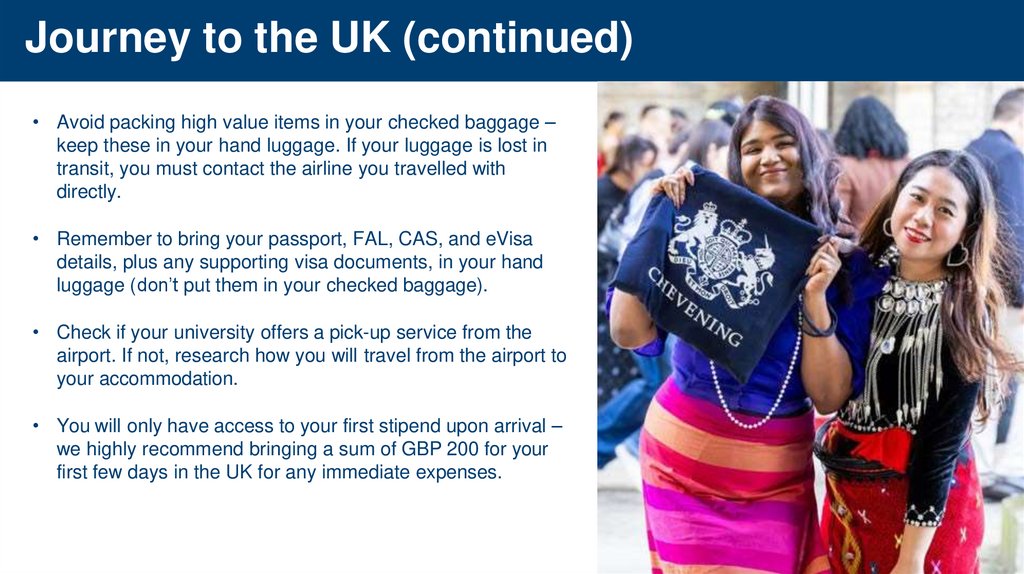
• Avoid packing high value items in your checked baggage –keep these in your hand luggage. If your luggage is lost in
transit, you must contact the airline you travelled with
directly.
• Remember to bring your passport, FAL, CAS, and eVisa
details, plus any supporting visa documents, in your hand
luggage (don’t put them in your checked baggage).
• Check if your university offers a pick-up service from the
airport. If not, research how you will travel from the airport to
your accommodation.
• You will only have access to your first stipend upon arrival –
we highly recommend bringing a sum of GBP 200 for your
first few days in the UK for any immediate expenses.
15. FINANCES AND
16. Cash card
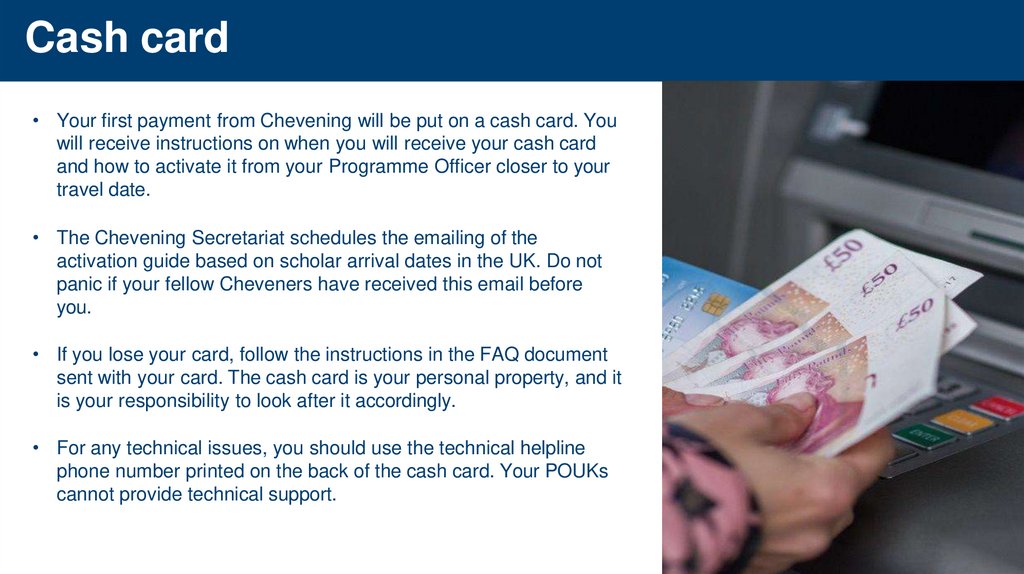
• Your first payment from Chevening will be put on a cash card. Youwill receive instructions on when you will receive your cash card
and how to activate it from your Programme Officer closer to your
travel date.
• The Chevening Secretariat schedules the emailing of the
activation guide based on scholar arrival dates in the UK. Do not
panic if your fellow Cheveners have received this email before
you.
• If you lose your card, follow the instructions in the FAQ document
sent with your card. The cash card is your personal property, and it
is your responsibility to look after it accordingly.
• For any technical issues, you should use the technical helpline
phone number printed on the back of the cash card. Your POUKs
cannot provide technical support.
17. Chevening stipend
• Your stipend should cover basic living costs in the UK, including accommodation, meals, personalexpenses, phone bills, daily travel, and required course resources.
• First payment: Your first stipend payment will be credited to your cash card. This will cover September and
October stipends and your arrival allowance. Please refer to your Final Award Letter to see if these
payments form part of your scholarship. Please budget your first month’s expenses carefully. You will not
receive your next stipend until the end of October.
• Subsequent payments: All subsequent payments will be directly deposited into your UK bank account at
the end of each month, to cover the following month’s expenses. This is why it is very important that you set
up your UK bank account as soon as you arrive in the UK.
• Final stipend payment: The date you receive your final stipend payment will be based on the last day of
your course or your departure date, whichever is earlier. Once we know your departure date, your last
stipend will be calculated accordingly, so please be aware this may be less than other stipends you have
received (see information on pro-rated payments here: https://www.chevening.org/resource-hub/scholarsupport/finances/).
18. UK bank account
• Once you have arrived in the UK and have your BRP (Biometric Residence Permit), you must:• open a UK bank account as soon as possible
• share your bank details with your Programme Officer via the form they share with you.
• Tips for opening a UK bank account can be found on the Chevening Resource Hub: Scholar
finances. Read the UKCISA advice for further guidance on setting up a bank account in the
UK.
• After you have submitted your bank details form to your POUK, subsequent stipends will be
deposited to your UK bank account.
For data protection reasons, DO NOT send your bank details in an email to your Programme
Officer under any circumstances.
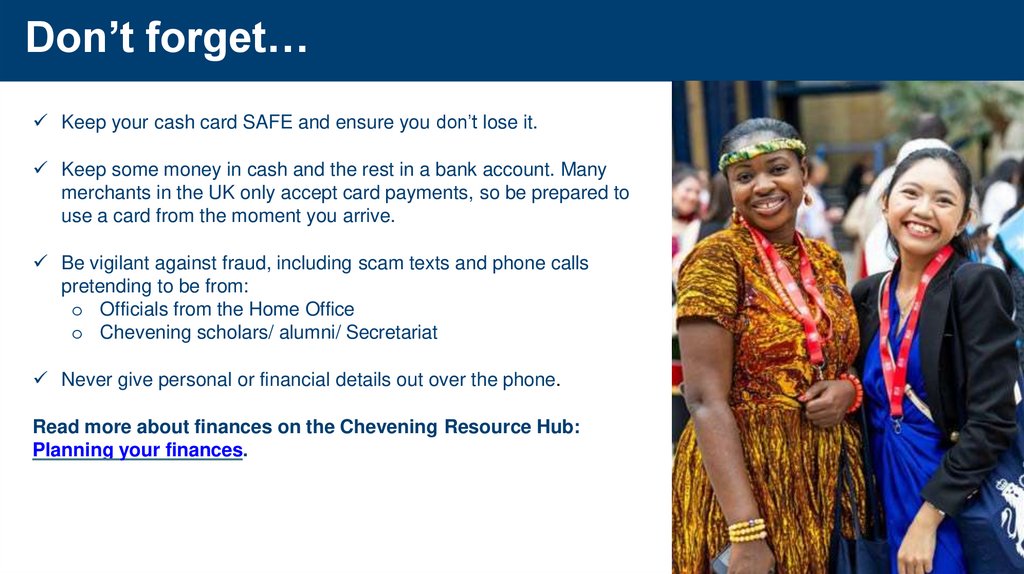
19. Don’t forget…
Keep your cash card SAFE and ensure you don’t lose it.Keep some money in cash and the rest in a bank account. Many
merchants in the UK only accept card payments, so be prepared to
use a card from the moment you arrive.
Be vigilant against fraud, including scam texts and phone calls
pretending to be from:
o Officials from the Home Office
o Chevening scholars/ alumni/ Secretariat
Never give personal or financial details out over the phone.
Read more about finances on the Chevening Resource Hub:
Planning your finances.
20. HEALTH AND
21. National Health Service (NHS)
• The NHS is the publicly funded healthcare system for England, Wales, Scotland and Northern Ireland.Before you come to the UK, please ensure you familiarise yourself with the NHS, as it will likely be quite
different to your health system at home.
• As part of the visa process, the Foreign, Commonwealth and Development Office pays the Immigration
Health Surcharge on your behalf, which allows you to have access to the NHS.
• Please note that not all NHS treatments are free of charge. For instance, you will have to pay for some
dental and optical treatments, plus prescription charges for medication if you live in England. We don’t
provide any additional funds for this, and you’re expected to use your monthly stipend to cover these costs.
• Read more about health and the NHS.
22. Registering with a doctor
• One of the first things you should do after you arrive in the UK is to register with a doctor, known as aGeneral Practitioner (GP). Please do not wait until you are ill to register with a GP and make sure you
choose an NHS doctor.
• Finding a GP to register with will depend on where you live in the UK. You can find further details at the
links below:
o England
o Scotland
o Wales
o Northern Ireland
• At many universities, there is also a student health service on campus.
• You may need to show proof of your student status and address, along with your Immigration Health
Surcharge number, when registering for a doctor. Your immigration health surcharge number will have
been sent to you by email when you made your student visa application.
23. Mental health and wellbeing
• Keeping a healthy body and mind is important so that you can focus on your studies and make the most ofyour time in the UK.
• Being chosen for Chevening is an incredible achievement and the start of a transformative journey.
However, moving to a new country also comes with its challenges. It’s important to be mindful of those
challenges and aware of the support services available to help you thrive on your Chevening year.
• Chevening provides current scholars with a 24/7 confidential support service and up to six sessions of
counselling. Once you arrive in the UK, you will receive details on how to access this service.
• UK universities also provide lots of resources to ensure that students are safe and supported.
• Mental health resource and support can be found here and a free online course for managing your
wellbeing while studying in the UK can be found here.
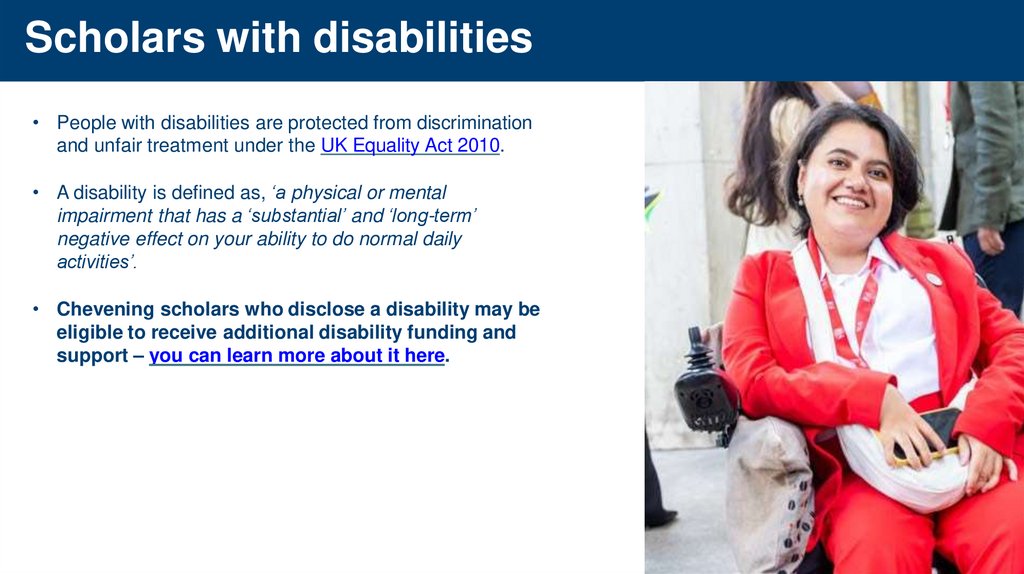
24. Scholars with disabilities
• People with disabilities are protected from discriminationand unfair treatment under the UK Equality Act 2010.
• A disability is defined as, ‘a physical or mental
impairment that has a ‘substantial’ and ‘long-term’
negative effect on your ability to do normal daily
activities’.
• Chevening scholars who disclose a disability may be
eligible to receive additional disability funding and
support – you can learn more about it here.
25. Dealing with culture shock
You may find that cultural norms in the UK differ from those in your own country.This may make you feel unsettled, but don’t worry, it's completely normal!
Top tips:
Keep in touch with friends and family at home.
Stay up to date with what is happening back home.
Eat your favourite foods from home.
Join local communities and groups.
Wellbeing tips:
Connect with peers and attend networking events.
Be active – try walking, group fitness challenges, or active volunteering.
Keep learning – try new skills, short courses, visit museums, etc.
Give to others – volunteering and helping others can significantly enhance your sense of
happiness and satisfaction.
Practice mindfulness to stay present and aware – keeping a journal and noticing daily sensations
can help you stay grounded.
26. UNIVERSITIES
27. UK academic culture
• Studying at a UK university is a unique and enriching experience. Here’s a glimpse of what you can expect:o Independent learning
o Critical thinking and discussion
o Interactive lectures
o Seminars and tutorials
o Assessments and feedback
• Please note, plagiarism is taken very seriously – you must ensure you cite sources correctly. Universities
offer many workshops to help you develop your skills in this area.
• Tutors and mentors: your academic mentors can provide valuable advice on how to approach your
coursework and succeed in the UK education system. Many lecturers and tutors offer ‘office hours’; a
designated time during the week when they are available to see students. They will usually let you know
when their ‘office hours’ are at the start of term.
• Student union: contact your student union or student support team to find out what help is available.
• Learn more on the Chevening Resource Hub: Studying in a UK classroom.
28. STAY INVOLVED
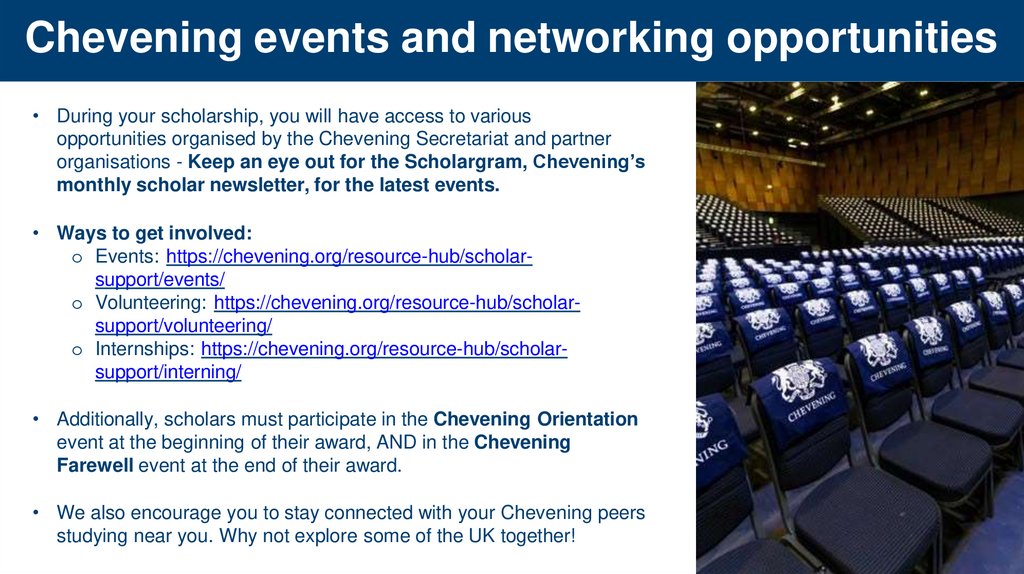
29. Chevening events and networking opportunities
• During your scholarship, you will have access to variousopportunities organised by the Chevening Secretariat and partner
organisations - Keep an eye out for the Scholargram, Chevening’s
monthly scholar newsletter, for the latest events.
• Ways to get involved:
o Events: https://chevening.org/resource-hub/scholarsupport/events/
o Volunteering: https://chevening.org/resource-hub/scholarsupport/volunteering/
o Internships: https://chevening.org/resource-hub/scholarsupport/interning/
• Additionally, scholars must participate in the Chevening Orientation
event at the beginning of their award, AND in the Chevening
Farewell event at the end of their award.
• We also encourage you to stay connected with your Chevening peers
studying near you. Why not explore some of the UK together!
30. WHO TO CONTACT
31. Your university
• Your university will be your primary source ofsupport in the UK.
• Reach out to them for:
o Support with your student visa (as they
are your student visa sponsor)
o Course-related queries
o Accommodation assistance
o Welfare and wellbeing support
o Campus security
o General wellbeing and advice on where
to go for support
o Changes of personal circumstances
o Disability-related queries and support
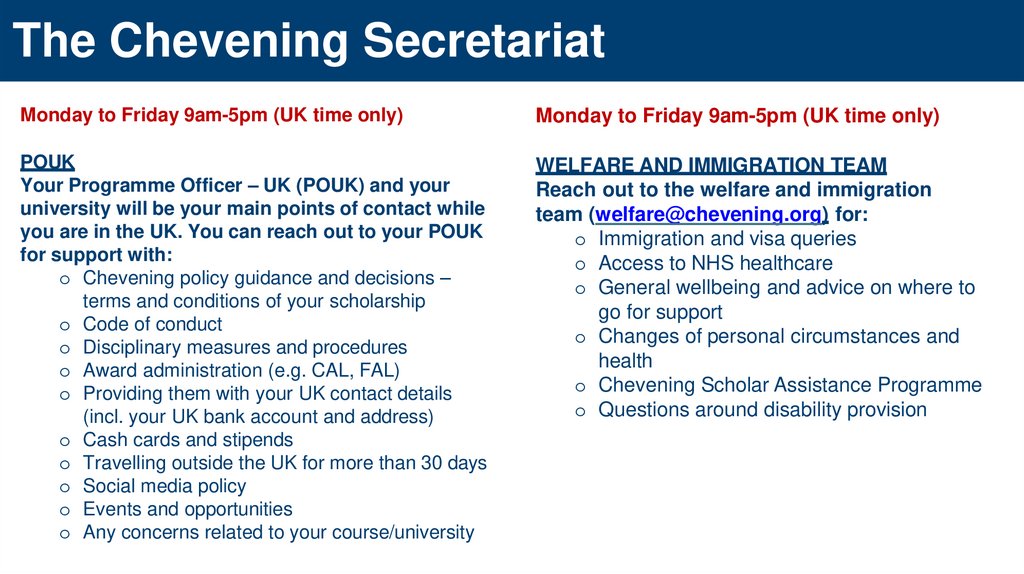
32. The Chevening Secretariat
Monday to Friday 9am-5pm (UK time only)Monday to Friday 9am-5pm (UK time only)
POUK
Your Programme Officer – UK (POUK) and your
university will be your main points of contact while
you are in the UK. You can reach out to your POUK
for support with:
o Chevening policy guidance and decisions –
terms and conditions of your scholarship
o Code of conduct
o Disciplinary measures and procedures
o Award administration (e.g. CAL, FAL)
o Providing them with your UK contact details
(incl. your UK bank account and address)
o Cash cards and stipends
o Travelling outside the UK for more than 30 days
o Social media policy
o Events and opportunities
o Any concerns related to your course/university
WELFARE AND IMMIGRATION TEAM
Reach out to the welfare and immigration
team (welfare@chevening.org) for:
o Immigration and visa queries
o Access to NHS healthcare
o General wellbeing and advice on where to
go for support
o Changes of personal circumstances and
health
o Chevening Scholar Assistance Programme
o Questions around disability provision
33. Your Chevening Officer at home
• Reach out to your in-country Chevening Officer to updatethem on your progress and any significant changes
during your time in the UK.
• Upon your return from the UK, ensure you inform them
and report any changes to your personal circumstances.
• Gentle reminder that you must return home for a period of
at least two years following the completion of your
scholarship.
• Once a Chevener, always a Chevener! Your Chevening
Officer is here to remind you that the end of your year in
the UK is not the end of your Chevening journey. Find out
how to stay involved as Chevening alumni.